1. Introduction
Plyometric training modalities are increasingly being integrated into the conditioning regimens of young soccer athletes, and several empirical studies have confirmed their effectiveness in increasing muscular strength and explosiveness, as well as improving sprinting and acceleration abilities [
1,
2,
3]. Adaptations induced by plyometric training improve muscle strength, dynamic stability, and neuromuscular coordination, and increase muscle contraction speed and tendon stiffness [
4,
5,
6]. The stretch–shortening cycle (SSC) plays a key role in both inducing and acquiring adaptations [
7]. Schmidtbleicher [
8] proposed a classification of SSC based on contraction speed into slow and fast types. Fast SSC is characterized by contraction times shorter than 0.25 s (e.g., drop jump), whereas slow SSC involves longer contraction times and greater angular changes (e.g., countermovement jump). The specific mechanisms underlying each SSC activity can be determined based on the requirements of the respective SSC task [
9]. The CMJ was used as a slow-SSC task reflecting longer-duration force production, the DJ as a fast-SSC task reflecting rapid ground-contact behavior [
8,
10], and the SJ as a concentric reference task used only for the EUR calculation.
While traditional monitoring often relies on gross output metrics such as Jump Height (JH) or Peak Power (PP), these indicators fail to isolate the movement’s underlying mechanical efficiency. Therefore, metrics such as the Eccentric Utilization Ratio (EUR) and the Reactive Strength Index (RSI) are used for a more nuanced assessment [
10,
11,
12]. The EUR quantifies the performance benefit derived from the SSC by comparing Countermovement Jump (CMJ) and Squat Jump (SJ) performance [
13]. Bobbert et al. [
14] attribute the superior performance of the CMJ over the SJ to the countermovement-induced active pre-contraction, which establishes substantial cross-bridge activity and force before concentric action, thereby improving muscle function at contraction onset. Because the CMJ reflects not only elastic energy storage and reuse (SSC) but also activation-dependent effects, it is an imperfect SSC model. Accordingly, EUR can provide a derived estimate of the performance benefit associated with the countermovement when CMJ is compared with SJ. However, because EUR is mathematically dependent on both CMJ and SJ performance, it should be interpreted alongside its component jump heights rather than as an isolated marker of SSC function. A subsequent study [
15] quantified joint-specific EUR and its relationship to whole-body EUR to better characterize jump neuromechanics and inform training, showing that knee SSC function is the primary determinant of overall SSC efficiency. In contrast, ankle and hip contributions are minor, if present.
Similarly, the RSI serves as a potent marker of sprint potential, providing a precise assessment of SSC for running compared to other tests [
16]. Previous research indicates that higher RSI and RSImod scores are associated with maximum sprint speed, more efficient agility and change of direction, greater eccentric braking forces, and greater horizontal deceleration, all of which are critical for elite soccer performance [
17,
18,
19,
20].
Growth and maturation influence SSC capability, with the RSI increasing over time, particularly in older, more mature youth athletes, and reflecting a distinct component of SSC function distinct from leg stiffness [
21]. In youth soccer, SSC-related drop jump and sprint parameters also differ across maturation groups classified by peak height velocity [
22]. Although position-specific physical demands are well established in adult soccer, the developmental trajectory of these characteristics in youth remains less clear [
23]. Existing evidence indicates that functional profiles do not differentiate significantly until later adolescence (U17–U19) [
24]. Therefore, mapping SSC indicators (e.g., EUR, RSI) across both age categories and positions is essential to understand when position-specific performance profiles truly emerge.
Current evidence in youth soccer is fragmented. Studies focused on growth and maturation show that SSC-related measures such as RSI and drop-jump performance change with age and maturity status, whereas position-based studies in youth soccer have largely examined broader anthropometric and general fitness characteristics rather than SSC-specific metrics [
21,
22,
24]. To our knowledge, studies integrating age category and playing position in male youth soccer remain scarce, and detailed profiling of SSC-specific outcomes derived from SJ, CMJ, and DJ has not been well characterized.
The aim of this study was twofold: first, to examine lower-body SSC indicators across chronological age categories in elite youth soccer players; and second, to compare these indicators across playing positions, including goalkeeper (GK), full-back (FB), center-back (CB), central midfielder (CM), winger (W), and forward (FW). It was hypothesized that older chronological age categories would show higher values in selected SSC-related outcomes, particularly RSI and jump height. Positional differences were expected to be smaller and more likely to emerge in older age categories, where positional specialization and role-specific loading are more established.
2. Materials and Methods
2.1. Participants
In this cross-sectional study, we included a convenience sample of 984 elite Slovak youth soccer players (U15–U19), comprising all eligible players available during the testing period. Participants were selected to ensure high-level training exposure and competition standards across all age categories. The U14 category was excluded from all analyses due to a methodological inconsistency in box height during DJ testing. The anthropometric characteristics of young soccer players, including height, weight, and age, stratified by age category, are presented in
Table 1. Participation in the study was contingent on active membership of the academies of the Slovak Football Association. Players were recruited from soccer academies across all regions of Slovakia, resulting in a geographically diverse multi-academy sample of elite youth soccer players. Players who were unable to participate in testing due to injury or were unable to perform at maximum effort in the SJ, CMJ, and DJ tests were excluded from the study.
Participants were assigned to their respective playing positions based on their regular roles during training and competition. The sample included goalkeepers (n = 115), full-backs (n = 161), center-backs (n = 170), wingers (n = 156), central midfielders (n = 248), and forwards (n = 134).
2.2. Ethics Committee
This study was part of a broader project approved by the institutional ethics committee (Approval No. 83/2025) and was conducted in accordance with the Declaration of Helsinki. The Ethics Committee waived the requirement for written informed consent because the data were anonymized and used for routine monitoring. Information about the study’s purpose, procedures, and risks was provided to players and their legal guardians by coaches and club officials. Participation was voluntary, and withdrawal was possible at any time without consequences. All players were familiar with the testing procedures as part of their regular training.
2.3. Sample Size Estimation and Justification
This study used a convenience sample of 984 elite youth soccer players recruited from multiple academy environments. As the data were collected within an organized testing setting, no a priori sample size calculation was performed. Because this was a convenience sample, inference was supported primarily by effect sizes, confidence intervals, and the consistency of observed patterns rather than by an a priori power target. To provide a benchmark for interpreting non-significant effects, an approximate post hoc sensitivity analysis was conducted for the primary factorial ANCOVA model. Assuming N = 984, α = 0.05, power = 0.80, and denominator df = 958, the analysis indicated sensitivity to detect small effects of approximately Cohen’s f = 0.11 for age category, f = 0.12 for playing position, and f = 0.14 for the Category × Position interaction, corresponding approximately to f2 = 0.011–0.020 and partial η2 = 0.011–0.019. Therefore, very small positional or interaction effects may remain statistically undetected or may have limited practical relevance.
2.4. Testing Procedures
The research was conducted from October to November during an ongoing competition among soccer academies, with each academy tested over the course of one day. Assessments of plyometric and jumping abilities were conducted indoors, with each soccer academy schedule typically allocated as follows: U15 from 10 AM to 11 AM, U16 from 11 AM to 12 PM, U17 from 12 PM to 1 PM, and U19 from 1 PM to 2 PM. These schedules were adapted according to the specific needs of each academy. The tests described here were part of a broader testing battery designed to evaluate speed, explosiveness, and strength, but only the plyometric and jumping tests were analyzed for this study. To minimize bias, all tests were conducted indoors by trained evaluators using identical test instructions across sessions. However, testing was performed across multiple academy environments. Therefore, exact surface hardness was not mechanically quantified, and the surface type could not be fully standardized across all sites. Players wore their usual training or indoor soccer footwear rather than a standardized shoe model. These factors are relevant particularly for DJ GCT and RSI interpretation and are therefore acknowledged as methodological constraints.
Before testing began, participants underwent a warm-up according to the RAMP protocol, lasting approximately 15 min. This protocol includes phases of body temperature increase, activation, mobilization, and potentiation [
25]. Initially, the procedural methodologies for the tests were articulated verbally to the participants, followed by a practical demonstration. This ensured that each participant had clear instructions and understood the required exercises. Each participant first completed one practice trial to become familiar with the procedure, followed by two attempts for each jump variant measured using the OptoJump Next (Microgate, Bolzano, Italy) photocell system [
26].
The first two plyometric performance tests included the SJ and CMJ. The participants performed both tests independently and kept their hands on their hips. For SJ, participants started from an approximately 90° flexed lower-limb position and were required to hold the bottom position for at least 2 s before take-off. Compliance with the required pause and starting position was monitored by trained testers through continuous visual inspection. Trials were repeated when a visible countermovement, premature take-off, hand movement, or clear deviation from the required starting position was observed. Nevertheless, because OptoJump does not provide force-time data, subtle pre-movement or loading deviations during SJ could not be quantified. For the CMJ, participants were allowed to self-select the depth of the countermovement and were instructed to jump as high and explosively as possible while keeping their hands on their hips. Because no force-time variables were recorded, it was not possible to determine whether individual execution strategies emphasized maximal force production, rate of force development, or movement coordination. There was a short break of approximately 10 s between each attempt. Between the two tests, players in the same category rested for approximately 2–3 min until everyone had completed their turn. The best results from the two attempts in each test were used in the analysis.
The DJ test was used to diagnose fast SSC. The drop jump test was conducted using a bilateral drop from a height of 39 cm. Each subject was given two trials with a 60 s rest interval between attempts, with the best trial being recorded. The directives provided to the participants specified that they should place their hands on their hips, step off the box, and execute a vertical jump to maximal height and speed, aiming to minimize GCT. Trials were invalidated if the participant did not land with both feet simultaneously between the photocells or if the jump did not meet the specified technical criteria. In these cases, participants were required to repeat the attempt at the end of the trial sequence.
2.5. Statistical Analyses
Statistical analyses were performed in JASP (version 0.95.4, Netherlands). Descriptive statistics are reported as mean, standard deviation, coefficient of variation, minimum, and maximum values. For each outcome (DJ RSI, DJ JH, DJ GCT, CMJ JH, SJ JH, and EUR), a factorial ANCOVA model was fitted with age category and playing position as fixed factors, including their interaction, and with height and weight entered as covariates (Type III sum of squares). The Category × Position interaction was used to assess whether positional differences varied across age categories.
Estimated marginal means (EMMs; adjusted means) with 95% confidence intervals were derived from the fitted models. Where an omnibus effect was statistically significant (p < 0.05), Tukey-adjusted pairwise comparisons were conducted on EMMs for the corresponding factor (e.g., age categories averaged across positions, or positions averaged across age categories).
For the applied positional profiling analysis, separate within-category ANCOVA models were conducted for each age group, with EMMs and Tukey-adjusted post hoc comparisons examined and reported when the omnibus positional effect was statistically significant.
Model assumptions were assessed using visual inspection of residual Q–Q plots, the Shapiro–Wilk test for residual normality, Levene’s test for homogeneity of variances across Category × Position cells, and covariate × factor interaction terms for homogeneity of regression slopes. Given the large sample size, formal normality tests were interpreted cautiously, and visual residual diagnostics were prioritized. Homogeneity of regression slopes was verified by adding covariate × factor interaction terms to each model (all
p > 0.10). Statistical significance was set at
p < 0.05. A post hoc sensitivity analysis quantifying the minimum detectable effect for the primary factorial model is reported in
Section 2.3 Sample Size Estimation. Conventional benchmarks for partial eta squared were used to aid interpretation (small ≈ 0.01, medium ≈ 0.06, and large ≈ 0.14) [
27].
3. Results
A total of 984 participants were included in the final analysis. Descriptive statistics (mean ± SD, coefficient of variation, and performance range) for CMJ JH, SJ JH, and DJ RSI across age categories are presented in
Table 2. Factorial ANCOVA (Category × Position) with height and weight as covariates showed significant main effects of age category for DJ RSI (ηp
2 = 0.090), DJ JH (ηp
2 = 0.112), CMJ JH (ηp
2 = 0.101), SJ JH (ηp
2 = 0.096), and DJ GCT (ηp
2 = 0.013;
p = 0.006). Shapiro–Wilk tests indicated deviations from normality in the ANCOVA residuals for DJ RSI, DJ GCT, CMJ JH, SJ JH, and EUR (all
p < 0.001), whereas DJ JH residuals did not differ significantly from normality (
p = 0.331). However, given the large sample size (
N = 984), these formal tests were expected to be sensitive to minor deviations. Visual inspection of residual Q–Q plots did not indicate substantial departures from normality likely to compromise model interpretation; therefore, parametric ANCOVA was retained. Levene’s tests indicated no substantial heterogeneity of variance for most outcomes; DJ JH showed possible heterogeneity depending on test specification and was therefore interpreted conservatively, with effect sizes and 95% confidence intervals emphasized alongside
p-values. The largest age-category effects were observed for DJ JH, CMJ JH, and SJ JH (ηp
2 = 0.096–0.112). In contrast, the age-category effect for DJ GCT was small, indicating limited practical magnitude despite statistical significance. Significant main effects of playing position were observed for DJ JH (ηp
2 = 0.019;
p = 0.002), CMJ JH (ηp
2 = 0.015;
p = 0.013), and SJ JH (ηp
2 = 0.015;
p = 0.012), whereas positional main effects were not significant for DJ RSI, DJ GCT, or EUR. However, because the Category × Position interaction was significant for DJ GCT (
p = 0.043, ηp
2 = 0.026), the main effect of age category for this outcome should be interpreted with caution. For EUR, Category, Position, and Category × Position effects were not significant (
p = 0.586,
p = 0.525, and
p = 0.991, respectively), and neither Height nor Weight showed a significant covariate effect. Detailed ANCOVA results are presented in
Table 3 and
Table 4.
Tukey-adjusted pairwise comparisons based on estimated marginal means (adjusted for height and weight and averaged across playing positions) indicated clear between-category differences for jump height and RSI outcomes. For DJ RSI and DJ JH, all pairwise age-category comparisons were significant. For CMJ and SJ JH, all pairwise differences were significant except U16 vs. U17. No Tukey post hoc comparisons were performed for EUR due to the non-significant omnibus age-category effect. Because the Category × Position interaction was significant for DJ GCT, this outcome was interpreted primarily in relation to the positional analyses.
The positional analyses (GK, FB, CB, CM, FW, and W) were conducted separately within each age category using ANCOVA models adjusted for height and weight. Overall, positional differences in the U15 to U17 categories were sporadic and largely non-significant, with only minor exceptions observed: in U15, DJ JH differed between positions (F = 2.380; p = 0.039; ηp2 = 0.049), and in U16, DJ GCT differed between positions (F = 2.599; p = 0.026; ηp2 = 0.047).
U19 was the only age category showing significant omnibus positional effects across multiple outcomes, including DJ RSI (F = 2.555;
p = 0.028; ηp
2 = 0.052), DJ GCT (F = 2.867;
p = 0.016; ηp
2 = 0.057), DJ JH (F = 4.698;
p < 0.001; ηp
2 = 0.091), CMJ JH (F = 2.639;
p = 0.024; ηp
2 = 0.053), and SJ JH (F = 2.507;
p = 0.031; ηp
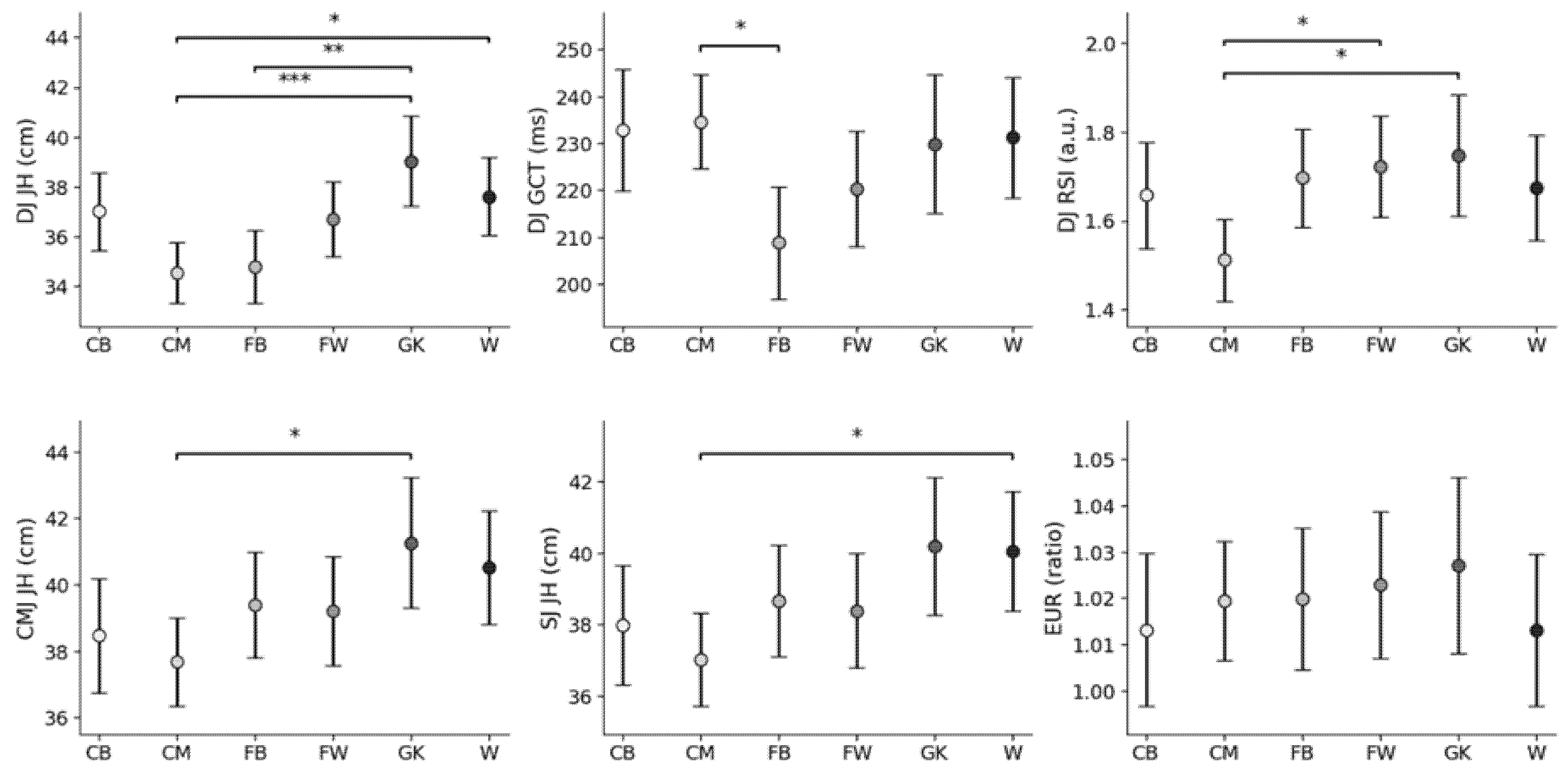
2 = 0.051), whereas EUR showed no significant positional differences. Adjusted estimated marginal means (95% CI) for each SSC indicator by playing position in U19 are presented in
Table 5 and visualized in
Figure 1.
When examining U19 positional differences in more detail using Tukey-adjusted post hoc comparisons on estimated marginal means, DJ RSI showed no pairwise differences that remained statistically significant after Tukey correction (the smallest adjusted p-values were for CM vs. FW and CM vs. GK, both p > 0.05). For DJ GCT, CM showed longer contact times than FB (p = 0.012). For DJ JH, GK exceeded CM (p = 0.002) and FB (p = 0.007), and W exceeded CM (p = 0.024). For CMJ JH, GK differed from CM (p = 0.049), and for SJ JH, W differed from CM (p = 0.045).
4. Discussion
This study examined the rapid and slow forms of the stretch–shortening cycle among elite young soccer players across the U19, U17, U16, and U15 categories. In this study, two SSC-based vertical jump tests (CMJ for slow SSC and DJ for fast SSC) were used, with the concentric-only SJ serving as the reference for the EUR calculation [
10,
11]. The main findings were that several SSC-related outcomes differed across chronological age categories, particularly DJ RSI, DJ JH, CMJ JH, and SJ JH. However, because biological maturity was not directly assessed, these age-category differences should not be interpreted as isolated effects of chronological age. Rather, they likely reflect a combined influence of maturation, body-size development, accumulated training exposure, and selection processes. EUR showed no statistically significant age-category or positional differences, suggesting limited sensitivity of this OptoJump-derived JH ratio in the present context rather than definitive evidence that EUR is physiologically stable. Positional differences were limited overall and were mainly confined to selected U19 jump-height and DJ GCT outcomes.
The findings indicate a general pattern of higher SSC-related performance in older chronological age categories for most outcomes. This pattern is biologically plausible, because growth and maturation are associated with increases in muscle mass, pennation angle, tendon stiffness, fascicle length, motor-unit recruitment efficiency, and pre-activation [
28]. These changes may improve SSC function through greater force production, altered muscle–tendon behavior, enhanced neural potentiation, and shorter electromechanical delay. However, these mechanisms should be interpreted as plausible maturational explanations rather than directly tested mechanisms in the present study. Without a direct maturity indicator, such as maturity offset or peak height velocity status, the observed age-category effects cannot be separated from biological maturation, training history, or selection-related differences. Beyond vertical jumping, the same neuromuscular qualities are recruited during sprint-relevant ground-contact actions: drop-jump RSI is associated with sprint-acceleration performance and step kinematics in field-sport athletes [
29], and jump-based power measures, including RSI, explain a meaningful proportion of variance in short-distance sprint times [
30]. The progressive between-category increase in DJ RSI observed here is therefore broadly consistent with the developing capacity for rapid, sprint-relevant explosive actions, although direct sprint measurements would be required to confirm this transfer in youth soccer players.
The absence of statistically significant EUR differences across age categories does not indicate, by itself, physiologically consistent SSC utilization across player ages. Previous research [
11] examined the EUR across various sports and found no significant differences among soccer, softball, and rugby. Significant differences between the pre-season and off-season were observed only in field hockey and rugby, and only for the EUR calculated from peak power and not jump height. In line with this, the present results indicate that EUR did not show statistically detectable differences across chronological age categories or playing positions. This should not be interpreted as proof that EUR is inherently stable as a physiological construct. A likely explanation is mathematical: because EUR is calculated as the ratio between CMJ and SJ performance, parallel increases in both jump types across age categories may conserve the ratio even when absolute jump performance improves substantially. A second explanation is methodological. OptoJump-derived SJ and CMJ outcomes do not provide force-time information and may not detect subtle pre-movement, loading, or execution deviations during SJ. Therefore, the null EUR finding more likely reflects limited sensitivity of this JH-based ratio in the present test configuration than definitive evidence that SSC utilization does not differ between players. Additionally, future investigations may benefit from applying allometric scaling of jump height and RSI to better account for the non-linear relationship between body mass and power-based performance during the rapid weight gain typical of the U15–U17 stages. In contrast, examination of RSI derived from GCT and JH in the Drop Jump test indicates that age categories significantly influence RSI scores within a cohort of young soccer athletes. While other authors observed only trivial differences in CMJ and RSI performance for Irish U17 and U19 female soccer players, our findings indicate meaningful differences across age categories in both slow SSC (CMJ) and fast SSC (DJ RSI) indicators, suggesting that reactive strength may vary considerably as players mature, potentially due to differences in developmental stage and training exposure [
31]. Notably, the performance values of our U17 group (CMJ JH: 36.5 cm; RSI: 1.54) and U19 group (CMJ JH: 39.2 cm; RSI: 1.65) presented in
Table 2 are highly comparable to the professional benchmarks (CMJ JH: 38 cm; RSI: 1.71) and generally superior in vertical output to the youth scholarship standards (CMJ JH: 35 cm; RSI: 1.59) recently established for the English Football League [
32]. Although direct comparisons should be interpreted with caution due to the different measurement systems used (OptoJump photocells in the current study vs. force plates [
32]), the consistency across these independent datasets reinforces the competitive physiological profiles of elite Slovak youth soccer players.
Across DJ variables, age-category differences were more pronounced for jump height than for ground contact time. This suggests that the factors captured by chronological age category—potentially including maturation, body-size development, training exposure, and selection—may be more strongly reflected in vertical output than in the ability to minimize ground contact time. However, because DJ performance was assessed without force-time variables, it is not possible to determine whether these differences resulted from greater force production, altered rate of force development, differences in jump strategy, or technical execution. The smaller effect size for DJ GCT compared with jump height therefore supports a cautious interpretation: older players jumped higher, but the ability to reduce ground contact time showed only limited age-category separation. This finding is strongly reinforced by Badby et al. [
32], who also reported that while kinetic output and jump height clearly discriminated between youth and professional levels, movement strategy metrics remained relatively stable, suggesting that neuromuscular ‘output’ matures earlier or to a greater extent than technical jumping ‘strategy’. Consequently, our findings may support placing greater emphasis on technical reactive-efficiency work in younger age categories, but this recommendation should be interpreted cautiously, as the present study was cross-sectional and did not test training interventions directly. In line with Ramirez-Campillo et al. [
33], who recommended reporting RSI together with its constituent components (e.g., jump height and ground contact time), we also support this approach in youth soccer, as it allows for a more precise interpretation of the magnitude and nature of performance changes across age categories. Given the reported associations between RSI and soccer-relevant performance qualities such as acceleration and change-of-direction ability, this targeted approach appears more justified than assuming that shorter contact times will emerge automatically with growth and general training exposure [
34].
The second part of the analysis focused on identifying differences among playing positions: goalkeepers (GK), full-backs (FB), center-backs (CB), central midfielders (CM), wingers (W), and forwards (FW). We then compared our results with existing research to determine the extent to which our findings aligned with previous studies. From a functional perspective, this positional comparison is highly relevant in SSC research, because different roles are exposed to distinct locomotor and mechanical demands during match-play, especially in relation to sprinting, accelerations, decelerations, and repeated high-intensity actions [
35,
36].
In elite adult Belgian soccer players, goalkeepers and central defenders had the highest jump heights, followed by strikers, who had higher values than central defenders and midfielders [
24]. In the oldest category, the observed pattern was broadly compatible with previous reports, with goalkeepers and some wide/offensive roles tending to show higher jump performance than central midfielders. However, these contrasts were not uniform across all outcomes. This interpretation is also broadly compatible with youth match-analysis data showing that wide players and attacking roles are typically exposed to greater sprint and high-speed running demands, whereas central defenders generally display the lowest high-speed outputs. Such role-specific loading may contribute to positional differences in SSC outcomes [
37], although the present data support this only indirectly, primarily for selected U19 outcomes. At the same time, tactical formation probably further shapes these position-specific loading patterns, as recent youth match-analysis studies indicate that it meaningfully alters running demands across roles, particularly the high-speed and sprint exposure of wide and attacking players [
38,
39].
In U15–U17, positional differences were small or absent, whereas the clearer separation observed in selected U19 outcomes may reflect a combination of more stable positional specialization, accumulated role-specific loading, training exposure, and prior selection processes. However, these interpretations remain tentative because global Category × Position interactions were not statistically significant across all outcomes. In U19, the clearest positional separation was observed for JH outcomes and DJ GCT characteristics, whereas positional separation for DJ RSI was not robust after multiple-comparison correction. This pattern is broadly compatible with the positional physical demands, given that the goalkeeper position in the soccer field places relatively low demands on aerobic energy metabolism, with its activities being predominantly oriented towards anaerobic performance, such as jumping and sprinting. In contrast, midfielders and defenders typically cover the greatest distance during a match. Boone et al. [
23] reported that midfielders have the second-highest VO2 max values, just after the extreme defenders. However, the authors did not differentiate between central and wide midfielders in their study, as we did in our analysis, which may have affected the results.
These findings suggest that position-specific profiling based on the present SSC tests has limited utility, even in the U19 category. Although selected U19 differences were observed, they were sparse and mainly involved jump-height outcomes and DJ GCT. In particular, DJ RSI showed a significant omnibus positional effect in U19, but no Tukey-adjusted pairwise position comparison remained statistically significant. Therefore, the present data do not strongly support broad position-specific SSC programming based solely on these tests. Instead, the findings support cautious individual profiling, with particular attention to isolated differences such as higher jump-height outcomes in goalkeepers or wingers relative to central midfielders and longer DJ GCT in central midfielders relative to full-backs. Given the large multi-academy sample of elite male Slovak youth players, the results offer valuable insights that may also be relevant to similar high-level youth soccer populations in other countries. However, their applicability to female athletes, non-elite players, or different soccer cultures should be explored in future research. From a programming perspective, these results support maintaining a broad SSC-development approach across youth categories, particularly because positional separation was weak or absent from U15 to U17. In older players, selected U19 differences may justify more individualized monitoring and cautious position-sensitive interpretation, but the current data do not provide strong evidence for highly differentiated position-specific SSC programs. This general progression is broadly consistent with Oliver et al. [
40], who support multicomponent development in youth players and highlight the need for greater training specificity when targeting maximal-speed qualities. Taken together with role-specific match-demand literature, the selected U19 findings may support cautious position-sensitive interpretation in older age categories. However, the present SSC tests alone do not provide sufficient evidence to prescribe strongly differentiated position-specific SSC programs. Moreover, because positional allocation in youth soccer may already be shaped by anthropometry, biological maturation, and selection-related biases, some of the positional differences observed in the oldest category may reflect not only role demands and accumulated training exposure but also prior selection processes [
41,
42].
Several methodological constraints should be considered when interpreting the findings. First, although all participants were elite academy players and were familiar with the testing procedures as part of regular monitoring, technical execution may still have varied between individuals and age categories. This is particularly relevant for SJ, where strict compliance with the required pause and absence of countermovement is difficult to verify using photocells alone. Second, detailed information on previous plyometric training exposure, training age, and recent training load was not available, which may have influenced reactive strength and jump-height outcomes. Third, the study relied on OptoJump-derived jump outcomes and did not include force-plate variables such as force, impulse, rate of force development, or eccentric braking characteristics. This limited the ability to explain whether age-category or positional differences reflected force production, movement strategy, technical execution, or SSC-specific mechanisms. Fourth, testing was conducted across multiple academy environments; exact surface hardness and footwear were not standardized, which may have affected DJ GCT and RSI. Finally, testing sessions were conducted at different times of the day across academies, which may have introduced circadian-related performance variability. These constraints limit mechanistic interpretation and direct comparison with force-plate studies, but they reflect the practical realities of large-scale academy testing.
A central limitation of this study is the absence of a direct biological maturity assessment, such as maturity offset or peak height velocity status. This is not only a methodological limitation but also a major interpretive confound, particularly across the U15–U17 categories, where players of the same chronological age may differ substantially in maturational status. Height and weight were included as covariates to account for part of the somatic variance associated with growth, but these variables are imperfect proxies and do not replace direct maturity assessment. Therefore, the present findings should be interpreted as body-size-adjusted differences in chronological age categories rather than as isolated effects of chronological age, biological maturation, or training exposure. In addition, detailed information on training age and prior exposure to systematic plyometric training was not available. As all participants were recruited from elite national academies, some degree of structured training exposure is likely, but its exact volume and quality could not be controlled and may also have contributed to the observed between-category differences. It should also be noted that in an academy cohort, the older age categories might be subject to de-selection effects: players who remain in the U19 cohort have already passed retention decisions that the U15 cohort has not yet faced. The observed age-category differences therefore reflect a combination of maturation, cumulative training exposure, and selection-related survivorship, which cannot be disentangled in a cross-sectional design.
5. Conclusions
This study showed differences in lower-body SSC indicators across chronological age categories in elite youth soccer players, with the most notable adjusted differences observed for DJ JH, CMJ JH, SJ JH, and DJ RSI. DJ GCT showed only a small age-category effect despite statistical significance. Because biological maturity was not directly assessed, these differences should be interpreted as body-size-adjusted chronological age-category differences that are likely confounded by maturation, training exposure, and selection processes.
EUR did not differ significantly across age categories or playing positions. This finding should be interpreted cautiously and does not demonstrate that EUR is inherently stable as a physiological construct. Rather, the lack of EUR differences may reflect the mathematical conservation of the CMJ/SJ ratio when both component jump heights increase in parallel, as well as the limited ability of OptoJump-based testing to detect subtle SJ execution deviations.
Positional differences were limited overall and were mainly evident in selected U19 outcomes. In U19, goalkeepers and wingers differed from central midfielders in selected jump-height outcomes, while central midfielders exhibited longer DJ GCT than full-backs. For DJ RSI, the U19 omnibus positional effect was small, and no Tukey-adjusted pairwise differences remained statistically significant, indicating limited practical positional separation for this metric.
From an applied perspective, the findings support broad SSC development and individual monitoring across youth categories rather than strong position-specific programming based solely on these tests. In older players, selected jump-height and DJ GCT differences may inform cautious position-sensitive interpretation, but future research should include direct maturity assessment, force-plate-derived variables, standardized surface and footwear conditions, detailed training-history data, and female cohorts to better clarify SSC development across youth soccer populations.