Article

Lumbar Compression During Dog Walking: Effects of Leash Tension and Trunk Posture Using a Static Musculoskeletal Model

by
Alexander T. Peebles
1,2,*,
Michael K. Bennett
1,
Samantha A. A. Morrison
2 and
Ji Chen
1,2
1
Department of Mechanical Engineering, University of the District of Columbia, Washington, DC 20008, USA
2
Biomedical Engineering Program, University of the District of Columbia, Washington, DC 20008, USA
*
Author to whom correspondence should be addressed.
Biomechanics 2026, 6(2), 57; https://doi.org/10.3390/biomechanics6020057
Submission received: 20 March 2026 / Revised: 19 May 2026 / Accepted: 27 May 2026 / Published: 2 June 2026
(This article belongs to the Section Injury Biomechanics and Rehabilitation)

Abstract

Background: Walking a dog on-leash is a common activity for a large portion of our society. Many dogs consistently pull on the leash, which transmits potentially dangerous forces to the human body. The purpose of this in silico study was to determine the effects of dog-leash tension and human posture on lumbar compression, and how comparable the effects of dog walking on lumbar compression are to lifting, an activity known to contribute to low back pain. Methods: Dog-leash simulations were performed with 50–300 N directed along the arm segment of a static three-dimensional musculoskeletal model across a range of trunk segment and shoulder joint angles. Lifting simulations were performed across a range of test postures with the model holding a 50–300 N weight close to the ground. Lumbar compression was computed for each simulation using McGill’s polynomial equation and compared with the 3400 N cutoff used to develop occupational safety guidelines. Results: Lumbar compression increased as trunk segment flexion increased for all simulation conditions. With 200 N of leash tension, lumbar compression exceeded 3400 N for all postures with 25° or more of trunk segment flexion. When lifting 150 N, lumbar compression exceeded 3400 N for all postures with shank segment angle of 80° or greater and knee flexion angle of 100° or less. Conclusions: Our in silico results suggest that dog owners should seek intervention if their dog routinely pulls on the leash with a force of 200 N or greater and should attempt to lean backward when resisting leash pulling to reduce lumbar compression and injury risk.

1. Introduction

Low back pain (LBP) is a leading cause of disability among middle and older-age adults [1], which disrupts activities of daily living and results in significant financial impact through healthcare costs and pain-related work absences [2]. LBP can often be attributed to vertebral disk injuries within the lumbar spine, such as disk herniation, end plate fracture, and nerve irritation [3,4]. While lumbar disk injuries can happen acutely in response to compressive stress exceeding the ultimate strength of the tissue, they typically develop progressively through fatigue failure [5]. The National Institute for Occupational Safety and Health (NIOSH) considered lumbar compression to be the critical stress factor when developing occupational safety guidelines for LBP prevention [6]. Further, NIOSH believes lumbar compression is a good predictor of overexertion injuries in general, as a large portion of lumbar compression is created through force produced by the erector spinae musculature [6]. While NIOSH considers the maximum permissible limit of lumbar compressive force to be 6377 N, they developed lifting guidelines around avoiding compressive forces greater than 3400 N based on cadaver and retrospective LBP occupational lifting studies [6,7]. It is crucial that we identify common daily life activities that place large amounts of compressive stress on the lumbar spine, such that appropriate guidelines and interventions can be established to reduce the incidence of LBP throughout society.
Occupations that require frequent or heavy lifting tasks have a high incidence of LBP [8,9], which motivated ergonomics research to understand the relationship between lifting biomechanics and lumbar injury. Early computational biomechanics studies employed static musculoskeletal models to investigate the effects of lifting magnitude and posture on compressive stress of the lumbar spine [10,11]. This computational literature was later supported by numerous experimental studies [12,13] and helped form essential occupational lifting guidelines. For example, NIOSH warns against lifting with limited knee flexion and increased trunk flexion, as it is known to increase compressive stress on the lumbar spine [14]. Instead of this ‘stoop posture’, it is recommended to lift with a ‘squat posture’ where trunk flexion is decreased, and knee flexion increased [15,16]. NIOSH also published a lifting equation that recommends how much weight is safe for workers to lift without increasing their risk of developing LBP, based on the 3400 N cutoff threshold for lumbar compression [6,14]. The equation starts with a base load recommendation of 23 kg (226 N at rest), which decreases as the load moves further from the body, lower to the floor, or is positioned asymmetrically [6,14].
A large portion of our society lives with a dog and takes them on frequent walks on-leash [17]. Some dogs are not well-trained and consistently pull on the leash during walks, which can transmit large forces to the human musculoskeletal system. As dog leashes are typically held in the hand, we expect that leash tension forces applied in the anterior direction will produce an external flexion moment on the human trunk similar to that of lifting. A recent study estimated that 32,306 people in the United States went to an emergency room in 2020 with an injury they sustained while walking their dog [18]. The authors found that 44.8% of injuries resulted directly from forces transmitted to the human through leash pulling, rather than from an accidental fall [18]. While the upper extremities were the most common injury location (50.6%), injuries within the lower extremities (19.5%) and torso (14.9%) were also common [18]. Along with acute traumatic injuries that bring dog-walkers to an emergency room, repetitive exposure to leash tension could contribute to wear and tear of passive joint structures.
Our group recently used a custom system to simultaneously measure leash tension and waist acceleration while 20 participants took their dog on a single routine walk around their neighborhood [19]. The population median for peak leash tension measured during periods of gait was 125 N, with the maximum force recorded during the study being 413 N. Based on this data, we believe dog leash pulling can contribute to repetitive stress injuries of the lumbar spine and that investigations on the effects of dog walking on lumbar mechanics are warranted. Here, we employ an in silico computational modeling approach for a first step in understanding the exclusive effects of leash tension and posture on lumbar compression. A computational approach offers a distinct advantage of being able to assess lumbar compression across a wide range of postures and loading conditions, which could be harmful for the human body. Lumbar compression was computed using McGill’s polynomial, which was developed with a detailed musculoskeletal model of the lumbar spine and an electromyography-driven optimization procedure [20]. McGill’s polynomial is used to compute lumbar compression for symmetric and asymmetric tasks as a function of three-dimensional lumbar joint reaction moments [20]. The objective of this study was to understand the effects of posture and dog-leash tension on lumbar compression, and to compare the effects of dog-leash tension and lifting on lumbar compression. We specifically sought to determine postures and leash tension magnitudes that increase lumbar compressive forces above 3400 N, which is the threshold used by NIOSH in developing lifting safety guidelines, and 6377 N, which is considered the maximum permissible limit of lumbar compression [6].

2. Materials and Methods

A static rigid-link musculoskeletal model was implemented and analyzed using a custom MATLAB program (MATLAB R2025a, The MathWorks, Inc., Natick, MA, USA). The source code is provided in Supplementary File S1. Through neglecting inertial forces, static models are known to underestimate joint kinetic outcomes for lifting movements [12,13]. However, static models have been widely used to determine the exclusive effects of posture and load on joint kinetics during lifting by reducing the models’ degrees of freedom [15]. Our model consisted of eleven segments (two feet, two shanks, two thighs, one pelvis, one trunk, one head, two arms) with segment anthropometrics estimated based on existing regression [21] for the 50th percentile adult female with a height of 1.6 m and weight of 64 kg [7]. Three-dimensional moments were computed at the L5S1 joint using a top-down approach, considering the weight of the trunk, head, arm(s), and the applied load. Three-dimensional lumbar moments were resolved into the trunk local coordinate system and used to estimate lumbar compression using McGill’s polynomial, which takes lumbar flexion, bending, and twisting moments as inputs [20]. McGill’s polynomial equation was developed using regression analysis with experimental data of subjects performing symmetric and asymmetric three-dimensional lifting, pushing, and pulling tasks [20]. McGill used a detailed biomechanical model of the lumbar spine, which includes 90 muscle fascicles and an electromyography-assisted optimization procedure to compute lumbar compression while accounting for antagonist co-activation [20]. There are several approaches for computing lumbar compression; however, many were not suited for this study as they were developed specifically for symmetric lifting tasks and assume load is applied in the vertical direction only [22,23,24]. Recent work has shown that McGill’s polynomial agrees well with in vivo measurements of intradiscal pressure and other biomechanical modeling tools, such as OpenSim, AnyBody, and 3DSSPP [25,26].
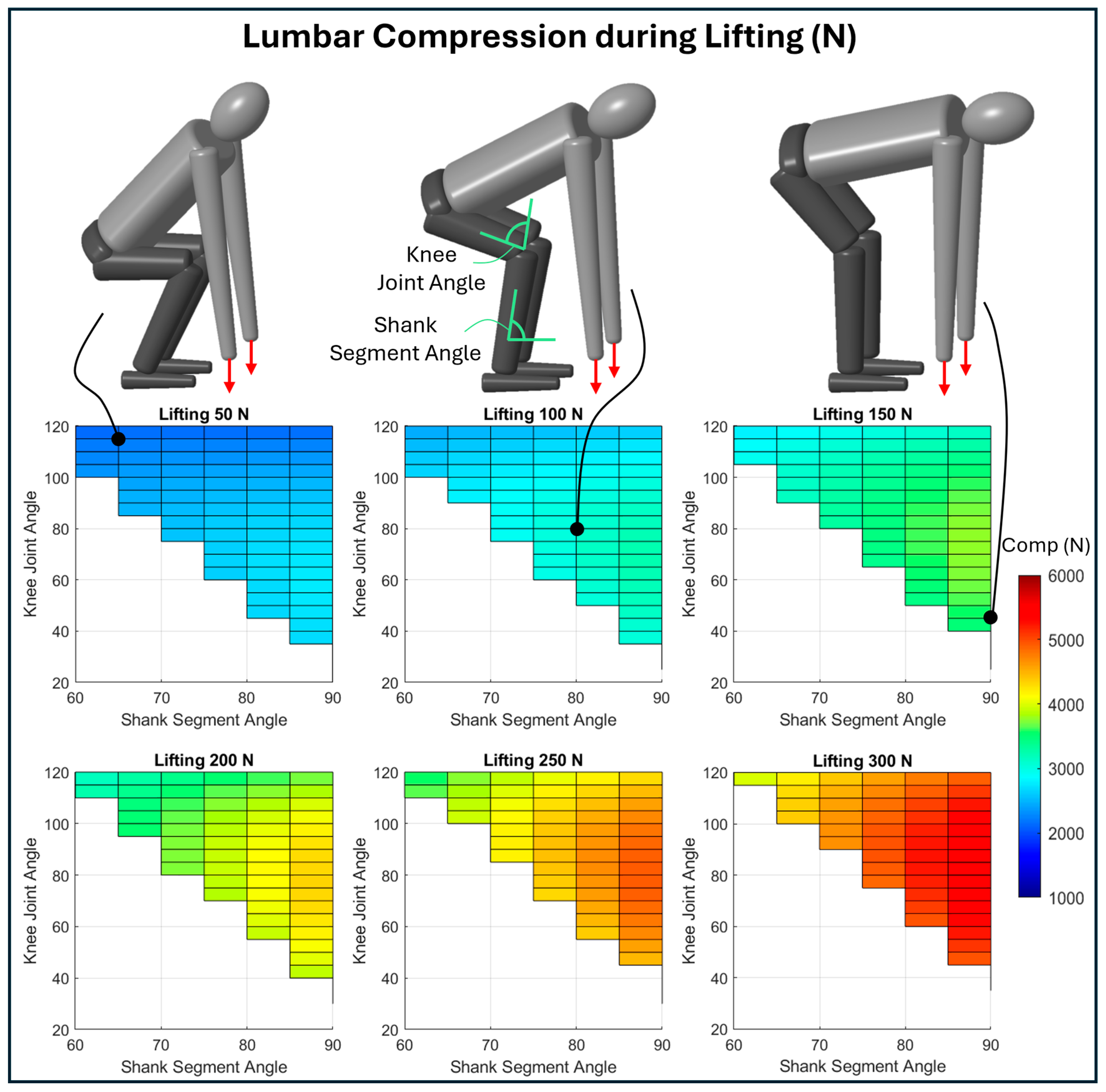
Lifting simulations were conducted with the model supporting a load just off the ground. The load was assumed to be 30 cm anterior to the ankle and 10 cm vertical from the floor, consistent with the previous literature [16]. Load magnitudes of 50, 100, 150, 200, 250, and 300 N were applied to the distal end of the arm segment in the vertical direction, shared equally between the two arms. Lifting is a closed-chain task that restricts degrees of freedom. We assumed that the foot remained flat on the ground, the pelvis, trunk, and head segments were aligned, and that leg and arm segments were symmetric with no abduction or rotation, which reduced the model to four angular degrees of freedom of flexion about the ankle, knee, hip, and shoulder joints. With the distal end of the arm segment fixed at the load location, the model is reduced to two degrees of freedom. A total of 175 lifting simulations were performed for each load condition across shank segment angles of 60° to 90° and knee joint angles of 0° to 120°, both in increments of 5°. For each shank segment and knee joint angle combination, the trunk and arm segment angles that result in the distal end of the arm segment being in contact with the load location were computed. Lifting simulations were excluded from analysis if the model’s center of mass was outside its base of support or if the shoulder angle was in extension or more than 180° of flexion.
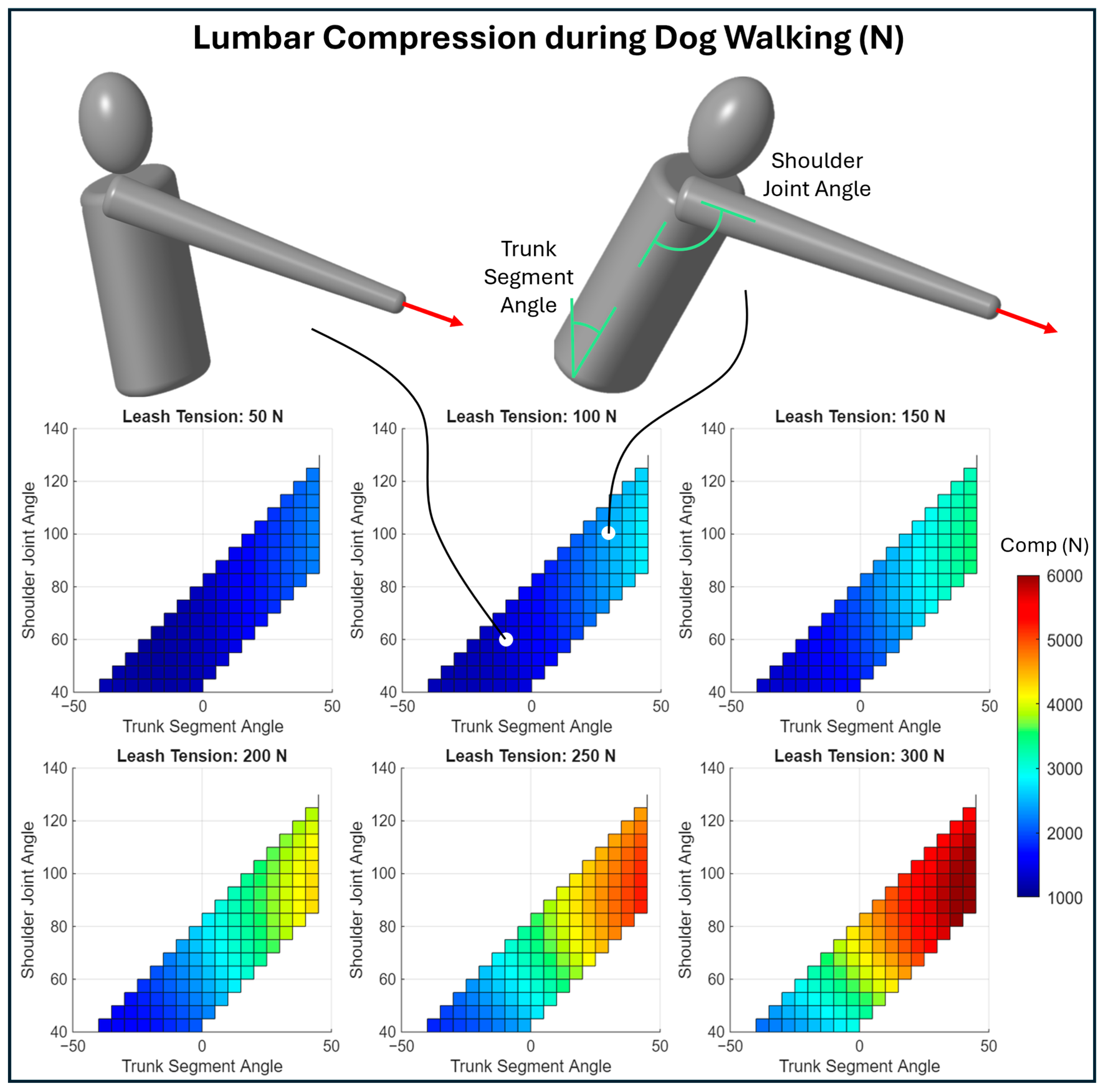
Dog-leash simulations were conducted through a range of test postures and leash tension magnitudes. For comparison with lifting, leash tension magnitudes of 50, 100, 150, 200, 250, and 300 N were applied to the distal end of the right arm segment and oriented distally along the arm segment. We assumed that the head and trunk segment were aligned and that there was no shoulder abduction or rotation, which reduced the model to two degrees of freedom above the lumbar joint. Trunk segment angles were varied from 45° to −45° and shoulder joint flexion angles from 40° to 160°, both in increments of 5°, resulting in a total of 475 test postures for each load condition. Postures that resulted in the leash being directed upward or more than 50° downwards were excluded as we believed them to be not realistic.

3. Results

Lumbar compression for all lifting simulations is visually represented with 2D colormaps in Figure 1. With an applied load of 150 N, lumbar compression exceeded 3400 N for all postures with shank segment angle of 80° or greater and knee flexion angle of 100° or less, peaking at 3909 N. Lumbar compression remained below 3400 for applied loads of 50 and 100 N across all postures evaluated. With an applied load of 300 N, the maximum lumbar compression was 5832 N. For each loading condition, lumbar compression increased as shank segment angle increased and knee flexion decreased.
Lumbar compression for all dog walking simulations is visually represented with 2D colormaps in Figure 2. With an applied load of 150 N, lumbar compression exceeded 3400 N with 45° of trunk flexion and shoulder flexion angles of 100° or less. With an applied load of 200 N, lumbar compression exceeded 3400 N for all postures with 25° or more of trunk segment flexion. With an applied load of 300 N, the maximum lumbar compression reached 6238 N. For each loading condition, lumbar compression increased as the trunk segment rotated forward and decreased as the trunk segment rotated backward.

4. Discussion

A large portion of our society lives with one or more dogs and takes their dog on routine walks using a leash. When a dog pulls the leash in response to a stimulus (e.g., squirrel or other dog), large and potentially dangerous forces can be transmitted to the human musculoskeletal system. We believe that frequent exposure to dog leash pulling can contribute to the development and progression of chronic pain conditions, such as LBP, dependent on the magnitude of force applied and the posture in which forces are resisted. There is currently a paucity of research examining the impact that dog-leash pulling has on human health, with no medical guidelines or regulations to reduce the incidence of dog-walking injuries. This study employed a static three-dimensional musculoskeletal model to determine the impact that dog-leash tension forces can have on lumbar joint compression throughout a range of test postures and leash tension conditions. The primary findings of this in silico study suggest that leash tension forces of 200 N or greater result in lumbar compression to exceed occupational safety recommendations. This work also suggests that dog owners should lean backward when resisting a dog pulling on their leash to reduce lumbar compression.
The lifting simulation results found that loads of 150 N cause lumbar compression to exceed the 3400 N threshold for stoop and semi-squat postures. These results agree quite well with the NIOSH Lifting Equation, which with the load location equating to horizontal and vertical multipliers of 0.83 and 0.81, results in a maximum load of 152 N [14]. Our computational study used a static skeletal model to compute 3D joint moments of the lumbar spine across different postures and loading conditions, which were inputs to a validated regression model used to estimate lumbar compression for each condition. The magnitudes of lumbar compression observed during lifting also agree with prior experimental studies that employed a similar lifting task. Khoddam-Khorasani et al. [27] collected in vivo kinematics data of participants holding a 180 N load with their trunk flexed to 40° and 65°, then employed a finite-element-based musculoskeletal model to compute lumbar compression. The authors found lumbar compression was about 3500 N with 40° of trunk flexion and about 4500 N with 65° of trunk flexion. Von Arx et al. [16] used a detailed musculoskeletal model with global optimization to compute lumbar compression while participants lifted a 23 kg load (~225 N). The authors found peak compressive forces of about five times bodyweight, which, when considering their participants had an average bodyweight of 71.7 kg, equates to about 3500 N of compression. Dreischarf et al. [28] measured in vivo lumbar compressive forces in four patients who had instrumented vertebral body replacements, finding maximum compression forces ranging from about 1100 to 1650 N when patients lifted about 100 N. The similarities between our simulation results and prior experimental reports of lumbar compression support the accuracy of the computational model employed in the present study.
The dog walking simulation results suggest that lumbar compressive forces can exceed this 3400 N threshold with leash tension force of 200 N or greater and trunk segment flexion of 25° or greater. With 300 N of leash tension, lumbar compression reached 6238 N with 45° of trunk segment flexion, which is close to the maximum permissible limit of 6377 N as outlined by NIOSH [14]. Our recent experimental study measured leash tension while participants took their dog on one routine walk [19]. Half of the studies, 20 participants recorded peak leash forces of 125 N or more, and a quarter of the participants recorded peak forces of 200 N or greater. The largest force measured during the study was 413 N. Taken together, these results suggest that some dog owners routinely experience leash tension forces that can harm their lower back, especially if restrained with poor posture. Based on the current findings, we recommend that individuals who routinely experience leash tension forces of 200 N or greater seek intervention to decrease the pulling forces transmitted to their musculoskeletal system, such as attending dog obedience training, purchasing a no-pull harness, or using a bungee leash designed to soften sharp pulling events.
Our dog walking simulation results found that lumbar compression is high for postures where the trunk is flexed anteriorly and can be reduced for postures where the trunk is tilted posteriorly. When the trunk is tilted posteriorly, its weight produces a positive moment about the lumbar joints, which balances out the negative moment caused by leash tension. Similar findings were observed for lifting, but to a lesser extent, because lifting is a closed-chain movement where some trunk flexion is required. Often referred to as a ‘stoop lifting posture’, low ankle dorsiflexion and low knee flexion require increased hip flexion, which increases lumbar extension moment and compression. Alternatively, a ‘squat lifting posture’ with increased ankle dorsiflexion and knee flexion allows for the trunk to be kept more upright and reduces lumbar kinetic outcomes. The impact of lifting posture on lumbar kinetics has been frequently discussed in the literature [15,16] and occupational safety guidelines [14]. Based on the findings of the present study, we recommend that dog owners attempt to lean backward when their dog pulls on the leash to reduce compressive forces within the lumbar spine.
The musculoskeletal model employed in this study made several assumptions that should be considered when interpreting the findings. First, we assumed that posture was static for both tasks. Static models are known to underestimate lumbar kinetics when lifting an object upwards, as inertial forces effectively increase the weight of the object and body segments [13]. It is possible that the static model could overestimate lumbar kinetic outcomes for dog-leash simulations if the trunk were accelerating in the same direction as the leash force vector. Second, our results inherit limitations from the McGill polynomial used for lumbar compression calculations. Specifically, the McGill polynomial was developed using electromyography-driven optimization, which was measured for surface muscles only and required normalization of electromyography signals to maximal voluntary contractions [20]. Finally, because McGill’s polynomial was derived from regression modeling, its validity is limited to the range of conditions used in its development, and increased error is expected at both low and high levels of task demand [26]. Nonetheless, McGill’s polynomial has been externally validated [25,26] and was well-suited for the objective of the present study. Future work should collect experimental data of human subjects resisting leash pulling and use musculoskeletal modeling software with detailed subject-specific geometries and advanced optimization techniques for estimating both compression and shear forces throughout the lumbar spine.

5. Conclusions

In conclusion, this in silico study found that dog-leash tension forces of 200 N or greater with 25° or more trunk segment flexion can result in lumbar compressive forces that exceed the 3400 N cutoff used by NIOSH in their occupational safety guidelines [6]. In conjunction with our recent experimental study that measured leash tension during routine bouts of dog-walking [19], this computational study supports the theory that some dog owners routinely experience unsafe musculoskeletal loading conditions while walking their dog. The results of this in silico study suggest that dog owners who routinely experience pulling forces of 200 N or greater should seek intervention to limit pulling behavior. Further, dog owners should attempt to lean backward when experiencing leash pulling while walking their dogs. Future experimental research in this area is needed to help develop safety regulations for this common activity.

Supplementary Materials

The following supporting information can be downloaded at: https://www.mdpi.com/article/10.3390/biomechanics6020057/s1, Supplementary File S1. Custom MATLAB code used for implementation and analysis of the static rigid-link musculoskeletal model described in this study.

Author Contributions

Conceptualization, A.T.P.; methodology, A.T.P. and J.C.; software, A.T.P.; investigation, A.T.P., M.K.B. and S.A.A.M.; writing—original draft preparation, A.T.P.; writing—review and editing, M.K.B., S.A.A.M. and J.C. All authors have read and agreed to the published version of the manuscript.

Funding

This research was supported by the District of Columbia Space Grant Consortium, National Aeronautics and Space Administration (grant number 80NSSC24K1626), and the National Institutes of Health (grant number R25AG067896).

Institutional Review Board Statement

Not applicable.

Data Availability Statement

The original contributions presented in this study are included in the Supplementary Materials. Further inquiries can be directed to the corresponding author.

Conflicts of Interest

The authors declare no conflicts of interest.

Abbreviations

The following abbreviations are used in this manuscript:
LBPLow back pain
NIOSHNational Institute for Occupational Safety and Health

References

  1. Wu, A.; March, L.; Zheng, X.; Huang, J.; Wang, X.; Zhao, J.; Blyth, F.M.; Smith, E.; Buchbinder, R.; Hoy, D. Global Low Back Pain Prevalence and Years Lived with Disability from 1990 to 2017: Estimates from the Global Burden of Disease Study 2017. Ann. Transl. Med. 2020, 8, 299. [Google Scholar] [CrossRef] [Scilit]
  2. Henschke, N.; Kamper, S.J.; Maher, C.G. The Epidemiology and Economic Consequences of Pain. Mayo Clin. Proc. 2015, 90, 139–147. [Google Scholar] [CrossRef] [Scilit]
  3. Fields, A.J.; Liebenberg, E.C.; Lotz, J.C. Innervation of Pathologies in the Lumbar Vertebral End Plate and Intervertebral Disc. Spine J. 2014, 14, 513–521. [Google Scholar] [CrossRef] [Scilit]
  4. Lotz, J.C.; Fields, A.J.; Liebenberg, E.C. The Role of the Vertebral End Plate in Low Back Pain. Glob. Spine J. 2013, 3, 153–163. [Google Scholar] [CrossRef] [Scilit]
  5. Gallagher, S.; Heberger, J.R. Examining the Interaction of Force and Repetition on Musculoskeletal Disorder Risk. Hum. Factors J. Hum. Factors Ergon. Soc. 2013, 55, 108–124. [Google Scholar] [CrossRef] [Scilit]
  6. Waters, T.R.; Putz-Anderson, V.; Garg, A.; Fine, L.J. Revised NIOSH Equation for the Design and Evaluation of Manual Lifting Tasks. Ergonomics 1993, 36, 749–776. [Google Scholar] [CrossRef] [Scilit]
  7. The National Institute for Occupational Safety and Health. NIOSH Work Practices Guide for Manual Lifting; The National Institute for Occupational Safety and Health: Washington, DC, USA, 1981.
  8. Hoogendoorn, W.E.; Bongers, P.M.; de Vet, H.C.W.; Doewes, M.; Koes, B.W.; Miedema, M.C.; Arients, G.A.M.; Bouter, L.M. Flexion and Rotation of the Trunk and Lifting at Work Are Risk Factors for Low Back Pain. Spine 2000, 25, 3087–3092. [Google Scholar] [CrossRef] [Scilit]
  9. Wai, E.K.; Roffey, D.M.; Bishop, P.; Kwon, B.K.; Dagenais, S. Causal Assessment of Occupational Lifting and Low Back Pain: Results of a Systematic Review. Spine J. 2010, 10, 554–566. [Google Scholar] [CrossRef] [Scilit]
  10. Anderson, C.K.; Chaffin, D.B.; Herrin, G.D.; Matthews, L.S. A Biomechanical Model of the Lumbosacral Joint during Lifting Activities. J. Biomech. 1985, 18, 571–584. [Google Scholar] [CrossRef] [Scilit]
  11. Chaffin, D.B. A Computerized Biomechanical Model—Development of and Use in Studying Gross Body Actions. J. Biomech. 1969, 2, 429–441. [Google Scholar] [CrossRef] [Scilit]
  12. Garg, A.; Chaffin, D.B.; Freivalds, A. Biomechanical Stresses from Manual Load Lifting: A Static vs Dynamic Evaluation. A I I E Trans. 1982, 14, 272–281. [Google Scholar] [CrossRef] [Scilit]
  13. McGill, S.M.; Norman, R.W. Dynamically and Statically Determined Low Back Moments during Lifting. J. Biomech. 1985, 18, 877–885. [Google Scholar] [CrossRef] [Scilit]
  14. Waters, T.R.; Putz–Anderson, V.; Garg, A. Applications Manual for the Revised NIOSH Lifting Equation; The National Institute for Occupational Safety and Health: Washington, DC, USA, 2021.
  15. Van Dieën, J.H.; Van Hoozemans, M.J.M.; Van Toussaint, H.M. A Review of Biomechanical Studies on Stoop and Squat Lifting. Proc. Hum. Factors Ergon. Soc. Annu. Meet. 2000, 44, 643–646. [Google Scholar] [CrossRef] [Scilit]
  16. von Arx, M.; Liechti, M.; Connolly, L.; Bangerter, C.; Meier, M.L.; Schmid, S. From Stoop to Squat: A Comprehensive Analysis of Lumbar Loading Among Different Lifting Styles. Front. Bioeng. Biotechnol. 2021, 9, 769117. [Google Scholar] [CrossRef] [Scilit]
  17. Applebaum, J.W.; Peek, C.W.; Zsembik, B.A. Examining U.S. Pet Ownership Using the General Social Survey. Soc. Sci. J. 2023, 60, 110–119. [Google Scholar] [CrossRef] [Scilit]
  18. Maxson, R.; Leland, C.R.; McFarland, E.G.; Lu, J.; Meshram, P.; Jones, V.C. Epidemiology of Dog Walking–Related Injuries among Adults Presenting to US Emergency Departments, 2001–2020. Med. Sci. Sports Exerc. 2023, 55, 1577–1583. [Google Scholar] [CrossRef] [Scilit]
  19. Peebles, A.; Bennett, M.; Morrison, S.; Ramirez-Reyes, J.; Chen, J.; Thompson, L. Assessment of Dog-Leash Pulling Force and the Impact of Dog-Walking on Gait Kinematics. Ann. Biomed. Eng. 2025, 54, 1482–1493. [Google Scholar] [CrossRef] [Scilit]
  20. McGill, S.M.; Norman, R.W.; Cholewicki, J. A Simple Polynomial That Predicts Low-Back Compression during Complex 3-D Tasks. Ergonomics 1996, 39, 1107–1118. [Google Scholar] [CrossRef] [Scilit]
  21. Robertson, D.G.; Caldwell, G.E.; Hamill, J.; Kamen, G.; Whittlesey, S. Research Methods in Biomechanics; Human Kinetics: Champaign, IL, USA, 2013. [Google Scholar]
  22. Potvin, J.R. Use of NIOSH Equation Inputs to Calculate Lumbosacral Compression Forces. Ergonomics 1997, 40, 691–707. [Google Scholar] [CrossRef] [Scilit]
  23. Merryweather, A.S.; Loertscher, M.C.; Bloswick, D.S. A Revised Back Compressive Force Estimation Model for Ergonomic Evaluation of Lifting Tasks. Work 2009, 34, 263–272. [Google Scholar] [CrossRef] [Scilit]
  24. Arjmand, N.; Plamondon, A.; Shirazi-Adl, A.; Larivière, C.; Parnianpour, M. Predictive Equations to Estimate Spinal Loads in Symmetric Lifting Tasks. J. Biomech. 2011, 44, 84–91. [Google Scholar] [CrossRef] [Scilit]
  25. Ghezelbash, F.; Shirazi-Adl, A.; Plamondon, A.; Arjmand, N. Comparison of Different Lifting Analysis Tools in Estimating Lower Spinal Loads—Evaluation of NIOSH Criterion. J. Biomech. 2020, 112, 110024. [Google Scholar] [CrossRef] [Scilit]
  26. Rajaee, M.A.; Arjmand, N.; Shirazi-Adl, A.; Plamondon, A.; Schmidt, H. Comparative Evaluation of Six Quantitative Lifting Tools to Estimate Spine Loads during Static Activities. Appl. Ergon. 2015, 48, 22–32. [Google Scholar] [CrossRef] [Scilit]
  27. Khoddam-Khorasani, P.; Arjmand, N.; Shirazi-Adl, A. Effect of Changes in the Lumbar Posture in Lifting on Trunk Muscle and Spinal Loads: A Combined in Vivo, Musculoskeletal, and Finite Element Model Study. J. Biomech. 2020, 104, 109728. [Google Scholar] [CrossRef] [Scilit]
  28. Dreischarf, M.; Rohlmann, A.; Graichen, F.; Bergmann, G.; Schmidt, H. In Vivo Loads on a Vertebral Body Replacement during Different Lifting Techniques. J. Biomech. 2016, 49, 890–895. [Google Scholar] [CrossRef] [Scilit]
Figure 1. Lumbar compression for lifting simulations across all test loads (different plots) and postures. Note that three representative postures are shown with black dots indicating their location on each graph. The red arrows portray the location and direction of lifting load applied.
Biomechanics 06 00057 g001
Figure 2. Lumbar compression for dog walking simulations across all test loads (different plots) and postures. Note that two representative postures are shown with white dots indicating their location on each graph. The red arrows portray the location and direction of dog-leash load applied.
Biomechanics 06 00057 g002
Disclaimer/Publisher’s Note: The statements, opinions and data contained in all publications are solely those of the individual author(s) and contributor(s) and not of MDPI and/or the editor(s). MDPI and/or the editor(s) disclaim responsibility for any injury to people or property resulting from any ideas, methods, instructions or products referred to in the content.