1. Introduction
Bone is a mechanosensitive tissue that continually adjusts its mass and structure in response to external loading and metabolic demands; this process is termed
bone adaptation (BA) [
1,
2,
3]. This adaptive behaviour occurs through bone remodelling, with cellular activities that sense mechanical stimuli and coordinate biochemical signalling to regulate tissue formation, maintenance, and resorption [
3,
4,
5]. Recent reviews further clarified that osteocyte mechanotransduction involved multiple coupled mechanisms, including cell deformation, fluid-flow-induced shear, integrin-based focal adhesion, primary cilia, connexin signalling and cytoskeletal responses [
4,
5]. These developments support the view that bone remodelling is not governed by a single scalar mechanical quantity alone, but by spatially distributed mechanobiological signals [
4,
5,
6].
In adults, BA mainly takes place in trabecular bone (TB), the porous tissue inside long bones. TB has a microarchitecture of interconnected trabeculae with a high surface-to-volume ratio, supporting cellular activity, and load-induced fluid movement. Compared with cortical bone, trabecular bone generally exhibits higher remodelling activity because of its much higher surface-to-volume ratio; commonly cited turnover values are on the order of 20–30% per year for trabecular bone and about 2–3% per year for cortical bone, although these values are strongly site-dependent [
7]. Although TB has a relatively low density, bone adaptation within TB can generate morphologies that efficiently carry external loads, enabling effective use of limited bone mass together with cortical bone [
8].
Owing to the frequent biochemical activity within the trabecular-bone (TB) network and its load-adapted microarchitecture, TB provides accessible and structurally diverse samples for investigating trabecular morphology and its underlying formation mechanisms.
Early studies established the principle of BA at the organ level. Julius Wolff first introduced the fundamental concept that the internal structure of bone aligns with mechanical loads [
9]. Frost’s mechanostat theories provided a biological explanation for the mass regulation of bone by defining stimuli thresholds for bone formation or resorption, with a so called “lazy zone” near homeostasis [
10,
11,
12]. Finite-element (FE) BA models then formalised these ideas. Huiskes et al. [
13] developed an FE-based BA model that treated a whole bone as a continuum material with spatially variable density. Weinans et al. [
14] developed an FE model of 2D proximal femur with a discontinuous trabecular structure, predicting a distribution of trabecular density. Such continuum models typically used a mechanical stimulus such as strain-energy density (SED) or stress as the driver of remodelling, and they assumed that the bone’s biological response was to normalise that stimulus. Recent reviews of FE-based schemes show that these approaches are still central to bone mechanoadaptation modelling but also emphasise that model predictions depend strongly on the selected stimulus, boundary conditions, loading history, material law and update rule [
15,
16].
By the 1990s, advances in imaging technology and computational power enabled a transition from treating bone as a homogenised continuum material to microstructural modelling with direct introduction of trabecular morphology. Mullender and Huiskes [
17] formulated a trabecular remodelling theory, where osteocytes, responding to strain gradients, regulated the surface resorption and formation rates at the osteocyte-network level. Their model proposed how cell-level sensing and signalling could change the structure of this network. Then, Ruimerman and Huiskes [
18] suggested the FE model of a lattice osteocyte network governed by external forces, with the computational development results closely resembling the actual TB. Their models focused on the evolution of the trabecular network. Hambli [
19] developed an integrated FE model incorporating cellular activities into bone-remodelling simulations using the ABAQUS UMAT subroutine, based on Komarova et al.’s [
20] dynamic law, highlighting the interplay between mechanical and biochemical factors. Mixture-theory models also described bone synthesis and resorption in terms of evolving mass densities [
21]. Contemporary bone-remodelling models increasingly include non-local signalling, history effects, cellular regulation and multiscale coupling [
4,
22,
23,
24].
At the single-trabecula level, Adachi et al. [
25,
26] introduced a voxel-based FE model and simulated surface remodelling for an X-shaped letter geometry under compression loading. Their model captured the morphological changes in single trabeculae rather than in the surrounding osteocyte network. Smotrova et al. [
27,
28,
29] investigated trabecular adaptation using different initial trabecular morphologies and applied density factors at the individual-trabecula level rather than at the level of the trabecular network. These studies explained the changes to designed initial trabecular morphology based on the stimulus non-uniformity theory. Recent progress reports continue to recognise stress non-uniformity as a distinct class of a mechanoregulated trabecular adaptation model, separate from SED- and daily-stress-based formulations [
16,
24].
Still, the formation mechanism for different single-trabecula morphologies, particularly rod and plate-structure trabeculae, remain underexplored. Due to the difficulty in precise identification and quantification of mechanical stimuli at individual-trabeculae regions, the influence of local mechanical stimuli on the evolution of individual trabeculae requires comprehensive investigation.
Previous remodelling models have already used stimulus gradients, stress non-uniformity, and osteocyte-mediated spatial signalling to make bone adaptation spatially dependent. However, the spatial effect was embedded within a single mechanical stimulus, neighbourhood-sensing term, or density-update rule; so, the trigger for remodelling and the allocation of limited surface-remodelling activity were not separated [
13,
14,
16,
30]. In this study, by contrast, the absolute local signal is retained explicitly through a mechanostat threshold, while a separate non-uniformity term is introduced to prioritise remodelling among potential surface sites.
Previous studies suggested that trabecular remodelling depended on both the magnitude and spatial distribution of the mechanical stimulus. Osteocyte-based theories proposed that embedded cells regulated nearby remodelling activity, whereas stress non-uniformity models indicated that local spatial contrast could influence where remodelling occurred. In addition, targeted-remodelling and remodelling-cycle studies suggest that the activity of basic multicellular units (BMUs) is local and asynchronous [
31]. However, an explicit two-criteria framework, in which mechanostat thresholds define remodelling eligibility and stimulus non-uniformity determines BMU allocation under finite remodelling capacity, has not yet been established for individual trabeculae [
17,
30,
32,
33,
34].
This study introduces a two-criteria remodelling approach to simulate remodelling: TBA depends not only on the local absolute magnitude of mechanical stimuli but also on the contrast between the neighbouring regions. Among sites that all satisfy the remodelling condition, those with higher mechanical stimuli recruit BMUs resources ahead of their neighbouring areas. With BA treated as a sequence of discrete events of morphological change, the non-uniformity criterion acts as a remodelling-priority rule. This order of remodelling results in unique shapes, and the remodelling condition (mechanostat thresholds) control the base bone mass under various loading conditions.
In this study, the two-criteria remodelling model is introduced using two explicit terms: the mechanostat criterion, which determines whether a site is ready for formation or resorption, and the non-uniformity criterion, which acts as a remodelling-priority criterion among surface sites with the same level of mechanical stimulus. It is proposed that combining mechanostat thresholds with a stimulus non-uniformity criterion will provide a more balanced and stable adaptation process than models based on only one of these criteria, while also reproducing loading-dependent trabecular morphologies.
To investigate TBA mechanisms in detail under different loads, this study focuses on TBA at the level of individual trabeculae, aiming to indicate the formation mechanism of specific trabeculae morphologies. Based on the suggested model, an adaptive FEA framework is developed in ABAQUS 2024 software, with user subroutines coded in Intel Fortran 2025 environment. By systematically varying load conditions and assessing the resulting structural morphologies, the mechanisms underlying the responses of individual trabeculae to compression, shear and bending both constant and changing within the model are clarified. The numerical analysis is performed at the microscale, using single-trabecula geometries and microstructural FE simulations as a mechanistically interpretable model of trabecular adaptation.
This work advances the understanding of TBA by providing a model-based analysis of shaping trabecular morphology at the microscale, offering new insights into trabecular-bone morphology classification. The following sections detail the methodology, results, and implications of this study.
2. Materials and Methods
2.1. Bone-Adaptation Model
The principal suggestion of this study is to extend theories of mechanostat remodelling and the stimulus non-uniformity theory by interpreting the non-uniformity thresholds as an additional criterion that defines the order of the remodelling of surface sites already satisfying the mechanostat condition. This is based on the finite capacity for remodelling. In vivo, bone remodelling is accomplished by basic multicellular units (BMUs), a group of osteoclasts and osteoblasts acting on a small part of the bone surface. As osteoclast-mediated resorption and osteoblast-mediated formation are both highly energy-consuming activities requiring adenosine triphosphate (ATP) and metabolic support [
35,
36,
37], the number of active BMUs is limited [
38,
39,
40], so that only a fraction of the bone surface occupied by active BMUs can remodel at any given time [
41]. To represent this discrete-event process in the model, local remodelling activity is described by the frequency of phase changes in an element. A surface site that satisfies both the mechanostat criterion and the non-uniformity criterion undergoes phase changes more frequently over successive increments. Biologically, this frequency can be interpreted as a representation of local BMU activation or recruitment frequency, rather than as a direct simulation of BMU cell kinetics. Therefore, sites with a stronger mechanical stimulus and a higher local stimulus contrast are treated as locations where BMU-mediated remodelling activity is more likely to occur. This results in a spatially selective remodelling process and allows distinct trabecular morphologies to emerge, rather than imposing uniform adaptation over the whole domain.
The discussed finite remodelling capacity defines the remodelling activity of surface regions. Sites experiencing higher local mechanical stimuli produce stronger osteocyte signals (such as altered RANKL/OPG and sclerostin/Wnt signalling), thereby recruiting BMUs more effectively than neighbouring regions with lower stimuli, even if these sites are within the mechanostat formation state [
42,
43]. Since BMUs are recruited, progress through the remodelling cycle, and are terminated over time, the number of active BMUs at a given stage of bone adaptation is not fixed but varies around an effective equilibrium level during ongoing remodelling [
38,
39,
40]. In the proposed model here, this finite remodelling capacity is accounted for in terms of the stimulus non-uniformity criterion, selecting active remodelling sites on the surface for TBA.
In the mathematically implement context, this TBA is described with a two-criteria remodelling rule: (i) a mechanostat criterion that determines whether formation or resorption is permitted [
11], and (ii) a non-uniformity stimulus criterion, which prioritises remodelling among suitable sites [
30]. During remodelling, only surface sites are considered suitable for phase change. Bone sites with local stimuli below the mechanostat resorption threshold and lower levels of non-uniformity tend to resorb, whereas marrow sites adjacent to the bone surface, where neighbouring areas exceed the formation mechanostat threshold and have high non-uniformity stimuli, are more likely to form bone. Control of mechanostat prevents the unbounded growth that may occur if non-uniformity alone drives adaptation, whereas the non-uniformity condition initiates remodelling events selectively across the bone surface rather than producing uniformly distributed changes.
The suggested model treats all surface elements that meet the mechanostat remodelling threshold as potential candidates, and the elements selected according to the stimulus non-uniformity criterion are preferentially remodelled. Under varying loading conditions, this process continuously redistributes remodelling events across the trabecular surface.
2.2. Mathematical Model of Bone Adaptation Based on Stimulus Non-Uniformity
This study uses mechanostat thresholds as the criterion to determine whether parts of bone or marrow are ready to remodel. According to Frost’s mechanostat theory, bone strains in the range from 1500 to 3000 microstrain or above cause an increase in cortical bone mass, while strains below 100–300 microstrain trigger bone resorption [
10]. The experiment by Yang et al. [
44] indicates that TB may have a greater adaptive strain threshold than cortical bone. Thus, in this study, the basic TB mechanostat thresholds are set at 500 microstrain for resorption and at 1750 microstrain for formation.
Considering linear isotropic elasticity, strain-energy density (SED) comprises both volumetric (hydrostatic) and deviatoric (shear) components, and its deviatoric component
is proportional to the square of the von Mises stress
:
where
is the shear modulus.
For a given material, deviatoric SED and von Mises stress provide similar information about the local stress state. To compare the proposed model with the established 2D benchmarks of Adachi et al. without introducing hydrostatic artefacts specific to 2D elasticity, von Mises stress was used as the primary mechanical stimulus; this choice was a modelling simplification. This approach does not capture the pressure-related effects, fluid-flow stimuli, or other mechanobiological signals that may contribute to osteocyte sensing in vivo.
The equivalent von Mises stress used in this model is obtained from the mechanostat strain threshold
as:
where
is the equivalent von Mises stress. For spatial element
, the equivalent von Mises stress defines the local mechanical signal
:
Based on the mechanostat thresholds, this study also models osteocyte sensing based on a distance-weighted contrast between the local signal at bone surface site and the weighted surface bone signals within mechanosensory range .
To obtain a weighted neighbour contribution from bone surface parts within mechanosensory range
, a linear decay function
is used:
where
l is the distance from neighbouring site
j to evaluated site
.
Let
denote the set of surface osteocytes within
of site
. The distance-weighted neighbour average of the trabecular surface stimuli is:
Here,
denotes the evaluated surface site, whereas
denotes neighbouring surface sites contributing to the weighted average in Equation (5). The non-uniformity selection criterion
is calculated as:
is a small positive number to avoid division by zero.
The logarithmic ratio normalises different stimuli magnitudes and units, is symmetric for formation and resorption changes, and converts multiplicative contrasts into additive factors that are easy to threshold.
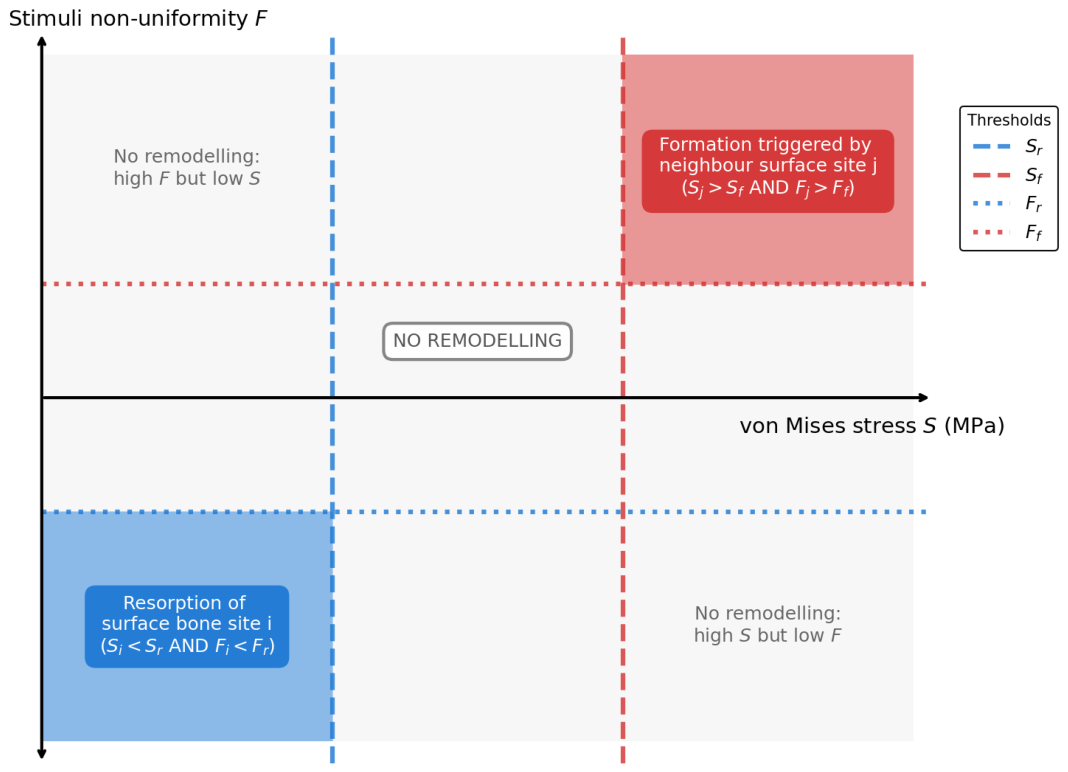
It is assumed that formation occurs when the marrow candidate element neighbours at least one surface bone site satisfying both criteria and . In contrast, resorption happens when the surface bone satisfies both and . Here, and are the formation and resorption thresholds of the mechanostat criterion, while and are the respective thresholds of the non-uniformity criterion.
The mechanostat thresholds
and
, together with the non-uniformity thresholds
and
, define a two-criteria remodelling scheme in the
plane (
Figure 1). Only sites satisfying both criteria can remodel; all other sites remain unchanged at the given step. In this framework, the mechanostat criterion primarily regulates the global bone mass by controlling eligibility for formation and resorption. The non-uniformity criterion determines where remodelling is preferentially located on the surface and therefore governs morphology evolution. Their combination provides a more balanced and better controlled adaptation process than single-criterion models.
2.3. FE Model of Bone Adaptation
The suggested TBA scheme was implemented using FE software in Abaqus/Standard 2024 (Dassault Systemes Simulia, Johnston, RI, USA) with a USDFLD subroutine written with Intel Fortran 2025 (Intel Corporation, Santa Clara, CA, USA). Numerical simulations with the developed FE model applied various boundary conditions to two trabecular geometries, the letter-shaped X and I cases, to systematically explore how local stimuli under controlled loading produced distinct trabecular morphologies.
To isolate the role of each criterion, three FE models were compared: (i) the two-criteria model, (ii) a mechanostat-only model, and (iii) a non-uniformity-only model.
2.3.1. Material and Geometry
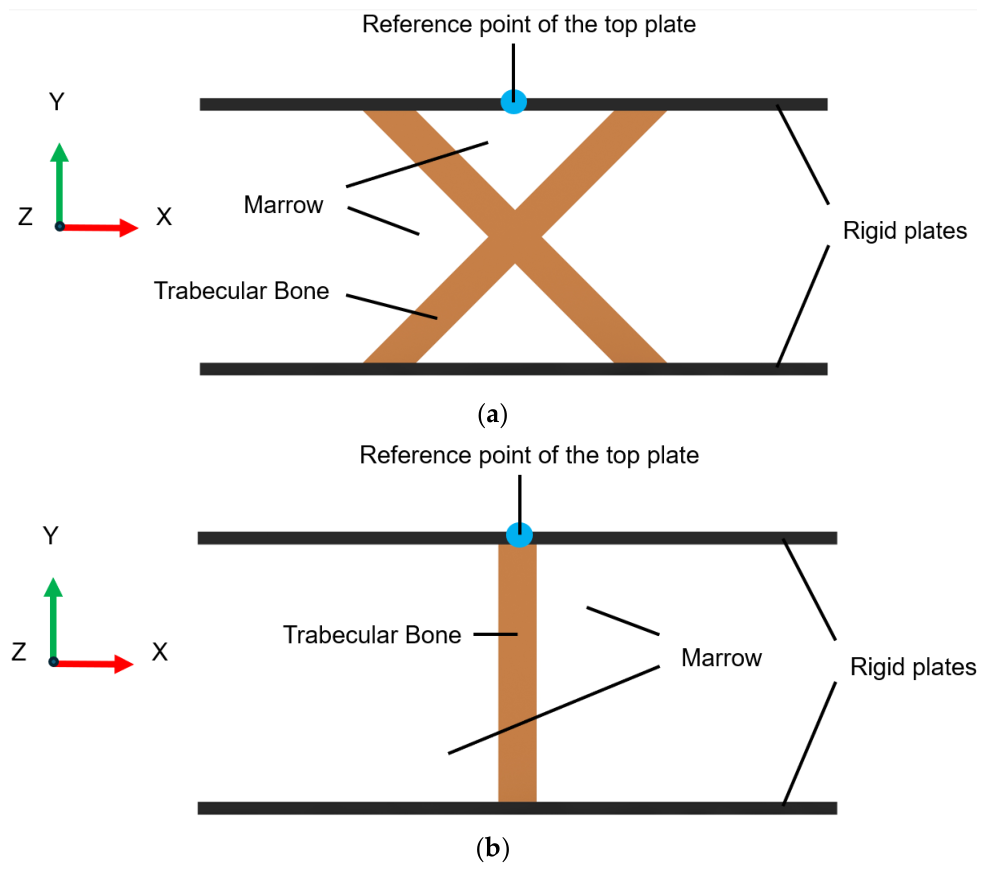
As mentioned, this study uses shapes of the letters X and I to represent TB geometry (
Figure 2). The former shape is the simplest model of two intersecting trabeculae, which is the base morphology of woven bone and has the potential to develop into various trabecular morphologies [
28]. The I shape is more general in TB geometry and is used for the analysis of TB.
The mechanical properties of TB and marrow are listed in
Table 1. The bone phase was assigned tissue-level elastic properties because the microstructured model represented individual-trabecular struts, not a homogenised porous trabecular network commonly used for trabecular tissue in simulations. Here, the trabecular geometry and the marrow space are already explicitly considered by introducing the two-phase domain.
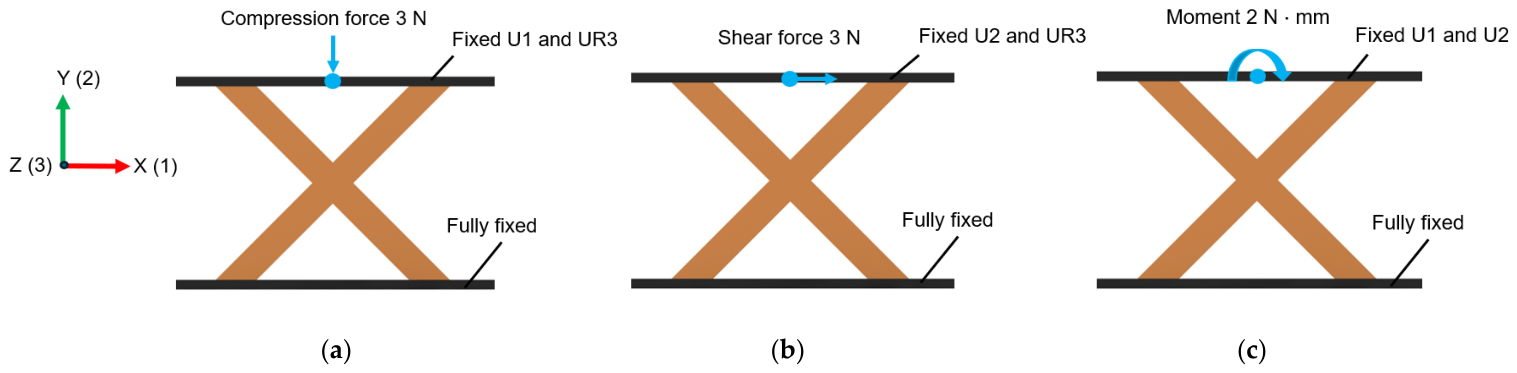
The applied boundary conditions are illustrated in
Figure 3. The X geometry occupies an area of 400
× 400
, with the rest of the simulation domain filled with marrow elements, providing sufficient space for TB evolution. The total size of this representative volume element (RVE) filled with bone and marrow elements is 1000
× 400
. The top and bottom edges of the RVE are tied to the rigid plates. The boundary conditions are applied to the representative trabeculae through the rigid plates. These plates provide sufficient length for structure evolution inside the RVE. The bottom rigid is fully fixed, and different types of mechanical loads are applied to the top plate.
Three principal loading cases were introduced to examine how different local mechanical-field structures influenced trabecular morphology. Compression was used to study adaptation towards dominant axial load-transfer paths and rod-like morphologies. Bending was used to generate strong spatial contrasts across the trabecular junction, allowing the role of non-uniformity in plate-like morphology formation to be examined. Shear loading was used to investigate remodelling under directional stress redistribution and to assess the stability of rod-like trabeculae under cyclic reversal.
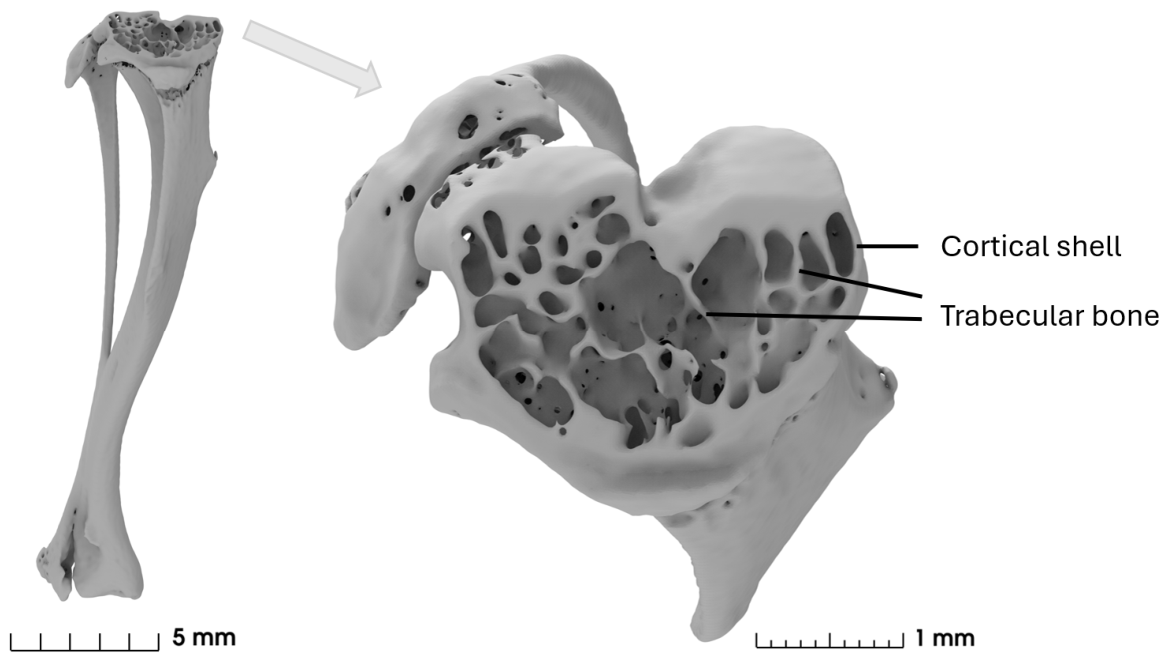
At the tibia level, the cortical shell shares the load with TB, and the load partition is spatially non-uniform (varying with height and proximity to the growth plate). Finite-element studies showed that the cortical shell could carry a considerable amount of compressive load that varied with location and the loading mode [
46]. Microstructural models further demonstrated increased stresses around the shell/endplate region and higher reliance on the shell when the trabecular compartment became weaker [
47]. Such load partitioning implies that boundary tractions transmitted from the cortical shell to adjacent trabeculae are not uniform, so neighbouring trabeculae near the cortex–trabecula transition can experience markedly different local stress states.
In the suggested framework, regions with strong spatial contrasts in mechanical stimulus are expected to exhibit larger values of the non-uniformity measure , and, therefore, be preferentially selected for discrete remodelling events in the two-criteria remodelling scheme. So, a bending moment is applied to the idealised X geometry as a controlled loading case that generates a significant stimuli gradient across the structure, to demonstrate the evolution of a single trabecula.
The model used a plane-stress formulation in Abaqus. The compression under 3
, shear under 3
and bending under 2
were applied to the RVE. (An additional 3.5 N compression case is used only in
Section 3.5 as an exploratory higher-load condition to examine the preservation of the hourglass morphology.) These values were not intended to reproduce physiological joint forces or subject-specific tibial loading. They were chosen as controlled numerical loading cases that produced stimulus levels within the prescribed mechanostat range and generated clearly distinguishable spatial stimulus fields under compression, shear, and bending.
In the main simulations, the loads were applied and then held constant to isolate the effect of the loading mode; cyclic or variable loading histories were treated separately as exploratory cases.
The analysis of the evolution of TB morphology under these principal loading conditions provides a basis for studies of more complex geometries of trabeculae.
A uniform mesh size of 5 was used, and together with the total size of the RVE, the simulations were explicitly conducted at the microscale.
2.3.2. Surface Detection and Remodelling Eligibility
Bone remodelling occurs primarily at the bone surface; therefore, the computational framework requires explicit identification of the bone–marrow interface so that phase changes are restricted to surface elements. This definition ensures that bone formation and resorption occur only at the bone–marrow interface, preventing non-physical phase changes within the interior of trabecular structures.
In the suggested two-phase bone–marrow model, the computational domain was discretised using a structured mesh of geometrically identical square elements with a characteristic size, . Thanks to this regular discretisation, the centroid-to-centroid distance between orthogonally adjacent elements equals , whereas the distance between diagonal neighbours equals . A bone element was classified as a surface element if at least one neighbouring element belonged to the marrow phase and the centroid distance between the two elements did not exceed the surface-detection radius . Similarly, a marrow element was considered surface-adjacent if the same condition was satisfied relative to a neighbouring bone element. Only these surface-related elements were permitted to undergo a phase change in simulations of the remodelling process.
Parameter controls the extent of the remodelling-active region and, therefore, influences both the sensitivity and numerical stability of the model. If , neighbouring elements cannot be detected, and surface identification becomes impossible. Conversely, if , diagonal neighbours are also included in the process, effectively expanding the remodelling-active region. In this study, the surface-detection radius was set equal to the mesh size (), so that only the four orthogonally adjacent neighbours were considered while the diagonal neighbours were excluded. Consequently, remodelling was restricted to the first layer of elements adjacent to the bone–marrow interface, ensuring biologically consistent surface remodelling and improved numerical stability by limiting topology changes to a single element layer.
2.3.3. Mechanosensory Sampling Region
The signal used in the remodelling rule is gathered from a mechanosensory sampling region associated with each surface site. This region is distinct from the surface-detection region introduced in
Section 2.3.2. In the numerical simulations, the surface-detection threshold was
, whereas the stimulus-sampling region was defined by mechanosensory radius
and inward sampling depth
. Thus,
controlled where remodelling could occur, while
and
controlled the sampling of the local mechanical stimulus for the remodelling decision [
48]. Thus, for a given surface site, only bone elements located both within the neighbourhood radius
and within the inward depth
from the surface were included in the mechanosensory sampling region.
In this 2D model, the mesh was regular, with element side length
m. The surface-detection threshold is taken as
, so that only the first layer of bone elements adjacent to the marrow was suitable for remodelling. By contrast, the stimulus-sampling depth was chosen to be larger than
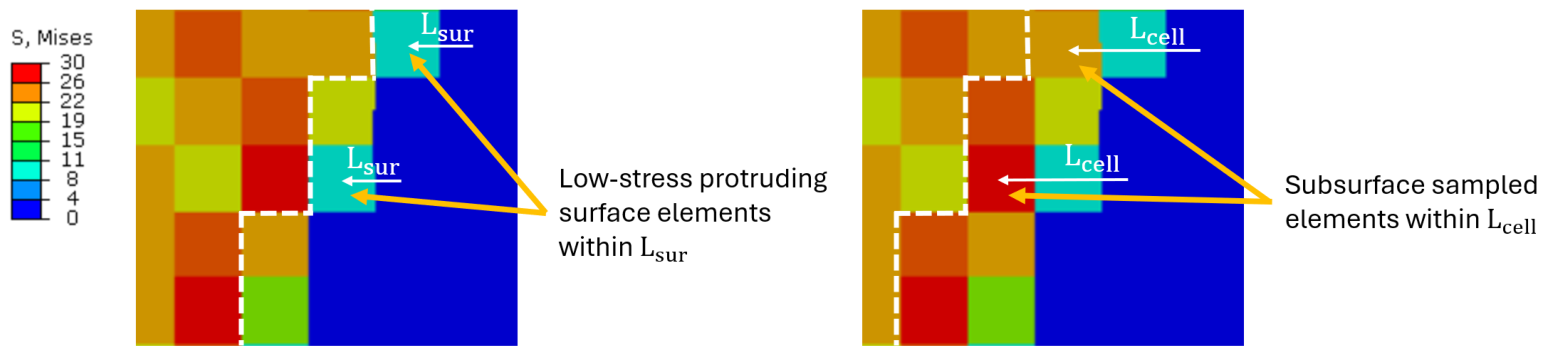
, so that the sampled mechanical signal was not restricted to only the outermost surface layer of elements (
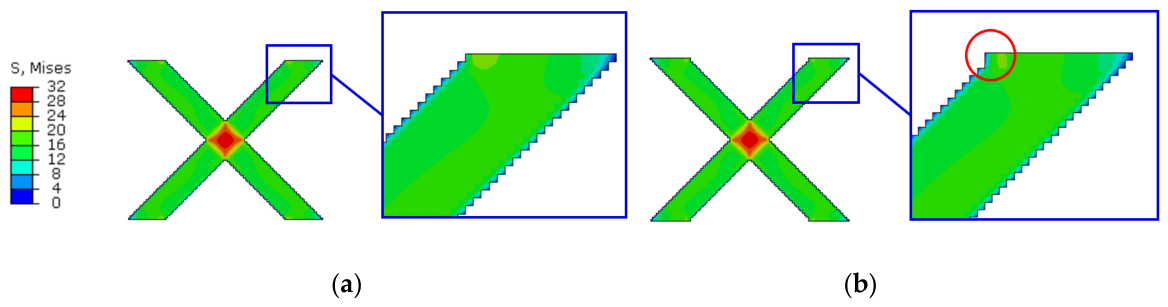
Figure 4).
This distinction is important because, in a square mesh, the discretised trabecular boundary may contain small protruding surface elements as a result of discretisation of a curved or inclined surface. These elements of traction-free surfaces can exhibit artificially low stresses compared with those from the neighbouring interior layer, not because of the underlying mechanical behaviour of the trabecula, but resulting from staircase-like boundary representation in the square FE mesh. If the sampling depth is taken as , the stimulus is considered only for the outermost surface layer, and the resulting signal becomes sensitive to FE-mesh-induced boundary noise. In contrast, using allows the stimulus calculation to include the first inward layer of bone elements, which more realistically represents the local stress state beneath the discretised boundary.
Therefore, within the suggested computational framework, controls where remodelling could occur, while and control how the local mechanical stimulus is sampled for the remodelling decision. This separation between location eligibility and signal gathering improves the numerical robustness of the two-criteria remodelling scheme.
In the USDFLD subroutine developed in ABAQUS, marrow elements are denoted by 0 and bone elements by 1. The element phase is then updated according to
The same thresholds were used throughout the simulations performed with the two-criteria remodelling scheme.
2.3.4. Morphological, Mechanical and Remodelling Descriptors
To evaluate the behaviour described by the proposed two-criteria remodelling model, a set of morphological, remodelling and mechanical descriptors was recorded throughout the numerical simulations. These descriptors were selected to quantify not only the final trabecular morphology but also the way in which the mechanostat criterion and the non-uniformity criterion affected the remodelling activity, mass stabilisation and structural efficiency during the adaptation process.
The first descriptor is the bone element fraction
, which is used here as a discrete measure of bone area fraction in the 2D model. It is defined as
where
is the number of bone elements and
is the total number of elements in the RVE. This parameter was used to quantify the overall gain or loss of bone mass during remodelling.
To characterise the amount of exposed remodelling surface, the surface-to-area ratio was approximated in discrete form as
where
is the number of bone elements classified as surface elements. This descriptor is important because trabecular remodelling is restricted to the surface, and the available remodelling-active interface between bone and marrow domains changes as the morphology evolves.
An equivalent trabecular thickness descriptor, , was also monitored. In the present 2D framework, this quantity was used as a measure quantifying whether the structure evolved towards a thinner rod-structure form or a broader plate-like form. It was evaluated from the discrete bone domain as an effective thickness measure derived from the evolving trabecular area and boundary extent. This descriptor was included because the transition between rod- and plate-structure morphologies was one of the principal features of interest in this study.
To assess the distribution character of mechanical stimulus in the remodelling-relevant surface region, the coefficient of variation of the surface stimulus was calculated as
where
is the standard deviation and
is the mean value of the mechanical signal on the relevant sensing surface sites. This quantity was included because the proposed model interprets stimulus non-uniformity as a remodelling-priority criterion; therefore, reduction or persistence of surface-stimulus variation is directly related to the model mechanism.
To quantify the instantaneous amount of remodelling activity, the fraction of active remodelling surface was introduced:
where
is the number of surface elements undergoing the phase change at a given increment. This descriptor was used to assess whether remodelling activity became selective rather than spatially uniform.
In addition to these geometric and activity-based measures, two descriptors were introduced to evaluate how the structure approached the thresholds of the two-criteria remodelling rule. The first is the mechanostat lazy-zone fraction, defined as the fraction of relevant elements with the local mechanical signal within the no-net-remodelling range of the mechanostat criterion:
where
is the number of evaluated elements contributing to remodelling stimuli, and
and
are the resorption and formation thresholds of the mechanostat criterion, respectively. This quantity was used to quantify how far the structure had progressed towards satisfaction of the mechanostat condition.
The second is the non-uniformity lazy-zone fraction, defined as the fraction of evaluated elements with the non-uniformity measure within the no-remodelling range of the non-uniformity criterion:
where
and
are the resorption and formation thresholds of the non-uniformity criterion. This descriptor was introduced because, unlike the mechanostat condition, the local spatial contrast in the stimulus may persist even for the stabilised global mass. Comparing
and
, therefore, helps to distinguish the fulfilment of the global homeostatic condition from the persistent local remodelling competition.
For compression-dominated cases, the structural efficiency was additionally evaluated using a normalised stiffness measure:
where
is the displacement immediately after the initial load application and
is the displacement at increment
. This descriptor quantifies the gain in structural stiffness relative to the initial configuration under the same applied load.
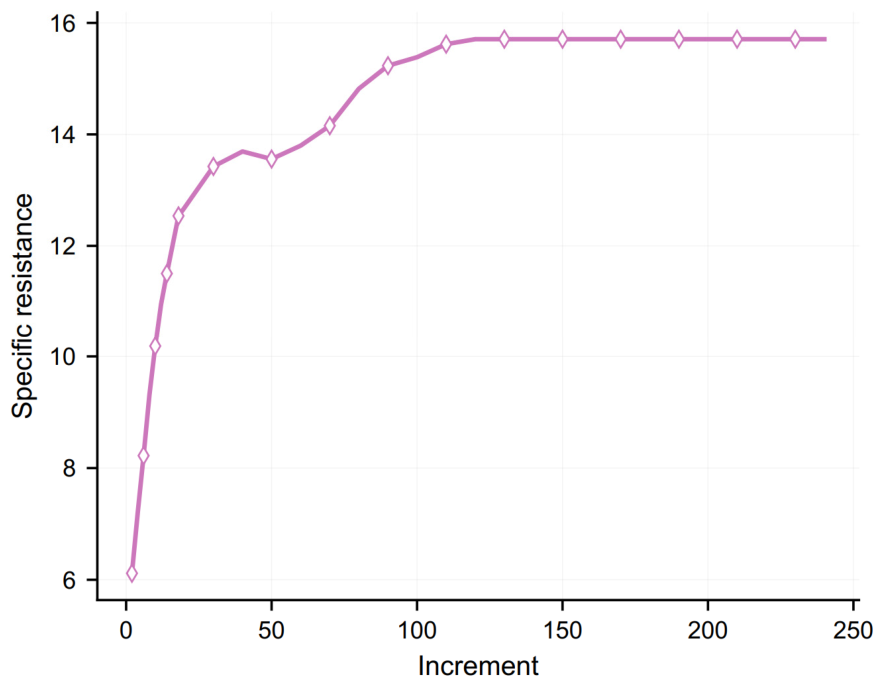
To assess the load-bearing efficiency per unit bone area, the specific resistance was calculated as
This parameter is useful since the purpose of trabecular adaptation is not only to increase the stiffness level but also to do so efficiently with a limited bone mass.
Together, these descriptors allow the simulation outcomes to be analysed at three complementary levels: morphology, employing , and ; remodelling dynamics, through , and ; and mechanical performance, through , and . This combination was selected to relate each observed morphology to not only its final shape but also the underlying remodelling process and its mechanical consequence.
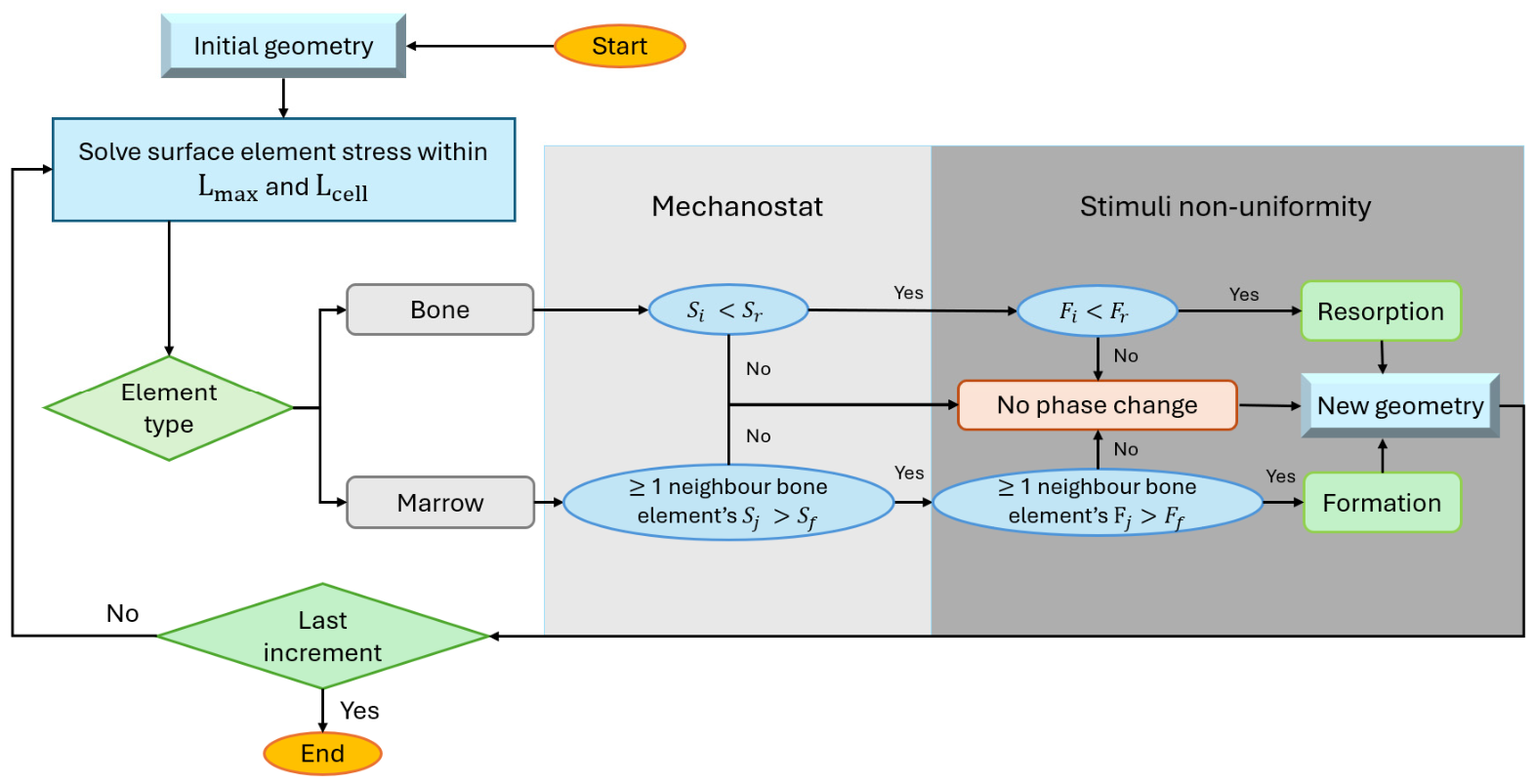
2.3.5. FE Framework Flow Diagram
The flow diagram of the developed FE model is given in
Figure 5.
This framework has a double stimuli filter function that selects the elements that meet the thresholds based on both absolute stimuli and stimulus non-uniformity. The workflow included the following main steps:
1. Define the trabeculae geometry.
2. Consider stresses in bone surface elements within the sensing depth , and calculate and for each element.
3. Consider elements within the surface depth of . For each element, if and , it is resorbed into marrow; otherwise, it remains bone. For each marrow element adjacent to the bone surface, formation occurs if at least one neighbouring surface bone site satisfies and ; otherwise, it remains marrow.
4. Continue simulations until a prescribed maximum increment is achieved.
The results obtained with the development model are discussed in the next section.
2.4. Extraction of CT Images
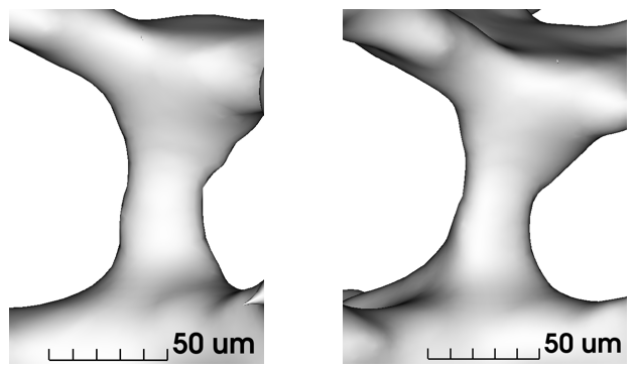
Computed tomography (CT) images were used for qualitative morphological comparison. Murine micro-CT images were employed since they provided sufficient spatial resolution to visualise trabecular junctions, rod- and plate-like regions, and perforations at the scale discussed in this study [
49,
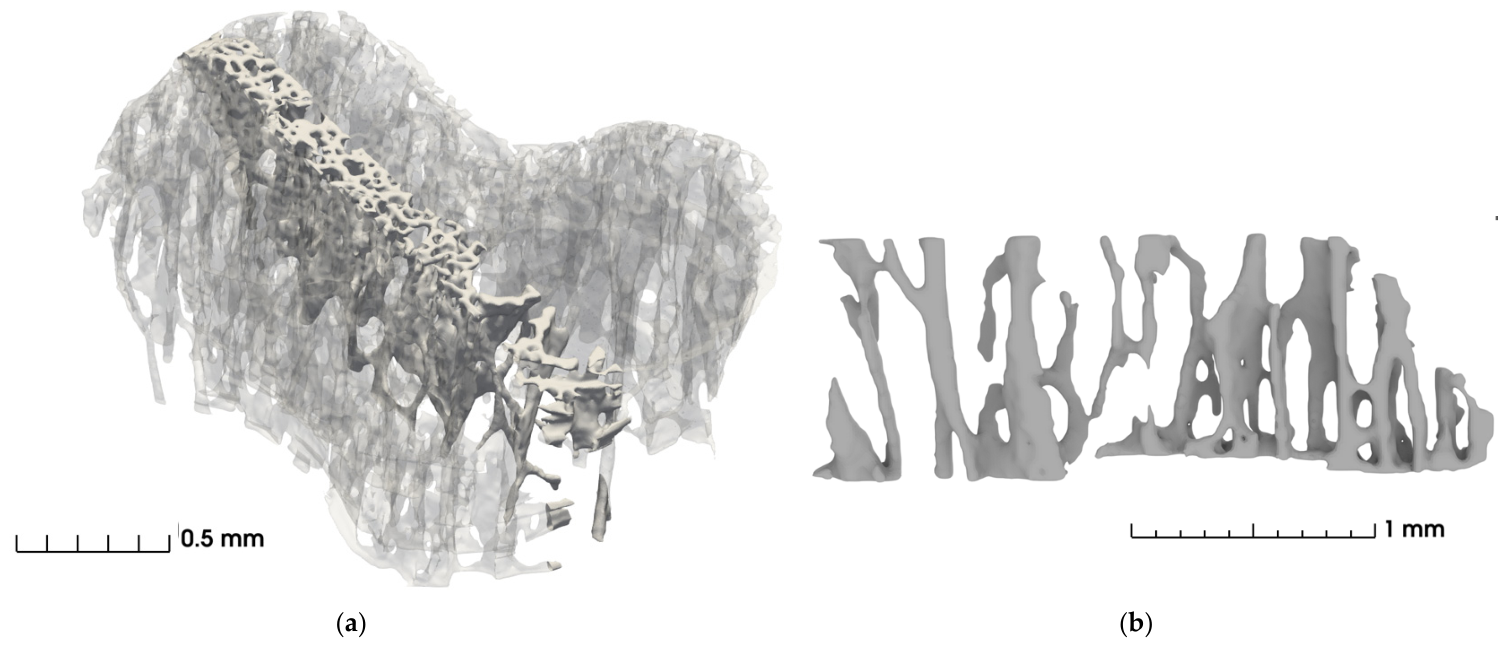
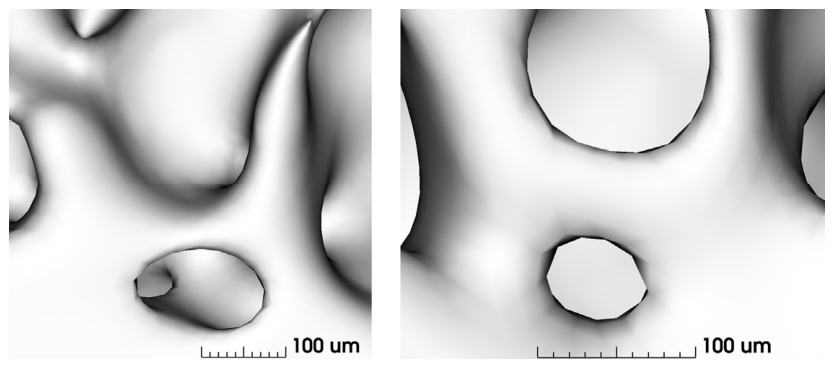
50] (CC BY 4.0). The image was imported into 3D Slicer, where the bone tissue was isolated using greyscale thresholding. A longitudinal Boolean cut was applied to expose the internal trabecular microarchitecture. This study selects a representative cross-sectional CT image, including the cortex–trabecula transition region, for qualitative comparison with the simulation results. The segmented CT images show irregular junctions, perforations and mixed rod/plate features in the transition region (
Figure 6). The cross-section is extracted at the proximal epiphysis above the growth plate area from the micro-CT image database [
49].
To test the flexibility of the two-criteria remodelling model, sections of segmented trabecular bone from below the proximal growth plate of both tibiae obtained from 12 female C57BL/J6 mice were extracted for morphological comparison [
50]. To preserve continuous trabecular features and ensure a reproducible sectioning protocol, the sectioning directions were defined using a surface-based trabecular fabric tensor computed from the triangulated segmentation (
Figure 7).
For each triangular segment
, with unit normal
and area
, the fabric tensor
was defined as the area-weighted orientation tensor of surface normals:
Eigen decomposition of the fabric tensor:
yielded the principal fabric directions
and their corresponding eigenvalues. The degree of structural anisotropy was defined as:
consistent with standard micro-CT anisotropy reporting.
The segmented geometry was then rotated so that and aligned with the Cartesian axes, providing a specimen-specific architectural frame for sectioning and align with the principal loading directions used in the FE simulations.
Cross-sections were extracted using the planes orthogonal to each aligned fabric axis. Candidate layers were screened using a connectivity ratio (fraction of segmented bone voxels belonging to the largest connected component within the layer). Only layers with connectivity above were retained, and a thickness-based deduplication filter removed the overlapping candidates. This procedure yielded structurally representative sections for qualitative comparison with the 2D simulation outcomes.
3. Results
To examine the implications of the proposed remodelling rule systematically, the results are presented below in six parts. First, the behaviour of the two-criteria model is compared with that of the two corresponding one-criterion models. The following sections then describe the effects of bending, compression, and variations in the threshold or boundary-condition, cyclic loading, and shear loading on trabecular morphology.
3.1. Comparison of Remodelling Schemes
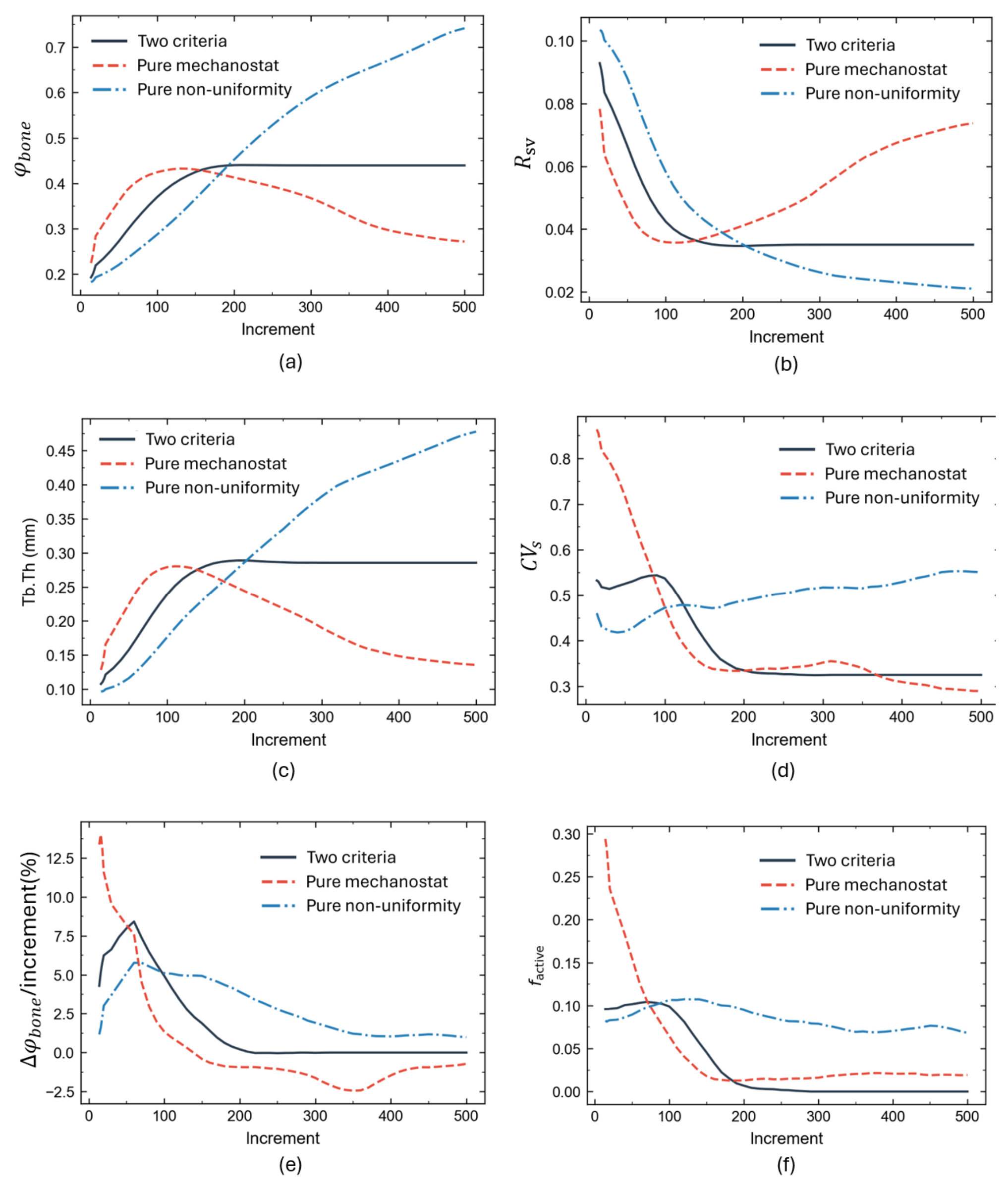
Comparison of the three remodelling schemes for the X-shape geometry under bending loading revealed clear differences in the adaptation behaviour. In the pure non-uniformity model, the bone formation continued to occur at sites that had already entered a mechanically adequate, or even weakly loaded, state, which delayed convergence. In the pure mechanostat model, all the bone elements with stresses outside the lazy zone remodelled simultaneously at the early stage, and the fraction of the active remodelling surface exceeded that in the two-criteria model by a factor higher than two (
Figure 8a and
Figure 9f).
The three remodelling schemes also showed different convergence behaviours (
Figure 9). The two-criteria model reached a stable final state with a lower active remodelling surface than the single-criterion models, whereas the pure mechanostat model demonstrated broader late-stage resorption, as it was only sensitive to the loading magnitude. The pure non-uniformity model retained a persistent formation bias under the non-uniform boundary conditions.
3.2. Bending-Driven Formation of Plate-like Trabeculae
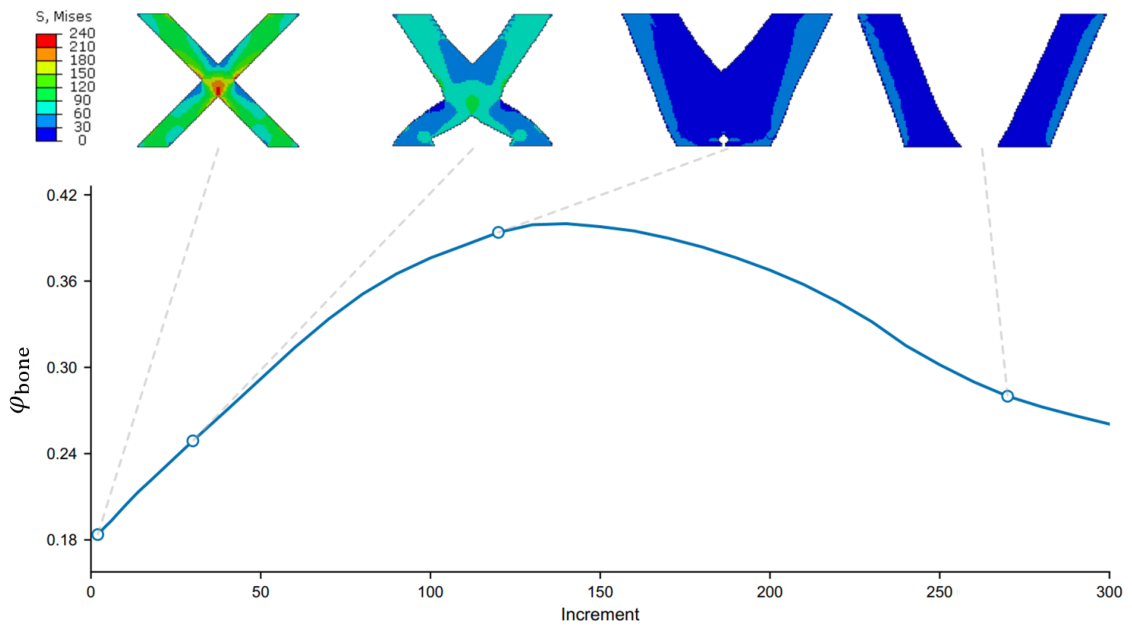
Under the two-criteria remodelling framework, bending loading applied to the X-shaped trabecular geometry produced a plate-like morphology (
Figure 9). Bending generates high spatial gradients of mechanical stimulus across the trabecular junction, allowing the morphology-shaping role of the non-uniformity criterion to be examined directly. The evolved structure shows qualitative resemblance to plate-dominated trabecular regions observed in CT images (
Figure 10).
This result suggests that, in the present model, loading conditions associated with high local stimulus gradients can promote broader, plate-like trabecular development in the present model.
The area fraction of bone in this model rose significantly at the early stages of remodelling (
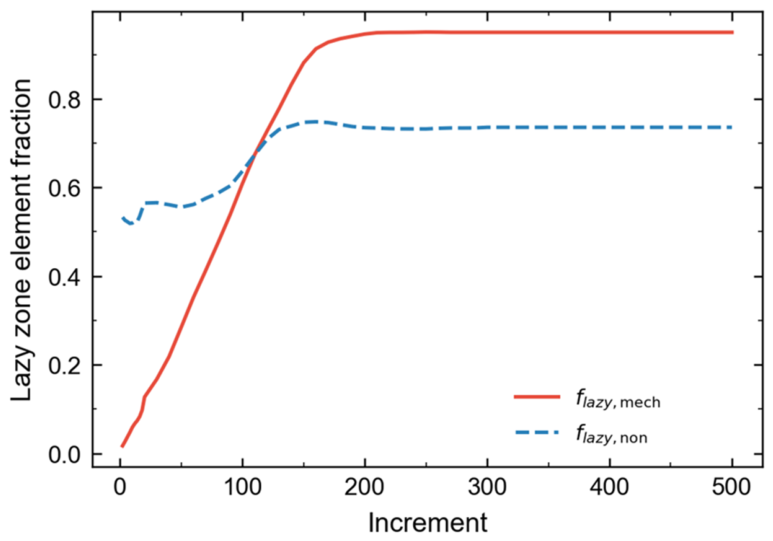
Figure 9a). This growth was accompanied by a rapid increase in the fraction of elements satisfying conditions of the mechanostat lazy zone
(
Figure 11). At later stages,
approached unity, indicating fulfilment of global homeostatic conditions for the absolute stimulus thresholds under constant loading. In contrast, the lazy-zone fraction
for the non-uniformity criterion stabilised below unity, reflecting persistent local stress contrasts around the central region. In the two-criteria remodelling scheme, such residual contrast can remain after reaching mechanostat homeostasis, thereby suppressing low-benefit remodelling events, consistent with energy-efficient maintenance under a finite remodelling capacity [
33,
41].
While the bending load promoted the structure’s widening under a strongly non-uniform stimulus field, compression produced a different adaptation pattern, in which remodelling was concentrated along the dominant axial load-transfer path.
3.3. Compression-Driven Formation of Rod-like Trabeculae
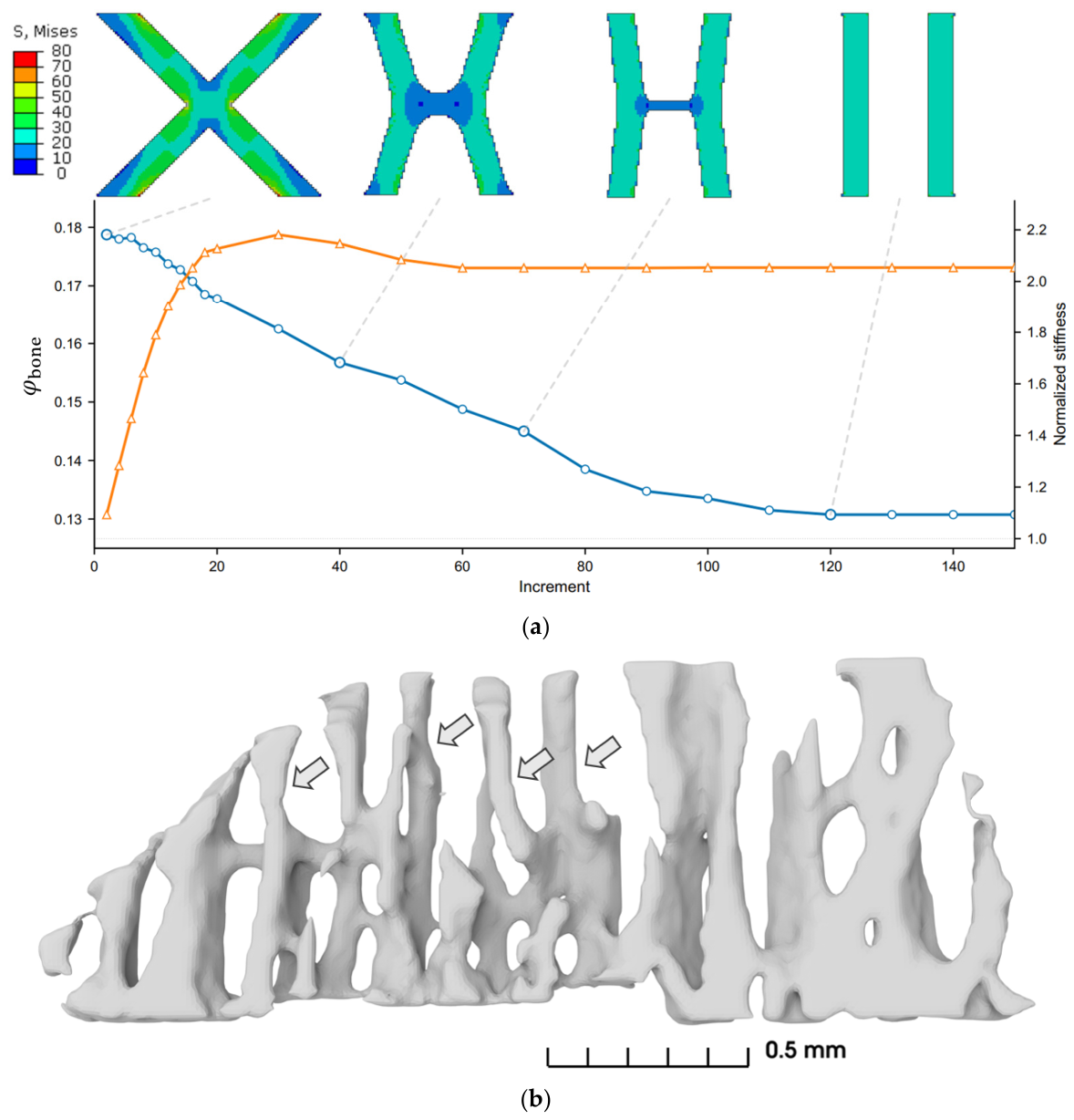
In contrast to the bending case, uniaxial compression drove remodelling towards a dominant axial load-transfer path and produced a rod-like morphology (
Figure 12a). The evolved structure showed qualitative resemblance to rod-like trabeculae identified in CT images of mouse tibia (
Figure 12b). This morphological transition was accompanied by a reduction in the bone element fraction but an increase in structural efficiency under the same applied load. Qualitatively similar rod-like trabeculae were observed in sections extracted from the trabecular region below the proximal growth plate in the dataset for an osteoporotic mouse [
50].
Quantitatively, the final trabecular structure contained 27% fewer bone elements than in the initial state. Despite this reduction in bone mass, the adapted structure exhibited 25% higher normalised stiffness than the initial configuration (
Figure 12a). Accordingly, the specific resistance
increased by 158% before reaching equilibrium (
Figure 13).
Having established the baseline morphologies under bending and compression, the next section examines how the changes in threshold conditions and loading magnitude shift the response towards a more resorption-biased state.
3.4. Effect of Threshold and Boundary-Condition Variation
To examine the sensitivity of morphology to a resorption bias, additional simulations were performed with modified non-uniformity thresholds.
Under bending, resorption-biased bone-adaptation behaviour was simulated by shifting the non-uniformity resorption band (
in
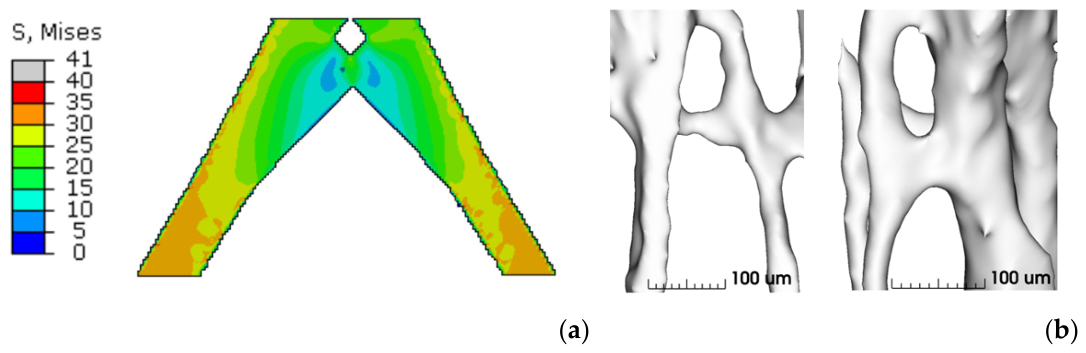
Figure 1) by 5%, generating more rod-like morphology under the same boundary condition. A qualitatively similar rod-like morphology was also obtained when the applied compressive load was reduced by 10%, without modifying the remodelling criteria (
Figure 14a).
This morphology resembles the CT example shown in
Figure 14b. These results indicate that both the spatial gradients in the mechanical stimulus and the overall load magnitude influence the emergence of rod-like morphologies; however, the present simulations are not sufficient to distinguish their relative contributions.
A stronger resorption-biased condition was examined by shifting the non-uniformity resorption band (
in
Figure 1) by 10% in the bending model, resulting in the low-stress region at the central junction, ultimately breaking the symmetry of the structure and leading to the separation of the trabeculae. This shifting in the non-uniformity resorption band prevented the formation of plate-like trabecular bone under bending (local stress gradient) in the simulations.
During the bone evolution in this model, rod-structure trabeculae with different orientations were formed, resembling the rod structures observed in osteoporotic mice (
Figure 15).
This result indicates that, under resorption-biased conditions, the local stimulus gradient generated by bending may be insufficient to maintain a broader plate-like morphology.
3.5. Hourglass Morphology Under Cyclic Shear and Compression
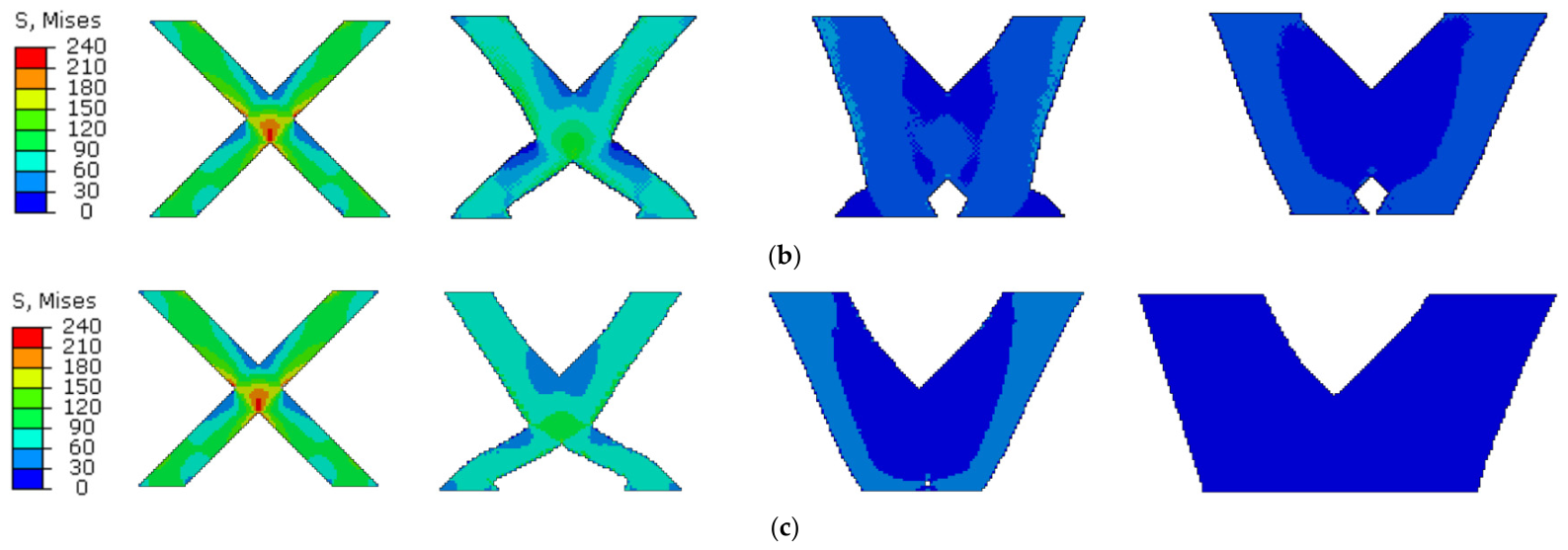
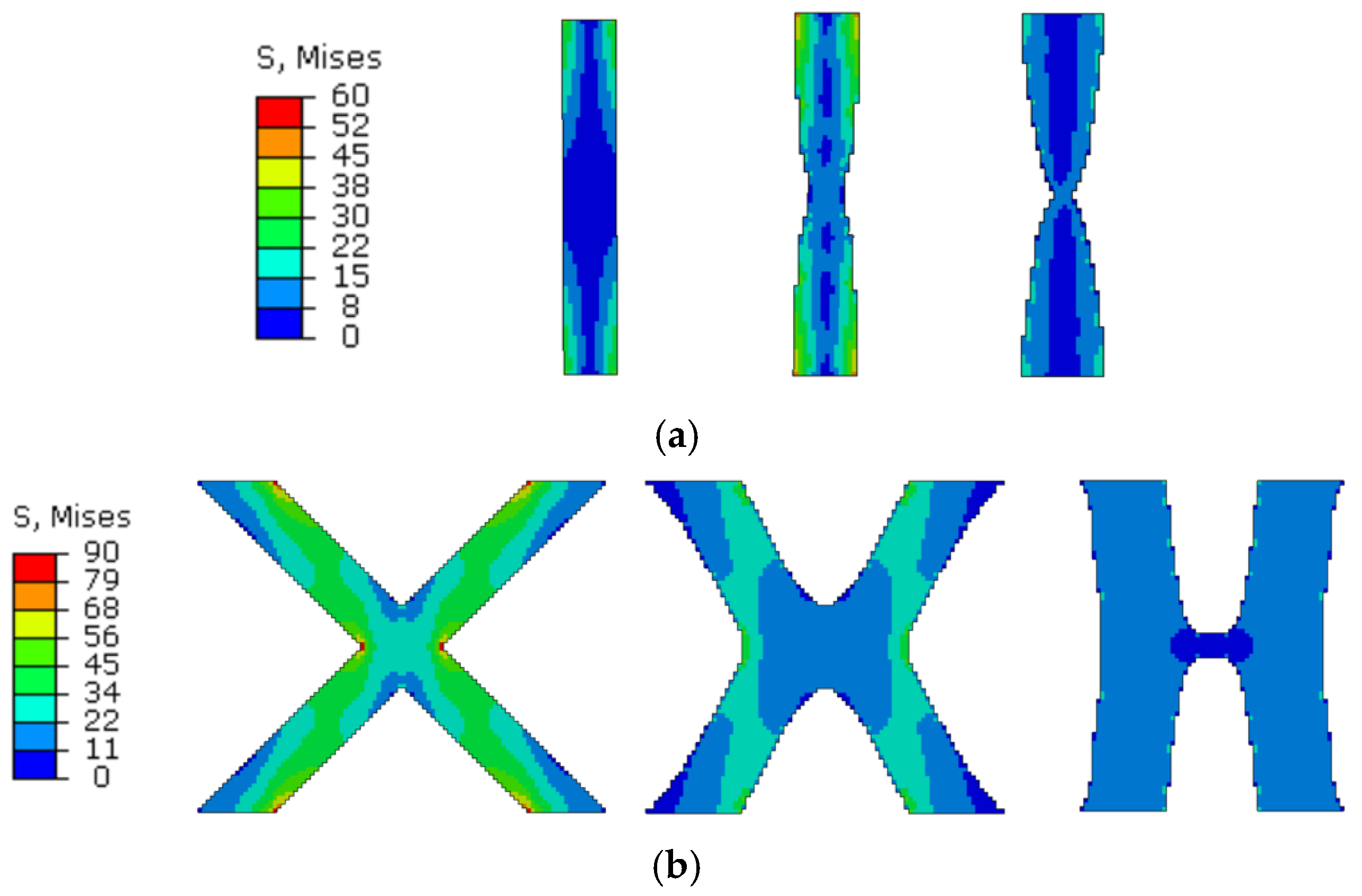
When the periodic shear loading with loading direction shifting with increments was applied to the single vertical rod-structure TB with I-shaped geometry, it evolved an hourglass shape, thicker at the ends close to the rigid plates and thinner in the middle (
Figure 16a).
Under 3.5 N compressive loading, the X-shaped trabecula demonstrated the elevated deviatoric stress at the connection region and preserved the same hourglass geometry (
Figure 16b), which in the present model contributed to the retention of bone mass in that area. Since hydrostatic stimuli were not included, the current simulations could not determine whether hydrostatic pressure also contributed to the hourglass morphology observed near rod connections.
This representative structure is observed at the rod trabeculae that connects two independent rod trabeculae at their middle (
Figure 17).
3.6. Shear-Driven Directional Remodelling
When shear loading was applied to the representative volume element containing the X-shape geometry, the geometry remained largely unchanged, with only minor material addition at the corners under increased loading (
Figure 18). This limited morphological adaptation indicates that the initial configuration was already well aligned with the principal-stress trajectories under shear loading. In pure shear, the principal stresses act along directions of approximately ±45°. Trabecular structures are therefore expected to align preferentially with these orientations, making a 45° strut mechanically favourable for transmitting shear loads.
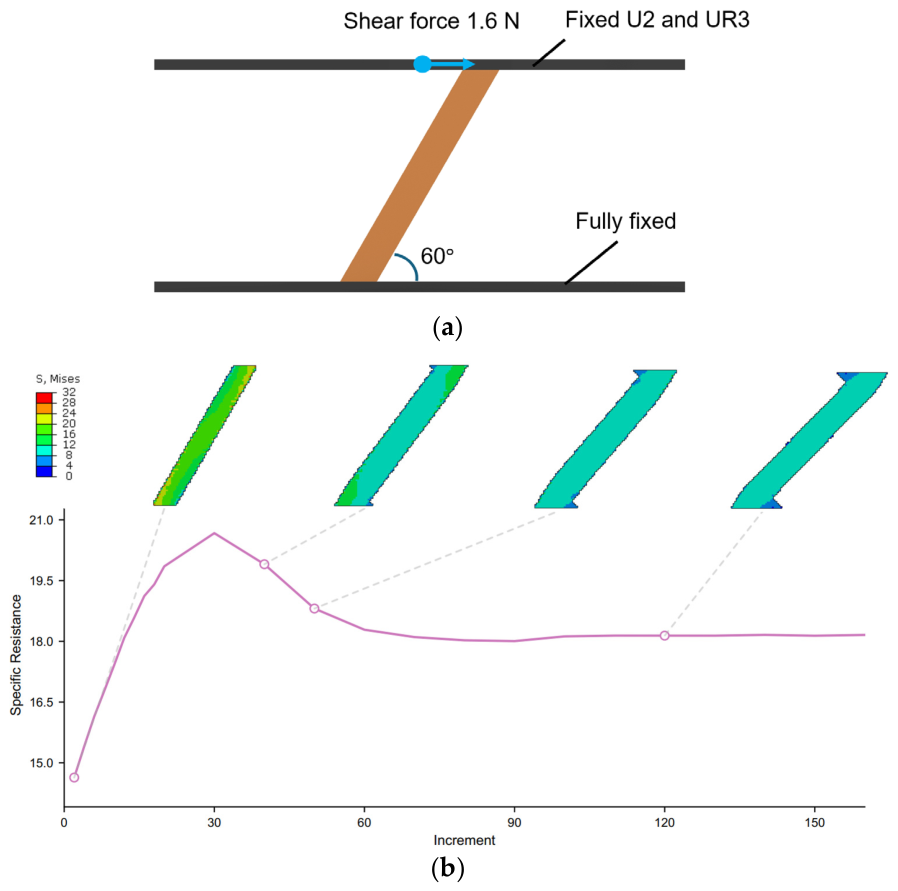
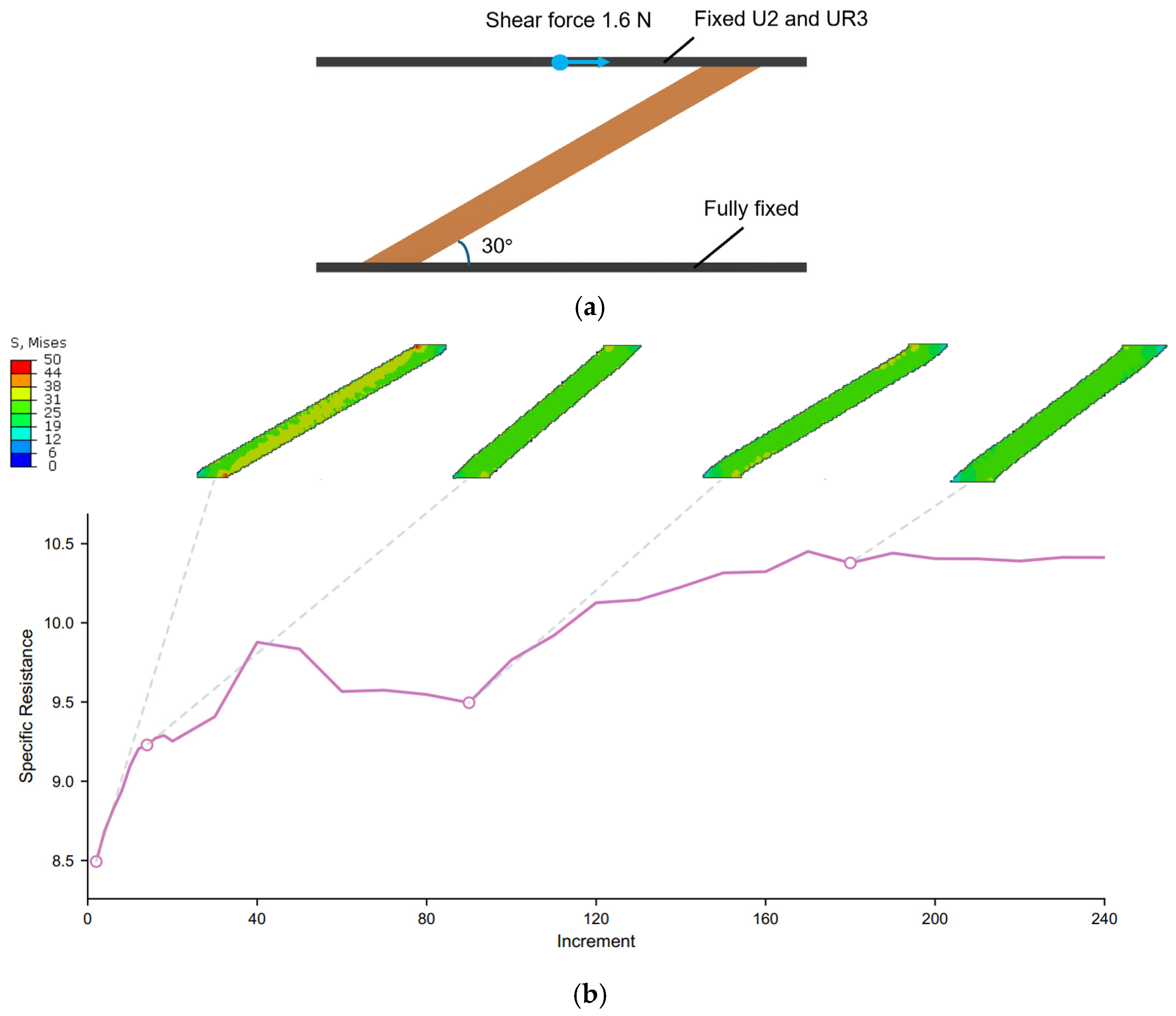
To further examine this behaviour, additional simulations were performed using isolated I-shaped trabeculae initially oriented at 30° and 60° relative to the loading plates. In these simulations the applied shear force was reduced from 3 N to 1.6 N to ensure that the resulting mechanical stimulus remained within the remodelling thresholds of the model. In the 60° configuration (
Figure 19), both positive and negative shear loading produced gradual structural adaptation toward a 45° rod-like trabecular orientation. This transition occurred through progressive chamfering of the structure and was accompanied by an increase in specific resistance to shear loading.
A similar convergence toward a 45° orientation was observed for the initial 30° trabecula (
Figure 20). However, the evolution of shear resistance and specific resistance was less stable and less monotonic compared with the 60° case. During the adaptation process, additional material formed near the ends of the trabeculae as the structure rotated toward the optimal orientation.
This redistribution of material may contribute to the rounded junctions commonly observed at connections between trabeculae and between trabecular and cortical bone in CT images.
4. Discussion
This study presented a mechanically driven trabecular-bone-adaptation (TBA) scheme that combined a mechanostat criterion with a stimulus non-uniformity criterion, extending traditional approaches based on a single criterion. Implemented in a 2D FE framework, the scheme reproduced distinct trabecular morphologies, commonly described as rod- and plate-structure trabeculae and generated additional morphologies such as hourglass thinning under cyclic shear. These results are consistent with the model’s central premise: discrete remodelling events occur preferentially at mechanically distinctive surface sites according to , while the mechanostat thresholds stabilise the response by preventing uncontrolled growth or excessive resorption.
The obtained results are consistent with earlier mechanostat-based FE studies in the sense that the mechanical stimulus regulates the balance between formation and resorption. In density-based remodelling models, adaptation commonly acts to reduce the difference between local and reference stimulus values, thereby stabilising the apparent bone mass. Osteocyte-network models add a spatial sensing mechanism, through which local cells can influence nearby surface remodelling. Stress-gradient and non-uniformity-based models further suggest that the local stimulus contrast can help identify where remodelling is likely to occur. The present framework explicitly combines the criteria at the individual-trabecula level by retaining an absolute mechanostat gate while using non-uniformity as an explicit priority rule among mechanically eligible surface sites.
The constant-compression simulations of TBA showed that the trabecular with initial letter-shaped geometry increased its specific compression resistance. This behaviour agrees with the concept of mechanically optimised trabecular alignment and the tendency of bone to redistribute material towards load paths rather than simply increasing its area. In the bending-driven models, the formation of plate-structure trabeculae with resorption in the central area reproduced the transition from a rod-dominated structure in the central region to plate-structure trabeculae near the cortex observed in CT images of mouse tibia.
The discrete-event interpretation of the developed framework provides a natural explanation for apparent differences in the localised remodelling rate without introducing an explicit time-dependent biological rate law: the sites that satisfy the formation or resorption conditions of the two-criteria remodelling rule more frequently undergo phase changes and, therefore, adapt faster, whereas the sites that satisfy the rule less frequently adapt more slowly. In this way, trabecular morphology emerges from the repeated local application of the two-criteria rule.
One feature of the suggested framework is the finite remodelling capacity interpretation of remodelling. Finite remodelling capacity defines the spatial realisation of formation and resorption events. Numerical simulations of resorption-biased conditions, implemented by expansion of the resorption band, shifted the balance from plate-structure structures towards rod-structure ones; it could also induce symmetry breaking and separation at low-stress junctions. This is consistent with the general observation that reduced formation capacity and enhanced resorption favour rod-dominated architectures (
Figure 16). Importantly, this interpretation remains mechanistic rather than biochemical: the model does not account for metabolic pathways, but it still demonstrates that modest shifts in effective thresholds are sufficient to produce qualitative morphological trends.
The simulations also highlighted the importance of loading history. Periodic reversals of moment direction increased resorption and promoted thinner, more rod-structure geometries compared with constant-moment loading, even for similar peak load magnitudes. This sensitivity to cyclic loading and direction reversal is in line with the experimental evidence that bone responds not just to peak strain but also to the number, rate and pattern of load cycles [
51]. Here, the exploratory cyclic cases were interpreted qualitatively; realistic activity-based loading histories will be required before the model can be used to study in vivo adaptation.
The shear-loading results provide a clearer mechanical interpretation than the compression case because the expected directions of principal stress are well defined. Under shear, the principal tensile and compressive directions are at ±45°, and the simulated trabeculae gradually adapted towards this orientation. This behaviour is consistent with load-aligned remodelling: the material is preserved or added along mechanically favourable directions, while less favourably aligned regions remodel. Therefore, the shear case supports the interpretation that the proposed non-uniformity criterion can initiate the remodelling activity according to directional stress redistribution.
Despite these strengths, several limitations of the suggested approach should be noted. First, use of the model was restricted to 2D simulations of idealised X- and I-shaped geometries. These geometries are useful for the isolation of basic remodelling mechanisms at the single-trabecula level, but they cannot reproduce the full connectivity, anisotropy, load redistribution, and boundary-condition complexity of a three-dimensional trabecular network. Second, the bone phase was treated as linear isotropic tissue, thus neglecting tissue anisotropy, mineral heterogeneity, local damage, and material variability. Third, von Mises stress was used as the mechanical driver. Other stimuli, including strain-energy density, fluid-induced shear, pressure-related parameters, or combined strain-damage measures, may better represent osteocyte mechanosensing in some contexts. For instance, recent microdamage-informed remodelling approaches suggest that history-dependent internal damage measures may enhance the physiological realism of mechanically driven adaptation models [
52]. Fourth, biological regulation is represented only through effective thresholds and allocation rules. The model does not explicitly simulate time-dependent cell kinetics, stochastic BMU activation, hormonal regulation, ageing, disease effects, or inter-individual variability. Still, the suggested framework could be further developed to introduce these features.
Overall, the results support the view that combining the mechanostat approach with stimulus non-uniformity can reproduce key trabecular morphologies and their dependence on loading mode and history at the single-trabecula scale.