
Tactile Sensory Deprivation Impairs Spatial but Not Motor Behavior in Freely Moving Previsual Rat Pups
 , , and
Abstract
1. Introduction
2. Materials and Methods
2.1. Animal Housing
2.2. Vibrissectomy
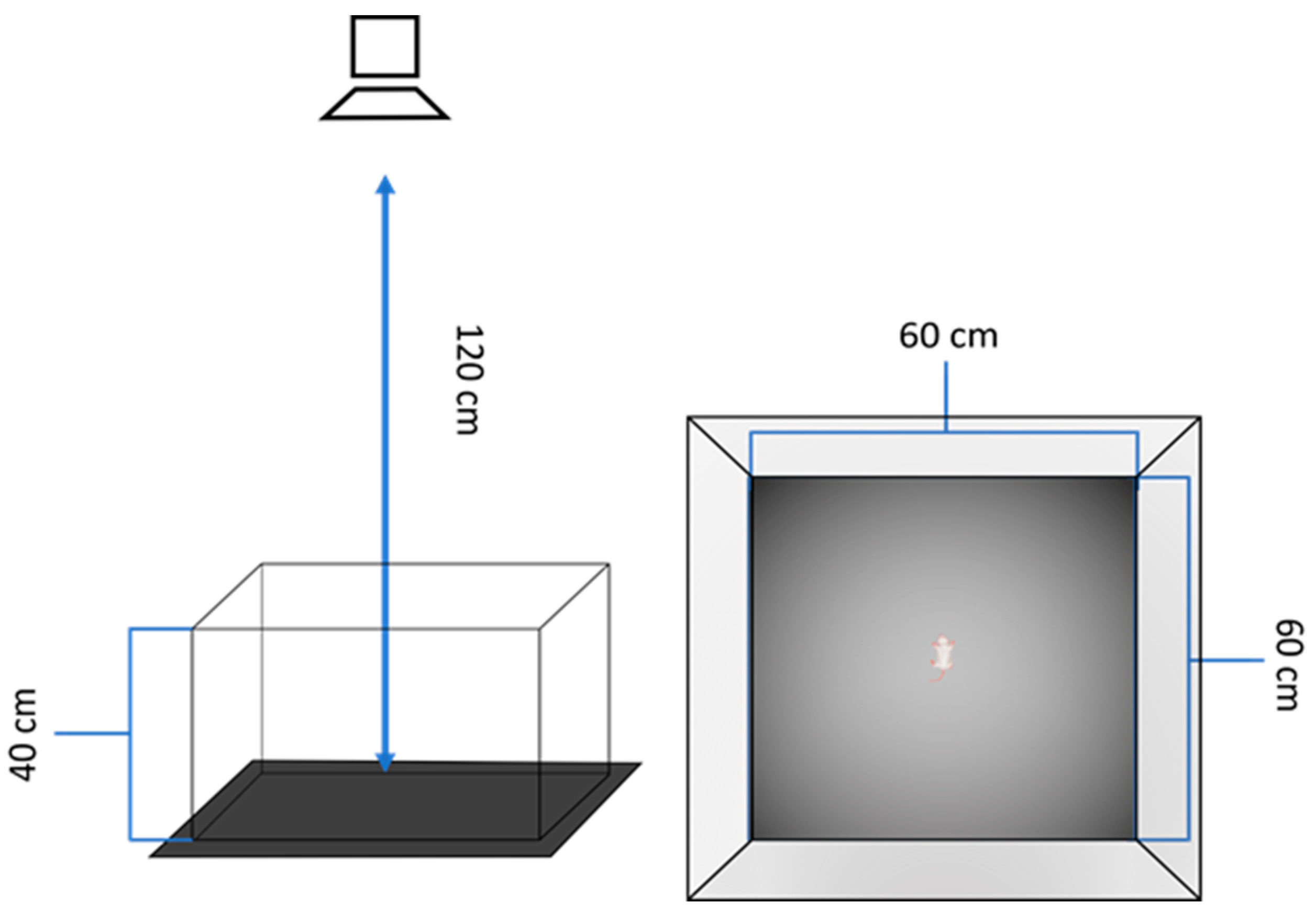
2.3. Open Field Test
2.4. Trajectory Analysis
2.4.1. Offline Tracking
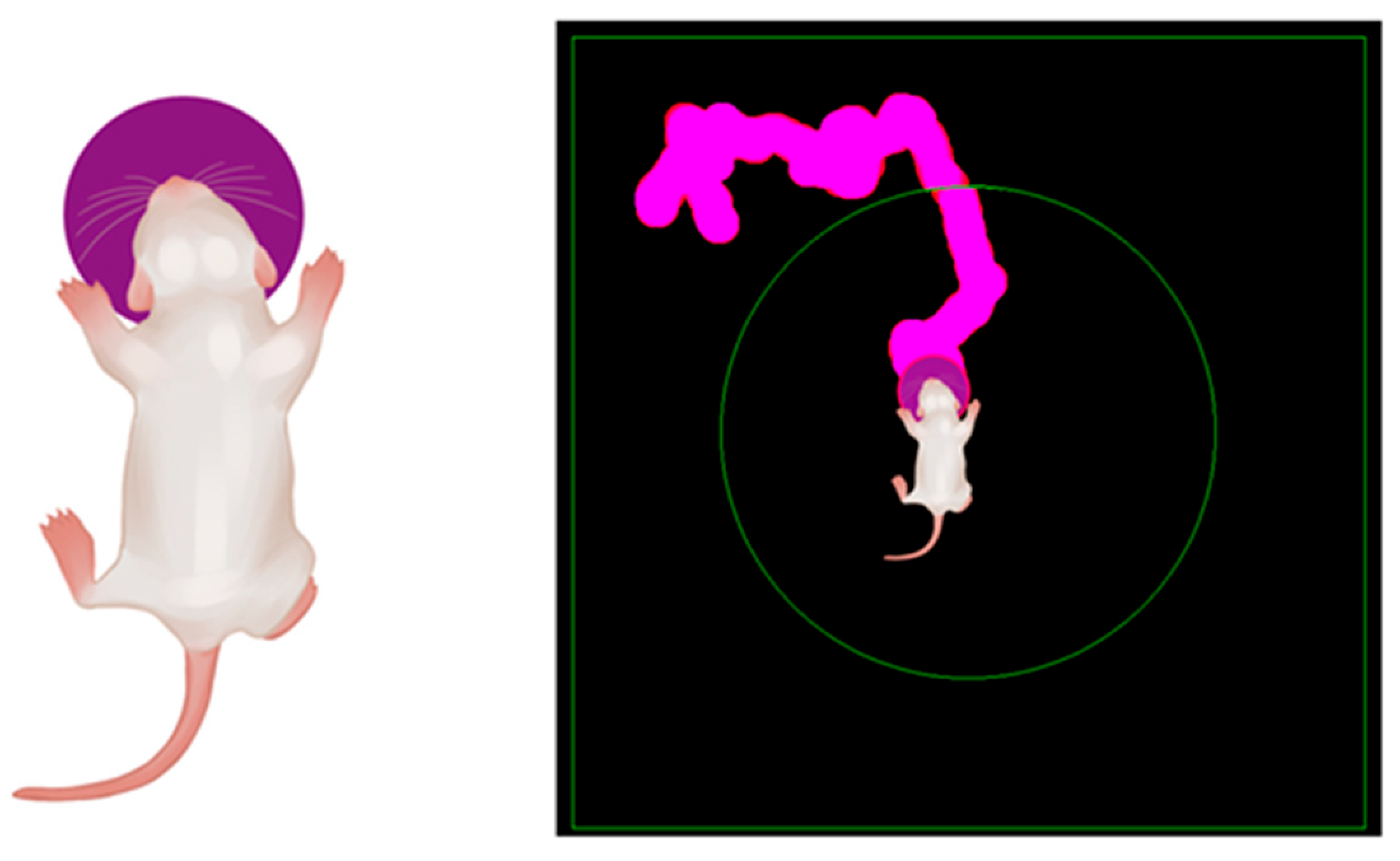
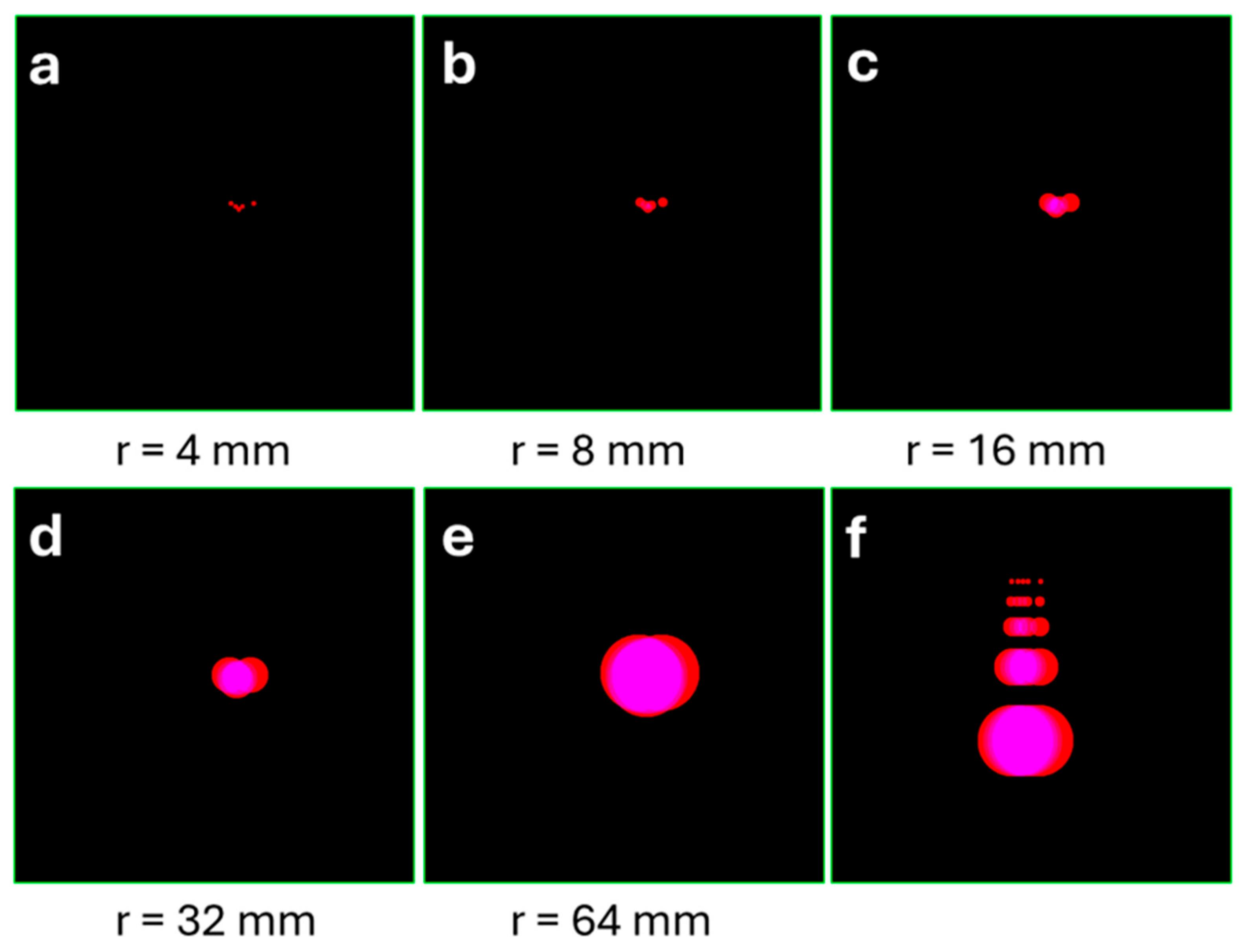
2.4.2. Trajectory Coating
2.5. Statistics
2.6. Use of AI Tools Declaration
3. Results
3.1. Gross Locomotor Parameters
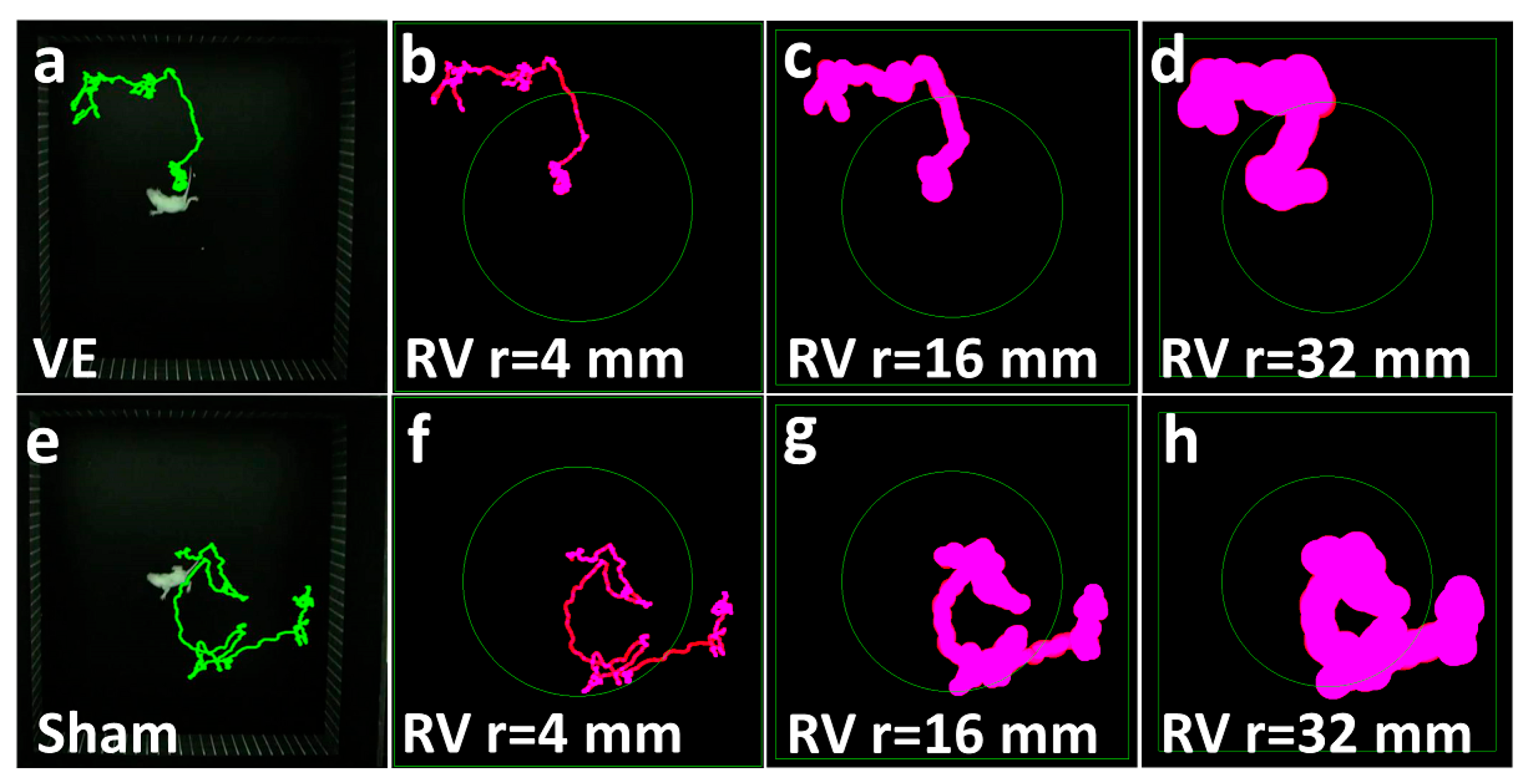
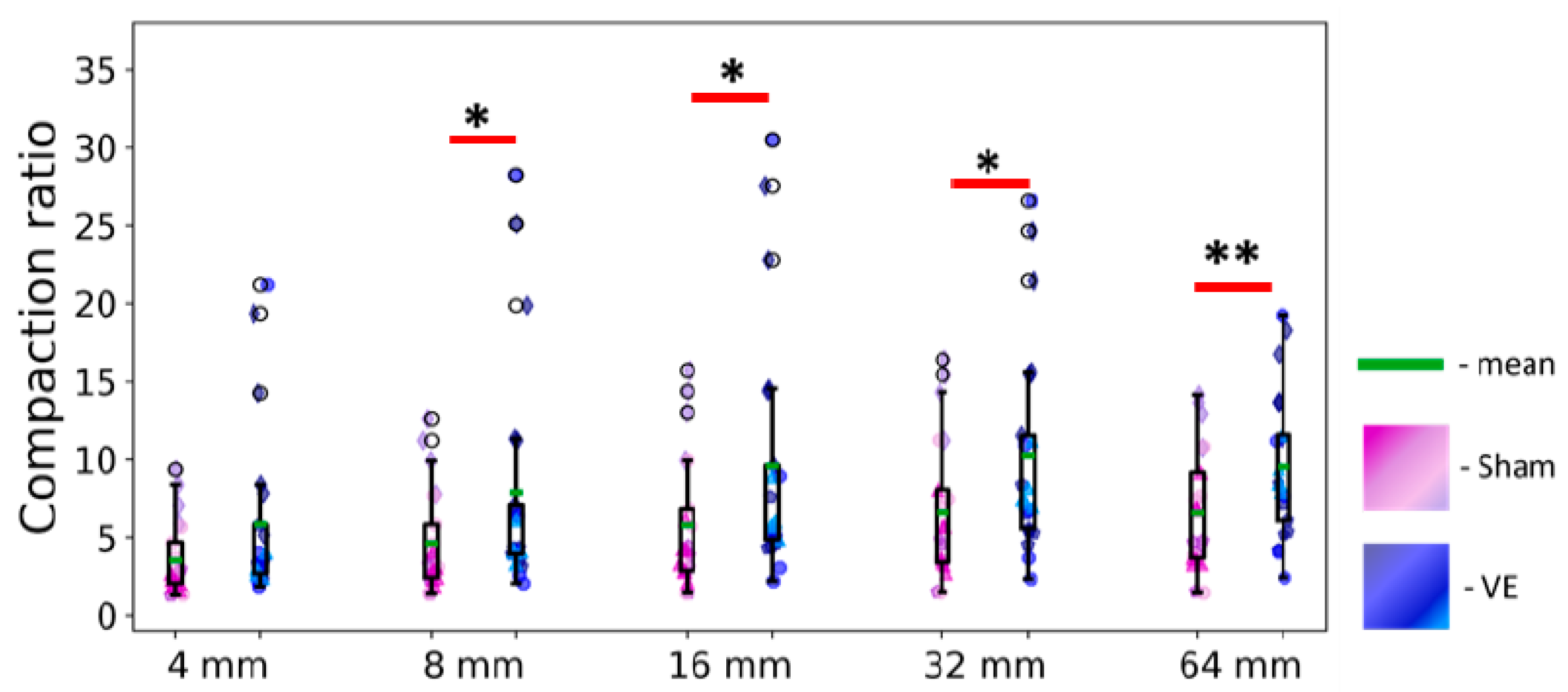
3.2. Compaction of Trajectories Within the Central Zone
4. Discussion
5. Limitations
6. Conclusions
Author Contributions
Funding
Institutional Review Board Statement
Informed Consent Statement
Data Availability Statement
Acknowledgments
Conflicts of Interest
Abbreviations
| ANOVA | Analysis of Variance |
| Cr | Compaction ratio |
| GLM | General Linear Model |
| IHNA & NPh, RAS | Institute of Higher Nervous Activity and Neurophysiology, Russian Academy of Sciences |
| PND | Postnatal Day |
| Rv | Radius of vibrissal length |
| VE | Vibrisectomy (whisker removal) |
References
- Morrison, A. Changing Concepts of the Nervous System. In Proceedings of the First Institute of Neurological Sciences Symposium in Neurobiology; Elsevier: Amsterdam, The Netherlands, 2012. [Google Scholar] [CrossRef]
- Solomon, P.; Leiderman, P.H.; Mendelson, J.; Wexler, D. Sensory deprivation; a review. Am. J. Psychiatry 1957, 114, 357–363. [Google Scholar] [CrossRef] [PubMed]
- Kubzansky, P.E.; Leiderman, P.H. Sensory deprivation: An overview. In Sensory Deprivation; Harvard University Press: Cambridge, MA, USA, 2013; pp. 221–238. [Google Scholar]
- Caras, M.L.; Sanes, D.H. Sustained perceptual deficits from transient sensory deprivation. J. Neurosci. 2015, 35, 10831–10842. [Google Scholar] [CrossRef]
- Hubel, D.H.; Wiesel, T.N. Receptive fields, binocular interaction and functional architecture in the cat’s visual cortex. J. Physiol. 1962, 160, 106–154. [Google Scholar] [CrossRef]
- Lee, L.J.; Chen, W.J.; Chuang, Y.W.; Wang, Y.C. Neonatal whisker trimming causes long-lasting changes in structure and function of the somatosensory system. Exp. Neurol. 2009, 219, 524–532. [Google Scholar] [CrossRef]
- Eilam, D.; Golani, I. The ontogeny of exploratory behavior in the house rat (Rattus rattus): The mobility gradient. Dev. Psychobiol. 1988, 21, 679–710. [Google Scholar] [CrossRef]
- Renner, M.J.; Pierre, P.J. Development of exploration and investigation in the Norway rat (Rattus norvegicus). J. Gen. Psychol. 1998, 125, 270–291. [Google Scholar] [CrossRef]
- Clarac, F.; Brocard, F.; Vinay, L. The maturation of locomotor networks. In Progress in Brain Research; Elsevier: Amsterdam, The Netherlands, 2004; Volume 143, pp. 57–66. [Google Scholar]
- Jamon, M.; Clarac, F. Early walking in the neonatal rat: A kinematic study. Behav. Neurosci. 1998, 112, 1218–1228. [Google Scholar] [CrossRef]
- Swann, H.E.; Brumley, M.R. Locomotion and posture development in immature male and female rats (Rattus norvegicus): Comparison of sensory-enriched versus sensory-deprived testing environments. J. Comp. Psychol. 2019, 133, 183–196. [Google Scholar] [CrossRef]
- Turchin, P. Fractal analyses of animal movement: A critique. Ecology 1996, 77, 2086–2090. [Google Scholar] [CrossRef]
- Bartumeus, F.; Levin, S.A. Fractal reorientation clocks: Linking animal behavior to statistical patterns of search. Proc. Natl. Acad. Sci. USA 2008, 105, 19072–19077. [Google Scholar] [CrossRef]
- Benhamou, S. How to reliably estimate the tortuosity of an animal’s path: Straightness, sinuosity, or fractal dimension? J. Theor. Biol. 2004, 229, 209–220. [Google Scholar] [CrossRef]
- Midzyanovskaya, I.S.; Rebik, A.A.; Idzhilova, O.S.; Smyk, F.S.; Strelkov, V.V.; Komarova, N.L.; Chichigina, O.A. Two modes in the absolute velocity statistics in cautious walks of laboratory rodents. Biophys. J. 2025, 124, 2708–2730. [Google Scholar] [CrossRef]
- Idzhilova, O.S.; Midzyanovskaya, I.S.; Strelkov, V.V.; Komarova, N.L.; Chichigina, O.A. Pros and cons of group averaging in studies of stochastic rodent locomotion. Chaos Solitons Fractals 2025, 201, 117381. [Google Scholar] [CrossRef]
- Midzyanovskaya, I.S.; Strelkov, V.V. Measuring locomotor strategies of freely moving previsual rat pups. Behav. Process. 2022, 203, 104780. [Google Scholar] [CrossRef]
- Golani, I. The developmental dynamics of behavioral growth processes in rodent egocentric and allocentric space. Behav. Brain Res. 2012, 231, 309–316. [Google Scholar] [CrossRef]
- Golani, I.; Benjamini, Y.; Eilam, D. Stopping behavior: Constraints on exploration in rats (Rattus norvegicus). Behav. Brain Res. 1993, 53, 21–33. [Google Scholar] [CrossRef]
- Drai, D.; Benjamini, Y.; Golani, I. Statistical discrimination of natural modes of motion in rat exploratory behavior. J. Neurosci. Methods 2000, 96, 119–131. [Google Scholar] [CrossRef]
- Fox, K. A critical period for experience-dependent synaptic plasticity in rat barrel cortex. J. Neurosci. 1992, 12, 1826–1838. [Google Scholar] [CrossRef] [PubMed]
- Erzurumlu, R.S.; Kind, P.C. Neural activity: Sculptor of ‘barrels’ in the neocortex. Trends Neurosci. 2001, 24, 589–595. [Google Scholar] [CrossRef] [PubMed]
- Sullivan, R.M.; Landers, M.S.; Flemming, J.; Vaught, C.; Young, T.A.; Polan, H.J. Characterizing the functional significance of the neonatal rat vibrissae prior to the onset of whisking. Somatosens. Mot. Res. 2003, 20, 157–162. [Google Scholar] [CrossRef]
- Grant, R.A.; Mitchinson, B.; Prescott, T.J. The development of whisker control in rats in relation to locomotion. Dev. Psychobiol. 2012, 54, 151–168. [Google Scholar] [CrossRef]
- Simons, D.J.; Land, P.W. Early experience of tactile stimulation influences organization of somatic sensory cortex. Nature 1987, 326, 694–697. [Google Scholar] [CrossRef] [PubMed]
- Shoykhet, M.; Land, P.W.; Simons, D.J. Whisker trimming begun at birth or on postnatal day 12 affects excitatory and inhibitory receptive fields of layer IV barrel neurons. J. Neurophysiol. 2005, 94, 3987–3995. [Google Scholar] [CrossRef]
- Papaioannou, S.; Brigham, L.; Krieger, P. Sensory deprivation during early development causes an increased exploratory behavior in a whisker-dependent decision task. Brain Behav. 2013, 3, 24–34. [Google Scholar] [CrossRef]
- Smirnov, K.; Tsvetaeva, D.; Sitnikova, E. Neonatal whisker trimming in WAG/Rij rat pups causes developmental delay, encourages maternal care and affects exploratory activity in adulthood. Brain Res. Bull. 2018, 140, 120–131. [Google Scholar] [CrossRef]
- Shishelova, A.Y. Effect of whisker removal on defensive behavior in rats during early ontogenesis. Neurosci. Behav. Physiol. 2006, 36, 883–888. [Google Scholar] [CrossRef]
- Carvell, G.; Simons, D. Abnormal tactile experience early in life disrupts active touch. J. Neurosci. 1996, 16, 2750–2757. [Google Scholar] [CrossRef]
- Rodriguez, A.; Zhang, H.; Klaminder, J.; Brodin, T.; Andersson, P.L. ToxTrac: A fast and robust software for tracking organisms. Methods Ecol. Evol. 2018, 9, 460–464. [Google Scholar] [CrossRef]
- Rodriguez, A.; Zhang, H.; Klaminder, J.; Brodin, T.; Andersson, P.L. ToxId: An efficient algorithm to solve occlusions when tracking multiple animals. Sci. Rep. 2017, 7, 14774. [Google Scholar] [CrossRef] [PubMed]
- Smirnov, K.; Sitnikova, E. Developmental milestones and behavior of infant rats: The role of sensory input from whiskers. Behav. Brain Res. 2019, 374, 112143. [Google Scholar] [CrossRef]
- Shishelova, A.Y.; Raevskii, V.V. Effects of vibrissectomy during early postnatal ontogenesis in rat pups on behavioral development. Neurosci. Behav. Physiol. 2010, 40, 671–677. [Google Scholar] [CrossRef]
- Martes, A.C.; Bozeman, A.L.; Doell, J.; Dunn, A.C.; Reiserer, R.S.; Malkova, L.; Flynn, M.R.; Cramer, C.P. Developmental changes in locomotion and sensorimotor reflexes following spinal cord transection. Dev. Psychobiol. 2024, 66, e22558. [Google Scholar] [CrossRef]
- Drai, D.; Kafkafi, N.; Benjamini, Y.; Elmer, G.; Golani, I. Rats and mice share common ethologically relevant parameters of exploratory behavior. Behav. Brain Res. 2001, 125, 133–140. [Google Scholar] [CrossRef] [PubMed]
- Abbas, W.; Masip Rodo, D. Computer methods for automatic locomotion and gesture tracking in mice and small animals for neuroscience applications: A survey. Sensors 2019, 19, 3274. [Google Scholar] [CrossRef]
- Barrett, J.M.; Martin, M.E.; Shepherd, G.M.G. Manipulation-specific cortical activity as mice handle food. Curr. Biol. 2022, 32, 4842–4853. [Google Scholar] [CrossRef]
- Altman, J.; Sudarshan, K. Postnatal development of locomotion in the laboratory rat. Anim. Behav. 1975, 23, 896–920. [Google Scholar] [CrossRef]
- Clarac, F.; Vinay, L.; Cazalets, J.R.; Fady, J.C.; Jamon, M. Role of gravity in the development of posture and locomotion in the neonatal rat. Brain Res. Rev. 1998, 28, 35–43. [Google Scholar] [CrossRef]
- Ni, Z.; Neifert, C.; Rosete, A.; Alcover, D.C.; Chen, Y.; Jones, L.; Ginty, D.D. Tactile mechanisms and afferents underlying the rat pup transport response. Curr. Biol. 2024, 34, 5595–5601. [Google Scholar] [CrossRef]
- Varejão, A.S.P.; Filipe, V.M. Contribution of cutaneous inputs from the hindpaw to the control of locomotion in rats. Behav. Brain Res. 2007, 176, 193–201. [Google Scholar] [CrossRef]
- Wilson, C.; Nungaray, K.; Garza, M.; Sanchez, M. Sit down and stay here! Transport response elicitation modulates subsequent activity in rat pups. Behav. Process. 2008, 77, 131–134. [Google Scholar] [CrossRef]



| VE (N = 21) | Sham (N = 21) | Effect | F | p-Level | |
|---|---|---|---|---|---|
| Total distance, mm | 1507 ± 144 | 1829 ± 189 | litter | F(3,41) = 18.8 | p < 0.001 |
| VE | ns | ||||
| litter × VE | ns | ||||
| Average speed, mm/s | 11.3 ± 1.1 | 13.9 ± 1.5 | litter | F(3,41) = 18.0 | p < 0.001 |
| VE | ns | ||||
| litter × VE | ns | ||||
| Average acceleration, mm/s2 | 13.5 ± 1.2 | 15.4 ± 1.4 | litter | F(3,41) = 15.6 | p < 0.001 |
| VE | ns | ||||
| litter × VE | ns | ||||
| Frozen time, s | 12.7 ± 4.6 | 8.3 ± 2.8 | litter | F(3,41) = 6.5 | p < 0.001 |
| VE | ns | ||||
| litter × VE | ns |
| R, mm | Cr (VE) | Cr (Sham) | Effect | F | p-Level | Eta-Squared | BH Correction |
|---|---|---|---|---|---|---|---|
| Mean ± SEM | Mean ± SEM | ||||||
| 4 | 5.9 ± 1.2 | 3.6 ± 0.5 | litter | F(3,41) = 6.0 | 0.002 | 0.35 | |
| VE | ns | ||||||
| litter × VE | ns | ||||||
| 8 | 7.9 ± 1.6 | 5.6 ± 0.7 | litter | F(3,41) = 6.5 | 0.001 | 0.37 | |
| VE | F(1,41) = 4.4 | 0.04 | 0.11 | ||||
| litter × VE | ns | 0.04 | |||||
| 16 | 9.6 ± 1.7 | 5.8 ± 0.9 | litter | F(3,41) = 8.7 | 0.0002 | 0.44 | |
| VE | F(1,41) = 5.2 | 0.03 | 0.14 | 0.03 | |||
| litter × VE | ns | ||||||
| 32 | 10.3 ± 1.5 | 6.6 ± 1.0 | litter | F(3,41) = 11.6 | 0.0002 | 0.51 | |
| VE | F(1,41) = 6.6 | 0.02 | 0.17 | 0.02 | |||
| litter × VE | ns | ||||||
| 64 | 9.6 ± 1.0 | 6.6 ± 0.9 | litter | F(3,41) = 13.0 | 0.00001 | 0.54 | |
| VE | F(1,41) = 8.0 | 0.008 | 0.19 | 0.01 | |||
| litter × VE | ns |
Disclaimer/Publisher’s Note: The statements, opinions and data contained in all publications are solely those of the individual author(s) and contributor(s) and not of MDPI and/or the editor(s). MDPI and/or the editor(s) disclaim responsibility for any injury to people or property resulting from any ideas, methods, instructions or products referred to in the content. |
© 2026 by the authors. Licensee MDPI, Basel, Switzerland. This article is an open access article distributed under the terms and conditions of the Creative Commons Attribution (CC BY) license.
Share and Cite
Odrinskaya, M.; Strelkova, E.; Rebik, A.; Aleksandrov, P.; Midzyanovskaya, I. Tactile Sensory Deprivation Impairs Spatial but Not Motor Behavior in Freely Moving Previsual Rat Pups. Biomechanics 2026, 6, 32. https://doi.org/10.3390/biomechanics6020032
Odrinskaya M, Strelkova E, Rebik A, Aleksandrov P, Midzyanovskaya I. Tactile Sensory Deprivation Impairs Spatial but Not Motor Behavior in Freely Moving Previsual Rat Pups. Biomechanics. 2026; 6(2):32. https://doi.org/10.3390/biomechanics6020032
Chicago/Turabian StyleOdrinskaya, Mariya, Elizaveta Strelkova, Anastasia Rebik, Pavel Aleksandrov, and Inna Midzyanovskaya. 2026. "Tactile Sensory Deprivation Impairs Spatial but Not Motor Behavior in Freely Moving Previsual Rat Pups" Biomechanics 6, no. 2: 32. https://doi.org/10.3390/biomechanics6020032
APA StyleOdrinskaya, M., Strelkova, E., Rebik, A., Aleksandrov, P., & Midzyanovskaya, I. (2026). Tactile Sensory Deprivation Impairs Spatial but Not Motor Behavior in Freely Moving Previsual Rat Pups. Biomechanics, 6(2), 32. https://doi.org/10.3390/biomechanics6020032