Article

Nano-Enhanced Binary Eutectic PCM with SiC for Solar HDH Desalination Systems

Department of Thermal Energy Storage, Iberian Centre for Research in Energy Storage CIIAE, 10003 Caceres, Spain
*
Author to whom correspondence should be addressed.
Nanoenergy Adv. 2026, 6(1), 4; https://doi.org/10.3390/nanoenergyadv6010004
Submission received: 28 November 2025 / Revised: 17 December 2025 / Accepted: 22 December 2025 / Published: 9 January 2026
(This article belongs to the Special Issue Innovative Materials for Renewable and Sustainable Energy Systems)

Abstract

Freshwater scarcity is increasing day by day and has already reached a threatening level, especially in remotely populated areas. One of the technological solutions to this rising concern could be the use of the solar-based humidification–dehumidification (SHDH) method for water desalination. This technology is a promising solution but has challenges such as solar intermittency. This challenge can be solved by integrating SHDH with the phase change material as a solar energy storage medium. Therefore, a novel nano-enhanced binary eutectic phase change material (NEPCM) was developed in this project. PCM consisting of 70 wt.% stearic acid (ST) and 30 wt.% suberic acid (SBU) with a varying concentration of silicon carbide (SiC) nanoparticles (NPs) (0.1 to 3 wt.%) was synthesized specifically considering the need of SHDH application. The systematic thermophysical characterization was conducted to investigate their energy storage capacity, thermal durability, and performance consistency over repeated cycles. DSC analysis revealed that the addition of SiC NPs preserved the thermal stability of the NEPCM, while the phase transition temperature remained nearly unchanged with a variation of less than 0.74%. The value of latent heat is inversely related to the nanoparticle concentration, i.e., from 142.75 kJ/kg for the base PCM to 131.24 kJ/kg at 3 wt.% loading. This corresponds to reductions in latent heat ranging between 0.98% and 8.06%. The FTIR measurement confirms that no chemical reactions or no new functional groups were formed. All original functional groups of ST and SBU remained intact, showing that incorporating the SiC NP to the PCM lead to physical interactions (e.g., hydrogen bonding or surface adsorption). The TGA analysis showed that the SiC NPs in the NEPCM act as supporting material, and its nano-doping enhanced the final degradation temperature and thermal stability. There was negligible change in thermal conductivity for nanoparticle loadings of 0.1% and 0.4%; however, it increased progressively by 5.2%, 10.8%, 23.12%, and 25.8% at nanoparticle loadings of 0.7%, 1%, 2%, and 3%, respectively, at 25 °C. Thermal reliability was analyzed through a DSC thermal cycling test which confirmed the suitability of the material for the desired applications.

1. Introduction

Energy conservation emerged as a major concern following early energy shortages and has gained renewed urgency today as the gap between production and demand continues to widen [1]. Fossil fuels remain the dominant energy source across various sectors; however, their limited availability and environmental concerns have driven global attention toward the effective utilization of renewable sources and the development of advanced heat reserve materials [2,3,4,5]. With continued economic growth and increasing population, the world faces a persistent energy crisis alongside critical challenges such as freshwater scarcity, rising energy consumption, food shortages, and climate change [6,7]. Among these, the shortage of clean water is particularly pressing, as sustainable development depends heavily on reliable water resources for human consumption, agriculture, industry, and scientific advancement [8]. Current trends indicate that global water demand is rising by approximately 1% annually, driven by urbanization and industrialization, and water scarcity is expected to emerge as one of the most severe challenges facing humanity in the coming decades [9]. According to UN Water (2016), 97% of Earth’s water is saline, and only about 1% of the remaining 3% freshwater is readily accessible, leaving over 1 billion people without safe drinking water and nearly 2.3 billion (41% of the global population) facing water scarcity [10]. The abundance of saline water resources, including seawater and brackish water, has made desalination a crucial approach for producing potable water worldwide.
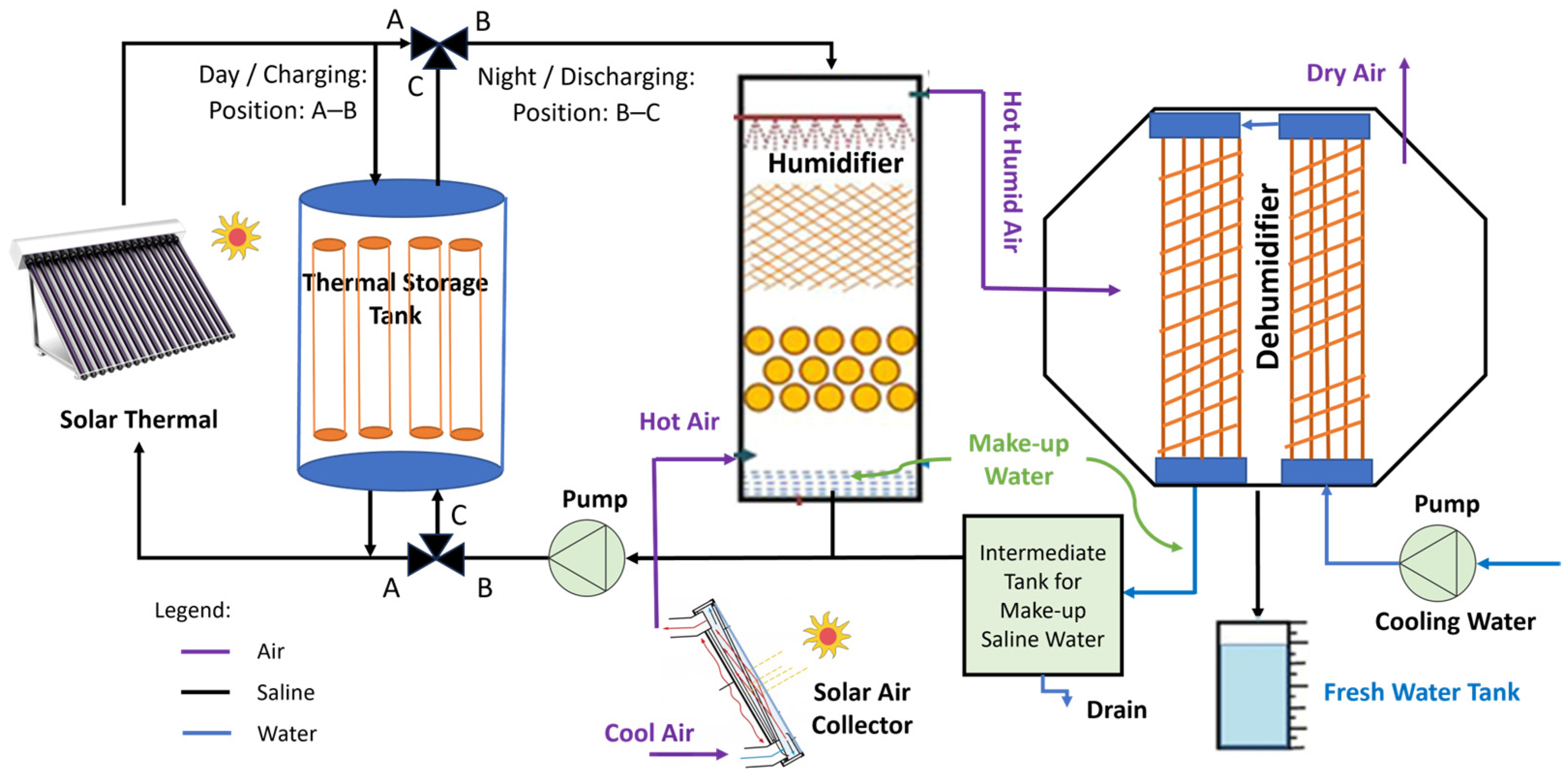
Among the available technologies, solar desalination, and particularly solar-based humidification–dehumidification (SHDH), systems stand out as a potential solution owing to their operation at low temperatures, modular configuration, and suitability for regions with high solar irradiance. These systems provide a sustainable and decentralized means to mitigate water scarcity, especially for off-grid rural communities and agricultural uses [11]. Nevertheless, a major drawback of current solar HDH systems lies in their intermittent operation, as productivity is largely restricted to daylight hours. This limitation undermines their reliability and prevents continuous 24 h water supply, which is critical in remote and water-scarce regions. To address this challenge, the incorporation of thermal energy storage (TES) systems is regarded as a crucial strategy, enabling round-the-clock desalination and significantly improving system dependability. The operational principle of the solar-based humidification–dehumidification (SHDH) desalination system, integrated with thermal energy storage (TES), is illustrated in Figure 1.
Solar thermal collectors preheat the saline feedwater, which enters the humidifier and is sprayed over packing material to maximize the effective contact surface area for hot, dry air delivered by the solar air collector. This enhances evaporation and produces hot, humid air rich in water vapour. The moist air then flows to the dehumidifier, where vapour condenses on a cooled surface, yielding freshwater collected in a storage tank. Simultaneously, saline water serves as the cooling medium, absorbing heat from the humid air before being stored in an intermediate tank. This warmed stream is mixed with the brine leaving the humidifier and recirculated to the solar collector, completing the closed-loop cycle.
The integration of TES ensures continuous operation. During the charging phase (daytime), the three-way valve remains in position A–B, enabling direct heating by solar energy. During the discharging phase (night-time), the valve is switched to position B–C, allowing the TES to supply the required thermal input. This arrangement facilitates uninterrupted, 24 h operation of the SHDH desalination system.
The energy storage technologies represent an impactful approach to overcoming the worldwide energy challenge, with wide-ranging applications in peak-load shifting and during off sun period hours to remove intermittent operations [12,13]. The accumulation of energy in the form of latent heat gained considerable interest due to its ability to accumulate large amounts of energy, exhibit excellent material durability, and ensure operational safety [14,15]. Phase change materials (PCMs) are widely employed for latent heat storage, as they are capable of storing and releasing thermal energy at nearly constant temperatures during phase transition. Fatty acids, in particular, have emerged as promising PCMs owing to their suitable melting temperature range, high latent heat, non-toxicity, non-corrosive nature, low degree of supercooling, excellent thermal reliability, and abundance as readily available raw materials. These attributes make fatty acids highly attractive for sustainable TES applications [16]. The use of single pure PCMs is often limited, as their inherent thermal properties make it challenging to achieve the desired phase transition temperature for specific solar thermal applications. To address this limitation, eutectic PCMs are developed by combining two or more components—organic, inorganic, or both—in fixed proportions that allow them to melt and solidify at a sharp and predictable temperature. These eutectic PCMs not only provide greater flexibility in tailoring phase transition temperatures but also exhibit synergistic effects that improve thermal performance and reliability in energy storage systems [17]. Consequently, the progressive improvement of eutectic PCMs strengthens the potential of energy accumulation for various practical applications, offering engineers greater flexibility in material selection and driving continuous improvements in solar TES technologies.
Sari et al. employed a PMMA shell to encapsulate a prepared binary mixture of myristic and palmitic acid and investigated its thermal behaviour, obtaining a transition temperature and enthalpy value of 38.2 °C and a 100.4 kJ/kg. TGA analysis confirmed stability up to 250 °C, and the material retained its chemical integrity even after 5000 thermal cycles [18]. Jebasingh et al. synthesized a binary mixture by combining capric and myristic acid as pure PCM. The resulting prepared eutectic PCM displayed a latent heat and transition temperature of 156.99 kJ/kg and 20.86 °C, respectively, indicating its strong energy storage potential. Despite its relatively less thermal conductivity (λ) of 0.153 W/m∙K, the material exhibited remarkable thermal and chemical stability [19]. In contrast, Hassan et al. synthesized a binary PCM for elevated temperature storage operations by mixing calcium chloride and lithium chloride in a specific ratio of (58:42 wt.%). This PCM exhibited a transition temperature of 480 °C and enthalpy of 206 J/g. However, the decomposition of the prepared salts led to poor thermal stability and fluctuating latent heat under repeated cycling, limiting long-term performance [20].
Although organic PCMs possess excellent TES properties, their practical application in TES systems is often hindered by their inherently low thermal conductivity (λ). This limitation restricts the rate of heat transfer during charging and discharging processes, thereby reducing the overall efficiency and responsiveness of the storage system, particularly in applications requiring rapid thermal management. To overcome this limitation, several enhancement strategies have been explored, including micro and nano-encapsulation [21], incorporation of fins and metal scrap [22], foam stabilization [23,24], nano dispersion [25], etc. Among these methods, incorporating nanoparticles (NPs) uniformly into the eutectic matrix, known as nano-enhancement, has been especially effective, resulting in notable increases in λ.
A wide range of nanoparticles have been investigated as thermal enhancers for organic phase change materials, including metal oxides (Al2O3, CuO, TiO2, ZnO), carbon-based nanomaterials (graphene, carbon nanotubes, expanded graphite), and ceramic nanoparticles (SiO2, AlN, SiC). While these additives can improve thermal conductivity, their effectiveness is often limited by issues such as chemical reactivity, agglomeration, reduced latent heat, or long-term stability during repeated thermal cycling [26]. Among these options, silicon carbide (SiC) nanoparticles were specifically chosen as thermal enhancers due to their exceptionally high thermal conductivity, which effectively compensates for the low conductivity of organic PCMs and enhances heat charging–discharging rates. Their strong thermal and chemical stability ensures compatibility with fatty-acid-based eutectics, preventing degradation during repeated cycles [27,28]. In addition, SiC provides a high surface area that improves interfacial heat transfer and promotes nucleation, thereby helping to minimize supercooling.
For instance, Jacob et al. developed a nano-embedded binary PCM composed of paraffin wax and palmitic acid, which was reinforced with TiO2 NPs. By the integration of 0.5 wt.% NPs, the λ increased by a factor of 2.3, alongside a 17% enhancement in latent heat and a high chemical stability after the 500th thermal cycle [29]. Similarly, Aslfattahi et al. investigated the incorporation of MXene nanocomposites into a PCM, reporting a 39% increase in λ and a 43% improvement in specific heat capacity at 0.3 wt.% NPs [30]. Additionally, the decomposition temperature improved by 6%, further supporting the suitability of MXene-enhanced PCMs for TES applications. Agrawal et al. prepared a nano-enhanced binary PCM composed of palmitic acid and stearic acid, incorporating different concentrations of CuO NPs [25]. The study reported a maximum improvement in λ of 118% at a NP loading of 3 wt.%. In a related study, Baskar et al. formulated a eutectic PCM of lauric and palmitic acid enhanced with SiO2 NPs [31]. The incorporation of these NPs led to a substantial 54.3% improvement in λ, thereby facilitating faster heat transfer. Importantly, the addition of nano-SiO2 had little effect on the transition temperature, although a minor reduction in latent heat was observed, which could slightly affect the total energy storage capacity. Saeed et al. proposed a novel eutectic PCM consisting of methyl palmitate and lauric acid, further modified with nano-graphene platelets. At a NPs loading of 10 wt.%, the system achieved an impressive 102.2% increase in λ, coupled with a 52% enhancement in specific heat capacity [32]. These improvements not only accelerated the charging and discharging rates but also significantly boosted the material’s overall heat storage efficiency, demonstrating the potential of graphene-based nanostructures in advancing PCM performance. Bharathiraja et al. investigated a hybrid nano-enhanced paraffin wax system containing multiwalled carbon nano tubes (MWCNTs) and nano-SiO2 [33]. With 1 wt.% of each NPs, the composite exhibited a 46% enhancement in λ values, though with a marginal reduction in latent heat. Kalidasan et al. enhanced a eutectic PCM, composed of sodium sulphate and sodium phosphate dibasic dodecahydrate, by incorporating expanded graphite as a λ modifier [34]. The base eutectic mixture exhibited a melting point of 27.8 °C and a latent heat of 207.8 J/g, making it suitable for low-temperature TES applications. With the addition of expanded graphite, the material not only showed a marked reduction in supercooling, thereby improving phase change reliability, but also demonstrated a significant increase in optical absorption capacity. Most notably, λ improved by 88.7%, ensuring faster charging and discharging rates and greater overall efficiency.
Zhang et al. performed an experimental investigation by incorporating paraffin wax as a phase change material (PCM) in a humidification–dehumidification (HDH) solar desalination system with active and passive air circulation, aiming to recover the latent heat of condensation and enhance freshwater production [35]. Their results showed an 84.4% increase in water yield compared to a conventional system without PCM, achieving a gain output ratio of 13.37 and a freshwater cost of 23.47 Yuan t−1. Vijayakumar et al. performed an experimental study to enhance the performance of solar distillation systems by integrating a humidification–dehumidification (HDH) unit and incorporating paraffin wax as a phase change material (PCM) into a passive solar still [36]. The modified stepped solar still demonstrated improved thermal performance and enabled more continuous freshwater production during daytime operation. Experimental results showed that the inclusion of PCM in the stepped solar still with HDH increased distilled water productivity by approximately 84.4% compared to a stepped solar still equipped with HDH alone. Table 1 shows the thermal characteristics of various PCMs.
The reviewed literature highlights the potential of nano-enhancement in organic PCMs using either single NPs or hybrid NPs composites. However, PCMs specifically suitable for the operating temperature range of SHDH desalination systems (65–70 °C) remain under-investigated. To bridge this research gap, the current study investigates TES materials tailored for SHDH applications. The core objective is to formulate a novel nano-enhanced binary eutectic PCM consisting of 70 wt.% stearic acid and 30 wt.% suberic acid, with varying loadings of silicon carbide (SiC) NPs at concentrations of 0.1, 0.4, 0.7, 1, 2, and 3 wt.%.

2. Methodology

2.1. Materials

Stearic acid (ST, 95% purity) and suberic acid (SBU, 95% purity) were procured from Merck Co., Ltd. and used as the primary organic PCMs in this study. ST is a long-chain saturated fatty acid with the chemical formula C18H36O2 and a molecular weight of 284.48 g/mol, melting temperature (Tmelt) of 72.3 °C and appears as a white, waxy solid. SBU, a dicarboxylic acid with the chemical formula C8H14O4, a molecular weight of 174.19 g/mol, and a high melting temperature of 144.07 °C, characterized as an off-white crystalline powder. In addition, silicon carbide (SiC, 99% purity) NPs of 50 nm were acquired from Merck Life Science SLU, Madrid, Spain.

2.2. Development of Eutectic PCM and Nano-Embedded Eutectic PCM

The eutectic PCM is formulated by using two different types of pure PCMs (ST and SBU) in a weight ratio of 70:30, as measured using an electronic weighing balance. The optimal weight ratio for preparing the binary eutectic mixture was established using Schröder’s equation, an empirical relation commonly applied to predict the melting temperature of eutectic systems composed of two components. The mathematical form of Schröder’s equation [46,47] is given as Equation (1).
ln x n = Δ H n R ( 1 T melt 1 T n ) , where n = component A or B
Here, Tmelt refers to the transition temperature associated with the prepared mixture, while Tn represents the transition temperature of each individual component n, R is universal gas constant, and ΔHn indicates the corresponding latent heat of that component. After the complete melting and uniform mixing of the ST–SBU eutectic PCM, a nano-embedded eutectic PCM was synthesized by dispersing SiC NPs as the supporting material. The objective is to study the impact of NPs concentration in the thermophysical characterization of nano-PCMs. A total of seven samples were synthesized—one without NPs (as control sample) and six with NP concentrations of 0.1, 0.4, 0.7, 1.0, 2.0, and 3.0 wt.%.
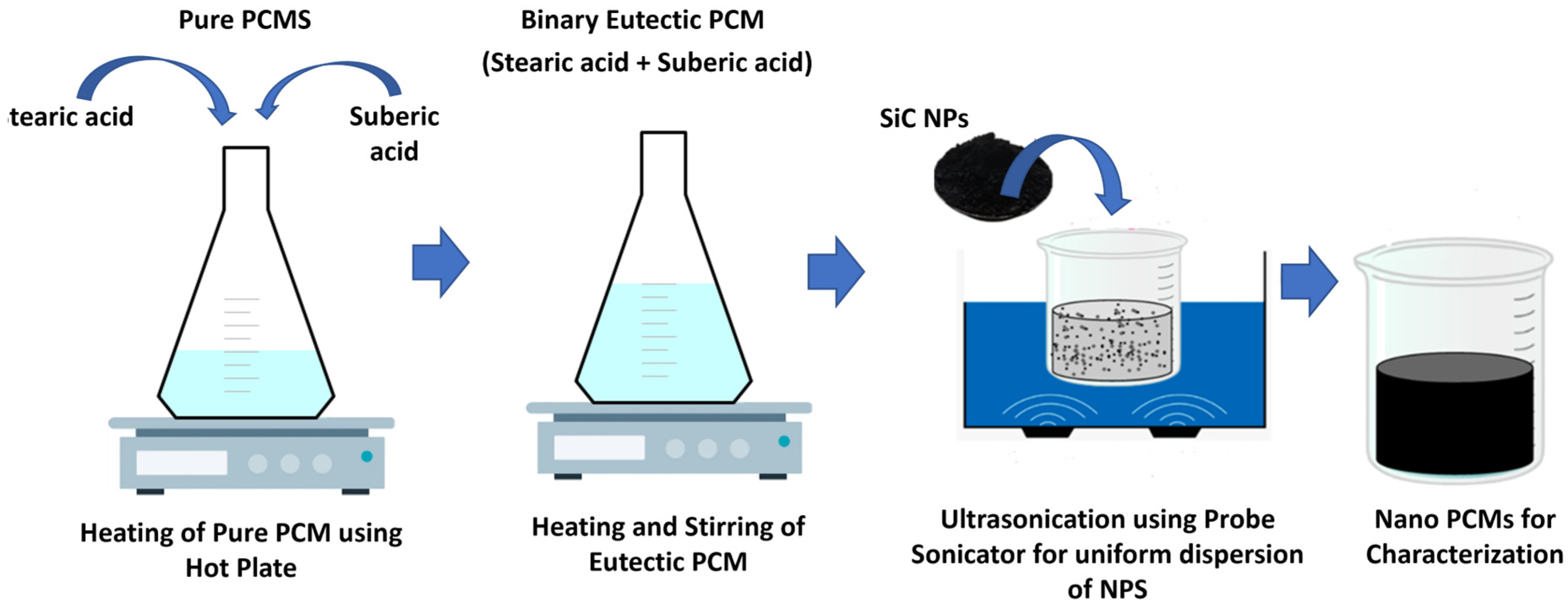
A two-stage methodology was employed to prepare the nano-PCM. In the first stage, preliminary mixing was carried out at 110 °C for 30 min at 500 RPM in a liquid state using a magnetic stirrer equipped with a hot plate, ensuring a uniform dispersion of NPs throughout the medium. In the second stage, the dispersion was further refined using an ultrasonic bath at 90 °C for 4 h to achieve homogeneous nanoparticle distribution. The schematic of this preparation process is illustrated in Figure 2.
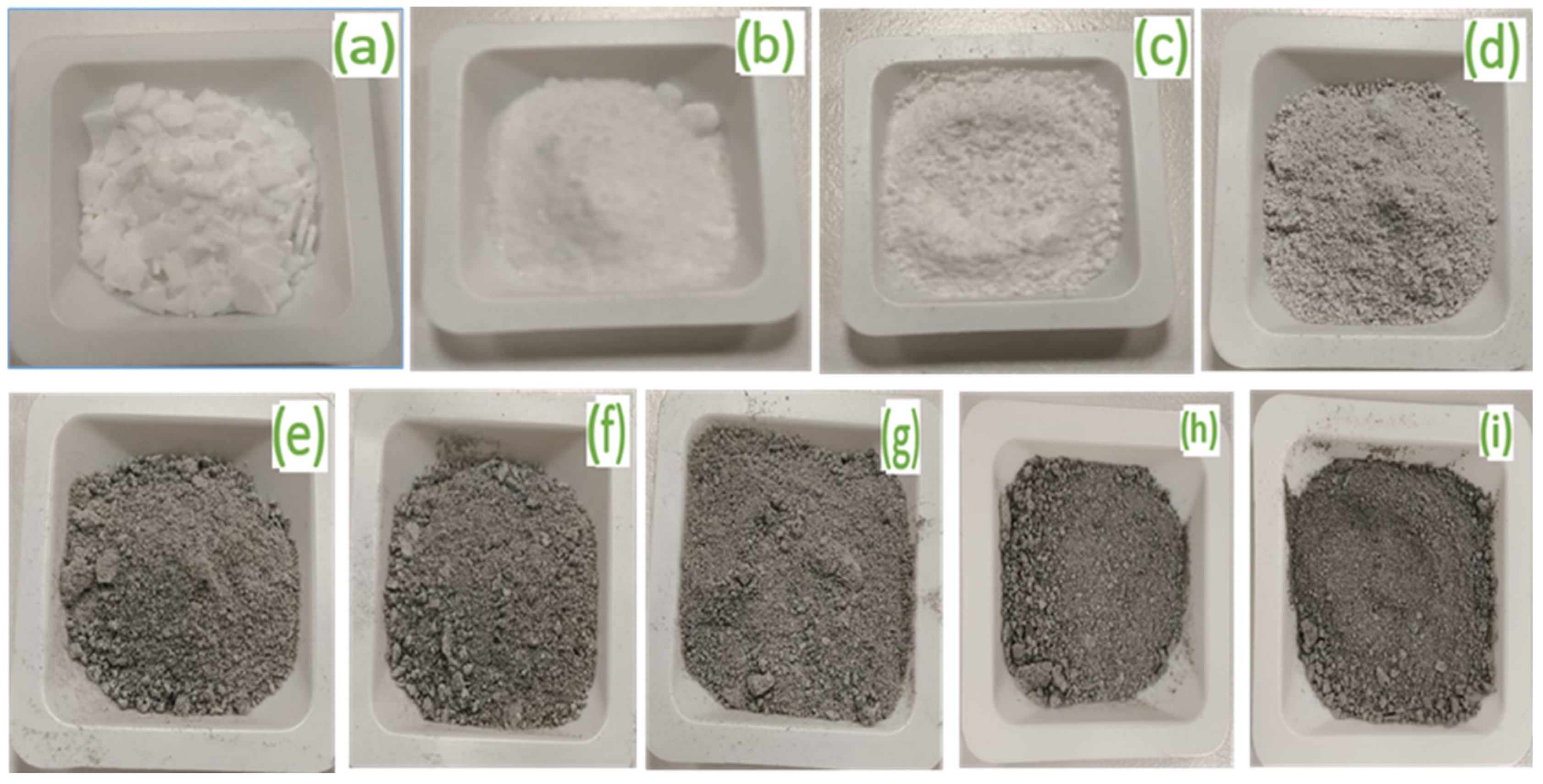
The sonication process plays an important role in achieving the uniform scattering of the NPs within the base PCM. The bath sonication was always encouraged to set above the transition temperature of the eutectic mixture to ensure its liquid phase throughout the process. Figure 3 presents the pictorial representations of pure PCM, binary eutectic and nano-enhanced PCMs.

3. Material Characterization

A series of advanced material characterization techniques were employed to evaluate the thermal behaviour and structural properties of the prepared eutectic and composite PCMs. The Differential Scanning Calorimeter (DSC, Discovery model no. DSC25 from TA Instrument, Barcelona, Spain) was used to determine the key thermal parameters, including latent heat, melting point, and sub-cooling, which are critical for assessing the suitability of the material for TES applications. All samples were tested using nitrogen atmosphere and the temperature range selected for measurement is between 30 and 100 °C for heating and 100 °C to 30 °C for cooling at a constant heating/cooling rate of 10 °C/min. The three measurements of each sample were carried out to ensure the consistency and accurate results of the measurement and the mean values obtained from multiple measurements were analyzed and discussed. The FTIR, (Bruker RAM II) was carried out in the wavenumber range of 400–4000 cm−1 with a spectral resolution of 2 cm−1 to investigate the chemical bonding and functional groups present in the PCM system and to examine possible molecular interactions or structural modifications induced by the addition of NPs.
The thermo-gravimetrical analysis (TGA, model TGA/DSC 3+ from Mettler Toledo, Barcelona, Spain), was utilized in an inert nitrogen atmosphere and PCM samples were heated from room temperature to 500 °C at a constant rate of 5 °C/min to assess their thermal stability and degradation behaviour. Furthermore, the λ of the prepared PCM was measured using the Light Flash Analyzer equipment (LFA, model LFA 467 HyperFlash from Netzsch, Selb, Germany), which enabled precise determination of heat transfer properties—an essential parameter for improving system efficiency. Finally, the thermal reliability of the PCM was evaluated using a DSC. Each sample was subjected to repeated heating and cooling cycles between 40 °C and 100 °C for heating and 100 °C to 40 °C for cooling at a constant heating/cooling rate of 10 °C min−1 to analyze phase change stability, reversibility, and long-term performance consistency. A total of 400 thermal cycles were performed to simulate prolonged operational conditions.

4. Result and Discussion

4.1. Spectroscopic Analysis—FTIR

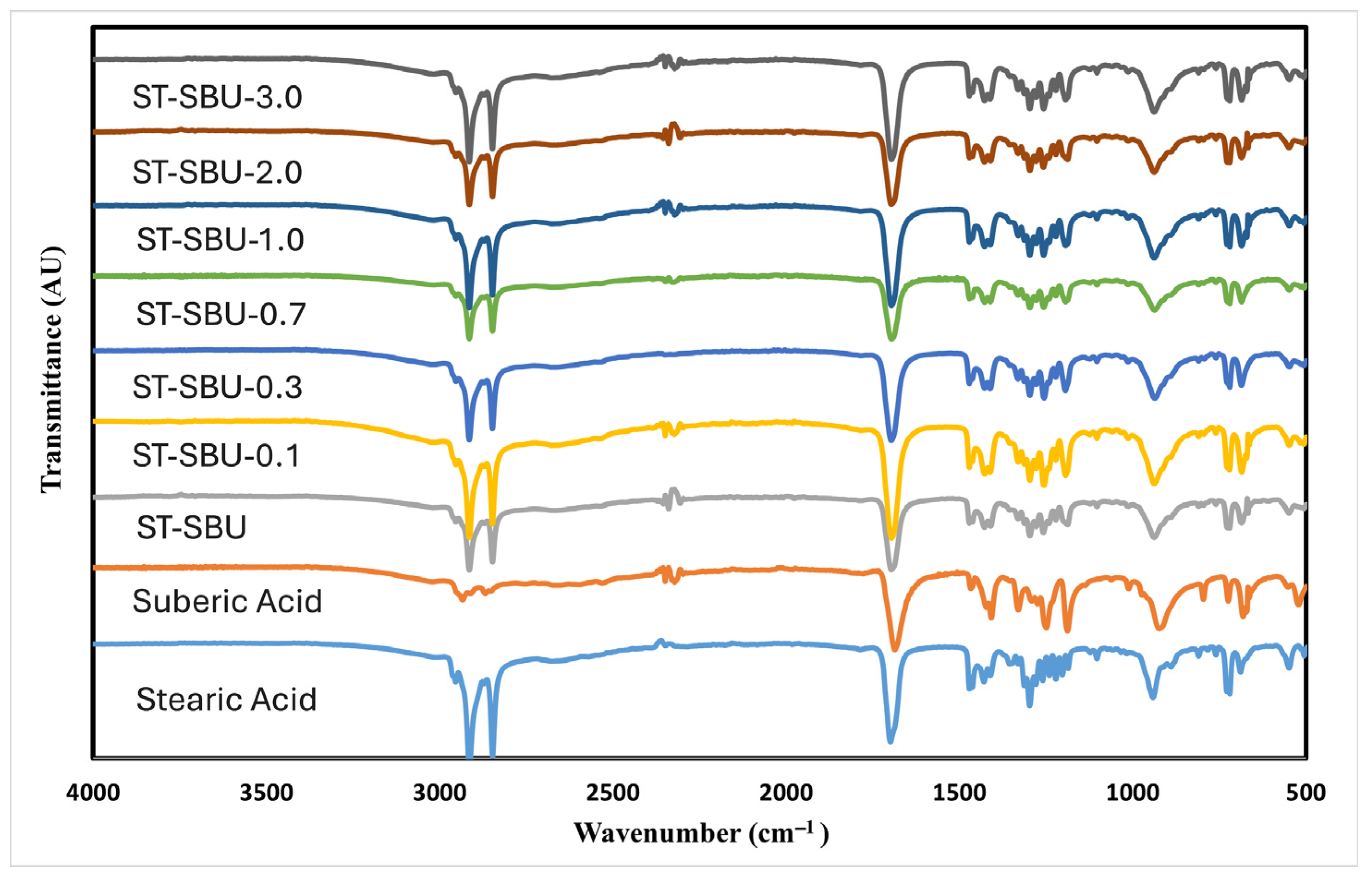
The FTIR spectrum of the ST-SBU eutectic PCM confirms the preservation of the characteristic functional groups of both ST and SBU, thereby validating the chemical stability of the mixture, as illustrated in Figure 4. Overall, the FTIR spectra of all NP loaded composites PCM’s show the same vibrational bands as the pristine ST and SBU components with no significant peak shift. This demonstrates that the molecular structure of all PCM’s remained intact and no covalent chemical reaction occurred during composite preparation. The observed spectral changes are not due to the chemical reaction but reflect the physical interactions between the PCM matrix and the NPs.
In ST, strong aliphatic C–H stretching vibrations are evident at 2914 cm−1 and 2847 cm−1, with a weaker band at 2957 cm−1 attributed to the asymmetric stretching of terminal –CH3 groups, consistent with its long hydrocarbon chain. A sharp C=O stretching vibration around 1695 cm−1 confirms the presence of the carboxylic functional group, while bending vibrations of –CH2 and –CH3 groups appear near 1462 cm−1 and 1437 cm−1, respectively. Additional low-frequency bands at 720 cm−1 correspond to the in-plane rocking of –CH2 groups, typical of long-chain fatty acids.
SBU, in contrast, exhibits a similar pattern of C–H, stretching between 2850 and 2950 cm−1, but shows relatively stronger O–H related features in the broad 3300–2500 cm−1 region, arising from hydrogen-bonded carboxylic groups. Its C=O stretching vibration appears at nearly the same wavenumber (~1695 cm−1) but with slightly greater intensity compared to stearic acid, reflecting the presence of two terminal carboxylic groups. Additional absorptions near 1298 cm−1 are associated with C–H and C–C bending vibrations, while O–H out-of-plane rocking appears at ~939 cm−1. The eutectic mixtures (ST-SBU and nanoparticle-loaded samples) preserve all of these characteristic functional group absorptions without introducing new peaks, indicating that the molecular structures of ST and SBU remain chemically stable in the composites.
The weak spectral feature in the 600–800 cm−1 and the minor band near 1100–1200 cm−1 are consistent with the vibrational modes commonly assigned to Si-C and Si-O related stretching or bending motions in silicon containing additives and silica-like species as reported in standard FTIR references and previous studies on silica- and Si-based nanoparticle systems [48,49,50]. In NP loaded PCMs, 0.4 wt.% and 0.7 wt.% loading, similar low intensity bands have been reported for silica and SiC samples and are interpreted as the evidence of Si-O or Si-C environments [51,52]. The low intensity of these bands indicates that the Si phase does not dominate the composite spectral response. At higher NP 1, 2, and 3 wt.% loading, the FTIR spectra show a moderated band broadening and baseline variation. These changes are related to the compositional heterogeneity and changes in the local molecular environment of the matrix PCM as a result of the matrix–NP interaction.
In the study by Pugalenthi et al., 2024, the incorporation of SiC nanoparticles into a LA–SA eutectic PCM induced scattering effects in the low wavenumber region [53]. At 0.025 and 0.050 vol% loadings, peak broadening was observed between 3250 and 3800 cm−1, along with the emergence of new C–H stretching bands at 2854 and 2921 cm−1. Apart from these changes, the spectra largely matched the base eutectic, indicating no significant chemical alteration. The retention of functional groups and strong hydrogen bonding ensures the chemical stability of the eutectic PCM, while the nanoparticle-induced physical interactions contribute to enhanced thermal performance. These findings validate that the ST-SBU eutectic PCM, both in its pristine and nanoparticle-enhanced forms, is a suitable candidate for latent heat thermal energy storage (LHTES) applications.

4.2. Thermal Analysis—TGA

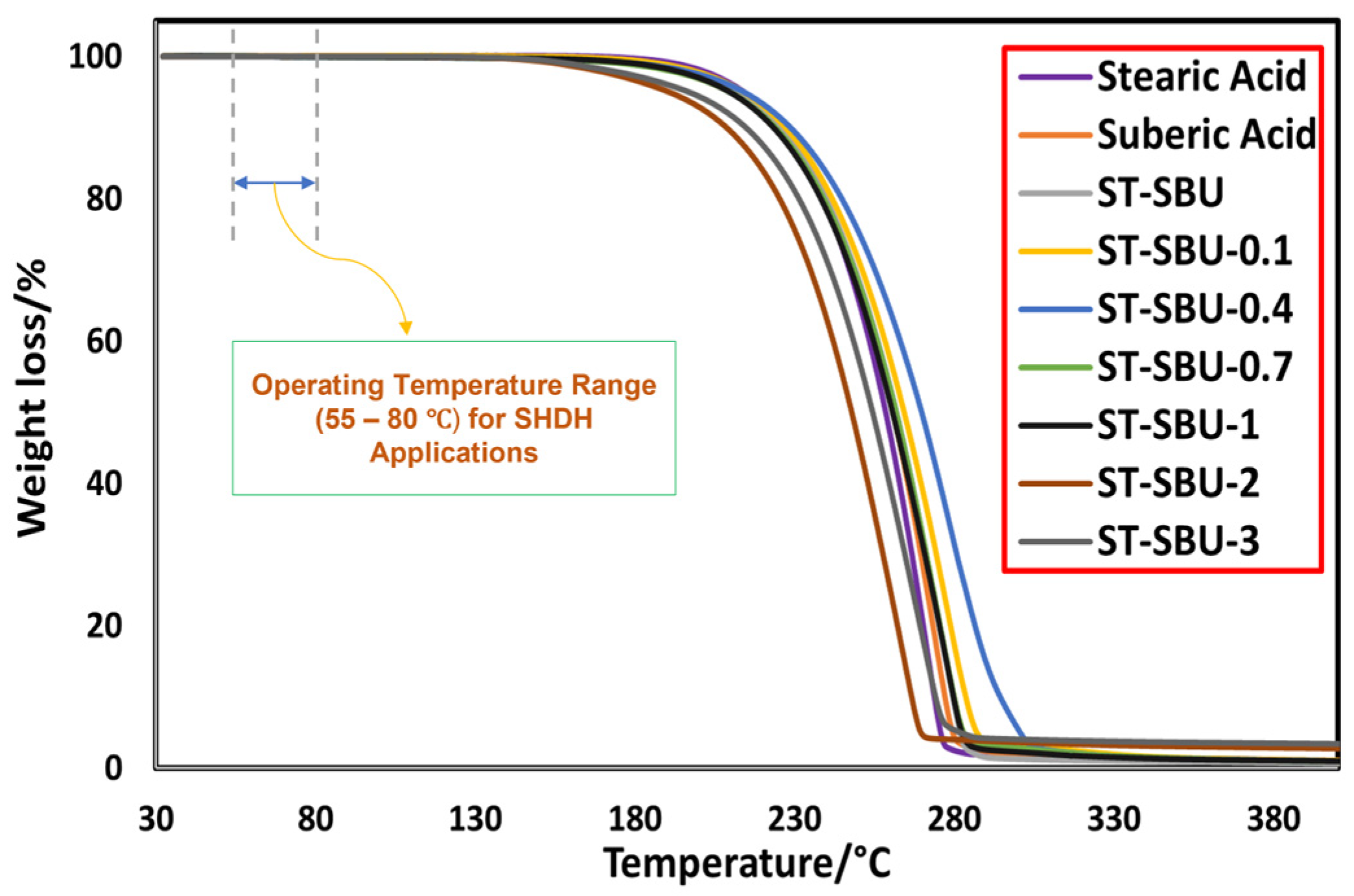
The TGA results presented in Figure 5 provide valuable insights into the thermal stability of ST, SBU, their eutectic mixture (ST-SBU), and SiC nanoparticle–enhanced PCMs (ST-SBU-0.1 to ST-SBU-3). All samples exhibit a single-step major degradation process, confirming the absence of complex multi-phase decomposition. The weight loss starts gradually at lower temperatures and becomes more pronounced between 250 °C and 310 °C, corresponding to the evaporation and decomposition of the organic chains. For reference, ST begins to degrade at ~186 °C, showing 97% mass loss at 280 °C and almost complete decomposition (~99%) by 298 °C. SBU starts slightly earlier at ~176 °C, reaching a 97% loss at 283 °C and complete degradation by 294 °C. The eutectic mixture ST-SBU initiates degradation around 178 °C, losing 96.1% at 282 °C and completing at ~317 °C. For the nanocomposite samples, ST-SBU-0.1 shows onset at 179 °C and reaches a 97.4% loss at 294 °C, completing degradation at ~347 °C. ST-SBU-0.4 begins at 179 °C with a 95.1% loss at 300 °C and ~99.2% loss at 306 °C, completing around 344 °C. ST-SBU-0.7 starts at 176 °C, losing ~95% at 282 °C and completing degradation by ~364 °C. Similarly, ST-SBU-1.0 initiates degradation at 180 °C, reaches a 97.5% loss at 291 °C, and shows complete decomposition at ~393 °C.
In contrast, higher NP concentrations resulted in earlier degradation onset. ST-SBU-2 initiates decomposition at ~150 °C, with a ~96% mass loss at ~272 °C and completing around 360 °C. Likewise, ST-SBU-3 shows onset near ~150 °C, reaches a ~96% mass loss at ~290 °C, and completes degradation at ~360 °C. The mass loss pattern indicates that low-to-moderate nanoparticle concentrations (≤1 wt.%) enhance thermal stability, delaying degradation and shifting decomposition to higher temperatures. This improvement can be attributed to the thermal shielding effect of SiC, which resists decomposition and contributes to residual mass at higher temperatures. Since nanoparticles do not evaporate, their presence reduces the total percentage mass loss, confirming their inert role during degradation. However, excessive nanoparticle loading (≥2 wt.%) leads to premature degradation onset, likely due to agglomeration effects and increased thermal conductivity that facilitate heat transfer to the PCM matrix. These results reveal that the onset of degradation for all samples, even at higher nanoparticle loadings (≥2 wt.%), occurs well above the SHDH operating temperature of ~70 °C, confirming that the PCMs are thermally stable for the intended desalination applications. Although the onset temperature decreases slightly with increasing SiC content, all samples remain far below their decomposition range during normal operation, providing a substantial safety margin. This thermal stability ensures that the PCMs will not degrade during daily cycling in the SHDH system, while the TGA results also provide useful guidance for potential high-temperature applications or accidental overheating scenarios where temperatures could exceed typical operating conditions.

4.3. Calorimetric Analysis—DSC

It is essential to evaluate the phase change properties, namely the melting/solidification temperatures and latent heats of prepared eutectic and nano-eutectic PCMs, as the addition of nanomaterials can influence these parameters. For practical applications, the thermal behaviour of composite PCMs should ideally remain close to that of the base material, with only negligible deviations. However, if the variations are significant, then the prepared composites may not be suitable for the intended applications.
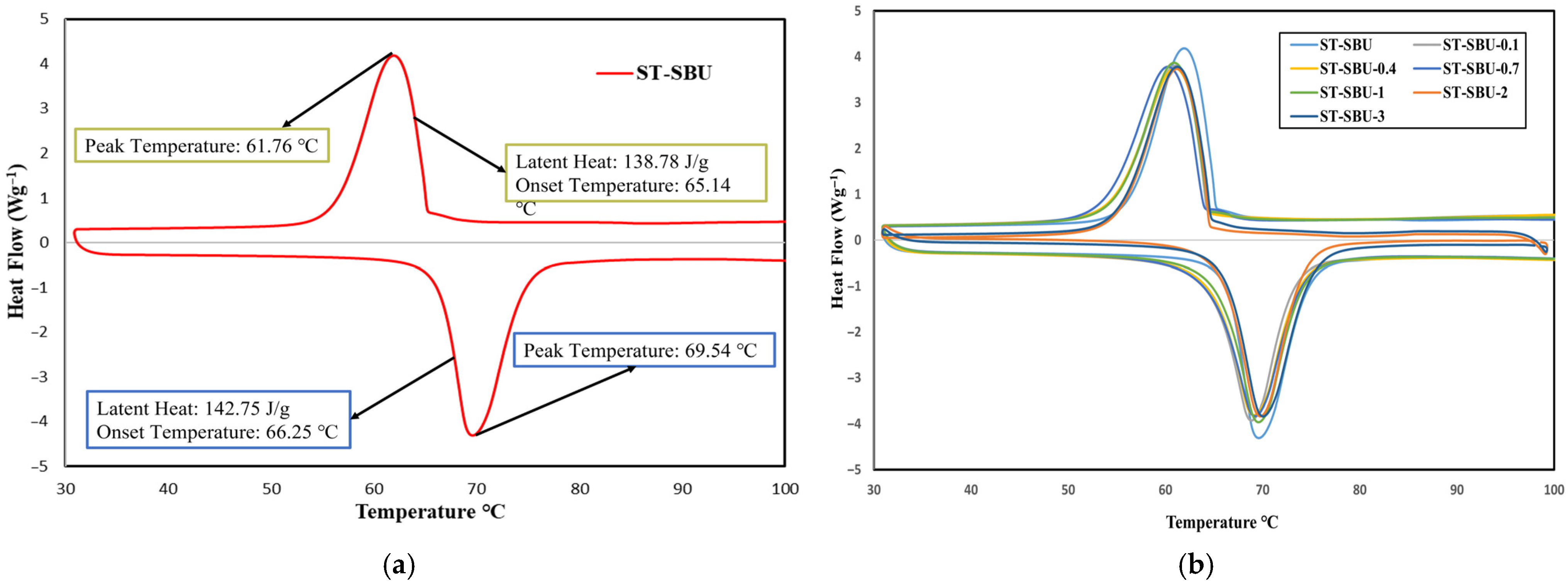
DSC analysis provides key insights into these properties by determining melting/solidification temperature, onset temperature, subcooling, and latent heat of fusion/solidification. Figure 6 illustrates the DSC curves for both binary eutectic PCMs and nano-enhanced PCMs. Figure 6a shows that the ST-SBU exhibits a single endothermic peak corresponding to melting and solidification, with a melting temperature of 69.54 °C, onset melting temperature of 66.44 °C, latent heat of fusion of 142.75 J/g, solidification temperature of 61.76 °C, onset solidification temperature of 65.23 °C, latent heat of solidification of 138.78 J/g, and subcooling temperature of 7.78 °C. Additionally, as observed in Figure 6b, only minor deviations are found in the DSC profiles of the nano-enhanced PCMs compared to the pure eutectic PCM.
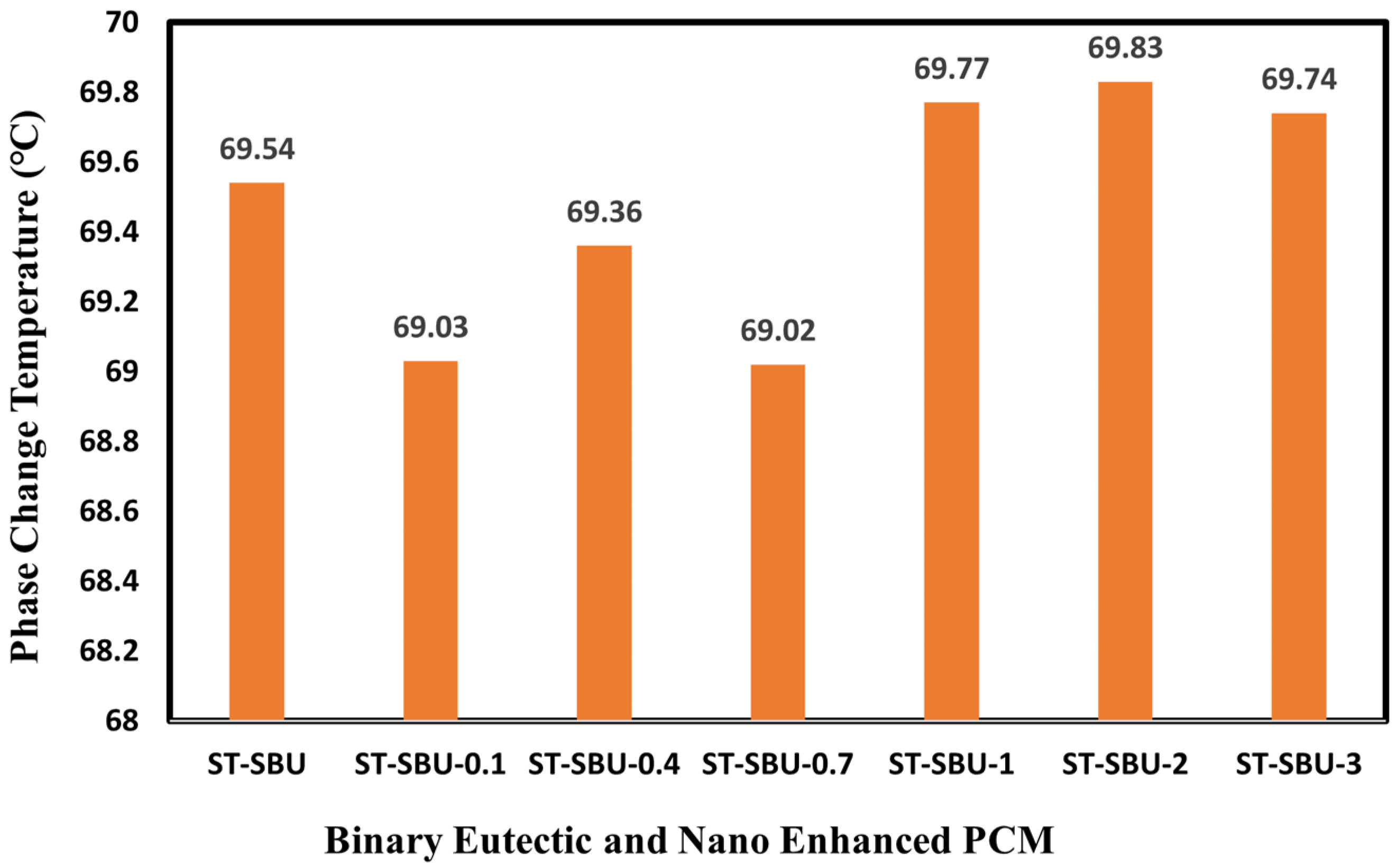
The melting temperatures of the composite PCMs, as presented in Figure 7, were found to be 69.03, 69.36, 69.02, 69.77, 69.83, and 69.74 °C for SiC NPs concentrations of 0.1, 0.4, 0.7, 1, 2, and 3 wt.%, respectively. These results indicate that the phase transition characteristics of the nano-enhanced composites remain very close to those of the pure eutectic mixture. However, slight fluctuations in the melting temperature were observed with increasing NPs loading. The overall variation in the melting point relative to the base eutectic PCM was between –0.41% and +0.73%, suggesting only minor influence of the NPs. The largest reduction in melting temperature occurred in the composite PCM with 2 wt.% SiC nanoparticles, whereas the maximum increase was recorded at 0.7 wt.% SiC nanoparticles. In addition to melting behaviour, the subcooling temperatures were observed to be 7.79, 8.28, 8.71, 8.42, 9.12, 8.8, and 8.20 °C for pure ST-SBU, 0.1, 0.4, 0.7, 1, 2, and 3 wt.%, respectively. From a technical perspective, these small deviations can be attributed to the interaction of NPs with the molecular structure of the base PCM [54]. The introduction of NPs alters the local energy distribution and create additional nucleation sites, thereby influence the crystallization and melting processes. Depending on the particle concentration and dispersion quality, these effects can either slightly enhance or suppress the melting point [55]. Since the observed deviations are minimal, the thermal reliability of the nano-enhanced PCMs remains consistent with that of the pure eutectic mixture, ensuring suitability for practical TES applications.
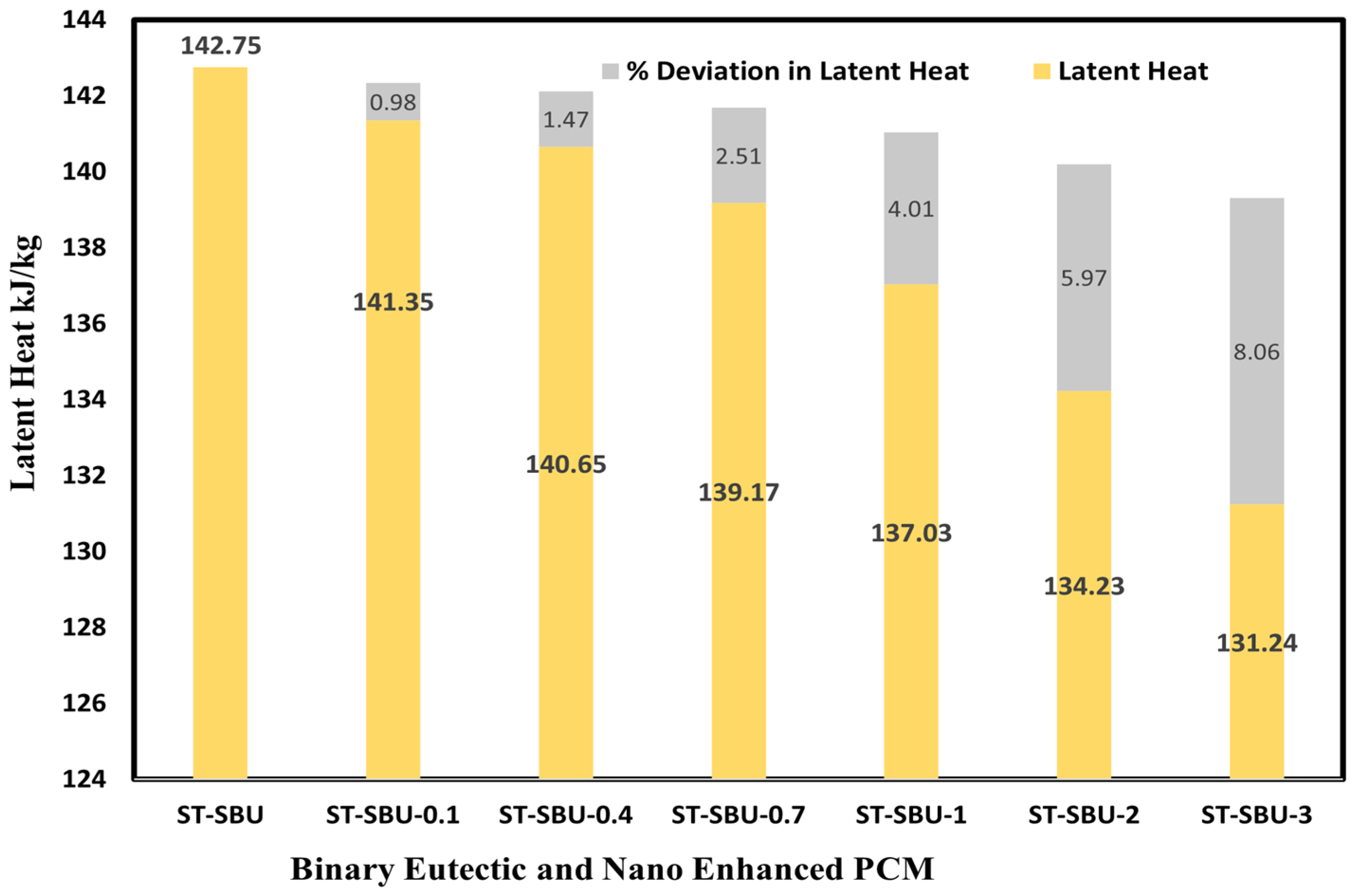
The measured latent heat values at varying SiC NPs concentrations of 0.1, 0.4, 0.7, 1, 2, and 3 wt.% were 142.75, 141.35, 140.65, 139.17, 137.03, 134.23, and 131.24 kJ/kg, respectively, as illustrated in Figure 8. These correspond to reductions of 0.98, 1.47, 2.51, 4.01, 5.97, and 8.06% compared with the base PCM. With increasing NPs concentration, the decline in latent heat values becomes more pronounced. The incorporation of NPs into eutectic PCMs is widely recognized as an effective approach to enhance λ and accelerate heat transfer kinetics. However, this improvement is accompanied by an inherent trade-off: a progressive reduction in the latent heat storage capacity. This is due to the reason that NPs are thermally conductive fillers rather than active contributor in the phase change process. Consequently, a fraction of the PCM mass is effectually substituted by inert material that does not contribute to the enthalpy of fusion, thereby dropping the total latent heat of the composite system. The maximum drop in the latent heat value observed was 8.06% at higher NP loadings of 3%, which, although prominent, remains within tolerable limits considering the significant concentration employed. These effects introduce confined thermal restrictions within the PCM, producing non-uniform heat pathways and thus dropping both λ and the effective energy storage capacity during charging (melting) and discharging (solidification) cycles. The current results are consistent with previous work carried out by Sharma et al. [56], who reported a 15.5% drop in latent heat upon the addition of 5 wt.% TiO2 NPs.

4.4. Thermal Conductivity (λ)

One of the key limitations restricting the large-scale application of PCMs is their inherently low λ [57,58]. To overcome this drawback, incorporating nanomaterials has been proposed as an effective strategy. NPs such as expanded graphite, aluminum, and metal oxides have been shown to improve conductivity through mechanisms including Brownian motion, particle agglomeration, surface morphology effects, and phonon transport [59,60]. In the present study, SiC NPs were incorporated into the eutectic ST-SBU PCM at concentrations ranging from 0.1 to 3.0 wt.%. The measurements for values of λ were performed at temperatures of 25, 30, 35, 40, and 45 °C, with each value representing the average of three repeated trials, as shown in Table 2.
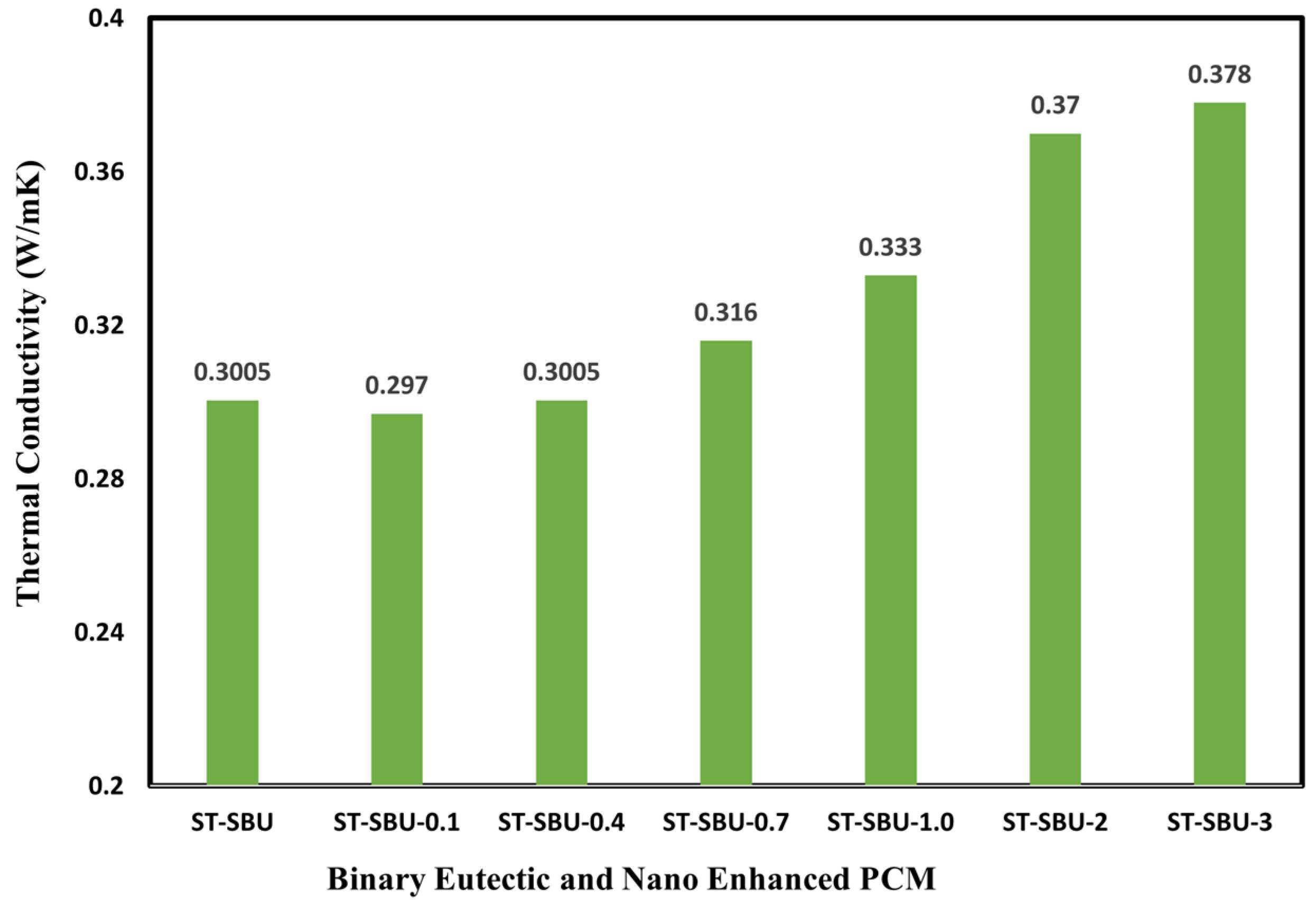
The base eutectic ST-SBU exhibited λ = 0.3005 W/m∙K at 25 °C, which progressively increased with NP loading, as shown in Figure 9, due to several mechanisms: formation of partial conductive networks at higher loadings, increased interfacial contact area facilitating phonon transport, and micro-scale energy transfer via Brownian motion of the nanoparticles. At low concentrations (i.e., 0.1 and 0.4 wt.%), SiC addition produced negligible changes in the values of λ. However, at 0.7 wt.% loading, a noticeable improvement of 5.2% was observed, resulting an increase in λ from 0.301 W/m∙K to 0.316 W/m∙K. A further rise in nanoparticle dosage to 1 wt.% enhanced conductivity by 10.8% (λ = 0.333 W/m∙K). At the maximum investigated concentration of 3 wt.%, thermal conductivity reached 0.378 W/m∙K, representing a significant increase of 25.8% relative to the pristine ST-SBU eutectic. These trends are consistent with the formation of effective heat-transfer pathways and the combined contribution of interfacial interactions and nanoparticle-induced micro convection, providing a mechanistic explanation beyond simple percentage improvements.

4.5. Uncertainty Calculation

The uncertainty investigation was performed to evaluate the possible discrepancies arising in the measurement values from the measuring instruments. To ensure accuracy, each thermal property was measured thrice, and the mean values were reported in the discussion. However, it is equally important to quantify the measurement uncertainty. This was determined using the mathematical approach proposed by Khan et al. [61]. As shown in Table 3, the uncertainties are very small and these values are within acceptable limits commonly reported in thermal property characterization studies, particularly for DSC-based measurements. In general, uncertainties below 2% are considered low and indicate that the measurements are both accurate and reproducible [62].
U C x = n = 1 3 ( X n X m ) 2 n 1
Here, UCx denotes the uncertainty value, Xn represents the individual measurement, and Xm corresponds to the mean value obtained from three repeated measurements.

4.6. Thermal Cycling Test

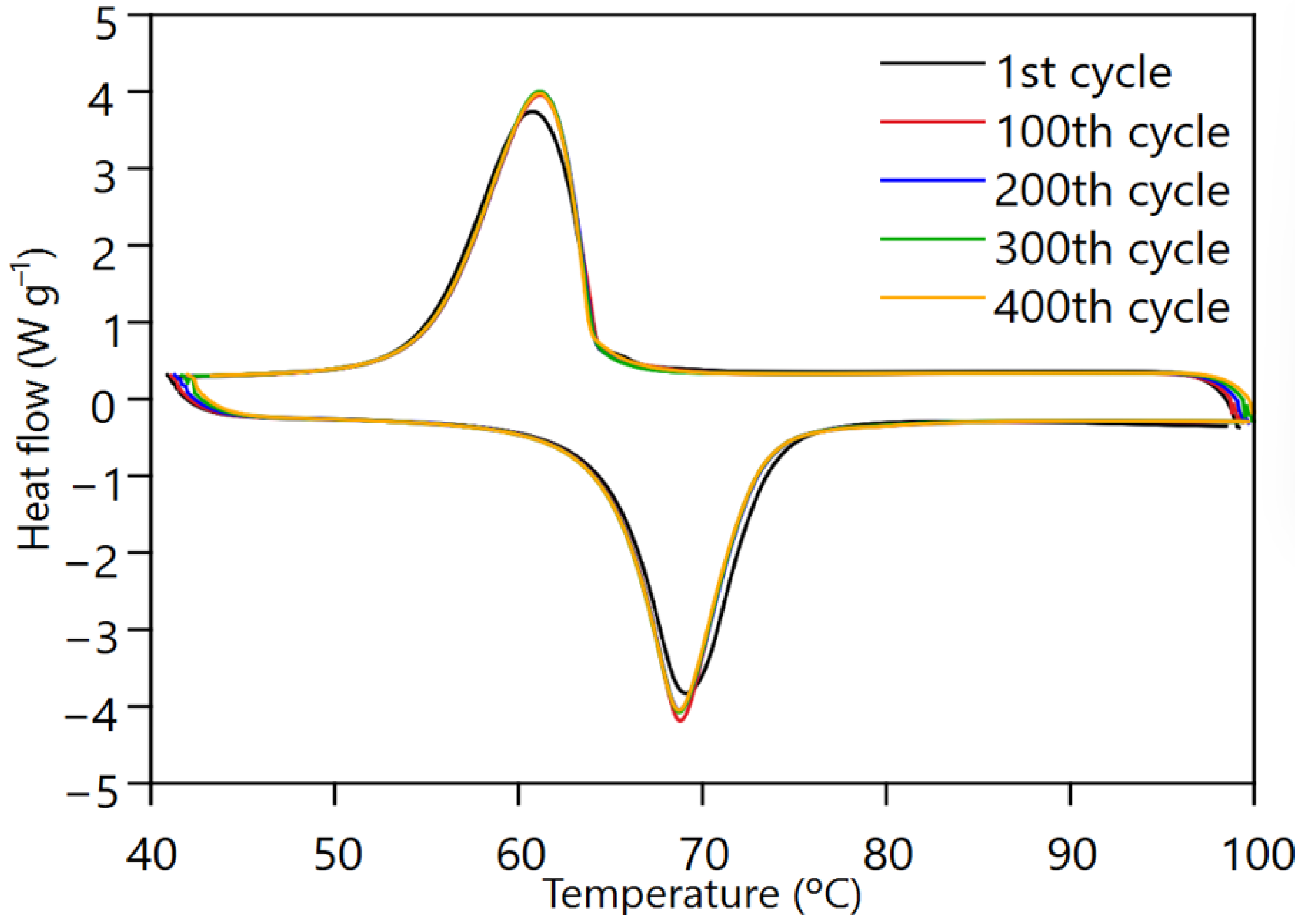
The long-lasting functioning stability of PCMs is a critical factor in evaluating their suitability for any thermal energy storage applications as the thermal systems are designed for extended cyclic operations. Accordingly, the thermal reliability of the prepared nano-eutectic PCM was systematically evaluated through DSC cycling test. The main objective was to monitor deviations in the latent heat capacity and phase change temperature during repeated thermal cycles, thereby establishing their thermo-reliability under extended service conditions. Figure 10 illustrates the DSC heating and cooling curves of the nano-eutectic PCM (ST-SBU-1) recorded over 1, 100, 200, 300, and 400 thermal cycles. The overlapping profiles validate that both melting and solidification peaks remain nearly unchanged throughout the cycling process.
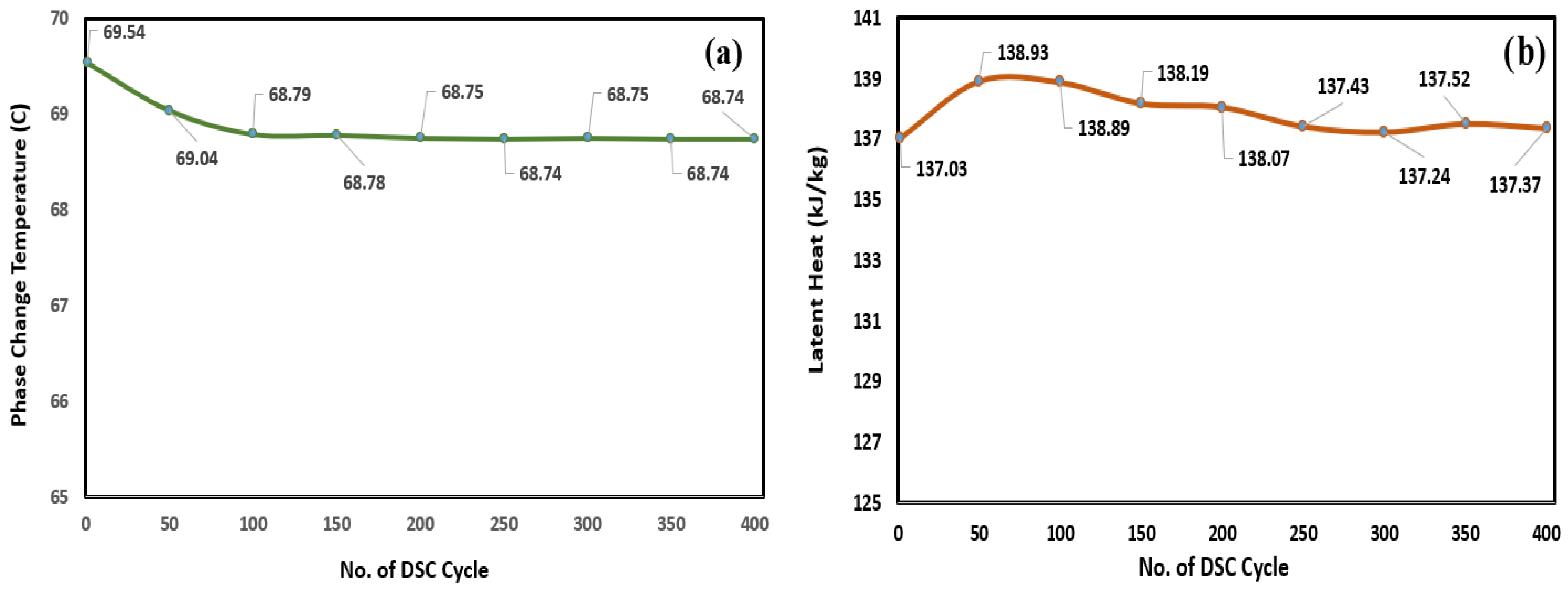
The DSC cycling test for phase change temperature, as shown in Figure 11a, reveals negligible variation across repeated cycling. The transition temperature initially measured at 69.54 °C at the first cycle and declined slightly to 68.74 °C after 400 cycles, corresponding to a reduction of only 1.15%. This negligible alteration in temperature values highlights the strong thermal stability of the composite PCM.
Similarly, as illustrated in Figure 11b, with successive progress of the DSC cycles, the composite PCMs exhibits the gradual decrease in latent heat values. The initial value of latent heat at the first cycle was 137.03 kJ/kg, which decreased to 137.37 kJ/kg after 400 cycles, representing an overall increase of approximately 0.25%. However, the minor fluctuations were recorded at intermediate cycles (e.g., 138.93 at 50 cycles, 138.07 at 200 cycles and 137.52 kJ/kg at 350 cycles), and the material revealed stable energy storage characteristics with no substantial dissipation in enthalpy values.
The observed minor deviations in latent heat and melting temperature values after extended cycling can be attributed to possible molecular relocations, impurity formation, or minor chemical alterations occurring during repetitive phase transitions. Overall, the outcomes confirm that the prepared composite PCMs maintains stable thermal storage performance over extended cycling, thereby validating its suitability for long-term energy storage applications.

4.7. Projected Performance Enhancement of SHDH System Using Nano-Enhanced PCM

To quantify the influence of the developed nano-enhanced eutectic PCM on SHDH system performance, a simple energy-balance estimation is performed for the functional prototype shown in Figure 1. The prototype (1 m height, 0.4 m diameter), coupled with an evacuated-tube solar water heater (4–5 m2) and a solar air collector (2–3 m2), is designed to produce 30–35 L day−1 of freshwater for a six-person household. This production corresponds to a daily thermal energy demand of approximately 19–22 kWh, based on the latent heat of water evaporation. Assuming 6–8 h of night-time operation, the required stored thermal energy is 5–7 kWh. For the stearic-acid/suberic-acid eutectic PCM, with a representative total storage capacity of ≈142.75 kJ kg−1, the estimated PCM mass required to support the night operation is approximately 90–105 kg, which is compatible with the proposed TES tank dimensions.
The experimentally observed enhancement in thermal conductivity (5–26%) directly improves heat-transfer rates during both charging and discharging, leading to proportionally shorter charging times and more effective utilization of stored heat during night hours. Although nano-enhancement results in a moderate reduction in latent heat, this corresponds to only a marginal increase in required PCM mass, which is largely offset by the improved heat-transfer performance. Overall, the nano-enhanced eutectic PCM enables a compact TES design, improves thermal response, and extends effective SHDH operation beyond daylight hours, thereby enhancing the GOR of the system to 3–4 and system efficiency by 30–40%.

5. Conclusions

The main aim of the current study is to investigate energy storage materials tailored for solar HDH applications. A novel nano-enhanced binary eutectic PCM consisting of 70 wt.% ST and 30 wt.% SBU, with varying loadings of silicon carbide (SiC) NPs at concentrations of 0.1, 0.4, 0.7, 1.0, 2.0, and 3.0 wt.% is prepared. The resulting nano-eutectic PCMs were systematically evaluated for their thermal characteristics (thermal conductivity, phase transition behaviour, enthalpy, reliability, and stability) as well as physicochemical properties (chemical integrity and structural retention). The outcomes of this experimental investigation are outlined below:
The FTIR analysis confirms that no chemical reactions occur when SiC NP incorporate into the PCM. This indicates that the function group of ST and SBU remain intact and the process involves only the physical interactions (e.g., hydrogen bonding or surface adsorption).
The retention of functional groups and strong hydrogen bonding ensures the chemical stability of the eutectic PCM, while the nanoparticle-induced physical interactions contribute to enhanced thermal performance.
The TGA results reveal that the incorporation of SiC NPs alters the mass loss pattern, effectively delays the degradation process, and validates that nano composite PCMs possess superior thermal stability compared to the pure eutectic, with a balance required between nanoparticle loading and thermal performance.
DSC results reveal that the ST-SBU exhibits a single endothermic peak corresponding to melting and solidification, with a melting temperature of 69.54 °C and latent heat of 142.75 J/g.
The melting temperatures of the composite PCMs at SiC nanoparticle concentrations of 0.1, 0.4, 0.7, 1.0, 2.0, and 3.0 wt.%, were 69.03, 69.36, 69.02, 69.77, 69.83, and 69.74 °C, respectively. The corresponding measured latent heat values were 142.75, 141.35, 140.65, 139.17, 137.03, 134.23, and 131.24 kJ/kg. As compared to eutectic PCM, the variation in melting point lies within –0.41% and +0.73%, while the reduction in latent heat ranged between 0.98 and 8.06%.
The thermal conductivity of the ST-SBU eutectic PCM reveals negligible changes at 0.1 and 0.4% nanoparticle loadings; however, it increased progressively by 5.2%, 10.8%, 23.12%, and 25.8% at nanoparticle loadings of 0.7%, 1.0%, 2.0%, and 3.0%, respectively, at 25 °C.
The DSC thermal cycling tests confirmed that the prepared composite PCMs exhibit only marginal enhancement in latent heat around 0.25% and phase transition temperature (1.15%) after 400 cycles. These slight discrepancies highlight the outstanding thermal reliability and stability of the material under repetitive cycling.
The obtained results signify that the optimized nano-enhanced eutectic PCM can be tested for the performance enhancement of the SHDH system during the next phase of the project.

Author Contributions

R.A.: Conceptualization, visualization, validation, formal analysis, resources, data curation, writing—original draft preparation, writing—review and editing, K.M.: validation, formal analysis, resources, data curation, writing—review and editing, supervision, project administration, funding acquisition. D.L.P.: Visualization, validation, formal analysis, resources, data curation, writing—original draft preparation, writing—review and editing. I.I.: formal analysis, resources, data curation. B.P.-D.: supervision, project administration, funding acquisition. All authors have read and agreed to the published version of the manuscript.

Funding

This research was supported by funding received through the European Union’s Next Generation EU funds, articulated at the national level by the Recovery, Transformation and Resilience Plan (Reference: C17.17 Spanish Recovery and Resilience Plan F).

Data Availability Statement

The original contributions presented in this study are included in the article. Further inquiries can be directed to the corresponding author.

Acknowledgments

This work was carried out at the laboratories of Iberian Centre for Research in Energy Storage—CIIAE, Spain.

Conflicts of Interest

The authors declare no conflicts of interest.

References

  1. Dixit, P.; Vennapusa, J.R.; Parvate, S.; Singh, J.; Dasari, A.; Chattopadhyay, S. Thermal buffering performance of a propyl palmitate/expanded perlite-based form-stable composite: Experiment and numerical modeling in a building model. Energy Fuels 2021, 35, 2704–2716. [Google Scholar]
  2. Le, X.; Guo, X.; Lee, C. Evolution of micro-nano energy harvesting technology—Scavenging energy from diverse sources towards self-sustained micro/nano systems. Nanoenergy Adv. 2023, 3, 101–125. [Google Scholar] [CrossRef]
  3. Zhang, Y.; Ren, J.; Pu, Y.; Wang, P. Solar energy potential assessment: A framework to integrate geographic, technological, and economic indices for a potential analysis. Renew. Energy 2020, 149, 577–586. [Google Scholar] [CrossRef]
  4. Da Cunha, J.P.; Eames, P. Thermal energy storage for low and medium temperature applications using phase change materials—A review. Appl. Energy 2016, 177, 227–238. [Google Scholar] [CrossRef]
  5. Zhang, S.; Wu, W.; Wang, S. Experimental investigations of alum/expanded graphite composite phase change material for thermal energy storage and its compatibility with metals. Energy 2018, 161, 508–516. [Google Scholar] [CrossRef]
  6. Altmann, T.; Robert, J.; Bouma, A.; Swaminathan, J.; Lienhard, J.H. Primary energy and exergy of desalination technologies in a power-water cogeneration scheme. Appl. Energy 2019, 252, 113319. [Google Scholar] [CrossRef]
  7. Tariq, R.; Sheikh, N.A.; Xamán, J.; Bassam, A. An innovative air saturator for humidification–dehumidification desalination application. Appl. Energy 2018, 228, 789–807. [Google Scholar]
  8. AlQdah, K.S.; Alharbi, K.A.; Alharbi, S.A.; Almutairi, M.A.; Alsuhimi, O.M.; Aljuhani, M.S. Design, fabrication and performance evaluation of a semi-cylindrical solar still working in Medina region. Arab. J. Sci. Eng. 2022, 47, 8567–8575. [Google Scholar]
  9. Agrawal, R.; Singh, K.D.P.; Paswan, M.K. Review on enhancement of thermal conductivity of phase change materials with nanoparticles in engineering applications. Mater. Today Proc. 2020, 22, 1617–1627. [Google Scholar]
  10. UN Water. Water and Jobs: The United Nations World Water Development Report 2016; UNESCO: Paris, France, 2016. [Google Scholar]
  11. Yugbodh, K.; Agrawal, R.; Jain, E.; Sarangapani, K.; Singh, S.K.; Kacker, R. Comprehensive 8E and 2C analysis of a modified semi-cylindrical solar still with sensible heat storage materials. Int. J. Environ. Res. 2025, 19, 109. [Google Scholar] [CrossRef]
  12. Mariello, M. Heart energy harvesting and cardiac bioelectronics: Technologies and perspectives. Nanoenergy Adv. 2022, 2, 344–385. [Google Scholar] [CrossRef]
  13. Baskar, I.; Chellapandian, M.; Jaswanth, S.S.H. Development of a novel composite phase change material-based paints and mortar for energy storage applications in buildings. J. Energy Storage 2022, 55, 105829. [Google Scholar] [CrossRef]
  14. Jathar, L.D.; Ganesan, S.; Shahapurkar, K.; Soudagar, M.E.M.; Mujtaba, M.A.; Anqi, A.E.; Farooq, M.; Khidmatgar, A.; Goodarzi, M.; Safaei, M.R. Effect of various factors and diverse approaches to enhance the performance of solar stills: A comprehensive review. J. Therm. Anal. Calorim. 2022, 147, 4491–4522. [Google Scholar]
  15. Fei, H.; Wang, L.; He, Q.; Du, W.; Gu, Q.; Pan, Y. Preparation and properties of a composite phase change energy storage gypsum board based on capric acid–paraffin/expanded graphite. ACS Omega 2021, 6, 6144–6152. [Google Scholar] [CrossRef]
  16. Elarem, R.; Alqahtani, T.; Mellouli, S.; Aich, W.; Ben Khedher, N.; Kolsi, L.; Jemni, A. Numerical study of an evacuated tube solar collector incorporating a nano-PCM as a latent heat storage system. Case Stud. Therm. Eng. 2021, 24, 100859. [Google Scholar] [CrossRef]
  17. Yang, Z.L.; Walvekar, R.; Wong, W.P.; Sharma, R.K.; Dharaskar, S.; Khalid, M. Advances in phase change materials, heat transfer enhancement techniques, and their applications in thermal energy storage: A comprehensive review. J. Energy Storage 2024, 87, 111329. [Google Scholar] [CrossRef]
  18. Sarı, A.; Bicer, A.; Alkan, C.; Özcan, A.N. Thermal energy storage characteristics of myristic acid–palmitic acid eutectic mixtures encapsulated in PMMA shell. Sol. Energy Mater. Sol. Cells 2019, 193, 1–6. [Google Scholar]
  19. Jebasingh, E.; Arasu, V. Characterisation and stability analysis of eutectic fatty acid as a low-cost cold energy storage phase change material. J. Energy Storage 2020, 31, 101708. [Google Scholar]
  20. Hassan, N.; Minakshi, M.; Liew, W.Y.H.; Amri, A.; Jiang, Z.-T. Thermal characterization of binary calcium–lithium chloride salts for thermal energy storage at high temperature. Energies 2023, 16, 4715. [Google Scholar] [CrossRef]
  21. Dhivya, S.; Hussain, S.I.; Kalaiselvam, S. Novel metal-coated nanocapsules of ethyl esters fatty acid eutectic mixture as phase change material with enhanced thermal conductivity for energy storage applications. Thermochim. Acta 2020, 687, 178581. [Google Scholar] [CrossRef]
  22. Villada, C.; Navarrete, N.; Rawson, A.; Kolbe, M.; Stahl, V.; Kraft, W.; Kargl, F. Recycling of aluminium scrap into phase change materials for high-temperature storage applications: Thermophysical properties and microstructural characterisation. J. Energy Storage 2023, 72, 108822. [Google Scholar] [CrossRef]
  23. Hu, X.; Gong, X.; Zhu, F.; Xing, X.; Li, Z.; Zhang, X. Thermal analysis and optimization of metal foam PCM-based heat sink for thermal management of electronic devices. Renew. Energy 2023, 212, 227–237. [Google Scholar] [CrossRef]
  24. Nandy, A.; Houl, Y.; Zhao, W.; D’Souza, N.A. Thermal heat transfer and energy modeling through incorporation of phase change materials into polyurethane foam. Renew. Sustain. Energy Rev. 2023, 182, 113410. [Google Scholar] [CrossRef]
  25. Agrawal, R.; Singh, K.D.P.; Sharma, R.K. Experimental investigations on the phase change and thermal properties of nano-enhanced binary eutectic PCM of palmitic acid–stearic acid/CuO nanoparticles. Int. J. Energy Res. 2022, 46, 6562–6576. [Google Scholar] [CrossRef]
  26. Suchikova, Y.; Kovachov, S.; Bohdanov, I.; Kozlovskiy, A.L.; Zdorovets, M.V.; Popov, A.I. Improvement of β-SiC synthesis technology on silicon substrate. Technologies 2023, 11, 152. [Google Scholar] [CrossRef]
  27. Lebedev, A.S.; Suzdal’tsev, A.V.; Anfilogov, V.N.; Farlenkov, A.S.; Porotnikova, N.M.; Vovkotrub, E.G.; Akashev, L.A. Carbothermal synthesis, properties, and structure of ultrafine SiC fibers. Inorg. Mater. 2020, 56, 20–27. [Google Scholar] [CrossRef]
  28. Leonova, A.M.; Bashirov, O.A.; Leonova, N.M.; Lebedev, A.S.; Trofimov, A.A.; Suzdaltsev, A.V. Synthesis of C/SiC mixtures for composite anodes of lithium-ion power sources. Appl. Sci. 2023, 13, 901. [Google Scholar] [CrossRef]
  29. Jacob, J.; Pandey, A.K.; Abd Rahim, N.; Selvaraj, J.; Paul, J.; Samykano, M.; Saidur, R. Quantifying thermophysical properties, characterization, and thermal cycle testing of nano-enhanced organic eutectic PCMs. Sol. Energy Mater. Sol. Cells 2022, 248, 112008. [Google Scholar]
  30. Aslfattahi, N.; Saidur, R.; Arifutzzaman, A.; Sadri, R.; Bimbo, N.; Sabri, M.F.M.; Maughan, P.A.; Bouscarrat, L.; Dawson, R.J.; Said, S.M.; et al. Experimental investigation of energy storage properties and thermal conductivity of a novel organic PCM/MXene nanocomposite. J. Energy Storage 2020, 27, 101115. [Google Scholar] [CrossRef]
  31. Baskar, I.; Chellapandian, M.; Jeyasubramanian, K. LA–PA eutectic/nano-SiO2 composite phase change material for thermal energy storage in buildings. Constr. Build. Mater. 2022, 338, 127663. [Google Scholar] [CrossRef]
  32. Saeed, R.M.; Schlegel, J.; Castano, C.; Sawafta, R. Preparation and enhanced thermal performance of novel solid-to-gel form-stable eutectic PCM modified by nano-graphene platelets. J. Energy Storage 2018, 15, 91–102. [Google Scholar]
  33. Bharathiraja, R.; Ramkumar, T.; Selvakumar, M. Studies on the thermal characteristics of nano-enhanced paraffin wax phase change material for thermal storage applications. J. Energy Storage 2023, 73, 109216. [Google Scholar] [CrossRef]
  34. Kalidasan, B.; Pandey, A.; Saidur, R.; Aljafari, B.; Kareri, T. Expanded graphite intersperse reliable binary eutectic PCM for low temperature thermal regulation systems. Mater. Today Sustain. 2023, 24, 100602. [Google Scholar]
  35. Zhang, L.X.; Jiang, Y.Z.; Zhang, X.J. Study on active and passive integration humidification–dehumidification solar desalination. In Proceedings of the Sino-Russian ASRTU Conference Alternative Energy: Materials, Technologies, and Devices, Ekaterinburg, Russia, 13–16 July 2018; pp. 215–222. [Google Scholar]
  36. Vijayakumar, V.; Manu, N.S.; Vasudevan, M.C.; Kiran, M.V.; Rejeesh, C.R. Phase change materials for improved performance and continuous output in stepped solar stills equipped with HDH. Mater. Today Proc. 2021, 47, 5064–5068. [Google Scholar] [CrossRef]
  37. Govindaraja, G.; Duraipandi, S.; Sreekumar, A. Development and characterization of a novel eutectic mixture with stearyl alcohol and adipic acid for hot air storage applications. J. Energy Storage 2023, 61, 106708. [Google Scholar] [CrossRef]
  38. Chinnasamy, V.; Appukuttan, S. Preparation and thermal properties of lauric acid/myristyl alcohol as a novel binary eutectic phase change material for indoor thermal comfort. Energy Storage 2019, 1, e80. [Google Scholar] [CrossRef]
  39. Philip, N.; Raam Dheep, G.; Sreekumar, A. Cold thermal energy storage with lauryl alcohol and cetyl alcohol eutectic mixture: Thermophysical studies and experimental investigation. J. Energy Storage 2020, 27, 101060. [Google Scholar] [CrossRef]
  40. Zhang, Y.; Jiang, Y.; Jiang, Y. A simple method, the T-history method, of determining the heat of fusion, specific heat and thermal conductivity of phase-change materials. Meas. Sci. Technol. 1999, 10, 201–205. [Google Scholar]
  41. Sarı, A. Eutectic mixtures of some fatty acids for low temperature solar heating applications: Thermal properties and thermal reliability. Appl. Therm. Eng. 2005, 25, 2100–2107. [Google Scholar] [CrossRef]
  42. Ma, G.; Sun, J.; Zhang, Y.; Jing, Y.; Jia, Y. A novel low-temperature phase change material based on stearic acid and hexanamide eutectic mixture for thermal energy storage. Chem. Phys. Lett. 2019, 714, 166–171. [Google Scholar] [CrossRef]
  43. Ma, G.; Sun, J.; Jia, Y.; Zhang, Y. Binary eutectic mixtures of stearic acid–n-butyramide/n-octanamide as phase change materials for low temperature solar heat storage. Appl. Therm. Eng. 2017, 111, 1052–1059. [Google Scholar]
  44. Ma, G.; Han, L.; Sun, J.; Jia, Y. Thermal properties and reliability of eutectic mixture of stearic acid–acetamide as phase change material for latent heat storage. J. Chem. Thermodyn. 2017, 106, 178–186. [Google Scholar]
  45. Yuan, Y.; Zhang, N.; Tao, W.; Cao, X.; He, Y. Fatty acids as phase change materials: A review. Renew. Sustain. Energy Rev. 2014, 29, 482–498. [Google Scholar] [CrossRef]
  46. Agrawal, R.; Sharma, R.K.; Sharma, K.; Siddiqui, M.I.H. Thermophysical characterization and chemical stability of Ag2O-enhanced eutectic nano-PCMs for moderate-temperature applications. Int. J. Chem. React. Eng. 2025, 23, 1143–1155. [Google Scholar]
  47. Alkan, C.; Alakara, E.H. Property development in n-alkane and n-alkane eutectic phase change materials for thermal energy storage applications. Sol. Energy Adv. 2025, 5, 100089. [Google Scholar] [CrossRef]
  48. Nakamoto, K. Infrared and Raman Spectra of Inorganic and Coordination Compounds, Part B: Applications in Coordination, Organometallic, and Bioinorganic Chemistry; John Wiley & Sons: Hoboken, NJ, USA, 2009. [Google Scholar]
  49. Socrates, G. Infrared and Raman Characteristic Group Frequencies: Tables and Charts; John Wiley & Sons: Chichester, UK, 2004. [Google Scholar]
  50. Dworschak, M.; Müller, M.; Tjardts, T.; Kienle, L.; Benedikt, J. Surface passivation of silicon nanoparticles monitored by in situ FTIR. Plasma Process. Polym. 2025, 22, 2400206. [Google Scholar]
  51. Wang, F.; Gao, S.; Pan, J.; Li, X.; Liu, J. Short-chain modified SiO2 with high absorption of organic PCM for thermal protection. Nanomaterials 2019, 9, 657. [Google Scholar] [CrossRef]
  52. Chung, O.; Jeong, S.G.; Yu, S.; Kim, S. Thermal performance of organic PCMs/micronized silica composite for latent heat thermal energy storage. Energy Build. 2014, 70, 180–185. [Google Scholar] [CrossRef]
  53. Pugalenthi, S.; Chellapandian, M.; Dharmaraj, J.J.J.; Devaraj, J.; Arunachelam, N.; Singh, S.B. Enhancing the thermal transport property of eutectic lauric–stearic acid PCM with silicon carbide nanoparticles for battery thermal management. J. Energy Storage 2024, 84, 110890. [Google Scholar]
  54. Harikrishnan, S.; Kalaiselvam, S. Preparation and thermal characteristics of CuO–oleic acid nanofluids as a PCM. Thermochim. Acta 2012, 533, 46–55. [Google Scholar] [CrossRef]
  55. Ouikhalfan, M.; Sari, A.; Chehouani, H.; Benhamou, B.; Biçer, A. Preparation and characterization of nano-enhanced myristic acid using metal oxide nanoparticles for thermal energy storage. Int. J. Energy Res. 2019, 43, 8592–8607. [Google Scholar] [CrossRef]
  56. Sharma, R.K.; Ganesan, P.; Tyagi, V.V.; Metselaar, H.S.C.; Sandaran, S.C. Thermal properties and heat storage analysis of palmitic acid–TiO2 composite as nano-enhanced organic PCM. Appl. Therm. Eng. 2016, 99, 1254–1262. [Google Scholar]
  57. Teamah, H.; Teamah, M. Integration of phase change material in flat plate solar water collector: A state of the art review. J. Energy Storage 2022, 54, 105357. [Google Scholar]
  58. Fauzi, H.; Metselaar, H.S.; Mahlia, T.; Silakhori, M. Sodium laurate enhances the thermal properties and thermal conductivity of eutectic fatty acid PCM. Sol. Energy 2014, 102, 333–337. [Google Scholar]
  59. Pugalenthi, S.; Devaraj, J.; Kadarkaraithangam, J.; Dharmaraj, J.J.J. Improvement in thermal conductivity and stability of rare-earth metal oxide nanofluids using CaCO3 nanoparticles versus SDS. J. Mol. Liq. 2023, 370, 121056. [Google Scholar]
  60. Selvan, P.; Jebakani, D.; Jeyasubramanian, K.; Jebaraj, D.J.J. Enhancement of thermal conductivity of SiO2/Ag hybrid nanofluids using calcium carbonate nanoparticles as stabilizing agent. J. Mol. Liq. 2022, 345, 117846. [Google Scholar] [CrossRef]
  61. Khan, M.M.A.; Ibrahim, N.I.; Saidur, R.; Mahbubul, I.; Al-Sulaiman, F.A. Performance assessment of a solar-powered ammonia–water absorption refrigeration system with storage units. Energy Convers. Manag. 2016, 126, 316–328. [Google Scholar] [CrossRef]
  62. Barclay, R.; Ghani, M.; Zhang, N.; Cabeza, L.F. An analysis of the influence of DSC parameters on the measurement of the thermal properties of PCM. Materials 2024, 17, 5689. [Google Scholar]
Figure 1. Integration of TES systems into SHDH desalination system.
Nanoenergyadv 06 00004 g001
Figure 2. Schematic illustration of the two-step method for preparing composite PCM.
Nanoenergyadv 06 00004 g002
Figure 3. Pictorial representations of pure PCM, binary eutectic and nano-enhanced PCM (a) ST, (b) SBU, (c) ST-SBU, (d) ST-SBU-0.1, (e) ST-SBU-0.4, (f) ST-SBU-0.7, (g) ST-SBU-1.0, (h) ST-SBU-2.0, and (i) ST-SBU-3.0.
Nanoenergyadv 06 00004 g003
Figure 4. FTIR curve of prepared composite PCMs.
Nanoenergyadv 06 00004 g004
Figure 5. TGA curves of prepared composite PCMs.
Nanoenergyadv 06 00004 g005
Figure 6. DSC curves of (a) prepared eutectic PCM and (b) composite PCM with varying SiC NPs concentrations.
Nanoenergyadv 06 00004 g006
Figure 7. Melting temperature of prepared composite PCMs.
Nanoenergyadv 06 00004 g007
Figure 8. Latent heat (kJ/kg) and deviation (%) values of prepared composite PCMs.
Nanoenergyadv 06 00004 g008
Figure 9. Thermal conductivity (W/m∙K) measurement at 25 °C of prepared composite PCMs.
Nanoenergyadv 06 00004 g009
Figure 10. DSC Curve of ST-SBU-1.0 for different cycles.
Nanoenergyadv 06 00004 g010
Figure 11. (a) Melting point and (b) latent heat at different DSC cycles.
Nanoenergyadv 06 00004 g011
Table 1. Thermal characteristics of various PCMs.
PCMMelting Temperature Tm [°C]Latent Heat [kJ/kg]Ref.
Stearyl alcohol + Adipic acid56.54172.59[37]
Lauric acid and Myristyl alcohol19.7152.6[38]
Lauryl and Cetyl alcohol20.01191.63[39]
58.7 wt.% Mg(NO3)2
6H2O + 41:3 wt.% MgCl2·6H2O
58.3120[40]
Lauric (66%) + Myristic acid (34%)34.2166.8[41]
Stearic acid + Hexanamide58176.62[42]
Stearic acid/n-butyramide64.41198.38[43]
Stearic acid/n-octanamide63.28198.98[43]
Stearic acid/Acetamide64.55193.87[44]
MgCl2·6H2O/NH4Al(SO4)2·12H2O64.7156.93[45]
Table 2. Thermal conductivity measurement at different temperature.
Sampleλ (W/m∙K)
25 °C
λ (W/m∙K)
30 °C
λ (W/m∙K)
35 °C
λ (W/m∙K)
40 °C
λ (W/m∙K)
45 °C
ST-SBU0.3010.3020.30010.3010.299
ST-SBU-0.10.2970.2990.3030.3040.306
ST-SBU-0.40.3010.3020.3030.3080.313
ST-SBU-0.70.3160.3150.3180.3180.319
ST-SBU-1.00.3330.3190.2680.3150.313
ST-SBU-20.3700.3550.3460.3390.334
ST-SBU-30.3780.360.3540.3470.342
Table 3. Uncertainty in measured values.
Thermal ParameterUncertainty (%)
Phase transition temperature0.25
Thermal conductivity (λ)0.285
Latent heat1.32
Subcooling0.45
Disclaimer/Publisher’s Note: The statements, opinions and data contained in all publications are solely those of the individual author(s) and contributor(s) and not of MDPI and/or the editor(s). MDPI and/or the editor(s) disclaim responsibility for any injury to people or property resulting from any ideas, methods, instructions or products referred to in the content.