
Article

Novel TiO2 Nanotube-Based Electrocatalysts for the Hydrogen Evolution Reaction in Alkaline Medium

by
Bogdan-Ovidiu Taranu
,
Radu Banica
* and
Florina Stefania Rus
*
National Institute of Research and Development for Electrochemistry and Condensed Matter (INCEMC), Dr. Aurel Paunescu Podeanu Str., No. 144, 300569 Timisoara, Romania
*
Authors to whom correspondence should be addressed.
Nanoenergy Adv. 2026, 6(1), 5; https://doi.org/10.3390/nanoenergyadv6010005
Submission received: 25 November 2025 / Revised: 29 December 2025 / Accepted: 5 January 2026 / Published: 12 January 2026

Abstract

The increasing global energy demand and its negative environmental impact created the need for substantial changes in the energy infrastructure. A hydrogen-based infrastructure appears to be the most promising way to secure a clean and safe energy future. Water electrolysis is a method that can be used to generate green hydrogen, but suitable electrocatalysts are required for large-scale applications. This work investigates the electrocatalytic activity of electrodes modified with novel TiO2 nanotube-based electrocatalysts for water electrolysis. The focus was on the hydrogen evolution reaction (HER), and the electrodes that displayed the highest activity were the ones obtained with the procedure consisting of the growth of TiO2 nanotubes on a Ti plate by anodization, the subsequent deposition of MoO2 and Ni(OH)2, and a thermal treatment performed under different conditions. The results of the HER experiments performed in a strong alkaline environment showed that the electrode obtained via vacuum heat treatment exhibited the lowest overpotential value, of 238 mV at i = −10 mA/cm2. Furthermore, the electrode was electrochemically stable, and inter-electrode reproducibility tests revealed only a small variation of the HER overpotential.

1. Introduction

Humanity finds itself in a period characterized by a constant increase in global energy demand, while the energy sector is heavily reliant on the combustion of non-renewable fossil fuels [1]. However, fossil fuels are a finite and rapidly depleting resource, and their combustion releases a large amount of greenhouse gases with deleterious environmental effects [2]. The need to adopt clean and renewable energy alternatives continues to grow. Driven by climate concerns, the search for a highly advantageous energy carrier is leading researchers to view hydrogen as the most promising candidate for replacing the current energy infrastructure [3]. Besides the fact that hydrogen does not release any greenhouse gases when it combusts, it possesses other properties that make it a highly desirable energy carrier [4]. Furthermore, there are several known hydrogen generation methods, some of which use electricity obtained from renewable energy sources [5]. The environmentally friendly processes used to produce hydrogen include electrochemical water splitting, also known as water electrolysis [6]. This involves two half-cell reactions. One occurs at the anode and is known as the oxygen evolution reaction (OER), while the other unfolds at the cathode and is referred to as the hydrogen evolution reaction (HER) [7]. The HER is a reduction reaction responsible for the reduction of water at the electrode/electrolyte interface [8].
The main issues facing water electrolysis are the high overpotentials needed for the unfolding of the two reactions [9]. A hydrogen economy in which the principal energy carrier is obtained via water electrolysis powered by electricity from renewable energy sources cannot become a reality without the identification and use of efficient, durable, easy-to-synthesize, and low-cost electrocatalysts [10]. Researchers are currently focusing on designing and synthesizing electrocatalysts that satisfy these conditions [11,12,13,14,15]. Furthermore, regarding the relationship between electrocatalysts and the pH of the electrolyte solution, for many materials, it has been observed that acidic aqueous environments cause an increase in their electrocatalytic activity at the expense of stability, while alkaline aqueous media are responsible for a relatively high stability and activity [16,17]. So far, the benchmark water electrolysis catalysts are noble metals and noble metal-based compounds [18]. For the HER, elements belonging to the Pt-group and materials containing elements from this group are regarded as benchmark electrocatalysts [19]. However, noble metals are costly and scarce, which is why they cannot be used for large-scale applications [20]. The search for suitable alternatives is an ongoing effort, and numerous materials based on low-cost and earth-abundant transition metals have been investigated to date [21,22]. These belong to various classes, including transition metal nitrides, chalcogenides, phosphides, and oxides [23].
Among the transition-metal oxides, TiO2-based catalysts have been revealed as efficient for the HER in strong alkaline media by several publications from the past five years [24,25,26,27,28]. Still, only some of these studies avoid combining the titanium dioxide structures with a noble metal, leaving room for the investigation of new combinations that do not include any of the noble metals.
The current study focuses on evaluating the alkaline HER water electrolysis electrocatalytic activity of new electrocatalysts obtained by combining TiO2 nanotubes with non-noble metals. The morphology and chemical composition of the electrodes modified with these catalytic materials were analyzed using SEM, XRD, and Raman. The electrode with superior electrocatalytic properties was identified and compared with electrodes obtained using similar procedures.

2. Materials and Methods

2.1. Materials and Reagents

A titanium foil (0.25 mm thickness and 99.7% purity) was purchased from Sigma Aldrich (Saint Louis, MO, USA) and cut into disks (ø = 10 mm). It served as the electro-conductive support for the electrodes. KOH, NH4F, Na2MoO4∙2H2O, and NH4Cl were obtained from Merck (Darmstadt, Germany). Ethylene glycol, NH3 (25 wt.% solution), and Ni(NO3)2∙6H2O were purchased from SC Silal Trading SRL (Bucharest, Romania). H2SO4 was purchased from Sigma-Aldrich. C2H5OH and (CH3)2CO were procured from SC Chimreactiv SRL (Bucharest, Romania). The reagents were used as received, and the solutions were prepared with double-distilled water.

2.2. Protocols for Obtaining the Modified Electrodes

The modified electrodes were obtained by following multi-stage protocols compiled based on electrode manufacturing strategies previously reported in the scientific literature [29,30,31]. Initially, the titanium disks were cleaned by ultrasonication for 15 min in acetone, 15 min in ethanol, and 15 min in deionized water. Subsequently, they were inserted into a polyamide support that limited the geometrical surface exposed to the electrolyte solution to 0.28 cm2. TiO2 nanotubes were fabricated by anodic oxidation at 26 ± 3 °C using a commercially available power supply and a two-electrode electrochemical cell. Each of the cleaned Ti disks fulfilled the role of working electrode by being connected to the power supply through the polyamide support. The auxiliary electrode was a Pt plate inserted into a Teflon support. It ensured a geometrical surface of 0.78 cm2. The distance between the anode and the cathode was approximately 2.5 cm. Ethylene glycol solution containing 0.5 wt% ammonium fluoride (NH4F) was used as electrolyte. The water content was 10 wt%. The electrolyte solution was added to a HDPE parallelepipedal cell. The electrochemical process lasted 30 min at an applied electrochemical potential of 55 V. After the experiment, the working electrode was washed with double-distilled water and ethanol, dried at room temperature (23 ± 2 °C), and employed in the next stage of the modification process: the electrodeposition of MoO2 on the TiO2-covered surface of the electrodes. The ensemble used for this electrodeposition consisted of a standard glass cell with three electrodes connected to a potentiostat (Voltalab PGZ 402 from Radiometer Analytical, Lyon, France). The counter electrode was a Pt plate (geometrical surface = 0.8 cm2), and a saturated calomel electrode was used as reference. The chronoamperometric experiment was conducted in 0.05 M sodium molybdate + 0.1 M ammonium chloride solution (pH = 5, adjusted with H2SO4). The open circuit potential was measured for 30 min before applying a constant potential of −0.85 V for 10 min. After the experiment, the working electrode was washed and dried at 23 ± 2 °C. In the next stage, the Ti disk modified with TiO2 nanotubes and electrodeposited MoO2 was immersed in a 2 M nickel(II) nitrate solution for 30 min, and subsequently exposed to NH3 vapors for 120 min. The last stage involved a thermal treatment at 400 °C for 120 min, performed either in air atmosphere or under vacuum.
The multi-stage electrode manufacturing protocols were applied to obtain the most complex electrodes, which displayed the highest catalytic activity. In this sense, Table 1 presents the codes used to identify all the electrodes evaluated for their water electrolysis catalytic activity and provides a brief description of the protocol employed to fabricate each of them.

2.3. Electrochemical Experiments

The water electrolysis tests were performed using the previously mentioned Voltalab PGZ 402 potentiostat and a standard glass cell with three electrodes. The counter electrode was a Pt plate (geometrical surface = 0.8 cm2). The reference electrode was an Ag/AgCl (sat KCl) electrode. E1 to E8 were each used as working electrodes after being placed into a polyamide support, which ensured a controlled geometrical surface of 0.28 cm2 exposed to the electrolyte solution. The electrodes were immersed in a strongly alkaline medium (1 M KOH solution, pH = 14). The electrochemical experiments focused on their HER properties. The electrolyte solution was deaerated by bubbling with high-purity nitrogen before each HER experiment. The cathodic linear sweep voltammograms (LSVs) were iR-corrected and recorded at a scan rate (v) of 5 mV/s. The electrochemical potential values were expressed vs. the reversible hydrogen electrode (RHE). The equations used to process the obtained experimental data are well-known and are rendered in the Supplementary Material file as Equations (S1)–(S6) [32,33]. Equation (S1) was used to convert the potential values recorded vs. the Ag/AgCl(sat. KCl) electrode into potential values vs. RHE. Equation (S2) was used to calculate the HER overpotential values (ηHER). Equation (S3) is the Tafel equation used for determining the Tafel slope. The capacitive current density values were found with Equation (S4). The roughness factor (Rf) and the electrochemically active surface area (ECSA) were calculated with Equations (S5) and (S6), respectively.

2.4. Morphological and Physical-Chemical Characterization

X-ray diffraction (XRD) studies were conducted using an X’Pert PRO MPD apparatus (PANalytical, Almelo, The Netherlands) with Ni-filtered Cu Kα radiation (λ = 1.54 Å). Scanning electron microscopy (SEM) analysis was performed using a Quanta FEG 250 (FEI, Hillsboro, OR, USA) equipped with an energy-dispersive X-ray (EDX) spectrometer and an Inspect S microscope (FEI, Eindhoven, The Netherlands). Raman spectra were recorded with a MultiView-2000 system (Nanonics Imaging Ltd., Jerusalem, Israel) equipped with a Shamrock 500i spectrograph (Andor, Essex, UK), at an excitation wavelength of 514 nm.

3. Results and Discussions

3.1. SEM Analysis

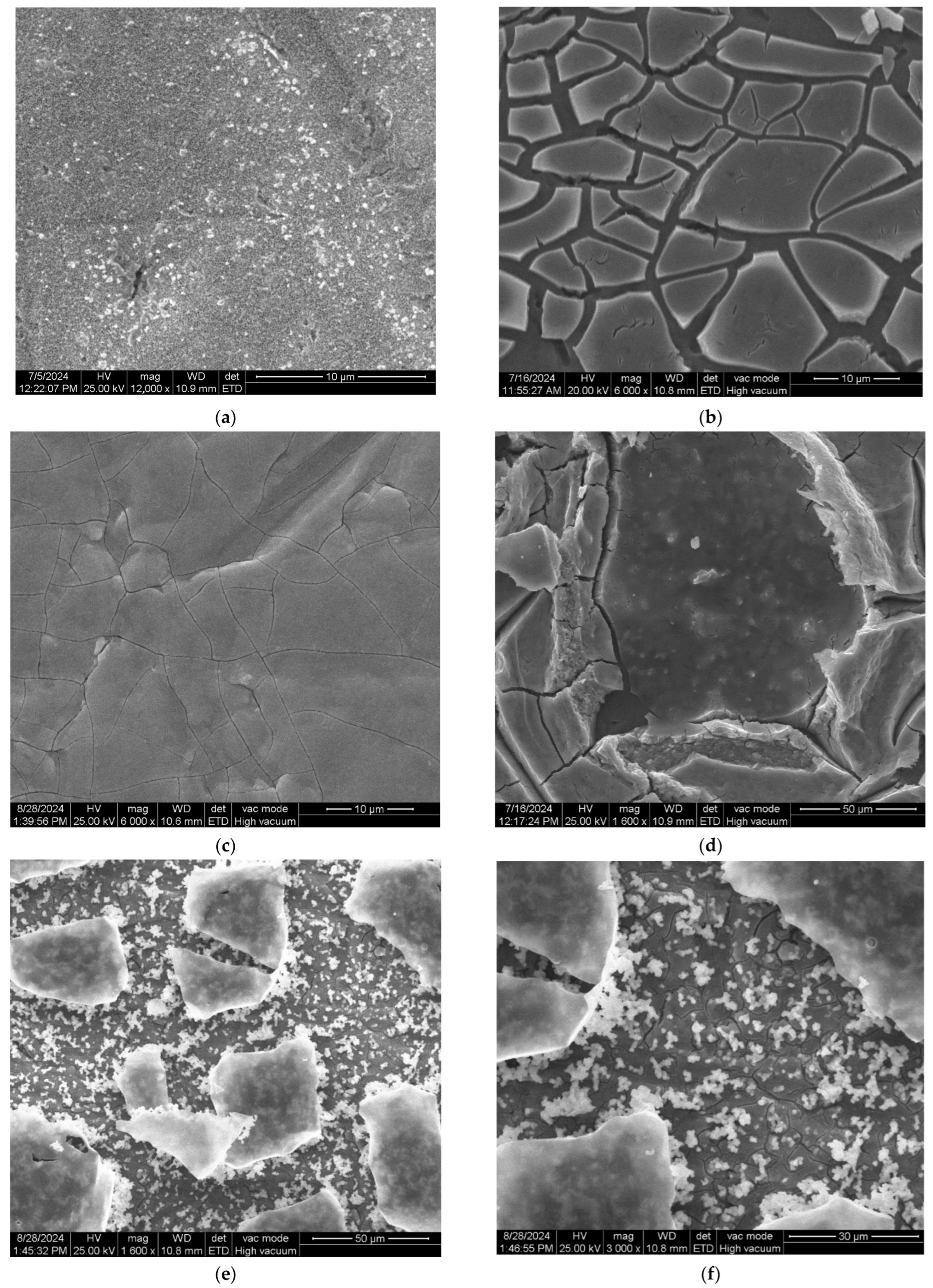
Figure 1 presents the SEM micrographs recorded on several TiO2 nanotube-based samples. The surface morphology of the TiO2 nanotube array obtained via anodization of a titanium substrate is shown in Figure 1a. The image reveals a dense, vertically aligned network of nanotubes with uniform spacing and consistent orientation across the field of view. The tubes appear open-ended and well-separated, forming a highly ordered architecture that reflects the stability and reproducibility of the anodization process. Based on the 2 µm scale bar and the magnification (50,000×), the average outer diameter of the nanotubes is estimated to be approximately 80–100 nm. The nanotubular scaffold in Figure 1a plays a crucial role in the subsequent modification steps. Its high aspect ratio and open geometry increase the active surface area and facilitate efficient mass transport during the hydrogen evolution reaction (HER). Importantly, the morphology reproducibly obtained through this passivation method contributes to the final electrode’s electrochemical stability and reproducible electrocatalytic activity. The vertical alignment enhances electron transfer pathways and promotes consistent catalyst distribution, both of which are essential for achieving low overpotential and reliable HER performance in alkaline media, as previously demonstrated in vertically aligned TiO2-based electrocatalysts designed for water splitting applications [34].
Figure 1b presents the surface morphology following MoO2 electrodeposition onto the TiO2 nanotube scaffold. Unlike the clean, vertically aligned tubes observed in Figure 1a, the surface appears fractured and irregular, with distinct grain boundaries and crack-like features spreading across the field. The dehydration of the amorphous MoO2 layer occurs during drying and subsequent thermal treatment. A similar cracking phenomenon was observed during the electrochemical deposition of MoO2 on Cu and Pt substrates from molybdate and peroxomolybdate solutions. According to thermogravimetric (TG) studies, the electrodeposited MoO2 layers lose ~10% of their mass due to dehydration in the 20–100 °C range, and an additional ~11% upon further heating up to around 400 °C [35]. This explains the formation of cracks in the superficial MoO2 layer even in the absence of thermal treatment, as observed in Figure 1b, as well as the subsequent contraction of the platelet-like formations after thermal treatment. This contraction reveals an underlying adherent substrate that itself displays a submicrometric crack network (Figure 1e,f). Beneath the fractured MoO2 surface, the TiO2 nanotubes are no longer visible. This transformation suggests that the MoO2 layer has partially filled or coated the nanotube openings, forming a more compact and textured surface, as previously mentioned. Despite the apparent roughness, the structure remains porous at the microscale, which may still allow electrolyte access and facilitate hydrogen evolution. Importantly, this modified morphology reflects the first major shift in the electrode architecture. The MoO2 layer introduces new catalytic sites and alters the electronic landscape of the surface. While the cracks might seem detrimental at first glance, they could also enhance surface reactivity by increasing edge exposure and defect density—both known to promote HER kinetics [36].
Figure 1c captures the surface morphology following nickel precursor deposition and subsequent exposure to NH3 vapors. The image reveals a fractured, grain-segmented surface with visible crack networks and irregular boundaries. Compared to earlier stages, the electrode surface displays relatively homogeneous agglomerations of nanoparticles, formed through the flocculation of Ni2+ precipitate onto the MoO2 surface. The structure appears more consolidated, suggesting that ammonia treatment has initiated a chemical transformation of the nickel species—likely forming nickel hydroxide via reactions such as (R1), (R2), and (R3):
NH3 + H2O → NH4+ + OH
Ni(NO3)2 + 2OH → Ni(OH)2(s) + 2NO3
Ni(OH)2(s) → NiO(s) + H2O
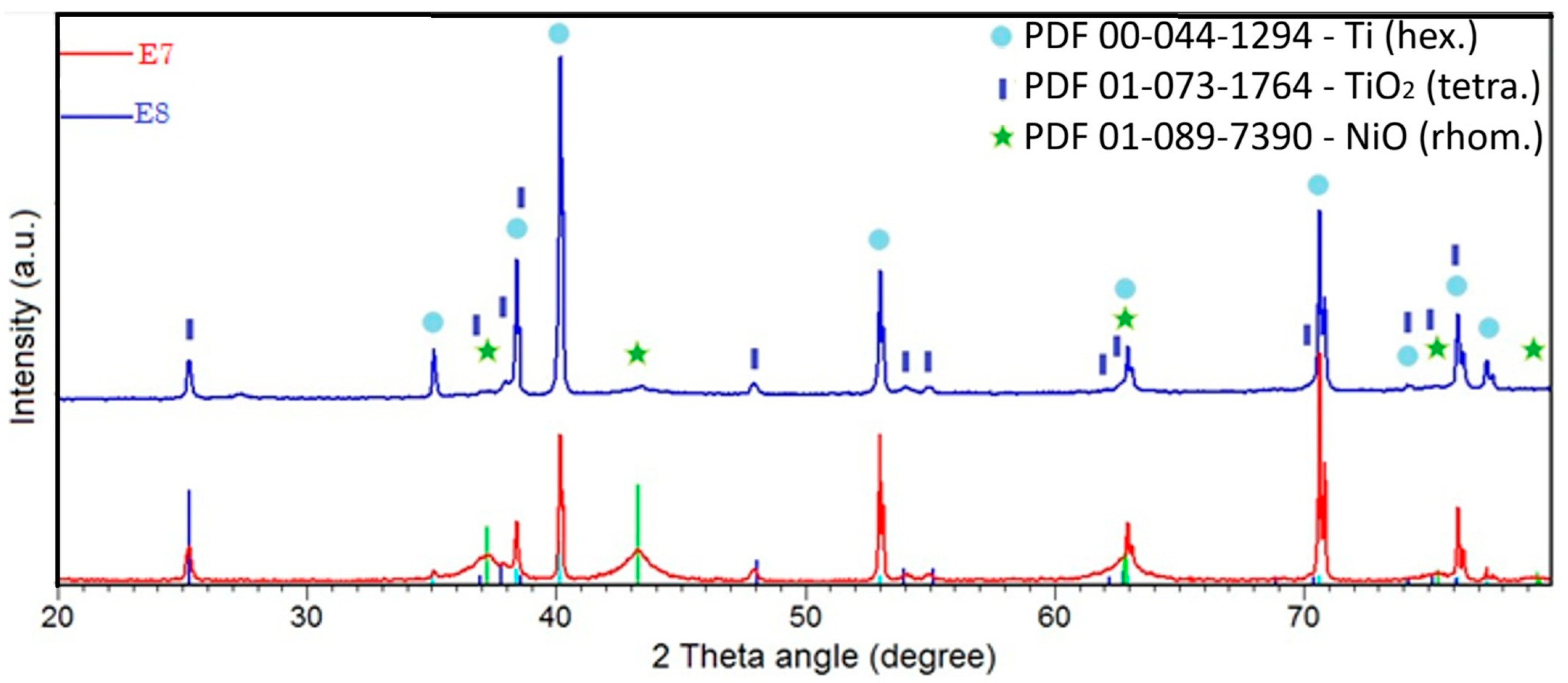
These features, while visually disruptive, can enhance electrocatalytic activity by increasing defect density and exposing high-energy edge sites [37]. The surface remains porous at the microscale, preserving electrolyte access and maintaining connectivity with the underlying TiO2 scaffold. This intermediate morphology is critical in shaping the final electrocatalyst. Figure 1d,e capture the surface of the fully treated electrode, revealing the cumulative impact of all modification steps. Figure 1d shows a compact, fractured structure with a smoother central region surrounded by a network of deep cracks. This morphology reflects the intense restructuring that occurs during thermal treatment as the layered components consolidate. However, they do not significantly react with each other, such that the X-ray diffraction spectra (Figure 2) reveal—after thermal treatment in air and under vacuum—the crystalline phases of the metallic substrate, the tetragonally crystallized TiO2 layer, and the NiO layer formed via reaction (R3). The structure appears stable, with no signs of delamination or flaking, which is crucial for long-term HER operation. In the case of thermally treating the electrodeposited layers in air, the partial oxidation of Mo(IV) to Mo(V) or Mo(VI) is theoretically possible, as described by reaction (R4).
MoO2 + x/2O2 → MoO2+x with (0 < x ≤ 1)
Reaction (R4) does not occur during thermal treatment under vacuum, meaning the MoO2 layer cannot undergo oxidation. These fine features suggest that vacuum treatment not only preserved the reduced chemical states but also maintained a surface with high roughness and exposed edges [38]. Nsanzimana et al. [39] demonstrated that Ni–Mo bifunctional catalysts with rough, fractured surfaces show improved water-splitting performance due to synergistic interactions between NiO and dispersed MoO2. Their work supports the idea that non-uniform, high-roughness morphologies are beneficial for catalytic activity [39].

3.2. XRD Analysis

The X-ray diffraction patterns of samples E7 and E8 reveal a well-crystallized composite structure anchored on a titanium substrate, having clearly visible and dominant diffraction peaks (Figure 2). These reflections confirm the preservation of the metallic base throughout the multi-step modification process, including anodization, nickel incorporation, and thermal treatment.
No distinct MoO2 peaks were observed, a result which may be attributed to its amorphous nature and is consistent with previous reports on molybdenum electrodeposition. This observation aligns with findings reported by Inguanta et al., who noted that molybdenum oxide nanostructures obtained via template electrodeposition often exhibit amorphous or mixed-valence characteristics, especially under mild thermal conditions or low deposition loads [40].
Overall, the XRD data reflect a coherent and highly crystalline oxide architecture built upon a titanium base, with the tubular TiO2 morphology playing a central role in enhancing structural uniformity and electrocatalyst adhesion. These features are expected to improve electrochemical performance by promoting efficient charge transport, mechanical stability, and the exposure of active surface sites to the electrolyte solution.

3.3. Water Electrolysis Study

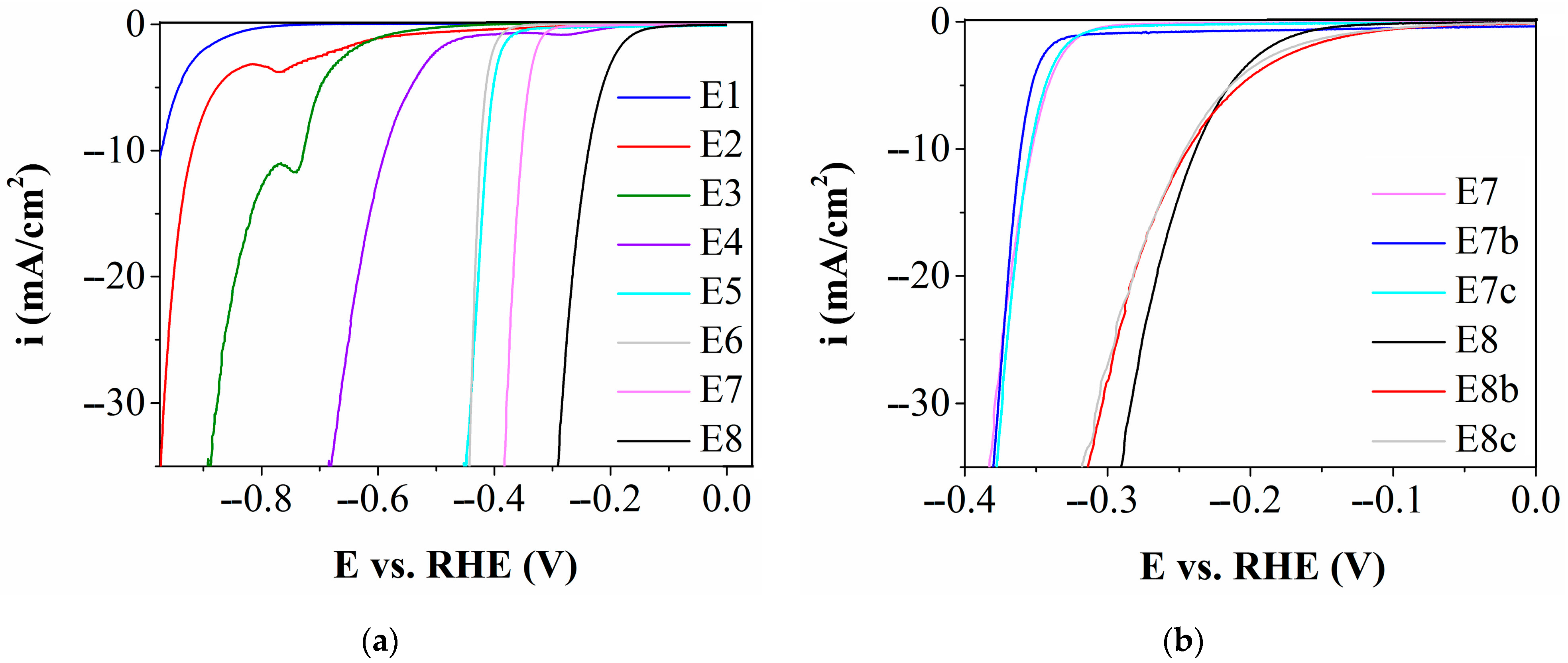
LSVs recorded during the HER experiments performed on the modified electrodes are presented in Figure 3. The value of the HER overpotential is usually specified at the current density of −10 mA/cm2 [41], and based on the results shown in Figure 3a, the lowest ηHER values were displayed by the E7 and E8 electrodes. Table 2 presents these values, as well as the ones determined for the other electrodes investigated in terms of their HER electrocatalytic activity. The LSV obtained on the E2 electrode shows a reduction peak at −0.767 V, which is absent from the curve recorded on E1 and can be attributed to the TiO2 nanotubes. The signal is also present on the LSV recorded on E3, but shifted towards a more positive electrochemical potential (−0.740 V). As for the difference between the ηHER values found for E3 and E2, it can be explained by the thermal treatment applied during the manufacturing process of E3. It was previously reported that the thermal treatment at calcination temperatures of amorphous TiO2 nanotubes obtained by anodization leads to nanotube crystallization and defect generation [42,43]. The newly formed crystal structure can enhance electron transfer [44], and defects are known to increase the number of available catalytic sites [45]. Improved electron transfer and a higher number of catalytic sites result in a lower HER overpotential. Concerning the rest of the studied electrodes, as the complexity of the electrode manufacturing process increased, so did their catalytic activity. This observation was expected to some extent. This is because electrocatalysts containing both transition metals (Ni and Mo) have been reported to exhibit high HER activity under alkaline conditions. For example, Park et al. employed electrodeposition and electrochemical etching to fabricate high-performance Mo oxide-decorated NiMo heterostructure catalysts on carbon paper, while Liu et al. utilized a calcination-based method to obtain MoO2-Ni nanowire arrays on Ni foam [46,47]. In both cases, the HER activity was attributed to a synergistic effect between the different components of the electrodes. Such an effect could also explain why the E7 and E8 electrodes displayed the highest electrocatalytic activity.
The protocols employed to obtain E7 and E8 were similar, and since these electrodes displayed the lowest HER overpotentials, they were selected for further electrochemical investigation. One study focused on their inter-electrode reproducibility, and the experimental results are shown in Figure 3b. A set of three E7 electrodes (E7, E7b, and E7c) and a set of three E8 electrodes (E8, E8b, and E8c) were considered, and mean ηHER values of 356 ± 4.36 mV and 242 ± 4.58 mV were obtained. They indicate a relatively high degree of inter-electrode reproducibility.
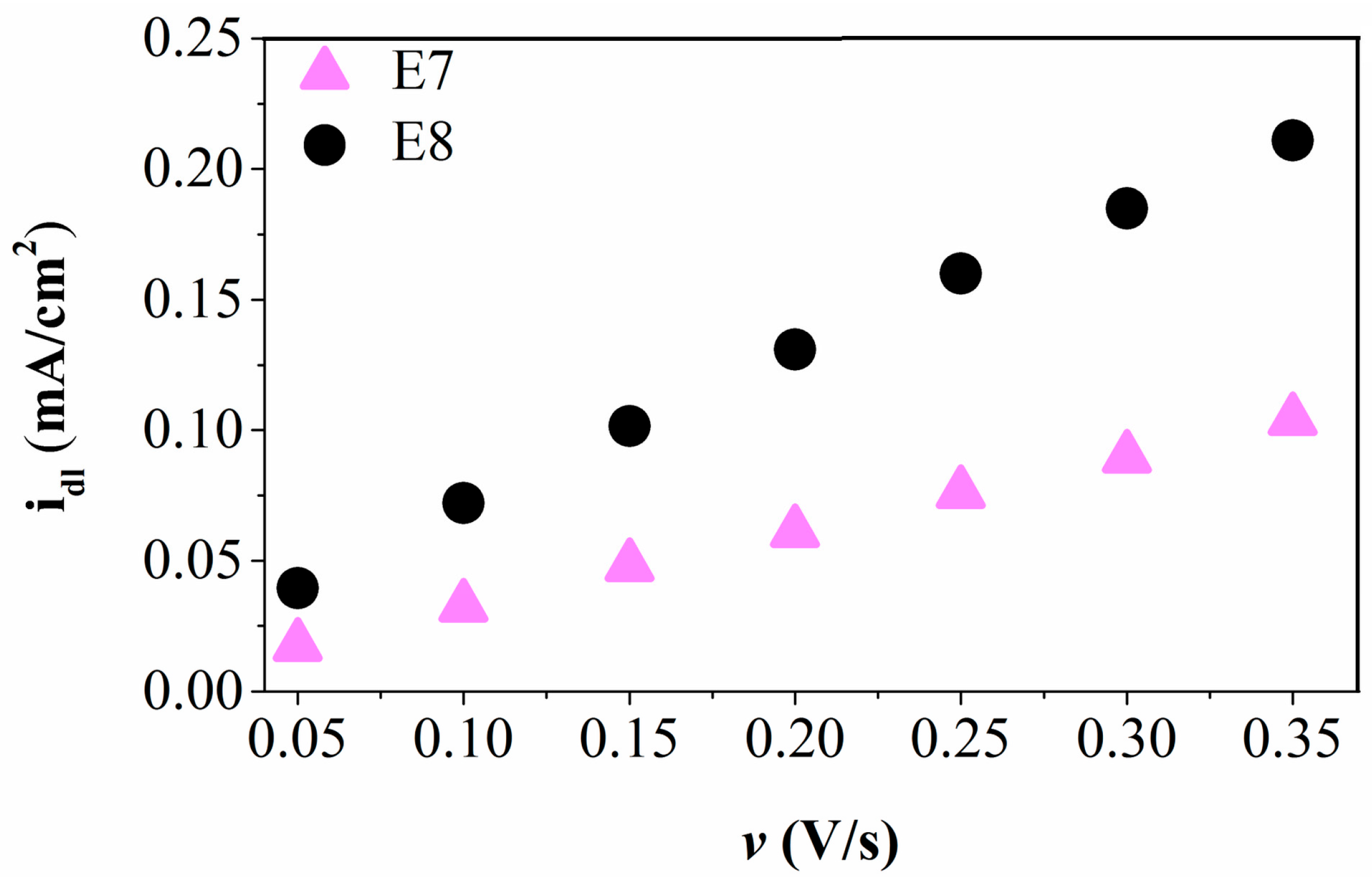
The values of several electrochemical parameters, including the electrical double layer capacitance (Cdl), Rf, ECSA, and Tafel slope, were also determined. Experimentally, cyclic voltammograms were recorded at increasing scan rate values for both electrodes (Figure S1). The acquired data were used together with Equation (S4) to calculate the capacitive current density values, which were subsequently represented graphically in Figure 4. The Cdl values were determined as the values of the slopes of the curves plotted for E7 and E8. Table 3 shows the electrochemical parameter values obtained for the two electrodes.
By comparison with E7, the higher ECSA value of the E8 electrode indicates a higher number of catalytic centers involved in the HER electrocatalysis [48].
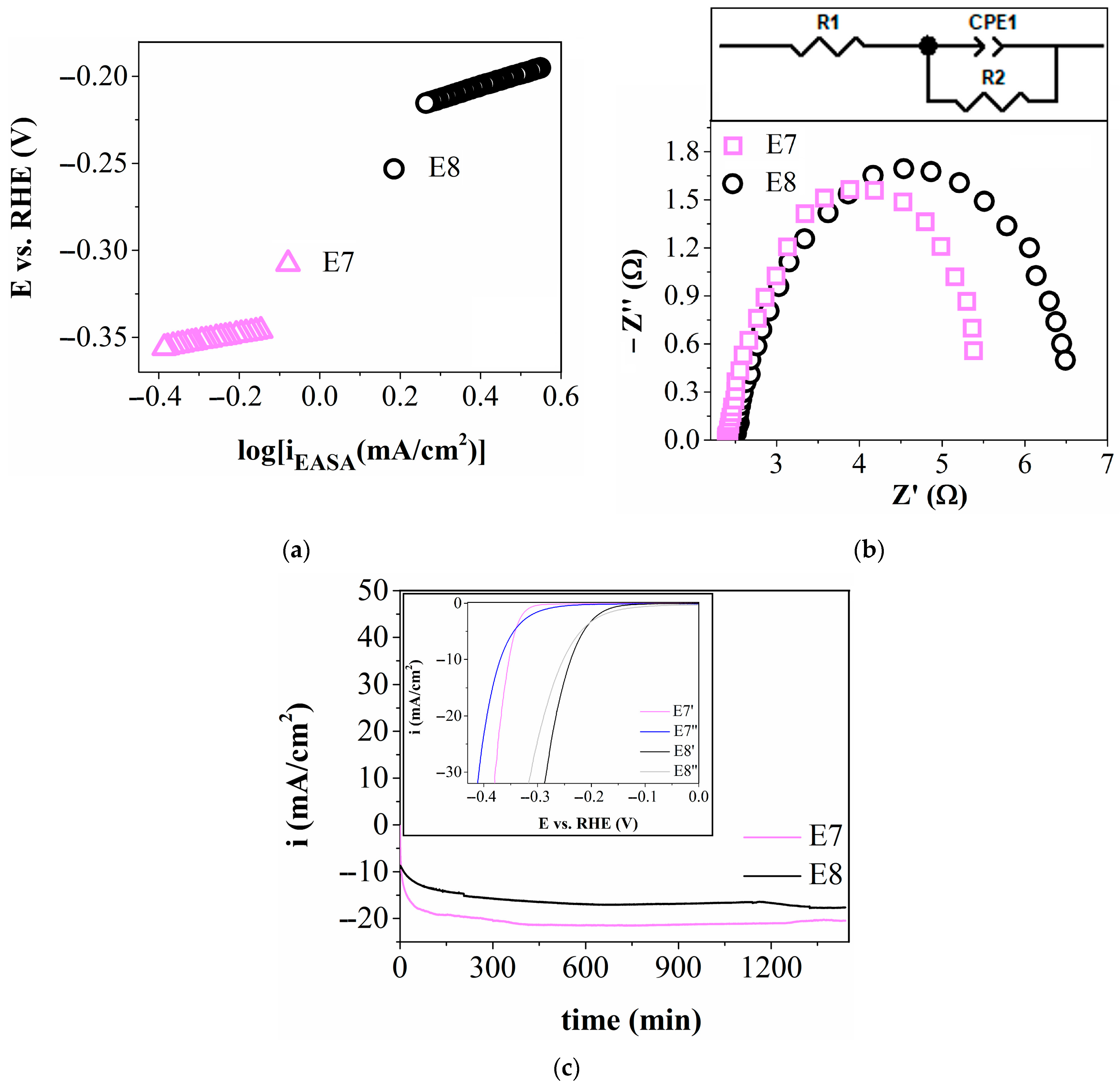
The Tafel slope values of the two electrodes were determined with the Tafel equation—Equation (S3)—and the Tafel plots presented in Figure 5a. Both electrodes exhibit low Tafel slope values, and both of them fall within the 40–120 mV/dec interval, suggesting that the hydrogen evolution reaction unfolding on the surface of the E7 and E8 electrodes follows a Volmer–Heyrovsky mechanism, and that there is congruence between the rate of the discharge and desorption steps [49]. The lower Tafel slope displayed by the E7 electrode indicates a higher hydrogen evolution reaction rate and more favorable kinetics compared to E8 [50]. The catalytic kinetics at the E7/electrolyte solution and E8/electrolyte solution interfaces were also evaluated by electrochemical impedance spectroscopy (EIS). This analysis aimed at measure the charge-transfer ability in the HER [51]. Nyquist plots were recorded for both electrodes at the ηHER values corresponding to i = −10 mA/cm2, at an amplitude of 10 mV, and in the 105–10−1 Hz range (Figure 5b). The inset of Figure 5b shows the equivalent electrical circuit that describes the HER kinetic process for the two electrodes. R1 and R2 are the electrolyte resistance and the charge-transfer resistance, respectively. The latter is often used to assess the interfacial HER process [52]. The semicircle of the Nyquist plots is a quantitative indicator of R2, and the values found for this resistance are 3.355 Ω for E7 and 4.238 Ω for E8. They are similar, but the smaller value of the E7 electrode evidences its higher conductivity with a faster electrochemical reaction rate [51]. The result is consistent with the smaller Tafel slope value determined for the same electrode.
The catalytic kinetics investigations were preceded by the testing of the electrochemical stability of the E7 and E8 electrodes. The chronoamperometric curves recorded at ηHER = 353 mV for E7 and 238 mV for E8 are presented in Figure 5c.
While both electrodes were relatively stable during the 24 h experiments, the current density values observed for E8 were closer to the −10 mA/cm2 value. The inset of Figure 5c shows the LSVs obtained for the two electrodes before (E7′ and E8′) and after (E7″ and E8″) the amperometric tests. Following the experiments, the ηHER values at i = −10 mA/cm2 increased by 16 mV in the case of E7, and by 14 mV in the case of E8. These relatively small differences indicate the stability of the studied electrodes, which was further confirmed by Raman analysis.
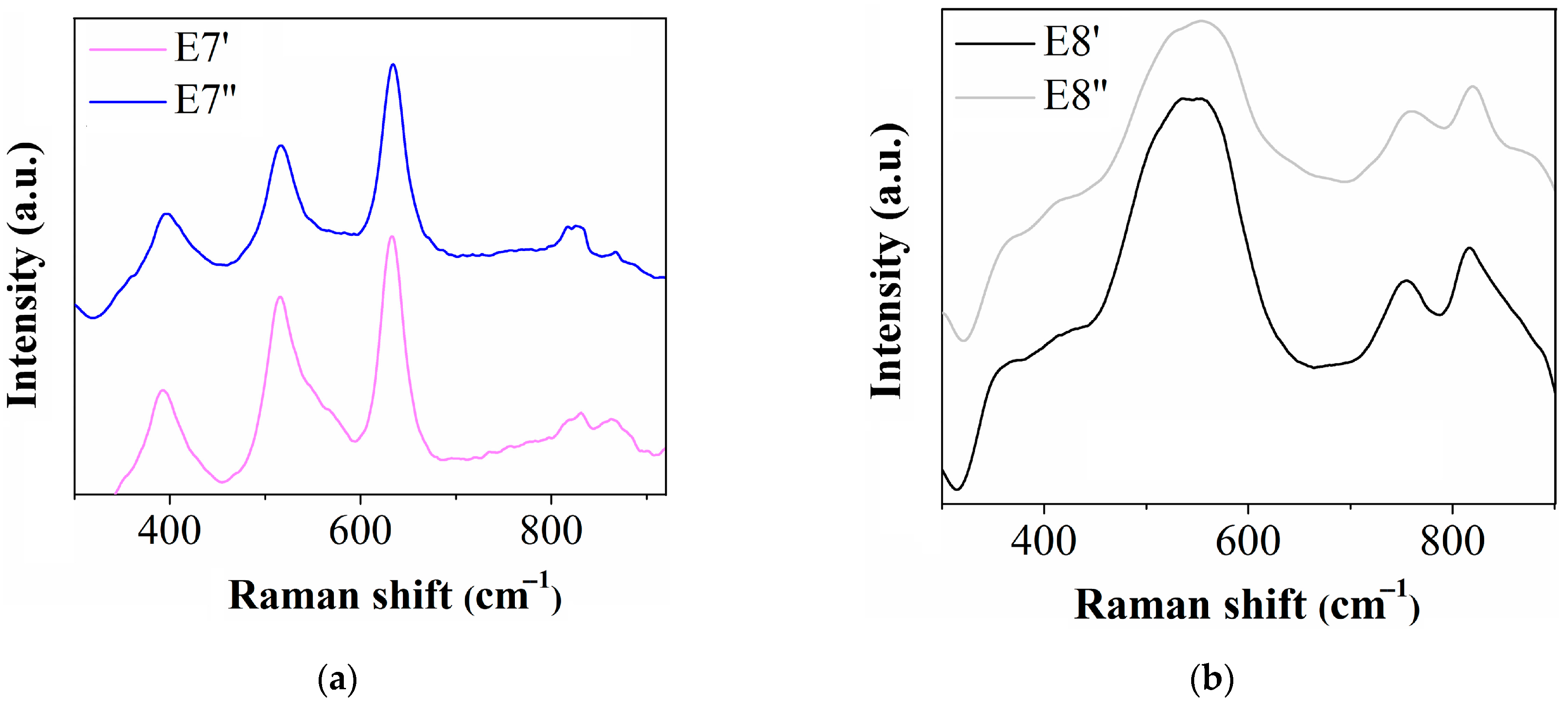
Raman spectra recorded for both electrodes before (E7′ and E8′) and after (E7″ and E8″) the stability tests are presented in Figure 6a and Figure 6b, respectively. The similar vibration bands observed around 400–800 cm−1 originate from TiO2-based configurations and metal oxides. The results indicate that the chemical structure of the electrodes was well-maintained during the electrochemical tests.
Anatase TiO2 is a widely studied crystalline phase of titanium dioxide with characteristic vibrational modes detectable by Raman spectroscopy [53]. The integrity of the structure for TiO2-based electrodes modified with a surface film of molybdenum oxide and nickel oxide (NiO) was evaluated by Raman spectroscopy. The spectra of the non-irradiated electrodes revealed typical anatase TiO2 vibrational modes—B1g (399 cm−1), A1g (513 cm−1), and Eg (~639 cm−1)—indicating the existence of a pure tetragonal phase. There were additional Raman bands contributed by MoO3 and NiO in the 500–800 cm−1 range, corresponding to Mo=O stretching and Ni–O lattice vibration, respectively. Interestingly, after chronoamperometric testing, no detectable shifts in peak positions or new bands were observed in the Raman spectra of the electrodes (E7″ and E8″). Maintenance of the anatase TiO2 signal and stability of the molybdenum oxide and NiO features do not indicate any chemical structural modification to the composite electrodes during electrochemical testing. Hua et al. reviewed Mo-based HER catalysts and emphasized that MoO2 is more catalytically active than MoO3, especially in alkaline media. They noted that vacuum or inert-atmosphere treatments help stabilize Mo4+ states and prevent over-oxidation to Mo6+, which can reduce conductivity and HER efficiency [54]. TiO2 Raman modes and their sensitivity to treatment atmosphere are well-documented by Pavlova et al., who showed that vacuum-treated TiO2 ceramics exhibit broadened and shifted Raman bands due to phase transformation and surface modification [55]. NiO Raman features often dominate in the 500–600 cm−1 region, especially when crystallized on TiO2 substrates, as shown in Wang et al., where NiO/TiO2 junctions exhibited strong electron–phonon coupling and overlapping vibrational modes [56].
Comparison of the spectra before and after chronoamperometric testing reveals no significant shifts in peak positions or emergence of new bands, indicating that the chemical structure of the composite electrodes remained unchanged. These results confirm the structural stability of the oxide layers and support their suitability for electrochemical applications requiring robust interfacial architectures. Luo et al. highlight that Ni–Mo interfaces under oxygen-deficient conditions tend to form amorphous MoO2 domains, which improve HER kinetics by exposing more active edge sites and enhancing electron transfer. These structures are often invisible in XRD but reveal subtle Raman features near 600 cm−1 [57].
The conclusion to the study comparing the water electrolysis activity and electrochemical properties of E7 and E8, is that the difference in the electrode manufacturing protocols employed to obtain the two electrodes, which consisted of the thermal treatment being performed in air atmosphere in the case of E7 and under vacuum in the case of E8, was probably responsible for the lower HER overpotential, higher ECSA, and higher electrochemical stability displayed by E8, and also for the lower Tafel slope and charge-transfer resistance values displayed by E7.
Furthermore, NiO is highly stable during hydrogen evolution in alkaline environments [58]. However, bare NiO exhibits low HER electrocatalytic activity due to its inability to stabilize the hydrogen atom, which is why it should be combined with other materials [59]. In alkaline media, MoO2 can become a hydrogen adsorption promoter, and even though neither NiO nor MoO2 possesses a high HER electrocatalytic activity, when combined in ways that result in the generation of efficient catalytic sites for fast hydrogen adsorption and desorption, they have the potential to substantially decrease the HER electrocatalytic activity of electrodes immersed in the respective electrolyte solutions [60]. It is expected that the HER overpotentials displayed by E7 and E8 are partly due to the local electron configuration arrangement resulting from the interaction between NiO and MoO2 [60].
A literature study was also conducted, and the reported data are included in Table S1 from the Supplementary Material file. They show the HER electrocatalytic activity of E7 and E8, as well as that of other electrodes, including transition metal oxide-based electrodes and nanostructure-containing electrodes. Most of the ηHER values identified in published studies and presented in the table are comparable to those found for E7 and E8. However, most ηHER values found in studies reported in 2024 and 2025, which were performed on non-noble metal HER electrocatalysts are smaller. This observation indicates that, compared to previous years, the catalysts reported in 2024 and 2025 exhibit overpotentials that are closer to those of the benchmark materials. Still, in the case of the Tafel slope parameter, the values obtained for E7 and E8 are among the smallest. It is also noteworthy that the same value of 237 mV (exhibited by E8) was also reported by Wu et al. [61], who showed that HER activity can be achieved in ZnIn2S4 (ZIS) nanosheets coupled to TiO2 nanofibers by boron doping (electrode code = B-ZIS@TiO2 NM). However, the Tafel slope of the reported electrode is significantly higher than the slope found for E8 (71 mV/dec for E8 vs. 198.8 mV/dec for B-ZIS@TiO2 NM), suggesting more sluggish HER kinetics. The morphological modifications introduced by MoO2 deposition, including crack formation and platelet contraction, are consistent with defect generation within the oxide layer. The coexistence of morphological evolution and structural stability suggests that the electrode architecture remains robust while simultaneously providing defect-rich regions that contribute positively to catalytic performance. These findings support the improved HER activity observed for electrodes E7 and E8.

4. Conclusions

TiO2-based electrodes modified using new multi-stage protocols were successfully manufactured. The recorded SEM micrographs show that each manufacturing stage progressively reshapes the surface morphology, resulting in a high-roughness architecture with abundant edge sites, crack networks, and granular domains, all of which are known to enhance electrocatalytic performance. The acquired XRD data indicate that the crystalline integrity of the TiO2 scaffold is preserved throughout the multi-step modification process, while the successful incorporation of NiO and the likely amorphous nature of MoO2 contribute to a chemically diverse and catalytically active surface. These structural features, confirmed by SEM and Raman spectroscopy, align with the observed electrocatalytic behavior. These findings underscore the importance of controlled thermal environments in shaping the final electrocatalyst architecture. The vacuum-treated surface, characterized by high roughness, crack networks, and exposed edge sites, appears particularly suited for HER applications due to its defect-rich matrix.
The alkaline HER electrocatalytic activity of TiO2-based electrodes modified using the new multi-stage protocols was successfully evaluated. The lowest ηHER values were found for the electrodes designated as E7 and E8, which differed in the type of thermal treatment applied during manufacturing. A ηHER value of 238 mV at i = −10 mA/cm2 and a Tafel slope of 71 mV/dec were displayed by E8, while a ηHER value of 353 mV and a Tafel slope of 40 mV/dec were found for E7. Both electrodes were shown to possess a relatively high stability and inter-electrode reproducibility. A comparison between the Raman spectra recorded on them before and after electrochemical stability tests did not reveal any significant chemical structural modifications.
In future studies, the electrode manufacturing protocols will include a pulsed laser deposition stage intended to enhance the HER electrocatalytic activity of the novel electrodes.

Supplementary Materials

The following supporting information can be downloaded at: https://www.mdpi.com/article/10.3390/nanoenergyadv6010005/s1, Figure S1. CVs recorded on the E7 electrode (a) and the E8 electrode (b) between −150 and 200 mV, at increasing v values (50, 100, 150, 200, 250, 300, and 350 mV/s), in 0.1 M KCl solution. Table S1. The HER activity of the E7 and E8 electrodes compared to that of other electrodes. Electrolyte solution: 1 M KOH. Current density: −10 mA/cm2. References [32,33,61,62,63,64,65,66,67,68,69,70,71,72,73,74,75,76,77,78,79] are cited in the Supplementary Material file.

Author Contributions

Conceptualization, R.B. and F.S.R.; methodology, B.-O.T.; investigation, B.-O.T.; resources, F.S.R.; data curation, R.B.; writing—original draft preparation, B.-O.T.; writing—review and editing, F.S.R.; supervision, R.B.; funding acquisition, F.S.R. All authors have read and agreed to the published version of the manuscript.

Funding

This work was supported by a mobility project of the Romanian Ministry of Research, Innovation and Digitization, CNCS-UEFISCDI, project number PN-IV-P2-2.2-MC-2024-0169, within PNCDI IV.

Data Availability Statement

The original contributions presented in this study are included in the article/Supplementary Materials. Further inquiries can be directed to the corresponding authors.

Acknowledgments

The authors acknowledge Daniel Ursu from the National Institute of Research and Development for Electrochemistry and Condensed Matter (Timisoara, Romania) for his contribution to the EIS investigation. During the preparation of this manuscript, the authors utilized GenAi for the purposes of verifying grammar and enhancing the clarity of scientific explanations. The authors have carefully reviewed and edited all AI-assisted output and take full responsibility for the content of this publication.

Conflicts of Interest

The authors declare no conflicts of interest.

Abbreviations

The following abbreviations are used in this manuscript:
SEMScanning electron microscopy
XRDX-ray diffraction
HERHydrogen evolution reaction
OEROxygen evolution reaction
ηHERHER overpotential
LSVLinear sweep voltammogram
RHEReversible hydrogen electrode
ECSAElectrochemically active surface area
RfRoughness factor
CdlElectrical double layer capacitance
idlCapacitive current density
EISElectrochemical impedance spectroscopy
RamanRaman spectroscopy

References

  1. Hosseini, S.H.; Tsolakis, A.; Alagumalai, A.; Mahian, O.; Lam, S.S.; Pan, J.; Peng, W.; Tabatabaei, M.; Aghbashlo, M. Use of Hydrogen in Dual-Fuel Diesel Engines. Prog. Energy Combust. Sci. 2023, 98, 101100. [Google Scholar] [CrossRef]
  2. Filonchyk, M.; Peterson, M.P.; Zhang, L.; Hurynovich, V.; He, Y. Greenhouse Gases Emissions and Global Climate Change: Examining the Influence of CO2, CH4, and N2O. Sci. Total Environ. 2024, 935, 173359. [Google Scholar] [CrossRef]
  3. Pan, X.; Zhou, H.; Baimbetov, D.; Syrlybekkyzy, S.; Akhmetov, B.B.; Abbas, Q. Development Status and Future Prospects of Hydrogen Energy Technology: Production, Storage, and Cost Analysis. Adv. Energy Sustain. Res. 2025, 6, 2400451. [Google Scholar] [CrossRef]
  4. Chi, J.; Yu, H. Water Electrolysis Based on Renewable Energy for Hydrogen Production. Chin. J. Catal. 2018, 39, 390–394. [Google Scholar] [CrossRef]
  5. Lee, J.E.; Jeon, K.-J.; Show, P.L.; Lee, I.H.; Jung, S.-C.; Choi, Y.J.; Rhee, G.H.; Lin, K.-Y.A.; Park, Y.-K. Mini Review on H2 Production from Electrochemical Water Splitting According to Special Nanostructured Morphology of Electrocatalysts. Fuel 2022, 308, 122048. [Google Scholar] [CrossRef]
  6. Vedrtnam, A.; Kalauni, K.; Pahwa, R. Water Electrolysis Technologies and Their Modeling Approaches: A Comprehensive Review. Eng 2025, 6, 81. [Google Scholar] [CrossRef]
  7. Kumar, S.S.; Lim, H. An Overview of Water Electrolysis Technologies for Green Hydrogen Production. Energy Rep. 2022, 8, 13793–13813. [Google Scholar] [CrossRef]
  8. Avani, A.V.; Anila, E.I. Recent Advances of MoO3 Based Materials in Energy Catalysis: Applications in Hydrogen Evolution and Oxygen Evolution Reactions. Int. J. Hydrogen Energy 2022, 47, 20475–20493. [Google Scholar] [CrossRef]
  9. Lee, J.; Lee, S.A.; Lee, T.H.; Jang, H.W. Unlocking the Potential of Chemical-Assisted Water Electrolysis for Green Hydrogen Production. Ind. Chem. Mater. 2025, 3, 277–310. [Google Scholar] [CrossRef]
  10. Amini Horri, B.; Ozcan, H. Green Hydrogen Production by Water Electrolysis: Current Status and Challenges. Curr. Opin. Green Sustain. Chem. 2024, 47, 100932. [Google Scholar] [CrossRef]
  11. Irshad, H.; Zia, M.; Al-Hajri, R.; Khattak, Z.A.K.; Al-Abri, M.; Ahmad, N.; Younus, H.A. Electrocatalysts for Hydrogen and Oxygen Evolution Reactions under Neutral/near-Neutral Conditions: Summary and Challenges. Int. J. Hydrogen Energy 2025, 137, 1009–1041. [Google Scholar] [CrossRef]
  12. Zhong, G.; Zhao, R.; Shi, Y.-R.; Li, C.-R.; He, L.; He, L.; Huang, Y. Thermal shock synthesis of carbon nanotubes supporting small-sized rhenium nanoparticles for efficient electrocatalytic hydrogen evolution. Rare Met. 2023, 42, 2166–2173. [Google Scholar] [CrossRef]
  13. Qiu, L.; Tian, F.; He, L.; Li, M.; Lin, F.; Li, L.; Ren, X.; Wu, F.; Li, L.; Zhang, T.; et al. Robust Interfacial Hydrogen-Bond Network on Positively Charged Ru-N-Ni Dual Sites Boosts Alkaline Hydrogen Electrocatalysis. Adv. Mater. 2025, e12568, Early View. [Google Scholar] [CrossRef] [PubMed]
  14. Kumar, R.S.; Ramakrishnan, S.; Prabhakaran, S.; Kim, A.R.; Kumar, D.R.; Kim, D.H.; Yoo, D.J. Structural, Electronic, and Electrocatalytic Evaluation of Spinel Transition Metal Sulfide Supported Reduced Graphene Oxide. J. Mater. Chem. A 2022, 10, 1999–2011. [Google Scholar] [CrossRef]
  15. Kumar, R.S.; Karthikeyan, S.C.; Ramakrishnan, S.; Vijayapradeep, S.; Kim, A.R.; Kim, J.-S.; Yoo, D.J. Anion Dependency of Spinel Type Cobalt Catalysts for Efficient Overall Water Splitting in an Acid Medium. Chem. Eng. J. 2023, 451, 138471. [Google Scholar] [CrossRef]
  16. Wang, S.; Lu, A.; Zhong, C.J. Hydrogen Production from Water Electrolysis: Role of Catalysts. Nano Converg. 2021, 8, 4. [Google Scholar] [CrossRef]
  17. Durovic, M.; Hnat, J.; Bouzek, K. Electrocatalysts for the Hydrogen Evolution Reaction in Alkaline and Neutral Media: A Comparative Review. J. Power Sources 2021, 493, 229708. [Google Scholar] [CrossRef]
  18. Shi, Q.; Zhu, C.; Du, D.; Lin, Y. Robust Noble Metal-Based Electrocatalysts for Oxygen Evolution Reaction. Chem. Soc. Rev. 2019, 48, 3181–3192. [Google Scholar] [CrossRef]
  19. González-Poggini, S. Hydrogen Evolution Descriptors: A Review for Electrocatalyst Development and Optimization. Int. J. Hydrogen Energy 2024, 59, 30–42. [Google Scholar] [CrossRef]
  20. Gao, G.; Zhao, G.; Zhu, G.; Sun, B.; Sun, Z.; Li, S.; Lan, Y.-Q. Recent Advancements in Noble-Metal Electrocatalysts for Alkaline Hydrogen Evolution Reaction. Chin. Chem. Lett. 2025, 36, 109557. [Google Scholar] [CrossRef]
  21. Kazemi, A.; Manteghi, F.; Tehrani, Z. Metal Electrocatalysts for Hydrogen Production in Water Splitting. ACS Omega 2024, 9, 7310–7335. [Google Scholar] [CrossRef]
  22. Tripathi, P.; Verma, A.K.; Sinha, A.S.K.; Singh, S. Graphene-Transition Metal Electrocatalysts for Sustainable Water Electrolysis. ChemistrySelect 2024, 9, e202403155. [Google Scholar] [CrossRef]
  23. Shi, Y.; Xiao, S.; Jiao, S.; Wang, Y.; Jiang, F.; Wang, R.; Zhang, Y.; Liu, J.; Qiao, J.; Hu, Z.; et al. Hydrogen Evolution Electrodes: Materials and Mechanisms in Alkaline Electrolysis. Desalination 2024, 586, 117887. [Google Scholar] [CrossRef]
  24. Jayakumar, A.; Krishnan, A. Co-TiO2 as a UV-Visible Photocatalyst for Hydrogen Generation by Alkaline Water Splitting. Mater. Lett. 2025, 399, 139003. [Google Scholar] [CrossRef]
  25. Li, R.; Hu, B.; Yu, T.; Shao, Z.; Wang, Y.; Song, S. New TiO2-Based Oxide for Catalyzing Alkaline Hydrogen Evolution Reaction with Noble Metal-Like Performance. Small Methods 2021, 5, 2100246. [Google Scholar] [CrossRef]
  26. Alsawat, M.; Alshehri, N.A.; Shaltout, A.A.; Ahmed, S.I.; Al-Malki, H.M.O.; Das, M.R.; Boukherrou, R.; Amin, M.A.; Ibrahim, M.M. Enhanced Alkaline Hydrogen Evolution on Gd1.0/Ndx (x = 0.5, 1.0, 3.0, and 6.0%)-Doped TiO2 Bimetallic Electrocatalysts. Catalysts 2023, 13, 1192. [Google Scholar] [CrossRef]
  27. Chen, J.; Gao, Y.; Yang, W.; Li, Z.; Xiong, K. Effect of Different Crystalline Phase of TiO2 on the Catalytic Activity of Ru Catalysts in Hydrogen Evolution under Acidic and Alkaline Media. Int. J. Hydrogen Energy 2024, 52, 302–310. [Google Scholar] [CrossRef]
  28. Capozzoli, L.; Caprì, A.; Baglio, V.; Berretti, E.; Evangelisti, C.; Filippi, J.; Gatto, I.; Lavacchi, A.; Pagliaro, M.; Vizza, F. Ruthenium-Loaded Titania Nanotube Arrays as Catalysts for the Hydrogen Evolution Reaction in Alkaline Membrane Electrolysis. J. Power Sources 2023, 562, 232747. [Google Scholar] [CrossRef]
  29. Chen, J.; Zhou, Y.; Li, R.; Wang, X.; Chen, G.Z. Highly-Dispersed Nickel Nanoparticles Decorated Titanium Dioxide Nanotube Array for Enhanced Solar Light Absorption. Appl. Surf. Sci. 2019, 464, 716–724. [Google Scholar] [CrossRef]
  30. Cheshideh, H.; Nasirpouri, F. Cyclic Voltammetry Deposition of Nickel Nanoparticles on TiO2 Nanotubes and Their Enhanced Properties for Electro-Oxidation of Methanol. J. Electroanal. Chem. 2017, 797, 121–133. [Google Scholar] [CrossRef]
  31. Cao, H.; Tong, C.; Zhang, H.; Zheng, G. Mechanism of MoO2 Electrodeposition from Ammonium Molybdate Solution. Trans. Nonferrous Met. Soc. China 2019, 29, 1744–1752. [Google Scholar] [CrossRef]
  32. Taranu, B.-O.; Svera, P.; Buse, G.; Poienar, M. Insights into the Electrocatalytic Activity of Mixed-Valence Mn3+/Mn4+ and Fe2+/Fe3+ Transition Metal Oxide Materials. Solids 2025, 6, 48. [Google Scholar] [CrossRef]
  33. Ciriaco, M.L.F.; Silva-Pereira, M.I.; Nunes, M.R.; Costa, F.M. Electrochemical Behaviour of BaSn0.9Sb0.1O3 Coated Titanium Electrodes. Port. Electrochim. Acta 1999, 17, 149–156. [Google Scholar] [CrossRef]
  34. Roy, P.; Berger, S.; Schmuki, P. TiO2 Nanotubes: Synthesis and Applications. Angew. Chem. Int. Ed. Engl. 2011, 50, 2904–2939. [Google Scholar] [CrossRef]
  35. Banica, R.; Barvinschi, P.; Vaszilcsin, N.; Nyari, T. A Comparative Study of the Electrochemical Deposition of Molybdenum Oxides Thin Films on Copper and Platinum. J. Alloys Compd. 2009, 483, 402–405. [Google Scholar] [CrossRef]
  36. Jian, C.; Yuan, J.; Cai, Q.; Hong, W.; Liu, W. Self-Standing Mo/MoO2 Porous Flake Arrays for Efficient Hydrogen Evolution Reaction in High-pH Media. ACS Appl. Mater. Interfaces 2024, 16, 55569–55577. [Google Scholar] [CrossRef] [PubMed]
  37. Liu, Z.-Z.; Fan, R.-Y.; Yu, N.; Zhou, Y.-N.; Zhang, X.-Y.; Dong, B.; Yan, Z.-F. Facile Synthesis of Ni(OH)2 through Low-Temperature N-Doping for Efficient Hydrogen Evolution. Catalysts 2024, 14, 534. [Google Scholar] [CrossRef]
  38. Zhang, D.; Qian, X.; Li, X.; Wang, K. Effect of Vacuum Heat Treatment on Microstructures and Mechanical Properties of 7A52 Aluminum Alloy-Al2O3 Ceramic Brazed Joints. Front. Mater. 2021, 8, 634658. [Google Scholar] [CrossRef]
  39. Nsanzimana, J.M.V.; Jose, V.; Sk, M.; Reddu, V.; Li, X.; Dangol, R.; Hao, R.; Huang, Z.; Yan, Q.; Thapa, R.; et al. Unlocking the Oxygen Evolving Activity of Molybdenum Nickel Bifunctional Electrocatalyst for Efficient Water Splitting. Small 2025, 21, 2500587. [Google Scholar] [CrossRef]
  40. Inguanta, R.; Spano, T.; Piazza, S.; Sunseri, C.; Barreca, F.; Fazio, E.; Neri, F.; Silipigni, L. Electrodeposition and Characterization of Mo Oxide Nanostructures. Chem. Eng. Trans. 2015, 43, 685–690. [Google Scholar] [CrossRef]
  41. Ayub, M.N.; Shahzad, U.; Rabbee, M.F.; Saeed, M.; Khan, M.M.R.; Rahman, M.M. Recent Advances on Water Electrolysis Based on Nanoscale Inorganic Metal-Oxides and Metal-Oxyhydroxides for Hydrogen Energy Production. Int. J. Hydrogen Energy 2025, 97, 307–327. [Google Scholar] [CrossRef]
  42. AlAqad, K.M.; Kandiel, T.A.; Jahangir, T.N.; Qamar, M.; Basheer, C. TiO2 Nanotubes Modified with Cobalt Oxyphosphide Spheres for Efficient Electrocatalytic Hydrogen Evolution Reaction in Alkaline Medium. Electrochim. Acta 2023, 456, 142436. [Google Scholar] [CrossRef]
  43. Savva, A.I.; Smith, K.A.; Lawson, M.; Croft, S.R.; Weltner, A.E.; Jones, C.D.; Bull, H.; Simmonds, P.J.; Li, L.; Xiong, H. Defect Generation in TiO2 Nanotube Anodes via Heat Treatment in Various Atmospheres for Lithium-Ion Batteries. Phys. Chem. Chem. Phys. 2018, 20, 22537–22546. [Google Scholar] [CrossRef] [PubMed]
  44. Sopha, H.; Mirza, I.; Turčičova, H.; Pavlinak, D.; Michalicka, J.; Krbal, M.; Rodriguez-Pereira, J.; Hromadko, L.; Novák, O.; Mužík, J.; et al. Laser-Induced Crystallization of Anodic TiO2 Nanotube Layers. RSC Adv. 2020, 10, 22137–22145. [Google Scholar] [CrossRef] [PubMed]
  45. Perivoliotis, D.K.; Ekspong, J.; Zhao, X.; Hu, G.; Wågberg, T.; Gracia-Espino, E. Recent Progress on Defect-Rich Electrocatalysts for Hydrogen and Oxygen Evolution Reactions. Nano Today 2023, 50, 101883. [Google Scholar] [CrossRef]
  46. Park, J.; Kim, H.; Han, G.H.; Kim, J.; Yoo, S.J.; Kim, H.-J.; Ahn, S.H. Electrochemically Fabricated MoO3–MoO2@NiMo Heterostructure Catalyst with Pt-like Activity for the pH-Universal Hydrogen Evolution Reaction. J. Mater. Chem. A 2021, 9, 3677–3684. [Google Scholar] [CrossRef]
  47. Liu, X.; Ni, K.; Niu, C.; Guo, R.; Xi, W.; Wang, Z.; Meng, J.; Li, J.; Zhu, Y.; Wu, P.; et al. Upraising the O 2p Orbital by Integrating Ni with MoO2 for Accelerating Hydrogen Evolution Kinetics. ACS Catal. 2019, 9, 2275–2285. [Google Scholar] [CrossRef]
  48. Taranu, B.; Fagadar-Cosma, E.; Sfirloaga, P.; Poienar, M. Free-Base Porphyrin Aggregates Combined with Nickel Phosphite for Enhanced Alkaline Hydrogen Evolution. Energies 2023, 16, 1212. [Google Scholar] [CrossRef]
  49. Wu, Z.Y.; Hu, B.C.; Wu, P.; Liang, H.W.; Yu, Z.L.; Lin, Y.; Zheng, Y.R.; Li, Z.; Yu, S.H. Mo2C Nanoparticles Embedded within Bacterial Cellulose-Derived 3D N-Doped Carbon Nanofiber Networks for Efficient Hydrogen Evolution. NPG Asia Mater. 2016, 8, e288. [Google Scholar] [CrossRef]
  50. Bao, F.; Kemppainen, E.; Dorbandt, I.; Bors, R.; Xi, F.; Schlatmann, R.; van de Krol, R.; Calnan, S. Understanding the Hydrogen Evolution Reaction Kinetics of Electrodeposited Nickel-Molybdenum in Acidic, near-Neutral, and Alkaline Conditions. ChemElectroChem 2021, 8, 195–208. [Google Scholar] [CrossRef]
  51. Pan, Y.; Fang, Y.; Jin, H.; Zhang, M.; Wang, L.; Ma, S.; Zhu, H.; Du, M. A Highly Active and Robust CoP/CoS2-Based Electrocatalyst Toward Overall Water Splitting. Electrocatalysis 2019, 10, 253–261. [Google Scholar] [CrossRef]
  52. Liu, J.; Wang, C.; Sun, H.; Wang, H.; Rong, F.; He, L.; Lou, Y.; Zhang, S.; Zhang, Z.; Du, M. CoOx/CoNy Nanoparticles Encapsulated Carbon-Nitride Nanosheets as an Efficiently Trifunctional Electrocatalyst for Overall Water Splitting and Zn-Air Battery. Appl. Catal. B Environ. 2020, 279, 119407. [Google Scholar] [CrossRef]
  53. Ohsaka, T.; Izumi, F.; Fujiki, Y. Raman Spectrum of Anatase, TiO2. J. Raman Spectrosc. 1978, 7, 321–324. [Google Scholar] [CrossRef]
  54. Hua, W.; Sun, H.-H.; Xu, F.; Wang, J.-G. A Review and Perspective on Molybdenum-Based Electrocatalysts for Hydrogen Evolution Reaction. Rare Met. 2020, 39, 335–351. [Google Scholar] [CrossRef]
  55. Pavlova, A.; Mironova-Ulmane, N.; Berzina-Cimdina, L.; Locs, J. Micro-Raman Spectroscopy of TiO2. Available online: https://solinstruments.com/wp-content/uploads/2009-SSP-Raman-Spectroscopy-TiO2.pdf (accessed on 24 November 2025).
  56. Wang, W.; Mao, Z.; Ren, Y.; Meng, F.; Shi, X.; Zhao, B. Operando Raman Spectroscopic Evidence of Electron–Phonon Interactions in NiO/TiO2 Pn Junction Photodetectors. Chem. Commun. 2021, 57, 12333–12336. [Google Scholar] [CrossRef]
  57. Luo, M.; Yang, J.; Li, X.; Eguchi, M.; Yamauchi, Y.; Wang, Z.-L. Insights into Alloy/Oxide or Hydroxide Interfaces in Ni–Mo-Based Electrocatalysts for Hydrogen Evolution under Alkaline Conditions. Chem. Sci. 2023, 14, 3400–3414. [Google Scholar] [CrossRef]
  58. Bruno, L.; Battiato, S.; Scuderi, M.; Priolo, F.; Terrasi, A.; Mirabella, S. Physical Insights into Alkaline Overall Water Splitting with NiO Microflowers Electrodes with Ultra-Low Amount of Pt Catalyst. Int. J. Hydrogen Energy 2022, 47, 33988–33998. [Google Scholar] [CrossRef]
  59. Faid, A.Y.; Barnett, A.O.; Seland, F.; Sunde, S. Ni/NiO Nanosheets for Alkaline Hydrogen Evolution Reaction: In Situ Electrochemical-Raman Study. Electrochim. Acta 2020, 361, 137040. [Google Scholar] [CrossRef]
  60. Zhou, Y.-N.; Li, M.-X.; Shi, Z.-N.; Zhou, J.-C.; Dong, B.; Jiang, W.; Liu, B.; Yu, J.-F.; Chai, Y.-M. Crystal–Amorphous NiO/MoO2 with a High-Density Interface for Hydrogen Evolution. Inorg. Chem. Front. 2022, 9, 2087–2096. [Google Scholar] [CrossRef]
  61. Wu, X.; Wang, Y.; Si, Y.; Ma, C.; Yu, J.; Liu, Y.-T.; Ding, B. Boron-Induced Sulfur Vacancies in ZnIn2S4 Nanosheets Coupled to TiO2 Nanofibers Enhance the Hydrogen Evolution Performance. Compos. Commun. 2021, 27, 100903. [Google Scholar] [CrossRef]
  62. Zhao, H.; Gao, G.; Wang, Y.; Chen, R.; Du, Y.; Wang, M.; Li, Z.; Liu, Y.; Wang, L. Growth of Carbon Nanotubes Coated CoP as Electrocatalyst for Hydrogen Evolution Reaction under Acidic and Alkaline Solutions. J. Alloys Compd. 2022, 927, 167057. [Google Scholar] [CrossRef]
  63. Wei, Z.; Zhao, Z.; Wang, J.; Zhou, Q.; Zhao, C.; Yao, Z.; Wang, J. Oxygen-Deficient TiO2 and Carbon Coupling Synergistically Boost the Activity of Ru Nanoparticles for the Alkaline Hydrogen Evolution Reaction. J. Mater. Chem. A 2021, 9, 10160–10168. [Google Scholar] [CrossRef]
  64. Sekar, S.; Ahmed, A.T.A.; Pawar, S.M.; Lee, Y.; Im, H.; Kim, D.Y.; Lee, S. Enhanced Water Splitting Performance of Biomass Activated Carbon-Anchored WO3 Nanoflakes. Appl. Surf. Sci. 2020, 508, 145127. [Google Scholar] [CrossRef]
  65. Liu, P.F.; Yang, S.; Zhang, B.; Yang, H.G. Defect-Rich Ultrathin Cobalt–Iron Layered Double Hydroxide for Electrochemical Overall Water Splitting. ACS Appl. Mater. Interfaces 2016, 8, 34474–34481. [Google Scholar] [CrossRef] [PubMed]
  66. Manikandan, R.; Sadhasivam, S.; Lee, S.; Seung-Cheol, C.; Kumar, K.A.; Bathula, C.; Sree, V.G.; Kim, D.Y.; Sekar, S. Deep Eutectic Solvents Assisted Synthesis of AC-Decorated NiO Nanocomposites for Hydrogen Evolution Reaction. J. Mol. Liq. 2023, 375, 121338. [Google Scholar] [CrossRef]
  67. Manikandan, R.; Sekar, S.; Mani, S.P.; Lee, S.; Kim, D.Y.; Saravanan, S. Bismuth Tungstate-Anchored PEDOT: PSS Materials for High Performance HER Electrocatalyst. Int. J. Hydrogen Energy 2023, 48, 11746–11753. [Google Scholar] [CrossRef]
  68. Devi, S.B.; Sekar, S.; Kowsuki, K.; Maiyalagan, T.; Preethi, V.; Nirmala, R.; Lee, S.; Navamathavan, R. Graphitic Carbon Nitride Encapsulated Sonochemically Synthesized β-Nickel Hydroxide Nanocomposites for Electrocatalytic Hydrogen Generation. Int. J. Hydrogen Energy 2022, 47, 40349–40358. [Google Scholar] [CrossRef]
  69. Sekar, S.; Park, S.; Jung, J.; Lee, S. Superb Bifunctional Water Electrolysis Activities of Carbon Nanotube-Decorated Lanthanum Hydroxide Nanocomposites. Int. J. Energy Res. 2023, 2023, 6685726. [Google Scholar] [CrossRef]
  70. Lin, T.W.; Liu, C.J.; Dai, C.S. Ni3S2/Carbon Nanotube Nanocomposite as Electrode Material for Hydrogen Evolution Reaction in Alkaline Electrolyte and Enzyme-Free Glucose Detection. Appl. Catal. B Environ. 2014, 154–155, 213–220. [Google Scholar] [CrossRef]
  71. Jin, L.; Lv, C.; Wang, J.; Xia, H.; Zhao, Y.; Huang, Z. Co9S8 Nanotubes as an Efficient Catalyst for Hydrogen Evolution Reaction in Alkaline Electrolyte. Am. J. Anal. Chem. 2016, 07, 210–218. [Google Scholar] [CrossRef]
  72. Zhao, X.; Pachfule, P.; Li, S.; Simke, J.R.J.; Schmidt, J.; Thomas, A. Bifunctional Electrocatalysts for Overall Water Splitting from an Iron/Nickel-Based Bimetallic Metal–Organic Framework/Dicyandiamide Composite. Angew. Chem. Int. Ed. Engl. 2018, 57, 8921–8926. [Google Scholar] [CrossRef]
  73. Ren, A.; Yu, B.; Huang, M.; Liu, Z. Encapsulation of Cobalt Prussian Blue Analogue-Derived Ultra-Small CoP Nanoparticles in Electrospun N-Doped Porous Carbon Nanofibers as an Efficient Bifunctional Electrocatalyst for Water Splitting. Int. J. Hydrogen Energy 2024, 51, 490–502. [Google Scholar] [CrossRef]
  74. Zhi, L.; Zhang, M.; Tu, J.; Li, M.; Liu, J. Coordination Polymer and Layered Double Hydroxide Dual-Precursors Derived Polymetallic Phosphides Confined in N-Doped Hierarchical Porous Carbon Nanoflower as a Highly Efficient Bifunctional Electrocatalyst for Overall Water Splitting. J. Colloid Interface Sci. 2024, 659, 82–93. [Google Scholar] [CrossRef] [PubMed]
  75. Wang, J.; Chen, F.; Dai, W.; Sun, X.; Zhao, Z.; Song, S.; Peng, W.; Zhou, J.; Gao, F. Boosting Alkaline Water Electrolysis via KOH Concentration-Adaptive Phosphorus-Doped CoNiO/NF Bifunctional Electrocatalyst. Inorg. Chem. Commun. 2025, 179, 114727. [Google Scholar] [CrossRef]
  76. Sfirloaga, P.; Bognár, S.; Taranu, B.-O.; Vlazan, P.; Merkulov, D.Š. Co- and Sn-Doped YMnO3 Perovskites for Electrocatalytic Water-Splitting and Photocatalytic Pollutant Degradation. Coatings 2025, 15, 475. [Google Scholar] [CrossRef]
  77. Deng, R.; Yao, H.; Wang, Y.; Wang, C.; Zhang, S.; Guo, S.; Li, Y.; Ma, S. Interface Effect of Fe Doped NiSe/Ni3Se2 Heterojunction as Highly Efficient Electrocatalysts for Overall Water Splitting. Chem. Eng. J. 2024, 488, 150996. [Google Scholar] [CrossRef]
  78. Ye, H.; Su, J.; Yang, G.; Zhou, L.; Xie, Y.; Zhan, X.; Tian, J.; Tong, X. Boosting HER Activity of FeCoNiMnZn High-Entropy Alloys Supported on Nitrogen-Doped Carbon Nanotubes. Mater. Today Commun. 2025, 45, 112365. [Google Scholar] [CrossRef]
  79. Chen, Y.; Mao, J.; Zhou, H.; Xing, L.; Qiao, S.; Yuan, J.; Mei, B.; Wei, Z.; Zhao, S.; Tang, Y.; et al. Coordination Shell Dependent Activity of CuCo Diatomic Catalysts for Oxygen Reduction, Oxygen Evolution, and Hydrogen Evolution Reaction. Adv. Funct. Mater. 2024, 34, 2311664. [Google Scholar] [CrossRef]
Figure 1. SEM images obtained on TiO2 nanotube-based samples. (a) TiO2 nanotubes grown on titanium substrate. (b) MoO2 electrodeposited on TiO2 nanotubes grown on titanium substrate. (c) MoO2 electrodeposited on TiO2 nanotubes grown on titanium substrate, followed by immersion in Ni solution and exposure to NH3 vapors. (d) MoO2 electrodeposited on TiO2 nanotubes grown on titanium substrate, followed by immersion in Ni solution, exposure to NH3 vapors and thermal treatment in air atmosphere (E7). (e,f) MoO2 electrodeposited on TiO2 nanotubes grown on titanium substrate, followed by immersion in Ni solution, exposure to NH3 vapors and thermal treatment under vacuum (E8).
Nanoenergyadv 06 00005 g001
Figure 2. The XRD patterns of samples E7 and E8. In Figure 2, the vertical green lines indicate the reference diffraction peak positions of NiO (PDF standard), while the blue lines correspond to those of TiO2.
Nanoenergyadv 06 00005 g002
Figure 3. (a) Cathodic LSVs recorded on the E1 to E8 electrodes. (b) Cathodic LSVs recorded on the set of E7 electrodes (E7, E7b, and E7c) and the set of E8 electrodes (E8, E8b, and E8c) during the inter-electrode reproducibility study. Electrolyte solution: 1 M KOH. v = 5 mV/s.
Nanoenergyadv 06 00005 g003
Figure 4. The idl vs. v graphical representations for the E7 and E8 electrodes.
Nanoenergyadv 06 00005 g004
Figure 5. (a) HER Tafel plots for the E7 and E8 electrodes in 1 M KOH solution. iECSA is the ECSA-normalized current density. (b) Nyquist plots obtained on the E7 and E8 electrodes in 1 M KOH solution, with an inset showing the equivalent circuit. (c) The i vs. time curves obtained on the E7 and E8 electrodes in 1 M KOH solution. The inset shows the cathodic LSVs recorded before (E7′ and E8′) and after (E7″ and E8″) the chronoamperometric experiment in 1 M KOH solution and at v = 5 mV/s.
Nanoenergyadv 06 00005 g005
Figure 6. (a) Raman spectra obtained on the E7 electrode before (E7′) and after (E7″) the chronoamperometric test. (b) Raman spectra obtained on the E8 electrode before (E8′) and after (E8″) the chronoamperometric test.
Nanoenergyadv 06 00005 g006
Table 1. The electrodes studied in the water electrolysis experiments.
Electrode CodeDescription
E1Ti disk
E2Ti disk modified with TiO2 nanotubes
E3Ti disk modified with TiO2 nanotubes + thermal treatment in air atmosphere
E4Ti disk modified with TiO2 nanotubes and electrodeposited MoO2
E5Ti disk modified with TiO2 nanotubes and electrodeposited MoO2 + thermal treatment in air atmosphere
E6Ti disk modified with TiO2 nanotubes, immersed in Ni solution and exposed to NH3 vapors + thermal treatment in air atmosphere
E7Ti disk modified with TiO2 nanotubes and electrodeposited MoO2, immersed in Ni solution and exposed to NH3 vapors + thermal treatment in air atmosphere
E8Ti disk modified with TiO2 nanotubes and electrodeposited MoO2, immersed in Ni solution and exposed to NH3 vapors + thermal treatment under vacuum
Table 2. ηHER values determined for the E1 to E8 electrodes at i = −10 mA/cm2.
Electrode CodeE1E2E3E4E5E6E7E8
ηHER (V)0.9700.9200.7260.5870.4230.4150.3530.237
Table 3. Electrochemical parameter values obtained for the E7 and E8 electrodes.
ParameterCdl (mF/cm2)RfECSA (cm2)HER Tafel Slope (V/dec)
Electrode
E70.29 (R2 = 0.9995)4.831.350.040 (R2 = 0.9992)
E80.57 (R2 = 0.9979)9.52.660.071 (R2 = 0.9996)
Disclaimer/Publisher’s Note: The statements, opinions and data contained in all publications are solely those of the individual author(s) and contributor(s) and not of MDPI and/or the editor(s). MDPI and/or the editor(s) disclaim responsibility for any injury to people or property resulting from any ideas, methods, instructions or products referred to in the content.