


Abstract
Edible mushrooms are well-known for their culinary and nutritional values. Additionally, they serve as a natural source of polyphenols, a group of bioactive compounds that significantly treat diseases associated with oxidative stress. The polyphenolic profile of mushrooms mainly consists of phenolic acids and flavonoids, whose chemical properties have attracted the attention of both the food and pharmaceutical industries. Consequently, methods for extracting polyphenols from mushrooms encompass conventional techniques (maceration and Soxhlet extraction) as well as innovative or green methods (ultrasound-assisted extraction, microwave-assisted extraction, pressurized liquid extraction, supercritical fluid extraction, enzyme-assisted extraction, and pulsed electric field extraction). Nonetheless, extraction with pressurized liquids and supercritical fluids is considered the most suitable method, as they function in a gentle and selective manner, preserving the integrity of the phenolic compounds. The use of mushroom-derived phenolic compounds in food and pharmaceutical formulations continues to face challenges concerning the safety of these extracts, as they might contain unwanted substances. Future applications should incorporate purification systems to yield highly pure extracts, thereby creating safe polyphenol carriers (for food and pharmaceutical products) for consumers.
1. Introduction
Edible mushrooms have been used as food and traditional medicine in various countries [1]. Although there are around 1600 species of mushrooms, only 100 species have been recognized as suitable for human consumption [2]. However, only 33 species are cultivated worldwide, among which the white mushroom (Agaricus bisporus), the oyster mushroom (Pleurotus ostreatus), and the rice straw mushroom (Volvariella volvacea) stand out [3,4]. These mushrooms are an excellent source of protein, fiber, vitamins, and minerals, as well as containing polyphenols with important bioactive properties [5,6], which have gained the interest of the pharmaceutical and food industries [7]. These compounds can be employed in the formulation of nutraceutical foods and the development of pharmaceuticals with targeted bioactive properties [8].
Phenolic compounds are secondary metabolites whose chemical structure presents at least one aromatic group, which must always be hydroxylated [9]. These compounds have various chemical structures, from monomers to high-molecular-weight polymers between 200 Da and 3500 kDa [10,11]. The polyphenol content ranges from 1.6 to ~105 mg GAE/g dry weight. However, this content may vary depending on the agronomic conditions and the type of mushroom grown [12,13]. Furthermore, the polyphenols present in mushrooms can be grouped into different specific families, such as phenolic acids, flavanols, flavonols, and flavones [14]. For the food industry, gallic acid inhibits lipid oxidation and microbial growth in meat products, prolonging their shelf life [15]. For the pharmaceutical industry, flavonols, such as quercetin, regulate blood glucose levels and insulin sensitivity [16]. Meanwhile, flavanols such as catechin and epicatechin have antibacterial and antioxidant properties [17]. However, despite the potential of edible mushrooms as an important source of phenolic compounds, selecting appropriate extraction techniques and parameters for their recovery remains a matter of discussion.
Different extraction techniques have been developed to recover phenolic compounds from edible mushrooms [18,19]. Conventional techniques such as maceration, shaking, and Soxhlet extraction are widely used due to their easy operation and scale-up [12,20]. However, these techniques require long extraction times (>4 h), large quantities of toxic solvents such as methanol, acetone, and hexane, and high temperatures (>40 °C) [21]. These conditions can degrade and/or oxidize the polyphenols present in the different species of mushrooms [22]. Contrary, alternative, or environmentally friendly technologies such as pressurized liquid extraction (PLE), ultrasonic-assisted extraction (UAE), supercritical fluid extraction (SFE), microwave-assisted extraction (MAE), enzyme extraction (EAE), and pulsed electric field extraction (PEF) have shown that they can not only preserve polyphenols but are also more selective in extracting compounds of interest [23]. These techniques require shorter process times (5–30 min) and smaller amounts of solvent, and they are useful for recovering higher contents of phenolic compounds than conventional methods [19,24,25,26].
In addition, the extracts obtained through these technologies can be used to formulate nutraceutical, pharmaceutical, and functional food products [27]. Despite advances in this field, a significant gap remains in knowledge regarding the comprehensive comparison of different extraction techniques in terms of the efficiency, sustainability, quality, and food applications of the phenolic compounds obtained. Thus, this review provides an analysis of the current techniques employed for extracting polyphenols from edible mushrooms, with a focus on the advantages associated with alternative technologies. Furthermore, it addresses the prospective challenges related to the safe and effective application of these extracts within the food and pharmaceutical industries.
2. General Characteristics of Edible Mushrooms
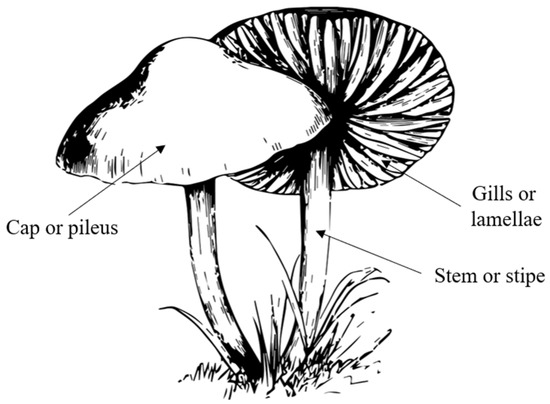
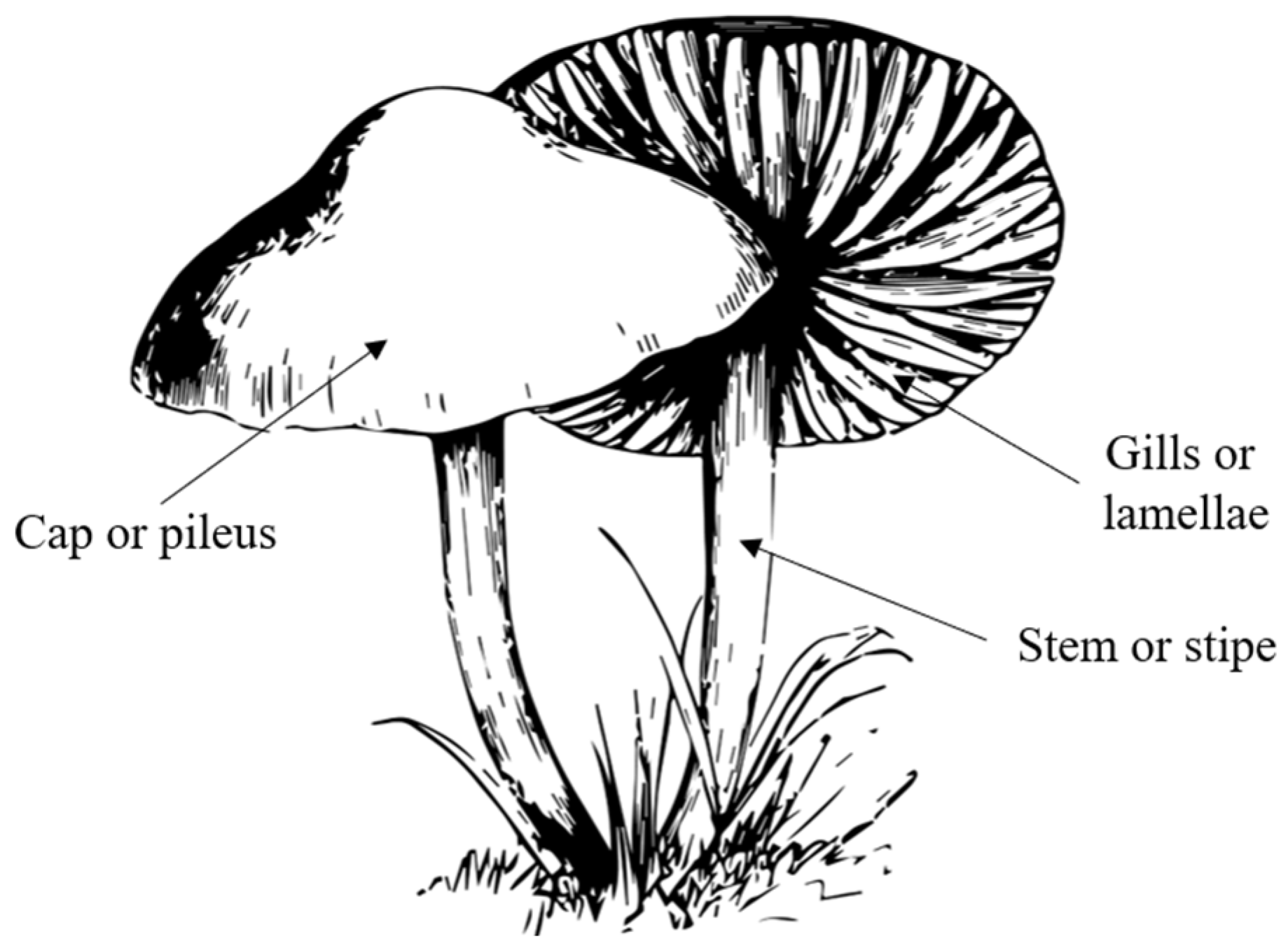
Edible mushrooms are very popular in the preparation of various dishes such as soups, stews, salads, and sauces, as well as in the preparation of burgers and sausages due to their meat-like flavor and texture [28,29,30]. The structure of mushrooms comprises a scaly textured cap or pileus, whose function is to protect the gills or lamellae. Meanwhile, the stipe or stem connects the pileus to the mycelial threads through which nutrients are transferred (Figure 1) [31]. However, the shape, color, and chemical composition of mushrooms vary depending on the species and agronomic characteristics of the crop [32].
Figure 1.
Structure of the edible mushroom.
The production of edible mushrooms worldwide reaches 44.97 million tons annually [33]. China is the main producer of cultivated mushrooms (~44.13 million tons), followed by Japan, the United States, and Poland with ~5.2, ~4.4, and ~2.8 million tons, respectively [34,35,36]. In Latin America, Mexico is the largest producer of edible mushrooms with 80.8% of the region’s total production, followed by Brazil and Colombia with 7.7% and 5.2%, respectively [37]. The most cultivated mushroom species are shiitake (Lentinus edodes), oyster mushroom (Pleurotus ostreatus), rice straw mushroom (Volvariella volvacea), portobello (Agaricus bisporus and Agaricus brunnescens), and enoki (Flammulina sp.) [38]. Although edible mushrooms are a natural source of protein (120–350 mg/kg ds), dietary fiber (8–10 mg/kg ds), vitamins (12–29.9 mg/kg ds), and minerals (1.8–2.3 g/kg ds), the presence of bioactive compounds is interesting for the food and pharmaceutical industries [39,40].
3. Bioactive Compounds in Edible Mushrooms
Edible mushrooms present different types of bioactive compounds such as terpenoids, sterols, and polyphenols, which are secondary metabolites related to the prevention and treatment of chronic diseases [41]. Although terpenoids and sterols possess anti-inflammatory and anticancer properties [42,43], polyphenols are present in higher concentrations, whose antioxidant properties neutralize free radicals, protecting cells from oxidative stress [44].
3.1. Phenolic Compounds in Edible Mushrooms
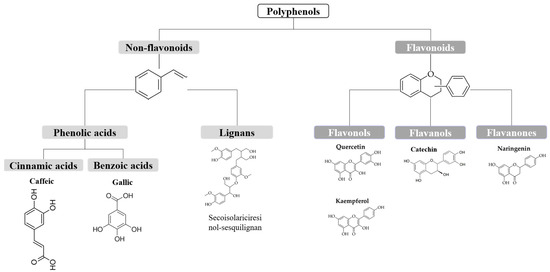
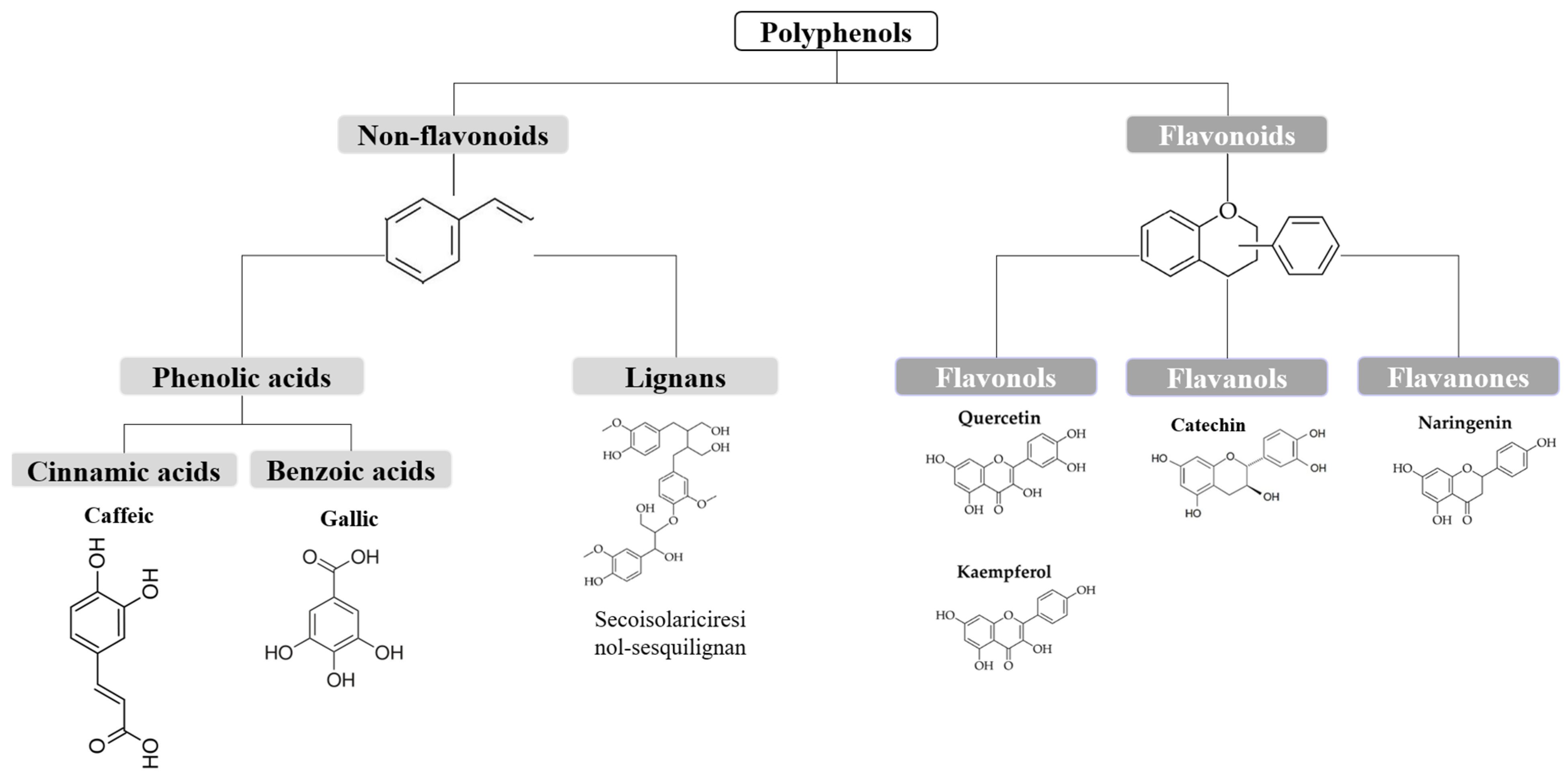
In edible mushrooms, phenolic compounds can be classified according to the type of chemical structure, the number of benzene rings, and molecular weight as flavonoids and non-flavonoids [45]. In particular, non-flavonoid compounds include phenolic acids (benzoic and cinnamic) [9], while flavanols, flavonols, and flavanones belong to the flavonoid group (Figure 2). Interestingly, the latter have a structure with a greater number of functional groups (OH), which increases their ability to chemically interact with other reactive molecules or free radicals (Figure 2) [46].
Figure 2.
Classification of polyphenols reported in edible mushrooms.
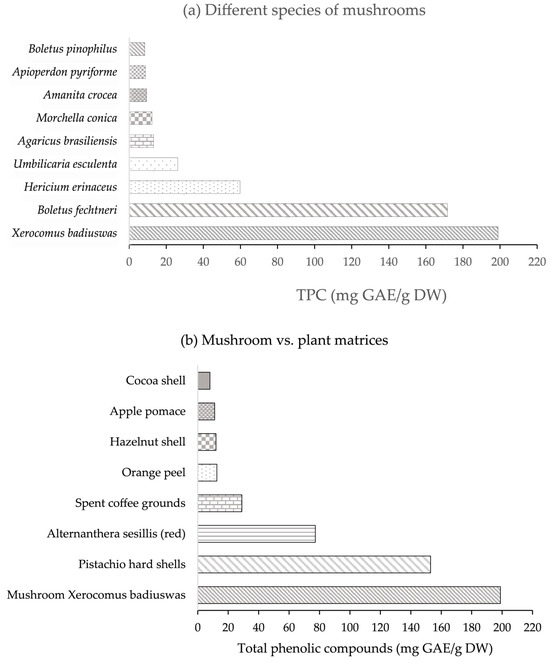
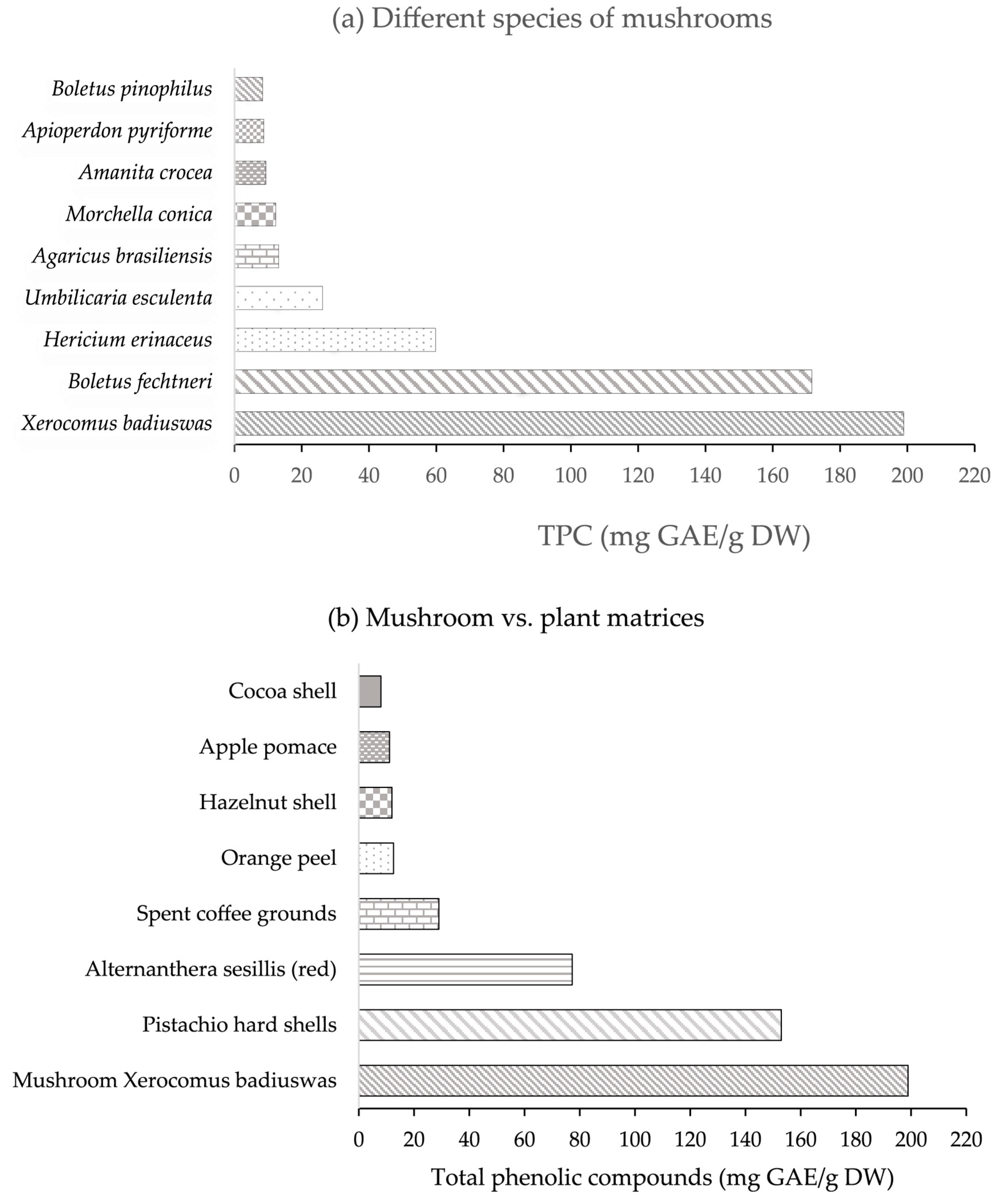
The content of phenolic compounds varies considerably among different mushroom species (Figure 3a). For example, the mushroom Xerocomus badius was found to have ~15, ~22, ~14, ~20.3, ~7, ~23, and ~2.3 times higher total polyphenol content compared to the mushrooms Morchella conica, Apioperdon pyriforme, Agaricus brasiliensis, Amanita crocea, Umbilicaria esculenta, Boletus pinophilus, and Hericium erinaceus, respectively (Figure 3a) [12,47,48,49,50,51]. These differences are probably due to genetic, agronomic, and environmental factors [52]. Furthermore, edible mushrooms exhibit higher phenolic compound content than other plant matrices (Figure 3b). For example, the mushroom Xerocomus badius was found to have ~23, ~61, ~85, ~93.7, ~94, ~94.4, and ~96% higher polyphenol content compared to pistachio peel, coffee residues, orange peel, hazelnut peel, apple pomace, and cocoa shell, respectively (Figure 3b) [31,53,54,55,56,57,58,59]. Thus, mushrooms can be considered as a new alternative for antioxidant compounds compared to other plant matrices.
Figure 3.
Comparison of total phenolic compounds between mushroom species (a) and Mushroom vs. plant matrices (b).
3.2. Specific Polyphenols
Edible mushrooms contain different families of polyphenols, such as phenolic acids and flavonoids [9]. In particular, phenolic acids represent the largest proportion of phenolic compounds in mushrooms, such as gallic acid, protocatechuic acid, and cinnamic acid, whose properties relate to cancer cell inhibition (Table 1) [60]. The concentration of phenolic acids can vary among mushroom species (Table 1). For example, the mushroom Pleurotus ostreatus presents ~84.5 times more homogentisic acid than the mushroom Cantharellus cibarius (Table 1). Meanwhile, the mushroom Pleurotus nebrodensis contains ~93% and 98% more protocatechuic acid than Sarcodon imbricatus and Morchella elata, respectively (Table 1). Meanwhile, quercetin, catechin, rutin, kaempferol, hesperetin, naringenin, and myricetin are the most abundant flavonoids in this matrix type (Table 1) [61,62].
Table 1.
Specific polyphenols of different species of edible mushrooms.
4. Extraction Methods
Several studies have developed methods for extracting polyphenols from different plant matrices, such as peels, seeds, and roots [32,69,70]. However, the extraction of polyphenols from edible mushrooms represents a challenge due to the complex composition of their cell wall, predominantly consisting of chitin, β-glucans, and structural proteins, which limit the recovery of these compounds [71,72].
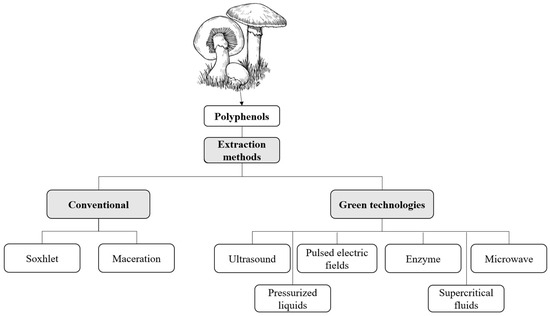
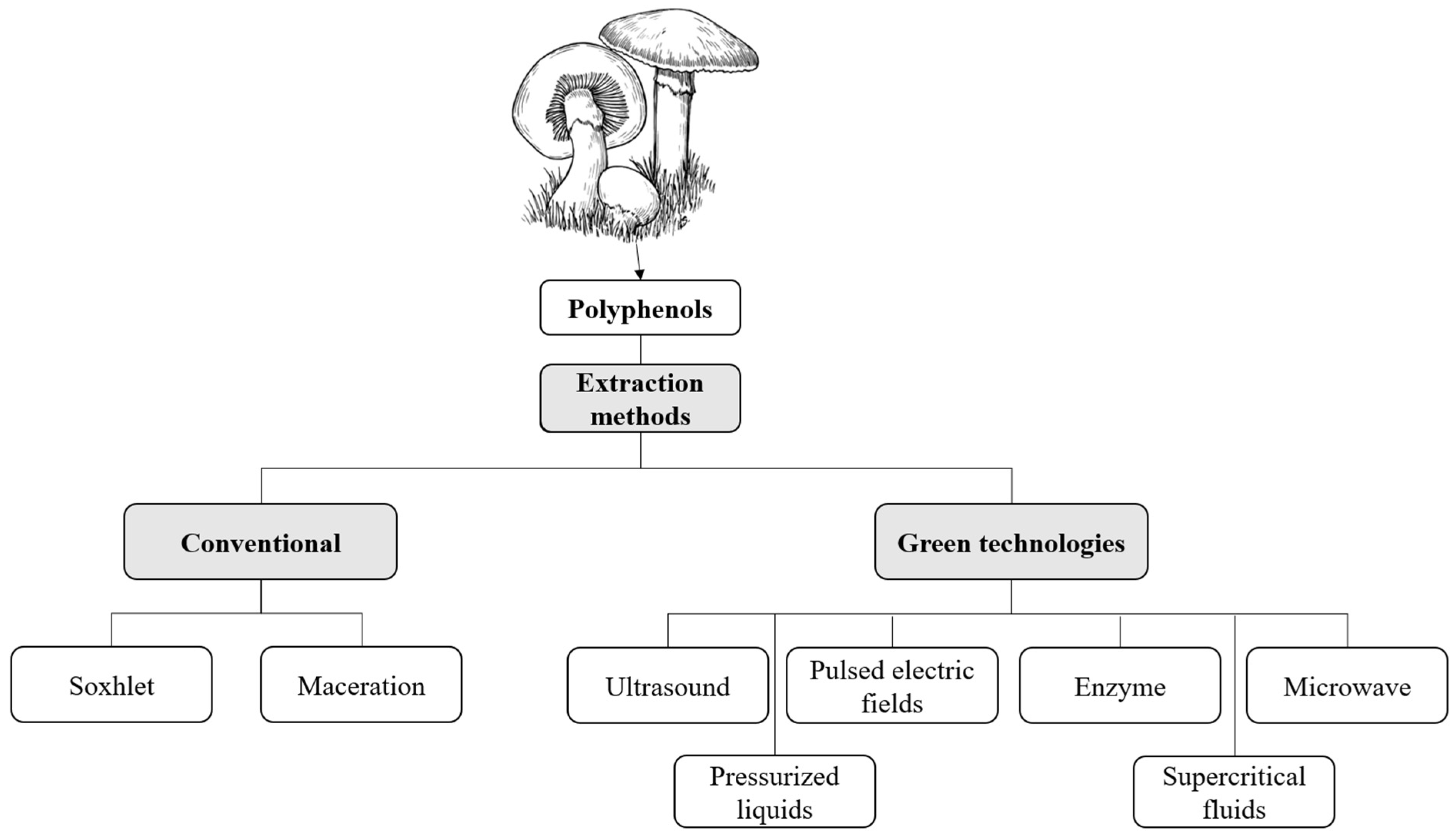
Conventional methods such as maceration and Soxhlet have been widely used due to their ease of use and low cost of implementation at an industrial level (Figure 4) [73]. However, these methods have limitations, such as lengthy process times, excessive solvent consumption, and potential degradation of thermally sensitive phenolic compounds [21]. Faced with this scenario, emerging or green methods have proven to be more efficient in breaking the cell wall of mushroom matrices compared to conventional methods (Figure 4) [74]. Therefore, selecting the appropriate method is pivotal for maximizing polyphenol recovery while maintaining their bioactivity.
Figure 4.
Methods used for the recovery of polyphenols from edible mushrooms.
4.1. Conventional Extraction Methods
4.1.1. Soxhlet
Soxhlet extraction is commonly used for lipid recovery; it can also be used to recover polyphenols from edible mushrooms [20,75]. This system heats the solvent, which evaporates, condenses, and falls onto the sample contained in a cartridge. The solvent then percolates through the solid matrix and extracts the phenolic compounds, returning to the flask by siphon. This process is repeated continuously for several hours until all of the compound of interest is recovered [76]. However, Soxhlet extraction requires large amounts of sample (10–20 g), lengthy extraction times (2–11 h), and substantial amounts of solvent (100–400 mL), also resulting in excessive thermal energy loss (Table 2). For example, Sevindik et al. [12] reported that the optimal extraction time to recover 59.75 mg GAE/g of phenolic compounds from Hericium erinaceus was 7.83 h. However, prolonged times represent a significant operational feasibility and energy efficiency limitation.
4.1.2. Maceration
Maceration is a solid–liquid extraction method that enables the extraction of polyphenols using organic solvents at room temperature or moderately high temperatures below their boiling point [77]. Additionally, agitation during the maceration process facilitates the transfer of phenolic compounds from the cells of the fungal matrix to the extraction solvent [78,79,80]. Similar to the Soxhlet method, a prolonged extraction time has a positive impact on the yield of polyphenols from edible mushrooms when using maceration (Table 2) [62,78,81]. Furthermore, a higher solid–liquid ratio enhances the extraction of polyphenols (Table 2) [49,82]. An increase in the volume of liquid relative to the solid likely reduces the medium’s viscosity, improving the solvent’s diffusivity within the cells and increasing the mass transfer of phenolic compounds to the solvent [83]. However, a higher solid–liquid ratio requires a greater volume of solvent, negatively impacting the process costs of obtaining these phenolic compounds.
Table 2.
Conventional extraction techniques for the recovery of phenolic compounds from edible mushrooms.
4.2. Alternative Methods (Green Technologies)
4.2.1. Pressurized Liquid Extraction
Pressurized liquid extraction (PLE) is a term applied to several systems that use the same principle, such as accelerated solvent extraction (ASE), high-pressure solvent extraction (HPSE), subcritical water extraction, or high-pressure hot water extraction (PHWE) [87]. In PLE, the solvent interacts with the solid matrix, which is subjected to temperatures between 50 and 200 °C, 4 to 10 MPa pressures, and short extraction times (5–20 min) [88,89,90]. Under these conditions, the solvent remains in a liquid state, favoring the rupture of the matrix and mass transfers [91,92].
During PLE, high temperatures (>100 °C) favor the recovery of phenolic compounds from edible mushrooms (Table 3). For example, Sakdasri et al. [19] found that using water at 140 °C improved the recovery of polyphenols by 25.5% compared to 100 °C from Pleurotus sajor-caju (Fr.) Singer. Similarly, Krümmel et al. [88] observed that using aqueous ethanol at 80 °C increased the extraction of polyphenols by ~27% compared to 40 °C from Pleurotus sajor-caju. In this regard, increasing temperatures enhance the kinetic energy of the solvent, favoring matrix breakdown and interactions between phenolic compounds and other compounds such as protein, polysaccharides, and fibers; consequently, the solubility of these compounds increases [90,92]. Furthermore, high temperatures (>100 °C) combined with high pressures (>4 MPa) favor the reduction in the viscosity and surface tension of the solvent, maintaining its liquid state and avoiding the oxidation and hydrolysis of phenolic compounds [89].
4.2.2. Microwave-Assisted Extraction
The microwave-assisted extraction (MAE) method utilizes the interaction of microwave electromagnetic radiation with the polyphenol-rich botanical matrix. The radiation produces dielectric heating of the solvent and the intrinsic moisture of the sample, where the polar molecules, primarily the solvent, vibrate and rotate rapidly, generating heat through molecular friction. This phenomenon ruptures cell walls and membranes, releasing the polyphenols.
In general, for the extraction of phenolic compounds from edible mushrooms, powers between 100 and 800 W, irradiation times of 1 to 30 min, temperatures ranging from 40 to 140 °C, and solid–liquid ratios of 1:10 to 1:70 (g/mL) are used [66,93]. During this process, the polyphenols are separated from the active sites of the matrix (proteins and carbohydrates). The solvent then diffuses through the matrix, and the polyphenols are released into the extraction solvent [94]. The efficiency of MAE extraction depends primarily on the microwave energy, treatment time, and temperature. Furthermore, the rapid heating of the system reduces thermal gradients, improving the stability and yield of the polyphenols (Table 3) [66,95]. For example, Latif et al. [96] reported that using 58% ethanol combined with 16 min allowed the highest polyphenol yields (14.82 mg GAE/g) from Agaricus busporus. Meanwhile, Maeng et al. [97] found that 40% ethanol and 3.8 min were the optimal conditions for extracting polyphenols (4.70 mg GAE/g) from Coriolus versicolor. On the other hand, independent of the temperature and process time, particle size reduction also significantly impacts polyphenol extraction efficiency (Table 2). For example, Xiaokang et al. [66] observed that smaller particle sizes (1.75 mm) recovered 36% more polyphenol content compared to 4.75 mm particles from Lentinula edodes. Thus, the smaller the particle size, the greater the surface area in contact with the solvent, improving mass transfer [98].
4.2.3. Ultrasound-Assisted Extraction
This method employs ultrasonic waves that induce acoustic cavitation to encourage the formation, growth, and explosive collapse of small bubbles, disrupting the biological matrix. As a result, phenolic compounds are released [99,100,101]. The UAE process generally uses either an ultrasonic bath or an ultrasonic probe. In an ultrasonic bath, the solid sample is placed in a beaker, flask, or test tube, which is immersed in the liquid medium contained in a stainless-steel tank connected to a transducer. An ultrasonic probe, on the other hand, consists of a probe connected to a transducer, which is immersed directly in the extraction medium [102,103].
During UAE, the most commonly used parameters are short extraction times (5–30 min), low temperatures < 70 °C, and water–ethanol mixtures. Furthermore, in this type of system, the working power is regulated by adjusting the amplitude (20–60%) (Table 3) [71,104,105]. For example, Dong-Bao et al. [27] reported that the use of 42% ethanol favors the extraction of polyphenols by 86% compared to the use of 80% ethanol from the mushroom Boletus bicolor. The authors of [106] found that using 40% ethanol allows for the extraction of 2.2 times more polyphenol content than pure water from Pleurotus ostreatus. Ethanol reduces the dielectric constant, viscosity, and density of the aqueous solvent, increasing the diffusion of polyphenols into the extraction solvent [107,108].
While some studies report higher polyphenol recovery at high temperatures (Table 3), Gogoi et al. [74] reported an opposite effect where a low temperature of 39 °C favored 14% polyphenol yields from Pleurotus citrinopileatus compared to 60 °C. Similarly, Xu et al. [104] reported that a moderate temperature (40 °C) recovered 23% more phenolic compound content than 80 °C from Thelephora ganbajun. During the UAE process, high temperatures cause an increase in the vapor pressure of the solvent, which decreases the implosion intensity of the bubbles formed. Consequently, a lower proportion of polyphenols is released [69].
Table 3.
Emerging methods for the recovery of phenolic compounds from edible mushrooms.
4.2.4. Pulsed Electric Field Extraction
Pulsed electric field (PEF) extraction involves applying high-voltage pulses (10 to 80 kV/cm) to a biological matrix for a specific time. The intensity of the generated electric field depends on the applied voltage and the distance between the electrodes [117]. When cells are exposed to this field, cell membranes can be damaged, causing the formation of temporary (reversible) or permanent (irreversible) pores. This phenomenon of cellular damage is called electroporation, which allows the release of polyphenols [118].
Although the number of PEF studies on polyphenol recovery from edible mushrooms is limited (Table 3), the results show its advantages over conventional extraction methods. For example, Calleja-Gómez et al. [114] reported that PEF allowed for the recovery of 87% more polyphenol content than a conventional method from Agaricus bisporus (Table 3). Furthermore, the obtained extract presented ~57% more antioxidant capacity to inhibit peroxyl radicals than the conventional extract. In particular, the PEF method exhibits greater environmental sustainability and economic efficiency due to its lower total energy consumption and lower energy requirements per unit of processed product compared to conventional methods [119].
4.2.5. Enzyme-Assisted Extraction
The enzyme-assisted extraction (EAE) method uses specific enzymes to degrade structural components of botanical cell walls, facilitating the release of bioactive compounds (polyphenols). This method is based on the enzymes’ ability to hydrolyze cellulases, pectinases, or hemicellulases, releasing phenolic compounds [120]. The EAE operates under moderate pH conditions (3.5 to 7) and low temperatures (35 to 60 °C), reducing the risk of degradation of phenolic compounds [115]. Hwang et al. [107] compared emerging methods (high-pressure, ultrasound, and enzymatic) versus a conventional method (hot water) for the extraction of phenolic compounds from chaga mushroom, where EAE extracted ~4.4% and ~18% higher gallic acid and caffeic acid content compared to the conventional method, respectively. Although the high cost of enzymes represents a challenge for their development and industrial scaling, enzyme-assisted extraction is an effective strategy for recovering large amounts of phenolic compounds.
4.2.6. Supercritical Fluid Extraction
Supercritical fluid extraction (SFE) is an advanced technique that utilizes a fluid at conditions above its critical temperature (20–60 °C) and pressure (80–600 bar). The fluid is in a transition state (gas–liquid), facilitating its diffusion within the solid matrix [121]. Carbon dioxide (CO2) is the most commonly used fluid in SFE due to its excellent mass transfer properties, density, and viscosity. Furthermore, supercritical CO2 is a relatively inert substance, considered a GRAS solvent [122]. The main advantages of SFE over conventional techniques include the use of low temperatures, significant reduction in solvent use, higher purity of extracts, and lower energy costs [123].
Joradon et al. [108] reported that using CO2 during SFE for 60 min favors the extraction of total polyphenols from Hericium erinaceus. However, the results obtained with SFE did not differ significantly from those obtained with the maceration process (60% acetone, 72 h). Interestingly, Table 3 shows that the temperatures used in supercritical fluid extraction did not exceed 60 °C. Therefore, thermal degradation would not be a problem for most phenolic compounds in edible mushrooms when using the supercritical fluid technique.
4.2.7. Green Solvents
Although alternative methods, referred to as green technologies, are more sustainable and effective for recovering polyphenols, selecting food-grade solvents such as water, ethanol, glycerol, or isopropanol could enhance the recovery of these compounds (Table 2 and Table 3) [124]. The effectiveness of these solvents in interacting with the target analytes is largely determined by their polarity [125]. Additionally, it is important to take into account the presence of both polar and non-polar functional groups in the chemical structure of the polyphenols [126].
The polarity of a solvent can be understood through its solvatochromic properties, which refer to its ability to engage in intermolecular interactions such as dipole–dipole interactions, London dispersion forces, and hydrogen bonding with the functional groups of the analytes of interest, including hydroxyl and aromatic groups [127,128]. For instance, water is a highly polar solvent (π*: 1.09) compared to ethanol (π*: 0.51), glycerol (π*: 0.62), and isopropanol (π*: 0.48) [127,129]. This higher polarity in water explains its greater capacity to form hydrogen bonds with various analytes. Contrary, solvents with low polarity are more adept at establishing intermolecular interactions like dipole–dipole interactions and London dispersion forces. Thus, when selecting a solvent, considering its polarity is crucial. However, other process parameters, such as temperature and pressure, should also be considered.
4.2.8. Economic Evaluation
Several studies have demonstrated that alternative methods for recovering phenolic compounds are both highly scalable and sustainable. For example, several companies offer polyphenol extracts with 30% and 50% polyphenol content priced at USD 32 and USD 15 per 100 g, respectively [130]. In contrast, de Aguiar et al. [131] reported that the production costs for obtaining phenolic extracts using pressurized liquid extraction (PLE) can reach up to USD 25.39 per kg. Meanwhile, Solana et al. [132] found that the process costs for polyphenol extraction using supercritical fluid extraction (SFE) can reach USD 21.90 per kg. Although these examples provide a useful baseline for assessing the economic viability of these techniques, it is crucial to continue researching methods that could further reduce time and energy consumption.
5. Bioactivity of Specific Phenolic Compounds
The polyphenols present in edible mushrooms have bioactive properties with important applications in the food and pharmaceutical industries (Table 4). For example, gallic acid has been shown to have high antioxidant and antibacterial activity, inhibiting strains such as Stenotrophomonas maltophilia, and reducing brain oxidative stress induced by environmental toxins [133,134].
Protocatechuic acid stands out for inhibiting lipid oxidation, a key property in preserving fat-rich food matrices and preventing cellular damage induced by lipid peroxidation [135,136]. Quercetin also protects the pancreas against lipid oxidation and acts as a modulator of hyperglycemia [16,137]. These findings support the potential of edible mushrooms as a sustainable source of antioxidant compounds, especially when green technologies are employed for their extraction.
On the other hand, the study of the bioactive properties of phenolic compounds is a prominent research area within the scientific community, where in vitro studies are most common. However, these studies often do not consider biochemical, metabolic, or physiological parameters, among others [138]. In contrast, in vivo studies, particularly in murine models, allow for a more comprehensive evaluation of how polyphenols impact disease progression. For instance, Kaur et al. [139] reported that gallic acid has a protective effect against sodium arsenite-induced toxicity in rats. This effect was primarily attributed to gallic acid’s ability to inhibit lipid peroxidation and reduce nitric oxide production, indicating significant antioxidant activity. Given the extensive scientific evidence supporting the antioxidant, anti-inflammatory, and neuroprotective roles of specific polyphenols in preventing degenerative diseases, edible mushrooms stand out as promising candidates for developing therapeutic and preventive strategies against various degenerative conditions.
Table 4.
Bioactivity of the different specific polyphenols.
6. Future Perspectives
Although various methods exist for recovering polyphenols from edible mushrooms, PLE and SFE are emerging as sustainable methods for extracting these compounds. This is due to their ability to operate under gentle and selective conditions that preserve the integrity of the phenolic compounds. Furthermore, both methods (PLE and SFE) are selective methods for recovering specific families.
Using sustainable, environmentally friendly methods will allow for producing polyphenolic extracts with potential applications in developing functional ingredients. This will enable the use of process parameters to develop future industrial systems. However, it is important to consider that the extracts contain polyphenols in the solution and unwanted compounds that could interfere with future applications, such as proteins, lipids, carbohydrates, and metals, which would limit their industrial use. Therefore, it is necessary to develop purification systems to obtain safe extracts with a high degree of purity. In this scenario, mushroom polyphenols would be incorporated as antioxidants in functional foods and as active ingredients in pharmaceutical formulations, opening new lines of high-value applications.
On the other hand, the processing of edible mushrooms generates byproducts such as discarded stems and fruiting bodies, which serve as a valuable secondary source of phenolic compounds. These compounds can be utilized as extraction materials, and the phenolic compounds recovered through pressurized liquid extraction (PLE) and supercritical fluid extraction (SFE) techniques can be reintegrated into the production chain to promote a circular and sustainable economy. Thus, future research should focus on assessing the technical and economic feasibility of PLE and SFE processes for extracting polyphenols from fungi at both pilot and industrial scales. This review provided a clearer understanding of the potential of these emerging technologies as scalable methods for the sustainable production of phenolic extracts from fungal biomass.
7. Conclusions
Edible mushrooms represent an invaluable and underappreciated natural source of phenolic compounds with significant bioactive properties, which are essential for preventing and treating chronic diseases. This review of extraction methods reveals a clear evolution from conventional techniques toward more efficient and sustainable approaches. Emerging methods, such as PLE and SFE, are promising tools for improving the yield of phenolic compounds while minimizing their degradation. Future research should focus on evaluating various process parameters, such as the solvent composition, temperature, pressure, and extraction time. Additionally, it should incorporate purification techniques such as membrane filtration and the use of macroporous resins to obtain extracts with high antioxidant capacity and free from unwanted compounds.
Author Contributions
N.L.H.-C. and E.S., supervision and conceptualization; J.D.R.-M., S.M.P. and M.F.Q.A., investigation and data analysis; N.L.H.-C., S.M.P. and E.S. writing—review and editing. All authors have read and agreed to the published version of the manuscript.
Funding
The authors thank the Programa Nacional de Investigación Científica y Estudios Avanzados—PROCIENCIA (Resolution No. 030-2023-PROCIENCIA-DE) for funding this research. The authors are grateful to the National University of Moquegua for funding this research (Resolución de Comisión Organizadora N° 059-2021-UNAM and N° 262-2021-UNAM).
Institutional Review Board Statement
Not applicable.
Informed Consent Statement
Not applicable.
Data Availability Statement
No new data were created or analyzed in this study. Data sharing is not applicable to this article.
Conflicts of Interest
The authors declare no conflicts of interest.
References
- Hussain, S.; Sher, H.; Ullah, Z.; Elshikh, M.S.; Al Farraj, D.A.; Ali, A.; Abbasi, A.M. Traditional Uses of Wild Edible Mushrooms among the Local Communities of Swat, Pakistan. Foods 2023, 12, 1705. [Google Scholar] [CrossRef] [Scilit] [PubMed]
- Kaliyaperumal, M.; Kezo, K.; Gunaseelan, S. A Global Overview of Edible Mushrooms. In Biology of Macrofungi; Springer: Cham, Switzerland, 2018; pp. 15–56. [Google Scholar] [CrossRef] [Scilit]
- Effiong, M.E.; Umeokwochi, C.P.; Afolabi, I.S.; Chinedu, S.N. Comparative Antioxidant Activity and Phytochemical Content of Five Extracts of Pleurotus ostreatus (Oyster mushroom). Sci. Rep. 2024, 14, 3794. [Google Scholar] [CrossRef] [Scilit] [PubMed]
- Erbiai, E.H.; Pinto da Silva, L.; Saidi, R.; Lamrani, Z.; Esteves da Silva, J.C.G.; Maouni, A. Chemical Composition, Bioactive Compounds and Antioxidant Activity of Two Wild Edible Mushrooms Armillaria mellea and Macrolepiota procera from Two Countries (Morocco and Portugal). Biomolecules 2021, 11, 575. [Google Scholar] [CrossRef] [Scilit] [PubMed]
- Dimopoulou, M.; Kolonas, A.; Mourtakos, S.; Androutsos, O.; Gortzi, O. Nutritional Composition and Biological Properties of Sixteen Edible Mushroom Species. Appl. Sci. 2022, 12, 8074. [Google Scholar] [CrossRef] [Scilit]
- Fogarasi, M.; Socaciu, M.I.; Sălăgean, C.D.; Ranga, F.; Fărcaş, A.C.; Socaci, S.A.; Socaciu, C.; Țibulcă, D.; Fogarasi, S.; Semeniuc, C.A. Comparison of Different Extraction Solvents for Characterization of Antioxidant Potential and Polyphenolic Composition in Boletus edulis and Cantharellus cibarius Mushrooms from Romania. Molecules 2021, 26, 7508. [Google Scholar] [CrossRef] [Scilit]
- Valverde, M.E.; Hernández-Pérez, T.; Paredes-López, O. Edible Mushrooms: Improving Human Health and Promoting Quality Life. Int. J. Microbiol. 2015, 2015, 376387. [Google Scholar] [CrossRef] [Scilit]
- Asghar, A.; Randhawa, M.A.; Masood, M.M.; Abdullah, M.; Irshad, M.A. Nutraceutical Formulation Strategies to Enhance the Bioavailability and Efficiency: An Overview. In Role of Materials Science in Food Bioengineering; Academic Press: Cambridge, MA, USA, 2018; pp. 329–352. [Google Scholar] [CrossRef] [Scilit]
- Chu, M.; Khan, R.D.; Zhou, Y.; Agar, O.T.; Barrow, C.J.; Dunshea, F.R.; Suleria, H.A.R.; Bao, Z.; Xu, Q.; Chu, M.; et al. LC-ESI-QTOF-MS/MS Characterization of Phenolic Compounds in Common Commercial Mushrooms and Their Potential Antioxidant Activities. Processes 2023, 11, 1711. [Google Scholar] [CrossRef] [Scilit]
- Albuquerque, B.R.; Heleno, S.A.; Oliveira, M.B.P.P.; Barros, L.; Ferreira, I.C.F.R. Phenolic Compounds: Current Industrial Applications, Limitations and Future Challenges. Food Funct. 2021, 12, 14–29. [Google Scholar] [CrossRef] [Scilit]
- Huamán-Castilla, N.L.; Mariotti-Celis, M.S.; Martínez-Cifuentes, M.; Pérez-Correa, J.R. Glycerol as Alternative Co-Solvent for Water Extraction of Polyphenols from Carménère Pomace: Hot Pressurized Liquid Extraction and Computational Chemistry Calculations. Biomolecules 2020, 10, 474. [Google Scholar] [CrossRef] [Scilit]
- Sevindik, M.; Gürgen, A.; Khassanov, V.T.; Bal, C. Biological Activities of Ethanol Extracts of Hericium erinaceus Obtained as a Result of Optimization Analysis. Foods 2024, 13, 1560. [Google Scholar] [CrossRef] [Scilit]
- Xue, D.; Farid, M.M. Pulsed Electric Field Extraction of Valuable Compounds from White Button Mushroom (Agaricus bisporus). Innov. Food Sci. Emerg. Technol. 2015, 29, 178–186. [Google Scholar] [CrossRef] [Scilit]
- Abdelshafy, A.M.; Belwal, T.; Liang, Z.; Wang, L.; Li, D.; Luo, Z.; Li, L. A Comprehensive Review on Phenolic Compounds from Edible Mushrooms: Occurrence, Biological Activity, Application and Future Prospective. Crit. Rev. Food Sci. Nutr. 2022, 62, 6204–6224. [Google Scholar] [CrossRef] [Scilit]
- Xiong, Y.; Kamboj, M.; Ajlouni, S.; Fang, Z. Incorporation of Salmon Bone Gelatine with Chitosan, Gallic Acid and Clove Oil as Edible Coating for the Cold Storage of Fresh Salmon Fillet. Food Control 2021, 125, 107994. [Google Scholar] [CrossRef] [Scilit]
- Trivedi, R.; Upadhyay, T.K. Preparation, Characterization and Antioxidant and Anticancerous Potential of Quercetin Loaded β-Glucan Particles Derived from Mushroom and Yeast. Sci. Rep. 2024, 14, 16047. [Google Scholar] [CrossRef] [Scilit]
- Miklasińska-Majdanik, M.; Kępa, M.; Wojtyczka, R.D.; Idzik, D.; Wąsik, T.J. Phenolic Compounds Diminish Antibiotic Resistance of Staphylococcus aureus Clinical Strains. Int. J. Environ. Res. Public Health 2018, 15, 2321. [Google Scholar] [CrossRef] [Scilit] [PubMed]
- Lazić, V.; Klaus, A.; Kozarski, M.; Doroški, A.; Tosti, T.; Simić, S.; Vunduk, J. The Effect of Green Extraction Technologies on the Chemical Composition of Medicinal Chaga Mushroom Extracts. J. Fungi 2024, 10, 225. [Google Scholar] [CrossRef] [Scilit] [PubMed]
- Sakdasri, W.; Arnutpongchai, P.; Phonsavat, S.; Bumrungthaichaichan, E.; Sawangkeaw, R. Pressurized Hot Water Extraction of Crude Polysaccharides, β-Glucan, and Phenolic Compounds from Dried Gray Oyster Mushroom. LWT 2022, 168, 113895. [Google Scholar] [CrossRef] [Scilit]
- Martínez-Flores, H.E.; Contreras-Chávez, R.; Garnica-Romo, M.G. Effect of Extraction Processes on Bioactive Compounds from Pleurotus ostreatus and Pleurotus djamor: Their Applications in the Synthesis of Silver Nanoparticles. J. Inorg. Organomet. Polym. Mater. 2021, 31, 1406–1418. [Google Scholar] [CrossRef] [Scilit]
- Abu-Reidah, I.M.; Critch, A.L.; Manful, C.F.; Rajakaruna, A.; Vidal, N.P.; Pham, T.H.; Cheema, M.; Thomas, R. Effects of Ph and Temperature on Water under Pressurized Conditions in the Extraction of Nutraceuticals from Chaga (Inonotus obliquus) Mushroom. Antioxidants 2021, 10, 1322. [Google Scholar] [CrossRef] [Scilit]
- Aliaño-González, M.J.; Barea-Sepúlveda, M.; Espada-Bellido, E.; Ferreiro-González, M.; López-Castillo, J.G.; Palma, M.; Barbero, G.F.; Carrera, C. Ultrasound-Assisted Extraction of Total Phenolic Compounds and Antioxidant Activity in Mushrooms. Agronomy 2022, 12, 1812. [Google Scholar] [CrossRef] [Scilit]
- Dias, A.L.B.; de Aguiar, A.C.; Rostagno, M.A. Extraction of Natural Products Using Supercritical Fluids and Pressurized Liquids Assisted by Ultrasound: Current Status and Trends. Ultrason. Sonochem. 2021, 74, 105584. [Google Scholar] [CrossRef] [Scilit]
- Nzekoue, F.K.; Sun, Y.; Caprioli, G.; Vittori, S.; Sagratini, G. Effect of the Ultrasound-Assisted Extraction Parameters on the Determination of Ergosterol and Vitamin D2 in Agaricus bisporus, A. bisporus Portobello, and Pleurotus ostreatus Mushrooms. J. Food Compos. Anal. 2022, 109, 104476. [Google Scholar] [CrossRef] [Scilit]
- Thikham, S.; Jeenpitak, T.; Shoji, K.; Phongthai, S.; Therdtatha, P.; Yawootti, A.; Klangpetch, W. Pulsed Electric Field-Assisted Extraction of Mushroom ß-Glucan from Pleurotus pulmonarius by-Product and Study of Prebiotic Properties. Int. J. Food Sci. Technol. 2024, 59, 3939–3949. [Google Scholar] [CrossRef] [Scilit]
- Zhang, C.; Xie, Y.; Liu, D.; Liu, R.; Han, J. Effects of Drying Process and High Hydrostatic Pressure on Extraction of Antioxidant Ergothioneine from Pleurotus citrinopileatus Singer. Foods 2024, 13, 878. [Google Scholar] [CrossRef] [Scilit] [PubMed]
- Dong-Bao, H.; Xue, R.; Zhuang, X.C.; Zhang, X.S.; Shi, S.L. Ultrasound-Assisted Extraction Optimization of Polyphenols from Boletus Bicolor and Evaluation of Its Antioxidant Activity. Front. Nutr. 2023, 10, 1135712. [Google Scholar] [CrossRef] [Scilit]
- Contato, A.G.; Conte-Junior, C.A. Mushrooms in Innovative Food Products: Challenges and Potential Opportunities as Meat Substitutes, Snacks and Functional Beverages. Trends Food Sci. Technol. 2025, 156, 104868. [Google Scholar] [CrossRef] [Scilit]
- Wong, K.M.; Decker, E.A.; Autio, W.R.; Toong, K.; DiStefano, G.; Kinchla, A.J. Utilizing Mushrooms to Reduce Overall Sodium in Taco Filling Using Physical and Sensory Evaluation. J. Food Sci. 2017, 82, 2379–2386. [Google Scholar] [CrossRef] [Scilit] [PubMed]
- Zhang, X.; Ma, H.; Guo, X.; Weng, Y.; Hu, X.; Ren, L. Cultivation and Utilization of Edible Mushrooms: From Extraction of Active Components to Effective Substrate Utilization. J. Food Compos. Anal. 2025, 140, 107224. [Google Scholar] [CrossRef] [Scilit]
- Ramos, M.; Burgos, N.; Barnard, A.; Evans, G.; Preece, J.; Graz, M.; Ruthes, A.C.; Jiménez-Quero, A.; Martínez-Abad, A.; Vilaplana, F.; et al. Agaricus bisporus and Its By-Products as a Source of Valuable Extracts and Bioactive Compounds. Food Chem. 2019, 292, 176–187. [Google Scholar] [CrossRef] [Scilit] [PubMed]
- Bhambri, A.; Srivastava, M.; Mahale, V.G.; Mahale, S.; Karn, S.K. Mushrooms as Potential Sources of Active Metabolites and Medicines. Front. Microbiol. 2022, 13, 837266. [Google Scholar] [CrossRef] [Scilit]
- FAOSTAT. Cultivos Y Productos Ganaderos. Available online: https://www.fao.org/faostat/es/#data/QCL (accessed on 2 March 2025).
- Singh, I.; Rani Rajpal, V.; Navi, S.S. Fungal Resources for Sustainable Economy; Springer Nature: Singapore, 2023. [Google Scholar]
- Sun, M.; Zhuang, Y.; Gu, Y.; Zhang, G.; Fan, X.; Ding, Y. A Comprehensive Review of the Application of Ultrasonication in the Production and Processing of Edible Mushrooms: Drying, Extraction of Bioactive Compounds, and Post-Harvest Preservation. Ultrason. Sonochem 2024, 102, 106763. [Google Scholar] [CrossRef] [Scilit]
- Thakur, M.P. Advances in Mushroom Production: Key to Food, Nutritional and Employment Security: A Review. Indian Phytopathol. 2020, 73, 377–395. [Google Scholar] [CrossRef] [Scilit]
- De Ita, M.A.V.; Aranda, D.P.B.; Lezama, C.P.; Reyes, J.R.T.; Martinez, A.I.; Romero-Arenas, O. Evaluation of Substrates in the Elaboration of Secondary Inoculum for the Cultivation of Pleurotus ostreatus. J. Pure Appl. Microbiol. 2018, 12, 679–686. [Google Scholar] [CrossRef] [Scilit]
- Barua, R.C.; Coniglio, R.O.; Molina, M.A.; Díaz, G.V.; Fonseca, M.I. Fungi as Biotechnological Allies: Exploring Contributions of Edible and Medicinal Mushrooms. J. Food Sci. 2024, 89, 6888–6915. [Google Scholar] [CrossRef] [Scilit]
- Bell, V.; Silva, C.R.P.G.; Guina, J.; Fernandes, T.H. Mushrooms as Future Generation Healthy Foods. Front. Nutr. 2022, 9, 1050099. [Google Scholar] [CrossRef] [Scilit]
- Haro, A.; Trescastro, A.; Lara, L.; Fernández-Fígares, I.; Nieto, R.; Seiquer, I. Mineral Elements Content of Wild Growing Edible Mushrooms from the Southeast of Spain. J. Food Compos. Anal. 2020, 91, 103504. [Google Scholar] [CrossRef] [Scilit]
- Sánchez, C. Bioactives from Mushroom and Their Application. In Food Bioactives: Extraction and Biotechnology Applications; Springer International Publishing: Cham, Switzerland, 2017; pp. 23–57. ISBN 9783319516394. [Google Scholar]
- El-Baba, C.; Baassiri, A.; Kiriako, G.; Dia, B.; Fadlallah, S.; Moodad, S.; Darwiche, N. Terpenoids’ Anti-Cancer Effects: Focus on Autophagy. Apoptosis 2021, 26, 491–511. [Google Scholar] [CrossRef] [Scilit] [PubMed]
- Morales, D.; Gil-Ramirez, A.; Smiderle, F.R.; Piris, A.J.; Ruiz-Rodriguez, A.; Soler-Rivas, C. Vitamin D-Enriched Extracts Obtained from Shiitake Mushrooms (Lentinula edodes) by Supercritical Fluid Extraction and UV-Irradiation. Innov. Food Sci. Emerg. Technol. 2017, 41, 330–336. [Google Scholar] [CrossRef] [Scilit]
- Aranha, G.M.; Contato, A.G.; Salgado, J.C.D.S.; de Oliveira, T.B.; Retamiro, K.M.; Ortolan, G.G.; Crevelin, E.J.; Nakamura, C.V.; de Moraes, L.A.B.; Peralta, R.M.; et al. Biochemical Characterization and Biological Properties of Mycelium Extracts from Lepista sordida GMA-05 and Trametes hirsuta GMA-01: New Mushroom Strains Isolated in Brazil. Braz. J. Microbiol. 2022, 53, 349–358. [Google Scholar] [CrossRef] [Scilit]
- Zeng, Y.; Zhou, W.; Yu, J.; Zhao, L.; Wang, K.; Hu, Z.; Liu, X. By-Products of Fruit and Vegetables: Antioxidant Properties of Extractable and Non-Extractable Phenolic Compounds. Antioxidants 2023, 12, 418. [Google Scholar] [CrossRef] [Scilit] [PubMed]
- Santos-Buelga, C.; González-Paramás, A.M.; Oludemi, T.; Ayuda-Durán, B.; González-Manzano, S. Plant Phenolics as Functional Food Ingredients. In Advances in Food and Nutrition Research; Academic Press Inc.: Cambridge, MA, USA, 2019; Volume 90, pp. 183–257. ISBN 9780128165676. [Google Scholar]
- Alkan, S.; Uysal, A.; Kasik, G.; Vlaisavljevic, S.; Berežni, S.; Zengin, G. Chemical Characterization, Antioxidant, Enzyme Inhibition and Antimutagenic Properties of Eight Mushroom Species: A Comparative Study. J. Fungi 2020, 6, 166. [Google Scholar] [CrossRef] [Scilit]
- Altaf, U.; Lalotra, P.; Sharma, Y.P. Nutritional and Mineral Composition of Four Wild Edible Mushrooms from Jammu and Kashmir, India. Indian. Phytopathol. 2020, 73, 313–320. [Google Scholar] [CrossRef] [Scilit]
- Bach, F.; Zielinski, A.A.F.; Helm, C.V.; Maciel, G.M.; Pedro, A.C.; Stafussa, A.P.; Ávila, S.; Haminiuk, C.W.I. Bio Compounds of Edible Mushrooms: In Vitro Antioxidant and Antimicrobial Activities. LWT 2019, 107, 214–220. [Google Scholar] [CrossRef] [Scilit]
- Dimitrijević, M.; Stankov Jovanović, V.; Cvetković, J.; Mitić, M.; Petrović, G.; Đorđević, A.; Mitić, V. Phenolics, Antioxidant Potentials, and Antimicrobial Activities of Six Wild Boletaceae Mushrooms. Anal. Lett. 2017, 50, 1691–1709. [Google Scholar] [CrossRef] [Scilit]
- Islam, T.; Yu, X.; Xu, B. Phenolic Profiles, Antioxidant Capacities and Metal Chelating Ability of Edible Mushrooms Commonly Consumed in China. LWT Food Sci. Technol. 2016, 72, 423–431. [Google Scholar] [CrossRef] [Scilit]
- Biondi, F.; Balducci, F.; Capocasa, F.; Visciglio, M.; Mei, E.; Vagnoni, M.; Mezzetti, B.; Mazzoni, L. Environmental Conditions and Agronomical Factors Influencing the Levels of Phytochemicals in Brassica Vegetables Responsible for Nutritional and Sensorial Properties. Appl. Sci. 2021, 11, 1927. [Google Scholar] [CrossRef] [Scilit]
- Alonso-Vázquez, P.; Lujan-Facundo, M.J.; Sánchez-Arévalo, C.M.; Cuartas-Uribe, B.; Vincent-Vela, M.C.; Álvarez-Blanco, S. Recovery of Phenolic Compounds from Orange Juice Solid Waste by Solid-Liquid Extraction. LWT 2024, 203, 116355. [Google Scholar] [CrossRef] [Scilit]
- Campos, L.; Seixas, L.; Henriques, M.H.F.; Peres, A.M.; Veloso, A.C.A. Pomegranate Peels and Seeds as a Source of Phenolic Compounds: Effect of Cultivar, By-Product, and Extraction Solvent. Int. J. Food Sci. 2022, 2022, 9189575. [Google Scholar] [CrossRef] [Scilit]
- Cardullo, N.; Leanza, M.; Muccilli, V.; Tringali, C. Valorization of Agri-Food Waste from Pistachio Hard Shells: Extraction of Polyphenols as Natural Antioxidants. Resources 2021, 10, 45. [Google Scholar] [CrossRef] [Scilit]
- Hobbi, P.; Okoro, O.V.; Delporte, C.; Alimoradi, H.; Podstawczyk, D.; Nie, L.; Bernaerts, K.V.; Shavandi, A. Kinetic Modelling of the Solid–Liquid Extraction Process of Polyphenolic Compounds from Apple Pomace: Influence of Solvent Composition and Temperature. Bioresour. Bioprocess. 2021, 8, 114. [Google Scholar] [CrossRef] [Scilit] [PubMed]
- Mohd Hazli, U.H.A.; Abdul-Aziz, A.; Mat-Junit, S.; Chee, C.F.; Kong, K.W. Solid-Liquid Extraction of Bioactive Compounds with Antioxidant Potential from Alternanthera Sesillis (Red) and Identification of the Polyphenols Using UHPLC-QqQ-MS/MS. Food Res. Int. 2019, 115, 241–250. [Google Scholar] [CrossRef] [Scilit] [PubMed]
- Rebollo-Hernanz, M.; Cañas, S.; Taladrid, D.; Segovia, Á.; Bartolomé, B.; Aguilera, Y.; Martín-Cabrejas, M.A. Extraction of Phenolic Compounds from Cocoa Shell: Modeling Using Response Surface Methodology and Artificial Neural Networks. Sep. Purif. Technol. 2021, 270, 118779. [Google Scholar] [CrossRef] [Scilit]
- Yuan, B.; Lu, M.; Eskridge, K.M.; Isom, L.D.; Hanna, M.A. Extraction, Identification, and Quantification of Antioxidant Phenolics from Hazelnut (Corylus avellana L.) Shells. Food Chem. 2018, 244, 7–15. [Google Scholar] [CrossRef] [Scilit]
- Zhu, B.; Shang, B.; Li, Y.; Zhen, Y. Inhibition of Histone Deacetylases by Trans-Cinnamic Acid and Its Antitumor Effect against Colon Cancer Xenografts in Athymic Mice. Mol. Med. Rep. 2016, 13, 4159–4166. [Google Scholar] [CrossRef] [Scilit]
- Bahadori, M.B.; Sarikurkcu, C.; Yalcin, O.U.; Cengiz, M.; Gungor, H. Metal Concentration, Phenolics Profiling, and Antioxidant Activity of Two Wild Edible Melanoleuca Mushrooms (M. cognata and M. stridula). Microchem. J. 2019, 150, 104172. [Google Scholar] [CrossRef] [Scilit]
- Veljović, S.; Veljović, M.; Nikićević, N.; Despotović, S.; Radulović, S.; Nikšić, M.; Filipović, L. Chemical Composition, Antiproliferative and Antioxidant Activity of Differently Processed Ganoderma Lucidum Ethanol Extracts. J. Food Sci. Technol. 2017, 54, 1312–1320. [Google Scholar] [CrossRef] [Scilit]
- Çayan, F.; Deveci, E.; Tel-Çayan, G.; Duru, M.E. Identification and Quantification of Phenolic Acid Compounds of Twenty-Six Mushrooms by HPLC–DAD. J. Food Meas. Charact. 2020, 14, 1690–1698. [Google Scholar] [CrossRef] [Scilit]
- Çol Ayvaz, M.; Aksu, F.; Kır, F. Phenolic Profile of Three Wild Edible Mushroom Extracts from Ordu, Turkey and Their Antioxidant Properties, Enzyme Inhibitory Activities. Br. Food J. 2019, 121, 1248–1260. [Google Scholar] [CrossRef] [Scilit]
- de Souza Campos Junior, F.A.; Petrarca, M.H.; Meinhart, A.D.; de Jesus Filho, M.; Godoy, H.T. Multivariate Optimization of Extraction and Validation of Phenolic Acids in Edible Mushrooms by Capillary Electrophoresis. Food Res. Int. 2019, 126, 108685. [Google Scholar] [CrossRef] [Scilit]
- Xiaokang, W.; Lyng, J.G.; Brunton, N.P.; Cody, L.; Jacquier, J.C.; Harrison, S.M.; Papoutsis, K. Monitoring the Effect of Different Microwave Extraction Parameters on the Recovery of Polyphenols from Shiitake Mushrooms: Comparison with Hot-Water and Organic-Solvent Extractions. Biotechnol. Rep. 2020, 27, e00504. [Google Scholar] [CrossRef] [Scilit] [PubMed]
- Yahia, E.M.; Gutiérrez-Orozco, F.; Moreno-Pérez, M.A. Identification of Phenolic Compounds by Liquid Chromatography-Mass Spectrometry in Seventeen Species of Wild Mushrooms in Central Mexico and Determination of Their Antioxidant Activity and Bioactive Compounds. Food Chem. 2017, 226, 14–22. [Google Scholar] [CrossRef] [Scilit] [PubMed]
- Alam, N.; Yoon, K.N.; Lee, T.S. Evaluation of the Antioxidant and Antityrosinase Activities of Three Extracts from Pleurotus nebrodensis Fruiting Bodies. Afr. J. Biotechnol. 2011, 10, 2978–2986. [Google Scholar] [CrossRef] [Scilit]
- Ameer, K.; Shahbaz, H.M.; Kwon, J.H. Green Extraction Methods for Polyphenols from Plant Matrices and Their Byproducts: A Review. Compr. Rev. Food Sci. Food Saf. 2017, 16, 295–315. [Google Scholar] [CrossRef] [Scilit] [PubMed]
- Brglez Mojzer, E.; Knez Hrnčič, M.; Škerget, M.; Knez, Ž.; Bren, U. Polyphenols: Extraction Methods, Antioxidative Action, Bioavailability and Anticarcinogenic Effects. Molecules 2016, 21, 901. [Google Scholar] [CrossRef] [Scilit]
- Carvalho, V.S.D.; Gómez-Delgado, L.; Curto, M.Á.; Moreno, M.B.; Pérez, P.; Ribas, J.C.; Cortés, J.C.G. Analysis and Application of a Suite of Recombinant Endo-β(1,3)-d-Glucanases for Studying Fungal Cell Walls. Microb. Cell Factories 2021, 20, 126. [Google Scholar] [CrossRef] [Scilit]
- Majumdar, S.; Negi, P.S. Extraction of Chitin-Glucan Complex from Shiitake (Lentinula edodes) Fruiting Bodies Using Natural Deep Eutectic Solvents and Its Prebiotic Potential. Int. J. Biol. Macromol. 2024, 273, 133046. [Google Scholar] [CrossRef] [Scilit]
- Umaña, M.; Eim, V.; Garau, C.; Rosselló, C.; Simal, S. Ultrasound-Assisted Extraction of Ergosterol and Antioxidant Components from Mushroom by-Products and the Attainment of a β-Glucan Rich Residue. Food Chem. 2020, 332, 127390. [Google Scholar] [CrossRef] [Scilit]
- Gogoi, P.; Chutia, P.; Singh, P.; Mahanta, C.L. Effect of Optimized Ultrasound-Assisted Aqueous and Ethanolic Extraction of Pleurotus Citrinopileatus Mushroom on Total Phenol, Flavonoids and Antioxidant Properties. J. Food Process Eng. 2019, 42, e13172. [Google Scholar] [CrossRef] [Scilit]
- Sunkar, S.; Ranimol, G.; Nellore, J.; Nachiyar, C.V.; Namasivayam, S.K.R.; Renugadevi, K. Extraction and Purification of Bioactive Ingredients from Natural Products. Handb. Nutraceuticals Nat. Prod. Biol. Med. Nutr. Prop. Appl. 2022, 2, 221–257. [Google Scholar] [CrossRef] [Scilit]
- Ocampo, R.; Ríos, L.A.; Betancur, L.A.; Ocampo, D.M. Curso Práctico de Química Orgánica: Enfocado a Biología Y Alimentos; Universidad de Caldas: Caldas, Colombia, 2008; ISBN 9789588319186. [Google Scholar]
- Naviglio, D.; Scarano, P.; Ciaravolo, M.; Gallo, M. Rapid Solid-Liquid Dynamic Extraction (RSLDE): A Powerful and Greener Alternative to the Latest Solid-Liquid Extraction Techniques. Foods 2019, 8, 245. [Google Scholar] [CrossRef] [Scilit]
- Lim, S.M.; Yim, H.S. Determination of Optimal Extraction Time and Temperature by Response Surface Methodology to Obtain High-Level Antioxidant Activity in Culinary-Medicinal Oyster Mushroom, Pleurotus ostreatus (Jacq.: Fr.) P. Kumm. (Higher Basidiomycetes). Int. J. Med. Mushrooms 2012, 14, 593–602. [Google Scholar] [CrossRef] [Scilit]
- Sudha, G.; Janardhanan, A.; Moorthy, A.; Chinnasamy, M.; Gunasekaran, S.; Thimmaraju, A.; Gopalan, J. Comparative Study on the Antioxidant Activity of Methanolic and Aqueous Extracts from the Fruiting Bodies of an Edible Mushroom Pleurotus djamor. Food Sci. Biotechnol. 2016, 25, 371–377. [Google Scholar] [CrossRef] [Scilit]
- Tepsongkroh, B.; Jangchud, K.; Trakoontivakorn, G. Antioxidant Properties and Selected Phenolic Acids of Five Different Tray-Dried and Freeze-Dried Mushrooms Using Methanol and Hot Water Extraction. J. Food Meas. Charact. 2019, 13, 3097–3105. [Google Scholar] [CrossRef] [Scilit]
- Chen, P.H.; Weng, Y.M.; Yu, Z.R.; Koo, M.; Wang, B.J. Extraction Temperature Affects the Activities of Antioxidation, Carbohydrate-Digestion Enzymes, and Angiotensin-Converting Enzyme of Pleurotus citrinopileatus Extract. J. Food Drug Anal. 2016, 24, 548–555. [Google Scholar] [CrossRef] [Scilit]
- Radzki, W.; Tutaj, K.; Skrzypczak, K.; Michalak-Majewska, M.; Gustaw, W. Ethanolic Extracts of Six Cultivated Mushrooms as a Source of Bioactive Compounds. Appl. Sci. 2024, 14, 66. [Google Scholar] [CrossRef] [Scilit]
- Vorobiev, E.; Lebovka, N. Solid/Liquid Extraction and Expression. In Processing of Foods and Biomass Feedstocks by Pulsed Electric Energy; Springer International Publishing: Cham, Switzerland, 2020; pp. 113–148. [Google Scholar] [CrossRef] [Scilit]
- Panthong, S.; Boonsathorn, N.; Chuchawankul, S. Antioxidant Activity, Anti-Proliferative Activity, and Amino Acid Profiles of Ethanolic Extracts of Edible Mushrooms. Genet. Mol. Res. 2016, 15, 1–14. [Google Scholar] [CrossRef] [Scilit]
- Quintero-Cabello, K.P.; Palafox-Rivera, P.; Lugo-Flores, M.A.; Gaitán-Hernández, R.; González-Aguilar, G.A.; Silva-Espinoza, B.A.; Tortoledo-Ortiz, O.; Ayala-Zavala, J.F.; Monribot-Villanueva, J.L.; Guerrero-Analco, J.A. Contribution of Bioactive Compounds to the Antioxidant Capacity of the Edible Mushroom Neolentinus lepideus. Chem. Biodivers. 2021, 18, e2100085. [Google Scholar] [CrossRef] [Scilit]
- Boonsong, S.; Klaypradit, W.; Wilaipun, P. Antioxidant Activities of Extracts from Five Edible Mushrooms Using Different Extractants. Agric. Nat. Resour. 2016, 50, 89–97. [Google Scholar] [CrossRef] [Scilit]
- de OXMachado, T.; Portugal, I.; de ACKodel, H.; Fathi, A.; Fathi, F.; Oliveira, M.B.P.; Dariva, C.; Souto, E.B. Pressurized Liquid Extraction as an Innovative High-Yield Greener Technique for Phenolic Compounds Recovery from Grape Pomace. Sustain. Chem. Pharm. 2024, 40, 101635. [Google Scholar] [CrossRef] [Scilit]
- Krümmel, A.; Gonçalves Rodrigues, L.G.; Vitali, L.; Ferreira, S.R.S. Bioactive Compounds from Pleurotus Sajor-Caju Mushroom Recovered by Sustainable High-Pressure Methods. LWT 2022, 160, 113316. [Google Scholar] [CrossRef] [Scilit]
- Tejedor-Calvo, E.; Morales, D.; Marco, P.; Sánchez, S.; Garcia-Barreda, S.; Smiderle, F.R.; Iacomini, M.; Villalva, M.; Santoyo, S.; Soler-Rivas, C. Screening of Bioactive Compounds in Truffles and Evaluation of Pressurized Liquid Extractions (PLE) to Obtain Fractions with Biological Activities. Food Res. Int. 2020, 132, 109054. [Google Scholar] [CrossRef] [Scilit] [PubMed]
- Plaza, M.; Turner, C. Pressurized Hot Water Extraction of Bioactives. TrAC Trends Anal. Chem. 2015, 71, 39–54. [Google Scholar] [CrossRef] [Scilit]
- Alvarez-Rivera, G.; Bueno, M.; Ballesteros-Vivas, D.; Mendiola, J.A.; Ibañez, E. Pressurized Liquid Extraction. In Liquid-Phase Extraction; Elsevier: Amsterdam, The Netherlands, 2020; pp. 375–398. [Google Scholar] [CrossRef] [Scilit]
- Morales, D.; Smiderle, F.R.; Villalva, M.; Abreu, H.; Rico, C.; Santoyo, S.; Iacomini, M.; Soler-Rivas, C. Testing the Effect of Combining Innovative Extraction Technologies on the Biological Activities of Obtained β-Glucan-Enriched Fractions from Lentinula edodes. J. Funct. Foods 2019, 60, 103446. [Google Scholar] [CrossRef] [Scilit]
- Harun, M.U.; Palma, M.; Setyaningsih, W. Development and Validation of Microwave-Assisted Extraction for Phenolic Compound Profiling in Diverse Oyster Mushrooms (Pleurotus spp.) Sourced from Various Geographical Regions. J. Agric. Food Res. 2025, 20, 101754. [Google Scholar] [CrossRef] [Scilit]
- López-Salazar, H.; Camacho-Díaz, B.H.; Arenas Ocampo, M.L.; Jiménez-Aparicio, A.R. Microwave-Assisted Extraction of Functional Compounds from Plants: A Review. Bioresources 2023, 18, 6614–6638. [Google Scholar] [CrossRef] [Scilit]
- Bouchez, A.; Vauchel, P.; Périno, S.; Dimitrov, K. Multi-Criteria Optimization Including Environmental Impacts of a Microwave-Assisted Extraction of Polyphenols and Comparison with an Ultrasound-Assisted Extraction Process. Foods 2023, 12, 1750. [Google Scholar] [CrossRef] [Scilit] [PubMed]
- Latif, A.; Khan, M.I.; Latif, A.; Khan, U.M.; Mousavi Khaneghah, A.; Aadil, R.M. Enhancing Polyphenol Extraction from White Button Mushrooms Using Microwave-Assisted Extraction: A Response Surface Methodology Optimization Approach. Microchem. J. 2024, 203, 110876. [Google Scholar] [CrossRef] [Scilit]
- Maeng, J.H.; Muhammad Shahbaz, H.; Ameer, K.; Jo, Y.; Kwon, J.H. Optimization of Microwave-Assisted Extraction of Bioactive Compounds from Coriolus Versicolor Mushroom Using Response Surface Methodology. J. Food Process Eng. 2017, 40, e12421. [Google Scholar] [CrossRef] [Scilit]
- Papoutsis, K.; Pristijono, P.; Golding, J.B.; Stathopoulos, C.E.; Bowyer, M.C.; Scarlett, C.J.; Vuong, Q.V. Screening the Effect of Four Ultrasound-Assisted Extraction Parameters on Hesperidin and Phenolic Acid Content of Aqueous Citrus Pomace Extracts. Food Biosci. 2018, 21, 20–26. [Google Scholar] [CrossRef] [Scilit]
- Alzorqi, I.; Sudheer, S.; Lu, T.J.; Manickam, S. Ultrasonically Extracted β-d-Glucan from Artificially Cultivated Mushroom, Characteristic Properties and Antioxidant Activity. Ultrason. Sonochem. 2017, 35, 531–540. [Google Scholar] [CrossRef] [Scilit] [PubMed]
- Klausen, S.J.; Falck-Ytter, A.B.; Strætkvern, K.O.; Martin, C. Evaluation of the Extraction of Bioactive Compounds and the Saccharification of Cellulose as a Route for the Valorization of Spent Mushroom Substrate. Molecules 2023, 28, 5140. [Google Scholar] [CrossRef] [Scilit]
- Machado-Carvalho, L.; Martins, T.; Aires, A.; Marques, G. Optimization of Phenolic Compounds Extraction and Antioxidant Activity from Inonotus hispidus Using Ultrasound-Assisted Extraction Technology. Metabolites 2023, 13, 524. [Google Scholar] [CrossRef] [Scilit]
- Amirullah, N.A.; Zainal Abidin, N.; Abdullah, N.; Manickam, S. Application of Ultrasound towards Improving the Composition of Phenolic Compounds and Enhancing in Vitro Bioactivities of Pleurotus pulmonarius (Fr.) Quél Extracts. Biocatal. Agric. Biotechnol. 2021, 31, 101881. [Google Scholar] [CrossRef] [Scilit]
- Sezer, Y.Ç.; Süfer, Ö.; Sezer, G. Extraction of Phenolic Compounds from Oven and Microwave Dried Mushrooms (Agaricus bisporus and Pleurotus ostreatus) by Using Methanol, Ethanol and Aceton as Solvents. Indian J. Pharm. Educ. Res. 2017, 51, S393–S397. [Google Scholar] [CrossRef] [Scilit]
- Xu, D.P.; Zheng, J.; Zhou, Y.; Li, Y.; Li, S.; Li, H. Bin Extraction of Natural Antioxidants from the Thelephora ganbajun Mushroom by an Ultrasound-Assisted Extraction Technique and Evaluation of Antiproliferative Activity of the Extract against Human Cancer Cells. Int. J. Mol. Sci. 2016, 17, 1664. [Google Scholar] [CrossRef] [Scilit] [PubMed]
- Kaya, M.; Cam, M. Eritadenine: Pressurized Liquid Extraction from Lentinula Edodes and Thermal Degradation Kinetics. Sustain. Chem. Pharm. 2022, 29, 100809. [Google Scholar] [CrossRef] [Scilit]
- Ianni, F.; Blasi, F.; Angelini, P.; Di Simone, S.C.; Flores, G.A.; Cossignani, L.; Venanzoni, R. Extraction Optimization by Experimental Design of Bioactives from Pleurotus ostreatus and Evaluation of Antioxidant and Antimicrobial Activities. Processes 2021, 9, 743. [Google Scholar] [CrossRef] [Scilit]
- Hwang, A.Y.; Yang, S.C.; Kim, J.; Lim, T.; Cho, H.; Hwang, K.T. Effects of Non-Traditional Extraction Methods on Extracting Bioactive Compounds from Chaga Mushroom (Inonotus obliquus) Compared with Hot Water Extraction. LWT 2019, 110, 80–84. [Google Scholar] [CrossRef] [Scilit]
- Joradon, P.; Rungsardthong, V.; Ruktanonchai, U.; Suttisintong, K.; Thumthanaruk, B.; Vatanyoopaisarn, S.; Uttapap, D.; Mendes, A.C. Extraction of Bioactive Compounds from Lion’s Mane Mushroom by-Product Using Supercritical CO2 Extraction. J. Supercrit. Fluids 2024, 206, 106162. [Google Scholar] [CrossRef] [Scilit]
- Özyürek, M.; Bener, M.; Güçlü, K.; Apak, R. Antioxidant/Antiradical Properties of Microwave-Assisted Extracts of Three Wild Edible Mushrooms. Food Chem. 2014, 157, 323–331. [Google Scholar] [CrossRef] [Scilit]
- Alves Filho, E.G.; Lima, M.; Silva, L.; Ribeiro, P.; Tiwari, B.K.; Fernandes, F.N.; Brito, E.S. Green Ultrasound-Assisted Extraction of Bioactive Compounds from Button Mushrooms, Potatoes, and Onion Peels. ACS Food Sci. Technol. 2021, 1, 1274–1284. [Google Scholar] [CrossRef] [Scilit]
- Yildiz, O.; Can, Z.; Laghari, A.Q.; Şahin, H.; Malkoç, M. Wild Edible Mushrooms as a Natural Source of Phenolics and Antioxidants. J. Food Biochem. 2015, 39, 148–154. [Google Scholar] [CrossRef] [Scilit]
- Nugraha, A.; Briliantama, A.; Harun, M.U.; Sing-Chung, L.; Tan, C.X.; Lim, V.; Husni, A.; Setyaningsih, W. Ultrasound-Assisted Extraction of Phenolic Compounds from Ear Mushrooms (Auricularia auricula-judae): Assessing Composition and Antioxidant Activity during Fruiting Body Development. AIMS Agric. Food 2024, 9, 1134–1150. [Google Scholar] [CrossRef] [Scilit]
- Valu, M.V.; Soare, L.C.; Sutan, N.A.; Ducu, C.; Moga, S.; Hritcu, L.; Boiangiu, R.S.; Carradori, S. Optimization of Ultrasonic Extraction to Obtain Erinacine A and Polyphenols with Antioxidant Activity from the Fungal Biomass of Hericium erinaceus. Foods 2020, 9, 1889. [Google Scholar] [CrossRef] [Scilit]
- Calleja-Gómez, M.; Castagnini, J.M.; Carbó, E.; Ferrer, E.; Berrada, H.; Barba, F.J. Evaluation of Pulsed Electric Field-Assisted Extraction on the Microstructure and Recovery of Nutrients and Bioactive Compounds from Mushroom (Agaricus bisporus). Separations 2022, 9, 302. [Google Scholar] [CrossRef] [Scilit]
- Nguyen, G.T.N.; Nguyen, T.M. Effect of Extraction Conditions (Temperature, Ph and Time) by Cellulase on Chemical Properties of Dried Oyster Mushroom (Pleurotus sajor-caju) Extract. Food Res. 2021, 5, 351–358. [Google Scholar] [CrossRef] [Scilit]
- Bhattacharya, M.; Srivastav, P.P.; Mishra, H.N. Optimization of Process Variables for Supercritical Fluid Extraction of Ergothioneine and Polyphenols from Pleurotus ostreatus and Correlation to Free-Radical Scavenging Activity. J. Supercrit. Fluids 2014, 95, 51–59. [Google Scholar] [CrossRef] [Scilit]
- El Kantar, S.; Boussetta, N.; Lebovka, N.; Foucart, F.; Rajha, H.N.; Maroun, R.G.; Louka, N.; Vorobiev, E. Pulsed Electric Field Treatment of Citrus Fruits: Improvement of Juice and Polyphenols Extraction. Innov. Food Sci. Emerg. Technol. 2018, 46, 153–161. [Google Scholar] [CrossRef] [Scilit]
- Mahnič-Kalamiza, S.; Miklavčič, D. The Phenomenon of Electroporation. In Pulsed Electric Fields Technology for the Food Industry: Fundamentals and Applications; Springer International Publishing: Cham, Switzerland, 2022; pp. 107–141. [Google Scholar] [CrossRef] [Scilit]
- Ahmed, M.; Ranjan, H.; Roy, S. Pulsed Electric Fields for Sustainable Meat, Poultry, and Fish Processing: Recent Advances, Prospects, and Industry Challenges. Innov. Food Sci. Emerg. Technol. 2025, 102, 104008. [Google Scholar] [CrossRef] [Scilit]
- Soto-Maldonado, C.; Zúñiga-Hansen, M.E. Enzyme-Assisted Extraction of Phenolic Compounds. In Water Extraction of Bioactive Compounds; Elsevier: Amsterdam, The Netherlands, 2017; pp. 369–384. [Google Scholar] [CrossRef] [Scilit]
- Huang, Z.; Foo, S.C.; Choo, W.S. A Review on the Extraction of Polyphenols from Pomegranate Peel for Punicalagin Purification: Techniques, Applications, and Future Prospects. Sustain. Food Technol. 2025, 3, 396–413. [Google Scholar] [CrossRef] [Scilit]
- Arumugham, T.; Rambabu, K.; Hasan, S.W.; Show, P.L.; Rinklebe, J.; Banat, F. Supercritical Carbon Dioxide Extraction of Plant Phytochemicals for Biological and Environmental Applications—A Review. Chemosphere 2021, 271, 129525. [Google Scholar] [CrossRef] [Scilit]
- Sökmen, M.; Demir, E.; Alomar, S.Y. Optimization of Sequential Supercritical Fluid Extraction (SFE) of Caffeine and Catechins from Green Tea. J. Supercrit. Fluids 2018, 133, 171–176. [Google Scholar] [CrossRef] [Scilit]
- Torres-Valenzuela, L.S.; Ballesteros-Gómez, A.; Rubio, S. Green Solvents for the Extraction of High Added-Value Compounds from Agri-Food Waste. Food Eng. Rev. 2019, 12, 83–100. [Google Scholar] [CrossRef] [Scilit]
- Gil-Martín, E.; Forbes-Hernández, T.; Romero, A.; Cianciosi, D.; Giampieri, F.; Battino, M. Influence of the Extraction Method on the Recovery of Bioactive Phenolic Compounds from Food Industry By-Products. Food Chem. 2022, 378, 131918. [Google Scholar] [CrossRef] [Scilit] [PubMed]
- Galanakis, C.M.; Goulas, V.; Tsakona, S.; Manganaris, G.A.; Gekas, V. A Knowledge Base for The Recovery of Natural Phenols with Different Solvents. Int. J. Food Prop. 2013, 16, 382–396. [Google Scholar] [CrossRef] [Scilit]
- Jessop, P.G.; Jessop, D.A.; Fu, D.; Phan, L. Solvatochromic Parameters for Solvents of Interest in Green Chemistry. Green Chem. 2012, 14, 1245–1259. [Google Scholar] [CrossRef] [Scilit]
- Huaman-Castilla, N.L.; Martínez-Cifuentes, M.; Camilo, C.; Pedreschi, F.; Mariotti-Celis, M.; Pérez-Correa, J.R. The Impact of Temperature and Ethanol Concentration on the Global Recovery of Specific Polyphenols in an Integrated HPLE/RP Process on Carménère Pomace Extracts. Molecules 2019, 24, 3145. [Google Scholar] [CrossRef] [Scilit]
- Jessop, P.G. Searching for Green Solvents. Green Chem. 2011, 13, 1391–1398. [Google Scholar] [CrossRef] [Scilit]
- Alibaba Manufacturers, Suppliers, Exporters & Importers. Available online: https://www.alibaba.com/trade/search?spm=a2700.product_home_newuser.home_new_user_first_screen_fy23_pc_search_bar.keydown__Enter&tab=all&SearchText=polyphenols+extracts (accessed on 4 July 2025).
- de Aguiar, A.C.; Osorio-Tobón, J.F.; Viganó, J.; Martínez, J. Economic Evaluation of Supercritical Fluid and Pressurized Liquid Extraction to Obtain Phytonutrients from Biquinho Pepper: Analysis of Single and Sequential-Stage Processes. J. Supercrit. Fluids 2020, 165, 104935. [Google Scholar] [CrossRef] [Scilit]
- Solana, M.; Mirofci, S.; Bertucco, A. Production of Phenolic and Glucosinolate Extracts from Rocket Salad by Supercritical Fluid Extraction: Process Design and Cost Benefits Analysis. J. Food Eng. 2016, 168, 35–41. [Google Scholar] [CrossRef] [Scilit]
- Flores-Maldonado, O.; Dávila-Aviña, J.; González, G.M.; Becerril-García, M.A.; Ríos-López, A.L. Antibacterial Activity of Gallic Acid and Methyl Gallate against Emerging Non-Fermenting Bacilli. Folia Microbiol. 2024, 70, 127–135. [Google Scholar] [CrossRef] [Scilit] [PubMed]
- Ojo, O.A.; Rotimi, D.E.; Ojo, A.B.; Ogunlakin, A.D.; Ajiboye, B.O. Gallic Acid Abates Cadmium Chloride Toxicity via Alteration of Neurotransmitters and Modulation of Inflammatory Markers in Wistar Rats. Sci. Rep. 2023, 13, 1577. [Google Scholar] [CrossRef] [Scilit]
- Deuchande, T.; Fundo, J.F.; Pintado, M.E.; Amaro, A.L. Protocatechuic Acid as an Inhibitor of Lipid Oxidation in Meat. Meat Sci. 2024, 213, 109519. [Google Scholar] [CrossRef] [Scilit]
- Habib, S.A.; Suddek, G.M.; Abdel Rahim, M.; Abdelrahman, R.S. The Protective Effect of Protocatechuic Acid on Hepatotoxicity Induced by Cisplatin in Mice. Life Sci. 2021, 277, 119485. [Google Scholar] [CrossRef] [Scilit]
- Shabir, I.; Kumar Pandey, V.; Shams, R.; Dar, A.H.; Dash, K.K.; Khan, S.A.; Bashir, I.; Jeevarathinam, G.; Rusu, A.V.; Esatbeyoglu, T.; et al. Promising Bioactive Properties of Quercetin for Potential Food Applications and Health Benefits: A Review. Front. Nutr. 2022, 9, 999752. [Google Scholar] [CrossRef] [Scilit]
- Xue, H.; Sang, Y.; Gao, Y.; Zeng, Y.; Liao, J.; Tan, J. Research Progress on Absorption, Metabolism, and Biological Activities of Anthocyanins in Berries: A Review. Antioxidants 2022, 12, 3. [Google Scholar] [CrossRef] [Scilit] [PubMed]
- Kaur, S.; Muthuraman, A. Ameliorative Effect of Gallic Acid in Paclitaxel-Induced Neuropathic Pain in Mice. Toxicol. Rep. 2019, 6, 505–513. [Google Scholar] [CrossRef] [Scilit] [PubMed]
- Lo, C.; Lai, T.Y.; Yang, J.S.; Yang, J.H.; Ma, Y.S.; Weng, S.W.; Lin, H.Y.; Chen, H.Y.; Lin, J.G.; Chung, J.G. Gallic Acid Inhibits the Migration and Invasion of A375.S2 Human Melanoma Cells through the Inhibition of Matrix Metalloproteinase-2 and Ras. Melanoma Res. 2011, 21, 267–273. [Google Scholar] [CrossRef] [Scilit]
- Hadidi, M.; Liñán-Atero, R.; Tarahi, M.; Christodoulou, M.C.; Aghababaei, F. The Potential Health Benefits of Gallic Acid: Therapeutic and Food Applications. Antioxidants 2024, 13, 1001. [Google Scholar] [CrossRef] [Scilit]
- Pereira, M.M.; de Morais, H.; dos Santos Silva, E.; Corso, C.R.; Adami, E.R.; Carlos, R.M.; Acco, A.; Zanoveli, J.M. The Antioxidant Gallic Acid Induces Anxiolytic-, but Not Antidepressant-like Effect, in Streptozotocin-Induced Diabetes. Metab. Brain Dis. 2018, 33, 1573–1584. [Google Scholar] [CrossRef] [Scilit]
- Hosseinzadeh, A.; Houshmand, G.; Goudarzi, M.; Sezavar, S.H.; Mehrzadi, S.; Mansouri, E.; Kalantar, M. Ameliorative Effect of Gallic Acid on Sodium Arsenite-Induced Spleno-, Cardio- and Hemato-Toxicity in Rats. Life Sci. 2019, 217, 91–100. [Google Scholar] [CrossRef] [Scilit]
- Taofiq, O.; Heleno, S.A.; Calhelha, R.C.; Fernandes, I.P.; Alves, M.J.; Barros, L.; González-Paramás, A.M.; Ferreira, I.C.F.R.; Barreiro, M.F. Phenolic Acids, Cinnamic Acid, and Ergosterol as Cosmeceutical Ingredients: Stabilization by Microencapsulation to Ensure Sustained Bioactivity. Microchem. J. 2019, 147, 469–477. [Google Scholar] [CrossRef] [Scilit]
- Chen, P.; Chen, P.; Wang, X. Design, Synthesis and Bioactivity Evaluation of Cinnamic Acid Derivatives as Potential Anti-Inflammatory Agents against LPS-Induced Acute Lung Injury. Bioorg. Med. Chem. Lett. 2025, 116, 130036. [Google Scholar] [CrossRef] [Scilit]
- Martin-Dominguez, V.; Estevez, J.; De Borja Ojembarrena, F.; Santos, V.E.; Ladero, M. Fumaric Acid Production: A Biorefinery Perspective. Fermentation 2018, 4, 33. [Google Scholar] [CrossRef] [Scilit]
- Refolo, M.G.; Lippolis, C.; Carella, N.; Cavallini, A.; Messa, C.; D’Alessandro, R. Chlorogenic Acid Improves the Regorafenib Effects in Human Hepatocellular Carcinoma Cells. Int. J. Mol. Sci. 2018, 19, 1518. [Google Scholar] [CrossRef] [Scilit] [PubMed]
- Santana-Gálvez, J.; Cisneros-Zevallos, L.; Jacobo-Velázquez, D.A. Chlorogenic Acid: Recent Advances on Its Dual Role as a Food Additive and a Nutraceutical against Metabolic Syndrome. Molecules 2017, 22, 358. [Google Scholar] [CrossRef] [Scilit]
- Zhang, Z.; Liu, Y.; Ren, X.; Zhou, H.; Wang, K.; Zhang, H.; Luo, P. Caffeoylquinic Acid Derivatives Extract of Erigeron Multiradiatus Alleviated Acute Myocardial Ischemia Reperfusion Injury in Rats through Inhibiting NF-KappaB and JNK Activations. Mediat. Inflamm. 2016, 2016, 7961940. [Google Scholar] [CrossRef] [Scilit]
- Jurič, A.; Brčić Karačonji, I.; Kopjar, N. Homogentisic Acid, a Main Phenolic Constituent of Strawberry Tree Honey, Protects Human Peripheral Blood Lymphocytes against Irinotecan-Induced Cytogenetic Damage in Vitro. Chem. Biol. Interact. 2021, 349, 109672. [Google Scholar] [CrossRef] [Scilit] [PubMed]
- García-Niño, W.R.; Zazueta, C. Ellagic Acid: Pharmacological Activities and Molecular Mechanisms Involved in Liver Protection. Pharmacol. Res. 2015, 97, 84–103. [Google Scholar] [CrossRef] [Scilit]
- Bangar, S.P.; Chaudhary, V.; Sharma, N.; Bansal, V.; Ozogul, F.; Lorenzo, J.M. Kaempferol: A Flavonoid with Wider Biological Activities and Its Applications. Crit. Rev. Food Sci. Nutr. 2023, 63, 9580–9604. [Google Scholar] [CrossRef] [Scilit]
- Zu, G.; Sun, K.; Li, L.; Zu, X.; Han, T.; Huang, H. Mechanism of Quercetin Therapeutic Targets for Alzheimer Disease and Type 2 Diabetes Mellitus. Sci. Rep. 2021, 11, 22959. [Google Scholar] [CrossRef] [Scilit] [PubMed]
- Wang, L.; Li, B.B.; Si, X.; Liu, X.; Deng, X.; Niu, X.; Jin, Y.; Wang, D.; Wang, J. Quercetin Protects Rats from Catheter-Related Staphylococcus Aureus Infections by Inhibiting Coagulase Activity. J. Cell Mol. Med. 2019, 23, 4808–4818. [Google Scholar] [CrossRef] [Scilit] [PubMed]
- Thiruvengadam, M.; Venkidasamy, B.; Subramanian, U.; Samynathan, R.; Shariati, M.A.; Rebezov, M.; Girish, S.; Thangavel, S.; Dhanapal, A.R.; Fedoseeva, N.; et al. Bioactive Compounds in Oxidative Stress-Mediated Diseases: Targeting the NRF2/ARE Signaling Pathway and Epigenetic Regulation. Antioxidants 2021, 10, 1859. [Google Scholar] [CrossRef] [Scilit] [PubMed]

Disclaimer/Publisher’s Note: The statements, opinions and data contained in all publications are solely those of the individual author(s) and contributor(s) and not of MDPI and/or the editor(s). MDPI and/or the editor(s) disclaim responsibility for any injury to people or property resulting from any ideas, methods, instructions or products referred to in the content. |
© 2025 by the authors. Licensee MDPI, Basel, Switzerland. This article is an open access article distributed under the terms and conditions of the Creative Commons Attribution (CC BY) license (https://creativecommons.org/licenses/by/4.0/).