Review

Gold Nanoparticles for Biomolecule Sensing: From Synthesis to Sensing

1
Department of Chemistry, Sanjay Ghodawat Institute, Atigre, Kolhapur 416118, MS, India
2
Centre for Interdisciplinary Research, D.Y. Patil Education Society, Deemed to Be University, Kolhapur 416003, MS, India
*
Author to whom correspondence should be addressed.
Nanomanufacturing 2026, 6(2), 10; https://doi.org/10.3390/nanomanufacturing6020010
Submission received: 30 October 2025 / Revised: 1 January 2026 / Accepted: 1 April 2026 / Published: 7 May 2026
(This article belongs to the Special Issue Nanomanufacturing: Feature Papers 2025)

Abstract

The distinct electronic and optical properties of gold nanoparticles (NPs) have made them innovative assets for biomolecular sensing. This review outlines the various gold nanoparticle-based biosensing techniques centred on biomolecule detection and signal relay. We discussed the physical, chemical (Turkevich, Brust, seed-mediated growth, and digestive ripening) and biological syntheses involving bacteria, fungi, and plant extracts. Also discussed were the various ways these techniques affect the shape and functionality of the nanoparticles. Detection techniques are typically classified as the following: colourimetric, fluorescence-based, electrochemical, and surface plasmon resonance (SPR). Colourimetric assays enable visual detection of proteins and oligonucleotides by monitoring gold NP aggregation, while molecular beacons enable precise fluorescent-based detection. Quantitative detection of small molecules and gold NPs can be performed using electrochemical sensing, and biomolecular interactions can be analysed in real time using SPR. With the review focusing on the integration of gold NPs with microfluidics and wearable sensors, this synthesis aims to support the design of more practical, real-world applications of the described techniques.

1. Introduction

The detection and quantification of biological macromolecules, such as proteins, nucleic acids, lipids, and metabolites, are reviving and expanding the discipline of biomolecular sensing. Biomolecule sensors are pivotal in diagnostics, environmental monitoring, food safety, and biomedical research [1]. Biosensors measure biological interactions by optical, electrochemical, or thermal transduction. Biomolecule sensing involves biorecognition elements such as antibodies, enzymes, aptamers, and nucleic acids. These elements bind to specific analytes, initiating signal transduction [2]. The most recent advances in the field have focused on increasing sensitivity and specificity, as well as on miniaturisation for real-time diagnostics and point-of-care testing. The various sensing methods are driven by molecular interactions, including affinity binding, hybridisation, and catalytic activity, which stimulate signal generation. For example, electrochemical biosensors measure potential and current changes that drive redox reactions, and optical sensors monitor biomolecular activity using fluorescence, absorbance, and surface plasmon resonance (SPR) [3]. Recently, advances in nanotechnology have enabled biosensors to perform better. Gold NPs, quantum dots, and carbon nanomaterials bring balanced surface chemistry, signal amplification, and multiplexing, which are essential for environmental monitoring and diagnostics at the point of care. Such biosensors are applied in healthcare (glucose monitoring, cancer biomarker detection), food safety (pathogen identification), and environmental surveillance (heavy metal sensing) [4].
Numerous researchers have delineated various sensing approaches and noteworthy recent advancements. Nanoparticles play an essential role in finding a wide range of targets. These targets comprise biomolecules, including proteins, enzymes, and microorganisms, as well as biochemical entities, such as metal ions [5]. Determining the correct concentration of a specific biomolecule within a living cell is critical for preserving the cell’s health and, by extension, the entire organism’s health. Multiple biosensing devices can detect and track biomolecule levels in living organisms [6]. Moreover, these biosensors can measure numerous biomolecules. Nanomaterials have unique optical, electrical, chemical, and physical properties that make them valuable in biosensors [7].
Moreover, nanoparticles are easily functionalised with target substrates and are comparable in size to biological processes. The synthesis and study of nanomaterials for biological and biomedical applications has advanced significantly [8]. Researchers have focused on gold nanoparticle-based methods for biomolecule detection among various metal or metal oxide nanoparticles. There are numerous ways to synthesise gold NPs. The unique optical properties and high surface-to-volume ratio of gold NPs render them highly effective for detecting pathogens [9]. Their ability to interact with biomolecules offers multiple possibilities for creating biosensors for disease diagnosis. Factors such as size, shape, biocompatibility, and physical characteristics impact the optical properties of gold NPs. The outstanding optical properties of gold NPs, including absorption, scattering, and luminescence, make them a preferred choice for optical biosensors [10].
Also, gold NPs exhibit strong SPR, enabling accurate detection of biomolecules using light. This property is stronger and more adjustable than in silver or other metals, making them ideal for colourimetric and spectroscopic biosensors. Gold NPs offer substantial optical and electrochemical signal enhancement, surpassing carbon nanomaterials that primarily depend on conductivity without plasmonic amplification [11]. Carbon nanoparticles rely on conductivity without plasmonic amplification, whereas gold NPs provide significant optical and electrochemical signal enhancement [12]. Compared to silver or copper nanoparticles, gold NPs do not oxidise or decompose as rapidly. This ensures that the sensor will continue to function consistently and dependably over time [13]. Numerous sensor types, including colourimetric, electrochemical, fluorescence, and Raman spectroscopy, can include gold NPs. However, carbon nanoparticles are limited to applications in electrochemical sensors [11,12].
Additionally, SPR arises from electron oscillations at the surface of gold NPs, producing distinct absorption and scattering bands that are influenced by NP size, shape, and surface chemistry. The environment surrounding gold NPs significantly affects the resonance wavelength of surface photoluminescence. Nanoparticles’ absorption and scattering properties change when they bind to a biomolecule. The need for gold NPs in optical biosensor production is growing amid environmental considerations, as nanoparticle optical properties are environment-dependent [14]. The exceptional chemical, optical, and electrical properties of gold NPs make them ideal for the development of (bio)chemical sensors. These characteristics include high electrical conductivity, excellent light scattering, distance-dependent fluorescence amplification or quenching, and tunable surface plasmon resonances.
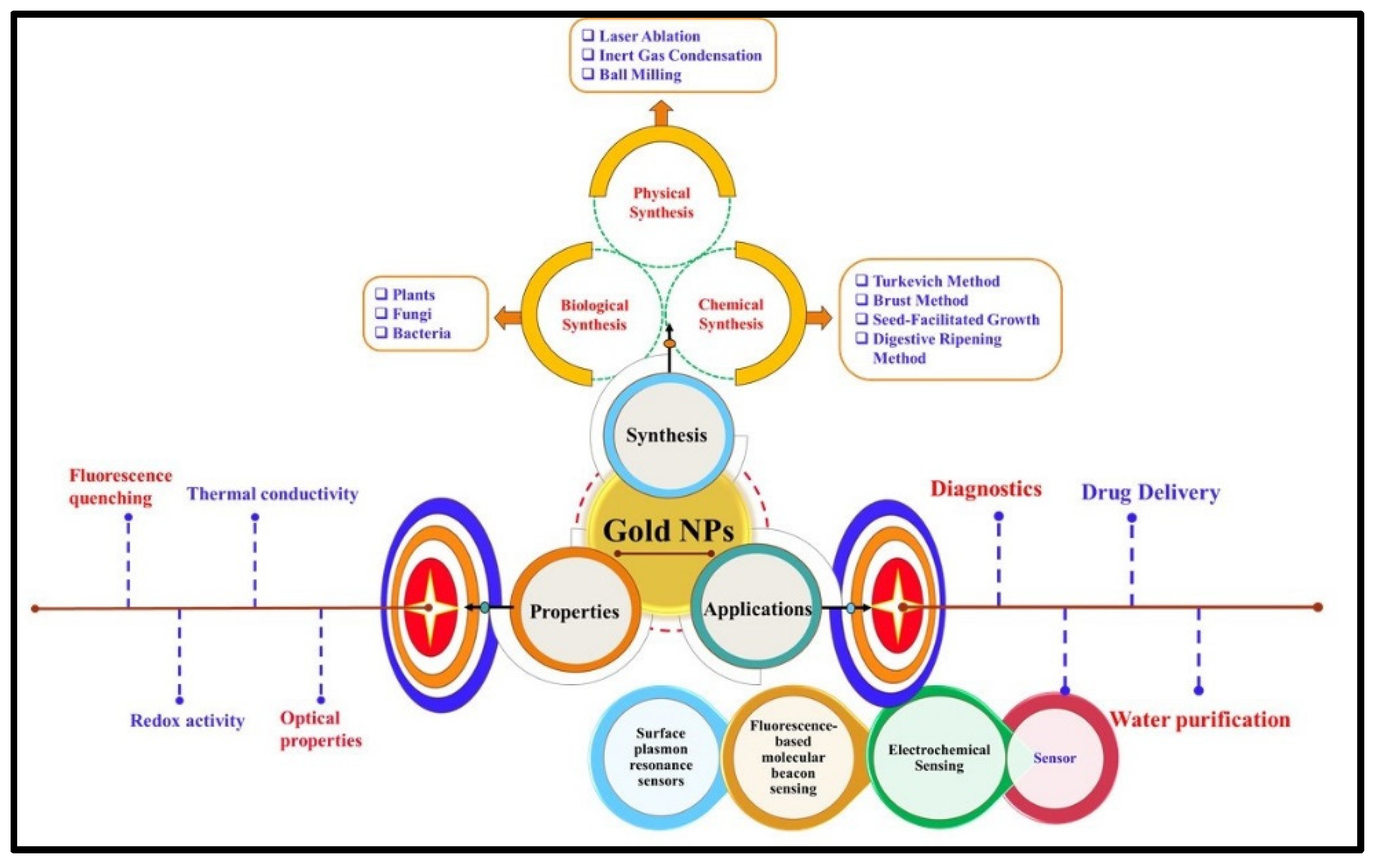
Moreover, gold NPs serve as excellent substrates for biomolecule immobilisation, ensuring retention of biological activity. A strategy for attaching biomolecules to gold NPs involves designing capping layers with dual functionality, enabling strong binding to the gold surface and featuring a chemically reactive group for additional functionality [15]. This type of capping agent provides a user-friendly, adjustable, and simple “biologically friendly” environment for attaching recognition elements to gold NP surfaces. The need to discover and characterise diagnostic biomolecules has prompted extensive research and development in biosensor manufacturing. Modern technology has focused on highly accurate, selective identification of relevant biomolecules, ideally as low-cost, fast, and easy-to-use point-of-care bioanalysis tools [16]. Among the different biochemical sensors, those that exhibit a colourimetric shift in the medium as their signal transduction mechanism have received substantial attention [17]. This is mainly because an intuitive evaluation of the findings makes the material easier to comprehend, useful for developing biosensors to research active biomolecules relevant to food safety, environmental monitoring, and the diagnosis of human health and diseases. Scheme 1 shows a schematic representation of gold NP synthesis, properties, and applications.
The biorecognition component provides selectivity to sensors by employing biomolecules that interact with the target analyte. Due to the diverse nature of these biomolecules, biochemical sensors can be classified based on their recognition elements. Immunosensors facilitate the detection of antigens, antibodies, proteins, nucleic acids, and enzymatic sensors. Gold NP transducers can be classified based on their physicochemical properties, which is another way to categorise (bio)sensors [18]. These features include optical (plasmon resonance, absorbance, luminescence, etc.) [19], electrical/electrochemical (potentiometric, voltage, etc.) [20], magnetic [21], and thermometric features.
Kader et al. [22] summarised the recent literature on nonenzymatic electrochemical detection of several chemical and biological substances using gold NPs. They demonstrated the advantages of gold NPs over traditional methods for detecting these substances. Gold nanoparticle-based electrochemical sensors have emerged as viable alternatives that overcome these difficulties while providing a fast, highly sensitive detection system. Kusuma et al. [23] outlined gold NP-based colourimetric sensors for the detection of heavy metals and biological molecules. They examined various synthesis methods for gold NPs and their morphological properties, which influence the sensing capabilities of gold NPs. They proposed that functionalising gold NPs with conjugates/receptors can enhance stability, sensitivity, selectivity, and solubility, and facilitate the detection of biological compounds by conjugating gold NPs to biological molecules. Kamwal et al. [11] examined the synthesis, characteristics, and diverse uses of gold NPs, emphasising their function as biosensors, by giving a complete picture of the various methods of synthesising gold NPs, including the pros and cons of each. They then elaborated on the amazing qualities that make them so good at biosensing, like localised surface plasmon resonance and a larger surface area. The conversation also discusses functionalisation strategies that enable gold-NP-based biosensors to bind specific biomolecules, thereby increasing their sensitivity and selectivity. Kumalasari et al. [24] explore the application of gold NPs in medical diagnostics, highlighting breakthroughs in illness detection through biosensors for COVID-19, dengue fever, and diabetes. The article highlights recent advances in the synthesis of gold NPs and their potential for use in biocompatible, efficient biosensors.
In the literature, many researchers have published work on gold NP-based biosensors and other types of sensors. Still, as discussed above, there are very few reports that detail gold NP synthesis and the physical, chemical, and biological methods used, given the various types of biomolecule sensing, including colourimetric, fluorescence-based, electrochemical, and surface plasmon-based. Many articles focus only on the synthesis and one kind of sensing. Therefore, there is scope to cover all the above points in one article. In this review, we systematically highlight the various synthesis methods for gold NPs and their advantageous features, making them ideal probes for diverse sensing applications.

2. Synthesis and Functionalization of Gold Nanoparticles

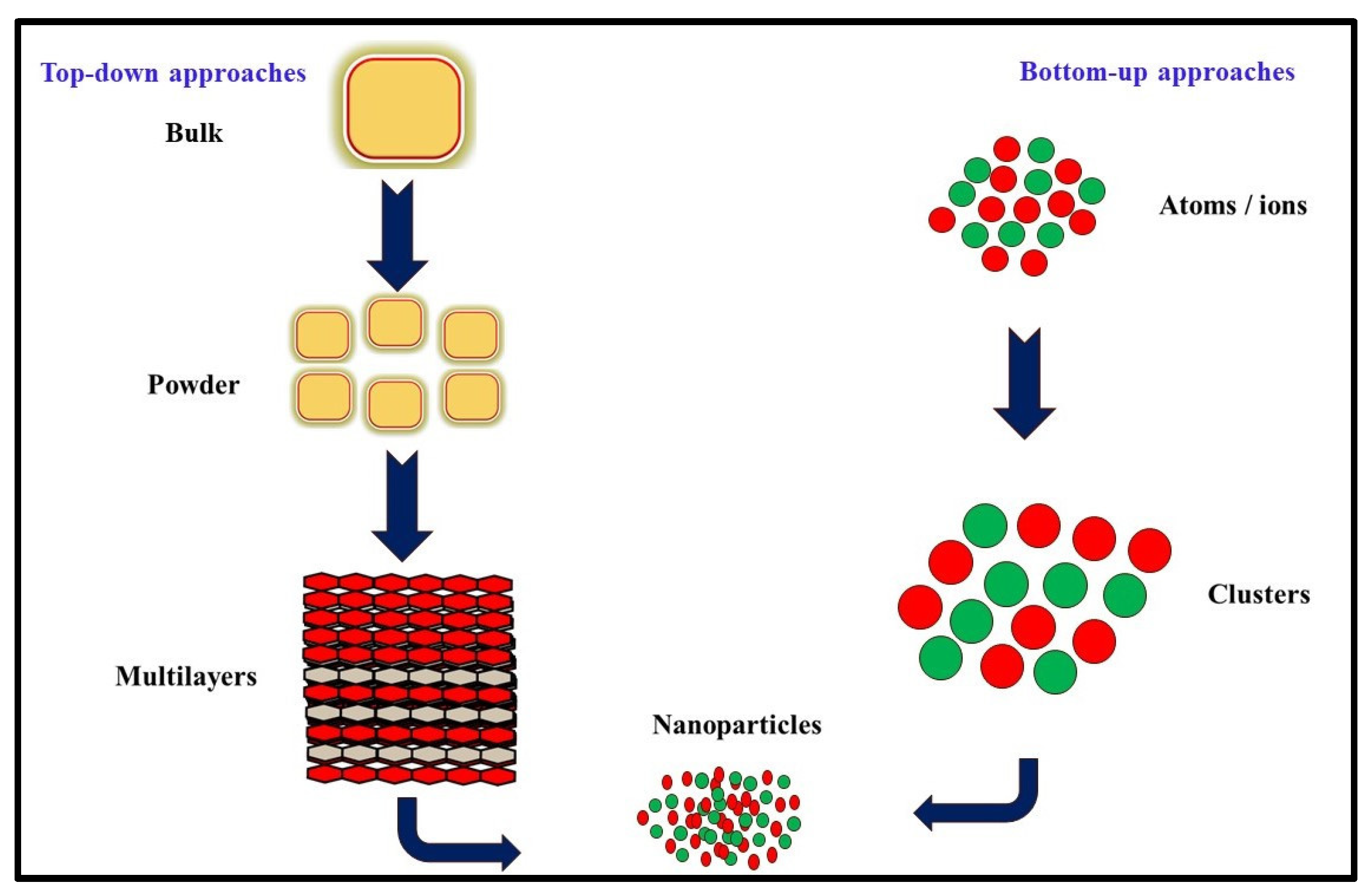
There are numerous methods for synthesising nanomaterials. These methods are divided into two categories: top-down and bottom-up procedures. The procedures are divided according to the phase of the starting material. Solid starting materials are used in top-down processes, while gaseous or liquid starting materials are used in bottom-up approaches. A top-down approach involves reducing bulk materials to nanosized particles. The bottom-up method involves building nanoscale structures from precursor atoms or molecules, where nanostructures are constructed atom-by-atom or molecule-by-molecule. Depending on the requirements, there is a need to find the appropriate process for nanomaterial preparation. Top-down methods, also known as destructive methods, break bulk materials into smaller particles, which are subsequently transformed into nanomaterials. Top-down processes include lithography, mechanical milling or ball milling, laser ablation, sputtering, electron explosion, arc discharge, and thermal breakdown [4]. Bottom-up methods, also known as constructive methods, involve assembling materials from atoms to clusters to nanoparticles. Chemical vapour deposition, sol–gel, spinning, pyrolysis, and biological synthesis are examples of bottom-up methods [25]. Figure 1 illustrates the two fundamental approaches to nanomaterial synthesis: top-down and bottom-up. The three main synthesis methods—physical, chemical and biological—are described below.
Gold NPs can be synthesised by physical, chemical, or biological methods, each providing distinct control over particle size, shape, and surface chemistry. These tunable properties make gold NPs valuable for applications such as colourimetric sensing, bioimaging, drug delivery, and photothermal therapy [24]. The synthesis methods are as follows:

2.1. Physical Synthesis

In physical methods, nanoparticles are synthesised from larger pieces of material by applying forces, offering high precision at the cost of sometimes requiring high-energy conditions. Commonly, gold ions (Au+ or Au3+) are chemically reduced in a solvent, making this the preferred method for large-batch synthesis. Employing living systems to convert gold ions results in eco-friendly synthesis of biocompatible gold NPs with far fewer toxic by-products. Commonly, laser ablation evaporation–condensation, ultrasonication, microwave irradiation, and chemical vapour deposition are used for the synthesis of gold NPs [26]. Physical detection methods primarily exploit changes in the optical or electrical response of gold NPs. Bortoli et al. [27] synthesised stable and ligand-free gold NPs by laser ablation in liquids with a nanosecond pulsed laser. Gold NPs were more efficient at promoting electronic transfer and electrocatalytic processes. The electrocatalytic dopamine sensor has an estimated limit of detection of 0.77 µmol/L for oxidation and 1.08 µmol/L for reduction. Phan et al. [28] used microwave-assisted synthesis to create a new composite material composed of gold NP-integrated carbon spheres and graphene oxide. This method uses microwave radiation to rapidly heat a solution of tannic acid and HAuCl4 via dipole rotation and ionic conduction, leading to the rapid formation of carbon spheres coated with gold NPs. It improves control over the size, shape, and stability of metal NPs. The synthesised nanomaterials were used for ascorbic acid detection and antibacterial applications. Zhang et al. [29] demonstrated ultrasound-assisted green production of gold NPs, which were then utilised for biomedical applications, such as Staghorn sumac for lung cancer treatment. All the physical methods used for gold NP synthesis show excellent control over the growth, morphology, and surface properties of gold NPs [30]. Still, these methods require sophisticated instruments, high temperatures and pressures, and specific conditions; therefore, using physical methods for the synthesis of gold NPs is expensive and limits their widespread use.

2.2. Chemical Synthesis

2.2.1. Turkevich Method

This is the most widely used method for obtaining spherical gold NPs, reported in 1951. The size range of gold NPs generated by this method is 1–5 nm. The basic concept of this method is to reduce ionic gold into atomic gold using a suitable catalyst. The reducing agents may include amino acids, ascorbic acid, UV light, or citrate [31,32]. Various stabilising agents are used to stabilise gold NPs. The original application of the Turkevich method was limited by the narrow range of gold NPs that could be synthesised using this procedure. Over time, many advancements to the underlying process have allowed scientists to broaden the range of particle sizes that can be synthesised with this method [33]. In 1973, it was revealed that adjusting the ratio of stabilising and reducing agents could yield specific-sized gold NPs with diameters ranging from 16 to 147 nm. Many researchers, including Oliveira et al. [32], have employed the Turkevich procedure to synthesise gold NPs.
In Figure S1, the SEM image shows a few cubic and more spherical gold NPs with an average particle size of 16–25 nm. Chavva et al. [34] described the design and validation of an inexpensive, semi-automated system for synthesising gold NPs using the Turkevich method. This gadget, called the ‘NanoSynth Mini’ and driven by a Raspberry Pi, can produce gold NPs with diameters ranging from 15 to 60 nm with minimal fluctuation, as shown in TEM images (Figure S2).
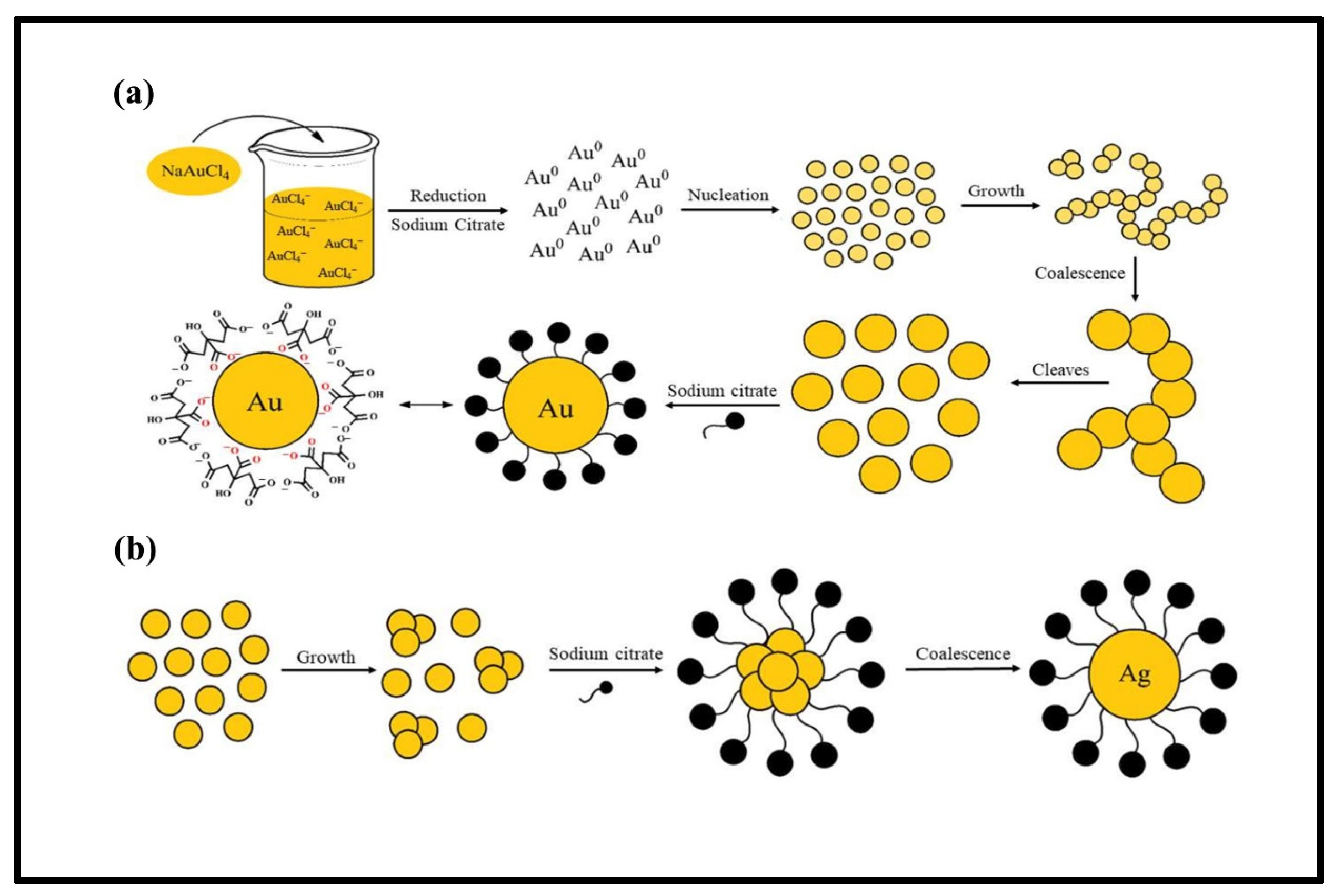
This design enables seamless integration into lab operations, ensuring consistent support for significant research endeavours. Figat et al. [35] employed 20 proteinogenic α-amino acids and one non-proteinogenic α-amino acid as reducing and capping agents to synthesise gold NPs using the Turkevich technique, similar to sodium citrate. The physical and chemical properties of synthesised gold NPs depend on the amino acid used for reduction. α-amino acids used in gold salt reduction typically behave like citrate in the Turkevich process. Differences in physical characteristics, stemming from variations in chemical structure, significantly affect reaction outcomes. The Turkevich approach is typically explained using two mechanisms, as shown in Figure 2a,b [32]. Pong et al. [36] used transmission electron microscopy to study the growth mechanism of Au nanowires formed during citrate reduction of gold(III) salt. First, a NaAuC solution was made in water. The pale-yellow tint resulted from the presence of gold salt, a yellow-gold powder. The addition of sodium citrate rapidly reduced Au3+ to metallic Au (Au0), yielding tiny clusters. This mechanism was noticed during the colourless phase. The nanoclusters then combined to form a network of nanowires, colouring the solution bluish-grey. The blue/purple colour observed during synthesis is due to the formation of gold nanowires, an intermediate phase in the development of gold NPs [32].

2.2.2. The Brust Method

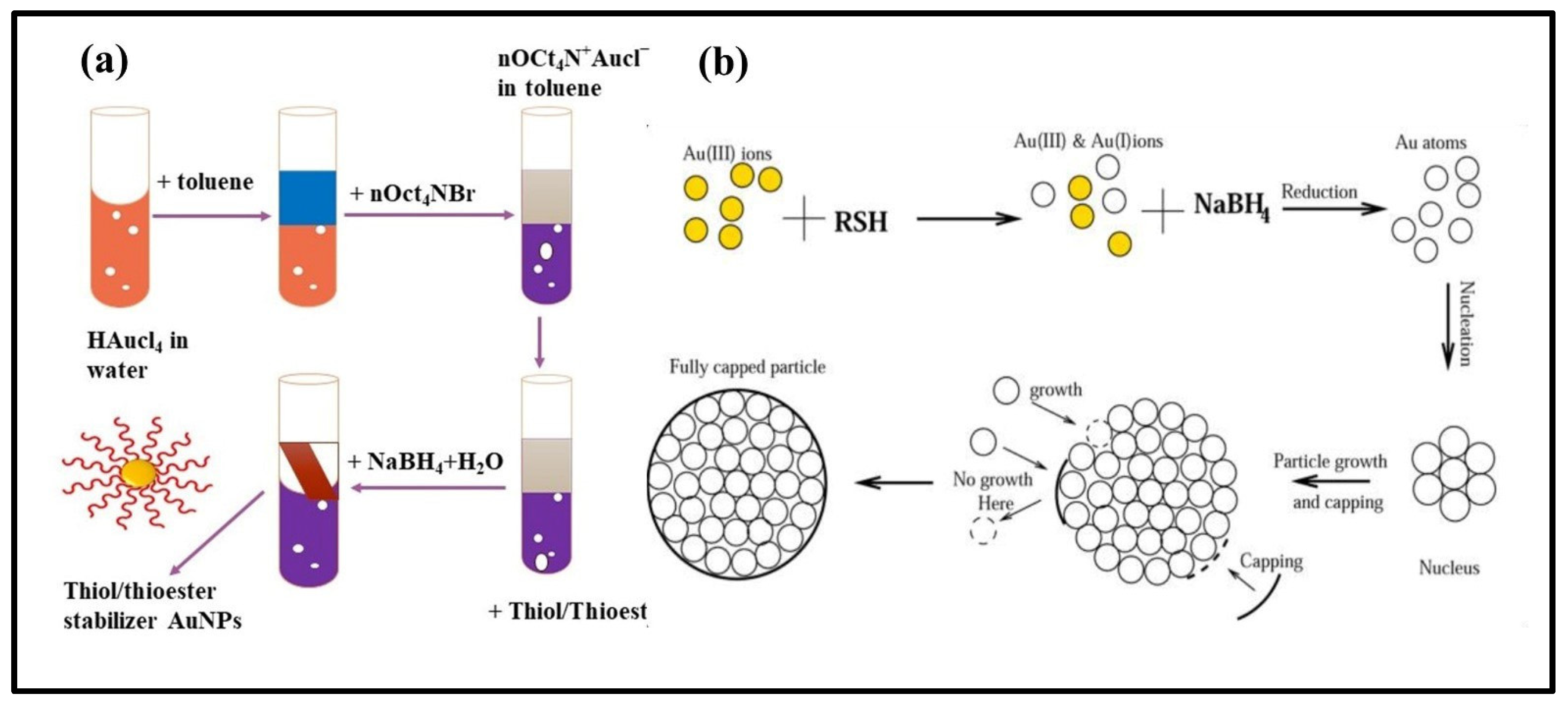
The Brust method was first reported in 1994. This approach uses organic solvents and a two-step procedure to synthesise gold NPs with nanoparticle sizes ranging from 1.5 to 5.2 nm [37]. A phase-transfer agent, such as tetra-octylammonium bromide, is used to transport a gold salt from aqueous solution to an organic solvent. The following stage involves reducing the gold using an alkane thiol and a reducing agent such as sodium borohydride. The alkane thiol stabilises gold NPs [38]. Booth et al. [39] employed X-ray absorption spectroscopy and liquid/liquid electrochemistry to investigate the Brust–Schiffrin synthesis of alkane thiol-protected metal nanoparticles. The favoured precursor is [AuBr4], which is resistant to Au(I) thiolate production. This new knowledge could result in increased nanoparticle yield and lower particle size polydispersity (as shown in Figure S3). Uehara et al. [40] investigated the mechanism of Brust–Schiffrin gold NP synthesis using ion transfer voltammetry at the 1,2-dichloroethane (DCE) solution interface, combined with X-ray absorption fine structure (XAFS) of the reaction between [AuCl4] and thiol (RSH) in a homogeneous toluene (TL) solution. Ion transfer simulations show the production of [AuCl2] at RSH/Au ratios ranging from 0.2 to 2, with time-dependent fluctuation observed over several days. This approach results in a colour change from orange to brown.
The mechanism of gold NP formation and capping with the thiol group is mainly described in three steps, as shown in Figure 3a,b [40]. Ripening and etching have minimal impact on this room-temperature synthesis. TOAB and alkanethiols can stabilise particles independently; thus, they assume no coagulation occurs during synthesis. The mechanism begins with the addition of a sodium borohydride solution, yielding Au0. At some point, the nuclei emerge. The nuclei provide surface area for the simultaneous assimilation of Au0 atoms and capping. The mechanism can control particle size by (i) changing precursor reactivity based on Au3+ and Au1+ ratios and/or (ii) capping growing particles with alkanethiols and dialkyl disulfides. This process is commonly referred to as Au3+ reduction to gold atoms, nucleation, growth, and capping [41].

2.2.3. Seed-Facilitated Growth

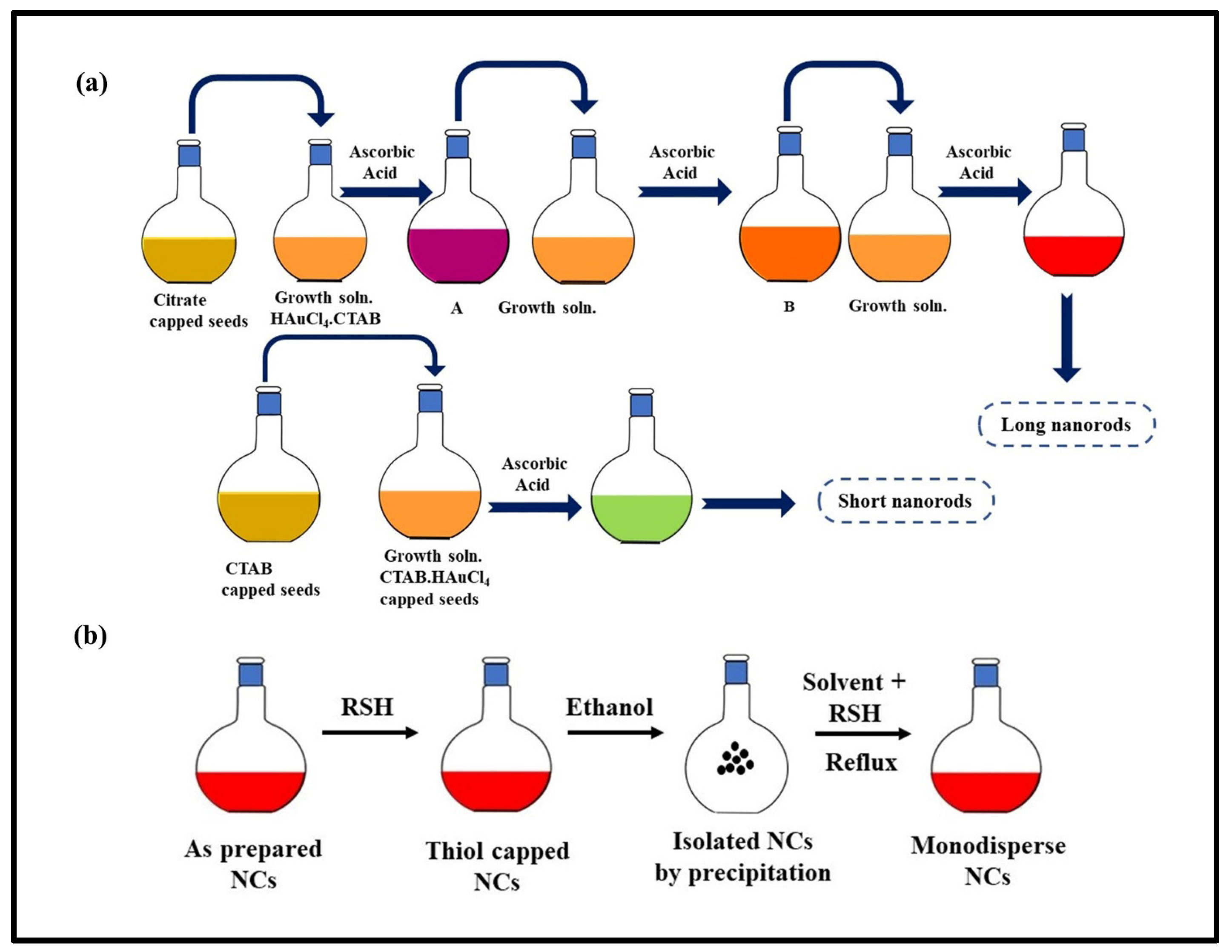
The two techniques mentioned above can only be used to get spherical gold NPs. However, gold NPs can be obtained in various shapes, like rods [42]. It is the most widely used technique for preparing rod-shaped gold NPs. The fundamental principle of this method is to obtain seed particles of gold NPs by reducing gold salts with reducing agents such as NaBH4. The seed particles are then transferred to a moderate reducing agent, such as ascorbic acid, and a metal salt. This enhances nucleation and accelerates the formation of gold NPs. The shape and form of gold NPs are determined by the seeds and consequent concentrations employed. Hema et al. [43] synthesised gold nanorods using a colloidal seed-mediated growth method. Synthesised gold nanorods of average length (34.41 nm) and width (11.37 nm) with a face-centred cubic (fcc) structure. Optical examination confirms that the produced gold nanorods exhibit a transverse surface plasmon resonance band at about 510 nm and longitudinal localised surface plasmon resonance at approximately 705 nm. It shows good catalytic activity in reducing 4-NP, an environmental organic pollutant, to its reduced form. Leng et al. [44] used a pH-controlled approach to prepare very uniform gold seeds with a Z-average diameter of 17.7 ± 0.8 nm and a polydispersity index of 0.03 ± 0.01 for the manufacture of gold NPs at room temperature using citrate and a gold salt. The mechanism of gold NP development was also examined using time-resolved UV-Vis spectroscopy, dynamic light scattering, and transmission electron microscopy. The seed-facilitated development of gold nanorods is shown in Figure 4a.

2.2.4. Digestive Ripening Method

This technique is considered a practical way to create monodispersed gold NPs when too many ligands are present, known as digestive ripening agents. In the basic process, a colloidal solution is heated to 138 °C, then heated again to 110 °C for five hours. Figure 4b (https://www.dovepress.com/a-review-on-the-synthesis-and-functionalization-of-gold-nanoparticles--peer-reviewed-fulltext-article-IJN#f0003, accessed on 1 January 2026) shows the digestive ripening process. Temperature is essential for determining the size distribution of gold colloids [45,46]. Eswaramoorthy et al. [47] reported that digestive ripening is a synthetic process in which a polydisperse colloid of metal NPs is refluxed with a free ligand in a high-boiling-point solvent to yield monodisperse NPs. This approach has only been used to synthesise large NPs (>5 nm) with highly monodispersed size distributions. The sequence of the two processes was reversed, with reduction occurring before thiol addition, using the same primary chemicals. The resulting nanomaterials, Au25(SR)18 and Au144(SR)60, exhibit atomic precision, thanks to this method. Lin et al. [48] explored how adding an excess amount of dodecanethiol to a gold colloid at room temperature and reflux heating in a silicone oil bath at 130 °C affected the gastric ripening of thiol-capped gold NPs. The experimental results show that adding more dodecanethiol at room temperature makes a polydisperse gold NP system essentially monodisperse. Reflux heating is not required to create a nearly monodispersed gold NP system. Reflux-heating the gold colloids with an additional amount of dodecanethiol accelerates the transformation from polydisperse to virtually monodisperse gold colloids. Prolonged heating converts the almost monodisperse gold colloids into a bidisperse distribution. The combined action of reflux heating and dodecanethiol concentration determines the digestive ripening of thiol-capped gold NPs. The self-assembly of almost monodisperse gold NPs is seen. Gold NPs typically form self-assembled nanostructures with six-fold symmetry, and greater ordering is observed in both monodisperse and bidisperse nanoparticles.

2.3. Biological Synthesis

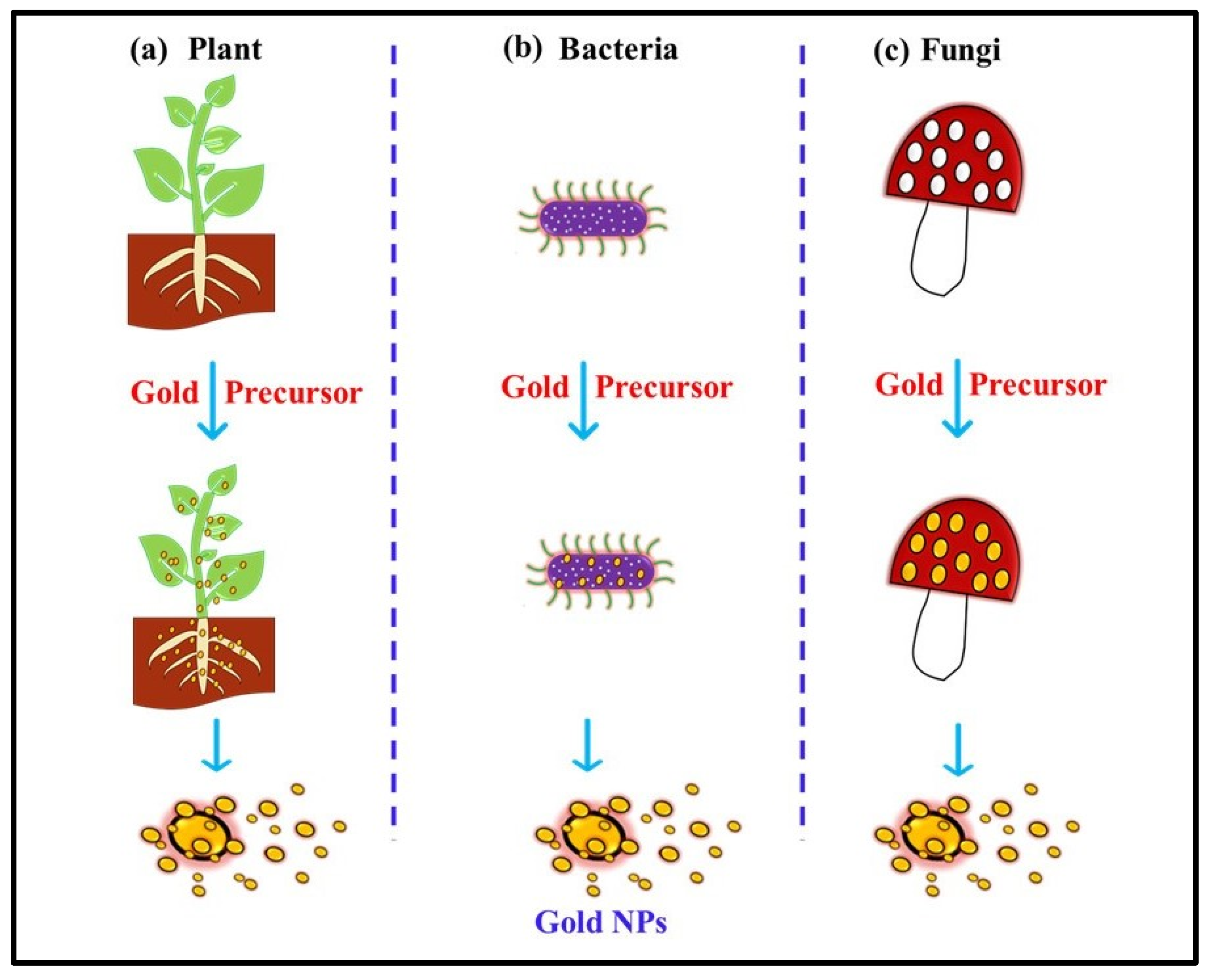
Recently, the biological synthesis of gold NPs has emerged as a dependable, secure, and eco-friendly alternative to chemical methods that use harsh chemicals [49]. The ability of organisms to synthesise metal NPs has led to the emergence of a new and interesting method for producing these biological nano-factories. Research has demonstrated that various organisms, including bacteria, plants, algae, and fungi, can efficiently produce gold NPs. Biological resources that form NPs include simple bacterial cells and complex eukaryotes.

2.3.1. Bacteria

The synthesis of intracellular and extracellular gold NPs is an exciting application of microorganisms [50]. The positive charge of gold (III) ions interacts electrostatically with the negative charge of bacterial cell walls. Ionic gold is taken up by the cell during intracellular synthesis, leading to biomolecule-mediated gold NP synthesis. Extracellular synthesis involves membrane enzymes binding ionic gold to the cell membrane. Microbial cells produce membrane-bound enzymes that can start the production process extracellularly [51]. The extracellular synthesis approach is more appealing because it eliminates the need for additional downstream processing steps to extract NPs from the intracellular matrix. According to one study, bacteria release NADPH-dependent enzymes that convert gold ions to metallic gold NPs throughout the extracellular process. Pseudomonas denitrificans produces a nitrate reductase enzyme. The results showed that once gold NPs were synthesised, the reductase enzyme’s activity dropped [52]. According to Singh et al. [53], Rhodopseudomonas capsulate produced NADH and NADH-dependent enzymes while synthesising gold NPs outside the cells. An NADH-dependent enzyme transfers electrons from NADH, reducing Au(III) to Au(0). This method yields gold NPs, and it has been shown that Thermomonospora species degrade Au(III) ions at the membrane and mycelial surfaces, producing gold NPs via internal enzymes [54]. Similarly, Shewanella algae effectively stimulated the enzyme-mediated bio-reduction of AuCl4 ions to gold NPs, which were discovered to be distributed throughout the bacterium’s periplasmic membrane [55]. Proteins, enzymes, and chemical substances produced by microbial cells can prevent nanoparticle agglomeration [56]. Certain reductase enzymes found in microorganisms can convert metal salts to metal NPs with uniform size distributions. The size and shape of gold NPs can be controlled by adjusting key growth parameters, as shown in Figure S4. Because bacterial culture takes time, using bacteria to synthesise gold NPs is a laborious operation that can take hours or even days. When dealing with microorganisms, extra caution is required. Due to these limitations, the use of microorganisms in the production of gold NPs has been restricted [57].

2.3.2. Fungi

Fungi are another biological source used to synthesise gold NPs. Numerous biomolecules released by fungi, including metabolites and extracellular enzymes such as β-1,3-glucanase, esterase, and cell wall lytic enzymes, are involved in the formation of metallic NPs [57]. Numerous studies have documented the use of unicellular and multicellular fungi in the manufacture of gold NPs. In one study, Fusarium oxysporum, a fungus, was used to synthesise extracellular gold–silver alloy NPs by reducing a shuttle quinone and a nitrate-dependent enzyme [58]. It has also been observed that the fungus Verticillium synthesises gold NPs within its cells. Gold NPs were observed to be trapped in the fungal cell wall and membrane, suggesting that reducing the activity of reductase enzymes from fungi bio-reduced Au3+ ions [59]. Research on gold NP synthesis using Phanerochaete chrysosporium suggests that ligninase is responsible for intracellular gold NP synthesis. Fungi also release laccase, which is produced both extracellularly and intracellularly [60].

2.3.3. Plants

Nowadays, phyto-nanotechnology has attracted greater attention because it offers a quick, inexpensive, and environmentally benign method for synthesising NPs. Using safe plant bioconstituents to reduce and cap gold NPs, numerous researchers have reported the biosynthesis of gold NPs using various plants or plant extracts, thereby reducing waste production and the need for additional purification processes [61]. Plants include a variety of bio-components, including flavonoids, phytosterols, quinones, and others, whose functional groups accelerate the reduction and stability of gold NPs and aid in their production [62]. Leaf portions are most frequently used, but it has been observed that almost any plant part can efficiently produce gold NPs. The synthesis of gold NPs is affected by variations in the concentrations of different chemicals found in different plants, and even in different sections of the same plant. For instance, one study examined the effects of varying levels of phenolic content in the fruit and leaves of the Garcinia mangostana plant on the production of gold NPs. Because of the high phenolic content of leaves, gold NPs were synthesised more quickly [63]. It has been found that the medicinal plants Cassia auriculata and Acorus calamus are capable of producing gold NPs [64]. People have observed that reactive chemicals in Justicia glauca leaves, such as alkaloids, flavonoids, lignans [(+)-pinoresinol and (+)-medioresinol], steroids (sitosterol-3-0-glucoside), and terpenoids, can complete the synthesis of gold NPs in only one hour [65]. Gold NPs had a spherical and hexagonal shape and were 32 nm in diameter. Gold NPs were also synthesised in 15 min using Terminalia Arjuna plant leaves. The study produced spherical gold NPs with a size range of 20–50 nm. The reactive chemicals arjunetin, leucoanthocyanidins and hydrolysable tannins, discovered in Terminalia arjuna leaves, a;lso assisted in the synthesis of gold NPs [66].
Likewise, it was demonstrated that Cassia auriculata and olive plant leaves could complete the synthesis reaction of gold NPs in 10 and 20 min, respectively. The synthesis of spherical anisotropic gold NPs with sizes ranging from 50 to 100 nm was facilitated by the proteins oleuropein, apigenin-7-glucoside, and luteolin-7-glucoside, as well as other active biomolecules and metabolites present in olive plant leaves. Flavonoids and polysaccharides are the main active components of Cassia auriculata leaves. The leaves of this plant have a spherical, anisotropic shape and ranged in size from 15 to 25 nm when gold NPs were formed from them. Philip et al. [67] reported that spherical gold NPs were synthesised from Mangifera indica leaves in less than two minutes after the reaction, rang in size from 17 to 20 nm. Mango fruit includes active compounds such as thiamine, flavonoids, and terpenoids, which may have contributed to the formation of gold NPs. Gold NPs have also been synthesised from other plant parts, such as fruits, roots, and stems, in addition to leaves. In one study, spherical gold NPs with diameters ranging from 15 to 35 nm were synthesised in around 5 min using Citrus maxima fruit [68]. In addition to the active components found in the flowers of Lonicera Japonica, such as amino acids, another main ingredient used in the synthesis of gold NPs was the high phenolic content of Sambucus nigra, or elderberry. Gold NPs with a triangular or tetrahedral morphology and an average size of 8 nm may be synthesised in one hour [69]. Similarly, the flowers of Moringa oleifera generated gold NPs in the size range of 3–5 nm, as shown in Figure S5. The plant’s rich composition of phenols, sterols, carotenoids, flavonoids, and amino acids was reportedly responsible for driving the reduction reaction during synthesis [70]. Researchers have demonstrated that different types of roses can facilitate the synthesis of gold NPs. The peels of bananas and mangoes can be utilised to synthesise gold NPs with diameters of 50 nm and 6.03–18.01 nm, respectively. Mango peels produced quasi-spherical gold NPs, whereas banana peels produced spherical gold NPs. The reaction times for the two processes were 20 min and 25 min, respectively [71]. Additional studies showed that the rhizomes of turmeric [72] and ginger [70], the pulp of green pepper [73], and the nuts of Areca catechu [74] can produce gold NPs. Figure 5 shows the schematic for the biological synthesis of gold NPs. A comparison of the advantages and disadvantages of the environmental effects and costs of physical, chemical, and biological methods is discussed in Table 1.

2.4. Effect of Growth Dynamics, Ligand Effects, or Facet-Selective Growth of Gold NPs on the Biomolecule Sensing Performance

The size and shape of gold NPs are determined by their growth, which is regulated by atom nucleation and subsequent atom deposition. According to recent studies, surfactant-driven growth paths can produce extremely anisotropic structures. For example, intricate forms like gold nanohexagrams have been created using active surface development regulated by cetyltrimethylammonium bromide. This demonstrates how branching and edge formation are influenced by kinetic variables and surfactant concentration. For the synthesis of nanoparticles that perform well in plasmonic and catalytic applications, insights into how development occurs over time are crucial [75]. Growth dynamics provide the structural “starting conditions” for sensing. Kinetically regulated regimes favour anisotropic morphologies (e.g., spikes, tips, and branches) that amplify local electromagnetic fields, thereby increasing plasmonic coupling and enhancing scattering and SERS-based signals. Diffusion-limited or equilibrium-like regimes, on the other hand, produce more isotropic particles, which moderate field localisation while improving spectral stability and lowering baseline noise. Seed-mediated procedures that adjust reduction rates, precursor flux, and additive selection can lock in high-curvature features, thereby reducing detection limits via hot spot formation in plasmonic assays [76]. During synthesis, morphology is further refined through faceted growth. Surface energies are modulated by surfactants and metal additions, leading to differential growth in the {111}, {100}, and {110} planes. This produces tip-rich (“superspiky”) structures in which regulated kinetics maintain protrusion growth rather than smoothing, improving near-field intensity and electromagnetic enhancement critical performance parameters for label-free and label-based biosensing devices. Ligands form the biochemical interface, which regulates colloidal stability, nonspecific binding, and recognition efficiency.
Terminal functional groups with varying polarity, such as COOH, OH, NH2, and CH3, alter the interactions of NPs with solvents and with one another. This alters the tendency of nanoparticles to adhere to one another, a critical signal transduction pathway in colourimetric experiments. Molecular dynamics studies show that polar termini reduce uncontrolled aggregation compared to nonpolar methyl groups, thereby improving baseline stability and enabling more precise, concentration-dependent signal shifts during specific binding events [77]. In addition to colloidal control, ligand density, packing, and chain length influence the accessibility and orientation of capture moieties. The best passivation (such as combined short and long chains or zwitterionic motifs) allows target access while inhibiting nonspecific adsorption, increasing the signal-to-noise ratio. The Debye screening environment can also be changed by adjusting the charge and hydrophobicity. It affects plasmonic shifts and SERS readouts by adjusting particle spacing and the refractive index of the binding layer [78]. Facet-selective synthesis enables the programmable location of high-curvature structures, such as tips, spikes, and ridges, which act as electromagnetic hot spots. Superspiky Au nanocrystals, created by manipulating seed shape and regulating facet growth, exhibit strong field localisation, increasing SERS sensitivity and improving plasmonic biosensing responses in situations where detection is challenging due to low abundance. This architecture leverages anisotropy to increase the scattering cross-section and extend the effective interaction length between the optical field and biomolecular labels or analytes. It decreases detection limits and improves spectral contrast.
Table 1. Comparison of physical, chemical and biological methods for gold NP synthesis [78].
Sr. No.Synthesis MethodAdvantagesDisadvantagesChallengesGeneral Environmental Impact (1
= Low, 2 = Medium, 3 = High)
General Cost of Apparatus (1
= Low, 2 = Medium, 3 = High)
1.Physical Methods
(i)
Microwave-Assisted
fast
energy-efficient
eco-friendly
wide range of materials
ligand-free NPs
easy-to-make BNPs
low yield
safety concern costly
non-uniform
heating and hot spots
23
(ii)
Inert Gas Condensation
material flexibility
high purity
uncontaminated surfaces
high cost
shape control
particle agglomeration
pressure tuning
gas flow optimisation
temperature gradient
21
(iii)
Ball Milling
high yield,
precise NP size control
low cost
ligand-free NPs
long processing times
limited in materials, challenging to make bimetallic nanoparticles
Ball Milling22
(iv)
Pulsed Laser Ablation in Liquids
quick
low cost, precise control on NP size
and concentration
low yield
too many parameters to control
scalability, stability/aggregation issues12
2.Chemical Methods
(i)
Turkevich Method
simplicity, reproducibility
cost-effectiveness
complex mechanism
low yield
environmental concerns
limited size and shape control21
(ii)
Brust Method
high stability
size tunability
facile functionalisation
contamination potential
hazardous chemicals
use of toxic chemicals
purification challenges
22
(iii)
Seed-Facilitated Growth
genetic diversity
disease resistance
scalability
lack of uniformity
vulnerability of seedlings
environmental, economic, and
regulatory domains
12
(iv)
Digestive Ripening Method
controllability
robustness
reproducible
mechanistic complexity
temperature sensitivity
temperature control22
3.Biological Methods
(i)
Bacteria
sustainable biocompatible NPs
narrow size distribution
low cost
many species available
high reproduction rate
limited materials
limited combinations for BNP synthesis require post-processing
NPs may not be suitable for catalytic and electronic applications due to ligands
sterile filtration validation
microbial challenge testing
12
(ii)
Fungi
sustainable
biocompatible NPs
narrow size distribution
low cost
many species have a high reproduction rate
limited materials
limited combinations for BNP synthesis
require post-processing, NPs may not be suitable for catalytic
and electronic applications due to
ligands
scalability, slower synthesis rate
purification challenges
12
(iii)
Plants
sustainable
biocompatible NPs
narrow size distribution
low cost
many species available
limited materials
processing
NPs may not be suitable for catalytic
and electronic applications due to
ligands
variability in plant extract
lack of reproducibility
limited control over morphology
11

3. Detection of Biomolecules

3.1. Colourimetric Detection of Biomolecules

3.1.1. Detection of Proteins

When gold NPs of the right size (d > 3.5 nm) aggregate at nanomolar concentrations, interparticle surface plasmon interactions result, leading to a discernible red-to-blue colour shift. Colourimetric sensing based on absorption can identify target analytes that induce gold NPs to aggregate or redisperse, as these processes are accompanied by a colour change [79]. Many diseases, including cancer, are characterised by irregular protein concentrations or the presence of biomarker proteins. Gold NPs have been widely used for protein colourimetric detection. A variety of carbohydrate-functionalised gold NPs have been developed to detect carbohydrate-binding proteins. For example, Recinus communis agglutinin (RCA120) was detected by Takae et al. [80], who reported that gold NPs functionalised with β-D-lactopyranoside (Lac) were aggregated. Because the degree of colloidal aggregation was proportional to protein amount, this approach could be beneficial for quantitative lectin detection. Interestingly, this approach offers high lectin-detection sensitivity (1 ppm lectin concentration). Later, the lectin detection range was controlled by varying the density of the Lac moiety on the particle surface. The study found that lectin-induced aggregation is dependent on a threshold Lac density of greater than 20% [81]. Researchers have developed gold glycol NPs assembled via protein-directed assembly to facilitate rapid and accurate identification of protein–protein interactions. Con A binding partners have been identified in an intriguing study that employs assemblies of Con A and mannose-modified gold NPs. This is because protein–protein interactions disrupt the initial nanoparticle–protein complexes. Similarly, the lectin Con A has been utilised to sense carbohydrate–protein via a succession of gold NPs functionalised with manno- and gluco-oligosaccharides [82].
Wang et al. [83] have described the application of a novel fluorescent-based competitive binding assay to determine the affinity of glycol nanoparticles (gold NPs linked with underivatised mono-, oligo-, and polysaccharides) for a model protein (lectin Con A). Reynolds et al. [84] employed lactose-stabilised gold glycol NPs to study calcium-ion-mediated carbohydrate–carbohydrate interactions. Colourimetric detection of cholera toxin at nanomolar quantities was achieved by aggregating lactose-stabilised ~16 nm gold NPs under controlled conditions. Chilkoti et al. [85] used label-free optical approaches to observe biomolecular interactions in real time, employing gold NPs functionalised with biotin and placed on glass substrates. An aptamer-based technique to detect platelet-derived growth factors (PDGFs) at nanomolar concentrations utilising gold NP probes bearing PDGF-specific aptamers [86]. Moreover, PDGF receptors were identified using this aptamer–gold NP–PDGF assembly in a competitive binding experiment. Dong et al. [87] used unaltered gold NP probes, an even simpler aptamer-based colourimetric protein sensing method. In the sensor architecture, unaltered gold NPs were first stabilised using thrombin-binding aptamers. Initially, thrombin-binding aptamers were used to stabilise unmodified gold NPs in the sensor architecture. Aptamer–protein recognition causes aptamers to fold into a G-quadruplex/duplex structure in the presence of thrombin. The relatively stiff aptamer structure causes gold NPs to aggregate, yielding a detection limit of 0.83 nM upon folding. Similarly, a thrombin-specific aptamer has been used to modify glass surfaces for thrombin sensing. The process creates a “sandwich” complex due to thrombin’s two aptamer-binding sites. The technique was improved by expanding the size of the trapped gold NPs using a growth solution containing CTAB, HAuCl4, and NADH. The method triggers SPR coupling between adjacent gold NPs, achieving a detection limit of 2 nM for thrombin. The gold NP aggregation-based protein immunoassay has also been used to study broad antigen–antibody interactions [88].
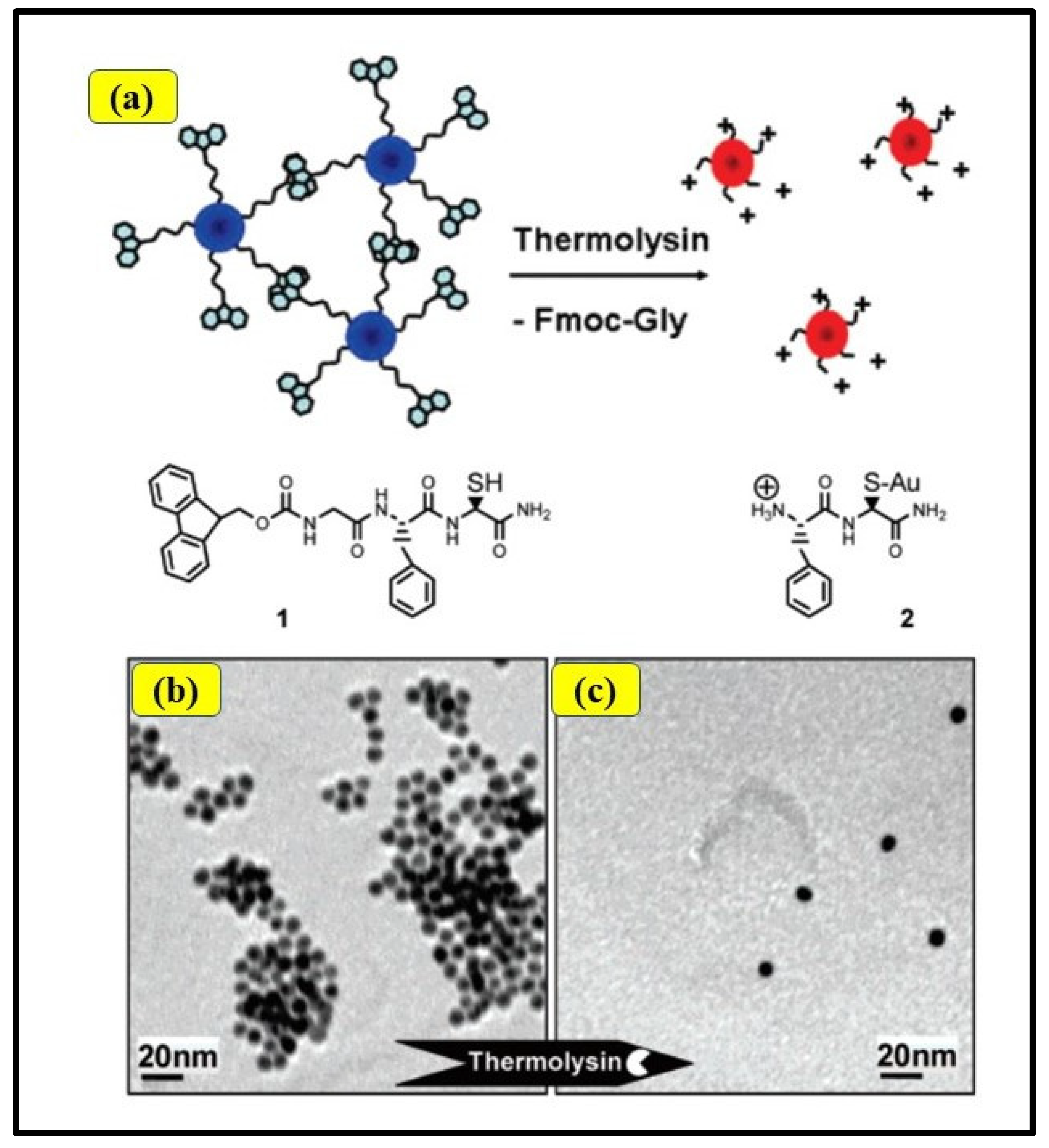
Thanh et al. [89] showed that serum samples can detect anti-protein concentrations as low as 2 μg/mL. Dithiols provide a valuable platform for colourimetric protease detection by cross-linking gold NPs with dithiol-functionalised peptides. Laromaine et al. [90] employed gold NPs coated with peptides containing a cysteine anchor to simplify this two-stage method. The blue-to-red colour shift indicated the presence of thermolysin in the system, which cleaved the peptide ligands, leading to the dispersion of the gold NPs in solution, as shown in Figure 6a. The TEM images of gold NPs with and without thermolysin are shown in Figure 6b,c. This device is reported to have a high sensitivity of 90 zg mL−1 (equivalent to less than 380 molecules). Mirkin et al. [91] developed a real-time colourimetric screening method for endonuclease activity based on the enzymatic cleavage of DNA molecules using DNA-mediated gold NP assemblies. The colourimetric endonuclease-inhibition test assesses the efficacy of endonuclease inhibitors, compounds that bind to DNA. Similarly, the enzyme-triggered gold NP assembly/disassembly approach has been used to identify and evaluate the activity of kinases, phosphatases, β-lactamases, and aminopeptidases [92]. Zare et al. [93] developed a colourimetric sensor for protein conformational changes using gold NP probes.

3.1.2. Detection of Oligonucleotides

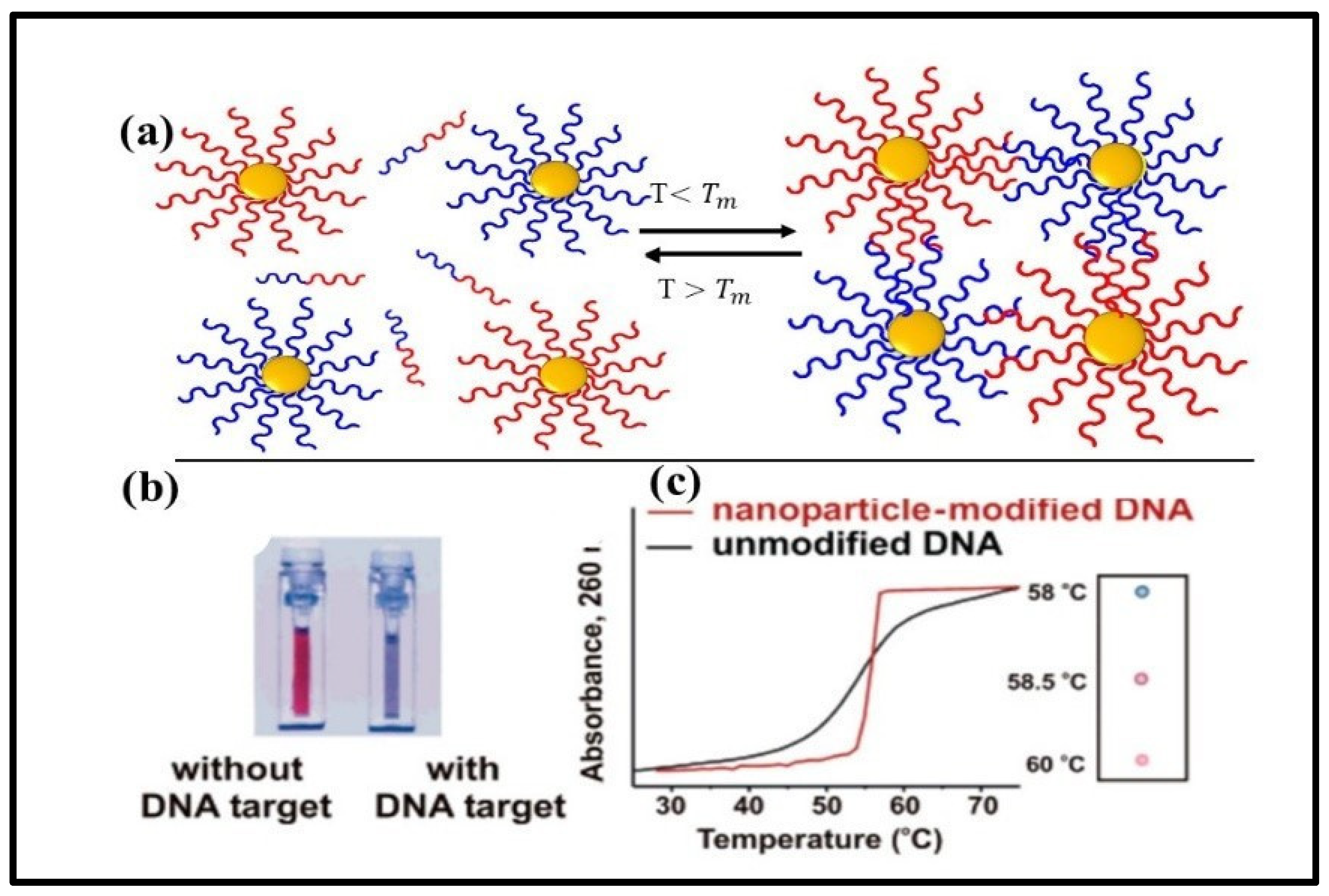
Detection of nucleic acids can identify microorganisms, and detection of genetic mutations is a vital target for diagnostics. Fluorescent and radioactive detection readout techniques, including PCR, RT-PCR, Northern blot, Southern blot, and high-density microarrays, are commonly used to detect oligonucleotides. Colourimetric assays utilising gold NPs have proven to be a highly competitive approach for oligonucleotide targets. Researchers modified the characteristics of NPs probes by creating gold nanoparticles with thiolated DNA strands. This finding has led to widespread use of oligonucleotide-directed gold NP aggregation for colourimetric oligonucleotide detection and for the formation of structured assemblies [94]. This method utilised two gold NP probes modified with ssDNA to detect target oligonucleotides by observing their colour change. The base sequences at both ends of the gold NP probes match the target oligonucleotides. The presence of target oligonucleotides produces gold NP aggregation and a colour shift at the same time because DNA strands are hybridised. The combination of precise base-pairing of DNA strands and the high absorptivity of gold NPs enables the detection of oligonucleotides at sub-picomolar levels using colourimetric methods. Maeda et al. [95] demonstrated that DNA-functionalized gold nanoparticles can aggregate during target DNA hybridisation without cross-linking the gold NPs, rendering this system susceptible to single-base mismatches. Citrate-stabilised gold NPs have been shown to differentiate between single-stranded DNA (ssDNA) and double-stranded DNA (dsDNA) at a concentration of 100 fmol, utilising fundamental electrostatic interactions. This approach makes it easy to find incompatibilities, even down to the level of a single base pair.
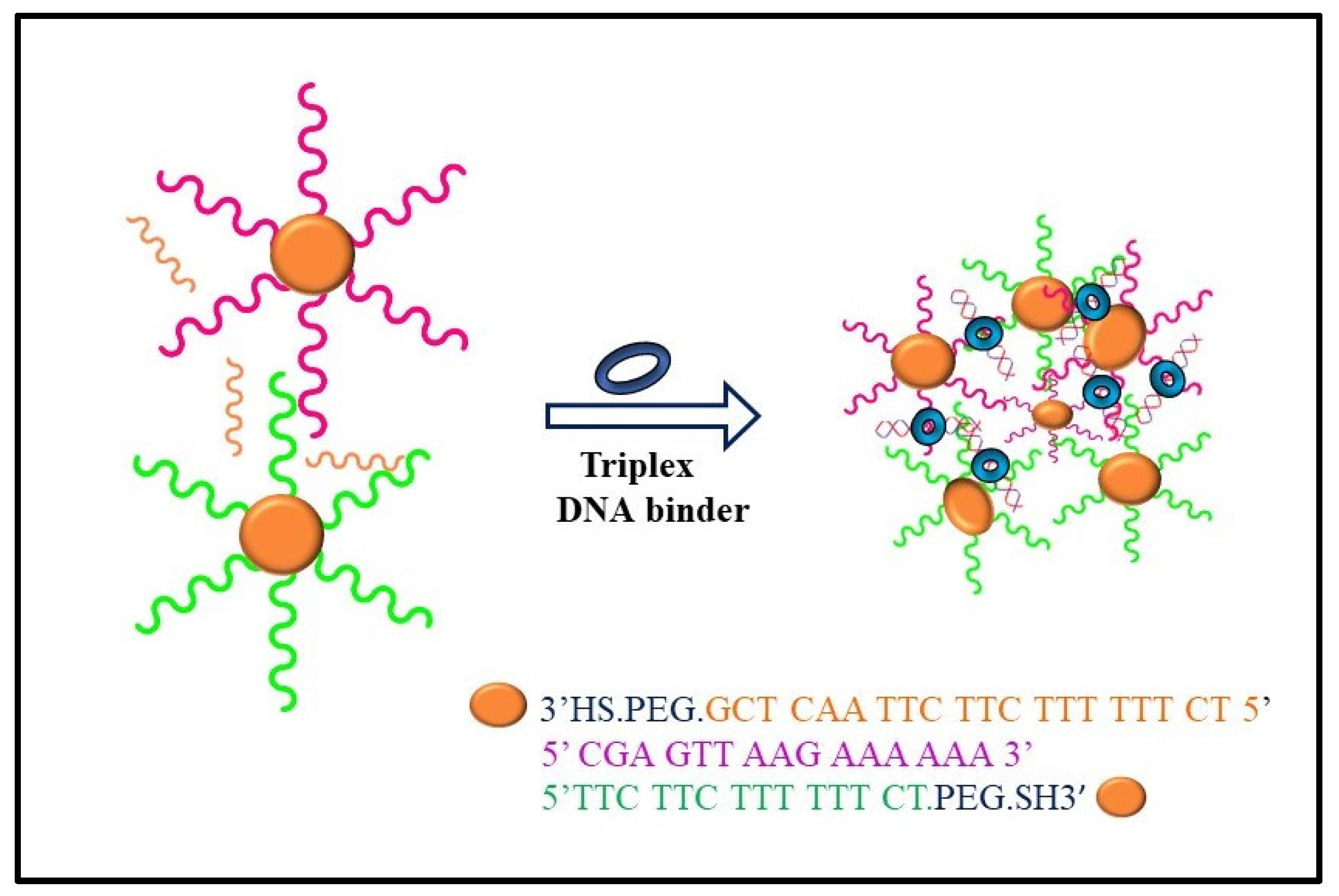
A nearly “universal” sensing approach that uses ssDNA probes, unmodified gold NPs, and a positively charged, water-soluble conjugated polyelectrolyte can detect DNA, proteins, small molecules, and inorganic ions. Xia et al. [96] demonstrated that oligonucleotide-directed synthesis of gold NPs also facilitates triplex DNA binding and enables colourimetric screening. Three parts are used to test triplex DNA binders: a complementary ssDNA strand that can form a triplex structure by binding to two sets of gold NPs, and non-complementary ssDNA strands, as shown in Figure 7a. At room temperature, ssDNA-functionalized gold NPs do not clump together because the triplex structure is relatively unstable. However, adding the appropriate triplex DNA binders, such as coralyne (CORA) and benzo pyridoindole, stabilises the triplex structure, causing the gold NPs to group together and change colour, as observed in Figure 7b. This method is easy to use, enabling rapid identification of triplex binders in large combinatorial libraries. Gold NP assembly directed by oligonucleotides has been employed to assess the relative binding affinities of molecules to duplex DNA, enabling DNA detection via colourimetric assays shown in Figure 7c.

3.2. Fluorescence-Based Molecular Beacon Sensing

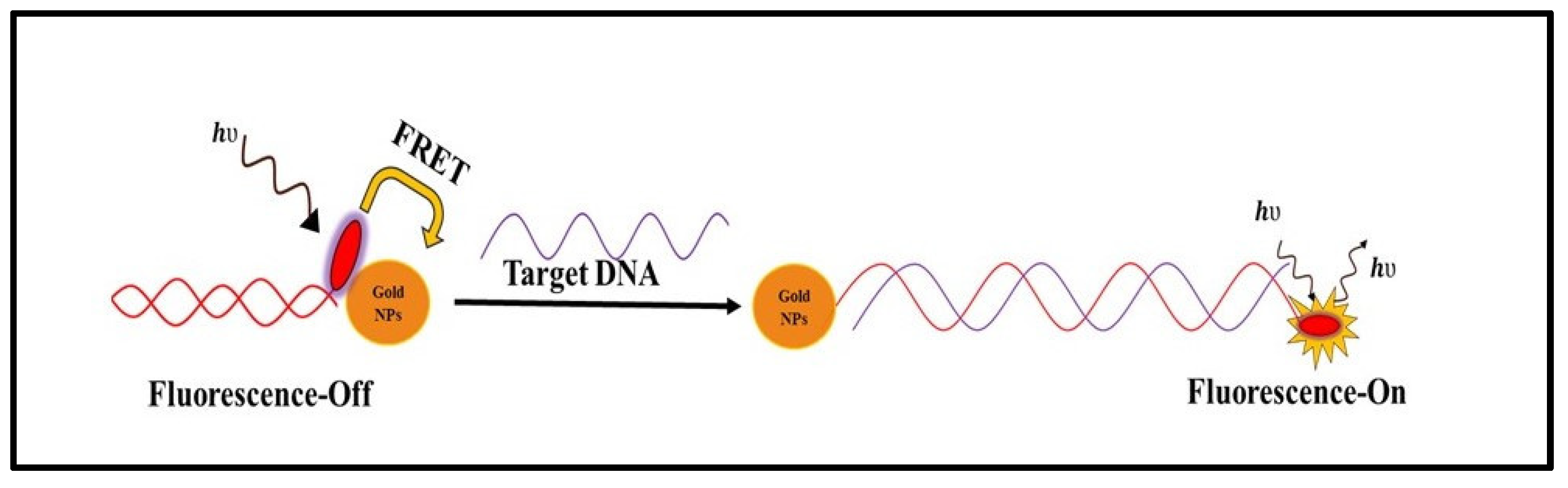
Molecular beacons labelled with gold nanoparticles have been used to develop hairpin FRET-based DNA detection systems. The self-complementary nucleic acid probe conjugated to an organic dye forms a hairpin structure on the gold NP, effectively quenching FRET fluorescence as shown in Figure 8. Hybridisation between the target DNA and the hairpin structure results in a rod-like conformation, increasing the dye’s fluorescence. A similar method was used by Nie et al. [97] to assemble single-stranded oligonucleotide-functionalised gold NPs with fluorophore termini into a limited arch-like structure. The proximity of the donor and acceptor leads to efficient fluorescence quenching by the gold NPs. When the fluorophore binds to the target DNA, it dissociates from the gold NPs, opening the restricted conformation and enabling fluorescence. The gold NP-based FRET test was also used to detect nuclease-induced DNA breaking.
Zheng et al. [98] developed gold NP probes, also known as nanoflares, to identify and analyse intracellular analytes, including mRNA. When dye-terminated DNA reporter sequences hybridise to gold NPs functionalised with oligonucleotides, the reporter sequences’ fluorescence is quenched. When the target is present, a more stable duplex forms between the target and the oligonucleotide on gold NPs, which then moves and releases the reporter from the NPs. Jin et al. [99] developed the FRET-based gold NP test to identify chemical substances that stabilise G-quadruplexes. The fluorescence of the probe is first quenched by gold NPs that contain fluorescein-tagged probe DNA. When a target organic molecule is specifically bound, the linear probe DNA folds intramolecularly into G-quadruplexes, increasing the distance between the probe DNA and the gold NPs while boosting fluorescence. Fan et al. [100] demonstrated the identification of target molecular analytes using multicolour fluorescent gold NP-based molecular beacons. Their technology reduces colour fluorescence by duplexing multicolour dye-labelled aptamers with DNA probes on gold NPs via complementary hybridisation. When target molecules are present, the contact between the dye-labelled aptamer and the target molecule breaks the duplex, restoring the dyes’ brightness. There have also been reports of Hg2+ detection using a gold NP assay based on FRET, tagged with fluorescent probes, as shown in Figure 9.

3.3. Electrochemical Sensing

Gold NPs are ideal electrochemical materials due to their high surface area, superior conductivity, and catalytic properties. This section presents the uses of gold NPs for electrochemical and electrocatalytic sensing. The catalytic activity of gold NPs is attributed to their interface-dominated properties and high surface area-to-volume ratio. Gold NPs can minimise overpotentials in several electroanalytical reactions while maintaining the reversibility of redox processes. Various methods have been investigated for depositing gold NPs on electrode surfaces, including electrostatic interactions, electrochemical deposition, and incorporation into a composite electrode matrix. In electro-generated chemiluminescence (ECL) sensors, gold NPs serve as electrochemical amplifiers.

3.3.1. Detection of Small Molecules

Gold NPs have been utilised to amplify the electrochemical detection of tiny biomolecules, including glucose, dopamine, uric acid, ascorbic acid, epinephrine, and nitrite. Wang et al. [101] reported the identification of phenolic compounds, including catechol, oxalic, succinic, malic, tartaric, and aliphatic dicarboxylic acids, for example, using a self-assembled dithiothreitol–dodecanethiol (DDT)–Au colloid-modified gold electrode to detect epinephrine electrocatalytically. With a detection limit of 60 nM, the nano-Au electrode significantly improves the electrode responsiveness of epinephrine. A voltametric sensor that detects norepinephrine using gold electrodes modified with 3, 3′-dithiodipropionic acid (DTDPA), gold NPs, and cystamine (CA) was recently reported by Luczak [102]. Furthermore, the approach may identify norepinephrine when ascorbic and uric acid are present as interferences. Also, Zhang et al. [103] employed 4-dimethylaminopyridine (DMAP)-coated gold NP/L-cysteine film on gold electrodes to demonstrate that positively charged gold NPs had higher electrocatalytic activity than negatively charged gold NPs. The electrode altered with positively charged gold NPs/NPs/L-cysteine exhibited enhanced electrochemical performance in the oxidation of biomolecules, including ascorbic acid, dopamine, and hydrogen peroxide, compared to electrodes modified with negatively charged gold nanoparticles/L-cysteine or L-cysteine alone.

3.3.2. Identification of Hazardous Substances and Substances

Electrodes fabricated with gold NPs have been used to detect toxic ions and radicals, such as arsenic, mercury, antimony, and chromium. Researchers have explored the use of gold NP-modified electrodes for electrocatalytic oxidation and sensing of hydrazine, nitric oxide, and carbon monoxide. Gold NP-decorated electrodes were employed to detect hydrogen peroxide (H2O2) via enzymatic, nonenzymatic, and microfluidic electrochemical techniques [104]. Gold NP-modified electrodes were also used to detect several drugs, including paracetamol, atenolol, prednisolone, and ethamsylate, as well as pesticides such as atrazine, methyl parathion, paraoxon ethyl, carbofuran, and phoxim. The sol–gel-derived 3D silicate network was used for the chemisorption of 70–100 nm gold NPs onto a 3D silicate network produced via sol–gel. Raj et al. [105] detected isoniazid, a well-known antituberculosis drug, with a sensitivity of 0.1 nm.

3.4. Gold NP-Based Surface Plasmon Resonance Sensors

A noble metal film’s surface interacts with light, leading to light absorption and the excitation of surface electromagnetic waves that resonate with the incident light. Surface plasmon resonance depends on the refractive index of the interfacial region. Metal NPs, such as gold and silver, exhibit incident wavelengths that give rise to localised surface plasmon resonance (LSPR), resulting in strong light scattering and intense surface plasmon absorption bands [106]. The frequency and strength of the absorption band are distinguishing features of various metal NPs, which are heavily influenced by their size, shape, and environment. As a result of this phenomenon, many LSPR-based sensors have been developed for chemical and biological applications. Although silver NPs have been used to develop biosensors, our focus will be on sensors based on gold NPs. The incorporation of gold NPs has increased the sensor’s sensitivity by enhancing the SPR spectroscopic signals. The electrical interaction between the confined surface plasmon and the propagating surface plasmon explained the signal amplification. It depends on various factors, including the size, shape, and proximity of the metal that causes SPR.

3.4.1. Sensing of Proteins

One use of the gold NP-amped SPR phenomenon is in an SPR-based immune-sensing system, where it may detect proteins via antigen–antibody interactions. Natan et al. [107] reported the use of antigen- or secondary antibody-functionalised gold NPs as signal enhancers. A gold film coated with γ-chain and Fc-specific monoclonal goat antihuman IgG (αh-IgG (Fc)) coats human IgG and a second free antibody, resulting in a modest plasmon shift. This illustrates the sandwich approach. Using an electrostatic coupling of gold NPs with α-h-IgG (Fc) instead of the secondary free antibody results in a 28-fold increase in plasmon shifts compared to unamplified experiments. This approach has enabled the detection of human IgG at picomolar quantities. Multiple sandwich and competitive immunoassays have been established for the detection of human tissue inhibitors of metallo-proteinases-2, anti-glutamic acid decarboxylase antibodies, allergens, TNT, human IgE, and testosterone, utilising gold NP-enhanced SPR signals. The sensitivity of these experiments can be increased by using fluorescence-labelled antibodies conjugated to gold NPs, resulting in a fibre-optic sensor that couples localised surface plasmon resonance to fluorescence [108].

3.4.2. Sensing of Oligonucleotides

The use of gold NP-amplified SPR can increase the sensitivity of oligonucleotide detection. Keating et al. [109] proposed a sandwich technique in which 12-mer oligonucleotides are first covalently bound to a gold substrate, followed by hybridisation of half of the target DNA molecules. A complementary sequence to the other half of the target was then added, either with or without gold NPs for tagging. When the target 24-mer oligonucleotide was detected at a limit of detection of about 10 pM, the gold NP-tagged surface increased sensitivity by 1000 times and angle shift by tenfold. For example, as demonstrated by Wang et al. [110], an electrochemical biosensor for platelet-derived growth factor (PDGF) detection has been developed using a sandwich construction and AuNP-mediated amplification. The aptamer was fixed on the electrode surface via self-assembly. In the presence of the target PDGF-BB, it would be trapped at the interface via formation of a PDGF–aptamer complex. The aptamer-modified AuNPs, which were negatively charged, then recognised the target and bonded to the electrode surface, forming a sandwich structure. Finally, the positively charged [Ru(NH3)5Cl]2+ probe was adsorbed onto the sandwich structure via electrostatic interactions. The acquired electrochemical signals were directly proportional to PDGF concentration. The comparative table of gold NP-based sensing of biomolecules with various biosensors is shown in Table 2.

4. Conclusions and Prospects

Gold nanoparticles have optical, electrical, and surface characteristics. Gold NPs have transformed biomolecular sensors. This review covered the physical, chemical and biological synthesis of gold NPs and their strategic use in diverse sensors. Chemical synthesis methods (Turkevich, Brust, seed-mediated growth, and digesting–ripening) allow exact control over particle size, shape, and uniformity (monodispersity), which is essential for consistent analytical results. Biological synthesis (bacteria, fungi, plant extracts) is eco-friendly, biocompatible, and valued for biomedical applications. General biomolecular sensing mechanisms depend on gold NPs’ ability to translate molecular recognition events into quantifiable signals. Their surface plasmon resonance (SPR), high surface area, and simplicity of functionalization make them excellent for colourimetric, fluorescence, electrochemical, and SPR-based detection platforms. It has made sensitive, selective detection of proteins, oligonucleotides, tiny compounds, and hazardous chemicals easier. It makes them ideal for clinical diagnostic, environmental, and food safety applications. The SPR shift induced by aggregation enables naked-eye detection of biomolecular species in colourimetric experiments. Fluorophore-based molecular beacons use gold NPs as quenchers or enhancers for real-time and multiplex detection. The conductivity and catalytic properties of gold NPs make them valuable in electrochemistry.
Several significant obstacles must be overcome before we can realise the full potential of gold NPs for real-world diagnostics. At this point, it is not easy to compare data or move anything toward clinical usage because of variances in size and shape. Therefore, the first step is for laboratories to reach a consensus on how to manufacture these particles. Additionally, there is the problem of safety. Particularly when discussing the use of these particles in the body, we need to conduct additional research on their toxicity and biocompatibility. Concerns remain about the duration they stay in the body and the manner in which the body eliminates them. In addition, there is the entire regulatory quagmire. It will be challenging to have diagnostics based on nanomaterials approved and disseminated to the general public if there are no clear and universal rules in place.
In the future, gold NPs have a good chance of becoming a fundamental component of next-generation sensing platforms. By combining these gold nanoparticle-based sensors with microfluidic devices, we can achieve quick, multiplexed diagnostics right where they are needed, with no more waiting in the lab. Gold NPs have even more promise when combined with other nanomaterials such as graphene or quantum dots. They can work together to achieve unprecedented levels of sensitivity and specificity. The bottom line is that gold NPs are at the centre of nanotechnology-based biosensing. However, getting them out of the lab and into clinical or environmental settings is not easy. The challenges are clear: reproducibility, safety, and regulation. Still, when professionals in nanotechnology, materials science, bioengineering, and data science collaborate, things move faster. The real future lies in developing scalable, standardised, and intelligent gold NP-based platforms that deliver robust, reliable diagnostics wherever they are needed.

Supplementary Materials

The following supporting information can be downloaded at https://www.mdpi.com/article/10.3390/nanomanufacturing6020010/s1. Figure S1. SEM images at 2000× and 30,000× magnification of NaAuCl4 and AuNPs samples [32]. Figure S2. TEM Analysis. (A) Shows TEM images of the AuNPs synthesized using different volumes of citrate solution. The average measured size of the AuNPs calculated across three replicate syntheses is inset in each image along with the volume of citrate used [34]. Figure S3. TEM micrographs of the reduction products using (a) [AuCl4] and (b) [AuBr4]. 0.5 mM TOA+ Au salt was mixed with 1.5 mM 1- dodecane thiol in toluene and contacted with a solution containing 20 mM TBA+BH4 in DCE [39]. Figure S4. Transmission electron microscopy (TEM) images showing the nanoparticle coating. Natural coating surrounding the spherical structure of nanoparticles made by Staphylococcus aureus (A) and Escherichia coli (B) [57]. Figure S5. Transmission electron microscopy of AuNPs synthesized by aqueous extract of Z. officinale rhizome. (A) TEM image (spherical and well-dispersed NPs); (B): size distribution (determination based on TEM image analysis) [70].

Author Contributions

Conceptualisation, S.J.K. and V.B.K.; methodology, S.J.K. and A.S.Y.; validation, V.B.K.; formal analysis, A.S.Y. and V.B.K.; investigation and resources, original draft preparation, S.J.K. and A.S.Y.; writing—review and editing, V.B.K.; visualisation, V.B.K.; supervision, and project administration. All authors have read and agreed to the published version of the manuscript.

Funding

The authors would like to acknowledge the Intramural Grant (No. DYPES/DU. R&D/2025/3033) from D. Y. Patil Education Society (Deemed to be University), Kolhapur.

Data Availability Statement

All the necessary data are included in the present article.

Conflicts of Interest

The authors declare no conflicts of interest.

References

  1. Xu, R.; Ouyang, L.; Chen, H.; Zhang, G.; Zhe, J. Recent advances in biomolecular detection based on aptamers and nanoparticles. Biosensors 2023, 13, 474. [Google Scholar] [CrossRef]
  2. Bhatia, D.; Paul, S.; Acharjee, T.; Ramachairy, S.S. Biosensors and their widespread impact on human health. Sens. Int. 2024, 5, 100257. [Google Scholar] [CrossRef]
  3. Wang, X.; Lu, D.; Liu, Y.; Wang, W.; Ren, R.; Li, M.; Pang, G. Electrochemical signal amplification strategies and their use in olfactory and taste evaluation. Biosensors 2022, 12, 566. [Google Scholar] [CrossRef]
  4. Rawat, S.; Phogat, P.; Shreya; Chand, B. Advances in nanomaterial-based biosensors: Innovations, challenges, and emerging applications. Mater. Today Commun. 2025, 48, 113334. [Google Scholar] [CrossRef]
  5. Babu, E.; Bhuvaneswari, J.; Mareeswaran, P.M.; Thanasekaran, P.; Lee, H.M.; Rajagopal, S. Transition metal complexes-based aptamers as optical diagnostic tools for disease proteins and biomolecules. Coord. Chem. Rev. 2019, 380, 519–549. [Google Scholar] [CrossRef]
  6. Naresh, V.; Lee, N. A review on biosensors and recent development of nanostructured materials-enabled biosensors. Sensors 2021, 21, 1109. [Google Scholar] [CrossRef] [PubMed]
  7. Huang, X.; Zhu, Y.; Kianfar, E. Nano biosensors: Properties, applications and electrochemical techniques. J. Mater. Res. Technol. 2021, 12, 1649–1672. [Google Scholar] [CrossRef]
  8. Mabrouk, M.; Das, D.B.; Salem, Z.A.; Beherei, H.H. Nanomaterials for biomedical applications: Production, characterisations, recent trends and difficulties. Molecules 2021, 26, 1077. [Google Scholar] [CrossRef]
  9. Draz, M.S.; Shafiee, H. Applications of gold nanoparticles in virus detection. Theranostics 2018, 8, 1985. [Google Scholar] [CrossRef]
  10. Aldewachi, H.; Chalati, T.; Woodroofe, M.; Bricklebank, N.; Sharrack, B.; Gardiner, P.J.N. Gold nanoparticle-based colorimetric biosensors. Nanoscale 2018, 10, 18–33. [Google Scholar] [CrossRef]
  11. Karnwal, A.; Sachan, R.; Devgon, I.; Devgon, J.; Pant, G.; Panchpuri, M.; Ahmad, A.; Alshammari, M.; Hossain, K.; Kumar, G. Gold nanoparticles in nanobiotechnology: From synthesis to biosensing applications. ACS Omega 2024, 9, 29966. [Google Scholar] [CrossRef] [PubMed]
  12. Thakur, A.; Kumar, A. Gold and silver nanoparticles-based electrodes for sensing biomolecules and pharmaceutical compounds. In Nanomaterial-Modified Electrodes; Springer: Cham, Switzerland, 2024; p. 171. [Google Scholar]
  13. Duman, H.; Akdasçi, E.; Eker, F.; Bechelany, M.; Karav, S. Gold banoparticles: Multifunctional properties, synthesis, and future prospects. Nanomaterials 2024, 14, 1805. [Google Scholar] [CrossRef] [PubMed]
  14. Nandhakumar, M.; Thangaian, D.; Kasi, N. Topical progress of gold nanoparticles towards diverse metal ion sensing through optical spectrometry and electrochemical techniques—A short review. J. Mater. Res. Technol. 2023, 22, 1185–1209. [Google Scholar] [CrossRef]
  15. Ielo, I.; Rando, G.; Giacobello, F.; Sfameni, S.; Castellano, A.; Galletta, M.; Plutino, M.R. Synthesis, chemical–physical characterisation, and biomedical applications of functional gold nanoparticles: A review. Molecules 2021, 26, 5823. [Google Scholar] [CrossRef]
  16. Calabretta, M.M.; Zangheri, M.; Lopreside, A.; Marchegiani, E.; Montali, L.; Simoni, P.; Roda, A. Precision medicine, bioanalytics and nanomaterials: Toward a new generation of personalised portable diagnostics. Analyst 2020, 145, 2841–2853. [Google Scholar] [CrossRef]
  17. Zhang, X.; Yin, J.; Yoon, J. Recent advances in development of chiral fluorescent and colorimetric sensors. Chem. Rev. 2014, 114, 4918–4959. [Google Scholar] [CrossRef] [PubMed]
  18. Ramesh, M.; Janani, R.; Deepa, C.; Rajeshkumar, L. Nanotechnology-enabled biosensors: A review of fundamentals, design principles, materials, and applications. Biosensors 2022, 13, 40. [Google Scholar] [CrossRef]
  19. Narsaiah, K.; Jha, S.N.; Bhardwaj, R.; Sharma, R.; Kumar, R. Optical biosensors for food quality and safety assurance—A review. J. Food Sci. Technol. 2012, 49, 383–406. [Google Scholar] [CrossRef]
  20. Ahmed, M.U.; Saaem, I.; Wu, P.C.; Brown, A.S. Personalised diagnostics and biosensors: A review of the biology and technology needed for personalised medicine. Crit. Rev. Biotechnol. 2014, 34, 180–196. [Google Scholar] [CrossRef]
  21. Ibrahim, S.A.H. Biosensor Devices: A review of recent technology and benefits. Int. J. Adv. Pharm. Biotech. 2023, 9, 1–9. [Google Scholar]
  22. Kader, M.; Azmi, N.; Kafi, A. Recent advances in gold nanoparticles-modified electrodes for electrochemical nonenzymatic sensing of chemical and biological compounds. Inorg. Chem. Commun. 2023, 153, 110767. [Google Scholar] [CrossRef]
  23. Kusuma, S.; Harmonis, J.; Pratiwi, R.; Hasanah, A. Gold nanoparticle-based colourimetric sensors: Properties and application in the detection of heavy metals and biological molecules. Sensors 2023, 23, 8172. [Google Scholar] [CrossRef]
  24. Kumalasari, M.; Alfanaar, R.; Andreani, A. Gold nanoparticles (AuNPs): A versatile material for biosensor application. Talanta Open 2024, 9, 100327. [Google Scholar] [CrossRef]
  25. Anwar, S.H. A brief review on nanoparticles: Types of platforms, biological synthesis, and applications. Res. Rev. J. Mater. Sci. 2018, 6, 109–116. [Google Scholar]
  26. Goncharova, D.; Salaev, M.; Volokitina, A.; Magaev, O.; Svetlichnyi, V.; Vodyankina, O. Gold-based catalysts prepared by pulsed laser ablation: A review of recent advances. Mater. Today Chem. 2023, 33, 101709. [Google Scholar] [CrossRef]
  27. De Bortoli, L.S.; Vanoni, C.R.; Jost, C.L.; Mezalira, D.Z.; Fredel, M.C. Stable and ligand-free gold nanoparticles produced by laser ablation as efficient electrocatalysts for electrochemical sensing of dopamine. J. Electroanal. Chem. 2023, 947, 117744. [Google Scholar] [CrossRef]
  28. Phan, T.; Le, T.; Doan, V.; Truong, H.; Le, V. Microwave-assisted synthesis of gold nanoparticle-integrated carbon spheres and graphene oxide: A multifunctional composite for ascorbic acid detection and antibacterial application. Microchem. J. 2025, 214, 114006. [Google Scholar] [CrossRef]
  29. Zhang, B.; Sun, X.; Tang, T. Ultrasound-assisted green synthesis of gold nanoparticles mediated by Staghorn sumac for the treatment of lung cancer: Introducing a novel chemotherapeutic drug. Inorg. Chem. Commun. 2024, 170, 113146. [Google Scholar] [CrossRef]
  30. Zhang, C.; Zhang, W.; Karadas, F.; Low, J.; Long, R.; Liang, C.; Wang, J.; Li, Z.; Xiong, Y. Laser-ablation assisted strain engineering of gold nanoparticles for selective electrochemical CO2 reduction. Nanoscale 2022, 14, 7702. [Google Scholar] [CrossRef] [PubMed]
  31. Gomes, D.S.; Paterno, L.G.; Santos, A.B.; Barbosa, D.P.; Holtz, B.M.; Souza, M.R.; Soler, M.A. UV-accelerated synthesis of gold nanoparticle–pluronic nanocomposites for X-ray computed tomography contrast enhancement. Polymers 2023, 15, 2163. [Google Scholar] [CrossRef]
  32. Oliveira, A.E.F.; Pereira, A.C.; Resende, M.A.; Ferreira, L.F. Gold nanoparticles: A didactic step-by-step of the synthesis using the Turkevich method, mechanisms, and characterisations. Analytica 2023, 4, 250–263. [Google Scholar] [CrossRef]
  33. Allen, T. Particle Size Measurement, 3rd ed.; Springer: Berlin/Heidelberg, Germany, 2013; pp. 1–64. [Google Scholar]
  34. Chavva, S.R.; San Juan, A.M.T.; Jaitpal, S.; Vu, N.N.; Mabbott, S. Efficient production of uniform gold nanoparticles via a streamlined low-cost, semi-automated, open-source platform. Nanoscale 2024, 16, 9944–9952. [Google Scholar] [CrossRef]
  35. Figat, A.M.; Bartosewicz, B.; Liszewska, M.; Budner, B.; Norek, M.; Jankiewicz, B.J. α-Amino acids as reducing and capping agents in gold nanoparticles synthesis using the Turkevich method. Langmuir 2023, 39, 8646–8657. [Google Scholar] [CrossRef] [PubMed]
  36. Polte, J.; Tuaev, X.; Wuithschick, M.; Fischer, A.; Thuenemann, A.; Rademann, K.; Kraehnert, R.; Emmerling, F. Formation mechanism of colloidal silver nanoparticles: Analogies and differences to the growth of gold nanoparticles. ACS Nano 2012, 6, 5791–5802. [Google Scholar] [CrossRef]
  37. Yeh, Y.C.; Creran, B.; Rotello, V.M. Gold nanoparticles: Preparation, properties, and applications in bionanotechnology. Nanoscale 2012, 4, 1871–1880. [Google Scholar] [CrossRef]
  38. Abdul-Moqueet, M.M.; Tovias, L.; Lopez, P.; Mayer, K.M. Synthesis and bioconjugation of alkanethiol-stabilised gold bipyramid nanoparticles. Nanotechnology 2021, 32, 225601. [Google Scholar] [CrossRef]
  39. Booth, S.G.; Uehara, A.; Chang, S.Y.; La Fontaine, C.; Fujii, T.; Okamoto, Y.; Dryfe, R.A.W. The significance of bromide in the Brust–Schiffrin synthesis of thiol-protected gold nanoparticles. Chem. Sci. 2017, 8, 7954–7962. [Google Scholar] [CrossRef] [PubMed]
  40. Uehara, A.; Booth, S.G.; Chang, S.Y.; Schroeder, S.L.; Imai, T.; Hashimoto, T.; Dryfe, R.A. Electrochemical insight into the Brust–Schiffrin synthesis of Au nanoparticles. J. Am. Chem. Soc. 2015, 137, 15135–15144. [Google Scholar] [CrossRef]
  41. Perala, S.; Kumar, S. On the Mechanism of metal nanoparticle synthesis in the Brust−Schiffrin method. Langmuir 2013, 29, 9863–9873. [Google Scholar] [CrossRef]
  42. Dudhat, K.; Kumar Chotaliya, M.; Rani, G.I. An investigation of current trends and future possibilities for the use of nanoparticles in the treatment of skin cancer. E3S Web Conf. 2025, 619, 05006. [Google Scholar] [CrossRef]
  43. Hema, D.; Ajitha, B. Seed-mediated growth of gold nanorods for enhanced catalytic activity. Inorg. Chem. Commun. 2025, 179, 114882. [Google Scholar] [CrossRef]
  44. Leng, W.; Pati, P.; Vikesland, P.J. Room temperature seed-mediated growth of gold nanoparticles: Mechanistic investigations and life cycle assessment. Environ. Sci. Nano 2015, 2, 440–453. [Google Scholar] [CrossRef]
  45. Hinman, J.G.; Stork, A.J.; Varnell, J.A.; Gewirth, A.A.; Murphy, C.J. Seed-mediated growth of gold nanorods: Towards nanorod matryoshkas. Faraday Discuss. 2016, 191, 9–33. [Google Scholar] [CrossRef]
  46. Prasad, B.L.V.; Stoeva, S.I.; Sorensen, C.M.; Klabunde, K.J. Digestive ripening of thiolated gold nanoparticles: The effect of alkyl chain length. Langmuir 2002, 18, 7515–7520. [Google Scholar] [CrossRef]
  47. Eswaramoorthy, S.K.; Dass, A. Digestive ripening yields atomically precise Au nanomolecules. New J. Chem. 2021, 45, 20241–20248. [Google Scholar] [CrossRef]
  48. Lin, M.L.; Yang, F.; Lee, S. Digestive ripening for self-assembly of thiol-capped gold nanoparticles: The effects of adding dodecanethiol and reflux-heating. Colloids Surf. A Physicochem. Eng. Asp. 2014, 448, 16–22. [Google Scholar] [CrossRef]
  49. Kamble, S.J.; Tawade, A.K.; Pawar, K.D.; Kamble, J.B.; Kamble, P.D.; More, V.B.; Naik, N.M.; Koli, V.B.; Kamble, G.S.; Patil, J.M. Electrochemical sensing of dopamine at biogenic gold nanoparticles interface. Asian J. Chem. 2023, 35, 1243–1249. [Google Scholar] [CrossRef]
  50. Pourali, P.; Badiee, S.H.; Manafi, S.; Noorani, T.; Rezaei, A.; Yahyaei, B. Biosynthesis of gold nanoparticles by two bacterial and fungal strains, Bacillus cereus and Fusarium oxysporum, and assessment and comparison of their nanotoxicity in vitro by direct and indirect assays. Electron. J. Biotechnol. 2017, 29, 86–93. [Google Scholar] [CrossRef]
  51. Egorov, A.M.; Ulyashova, M.M.; Rubtsova, M.Y. Bacterial enzymes and antibiotic resistance. Acta Naturae 2018, 10, 33–48. [Google Scholar] [CrossRef]
  52. Lou-Franco, J.; Das, B.; Elliott, C.; Cao, C. Gold nanozymes: From concept to biomedical applications. Nano Micro Lett. 2021, 13, 10. [Google Scholar] [CrossRef]
  53. Singh, P.K.; Kundu, S. Biosynthesis of gold nanoparticles using bacteria. Proc. Natl. Acad. Sci. India Sect. B Biol. Sci. 2014, 84, 331–336. [Google Scholar] [CrossRef]
  54. Ahmad, A.; Senapati, S.; Khan, M.I.; Kumar, R.; Sastry, M. Extracellular biosynthesis of monodisperse gold nanoparticles by a novel extremophilic actinomycete. Langmuir 2003, 19, 3550–3553. [Google Scholar] [CrossRef]
  55. Khan, M.A.R.; Al Mamun, M.S.; Habib, M.A.; Islam, A.N.; Mahiuddin, M.; Karim, K.M.R.; Ara, M.H. A review on gold nanoparticles: Biological synthesis, characterisations, and analytical applications. Results Chem. 2022, 4, 100478. [Google Scholar] [CrossRef]
  56. Sidhu, A.K.; Verma, N.; Kaushal, P. Role of biogenic capping agents in the synthesis of metallic nanoparticles and evaluation of their therapeutic potential. Front. Nanotechnol. 2022, 3, 801620. [Google Scholar] [CrossRef]
  57. Cruz, D.; Mi, G.; Webster, T.J. Synthesis and characterisation of biogenic selenium nanoparticles with antimicrobial properties made by Staphylococcus aureus, methicillin-resistant Staphylococcus aureus (MRSA), Escherichia coli, and Pseudomonas aeruginosa. J. Biomed. Mater. Res. Part A 2018, 106, 1400–1412. [Google Scholar] [CrossRef] [PubMed]
  58. Khandel, P.; Shahi, S.K. Mycogenic nanoparticles and their bio-prospective applications: Current status and future challenges. J. Nanostruct. Chem. 2018, 8, 369–391. [Google Scholar] [CrossRef]
  59. Zhao, X.; Hou, N.; Wan, C.; Zhang, L.; Liu, X. Gold nanoparticles synthesis mediated by fungus isolated from aerobic granular sludge: Process and mechanisms. Heliyon 2024, 10, e28281. [Google Scholar] [CrossRef]
  60. Chaurasia, P.K.; Bharati, S.L.; Yadava, S. Nano-reduction of gold and silver ions: A perspective on the fate of microbial laccases as potential biocatalysts in the synthesis of metals (gold and silver) nanoparticles. Curr. Res. Microb. Sci. 2022, 3, 100098. [Google Scholar] [CrossRef]
  61. Desai, M.P.; Sangaokar, G.M.; Pawar, K.D. Kokum fruit-mediated biogenic gold nanoparticles with photoluminescent, photocatalytic, and antioxidant activities. Process Biochem. 2018, 70, 188–197. [Google Scholar] [CrossRef]
  62. Kureshi, A.A.; Vaghela, H.M.; Kumar, S.; Singh, R.; Kumari, P. Green synthesis of gold nanoparticles mediated by Garcinia fruits and their biological applications. Pharm. Sci. 2020, 27, 238–250. [Google Scholar] [CrossRef]
  63. Lee, K.X.; Shameli, K.; Miyake, M.; Khairudin, N.B.B.A.; Mohamad, S.E.B.; Hara, H.; Yew, Y.P. Gold nanoparticles biosynthesis: A simple route for controlling size using waste peel extract. IEEE Trans. Nanotechnol. 2017, 16, 954–957. [Google Scholar] [CrossRef]
  64. Nadaf, S.J.; Jadhav, N.R.; Naikwadi, H.S.; Savekar, P.L.; Sapkal, I.D.; Kambli, M.M.; Desai, I.A. Green synthesis of gold and silver nanoparticles: Updates on research, patents, and prospects. OpenNano 2022, 8, 100076. [Google Scholar] [CrossRef]
  65. Karuppiah, C.; Palanisamy, S.; Chen, S.M.; Emmanuel, R.; Muthupandi, K.; Prakash, P. Green synthesis of gold nanoparticles and its application for the trace level determination of painter’s colic. RSC Adv. 2015, 5, 16284–16291. [Google Scholar] [CrossRef]
  66. Gopinath, K.; Venkatesh, K.S.; Ilangovan, R.; Sankaranarayanan, K.; Arumugam, A. Green synthesis of gold nanoparticles from leaf extract of Terminalia arjuna, for the enhanced mitotic cell division and pollen germination activity. Ind. Crops Prod. 2013, 50, 737–742. [Google Scholar] [CrossRef]
  67. Philip, D. Rapid green synthesis of spherical gold nanoparticles using Mangifera indica leaf. Spectrochim. Acta Part A 2010, 77, 807–810. [Google Scholar] [CrossRef]
  68. Yu, J.; Xu, D.; Guan, H.N.; Wang, C.; Huang, L.K.; Chi, D.F. Facile one-step green synthesis of gold nanoparticles using Citrus maxima aqueous extracts and its catalytic activity. Mater. Lett. 2016, 166, 110–112. [Google Scholar] [CrossRef]
  69. Patil, M.P.; Bayaraa, E.; Subedi, P.; Piad, L.L.A.; Tarte, N.H.; Kim, G.D. Biogenic synthesis, characterisation of gold nanoparticles using Lonicera japonica and their anticancer activity on HeLa cells. J. Drug Deliv. Sci. Technol. 2019, 51, 83–90. [Google Scholar] [CrossRef]
  70. Fouda, A.; Eid, A.M.; Guibal, E.; Hamza, M.F.; Hassan, S.E.D.; Alkhalifah, D.H.M.; El-Hossary, D. Green synthesis of gold nanoparticles by aqueous extract of Zingiber officinale: Characterisation and insight into antimicrobial, antioxidant, and in vitro cytotoxic activities. Appl. Sci. 2022, 12, 12879. [Google Scholar] [CrossRef]
  71. Vijayakumar, S.; Vaseeharan, B.; Malaikozhundan, B.; Gopi, N.; Ekambaram, P.; Pachaiappan, R.; Velusamy, P.; Murugan, K.; Benelli, G.; Kumar, R.S.; et al. Therapeutic effects of gold nanoparticles synthesised using Musa paradisiaca peel extract against multiple antibiotic-resistant Enterococcus faecalis biofilms and human lung cancer cells (A549). Microb. Pathog. 2017, 102, 173–183. [Google Scholar] [CrossRef]
  72. Sreelakshmi, C.; Goel, N.; Datta, K.K.R.; Addlagatta, A.; Ummanni, R.; Reddy, B.V. Green synthesis of curcumin-capped gold nanoparticles and evaluation of their cytotoxicity. Nanosci. Nanotechnol. Lett. 2013, 5, 1258–1265. [Google Scholar] [CrossRef]
  73. Yuan, C.G.; Huo, C.; Yu, S.; Gui, B. Biosynthesis of gold nanoparticles using Capsicum annuum var. grossum pulp extract and its catalytic activity. Phys. E Low-Dimens. Syst. Nanostruct. 2017, 85, 19–26. [Google Scholar] [CrossRef]
  74. Hu, X.; Wu, L.; Du, M.; Wang, L. Eco-friendly synthesis of size-controlled silver nanoparticles by using Areca catechu nut aqueous extract and investigation of their potent antioxidant and antibacterial activities. Arab. J. Chem. 2022, 15, 103763. [Google Scholar] [CrossRef]
  75. Su, A.; Wang, Q.; Huang, L.; Zheng, Y.; Wang, Y.; Chen, H. Gold nanohexagrams via active surface growth under sole CTAB control. Nanoscale 2023, 15, 14858. [Google Scholar] [CrossRef]
  76. Li, J.; Lin, H.; Zhang, X.; Li, M. Seed shape-controlled, facet-selective growth of superspiky gold nanocrystals for biosensing application. J. Mater. Chem. C 2021, 9, 8694–8704. [Google Scholar] [CrossRef]
  77. Cetin, A.; Capar, M. Functional-group effect of ligand molecules on the aggregation of gold nanoparticles: A molecular dynamics simulation study. J. Phys. Chem. B 2022, 126, 5534–5543. [Google Scholar] [CrossRef] [PubMed]
  78. Nyabadza, A.; McCarthy, E.; Makhesana, M.; Heidarinassab, S.; Plouze, A.; Vazquez, M.; Brabazon, D. A review of physical, chemical and biological synthesis methods of bimetallic nanoparticles and applications in sensing, water treatment, biomedicine, catalysis and hydrogen storage. Adv. Colloid Interface Sci. 2023, 321, 103010. [Google Scholar] [CrossRef]
  79. Yang, Y. On the Interplay of Gold Nanoparticles and Small Molecules. Doctoral Dissertation, University College London, London, UK, 2019. [Google Scholar]
  80. Takae, S.; Akiyama, Y.; Otsuka, H.; Nakamura, T.; Nagasaki, Y.; Kataoka, K. Ligand density effect on biorecognition by PEGylated gold nanoparticles: Regulated interaction of RCA120 lectin with lactose installed to the distal end of tethered PEG strands on gold surface. Biomacromolecules 2005, 6, 818–824. [Google Scholar] [CrossRef]
  81. Marradi, M.; Chiodo, F.; Garcia, I.; Penadés, S. Glyconanoparticles as multifunctional and multimodal carbohydrate systems. Chem. Soc. Rev. 2013, 42, 4728–4745. [Google Scholar] [CrossRef]
  82. Hernando, P.J.; Ivanova, I.M.; Chessa, S.; Marín, M.J.; Dedola, S.; Field, R.A. Sensitive dipstick assays for lectin detection, based on glycan–BSA conjugate immobilisation on gold nanoparticles. Org. Chem. Front. 2023, 10, 3819–3829. [Google Scholar] [CrossRef]
  83. Wang, X.; Ramstrom, O.; Yan, M. Quantitative analysis of multivalent ligand presentation on gold glyconanoparticles and the impact on lectin binding. Anal. Chem. 2010, 82, 9082–9089. [Google Scholar] [CrossRef]
  84. Reynolds, A.J.; Haines, A.H.; Russell, D.A. Gold glyconanoparticles for mimics and measurement of metal ion-mediated carbohydrate−carbohydrate interactions. Langmuir 2006, 22, 1156–1163. [Google Scholar] [CrossRef] [PubMed]
  85. Nath, N.; Chilkoti, A. A colorimetric gold nanoparticle sensor to interrogate biomolecular interactions in real time on a surface. Anal. Chem. 2002, 74, 504–509. [Google Scholar] [CrossRef] [PubMed]
  86. Hu, X.; Zhang, D.; Zeng, Z.; Huang, L.; Lin, X.; Hong, S. Aptamer-based probes for cancer diagnostics and treatment. Life 2022, 12, 1937. [Google Scholar] [CrossRef]
  87. Wei, H.; Li, B.; Li, J.; Wang, E.; Dong, S. Simple and sensitive aptamer-based colorimetric sensing of protein using unmodified gold nanoparticle probes. Chem. Commun. 2007, 36, 3735–3737. [Google Scholar] [CrossRef] [PubMed]
  88. Roudsari, Z.O.; Ghasemi, H.; Khatami, S.H.; Khorsand, M.; Rahdan, F.; Chehri, D.; Movahedpour, A. Aptamer biosensors for thrombin. Clin. Chim. Acta 2025, 565, 119976. [Google Scholar] [CrossRef] [PubMed]
  89. Thanh, N.; Rosenzweig, Z. Development of an aggregation-based immunoassay for anti-protein A using gold nanoparticles. Anal. Chem. 2002, 74, 1624–1628. [Google Scholar] [CrossRef]
  90. Laromaine, A.; Koh, L.; Murugesan, M.; Ulijn, R.V.; Stevens, M.M. Protease-triggered dispersion of nanoparticle assemblies. J. Am. Chem. Soc. 2007, 129, 4156–4157. [Google Scholar] [CrossRef]
  91. Xu, X.; Han, M.S.; Mirkin, C.A. A gold-nanoparticle-based real-time colorimetric screening method for endonuclease activity and inhibition. Angew. Chem. 2007, 119, 3538. [Google Scholar] [CrossRef]
  92. Saha, K.; Agasti, S.S.; Kim, C.; Li, X.; Rotello, V.M. Gold nanoparticles in chemical and biological sensing. Chem. Rev. 2012, 112, 2739–2779. [Google Scholar] [CrossRef]
  93. Bhambhani, A.; Chah, S.; Hvastkovs, E.G.; Jensen, G.C.; Rusling, J.F.; Zare, R.N.; Kumar, C.V. Folding control and unfolding free energy of yeast iso-1-cytochrome c bound to layered zirconium phosphate materials monitored by surface plasmon resonance. J. Phys. Chem. B 2008, 112, 9201–9208. [Google Scholar] [CrossRef]
  94. Thaxton, C.S.; Georganopoulou, D.G.; Mirkin, C.A. Gold nanoparticle probes for the detection of nucleic acid targets. Clin. Chim. Acta 2006, 363, 120–126. [Google Scholar] [CrossRef] [PubMed]
  95. Sato, K.; Hosokawa, K.; Maeda, M. Rapid aggregation of gold nanoparticles induced by non-cross-linking DNA hybridisation. J. Am. Chem. Soc. 2003, 125, 8102–8103. [Google Scholar] [CrossRef] [PubMed]
  96. Xia, F.; Zuo, X.; Yang, R.; Xiao, Y.; Kang, D.; Vallée-Bélisle, A.; Plaxco, K.W. Colorimetric detection of DNA, small molecules, proteins, and ions using unmodified gold nanoparticles and conjugated polyelectrolytes. Proc. Natl. Acad. Sci. USA 2010, 107, 10837–10841. [Google Scholar] [CrossRef]
  97. Maxwell, D.J.; Taylor, J.R.; Nie, S. Self-assembled nanoparticle probes for recognition and detection of biomolecules. J. Am. Chem. Soc. 2002, 124, 9606–9612. [Google Scholar] [CrossRef]
  98. Zheng, D.; Seferos, D.S.; Giljohann, D.A.; Patel, P.C.; Mirkin, C.A. Aptamer nanoflares for molecular detection in living cells. Nano Lett. 2009, 9, 3258–3261. [Google Scholar] [CrossRef]
  99. Jin, Y.; Li, H.; Bai, J. Homogeneous selection of a quadruplex-binding ligand-based gold nanoparticle fluorescence resonance energy transfer assay. Anal. Chem. 2009, 81, 5709–5715. [Google Scholar] [CrossRef]
  100. Zhang, J.; Wang, L.; Zhang, H.; Boey, F.; Song, S.; Fan, C. Aptamer-based multicolor fluorescent gold nanoprobes for multiplex detection in homogeneous solution. Small 2010, 6, 201–204. [Google Scholar] [CrossRef]
  101. Wang, L.; Bai, J.; Huang, P.; Wang, H.; Zhang, L.; Zhao, Y. Self-assembly of gold nanoparticles for the voltammetric sensing of epinephrine. Electrochem. Commun. 2006, 8, 1035–1040. [Google Scholar] [CrossRef]
  102. Łuczak, T. Electroanalysis of Norepinephrine at Bare Gold Electrode Pure and Modified with Gold Nanoparticles and S-Functionalized Self-Assembled Layers in Aqueous Solution. Electroanalysis 2009, 21, 1539–1549. [Google Scholar] [CrossRef]
  103. Zhang, L.; Yuan, R.; Chai, Y.; Li, X. Investigation of the electrochemical and electrocatalytic behavior of positively charged gold nanoparticle and l-cysteine film on an Au electrode. Anal. Chim. Acta 2007, 596, 99–105. [Google Scholar] [CrossRef]
  104. Yin, H.; Ai, S.; Shi, W.; Zhu, L. A novel hydrogen peroxide biosensor based on horseradish peroxidase immobilised on gold nanoparticles–silk fibroin modified glassy carbon electrode and direct electrochemistry of horseradish peroxidase. Sens. Actuators B 2009, 137, 747–753. [Google Scholar] [CrossRef]
  105. Jena, B.K.; Raj, C.R. Au nanoparticle decorated silicate network for the amperometric sensing of isoniazid. Talanta 2010, 80, 1653–1656. [Google Scholar] [CrossRef]
  106. Kamble, S.J.; Pawar, K.D.; Kamble, P.D.; Patil, J.M.; Sawant, V.J. Biogenic Capped Silver Nanoparticles in Lablal Purpureus Pod Extract Exhibit Selective Antibacterial and Synergistic Anticancer Activity. Adv. Mater. Lett. 2021, 12, 21081657. [Google Scholar] [CrossRef]
  107. Lyon, L.A.; Musick, M.D.; Natan, M.J. Colloidal Au-enhanced surface plasmon resonance immunosensing. Anal. Chem. 1998, 70, 5177–5183. [Google Scholar] [CrossRef]
  108. Chang, Y.F.; Chen, R.C.; Lee, Y.J.; Chao, S.C.; Su, L.C.; Li, Y.C.; Chou, C. Localised surface plasmon coupled fluorescence fiber-optic biosensor for alpha-fetoprotein detection in human serum. Biosens. Bioelectron. 2009, 24, 1610–1614. [Google Scholar] [CrossRef]
  109. He, L.; Musick, M.D.; Nicewarner, S.R.; Salinas, F.G.; Benkovic, S.J.; Natan, M.J.; Keating, C.D. Colloidal Au-enhanced surface plasmon resonance for ultrasensitive detection of DNA hybridisation. J. Am. Chem. Soc. 2000, 122, 9071–9077. [Google Scholar] [CrossRef]
  110. Wang, J.; Meng, W.; Zheng, X.; Liu, S.; Li, G. Combination of aptamer with gold nanoparticles for electrochemical signal amplification: Application to sensitive detection of platelet-derived growth factor. Biosens. Bioelectron. 2009, 24, 1598–1602. [Google Scholar] [CrossRef] [PubMed]
  111. Sun, Y.; Lin, Y.; Sun, W.; Han, R.; Luo, C.; Wang, X.; Wei, Q. A highly selective and sensitive detection of insulin with chemiluminescence biosensor based on aptamer and oligonucleotide-AuNPs functionalised nanosilica @ graphene oxide aerogel. Anal. Chim. Acta 2019, 1089, 152–164. [Google Scholar] [CrossRef] [PubMed]
  112. Luo, L.; Zhou, X.; Pan, Y.; Zhao, K.; Deng, A.; Li, J. A sensitive and straightforward flow injection chemiluminescence immunoassay for chloramphenicol based on gold nanoparticle-loaded enzyme. Luminescence 2020, 35, 877–884. [Google Scholar] [CrossRef]
  113. Shi, J.; Chan, C.; Pang, Y.; Ye, W.; Tian, F.; Lyu, J.; Zhang, Y.; Yang, M. A fluorescence resonance energy transfer (FRET) biosensor based on graphene quantum dots (GQDs) and gold nanoparticles (AuNPs) for the detection of mecA gene sequence of Staphylococcus aureus. Biosens. Bioelectron. 2015, 67, 595–600. [Google Scholar] [CrossRef] [PubMed]
  114. Minopoli, A.; Della Ventura, B.; Lenyk, B.; Gentile, F.; Tanner, J.A.; Offenhäusser, A.; Mayer, D.; Velotta, R. Ultrasensitive antibody-aptamer plasmonic biosensor for malaria biomarker detection in whole blood. Nat. Commun. 2020, 11, 6134. [Google Scholar] [CrossRef] [PubMed]
  115. Miao, P.; Tang, Y. Gold nanoparticles-based multipedal DNA walker for ratiometric detection of circulating tumour cells. Anal. Chem. 2019, 91, 15187–15192. [Google Scholar] [CrossRef]
  116. Wahyuni, H.Y.; Misonia, B.S.U.; Santhy, W.; Shabarni, G. A voltammetric immunosensor for detection of HER2 using gold modified-screen printed carbon electrode. Res. J. Chem. Environ. 2018, 22, 294–301. [Google Scholar]
  117. Yuan, H.; Ji, W.; Chu, S.; Liu, Q.; Guang, J.; Sun, G.; Zhang, Y.; Han, X.; Masson, J.-F.; Peng, W. Au nanoparticles as label-free competitive reporters for sensitivity-enhanced fibre-optic SPR heparin sensor. Biosens. Bioelectron. 2020, 154, 112039. [Google Scholar] [CrossRef] [PubMed]
  118. Špringer, T.; Hemmerová, E.; Finocchiaro, G.; Krištofíková, Z.; Vyhnálek, M.; Homola, J. Surface plasmon resonance biosensor for the detection of tau-amyloid β complex. Sens. Actuators B Chem. 2020, 316, 128146. [Google Scholar] [CrossRef]
Scheme 1. Schematic representation of gold NP synthesis, properties, and applications.
Nanomanufacturing 06 00010 sch001
Figure 1. Top-down and bottom-up approaches for nanomaterial synthesis.
Nanomanufacturing 06 00010 g001
Figure 2. Schematic synthesis of gold nanoparticles by the Turkevich method (a) forming an intermediary during the process and (b) without formation of an intermediary during the process [32].
Nanomanufacturing 06 00010 g002
Figure 3. Schematic of gold nanoparticle synthesis. (a) The Brust method; (b) the proposed mechanism of synthesis and capping of gold NPs [41]. Published by the American Chemical Society.
Nanomanufacturing 06 00010 g003
Figure 4. (a) Seed-facilitated method. (b) Digestive ripening method.
Nanomanufacturing 06 00010 g004
Figure 5. Schematic presentations of the biological synthesis of gold NPs using (a) plant, (b) Bacteria (c) Fungi.
Nanomanufacturing 06 00010 g005
Figure 6. A schematic showing how thermolysin causes gold NPs assemblies to break apart (a), and (b,c) TEM pictures of gold NPs without and with thermolysin. Reproduced with permission from [90], published by the American Chemical Society.
Nanomanufacturing 06 00010 g006
Figure 7. When complementary target DNA is present, oligonucleotide gold NPs bind (a), changing the solution colour from red to blue (b). Absorbance spectra with respect to temperature of modified and unmodified DNA (c). Reproduced with permission from [92], published by the American Chemical Society.
Nanomanufacturing 06 00010 g007
Figure 8. Diagrammatic illustration of the structure and colour change of DNA-functionalized gold NPs in the presence of triplex DNA binders. Reproduced with permission from [92], published by the American Chemical Society.
Nanomanufacturing 06 00010 g008
Figure 9. A diagrammatic illustration of DNA detection that shows the structural changes of dye oligonucleotide–gold NP conjugates before and after target DNA hybridisation. Reproduced with permission from [90], published by the American Chemical Society.
Nanomanufacturing 06 00010 g009
Table 2. Comparison of gold NP-based sensing of biomolecules with various biosensors.
Sr. No.MaterialsType of
Biosensor
TargetsLinear RangeLODSamplesReference
1.Oligonucleotide-functionalised
gold NPs (ssDNA-AuNPs)
ColourimetricProteins, insulin aptamer (IGA3)7.5 × 10⁻¹²
5.0 × 10⁻⁹ moL/L
1.6 × 10⁻¹²
moL/L
Insulin injection[111]
2.Enzyme-loaded AuNPsColourimetricChloramphenicol0.001–10 ng/mL0.33 pg/mLShrimp and honey[112]
3.GQDs–AuNPsFluorescenceS. aureus gene detection0.001–10 ng/mL1 nMGene sequence of the whole
genome of S. aureus
[113]
4.2D AuNPsFluorescencePlasmodium falciparum lactate dehydrogenase (PfLDH)-0.6 pg/mLBlood[114]
5.DNA-AuNPElectrochemicalCirculating tumour cell (CTC)5–5000 cells/mL1 cell/mLBlood[115]
6.Gold-modified–screen-printed
carbon electrode (SPCE)
ElectrochemicalHER2 antigen0–10 ng/mL2.9 ng/mLHER2[116]
7.AuNPs on a PDDA-modified
optical fibre surface
Surface Plasmon ResonanceHeparin10−6–10−9 g/mL0.0257 ng/mSerum (FBS)[117]
8.Streptavidin-AuNPsSurface Plasmon Resonancetau-Aβ complex-1 pMCerebrospinal fluid (CSF)[118]
Disclaimer/Publisher’s Note: The statements, opinions and data contained in all publications are solely those of the individual author(s) and contributor(s) and not of MDPI and/or the editor(s). MDPI and/or the editor(s) disclaim responsibility for any injury to people or property resulting from any ideas, methods, instructions or products referred to in the content.