1. Introduction
Chagas disease remains a major parasitic disease in the Americas and continues to pose a substantial public health challenge despite advances in vector control, blood screening, and surveillance. Its epidemiological complexity is sustained by persistent native transmission cycles, oral outbreaks, vertical transmission, urbanization, underdiagnosis, and barriers to timely care, contributing to the burden of
Trypanosoma cruzi infection across endemic and nonendemic settings [
1]. Clinically, Chagas disease is marked by broad heterogeneity: after the acute phase, many individuals remain asymptomatic for years, whereas others develop chronic organ involvement, particularly cardiac and gastrointestinal forms, reflecting interactions among parasite persistence, host response, and tissue-specific pathophysiological mechanisms [
1,
2].
Gastrointestinal involvement is clinically relevant, often underappreciated, and still incompletely understood. A recent systematic review with meta-analysis estimated that gastrointestinal manifestations occur in approximately 12% of individuals with Chagas disease, with megacolon and megaesophagus representing the main clinical presentations [
2]. These findings highlight an important gap between visible structural complications and the mechanisms by which local immune and inflammatory responses contribute to intestinal injury. Experimental evidence indicates that intestinal inflammation, tissue infiltrate, neuronal integrity, microbiota composition, and parasite burden are interconnected and may vary according to parasite strain and infection stage. For example, microbiota depletion can reshape intestinal parasite burden and histopathological inflammation in a strain-dependent manner [
3], while transcriptomic studies have revealed dysregulated immune programs involving inflammatory and regulatory cytokine pathways, including IL-12 and IL-10 [
4,
5].
In this context, immunomodulatory strategies capable of reshaping host inflammatory responses are of particular interest. Plant lectins are carbohydrate-recognition molecules that interact with glycosylated receptors on immune cells and influence innate and adaptive responses. Among them, ArtinM, a D-mannose-binding lectin obtained from
Artocarpus heterophyllus seeds, has attracted attention because of its reproducible immunomodulatory activity [
6,
7]. ArtinM recognizes the trimannoside core of N-glycans and can modulate immune-cell activation, cytokine production, and functional reprogramming through carbohydrate-dependent interactions [
7,
8,
9].
The immunological effects of ArtinM have been linked to several complementary mechanisms. In antigen-presenting cells, ArtinM recognizes N-glycans associated with TLR2, activates NF-κB-related signaling, and induces cytokine production, particularly IL-12, while PI3K signaling contributes to IL-10 production [
8]. CD14 has also been identified as a co-receptor involved in ArtinM-induced macrophage activation, M1 polarization, nitric oxide release, migration, phagocytosis, modulation of TLR2 expression, and NF-κB activation [
10]. In addition, ArtinM can activate T lymphocytes through CD3-associated glycans, favoring IL-2, IFN-γ, and IL-17-related responses [
7,
10,
11,
12], and can modulate neutrophil and mast-cell functions without necessarily promoting uncontrolled tissue damage [
13,
14,
15]. In experimental infections caused by
Leishmania,
Paracoccidioides brasiliensis,
Candida albicans,
Neospora caninum,
Toxoplasma gondii, and
Cryptococcus gattii, ArtinM has been associated with enhanced host resistance, Th1/Th17 polarization, reduced pathogen burden, and preservation of tissue integrity [
16,
17,
18,
19,
20,
21]. Dose-dependent safety has also been reported in naïve mice, supporting the relevance of ArtinM as an immune modulator rather than a nonspecific inflammatory stimulus [
22,
23,
24,
25].
In Chagas disease, however, the application of this knowledge remains limited. Previous experimental work showed that ArtinM reduced the severity of acute
T. cruzi infection, lowering parasitemia, increasing survival, improving hematological parameters, and reducing cardiac inflammatory infiltrates and amastigote nests [
26]. However, whether these effects extend to the intestinal compartment, including local cytokine responses, inflammatory infiltrate, and tissue parasitism, remains insufficiently defined. Because the intestine is a relevant target of Chagas disease, where inflammation, neuronal dysfunction, parasite persistence, and tissue remodeling may intersect, it remains important to determine whether ArtinM can modulate local cytokine responses and inflammatory infiltrate during acute infection.
We hypothesized that ArtinM treatment would attenuate the acute intestinal inflammatory response induced by T. cruzi infection, as reflected by reduced inflammatory infiltrate and lower tissue concentrations of pro-inflammatory cytokines. Therefore, the present study was designed to determine whether ArtinM modulates intestinal inflammation during acute experimental T. cruzi infection. We quantified intestinal inflammatory infiltrate and tissue concentrations of TNF-α, IFN-γ, IL-12p40, and IL-10 in infected mice treated or not with ArtinM. In addition, we analyzed a public murine intestinal scRNA-seq dataset to verify whether related inflammatory, innate immune, chemotactic, and adhesion-associated genes were detectable in intestinal single-cell data from T. cruzi infection. Because this dataset was derived from chronic infection, it was used only as exploratory pathway-level context and not as a temporally matched comparator or validation dataset for the acute experimental model. The novelty of this study lies in the direct assessment of intestinal inflammatory outcomes after ArtinM treatment during acute experimental T. cruzi infection, combined with an explicitly exploratory transcriptomic context for related inflammatory pathways.
2. Materials and Methods
2.1. Public Dataset Selection and Study Design
To provide exploratory pathway-level context for the experimental findings, we analyzed the publicly available single-cell RNA sequencing dataset GSE319934 from the Gene Expression Omnibus. This resource comprises murine colonic lamina propria cells generated in the context of T. cruzi infection and includes processed single-cell expression matrices and metadata. According to the repository description, the original study characterized the colonic immune landscape in a murine model of chronic T. cruzi infection using the BD Rhapsody platform followed by Illumina NovaSeq 6000 sequencing.
Two processed objects, GSM9529706 and GSM9529707, were analyzed. Because this dataset was derived from chronic infection, it was not used as a phase-matched comparator, validation dataset, or mechanistic extension of the acute in vivo model. Instead, it was used only to explore whether cytokine-related, innate immune, chemotactic, and adhesion-associated genes measured or discussed in the experimental component were detectable in intestinal single-cell data from T. cruzi infection.
2.2. Processing of Public Single Cell Objects and Extraction of Metadata
Processed single cell data files were handled in a Linux environment. The exported matrices, gene annotation files, and processed Seurat-derived objects were organized into a reproducible directory structure containing image outputs, tabular summaries, and intermediate objects. For each public object, metadata tables and count matrices were inspected to obtain the number of cells, the number of detected genes, and global transcriptomic complexity metrics. For gene-level detection and expression summaries, the count matrix was extracted from the processed Seurat objects by prioritizing the RNA counts layer when available, with the RNA data layer used only as a fallback if counts were not accessible. These count-based summaries were used for descriptive gene detection, percentage of expressing cells, and mean expression calculations.
To characterize the global structure of the datasets used, we extracted per-cell metadata from the processed objects and summarized the distributions of nCount_RNA and nFeature_RNA. For each object, the total number of cells, median values, interquartile ranges, and minimum and maximum values were calculated. These metrics were used to describe transcript abundance and gene complexity per cell and to support the interpretation of UMAP projections as a representation of global transcriptomic heterogeneity in murine colonic lamina propria cells. Because the processed metadata did not support reliable biologically resolved cell-type annotation, these objects were interpreted as global single-cell transcriptomic maps rather than as definitive cell-type annotation maps.
2.3. Definition of the Inflammatory Gene Module
A predefined inflammatory gene module was established a priori based on its biological relevance to the intestinal immune response assessed in vivo. The module was anchored on the cytokine endpoints measured experimentally, namely TNF-α, IFN-γ, IL-12p40, and IL-10, and expanded to include upstream innate immune sensors, intracellular inflammatory signaling mediators, chemokines related to leukocyte recruitment, and adhesion-associated genes linked to tissue inflammatory activation. The final 20-gene module comprised Tnf, Ifng, Il12a, Il12b, Il10, Tlr2, Cd14, Myd88, Nfkb1, Rela, Stat1, Ccl2, Ccl3, Ccl4, Ccl5, Cxcl9, Cxcl10, Nos2, Icam1, and Vcam1. Within this module, Il12b was included because it encodes the p40 subunit shared by IL-12 and IL-23, whereas Il12a was retained as an IL-12-related subunit gene.
This module was selected because it captured key biological axes relevant to the experimental hypothesis. These included cytokines directly measured in vivo, upstream innate immune receptors and signaling mediators involved in inflammatory activation, chemokines associated with immune cell migration, and genes linked to inflammatory adhesion and tissue activation. The panel was therefore used to summarize host inflammatory responses in the intestinal single-cell datasets.
2.4. Gene Presence and Quantitative Expression Profiling
To determine whether the predefined inflammatory module was represented in the public single-cell objects, count matrices extracted from the processed Seurat objects and gene annotation tables were parsed using custom scripts implemented in Python 3.13. For each object, the 20 genes of interest were queried against the available gene list, and a binary detection summary was generated indicating whether each gene was present in the dataset. These outputs were used to calculate module coverage as the proportion of genes detected among the 20 predefined targets.
To complement simple gene-presence assessment, additional quantitative summaries were generated directly from the count matrices for each inflammatory gene. For every gene in each object, the total number of cells, the number of expressing cells, the percentage of expressing cells, the mean expression across all cells, and the mean expression among expressing cells only were calculated. Expression was considered present when the extracted gene count value was greater than zero in a given cell. These summaries enabled the identification of genes that were broadly distributed across the cell population, genes that were more restricted but showed higher expression among expressing cells, and genes that were simultaneously frequent and strongly represented. This approach allowed a more defensible description of inflammatory module representation across the public datasets and provided a quantitative basis for identifying the most broadly represented genes, the most restricted but strongly expressed genes, and the dominant inflammatory patterns across the two objects.
2.5. Single Cell Inflammatory Module Scoring
To evaluate inflammatory activity at the module level rather than at the level of isolated genes, a composite inflammatory score was analyzed across all cells in each processed object. The score was extracted from the metadata field InflammatoryScore1 available in the processed Seurat-derived objects. This score had been generated after normalization of the Seurat object using NormalizeData() and module scoring with AddModuleScore(). Therefore, InflammatoryScore1 represents a Seurat-derived module score calculated from normalized expression values of the predefined inflammatory gene set relative to matched control genes, rather than a raw count sum or a simple arithmetic mean of gene counts. In the present study, this score was analyzed as provided in the processed metadata and was used only as a per-cell summary of inflammatory-module activity. For each dataset, all non-missing score values were retained and summarized.
Descriptive statistics included the number of cells with available score values, mean score, median score, standard deviation, first quartile, third quartile, interquartile range, minimum value, and maximum value. In addition, to quantify the proportion of cells carrying relatively elevated inflammatory module activity, three proportion based indicators were calculated for each object. These included the percentage of cells with scores above zero, the percentage of cells at or above the 75th percentile, and the percentage of cells at or above the 90th percentile. These metrics were used to characterize the overall spread, central tendency, and upper tail behavior of the inflammatory module score distributions. The score was interpreted as a dataset-wide summary of inflammatory module activity rather than as a marker of a specific annotated cell subtype.
2.6. Visualization Strategy
The in silico analysis was organized in three complementary levels. First, the global single-cell structure of the two processed public objects was examined through UMAP projection, with interpretation supported by RNA count and gene complexity summaries derived from metadata. Second, the predefined inflammatory gene module was summarized through a compact comparative visualization emphasizing the genes with the broadest cellular representation in each object, interpreted together with quantitative gene presence and expression summaries obtained from the count matrices. Third, the composite inflammatory score was examined through distribution-based visualization and interpreted using summary statistics and proportion-based metrics calculated from the score distributions. This layered strategy organized the transcriptomic analysis from global dataset structure to target inflammatory gene-module activity.
2.7. Analytical Scope and Interpretive Framework
The in silico component was analyzed as a secondary and exploratory contextual resource. Because the public objects were generated from a chronic intestinal T. cruzi infection model and the processed metadata did not support reliable lineage-resolved cell-type annotation, no phase-matched comparison, mechanistic validation, causal inference, or cell-type-specific interpretation was performed. The analysis was limited to gene detection, quantitative expression summaries, module scoring, and visualization of inflammatory gene activity in the processed single-cell objects.
2.8. Reproducibility and Output Generation
All tabular summaries used to describe and document figure interpretation were generated through scripted analyses, ensuring full reproducibility of the in silico workflow. Output tables included metadata summaries for transcriptomic complexity, gene presence tables for the inflammatory module, quantitative expression summaries for each module gene, and inflammatory score summary files for each public object and their combined figure level report. These outputs were used to generate the corresponding figures, tables, descriptive summaries, and figure legends in a manner directly anchored in exported quantitative data rather than solely on visual inspection of plots.
2.9. Murine Infection Model and Immunomodulatory Intervention
To test whether ArtinM treatment is associated with changes in intestinal inflammation in vivo, we used a controlled murine model of acute Trypanosoma cruzi infection combined with ArtinM administration. The experimental unit for all in vivo analyses was the individual mouse. The primary outcome was quantitative morphometric assessment of inflammatory infiltrate in distal intestinal segments. Secondary inflammatory outcomes were intestinal tissue concentrations of TNF-α, IFN-γ, IL-12p40, and IL-10.
2.10. Ethical Approval and Regulatory Compliance
All animal procedures were conducted in accordance with the guidelines of the Brazilian National Council for the Control of Animal Experimentation and were approved by the Animal Ethics Committee of the Federal University of Triângulo Mineiro under protocol number 157. Experimental planning and conduct followed welfare-oriented procedures designed to minimize animal distress and reduce animal use while preserving experimental validity.
2.11. Animals, Acclimatization, Housing, and Husbandry
Fifteen male BALB/c mice aged 4 to 6 weeks and weighing 20 to 25 g were obtained from an institutional breeding facility with known sanitary status and no prior experimental manipulation. Animals underwent an acclimatization period before any intervention to reduce stress-related variability. Mice were housed in standard polypropylene cages measuring 414 × 344 × 168 mm with sterilized bedding under controlled environmental conditions of 22 to 25 °C, 45 to 55% relative humidity, and a 12 h light/dark cycle. Sterilized water and a defined commercial diet were provided ad libitum. Environmental enrichment was maintained throughout the study through the provision of nesting material and sunflower seeds. All husbandry and handling procedures were performed by trained personnel under standardized operating conditions.
2.12. Experimental Groups, Allocation, and Sample Size Rationale
Animals were assigned to three parallel groups with five mice per group: Saline control, T. cruzi + Saline, and T. cruzi + ArtinM. Group allocation was performed before treatment initiation using a computer-generated random sequence in order to minimize selection bias. Cage positions were balanced to reduce rack-location effects, husbandry was standardized across groups, and handling, dosing, and tissue collection order were alternated within a consistent daily time window to reduce circadian and batch-related variation.
No formal a priori power calculation was performed. Sample size was instead informed by prior experimental evidence from a related murine study of ArtinM administration during acute T. cruzi infection, in which five animals per group were sufficient to detect relevant inflammatory and cytokine-related effects. Considering the limited number of animals per group, the primary interpretation of the present study was based on predefined univariate comparisons of intestinal inflammatory infiltrate and cytokine concentrations. The multivariate analysis was used as a complementary adjusted approach to examine whether the cytokine profile remained associated with group after accounting for inflammatory infiltrate. This previous study provided biological and practical justification for the present design and supported the use of a comparable group size for tissue-based inflammatory endpoints. In addition, the experimental procedures and overall outcome pattern were reproduced in two independent experimental runs performed under the same conditions. Unless otherwise stated, the quantitative analyses presented in the main results and tables correspond to one complete experimental run comprising five animals per group.
2.13. Inclusion Criteria, Monitoring, Welfare Measures, and Humane Endpoints
No predefined exclusion criteria were applied beyond welfare or technical conditions that could preclude valid endpoint acquisition, such as severe unexpected illness requiring early euthanasia before scheduled tissue collection or technical failure during sample processing. Animals were monitored daily for posture, grooming, mobility, feeding behavior, and body weight variation. Humane endpoints were established before study initiation and included persistent anorexia, marked lethargy, severe weight loss, or inability to access food or water. If any of these criteria had been met, animals would have been humanely euthanized before the planned endpoint. No unexpected adverse events, premature euthanasia, or data exclusions occurred.
2.14. Blinding
To reduce the risk of bias, group allocation codes were generated before treatment initiation. Investigators responsible for administering ArtinM or saline did not participate in outcome quantification. Tissue samples, histological slides, ELISA plates, and image files were labeled with anonymized codes, and investigators responsible for morphometric quantification, ELISA readout, and statistical analysis remained blind to group allocation until completion of the primary analyses.
2.15. Parasite Strain and Infection Procedure
Experimental infection was performed using the Colombian strain of Trypanosoma cruzi (MHOM/CO/00 Colombiana; T. cruzi I), maintained in the animal facility of the Cell Biology Laboratory at the Federal University of Triângulo Mineiro. Bloodstream trypomastigotes were used for infection, and animals in the infected groups received a standardized inoculum of 3 × 10³ parasites by subcutaneous injection. The same dose, route, and preparation procedure were used for all infected animals to reduce variability in inoculum delivery and early infection kinetics.
2.16. ArtinM Preparation and Treatment Regimen
ArtinM lectin was purified according to previously validated protocols and stored at −20 °C until use. For administration, ArtinM was diluted in sterile 0.9% physiological saline to a final dose of 0.5 µg in 100 µL and delivered intraperitoneally. Control groups received equivalent volumes of sterile saline. Treatment began five days before infection in order to assess immunological conditioning effects and continued daily until day 15 post-infection, covering the critical window of acute inflammatory response development. Animals were euthanized on day 23 post-infection, a standardized time point selected to capture established intestinal inflammatory alterations during the acute phase of infection.
2.17. Euthanasia, Necropsy, and Tissue Processing
Euthanasia was performed by intraperitoneal administration of xylazine at 30 mg/kg and ketamine at 300 mg/kg, followed by heparin administration at 15 µL/g body weight to prevent coagulation during tissue harvesting. A midline mento-pubic incision was then performed to expose the abdominal cavity. Distal intestinal segments including colon and rectum were removed, rinsed in phosphate-buffered saline, and divided into two portions. One portion was stored at −70 °C for cytokine quantification. The other portion was fixed in 10% buffered formalin, dehydrated, cleared, paraffin embedded, and sectioned at 7 µm thickness for histological analysis.
2.18. Histopathology and Morphometric Quantification of Inflammatory Infiltrate
Paraffin-embedded intestinal sections were stained with hematoxylin and eosin to evaluate inflammatory activity within the intestinal musculature. As described above, distal intestinal samples were fixed, dehydrated, cleared, paraffin-embedded, and sectioned at 7 µm thickness before staining. Images were acquired under standardized microscopy conditions using a light microscope coupled to a digital video camera (Nikon Eclipse 50i, Nikon, Melville, NY, USA; Evolution MP 5.0 color, Media Cybernetics, Silver Spring, MD, USA) at 20× magnification. Image acquisition was performed using Image-Pro Plus software, version 5.0 (MediaCybernetics, Silver Spring, MD, USA), and digital images were stored for subsequent morphometric analysis in ImageJ, version 1.54 (National Institutes of Health, Bethesda, MD, USA).
Quantification of inflammatory infiltrate was performed in ImageJ using a structured point-counting morphometric approach. For each animal, ten non-overlapping microscopic fields were analyzed in standardized distal intestinal sections, totaling 1000 assessment points per animal. Field selection was performed across the intestinal muscular layer while avoiding torn, folded, or technically unsuitable areas. Histological slides, digital images, field selection, and image analysis were coded so that investigators responsible for morphometric quantification remained blinded to experimental group allocation until completion of the primary analyses.
Inflammatory infiltrate was defined as assessment points falling on inflammatory cell aggregates or inflammatory cell-rich areas within the intestinal musculature. Points corresponding to non-inflammatory tissue components, empty spaces, artifacts, or technically unsuitable regions were not counted as inflammatory infiltrate. The percentage of inflammatory infiltrate was calculated as the number of points corresponding to inflammatory infiltrate divided by the total number of valid tissue assessment points and multiplied by 100. Therefore, the estimate was normalized to the total tissue area evaluated through the standardized point-counting grid. No automated color-thresholding segmentation was used; quantification was based on blinded point-counting morphometry.
Representative hematoxylin and eosin images were selected to illustrate the same histological endpoint quantified morphometrically, namely inflammatory infiltrate within the intestinal musculature (
Supplementary Figure S1). These images were used for visual representation only, whereas statistical inference was based on the quantitative point-counting data obtained from all animals. The histopathological assessment was restricted to morphometric quantification of inflammatory infiltrate, in accordance with the acute inflammatory focus of the study. Additional pathological features more directly related to broader digestive Chagas disease progression, such as neuronal alterations, muscular damage, fibrosis, edema, necrosis, or structural tissue remodeling, were not evaluated in this analysis.
2.19. Cytokine Quantification by ELISA
Frozen intestinal fragments were homogenized in buffers containing protease inhibitors, and the resulting supernatants were collected for cytokine determination. Concentrations of TNF-α, IFN-γ, IL-12p40, and IL-10 were measured using commercial ELISA kits from R&D Systems according to the manufacturer’s instructions. The IL-12-related assay used in this study detected IL-12p40, a subunit shared by IL-12 and IL-23, rather than heterodimeric IL-12p70. Cytokine concentrations were estimated from standard curves by regression-based interpolation and normalized to tissue mass. Results were expressed as pg/g tissue.
2.20. Statistical Analysis
All statistical analyses were performed in R version 4.4.1. Data were summarized descriptively as mean and standard deviation for parametric outcomes and as median and interquartile range for nonparametric outcomes. The analytical strategy was defined according to the distributional properties of each outcome and the biological questions under investigation.
For the primary univariate analyses, normality was assessed using the Shapiro–Wilk test and homogeneity of variances was assessed using Levene’s test. When both assumptions were adequately met, group comparisons were performed using one-way analysis of variance followed by Tukey’s post hoc test for pairwise comparisons. Tukey’s test was used as the multiple-comparison procedure for parametric pairwise contrasts after a significant omnibus ANOVA. Because inflammatory infiltrate violated both normality and homogeneity assumptions, this outcome was analyzed using the Kruskal–Wallis test followed by Dwass–Steel–Critchlow–Fligner pairwise comparisons, which were used as the nonparametric multiple-comparison procedure for between-group contrasts. As an additional robustness check for outcomes with potential variance heterogeneity, Welch’s one-way ANOVA was also examined and showed results consistent with the main analyses.
To determine whether between-group differences in intestinal cytokine concentrations persisted after adjustment for tissue inflammatory burden, a multivariate analysis of covariance was conducted using TNF-α, IFN-γ, IL-12p40, and IL-10 as dependent variables and inflammatory infiltrate as the covariate. The covariate was selected a priori because inflammatory infiltrate was the primary histological endpoint and represents local tissue inflammatory burden, which could influence tissue cytokine concentrations. Multivariate assumptions were evaluated using Box’s M test for homogeneity of covariance matrices and the multivariate Shapiro–Wilk test for multivariate normality. The multivariate group effect and covariate effect were assessed using Pillai’s trace, Wilks’ lambda, Hotelling’s trace, and Roy’s largest root. When a significant multivariate group effect was detected, adjusted univariate follow-up tests were used to identify the cytokines contributing to the multivariate separation. These adjusted univariate tests were interpreted as complementary to the primary univariate analyses and not as the sole basis for mechanistic inference.
Effect sizes were reported to support biological interpretation. Eta squared was used for one-way ANOVA models, epsilon squared for Kruskal–Wallis analyses, and partial eta squared for adjusted univariate effects derived from the multivariate model. All tests were two-sided, and statistical significance was set at p < 0.05.
The analytical workflow was implemented in R version 4.4.1 using base functions and standard packages for assumption testing, univariate and multivariate modeling, and multiple-comparison procedures. This workflow included Shapiro–Wilk normality testing, Levene’s test for homogeneity of variances, one-way ANOVA, Welch’s ANOVA, Kruskal–Wallis testing, Tukey multiple comparisons, Dwass–Steel–Critchlow–Fligner post hoc testing, and MANCOVA-based adjusted modeling of cytokine outcomes. Descriptive and inferential results were summarized in manuscript tables.
3. Results
3.1. Global Single-Cell Transcriptomic Structure of Colonic Lamina Propria Cells in Public T. cruzi Datasets
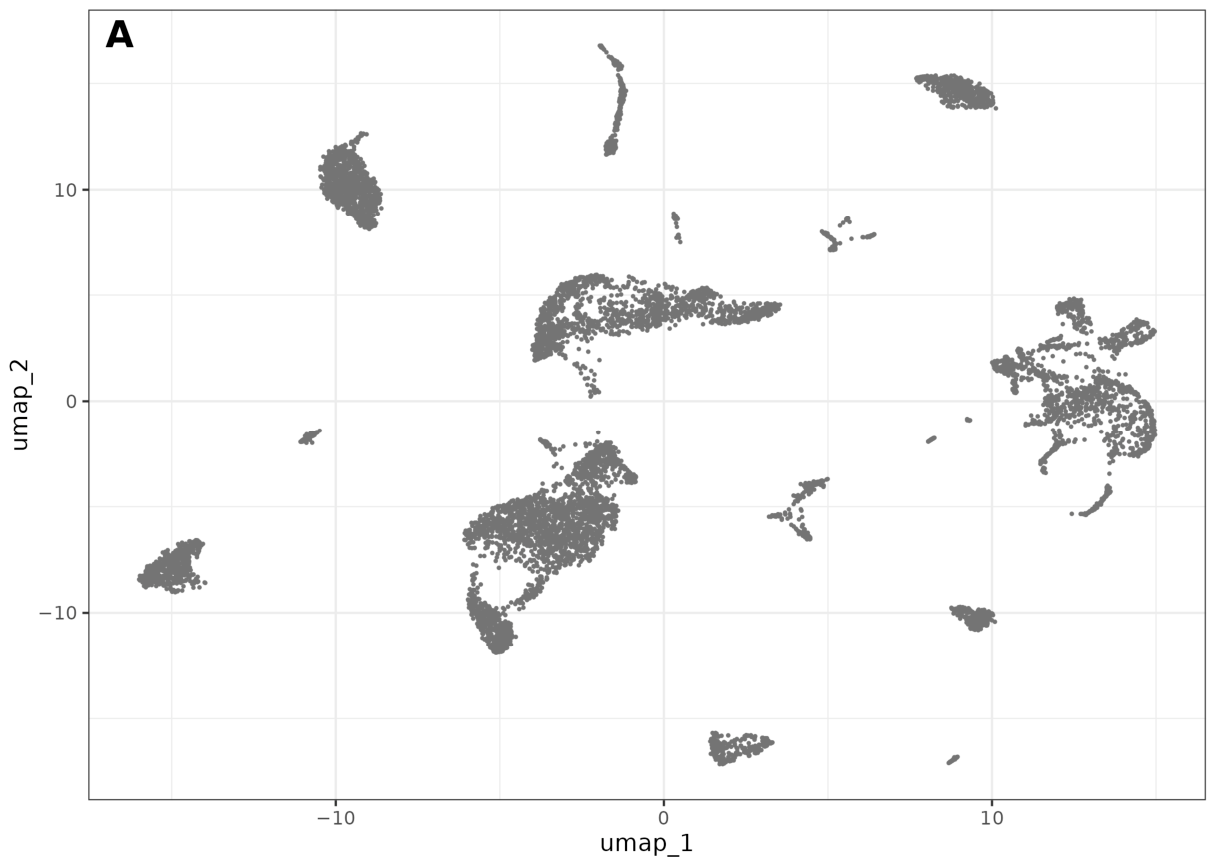
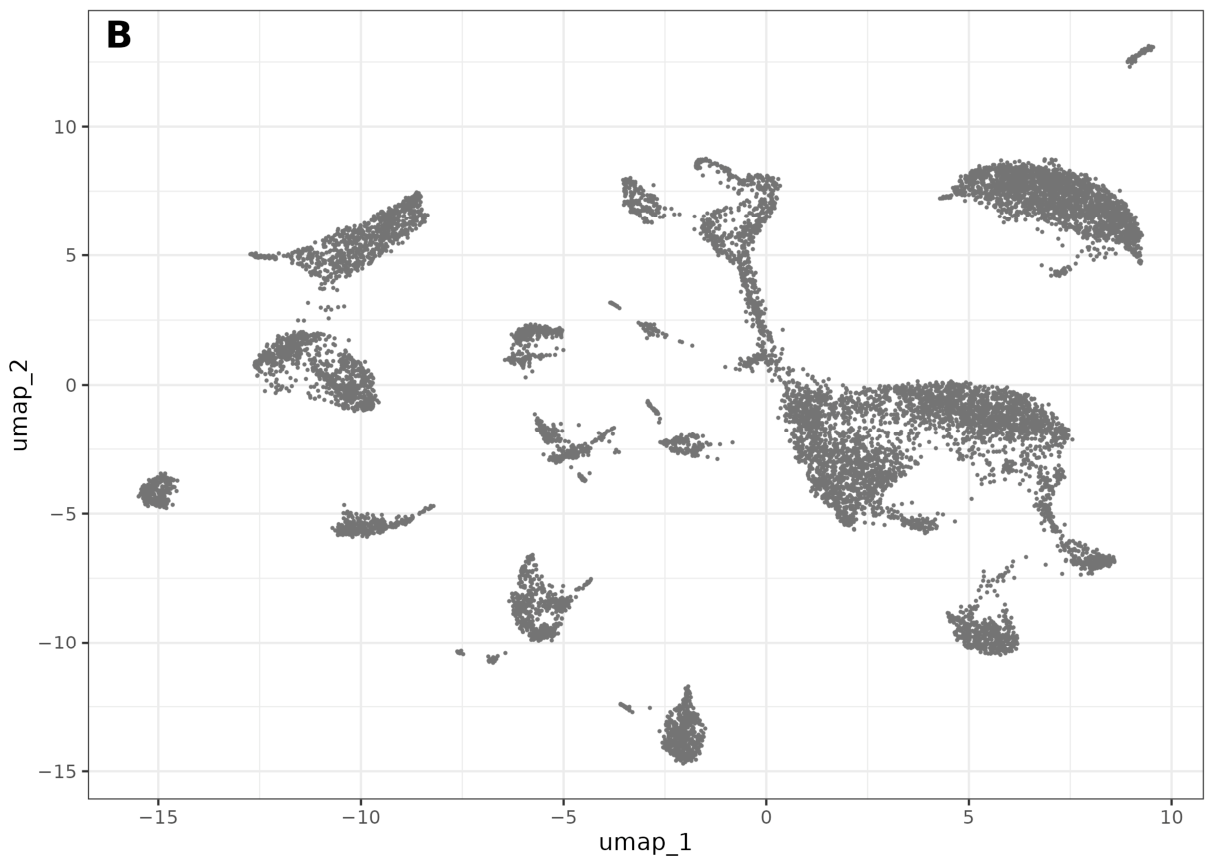
To establish the single-cell transcriptomic framework used for subsequent inflammatory analyses, we first examined the low-dimensional projection of the two processed public scRNA-seq objects derived from murine colonic lamina propria cells (
Figure 1A,B). The first object (GSM9529706) comprised 8258 cells and the second (GSM9529707) comprised 11,515 cells, totaling 19,773 cells analyzed across the two public datasets. In both objects, UMAP projection revealed a structured, non-random distribution of cells in transcriptional space, indicating substantial heterogeneity within the colonic lamina propria compartment.
This heterogeneity was supported by the per-cell RNA complexity metrics extracted from the processed metadata. In GSM9529706, the median nCount_RNA was 5325.5 (IQR: 3540.0–9077.75), with values ranging from 1371 to 117,484, while the median nFeature_RNA was 2001.5 (IQR: 1449.0–2972.5), ranging from 79 to 11,070 detected features per cell. In GSM9529707, the median nCount_RNA was 4748.0 (IQR: 3370.5–7116.0), ranging from 1321 to 81,800, whereas the median nFeature_RNA was 1682.0 (IQR: 1285.0–2263.0), with a range from 83 to 8915 features per cell. Together, these values indicate broad variation in transcript abundance and gene complexity across individual cells, consistent with a biologically diverse intestinal immune microenvironment.
Although the processed metadata did not permit reliable attribution of specific immune-cell identities, the UMAP organization and per-cell transcriptomic complexity metrics indicated that the public dataset could be used for descriptive assessment of inflammatory gene representation and module-level score distribution. Thus,
Figure 1 provides a global overview of the processed intestinal single-cell objects used in the subsequent exploratory analyses.
3.2. Inflammatory Gene-Module Profiling in Public Intestinal Single-Cell Datasets
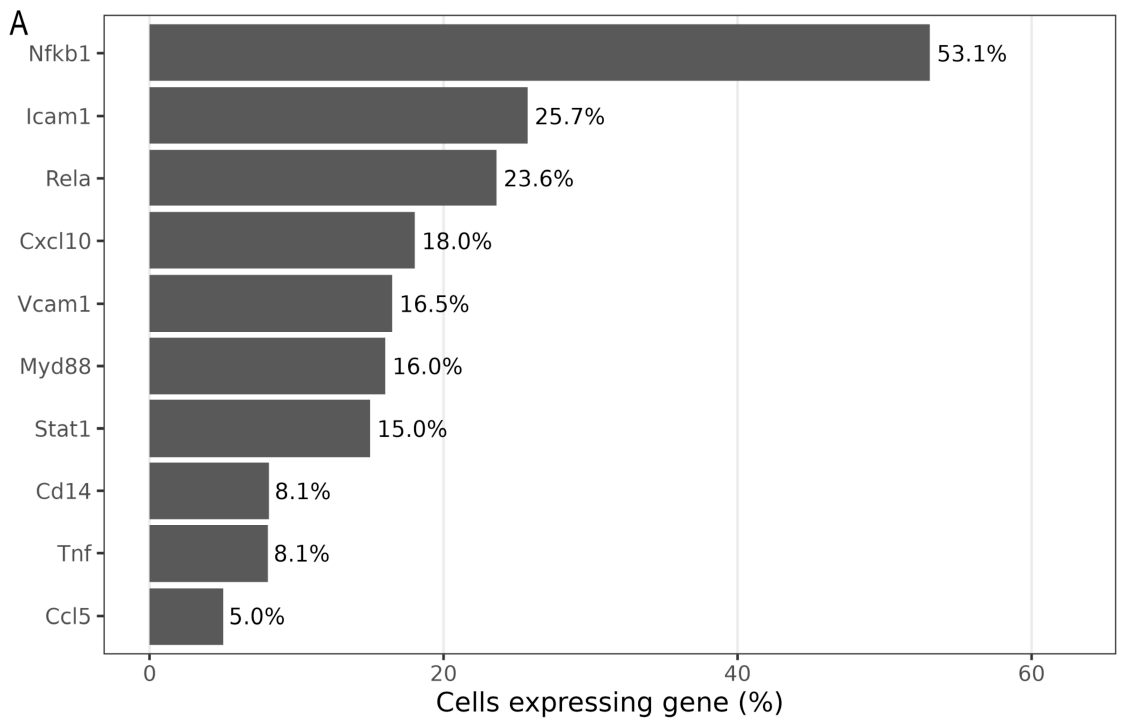
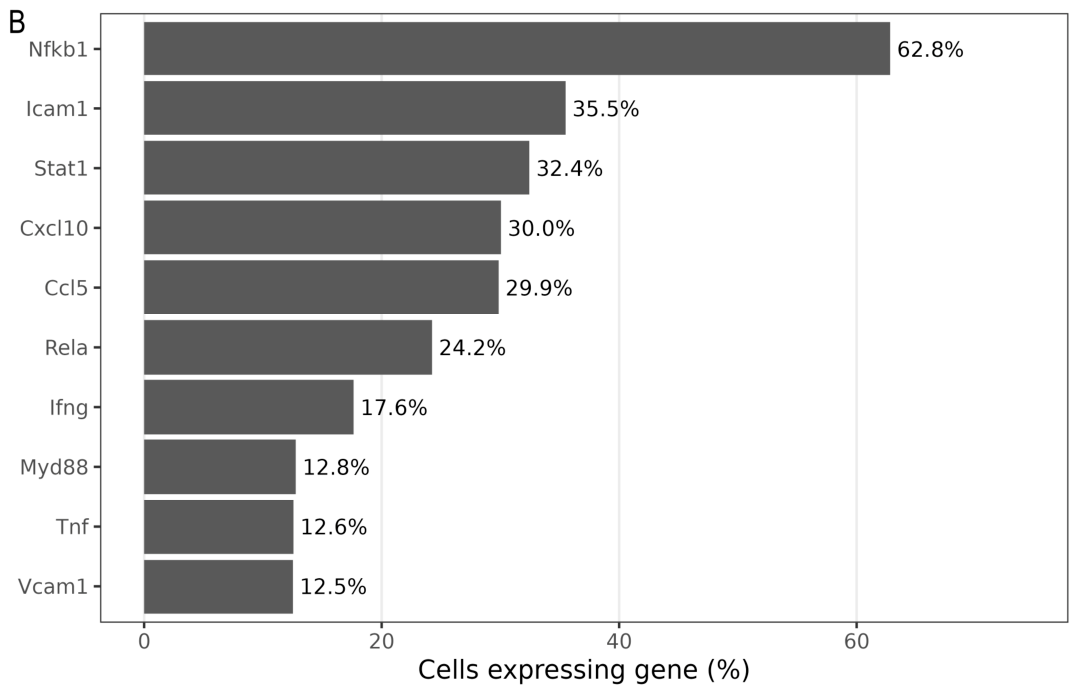
To determine whether inflammatory genes related to the experimental readouts were detectable in the public intestinal scRNA-seq resource, we next examined a predefined host inflammatory module composed of 20 genes linked to cytokine signaling, innate immune activation, leukocyte recruitment, and tissue inflammatory responses (
Figure 2A,B). This panel included Tnf, Ifng, Il12a, Il12b, Il10, Tlr2, Cd14, Myd88, Nfkb1, Rela, Stat1, Ccl2, Ccl3, Ccl4, Ccl5, Cxcl9, Cxcl10, Nos2, Icam1, and Vcam1. Importantly, all 20 genes were detected in both processed objects, corresponding to 100% module representation in GSM9529706 and GSM9529707.
Quantitative inspection of the gene-level summaries showed that several inflammatory-module genes were detectable across the single-cell datasets. In GSM9529706 (
Figure 2A), the most broadly detected genes were Nfkb1 (53.1% of cells), Icam1 (25.7%), Rela (23.6%), Cxcl10 (18.0%), Vcam1 (16.5%), Myd88 (16.0%), and Stat1 (15.0%). In GSM9529707 (
Figure 2B), a comparable but overall stronger inflammatory profile was observed, with broader detection of Nfkb1 (62.8%), Icam1 (35.5%), Stat1 (32.4%), Cxcl10 (30.0%), Ccl5 (29.9%), and Rela (24.2%). Among cytokine-related genes directly connected to the in vivo readouts, Tnf and Ifng also showed broader representation in GSM9529707 than in GSM9529706.
With respect to expression magnitude, the highest mean expression among expressing cells in GSM9529706 was observed for Cxcl10 (7.19), Ccl5 (6.77), Ccl4 (6.61), Ccl3 (6.44), and Ccl2 (4.07). In GSM9529707, the strongest signals were observed for Cxcl9 (12.61), Ccl5 (12.52), Cxcl10 (9.70), Il12b (7.25, despite rare detection), and Ccl2 (6.46). Together, these data indicate that the processed intestinal single-cell datasets contained detectable inflammatory, cytokine-associated, chemotactic, and adhesion-related gene expression patterns.
This molecular profile was used only to describe the presence and expression of inflammatory genes related to the experimental readouts in the public intestinal scRNA-seq datasets. Because reliable lineage-resolved cell-type annotation was not available in the processed metadata, these results were interpreted at the gene-module level and not as evidence of specific inflammatory activity in defined immune-cell populations. The detection of cytokine-related, chemokine, and adhesion-associated genes indicates that these pathways are represented in intestinal single-cell data from T. cruzi infection. However, these findings should not be interpreted as temporal validation or mechanistic evidence for the acute in vivo results.
3.3. Distribution of the Inflammatory Module Score in Public Intestinal Single-Cell Datasets
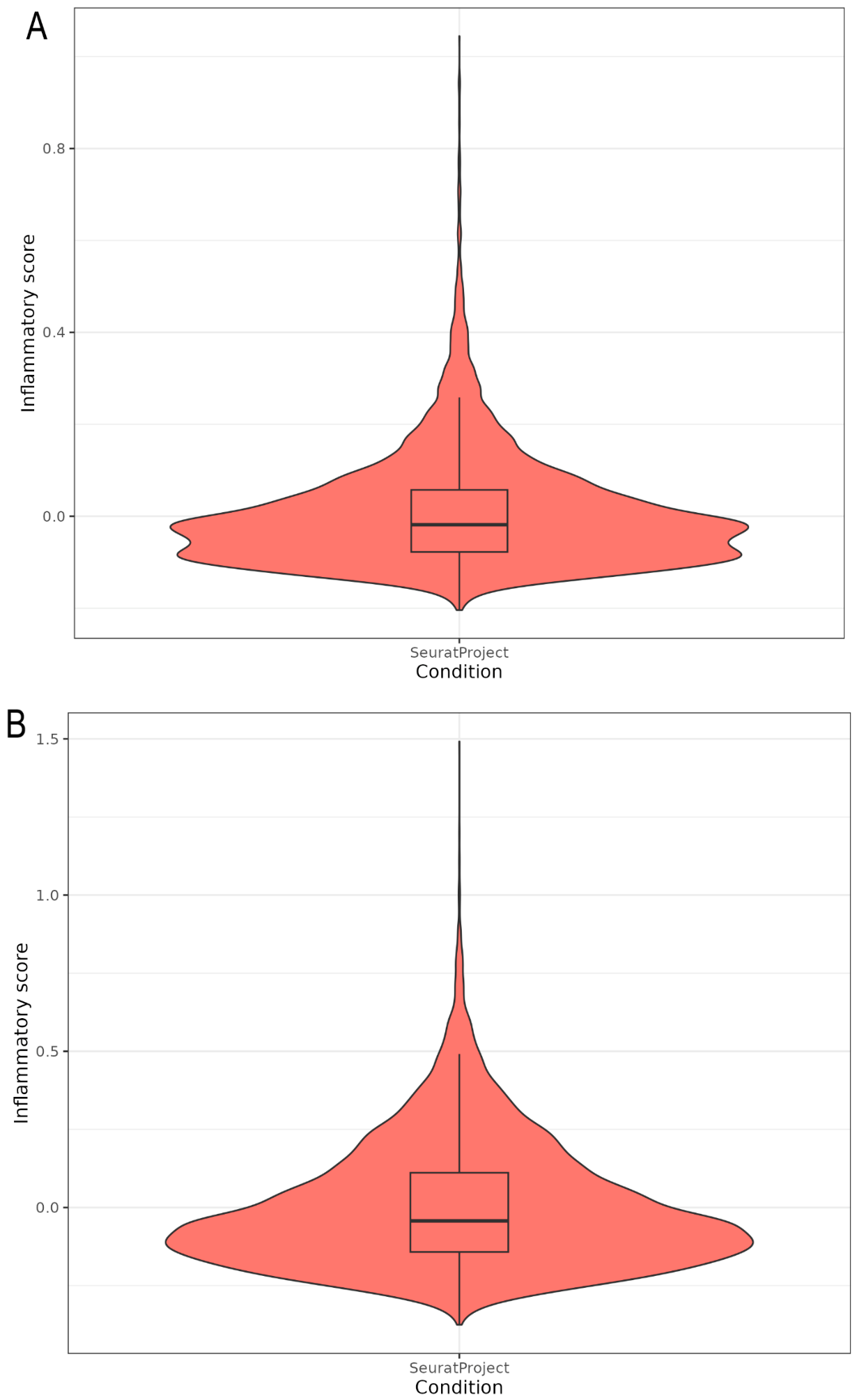
To summarize the global activity of the predefined inflammatory module at the single-cell level, we next examined the distribution of the composite inflammatory score across both processed intestinal scRNA-seq objects (
Figure 3A,B). Score values were available for all cells in both datasets, corresponding to 8258 cells in GSM9529706 and 11,515 cells in GSM9529707. In both objects, the inflammatory score showed a broad distribution rather than a narrow or collapsed profile, indicating substantial cell-to-cell variability in inflammatory program activity.
In GSM9529706 (
Figure 3A), the inflammatory score had a mean of 0.0085 and a median of −0.0184, with an interquartile range from −0.0776 to 0.0574 (IQR = 0.1350), spanning values from −0.2040 to 1.0443. In GSM9529707 (
Figure 3B), the mean score was 0.0031 and the median was −0.0429, with a broader interquartile range from −0.1425 to 0.1112 (IQR = 0.2537), and an overall range from −0.3753 to 1.4915. Thus, although the central tendency of the score remained close to zero in both objects, the spread of values demonstrated that a substantial fraction of cells carried elevated inflammatory-module activity.
This interpretation was reinforced by proportion-based metrics. In GSM9529706, 41.7% of cells showed inflammatory scores above zero, whereas 25.0% and 10.0% of cells were at or above the 75th and 90th percentiles, respectively. Very similar proportions were observed in GSM9529707, where 41.1% of cells had scores above zero, with 25.0% and 10.0% of cells at or above the 75th and 90th percentiles, respectively. Notably, GSM9529707 displayed a wider dispersion (SD = 0.2019) than GSM9529706 (SD = 0.1249), together with a larger dynamic range of score values, suggesting greater variability in inflammatory-module intensity across cells in the second object.
Taken together, these findings indicate that the public scRNA-seq datasets contain detectable expression of the predefined inflammatory gene module and measurable variation in module-score distribution across cells. These results provide descriptive pathway-level context for the genes selected in the in vivo analysis but do not establish temporal correspondence or mechanistic linkage with the acute experimental model.
3.4. Effects of ArtinM on Intestinal Cytokines and Inflammatory Infiltrate in Acute Trypanosoma cruzi Infection
Marked differences in the intestinal inflammatory profile were observed across the experimental groups. Acute
T. cruzi infection was associated with substantial increases in pro-inflammatory cytokines and inflammatory infiltrate, whereas ArtinM treatment was associated with attenuation of several of these responses. Descriptive statistics, global group comparisons, effect sizes, and post hoc results are presented in
Table 1.
Before inferential testing, the distributional assumptions for each outcome were examined. Shapiro–Wilk tests indicated that TNF-α (W = 0.913, p = 0.153), IFN-γ (W = 0.930, p = 0.274), IL-12p40 (W = 0.969, p = 0.838), and IL-10 (W = 0.965, p = 0.771) did not significantly deviate from normality. Likewise, Levene’s test supported homogeneity of variances for these cytokines, with non-significant results for TNF-α (p = 0.495), IFN-γ (p = 0.570), IL-12p40 (p = 0.708), and IL-10 (p = 0.421). These findings justified the use of one-way ANOVA followed by Tukey’s post hoc test for these variables. In contrast, inflammatory infiltrate violated both the normality assumption (W = 0.698, p < 0.001) and homogeneity of variances (Levene’s F = 4.725, p = 0.031). Accordingly, this variable was analyzed using the Kruskal–Wallis test with Dwass–Steel–Critchlow–Fligner pairwise comparisons. Notably, Welch’s ANOVA yielded results consistent with the main analyses, further supporting the robustness of the group effects observed for TNF-α, IFN-γ, IL-12p40, and inflammatory infiltrate.
Among the cytokines, TNF-α showed the strongest overall group effect, with a highly significant difference across groups (ANOVA, F(2,12) = 116.00, p < 0.001, η2 = 0.951), indicating that group membership explained a very large proportion of the variance in this marker. Mean TNF-α levels were highest in the T. cruzi + Saline group (338.80 ± 25.95 pg/g tissue), substantially exceeding those observed in both the T. cruzi + ArtinM group (102.90 ± 43.70 pg/g tissue) and the Saline control group (50.10 ± 21.89 pg/g tissue). Tukey’s post hoc test confirmed that the infected untreated group had significantly higher TNF-α concentrations than both the ArtinM-treated infected group and the uninfected Saline control group (both p < 0.001), while no significant difference was detected between the T. cruzi + ArtinM and Saline control groups. This pattern suggests a pronounced TNF-α upregulation during acute infection that was markedly reduced in the presence of ArtinM.
A similar pattern was observed for IFN-γ. Group differences were statistically significant and large in magnitude (ANOVA, F(2,12) = 23.10, p < 0.001, η2 = 0.794). The T. cruzi + Saline group again presented the highest mean levels (394.27 ± 51.28 pg/g tissue), whereas lower values were found in the T. cruzi + ArtinM (185.67 ± 54.51 pg/g tissue) and Saline control (152.88 ± 74.47 pg/g tissue) groups. Post hoc testing showed that the infected untreated animals differed significantly from both comparison groups (both p < 0.001), whereas ArtinM-treated infected animals did not differ significantly from uninfected controls. Thus, although IFN-γ remained numerically elevated in the T. cruzi + ArtinM group relative to the Saline control group alone, the major statistical contrast was driven by the pronounced increase observed in untreated infection.
IL-12p40 followed the same general trend. A significant overall group effect was observed (ANOVA, F(2,12) = 18.20, p < 0.001, η2 = 0.752), again indicating a large effect size. The highest intestinal IL-12p40 concentration was detected in the T. cruzi + Saline group (360.81 ± 82.23 pg/g tissue), compared with substantially lower means in the T. cruzi + ArtinM (148.30 ± 48.65 pg/g tissue) and Saline control (135.42 ± 63.66 pg/g tissue) groups. Tukey’s comparisons revealed significant differences between T. cruzi + Saline and both T. cruzi + ArtinM and Saline control groups (both p < 0.001), while the latter two groups did not differ from each other. Taken together, the TNF-α, IFN-γ, and IL-12p40 results consistently indicate that acute intestinal infection induced a robust pro-inflammatory response that was substantially blunted in the ArtinM-treated infected group.
By contrast, IL-10 did not show a statistically significant global group effect (ANOVA, F(2,12) = 3.13, p = 0.080, η2 = 0.343), despite a moderate-to-large effect size estimate. Numerically, IL-10 values were higher in both the T. cruzi + ArtinM group (336.07 ± 90.00 pg/g tissue) and the T. cruzi + Saline group (333.43 ± 133.58 pg/g tissue) than in the Saline control group (196.48 ± 67.64 pg/g tissue), but Tukey’s post hoc analysis did not identify any significant pairwise differences. This pattern suggests a possible infection-associated regulatory response, although the present sample did not provide sufficient statistical evidence to confirm between-group separation for this marker. Therefore, IL-10 was not interpreted as a primary ArtinM-driven effect in the univariate analysis.
Inflammatory infiltrate exhibited the clearest histopathological separation among groups and, because of assumption violations, was analyzed non-parametrically. The Kruskal–Wallis test revealed a significant overall difference (χ
2(2) = 12.59,
p = 0.002, ε
2 = 0.899), indicating a very large effect. The
T. cruzi + Saline group showed the highest inflammatory infiltrate values [median 0.264% (IQR: 0.068)], followed by the
T. cruzi + ArtinM group [median 0.032% (IQR: 0.014)], whereas the Saline control group remained essentially null [median 0.000% (IQR: 0.000)]. Pairwise comparisons demonstrated that inflammatory infiltrate was significantly higher in
T. cruzi + ArtinM than in Saline control (
p = 0.024), but significantly lower than in
T. cruzi + Saline (
p = 0.022). In addition,
T. cruzi + Saline differed significantly from Saline control (
p = 0.022). These findings indicate that infection increased intestinal inflammatory cell recruitment, whereas ArtinM treatment was associated with a significant reduction in tissue infiltrate relative to untreated infected animals, although not to baseline levels. Representative images of the collected intestinal segment, flattened tissue preparation, and H&E-stained sections from the
T. cruzi + Saline and
T. cruzi + ArtinM groups are provided in
Supplementary Figure S1.
Overall, the results presented in
Table 1 show that acute
T. cruzi infection strongly increased intestinal TNF-α, IFN-γ, IL-12p40, and inflammatory infiltrate, while ArtinM treatment was associated with attenuation of these inflammatory outcomes. Because local intestinal parasite burden was not quantified, these findings should be interpreted as evidence of reduced intestinal inflammatory activity rather than as evidence of direct local antiparasitic protection. The absence of significant differences in IL-10, despite numerically higher values in infected groups, suggests that the most evident pattern associated with ArtinM treatment in this setting was the reduction in pro-inflammatory cytokines and tissue inflammatory infiltrate, rather than a clear univariate increase in IL-10-mediated regulation.
3.5. Multivariate Analysis of Intestinal Cytokines Adjusted for Inflammatory Infiltrate
As a complementary adjusted analysis, a multivariate analysis of covariance (MANCOVA) was performed to examine whether the intestinal cytokine profile differed among experimental groups after accounting for tissue inflammatory burden using TNF-α, IFN-γ, IL-12p40, and IL-10 as dependent variables and inflammatory infiltrate as the covariate. As shown in
Table 2, the assumption checks supported the adequacy of the multivariate model. Box’s M test was not significant (χ
2 = 26.8, df = 20,
p = 0.141), indicating no evidence against homogeneity of covariance matrices across groups. Likewise, the multivariate Shapiro–Wilk test did not indicate violation of multivariate normality (W = 0.903,
p = 0.105). Together, these findings support the appropriateness of the MANCOVA framework for evaluating adjusted group differences in the intestinal cytokine panel.
The multivariate tests indicated a significant overall association between group and the combined cytokine outcomes after adjustment for inflammatory infiltrate. This was supported by Pillai’s trace (1.422, F(8,18) = 5.53,
p = 0.001), Wilks’ lambda (0.014, F(8,16) = 14.73,
p < 0.001), Hotelling’s trace (38.449, F(8,14) = 33.64,
p < 0.001), and Roy’s largest root (37.638, F(4,9) = 84.69,
p < 0.001) (
Table 2). The convergence of all four multivariate criteria indicates a consistent group-related pattern in the overall intestinal cytokine profile after accounting for inflammatory infiltrate. In contrast, the covariate itself did not exert a significant overall multivariate effect on the cytokine set, as indicated by non-significant values for Pillai’s trace (0.408, F(4,8) = 1.38,
p = 0.323), Wilks’ lambda (0.592, F(4,8) = 1.38,
p = 0.323), Hotelling’s trace (0.690, F(4,8) = 1.38,
p = 0.323), and Roy’s largest root (0.690, F(4,8) = 1.38,
p = 0.323). Thus, the global cytokine differences observed among groups cannot be attributed solely to variation in inflammatory infiltrate.
The adjusted univariate follow-up tests provided a more detailed view of the specific cytokines contributing to this multivariate group effect. After controlling for inflammatory infiltrate, TNF-α remained strongly associated with group membership (F = 108.363,
p < 0.001, ηp
2 = 0.952), representing the most pronounced adjusted group effect among the analyzed mediators (
Table 2). Significant adjusted group effects were also observed for IFN-γ (F = 23.369,
p < 0.001, ηp
2 = 0.809) and IL-12p40 (F = 16.955,
p < 0.001, ηp
2 = 0.755). These effect sizes indicate that the between-group differences in these pro-inflammatory cytokines remained not only statistically significant but also substantial after statistical control for intestinal inflammatory infiltrate. In practical terms, the variation in TNF-α, IFN-γ, and IL-12p40 appears to reflect intrinsic differences among experimental conditions rather than being merely secondary to tissue inflammatory burden.
IL-10 also showed a significant adjusted group effect in the multivariate model (F = 4.791, p = 0.032, ηp2 = 0.466), whereas the corresponding unadjusted one-way ANOVA did not reach statistical significance. Therefore, this adjusted IL-10 result should be interpreted cautiously. Rather than indicating a definitive biological effect, it suggests a possible association between IL-10 variation, experimental group, and inflammatory infiltrate after statistical adjustment. Given the limited sample size and the complementary nature of the adjusted analysis, this finding should be considered hypothesis-generating and not conclusive evidence of IL-10-mediated anti-inflammatory regulation.
When the specific contribution of the covariate was examined at the univariate level, inflammatory infiltrate did not show significant adjusted associations with TNF-α (F = 0.233,
p = 0.639), IFN-γ (F = 1.156,
p = 0.305), or IL-12p40 (F = 0.159,
p = 0.697) (
Table 2). In contrast, inflammatory infiltrate showed a significant adjusted association with IL-10 (F = 7.352,
p = 0.020). This pattern suggests that IL-10 variation may be more sensitive to adjustment for local inflammatory infiltrate than the pro-inflammatory cytokines. However, because IL-10 did not reach significance in the primary univariate analysis, this finding should be interpreted as exploratory and hypothesis-generating rather than as definitive evidence of IL-10-mediated regulation.
Taken together, the MANCOVA results presented in
Table 2 indicate that the intestinal cytokine profile remained associated with experimental group after adjustment for inflammatory infiltrate. The adjusted group effects observed for TNF-α, IFN-γ, and IL-12p40 suggest that the differences in these cytokines were not explained only by variation in tissue inflammatory burden. At the same time, the adjusted IL-10 result should be interpreted cautiously and in relation to the primary univariate analysis, in which IL-10 did not reach statistical significance. Overall, the multivariate analysis complements the primary comparisons by supporting an association between ArtinM treatment and modulation of the intestinal cytokine profile after accounting for inflammatory infiltrate.
4. Discussion
The present study provides tissue-focused evidence that ArtinM treatment is associated with attenuation of intestinal inflammation during acute experimental Trypanosoma cruzi infection. Acute infection was associated with marked increases in TNF-α, IFN-γ, IL-12p40, and inflammatory infiltrate, whereas ArtinM administration attenuated this inflammatory profile. These effects were further supported by a complementary adjusted multivariate analysis, in which the cytokine profile remained associated with group after controlling for inflammatory infiltrate. The public scRNA-seq analysis was used only as an exploratory pathway-level resource to determine whether genes related to the experimental inflammatory readouts were detectable in intestinal single-cell data from T. cruzi infection. Because this dataset derived from chronic infection, it was not interpreted as a phase-matched comparator, mechanistic validation, or temporal extension of the acute in vivo model.
A relevant contribution to this study is its intestinal focus. Available experimental evidence on immune regulation in Chagas disease remains largely centered on systemic compartments, spleen, liver, heart, serum, or plasma, whereas direct intestinal measurements are less frequent. Thus, the present analysis helps address a specific gap by quantifying TNF-α, IFN-γ, IL-12p40, IL-10, and inflammatory infiltrate directly in intestinal tissue. The limited availability of intestinal studies assessing TLR2, CD14, MyD88, or NF-κB also supports the value of connecting local cytokine findings with pathway-level information from public single-cell data.
The in vivo pattern observed here, characterized by increased TNF-α, IFN-γ, and IL-12p40 in untreated infected animals and attenuation in the ArtinM-treated group, is consistent with the dual role of these cytokines in
T. cruzi infection. Systemically, IL-12, IFN-γ, and TNF-α are essential mediators of resistance, parasite control, and survival in acute experimental infection; IL-12 administration increases IFN-γ and TNF-α, whereas neutralization or deficiency of these pathways worsens infection outcomes [
27,
28,
29,
30,
31]. However, in the intestinal compartment, excessive inflammatory activation may contribute to tissue damage. Arantes et al. showed that IFN-γ-induced nitric oxide production via iNOS mediates myenteric denervation, indicating that intestinal pathology depends not only on infiltrate magnitude but also on the inflammatory mediators activated within tissue [
32]. Because the present assay measured IL-12p40 rather than IL-12p70, the IL-12-related findings should be interpreted as reflecting a p40-associated inflammatory signal, not as a direct measurement of bioactive heterodimeric IL-12p70.
In this context, the attenuation of TNF-α, IFN-γ, IL-12p40, and inflammatory infiltrate after ArtinM treatment is compatible with regulation of excessive local inflammation rather than nonspecific immunosuppression. However, because intestinal parasite burden was not directly measured, we cannot determine whether these inflammatory changes resulted exclusively from host immune modulation or were also influenced by possible differences in local parasite load. This interpretation is consistent with previous literature showing that ArtinM can recognize N-glycans associated with TLR2, engage CD14, and activate MyD88/NF-κB-related signaling involved in IL-12 production and Th1 polarization [
8,
10,
33]; however, these pathways were not directly tested in the present intestinal model. In fungal and parasitic models, these mechanisms have been associated with enhanced resistance, macrophage and neutrophil activation, and improved pathogen clearance [
14,
17,
18,
21,
34]. Nevertheless, ArtinM may also engage regulatory pathways, including PI3K-dependent IL-10 production and T-cell responses involving CD3-associated glycans, IL-17, and IFN-γ [
8,
11,
12]. Therefore, the reduced cytokine escalation observed here is best interpreted as an inflammatory pattern compatible with ArtinM-associated immunomodulatory activity, rather than as direct evidence of a specific receptor- or pathway-mediated mechanism.
The IL-10 results require a cautious interpretation. Although IL-10 did not differ significantly among groups in the primary univariate analysis, it showed a significant adjusted group effect in the MANCOVA, in which inflammatory infiltrate was included as a covariate. This finding suggests that IL-10 variation may be related to the local inflammatory context after accounting for tissue inflammatory burden. However, given the limited sample size and the complementary nature of the adjusted model, this result should not be interpreted as definitive evidence of IL-10-mediated anti-inflammatory regulation. Instead, it should be viewed as a secondary, hypothesis-generating signal. This interpretation remains consistent with previous evidence showing that IL-10 can limit toxic inflammatory responses during
T. cruzi infection [
29,
35,
36], but in the present study the main measurable effect associated with ArtinM treatment was the attenuation of TNF-α, IFN-γ, IL-12p40, and inflammatory infiltrate. Thus, IL-10 is better interpreted as a possible compensatory regulatory signal associated with the local inflammatory context, rather than as a primary ArtinM-driven outcome.
The histopathological findings further support the inflammatory nature of the intestinal response observed in this acute model. Untreated infected animals showed the highest inflammatory infiltrate, whereas ArtinM-treated animals showed marked reduction, although not complete normalization. This finding aligns with previous intestinal studies showing that host-directed interventions can modify inflammatory and tissue-associated outcomes during experimental Chagas disease. Exercise-based studies reported preservation of myenteric neurons and reduction in inflammatory foci in infected mice [
37,
38,
39], and microbiota modulation was shown to reshape parasite burden and intestinal histopathology in a strain- and time-dependent manner [
3]. However, the present histological analysis was focused on inflammatory infiltrate as the primary tissue-level endpoint and did not assess neuronal alterations, muscular damage, fibrosis, edema, necrosis, or structural remodeling. Therefore, our findings should be interpreted as evidence of reduced intestinal inflammatory infiltrate during acute infection, rather than as a comprehensive assessment of digestive tissue protection or neuromuscular preservation.
The public scRNA-seq analysis provides pathway-level context for the tissue findings. The predefined inflammatory panel was represented in both datasets, with prominent detection of
Nfkb1,
Rela,
Stat1,
Myd88,
Icam1,
Vcam1,
Cxcl10, and
Ccl5. These genes are related to innate signaling, cytokine activation, chemotaxis, adhesion, and leukocyte recruitment, providing a descriptive molecular background for pathways discussed in relation to the in vivo results. The prominence of Nfkb1 and Myd88 is relevant because these molecules are compatible with pathways previously described in ArtinM studies, including TLR2/CD14/MyD88/NF-κB-related signaling [
8,
10]. Nevertheless, these transcriptomic findings should be interpreted only as exploratory pathway-level context, since the dataset derives from chronic infection, was analyzed secondarily, and did not provide receptor-level, protein-level, activation, causal, or temporal evidence for the acute in vivo model.
The findings can also be discussed in light of innate signaling pathways described in previous studies. Although intestinal studies directly assessing TLR2, CD14, MyD88, or NF-κB during
T. cruzi infection remain limited, systemic and macrophage-based evidence indicates that these pathways contribute to host defense and inflammatory control. MyD88 deficiency impairs TNF-α, IL-12, and reactive nitrogen intermediate production and increases susceptibility to acute infection, whereas TLR2 deficiency has more selective effects [
31]. Because ArtinM has been reported to activate TLR2-associated signaling through N-glycan recognition [
8,
33], these pathways provide a plausible literature-based framework for future mechanistic studies, but they were not directly evaluated in the present intestinal model.
This interpretation is consistent with the broader lectin literature, which indicates that lectin-mediated immunomodulation is not unidirectional. Some lectins, including ArtinM, paracoccin, and Gal-lectin, favor Th1 or Th17-related activation through TLR-associated signaling and IL-12 induction [
14,
40,
41], whereas others, such as DC-SIGN, galectin-3, and mannan-binding lectin, may dampen NF-κB activation, increase IL-10, or interfere with dendritic-cell maturation [
42,
43,
44,
45]. In this context, ArtinM has been described as combining immune activation with regulatory balancing, a profile that is compatible with the attenuation of intestinal inflammatory parameters observed in the present study.
Some limitations should be considered. First, local intestinal parasite burden was not quantified by qPCR, amastigote counting, immunohistochemistry, or histological assessment of tissue parasitism. Therefore, the present design does not allow us to determine whether the attenuation of intestinal cytokines and inflammatory infiltrate after ArtinM treatment resulted exclusively from host immunomodulation or was also influenced by possible reductions in local parasite load. Accordingly, the findings should be interpreted as evidence compatible with attenuation of intestinal inflammatory activity, not as proof of direct local antiparasitic activity in the intestinal compartment. Second, the number of animals per group was limited, as is common in controlled experimental infection studies involving animal use and tissue-based endpoints. Although this group size was informed by previous ArtinM research in acute T. cruzi infection and was sufficient to detect marked differences in the primary inflammatory outcomes, it limits the precision of adjusted multivariate estimates. For this reason, the MANCOVA was interpreted as a complementary analysis supporting the primary univariate findings rather than as the sole basis for mechanistic inference. This caution is particularly relevant for IL-10, which did not reach statistical significance in the primary univariate analysis and was therefore interpreted as an adjusted, hypothesis-generating signal rather than as conclusive evidence of IL-10-mediated regulation.
Third, the IL-12-related ELISA measured IL-12p40 rather than heterodimeric IL-12p70; therefore, this marker was interpreted as a p40-associated inflammatory signal rather than as a direct measure of bioactive IL-12p70. Fourth, the present study did not directly evaluate receptors or signaling pathways potentially involved in ArtinM activity, such as TLR2, CD14, MyD88, NF-κB, or immune-cell population dynamics in intestinal tissue. Therefore, mechanistic interpretations were framed as literature-based hypotheses or biological plausibility rather than as directly demonstrated mechanisms. Fifth, the histopathological assessment was restricted to morphometric quantification of inflammatory infiltrate, consistent with the acute inflammatory focus of the study. Additional pathological features relevant to broader digestive Chagas disease progression, including neuronal alterations, muscular damage, fibrosis, edema, necrosis, and structural tissue remodeling, were not evaluated. Sixth, the public scRNA-seq dataset was derived from chronic infection, whereas the in vivo experiment focused on acute infection; thus, the transcriptomic analysis was used only as exploratory pathway-level context and not as temporal or mechanistic validation. Seventh, the processed metadata did not allow reliable lineage-resolved cell-type interpretation. Together, these limitations define the scope of the study and support a cautious interpretation of the inflammatory, histopathological, mechanistic, multivariate, and transcriptomic findings.
Taken together, these findings indicate that ArtinM is associated with attenuation of acute intestinal inflammatory responses in experimental T. cruzi infection, including reduced pro-inflammatory cytokine levels and inflammatory infiltrate. However, because local parasite burden was not measured, future studies should determine whether these intestinal effects are driven primarily by host immunomodulation, reduced tissue parasitism, or both. The public intestinal single-cell analysis provides exploratory context for related inflammatory pathways but does not establish temporal correspondence or mechanistic validation of the acute in vivo findings. These results provide a focused basis for future studies assessing local parasite burden, receptor- and pathway-level mechanisms, immune-cell population dynamics, and the therapeutic potential of ArtinM in Chagas disease-associated intestinal inflammation.
5. Conclusions
In conclusion, ArtinM treatment was associated with attenuation of the intestinal inflammatory response during acute experimental T. cruzi infection. In vivo, ArtinM treatment was associated with marked attenuation of intestinal TNF-α, IFN-γ, IL-12p40, and inflammatory infiltrate, indicating reduction in the exaggerated proinflammatory response induced during the acute phase. The main pro-inflammatory differences, particularly TNF-α, IFN-γ, and IL-12p40, remained detectable after adjustment for inflammatory infiltrate. In contrast, IL-10 reached significance only in the adjusted model and should be interpreted cautiously as a hypothesis-generating finding.
In parallel, the in silico component indicated that genes related to the inflammatory mediators assessed experimentally, as well as innate, chemotactic, and adhesion-associated pathways, were detectable in a public intestinal single-cell dataset from T. cruzi infection. Because this transcriptomic resource was derived from chronic infection, it was interpreted only as exploratory pathway-level context and not as temporal or mechanistic validation of the acute experimental findings.
Overall, the present study suggests that ArtinM treatment is associated with attenuation of acute intestinal inflammatory outcomes in experimental Chagas disease. Because local parasite burden was not assessed, the findings should be interpreted within the scope of inflammatory modulation rather than as evidence of direct local antiparasitic activity. These results provide a rationale for future studies directly integrating intestinal parasite burden, amastigote quantification, expanded histopathological characterization, enteric neuronal assessment, receptor- and pathway-level validation, immune-cell profiling, cell-type-resolved transcriptomics, and chronic tissue outcomes.





 ,
,