
Article

Geographic Distance as a Driver of Tabanidae Community Structure in the Coastal Plain of Southern Brazil


by
Rodrigo Ferreira Krüger
1,*,
Helena Iris Leite de Lima Silva
2,
Rafaela de Freitas Rodrigues Mengue Dimer
1,3,
Marta Farias Aita
1,4,
Pablo Parodi
5,
Steve Mihok
6 and
Tiago Kütter Krolow
7
1
Parasites and Vectors Group, Instituto de Biologia, Universidade Federal de Pelotas, Pelotas 96160-000, Brazil
2
Programa de Pós-Graduação em Entomologia, Instituto de Biologia, Universidade Federal de Pelotas, Pelotas 96160-000, Brazil
3
Programa de Pós-Graduação em Biodiversidade Animal, Instituto de Biologia, Universidade Federal de Pelotas, Pelotas 96160-000, Brazil
4
Secretaria da Agricultura, Pecuária, Produção Sustentável e Irrigação, Estado do Rio Grande do Sul, Pelotas 96075-000, Brazil
5
Instituto Nacional de Investigación Agropecuaria (INIA), Plataforma de Investigación en Salud Animal, Tacuarembó 45000, Uruguay
6
388 Church Street, Russell, ON K4R 1A8, Canada
7
Laboratório de Entomologia, Universidade Federal do Tocantins (UFT), Porto Nacional 77500-000, Brazil
*
Author to whom correspondence should be addressed.
Parasitologia 2026, 6(1), 5; https://doi.org/10.3390/parasitologia6010005
Submission received: 11 September 2025 / Revised: 17 December 2025 / Accepted: 7 January 2026 / Published: 13 January 2026

Abstract

Horse flies (Tabanidae) negatively affect livestock by reducing productivity, compromising animal welfare, and serving as mechanical vectors of pathogens. However, the spatial processes shaping their community organization in southern Brazil’s Coastal Plain of Rio Grande do Sul (CPRS) remain poorly understood. To address this, we conducted standardized Malaise-trap surveys and combined them with historical–contemporary comparisons to examine distance–decay patterns in community composition. We evaluated both abundance-based (Bray–Curtis) and presence–absence (Jaccard) dissimilarities using candidate models. Across sites, Tabanus triangulum emerged as the dominant species. Dissimilarity in community structure increased monotonically with geographic distance, with no evidence of abrupt thresholds. The square-root model provided the best fit for abundance-based data, whereas a linear model best described presence–absence patterns, reflecting dispersal limitation and environmental filtering across a heterogeneous coastal landscape. Sites within riparian forests and conservation units displayed higher diversity, emphasizing the ecological role of protected habitats and the importance of maintaining connected corridors. Collectively, these findings establish a process-based framework for surveillance and landscape management strategies to mitigate vector, host contact. Future directions include integrating remote sensing and host distribution, applying predictive validation across temporal scales.

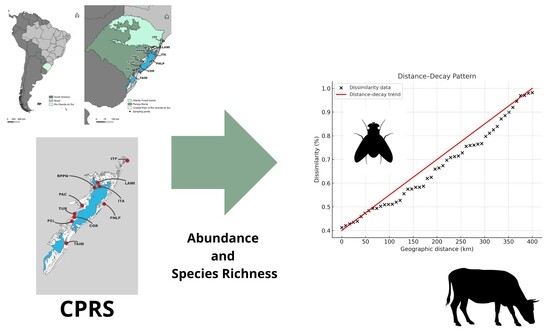
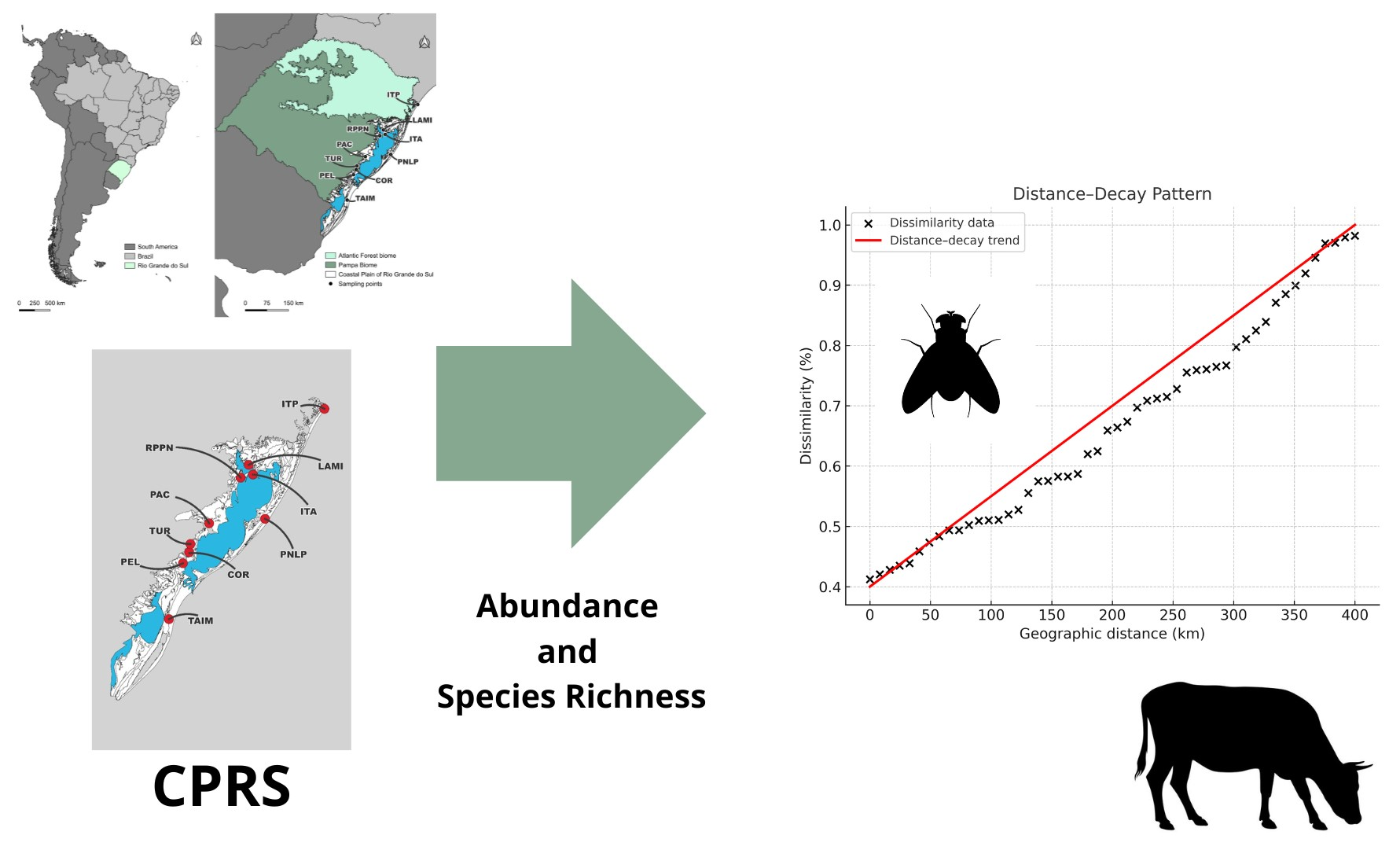
Graphical Abstract

1. Introduction

Tabanidae (Diptera) is a large cosmopolitan family of species whose females are hematophagous. Bites are painful, disturbing animals while grazing resulting in significant productivity losses. In many areas, Tabanidae also play a major role in the transmission of pathogens. These flies have been associated with the spread of equine and bovine trypanosomiasis, anaplasmosis, babesiosis, and equine infectious anemia [1,2,3,4,5,6]. Tabanidae is a highly diverse family, comprising 177 genera and 4667 species worldwide [7]. In the Neotropical region, 71 genera and 1205 species have been recorded [8,9]. In Brazil, the diversity of Tabanidae varies substantially across biomes, with the highest richness observed in the Amazon rainforest and progressively declines towards the Pampa biome [10,11,12]. In the Pampa, 46 species have been recorded [8,11,12,13,14], whereas in the state of Rio Grande do Sul, this number is 56 species [12].
The Coastal Plain of Rio Grande do Sul (CPRS), its origin and evolution are linked to sea level fluctuations. This has led to the development of different coastal depositional environments, mainly large lagoonal and lacustrine bodies and extensive sand barriers [15]. Over the past century, it has been an ecologically important region severely impacted by human activities, including rice cultivation and urban development [16,17]. These anthropogenic pressures have fragmented natural habitats, with preserved areas restricted primarily to riparian forests and scattered conservation units [18,19,20]. These characteristics make the region particularly useful for analyzing how geographic distance and habitat fragmentation influence the similarity and diversity of horse fly communities.
Previous studies on Tabanidae in South America have typically focused on abiotic factors such as temperature and rainfall [11,21,22,23], but have rarely explored the role of spatial factors, such as the distance between habitats [24,25]. Moreover, few investigations have applied detailed statistical models to examine dissimilarity patterns [26], which can reveal saturation levels over longer distances, an important aspect for understanding geographic constraints on communities [27]. Bridging these gaps is essential for developing more effective and integrated conservation strategies.
In the context of vector ecology, analyzing such spatial patterns is crucial for understanding the dynamics of species of veterinary importance [28]. At the landscape scale, structure and connectivity influence the movement of organisms and cross-habitat interactions [29]. For example, in communities with low species richness and strong dominance by a single, highly aggressive tabanid, this species may expand its ecological range, exploiting multiple habitats and host types. Such behavior can disproportionately drive movements across habitat patches, increasing contacts between wildlife and livestock and facilitating the circulation of pathogens across ecological boundaries. Consequently, landscape configuration, particularly patch size and connectivity [29], can modulate vector–host encounter rates, with direct implications for the epidemiology of diseases affecting animal health and livestock productivity. These insights can inform targeted surveillance and environmental management strategies, such as designing ecological corridors to enhance habitat connectivity and mitigate fragmentation effects on vector communities.
This study aims to investigate how geographic distance influences the similarity and diversity of Tabanidae communities in the Coastal Plain of Rio Grande do Sul. It also assesses how habitat fragmentation contributes to the structuring of these communities.

2. Materials and Methods

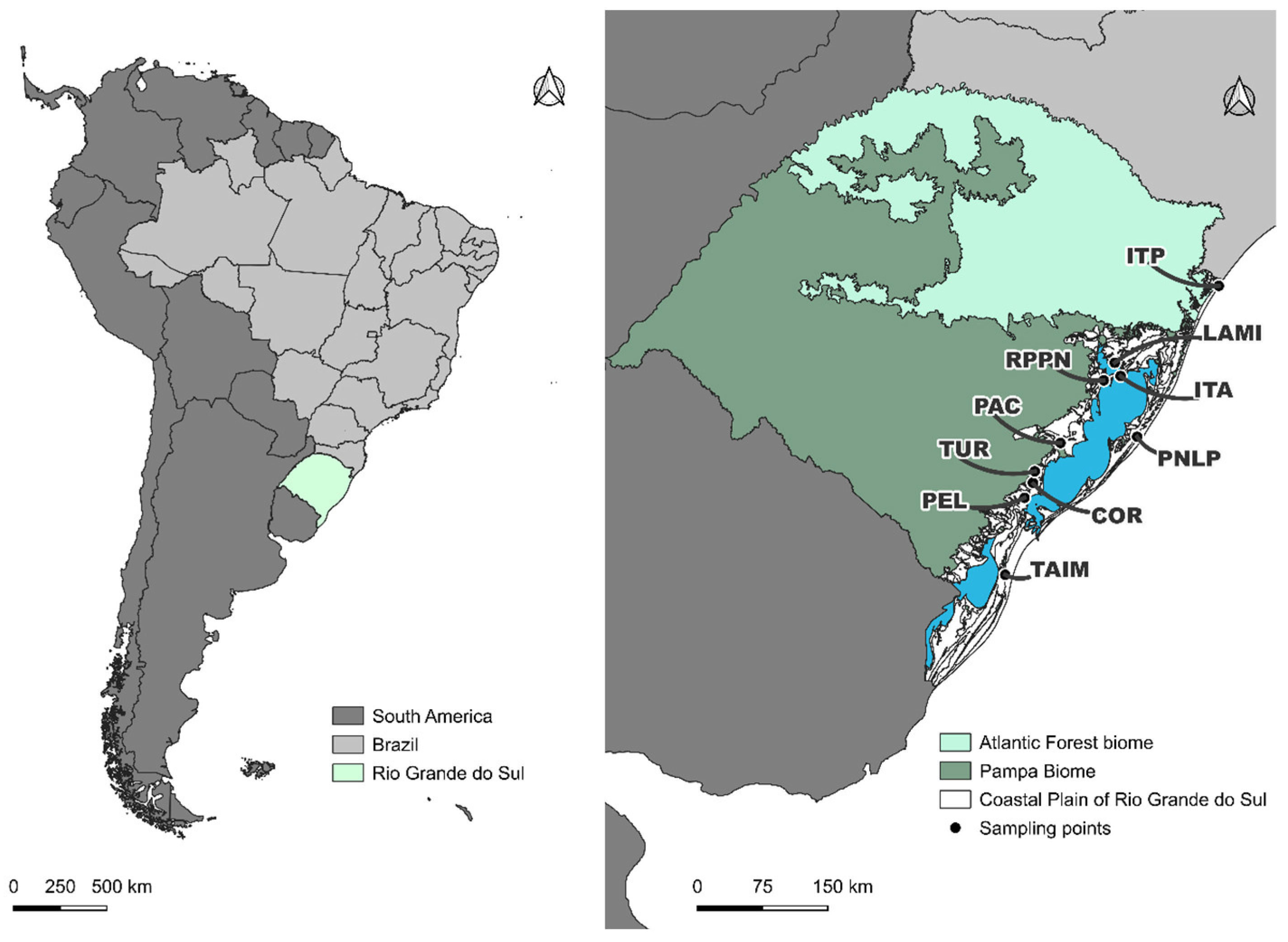
The Sampling. Between October 2011 and February 2012, samples were collected from various localities within five regions of the Coastal Plain of Rio Grande do Sul (CPRS) (Table 1, Supplementary Figure S1, Figure 1) using a Malaise trap [30] (see Supplementary Figures S2–S6 of each region). The environmental characteristics of each sampling area and region are described in Zafalon-Silva et al. [31] and detailed in the supplementary material (Table S1, references [32,33,34,35,36,37,38,39,40,41,42,43,44,45,46,47,48,49,50,51,52,53,54]). The Malaise trap was deployed in each locality for eight consecutive days (Table 1).
Specimens of Tabanidae were identified based on the following taxonomic references: Lutz [55]; Kröber [56,57]; Coscarón & Philip [58]; Coscarón [59,60,61,62]; Coscarón & Fairchild [63]; Fairchild [64,65,66]; Henriques & Rafael [67]; Henriques & Krolow [68]; Krolow & Henriques [69]; Wilkerson & Fairchild [70]. The material is deposited at the Coleção de Entomologia da Universidade Federal do Tocantins (CEUFT), Porto Nacional, Tocantins, and in the Collection of the Laboratory of Ecology of Parasites and Vectors (CoLEPAV) at the Federal University of Pelotas, Rio Grande do Sul.

Data Analysis

Ecological diversity indices were calculated using the vegan package [71] in R. The diversity() function was applied to compute Shannon (H′) and Simpson (1 − λ) indices, which quantify both species richness and evenness within communities. In addition, Hill numbers of orders q = 0, 1, and 2 were derived to provide a unified diversity framework: q0 corresponds to species richness, q1 represents the effective number of common species (exp H′), and q2 represents the effective number of dominant species (1/Simpson). Community similarity among sites was evaluated using the vegdist() function to compute Jaccard and Sørensen indices, which provide quantitative measures of pairwise similarity based on species presence–absence data.
To evaluate the temporal stability of community composition and to control for seasonal variation, we compared our data with data obtained by Krüger & Krolow [11], derived from standardized collections conducted between 2002 and 2004 in the municipalities of Pelotas and Capão do Leão, within the CPRS (see the dataset D1 in the supplementary material). Subsets of the current data were selected to match equivalent periods and localities based on the sampling periods (Table 1), allowing for a direct comparison of taxonomic composition and abundance structure. Analyses were based on Bray–Curtis (abundance) and Jaccard (presence/absence) dissimilarity indices, calculated from standardized and transposed species matrices. This approach allowed for the estimation of compositional changes and the evaluation of temporal community persistence in response to environmental and anthropogenic variation.
For each region, we selected historical samples from the database that corresponded to the same time of year as the current collections, based on the sampling periods described by Zafalon-Silva et al. [31] (Table 1). This temporal equivalence allowed us to isolate the spatial component in the analysis of community dissimilarity, minimizing the influence of seasonal microclimatic variation.
The distm() function from the geosphere package [72] was used to compute a distance matrix between localities, based on geographic coordinates (in kilometers). This matrix quantified the distance between each pair of sites, which was essential for correlating biological dissimilarity with spatial separation.
We first assessed the correlation between community dissimilarity and geographic distance using Mantel tests implemented in the vegan package (function “mantel”). Dissimilarity among sites was computed from two matrices: Bray–Curtis for abundance data and Jaccard for presence/absence data. Using rank-based Mantel statistics with permutation testing, we evaluated whether biological similarity declines with increasing geographic distance. When appropriate, we also examined the partial association between dissimilarity and distance while conditioning on broad geographic regions using partial Mantel tests (mantel.partial).
Although the number of Malaise traps varied slightly among sites due to logistical constraints, this difference does not influence the abundance-based analyses. All Bray–Curtis dissimilarities were computed from standardized community matrices in which the abundance of each species was expressed as its relative proportion within each locality. Consequently, dissimilarity values represent differences in the internal structure of communities, relative dominance and evenness, rather than variation in total catches. This standardization ensures that the Mantel and partial Mantel tests, as well as the subsequent distance–decay models, reflect genuine ecological gradients in community composition, independent of unequal trap numbers.
To describe the distance–decay relationship explicitly, we fitted seven regression models to the pairwise data, analyzing abundance (Bray–Curtis) and presence/absence (Jaccard) separately. The candidate set comprised a linear model, a log–linear model using log(1 + distance) to retain pairs at zero distance, a square–root model using d i s t a n c e , a quadratic polynomial in distance, a saturating negative exponential model, an asymptotic Michaelis–Menten model, and a segmented (“hockey-stick”) piecewise linear model with an unknown breakpoint. The exact functional forms, notation, and parameter interpretations for all seven models are provided in Table 2. In brief, D denotes predicted dissimilarity on the 0–1 scale and d denotes geographic distance in kilometers.
Linear, log–linear, square–root, and quadratic models were estimated by ordinary least squares; the negative exponential and Michaelis–Menten models were fitted by nonlinear least squares; and the segmented model was fitted with the segmented algorithm, with the presence of a breakpoint evaluated by Davies’ test. Model fit and parsimony were compared using Akaike’s Information Criterion (AIC) and ΔAIC. For the best-supported model we also derived characteristic distance scales, D50, D75, and D90, the distances at which the fitted curve reaches 0.50, 0.75, and 0.90 dissimilarity, together with 95% confidence intervals obtained by parametric simulation from the estimated parameter covariance.
All analyses were performed in R [73].

3. Results

A total of 3682 individuals, representing 25 species and 12 genera, was collected. Tabanus triangulum Wiedemann, 1828 was the dominant species, accounting for 62.7% of all specimens. Species with intermediate levels of abundance included Tabanus claripennis (Bigot, 1892), Tabanus occidentalis Linnaeus, 1758, Lepiselaga albitarsis Macquart, 1850, Chrysops varians Wiedemann, 1828, Dichelacera alcicornis (Wiedemann, 1828), Diachlorus bivittatus (Wiedemann, 1828), and Tabanus fuscofasciatus Macquart, 1838 (Table 3).
Horse fly diversity varied considerably among the sampled sites. The highest Shannon diversity indices were recorded at RPPN Barba Negra and Lami (1.77 and 1.71, respectively), corresponding to effective numbers of common species (q1) of approximately six and five. These localities also exhibited high values of q2 (4.1 and 4.6), indicating balanced abundance distributions with weak dominance by any single taxon. In contrast, Itapeva State Park and the riparian forest of Pelotas stream showed the lowest Shannon values (0.18 and 0.23) and correspondingly low Hill numbers (q1 < 1.3; q2 ≈ 1.1), reflecting strong dominance by one or few species. Overall, Hill numbers reinforced the patterns derived from conventional indices, providing a unified interpretation of richness, evenness, and dominance across the sampled sites (Table 3).
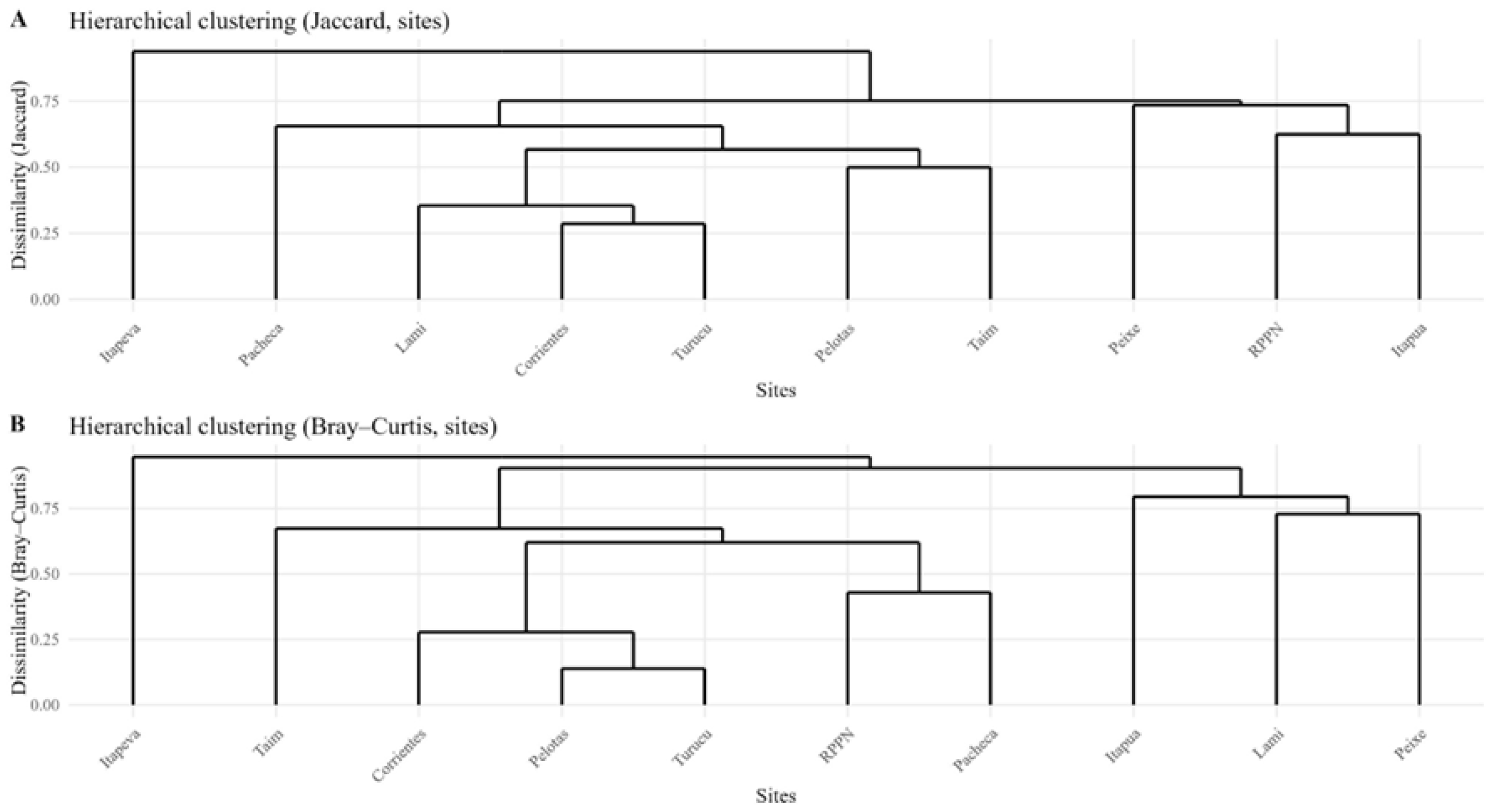
Similarity analyses based on species presence/absence and relative abundance revealed distinct local groupings with shared community structures (Table 4; Figure 2). In terms of composition, the riparian forests of the Corrientes, Turuçu, and Lami streams formed a high-similarity subgroup (dissimilarity < 50%), and Vila Pacheca (near the Camaquã River) grouped with RPPN Barba Negra in relative abundance, reinforcing ecological connectivity. Using temporally matched datasets to compare five CPRS regions with historical records from Pelotas and Capão do Leão (2002–2004), Bray–Curtis (abundance) and Jaccard (presence/absence) indices indicated pronounced spatial structuring, with a systematic increase in dissimilarity between current sites and historical localities; several comparisons showed high Bray–Curtis values (>0.80), signaling strong shifts in relative abundances, whereas elevated Jaccard values (>0.65) pointed to substantial taxonomic turnover (Table 5). Region 1 (south of Patos Lagoon, near the estuary) exhibited the lowest dissimilarities relative to historical sites (Bray–Curtis: 0.13–0.36; Jaccard: 0.28–0.62), Region 3 (farther south, near Mirim Lagoon) showed intermediate values (Bray–Curtis: 0.54–0.89; Jaccard: 0.50–0.60), and Regions 2, 4, and 5 displayed the highest dissimilarities, Region 2 (including Camaquã River and areas around the Guaíba River) with Bray–Curtis 0.42–0.88 and Jaccard 0.63–0.80, and Regions 4 (northern Patos Lagoon to Atlantic Forest-influenced coast) and 5 (mid-littoral between lagoon and ocean) with Bray–Curtis > 0.88 and Jaccard > 0.72, indicating structurally distinct communities (Table 5).
Mantel tests based on Spearman rank correlation showed positive associations between pairwise geographic distance and community dissimilarity. For Bray–Curtis, r = 0.573 with p = 0.002 (999 permutations; upper null quantiles: 90% = 0.255, 95% = 0.337, 97.5% = 0.434, 99% = 0.507). For Jaccard, r = 0.509 with p = 0.010 (999 permutations; upper null quantiles: 90% = 0.321, 95% = 0.398, 97.5% = 0.447, 99% = 0.504). Partial Mantel tests controlling for broad regions yielded r = 0.556 with p = 0.002 for Bray–Curtis (upper null quantiles: 0.272, 0.358, 0.406, 0.474) and r = 0.499 with p = 0.017 for Jaccard (upper null quantiles: 0.293, 0.406, 0.451, 0.533; 999 permutations in both cases).
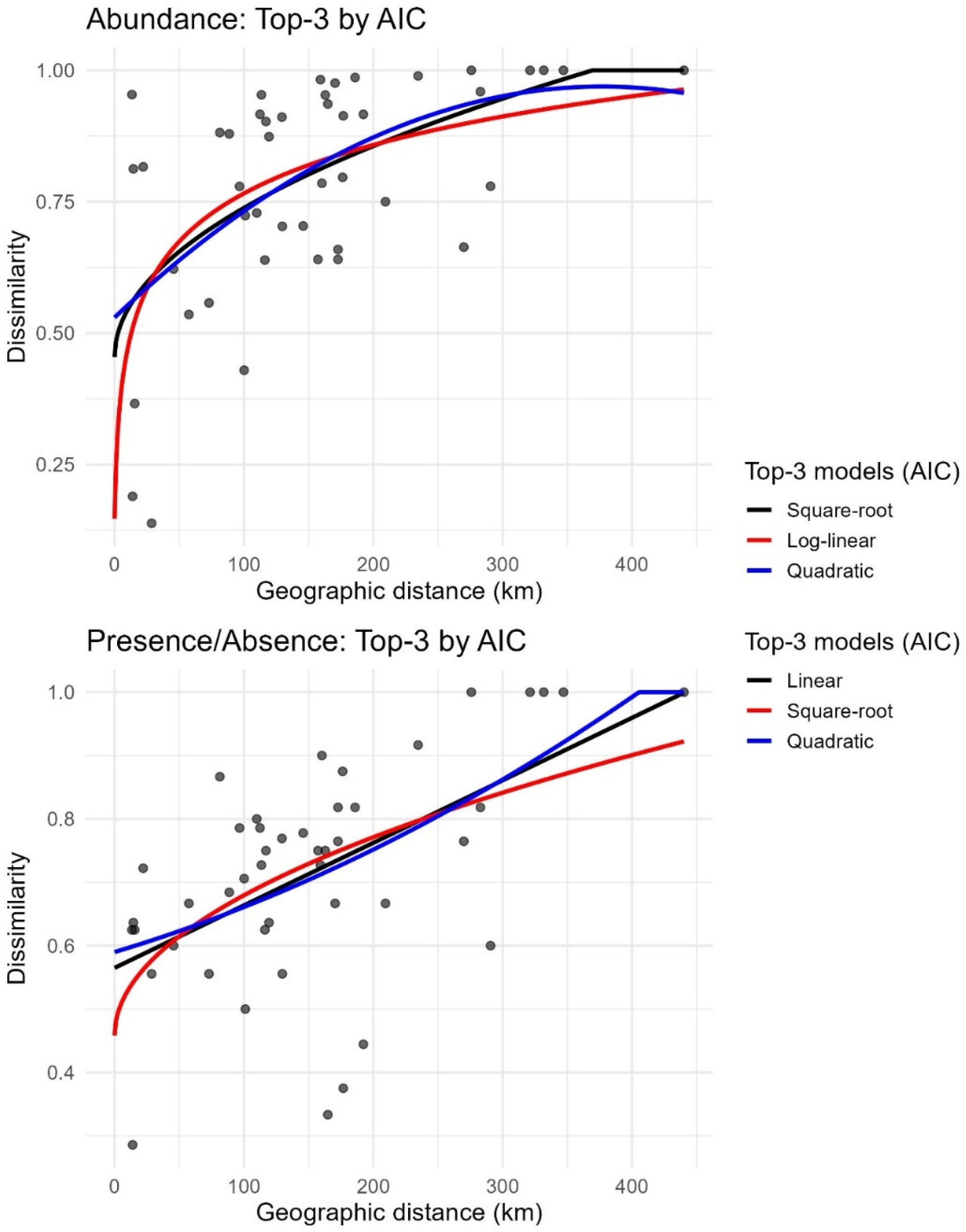
Among seven candidate distance–decay models (linear, log-linear, square-root, quadratic, exponential–saturating, Michaelis–Menten, and segmented), the best-supported model by AIC differed between dissimilarity metrics (Table 6 for the complete AIC and p-values). For Bray–Curtis, the square-root model had the lowest AIC (−24.5), followed by the log-linear model (−23.7; ΔAIC = 0.77) and the quadratic model (−22.7; ΔAIC = 1.78) (Figure 3). For Jaccard, the linear model ranked first (AIC = −42.6), followed by square-root (−41.1; ΔAIC = 1.54) and quadratic (−41.0; ΔAIC = 1.65); segmented (−39.8), log-linear (−38.2), Michaelis–Menten (−33.8), and exponential–saturating (−31.0) ranked lower (Figure 3). For the segmented fits, Davies’ tests returned p = 0.224 for Bray–Curtis and p = 0.790 for Jaccard (Table 6).
Characteristic distance scales derived for the top-ranked model of each metric are as follows (point estimate; 95% CI). For Bray–Curtis (square-root model): D50 = 2.57 km [0.013–43.1], D75 = 108 km [61.4–151], and D90 = 247 km [185–379]. For Jaccard (linear model): D50 = −65.9 km [0.44–36.5], D75 = 188 km [146–244], and D90 = 340 km [274–469]. An estimated breakpoint for the segmented formulation was 146 km for both metrics; confidence intervals from the model summaries are reported in Table 7. Under the linear specification, predicted dissimilarity at zero geographic distance was D(0) = 0.565 (95% CI 0.484–0.646) for Jaccard.

4. Discussion

4.1. Spatial Gradients and Dissimilarity Models

The main result of this study is the detection of a spatial gradient in Tabanidae community composition along the Coastal Plain of Rio Grande do Sul (CPRS). Significant Mantel correlations for both abundance (Bray–Curtis) and presence–absence (Jaccard) data indicate that biological dissimilarity increases with geographic distance. This pattern remains even after controlling for broad regional groupings, suggesting that it reflects species turnover rather than spatial clustering. Both indices support the conclusion that dispersal limitation and environmental filtering are central processes in community assembly. The use of standardized sampling over two years [11] minimizes temporal confounding and reinforces the inference that geographic and environmental gradientes, not seasonal variation, organize community structure. As land use intensifies across the CPRS, spatial turnover may increase, amplifying differentiation across sites. Comparable patterns have been documented for tsetse in East Africa, using random-forest models that couple trap data with satellite predictors. Relative densities increased with tree cover and decreased with precipitation and soil moisture, emphasizing the role of riparian/wooded corridors in sustaining biting-fly populations [74].
Model comparisons indicate that low-curvature forms best describe the distance–dissimilarity relationship in Tabanidae communities across the CPRS. For Bray–Curtis, the square-root model received the strongest support, followed by log-linear and quadratic forms. For Jaccard, the linear model ranked highest, with square-root and quadratic models also performing well. In contrast, saturating models showed lower support under AIC, and segmented models failed to detect slope changes, as confirmed by non-significant Davies tests. These results indicate a gradual, monotonic increase in dissimilarity with distance, without abrupt transitions or ecological thresholds.
Quantitatively, the square-root model for Bray–Curtis suggests that 50% dissimilarity is reached at approximately 2.6 km, and 75% at 108 km. For Jaccard, the linear model projects approximately 56.5% dissimilarity even at near-zero distance, reaching 75% at a distance of 188 km. These patterns reflect high local heterogeneity and support continuous spatial turnover, with no evidence of saturation. The lack of support for segmented or threshold models favors an interpretation of cumulative differentiation driven by dispersal limitation and environmental gradients. In practical terms, the square-root model offers an effective fit for abundance-based dissimilarity, capturing gradual changes without requiring complex curvature. For presence–absence data, the linear model reflects steady taxonomic turnover in a connected and environmentally heterogeneous landscape. These results align with the general theory of distance-decay [75], which emphasizes that most ecological communities exhibit continuous species replacement over space, rather than abrupt shifts.
Together, the consistent Mantel correlations, the strong performance of simple models, and the absence of spatial breakpoints support a model of progressive community differentiation, especially in terms of abundance structure. This pattern reinforces the role of continuous species turnover shaped by dispersal limitation and environmental gradients. The spatially structured nature of tabanid communities observed here provides a basis for targeted surveillance and vector control strategies in the CPRS. For example, place regional sentinel stations ~75–100 km apart along the coast–lagoon corridor to detect turnover, and cluster 3–5 traps within 2–5 km around high-risk ranches in the Pelotas–Turuçu–Taim wetlands.
Although the analytical framework differs, this approach aligns with the spatial principles advocated by Kitron [28], who emphasized the importance of identifying geographic heterogeneity in vector distribution to optimize surveillance and allocate control efforts more effectively. As proposed, understanding fine-scale spatial variation can improve the early detection of risk zones and enhance the precision of interventions. Methodologically, recent work upscaled vector relative abundance by integrating in situ catches with satellite covariates via random forests, explaining ~41% of spatial variability and yielding national-scale maps; however, predictive reliability declined when extrapolating beyond the environmental envelope of the training data, with VSURF-based variable selection improving geographic realism [74]. Incorporating environmental covariates and implementing predictive validation in future studies will help refine inference and strengthen the integration of ecological data into epidemiological forecasting and spatial planning in veterinary entomology. Recent advances in metagenomic approaches have also demonstrated that high-resolution analysis of individual vectors can reveal substantial spatial heterogeneity in microbiota composition and pathogen presence, reinforcing the need for surveillance systems that are both spatially and biologically fine-scaled [76].

4.2. Ecological Mechanisms Underlying Spatial Dissimilarity

These spatial patterns raise questions about the ecological processes that underlie community dissimilarity. In particular, exploring which species dominate across space, and why, offers insights into the mechanisms driving distance decay.
Local variation in species abundance, rather than presence or absence alone, appears central to the spatial organization of Tabanidae communities across the CPRS. This interpretation is reinforced by diversity estimates based on Hill numbers. Localities such as RPPN Barba Negra and Lami showed high q2 values (4.1 and 4.6), indicating relatively even abundance distributions and weak dominance by any single taxon. In contrast, Itapeva State Park and the riparian forest of the Pelotas stream exhibited the lowest Shannon diversity values (0.18 and 0.23), accompanied by very low Hill numbers (q1 < 1.3; q2 ≈ 1.1), reflecting strong dominance by one or a few species. These patterns confirm that differences among sites are driven not only by species turnover, but also by marked shifts in abundance structure and dominance intensity.
Tabanus triangulum accounted for more than 60% of all individuals, and between-site differences in relative abundance contributed strongly to overall community dissimilarity. Bray–Curtis values consistently exceeded those from Jaccard, highlighting the role of dominance patterns and abundance shifts beyond taxonomic turnover. These indices provide complementary perspectives: Jaccard captures species replacement and the influence of rare taxa, whereas Bray–Curtis emphasizes changes in relative abundance with direct ecological and epidemiological relevance [77,78].
Dominance-driven restructuring was evident even across short distances and in sites with similar species pools, suggesting ecological homogenization without full compositional replacement. This finding is consistent with observations from urban mosquito communities, where generalist species exhibit reduced differentiation across space [79], as well as comparisons between forested and open areas with or without horses in the Amazon forest [23,80]. In the CPRS, T. claripennis was present at all sites, supporting its generalist status [81,82], whereas Lepiselaga albitarsis was restricted to humid, forested environments, indicating environmental sensitivity. Caution may however be warranted when extrapolating from trap data to epidemiological relevance. Capture rates do not correspond to host contact or feeding efficiency, as demonstrated by Muzari et al. [83] in Australia, where species that were abundant in traps showed low feeding success, and vice versa. However, in the CPRS, the dominance of T. triangulum is likely ecologically and epidemiologically meaningful. Approximately one-third of the specimens collected in region 1 tested positive for Trypanosoma kaiowa DNA [84], indicating potential involvement in mechanical transmission under simpler ecological conditions.
Historical data from Pelotas and Capão do Leão [11] point to increasing spatial differentiation over time, likely driven by habitat alteration. Protected areas, such as the Barba Negra and Lami reserves, exhibited higher diversity and lower dominance, illustrating how landscape integrity contributes to more balanced assemblages. Regional contrasts further support this interpretation: in Santa Catarina, Dichelacera alcicornis dominates [85]; in Uruguay, Poeciloderas lindneri is more frequent [21]; and in protected areas of Paraná, assemblages are more evenly structured [86]. Although the sampling methods varied, the discussion here focuses on dominance patterns rather than absolute abundance or trap efficiency. While differences in bait type, fabric color, and trap configuration can influence capture rates for certain species (e.g., Hybomitra epistates (Osten Sacken, 1878)) [87], the patterns of species dominance cited in these studies are consistent within each respective region. Therefore, despite methodological variation, the observed contrasts reinforce the influence of environmental filtering in shaping tabanid assemblages across landscapes with differing levels of disturbance and protection.

4.3. Implications for Disease Transmission and Vector Surveillance

The observed dominance patterns are not only ecologically significant but also carry important implications for veterinary epidemiology. Changes in species composition and abundance can influence vectorial capacity and contact rates with hosts, especially in altered landscapes.
Two non-exclusive mechanisms may link the spatial restructuring of Tabanidae communities to increased pathogen transmission risk. First, the dominance of one or a few horsefly species with effective transmission capacity can elevate contact rates with livestock, a mechanism conceptually supported by empirical evidence from mosquito systems showing that vector community dominance and host–vector contact structure are key determinants of pathogen transmission risk [88]. Second, land-use change may shift ecological niches and alter which species dominate locally [89]. These hypotheses are testable by comparing encounter rates in landscapes converted from forested wildlife habitats to cattle-dominated systems, while controlling for host density and season.
Within the CPRS, the predominance of T. triangulum represents a potential entomological risk. Although its vector competence is considered limited, its numerical dominance, particularly in fragmented landscapes with reduced biodiversity, may increase mechanical transmission. This pattern aligns with the dilution-effect hypothesis, which posits that higher species richness can disrupt pathogen transmission by reducing effective vector–host encounters [90]. Analogous mechanisms have been demonstrated in other systems, such as Culex pipiens Linnaeus, 1758 and West Nile virus [91,92,93]. Land-use changes in the CPRS, notably the conversion of riparian forests into pasture, have likely contributed to the local dominance of a few vector species, reducing taxonomic and functional diversity. Several Tabanidae species with mechanical transmission potential were recorded, reinforcing the epidemiological relevance of this shift [2].
The quantified distance decay patterns based on Bray–Curtis dissimilarity enhance the predictive capacity of vector surveillance by revealing how community composition changes gradually across space in terms of species abundance. Even short-range ecological differences can result in substantial variation in vector dominance, which holds direct implications for mechanical transmission potential in livestock systems. These findings support the design of intra- and inter-property sampling grids that reflect microhabitat heterogeneity, especially near ecotones such as water margins, riparian zones, and forest edges. At broader spatial scales, the absence of abrupt dissimilarity thresholds reinforces the effectiveness of gradual surveillance strategies rather than rigid geographic zoning. This approach aligns with insights that advocate fine-scale sampling to detect local hotspots of vector activity while maintaining broader-scale continuity in monitoring efforts [94]. As land-use change continues to reshape vector habitats, transitional zones become especially important for early detection of epidemiological risk [89]. Shifts in vector community structure, particularly those involving dominance by a few species, can alter disease dynamics through increased host–vector contact rates and reduced ecological buffering [88]. In this context, abundance-based decay models provide a practical framework for anticipating spatial variation in entomological risk. Their integration into surveillance planning improves the ability to locate emergent hotspots, allocate resources more efficiently, and inform vector control strategies under changing environmental conditions.

4.4. Analytical Limitations and Future Research Directions

While these findings support practical applications for surveillance and control, they must be interpreted in light of certain analytical constraints and sampling limitations.
Another methodological consideration concerns the exclusive use of Malaise traps. This passive interception method was chosen to ensure standardized and unbiased sampling of flying Diptera, following the principles established by Townes [30]. The approach enables direct comparisons of relative abundance and community composition across distant sites, as demonstrated in regional studies using Malaise traps for Tabanidae inventories [86]. The design minimizes both collector bias and logistical variability, consistent with the efficiency and impartiality emphasized by Breeland & Pickard [95]. However, passive interception may under-represent species with strong host-oriented or crepuscular activity patterns, which are often better sampled by attractive traps [87].
Future studies should therefore integrate complementary sampling methods, including both passive interception and active or attractive traps (e.g., Nzi, canopy, or octenol-baited models), to evaluate how trap type influences species detectability and relative dominance within Tabanidae assemblages. This combined approach will provide a more comprehensive understanding of community structure and improve cross-study comparability within the Pampa biome and other Neotropical regions.
Some limitations contextualize the interpretation of the distance decay patterns observed in Tabanidae communities across the CPRS. The sampling design, involving 10 sites and generating 45 non-independent pairs, reduces the effective number of unique comparisons and can bias model selection toward simpler structures under AIC-based criteria [96]. The distribution of distances was skewed toward medium and long spatial separations, with relatively few short-distance comparisons. This is precisely the range where stronger initial curvature in dissimilarity patterns might be expected due to dispersal limitation or fine-scale environmental heterogeneity. This imbalance in pairwise distances can impair the detection of nonlinearities in spatial turnover, such as those described in community ecology literature [97]. Furthermore, the absence of high-resolution environmental covariates and fine-scale temporal matching across sites may contribute to unexplained variation in abundance-based dissimilarity, limiting ecological inference from the observed patterns. Pseudoreplication, due to repeated site pairings, reduces effective degrees of freedom, potentially inflating support for parsimonious models.
To refine inference, future studies should incorporate leave-one-site-out validation to reduce pairwise dependence and explore fits restricted to distances below 200 km to detect short-range curvature better. Additionally, approaches such as multiple regression on distance matrices (MRM) or generalized dissimilarity modeling may account for unmeasured environmental gradients and improve explanatory capacity. Including structured land-use histories could enhance model sensitivity to anthropogenic pressures.
Similar patterns of community shifts following land-use change have been reported in other biomes. For instance, in boreal forests of northwestern Ontario, Buckley et al. [98] observed that recently logged stands supported higher abundances of anautogenous tabanids, species more persistent in host seeking, while older stands maintained higher richness but lower abundance. These findings support the idea that disturbance increases vector pressure while reducing overall diversity. Observations from peri-urban and forested habitats in eastern Canada (Steve Mihok, pers. comm.) indicate that community similarity can remain high across ~50 km in homogeneous environments but diverges in contrasting habitats such as bogs or boreal forests. Although sampling protocols vary, these insights underscore the value of incorporating habitat type and management history into future Tabanidae studies.
Despite current methodological constraints, the observed patterns in the CPRS align with findings from other systems where habitat simplification favors generalist vectors [23,80,99,100,101] and increases transmission risk [102]. In the CPRS, higher diversity and lower dominance in protected areas such as Barba Negra and Lami illustrate the ecological benefits of conservation. Analogous processes occur in South American livestock systems with Rhipicephalus (Boophilus) microplus (Canestrini, 1887) (Acari: Ixodidae). Landscape simplification through the replacement of native vegetation with exotic pastures has promoted the expansion and dominance of this tick [103]. Regional warming can intensify these dynamics by expanding thermal suitability, as suggested by the southward extension of R. microplus in southern Brazil [104], reinforcing the importance of integrated One Health approaches.

5. Conclusions

Despite methodological constraints, the results provide strong support for the ecological interpretation of distance-decay in Tabanidae communities and offer a valuable framework for applied surveillance and disease prevention.
The results demonstrate that Tabanidae community composition across the CPRS exhibits continuous spatial differentiation, primarily driven by species abundance patterns and gradual turnover, with no evidence of clear ecological thresholds. This spatial structure, shaped by dispersal limitation and environmental filtering, has direct implications for disease ecology and vector management.
The numerical dominance of T. triangulum in degraded areas, coupled with high local dissimilarity, indicates elevated risk of mechanical transmission under conditions of biodiversity loss. These findings highlight the importance of conserving structurally complex habitats to preserve ecological buffers against disease spread.
From a practical standpoint, we would revise the original survey to better resolve short-range turnover. Specifically, we would add 3–5 co-located traps per ranch along forest–pasture, wet margin transects (0, 250, and 500 m from water or marsh) to increase the number of <10–20 km pairs; enforce identical trap types and synchronized 48 h deployment windows; and record microclimate, livestock density, and pasture type at each site. These changes target the portion of the curve where distance–decay is steepest and reduce unexplained variance in abundance-based dissimilarity.
Going forward, we will adopt an operational design that links analysis to action. Within high-risk ranches, we will deploy short-range trap clusters (2–5 km radius) across ecotones and conduct repeat sampling after significant rainfall events. Across the CPRS, we will track temporal changes by comparing each round to its immediate predecessor at the same sites. Two simple triggers will guide intensified control: (i) relative abundance of T. triangulum > 60% of catches, or (ii) a ≥0.20 increase in Bray–Curtis dissimilarity to the nearest neighbor within ≤10 km. When either threshold is met, we will add weekly trapping for four weeks and apply targeted measures (e.g., treated screens at watering points, relocating cattle away from riparian edges at peak biting times). This workflow converts the observed spatial structure into concrete surveillance and response steps for livestock systems in the CPRS.
Beyond operational implications, the study supports the integration of ecological metrics into veterinary public health policies and rural land-use planning, especially under a One Health framework. Incorporating spatially explicit surveillance models into policy can enhance the allocation of control resources, guide habitat restoration priorities, and inform zoning decisions in agricultural landscapes.

Supplementary Materials

The following supporting information can be downloaded at: https://www.mdpi.com/article/10.3390/parasitologia6010005/s1, Supplementary Table S1. Description of the 35 points sampled in five regions of the Coastal Plain on Pampa Biome (CPPB); Supplementary Figure S1. Geographic location of the study area in the Coastal Plain of Rio Grande do Sul (CPRS), southern Brazil; Supplementary Figure S2. A, Malaise trap at one point of the Pelotas Stream; B, Transition area from the field to the riparian forest of the Pelotas Stream; C, Extension of the riparian forest of the Corrientes Stream and the surrounding field area; D, collection point next to the Turuçu Stream; E, Mouth of the Turuçu Stream next to Laguna dos Patos; F, Malaise trap installed in the forest of the Pelotas Stream; Supplementary Figure S3. A, Collection area in the riparian forest of the Camaquã River near Vila Pacheca; B, Malaise traps installed on Morro da Formiga in the Barba Negra Private Natural Reserve; C, The Arroinho collection area in the Barba Negra Private Natural Reserve, next to the dunes; D, Collection area in the riparian forest of the Camaquã River, next to a beef cattle field; E, Collection area in the Lami Biological Reserve; F, Collection area at the top of the dunes in the Barba Negra Private Natural Reserve; Supplementary Figure S4. A, Arboreal restinga/shrub–grassland mosaic; B, Herbaceous freshwater marsh; C, Internal dune field along the Taim margin; D, Riparian restinga swamp forest with epiphytes; E, Arboreal restinga forest patch (low semideciduous forest); F, Forest interior (understory) with a Malaise trap; Supplementary Figure S5. A, Coastal dune field (restinga) near the Patos Lagoon; shrub–grassland restinga mosaic, Itapuã State Park; B, Restinga grassland–shrubland on a granitic slope; view toward Morro da Formiga (Barba Negra RPPN) across Lake Guaíba, Itapuã State Park; C, Herbaceous freshwater marsh/shallow lagoon with emergent macrophytes, Tupancy Natural Municipal Park; D, Forest interior (restinga forest understory) with a Malaise trap, Itapeva State Park; E, Coastal dune field with Atlantic Ocean view; herbaceous–shrub restinga, Itapeva State Park; F, Wet meadow/freshwater marsh with temporary standing water, José Lutzenberger State Park. Supplementary Figure S6. A, Fringing marsh/reedbed along Pai João Lagoon with emergent macrophytes in the northern sector of the park; B, Transition zone among pastures of Fazenda Bioadeiro within an anthropogenic matrix, bordered by forest patches (capões) along the park’s central margin; C, Restinga forest edge (grassland–forest ecotone); D, Interior of restinga/gallery forest with a closed understory in the southern sector of the park; E, Restinga forest understory with a Malaise trap (sampling point); F, Livestock management area/degraded pasture with exposed soil and watering troughs, surrounded by restinga forest patches.

Author Contributions

Conceptualization, R.F.K., H.I.L.d.L.S. and T.K.K.; Methodology, R.F.K., H.I.L.d.L.S. and T.K.K.; Investigation, R.F.K. and H.I.L.d.L.S.; Species identification, H.I.L.d.L.S., R.d.F.R.M.D., T.K.K. and R.F.K.; Data analysis, R.F.K., P.P., M.F.A., R.d.F.R.M.D. and S.M.; Writing, original draft, all authors; Writing, review and editing, R.F.K., R.d.F.R.M.D., P.P., M.F.A., S.M. and T.K.K.; Supervision, R.F.K. All authors have read and agreed to the published version of the manuscript.

Funding

This research was funded by the Conselho Nacional de Desenvolvimento Científico e Tecnológico (CNPq), Brazil, grant numbers 422146/2023-4 and 444739/2024-6.

Institutional Review Board Statement

Field collections were conducted under SISBIO/ICMBio authorization number 29229-2 (15 September 2012, issued to R.F. Krüger, Universidade Federal de Pelotas), covering sampling in the Estação Ecológica do Taim, Parque Nacional da Lagoa do Peixe, and other sites in the Coastal Plain of Rio Grande do Sul, Brazil.

Informed Consent Statement

Not applicable.

Data Availability Statement

The data that support the findings of this study are available on request from the corresponding author.

Acknowledgments

R.F.K. thanks the Conselho Nacional de Desenvolvimento Científico e Tecnológico (CNPq) for the grants process numbers 422146/2023-4, 444739/2024-6, and 300899/2025-4. TKK thanks the Conselho Nacional de Desenvolvimento Científico e Tecnológico (CNPq) for the scholarship grant number 310214/2021-1.

Conflicts of Interest

The authors declare no conflicts of interest.

References

  1. Krinsky, W.L. Animal disease agents transmitted by horse flies and deer flies (Diptera: Tabanidae). J. Med. Entomol. 1976, 13, 225–275. [Google Scholar] [CrossRef]
  2. Baldacchino, F.; Porciani, A.; Bernard, C.; Jay-Robert, P. Spatial and temporal distribution of Tabanidae in the Pyrenees Mountains: The influence of altitude and landscape structure. Bull. Entomol. Res. 2014, 104, 1–11. [Google Scholar] [CrossRef]
  3. Rodrigues, G.D.; Lucas, M.; Ortiz, H.G.; dos Santos Gonçalves, L.; Blodorn, E.; Domingues, W.B.; Nunes, L.S.; Saravia, A.; Parodi, P.; Riet-Correa, F.; et al. Molecular of Anaplasma marginale Theiler (Rickettsiales: Anaplasmataceae) in horseflies (Diptera: Tabanidae) in Uruguay. Sci. Rep. 2022, 12, 22460. [Google Scholar] [CrossRef] [PubMed]
  4. Dafka, S.; Osman, A.M.; Koua, H.K.; Vieira, R.F.; Rocklöv, J. Impact of climate change and variability on the occurrence and distribution of Trypanosoma vectors in The Gambia. Parasitol. Res. 2025, 124, 29. [Google Scholar] [CrossRef]
  5. Morales, D.F.; Parodi, P.; Dos Reis, L.F.V.; Nascimento, M.C.; Rodrigues, G.D.; Nunes, L.S.; Menchaca, A.; Riet-Correa, F.; Krolow, T.K.; Lucas, M.; et al. First molecular detection of Babesia bigemina in horseflies from Uruguay. Acta Trop. 2025, 264, 107595. [Google Scholar] [CrossRef]
  6. Thieulent, C.J.; Carossino, M.; Reis, J.K.; Vissani, M.A.; Barrandeguy, M.E.; Valle-Casuso, J.C.; Balasuriya, U.B. Equine Infectious Anemia Virus Worldwide Prevalence: A 24-year retrospective review of a Global Equine Health Concern with Far-reaching Implications. Vet. Microbiol. 2025, 306, 110548. [Google Scholar] [CrossRef]
  7. Evenhuis, N.L.; Pape, T. Systema Dipterorum (version 5.6). In Catalogue of Life Checklist 2025; Catalogue of Life Foundation: Amsterdam, The Netherlands, 2025. [Google Scholar] [CrossRef]
  8. Coscarón, S.; Papavero, N. Catalogue of Neotropical Diptera. Tabanidae. Neotrop. Diptera 2009, 16, 1–199. [Google Scholar]
  9. Henriques, A.L.; Krolow, T.K.; Rafael, J.A. Corrections and additions to Catalogue of Neotropical Diptera (Tabanidae) of Coscarón & Papavero (2009). Rev. Bras. Entomol. 2012, 56, 277–280. [Google Scholar] [CrossRef]
  10. Ferreira-Keppler, R.L.; Rafael, J.A.; Guerrero, J.C.H. Sazonalidade e uso de ambientes por espécies de Tabanidae (Diptera) na Amazônia Central, Brasil. Neotrop. Entomol. 2010, 39, 645–654. [Google Scholar] [CrossRef]
  11. Krüger, R.F.; Krolow, T.K. Seasonal patterns of horse fly richness and abundance in the Pampa biome of southern Brazil. J. Vector Ecol. 2015, 40, 364–372. [Google Scholar] [CrossRef] [PubMed]
  12. Krolow, T.K.; Carmo, D.D.D.; Oliveira, L.P.; Henriques, A.L. The Tabanidae (Diptera) in Brazil: Historical aspects, diversity and distribution. Zoologia 2024, 41, e23074. [Google Scholar] [CrossRef]
  13. Krolow, T.K.; Krüger, R.F.; Ribeiro, P.B. Chave pictórica para os gêneros de Tabanidae (Insecta: Diptera) do bioma Campos Sulinos, Rio Grande do Sul, Brasil. Biota Neotrop. 2007, 7, 253–264. [Google Scholar] [CrossRef]
  14. Andrade, B.O.; Dröse, W.; Aguiar, C.A.D.; Aires, E.T.; Alvares, D.J.; Barbieri, R.L.; de Carvalho, C.J.B.; Bartz, M.; Becker, F.G.; Bencke, G.A.; et al. 12,500+ and counting: Biodiversity of the Brazilian Pampa. Front. Biogeogr. 2023, 15, e60957. [Google Scholar] [CrossRef]
  15. Buchmann, F.S.C.; Caron, F.; Lopes, R.P.; Ugri, A.; Lima, L.G. Panorama geológico da planície costeira do Rio Grande do Sul. In Quaternário do Rio Grande do Sul: Integrando Conhecimentos, 1st ed.; Sociedade Brasileira de Paleontologia: Porto Alegre, Brazil, 2009; pp. 35–56. [Google Scholar]
  16. Ávila, A.C.; Boelter, T.; dos Santos, R.M.; Stenert, C.; Würdig, N.L.; Rocha, O.; Maltchik, L. The effects of different rice cultivation systems and ages on resting stages of wetland invertebrates in southern Brazil. Mar. Freshw. Res. 2015, 66, 276–285. [Google Scholar] [CrossRef]
  17. Sganzerla, C.; Dalzochio, M.S.; Prass, G.D.S.; Périco, E. Effects of urbanization on the fauna of Odonata on the coast of southern Brazil. Biota Neotrop. 2021, 21, e20201122. [Google Scholar] [CrossRef]
  18. Fernandes, F.A.; Fernández-Stolz, G.P.; Lopes, C.M.; Freitas, T.R.O. The conservation status of the tuco-tucos, genus Ctenomys (Rodentia: Ctenomyidae), in southern Brazil. Braz. J. Biol. 2007, 67, 839–847. [Google Scholar] [CrossRef]
  19. Rolon, A.S.; Homem, H.F.; Maltchik, L. Aquatic macrophytes in natural and managed wetlands of Rio Grande do Sul State, Southern Brazil. Acta Limnol. Bras. 2010, 22, 133–146. [Google Scholar] [CrossRef]
  20. Kirst, F.D.; Marinoni, L.; Krüger, R.F. What does the Southern Brazilian Coastal Plain tell about its diversity? Syrphidae (Diptera) as a model. Bull. Entomol. Res. 2017, 107, 645–657. [Google Scholar] [CrossRef] [PubMed]
  21. Lucas, M.; Krolow, T.K.; Riet-Correa, F.; Barros, A.T.M.; Krüger, R.F.; Saravia, A.; Miraballes, C. Diversity and seasonality of horse flies (Diptera: Tabanidae) in Uruguay. Sci. Rep. 2020, 10, 401. [Google Scholar] [CrossRef] [PubMed]
  22. Costa, M.V.; Henriques, A.L.; Rodrigues, G.D.; Krolow, T.K.; Krüger, R.F. Tabanidae (Diptera) collected on horses in a Cerrado biome in the state of Tocantins, Brazil. Rev. Bras. Parasitol. Vet. 2024, 33, e001924. [Google Scholar] [CrossRef]
  23. Zamarchi, T.B.O.; Henriques, A.L.; Krolow, T.K.; Krüger, R.F.; Rodrigues, G.D.; Guimarães, A.M.; Pessoa, F.A.C.; Camargo, L.M.A. Diversity and seasonality of horse flies (Diptera: Tabanidae) in Amazon Forest fragments of Monte Negro, Rondônia, Western Amazon. Parasitol. Res. 2024, 123, 288. [Google Scholar] [CrossRef] [PubMed]
  24. Barros, A.T.M.; Foil, L.D. The influence of distance on movement of tabanids (Diptera: Tabanidae) between horses. Vet. Parasitol. 2007, 144, 380–384. [Google Scholar] [CrossRef] [PubMed]
  25. Soininen, J.; McDonald, R.; Hillebrand, H. The distance decay of similarity in ecological communities. Ecography 2007, 30, 3–12. [Google Scholar] [CrossRef]
  26. Nekola, J.C.; Brown, J.H. The wealth of species: Ecological communities, complex systems and the legacy of Frank Preston. Ecol. Lett. 2007, 10, 188–196. [Google Scholar] [CrossRef]
  27. Raes, J.; Letunic, I.; Yamada, T.; Jensen, L.J.; Bork, P. Toward molecular trait-based ecology through integration of biogeochemical, geographical and metagenomic data. Mol. Syst. Biol. 2011, 7, 473. [Google Scholar] [CrossRef]
  28. Kitron, U. Landscape ecology and epidemiology of vector-borne diseases: Tools for spatial analysis. J. Med. Entomol. 1998, 35, 435–445. [Google Scholar] [CrossRef]
  29. Turner, M.G. Landscape ecology: The effect of pattern on process. Annu. Rev. Ecol. Syst. 1989, 20, 171–197. [Google Scholar] [CrossRef]
  30. Townes, H. A Light-weight Malaise Trap. Entomol. News 1972, 83, 239–247. [Google Scholar]
  31. Zafalon-Silva, Â.; Kirst, F.D.; Krüger, R.F. Houseflies speaking for the conservation of natural areas: A broad sampling of Muscidae (Diptera) on coastal plains of the Pampa biome, Southern Brazil. Rev. Bras. Entomol. 2018, 62, 292–303. [Google Scholar] [CrossRef]
  32. Conservation International do Brasil; Fundação SOS Mata Atlântica; Fundação Biodiversitas; Instituto de Pesquisas Ecológicas; Secretaria do Meio Ambiente do Estado de São Paulo; SEMAD/Instituto Estadual de Florestas–MG. Avaliação e Ações Prioritárias para a Conservação da Biodiversidade da Mata Atlântica e Campos Sulinos; Ministério do Meio Ambiente/Secretaria de Biodiversidade e Florestas: Brasília, Brazil, 2000; ISBN 85-87166-09-3. [Google Scholar]
  33. Ministério do Meio Ambiente (MMA). Avaliação e Ações Prioritárias para a Conservação da Biodiversidade da Mata Atlântica e Campos Sulinos; MMA/SBF: Brasília, Brazil, 2000. Available online: http://www.mma.gov.br/estruturas/sbf_chm_rbbio/_arquivos/Sumario%20Mata%20Atlantica.pdf (accessed on 10 September 2025).
  34. Waechter, J.L. Aspectos ecológicos da vegetação de Restinga no Rio Grande do Sul, Brasil. Comum. Mus. Ciênc. PUCRS Sér. Bot. 1985, 33, 49–68. [Google Scholar]
  35. Waechter, J.L. Padrões geográficos na flora atual do Rio Grande do Sul. Ciênc. Ambiente 2002, 24, 93–108. [Google Scholar]
  36. IBGE—Instituto Brasileiro de Geografia e Estatística. Vegetação: Uso Potencial da Terra. In Levantamento de Recursos Naturais; IBGE: Rio de Janeiro, Brazil, 1986; pp. 1–796. [Google Scholar]
  37. IBGE—Instituto Brasileiro de Geografia e Estatística. Mapa de Vegetação do Brasil. 2004. Available online: https://geoftp.ibge.gov.br/informacoes_ambientais/vegetacao/mapas/brasil/vegetacao.pdf (accessed on 25 August 2025).
  38. Mello-Filho, L.E.; Somner, G.V.; Peixoto, A.L. Centuria Plantarum Brasiliensium Exstintionis Minitata; Sociedade Botânica do Brasil/IBAMA: Brasília, Brazil, 1992. [Google Scholar]
  39. SEMA—Secretaria Estadual do Meio Ambiente. Plano de Manejo do Parque Estadual Itapuã. 1996. Available online: https://www.sema.rs.gov.br/upload/arquivos/201610/15171153-plano-manejo-peitapua.pdf (accessed on 10 September 2025).
  40. SEMA—Secretaria Estadual do Meio Ambiente. Unidades de Conservação Estaduais. 2025. Available online: https://www.sema.rs.gov.br/unidades-de-conservacao-estaduais (accessed on 10 September 2025).
  41. Meira, J.R.; Porto, M.L. Reserva Biológica do Lami: A vida na beira do lago. In Atlas Ambiental de Porto Alegre; Menegat, R., Ed.; Editora UFRGS: Porto Alegre, Brazil, 1998; pp. 89–92. [Google Scholar]
  42. ICMBio—Instituto Chico Mendes de Conservação da Biodiversidade. Plano de Manejo do Parque Nacional da Lagoa do Peixe. 1999. Available online: https://www.gov.br/icmbio/pt-br/assuntos/biodiversidade/unidade-de-conservacao/unidades-de-biomas/marinho/lista-de-ucs/parna-da-lagoa-do-peixe/copy_of_PM.pdf (accessed on 25 August 2025).
  43. Burger, M.I. Situação e ações prioritárias para a conservação de banhados e áreas úmidas da zona costeira; Fundação Zoobotânica do Rio Grande do Sul (FZB): Porto Alegre, Brazil, 2000; 60p.
  44. Leite, P.F. Contribuição ao conhecimento fitoecológico do sul do Brasil. Ciênc. Ambiente 2002, 24, 52–73. [Google Scholar]
  45. Venzke, T.S. Florística de comunidades arbóreas no Município de Pelotas, Rio Grande do Sul. Rodriguésia 2012, 63, 571–578. [Google Scholar] [CrossRef]
  46. Witt, P.B.R. Fauna e Flora da Reserva Biológica Lami José Lutzenberger; Secretaria Municipal do Meio Ambiente: Porto Alegre, Brazil, 2013; 308p. [Google Scholar]
  47. CMPC Celulose Riograndense; Fundação Gaia—Legado Lutzenberger; SEMA/DBIO/DUC. Plano de Manejo: Reserva Particular do Patrimônio Natural Estadual Barba Negra. Guaíba. 2018. Available online: https://www.sema.rs.gov.br/upload/arquivos/202204/26171531-plano-de-manejo-rppn-estadual-barba-negra-2018.pdf (accessed on 25 August 2025).
  48. Waechter, J.L. Comunidades vegetais das restingas do Rio Grande do Sul. In Anais do Simpósio de Ecossistemas da Costa Sul e Sudeste Brasileira; Academia de Ciências do Estado de São Paulo: São Paulo, Brazil, 1990; Volume 3, pp. 228–238. [Google Scholar]
  49. Printes, R.C. Plano de Manejo Participativo da Reserva Biológica do Lami; SMAM: Porto Alegre, Brazil, 2002; 133p. [Google Scholar]
  50. Rambo, S.J. A Fisionomia do Rio Grande do Sul; Editora Unisinos: Porto Alegre, Brazil, 1956; 473p. [Google Scholar]
  51. Jost, H. O Quaternário da Planície Costeira do Rio Grande do Sul. Master’s Thesis, Universidade Federal do Rio Grande do Sul, Porto Alegre, Brazil, 1991; 80p. [Google Scholar]
  52. SEMA—Secretaria Estadual do Meio Ambiente. Plano de Manejo do Parque Estadual de Itapeva; Secretaria do Meio Ambiente e Infraestrutura: Porto Alegre, Brazil, 2006; 274p. Available online: https://www.sema.rs.gov.br/upload/arquivos/201610/24172037-plano-manejo-peitapeva.pdf (accessed on 10 September 2025).
  53. Western Hemisphere Shorebird Reserve Network (WHSRN). Lagoa do Peixe Site Description. 2025. Available online: https://whsrn.org/whsrn_sites/lagoa-do-peixe/ (accessed on 10 September 2025).
  54. Ramsar Convention Secretariat. Lagoa do Peixe Ramsar Site Information Service (RIS #603). 1993. Available online: https://rsis.ramsar.org/ris/603 (accessed on 10 September 2025).
  55. Lutz, A. Tabanidas do Brazil e alguns Estados visinhos. Mem. Inst. Oswaldo Cruz 1913, 5, 142–191. [Google Scholar] [CrossRef]
  56. Kröber, O. Die Tabanidenuntergattung Phaeotabanus Lutz. Zool. Anz. 1930, 86, 1–30. [Google Scholar]
  57. Kröber, O. Das Tabanidengenus Catachlorops Lutz (Dipt.). Veröff. Deutsch. Kolon. Übersee-Mus. Brem. 1939, 2, 211–232. [Google Scholar]
  58. Coscarón, S.; Philip, C.B. Key to the Neotropical species of Dasybasis Macquart. In Segundas Jornadas Entomoepidemiológicas Argentinas; Comité Organizador Ejecutivo de las Segundas Jornadas Entomoepidemiológicas Argentinas: Buenos Aires, Argentinas, 1967; Volume 1, pp. 95–103. [Google Scholar]
  59. Coscarón, S. Notas sobre tabánidos argentinos (Diptera) VI. El género Lepiselaga Macquart en la Argentina. Rev. Soc. Entomol. Argent. 1968, 30, 51–59. [Google Scholar]
  60. Coscarón, S. Notas sobre tabánidos argentinos X. El género Dichelacera Macquart (Diptera-Insecta). Rev. Soc. Entomol. Argent. 1974, 34, 229–250. [Google Scholar]
  61. Coscarón, S. Notas sobre tabánidos argentinos XV. El género Tabanus Linnaeus. Obra Centen. Mus. Plata 1979, 6, 251–278. [Google Scholar]
  62. Coscarón, S. Notas sobre tabánidos argentinos XVI. El género Chrysops Meigen (Diptera-Insecta). Acta Zool. Lilloana 1979, 25, 365–392. [Google Scholar]
  63. Coscarón, S.; Fairchild, G.B. El género Poeciloderas Lutz en Argentina (Tabanidae, Diptera, Insecta). Physis 1976, 35, 293–401. [Google Scholar]
  64. Fairchild, G.B. Notes on Neotropical Tabanidae (Diptera). XVI. The Tabanus trivittatus complex. Stud. Entomol. 1976, 19, 237–261. [Google Scholar]
  65. Fairchild, G.B. Notes on Neotropical Tabanidae (Diptera). XIX. The Tabanus lineola complex. Misc. Publ. Entomol. Soc. Am. 1983, 57, 1–50. [Google Scholar]
  66. Fairchild, G.B. Notes on Neotropical Tabanidae (Diptera). XX. The larger species of Tabanus of eastern South America. Contrib. Am. Entomol. Inst. 1984, 21, 1–50. [Google Scholar]
  67. Henriques, A.L.; Rafael, J.A. Revisão do gênero Neotropical Acanthocera Macquart (Diptera: Tabanidae). Acta Amaz. 1993, 23, 405–439. [Google Scholar] [CrossRef]
  68. Henriques, A.L.; Krolow, T.K. Description of a new species of Tabanidae (Diptera) from the Amazon region: Catachlorops (Rhamphidommia) dubius sp. nov. and a key to species of the subgenus. Zootaxa 2009, 2295, 64–68. [Google Scholar] [CrossRef]
  69. Krolow, T.K.; Henriques, A.L. Taxonomic revision of the New World genus Chlorotabanus Lutz, 1913 (Diptera: Tabanidae). Zootaxa 2010, 2656, 1–40. [Google Scholar] [CrossRef]
  70. Wilkerson, R.C.; Fairchild, G.B. Five new species of Diachlorus (Diptera: Tabanidae) from South America, with a revised key to species and new locality records. Proc. Entomol. Soc. Wash. 1982, 84, 636–650. [Google Scholar]
  71. Oksanen, J.; Simpson, G.L.; Blanchet, F.G.; Kindt, R.; Legendre, P.; Minchin, P.R.; O’Hara, R.B.; Solymos, P.; Stevens, M.H.H.; Szoecs, E.; et al. Vegan: Community Ecology Package. R Package Version 2.7-1, 5 June 2025. Available online: https://cran.r-project.org/package=vegan (accessed on 17 December 2025).
  72. Hijmans, R.J.; Barbosa, M.; Bivand, R.; Brown, A.; Chirico, M.; Cordano, E.; Dyba, K.; Pebesma, E.; Rowlingson, B.; Sumner, M.D. Terra: Spatial Data Analysis. R Package Version 1.7-78. 2024. Available online: https://CRAN.R-project.org/package=terra (accessed on 17 December 2025).
  73. R Development Core Team. R: A Language and Environment for Statistical Computing; R Foundation for Statistical Computing: Vienna, Austria, 2025. [Google Scholar]
  74. Gachoki, S.M.; Groen, T.A.; Vrieling, A.; Skidmore, A.K.; Masiga, D. Towards accurate spatial prediction of Glossina pallidipes relative densities at country-scale in Kenya. Ecol. Inform. 2024, 81, 102610. [Google Scholar] [CrossRef]
  75. Nekola, J.C.; White, P.S. The distance decay of similarity in biogeography and ecology. J. Biogeogr. 1999, 26, 867–878. [Google Scholar] [CrossRef]
  76. Batson, J.; Dudas, G.; Haas-Stapleton, E.; Kistler, A.L.; Li, A.L.; Logan, P.; Ratnasiri, K.; Retallack, H. Single Mosquito Metatranscriptomics Identifies Vectors, Emerging Pathogens and Reservoirs in One Assay. eLife 2021, 10, e68353. [Google Scholar] [CrossRef] [PubMed]
  77. Rousseau, R.; Delooz, L.; Dion, E.; Quinet, C.; Vanwambeke, S.O. Environmental determinants of Anaplasma phagocytophilum infection in cattle using a kernel density function. Ticks Tick-Borne Dis. 2021, 12, 101814. [Google Scholar] [CrossRef]
  78. Qiu, J.; Li, X.; Zhu, H.; Xiao, F. Spatial epidemiology and its role in prevention and control of swine viral disease. Animals 2024, 14, 2814. [Google Scholar] [CrossRef]
  79. Wen, T.H.; Tsai, C.T.; Chin, W.C.B. Evaluating the role of disease importation in the spatiotemporal transmission of indigenous dengue outbreak. Appl. Geogr. 2016, 76, 137–146. [Google Scholar] [CrossRef]
  80. Zamarchi, T.B.O.; Henriques, A.L.; Krolow, T.K.; Krüger, R.F.; Rodrigues, G.D.; Guimarães, A.M.; Pessoa, F.A.C.; Camargo, L.M.A. Tabanidae (Diptera) captured on horses in Amazon Forest fragments of the state of Rondônia, Brazil. Acta Trop. 2023, 237, 106734. [Google Scholar] [CrossRef]
  81. Barros, A.T.M. Seasonality and relative abundance of Tabanidae (Diptera) captured on horses in the Pantanal, Brazil. Mem. Inst. Oswaldo Cruz 2001, 96, 917–923. [Google Scholar] [CrossRef]
  82. Marques, R.; Jiménez-García, D.; Escobar, L.E.; Krolow, T.K.; Krüger, R.F. Spatial epidemiology of Tabanus (Diptera: Tabanidae) vectors of Trypanosoma. Parasites Vectors 2025, 18, 128. [Google Scholar] [CrossRef]
  83. Muzari, M.O.; Skerratt, L.F.; Jones, R.E.; Duran, T.L. Alighting and feeding behaviour of tabanid flies on horses, kangaroos and pigs. Vet. Parasitol. 2010, 170, 104–111. [Google Scholar] [CrossRef]
  84. Rodrigues, G.D.; Blodorn, E.; Zafalon-Silva, Â.; Domingues, W.; Marques, R.; Krolow, T.K.; Greif, G.; Campos, V.F.; Krüger, R.F. Molecular detection of Trypanosoma kaiowa in Tabanus triangulum (Diptera: Tabanidae) from the coastal plain of Rio Grande do Sul, southern Brazil. Acta Parasitol. 2022, 67, 518–522. [Google Scholar] [CrossRef] [PubMed]
  85. Miletti, L.C.; Colombo, B.B.; Cardoso, C.P.; Stalliviere, F.M.; Tavares, K.C.S.; Komati, L.K.O.; Vieira, L.L.; Christen, S.E.; Ramos, C.J.R. Prevalence, seasonality and behaviour of Tabanidae (Diptera) captured on a horse in the Planalto Serrano of Santa Catarina State, Brazil. Int. J. Trop. Insect Sci. 2011, 31, 122–126. [Google Scholar] [CrossRef]
  86. Dutra, R.R.; Marinoni, R.C. Insetos capturados com armadilha Malaise na Ilha do Mel, Baía de Paranaguá, Paraná, Brasil: II. Tabanidae (Diptera). Rev. Bras. Zool. 1994, 11, 247–256. [Google Scholar] [CrossRef]
  87. Mihok, S.; Lange, K. Synergism between ammonia and phenols for Hybomitra tabanids in northern and temperate Canada. Med. Vet. Entomol. 2012, 26, 282–290. [Google Scholar] [CrossRef]
  88. Pan, Y.-F.; Zhao, H.; Gou, Q.-Y.; Shi, P.-B.; Tian, J.-H.; Feng, Y.; Li, K.; Yang, W.-H.; Wu, D.; Tang, G.; et al. Metagenomic analysis of individual mosquito viromes reveals the geographical patterns and drivers of viral diversity. Nat. Ecol. Evol. 2024, 8, 1–17. [Google Scholar] [CrossRef]
  89. Rulli, M.C.; D’Odorico, P.; Galli, N.; John, R.S.; Muylaert, R.L.; Santini, M.; Hayman, D.T.S. Land Use Change and Infectious Disease Emergence. Rev. Geophys. 2025, 63, e2022RG000785. [Google Scholar] [CrossRef]
  90. Ostfeld, R.S.; Keesing, F. Biodiversity series: The function of biodiversity in the ecology of vector-borne zoonotic diseases. Can. J. Zool. 2000, 78, 2061–2078. [Google Scholar] [CrossRef]
  91. Chaves, L.F.; Hamer, G.L.; Walker, E.D.; Brown, W.M.; Ruiz, M.O.; Kitron, U.D. Climatic variability and landscape heterogeneity impact urban mosquito diversity and vector abundance and infection. Ecosphere 2011, 2, 1–21. [Google Scholar] [CrossRef]
  92. Bennett, K.L.; Almanza, A.; McMillan, W.O.; Saltonstall, K.; Vdovenko, E.L.; Vinda, J.S.; Mejia, L.; Driesse, K.; De León, L.F.; Loaiza, J.R. Habitat disturbance and the organization of bacterial communities in Neotropical hematophagous arthropods. PLoS ONE 2019, 14, e0222145. [Google Scholar] [CrossRef]
  93. Farner, J.E.; Howard, M.; Smith, J.R.; Anderson, C.B.; Mordecai, E.A. Local tree cover predicts mosquito species richness and disease vector presence in a tropical countryside landscape. Landsc. Ecol. 2025, 40, 111. [Google Scholar] [CrossRef]
  94. Shen, Y.; Ren, Z.; Fan, J.; Xiao, J.; Zhang, Y.; Liu, X. Fine-Scale Risk Mapping for Dengue Vector Using Spatial Downscaling in Intra-Urban Areas of Guangzhou, China. Insects 2025, 16, 661. [Google Scholar] [CrossRef]
  95. Breeland, S.G.; Pickard, E. The Malaise trap—An efficient and unbiased mosquito collecting device. Mosq. News 1965, 25, 221–228. [Google Scholar] [CrossRef]
  96. Legendre, P.; Fortin, M.-J.; Borcard, D. Spatial analysis of ecological data. In Encyclopedia of Life Support Systems (EOLSS); UNESCO/EOLSS Publishers: Oxford, UK, 2005. [Google Scholar]
  97. Martín-Devasa, R.; Martínez-Santalla, S.; Gomez-Rodríguez, C.; Crujeiras, R.M.; Baselga, A. Comparing distance-decay parameters: A novel test under pairwise dependence. Ecol. Inform. 2022, 72, 101894. [Google Scholar] [CrossRef]
  98. Buckley, J.; Beresford, D.V.; Marshall, S.A.; Lindsay, R. Horse fly and deer fly (Diptera: Tabanidae) species and abundance following logging in northwestern Ontario. For. Ecol. Manag. 2023, 544, 121158. [Google Scholar] [CrossRef]
  99. Multini, L.C.; de Souza, A.L.D.S.; Marrelli, M.T.; Wilke, A.B.B. The influence of anthropogenic habitat fragmentation on the genetic structure and diversity of the malaria vector Anopheles cruzii (Diptera: Culicidae). Sci. Rep. 2020, 10, 18018. [Google Scholar] [CrossRef] [PubMed]
  100. Orlandin, E.; Santos, E.B.; Schneeberger, A.H.; Souza, V.O.; Favretto, M.A. Habitat use by Neotropical mosquitoes (Diptera: Culicidae): Vegetation structure and edge effects. Aust. Entomol. 2020, 59, 541–548. [Google Scholar] [CrossRef]
  101. Corrêa-Neto, J.J.; Henriques, A.L. Horse Flies (Diptera: Tabanidae) in Mangrove Forests and Estuarine Floodplains on Marajó Island, Brazil. Neotrop. Entomol. 2023, 52, 571–583. [Google Scholar] [CrossRef] [PubMed]
  102. Zittra, C.; Vitecek, S.; Obwaller, A.G.; Rossiter, H.; Eigner, B.; Zechmeister, T.; Fuehrer, H.P. Landscape structure affects distribution of potential disease vectors (Diptera: Culicidae). Parasites Vectors 2017, 10, 205. [Google Scholar] [CrossRef] [PubMed]
  103. Estrada-Peña, A.; Mallón, A.R.; Bermúdez, S.; De La Fuente, J.; Domingos, A.; García, M.P.E.; Labruna, M.B.; Merino, O.; Mosqueda, J.; Nava, S.; et al. One health approach to identify research needs on Rhipicephalus microplus ticks in the Americas. Pathogens 2022, 11, 1180. [Google Scholar] [CrossRef]
  104. Marques, R.; Krüger, R.F.; Peterson, A.T.; de Melo, L.F.; Vicenzi, N.; Jiménez-García, D. Climate change implications for the distribution of the babesiosis and anaplasmosis tick vector, Rhipicephalus (Boophilus) microplus. Vet. Res. 2020, 51, 81. [Google Scholar] [CrossRef]
Figure 1. Geographic location of the study area in the Coastal Plain of Rio Grande do Sul (CPRS), southern Brazil. Left panel: Position of the state of Rio Grande do Sul (outlined in green) within Brazil and South America. Right panel: Sampling sites (black dots) distributed along the CPRS (shaded in white), encompassing a gradient of protected and unprotected environments.
Parasitologia 06 00005 g001
Figure 2. Dendrograms of dissimilarity among horsefly (Tabanidae) communities in the Coastal Plain of Rio Grande do Sul, Brazil. (A) Hierarchical clustering based on species presence/absence using the Jaccard index. (B) Hierarchical clustering based on species abundance using the Bray–Curtis index. Sampling locations are grouped according to community similarity.
Parasitologia 06 00005 g002
Figure 3. Relationship between geographic distance and dissimilarity in Tabanidae communities from the Coastal Plain of Rio Grande do Sul, Brazil. (Top): Abundance-based dissimilarity (Bray–Curtis); (Bottom): Presence/absence-based dissimilarity (Jaccard). Data are shown for three of the top models: linear (red), exponential (purple), and Michaelis-Menten (black). The Michaelis-Menten model showed the best fit in both cases.
Parasitologia 06 00005 g003
Table 1. Averages of meteorological variables during the exposure periods of Malaise traps in the five sampled regions of the Coastal Plain of Rio Grande do Sul. Tmax: average maximum temperature; Tmin: average minimum temperature; RH%: average relative humidity. Data obtained from INMET.
RegionSampling PeriodRoute Distance (Km)Tmax (°C)Tmin (°C)TM (°C)RH%
127 October to 8 November 201125723.2812.2617.7774
216 to 27 November 2011104029.1617.0023.0869
37 to 17 December 201123824.4517.2020.8279
412 to 22 January 2012106830.3820.7724.5381
53 to 12 February 201244229.6820.9325.3078
Table 2. Candidate distance–decay models relating pairwise community dissimilarity (D) to geographic distance. For each model the table lists the English name, mathematical formula, model parameters, and a brief biological interpretation of the expected decay pattern; one additional column is intentionally left blank for bibliographic references. Here, D denotes Bray–Curtis or Jaccard dissimilarity (0–1), and Distance is great-circle separation (km). Parameters are interpreted as follows: a (or Vmax) = asymptotic dissimilarity; b (or Km) = characteristic distance at which D reaches half of a (i.e., D50); β0 = intercept (predicted D at zero distance); β1, β2 = slopes/curvature terms; ψ = breakpoint (km) for the segmented model. Models were fitted separately for abundance (Bray–Curtis) and presence/absence (Jaccard) datasets and compared via AIC.
ModelFormulaParametersBiological Rationale for Distance–Decay
LinearD(d) = α + β·dα: dissimilarity at zero distance; β: average increase per kmApproximately proportional increase in turnover with distance when no saturation is evident within the sampled range.
Log-linearD(d) = α + β·log(1 + d)α: baseline; β: rate with log-distanceRapid initial turnover at short distances with diminishing increments as distance grows.
Square-rootD(d) = α + β·√dα: baseline; β: sublinear increase per √kmEarly acceleration followed by sublinear growth; moderate concavity consistent with short–medium range dispersal limitation.
QuadraticD(d) = α + β·d + γ·d2α: baseline; β: linear trend; γ: curvatureFlexible curve for accelerating or decelerating turnover when the relationship bends but does not strictly saturate.
Exponential–saturatingD(d) = a·(1 − e−b*d·)a: asymptote; b: rate constantStrong short-range turnover that levels off as communities approach maximal dissimilarity.
Michaelis–Menten (asymptotic)D(d) = V_max·d/(K_m + d)V_max: asymptote; K_m: half-saturation distance (D50)Asymptotic increase with interpretable scales (D50, D75, D90) for turnover distances.
Segmented (“hockey stick”)For d ≤ ψ: D(d) = α + β1·d; for d > ψ: D(d) = α + β1·ψ + β2·(d − ψ)α: intercept; β1, β2: slopes; ψ: breakpointAllows a threshold where turnover rate changes, e.g., across ecoregional or major habitat transitions.
Table 3. Abundance, distribution, and diversity of Tabanidae communities sampled in the Coastal Plain of Rio Grande do Sul (CPRS). For each of the 10 localities (PEL = Pelotas stream; COR = Corrientes stream; TUR = Turuçu stram; RPPN = RPPN Barba Negra; LAMI = ReBio Lami; PAC = Pacheca village; TAIM = Taim Ecological Station; ITA = Itapuã State Park; ITP = Itapeva State Park; PNLP = National Park of Lagoa do Peixe), values represent the number of individuals per species collected at each site. UC (protected area status): P = protected; NP = not protected. The total number of Malaise traps deployed per locality is indicated in the second row. Columns “abund” and “(%)” indicate total abundance and relative frequency of each species, respectively; S is species richness. Shannon and Simpson (1 − λ) indices were calculated from relative abundances, where higher values indicate greater diversity and evenness. Hill numbers were derived from these indices to express the effective number of species: q0 corresponds to richness (number of species), q1 = exp(Shannon) represents the effective number of common species, and q2 = 1/Simpson represents the effective number of dominant species.
SpeciesPELCORTURRPPNLAMIPACTAIMITAITPPNLPAbund(%)
NPNPNPPPNPPPPP________
N Malaise1078164322941598
q0 (richness)657157767310________
Shannon0.2280.7140.6291.7681.7061.1351.3551.5580.1811.405________
q1 (exp Shannon)1.262.041.885.865.513.113.884.751.204.08________
Simpson (1 − λ)0.0810.4670.3750.7560.7810.6010.6990.7380.0710.634________
q2 (1/Simpson)1.091.881.604.104.582.513.333.811.082.73________
Chrysops nigricorpus Lutz, 1911000000000110.03
Chrysops varians Wiedemann, 18280386401930751183.20
Chrysops variegatus (De Geer, 1776)3010260000120.33
Fidena marginalis (Wiedemann, 1830)000000000110.03
Acanthocera aureoscutellata Henriques & Rafael, 1992000201000030.08
Acanthocera exstincta (Wiedemann, 1828)021020000050.14
Acanthocera longicornis (Fabricius, 1775)000000000660.16
Catachlorops aff. fuscinevris (Macquart, 1838)000800000080.22
Catachlorops potator (Wiedemann, 1828)000300000030.08
Chlorotabanus inanis (Fabricius, 1787)000400000040.11
Dasybasis missionum (Macquart, 1838)002000100030.08
Diachlorus bivittatus (Wiedemann, 1828)00082000001832.25
Dichelacera alcicornis (Wiedemann, 1828)00050130015301173.18
Dichelacera fuscipes Lutz & Neiva, 19150000060800140.38
Lepiselaga albitarsis Macquart, 185020001501130001303.53
Phaeotabanus litigiosus (Walker, 1850)000600010070.19
Poeciloderas quadripunctatus (Fabricius, 1805)40020015003240.65
Tabanus claripennis (Bigot, 1892)15217199111748001050813.80
Tabanus fuscofasciatus Macquart, 1838000520270000792.15
Tabanus fuscus Wiedemann, 1819000100012111250.68
Tabanus sorbillans Wiedemann, 1828000000001010.03
Tabanus occidentalis Linnaeus, 175852137715501002085.65
Tabanus pungens Wiedemann, 1828000000000110.03
Tabanus sp.000500000050.14
Tabanus triangulum Wiedemann, 1828669403659187222291194024231662.90
Local abundance6986278714466644131530551333682
Table 4. Pairwise dissimilarity of Tabanidae communities among localities in the Coastal Plain of Rio Grande do Sul (CPRS). (a) Bray–Curtis dissimilarity based on relative abundance; (b) Jaccard dissimilarity based on presence–absence. Values range from 0 (identical composition) to 1 (no shared composition). Matrices are symmetric; the main diagonal equals 0.
(a) Bray–Curtis dissimilarity
LocalityPelotasCorrientesTurucuRPPNLamiPachecaTaimItapuaItapevaPeixe
Pelotas0.0000.3660.1380.6590.9160.5580.7240.9861.0000.911
Corrientes0.3660.0000.1900.6400.9130.5360.6390.9761.0000.903
Turucu0.1380.1900.0000.7040.9360.6220.7030.9821.0000.916
RPPN0.6590.6400.7040.0000.8160.4300.6640.9540.7960.879
Lami0.9160.9130.9360.8160.0000.8740.7800.8120.7850.729
Pacheca0.5580.5360.6220.4300.8740.0000.6400.9531.0000.882
Taim0.7240.6390.7030.6640.7800.6400.0000.9591.0000.750
Itapua0.9860.9760.9820.9540.8120.9530.9590.0000.9530.779
Itapeva1.0001.0001.0000.7960.7851.0001.0000.9530.0000.989
Peixe0.9110.9030.9160.8790.7290.8820.7500.7790.9890.000
(b) Jaccard dissimilarity
LocalityPelotasCorrientesTurucuRPPNLamiPachecaTaimItapuaItapevaPeixe
Pelotas0.0000.6250.5560.7650.4440.5560.5000.8181.0000.769
Corrientes0.6250.0000.2860.7500.3750.6670.6250.6671.0000.750
Turucu0.5560.2860.0000.7780.3330.6000.5560.7271.0000.786
RPPN0.7650.7500.7780.0000.7220.7060.7650.6250.8750.684
Lami0.4440.3750.3330.7220.0000.6360.6000.6360.9000.800
Pacheca0.5560.6670.6000.7060.6360.0000.8180.7271.0000.867
Taim0.5000.6250.5560.7650.6000.8180.0000.8181.0000.667
Itapua0.8180.6670.7270.6250.6360.7270.8180.0000.7500.786
Itapeva1.0001.0001.0000.8750.9001.0001.0000.7500.0000.917
Peixe0.7690.7500.7860.6840.8000.8670.6670.7860.9170.000
Table 5. Dissimilarity between Tabanidae communities sampled in five regions of the Coastal Plain of Rio Grande do Sul (CPRS) and historical data from Pelotas and Capão do Leão [11]. Bray–Curtis values are based on species abundance, while Jaccard values are based on species presence/absence. Regions: 1 = Arroio Pelotas, Arroio Corrientes, Arroio Turuçu; 2 = RPPN Barba Negra, ReBio Lami, Vila Pacheca; 3 = Estação Ecológica do Taim (EE Taim); 4 = Parque Estadual de Itapuã, Parque Estadual de Itapeva; 5 = Parque Nacional da Lagoa do Peixe (PNLP). Higher values indicate greater dissimilarity between current and historical communities.
RegionBray–Curtis vs. PelotasBray–Curtis vs. CapãoJaccard vs. PelotasJaccard vs. Capão
10.82080.92870.66670.7143
20.88060.88240.78570.8000
30.88100.89190.57140.5000
40.65000.66670.66670.7778
50.92750.89120.80000.7273
Table 6. Distance–decay model comparison by dissimilarity metric. Model comparison for Bray–Curtis (abundance) and Jaccard (presence/absence) distance–decay fits. Columns show Akaike’s Information Criterion (AIC) and ΔAIC (difference from the best model per metric). Lower AIC indicates a better fit. The top-ranked model for each metric is shown in bold. Models tested: Linear, Log-linear, Square-root, Quadratic, Exponential–saturating, Michaelis–Menten, and Segmented.
Bray–Curtis (abundance): AIC and ΔAIC
ModelAICΔAIC
Square-root−24.510.00
Log-linear−23.740.77
Quadratic−22.731.78
Linear−22.472.04
Segmented (“hockey stick”)−21.792.72
Michaelis–Menten (asymptotic)−19.574.93
Exponential–saturating−14.2110.30
Jaccard (presence/absence): AIC and ΔAIC
ModelAICΔAIC
Linear−42.640.00
Square-root−41.091.54
Quadratic−40.991.65
Segmented (“hockey stick”)−39.822.82
Log-linear−38.204.43
Michaelis–Menten (asymptotic)−33.768.88
Exponential–saturating−31.0011.64
Table 7. Model coefficients for the top-ranked fitted models used in the study. For each model and predictor term, we report the estimated coefficient (Estimate), standard error (Std. Error), 95% confidence intervals (CI 2.5% and CI 97.5%), Akaike Information Criterion (AIC), and ΔAIC. The column “Metric” indicates the response variable associated with each model.
ModelEstimateAICMetricParameterStd. ErrorCI 2.5%CI 97.5%DeltaAIC
Square-root0.454−24.509Bray–CurtisIntercept0.0780.2970.6120.000
Square-root0.028−24.509Bray–Curtissqrt(Distance)0.0060.0160.0410.000
Log-linear0.147−23.743Bray–CurtisIntercept0.148−0.1520.4460.766
Log-linear0.134−23.743Bray–Curtislog(1 + Distance)0.0310.0720.1960.766
Quadratic0.530−22.732Bray–CurtisIntercept0.0730.3830.6771.777
Quadratic0.002−22.732Bray–CurtisDistance (km)0.0010.0010.0041.777
Quadratic−0.000−22.732Bray–CurtisDistance20.000−0.0000.0001.777
Linear0.565−42.635JaccardIntercept0.0400.4840.6460.000
Linear0.001−42.635JaccardDistance (km)0.0000.0010.0010.000
Square-root0.458−41.093JaccardIntercept0.0650.3270.5891.543
Square-root0.022−41.093Jaccardsqrt(Distance)0.0050.0120.0331.543
Quadratic0.590−40.987JaccardIntercept0.0590.4700.7101.648
Quadratic0.001−40.987JaccardDistance (km)0.001−0.0010.0021.648
Quadratic0.000−40.987JaccardDistance20.000−0.0000.0001.648
Disclaimer/Publisher’s Note: The statements, opinions and data contained in all publications are solely those of the individual author(s) and contributor(s) and not of MDPI and/or the editor(s). MDPI and/or the editor(s) disclaim responsibility for any injury to people or property resulting from any ideas, methods, instructions or products referred to in the content.