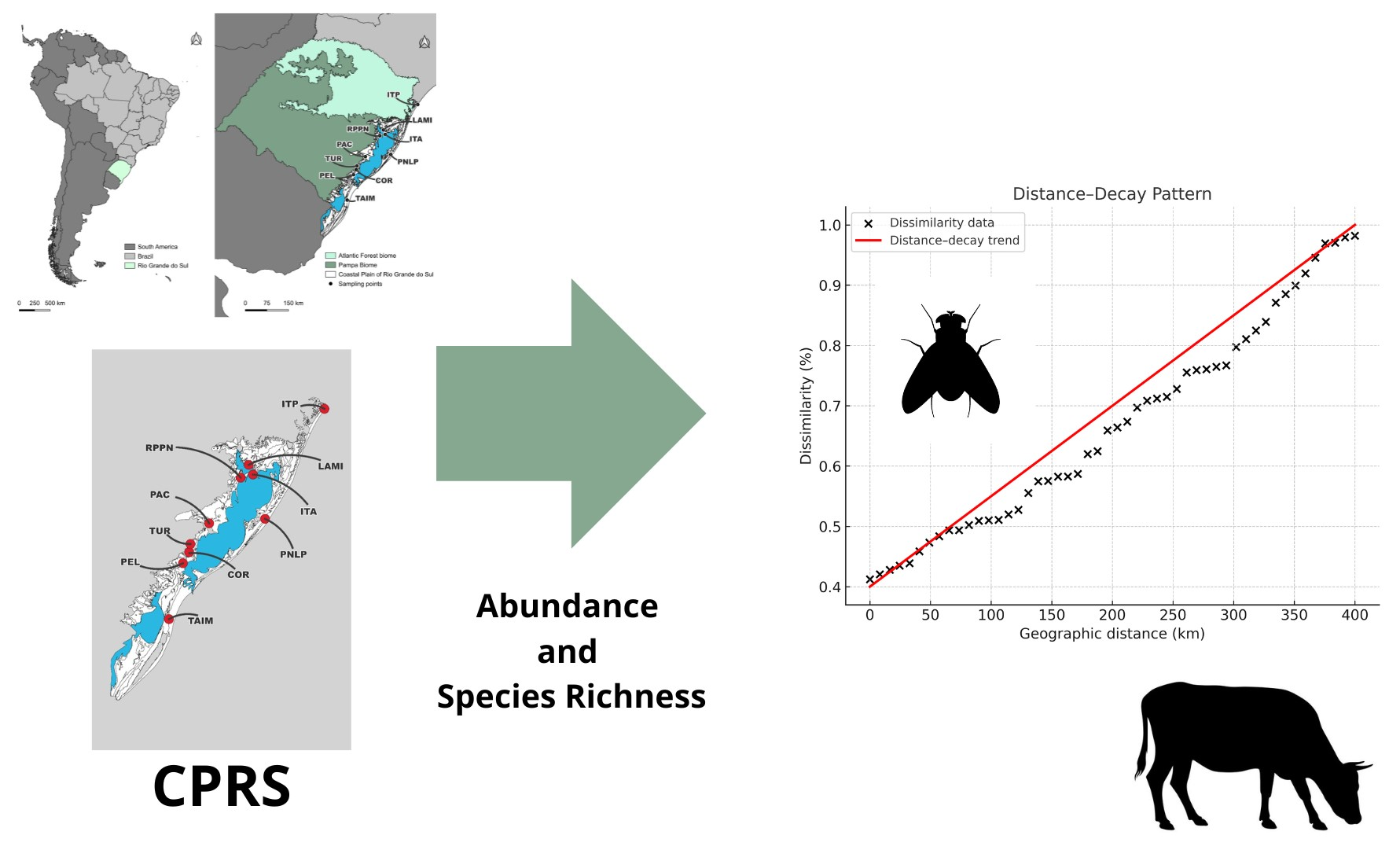

Geographic Distance as a Driver of Tabanidae Community Structure in the Coastal Plain of Southern Brazil

 , , , , and
Abstract
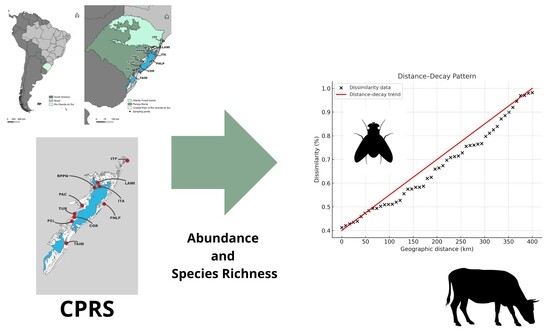
1. Introduction
2. Materials and Methods
Data Analysis
3. Results
4. Discussion
4.1. Spatial Gradients and Dissimilarity Models
4.2. Ecological Mechanisms Underlying Spatial Dissimilarity
4.3. Implications for Disease Transmission and Vector Surveillance
4.4. Analytical Limitations and Future Research Directions
5. Conclusions
Supplementary Materials
Author Contributions
Funding
Institutional Review Board Statement
Informed Consent Statement
Data Availability Statement
Acknowledgments
Conflicts of Interest
References
- Krinsky, W.L. Animal disease agents transmitted by horse flies and deer flies (Diptera: Tabanidae). J. Med. Entomol. 1976, 13, 225–275. [Google Scholar] [CrossRef]
- Baldacchino, F.; Porciani, A.; Bernard, C.; Jay-Robert, P. Spatial and temporal distribution of Tabanidae in the Pyrenees Mountains: The influence of altitude and landscape structure. Bull. Entomol. Res. 2014, 104, 1–11. [Google Scholar] [CrossRef]
- Rodrigues, G.D.; Lucas, M.; Ortiz, H.G.; dos Santos Gonçalves, L.; Blodorn, E.; Domingues, W.B.; Nunes, L.S.; Saravia, A.; Parodi, P.; Riet-Correa, F.; et al. Molecular of Anaplasma marginale Theiler (Rickettsiales: Anaplasmataceae) in horseflies (Diptera: Tabanidae) in Uruguay. Sci. Rep. 2022, 12, 22460. [Google Scholar] [CrossRef] [PubMed]
- Dafka, S.; Osman, A.M.; Koua, H.K.; Vieira, R.F.; Rocklöv, J. Impact of climate change and variability on the occurrence and distribution of Trypanosoma vectors in The Gambia. Parasitol. Res. 2025, 124, 29. [Google Scholar] [CrossRef]
- Morales, D.F.; Parodi, P.; Dos Reis, L.F.V.; Nascimento, M.C.; Rodrigues, G.D.; Nunes, L.S.; Menchaca, A.; Riet-Correa, F.; Krolow, T.K.; Lucas, M.; et al. First molecular detection of Babesia bigemina in horseflies from Uruguay. Acta Trop. 2025, 264, 107595. [Google Scholar] [CrossRef]
- Thieulent, C.J.; Carossino, M.; Reis, J.K.; Vissani, M.A.; Barrandeguy, M.E.; Valle-Casuso, J.C.; Balasuriya, U.B. Equine Infectious Anemia Virus Worldwide Prevalence: A 24-year retrospective review of a Global Equine Health Concern with Far-reaching Implications. Vet. Microbiol. 2025, 306, 110548. [Google Scholar] [CrossRef]
- Evenhuis, N.L.; Pape, T. Systema Dipterorum (version 5.6). In Catalogue of Life Checklist 2025; Catalogue of Life Foundation: Amsterdam, The Netherlands, 2025. [Google Scholar] [CrossRef]
- Coscarón, S.; Papavero, N. Catalogue of Neotropical Diptera. Tabanidae. Neotrop. Diptera 2009, 16, 1–199. [Google Scholar]
- Henriques, A.L.; Krolow, T.K.; Rafael, J.A. Corrections and additions to Catalogue of Neotropical Diptera (Tabanidae) of Coscarón & Papavero (2009). Rev. Bras. Entomol. 2012, 56, 277–280. [Google Scholar] [CrossRef]
- Ferreira-Keppler, R.L.; Rafael, J.A.; Guerrero, J.C.H. Sazonalidade e uso de ambientes por espécies de Tabanidae (Diptera) na Amazônia Central, Brasil. Neotrop. Entomol. 2010, 39, 645–654. [Google Scholar] [CrossRef]
- Krüger, R.F.; Krolow, T.K. Seasonal patterns of horse fly richness and abundance in the Pampa biome of southern Brazil. J. Vector Ecol. 2015, 40, 364–372. [Google Scholar] [CrossRef] [PubMed]
- Krolow, T.K.; Carmo, D.D.D.; Oliveira, L.P.; Henriques, A.L. The Tabanidae (Diptera) in Brazil: Historical aspects, diversity and distribution. Zoologia 2024, 41, e23074. [Google Scholar] [CrossRef]
- Krolow, T.K.; Krüger, R.F.; Ribeiro, P.B. Chave pictórica para os gêneros de Tabanidae (Insecta: Diptera) do bioma Campos Sulinos, Rio Grande do Sul, Brasil. Biota Neotrop. 2007, 7, 253–264. [Google Scholar] [CrossRef]
- Andrade, B.O.; Dröse, W.; Aguiar, C.A.D.; Aires, E.T.; Alvares, D.J.; Barbieri, R.L.; de Carvalho, C.J.B.; Bartz, M.; Becker, F.G.; Bencke, G.A.; et al. 12,500+ and counting: Biodiversity of the Brazilian Pampa. Front. Biogeogr. 2023, 15, e60957. [Google Scholar] [CrossRef]
- Buchmann, F.S.C.; Caron, F.; Lopes, R.P.; Ugri, A.; Lima, L.G. Panorama geológico da planície costeira do Rio Grande do Sul. In Quaternário do Rio Grande do Sul: Integrando Conhecimentos, 1st ed.; Sociedade Brasileira de Paleontologia: Porto Alegre, Brazil, 2009; pp. 35–56. [Google Scholar]
- Ávila, A.C.; Boelter, T.; dos Santos, R.M.; Stenert, C.; Würdig, N.L.; Rocha, O.; Maltchik, L. The effects of different rice cultivation systems and ages on resting stages of wetland invertebrates in southern Brazil. Mar. Freshw. Res. 2015, 66, 276–285. [Google Scholar] [CrossRef]
- Sganzerla, C.; Dalzochio, M.S.; Prass, G.D.S.; Périco, E. Effects of urbanization on the fauna of Odonata on the coast of southern Brazil. Biota Neotrop. 2021, 21, e20201122. [Google Scholar] [CrossRef]
- Fernandes, F.A.; Fernández-Stolz, G.P.; Lopes, C.M.; Freitas, T.R.O. The conservation status of the tuco-tucos, genus Ctenomys (Rodentia: Ctenomyidae), in southern Brazil. Braz. J. Biol. 2007, 67, 839–847. [Google Scholar] [CrossRef]
- Rolon, A.S.; Homem, H.F.; Maltchik, L. Aquatic macrophytes in natural and managed wetlands of Rio Grande do Sul State, Southern Brazil. Acta Limnol. Bras. 2010, 22, 133–146. [Google Scholar] [CrossRef]
- Kirst, F.D.; Marinoni, L.; Krüger, R.F. What does the Southern Brazilian Coastal Plain tell about its diversity? Syrphidae (Diptera) as a model. Bull. Entomol. Res. 2017, 107, 645–657. [Google Scholar] [CrossRef] [PubMed]
- Lucas, M.; Krolow, T.K.; Riet-Correa, F.; Barros, A.T.M.; Krüger, R.F.; Saravia, A.; Miraballes, C. Diversity and seasonality of horse flies (Diptera: Tabanidae) in Uruguay. Sci. Rep. 2020, 10, 401. [Google Scholar] [CrossRef] [PubMed]
- Costa, M.V.; Henriques, A.L.; Rodrigues, G.D.; Krolow, T.K.; Krüger, R.F. Tabanidae (Diptera) collected on horses in a Cerrado biome in the state of Tocantins, Brazil. Rev. Bras. Parasitol. Vet. 2024, 33, e001924. [Google Scholar] [CrossRef]
- Zamarchi, T.B.O.; Henriques, A.L.; Krolow, T.K.; Krüger, R.F.; Rodrigues, G.D.; Guimarães, A.M.; Pessoa, F.A.C.; Camargo, L.M.A. Diversity and seasonality of horse flies (Diptera: Tabanidae) in Amazon Forest fragments of Monte Negro, Rondônia, Western Amazon. Parasitol. Res. 2024, 123, 288. [Google Scholar] [CrossRef] [PubMed]
- Barros, A.T.M.; Foil, L.D. The influence of distance on movement of tabanids (Diptera: Tabanidae) between horses. Vet. Parasitol. 2007, 144, 380–384. [Google Scholar] [CrossRef] [PubMed]
- Soininen, J.; McDonald, R.; Hillebrand, H. The distance decay of similarity in ecological communities. Ecography 2007, 30, 3–12. [Google Scholar] [CrossRef]
- Nekola, J.C.; Brown, J.H. The wealth of species: Ecological communities, complex systems and the legacy of Frank Preston. Ecol. Lett. 2007, 10, 188–196. [Google Scholar] [CrossRef]
- Raes, J.; Letunic, I.; Yamada, T.; Jensen, L.J.; Bork, P. Toward molecular trait-based ecology through integration of biogeochemical, geographical and metagenomic data. Mol. Syst. Biol. 2011, 7, 473. [Google Scholar] [CrossRef]
- Kitron, U. Landscape ecology and epidemiology of vector-borne diseases: Tools for spatial analysis. J. Med. Entomol. 1998, 35, 435–445. [Google Scholar] [CrossRef]
- Turner, M.G. Landscape ecology: The effect of pattern on process. Annu. Rev. Ecol. Syst. 1989, 20, 171–197. [Google Scholar] [CrossRef]
- Townes, H. A Light-weight Malaise Trap. Entomol. News 1972, 83, 239–247. [Google Scholar]
- Zafalon-Silva, Â.; Kirst, F.D.; Krüger, R.F. Houseflies speaking for the conservation of natural areas: A broad sampling of Muscidae (Diptera) on coastal plains of the Pampa biome, Southern Brazil. Rev. Bras. Entomol. 2018, 62, 292–303. [Google Scholar] [CrossRef]
- Conservation International do Brasil; Fundação SOS Mata Atlântica; Fundação Biodiversitas; Instituto de Pesquisas Ecológicas; Secretaria do Meio Ambiente do Estado de São Paulo; SEMAD/Instituto Estadual de Florestas–MG. Avaliação e Ações Prioritárias para a Conservação da Biodiversidade da Mata Atlântica e Campos Sulinos; Ministério do Meio Ambiente/Secretaria de Biodiversidade e Florestas: Brasília, Brazil, 2000; ISBN 85-87166-09-3. [Google Scholar]
- Ministério do Meio Ambiente (MMA). Avaliação e Ações Prioritárias para a Conservação da Biodiversidade da Mata Atlântica e Campos Sulinos; MMA/SBF: Brasília, Brazil, 2000. Available online: http://www.mma.gov.br/estruturas/sbf_chm_rbbio/_arquivos/Sumario%20Mata%20Atlantica.pdf (accessed on 10 September 2025).
- Waechter, J.L. Aspectos ecológicos da vegetação de Restinga no Rio Grande do Sul, Brasil. Comum. Mus. Ciênc. PUCRS Sér. Bot. 1985, 33, 49–68. [Google Scholar]
- Waechter, J.L. Padrões geográficos na flora atual do Rio Grande do Sul. Ciênc. Ambiente 2002, 24, 93–108. [Google Scholar]
- IBGE—Instituto Brasileiro de Geografia e Estatística. Vegetação: Uso Potencial da Terra. In Levantamento de Recursos Naturais; IBGE: Rio de Janeiro, Brazil, 1986; pp. 1–796. [Google Scholar]
- IBGE—Instituto Brasileiro de Geografia e Estatística. Mapa de Vegetação do Brasil. 2004. Available online: https://geoftp.ibge.gov.br/informacoes_ambientais/vegetacao/mapas/brasil/vegetacao.pdf (accessed on 25 August 2025).
- Mello-Filho, L.E.; Somner, G.V.; Peixoto, A.L. Centuria Plantarum Brasiliensium Exstintionis Minitata; Sociedade Botânica do Brasil/IBAMA: Brasília, Brazil, 1992. [Google Scholar]
- SEMA—Secretaria Estadual do Meio Ambiente. Plano de Manejo do Parque Estadual Itapuã. 1996. Available online: https://www.sema.rs.gov.br/upload/arquivos/201610/15171153-plano-manejo-peitapua.pdf (accessed on 10 September 2025).
- SEMA—Secretaria Estadual do Meio Ambiente. Unidades de Conservação Estaduais. 2025. Available online: https://www.sema.rs.gov.br/unidades-de-conservacao-estaduais (accessed on 10 September 2025).
- Meira, J.R.; Porto, M.L. Reserva Biológica do Lami: A vida na beira do lago. In Atlas Ambiental de Porto Alegre; Menegat, R., Ed.; Editora UFRGS: Porto Alegre, Brazil, 1998; pp. 89–92. [Google Scholar]
- ICMBio—Instituto Chico Mendes de Conservação da Biodiversidade. Plano de Manejo do Parque Nacional da Lagoa do Peixe. 1999. Available online: https://www.gov.br/icmbio/pt-br/assuntos/biodiversidade/unidade-de-conservacao/unidades-de-biomas/marinho/lista-de-ucs/parna-da-lagoa-do-peixe/copy_of_PM.pdf (accessed on 25 August 2025).
- Burger, M.I. Situação e ações prioritárias para a conservação de banhados e áreas úmidas da zona costeira; Fundação Zoobotânica do Rio Grande do Sul (FZB): Porto Alegre, Brazil, 2000; 60p.
- Leite, P.F. Contribuição ao conhecimento fitoecológico do sul do Brasil. Ciênc. Ambiente 2002, 24, 52–73. [Google Scholar]
- Venzke, T.S. Florística de comunidades arbóreas no Município de Pelotas, Rio Grande do Sul. Rodriguésia 2012, 63, 571–578. [Google Scholar] [CrossRef]
- Witt, P.B.R. Fauna e Flora da Reserva Biológica Lami José Lutzenberger; Secretaria Municipal do Meio Ambiente: Porto Alegre, Brazil, 2013; 308p. [Google Scholar]
- CMPC Celulose Riograndense; Fundação Gaia—Legado Lutzenberger; SEMA/DBIO/DUC. Plano de Manejo: Reserva Particular do Patrimônio Natural Estadual Barba Negra. Guaíba. 2018. Available online: https://www.sema.rs.gov.br/upload/arquivos/202204/26171531-plano-de-manejo-rppn-estadual-barba-negra-2018.pdf (accessed on 25 August 2025).
- Waechter, J.L. Comunidades vegetais das restingas do Rio Grande do Sul. In Anais do Simpósio de Ecossistemas da Costa Sul e Sudeste Brasileira; Academia de Ciências do Estado de São Paulo: São Paulo, Brazil, 1990; Volume 3, pp. 228–238. [Google Scholar]
- Printes, R.C. Plano de Manejo Participativo da Reserva Biológica do Lami; SMAM: Porto Alegre, Brazil, 2002; 133p. [Google Scholar]
- Rambo, S.J. A Fisionomia do Rio Grande do Sul; Editora Unisinos: Porto Alegre, Brazil, 1956; 473p. [Google Scholar]
- Jost, H. O Quaternário da Planície Costeira do Rio Grande do Sul. Master’s Thesis, Universidade Federal do Rio Grande do Sul, Porto Alegre, Brazil, 1991; 80p. [Google Scholar]
- SEMA—Secretaria Estadual do Meio Ambiente. Plano de Manejo do Parque Estadual de Itapeva; Secretaria do Meio Ambiente e Infraestrutura: Porto Alegre, Brazil, 2006; 274p. Available online: https://www.sema.rs.gov.br/upload/arquivos/201610/24172037-plano-manejo-peitapeva.pdf (accessed on 10 September 2025).
- Western Hemisphere Shorebird Reserve Network (WHSRN). Lagoa do Peixe Site Description. 2025. Available online: https://whsrn.org/whsrn_sites/lagoa-do-peixe/ (accessed on 10 September 2025).
- Ramsar Convention Secretariat. Lagoa do Peixe Ramsar Site Information Service (RIS #603). 1993. Available online: https://rsis.ramsar.org/ris/603 (accessed on 10 September 2025).
- Lutz, A. Tabanidas do Brazil e alguns Estados visinhos. Mem. Inst. Oswaldo Cruz 1913, 5, 142–191. [Google Scholar] [CrossRef]
- Kröber, O. Die Tabanidenuntergattung Phaeotabanus Lutz. Zool. Anz. 1930, 86, 1–30. [Google Scholar]
- Kröber, O. Das Tabanidengenus Catachlorops Lutz (Dipt.). Veröff. Deutsch. Kolon. Übersee-Mus. Brem. 1939, 2, 211–232. [Google Scholar]
- Coscarón, S.; Philip, C.B. Key to the Neotropical species of Dasybasis Macquart. In Segundas Jornadas Entomoepidemiológicas Argentinas; Comité Organizador Ejecutivo de las Segundas Jornadas Entomoepidemiológicas Argentinas: Buenos Aires, Argentinas, 1967; Volume 1, pp. 95–103. [Google Scholar]
- Coscarón, S. Notas sobre tabánidos argentinos (Diptera) VI. El género Lepiselaga Macquart en la Argentina. Rev. Soc. Entomol. Argent. 1968, 30, 51–59. [Google Scholar]
- Coscarón, S. Notas sobre tabánidos argentinos X. El género Dichelacera Macquart (Diptera-Insecta). Rev. Soc. Entomol. Argent. 1974, 34, 229–250. [Google Scholar]
- Coscarón, S. Notas sobre tabánidos argentinos XV. El género Tabanus Linnaeus. Obra Centen. Mus. Plata 1979, 6, 251–278. [Google Scholar]
- Coscarón, S. Notas sobre tabánidos argentinos XVI. El género Chrysops Meigen (Diptera-Insecta). Acta Zool. Lilloana 1979, 25, 365–392. [Google Scholar]
- Coscarón, S.; Fairchild, G.B. El género Poeciloderas Lutz en Argentina (Tabanidae, Diptera, Insecta). Physis 1976, 35, 293–401. [Google Scholar]
- Fairchild, G.B. Notes on Neotropical Tabanidae (Diptera). XVI. The Tabanus trivittatus complex. Stud. Entomol. 1976, 19, 237–261. [Google Scholar]
- Fairchild, G.B. Notes on Neotropical Tabanidae (Diptera). XIX. The Tabanus lineola complex. Misc. Publ. Entomol. Soc. Am. 1983, 57, 1–50. [Google Scholar]
- Fairchild, G.B. Notes on Neotropical Tabanidae (Diptera). XX. The larger species of Tabanus of eastern South America. Contrib. Am. Entomol. Inst. 1984, 21, 1–50. [Google Scholar]
- Henriques, A.L.; Rafael, J.A. Revisão do gênero Neotropical Acanthocera Macquart (Diptera: Tabanidae). Acta Amaz. 1993, 23, 405–439. [Google Scholar] [CrossRef]
- Henriques, A.L.; Krolow, T.K. Description of a new species of Tabanidae (Diptera) from the Amazon region: Catachlorops (Rhamphidommia) dubius sp. nov. and a key to species of the subgenus. Zootaxa 2009, 2295, 64–68. [Google Scholar] [CrossRef]
- Krolow, T.K.; Henriques, A.L. Taxonomic revision of the New World genus Chlorotabanus Lutz, 1913 (Diptera: Tabanidae). Zootaxa 2010, 2656, 1–40. [Google Scholar] [CrossRef]
- Wilkerson, R.C.; Fairchild, G.B. Five new species of Diachlorus (Diptera: Tabanidae) from South America, with a revised key to species and new locality records. Proc. Entomol. Soc. Wash. 1982, 84, 636–650. [Google Scholar]
- Oksanen, J.; Simpson, G.L.; Blanchet, F.G.; Kindt, R.; Legendre, P.; Minchin, P.R.; O’Hara, R.B.; Solymos, P.; Stevens, M.H.H.; Szoecs, E.; et al. Vegan: Community Ecology Package. R Package Version 2.7-1, 5 June 2025. Available online: https://cran.r-project.org/package=vegan (accessed on 17 December 2025).
- Hijmans, R.J.; Barbosa, M.; Bivand, R.; Brown, A.; Chirico, M.; Cordano, E.; Dyba, K.; Pebesma, E.; Rowlingson, B.; Sumner, M.D. Terra: Spatial Data Analysis. R Package Version 1.7-78. 2024. Available online: https://CRAN.R-project.org/package=terra (accessed on 17 December 2025).
- R Development Core Team. R: A Language and Environment for Statistical Computing; R Foundation for Statistical Computing: Vienna, Austria, 2025. [Google Scholar]
- Gachoki, S.M.; Groen, T.A.; Vrieling, A.; Skidmore, A.K.; Masiga, D. Towards accurate spatial prediction of Glossina pallidipes relative densities at country-scale in Kenya. Ecol. Inform. 2024, 81, 102610. [Google Scholar] [CrossRef]
- Nekola, J.C.; White, P.S. The distance decay of similarity in biogeography and ecology. J. Biogeogr. 1999, 26, 867–878. [Google Scholar] [CrossRef]
- Batson, J.; Dudas, G.; Haas-Stapleton, E.; Kistler, A.L.; Li, A.L.; Logan, P.; Ratnasiri, K.; Retallack, H. Single Mosquito Metatranscriptomics Identifies Vectors, Emerging Pathogens and Reservoirs in One Assay. eLife 2021, 10, e68353. [Google Scholar] [CrossRef] [PubMed]
- Rousseau, R.; Delooz, L.; Dion, E.; Quinet, C.; Vanwambeke, S.O. Environmental determinants of Anaplasma phagocytophilum infection in cattle using a kernel density function. Ticks Tick-Borne Dis. 2021, 12, 101814. [Google Scholar] [CrossRef]
- Qiu, J.; Li, X.; Zhu, H.; Xiao, F. Spatial epidemiology and its role in prevention and control of swine viral disease. Animals 2024, 14, 2814. [Google Scholar] [CrossRef]
- Wen, T.H.; Tsai, C.T.; Chin, W.C.B. Evaluating the role of disease importation in the spatiotemporal transmission of indigenous dengue outbreak. Appl. Geogr. 2016, 76, 137–146. [Google Scholar] [CrossRef]
- Zamarchi, T.B.O.; Henriques, A.L.; Krolow, T.K.; Krüger, R.F.; Rodrigues, G.D.; Guimarães, A.M.; Pessoa, F.A.C.; Camargo, L.M.A. Tabanidae (Diptera) captured on horses in Amazon Forest fragments of the state of Rondônia, Brazil. Acta Trop. 2023, 237, 106734. [Google Scholar] [CrossRef]
- Barros, A.T.M. Seasonality and relative abundance of Tabanidae (Diptera) captured on horses in the Pantanal, Brazil. Mem. Inst. Oswaldo Cruz 2001, 96, 917–923. [Google Scholar] [CrossRef]
- Marques, R.; Jiménez-García, D.; Escobar, L.E.; Krolow, T.K.; Krüger, R.F. Spatial epidemiology of Tabanus (Diptera: Tabanidae) vectors of Trypanosoma. Parasites Vectors 2025, 18, 128. [Google Scholar] [CrossRef]
- Muzari, M.O.; Skerratt, L.F.; Jones, R.E.; Duran, T.L. Alighting and feeding behaviour of tabanid flies on horses, kangaroos and pigs. Vet. Parasitol. 2010, 170, 104–111. [Google Scholar] [CrossRef]
- Rodrigues, G.D.; Blodorn, E.; Zafalon-Silva, Â.; Domingues, W.; Marques, R.; Krolow, T.K.; Greif, G.; Campos, V.F.; Krüger, R.F. Molecular detection of Trypanosoma kaiowa in Tabanus triangulum (Diptera: Tabanidae) from the coastal plain of Rio Grande do Sul, southern Brazil. Acta Parasitol. 2022, 67, 518–522. [Google Scholar] [CrossRef] [PubMed]
- Miletti, L.C.; Colombo, B.B.; Cardoso, C.P.; Stalliviere, F.M.; Tavares, K.C.S.; Komati, L.K.O.; Vieira, L.L.; Christen, S.E.; Ramos, C.J.R. Prevalence, seasonality and behaviour of Tabanidae (Diptera) captured on a horse in the Planalto Serrano of Santa Catarina State, Brazil. Int. J. Trop. Insect Sci. 2011, 31, 122–126. [Google Scholar] [CrossRef]
- Dutra, R.R.; Marinoni, R.C. Insetos capturados com armadilha Malaise na Ilha do Mel, Baía de Paranaguá, Paraná, Brasil: II. Tabanidae (Diptera). Rev. Bras. Zool. 1994, 11, 247–256. [Google Scholar] [CrossRef]
- Mihok, S.; Lange, K. Synergism between ammonia and phenols for Hybomitra tabanids in northern and temperate Canada. Med. Vet. Entomol. 2012, 26, 282–290. [Google Scholar] [CrossRef]
- Pan, Y.-F.; Zhao, H.; Gou, Q.-Y.; Shi, P.-B.; Tian, J.-H.; Feng, Y.; Li, K.; Yang, W.-H.; Wu, D.; Tang, G.; et al. Metagenomic analysis of individual mosquito viromes reveals the geographical patterns and drivers of viral diversity. Nat. Ecol. Evol. 2024, 8, 1–17. [Google Scholar] [CrossRef]
- Rulli, M.C.; D’Odorico, P.; Galli, N.; John, R.S.; Muylaert, R.L.; Santini, M.; Hayman, D.T.S. Land Use Change and Infectious Disease Emergence. Rev. Geophys. 2025, 63, e2022RG000785. [Google Scholar] [CrossRef]
- Ostfeld, R.S.; Keesing, F. Biodiversity series: The function of biodiversity in the ecology of vector-borne zoonotic diseases. Can. J. Zool. 2000, 78, 2061–2078. [Google Scholar] [CrossRef]
- Chaves, L.F.; Hamer, G.L.; Walker, E.D.; Brown, W.M.; Ruiz, M.O.; Kitron, U.D. Climatic variability and landscape heterogeneity impact urban mosquito diversity and vector abundance and infection. Ecosphere 2011, 2, 1–21. [Google Scholar] [CrossRef]
- Bennett, K.L.; Almanza, A.; McMillan, W.O.; Saltonstall, K.; Vdovenko, E.L.; Vinda, J.S.; Mejia, L.; Driesse, K.; De León, L.F.; Loaiza, J.R. Habitat disturbance and the organization of bacterial communities in Neotropical hematophagous arthropods. PLoS ONE 2019, 14, e0222145. [Google Scholar] [CrossRef]
- Farner, J.E.; Howard, M.; Smith, J.R.; Anderson, C.B.; Mordecai, E.A. Local tree cover predicts mosquito species richness and disease vector presence in a tropical countryside landscape. Landsc. Ecol. 2025, 40, 111. [Google Scholar] [CrossRef]
- Shen, Y.; Ren, Z.; Fan, J.; Xiao, J.; Zhang, Y.; Liu, X. Fine-Scale Risk Mapping for Dengue Vector Using Spatial Downscaling in Intra-Urban Areas of Guangzhou, China. Insects 2025, 16, 661. [Google Scholar] [CrossRef]
- Breeland, S.G.; Pickard, E. The Malaise trap—An efficient and unbiased mosquito collecting device. Mosq. News 1965, 25, 221–228. [Google Scholar] [CrossRef]
- Legendre, P.; Fortin, M.-J.; Borcard, D. Spatial analysis of ecological data. In Encyclopedia of Life Support Systems (EOLSS); UNESCO/EOLSS Publishers: Oxford, UK, 2005. [Google Scholar]
- Martín-Devasa, R.; Martínez-Santalla, S.; Gomez-Rodríguez, C.; Crujeiras, R.M.; Baselga, A. Comparing distance-decay parameters: A novel test under pairwise dependence. Ecol. Inform. 2022, 72, 101894. [Google Scholar] [CrossRef]
- Buckley, J.; Beresford, D.V.; Marshall, S.A.; Lindsay, R. Horse fly and deer fly (Diptera: Tabanidae) species and abundance following logging in northwestern Ontario. For. Ecol. Manag. 2023, 544, 121158. [Google Scholar] [CrossRef]
- Multini, L.C.; de Souza, A.L.D.S.; Marrelli, M.T.; Wilke, A.B.B. The influence of anthropogenic habitat fragmentation on the genetic structure and diversity of the malaria vector Anopheles cruzii (Diptera: Culicidae). Sci. Rep. 2020, 10, 18018. [Google Scholar] [CrossRef] [PubMed]
- Orlandin, E.; Santos, E.B.; Schneeberger, A.H.; Souza, V.O.; Favretto, M.A. Habitat use by Neotropical mosquitoes (Diptera: Culicidae): Vegetation structure and edge effects. Aust. Entomol. 2020, 59, 541–548. [Google Scholar] [CrossRef]
- Corrêa-Neto, J.J.; Henriques, A.L. Horse Flies (Diptera: Tabanidae) in Mangrove Forests and Estuarine Floodplains on Marajó Island, Brazil. Neotrop. Entomol. 2023, 52, 571–583. [Google Scholar] [CrossRef] [PubMed]
- Zittra, C.; Vitecek, S.; Obwaller, A.G.; Rossiter, H.; Eigner, B.; Zechmeister, T.; Fuehrer, H.P. Landscape structure affects distribution of potential disease vectors (Diptera: Culicidae). Parasites Vectors 2017, 10, 205. [Google Scholar] [CrossRef] [PubMed]
- Estrada-Peña, A.; Mallón, A.R.; Bermúdez, S.; De La Fuente, J.; Domingos, A.; García, M.P.E.; Labruna, M.B.; Merino, O.; Mosqueda, J.; Nava, S.; et al. One health approach to identify research needs on Rhipicephalus microplus ticks in the Americas. Pathogens 2022, 11, 1180. [Google Scholar] [CrossRef]
- Marques, R.; Krüger, R.F.; Peterson, A.T.; de Melo, L.F.; Vicenzi, N.; Jiménez-García, D. Climate change implications for the distribution of the babesiosis and anaplasmosis tick vector, Rhipicephalus (Boophilus) microplus. Vet. Res. 2020, 51, 81. [Google Scholar] [CrossRef]



| Region | Sampling Period | Route Distance (Km) | Tmax (°C) | Tmin (°C) | TM (°C) | RH% |
|---|---|---|---|---|---|---|
| 1 | 27 October to 8 November 2011 | 257 | 23.28 | 12.26 | 17.77 | 74 |
| 2 | 16 to 27 November 2011 | 1040 | 29.16 | 17.00 | 23.08 | 69 |
| 3 | 7 to 17 December 2011 | 238 | 24.45 | 17.20 | 20.82 | 79 |
| 4 | 12 to 22 January 2012 | 1068 | 30.38 | 20.77 | 24.53 | 81 |
| 5 | 3 to 12 February 2012 | 442 | 29.68 | 20.93 | 25.30 | 78 |
| Model | Formula | Parameters | Biological Rationale for Distance–Decay |
|---|---|---|---|
| Linear | D(d) = α + β·d | α: dissimilarity at zero distance; β: average increase per km | Approximately proportional increase in turnover with distance when no saturation is evident within the sampled range. |
| Log-linear | D(d) = α + β·log(1 + d) | α: baseline; β: rate with log-distance | Rapid initial turnover at short distances with diminishing increments as distance grows. |
| Square-root | D(d) = α + β·√d | α: baseline; β: sublinear increase per √km | Early acceleration followed by sublinear growth; moderate concavity consistent with short–medium range dispersal limitation. |
| Quadratic | D(d) = α + β·d + γ·d2 | α: baseline; β: linear trend; γ: curvature | Flexible curve for accelerating or decelerating turnover when the relationship bends but does not strictly saturate. |
| Exponential–saturating | D(d) = a·(1 − e−b*d·) | a: asymptote; b: rate constant | Strong short-range turnover that levels off as communities approach maximal dissimilarity. |
| Michaelis–Menten (asymptotic) | D(d) = V_max·d/(K_m + d) | V_max: asymptote; K_m: half-saturation distance (D50) | Asymptotic increase with interpretable scales (D50, D75, D90) for turnover distances. |
| Segmented (“hockey stick”) | For d ≤ ψ: D(d) = α + β1·d; for d > ψ: D(d) = α + β1·ψ + β2·(d − ψ) | α: intercept; β1, β2: slopes; ψ: breakpoint | Allows a threshold where turnover rate changes, e.g., across ecoregional or major habitat transitions. |
| Species | PEL | COR | TUR | RPPN | LAMI | PAC | TAIM | ITA | ITP | PNLP | Abund | (%) |
|---|---|---|---|---|---|---|---|---|---|---|---|---|
| NP | NP | NP | P | P | NP | P | P | P | P | ____ | ____ | |
| N Malaise | 10 | 7 | 8 | 16 | 4 | 3 | 22 | 9 | 4 | 15 | 98 | |
| q0 (richness) | 6 | 5 | 7 | 15 | 7 | 7 | 6 | 7 | 3 | 10 | ____ | ____ |
| Shannon | 0.228 | 0.714 | 0.629 | 1.768 | 1.706 | 1.135 | 1.355 | 1.558 | 0.181 | 1.405 | ____ | ____ |
| q1 (exp Shannon) | 1.26 | 2.04 | 1.88 | 5.86 | 5.51 | 3.11 | 3.88 | 4.75 | 1.20 | 4.08 | ____ | ____ |
| Simpson (1 − λ) | 0.081 | 0.467 | 0.375 | 0.756 | 0.781 | 0.601 | 0.699 | 0.738 | 0.071 | 0.634 | ____ | ____ |
| q2 (1/Simpson) | 1.09 | 1.88 | 1.60 | 4.10 | 4.58 | 2.51 | 3.33 | 3.81 | 1.08 | 2.73 | ____ | ____ |
| Chrysops nigricorpus Lutz, 1911 | 0 | 0 | 0 | 0 | 0 | 0 | 0 | 0 | 0 | 1 | 1 | 0.03 |
| Chrysops varians Wiedemann, 1828 | 0 | 3 | 8 | 6 | 4 | 0 | 19 | 3 | 0 | 75 | 118 | 3.20 |
| Chrysops variegatus (De Geer, 1776) | 3 | 0 | 1 | 0 | 2 | 6 | 0 | 0 | 0 | 0 | 12 | 0.33 |
| Fidena marginalis (Wiedemann, 1830) | 0 | 0 | 0 | 0 | 0 | 0 | 0 | 0 | 0 | 1 | 1 | 0.03 |
| Acanthocera aureoscutellata Henriques & Rafael, 1992 | 0 | 0 | 0 | 2 | 0 | 1 | 0 | 0 | 0 | 0 | 3 | 0.08 |
| Acanthocera exstincta (Wiedemann, 1828) | 0 | 2 | 1 | 0 | 2 | 0 | 0 | 0 | 0 | 0 | 5 | 0.14 |
| Acanthocera longicornis (Fabricius, 1775) | 0 | 0 | 0 | 0 | 0 | 0 | 0 | 0 | 0 | 6 | 6 | 0.16 |
| Catachlorops aff. fuscinevris (Macquart, 1838) | 0 | 0 | 0 | 8 | 0 | 0 | 0 | 0 | 0 | 0 | 8 | 0.22 |
| Catachlorops potator (Wiedemann, 1828) | 0 | 0 | 0 | 3 | 0 | 0 | 0 | 0 | 0 | 0 | 3 | 0.08 |
| Chlorotabanus inanis (Fabricius, 1787) | 0 | 0 | 0 | 4 | 0 | 0 | 0 | 0 | 0 | 0 | 4 | 0.11 |
| Dasybasis missionum (Macquart, 1838) | 0 | 0 | 2 | 0 | 0 | 0 | 1 | 0 | 0 | 0 | 3 | 0.08 |
| Diachlorus bivittatus (Wiedemann, 1828) | 0 | 0 | 0 | 82 | 0 | 0 | 0 | 0 | 0 | 1 | 83 | 2.25 |
| Dichelacera alcicornis (Wiedemann, 1828) | 0 | 0 | 0 | 50 | 13 | 0 | 0 | 1 | 53 | 0 | 117 | 3.18 |
| Dichelacera fuscipes Lutz & Neiva, 1915 | 0 | 0 | 0 | 0 | 0 | 6 | 0 | 8 | 0 | 0 | 14 | 0.38 |
| Lepiselaga albitarsis Macquart, 1850 | 2 | 0 | 0 | 0 | 15 | 0 | 113 | 0 | 0 | 0 | 130 | 3.53 |
| Phaeotabanus litigiosus (Walker, 1850) | 0 | 0 | 0 | 6 | 0 | 0 | 0 | 1 | 0 | 0 | 7 | 0.19 |
| Poeciloderas quadripunctatus (Fabricius, 1805) | 4 | 0 | 0 | 2 | 0 | 0 | 15 | 0 | 0 | 3 | 24 | 0.65 |
| Tabanus claripennis (Bigot, 1892) | 15 | 217 | 199 | 1 | 1 | 17 | 48 | 0 | 0 | 10 | 508 | 13.80 |
| Tabanus fuscofasciatus Macquart, 1838 | 0 | 0 | 0 | 52 | 0 | 27 | 0 | 0 | 0 | 0 | 79 | 2.15 |
| Tabanus fuscus Wiedemann, 1819 | 0 | 0 | 0 | 1 | 0 | 0 | 0 | 12 | 1 | 11 | 25 | 0.68 |
| Tabanus sorbillans Wiedemann, 1828 | 0 | 0 | 0 | 0 | 0 | 0 | 0 | 0 | 1 | 0 | 1 | 0.03 |
| Tabanus occidentalis Linnaeus, 1758 | 5 | 2 | 1 | 37 | 7 | 155 | 0 | 1 | 0 | 0 | 208 | 5.65 |
| Tabanus pungens Wiedemann, 1828 | 0 | 0 | 0 | 0 | 0 | 0 | 0 | 0 | 0 | 1 | 1 | 0.03 |
| Tabanus sp. | 0 | 0 | 0 | 5 | 0 | 0 | 0 | 0 | 0 | 0 | 5 | 0.14 |
| Tabanus triangulum Wiedemann, 1828 | 669 | 403 | 659 | 187 | 22 | 229 | 119 | 4 | 0 | 24 | 2316 | 62.90 |
| Local abundance | 698 | 627 | 871 | 446 | 66 | 441 | 315 | 30 | 55 | 133 | 3682 |
| (a) Bray–Curtis dissimilarity | ||||||||||
| Locality | Pelotas | Corrientes | Turucu | RPPN | Lami | Pacheca | Taim | Itapua | Itapeva | Peixe |
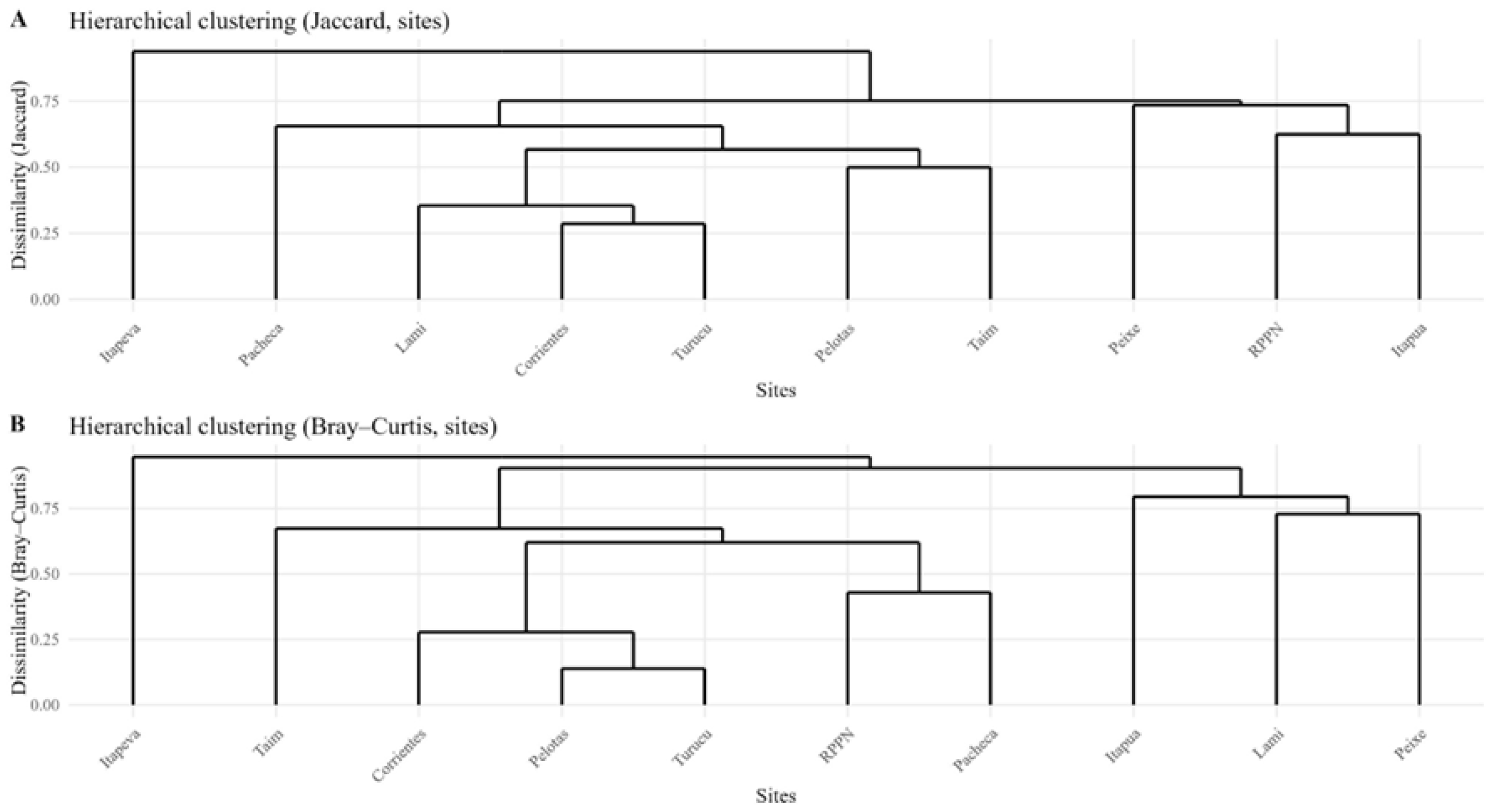
| Pelotas | 0.000 | 0.366 | 0.138 | 0.659 | 0.916 | 0.558 | 0.724 | 0.986 | 1.000 | 0.911 |
| Corrientes | 0.366 | 0.000 | 0.190 | 0.640 | 0.913 | 0.536 | 0.639 | 0.976 | 1.000 | 0.903 |
| Turucu | 0.138 | 0.190 | 0.000 | 0.704 | 0.936 | 0.622 | 0.703 | 0.982 | 1.000 | 0.916 |
| RPPN | 0.659 | 0.640 | 0.704 | 0.000 | 0.816 | 0.430 | 0.664 | 0.954 | 0.796 | 0.879 |
| Lami | 0.916 | 0.913 | 0.936 | 0.816 | 0.000 | 0.874 | 0.780 | 0.812 | 0.785 | 0.729 |
| Pacheca | 0.558 | 0.536 | 0.622 | 0.430 | 0.874 | 0.000 | 0.640 | 0.953 | 1.000 | 0.882 |
| Taim | 0.724 | 0.639 | 0.703 | 0.664 | 0.780 | 0.640 | 0.000 | 0.959 | 1.000 | 0.750 |
| Itapua | 0.986 | 0.976 | 0.982 | 0.954 | 0.812 | 0.953 | 0.959 | 0.000 | 0.953 | 0.779 |
| Itapeva | 1.000 | 1.000 | 1.000 | 0.796 | 0.785 | 1.000 | 1.000 | 0.953 | 0.000 | 0.989 |
| Peixe | 0.911 | 0.903 | 0.916 | 0.879 | 0.729 | 0.882 | 0.750 | 0.779 | 0.989 | 0.000 |
| (b) Jaccard dissimilarity | ||||||||||
| Locality | Pelotas | Corrientes | Turucu | RPPN | Lami | Pacheca | Taim | Itapua | Itapeva | Peixe |
| Pelotas | 0.000 | 0.625 | 0.556 | 0.765 | 0.444 | 0.556 | 0.500 | 0.818 | 1.000 | 0.769 |
| Corrientes | 0.625 | 0.000 | 0.286 | 0.750 | 0.375 | 0.667 | 0.625 | 0.667 | 1.000 | 0.750 |
| Turucu | 0.556 | 0.286 | 0.000 | 0.778 | 0.333 | 0.600 | 0.556 | 0.727 | 1.000 | 0.786 |
| RPPN | 0.765 | 0.750 | 0.778 | 0.000 | 0.722 | 0.706 | 0.765 | 0.625 | 0.875 | 0.684 |
| Lami | 0.444 | 0.375 | 0.333 | 0.722 | 0.000 | 0.636 | 0.600 | 0.636 | 0.900 | 0.800 |
| Pacheca | 0.556 | 0.667 | 0.600 | 0.706 | 0.636 | 0.000 | 0.818 | 0.727 | 1.000 | 0.867 |
| Taim | 0.500 | 0.625 | 0.556 | 0.765 | 0.600 | 0.818 | 0.000 | 0.818 | 1.000 | 0.667 |
| Itapua | 0.818 | 0.667 | 0.727 | 0.625 | 0.636 | 0.727 | 0.818 | 0.000 | 0.750 | 0.786 |
| Itapeva | 1.000 | 1.000 | 1.000 | 0.875 | 0.900 | 1.000 | 1.000 | 0.750 | 0.000 | 0.917 |
| Peixe | 0.769 | 0.750 | 0.786 | 0.684 | 0.800 | 0.867 | 0.667 | 0.786 | 0.917 | 0.000 |
| Region | Bray–Curtis vs. Pelotas | Bray–Curtis vs. Capão | Jaccard vs. Pelotas | Jaccard vs. Capão |
|---|---|---|---|---|
| 1 | 0.8208 | 0.9287 | 0.6667 | 0.7143 |
| 2 | 0.8806 | 0.8824 | 0.7857 | 0.8000 |
| 3 | 0.8810 | 0.8919 | 0.5714 | 0.5000 |
| 4 | 0.6500 | 0.6667 | 0.6667 | 0.7778 |
| 5 | 0.9275 | 0.8912 | 0.8000 | 0.7273 |
| Bray–Curtis (abundance): AIC and ΔAIC | ||
|---|---|---|
| Model | AIC | ΔAIC |
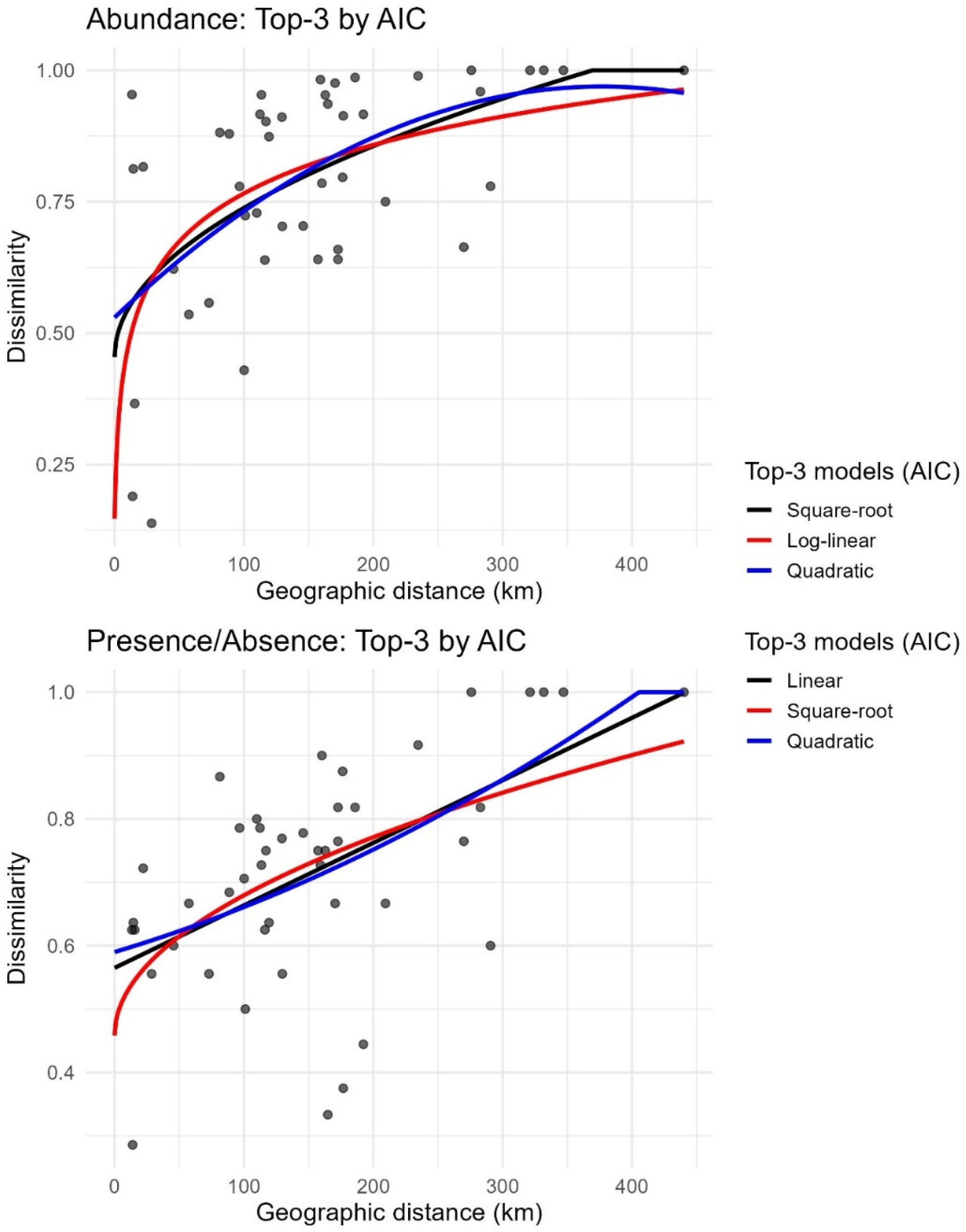
| Square-root | −24.51 | 0.00 |
| Log-linear | −23.74 | 0.77 |
| Quadratic | −22.73 | 1.78 |
| Linear | −22.47 | 2.04 |
| Segmented (“hockey stick”) | −21.79 | 2.72 |
| Michaelis–Menten (asymptotic) | −19.57 | 4.93 |
| Exponential–saturating | −14.21 | 10.30 |
| Jaccard (presence/absence): AIC and ΔAIC | ||
| Model | AIC | ΔAIC |
| Linear | −42.64 | 0.00 |
| Square-root | −41.09 | 1.54 |
| Quadratic | −40.99 | 1.65 |
| Segmented (“hockey stick”) | −39.82 | 2.82 |
| Log-linear | −38.20 | 4.43 |
| Michaelis–Menten (asymptotic) | −33.76 | 8.88 |
| Exponential–saturating | −31.00 | 11.64 |
| Model | Estimate | AIC | Metric | Parameter | Std. Error | CI 2.5% | CI 97.5% | DeltaAIC |
|---|---|---|---|---|---|---|---|---|
| Square-root | 0.454 | −24.509 | Bray–Curtis | Intercept | 0.078 | 0.297 | 0.612 | 0.000 |
| Square-root | 0.028 | −24.509 | Bray–Curtis | sqrt(Distance) | 0.006 | 0.016 | 0.041 | 0.000 |
| Log-linear | 0.147 | −23.743 | Bray–Curtis | Intercept | 0.148 | −0.152 | 0.446 | 0.766 |
| Log-linear | 0.134 | −23.743 | Bray–Curtis | log(1 + Distance) | 0.031 | 0.072 | 0.196 | 0.766 |
| Quadratic | 0.530 | −22.732 | Bray–Curtis | Intercept | 0.073 | 0.383 | 0.677 | 1.777 |
| Quadratic | 0.002 | −22.732 | Bray–Curtis | Distance (km) | 0.001 | 0.001 | 0.004 | 1.777 |
| Quadratic | −0.000 | −22.732 | Bray–Curtis | Distance2 | 0.000 | −0.000 | 0.000 | 1.777 |
| Linear | 0.565 | −42.635 | Jaccard | Intercept | 0.040 | 0.484 | 0.646 | 0.000 |
| Linear | 0.001 | −42.635 | Jaccard | Distance (km) | 0.000 | 0.001 | 0.001 | 0.000 |
| Square-root | 0.458 | −41.093 | Jaccard | Intercept | 0.065 | 0.327 | 0.589 | 1.543 |
| Square-root | 0.022 | −41.093 | Jaccard | sqrt(Distance) | 0.005 | 0.012 | 0.033 | 1.543 |
| Quadratic | 0.590 | −40.987 | Jaccard | Intercept | 0.059 | 0.470 | 0.710 | 1.648 |
| Quadratic | 0.001 | −40.987 | Jaccard | Distance (km) | 0.001 | −0.001 | 0.002 | 1.648 |
| Quadratic | 0.000 | −40.987 | Jaccard | Distance2 | 0.000 | −0.000 | 0.000 | 1.648 |
Disclaimer/Publisher’s Note: The statements, opinions and data contained in all publications are solely those of the individual author(s) and contributor(s) and not of MDPI and/or the editor(s). MDPI and/or the editor(s) disclaim responsibility for any injury to people or property resulting from any ideas, methods, instructions or products referred to in the content. |
© 2026 by the authors. Licensee MDPI, Basel, Switzerland. This article is an open access article distributed under the terms and conditions of the Creative Commons Attribution (CC BY) license.
Share and Cite
Krüger, R.F.; Silva, H.I.L.d.L.; Dimer, R.d.F.R.M.; Aita, M.F.; Parodi, P.; Mihok, S.; Krolow, T.K. Geographic Distance as a Driver of Tabanidae Community Structure in the Coastal Plain of Southern Brazil. Parasitologia 2026, 6, 5. https://doi.org/10.3390/parasitologia6010005
Krüger RF, Silva HILdL, Dimer RdFRM, Aita MF, Parodi P, Mihok S, Krolow TK. Geographic Distance as a Driver of Tabanidae Community Structure in the Coastal Plain of Southern Brazil. Parasitologia. 2026; 6(1):5. https://doi.org/10.3390/parasitologia6010005
Chicago/Turabian StyleKrüger, Rodrigo Ferreira, Helena Iris Leite de Lima Silva, Rafaela de Freitas Rodrigues Mengue Dimer, Marta Farias Aita, Pablo Parodi, Steve Mihok, and Tiago Kütter Krolow. 2026. "Geographic Distance as a Driver of Tabanidae Community Structure in the Coastal Plain of Southern Brazil" Parasitologia 6, no. 1: 5. https://doi.org/10.3390/parasitologia6010005
APA StyleKrüger, R. F., Silva, H. I. L. d. L., Dimer, R. d. F. R. M., Aita, M. F., Parodi, P., Mihok, S., & Krolow, T. K. (2026). Geographic Distance as a Driver of Tabanidae Community Structure in the Coastal Plain of Southern Brazil. Parasitologia, 6(1), 5. https://doi.org/10.3390/parasitologia6010005