
Article

The Caddisfly Genus Contulma Flint, 1969 (Trichoptera: Anomalopsychidae) in Brazil: A New Species, Distribution, and an Identification Key †

by
Gleison R. Desidério
1,2,3,*,
Lívia Piovezani
1,
Maria C. L. Ghirardello
1,2 and
Pitágoras C. Bispo
1
1
Laboratório de Biologia Aquática (LABIA), Faculdade de Ciências e Letras de Assis (FCLAs), Universidade Estadual Paulista “Júlio de Mesquita Filho” (UNESP), Assis 19806-900, Brazil
2
Programa de Pós-Graduação em Biociências—Interunidades, Universidade Estadual Paulista “Júlio de Mesquita Filho” (UNESP), Assis 19806-900, Brazil
3
Programa de Pós-Graduação em Biodiversidade Neotropical (PPGBN), Universidade Federal da Integração Latino-Americana (UNILA), Foz do Iguaçu 85870-650, Brazil
*
Author to whom correspondence should be addressed.
urn:lsid:zoobank.org:pub:6B98EE8A-2A2A-4B10-B7A5-A9041E068807; urn:lsid:zoobank.org:act:FB574421-77AE-4774-9199-7B70722D692C.
Taxonomy 2026, 6(2), 23; https://doi.org/10.3390/taxonomy6020023
Submission received: 7 March 2026 / Revised: 31 March 2026 / Accepted: 31 March 2026 / Published: 10 April 2026

Abstract

Anomalopsychidae Flint, 1981, is a small family of caddisflies comprising two genera: the monotypic Anomalopsyche Flint, 1967, and Contulma Flint, 1969, including 31 described species grouped into the cranifer and spinosa species groups. The genus Contulma is distributed across Costa Rica, the Andes, and the mountainous areas of Brazil and Chile, with six species recorded in Brazil, primarily from the Atlantic Forest biome in the southeastern region. In this study, we describe and illustrate a new species of Contulma from the Cerrado biome of São Paulo State, representing the first record of the genus in this biome. Male specimens were collected using Malaise traps in a stream within a protected area. The new species is distinguished by the presence of both a strongly sclerotized dorsomesal process and a strongly dorsolateral process on tergum IX and by an extremely deep cleft in the posteromesal process of sternum IX, dividing it into two narrow, digitated lobes. Based on its unique combination of characters, the new species cannot be placed unambiguously in either of the species groups. Consequently, C. assisensis sp. nov. is here treated as incertae sedis within Contulma. With this addition, seven species of Contulma are now known from Brazil, most of which are recorded from the Atlantic Forest (6 spp.), especially in the mountainous areas of southeastern Brazil. The discovery of this new species in the Cerrado highlights the underestimated diversity of the genus in Brazil and underscores the importance of regional taxonomic studies for addressing biogeographic and diversity knowledge gaps. The identification key provided enables the differentiation of the seven Contulma species now known from Brazil.

1. Introduction

The family Anomalopsychidae Flint, 1981, belongs to Sericostomatoidea, a large group of integripalpian caddisflies comprising 15 families [1,2]. Although the synonym of Anomalopsychidae under Antipodeciidae Ross, 1967, has been proposed by St. Clair et al. [3] based on morphological similarities, recent molecular-based phylogenetic studies of caddisflies do not corroborate this proposal [2,4], and therefore the taxa are treated as separate families. This is a small family of Andean and Neotropical caddisflies, with only two genera: the monotypic Anomalopsyche Flint, 1967, and the most diverse Contulma Flint, 1969 [5], which were originally classified in Sericostomatidae [6,7].
Adults of Contulma can be primarily distinguished by their unique wing venation and genital morphology. The forewing is characterized by a vein Rs that is shorter than the veins R2+3 and R4+5; the m-cu crossvein intersects Cu1 near the base of fork V, and vein 1A forms a distinct arch with vein Cu2. The hindwing lacks fork I. In the male genitalia, the inferior appendages are unsegmented, highly modified, and relatively small or indistinct. Tergum X is significantly reduced and typically membranous. In the female genitalia, segment VIII is modified such that tergum X is curved, the sternite is elongated and dorsally concave, and the vaginal sclerites are trident-shaped [8].
Except for the type species, Contulma cranifer Flint, 1969, which occurs in the Andean region (sensu Morrone [9]), most species of Contulma are distributed across the Neotropical region (sensu Morrone [10]). Their range extends from Costa Rica, through the Andes of Bolivia, Colombia, Ecuador, and Peru, to the mountains of southeastern Brazil [11]. Based on a morphology-based phylogeny, Holzenthal and Flint [8] classified the genus into two species groups: the cranifer Group and the spinosa Group. Currently, Contulma comprises 31 described species, about half of which were described over the last two decades in subsequent contributions [8,11,12,13,14,15].
Species of the genus Contulma exhibit a high degree of local endemism across the mountainous regions of Central and South America [12]. The genus reaches its peak of recorded species in Ecuador (10 species), followed by Colombia (8 species), and Brazil and Costa Rica (6 species each) [11,15]. In Brazil, known species are primarily distributed in the highlands of the Atlantic Forest biome within the country’s Southeastern region [16] (Figure 1A).
In this study, we describe and illustrate a new species of Contulma based on adult male specimens collected in a well-preserved protected area within the Cerrado biome of southeastern Brazil, São Paulo state (Figure 1A). Additionally, we provide an identification key for males of all known Brazilian species in the genus.

2. Materials and Methods

2.1. Study Area, Specimen Collection, Preparation, and Observation

Adult specimens were collected using a Malaise trap [17] in a second-order stream within the Assis Ecological Station, municipality of Assis, western São Paulo State, Brazil (Figure 1B,C). This protected and preserved area lies in the Atlantic Forest-Cerrado ecotonal zone, characterized predominantly by Forested Savannah (Cerradão) vegetation, but also including other phytophysiognomies such as Wooded Savannah and Alluvial Semideciduous Seasonal Forest [18] (Figure 1C).
Specimens were preserved in absolute ethanol and will be deposited in the Museu Nacional, Universidade Federal do Rio de Janeiro, Rio de Janeiro, Brazil (MNRJ); the Coleção de Insetos Aquáticos “Prof. Dr. Cláudio Gilberto Froehlich”, Universidade Estadual Paulista, Assis, Brazil (CIASP); the Coleção de Invertebrados, Instituto Nacional de Pesquisas da Amazônia, Manaus, Brazil (INPA); the Museu de Entomologia, Universidade Federal de Viçosa, Viçosa, Brazil (UFVB); and the Museu de Zoologia, Universidade de São Paulo, São Paulo, Brazil (MZUSP), as listed in the examined material.
Specimen preparation followed standard methods [19], using a hot 10% KOH solution to diaphanize the abdominal tissues. Male genital structures, once clarified, were examined under a Leica DM2500 compound microscope (Leica Microsystems, Wetzlar, Germany) and stored according to the procedures outlined in Desidério et al. [20].

2.2. Illustrations and Map

Photographs were taken using a Leica DFC420 digital camera mounted on a Leica M165C stereomicroscope (Wetzlar, Germany), utilizing an LED illumination dome [21]. Genitalia were photographed using a Leica DFC295 digital camera attached to a Leica DM2500 compound microscope. Image stacks were created and merged automatically using Helicon Focus Pro® stacking software (version 7.6.4). Illustrations were produced by vectorizing stacked images in Adobe Illustrator CC® (version 29.7.1). All figure plates were assembled in Adobe Photoshop CC®, Version 26.9.0.
The distribution map was generated using QGIS software (version 3.38.1-Grenoble), incorporating biomes shapefiles from IBGE. The satellite imagery was obtained from Google Earth® (version 10.103.79.1). Distribution data were compiled from literature sources and examined specimens.

2.3. Morphological Terminology and Description, and Key

Morphological terminology for the head setal warts follows Oláh and Johanson [22], while male genitalia terminology is based on Nielsen [23], as interpreted for Contulma by Holzenthal and Flint [8]. Wing venation terminology adheres to the Comstock-Needham system, as applied to Trichoptera by Mosely et al. [24]. To ensure consistency in descriptive taxonomy, we generated species descriptions through the DELTA editor (Description Language for Taxonomy) software (version 1.02) based on a morphological character matrix. The manually constructed identification key concentrates solely on male specimens Contulma, emphasizing genital characteristics; all referenced figures correspond to works of Holzenthal and Flint [8], Holzenthal and Robertson [12], Jardim and Nessimian [13], and Dumas [15], except for those of the new species.

3. Results

3.1. Species Description

Contulma assisensis sp. nov.
Diagnosis. Contulma assisensis sp. nov. can be readily distinguished from all congeners by the presence of both a strongly sclerotized dorsomesal process and a strongly dorsolateral process on tergum IX. The dorsomesal process is medium-sized, spatulate, flat, and stout, directed posteromesad, with an obliquely truncated apex in dorsal view. The dorsolateral process is long, with the basal third enlarged and the apical half narrow and rod-like, extending over the dorsomesal process and directed anteromesad. Additionally, the new species is characterized by an extremely deep cleft on the posteromesal process of sternum IX, dividing it into two narrow, digitated lobes.
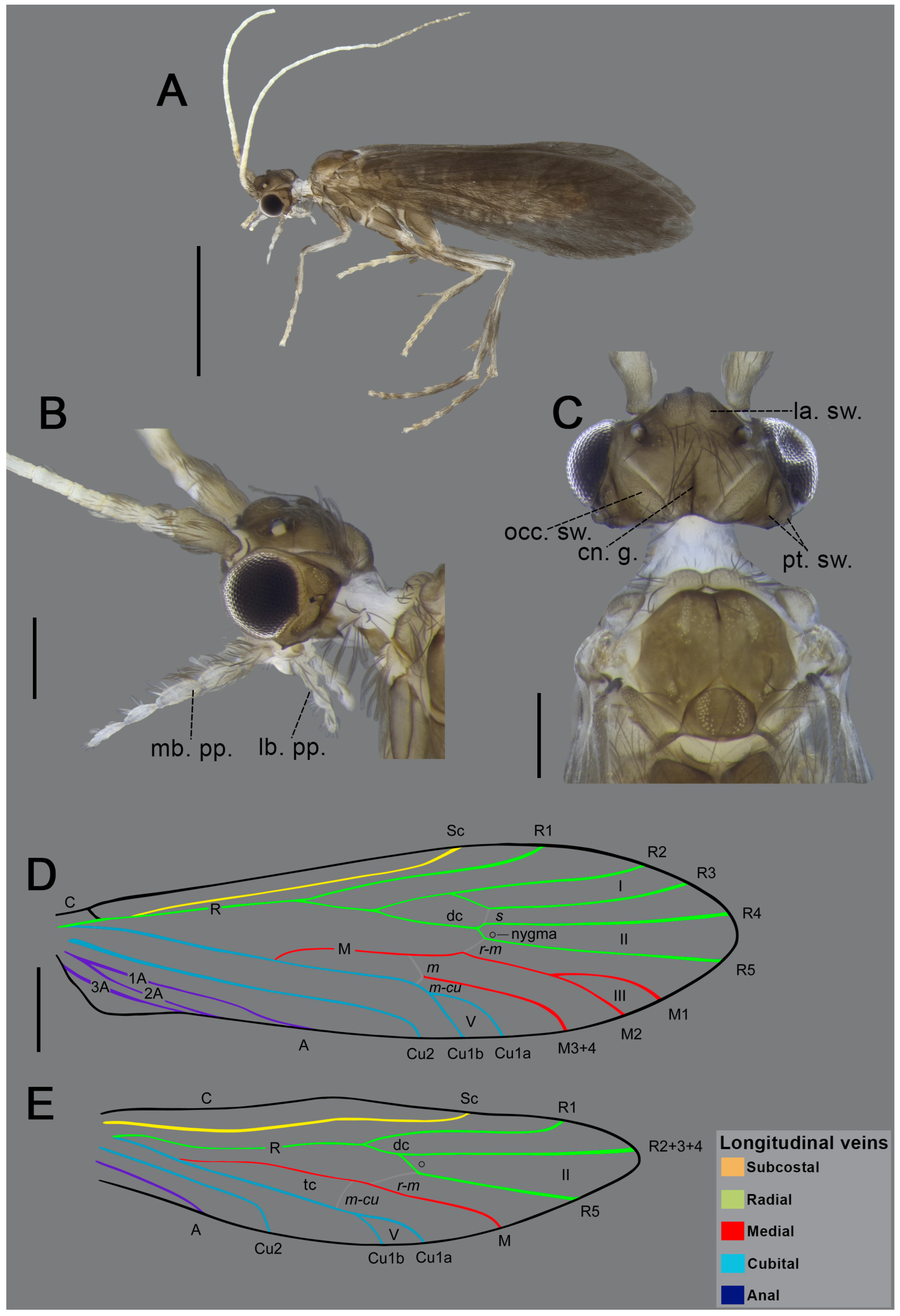
Description. Adult male: General coloration brown (in alcohol) (Figure 2A). Body length 3.28–3.56 mm (mean = 3.37, n = 7). Head dorsally with seven setal warts; lateroantennal pair (la. sw.) medium-sized, obovoid; occipital pair (occ. sw.) very large, ellipsoid; postgenal pair (pt. sw.) divided into two small, posterad to eye, rounded (Figure 2C). Coronal groove (cn. g.) thread-shaped, weakly pronounced on posterior half of head (Figure 2C). Maxillary palp length formula (I = II = III = IV = V); labial segment length formula (I = II = III) (Figure 2B). Forewing, in alcohol, brown, without spots; forks I, II, III and V present; fork I and II without petiole; fork III about 2× longer than fork V; thyridial cell (tc) about as long as discoidal cell (dc) (Figure 2D). Hindwing with forks II and V, bearing fork II without petiole and fork V with short petiole; fork V about 3× shorter than fork II; discoidal cell (dc) absent; thyridial cell (tc) present; r-m and m-cu crossvein almost aligned (Figure 2E). Tibial spur formula 2:2:2.
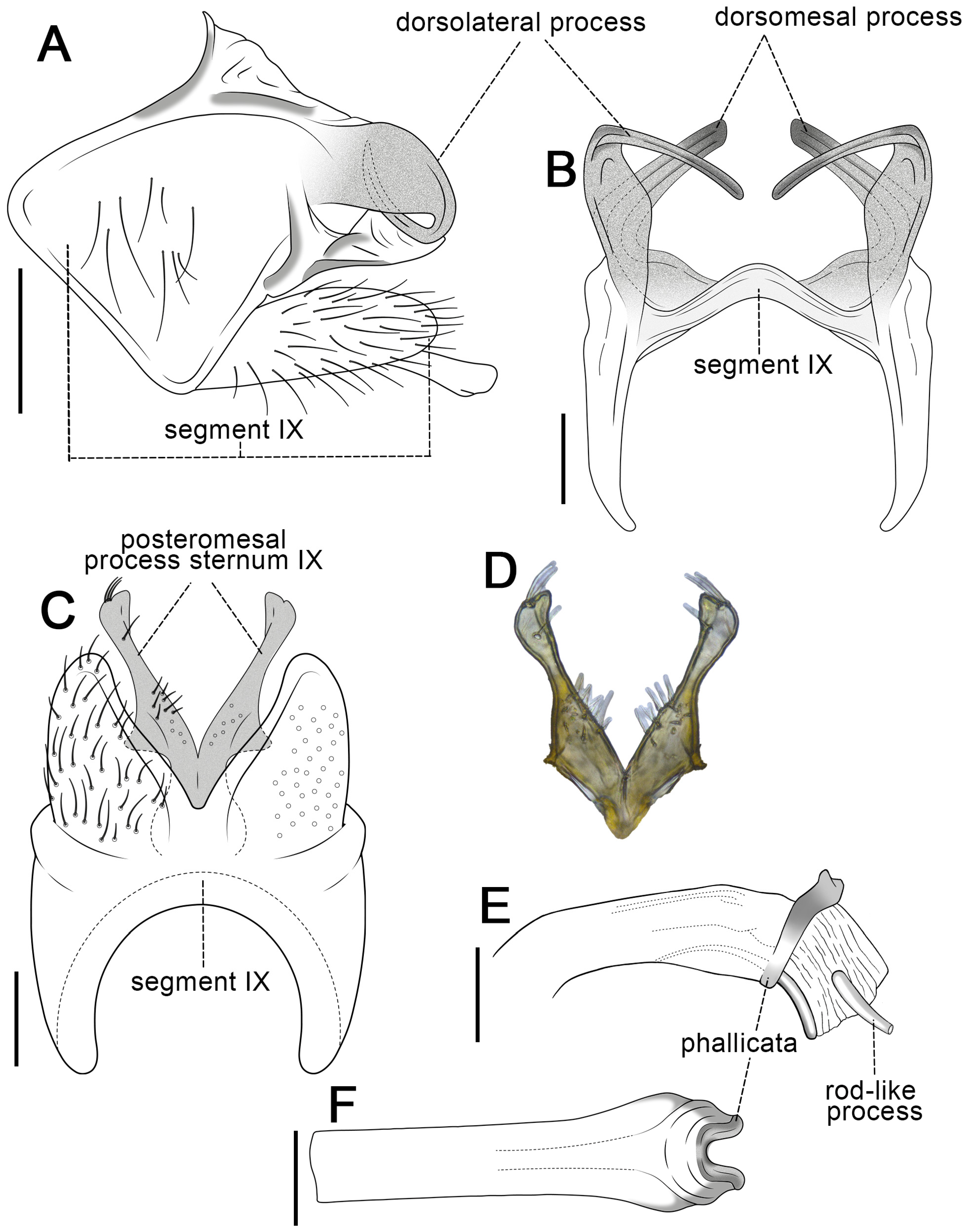
Male genitalia: Segment IX, in lateral view, subtriangular, with anterodorsal margin almost straight; anteromesal margin convex, rounded, strongly produced; anteroventral margin straight; posterior margin produced basally, bearing apex rounded (Figure 3A); in dorsal view, anterior margin with deep, wide U-shaped mesal incision; posterior margin produced mesally, strongly sclerotized and convex (Figure 3B); bearing two pairs of paired dorsal processes; pair of dorsomesal processes strongly sclerotized, spatulate, flat, stout, directed posteromesad, medium-sized, each with apex obliquely truncated; pair of dorsolateral processes strongly sclerotized, long, enlarged basally and narrow and rod-like on apical half, extending over the dorsomesal process, and directed anteromesad; in ventral view, anterior margin with deep, wide U-shaped mesal incision, extending slightly beyond half length of the segment; posterior margin strongly pronounced, forming a pair of large, subtriangular lobes divided by mesal V-shaped incision (Figure 3C); posteromesal process strongly sclerotized, long, divided by V-shaped apicomesal incision extending anteriorly to base of process, originating pair of paired narrow, digitated lobes, each lobe bearing tuft of medium-sized, thick setae clustered in middle of mesal margin and apically (Figure 3C,D). Tergum X apparently indistinct (Figure 3A). Inferior appendage apparently fused to base of posteromesal process of sternum IX or indistinct (Figure 3A,B). Processes of subphallic membranes indistinct or absent. Phallic apparatus, in lateral view, tubular, slightly curved along its length; phallobase slender, elongate; phallicata with narrow, sclerotized, ring-like apicolateral plate; endothecal membranes striate, apically with long, stout, rod-like process, directed posteroventrad in lateral view; endothecal spines absent; phallotremal sclerite undeveloped, comma-shaped in lateral view and U-shaped in dorsal view (Figure 3E,F).
Distribution. BRAZIL: Cerrado (São Paulo State).
Material examined. HOLOTYPE MALE. BRAZIL: São Paulo, Assis, Estação Ecológica de Assis, Córrego Campestre, 22.597753° S, 50.371354° W, 531 m a.s.l., 30.vi.2022, L.H. Almeida, P.N. Taniguti, M. Encenha, V. Passadori legs., Malaise trap (CIASP-TRI 000001) (MNRJ). PARATYPES. Same data as holotype, except 37 males (CIASP), 2 males (INPA), 2 males (MZUSP), 2 males (UFVB), 4 males (MNRJ).
Etymology. The specific epithet “assisensis” is derived from the Portuguese adjective meaning “from Assis” and refers to Assis, a municipality in São Paulo State, Brazil, where the species was collected. The name also honors the 120th anniversary of the municipality of Assis.

3.2. Key to Males of Contulma from Brazil

1.
Posterodorsal margin of segment IX with dorsomesal and dorsolateral processes strongly sclerotized (figs 2A,B); dorsomesal processes of segment IX stout, spatulate, directed posteromesad (fig 2A) ………………………………..…… C. assisensis sp. nov.
-
Posterodorsal margin of segment IX generally with dorsomesal processes slightly sclerotized and without dorsolateral process (see figs 2A,B in Holzenthal and Robertson [12]); dorsomesal processes of segment IX generally slender, directed posteroventrad ……………………...………………………………....………...…...……. 2
2.
Dorsomesal process of segment IX long, exceeding the posterior margin of segment IX, with rugose apices (see figs 2A,B and 4A,B in Holzenthal and Robertson [12]) ……...…………...…………………...…………………………………………………….…3
-
Dorsomesal process of segment IX absent or, when present, is short, not exceeding the posterior margin of segment IX, without rugose apices (see figs 3A,B in Holzenthal and Robertson [12]) …………..………………..……...………………………. C. meloi
3.
Posterolateral margin of segment IX extended into a setose lobe (see figs 1 and 2 in Jardim and Nessimian [13]) ………....…………………………………..….……...…...… 4
-
Posterolateral margin of segment IX not extended into a setose lobe (see figs 2A,B in Holzenthal and Robertson [12])………………….……………………………..…...….…6
4.
Dorsomesal processes of segment IX parallel dorsally for a distance approximately the length of the posterior margin of the segment (see fig 108 in Holzenthal and Flint [8]); posterolateral lobe of segment IX short, subtriangular (see fig 107 in Holzenthal and Flint [8]) ............................................................................................................... C. tijuca
-
Dorsomesal processes of segment IX parallel dorsally for a distance approximately half the length of the posterior margin of the segment (see fig 2 in Jardim and Nessimian [13] and fig 1B in Dumas [15]); posterolateral lobe of segment IX medium-sized to long, narrow, acute (see figs 1 and 2 in Jardim and Nessimian [13] and figs 1A,B in Dumas [15]) ………………………….……............................................................. 5
5.
Posterolateral lobe of segment IX has a long, spine-like seta at apex (see figs 1A,B in Dumas [15]) …………….....………………………...……………………….….. C. vascaina
-
Posterolateral lobe of segment IX lacks a long, spine-like seta at apex (see figs 1 and 2 in Jardim and Nessimian [13]) …………...………………………………...…….. C. sana
6.
Segment IX extended anterodorsally; setose lobe of posterior margin of segment IX situated close to the middle of the segment (see fig 4A in Holzenthal and Robertson [12]) ............................................................................................................................. C. tripui
-
Segment IX only slightly extended anterodorsally, if at all; setose lobe of posterior margin of segment IX situated close to ventral margin of segment (see fig 2A in Holzenthal and Robertson [12]) .................................................................... C. fluminensis

4. Discussion

In Brazil, Contulma species are predominantly distributed in the Atlantic Forest (6 spp.), especially in the montane regions of southeastern region, particularly from the Rio de Janeiro (Table 1) [16,25]. The discovery of C. assisensis sp. nov. in the Cerrado highlights both the underestimated diversity of Contulma in Brazil and the importance of targeted regional surveys for addressing taxonomic and biogeographic knowledge gaps. This finding reinforces the high potential for new discoveries in the Cerrado, one of the world’s major biodiversity hotspots [26] and the second largest biome in South America [27]. The presence of C. assisensis sp. nov. within the Assis Ecological Station further underscores the crucial role of protected areas (PAs), particularly those under Integral Protection, in safeguarding biodiversity in the Cerrado [28]. This biome has faced escalating pressures from agricultural expansion, hydroelectric development, and increasing water demand [29,30]. As a result, conserving the remaining Cerrado and its freshwater ecosystems is becoming increasingly urgent, requiring coordinated action by federal and state governments, as well as civil society, to halt ongoing environmental degradation [29].
Capturing adults of Contulma is typically challenging using conventional light-trap methods such as Pennsylvania traps [32] or bucket lights. These methods often yield very few specimens, generally limited to brief activity periods in the early morning or late afternoon. Holzenthal and Robertson [12] emphasized the rarity of adults in collections, noting that the 21 species then described were based on only 144 adult specimens; likewise, the four new species they described were represented by merely five individuals. The scarcity of adults is partly attributable to their poor attraction to blacklights, the standard method for collecting adult Trichoptera, but, more importantly, to the microhabitats they occupy. Species of Contulma inhabit small waterfalls, seeps, and shaded, fast-flowing streams in remote, densely forested montane environments, where adults must be actively netted during daylight hours [14]. This pattern is also reflected in Brazilian species, most of which are known from very small type series or limited material examined over time (Table 1). In contrast, the present study obtained an unusually high number of specimens of C. assisensis sp. nov. (Table 1). Our results indicate that, in addition to having both diurnal and nocturnal adult activity, with increased activity during late afternoon, the Malaise trap is the most effective method for collecting species of Contulma.
Currently, the species of Contulma are classified into two species groups, the cranifer Group and the spinosa Group, defined primarily by characters of the male genitalia [8]. Species of the cranifer Group are characterized by the presence of either an elongate dorsolateral or dorsomesal process posteriorly on segment IX, whereas those of the spinosa Group possess a mesolateral patch of setae on segment IX, which may be absent in some species or modified into a rod-like process [8]. Contulma assisensis sp. nov. resembles species of the cranifer Group in having processes posteriorly on tergum IX. However, it differs markedly from all known members of this group by possessing both a strongly sclerotized dorsomesal process and a strongly sclerotized dorsolateral process on tergum IX. In species assigned to the cranifer Group, tergum IX bears only one of these processes [8,12]. Therefore, based on its unique combination of characters, the new species cannot be placed unambiguously in either the cranifer or spinosa Groups. Consequently, C. assisensis sp. nov. is here treated as incertae sedis within Contulma.
This situation exemplifies the challenges encountered as new species of Contulma continue to be described. The species groups were proposed several decades ago, and additional morphological diversity has since been documented. A reassessment of the cranifer and spinosa Groups is needed, ideally through a cladistic analysis, to test their monophyly and to clarify relationships among species and between the groups. Such an approach would greatly improve our understanding of the evolutionary history of Contulma. Finally, to help reduce the taxonomic impediment [33], we provide an identification key to the seven Contulma species currently recorded from Brazil. This key will facilitate species recognition in taxonomic, phylogenetic, and ecological studies.

Author Contributions

Conceptualization, G.R.D.; methodology, G.R.D., L.P. and M.C.L.G.; software, G.R.D. and M.C.L.G.; validation, G.R.D. and P.C.B.; formal analysis, G.R.D., L.P. and M.C.L.G.; investigation, all authors; resources, P.C.B.; data curation, G.R.D.; writing—original draft preparation, G.R.D. and L.P.; writing—review and editing, G.R.D., L.P., M.C.L.G. and P.C.B.; visualization, G.R.D.; supervision, G.R.D. and P.C.B.; project administration, G.R.D.; funding acquisition, G.R.D. and P.C.B. All authors have read and agreed to the published version of the manuscript.

Funding

G.R.D. and P.C.B. express their gratitude to the São Paulo Research Foundation (FAPESP) for current support through a postdoctoral fellowship (grant 2024/04714-2) and a research grant (grant 2023/03818-6), respectively. The Conselho Nacional de Desenvolvimento Científico e Tecnológico (CNPq) awarded a research fellowship to P.C.B. (grant 306400/2022-7). PIBIC-UNESP/CNPq also awarded an undergraduate scientific initiation research fellowship to L.P. (grant 16600/2024-8). Part of the APC was funded by the Programa de Pós-Graduação em Biodiversidade Neotropical (PPGBN) (PROAP/CAPES 2025).

Data Availability Statement

All available data are presented in the present study, and specimens are vouchered as indicated in the examined material Section 3.1.

Acknowledgments

We are grateful to the Laboratory of Aquatic Biology (UNESP-Assis) team for field collecting assistance, especially Lucas Almeida (FCLAs/UNESP). We also thank the anonymous reviewers for providing very useful suggestions to improve the manuscript. During the preparation of this manuscript/study, the author(s) used ChatGPT, version 1.2025.245, to review the language editing only. The authors have reviewed and edited the output and take full responsibility for the content of this publication.

Conflicts of Interest

The authors declare no conflicts of interest. The funders had no role in the design of the study; in the collection, analyses, or interpretation of the data; in the writing of the manuscript; or in the decision to publish the results.

Abbreviations

The following abbreviations are used in this manuscript:
cn. g.coronal groove
la. sw.lateroantennal wart
lb. pp.maxillary palp
mb. pp.labial palp
occ. sw.occipital wart
pt. sw.postgenal wart

References

  1. Johanson, K.A.; Malm, T.; Espeland, M. Molecular Phylogeny of Sericostomatoidea (Trichoptera) with the Establishment of Three New Families. Syst. Entomol. 2017, 42, 240–266. [Google Scholar] [CrossRef]
  2. Frandsen, P.B.; Holzenthal, R.W.; Espeland, M.; Breinholt, J.; Thomas Thorpe, J.A.; Simon, S.; Kawahara, A.Y.; Plotkin, D.; Hotaling, S.; Li, Y.; et al. Phylogenomics Recovers Multiple Origins of Portable Case Making in Caddisflies (Insecta: Trichoptera), Nature’s Underwater Architects. Proc. R. Soc. B Biol. Sci. 2024, 291, 20240514. [Google Scholar] [CrossRef]
  3. Clair, R.M.S.; Dean, J.C.; Flint, O.S.J. Description of Adults and Immature Stages of Antipodoecia Mosely from Australia and Synonymy of the Families Antipodoeciidae and Anomalopsychidae (Insecta: Trichoptera). Zootaxa 2018, 4532, 125–136. [Google Scholar] [CrossRef] [PubMed]
  4. Thomas, J.A.; Frandsen, P.B.; Prendini, E.; Zhou, X.; Holzenthal, R.W. A Multigene Phylogeny and Timeline for Trichoptera (Insecta). Syst. Entomol. 2020, 45, 670–686. [Google Scholar] [CrossRef]
  5. Flint, O.S. Studies of Neotropical Caddisflies, XXVII: Anomalopsychidae, a New Family of Trichoptera. In Proceedings of the Third International Symposium on Trichoptera; Moretti, G.P., Ed.; Springer: Dordrecht, The Netherlands, 1981; pp. 75–85. [Google Scholar]
  6. Flint, O.S.J. Studies of Neotropical Caddisflies II, Trichoptera Collected by Prof. J. Illies in the Chilean Subregion. Beitr. Neotropischen Fauna 1967, 5, 45–68. [Google Scholar] [CrossRef]
  7. Flint, O.S.J. Studies of Neotropical Caddis Flies, IX: New Genera and Species from the Chilean Subregion (Trichoptera). Proc. Entomol. Soc. Wash. 1969, 71, 497–514. [Google Scholar]
  8. Holzenthal, R.W.; Flint, O.S. Studies of Neotropical Caddisflies, LI: Systematics of the Neotropical Caddisfly Genus Contulma (Trichoptera: Anomalopsychidae). Smithson. Contrib. Zool. 1995, 575, 1–59. [Google Scholar] [CrossRef]
  9. Morrone, J.J. Biogeographical Regionalisation of the Andean Region. Zootaxa 2015, 3936, 207–236. [Google Scholar] [CrossRef] [PubMed]
  10. Morrone, J.J. Biogeographical Regionalisation of the Neotropical Region. Zootaxa 2014, 3782, 1–110. [Google Scholar] [CrossRef]
  11. Holzenthal, R.W.; Ríos-Touma, B.; Rázuri-Gonzales, E. New Species of the Endemic Neotropical Caddisfly Genus Contulma from the Andes of Ecuador (Trichoptera: Anomalopsychidae). PeerJ 2017, 5, e3967. [Google Scholar] [CrossRef]
  12. Holzenthal, R.W.; Robertson, D.R. Four New Species of Contulma from South America (Trichoptera: Anomalopsychidae). Zootaxa 2006, 1355, 49–59. [Google Scholar] [CrossRef]
  13. Jardim, G.A.; Nessimian, J.L. A New Species of Contulma Flint (Trichoptera, Anomalopsychidae) from Southeastern Brazil. Rev. Bras. Entomol. 2011, 55, 226–228. [Google Scholar] [CrossRef]
  14. Holzenthal, R.W.; Ríos-Touma, B. Contulma Paluguillensis (Trichoptera: Anomalopsychidae), a New Caddisfly from the High Andes of Ecuador, and Its Natural History. Freshw. Sci. 2012, 31, 442–450. [Google Scholar] [CrossRef]
  15. Dumas, L.L. Contulma Vascaina sp. n. (Insecta: Trichoptera: Anomalopsychidae), a New Species from Rio de Janeiro State, Southeastern Brazil. An. Acad. Bras. Ciênc. 2018, 90, 2921–2926. [Google Scholar] [CrossRef]
  16. Pereira, R. Anomalopsychidae in Catálogo Taxonômico Da Fauna Do Brasil; Instituto de Pesquisas Jardim Botânico do Rio de Janeiro: Rio de Janeiro, Brazil, 2026. [Google Scholar]
  17. Gressitt, J.L.; Gressitt, M.K. An Improved Malaise Trap. Pac. Insects 1962, 4, 87–90. [Google Scholar]
  18. Instituto Florestal. Plano de Manejo Da Estação Ecológica de Assis; Instituto Florestal: São Paulo, Brazil, 2009. [Google Scholar]
  19. Blahnik, R.J.; Holzenthal, R.W. Collection and Curation of Trichoptera, with an Emphasis on Pinned Material. Nectopsyche Neotrop. Trichoptera Newsl. 2004, 1, 8–20. [Google Scholar]
  20. Desiderio, G.R.; Santana, V.; Pereira, E.S.; Pes, A.M.; Hamada, N. On the Identity of Smicridea (Smicridea) Aequalis Banks, 1920 (Trichoptera: Hydropsychidae): Morphology of Adults and Immature Stages, Bionomics, Distribution, and Male Color Dimorphism. Neotrop. Entomol. 2021, 50, 430–443. [Google Scholar] [CrossRef] [PubMed]
  21. Kawada, R.; Buffington, M.L. A Scalable and Modular Dome Illumination System for Scientific Microphotography on a Budget. PLoS ONE 2016, 11, e0153426. [Google Scholar] [CrossRef]
  22. Olàh, J.; Johanson, K.A. Trinominal Terminology for Cephalic Setose Warts in Trichoptera (Insecta). Braueria 2007, 34, 43–50. [Google Scholar]
  23. Nielsen, A. A Comparative Study of the Genital Segments and Their Appendages in Male Trichoptera. Biol. Skr. 1957, 8, 1–159. [Google Scholar]
  24. Mosely, M.E.; Kimmins, D.E.; British Museum (Natural History). The Trichoptera (Caddis-Flies) of Australia and New Zealand; British Museum: London, UK, 1953. [Google Scholar]
  25. Holzenthal, R.W.; Calor, A.R. Catalog of the Neotropical Trichoptera (Caddisflies). ZooKeys 2017, 654, 1–566. [Google Scholar] [CrossRef] [PubMed]
  26. Myers, N.; Mittermeier, R.A.; Mittermeier, C.G.; Da Fonseca, G.A.B.; Kent, J. Biodiversity Hotspots for Conservation Priorities. Nature 2000, 403, 853–858. [Google Scholar] [CrossRef] [PubMed]
  27. Diniz, I.R.; Marinho-Filho, J.; Machado, R.B.; Cavalcanti, R.B. Cerrado: Conhecimento Científico Quantitativo como Subsídio para Ações de Conservação; Thesaurus: Brasília, Brazil, 2011. [Google Scholar]
  28. Françoso, R.D.; Brandão, R.; Nogueira, C.C.; Salmona, Y.B.; Machado, R.B.; Colli, G.R. Habitat Loss and the Effectiveness of Protected Areas in the Cerrado Biodiversity Hotspot. Nat. Conserv. 2015, 13, 35–40. [Google Scholar] [CrossRef]
  29. Latrubesse, E.M.; Arima, E.; Ferreira, M.E.; Nogueira, S.H.; Wittmann, F.; Dias, M.S.; Dagosta, F.C.P.; Bayer, M. Fostering Water Resource Governance and Conservation in the Brazilian Cerrado Biome. Conserv. Sci. Pract. 2019, 1, e77. [Google Scholar] [CrossRef]
  30. Colli, G.R.; Vieira, C.R.; Dianese, J.C. Biodiversity and Conservation of the Cerrado: Recent Advances and Old Challenges. Biodivers. Conserv. 2020, 29, 1465–1475. [Google Scholar] [CrossRef]
  31. Bonfá-Neto, P.; Vilarino, A.; Salles, F.F. Brevitentoria Weaver 1984 (Trichoptera: Integripalpia) of Espírito Santo State, Brazil: New Records and New Species. Zootaxa 2023, 5336, 301–327. [Google Scholar] [CrossRef]
  32. Nessimian, J.L.; Santos, A.P.M.; Sampaio, B.H.L.; Dumas, L.L.; Pes, A.M.; Ferreira-Jr, N. The Collapsible Light Trap: A Portable Pennsylvania Light Trap for Collecting Aquatic Insects. An. Acad. Bras. Ciênc. 2024, 96, e20230784. [Google Scholar] [CrossRef]
  33. Giangrande, A. Biodiversity, Conservation, and the ‘Taxonomic Impediment’. Aquat. Conserv. Mar. Freshw. Ecosyst. 2003, 13, 451–459. [Google Scholar] [CrossRef]
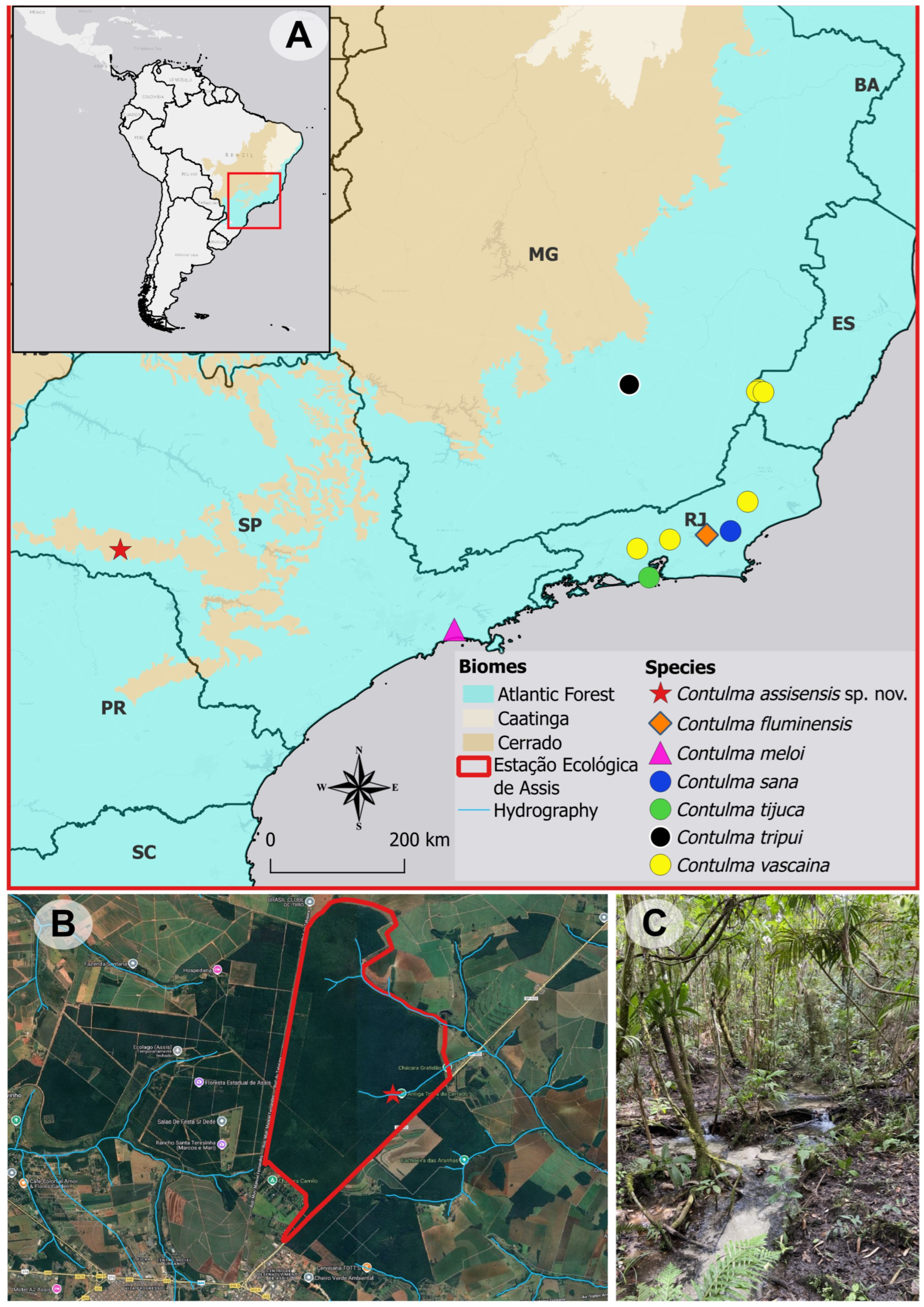
Figure 1. Distribution of Contulma species in Brazil and general views of the collection site of the new species described here: (A) map of Brazil, showing the geographic distribution for all Contulma Brazilian species, some of its states and biomes (highlighted in colors); (B) satellite image from Google Earth® showing the type locality of Contulma assisensis sp. nov. in the Assis Ecological Station; (C) córrego Campestre, Estação Ecológica de Assis, São Paulo state, Brazil—the site where Contulma assisensis sp. nov. was collected.
Taxonomy 06 00023 g001
Figure 2. Contulma assisensis sp. nov., holotype male: (A) lateral habitus; (B) head, lateral view; (C) head and thorax, dorsal view; (D) right forewing, dorsal view (longitudinal veins highlighted in color); (E) right hindwing, dorsal view (longitudinal veins highlighted in color). Scale bars in mm: (A) 1; (B,C) 0.2; (D,E) 0.02.
Taxonomy 06 00023 g002
Figure 3. Contulma assisensis sp. nov., male genitalia (holotype): (A) genitalia, left lateral view; (B) genitalia, dorsal view; (C) genitalia, ventral view; (D) posteromesal process of segment IX, ventral view (photograph); (E) phallic apparatus, lateral view; (F) phallic apparatus, dorsal view. Scale bars in mm: (A) 0.1; (B,C) 0.05; (E,F) 0.2.
Taxonomy 06 00023 g003
Table 1. Species, distributions, and published records of known individuals in the caddisfly genus Contulma (Anomalopsychidae) in Brazil. HT = holotype, PT = paratype, NT = nontypes, * = immature stages known.
SpeciesDistributionKnown Individuals
in the Literature
References
C. assisensis sp. nov.Cerrado (SP)1 male HT, 47 males PTsThis study
C. fluminensis Holzenthal & Robertson, 2006Atlantic Forest (RJ)1 male HT[12]
C. meloi Holzenthal & Robertson, 2006Atlantic Forest (SP)1 male HT, 1 male PT[12]
C. sana Jardim & Nessimian, 2011Atlantic Forest (RJ)1 male HT, 2 males PTs[13]
C. tijuca Holzenthal & Flint, 1995 *Atlantic Forest (RJ)1 male HT, 1 female PT, 2 larvae NT[8]
C. tripui Holzenthal & Robertson, 2006Atlantic Forest (MG)1 male HT[12]
C. vascaina Dumas, 2018Atlantic Forest (ES, RJ)1 male HT, 3 males, 3 females PTs, 11 males, 2 females NT[15,31]
Disclaimer/Publisher’s Note: The statements, opinions and data contained in all publications are solely those of the individual author(s) and contributor(s) and not of MDPI and/or the editor(s). MDPI and/or the editor(s) disclaim responsibility for any injury to people or property resulting from any ideas, methods, instructions or products referred to in the content.