1. Introduction
Mining and mineral processing waste comprises large quantities of materials generated during the extraction and processing of raw materials (e.g., ores and rocks). The extraction of mineral resources and related industries (metallurgy, chemical industry) generate more than 100 billion tons of industrial waste annually [
1,
2,
3]. On a planetary scale, the area of disturbed land within mining territories exceeds 101,583 km
2, of which approximately 50% is accounted for by waste storage facilities and other sites of permanent waste disposal [
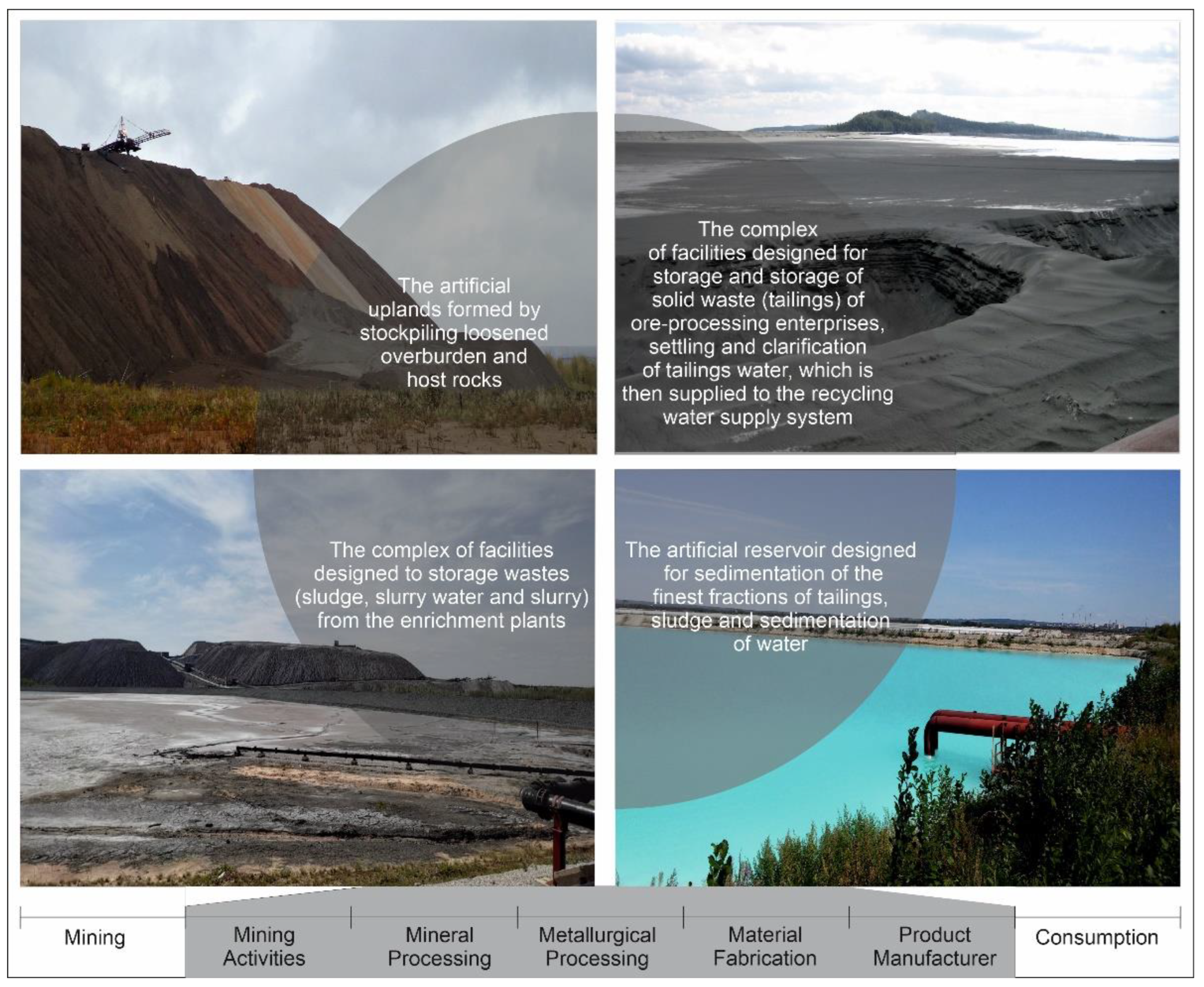
4]. These wastes are typically disposed of in specialized containment structures. Depending on their particle size distribution and consistency, they are placed in tailings storage facilities, sludge ponds, or settling basins (
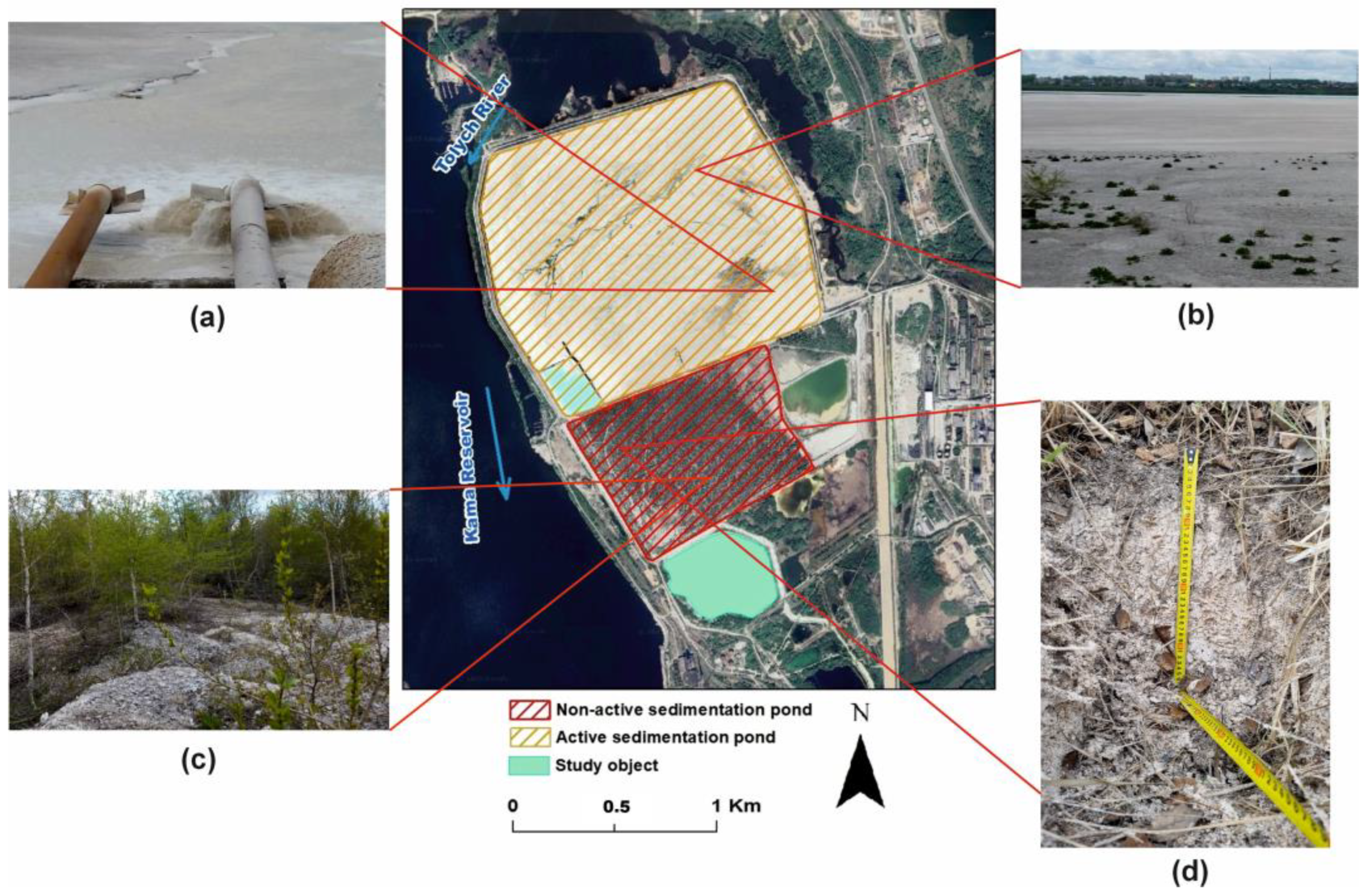
Figure 1) [
5]. Substantially greater risks can be posed by waste storage sites that have been abandoned for various reasons—so-called brownfield sites. The concentration of brownfields is particularly high in old industrial regions. According to Garbarino et al. [
6], the combined territory of 28 European Union countries hosts approximately 9700 extractive waste facilities that are in the process of being closed or abandoned.
In Russia, the peak period for the closure, decommissioning, and abandonment of industrial facilities and mineral deposits occurred during the 1990s and the early 2000s. Frequently, the shutdown of these industrial sites was carried out without implementing measures for their conservation, formal decommissioning, reclamation, or the remediation of sites with accumulated environmental damage [
7].
Stockpiled waste can constitute a source of environmental pollution [
8]. Historically, dating back to Roman times, mining waste was disposed of in natural depressions, adjacent to mines, or on industrial sites without specialized protective or impermeable barriers. This practice was driven by a primary focus on economic benefit and historical precedent, rather than environmental considerations [
9,
10]. Due to their limited economic value, a significant portion of these tailings are deposited in close proximity to mining sites, often underwater [
11]. Rehabilitation measures for disturbed lands and the reclamation of waste impoundments are typically carried out using the simplest approach: the in-situ isolation of industrial waste, followed by technical and biological remediation. However, for a number of industrial waste types, this reclamation pathway is not feasible. This can be due to their inherent properties (e.g., environmental reactivity or toxicity) or the specific location of the site requiring remediation (for instance, within water protection zones of drinking water sources or within urban settlements). In such cases, the optimal solution involves the secondary use and processing of the accumulated waste prior to land restoration [
12,
13].
A global trend in the remediation of abandoned solid waste disposal sites from mining and processing operations is the implementation of state-sponsored brownfield reclamation and land restoration programs, which were actively initiated in the late 1950s in North America and Europe [
14]. Russia is no exception, where state support for the remediation of environmentally hazardous sites has been implemented since 2018 under the federal project “Clean Country” within the national project “Ecology.” In 2024 alone, this project facilitated the elimination of 185 unauthorized landfills and the restoration of 3316 hectares of disturbed land [
15].
In the Perm Krai region of Russia, there is an abandoned sludge pond containing sewage sludge from chemical and metallurgical industries [
16]. For an extended period (since the late 1960s), this facility operated as a backup sludge pond, receiving wastewater from industrial enterprises. Following the restructuring of Soviet industrial enterprises in the 1990s, it lost its operational significance and ended up outside the boundaries of active industrial sites.
However, historical operations have resulted in the accumulation of over 1 million tons of saline–alkaline sediments within the sludge pond, which also contain potentially toxic impurities [
16,
17,
18]. These sediments in the sludge pond are presently located on municipal lands in immediate proximity to the region’s largest drinking water reservoir—the Kama Reservoir.
In accordance with Russian legal norms and environmental legislation, such industrial waste storage sites must be included in the inventory of environmental damage objects eligible for reclamation. The reclamation of such facilities is carried out based on a project that must consider various sludge disposal options. In particular, the use of sludge as secondary raw materials represents an option aligned with the circular economy concept, which is increasingly being implemented and supported at the legislative level in the Russian Federation.
This study presents the first comprehensive assessment of potential recycle and reuse options for the sediment from an abandoned sludge pond in the city of Berezniki (Perm Krai, Russia). Russian regulations require full characterization of unaccounted waste disposal and accumulation sites to enable their subsequent registration, remediation, and recycling within a circular economy framework. Based on data on the material composition of the sediment, this work provides, for the first time, an overview of the literature on secondary use and processing practices applicable to such waste in this region. A critical analysis of the composition of technogenic sediments, their comparison with analogous sites, and recommendations for recycling will help identify the benefits, risks, necessary preliminary tests, limitations, and recommendations for future research.
2. Materials and Methods
2.1. Location and Formation History of the Brownfield Site
The area under consideration has a long history of industrial development. Small-scale salt manufacturers, which evaporated salt from brines on the left bank of the Kama River, have been operating in this territory since the 15th century. Some of these were located in immediate proximity to the object of the present study (the Lyonvinsky and Dedyukhinsky saltworks). In 1881, on the left bank of the Kama River in the city of Berezniki, the first soda ash production facility in Russia (“Lubimoff, Solvay & Cie”) using the Ernest Solvay ammonia–soda process was established by Perm merchant and industrialist Ivan Lyubimov [
19,
20]. Subsequently, during the Soviet period of industrial modernization of the national economy in the 1930s–1940s, a major industrial center was established on the site of former saltworks and the old soda production facilities.
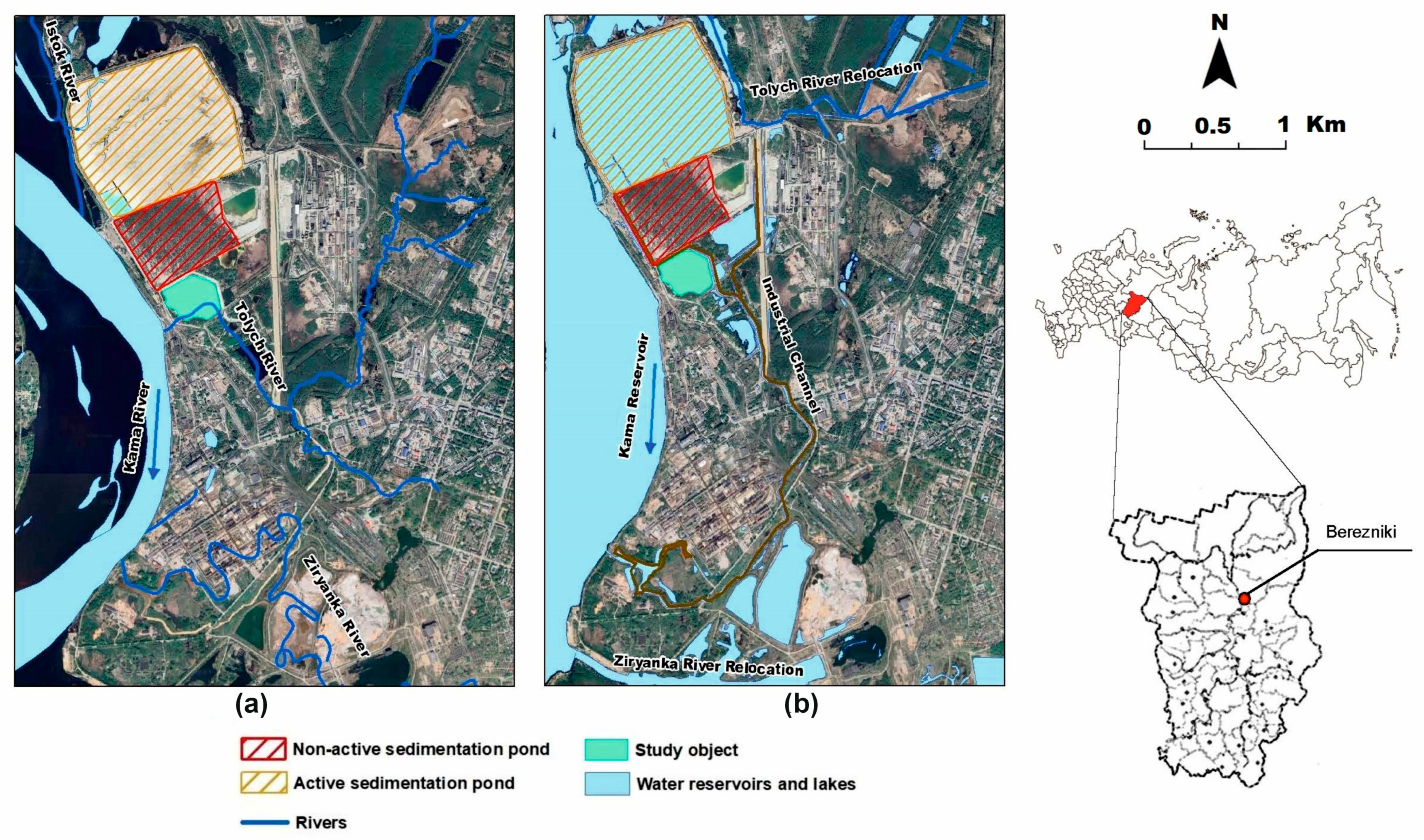
The studied sludge pond currently covers an area of 17.5 hectares, with a diameter of approximately 500 m, and the sediment is covered by a water layer about 1 m deep. North of the studied sludge pond are located non-active and active sedimentation ponds of soda ash production. The studied sludge pond was formed in the 1950s during territorial redevelopment involving the construction of a containment dike along the shoreline of the Kama River. These measures were implemented to protect previously constructed industrial facilities in the industrial zone of Berezniki from flooding, which became an inevitable consequence of the impoundment of the Kama Reservoir in 1953 [
21].
The constructed protective dike blocked the mouth of the Tolych River, resulting in the lower course of the river being diverted approximately 1 km north of the structure (
Figure 2). Subsequently, between 1968 and 1972, a dike for an industrial wastewater discharge channel was constructed on the study site to serve adjacent chemical and metallurgical production facilities. This engineering intervention resulted in the formation of a topographically depressed area bounded by the protective dike of the Kama Reservoir to the west, the dike of a soda production sludge disposal site to the north, and the dike of an open industrial channel to the east.
Despite the presence of perimeter dikes, this facility cannot be classified as a hydraulic engineering structure of the sludge storage or tailings impoundment type, due to the absence of design solutions mandatory for such structures and non-compliance with the technical requirements applicable to hydraulic engineering works. There are no drainage channels or streams in the area under study. Consequently, the studied sludge pond is not categorized as a waste storage facility, as it lacks the characteristics of a specially engineered structure designed in accordance with environmental legislation requirements and intended for the long-term containment of waste. In the current period, the studied sludge pond exhibits no visible hydraulic connection to surrounding features, with atmospheric precipitation serving as its primary source of recharge.
2.2. Sample Collection
Analysis of the sediment composition from the sludge pond, including sampling, was conducted in September 2024 and March 2025 [
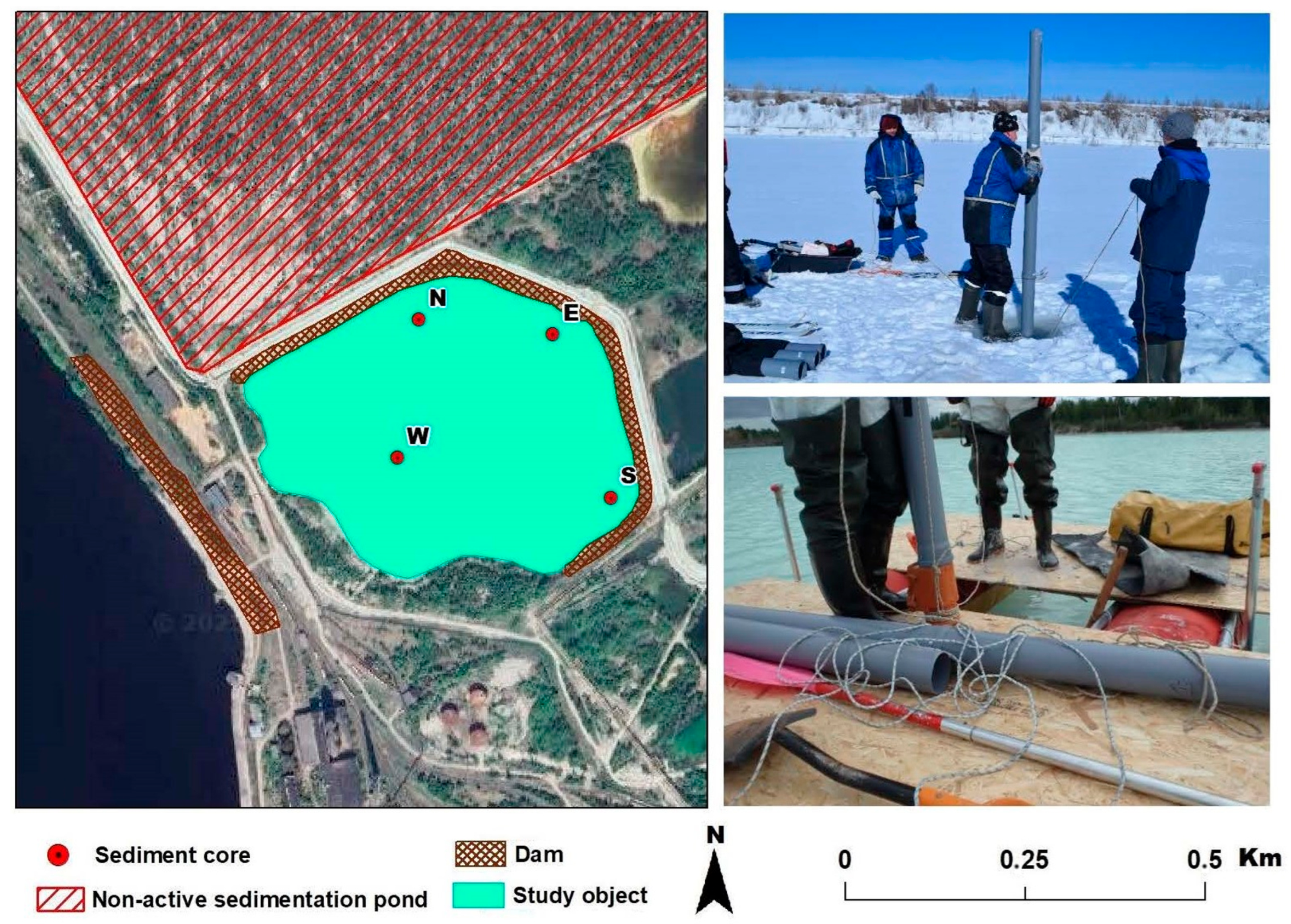
18]. Sampling locations for the technogenic sediment (
Figure 3) were selected to cover various areas of the sludge pond along two perpendicular transects: N–S and W–E. Sampling of the full sediment sequence was performed during the warm season (columns W and E) from a mobile research platform and during the cold season from the ice cover (columns N and S).
Sampling was carried out using a patented coring device [
22], which enables the extraction of an undisturbed core representing the complete sediment sequence. Samples were collected using polyvinyl chloride (PVC) tubes with a diameter of 110 mm and a length of up to 5 m. Both in warm and cold weather, the sediment was covered by a layer of water up to 1 m deep (in winter, including a layer of ice up to 0.5 m thick).
Each coring tube featured a plastic check valve to maintain sediment integrity during retrieval. All sampling equipment components were constructed from chemically inert materials and thoroughly cleaned prior to use to prevent contamination (e.g., rust particles or other foreign matter) in the collected samples. Prior to sampling, the depth of the sediment at the drill hole was determined with a rigid, labeled dipstick. The sediment was partially compacted during extraction. To reconstruct the true thickness of each layer, the thickness of the sediment after extraction was adjusted to the thickness determined by the dipstick using a proportional method.
The layers of sediment cores from each extraction point were then described, had their thicknesses measured, and were photographed. Sediment layers were identified by visual characteristics (color, layering, and small inclusions) and morphological features (consistency and porosity).
Based on field observations of the physical properties (color, odor) and consistency in the core of extracted sediments, nine distinct layers were identified at each sampling point. To ensure the comparability of results obtained at different times, a control drilling of column W was conducted in winter. The number of sediment layers and their sequence, as determined by the control drilling, remained unchanged. Differences in the thickness of sediment layers in column W between the warm and cold seasons did not exceed 5 cm and were attributed to slight variations in the degree of sediment compaction during core retrieval. A comparison of the morphological and organoleptic characteristics of the sediments in autumn and spring revealed no differences caused by seasonality.
The sediment core was placed onto a prepared surface for description and photographic documentation of the sediment layers. Layer-by-layer sampling was then carried out by cutting each layer with a sharp tool, followed by sealing the samples in airtight containers. Paste-like samples from each layer (36 samples in total) were collected in hermetically sealed bags and delivered to an accredited laboratory, where they were stored in a refrigerator (4 °C).
2.3. Sample Preparation and Analysis
The mineral composition, major elements and grain size distribution of the samples were investigated at the Sector of Nanomineralogy of the Centre for Collective Use of Unique Scientific Equipment of Perm State University for laboratory research, which is accredited in accordance with the requirements of the international ISO 17025 standard [
23].
The laboratory sample preparation procedure included air drying and quartering using the ring and cone method to obtain representative aliquots for various types of analyses. Samples for granulometric analysis were additionally dried in an oven at 105 °C until a constant mass was achieved. Next, the dried sediment was sieved using a lithological set of sieves with mesh sizes of 1, 0.5, 0.25, 0.1, and 0.05 mm, and the particle size distribution was determined by the calculation method according to GOST 12536-2014 [
24]. According to GOST 8.777-2011 [
25], the granulometric composition of the fraction smaller than 0.05 mm was determined using the Analysette 22 Micro Tec plus analyzer (Fritsch, Idar-Oberstein, Germany).
In this study X-ray diffraction (XRD) using a Bruker-D2 Phaser diffractometer (Bruker, Bremen, Germany) was used as well as X-ray fluorescence (XRF) using a Bruker S8 TIGER spectrometer (Rheinstetten, Germany) analysis as one of the most powerful methods used widely in geological research and environmental science to identify and quantify minerals. The dried samples for mineralogical composition determination were homogenized by grinding into a powder with a particle size of less than 44 μm using a Pulverisette 5 ball mill (Bruker, Bremen, Germany).
XRD patterns were acquired using a powder diffractometer XRD D2 Phaser (Bruker, Bremen, Germany), with a copper anode (emitting CuKα, λ = 1.54060 Å). Data collection was conducted over a 2θ range of 5° to 70°, employing a step size of 0.03°. Phase identification was performed using Diffrac.Eva version 1.2 software. Quantitative phase analysis was conducted using the Rietveld refinement method, a procedure for minimizing the deviation between the experimental and theoretically calculated diffractograms. Quantitative analysis was performed using the Topas 4-2 software, with the sum of the mineral phases brought to 100%.
The content of the major element oxides was determined using X-ray fluorescence analysis, carried out on a Bruker S8 TIGER spectrometer (Rheinstetten, Germany) sequential wave dispersion spectrometer, operating at 170 mA, and using a 4 kW Rh-anode X-ray tube. During the preparation of samples, the determination of loss on ignition (LOI) was carried out. Calcination for one hour with a slow temperature increase to a constant mass at 1000 °C was conducted using a high-temperature electric furnace PL 10/12.5 (Na-kalProm, Russia). In the XRF analysis, the detection limits for oxides of the major elements, the lowest and highest measurable concentrations, ranged from 0.01% to 99.9%, respectively. Measurements were carried out using a quantitative chemical analysis program for carbonate rocks, developed according to calibration tables based on Russian-made standards. Detailed conditions for sample preparation and analytical laboratory procedures for establishing the mineral and chemical composition are described in a previously published work [
18].
This study analyzed and classified the existing literature on calcium-containing waste utilization to identify similarities and differences with the sediment from the studied sludge pond. The literature review was based on data retrieved from scientific databases (Scopus, Web of Science, Google Scholar, Dimensions), including RSCI and other sources, and was complemented by an analysis of the Google Patents database. Conference proceedings were also included in the review, as the topic of calcium-containing waste processing involves nuances that depend significantly on the chemical composition of specific samples.
3. Characterization of the Studied Sediment Composition
3.1. Morphological Properties and Mineral Composition of the Sediment
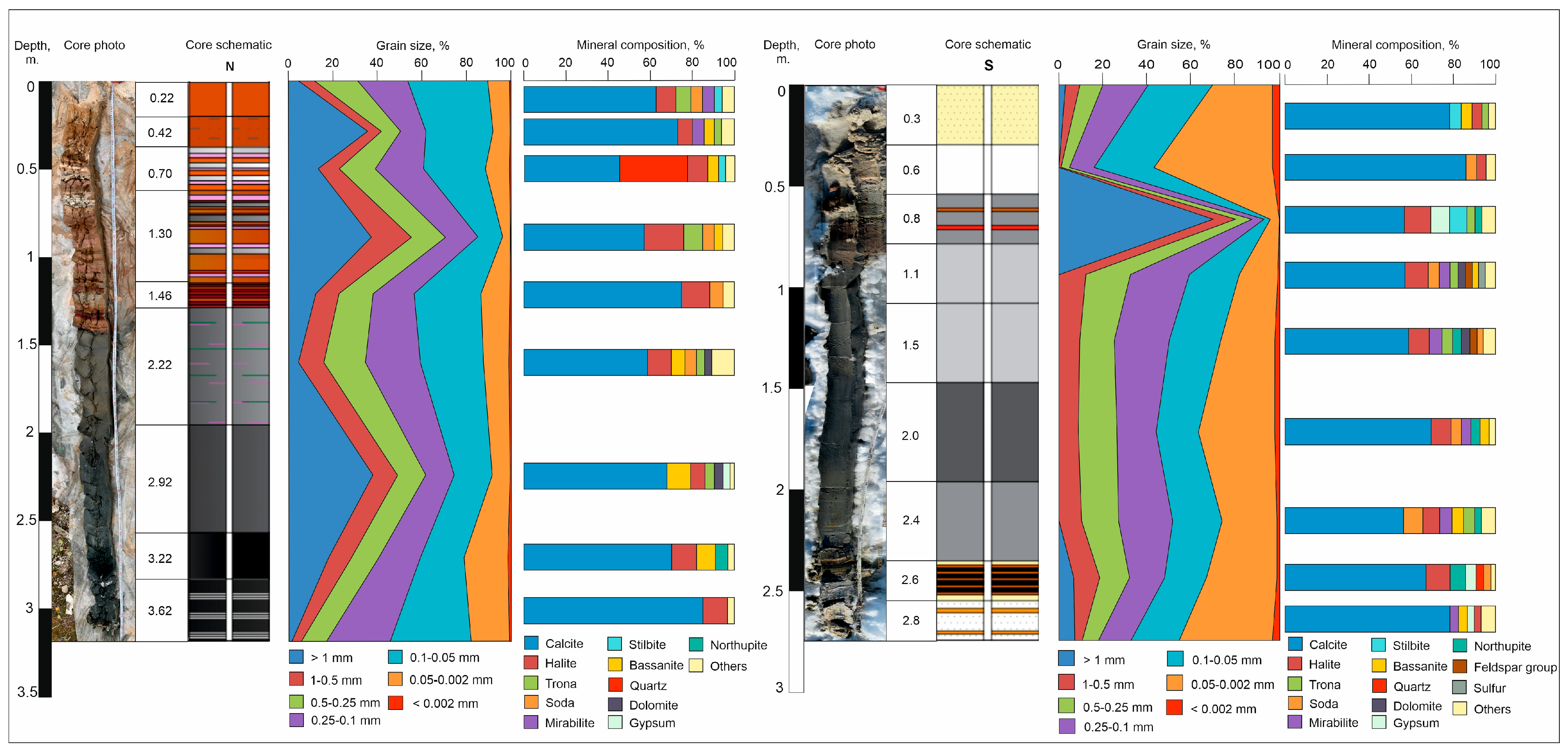
As mentioned above, nine distinct layers, differing primarily in their morphological characteristics (notably sediment color), were identified in each of the studied cores at the sampling site. A composite diagram illustrating the stratigraphic arrangement of layers in cores N and S, integrated with the results of their granulometric composition analysis, is presented in
Figure 4.
The total thickness of the sediment in core N was 3.62 m. The upper layers, down to a depth of 1.46 m, are represented by strata of predominantly brown and red colors with white interlayers. Below this depth, the sediment color changes from grey in the central part to black in the deep layers. The sediment consistency is uniformly paste-like, with the exception of the surface layer, which is characterized by a granular structure.
The total sediment thickness in sediment core S was 2.80 m. The distribution of layers by color is similar to that in core N: the upper part is cream-to-brown, changing to grey and then black at greater depths. The boundary separating layers of different shades is also marked by a distinct red layer, which is located higher in the sequence than in core N, at a depth of approximately 1 m. The sediment consistency is uniformly paste-like, except for the surface layer characterized by a granular structure.
The granulometric composition of the sediment core N is distinguished by the largest particle size: sand-sized particles (>1 mm) constituted up to 38% of some layers. In core S, such particles were found in only one layer. The fraction of sediments with a particle size of <0.05 mm is characterized by a predominance of silt particles (comprising up to 77–80% of all particles in this fraction), while the proportion of even finer clay particles with a size of <0.002 mm accounts for approximately 20%. The particle-size distribution with depth in sediment core S is generally homogeneous. However, a distinct shift was observed at a depth of 0.76 m, where the fraction of particles larger than 1 mm increased to 71%. This anomaly may be attributed to a different source of wastewater inflow specific to this section of the studied pond, distinct from the sources identified in other sampled sediment cores.
The mineral composition of the crystalline part of the sediments in cores N and S is dominated by calcite (46–86%), with lesser amounts of quartz (0.4–32%), halite (3–19%), bassanite (2–11%), soda (natron) (1–9%), trona (1–9%), northupite (1–9%), gypsum (2–9%), mirabilite (2–6%), stilbite (1–8%), and dolomite (0.3–4%). Trace constituents (less than 3%) include native sulfur, kieserite, feldspars, and sylvite. Localized inclusions of sylvite, feldspars, northupite, and kieserite were identified in the northern part of the studied pond (sampling point N), distinguishing it from sampling point S. Native sulfur and stilbite occur in the layers only at sampling points N and S.
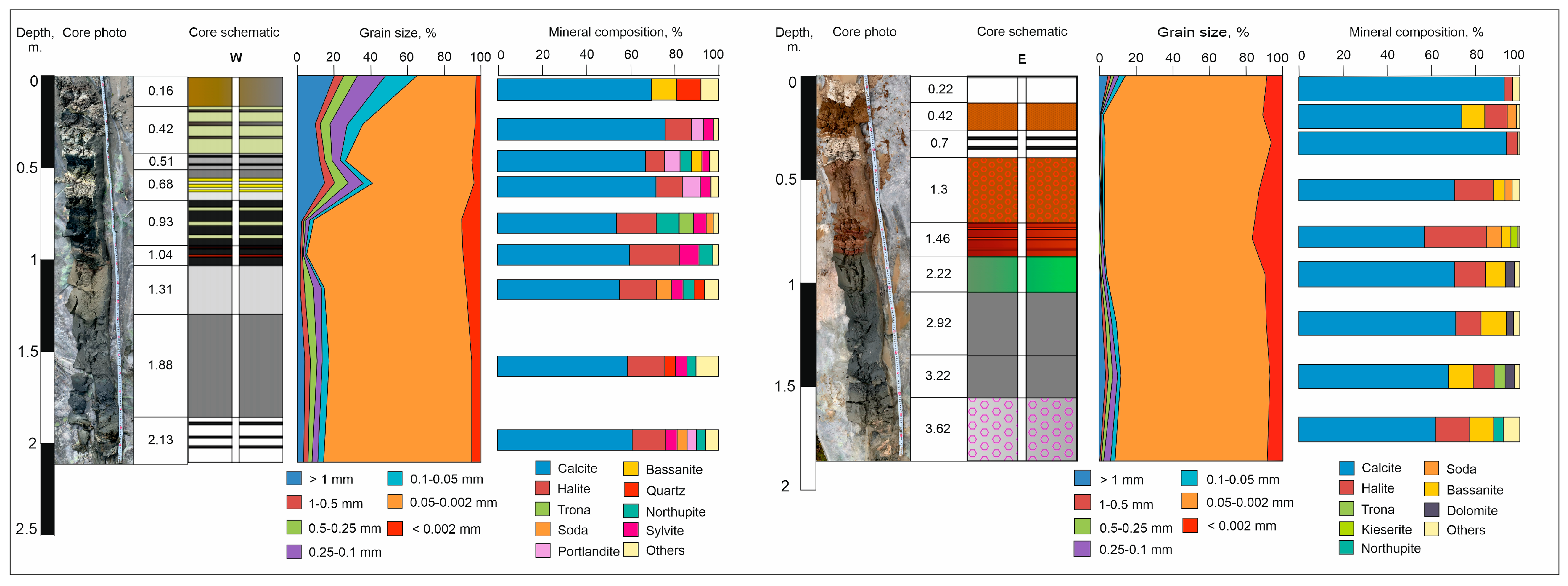
A composite diagram illustrating the stratigraphic arrangement of layers in cores W and E, integrated with the results of their granulometric composition analysis, is presented in
Figure 5.
The recovered sediment thickness in cores W and E was slightly lower than in the southern and northern parts, measuring 2.13 m and 1.82 m, respectively. The color of the layers in core E is generally similar to those described previously, consisting of predominantly brown upper layers, a distinct red interlayer at a depth of 0.70–0.85 m, and grey lower layers. The main distinguishing feature of the sediments in core W from the western part of the water body is the presence of bright yellow layers with individual crystals up to 2 cm in cross-section at a depth of approximately 0.6 m.
Sieving analysis of the granulometric composition of sediments in cores W and E reveals an absolute predominance of fine particles with a size of less than 0.05 mm. Through the separate examination of the particle size distribution within this fraction, using laser diffraction data, a similar ratio of silt and clay particles was determined, amounting to approximately 80/20%. The crystalline phase of the sediment in cores W and E contains calcite (54–94%), halite (3–28%), bassanite (2.6–12%), quartz (0.1–11%), northupite (0.3–10%), sylvite (0.3–8.5%), portlandite (2–8%), soda (natron) (2–7%), trona (1–7%), dolomite (0.5–4%), feldspars (0.8–2%), gypsum (0.4–2%), as well as mirabilite and kieserite (less than 3%).
Overall, the studied sediments are characterized by the presence of both hydrogenic (carbonates, sulfates, and chlorides) and terrigenous (feldspars, quartz) mineral associations, along with other detected minerals present in low abundances. The XRD analysis showed the following composition: calcite (67.7%) and halite (11.5%), which are common minerals in the crystalline part of the sediments. (
Table 1). Due to the predominance of the hydrogenic mineral group, the formation of the mineral composition of the technogenic sediments in the studied sludge pond is primarily related to the composition of the incoming wastewater and its interaction with the underlying sediments/rocks, with a subordinate role played by climatic and biogeochemical factors.
3.2. Mineral Formation in the Sediment
The formation of the studied sediment is considered within a historical context (
Section 2.1), which identifies the wastewater discharge from plants that use sodium chloride solutions in their technology, with calcium chloride as a by-product, as one of the sources. Therefore, we examine the chemical composition of wastewater from soda ash production, as the investigated sediments show similarity in chemical and mineral composition to the solid waste (
Table 1 and
Table 2) generated by the Solvay process for producing soda ash. The initial wastewater fed into this sludge pond throughout its operation was characterized by a highly alkaline environment (pH 11–12) with high concentrations of chloride ions, calcium ions, and sodium ions; the total dissolved solids change 86–180 g/L [
26,
27].
Typically, the formation of calcite in such saturated solutions occurs during the early stages of evolution as a result of settling and the accumulation of calcium ions and the carbonate complex (HCO
3− + CO
32−) in the water [
28,
29].
The climate of the study area is boreal, featuring a short, hot summer and a severe winter. During periods of high summer temperatures and absence of atmospheric precipitation, the deposition of mineral soda (natron) is possible under evaporative conditions. Subsequently, as water salinity increases, the formation of trona and gypsum occurs; the latter can also form under significant ice cover, when the residual water becomes saturated after ice formation [
30,
31]. The mechanism of halite formation is related to its solubility in water, which decreases significantly with falling temperature. The formation of this mineral is also facilitated by an increase in solution mineralization due to the evaporation of part of the water [
32].
The formation of sulfur in the sediment may be associated with the process of sulfate reduction during the precipitation of SO
42− and Cl
− in the settling pond, as well as a result of the activity of sulfate-reducing bacteria. One of the seven phylogenetic groups of these bacteria (Clostridiales) was identified in the sediments of the studied pond [
18,
31]. In the course of their metabolism, sulfate-reducing bacteria release CO
2 and H
2S, which subsequently participate in mineral formation [
33]. The general form of the equation for dissimilatory sulfate reduction, where CH
2O represents general labile organic matter, can be expressed as follows:
The oxidation of sulfide minerals results in an increase in pore water acidity. This leads to the dissolution of carbonate minerals in the sediment and the release of calcium ions, consequently causing the precipitation of gypsum [
34].
The presence of quartz and feldspars in the cores is typically associated with the influx of sand, dust, and clay through wind action and washout by rainwater from the dam surfaces. An additional source is surface runoff during heavy rainfall events that occurred while earthworks were being conducted around the perimeter of the storage pond. The variability in the content of quartz and feldspars may indicate the presence of multiple sources of terrigenous material within the catchment area of the settling pond.
3.3. Conclusions on the Study of the Sediment
The description of the chemical composition of the sediments in the studied sludge pond and the patterns of its variation are provided in a previously published work [
18]. X-ray fluorescence analysis data established that the main constituents of each sediment layer, regardless of its color and particle size, are CaO, Cl, and loss on ignition (LOI), the main component of which is carbon dioxide from the decomposition of the carbonate ion. This chemical composition fully corresponds to the mineral composition of the sediments established in this work, according to which each sediment layer is characterized by the dominance of calcite. Together with the predominance of fine-grained particles of clay and silt size in most of the samples studied, it is concluded that the sediments accumulated in the studied pond fundamentally correspond to the waste from the production of soda via the Solvay method.
The sediments of the studied sludge pond are largely similar to the solid waste from soda ash production, known as ammonia–soda residue (ASR), as shown in
Table 2. A comparative assessment of the chemical and mineral composition of the studied sediment and ASR from the soda ash production of an active sedimentation pond, located 500 m north, was performed. The ASR was a composite obtained from depth intervals of 0–10, 20–40, and 60–80 cm. The average composition of ASR is characterized by CaO—51.0%; MgO—3.35%; SO
3—1.92%; SiO
2—1.76%; other oxides accounted for less than 1%; and LOI—37.52% [
34]. In the studied pond, the sediment was characterized by a predominance of calcite (62–70 mass%) and halite (9–13 mass%). The chemical composition (CaO and LOI) of these sediments was lower than in ASR (
Table 2).
According to previously conducted X-ray phase analysis studies [
35], the composition of the ASR from the active sedimentation pond includes calcite, X-ray amorphous calcium hydroxide, halite, gypsum, anhydrite, and quartz. In contrast, the ASR from the non-active sedimentation pond is mainly composed of calcite (up to 97%), portlandite, X-ray amorphous calcium hydroxide, aragonite, dolomite, as well as rare minerals such as ettringite, thaumasite, and pyroaurite. These mineral phases in ASR are confirmed by X-ray phase analysis data from the non-active sedimentation pond and by other researchers [
36], according to whom the predominant mineral is also calcite, present in both crystalline (up to 58%) and cryptocrystalline (up to 70%) forms.
In general, the ASR from the active sedimentation pond and the studied sediment share similarities with other ASR generated worldwide by the Solvay process, which are characterized by an alkaline environment (pH 10–12) and a composition that mainly includes CaCO
3 (50–80% of dry mass), water-soluble salts (NaCl and CaCl
2), CaSO
4, Ca(OH)
2, Fe(OH)
3, silicates, and aluminosilicates. However, ASR are characterized by homogeneous bedding with a predominance of the silt-clay fraction of calcium carbonate [
37]. In contrast, the studied sediments are characterized by stratification and heterogeneity in the composition of individual layers (
Figure 4 and
Figure 5), a characterization which is associated with different sources of effluent inflow into the studied pond.
Based on the data from this comparison, it is logical to consider the experience of the remediation, disposal, or recycling of ASR from the sedimentation pond of soda ash production in order to find approaches for managing the sediment accumulated in the studied pond.
4. Calcium-Rich Waste Recycling, Applications, and Future Prospects
The predominant component of the studied sediment was identified as calcium carbonate. The total volume and mass of the studied sediment are estimated at 497,740 m
3 and 1,294,124 t, respectively [
38]. The studied sediments are similar in their component and mineral composition to ASR, suggesting their potential for analogous utilization methods. The most common applications of recycled ASR are in environmental protection technologies and building materials. Less frequently used directions include the application of ASR in agriculture and the synthesis of chemical reagents [
39].
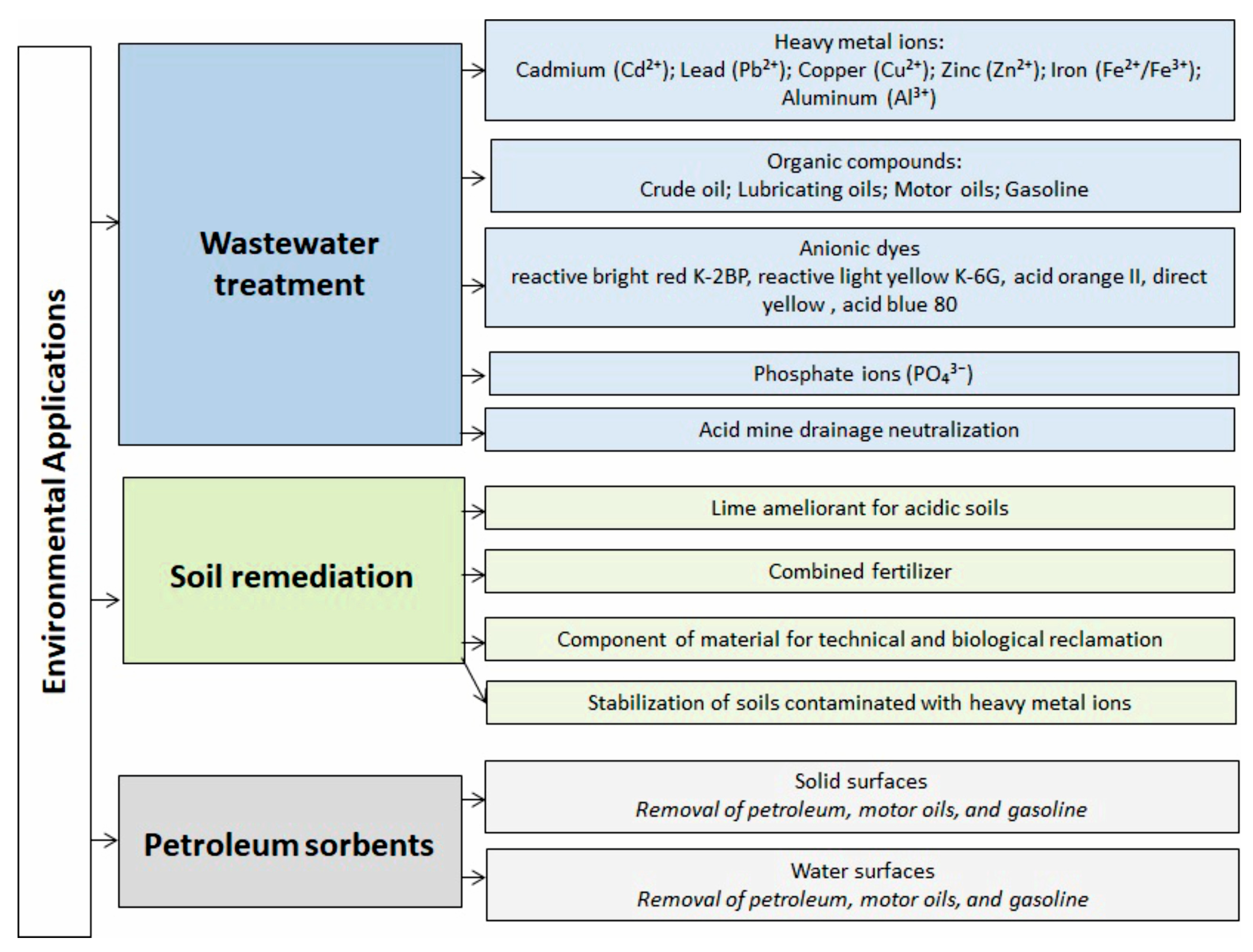
Potential applications for the recycling of the studied sediments within the region include the neutralization of acidic mine drainage at abandoned mines in the Kizel Coal Basin, their utilization as sorbents for oil spill remediation, application as a soil amendment in agriculture, and use as an additive in building materials.
Figure 6 presents information on the potential reuse and recycling of ASR [
40,
41,
42,
43,
44,
45,
46,
47,
48,
49,
50], which will inform the selection of recycling routes for the studied sediment.
ASR finds application in two primary sectors. In environmental protection, it functions as an adsorbent for mine water treatment, soil remediation, and emergency spill response for hydrocarbons. In building materials, it is incorporated into road pavement structural layers, used in ceramic brick production, and employed as a cement additive and soil stabilizer.
Table 3 presents patented applications for the use of soda ash production ASR [
40,
51,
52,
53,
54,
55,
56,
57,
58,
59,
60]. The following section discusses a number of promising directions for the recycling of soda sludge waste that are applicable under the specific conditions of the study region.
4.1. Neutralization of Acid Mine Drainage
Currently, the chemical neutralization method, using various alkaline materials, is employed worldwide for treating the acidic mine drainage (AMD) generated during mining and mineral processing, as well as at abandoned mine sites. This preference is due to their high reactivity and capacity to immobilize toxic metal ions [
61,
62,
63]. Commonly used alkaline neutralizing agents include limestone (CaCO
3), quicklime (CaO), slaked lime (Ca(OH)
2), soda ash (Na
2CO
3), caustic soda (NaOH), magnesium oxide (MgO), ammonium hydroxide (NH
4OH), and magnesium hydroxide (Mg(OH)
2) [
64,
65].
The use of alkaline industrial wastes, such as ASR, construction waste, slags, and fly ash, as reagents for neutralizing mine drainage can be a viable alternative to the application of commercial reagents. This approach can help reduce the volume of waste sent to disposal sites and lower the costs of remediation activities, provided that transportation is feasible [
66,
67,
68].
Following the closure of the mines in the Kizel Coal Basin, the area contains 100 waste dumps, 16 acid mine discharges (AMDs) (with a total flow rate of approximately 25,000 m
3/h), and 11 contaminated springs [
69,
70]. A promising application for ASR from Berezniki can be found in it the potential for neutralizing AMD and remediating soils in the Kizel Coal Basin (Perm Krai). The abandoned mines of the Kizel Coal Basin are located 80–150 km from the studied waste site. The AMD from the Kizel Coal Basin is characterized by a pH of 2–4 and of high total dissolved solids (TDS up to 13 g/L), which are largely attributed to high concentrations of SO
42− (up to 6229 mg/L), iron (up to 2387 mg/L), aluminum (up to 144 mg/L), a range of heavy metals (Be, Co, Ni, Li, Pb, and Zn), and rare earth elements (REEs) [
71,
72,
73].
Reducing the environmental impact of AMD discharge into adjacent watercourses and surrounding areas requires a focus on the pollution source. For effective AMD neutralization in the Kizel Coal Basin, it is essential to consider the unique chemical composition of each AMD discharge, as well as the local physico-chemical, geological, geomorphological, and climatic conditions, along with microbial activity [
74]. Therefore, laboratory and field pilot experiments are necessary to determine the optimal dosage for utilizing the studied sediment.
The limiting factors for AMD neutralization will be the short warm summer (overall reaction rates decrease with temperature) and the high AMD discharge (up to 1558 L/s) during periods of intense precipitation and snowmelt [
71]. Utilizing this ASR is advantageous for low-flow, low-acidity discharges with minimal metal loads. Key disadvantages, however, include elevated costs, operational safety issues, and the production of significant sludge volumes [
75]. The application of a neutralization ASR for AMD requires an evaluation of the specific metal ions to be precipitated and their resultant chemical forms. As demonstrated by Zhao et al. [
66], calcium-based reagents are insufficient for effective treatment of this AMD, necessitating a pretreatment step for pH adjustment in conjunction with more potent neutralizers.
Considering the aforementioned conditions influencing technology selection, a theoretical assessment of the feasibility of applying the studied sediment was conducted for the Kosva River basin (for four AMD discharges from mines and two AMD-contaminated springs) [
69]. Individualized treatment strategies for AMD—active, combined active/passive phased, and passive/active (with aeration)—were proposed for each AMD point source in the study area. The application of these approaches incurs continuous maintenance expenses, such as the periodic flushing or full replacement of the alkaline media and the dredging of sludge from settling basins for subsequent handling. According to researchers [
76,
77], hybrid technologies may offer an optimal solution for improving pollutant removal and mitigating the environmental impact of AMD.
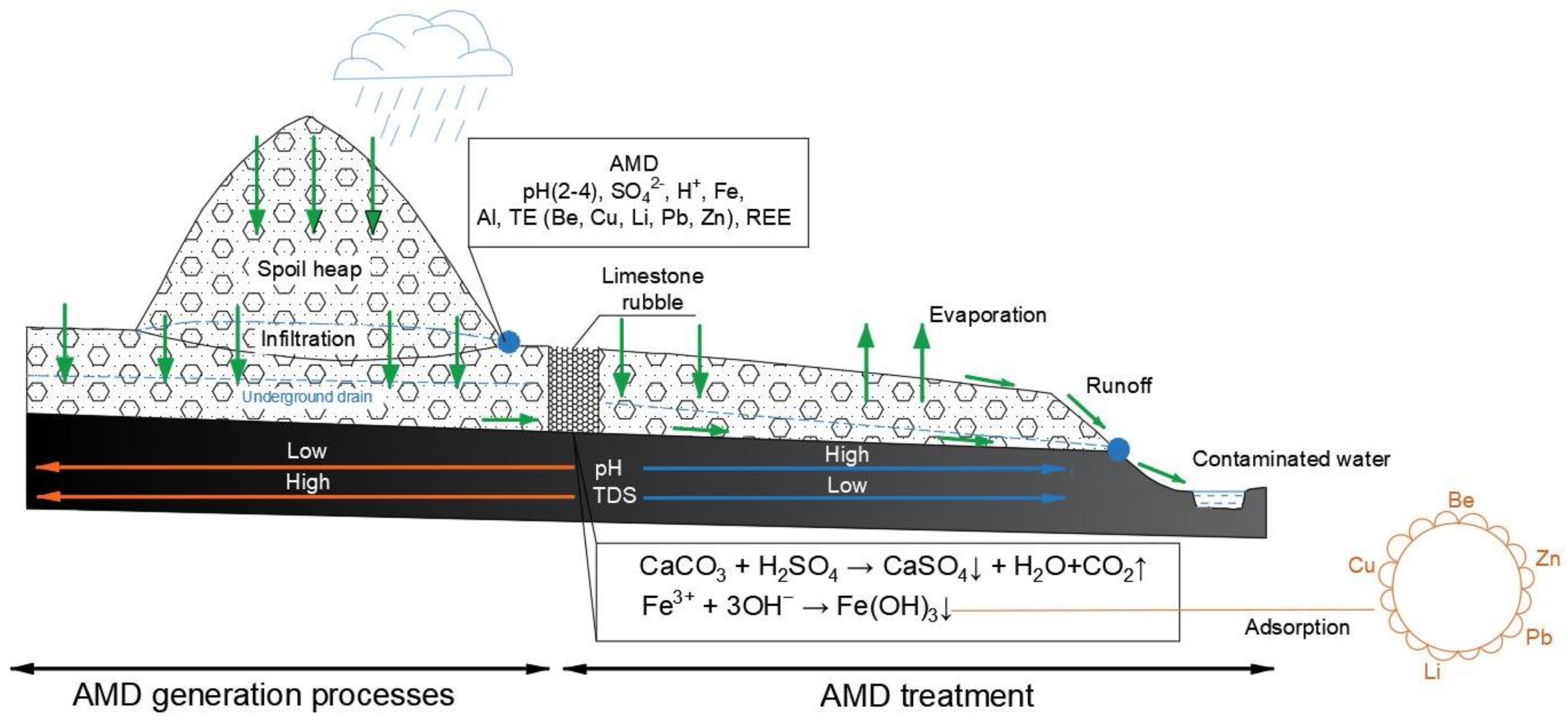
Developed technical methods for implementing mine water treatment and soil remediation using ASR (patents RU2336684C2, RU2293063C2) are presented in
Table 3. AMD was neutralized using a slurry prepared from the ASR of the Berezniki soda plant, applied at a dosage of 1.2–1.8 kg of ASR per 1 m
3 of mine water. During winter, the temperature was kept equal to the mine water temperature [
52]. Laboratory and field tests (Patent RU2293063C2) [
40] demonstrated that the application of ASR in the Kizel Coal Basin area increased the pH of mine water from 2.5 to 6–7. The total iron concentration decreased from 30–40 mg/dm
3 to 0.2–0.3 mg/dm
3, aluminum decreased from 10–14 mg/dm
3 to below the detection limit, and the concentrations of Be, Ni, Co, and Cu were reduced to levels meeting the regulatory standards for all types of water use [
42]. Based on the results of studies in the Kizel coal basin [
40,
42,
43,
51,
69] and the experience of AMD treatment [
78,
79,
80], a general schematic of the treatment process was compiled and is provided in
Figure 7.
The absence of studies regarding the investigated sediment as an AMD neutralizer in heap leaching and regarding LSA analysis indicate the potential for further research and development to assess its technical feasibility, environmental safety, and economic potential [
81].
4.2. Soil Remediation and Improvement
The high alkalinity and significant calcium ion content of ASR mean it has the potential to be used as a soil amendment or a reagent for soil remediation. The majority of arable land in Perm Krai consists of soddy podzolic soils, which are characterized by low natural fertility [
81].
An assessment of the ameliorative properties of soda production sludge from a facility in Sterlitamak (Bashkortostan, Ufa, Russia) under a temperate continental climate similar to that of Perm Krai showed that sludge application at rates of 0.5–2.0 g/kg significantly improved the acid–base properties of slightly acidic soddy podzolic soil and increased barley grain yield by 14.1–25.9% and potato tuber yield by 14.7–25.9% [
82].
In Perm Krai, elevated soil acidity constitutes the primary constraint on crop growth and development by reducing the bioavailability of essential plant nutrients [
83,
84]. The conventional remedy for this issue is soil liming. While the annual limed area in the region expanded from 82.3 thousand hectares in 1966 to 198.1 thousand hectares by 1990, the practice has since ceased entirely owing to a cessation of funding [
84].
According to observations conducted 17 years after the remediation of acidic soils using ASR and sewage sludge on an experimental plot, an improvement in the physicochemical properties of the disturbed soils was noted, along with a reduction in acidity and an increase in organic matter content [
43]. This method can be cost-effective, as replacing commercial reagents (lime, dolomite) with waste reduces costs by 30–50% [
85].
In summary, and similar to typical ASR, the studied sediment is rich in soluble salts, including major ions (Na
+, Cl
−, Ca
2+) and associated hydroxides, sulfates, and carbonates [
86]. This leads to a high chloride content, which poses a significant risk of soil salinization and consequent crop damage [
87]. Beyond salinity, the potential leaching of heavy metals from the sediment restricts the use of any cultivated biomass for food or feed. With proper risk assessment, however, such biomass could be directed toward technical applications like biofuel or biopolymer production [
88]. Alternatively, if the sediment proves phytotoxic, it could be utilized in constructing firebreaks in adjacent areas [
27] or for constructing impermeable liner systems at municipal solid waste landfills [
89]. Furthermore, the hydraulic activity of ASR materials can induce soil compaction [
90,
91]. Consequently, applying large quantities of this sediment to farmland risks soil over-compaction, adversely affecting its physical structure and chemical fertility.
4.3. Sorption of Organic Pollutants and Petroleum Products
Perm Krai has a developed oil industry. The state balance register includes oil reserves from 196 fields, with an annual production of approximately 16 million tons [
92]. Oil production, transportation, and refining operations in the study region carry an inherent risk of accidental spills affecting aquatic ecosystems, soil, and impervious surfaces like concrete or asphalt [
48,
93]. The predominant soil types in the oil mining areas of the study region include soddy podzolic soils (mainly the shallow podzolic and fine/shallow podzolic subtypes), light and dark gray forest soils, soddy calcareous soils (including leached and podzolized variants), podzolic soils (primarily the shallow podzolic subtype), and podzolized chernozems [
92,
94].
ASR exhibits sorption properties towards crude oil and petroleum products. For instance, they remove 95–99% of emulsified oil from a model solution of water produced by alkaline surfactant polymer flooding [
46]. The oil sorption capacity of ASR is (g/g) 0.95 for gasoline, 0.9 for motor oil, and 0.75 for crude oil, which is comparable to the oil sorption capacity of common natural sorbents used for emergency spill response on solid surfaces. Thermal treatment of ASR increases its oil sorption capacity by 15–32% [
93]. Chemical treatment of the sludge with sodium methyl silicate or potassium methyl silicate increases the oil sorption capacity by 30–80% [
47].
The application of the studied sediment as a sorbent for oil spills on water faces challenges due to its inherent low buoyancy and the potential leaching of toxic constituents. These drawbacks, however, might be addressed through pre-treatment methods such as thermal modification or surface coating with hydrophobic agents [
48,
93].
A limitation of using the studied sediment as an oil sorbent for collecting oil and petroleum products from solid surfaces is its low sorption capacity, which can be improved through thermal treatment and treatment with organosilicon hydrophobic agents. [
95]. The application of calcium-containing sludges to petroleum-contaminated soil requires establishing and maintaining a bioremediation-stimulating dose, as with the sludge amendment scenarios described in
Section 4.1 and
Section 4.2.
4.4. Construction
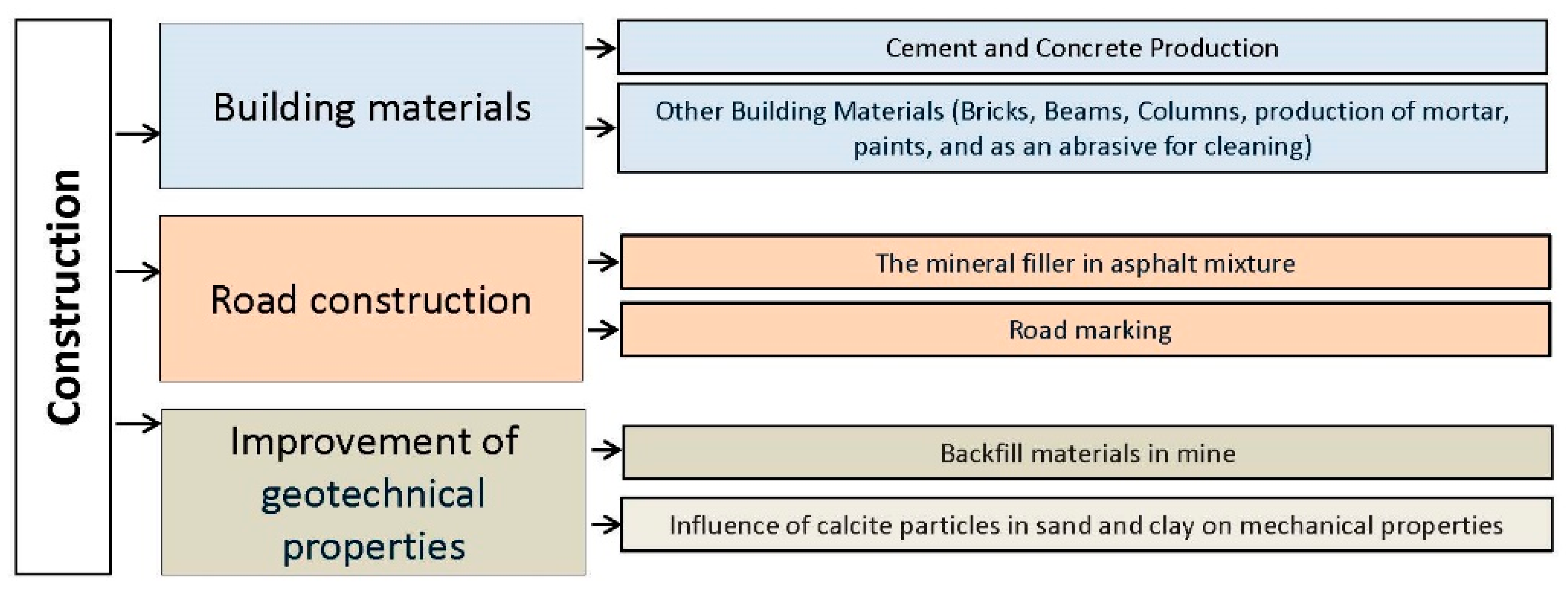
Based on the experience with ASR, the recycling of the studied sediment can be considered as an additive to cement in the construction industry [
96,
97,
98,
99,
100], concrete [
101,
102,
103], for soil and base stabilization [
104,
105] and for constructing structural layers of road pavements [
106,
107,
108,
109,
110,
111] (
Figure 8).
The studied sediment could potentially be used in the production of silicate brick. For instance, in Sterlitamak (Russia), after 17 years of service, buildings constructed from silicate brick in which lime was replaced with ASR showed no changes in their technical performance characteristics [
112,
113]. The only calcium silicate brick production facility in the region is located in close proximity to the studied sludge pond (in Berezniki), which represents a distinct benefit of the considered sediment recycle technology.
Considering the location of the object of study, promising avenues for utilizing the waste could involve their incorporation into the cement production cycle. A large cement production facility is located 100 km from the site, in Gornozavodsk city (Perm Krai).
The feasibility of the joint application of ASR and metallurgical slags in asphalt concrete mixtures as mineral additives, demonstrated for the conditions of Perm Krai, has shown the expediency of incorporating the waste in a mass fraction of up to 4% [
110]. The hydraulic properties of ASR support its application as a binder for stabilizing unpaved road surfaces [
35], which should also be evaluated for the studied sediment. Replacing the mineral filler in asphalt concrete mixtures with ASR can reduce raw material costs by 5–8%, an approach that should also be considered for the studied sediment [
114,
115]. The extensive network of unpaved roads in the Perm Krai, spanning approximately 10,000 km, creates a significant demand for the application of calcium-containing industrial wastes, such as soda residue, in road construction [
116]. This is exemplified by the 2025 road infrastructure program, which included the construction and reconstruction of 16.5 km of roads and the repair of 455 km [
117].
The application of study sediments to improve the load-bearing capacity of road subgrades can be constrained by elevated chloride concentrations, which may promote leaching upon moisture ingress. This limitation can be mitigated by incorporating fly ash, which actively immobilizes free chloride ions through the promotion of gel-forming phases [
118]. These phases fill pore spaces, chemically bind chlorides, and consequently reduce their migration potential within the soil matrix.
A positive example of using ASR in geotechnical works was obtained in China, where experimental results from a test mine demonstrated the use of solid soda residue waste to improve backfill material for engineering purposes with an economic effect [
119]. Every year, several million tons of salt waste are used for backfilling in the Berezniki and Solikamsk mines (Perm Krai) [
20]. Backfilling the mined-out space is the primary method for disposing of halite waste from potash mines [
120]. For the studied sediment, it will be necessary to evaluate its binding properties to determine the feasibility of its use for backfilling mined-out areas of the potassium mines in the Verkhnekamsk salt deposit.
A further option is to use the studied sediment in a manner similar to the way in which ASR, used for soil stabilization, improves the bearing capacity of the subgrade, indicating that this waste can be used as an engineering soil (e.g., fill soil for atriums, foundation soil for workshops, backfill soil for road subgrades) in geotechnical design [
121,
122].
Among the potential commercial applications of the studied sediment is its use in the preparation of drilling muds and cement slurries. This has been demonstrated in the successful experience of a low-temperature grouting binder utilizing calcined ASR (up to 10%) and Portland cement clinker (90%), with additives of plasticizers and electrolytes. This was tested at the Peschanoozerskoye, Rusanovskoye, and Shtokmanovskoye fields by the “Arctic Marine Oil and Gas Exploration” Production Association (Russia) at temperatures ranging from −2 to +15 °C [
123].
Composite cementitious materials derived from ASR possess a dual nature due to their composition, which includes both calcium-rich and chloride-bearing minerals [
124], similar to the studied sediment. This combination offers specific benefits but also poses a significant drawback: when used in reinforced concrete, chlorides present in ASR (as found in the studied sediment) can initiate and accelerate the corrosion of steel reinforcement [
125]. In composite cementitious systems incorporating ASR and cement, ASR was observed to elevate the heat of hydration. This increase is mainly due to the accelerating effect of the chlorides and carbonates present in ASR on the hydration reactions of silicates and aluminates [
124]. Li et al. [
126] demonstrated a beneficial effect of ASR in producing magnesium oxychloride cement with GGBS, which led to improved rheological behavior of the mixtures, resulting in bricks that were denser and exhibited reduced anisotropy with higher firing temperatures [
127,
128,
129].
4.5. In Situ Waste Remediation
Significant experience in dealing with the legacies of soda plants has been accumulated in Poland [
130]. For instance, in Jaworzno, a waste pile with high calcium content and strong alkalinity, 3–5 m high and covering an area of about 33,000 square meters, was formed between 1885 and 1909 [
131]. Despite natural remediation, it continues to impact local soils and change the chemistry of the Wilga River [
132].
Information on the progress of natural vegetation succession on soda sludge can also be provided by the case study of the industrial site in Berezniki City. As shown above (
Figure 2), two sedimentation ponds of soda ash production are located north of the abandoned sludge pond, which is the subject of the present study. One of these ponds was decommissioned and drained in the mid-1990s, while the other remains operational to date [
133]. Due to the large area of the active sedimentation pond (over 2,000,000 square meters), slurry is supplied in a controlled manner to different sections. This allows for an assessment of the rate of surface revegetation and the plant species composition (
Figure 9). In the section where the active sedimentation pond was deposited approximately 5 years ago, sheep’s sorrel (
Rumex acetosella), white clover (
Trifolium repens), and sporadic occurrences of white sweet clover (
Melilotus albus Medik) were found in a mosaic distribution. In the section of the non-active sedimentation pond, where ASR was deposited over 30 years ago, white clover (
Trifolium repens), and plants from the sedge family (
Cyperaceae), and the grass family (
Poaceae) were observed. In the tree layer, willow (
Salix) and birch (
Betula) were recorded, with an estimated age of 10 to 20 years.
Thus, despite the emergence of salt-tolerant vegetation, the developing soil layer, even after 30 years, does not exceed a thickness of 0.05–0.07 m and remains weakly humified and structureless. Together with the cases considered in Jaworzno and Krakow, the option of leaving highly soluble soda sludges on the surface for natural remediation carries risks of secondary contamination of natural waters and the soil cover. Given that the natural remediation process may continue for over 100 years, a more promising approach appears to be considering options for extracting and recycling the accumulated waste prior to remediating the disturbed lands. This would enable environmentally safe waste disposal and restore the disturbed territory [
134].
Currently, natural revegetation of the studied pond is precluded by the lack of stormwater drainage, resulting in the permanent coverage of the sediment deposit—by water above 0 °C and by ice below 0 °C.
To address orphaned waste disposal sites, such as the one studied here, a state program for the remediation of accumulated environmental damage is currently being implemented in Russia. The studied abandoned pond with accumulated sediments investigated in this work has no owner and is located within a land plot owned by the municipality. Consequently, it can be classified as a site of accumulated environmental damage (SAED). The conducted research can provide the necessary primary data for including the site in the SAED remediation program and serve as a starting point for selecting studied pond reclamation approaches. Constraints related to the pond’s location (an urban setting within a water protection zone) render the simplest reclamation method—capping with impervious soil for in situ disposal—unfeasible. Therefore, if a large number of factors limiting sediment utilization are identified, the sediments must be relocated to authorized waste disposal facilities.
5. Opportunities and Recommendations for Recycling the Studied Sediment
Excavation is the likely method for removing the sediment from the sludge pond for secondary use. This will inevitably lead to mixing of the layers, as selective extraction of paste-like layers of low thickness is not feasible. In this study, the minimum layer thickness is 0.16 m and the maximum is 0.70 m (
Figure 4 and
Figure 5). The approximate mineral composition of the sludge after mixing can be estimated from the average mineral phase contents calculated in
Section 3: calcite 67.7%, halite 11.5%, carbonate group minerals total 77%, sulfate minerals 15.2%, chloride minerals 14.4%, and others 19.2% (
Table 1).
The selection of well-substantiated potential reuse and recycling of sediments alternatives from among those presented in
Section 4.1,
Section 4.2,
Section 4.3,
Section 4.4 and
Section 4.5 must be made on the basis of the following key characteristics: mineralogical, physico-chemical and granulometric composition, as well as physical–mechanical and toxicological properties. To date, studies on the granulometric, mineral, and chemical composition of the studied sediment have been carried out (with the exception of organic components). Further research will address its physical–mechanical and toxicological properties of sediment.
A complete analysis of the requirements set by regulatory and technical documents regarding the quality of raw materials for the production of commercial products from the planned reuse and recycling of sediments is necessary. In case of minor deviations, recommendations for their elimination need to be developed. The selection of sediment reuse and recycling routes will be governed by industrial resource demand (the chosen route should maximize sediment consumption), the proximity of processing facilities to the studied sludge pond, and the environmental and economic performance of the technologies employed.
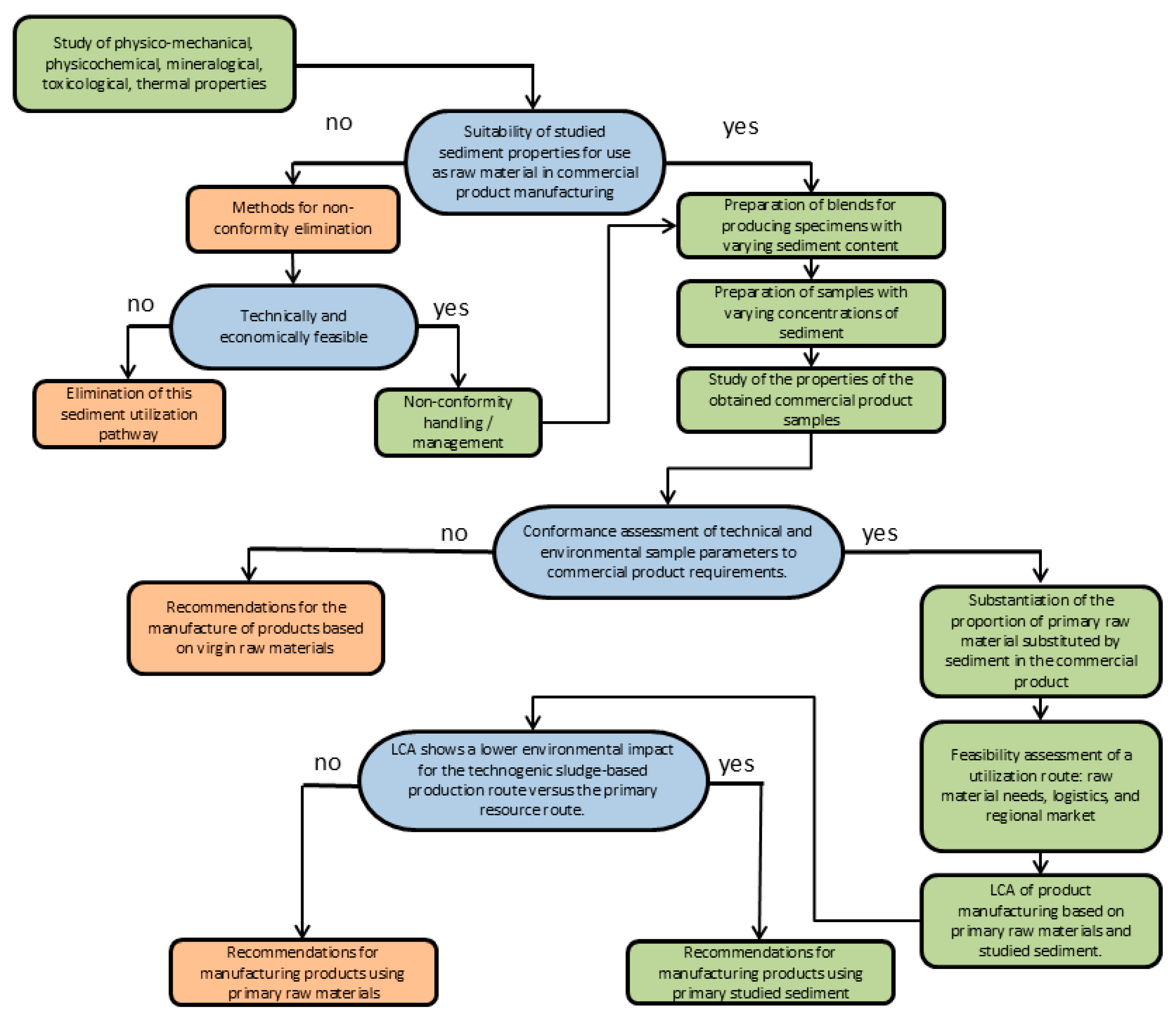
If the sediment properties do not conform to the raw material specifications for the intended products, the technical, environmental, and economic viability of adjusting these properties to meet regulatory requirements should be assessed. Potential approaches include chloride removal by washing; toxicity reduction via washing, dewatering, neutralization, or thermal treatment; pulverization to produce fine powder; and hydrophobization through thermal or chemical treatment. The subsequent research algorithm is shown in
Figure 10.
In some cases, the use of sediment in the production of a commercial product may lead to the redistribution of pollution sources from the studied sludge pond to the production site, for example, through the formation of new pollutants in emissions or discharges, or the generation of new waste types not typical of the given production process. For instance, when sludge is incorporated into pavement layers with insufficient waterproofing, emissions of heavy metal ions may occur into the underlying subgrade soils, natural ground, and groundwater aquifers. Thermal treatment of mixtures for ceramic brick production may result in the release of hydrogen chloride.
According to the requirements of environmental legislation, manufacturing enterprises will need to update their permitted emission and discharge limits as well as waste generation norms when the composition of raw materials is altered. Another potential limitation is the specificity of manufacturing commercial products from primary raw materials and the consequent need to adapt technological processes to the use of secondary resources. This may entail additional processing steps for the sediment and supplementary technical equipment (e.g., receiving hoppers, additional sediment feeding and dosing systems, etc.).
The technical feasibility of the disposal methods will be determined based on the results of experimental investigations. Products incorporating the sediment will be evaluated in accordance with the requirements of state standards [
135].
The following additional assessments of the sediment will also be carried out: geometric parameters and physical–mechanical properties (compressive and flexural strength, frost resistance, water absorption). In accordance with GOST R 58406 [
136], physical parameters of asphalt concrete specimens incorporating the sediment as a mineral filler will be investigated, including air void content, voids in the mineral aggregate, voids filled with bitumen binder, and flexural tensile strength. For sediment used in cement compositions, physical–mechanical characteristics—such as fineness of grinding, setting time, soundness (uniformity of volume change), and flexural and compressive strength—will be tested in compliance with GOST 30515-2013 [
137].
Changes in the material composition of the resulting new materials will be studied using a combination of X-ray fluorescence spectrometry (XRF) for chemical composition, X-ray diffraction (XRD) for phase composition, scanning electron microscopy (SEM) for microstructure, and simultaneous thermal TG–DSC analysis to clarify amorphous phases, forms of water, and thermal stability. Each research result is subject to boundary conditions, on the basis of which the performance of new materials under specific conditions can be inferred. Therefore, it is important to conduct a systematic analysis of the technical feasibility and environmental safety of the investigated sediment reuse and recycling options. One of the most critical tasks in future research is to determine the optimal application rate for the selected reuse and recycling pathways in order to prevent risks of salinization, contamination of soil and water environments, and human health hazards.
The environmental feasibility of the investigated sediment reuse and recycling options methods will be assessed using life cycle assessment according to the ReCiPe method, implemented with OpenLCA software and the Ecoinvent v. 3.8 database.
Following the completion of all planned sediment investigations and the identification of existing constraints, a sediment reuse and recycling option must be selected. The selection of secondary use pathways will also require the development of an optimization model for raw material transport routes in order to minimize transportation costs and vehicle exhaust emissions [
138].
An important consideration is the examination of legal and economic issues to determine the industrial feasibility of the large-scale implementation of new materials and the interest of enterprises in utilizing the investigated sediment in their production processes. A constraint on activities related to the application of the studied sediment or the reclamation of the facility in question is the absence of a legally established owner of the site. In the event that no environmentally and economically acceptable technologies are available for the reuse and recycling of the investigated sediment, or of a portion thereof, measures shall be provided for the landfilling of such sediment at an authorized waste disposal facility.
6. Benefits and Risks of Study Waste Recycling
An analysis of known utilization avenues, including the results of practical implementation, has established that the primary reuse and recycling of sediments of calcium-containing waste—such as ASR—are environmental protection and construction applications.
The following risks have been taken into account in this study when reusing the investigated sediment:
Long payback period for recycling equipment;
Extended implementation timeline for sediment recycle and sludge pond reclamation;
Decreased demand for secondary resources;
Unstable market for derived products and materials;
Low cost of primary raw materials;
Competition among other regional calcium-containing wastes (ASR, concrete and structural demolition waste, metallurgical slags, fuel combustion ash);
High transportation costs due to the remoteness of the sediment sludge pond from recycling facilities and points of end use;
Excess of accumulated studied sediment volume relative to regional raw material demand;
Potential generation of secondary pollutants during sludge pretreatment (wash water, sediments, dust);
Loss of public and business confidence;
Penalties for non-compliance with legislative requirements.
Tightening or amendment of legal regulations;
Rejection of technical documentation packages and negative conclusions from mandatory expert reviews (construction, environmental) for novel materials and technologies;
Refusal of approval for planned works by owners of hydraulic structures (dams) located along the perimeter of the sludge pond.
Heterogeneity of sediment composition and properties across vertical profiles and lateral extent of the sludge pond;
Encountering large-sized waste items (tanks, metal drums, etc.) during sediment excavation;
Water ingress into the sludge pond during sediment excavation;
Impact of sediment excavation on the integrity and stability of hydraulic structures adjoining the sludge pond (non-active sedimentation pond of soda plant and the Berezniki industrial canal);
Effect of reclamation works on the stability of slopes and dam bodies around the sludge pond perimeter; alteration of geological and hydrogeological conditions (filtration regime, groundwater, dynamic loading);
Unforeseen chemical interactions between sediment components;
Increased corrosive wear on equipment used for transport and processing;
Emergency situations during technology implementation;
Non-compliance with sediment reuse and recycling technology at any stage (risk of environmental contamination, risk of producing off-specification commercial products);
Divergence between actual operational conditions and those of laboratory or pilot trials;
Failure to adhere to prescribed sediment dosage rates in technological applications.
Leaching of water-soluble components leading to salinization of water bodies and soils;
Contamination of the geological medium and subsurface hydrosphere beneath the sediment sludge pond;
Emissions of heavy metals from improperly disposed sediment;
Secondary emissions (heavy metals, chlorides) from products derived from the sediment;
Air pollution with fine dust during handling, transport, and processing of dry waste;
Toxicological exposure to humans via inhalation and dermal routes during sediment excavation, transport, and processing.
Recycling and reuse of the calcium-rich studied sediment will enable the following objectives to be met:
Elimination of a potential source of pollution of the Kama River, on which drinking and industrial water intake facilities are located;
Reclamation of the land occupied by the sediment of sludge pond and return of the freed land to economic use;
Expansion of the raw material base for the construction industry, environmental protection applications, and agriculture;
Reduction in the extraction of primary calcium-containing natural resources;
Decrease in the production costs of goods manufactured using secondary resources.
The use of sediment of the studied sludge pond as a secondary resource has undeniable advantages, though environmental risks must also be considered (
Table 4) and managed.
7. Study Limitations
The use of the investigated calcium-containing sediment as secondary materials in environmental applications and construction offers a number of ecological and economic advantages in the region. However, realizing these benefits requires consideration of the following constraints:
The environmental and physical–mechanical properties of the sediment may vary significantly depending on the location within the sludge pond. The actual characteristics of the sediment may restrict its secondary use, necessitating additional research into remediation options to enable its subsequent reuse.
Lack of regional processing infrastructure for the required product types;
Industrial demand for secondary feedstock is considerably below the volume of sediment accumulated in the studied sludge pond;
Inhomogeneous sediment composition;
Necessity of adapting raw material pretreatment and processing technologies;
Obsolescence of equipment and processes at recycling facilities.
Low price of virgin raw calcium-containing materials;
High capital investment required for new processing infrastructure;
Volatile market demand for products made from secondary resources;
No incentive schemes to promote secondary feedstock use;
Geographic distance between waste storage/generation sites and recycling plants.
Absence of technical standards and specifications for the manufacture of products using secondary raw materials;
Cumbersome procedure for accounting and reclassifying the status of waste to secondary raw material;
Lack of a regional program for integrating calcium-containing waste into production.
The investigated sediment may contain contaminants capable of affecting the performance characteristics of the commercial product;
Negative outcome of public hearings when reviewing the program for secondary use of the studied sediment in construction and environmental applications.
Addressing these constraints requires interdisciplinary studies with participation from relevant research institutes, industry specialists, process engineers, regional and local government, and community stakeholders. In addition, a project roadmap with a clear implementation timeline for sediment valorization must be established.
8. Conclusions
This review presents the first literature-based assessment of sediment from an abandoned sludge pond to evaluate its utilization potential. The sediment is characterized by a high content of calcite (62–70 wt.%) and halite (9–13 wt.%), alongside other carbonates, sulfates, and chlorides. Granulometric analysis reveals a predominance of fine silt and clay fractions. Its compositional and mineralogical profile closely resembles that of calcium-rich industrial wastes, specifically soda production sludge. A global analysis of soda sludge management practices shows its primary applications are in environmental remediation and as a raw material for construction products.
Utilization pathways were evaluated for sediment within an abandoned 17.5-hectare impoundment, containing an estimated 497,790 m3 (1,294,124 t) of material. The inconsistent thickness and lateral heterogeneity of sediment layers, observed in boreholes, preclude the selective extraction of a specific stratum. Consequently, excavation would likely homogenize the sediment layers. For each viable utilization pathway, technical feasibility must be demonstrated through experimental research, confirming (1) the feasible substitution rate for primary raw materials, (2) the compliance of the final product’s technical specifications, and (3) the environmental safety of the resulting commercial goods. Future work will target the characterization of the sediment’s key physico-mechanical and toxicological properties.
Potential regional pathways for the recycling of the studied sediment of sludge pond include (1) acid mine drainage (AMD) neutralization at abandoned mines in the Kizelovsky Coal Basin, (2) oil sorbent production for spill response, (3) agricultural use as a soil conditioner, (4) incorporation as an additive in construction materials, and (5) evaluation as backfill for abandoned mine workings at the Verkhnekamskoye Deposit. In-situ burial is considered non-viable due to regulatory constraints.
Each utilization pathway will undergo a product performance assessment against key criteria, coupled with an analysis of the associated environmental and economic trade-offs. A pivotal next step is to resolve the legal and economic framework at the regional level to ascertain the commercial viability of large-scale adoption and to incentivize industry participation in integrating this sediment into manufacturing processes.
Author Contributions
Conceptualization, E.U. and E.K.; methodology, E.U., E.K. and P.B.; software, R.P. and V.P.; validation, E.U., E.M. and P.B.; formal analysis, E.U., P.B. and S.B.; investigation, P.B., R.P. and S.B.; resources, E.M., S.B. and P.B.; data curation, E.U., P.B. and E.M.; writing—original draft preparation, E.U., E.K., P.B. and V.P.; writing—review and editing, E.U., E.M., P.B. and E.K.; visualization, E.U.,R.P., E.K. and V.P.; supervision, E.M.; project administration, E.U. and P.B.; funding acquisition, P.B. and S.B. All authors have read and agreed to the published version of the manuscript.
Data Availability Statement
Data are available upon request to the corresponding author of the manuscript.
Acknowledgments
The authors thank the Sector of Nanomineralogy of the Centre for Collective Use of Unique Scientific Equipment of Perm State University for laboratory research.
Conflicts of Interest
The authors declare no conflicts of interest.
References
- Tayebi-Khorami, M.; Edraki, M.; Corder, G.; Golev, A. Re-Thinking Mining Waste through an Integrative Approach Led by Circular Economy Aspirations. Minerals 2019, 9, 286. [Google Scholar] [CrossRef]
- García, G.; Rosique, G. Underlying Causes of Long-Term Environmental Pollution by Waste from an Abandoned Metal Mining District: When Legislative and Remediation Measures Are Ineffective. Environments 2025, 12, 7. [Google Scholar] [CrossRef]
- Valenta, R.K.; Lèbre, É.; Antonio, C.; Franks, D.M.; Jokovic, V.; Micklethwaite, S.; Parbhakar-Fox, A.; Runge, K.; Savinova, E.; Segura-Salazar, J.; et al. Decarbonisation to Drive Dramatic Increase in Mining Waste–Options for Reduction. Resour. Conserv. Recycl. 2023, 190, 106859. [Google Scholar] [CrossRef]
- Maus, V.; Giljum, S.; da Silva, D.M.; Gutschlhofer, J.; da Rosa, R.P.; Luckeneder, S.; Gass, S.L.B.; Lieber, M.; McCallum, I. An update on global mining land use. Sci. Data 2022, 9, 433. [Google Scholar] [CrossRef]
- Abiahu, C.M.G.; Fagorite, V.I.; Oli, I.C. Mine Waste: Sources, Problems and Mitigations. EPH-Int. J. Appl. Sci. 2019, 5, 1–7. [Google Scholar] [CrossRef]
- Garbarino, E.; Orveillon, G.; Saveyn, H.G. Management of Waste from Extractive Industries: The New European Reference Document on the Best Available Techniques. Resour. Policy 2020, 69, 101782. [Google Scholar] [CrossRef]
- Grebenets, V.I.; Tolmanov, V.A.; Khayredinova, A.G.; Yurov, F.D. The problem of waste disposal in the Arctic regions of Russia. Probl. Reg. Ecol. 2019, 3, 63–67. [Google Scholar] [CrossRef]
- Akhtar, N.; Syakir Ishak, M.I.; Bhawani, S.A.; Umar, K. Various Natural and Anthropogenic Factors Responsible for Water Quality Degradation: A Review. Water 2021, 13, 2660. [Google Scholar] [CrossRef]
- Norwegian Environment Agency. Mining Industry and Tailings Disposal: Status, Environmental Challenges, and Gaps of Knowledge; Report M1335; Norwegian Environment Agency: Oslo, Norway, 2019; 138p, Available online: https://www.miljodirektoratet.no/globalassets/publikasjoner/m1335/m1335.pdf (accessed on 23 March 2025).
- Oyarzun, R.; Lillo, J.; López-García, J.A.; Esbrí, J.M.; Cubas, P.; Llanos, W.; Higueras, P. The Mazarrón Pb–(Ag)–Zn Mining District (SE Spain) as a Source of Heavy Metal Contamination in a Semiarid Realm: Geochemical Data from Mine Wastes, Soils, and Stream Sediments. J. Geochem. Explor. 2011, 109, 113–124. [Google Scholar] [CrossRef]
- Manaviparast, H.R.; Miranda, T.; Medius, G.; Cristelo, N. Mine tailings properties and its hypoplastic predictions. In Geotechnical Engineering Challenges to Meet Current and Emerging Needs of Society; CRC Press: Boca Raton, FL, USA, 2024; pp. 1786–1789. [Google Scholar] [CrossRef]
- Araujo, F.S.M.; Taborda-Llano, I.; Nunes, E.B.; Santos, R.M. Recycling and Reuse of Mine Tailings: A Review of Advancements and Their Implications. Geosciences 2022, 12, 319. [Google Scholar] [CrossRef]
- Mancini, S.; Casale, M.; Tazzini, A.; Dino, G.A. Use and Recovery of Extractive Waste and Tailings for Sustainable Raw Materials Supply. Mining 2024, 4, 149–167. [Google Scholar] [CrossRef]
- Hao, C.; Meng, W.Q.; Li, H.Y. Project Description of Ecological Reconstruction of Soda Residue Dump in Tianjin, China. Conf. Environ. Pollut. Public Health 2010, 1, 542–547. [Google Scholar]
- Report on the State of the Environment of the Russian Federation. 2023. Available online: https://www.mnr.gov.ru/activity/np_ecology/fp-chistaya-strana/?ysclid=mmsrxooofd859653897 (accessed on 23 March 2025).
- Belkin, P.; Nechaeva, Y.; Blinov, S.; Perevoshchikov, R.; Plotnikova, E. Sediment Microbial Communities of a Technogenic Saline-Alkaline Reservoir. Heliyon 2024, 10, e33640. [Google Scholar] [CrossRef] [PubMed]
- Drobinina, E.V.; Belkin, P.A.; Vaganov, S.S.; Perevoshchikov, R.D. Study of long-term industrial waste storage areas using remote sensing data. Curr. Probl. Remote Sens. Earth Space 2025, 22, 276–287. [Google Scholar] [CrossRef]
- Belkin, P.; Blinov, S.; Drobinina, E.; Menshikova, E.; Vaganov, S.; Perevoshchikov, R.; Tomilina, E. Factors of Bottom Sediment Variability in an Abandoned Alkaline Waste Settling Pond: Mineralogical and Geochemical Evidence. Minerals 2025, 15, 662. [Google Scholar] [CrossRef]
- Solvay. Official Website. Available online: https://www.solvay.com/en/ (accessed on 20 March 2025).
- Perm State Archive. Official Website. Available online: http://www.archive.perm.ru (accessed on 20 March 2025).
- Ushakova, E.S.; Belkin, P.A.; Drobinina, E.V. Sewage Sludge Formation Characteristics and Environmental Status of the Industrial Wastewater Channel. Bull. Tomsk Polytech. Univ. Geo Assets Eng. 2023, 334, 75–91. [Google Scholar] [CrossRef]
- Vaganov, S.S.; Perevoshchikov, R.D.; Menshikova, E.A.; Ushakova, E.S. Method for Sampling Bottom Sediments for Environmental Studies and a Device for Its Implementation. Russian Patent RU2762631 C1, 21 December 2021. Available online: https://patents.google.com/patent/RU2762631C1 (accessed on 23 March 2025).
- ISO 17025; General Requirements for the Competence of Testing and Calibration Laboratories. International Organization for Standardization: Geneva, Switzerland, 2021.
- GOST 12536-2014; Soils. Methods of Laboratory Granulometric (Grain-Size) and Microaggregate Distribution. Standartinform: Moscow, Russia, 2019.
- GOST 8.777-2011; State System for Ensuring the Uniformity of Measurements. Disperse Composition of Aerosols and Suspensions. Determination of Particle Size by Laser Diffraction. Standartinform: Moscow, Russia, 2012.
- Kalinina, E.V.; Rudakova, L.V. Decrease of toxic properties of soda production sludge and its utilization. Bull. Tomsk Polytech. Univ. Geo Assets Eng. 2018, 329, 85–96. [Google Scholar]
- Pugin, K.G.; Salakhov, R.R. Use of the resource potential of soda production sludge. Rudn. J. Ecol. Life Saf. 2025, 33, 452–460. [Google Scholar] [CrossRef]
- Kolpakova, M.N.; Borzenko, S.V.; Isupov, V.P.; Shatskaya, S.S.; Shvartsev, S.L. Hydrochemistry and geochemical typification of saline lakes in the Altai Krai. Water Chem. Ecol. 2015, 1, 11–16. [Google Scholar]
- Shvartsev, S.L.; Kolpakova, M.N.; Isupov, V.P.; Vladimirov, A.G.; Ariunbileg, S. Geochemistry and formation of the composition of saline lakes in Western Mongolia. Geochemistry 2014, 5, 432–449. [Google Scholar] [CrossRef]
- Borzenko, S.V.; Zamana, L.V. Sulfate reduction as a factor in the formation of soda waters of Lake Doroninskoye. Bull. Tomsk. State Univ. 2008, 312, 188–194. [Google Scholar]
- Borzenko, S.V. Main conditions for the formation of lake water composition in Eastern Transbaikalia. Geochemistry 2020, 65, 1212–1230. [Google Scholar] [CrossRef]
- Valekzhanin, I.V.; Ishmiyarov, E.R.; Presnyakov, A.Y.; Garifullin, A.R.; Voloshin, A.I. The problem of halite deposits in highly mineralized environments: Causes, mechanism, control. Oilfield Eng. 2019, 10, 65–78. [Google Scholar] [CrossRef]
- Korolev, E.A.; Shilovsky, O.P.; Barieva, E.R.; Nuzhdin, E.V.; Nikolaeva, V.M.; Khamadiev, R.I. Influence of Structural-Genetic Features of Various Kinds of Fossils on Peculiarities of Authigenic Pyrite Formation in Upper Jurassic Deposits. Sci. Notes Kazan Univ. Ser. Nat. Sci. 2010, 152, 192–207. [Google Scholar]
- Ruban, A.S.; Rudmin, M.A.; Gershelis, E.V.; Leonov, A.A.; Mazurov, A.K.; Dudarev, O.V.; Semiletov, I.P. Authigenic minerals in the bottom sediments from seeps of the Laptev Sea. Bull. Tomsk Polytech. Univ. Geo Assets Eng. 2020, 331, 24–36. [Google Scholar] [CrossRef]
- Blinov, S.M.; Maksimovich, N.G.; Naidanova, N.F.; Shlykov, V.G.; Potapov, S.S. Mineralogical bases of waste disposal of JSC «Berezniki soda plant». Mineral. Technog. 2003, 4, 51–55. [Google Scholar]
- Kozlov, S.G.; Vyazovikova, I.V.; Cherny, S.A.; Krepysheva, I.V. Use of soda production waste in road construction. Fundam. Res. 2013, 10, 10–12. [Google Scholar]
- Glushankova, I.S.; Kalinina, E.V.; Demina, E.N. Modified Sorbents based on soda production sludge for extracting heavy metal ions from aqueous solutions and wastewater. Theor. Appl. Ecol. 2018, 3, 100–108. [Google Scholar] [CrossRef]
- Drobinina, E.V.; Belkin, P.A. Modeling as a Means of Retrospective Analysis of Geoecological Processes within a Technogenic Object. Sergeev Readings. Soil Masses as a Life-Supporting Resource of Society. In Proceedings of the Annual Session of the Russian Academy of Sciences Scientific Council on Geoecology, Engineering Geology, and Hydrogeology, Pskov, Russia, 27–28 March 2025; Geoinfo: Moscow, Russia, 2025; pp. 80–83. [Google Scholar]
- Zong, Y.; Gong, J.; Zhang, J.; Su, Y.; Hu, C.; Li, T.; Wu, Y.; Jiang, M. Research Status of Soda Residue in the Field of Environmental Pollution Control. RSC Adv. 2023, 13, 28975–28983. [Google Scholar] [CrossRef] [PubMed]
- Maksimovich, N.G.; Basov, V.N.; Kholostov, S.B. Method of Neutralization of Acidic Mine Water and Plant for Realization of This Method. RU Patent 2293063 C2, 10 February 2007. Available online: https://patents.google.com/patent/RU2293063C2/ru?oq=RU+Patent+2%2c293%2c063+C2 (accessed on 23 March 2025).
- Krasil’nikova, S.A. Ecological-Economic Efficiency of Land Reclamation of Disturbed Lands. Mod. Probl. Sci. Educ. 2011, 6, 284. [Google Scholar]
- Maksimovich, N.G. Use of Geochemical Barriers for Acid Mine Drainage Treatment in the Kizel Coal Basin. Eng. Geol. 2011, 9, 20–25. [Google Scholar]
- Mitrakova, N.V.; Khayrulina, E.A.; Blinov, S.M.; Perevoshchikova, A.A. Efficiency of acid sulphate soils reclamation in coal mining areas. J. Min. Inst. 2023, 260, 266–278. [Google Scholar] [CrossRef]
- Shi, L.; Luo, H. Preparation of Soil Nutrient Amendment Using White Mud Produced in Ammonia-Soda Process and Its Environmental Assessment. Trans. Nonferrous Met. Soc. China 2009, 19, 1383–1388. [Google Scholar] [CrossRef]
- Kalinina, E.V. Material for Biological Reclamation Based on Soda Production Sludge and Excess Activated Sludge. Vestn. Perm. Nats. Issled. Politekh. Univ. Prikl. Ekol. Urbanist. 2017, 2, 63–73. [Google Scholar]
- Zha, F.; Liu, C.; Kang, B.; Yang, X.; Zhou, Y.; Yang, C. Acid Rain Leaching Behavior of Zn-Contaminated Soils Solidified/Stabilized Using Cement–Soda Residue. Chemosphere 2021, 281, 130916. [Google Scholar] [CrossRef] [PubMed]
- Gao, R.; Li, F.; Li, Y.; Wu, T. Effective Removal of Emulsified Oil from Oily Wastewater Using In-Situ Generated Metallic Hy-droxides from Leaching Solution of White Mud. Chem. Eng. J. 2017, 309, 513–521. [Google Scholar] [CrossRef]
- Karmanova, E.N.; Kalinina, E.V. Elimination of Emergency Spills of Oil and Oil Products from Solid Surfaces with Modified Waste from Soda Production. Transp. Struct. Ecol. 2018, 4, 53–60. [Google Scholar]
- Kalinina, E.V.; Glushankova, I.S.; Rudakova, L.V.; Sabirov, D.O. Obtaining a Modified Sorbent Based on Soda Production Sludge for Eliminating Oil and Oil Product Spills from the Water Surface. Ecol. Ind. Russ. 2018, 22, 30–35. [Google Scholar] [CrossRef]
- Zhang, G.; Li, X.; Li, Y.; Wu, T.; Sun, D.; Lu, F. Removal of Anionic Dyes from Aqueous Solution by Leaching Solutions of White Mud. Desalination 2011, 274, 255–261. [Google Scholar] [CrossRef]
- Blinov, S.M.; Khozyajkin, A.I.; Usol’tseva, S.P.; Domozhirova, S.A. Method of Reclamation of Disturbed Lands Using Industrial Waste. Russian Patent RU2336684 C2, 27 October 2008. Available online: https://patents.google.com/patent/RU2336684C2/ru?oq=RU2%2c336%2c684 (accessed on 26 March 2025).
- Kalinina, E.V.; Vajsman, Y.I.; Rudakova, L.V. Material for Biological Reclamation of Disturbed Soils. RU Patent 2546155 C1, 10 April 2015. Available online: https://patents.google.com/patent/RU2546155C1/ru?oq=RU+Patent+2%2c546%2c155+C1 (accessed on 23 March 2025).
- Green, K.L.; Skogley, R.N. Method for Treating Mine Water Using Caustic Soda. U.S. Patent 5575922A, 19 November 1996. Available online: https://patents.google.com/patent/US5575922A/en?oq=U.S.+Patent+5%2c575%2c922 (accessed on 23 March 2025).
- Lu, Q. Treatment Method of Combined-Soda Plant Wastewater. Chinese Patent CN104310684 A, 28 January 2015. Available online: https://patents.google.com/patent/CN104310684A/en?oq=CN104%2c310%2c684+A (accessed on 23 March 2025).
- Beijing Bailing Tiandi Environmental Protection Technology Co., Ltd. A High-Salinity Coal Mine Mine Water Up-to-Standard Treatment and Resource Utilization Device and Using Method. Chinese Patent CN111362453 B, 3 November 2020. Available online: https://patents.google.com/patent/CN111362453B/en?oq=Chinese+Patent+CN111%2c362%2c453+B%2c+ (accessed on 23 March 2025).
- Fedorkin, S.I.; Lyubomirsky, N.V.; Bakhtin, A.S.; Bakhtina, T.A. Raw Mixture for Production of Carbonized Wall Materials. Russian Patent RU2675648 C1, 21 December 2018. Available online: https://patents.google.com/patent/RU2675648C1/ru?oq=RU2%2c675%2c648+C1 (accessed on 23 March 2025).
- Fedorkin, S.I.; Falkovsky, N.N. Method of Producing Building Articles. Russian Patent RU2012548 C1, 15 May 1994. Available online: https://patents.google.com/patent/RU2012548C1/ru?oq=RU2%2c012%2c548+C1 (accessed on 23 March 2025).
- Karimov, N.K.; Agzamov, F.A.; Akchurin, K.I.; Dolgikh, F.A.; Shkaretný, V.I.; Gazizov, K.V.; Karimov, I.N. Grouting Mortar. Russian Patent RU2136845 C1, 10 September 1999. Available online: https://patents.google.com/patent/RU2136845C1/ru?oq=RU2%2c136%2c845+C1 (accessed on 23 March 2025).
- Shatov, A.A.; Titov, V.M.; Voronin, A.V.; Sergeev, V.N.; Fisenko, L.K.; Gareev, A.T.; Badertdinov, R.N. Raw Mixture for Light Cellular Concrete Producing. Russian Patent RU2114088 C1, 27 June 1998. Available online: https://patents.google.com/patent/RU2114088C1/ru?oq=RU2%2c114%2c088+C1 (accessed on 23 March 2025).
- Shcherbakov, A.S.; Podchufarov, V.S.; Kucheyavy, V.I.; Gol’tseva, L.V.; Podchufarov, S.V. Binding Agent for Wood-Cement Materials. Russian Patent RU2035422 C1, 20 May 1995. Available online: https://patents.google.com/patent/RU2035422C1/ru?oq=RU2%2c035%2c422+C1 (accessed on 23 March 2025).
- Castro Huaman, K.; Vasquez Olivera, Y.; Aramburu Rojas, V.; Arauzo, L.; Raymundo Ibañez, C.; Dominguez, F. Minimally Active Neutralization of Acid Mine Drainage through the Monte Carlo Method. Water 2023, 15, 3496. [Google Scholar] [CrossRef]
- Masindi, V.; Foteinis, S.; Renforth, P.; Ndiritu, J.; Maree, J.P.; Tekere, M.; Chatzisymeon, E. Challenges and Avenues for Acid Mine Drainage Treatment, Beneficiation, and Valorisation in Circular Economy: A Review. Ecol. Eng. 2022, 183, 106740. [Google Scholar] [CrossRef]
- RoyChowdhury, A.; Sarkar, D.; Datta, R. Remediation of Acid Mine Drainage-Impacted Water. Curr. Pollut. Rep. 2015, 1, 131–141. [Google Scholar] [CrossRef]
- Baloyi, J.; Ramdhani, N.; Mbhele, R.; Ramutshatsha-Makhwedzha, D. Recent Progress on Acid Mine Drainage Technological Trends in South Africa: Prevention, Treatment, and Resource Recovery. Water 2023, 15, 3453. [Google Scholar] [CrossRef]
- Skousen, J.; Zipper, C.E.; Rose, A.; Ziemkiewicz, P.F.; Nairn, R.; McDonald, L.M.; Kleinmann, R.L. Review of Passive Systems for Acid Mine Drainage Treatment. Mine Water Environ. 2017, 36, 133–153. [Google Scholar] [CrossRef]
- Zhao, P.; Zhang, R.; Hu, M. Alkaline Chemical Neutralization to Treat Acid Mine Drainage with High Concentrations of Iron and Manganese. Water 2024, 16, 821. [Google Scholar] [CrossRef]
- Iizuka, A.; Ho, H.-J.; Sasaki, T.; Yoshida, H.; Hayakawa, Y.; Yamasaki, A. Comparative Study of Acid Mine Drainage Neutralization by Calcium Hydroxide and Concrete Sludge–Derived Material. Miner. Eng. 2022, 188, 107819. [Google Scholar] [CrossRef]
- Mulopo, J.; Radebe, V. Recovery of Calcium Carbonate from Waste Gypsum and Utilization for Remediation of Acid Mine Drainage from Coal Mines. Water Sci. Technol. 2012, 66, 1296–1300. [Google Scholar] [CrossRef][Green Version]
- Fetisova, N.N.; Fetisov, V.V. Choosing purification systems for drainage water from abandoned mines in the Kizel Coal Field. MIAB Min. Inf. Anal. Bull. 2024, 1, 109–124. [Google Scholar] [CrossRef]
- Abdullin, R.K.; Berezina, O.A.; Maksimovich, N.G. Development of a geodata base to assess the environmental condition of the abandoned Kizel coal basin. News TulSU Earth Sci. 2018, 3, 3–17. [Google Scholar]
- Ushakova, E.; Menshikova, E.; Blinov, S.; Osovetsky, B.; Belkin, P. Environmental Assessment Impact of Acid Mine Drainage from Kizel Coal Basin on the Kosva Bay of the Kama Reservoir (Perm Krai, Russia). Water 2022, 14, 727. [Google Scholar] [CrossRef]
- Belkin, P.A.; Perevoshchikov, R.D.; Volkova, M.A. Rare and rare-earth elements in rock waste piles of the Kizel coal basin. Geol. Miner. Resour. West. Ural. 2021, 4, 288–293. [Google Scholar]
- Maximovich, N.; Khmurchik, V.; Berezina, O.; Demenev, A.; Tatarkin, A. Accumulation of Beryllium in Bottom Sediments of Rivers in the Kizelovsky Coal Basin. Ecol. Ind. Russ. 2024, 28, 66–71. [Google Scholar] [CrossRef]
- Du, G.; Ho, H.-J.; Iizuka, A. A critical review of current treatment methods of acid mine drainage with an assessment of associated CO2 emissions toward carbon neutrality. J. Water Process Eng. 2025, 77, 108347. [Google Scholar] [CrossRef]
- Saha, S.; Sinha, A. Review on Treatment of Acid Mine Drainage with Waste Materials: A Novel Approach. Glob. NEST J. 2018, 20, 512–528. [Google Scholar] [CrossRef]
- Schoeman, Y.; Erasmus, M.; Naidoo, N.; Oberholster, P.J. Novel Hybrid Nature-Based Solutions for the Sus-tainable Treatment of Industrial Wastewater. In Customized Technologies for Sustainable Management of Industrial Wastewater; Fosso-Kankeu, E., Masindi, V., Maree, J., Mamba, B., Eds.; John Wiley & Sons: Hoboken, NJ, USA, 2025. [Google Scholar] [CrossRef]
- Mogashane, T.M.; Maree, J.P.; Mokoena, L.; Tshilongo, J. Research Activities on Acid Mine Drainage Treatment in South Africa (1998–2025): Trends, Challenges, Bibliometric Analysis and Future Directions. Water 2025, 17, 2286. [Google Scholar] [CrossRef]
- Azizi, S.; Beauclair, N.; Maaza, M.; Mokrani, T.; Ambushe, A.A.; Seopela, M.P.; Msagati, A.T.M. Acid mine drainage treatment and metals recovery by means of selective precipitation using magnesium oxide (MgO): An experimental study. Groundw. Sustain. Dev. 2024, 25, 101151. [Google Scholar] [CrossRef]
- Merchichi, A.; Hamou, M.O.; Edahbi, M.; Bobocioiu, E.; Neculita, C.M.; Benzaazoua, M. Passive treatment of acid mine drainage from the Sidi-Kamber mine wastes (Mediterranean coastline, Algeria) using neighbouring phosphate material from the Djebel Onkmine. Sci. Total Environ. 2022, 807, 151002. [Google Scholar] [CrossRef]
- Yang, Y.; Li, B.; Li, T.; Liu, P.; Zhang, B.B.; Che, L.L. A review of treatment technologies for acid mine drainage and sustainability assessment. J. Water Process Eng. 2023, 55, 104213. [Google Scholar] [CrossRef]
- Vasbieva, M.T. Change of Agrochemical Properties in Soddy-Podzolic Soil Owing to Long-Term Application of Fertilizers. Eurasian Soil Sci. 2021, 1, 90–99. [Google Scholar] [CrossRef]
- Akanova, N.I.; Orlov, P.M.; Zinatullin, R.R.; Smirnov, M.O. Efficiency of Soda Production Waste as a Lime Amendment for Agriculture. Fertility 2023, 1, 68–72. [Google Scholar] [CrossRef]
- Kaygorodova, A.T.; Piskunova, N.I. Current state of soil fertility of arable lands in the Perm region. Agriculture and Crop Production. Achiev. Sci. Technol. Agro-Ind. Complex 2017, 31, 22–26. [Google Scholar]
- Methods of Increasing Soil Fertility: Liming, Phosphoritization—Scientific and Methodological Recommendations; FSBI “Rosinformagrotekh”: Moscow, Russia, 2021; 116p.
- Maksimovich, N.G.; Pyankov, S.V. Kizelovsky Coal Basin: Environmental Problems and Solutions; Raritet: Obninsk, Russia, 2018; p. 288. [Google Scholar]
- Zhong, W.; Wang, X.; Lai, Y.; Yang, S.; Jin, S.; Liu, K. A new strategy for the comprehensive utilization of wastewater from the production of soda ash by sodium sulfate-based ammonia-soda process. J. Environ. Chem. Eng. 2024, 12, 114198. [Google Scholar] [CrossRef]
- Wang, X.-B.; Yan, X.; Li, X.-Y. Environmental risk for application of ammonia-soda white mud in soils in China. J. Integr. Agric. 2020, 19, 601–611. [Google Scholar] [CrossRef]
- Duan, B.; Feng, Q. Risk Assessment and Potential Analysis of the Agricultural Use of Sewage Sludge in Central Shanxi Province. Int. J. Environ. Res. Public Health 2022, 19, 4236. [Google Scholar] [CrossRef] [PubMed]
- Weissman, Y.I.; Kalinina, E.V.; Petrov, V.Y. Use of Soda Production Sludge as an Insulating Material in MSW Landfills. Ecol. Ind. Russ. 2011, 5, 4–7. [Google Scholar]
- Zhao, X.; Yang, T.; Liang, T.; Zong, Z.; Li, J. Mechanical Properties and Dry–Wet Stability of Soda Residue Soil. Buildings 2023, 13, 2407. [Google Scholar] [CrossRef]
- Ali, A.; Raza, A.; Aziz, M.; Mahmoud, M.; Ali, U.; Alshmmari, A.M. Advanced soil carbonation strategies: Insights into quantification, performance, and scalable carbon capture. Carbon Capture Sci. Technol. 2025, 17, 100551. [Google Scholar] [CrossRef]
- Ministry of Natural Resources of Perm Krai. 12 December 2024. Available online: https://priroda.permkrai.ru/dokumenty/360883/ (accessed on 15 March 2025).
- Kalinina, E.V.; Glushankova, I.S.; Rudakova, L.V. Modification of Soda Production Sludge to Obtain Oil Sorbents. Theor. Appl. Ecol. 2018, 2, 79–86. [Google Scholar] [CrossRef]
- Andreev, D.N.; Shatrova, A.I. Oil industrial facilities in perm region. Anthropog. Transform. Nat. Environ. 2019, 5, 3–7. [Google Scholar]
- Kalinina, E.V.; Rudakova, L.V. Lime soil conditioner based on soda production sludge for reclamation of industry-disturbed soils in the impact zone of an oil refinery. E3S Web Conf. 2020, 217, 10003. [Google Scholar] [CrossRef]
- Tang, P.; Javadi, A.A.; Vinai, R. Sustainable utilisation of calcium-rich industrial wastes in soil stabilisation: Potential use of calcium carbide residue. J. Environ. Manag. 2024, 357, 120800. [Google Scholar] [CrossRef]
- Seifu, M.N.; Jang, D.; Kim, G.M.; Park, S. Improving properties of Portland cement–blast furnace slag blended paste through sodium bicarbonate-induced carbonation. Dev. Built Environ. 2024, 20, 100575. [Google Scholar] [CrossRef]
- Hao, S.; Luo, G.; Wang, L.; An, S.; Chai, Y.; Song, W. Tempering and modification of basic oxygen furnace slag with blast furnace slag: Mineral phase transformations and cementitious material enrichment mechanisms. Case Stud. Constr. Mater. 2024, 21, e03803. [Google Scholar] [CrossRef]
- Ucal, G.O.; Mahyar, M.; Tokyay, M. Hydration of alinite cement produced from soda waste sludge. Constr. Build. Mater. 2018, 164, 178–184. [Google Scholar] [CrossRef]
- Marvila, M.T.; de Azevedo, A.R.G.; Linhares Júnior, J.A.T.; Vieira, C.M.F. Activated alkali cement based on blast furnace slag: Effect of curing type and concentration of Na2O. J. Mater. Res. Technol. 2023, 23, 4551–4565. [Google Scholar] [CrossRef]
- Guo, W.; Wang, S.; Xu, Z.; Zhang, Z.; Zhang, C.; Bai, Y.; Zhao, Q. Mechanical Performance and Microstructure Improvement of Soda Residue–Carbide Slag–Ground Granulated Blast Furnace Slag Binder by Optimizing Its Preparation Process and Curing Method. Constr. Build. Mater. 2021, 302, 124403. [Google Scholar] [CrossRef]
- Guo, W.; Zhang, Z.; Xu, Z.; Zhang, J.; Bai, Y.; Zhao, Q.; Qiu, Y. Mechanical properties and compressive constitutive relation of solid waste-based concrete activated by soda residue-carbide slag. Constr. Build. Mater. 2022, 333, 127352. [Google Scholar] [CrossRef]
- Mohammed, A.M.A.; Al Saadi, H.K.H.; Fahad, A.R.M.; Ali, A.N.N.; Salim, A.W.N.; Said, A.; Seku, K.R.; Bellum, R.R. Influence of nano-CaCO3 on pore structure and compressive strength in concrete bricks. J. Build. Eng. 2025, 105, 112520. [Google Scholar] [CrossRef]
- Janani, V.; Ravichandran, P.T. Effect of calcined clay on the improvement of compaction, swell and microstructural characteristics of expansive soil. Heliyon 2023, 9, e19337. [Google Scholar] [CrossRef] [PubMed]
- Glazachev, A.O.; Pavlov, S.Y.; Shaikhullin, I.R.; Khalikov, R.M. Resource-saving methods for strengthening weak subgrade soils in roadbeds of highways. Trends Dev. Sci. Educ. 2024, 105, 10–13. [Google Scholar] [CrossRef]
- He, J.; Shi, X.-K.; Li, Z.-X.; Zhang, L.; Feng, X.-Y.; Zhou, L.-R. Strength properties of dredged soil at high water content treated with soda residue, carbide slag, and ground granulated blast furnace slag. Constr. Build. Mater. 2020, 242, 118126. [Google Scholar] [CrossRef]
- Khalikov, R.M.; Ivanova, O.V.; Pavlov, S.Y.; Glazachev, A.O. Efficient strengthening of highway subgrades using lime-slag binders based on large-tonnage waste. Trends Dev. Sci. Educ. 2023, 103, 116–119. [Google Scholar] [CrossRef]
- Mymrin, V.A.; Volkov, F.E.; Osipov, V.I. Composition for the Construction of Roadbeds and Above-Ground Structures. Russian Patent RU2114239C1, 27 June 1998. Available online: https://patents.google.com/patent/RU2114239C1/ru?oq=RU2%2c114%2c239 (accessed on 26 March 2025).
- Shatov, A.A. Application of soda industry waste in the production of asphalt concrete and bitumen-mineral mixtures. Constr. Mater. 1991, 7, 23–25. [Google Scholar]
- Pugin, K.G.; Kalinina, E.V.; Khalitov, A.R. Resource-saving technologies for the construction of asphalt concrete road pavements using industrial waste. Bull. Perm Natl. Res. Polytech. Univ. Urban Stud. 2011, 2, 60–69. [Google Scholar]
- Yang, Z.; Chen, Y.; Wang, Q.; Chen, T.; Zhu, X.; Bao, S. The utilization of ammonia soda residue in building materials: A review. J. Build. Eng. 2024, 98, 111122. [Google Scholar] [CrossRef]
- Oratovskaya, A.A.; Merkulov, Y.I.; Khabirov, D.M.; Galeeva, L.S.; Shatov, A.A.; Yakimtseva, G.V.; Dryamina, M.A.; Babkov, V.V. Autoclaved aerated concrete in the Republic of Bashkortostan. Constr. Mater. 2005, 1, 52–54. [Google Scholar]
- Oratovskaya, A.A.; Sinitsyn, D.A.; Galeeva, L.S.; Babkov, V.V.; Shatov, A.A. Use of waste from soda ash production for obtaining lime-containing binders and construction materials based on them. Constr. Mater. 2012, 2, 52–53. [Google Scholar]
- Leontyev, S.V.; Shamanov, V.A.; Kurzanov, A.D. Features of structure formation of silicate brick obtained using solid waste from JSC ‘Berezniki Soda Plant’. Ecol. Ind. Russ. 2019, 23, 60–65. [Google Scholar]
- Pugin, R.R.; Salakhov, K.G. Use of soda production waste for obtaining asphalt concrete mixtures. Agrotechnologies of the 21st century: Development strategy, technologies, innovations. In Proceedings of the International Conference 3 parts, Perm, Russia, 11–15 November 2024; IPC Prokrost: Perm, Russia, 2024; pp. 174–178. [Google Scholar]
- Federal State Statistics Service of Perm Krai. Official Website. Available online: https://59.rosstat.gov.ru (accessed on 20 March 2025).
- Website of the Governor and Government of Perm Krai. Official Website. Available online: https://permkrai.ru/news/v-permskom-krae-podveli-itogi-dorozhnogo-sezona/ (accessed on 20 March 2025).
- Salakhov, R.R.; Pugin, K.G.; Salakhova, V.K. Utilization of the Resource Potential of Soda Production Waste in Road Construction. Chem. Ecol. Urban. 2024, 1, 101–106. [Google Scholar]
- Yin, W.; Zhang, K.; Ouyang, S.; Bai, X.; Sun, W.; Zhao, J. Experimental Study on Gangue Backfilling Materials Improved by Soda Residue and Field Measurement of Surface Subsidence. Front. Earth Sci. 2021, 9, 747675. [Google Scholar] [CrossRef]
- Perevoshchikova, A.A.; Perevoshchikov, R.D.; Malyshkina, E.E.; Mitrakova, N.V. Waste management in potash mining companies. Bull. Tomsk. Polytech. Univ. Geo Asses Eng. 2024, 335, 19–35. [Google Scholar] [CrossRef]
- Ma, J.; Yan, N.; Zhang, M.; Liu, J.; Bai, X.; Wang, Y. Mechanical Characteristics of Soda Residue Soil Incorporating Different Admixture: Reuse of Soda Residue. Sustainability 2020, 12, 5852. [Google Scholar] [CrossRef]
- Road Environment Technology Co., Ltd. Method for Preparing Engineering Soil from Alkaline Residues. CN114904897A, 28 February 2023. Available online: https://patents.google.com/patent/CN114904897A/en?oq=CN114904897A (accessed on 26 March 2025).
- Shatov, A.A.; Kutyriev, A.S.; Badertdinov, R.N. Some approaches to the utilization of soda production waste. Bashkir Ecol. Bull. 2013, 3–4, 8–16. [Google Scholar]
- Xu, D.; Fu, P.; Ni, W.; Wang, Q.; Li, K. Characterization and Hydration Mechanism of Ammonia Soda Residue and Port-land Cement Composite Cementitious Material. Materials 2021, 14, 4794. [Google Scholar] [CrossRef]
- Qiao, C.; Suraneni, P.; Weiss, J. Flexural strength reduction of cement pastes exposed to CaCl2 solutions. Cem. Concr. Compos. 2018, 86, 297–305. [Google Scholar] [CrossRef]
- Li, C.; Liang, Y.; Jiang, L.; Zhang, C.; Wang, Q. Characteristics of ammonia-soda residue and its reuse in magnesium ox-ychloride cement pastes. Constr. Build. Mater. 2021, 300, 123981. [Google Scholar] [CrossRef]
- Cultrone, G.; Rosua, F.J.C. Growth of metastable phases during brick firing: Mineralogical and microtextural changes induced by the composition of the Raw material and the presence of additives. Appl. Clay Sci. 2020, 185, 105419. [Google Scholar] [CrossRef]
- Elias, M.L.; Cultrone, G. On the Use of Sodium Chloride and Calcined Diatomite Sludge as Additives to Improve the Engineering Properties of Bricks Made with a Clay Earth from Jun (Granada, Spain). Minerals 2019, 9, 64. [Google Scholar] [CrossRef]
- Agha, M.; Ferrell, R.; Hart, G.; Abu El Ghar, M.; Abdel Motelib, A. Physical properties and Na-activation of Egyptian bentonitic clays for appraisal of industrial applications. Appl. Clay Sci. 2016, 131, 74–83. [Google Scholar] [CrossRef]
- Gołub, A.; Piekutin, J. Pollution of Sedimentary Ponds at an Industrial Plant in Janikowo (Poland). Water 2020, 12, 536. [Google Scholar] [CrossRef]
- Sutkowska, K.; Teper, L.; Stania, M. Tracing potential soil contamination in the historical Solvay soda ash plant area, Jaworzno, Southern Poland. Environ. Monit. Assess. 2015, 187, 704. [Google Scholar] [CrossRef]
- Likus-Cieślik, J.; Pietrzykowski, M. The Influence of Sedimentation Ponds of the Former Soda “Solvay” Plant in Krakow on the Chemistry of the Wilga River. Sustainability 2021, 13, 993. [Google Scholar] [CrossRef]
- Kalinina, E.; Glushankova, I.; Sabirov, D. Sorbent for water purification from oil-based sludge soda production. PNRPU Appl. Ecol. Urban Dev. 2017, 4, 37–49. [Google Scholar] [CrossRef]
- Guman, O.M.; Antonova, I.A. Potential use of water treatment sludge for the reclamation of small-capacity sludge collectors. J. Min. Inst. 2024, 267, 466–476. [Google Scholar]
- GOST 379-2015; Bricks, Stones, Blocks, and Slabs Partition Silicate. Standartinform: Moscow, Russia, 2015.
- GOST R 58406.2-2020; Public Roads. Hot Asphalt Mixtures and Asphalt Concrete. Russian Institute of Standardization: Moscow, Russia, 2020.
- GOST 30515-2013; Cements. General Technical Specifications. Standartinform: Moscow, Russia, 2013.
- Wu, H.; Zhang, J.; Ji, Y.; Su, Y.; Shu, S. Research on Optimum Design of Waste Recycling Network for Agricultural Production. Systems 2025, 13, 570. [Google Scholar] [CrossRef]
| Disclaimer/Publisher’s Note: The statements, opinions and data contained in all publications are solely those of the individual author(s) and contributor(s) and not of MDPI and/or the editor(s). MDPI and/or the editor(s) disclaim responsibility for any injury to people or property resulting from any ideas, methods, instructions or products referred to in the content. |




 ,
,