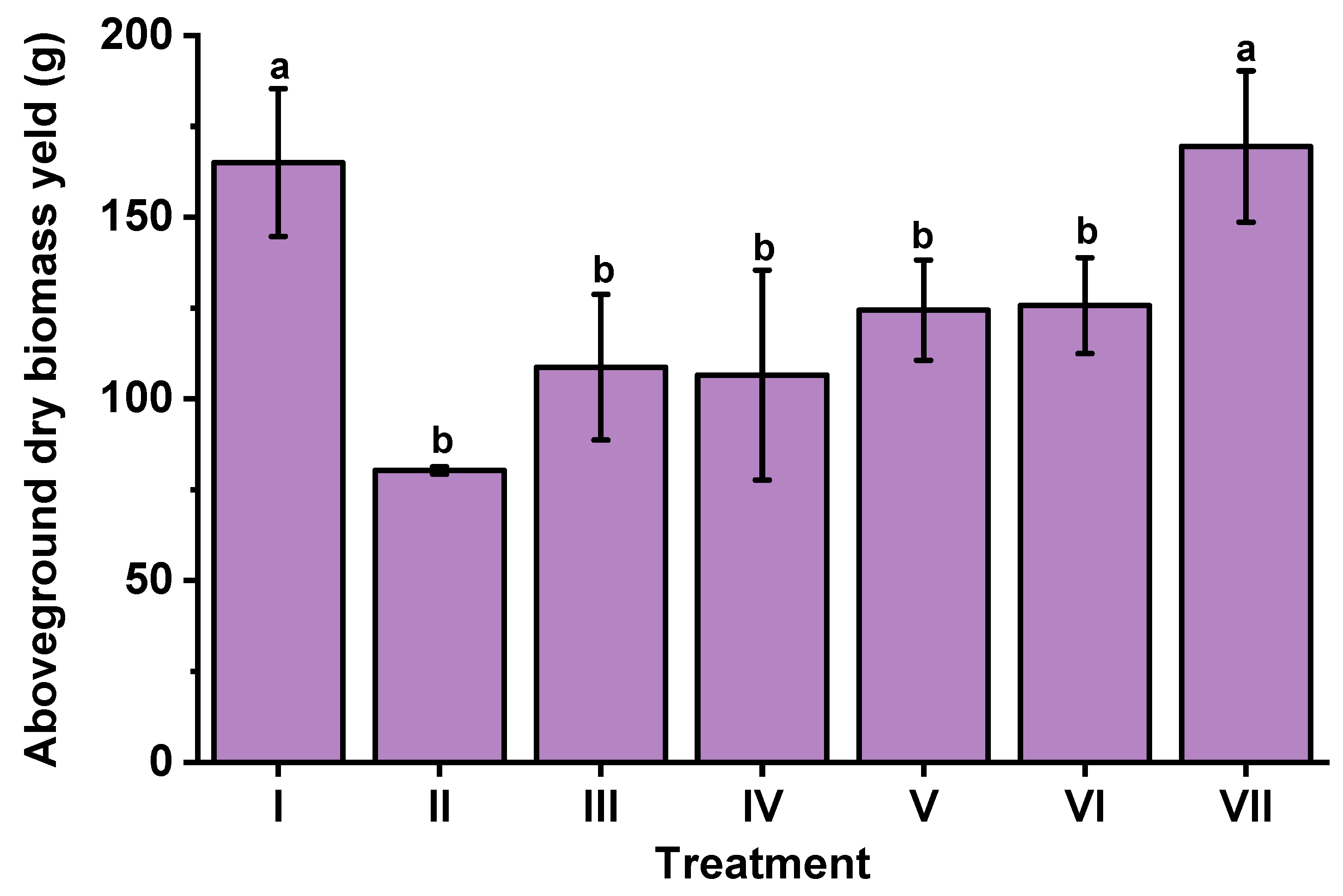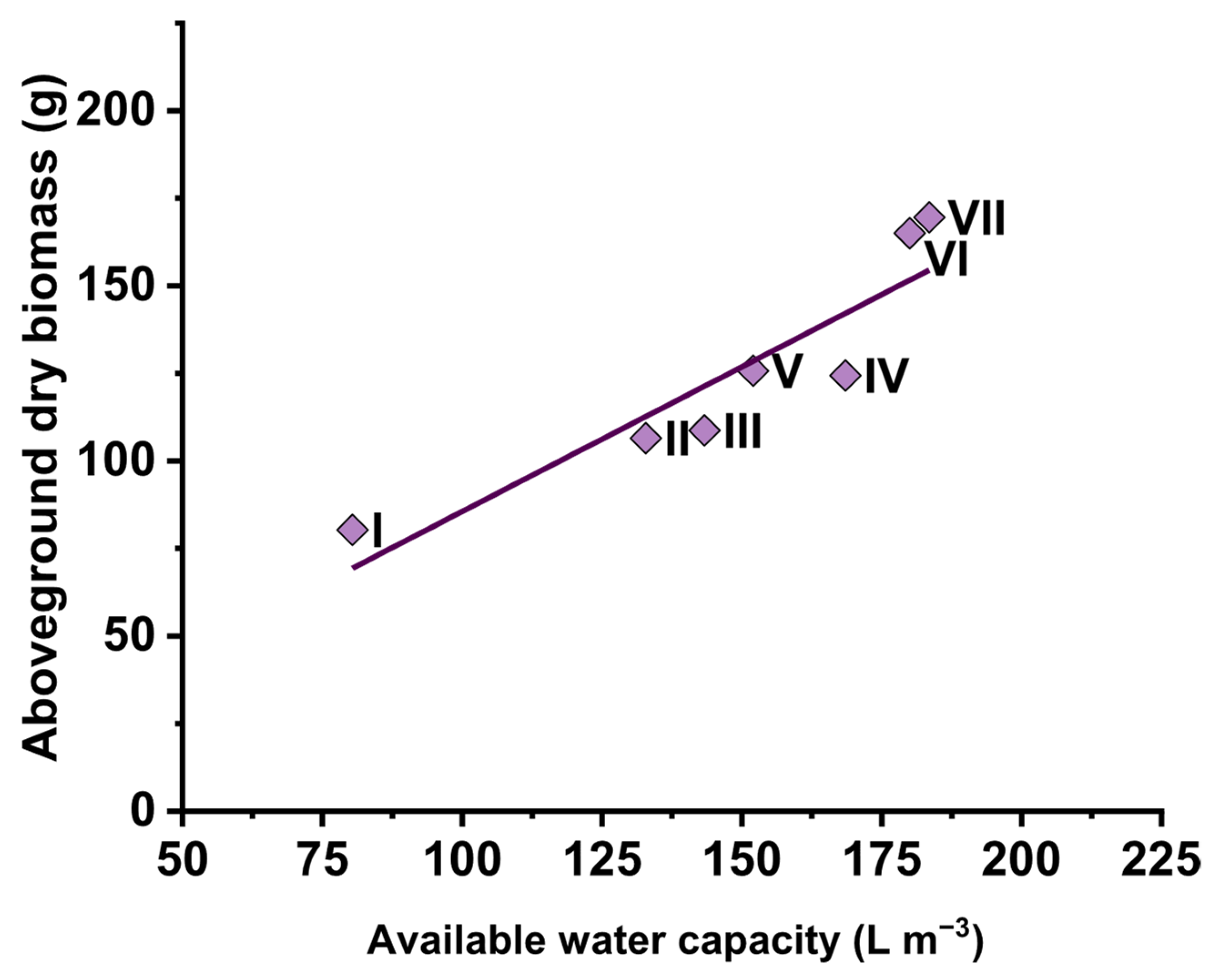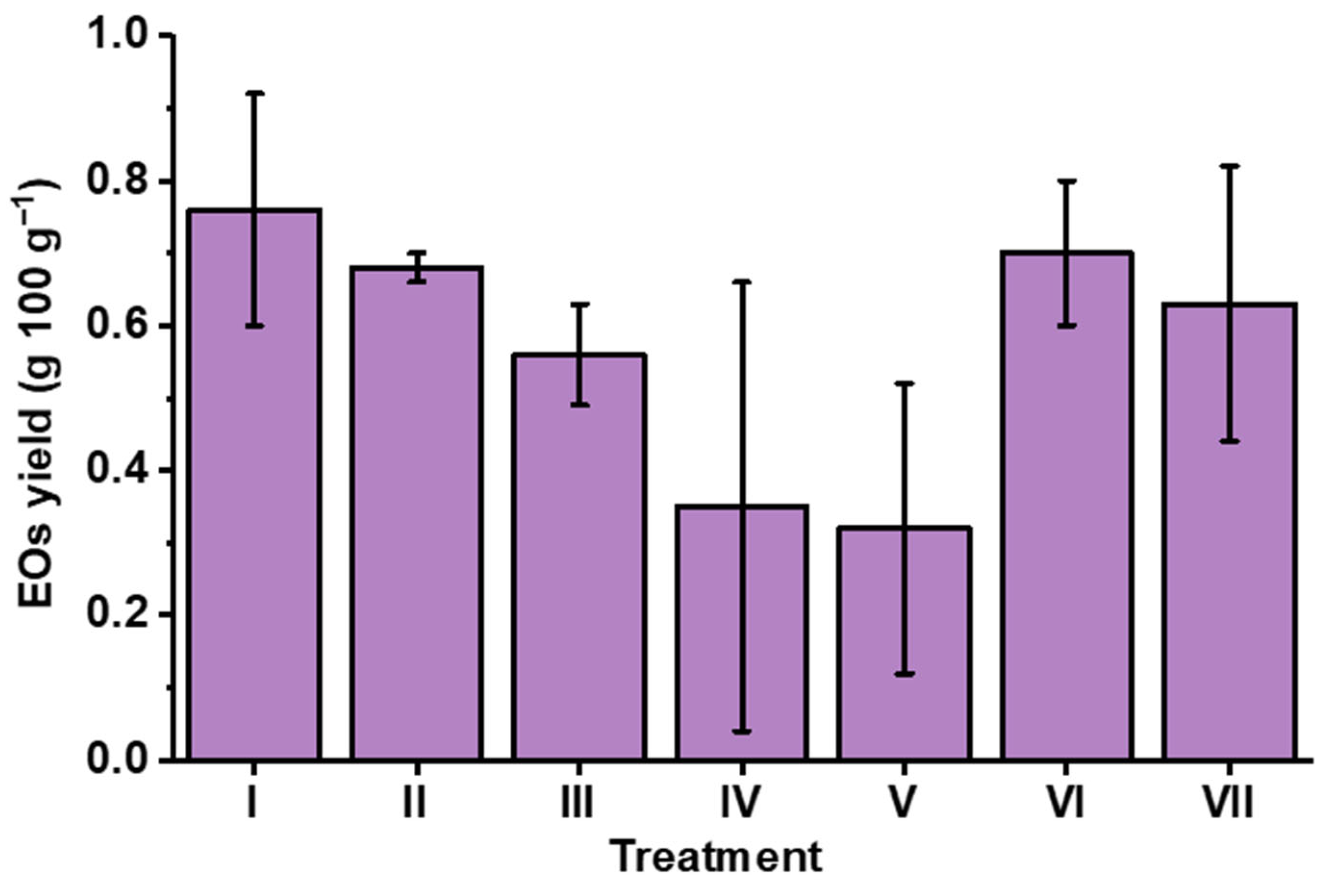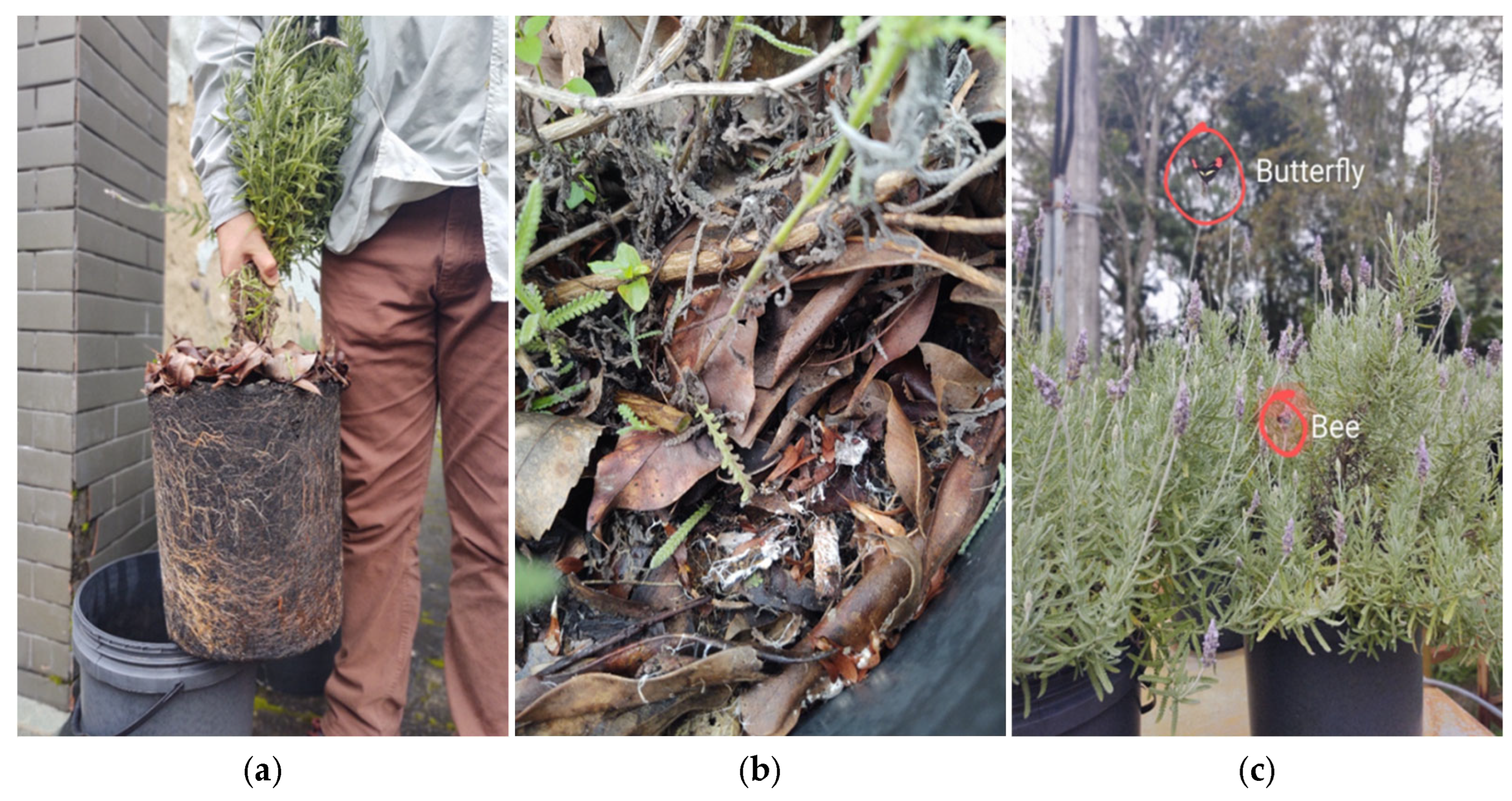

Cultivating Lavandula dentata in Coal-Waste Technosols: Implications for Essential Oil Production and Post-Mining Restoration

 , ,
, ,
Abstract
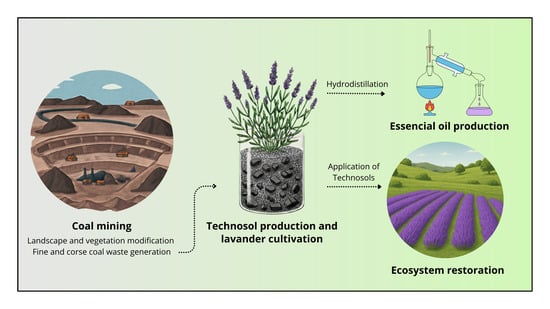
1. Introduction
2. Materials and Methods
2.1. Coal Waste and Sewage Sludge Samples
2.2. Technosols Manufacture and Their Characterization
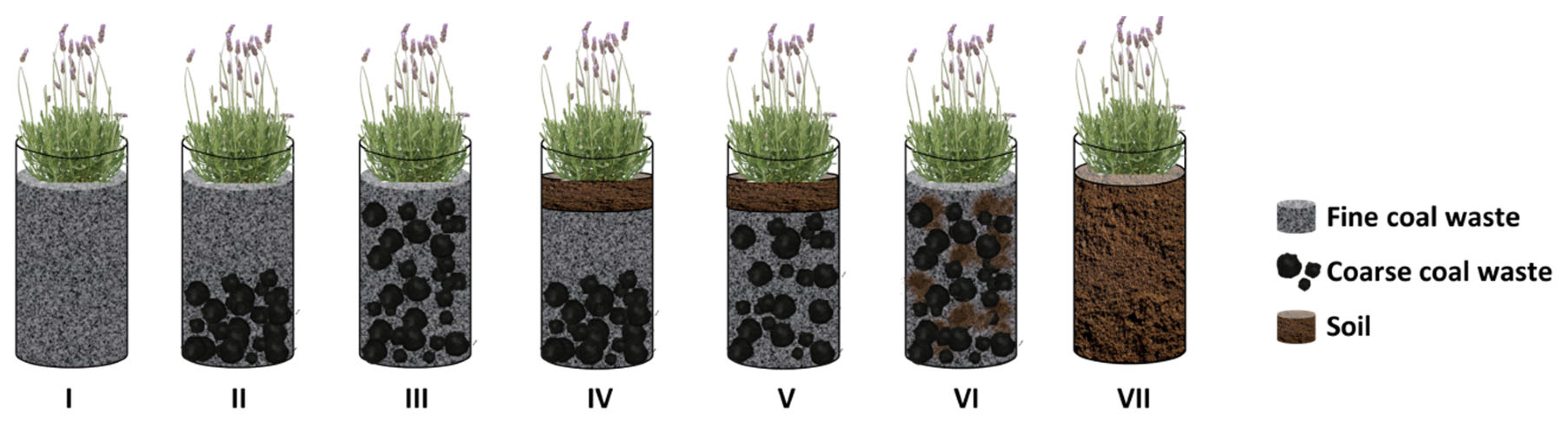
- Fine coal waste;
- Fine coal waste and coarse coal waste, composing two seams;
- Fine coal waste and coarse coal waste as a mixture;
- Agricultural soil, fine coal waste, and coarse coal waste, composing three seams;
- Agricultural soil and a mixture of fine coal waste and coarse coal waste, composing two seams;
- Agricultural soil, fine coal waste, and coarse coal waste as a mixture;
- Agricultural soil used as the control.
2.3. Growth Study of Lavandula Dentata
2.4. Soil, Plant Tissue, and Essential Oil Analysis
2.5. Statistical Analysis
3. Results and Discussion
4. Conclusions
Supplementary Materials
Author Contributions
Funding
Data Availability Statement
Acknowledgments
Conflicts of Interest
References
- Energy Institute. Statistical Review of World Energy 2025; Energy Institute: London, UK, 2025; Available online: https://www.energyinst.org/statistical-review (accessed on 13 September 2025).
- Xu, J.; Zhao, H.; Yin, P.; Wu, L.; Li, G. Landscape ecological quality assessment and its dynamic change in coal mining area: A case study of Peixian. Environ. Earth Sci. 2019, 78, 708. [Google Scholar] [CrossRef]
- Chen, L.; Zhang, H.; Zhang, X.; Liu, P.; Zhang, W.; Ma, X. Vegetation changes in coal mining areas: Naturally or anthropogenically driven? Catena 2022, 208, 105712. [Google Scholar] [CrossRef]
- Wang, Z.; Wang, G.; Ren, T.; Wang, H.; Xu, Q.; Zhang, G. Assessment of soil fertility degradation affected by mining disturbance and land use in a coalfield via machine learning. Ecol. Indic. 2021, 125, 107608. [Google Scholar] [CrossRef]
- Rouhani, A.; Skousen, J.; Tack, F.M.G. An overview of soil pollution and remediation strategies in coal mining regions. Minerals 2023, 13, 1064. [Google Scholar] [CrossRef]
- Rouhani, A.; Gusiatin, M.Z.; Hejcman, M. An overview of the impacts of coal mining and processing on soil: Assessment, monitoring, and challenges in the Czech Republic. Environ. Geochem. Health 2023, 45, 7459–7490. [Google Scholar] [CrossRef]
- Wolkersdorfer, C.; Mugova, E. Effects of mining on surface water. Encycl. Inland Waters 2022, 4, 170–188. [Google Scholar]
- Yang, J.; Wei, H.; Quan, Z.; Xu, R.; Wang, Z.; He, H. A global meta-analysis of coal mining studies provides insights into the hydrological cycle at watershed scale. J. Hydrol. 2023, 617, 129023. [Google Scholar] [CrossRef]
- Silvia, F.; Talia, V.; Di Matteo, M. Coal mining and policy responses: Are externalities appropriately addressed? A meta-analysis. Environ. Sci. Policy 2012, 126, 39–47. [Google Scholar] [CrossRef]
- Rocha-Nicoleite, E.; Overbeck, G.E.; Müller, S.C. Degradation by coal mining should be priority in restoration planning. Perspect. Ecol. Conserv. 2017, 15, 202–205. [Google Scholar] [CrossRef]
- Rodriguez-Espinosa, T.; Pérez-Gimeno, A.; Almendro-Candel, M.B.; Navarro-Pedreño, J.; García-Fernández, G. Technosols for mine restoration: Overcoming challenges and maximizing benefit. Appl. Sci. 2025, 15, 11664. [Google Scholar] [CrossRef]
- Weiler, J.; Firpo, B.A.; Schneider, I.A.H. Coal waste derived soil-like substrate: An opportunity for coal waste in a sustainable mineral scenario. J. Clean. Prod. 2018, 174, 739–745. [Google Scholar] [CrossRef]
- Weiler, J.; Firpo, B.A.; Schneider, I.A.H. Technosol as an integrated management tool for turning urban and coal mining waste into a resource. Miner. Eng. 2020, 147, 106179. [Google Scholar] [CrossRef]
- Amaral Filho, J.R.; Firpo, B.A.; Broadhurst, J.L.; Harrison, S.T.L. On the feasibility of South African coal waste for production of ‘FabSoil’, a Technosol. Miner. Eng. 2020, 146, 106059. [Google Scholar] [CrossRef]
- Firpo, B.A.; Weiler, J.; Schneider, I.A.H. Technosol made from coal waste as a strategy to plant growth and environmental control. Energy Geosci. 2021, 2, 160–166. [Google Scholar] [CrossRef]
- Halecki, W.; Klatka, S. Application of soil productivity index after eight years of soil reclamation with sewage sludge amendments. Environ. Manag. 2021, 67, 822–832. [Google Scholar] [CrossRef]
- Bauerek, A.; Diatta, J.; Pierzchala, L.; Wieckol-Ryk, A.; Krzemien, A. Development of soil substitutes for the sustainable land reclamation of coal mine-affected area. Sustainability 2022, 14, 4604. [Google Scholar] [CrossRef]
- Zocche, J.J.; Sehn, L.M.; Pillon, J.G.; Schneider, C.H.; Olivo, E.F.; Raupp-Pereira, F. Technosols in coal mining areas: Viability of combined use of agro-industry waste and synthetic gypsum in the restoration of areas degraded. Clean. Eng. Technol. 2023, 13, 100618. [Google Scholar] [CrossRef]
- Olivo, E.F.; Zaccaron, A.; Acordi, J.; Ribeiro, M.J.; Fernandes, E.M.R.; Zocche, J.J.; Raupp-Pereira, F. Technosol development based on residual fraction of coal tailings processing, agro-industrial waste, and paper industry waste. Sustainability 2024, 16, 7471. [Google Scholar] [CrossRef]
- Oliveira, E.K.; Venturella, A.C.; Weiler, J.; Schneider, I.A.H. Prospect for fine and coarse coal waste deployment for a constructed technosol and Eragrostis tef growth. Mining 2024, 4, 806–817. [Google Scholar] [CrossRef]
- Weiler, J.; Tassinari, C.C.G. Evaluating CO2 sequestration through Technosol constructed from coal mining waste. Miner. Eng. 2024, 218, 109032. [Google Scholar] [CrossRef]
- Gryczak, M.; Gomes, T.; Angioletto, E.; Petzhold, C.L.; Elyseu, F.; Raupp-Pereira, F.; De Noni Júnior, A.; Zocche, J.J. Enviromental risk assessment of Technosols formulated with calcined pyrite-rich coal gangue. Energy Ecol. Environ. 2026. [Google Scholar] [CrossRef]
- Young, R.E.; Gann, G.D.; Walder, B.; Liu, J.; Cui, W.; Newton, V.; Nelson, C.R.; Tashe, N.; Jasper, D.; Silveira, F.A.O.; et al. International principles and standards for the ecological restoration and recovery of mine sites. Restor. Ecol. Restor. Ecol. 2022, 30, e13771. [Google Scholar] [CrossRef]
- Feng, S.; Hou, W.; Chang, J. Changing coal mining brownfields into green infrastructure based on ecological potential assessment in Xuzhou, Eastern China. Sustainability 2019, 11, 2252. [Google Scholar] [CrossRef]
- Hatton, W.; Fardell, A. New discoveries of coal in Mozambique—Development of the coal resource estimation methodology for International Resource Reporting Standards. Int. J. Coal Geol. 2012, 89, 2–12. [Google Scholar] [CrossRef]
- Sampaio, C.H.; Ambrós, W.M.; Cazacliu, B.; Moncunill, J.O.; José, D.S.; Miltzarek, G.L.; de Brum, I.A.S.; Petter, C.O.; Fernandes, E.Z.; Oliveira, L.F.S. Destoning the Moatize Coal Seam, Mozambique, by dry jigging. Minerals 2020, 10, 771. [Google Scholar] [CrossRef]
- Weiler, J.; da Silva, A.C.; Firpo, B.A.; Fernandes, E.Z.; Schneider, I.A.H. Using static, kinetic and metal mobility procedures to evaluate possibilities of coal waste land disposal at Moatize Mine, Mozambique. REM-Int. Eng. J. 2020, 73, 587–596. [Google Scholar] [CrossRef]
- Pondja, J.R.; Persson, K.M.; Matsinhe, N.P. Assessment of coal mine water in Moatize by static and leaching tests. Sustain. Water Resour. Manag. 2017, 3, 403–412. [Google Scholar] [CrossRef]
- Pandey, V.C.; Pandey, D.N.; Singh, N. Sustainable phytoremediation based on naturally colonizing and economically valuable plants. J. Clean. Prod. 2014, 86, 37–39. [Google Scholar] [CrossRef]
- Pandey, V.C.; Rai, A.; Korstad, J. Aromatic crops in phytoremediation: From contaminated to waste dumpsites. In Phytomanagement of Polluted Sites; Pandey, V.C., Bauddh, K., Eds.; Elsevier: Amsterdam, The Netherlands, 2019; Chapter 9; pp. 255–275. [Google Scholar]
- Pandey, J.; Verma, R.K.; Singh, S. Suitability of aromatic plants for phytoremediation of heavy metal contaminated areas: A review. Int. J. Phytoremed. 2019, 21, 405–418. [Google Scholar] [CrossRef]
- Boelens, M.H. Chemical and sensory evaluation of Lavandula Oils. Perfum. Flavor 1995, 20, 23–25. [Google Scholar]
- Prusinowska, R.; Smigielski, K.B. Composition, biological properties and therapeutic effects of lavender (Lavandula angustifolia L.). A review. Herba Polica 2014, 60, 56–66. [Google Scholar] [CrossRef]
- Angelova, V.A.; Grekov, D.F.; Kisyov, V.K.; Ivanov, K.I. Potential of lavender (Lavandula vera L.) for phytoremediation of soils contaminated with heavy metals. Int. J. Biol. Food Vet. Agric. Eng. 2015, 9, 465–472. [Google Scholar]
- Bozhanov, S.; Karadjova, I.; Alexandrov, S. Determination of trace elements in the Lavender inflorescence (Lavandula augustifolia Mill.)—Lavender Oil system. Microchem. J. 2007, 86, 119–223. [Google Scholar] [CrossRef]
- Zheljazkov, V.D.; Astatkie, T. Effect of plant species and benomyl on lead concentration and removal from lead-enriched soil. HortScience 2011, 46, 1604–1607. [Google Scholar] [CrossRef]
- Apallachian Botanical Company. Lavanda Mined Sites Appalachians. 2023. Available online: https://appalachianbotanical.com/ (accessed on 22 June 2025).
- Malešević, Z.; Jovović, M.; Kovačević, S.; Bošković, I.; Ilić, Đ. Essential Oils of Lavender and Sage from Reclaimed Soil at Coal Mine Dumps. ACCHE 2025—Annual Conference on Challenges of Contemporary Higher Education. 2025. Available online: https://acche.rs/ACCHE_2025/radovi/natural/112.pdf (accessed on 13 September 2025).
- IUSS Working Group WRB. World Reference Base for Soil Resources 2014. International Soil Classification System for Naming Soils and Creating Legends for Soil Maps; World Soil Resources Reports No. 106; IUSS Working Group: Rome, Italy, 2014. [Google Scholar]
- Sparks, D.L. Chemistry of Soil Organic Matter. In Environmental Soil Chemistry; Sparks, D.L., Ed.; Academic Press: Singapore, 2003; pp. 75–113. ISBN 978-0-12-656446-4. [Google Scholar]
- Collischonn, W.; Brêda, J.P.L.F.; Correa, S.W.; Wongchuig, S.; Ruhoff, A.; de Paiva, R.C.D.; Fan, F.M.; Machado Filho, R.C.C.; Ramalho, N. Unprecedented April-May 2024 rainfall in South Brazil sets new record. Rev. Bras. Recur. Hídricos 2024, 29, e50. [Google Scholar] [CrossRef]
- Collischonn, W.; Fan, F.M.; Possanti, I.; Dornelles, F.; Paiva, R.; Medeiros, M.S.; Michel, G.P.; Magalhães Filho, F.J.C.; Moraes, S.R.; Marcuzzo, F.F.N.; et al. The exceptional hydrological disaster of April-May 2024 in southern Brazil. Rev. Bras. Recur. Hídricos 2025, 30, e1. [Google Scholar] [CrossRef]
- INMET Dados Meteorológicos. Estação: Porto Alegre—Jardim Botânico A801. Available online: https://portal.inmet.gov.br/ (accessed on 29 November 2025).
- Embrapa. Manual de Métodos de Análise de Solo, 3rd ed.; Teixeira, P.C., Donagemma, G.K., Fontana, A., Teixeira, W.G., Eds.; Embrapa: Brasília, Brazil, 2017; ISBN 9788570357717. [Google Scholar]
- Vance, E.D.; Brookes, P.C.; Jenkinson, D.S. An extraction method for measuring soil microbial biomass. Soil Biol. Biochem. 1987, 19, 703–707. [Google Scholar] [CrossRef]
- Anderson, J.P.E. Soil Respiration. In Methods of Soil Analysis, 2nd ed.; Page, A.L., Miller, R.H., Keeney, D.R., Eds.; Part 2, (Agronomy Monograph N. 7); ASA/SSSA: Madison, WI, USA, 1982; pp. 837–871. [Google Scholar]
- Ashraf, M.N.; Waqas, M.A.; Rahman, S. Microbial metabolic quotient is a dynamic indicator of soil health: Trends, implications and perspectives (Review). Eurosian Soil Sci. 2022, 55, 1794–1803. [Google Scholar] [CrossRef]
- Reichardt, K. Capacidade de Campo. Rev. Bras. Ciências Solo 1988, 12, 211–216. [Google Scholar]
- Kalra, Y.P. Handbook of Reference Methods for Plant Analysis; CRC Press: Boca Raton, FL, USA, 1998; 300p. [Google Scholar]
- Brasil, Agência Nacional de Vigilância Sanitária. Formulário Nacional da Farmacopeia Brasileira, 5th ed.; Agência Nacional de Vigilância Sanitária: Brasília, Brazil, 2010. Available online: https://www.gov.br/anvisa/pt-br/assuntos/farmacopeia/farmacopeia-brasileira/VOLUME1FB6at2Erratappdfcomcapa.pdf (accessed on 22 June 2025).
- Kauffmann, C.; Ethur, E.M.; Arossi, K.; Hoehne, L.; Freitas, E.M.; Machado, G.M.C.; Cavalheiro, M.M.C.; Flach, A.; Costa, L.A.M.A.C.; Gnoatto, S.C.B. Chemical composition and evaluation preliminary of Antileishmanial Activity in vitro of essential oil from leaves of Eugenia pitanga, a native species of Southern of Brazil. J. Essent. Oil Bear. Plants 2017, 20, 559–569. [Google Scholar] [CrossRef]
- Adams, R.P. Identification of Essential Oil Components by Gas Cromatography/Quadrupole Mass Spectroscopy; Allured Publishing Corporation: Carol Stream, IL, USA, 2009; 456p, Available online: https://diabloanalytical.com/ms/essential-oil-components-by-gcms/essential_oil_components_ebook.pdf (accessed on 22 June 2025).
- Van Den Dool, H.; Kratz, P.D. A generalization of the retention index system including linear temperature programmed gas-liquid partition chromatography. J. Chromatogr. A 1963, 11, 463–471. [Google Scholar] [CrossRef] [PubMed]
- Ferreira, C.F. Fertilidade do Solo: Correção e Adubação; SENAR—Pr: Curitiba, Brazil, 2016; Available online: https://www.sistemafaep.org.br/wp-content/uploads/2025/10/PR.0319_Fertilidade-Solo.pdf (accessed on 22 June 2025).
- Wiethölter, S. Calagem no Brasil; Passo Fundo: Embrapa Trigo, 2000; 104p, Available online: https://www.infoteca.cnptia.embrapa.br/infoteca/bitstream/doc/820412/1/CNPTDOC.2200.pdf (accessed on 22 June 2025).
- Bolton, J., Jr.; Elliot, L.F.; Papendick, R.I.; Bezkicek, D.F. Soil microbial biomass and selected soil enzyme activities: Effect of fertilization and cropping practices. Soil Biol. Biochem. 1985, 17, 297–302. [Google Scholar] [CrossRef]
- Moreno-Barriga, F.; Díaz, V.; Acosta, J.A.; Muñoz, M.Á.; Faz, Á.; Zornoza, R. Organic matter dynamics, soil aggregation and microbial biomass and activity in Technosols created with metalliferous mine residues, biochar and marble waste. Geoderma 2017, 301, 19–29. [Google Scholar] [CrossRef]
- Zornoza, R.; Gómez-Garrido, M.; Martínez-Martínez, S.; Gómez-López, M.D.; Faz, Á. Bioaugmentation in Technosols created in abandoned pyritic tailings can contribute to enhance soil C sequestration and plant colonization. Sci. Total Environ. 2017, 593–594, 357–367. [Google Scholar] [CrossRef] [PubMed]
- Crowther, T.W.; Van den Hoogen, J.; Wan, J.; Mayes, M.A.; Keiser, A.D.; Mo, L.; Averill, C.; Maynard, D.S. The global soil community and its influence on biogeochemistry. Science 2019, 365, eaav0550. [Google Scholar] [CrossRef]
- Anderson, T.-H.; Domsh, K.H. Maintenance carbon requirement of actively-metabolizing microbial populations under in situ condition. Soil Biol. Biochem. 1985, 17, 197–203. [Google Scholar] [CrossRef]
- Du, B.; Rennenberg, H. Physiological responses of lavender (Lavandula angustifolia Mill.) to water deficit and recovery. S. Afr. J. Bot. 2018, 119, 212–218. [Google Scholar] [CrossRef]
- Saunier, A.; Ormeño, E.; Moja, S.; Fernandez, C.; Robert, E.; Dupouyet, S.; Despinasse, Y.; Baudino, S.; Nicolè, F.; Bousquet-Mélou, A. Lavender sentitivity to water stress: Comparision between eleven varieties across two phenological stages. Ind. Crops Prod. 2022, 177, 114531. [Google Scholar] [CrossRef]
- Chrysargyris, A.; Panayiotou, C.; Tzortzakis, N. Nitrogen and phosphorous levels affected plant growth, essential oil composition and antioxidant status of lavender plant (Lavandula augustifollia Mill.). Ind. Crops Prod. 2016, 83, 577–586. [Google Scholar] [CrossRef]
- Peçanha, D.A.; Freitas, M.S.M.; Vieira, M.E.; Cunha, J.M.; de Jesus, A.C. Phosphorous fertilization affects growth, essential oil yield and quality of true lavender in Brazil. Ind. Crops Prod. 2021, 170, 113803. [Google Scholar] [CrossRef]
- Kvaternjak, I.; Erhtic, R.; Stojnovic, M.; Louis, A.; Jouve, A. Macroelement content of true lavender (Lavandula augustifolia Mill.) and lavender (Lavandula × intermedia Emeric ex Loisel.) in organic fertilization. In Proceedings of the 55th Croatian & 15th International Symposium onf Agriculture, Vodice, Croatia, 16–21 February 2020. [Google Scholar]
- Martins, R.P. Caracterização Química e Avaliação da Atividade Antimicrobiana de óleos Essenciais de Lavandula dentata L. Master’s Thesis, Universidade Federal do Triângulo Mineiro, Uberaba, MG, Brazil, 2018; 75p. Available online: https://bdtd.uftm.edu.br/bitstream/tede/569/5/Dissert%20Rheltheer%20P%20Martins.pdf (accessed on 22 June 2025).
- Houssayni, S.; Akachoud, O.; Zoubi, B.; Youssfi, M.; Sahraoui, A.L.-H.; Laruell, F.; Coloma, A.G.; Yeves, M.F.A.; Bouamama, H.; Qaddoury, A. Comparative study of wild and cultivated Lavandula dentata: Differences in essential oil composition, biological activities, and associated microbial communities. Molecules 2025, 30, 4695. [Google Scholar] [CrossRef]
- Carmen, D.; Hadaruga, N.; Luca, R.; Dobrei, A.; Nistor, E.; Posta, D.; Dobrei, A.; Velicevici, G.; Petcov, A.; Sala, F. Research concerning the influence of fertilization on some physiological processes and biochemical composition of Lavender (Lavandula augustifolia L.). Agric. Agric. Sci. Procedia 2016, 10, 198–205. [Google Scholar]
- Abdali, Y.E.; Agour, A.; Allali, A.; Bourhia, M.; Moussaoui, A.E.; Eloutassi, N.; Salamatullah, A.M.; Alzahrani, A.; Ouahmane, L.; Aboul-Soud, M.A.M.; et al. Lavanduladentata L.: Phytochemical analysis, antioxidant, antifungal and insecticidal activities of its essencial oil. Plants 2022, 11, 311. [Google Scholar] [CrossRef]
- Heneberg, P.; Holec, M.; Halcová, D.; Bogusch, P.; Tuf, I.H.; Rezác, M. Time-dependent biodiversity development in arable fields created by post-mining reclamation. Agric. Ecosyst. Environ. 2026, 398, 110094. [Google Scholar] [CrossRef]
- Vindusková, O.; Simánová, D.; Reitshmiedová, E.; Cerný, J.; Frouz, J. Natural regeneration of Norway spruce under pioneer tree outperforms conventional reclamation on post-mining sites. Ecol. Eng. 2026, 222, 107812. [Google Scholar] [CrossRef]
- Measham, T.; Walker, J.; McKenzie, F.H.; Kirby, J.; Williams, C.; D’Urso, J.; Littleboy, A.; Samper, A.; Rey, R.; Maybee, B.; et al. Beyond closure: A literature review and research agenda for post-mining transitions. Resour. Policy 2024, 90, 104859. [Google Scholar] [CrossRef]
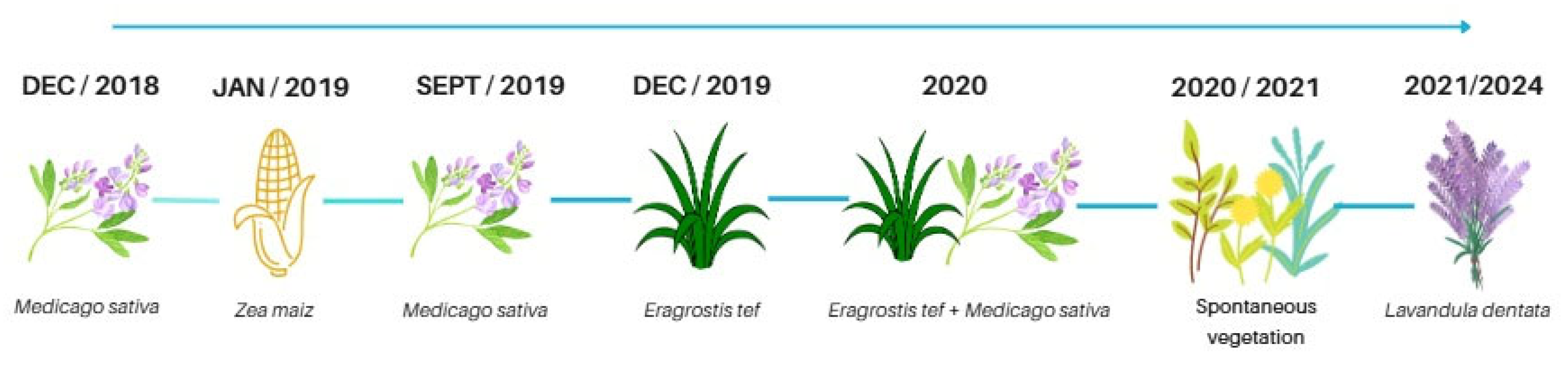


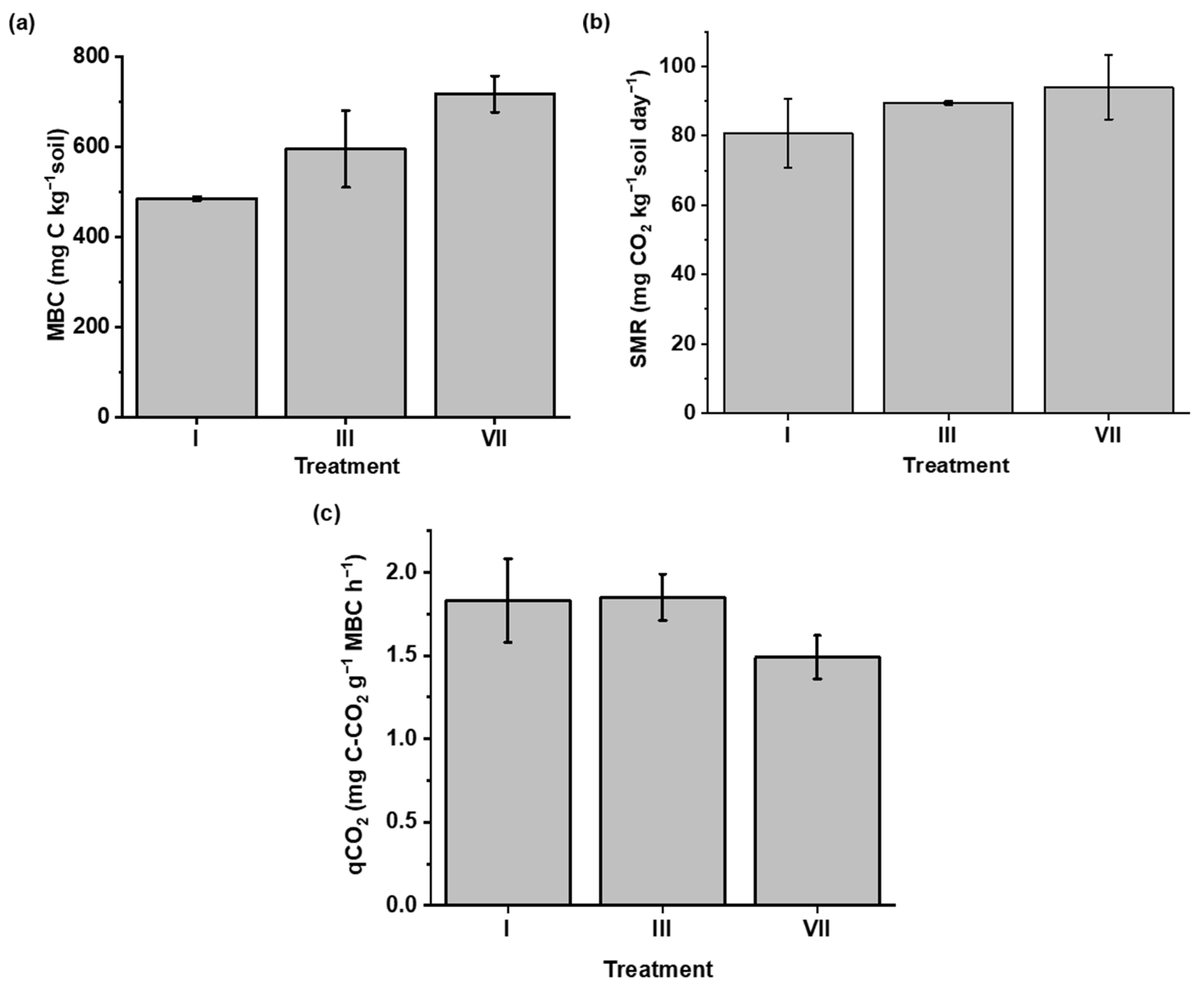



| Main Substrate—From All Previous Cultures | For Lavandula dentata Growth | ||||||
|---|---|---|---|---|---|---|---|
| Treatment | Fine Coal Waste (kg) | Coarse Coal Waste (kg) | Agric. Soil (kg) | Sewage Sludge (kg) | Total (kg) | NPK 10:10:10 (g) | Leaf Litter Layer (g) |
| I | 18.9 | - | - | 1.1 | 20 | 15 | 20 |
| II | 7.7 | 11.2 | - | 1.1 | 20 | 15 | 20 |
| III | 7.7 | 11.2 | - | 1.1 | 20 | 15 | 20 |
| IV | 5.1 | 7.4 | 6.3 | 1.1 | 20 | 15 | 20 |
| V | 5.1 | 7.4 | 6.3 | 1.1 | 20 | 15 | 20 |
| VI | 5.1 | 7.4 | 6.3 | 1.1 | 20 | 15 | 20 |
| VII | - | - | 18.9 | 1.1 | 20 | 15 | 20 |
| Treatment | Macronutrients | Micronutrients | ||||||||||||
|---|---|---|---|---|---|---|---|---|---|---|---|---|---|---|
| pH | SOM | CEC | Al | N | P | K | Ca | Mg | Cu | Zn | Mn | Fe | B | |
| % | cmolc dm−3 | % | mg dm−3 | cmolc dm−3 | mg dm−3 | |||||||||
| I | 5.6 | 3.5 | 11.4 | bdl * | 0.55 | 220.4 | 46.7 | 6.9 | 1.9 | 13.7 | 36.5 | 16.1 | >5.0 | 0.30 |
| II | 5.4 | 4.2 | 10.5 | 0.1 | 0.56 | 252.6 | 44.0 | 5.3 | 2.2 | 13.4 | 35.9 | 21.3 | >5.0 | 0.17 |
| III | 5.2 | 3.3 | 12.0 | 0.3 | 0.54 | 224.1 | 50.7 | 5.9 | 2.1 | 13.0 | 36.2 | 28.4 | >5.0 | 0.30 |
| IV | 5.4 | 4.4 | 16.2 | 0.2 | 0.57 | 201.8 | 122.7 | 9.6 | 2.6 | 7.9 | 32.8 | 44.8 | >5.0 | 0.27 |
| V | 5.3 | 3.0 | 18.6 | 0.3 | 0.53 | 162.0 | 128.0 | 11.3 | 2.9 | 6.4 | 31.3 | >50 | >5.0 | 0.23 |
| VI | 5.0 | 3.9 | 17.7 | 1.0 | 0.58 | 159.4 | 86.7 | 8.7 | 3.3 | 8.1 | 31.2 | >50 | >5.0 | 0.40 |
| VII | 5.5 | 2.0 | 23.1 | 0.1 | 0.30 | 111.8 | 308.0 | 15.0 | 3.0 | 3.5 | 24.5 | >50 | >5.0 | 0.27 |
| Ref. | 5.5–6 | 2.6–5 | 5.0–15 | 0.5–1 | - | 59–117 | 31–180 | 0.5–1 | 0.4–0.8 | 0.3–0.8 | 0.6–1.2 | 1.3–5 | 5–12 | 0.2–0.3 |
| Treatment | Macronutrients (g kg−1) | Micronutrients (mg kg−1) | ||||||||
|---|---|---|---|---|---|---|---|---|---|---|
| N | P | K | Ca | Mg | Fe | Mn | Zn | Cu | B | |
| I | 18.2 | 2.9 | 13.7 | 16.1 | 2.7 | 93.4 | 105.5 | 92.1 | 9.5 | 22.3 |
| II | 14.7 | 2.6 | 14.7 | 13.7 | 2.8 | 113.1 | 303.5 | 125.5 | 8.5 | 21.5 |
| III | 17.7 | 2.6 | 14.5 | 16.8 | 3.1 | 128.8 | 256.0 | 117.7 | 9.9 | 21.5 |
| IV | 17.9 | 2.8 | 18.3 | 15.4 | 2.5 | 119.3 | 247.1 | 95.1 | 9.9 | 19.9 |
| V | 17.7 | 2.7 | 15.1 | 15.3 | 2.3 | 103.0 | 238.7 | 83.3 | 11.4 | 20.5 |
| VI | 15.4 | 2.6 | 17.8 | 15.4 | 2.5 | 107.1 | 264.6 | 96.1 | 11.8 | 24.7 |
| VII | 16.8 | 2.3 | 22.9 | 13.5 | 1.6 | 112.4 | 125.3 | 42.3 | 7.2 | 22.8 |
| Compound | RI Calc. | RI Adams | Treatment (%) | ||||||
|---|---|---|---|---|---|---|---|---|---|
| I | II | III | IV | V | VI | VII | |||
| 1,8-Cineole | 1033 | 1033 | 21.67 | 26.23 | 27.36 | 20.69 | 22.10 | 24.80 | 24.94 |
| Fenchone | 1091 | 1086 | 14.05 | 16.24 | 16.37 | 14.05 | 15.64 | 15.79 | 15.2 |
| Endo-Fenchol | 1116 | 1116 | 9.21 | 9.49 | 9.73 | 9.78 | 10.01 | 8.39 | 8.18 |
| Camphor | 1147 | 1146 | 16.12 | 18.95 | 18.51 | 16.34 | 18.72 | 18.05 | 16.99 |
Disclaimer/Publisher’s Note: The statements, opinions and data contained in all publications are solely those of the individual author(s) and contributor(s) and not of MDPI and/or the editor(s). MDPI and/or the editor(s) disclaim responsibility for any injury to people or property resulting from any ideas, methods, instructions or products referred to in the content. |
© 2026 by the authors. Licensee MDPI, Basel, Switzerland. This article is an open access article distributed under the terms and conditions of the Creative Commons Attribution (CC BY) license.
Share and Cite
Venturella, A.C.; de Oliveira, E.K.; Weiler, J.; Ethur, E.M.; Schneider, I.A.H. Cultivating Lavandula dentata in Coal-Waste Technosols: Implications for Essential Oil Production and Post-Mining Restoration. Mining 2026, 6, 25. https://doi.org/10.3390/mining6010025
Venturella AC, de Oliveira EK, Weiler J, Ethur EM, Schneider IAH. Cultivating Lavandula dentata in Coal-Waste Technosols: Implications for Essential Oil Production and Post-Mining Restoration. Mining. 2026; 6(1):25. https://doi.org/10.3390/mining6010025
Chicago/Turabian StyleVenturella, Arthur Cesa, Eduardo Kercher de Oliveira, Jéssica Weiler, Eduardo Miranda Ethur, and Ivo André Homrich Schneider. 2026. "Cultivating Lavandula dentata in Coal-Waste Technosols: Implications for Essential Oil Production and Post-Mining Restoration" Mining 6, no. 1: 25. https://doi.org/10.3390/mining6010025
APA StyleVenturella, A. C., de Oliveira, E. K., Weiler, J., Ethur, E. M., & Schneider, I. A. H. (2026). Cultivating Lavandula dentata in Coal-Waste Technosols: Implications for Essential Oil Production and Post-Mining Restoration. Mining, 6(1), 25. https://doi.org/10.3390/mining6010025