Review

Computational Methods in Anti-Cancer Drug Discovery, Development, and Therapy Management: A Review


1
College of Marine Sciences, Fujian Agriculture and Forestry University, Fuzhou 350002, China
2
State Key Laboratory of Mariculture Breeding, Key Laboratory of Marine Biotechnology of Fujian Province, Fujian Agriculture and Forestry University, Fuzhou 350002, China
3
Computer and Information Science, Department of Science and Engineering, Faculty of Science and Engineering, Iwate University, 4-3-5 Ueda, Morioka 020-8551, Iwate, Japan
*
Author to whom correspondence should be addressed.
These authors contributed equally to this work.
Digital 2026, 6(2), 32; https://doi.org/10.3390/digital6020032
Submission received: 27 February 2026 / Revised: 7 April 2026 / Accepted: 14 April 2026 / Published: 21 April 2026

Abstract

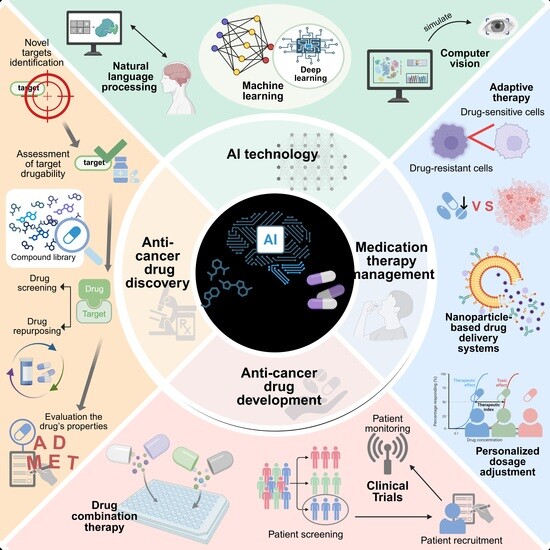
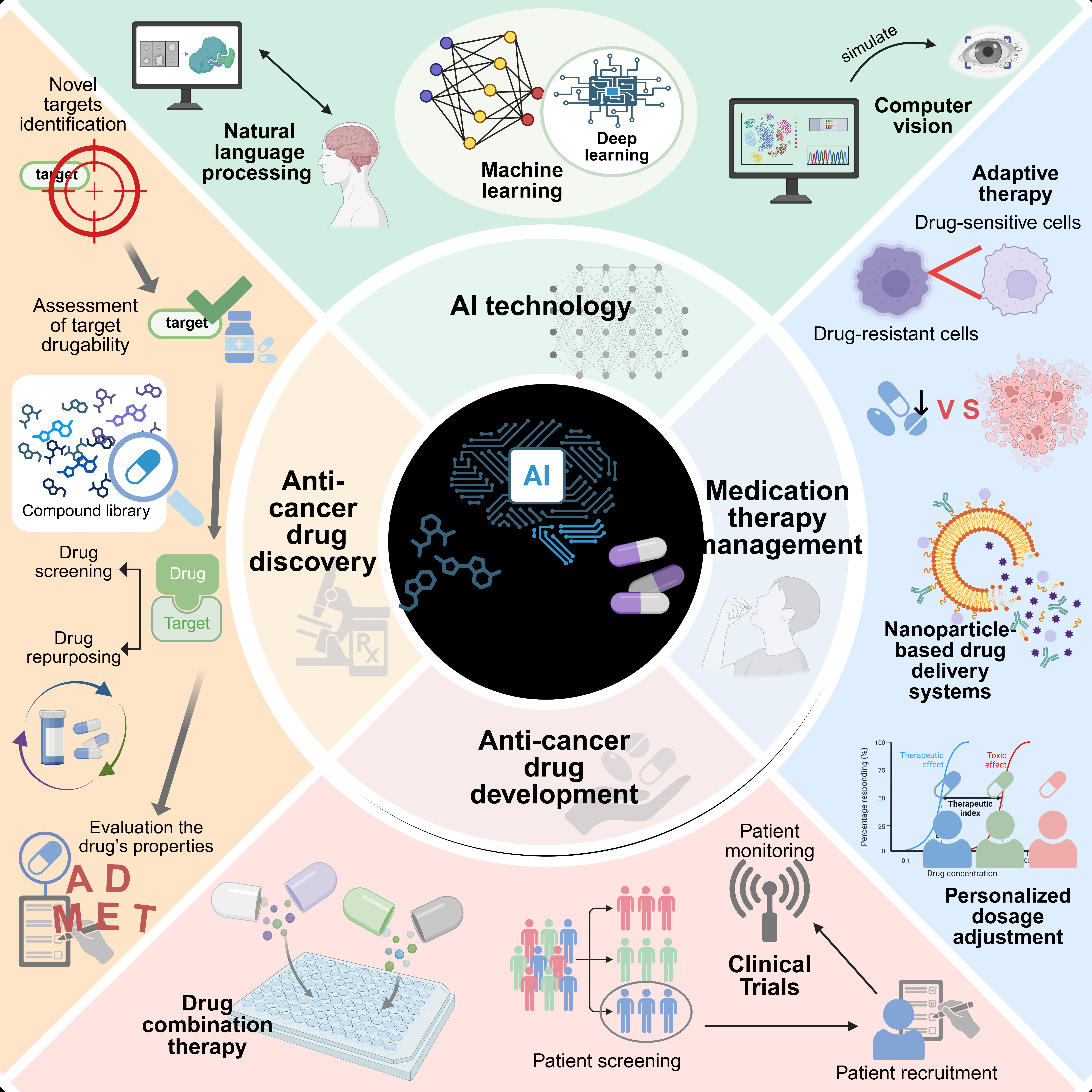
Cancer has become a major global health threat due to its high incidence and mortality. However, the development of anti-cancer drugs is limited by high costs, long cycles, and low success rates, slowing the progress of new treatments. As a method that simulates human cognitive functions, artificial intelligence (AI) has greatly improved the efficiency of drug development. Machine learning is a core part of AI and supports applications such as natural language processing and computer vision. This paper reviews recent advances in AI for optimizing anti-cancer drug discovery, development, and medication therapy management. First, we highlight the applications of AI in target identification, druggability assessment, drug screening, and repurposing. Second, we detail how AI optimizes drug combination therapy and clinical trial design. Finally, we describe the role of AI in treatment management, including nanoparticle delivery systems, personalized dosing, and adaptive therapy. AI greatly streamlines anti-cancer drug development and provides new directions for precision cancer therapy.

Graphical Abstract

1. Introduction

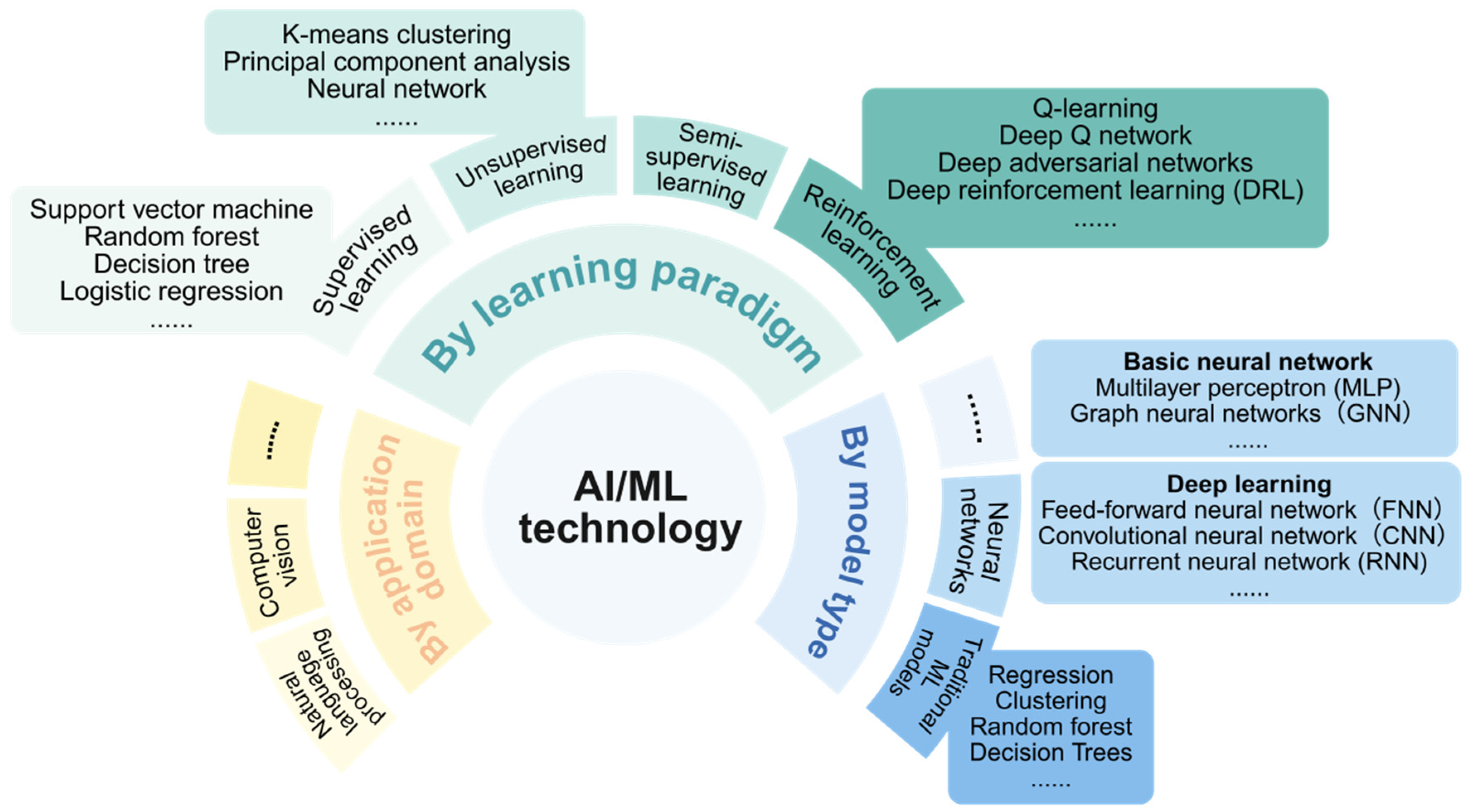
Artificial intelligence (AI) is a broad field of study that refers to the ability of computer systems to simulate human intelligence, perform tasks that typically require human thinking, and expand human capabilities [1]. AI is closely related to pattern recognition, probability theory, statistics, machine learning (ML), and computational intelligence methods such as fuzzy models and neural networks. Among these, machine learning (ML) is the core subfield of AI, focusing on making predictions by learning patterns from data and achieving automatic optimization as the training data increases [2,3]. Deep learning (DL), as a branch of ML, uses multilayer neural network structures to learn high-level data features and performs well in recognition and prediction tasks [3]. Compared to traditional machine learning methods, DL can handle large-scale and complex data more efficiently. In recent years, the term “AI” is often associated with large language models (LLMs) in the public discourse. The AI methods discussed in this review all fall within the scope of ML and DL. In the field of drug development, AI (specifically ML/DL methods) demonstrates great potential and can accelerate the process of precision medicine. In the research of anti-cancer drugs, DL has shown remarkable effectiveness by integrating multi-omics data, optimizing the screening process, and enhancing the efficacy of personalized treatment, especially in the application of graph neural networks [4,5,6,7,8].The categorization of AI technologies alongside their representative techniques is illustrated (Figure 1).
Cancer ranks as the second leading cause of death globally. According to the latest statistics from the World Health Organization (WHO; https://www.who.int/zh (accessed on 16 May 2025)), approximately 10 million individuals died of cancer in 2020, with projections indicating a rise to 16 million by 2040. Cancer is a complex, heterogeneous, and dynamic developmental process, presenting significant challenges at every stage of its treatment. Consequently, designing novel, effective, and safe anti-cancer drugs is a challenging project. It takes 10–17 years and nearly $2.8 billion to develop a novel anti-cancer drug from development to clinical approval [9,10]. Furthermore, only 10% of drug candidates entering clinical trials are eventually approved for marketing [11].
Identifying novel targets represents the initial step in drug discovery. The human genome contains thousands of potential drug targets, which makes comprehensive experimental screening resource-intensive or time-consuming. Although high-throughput screening (HTS) can systematically identify compounds that interact with specific targets, its high cost remains a practical consideration [12]. The key steps in artificial intelligence-driven drug development involve predicting drug–target interactions (DTIs) by integrating chemical structures, drug–target interaction network data, and genomic sequence information [2]. To address the issues of high computational cost of molecular docking in traditional DTI prediction methods and the reliance on manual feature design in traditional machine learning, researchers have developed deep learning-based DTI prediction methods, such as EEG-DTI and DTI-HETA [13,14]. These methods have demonstrated superior prediction performance over traditional methods in multiple evaluation metrics [15,16]. The research by Zhavoronkov et al. is based on the generative tensorial reinforcement learning (GENTRL) model of deep learning, which can complete the entire process from target identification to candidate compound design and preliminary verification within several weeks, significantly shortening the research and development cycle [17]. Transitioning from lab studies to clinical trials is critical in drug development. This stage requires careful optimization of drug combinations and dosing regimens to balance efficacy with safety. However, the number of potential drug combinations is extremely large. How to efficiently and accurately select the optimal combined treatment plan from the vast array of potential combinations has become the core issue that needs to be addressed in current cancer drug research [18]. The artificial intelligence approach, combining deep learning with machine learning models, offers a new solution to address this challenge [19,20]. Clinical trial efficiency is limited by patient screening, recruitment, and monitoring and is affected by information asymmetry, low compliance, and disease heterogeneity. These issues are particularly pronounced in rare tumors, where limited patient populations and resource constraints contribute to higher attrition rates [21,22]. Even approved drugs still show significant differences in effectiveness between individuals [23,24]. Personalized therapy is important in cancer treatment but is limited by intra-tumor heterogeneity (ITH). This makes single-target treatments less effective, as tumors respond differently to drugs [25]. Drug resistance during treatment also means therapy must be adjusted dynamically [26,27,28,29]. Therefore, we need better drug development and precise treatment strategies to cut costs, shorten time, and reduce side effects and patient burden.

2. AI-Driven Discovery of Anti-Cancer Drugs

Drug discovery is a process focused on identifying and developing new compounds with therapeutic potential. In anti-cancer drug discovery, two critical prerequisites are the identification of novel targets and the assessment of their druggability. Target druggability assessment evaluates whether a specific target can be selectively bound and modulated by a small molecule or biological agent. After potential targets are identified, research often centers on drug–target interactions (DTIs) for drug screening or drug repurposing. Drug repurposing, also known as drug repositioning, aims to explore the potential therapeutic effects of approved or existing drugs for new indications. Both approaches rely on DTI analysis but target different databases and indications. Before a candidate drug enters clinical trials, a comprehensive assessment of its ADMET properties (absorption, distribution, metabolism, excretion, and toxicity) is necessary to evaluate its clinical potential [30,31]. AI’s core role in this stage is to accelerate drug discovery efficiency, reduce experimental costs, and improve the precision of target identification and drug screening. Its most impactful areas are target mining, druggability assessment, and drug repurposing; key existing challenges include reliance on high-quality, large-scale data, insufficient clinical validation of AI-predicted results, and poor model interpretability.

2.1. Application of NBAM in Anti-Cancer Drug Discovery

Multimodal data provide the basis for constructing biological networks, of which the interactome data is the centerpiece for constructing networks. In these networks, nodes represent biological entities such as genes, proteins, mRNAs, and metabolites, while edges signify associations or interactions between them, including gene co-expression, signaling pathways, and physical interactions between proteins. Building on this, researchers have proposed network-based biology analysis methods (NBAMs) to elucidate disease mechanisms and guide drug discovery through biological networks [2,30].
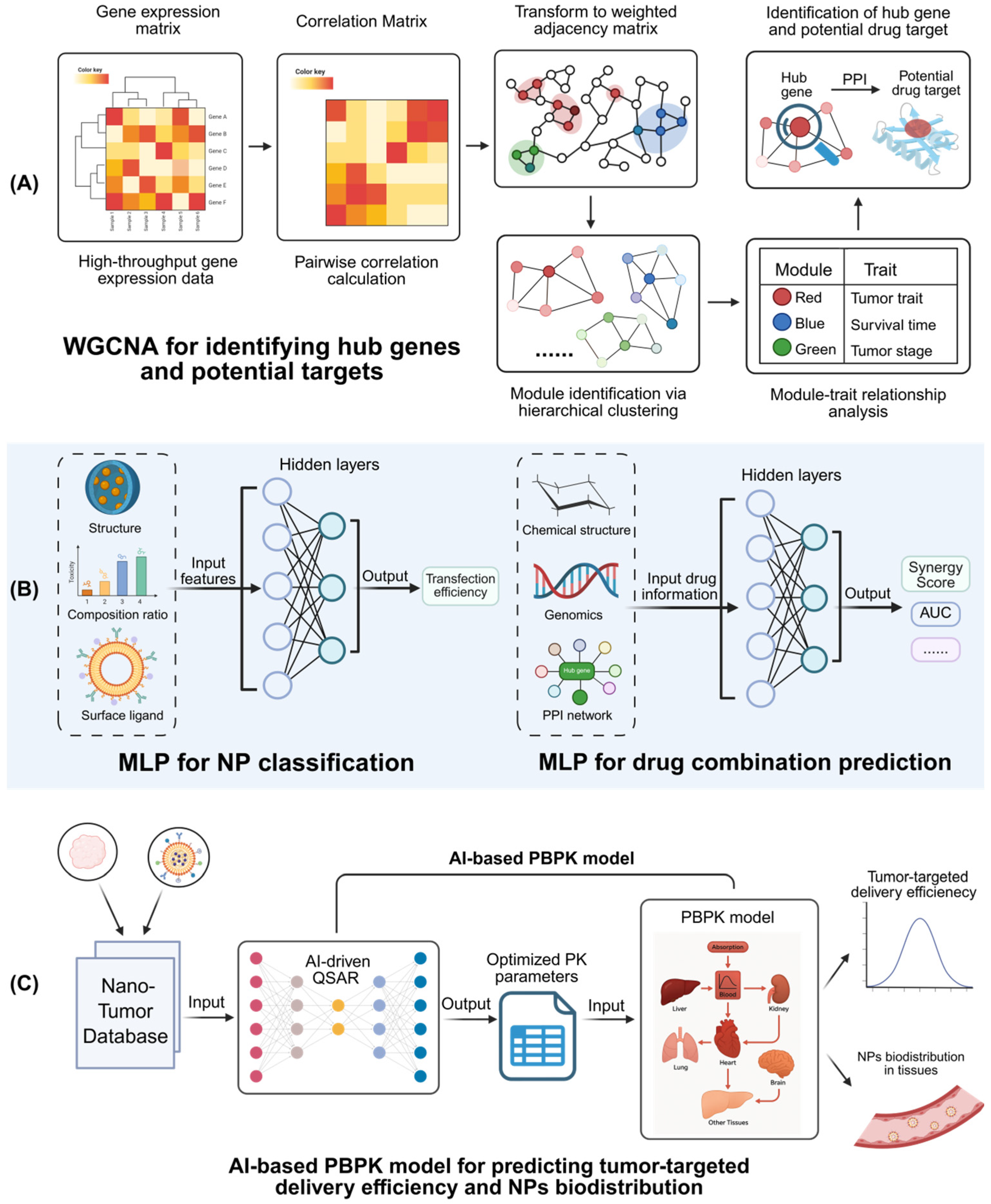
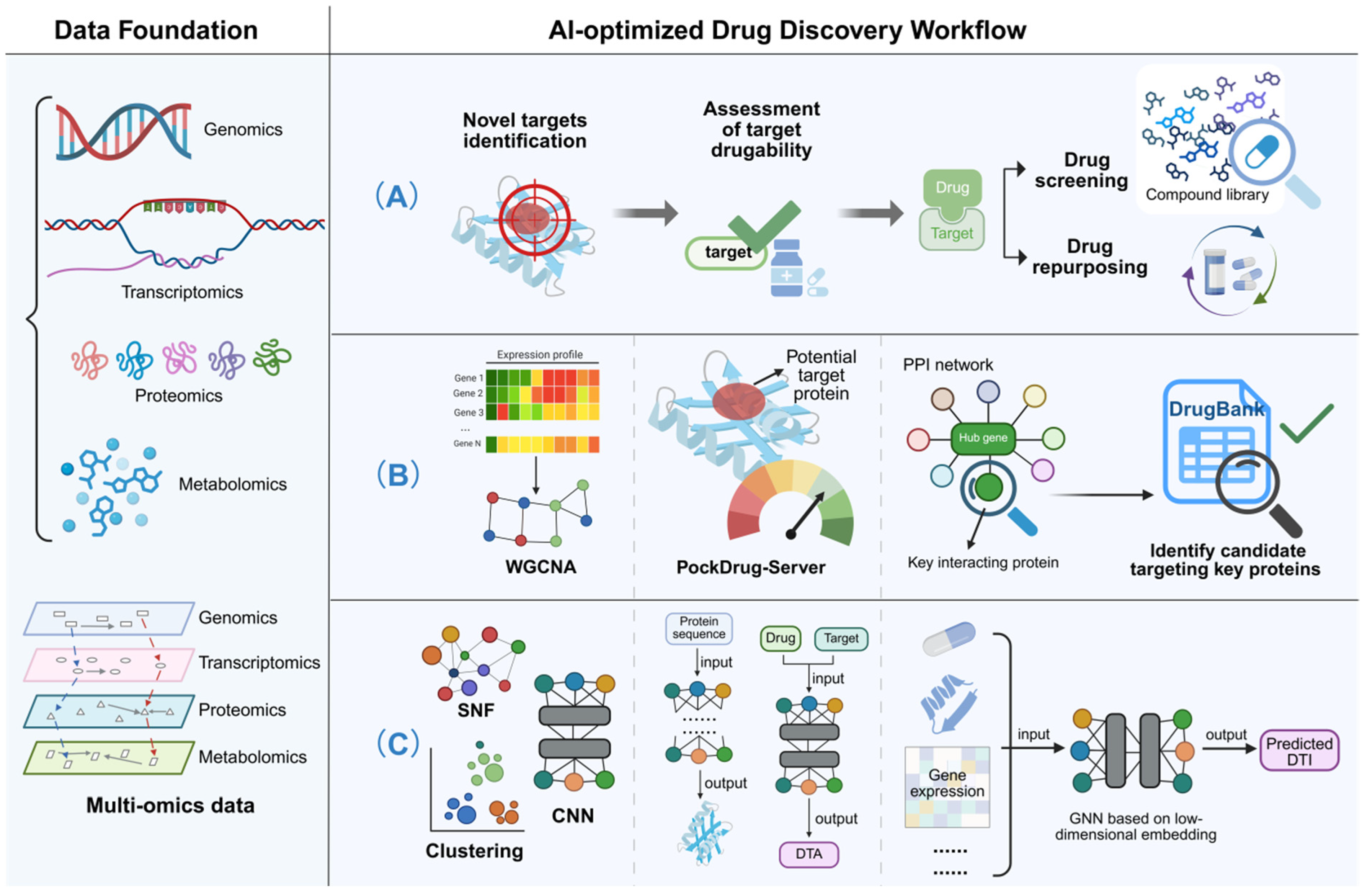
NBAM’s core positioning is to rapidly mine potential therapeutic targets and conduct preliminary screening of candidate drugs via network topology analysis, without relying on complex data modeling processes. This characteristic makes it a cost-effective and efficient tool, particularly suitable for the initial stage of anti-cancer drug discovery where the primary goal is to quickly narrow down the scope of research objects. NBAM has been applied throughout the drug discovery process for thyroid cancer. RNA sequencing data and The Cancer Genome Atlas (TCGA) database were used to identify differentially expressed genes. Hub genes were pinpointed through Weighted Gene Co-Expression Network Analysis (WGCNA) and Differential Methylation Analysis (DMA). Based on these findings, a protein–protein interaction (PPI) network was constructed, identifying three potential therapeutic targets: HEY2, TNIK, and LRP4. The workflow of WGCNA is shown in Figure 2A. Its principle is to construct co-expression modules by analyzing gene expression covariances across samples, identify modules highly correlated with disease traits, and screen hub genes with the strongest regulatory effects as potential anti-cancer targets. PPI is a network structure based on protein–protein interactions, used to identify functional core proteins associated with hub genes that may serve as drug targets. Researchers then used PockDrug-Server to predict the druggability of protein pockets in potential targets within the overlapping regions of central genes and differentially methylated genes. The results showed that TNIK had four highly druggable pockets (score > 0.8), suggesting that it may be an ideal therapeutic target. Further analysis combined drug repositioning to construct a TNIK-centered PPI network, identifying MAP3K1 as a key interacting protein. According to DrugBank, binimetinib can target MAP3K1, indicating its potential as a promising drug candidate for thyroid cancer [32].
Similarly, previous studies carried out comparative transcriptomic analyses on epidermal cells, stromal cells, and tumor tissues in ovarian cancer, integrating genome-wide biomolecular networks; researchers identified tissue-specific key biomolecules. Based on the above findings, Gov et al., constructed a tissue-specific network and carried out topological analysis to find out some important targets like Gata2 and miR-124-3p that might be new ovarian cancer markers. This study demonstrates the value of combining multi-omics data and network analysis for pinpointing promising anti-cancer targets [33]. Additionally, Wang et al. combined WGCNA with PPI network and found out three key targets and 15 candidate drugs for melanoma. Their findings further demonstrate the effectiveness of NBAM in target recognition and drug screening [34]. Its main advantages include high computational efficiency and low requirements for initial drug molecular data, which makes it ideal for the preliminary screening stage of anti-cancer drugs to quickly exclude invalid molecules and reduce the scope of subsequent research. However, NBAM also has obvious limitations: it poorly fits complex drug molecular structures and easily misses potential targets with low expression levels or complex interaction patterns, which limits its application in the in-depth optimization of drugs and precise validation of targets.

2.2. Application of MLBAM in Anti-Cancer Drug Discovery

ML-based biology analysis methods (MLBAMs), which integrate machine learning (ML) techniques to analyze large-scale biological data, serve as an important complement to NBAM and can effectively overcome some of its inherent limitations. Its core positioning is to mine multi-dimensional and complex biological associations (such as drug–target interactions, gene–protein regulatory relationships) through large-scale data learning. MLBAM models can automatically acquire and extract key features based on input data, and continuously improve their prediction accuracy and reliability as more high-quality data is available, focusing primarily on the precise validation of potential targets and the in-depth optimization of drug molecules [2,35,36,37]. MLBAM plays a central role in identifying new anti-cancer targets through biological network analysis. Classification systems based on transcriptomic, proteomic, and other molecular data can identify biomarkers and define tumor subtypes. For instance, the combination of the classical machine learning method K-means clustering with the graph-theoretic computational method Similarity Network Fusion (SNF) enables multi-omics analysis of DNA methylation, mRNA, and miRNA data in pancreatic cancer, identifying two significant subtypes along with 50 mRNAs, 49 methylated genes, 14 proteins, and 20 miRNAs as key biomarkers [38].
Moreover, graph neural networks (GNNs) improve target identification accuracy by modeling target–neighbor interactions in biological networks. The MOGONET model uses graph convolutional networks (GCNs) to construct weighted sample similarity networks for multi-omics data. By integrating View Correlation Discovery Networks (VCDNs), MOGONET effectively captures latent associations across omics modalities, facilitating key biomarker identification in breast cancer [39]. These ML approaches enhance target detection and support anti-cancer drug development and precision medicine.
MLBAM is also a powerful tool for assessing target druggability, particularly in protein structure modeling and drug–target affinity (DTA) analysis. AlphaFold employs neural networks to study homologous sequence covariance, predicting residue distances and refolding protein structures with a gradient descent algorithm, achieving high accuracy even with limited homologous sequences [40]. DTA prediction evaluates binding affinity to determine target stability. GNNs outperform traditional methods like molecular docking and collaborative filtering by learning drug structures and drug–target interactions. GraphDTA, the first GNN-based DTA model, takes drug–target pairs as input and outputs binding affinities, automatically identifying key chemical features such as aliphatic hydroxyl groups. It achieves higher prediction accuracy for drugs with clear structural characteristics [41]. MLBAM not only identifies promising drug targets for various cancers but also significantly reduces experimental time and costs.
Furthermore, MLBAM plays a crucial role in drug screening and repurposing, particularly through GNNs, which integrate non-Euclidean data such as drugs, proteins, and gene expressions into graph structures, learn low-dimensional embeddings, model complex molecular relationships, and improve prediction accuracy and interpretability. For instance, DTI-Voodoo combines molecular features, ontological drug phenotypic effects, and PPI networks to identify drug–protein interactions, then uses GNN to calculate similarity scores. It predicted that mesalazine, an anti-diarrheal drug, interacts with five proteins containing PHD-type zinc finger domains. Notably, RSF1 overexpression is linked to poor prognosis in colorectal cancer, suggesting that inhibiting RSF1 could serve as a chemopreventive strategy [42]. For drug repurposing, GraphRepur used GNN to integrate drug gene expression data and drug–drug interaction information, calculating therapeutic scores for breast cancer and outperforming traditional methods [43,44]. Overall, GNN reduces false-positive predictions in traditional network biology analyses, accelerating drug development and lowering experimental costs. Figure 3 illustrates the AI-optimized drug discovery workflow and its data foundations.
MLBAM excels at mining multi-dimensional drug–target associations with high prediction accuracy, making it well-suited for drug molecular optimization and target validation to enhance specificity and reduce experimental risks. However, it has limitations: it requires large amounts of high-quality data, has a relatively long training cycle, and demands high computational resources, which may limit its application in laboratories with limited data and computing capacity.
Notably, NBAM and MLBAM have complementary advantages in anti-cancer drug discovery, and their combined application shows great potential for improving efficiency and precision. NBAM can be used for preliminary screening to quickly narrow down candidate targets and drugs, reducing workload and saving time and costs; MLBAM can then perform in-depth optimization and precise validation on the screened candidates, improving reliability and success rates. Currently, the main limitation in their practical application is the lack of head-to-head clinical validation data comparing their effectiveness across different cancer types. Therefore, further research is needed to standardize their combined workflow, promote clinical translation, and maximize their practical value in anti-cancer drug development.

3. AI-Driven Development of Anti-Cancer Drugs

Drug development can be defined as the refinement of promising compounds that have been identified during drug discovery such as refining drug formulations, devising large-scale production processes, and even carrying out clinical trials. Only drugs that successfully complete these procedures can apply for market approval. Therefore, drug development represents a crucial gap between drugs since they have started their basic research phase and can be used in clinical practice and finally, in the market. The current section is concentrated on the way the AI may optimize drug combination therapy (DCT) approaches and how it can resolve the issues in the process of clinical trials and make the results more effective and successful in terms of the new drug development.

3.1. AI-Driven Drug Combination Therapy

DCT uses multiple drugs in order to maximize beyond one drug to improve efficacy, mitigate drug resistance, and reduce the side effects synergistically. Recent developments in pharmacokinetics (PK), pharmacodynamics (PD), biological networks, and AI technologies have enabled a transition of anti-cancer drug combinations to empirical screening to precision optimization through data. Optimized DCT designs are aimed at determining the most effective combination and dose of drugs that can cause specific pathways and reduce toxicity to other organs. Conventional screening techniques like clinical experience-based screening or HTS are commonly expensive, time-sensitive, and have the susceptibility of varying reactions in patients and may result in ineffective pairing of tests that might even cause harm to patients or even delay the treatment process. Since not every combination of drugs and dosages can be tested in practice, AI methods can provide an excellent solution to DCT optimization [36,45]. AI’s role here is to accelerate DCT screening, refine dosage design, and explore non-synergistic effective combinations. Its core impact lies in improving prediction accuracy of drug synergy and reducing experimental workload; key challenges include difficulty in modeling complex drug–drug interactions and lack of clinical validation for AI-optimized combinations.
SynDeep represented a deep neural network (DNN) model which combined biological data such as physicochemical property and genomic and the PPIs to form a comprehensive feature network by means of multilayer perceptron (MLP) training. Experimental evidence shown that SynDeep obtained a prediction accuracy of 92.21% on the NCI-ALMANAC dataset with an AUC of 97.32%, which is by far much better than the conventional ML models like random forests. SynDeep has successfully identified several potential anti-cancer drug synergy strategies, including the synergistic effects of doxorubicin and sirolimus in breast cancer MCF-7 cells, and the combined inhibition of etoposide and cediranib in non-small cell lung cancer NCI-H460 cells [46]. The workflow of using MLP for drug combination prediction is illustrated (Figure 2B). Similarly, DeepSynergy, a DL model trained on HTS data and cancer cell gene expression data from ArrayExpress (E-MTAB-3610), combined drug chemical structures with cancer cell genomic information using hierarchical feature extraction and normalization strategies. This model has demonstrated superior performance in predicting anti-cancer drug combinations, such as the additive effect of paclitaxel and SN-38 (a metabolite of irinotecan) and the effectiveness of irinotecan and oxaliplatin against the HCT-116 cell line, consistent with experimental findings [47]. Compared with the traditional models, these two models can make predictions quickly and efficiently on the basis of large-scale data, providing an important reference for DCT.
Predicting proper efficacy and assessing safety profile at different doses is also vital in maximizing DCT. Chen et al. [48] proposed that a combination of PK/PD modeling and ML offered a way of defining critical PK indicators of drug action. To investigate the effect of varying PK properties on the efficacy of drugs, they developed a physiologically relevant PK model and used Monte Carlo simulation to generate 15,000 combinations of PK parameters automatically. Ranking the importance of PK endpoints with a SHapley Additive exPlanations algorithm, they used a regression tree model to examine the impact of the PK endpoints. The analysis also indicated that various pharmacological processes were motivated by different PK parameters to maximize drug dosage development and enhance the success rates of clinical trials as well as decrease the chances of drug development failures [48].
Nevertheless, the effect of DCT on patients is not always the same, and drug combinations that are not dependent on synergy become an effective solution [49]. AI models can forecast interactions between drug targets and pathways beyond the traditional synergy-based framework, thereby increasing therapeutic options and identifying effective drug combinations. Since there are far too many drug and dosage combinations, AI can rapidly explore these parameter spaces to identify optimal regimens. For instance, IDACombo, a machine learning-based method grounded in the independent drug action (IDA) principle, predicts drug combination efficacy using monotherapy data from high-throughput cancer cell line screens. Validated on over 5000 in vitro combinations (Pearson’s r = 0.93) and 26 clinical trials (>84% accuracy), IDACombo demonstrates that most combination effects can be accurately modeled without invoking synergy, offering a systematic framework for prioritizing combinations in specific cancer settings [50]. AI-driven optimization of DCT enhances screening efficiency, refines dosage design, and explores non-synergistic effective combinations, offering new strategies for personalized treatment.

3.2. AI-Driven Clinical Trials in Cancer

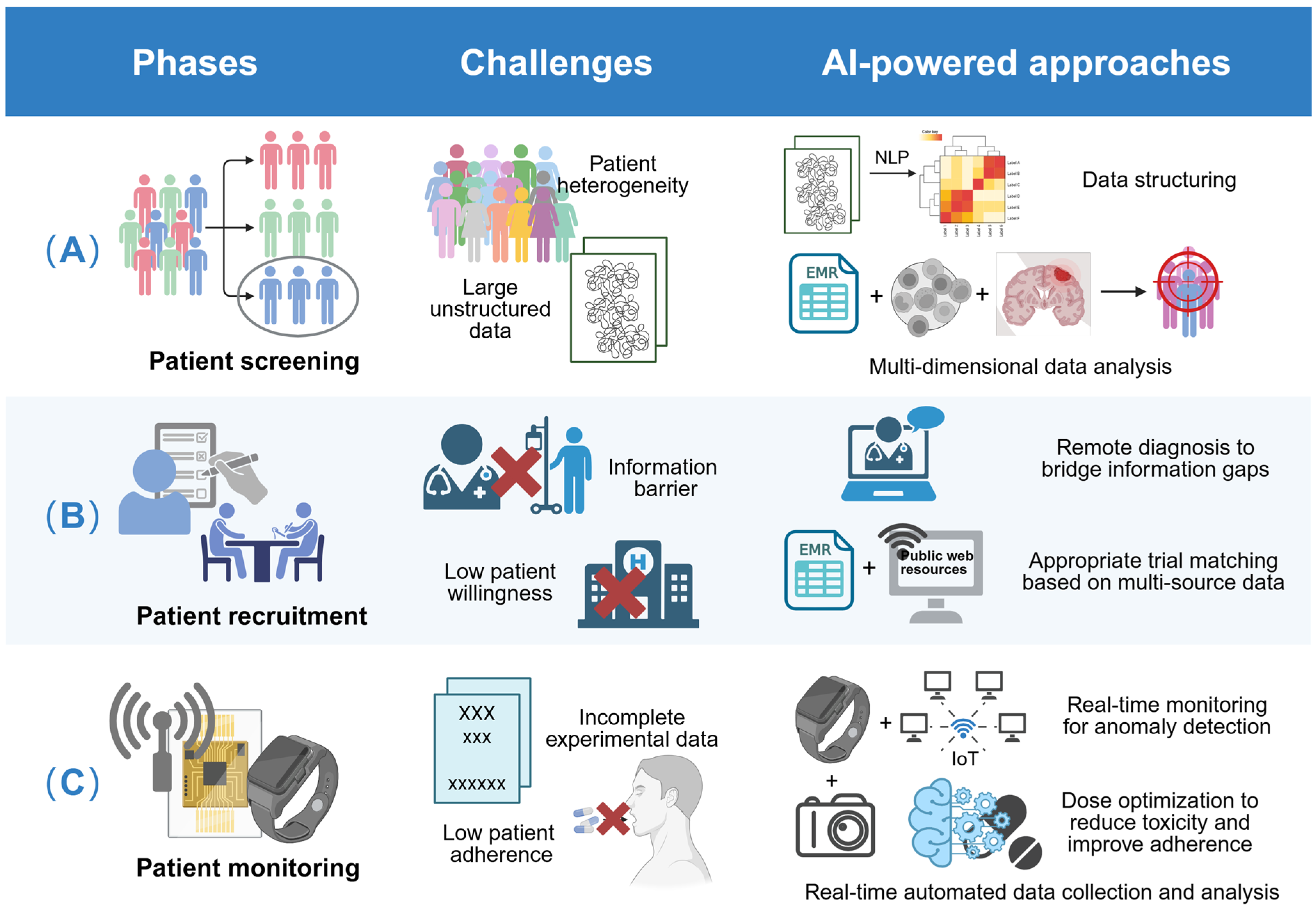
Clinical trials, which are systematic studies designed to evaluate the safety and efficacy of a drug for a specific disease, are usually divided into three phases and require 10–15 years, a large number of subjects, and a significant financial investment. According to existing research, the general success of cancer drug clinical trials is estimated at 3.4 percent, which is significantly lower than in other types of diseases [51]. The biggest issue in the modern clinical trial processes is the possibility to recruit enough qualified patients and properly collect the experimental data. Patient screening is challenging because many patients fail to meet strict enrollment criteria due to their medical history, disease status, and disease heterogeneity. Also doctors have difficulties in filtering through the innumerous and unstructured data in search of vital information, and it is not only time-consuming but also labor-intensive. Moreover, recruitment of patients is also hampered by other factors, such as lack of publicity channel, incomprehensible inclusion criteria, and the preference of the patients. In addition, low patient compliance and absence of real-time feedback lead to a significant loss of experimental data, and anomalies may not be identified timely [52]. Current statistics indicate that the screening and recruitment rates of the patients into clinical trials of the cancer type are all at the range of 5–10 percent, and sometimes even 2–5 percent [53,54]. Luckily, AI has contributed to the patient screening, recruitment, and monitoring process in clinical trials by combining multi-omics data and applying the method of ML and NLP to enhance the efficiency and success rates of the trials [55,56,57]. The challenges in patient screening, recruitment, and monitoring, along with their AI-powered approaches, are illustrated in Figure 4. AI’s core role in clinical trials is to address bottlenecks in patient screening, recruitment, and monitoring, thereby shortening trial cycles and improving success rates. Its most impactful areas are automated patient matching and real-time data monitoring; key challenges include data privacy concerns, poor integration of heterogeneous clinical data, and limited application in oncology-specific trial scenarios.

3.2.1. Patient Screening

The primary objective of patient screening is to identify potentially eligible patients for clinical trials from a population diagnosed with specific types of cancer. To confront the challenges in patient screening, AI technologies can automate the analysis of EMRs and clinical trial databases, thereby enhancing matching efficiency [58]. ML algorithms can automatically learn patterns from large volumes of EMR data to predict which patients meet the inclusion criteria for specific cancer clinical trials. DL, through its multilayer neural networks, can automatically analyze cancer images, genomic data, and pathology slides to assist in identifying suitable patient groups. As an example, in a trial of the HER2-positive breast cancer, DL identified the biomarkers of HER2 and filtered the subjects [59]. Other research integrated pathological images with the clinical data using a multimodal AI (MMAI) system to better predict the course of the disease and treatment outcome, resulting in being able to more scientifically filter the potential patients to undergo clinical trials. The results of the experiment revealed that the MMAI was more effective and could predict 5-year and 10-year remote metastasis, biochemical recurrence, and cancer-specific survival by 9.2–14.6% as compared to the traditional stratification tools, and improved the accuracy of patient screening [60]. Additionally, AI can accurately screen specific diseased populations for phase II and III clinical trials by profiling patient-specific genomic exposomes using ML and DL technologies. As an example, AI was able to detect patients with lung cancer who had EGFR mutations and estimated their response to EGFR inhibitors based on exposome data like smoking history [52]. The NLP and optical character recognition (OCR) of AI allow the automatic interpretation and combination of EMRs and data from different formats; they also dig out important details to find the right patients more effectively. A clinical decision support system (CDSS) assisted by AI with a seamless integration with the EHRs can process both structured (e.g., lab values and demographic data) and unstructured (e.g., pathology reports and clinical notes) data by applying the NLP. This combination process has been demonstrated to have more than 80 percent accuracy, sensitivity, and specificity in automated screening of breast cancer clinical trials, which is far higher than manual screening [61]. Artificial intelligence methods would accelerate and make the process of screening patients with clinical trials to detect cancer more precise, would be more efficient in terms of matches, and would offer a consistent basis to conduct further monitoring of patients.

3.2.2. Patient Recruitment

The main task of patient recruitment is to break down information barriers and encourage eligible patients to actively contact researchers for clinical trials. Combining patient biomarker data with EHR processed with DL technology can assist in inferencing patient discharge diagnosis, which is of great value for patient recruitment [62]. Through deep reinforcement learning (DRL), AI can predict a patient’s interest in clinical trials based on historical behavioral data, such as medical record queries and search records, and proactively recommend suitable trials to potentially eligible patients [63]. The SYNERGY-AI study (NCT03452774) [36] used Virtual Tumor Boards to enable teams of physicians to provide treatment recommendations and diagnostic opinions remotely, and to link cancer patients to the best-matched clinical trials by analyzing multi-dimensional disease factors in the EHR. The study also combined EHR data with progression-free survival (PFS) and overall survival (OS) data to determine the effectiveness of the trial matching platform. An essential fact to note is that AI needs to combine the data of the large population and individualized one to make sure that a patient is provided with treatment with high chances of response, thus, making treatment really personalized [36]. The system is an AI-based clinical trial matching system that matches a given patient with an appropriate trial after which the matching outcomes are subsequently suggested to both the physician and the patient, which enables both parties to take proactive action. Besides that, NLP and OCR may actively carry out the information search in publicly available Internet sources, including digital trial databases, trial announcements, and social media, to automatically nominate potentially eligible patients. This AI system allows patients to find appropriate trials faster than in the case of the traditional manual system of retrieval and makes them actively approach their physicians and seek additional check-ups [58]. Briefly, as AI has continued to be applied, the scope and the effectiveness of digital recruitment strategies have significantly increased, thus, increasing the overall value of clinical trials.

3.2.3. Patient Monitoring

The major issues of patient monitoring in clinical trial involve the danger of loss of patients and the inability to receive instant feedback on data. In order to overcome these problems, ML would help those at risk of withdrawal through the analysis of patients’ behavior and mood by making a record and offering personalized interventions to help patients remember to keep taking part in the trial, hence enhancing compliance and guaranteeing more comprehensive data collection. AI also enables proactive intervention when severe side effects are detected or when treatment options are incompatible with a patient’s daily life, allowing for regimen adjustments before patient dropout occurs [56]. For instance, there is the use of DRL algorithms to optimize doses of chemotherapy, which efficiently reduced brain tumors and avoided the toxic side effects. The ML-designed treatment regimen cycle decreased the overall dosage by 1/4 or 1/2 of the initial dose when compared to current practices, keeping the same anti-tumor response in a simulated trial on 50 patients and increasing adherence to treatment and reducing dropout rates and data missing rates [64].
Combining wearable sensors with video surveillance technology will be an automated solution of capturing real-time and continuous data to record the medication status of patients, the physical functioning of patients, and the data of patients in relation to the drug. This goes a long way in ensuring that patients’ omissions are curtailed and a greater burden on their record-keeping is mitigated. This data can be analyzed in real-time by ML and DL-based models and can identify and record the main events and create dynamic disease diaries. The adaptation of the diaries to the alterations of the disease presentation and patient behavior is possible, since the DL models can be retrained with new measurements periodically to give accurate evidence of the adherence [56]. Furthermore, AI proves to be of substantial importance regarding image-based endpoint detection, where DL could be applied to gather and process cancer image data automatically to detect and measure lesions and provide real-time analysis results and enhance the efficiency of data collection [65,66]. The method is more reliable and efficient than the conventional patient self-monitoring techniques. Moreover, together with the IoT and wearable-based items, AI is capable of automatically gathering physiological data including heart rate, blood sugar, and exercise statistics and processing them in real-time, before uploading them to the trial database, which increases the accuracy of data acquisition [67]. The system automatically notifies the doctors and eliminates the chances of an emergency in case of any abnormalities. Although the application is more common in neurological trials, it has fewer applications in oncology trials and, therefore, it is not extensively discussed here [56,68]. To sum up, patient monitoring would be impossible without AI, especially ML technology in the course of clinical trials, as it allows for detecting patient conditions in real-time, preventing risks and ensuring holistic data development, analysis, and reporting, thus allowing researchers to be able to conduct clinical trials effectively and making successful cancer therapy and drug commercialization more likely.

4. AI-Driven Medication Therapy Management for Cancer

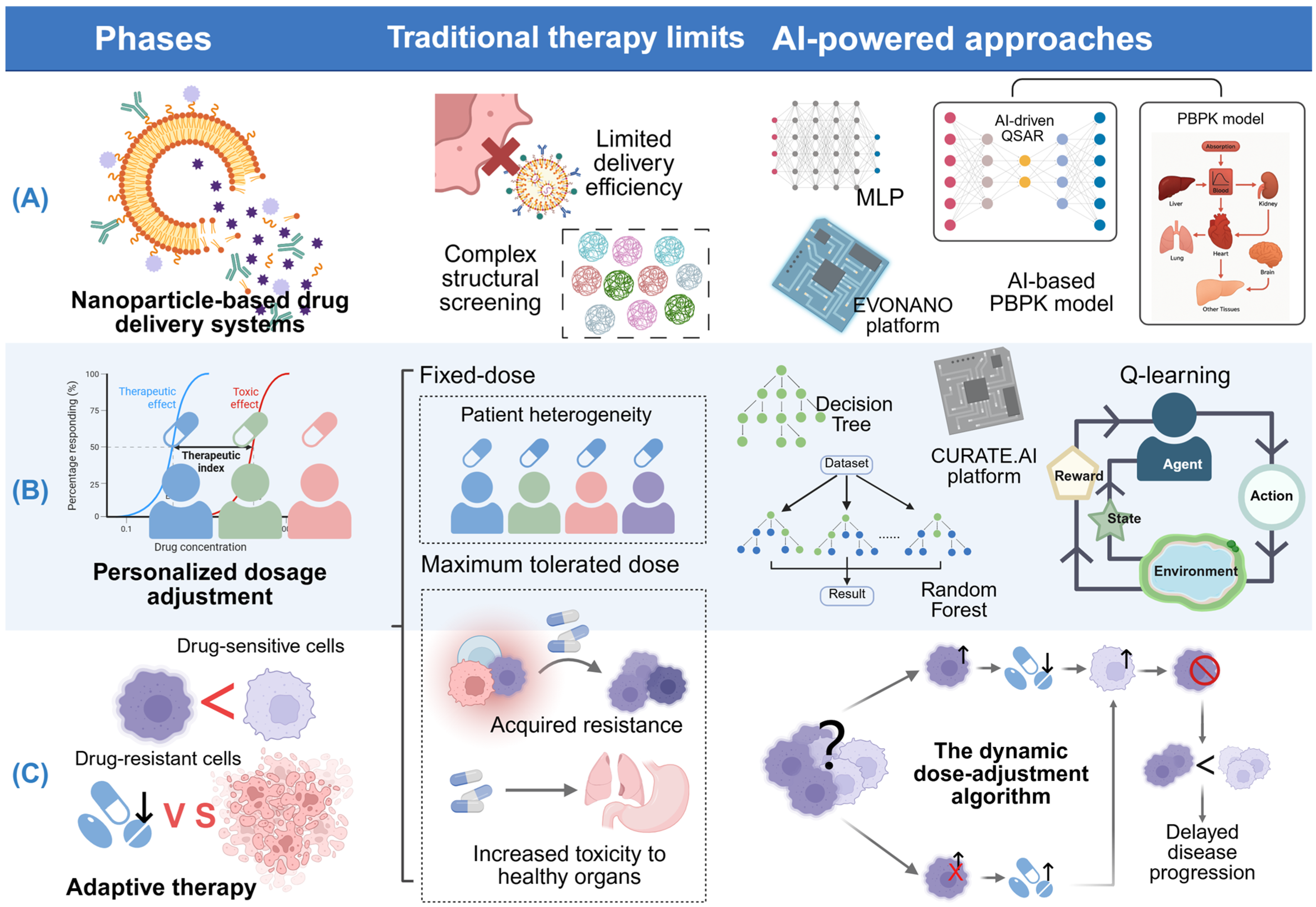
The development of a successful drug is just the first step on the way to patient benefit but the main issue is the scientific, rational, and efficient way of transferring these new therapies into clinical practice. This warrants therapy through medication, which is a broad method of maximizing medication at the individual patient range. The important aspects of the management of medication therapy include improvement in the drug delivery system, personalized changes in dosage, refinement of adaptive therapy, and better compliance during medication therapy. The technological movement of drug development to medication therapy management is not merely a technological replacement of the laboratory by the clinic, but it is also an element that ensures maximum benefit to the patients and improves the treatment outcomes. Since treatment adherence management has been pointed out significantly in the previous sections, this section will specifically address the aspect of utilizing AI in enhancing NP-guided drug delivery systems and personalizing drug dosing of cancerous drugs and advanced adaptive therapeutic models, potentially leading to the development of precision medicine (Figure 5).

4.1. AI-Optimized NP-Based Drug Delivery System

Drug delivery systems refer to technologies that facilitate the delicate and controlled delivery of drugs to suit external or internal stimuli. Systems regulating drug release through physical, chemical, and biological signals have been extensively studied to effectively increase drug enrichment in tumor tissues and reduce toxic side effects on non-target organs [69]. Advantages in nanotechnology have enabled targeted delivery on the basis of nanoparticles (NPs) besides enhancing bioavailability and decreasing side effects. Nevertheless, there are still difficulties in the model of the ideal NP, which include intricate structural screening and reduced efficiency of delivery [70]. AI technology combines information from multiple sources about several subjects—such as drug molecular properties, physicochemical properties of NP, and the tumor microenvironment characteristics—to enhance NP design parameters, predict their behavior in vivo, and be intelligent and adaptable to regulate drug release [71]. AI’s role here is to optimize NP design, predict in vivo performance, and improve targeted delivery efficiency. Its core impact lies in accelerating NP development and enhancing drug enrichment in tumors; key challenges include limited generalization of AI models across different NP types and lack of in vivo validation for AI-predicted designs.
Molecular representation learning and classification models by using ML methods have been employed to predict transfection efficiency in lipid nanoparticle (LNP) design. A dataset of 622 LNPs, compiled from published studies, was used to train classification models such as MLP. These models estimated the efficiency of transfection of LNPs based on chemical structures and ratios of components. Experimental results demonstrated that “expert fingerprints” derived from chemical domain knowledge performed well in predicting transfection efficiency, with the MLP model achieving a classification accuracy of 98% on the test set. This meant that MLP could afford to prioritize LNP candidates with high transfection efficacy to be experimentally validated, thus allowing more relevant mRNA delivery systems to emerge [72]. The workflow of using MPL for NP classification is illustrated (Figure 2B).
Dawoud et al. used AI along with mass-derived design to optimize lecithin/chitosan NP to deliver otherwise insoluble drugs in cancer therapy. Concerning silymarin as the model drug, the experiment optimized the formulation of lecithin and chitosan to achieve NPs whose encapsulation percentage was 98. The AI model had good accuracy in the predicted rate of drug release and the optimized formulation showed a significant increase in the cytotoxic effect of silymarin by reducing its IC50 relative to silyminar standard and also showed a good success in the anti-cancer effect of silyminar [73]. An evolutionary computational platform called EVONANO combines multi-scale and modular simulations with advanced ML techniques, creating an AI-driven system that automates the discovery of nanocarriers for cancer therapy. EVONANO can simulate tumor development and extraction scenarios and predict NPs’ transport and distribution. Studies have shown that ML can effectively identify NP designs with high diffusivity (smaller radius) and low binding affinity (higher dissociation constant, KD value) for efficient targeting of tumor tissues and drug delivery. Additionally, effective therapeutic efficacy can be achieved by decreasing NP concentration and increasing drug loading per NP. The EVONANO platform could achieve 95% cancer cell elimination in virtual tumors at minimal doses. For heterogeneous tumors containing cancer stem cells, certain NP designs significantly improved efficacy even at low doses, achieving 99% cancer cell elimination and over 80% cancer stem cell reduction [74].
The accurate prediction of the efficiency of tumor-targeted delivery and the in vivo distribution of different NPs is achievable through an AI-based physiological pharmacokinetic (PBPK) model. This model fused an AI-driven Quantitative Constitutive-Activity-Relationship (QSAR) model with the PBPK framework, employing DNN algorithms. Trained on the publicly available Nano-Tumor Database, the model optimized key input parameters of the PBPK model. The principle of the AI-based PBPK model is shown in Figure 2C. The model can predict the PK characteristics of NPs in tumors under various experimental conditions with high accuracy, achieving a coefficient of determination (R2) ≥ 0.70 in 133 out of 288 datasets. This method provided an efficient and ethically friendly computational approach for nanomedicine research and development, relying solely on the physicochemical properties of NPs without requiring animal experiment-based data training [75]. In sum, AI application in nanomedicine delivery systems is predominantly manifested through the domains of screening of effective NP applicants, NP design optimization, and precise prediction of NP delivery effectiveness, which can vastly enhance the target delivery efficiency of nanomedicines, minimize toxicity of drugs, and accelerate the development of personalized drug delivery strategies [76].

4.2. Personalized Dosage Adjustment

Cancer treatment often employs a variety of drug intervention strategies, including chemotherapy, targeted therapy, and immunotherapy. Nevertheless, the common fixed-dose regimen does not sufficiently consider inter-patient variability and may result in inappropriate efficacy or an insufficient exposure to drugs in certain patients. High-dose administration improves anti-tumor activity but also promotes increased drug-related toxicity, increased adverse effects, and damages non-tumor organs. Consequently, personalized dosage adjustment based on individual patient characteristics, such as genetic background, metabolic capacity, and tumor burden, has emerged as a critical approach to optimize treatment effectiveness and improve safety. Personalized dosage adjustment is based on determining patient reaction to drugs or making subsequent adjustments based on adverse reactions, which requires reasonable predictions about patient reactions. Physiological factors affect drug absorption, metabolism, and clearance. Indicatively, patients with kidney failure need cisplatin dosage to be considered in order to increase its effectiveness and decrease its toxicity to the kidney [77]. Also there are genes involved in drug metabolism, which have a direct effect on the clearance of drugs. Mutations in the UGT1A128 gene can slow metabolism and increase the risk of irinotecan-related adverse effects, making liposomal delivery methods a valuable approach for refining dosing and improving therapeutic safety [78]. Despite its promise, personalized dosage adjustment faces challenges, such as the difficulty of acquiring, integrating, and analyzing multi-omics data, and the limitations of traditional statistical models in predicting individualized drug responses. The AI technology has great potential in this domain, and it will allow for uniting multi-dimensional biological data and optimizing individual methods of dose adjustment to increase the accuracy and safety of treating cancer [79]. AI’s role here is to integrate multi-dimensional patient data to predict optimal dosages, balancing efficacy and toxicity. Its core impact lies in personalized dose optimization for heterogeneous patient groups; key challenges include reliance on large-scale clinical data, lack of unified algorithmic frameworks, and insufficient large-cohort validation.
The application of classical ML in personalized dosage adjustment has been documented. In a lapatinib dose optimization study for breast cancer, researchers utilized a random forest-based sequential forward selection algorithm to analyze treatment data from 149 HER2(+) breast cancer patients, and identified that the key factors influencing dosage adjustment were body weight, prior chemotherapy treatments, number of metastases, and underlying treatment regimen. After comparing various ML algorithms, the study found that TabNet, a DNN, achieved the highest prediction accuracy exceeding 80%, though the study’s small sample size limits its generalizability and calls for further validation in larger cohorts [80]. Cauvin et al. used ML to analyze retrospective data from 80 stage III–IV head and neck cancer patients, evaluating cisplatin dose–efficacy/toxicity relationships based on a three-compartment PK model. Tree-structured Parzen Estimation identified peak blood concentration as the optimal dose measure, and ML-based dosing optimization improved target drug exposure, thereby enhancing efficacy and reducing adverse reactions; the generalized linear model performed best in dose–effect prediction (accuracy = 0.71), highlighting ML’s potential in chemotherapy dose regulation [81].
RL exhibits substantial potential in personalized cancer dose adjustment. Q-Learning is an off-policy RL algorithm that calculates target values regardless of the experience generation [82]. Classical Q-Learning has been applied to optimize various chemotherapy adjustment regimens of doses. To illustrate, Q-Learning was used to optimize endothelin intravenous therapy via a dynamic tumor growth model, achieving superior tumor control with a smaller total drug dose over a shorter period [83]. Q-Learning was used by researchers who attempted to create an optimized intravenous chemotherapy drug dose controller, where tumor growth was modeled using a four state nonlinear model and dosing is optimized to cause as much tumor shrinkage as possible, while utilizing as little drug as possible because of drug toxicity [84]. Also the optimization of a personalized dosage regimen of erdafitinib in patients with metastatic uroepithelial cancer was also addressed with the help of Q-Learning, which showed better results than the Food and Drug Administration-approved adaptive dosage regimen [85]. Its advantages lie in simple implementation and suitability for small-sample scenarios, but it struggles to fit complex dose–efficacy relationships and process high-dimensional clinical data.
Deep Q-Learning further enhances the optimization capabilities and it has been utilized to autonomously select the appropriate dose for minimizing tumor volume in glioma patients [64]. Similarly, Deep Dual Q-Learning was applied to optimize the doses of chemotherapy used in the treatment of breast and ovarian cancer with the purpose to ensure the growth of tumors is controlled and that the myelotoxicity is minimized. A mouse model simulating 200 patients was constructed by researchers, using mean-based optimization and including bone marrow density data to enhance accuracy. The results indicated that, for unknown patients, this method approached the theoretical optimal solution more closely than traditional optimal control or nearest neighbor test control, particularly when patient physiological parameters exhibited significant fluctuations [79]. Moreover, Huo and Tang suggested a multi-objective deep Q-network to optimize a general chemotherapy regimen, allowing for personal adjustment of the dosage with references to the maximum number of immune cells, minimum numbers of tumor cells, and the dosage of drugs [86]. Compared to classical Q-Learning, it excels in high-dimensional data mining and fitting accuracy but requires large-scale training data, is prone to overfitting, and has higher computational costs.
Fuzzy reinforcement learning (FRL) is a fuzzy extension of Q-Learning which combines the knowledge of fuzzy system and RL. In the context of personalized oncology dosing, FRL not only classified patients as “overdosed” but also accurately quantified the degree of overdosage and formulated rules accordingly. To illustrate, in the study, the dosage of drugs was modified to individual patient needs with respect to the fuzzy rules, aiding in the personalization of treatment to individual patients, where those who are more sensitive to a certain drug are given lower dosages, yet the effect of delayed treatment in drug concentration change is taken into account [11,87]. Another study further accounted for physiological differences between the young and elderly patients, optimizing dosage control using the State-Action-Reward-State-Selected Action algorithm. Experimental results demonstrated that these approaches effectively reduce prediction errors, improving dose adjustment accuracy, and performing better than the conventional Q-Learning in terms of treatment effect and toxicity in a heterogeneous group of patients [12]. FRL’s strength is its ability to handle ambiguous clinical data and strong robustness, but it relies heavily on expert experience for rule design, leading to poor generalization.
Other RL methods have also proven effective. The algorithm using Bayesian Data Assimilation and RL was used to optimize the specific dosing regimen of paclitaxel in simulated non-small cell lung cancer patients and achieved success in ensuring the optimal efficacy and minimizing the occurrence of neutropenia [88]. Conservative Q-Learning combined with supervised optimization of chemotherapy regimens was used to optimize bevacizumab or cetuximab regimens in stage IV colon cancer patients. The former mainly minimized the potential loss of overestimation inherent in traditional Q-Learning, while the latter monitored RL-generated regimens through physicians’ past treatment decisions. The findings indicated that scenarios simulated by RL do not fluctuate between treatment cycles with small and reasonable root mean square error [89]. Notably, RL methods lack a unified framework due to algorithmic differences, requiring further optimization and standardization for clinical application.
The CURATE.AI platform (a neural network-based system) optimizes personalized combination therapy dosages. Unlike traditional ML that relies on large-scale data training, it uses second-order algebraic algorithms to establish personalized phenotypic mappings, adjusting doses based solely on individual patient data to balance tumor shrinkage and safety [90]. It improved maintenance therapy for pediatric acute lymphoblastic leukemia (better ANC control, normal platelet counts, and lower recommended doses [91]) and achieved long-term tumor control in a patient receiving enzalutamide and BET inhibitor therapy by reducing BET inhibitor dose by 50% [92]. Its advantage is clinical practicality without relying on big data or genetic information, but it has limited compatibility and insufficient clinical validation data.
In summary, classical ML, RL (including Q-Learning, Deep Q-Learning, FRL), and the CURATE.AI platform all demonstrate significant potential in personalized anti-cancer drug dosage adjustment, with distinct strengths and limitations: classical ML and Deep Q-Learning excel in prediction accuracy but depend on large data volumes; Q-Learning and FRL are suitable for small-sample or ambiguous data scenarios but have weaknesses in generalization or complexity handling; CURATE.AI is clinically feasible but lacks compatibility and validation. The lack of a unified algorithmic framework remains a key barrier to clinical translation, emphasizing the need for further standardization and large-scale clinical validation of these methods.

4.3. AI-Driven Adaptive Therapy in Cancer

Currently, the maximum tolerated dose (MTD) is commonly used in cancer treatment. Doctors give patients the highest dose they can bear to kill drug-sensitive tumor cells. However, this method often leaves drug-resistant cells alive and eventually leads to treatment failure. To solve this problem, researchers have put forward a competitive treatment strategy based on a dynamic dose-adjustment algorithm. By dynamically changing the drug dose, this method keeps the number of drug-resistant cells lower than sensitive ones. Generally, drug-resistant cells need more energy to survive and grow. So keeping a certain number of sensitive cells can help suppress resistant cells and make treatment last longer. This strategy is known as adaptive therapy. It uses dynamic dose changes or intermittent dosing to slow down the development of drug resistance, improve treatment effects, and delay disease progression [36,93]. AI’s role here is to design dynamic, personalized dose-adjustment algorithms to suppress drug resistance and extend treatment duration. Its core impact lies in improving long-term tumor control compared to fixed MTD regimens; key challenges include reliance on population-based rules in current designs and lack of personalized dynamic adjustment strategies for heterogeneous tumors.
In a breast cancer study, researchers designed the AT-1 Algorithm to lower paclitaxel doses dynamically once tumors began to shrink. They compared AT-1 with both fixed-dose treatment (AT-2) and standard high-dose therapy. The results showed that AT-1 achieved better tumor control and longer patient survival than traditional high-dose approaches. These results support the clinical benefits of adaptive dose adjustment over fixed high-dose treatments [94]. In a pilot clinical study of prostate cancer patients treated with abiraterone hormone therapy, researchers used adaptive therapy. Patients on average got only 47% of the standard dose, with three using less than 25%. Of 11 patients, only one showed tumor progression. Their median PFS was at least 27 months, clearly better than the 11.1 months and 16.5 months in the control group [95]. Preliminary results show that adaptive therapy works well for breast and prostate cancer. However, present dose adjustments still rely on population-based rules. More precise, personalized strategies are urgently needed to improve cancer treatment.

5. Discussion

However, DL models still suffer from the “black box” problem. We can see the input and output, but cannot fully explain how the model makes decisions. This makes it hard to find errors or fix bias in the data. It also raises ethical issues and makes regulatory approval more difficult. Beyond the “black box” problem discussed above, the clinical translation of AI-driven approaches faces additional ethical and practical challenges. First, the accuracy and reliability of AI models must be rigorously validated across diverse patient populations to avoid biased or erroneous predictions that could harm patients. Second, liability and accountability remain unresolved: when clinical decisions are guided by AI recommendations, it is unclear whether responsibility lies with the clinician, the institution, or the algorithm developers. Third, data privacy and security concerns arise from the use of large-scale patient data for model training, necessitating robust governance frameworks. Addressing these issues is essential for the responsible integration of AI into clinical practice.
In the future, building interpretable and transparent AI systems while maintaining performance will be a key challenge for medical applications. In addition, limited clinical trial data makes it hard to evaluate the efficacy, PK properties, and safety of potential anti-cancer drugs, which is necessary for clinical use [96]. Furthermore, natural product drug discovery faces issues with database structure, data quality, and accessibility. Although large databases such as PubChem and ChEMBL offer abundant data, they often lack complete information on natural product specificity. Many databases limit access for academic users or do not allow full dataset downloads, which restricts the training of stable AI models. Scientific papers are still important for data sharing, but most are not machine-readable, so automatic data extraction is difficult. Solving these problems is urgently needed to support the wider use and clinical translation of natural products in anti-cancer drug development [97,98,99,100]. Future work should focus on solving data-sharing problems, improving database standards, and ensuring more complete and accessible data to support AI model training. With cross-disciplinary cooperation and new technologies in chemistry, bioinformatics, and computational pharmacology, more effective natural products can be developed into safe anti-cancer drugs, offering new approaches for precision tumor therapy.

6. Conclusions

AI is now changing how we develop anti-cancer drugs and manage treatment. By combining multi-omics data, finding new targets, and supporting drug screening and repurposing, AI greatly speeds up drug discovery. In drug development, AI improves DCT and cancer clinical trials, shortens cycles, lowers costs, and raises success rates. In treatment management, AI-based NP systems help screen and design nanoparticles and predict delivery efficiency. Compared with fixed-dose or MTD strategies, AI-guided adaptive dosing and personalized treatment show stronger anti-tumor effects and fewer side effects, improving both safety and efficacy.

Author Contributions

Conceptualization, J.C.; Investigation, J.C. and J.L.; Writing—original draft, J.C. and J.L.; Writing—review & editing, J.C., J.L., and C.Z.; Software, J.L.; Visualization, J.L. and Y.L.; Formal analysis, J.Y.; Methodology, X.L.; Project administration, C.Z.; Supervision, C.Z. All authors have read and agreed to the published version of the manuscript.

Funding

The project was funded by Open Research Fund of Fujian Key Laboratory of Tumor Immunotherapy (ZLMYZL-2025-01) and FuXiaQuan National Independent Innovation Demonstration Zone Collaborative Innovation Platform Project (2023FX0001).

Institutional Review Board Statement

Not applicable.

Informed Consent Statement

Not applicable.

Data Availability Statement

No new data were created or analyzed in this study. Data sharing is not applicable to this article.

Conflicts of Interest

The authors declare that the research was conducted in the absence of any commercial or financial relationships that could be construed as a potential conflict of interest.

Abbreviations

AI, artificial intelligence; ANC, absolute neutrophil count; CDSS, clinical decision support system; CV, computer vision; DCT, drug combination therapy; DL, deep learning; DMA, Differential Methylation Analysis; DNN, deep neural network; DRL, deep reinforcement learning; DTA, drug–target affinity; DTI, drug–target interactions; EHR, electronic health record; EMR, electronic medical records; FRL, fuzzy reinforcement learning; GCN, graph convolutional network; GNN, Graph Neural Network; HTS, high-throughput screening; IoT, Internet of Things; ITH, intra-tumor heterogeneity; LNP, lipid nanoparticle; ML, machine learning; MLBAM, machine learning-based biology analysis methods; MLP, multilayer perceptron; MMAI, multimodal AI; MTD, maximum tolerated dose; NBAM, network-based biology analysis methods; NLP, natural language processing; NP, nanoparticle; OCR, optical character recognition; OS, overall survival; PBPK, physiological pharmacokinetic; PD, pharmacodynamics; PFS, progression-free survival; PK, pharmacokinetics; PPI, protein–protein interaction; PSA, prostate-specific antigen; QPOP, Quadratic Phenotype Optimization Platform; QSAR, Quantitative Constitutive-Activity-Relationship; RL, reinforcement learning; SNF, similarity Network Fusion; TCGA, The Cancer Genome Atlas; VCDN, View Correlation Discovery Network; WGCNA, Weighted Gene Co-Expression Network Analysis.

References

  1. Elemento, O.; Leslie, C.; Lundin, J.; Tourassi, G. Artificial intelligence in cancer research, diagnosis and therapy. Nat. Rev. Cancer 2021, 21, 747–752. [Google Scholar] [CrossRef] [Scilit]
  2. Dara, S.; Dhamercherla, S.; Jadav, S.S.; Babu, C.M.; Ahsan, M.J. Machine learning in drug discovery: A review. Artif. Intell. Rev. 2022, 55, 1947–1999. [Google Scholar] [CrossRef] [Scilit] [PubMed]
  3. Russell, S.; Norvig, P. Artificial Intelligence: A Modern Approach, 4th ed.; Pearson: Hoboken, NJ, USA, 2020. [Google Scholar]
  4. Liang, M.; Tang, W.; Xu, D.M.; Jirapatnakul, A.C.; Reeves, A.P.; Henschke, C.I.; Yankelevitz, D. Low-Dose CT Screening for Lung Cancer: Computer-aided Detection of Missed Lung Cancers. Radiology 2016, 281, 279–288. [Google Scholar] [CrossRef] [Scilit] [PubMed]
  5. Begines, B.; Ortiz, T.; Pérez-Aranda, M.; Martínez, G.; Merinero, M.; Argüelles-Arias, F.; Alcudia, A. Polymeric nanoparticles for drug delivery: Recent developments and future prospects. Nanomaterials 2020, 10, 1403. [Google Scholar] [CrossRef] [Scilit]
  6. Zhang, J.; Wu, J.; Zhou, X.S.; Shi, F.; Shen, D. Recent advancements in artificial intelligence for breast cancer: Image augmentation, segmentation, diagnosis, and prognosis approaches. In Seminars in Cancer Biology; Academic Press: Cambridge, MA, USA, 2023; pp. 11–25. [Google Scholar]
  7. Shmatko, A.; Ghaffari Laleh, N.; Gerstung, M.; Kather, J.N. Artificial intelligence in histopathology: Enhancing cancer research and clinical oncology. Nat. Cancer 2022, 3, 1026–1038. [Google Scholar] [CrossRef] [Scilit] [PubMed]
  8. Gogoshin, G.; Rodin, A.S. Graph Neural Networks in Cancer and Oncology Research: Emerging and Future Trends. Cancers 2023, 15, 5858. [Google Scholar] [CrossRef] [Scilit]
  9. Schneider, P.; Walters, W.P.; Plowright, A.T.; Sieroka, N.; Listgarten, J.; Goodnow, R.A., Jr.; Fisher, J.; Jansen, J.M.; Duca, J.S.; Rush, T.S.; et al. Rethinking drug design in the artificial intelligence era. Nat. Rev. Drug Discov. 2020, 19, 353–364. [Google Scholar] [CrossRef] [Scilit]
  10. Pandiyan, S.; Wang, L. A comprehensive review on recent approaches for cancer drug discovery associated with artificial intelligence. Comput. Biol. Med. 2022, 150, 106140. [Google Scholar] [CrossRef] [Scilit]
  11. Wouters, O.J.; McKee, M.; Luyten, J. Estimated Research and Development Investment Needed to Bring a New Medicine to Market, 2009–2018. JAMA 2020, 323, 844–853. [Google Scholar] [CrossRef] [Scilit]
  12. Chen, H.M.; Engkvist, O. Has Drug Design Augmented by Artificial Intelligence Become a Reality? Trends Pharmacol. Sci. 2019, 40, 806–809. [Google Scholar] [CrossRef] [Scilit]
  13. Peng, J.; Wang, Y.; Guan, J.; Li, J.; Han, R.; Hao, J.; Wei, Z.; Shang, X. An end-to-end heterogeneous graph representation learning-based framework for drug-target interaction prediction. Brief. Bioinform. 2021, 22, bbaa430. [Google Scholar] [CrossRef] [Scilit]
  14. Shao, K.; Zhang, Y.; Wen, Y.; Zhang, Z.; He, S.; Bo, X. DTI-HETA: Prediction of drug-target interactions based on GCN and GAT on heterogeneous graph. Brief. Bioinform. 2022, 23, bbac207. [Google Scholar] [CrossRef] [Scilit]
  15. Wang, L.; Song, Y.; Wang, H.; Zhang, X.; Wang, M.; He, J.; Li, S.; Zhang, L.; Li, K.; Cao, L. Advances of Artificial Intelligence in Anti-Cancer Drug Design: A Review of the Past Decade. Pharmaceuticals 2023, 16, 253. [Google Scholar] [CrossRef] [Scilit]
  16. Yang, Z.; Zhong, W.; Zhao, L.; Chen, C.Y. ML-DTI: Mutual Learning Mechanism for Interpretable Drug-Target Interaction Prediction. J. Phys. Chem. Lett. 2021, 12, 4247–4261. [Google Scholar] [CrossRef] [Scilit]
  17. Zhavoronkov, A.; Ivanenkov, Y.A.; Aliper, A.; Veselov, M.S.; Aladinskiy, V.A.; Aladinskaya, A.V.; Terentiev, V.A.; Polykovskiy, D.A.; Kuznetsov, M.D.; Asadulaev, A.; et al. Deep learning enables rapid identification of potent DDR1 kinase inhibitors. Nat. Biotechnol. 2019, 37, 1038–1040. [Google Scholar] [CrossRef] [Scilit]
  18. Jin, H.J.; Wang, L.Q.; Bernards, R. Rational combinations of targeted cancer therapies: Background, advances and challenges. Nat. Rev. Drug Discov. 2023, 22, 213–234. [Google Scholar] [CrossRef] [Scilit] [PubMed]
  19. Li, L.; Zhang, H.; Zheng, C.; Wang, S.; Zhao, H.; Li, Y. A review of deep learning approaches for drug synergy prediction in cancer. npj Drug Discov. 2025, 2, 30. [Google Scholar] [CrossRef] [Scilit]
  20. Wu, L.; Wen, Y.; Leng, D.; Zhang, Q.; Dai, C.; Wang, Z.; Liu, Z.; Yan, B.; Zhang, Y.; Wang, J.; et al. Machine learning methods, databases and tools for drug combination prediction. Brief. Bioinform. 2022, 23, bbab355. [Google Scholar] [CrossRef] [Scilit] [PubMed]
  21. Xue, J.; Lyu, Q. Challenges and opportunities in rare cancer research in China. Sci. China Life Sci. 2024, 67, 274–285. [Google Scholar] [CrossRef] [Scilit]
  22. Wang, Y.; Wang, S.; Li, N. Navigating the digital health landscape from artificial intelligence-driven molecular subtyping towards optimized rare sarcoma trial design. Int. J. Surg. 2025, 111, 9771–9772. [Google Scholar] [CrossRef] [Scilit]
  23. Unger, J.M.; Hershman, D.L.; Albain, K.S.; Moinpour, C.M.; Petersen, J.A.; Burg, K.; Crowley, J.J. Patient income level and cancer clinical trial participation. J. Clin. Oncol. 2013, 31, 536–542. [Google Scholar] [CrossRef] [Scilit]
  24. Jain, S.S.; Sarraju, A.; Shah, N.H.; Schulman, K.A.; Ashley, E.A.; Harrington, R.A.; Mahaffey, K.W. The Coming AI Revolution in Clinical Trials. J. Am. Coll. Cardiol. 2025, 85, 378–380. [Google Scholar] [CrossRef] [Scilit]
  25. Marusyk, A.; Almendro, V.; Polyak, K. Intra-tumour heterogeneity: A looking glass for cancer? Nat. Rev. Cancer 2012, 12, 323–334. [Google Scholar] [CrossRef] [Scilit]
  26. Passaro, A.; Al Bakir, M.; Hamilton, E.G.; Diehn, M.; Andre, F.; Roy-Chowdhuri, S.; Mountzios, G.; Wistuba, I.I.; Swanton, C.; Peters, S. Cancer biomarkers: Emerging trends and clinical implications for personalized treatment. Cell 2024, 187, 1617–1635. [Google Scholar] [CrossRef] [Scilit]
  27. Vitale, I.; Shema, E.; Loi, S.; Galluzzi, L. Intratumoral heterogeneity in cancer progression and response to immunotherapy. Nat. Med. 2021, 27, 212–224. [Google Scholar] [CrossRef] [Scilit]
  28. Garraway, L.A.; Janne, P.A. Circumventing cancer drug resistance in the era of personalized medicine. Cancer Discov. 2012, 2, 214–226. [Google Scholar] [CrossRef] [Scilit] [PubMed]
  29. Roerden, M.; Spranger, S. Cancer immune evasion, immunoediting and intratumour heterogeneity. Nat. Rev. Immunol. 2025, 25, 353–369. [Google Scholar] [CrossRef] [Scilit] [PubMed]
  30. You, Y.; Lai, X.; Pan, Y.; Zheng, H.; Vera, J.; Liu, S.; Deng, S.; Zhang, L. Artificial intelligence in cancer target identification and drug discovery. Signal Transduct. Target. Ther. 2022, 7, 156. [Google Scholar] [CrossRef] [Scilit]
  31. Wang, L.; Zhou, Z.; Yang, X.; Shi, S.; Zeng, X.; Cao, D. The present state and challenges of active learning in drug discovery. Drug Discov. Today 2024, 29, 103985. [Google Scholar] [CrossRef] [Scilit] [PubMed]
  32. Yang, Y.F.; Yu, B.; Zhang, X.X.; Zhu, Y.H. Identification of TNIK as a novel potential drug target in thyroid cancer based on protein druggability prediction. Medicine 2021, 100, e25541. [Google Scholar] [CrossRef] [Scilit]
  33. Gov, E.; Kori, M.; Arga, K.Y. Multiomics Analysis of Tumor Microenvironment Reveals Gata2 and miRNA-124-3p as Potential Novel Biomarkers in Ovarian Cancer. Omics 2017, 21, 603–615. [Google Scholar] [CrossRef] [Scilit]
  34. Wang, L.; Wei, C.Y.; Xu, Y.Y.; Deng, X.Y.; Wang, Q.; Ying, J.H.; Zhang, S.M.; Yuan, X.; Xuan, T.F.; Pan, Y.Y.; et al. Prognostic genes of melanoma identified by weighted gene co-expression network analysis and drug repositioning using a network-based method. Oncol. Lett. 2019, 18, 6066–6078. [Google Scholar] [CrossRef] [Scilit]
  35. Askr, H.; Elgeldawi, E.; Aboul Ella, H.; Elshaier, Y.; Gomaa, M.M.; Hassanien, A.E. Deep learning in drug discovery: An integrative review and future challenges. Artif. Intell. Rev. 2023, 56, 5975–6037. [Google Scholar] [CrossRef] [Scilit]
  36. Ho, D. Artificial intelligence in cancer therapy. Science 2020, 367, 982–983. [Google Scholar] [CrossRef] [Scilit] [PubMed]
  37. Lavecchia, A. Machine-learning approaches in drug discovery: Methods and applications. Drug Discov. Today 2015, 20, 318–331. [Google Scholar] [CrossRef] [Scilit]
  38. Sinkala, M.; Mulder, N.; Martin, D. Machine Learning and Network Analyses Reveal Disease Subtypes of Pancreatic Cancer and their Molecular Characteristics. Sci. Rep. 2020, 10, 1212. [Google Scholar] [CrossRef] [Scilit]
  39. Wang, T.; Shao, W.; Huang, Z.; Tang, H.; Zhang, J.; Ding, Z.; Huang, K. MOGONET integrates multi-omics data using graph convolutional networks allowing patient classification and biomarker identification. Nat. Commun. 2021, 12, 3445. [Google Scholar] [CrossRef] [Scilit]
  40. Senior, A.W.; Evans, R.; Jumper, J.; Kirkpatrick, J.; Sifre, L.; Green, T.; Qin, C.; Zidek, A.; Nelson, A.W.R.; Bridgland, A.; et al. Improved protein structure prediction using potentials from deep learning. Nature 2020, 577, 706–710. [Google Scholar] [CrossRef] [Scilit]
  41. Nguyen, T.; Le, H.; Quinn, T.P.; Nguyen, T.; Le, T.D.; Venkatesh, S. GraphDTA: Predicting drug-target binding affinity with graph neural networks. Bioinformatics 2021, 37, 1140–1147. [Google Scholar] [CrossRef] [Scilit] [PubMed]
  42. Hinnerichs, T.; Hoehndorf, R. DTI-Voodoo: Machine learning over interaction networks and ontology-based background knowledge predicts drug-target interactions. Bioinformatics 2021, 37, 4835–4843. [Google Scholar] [CrossRef] [Scilit] [PubMed]
  43. Cui, C.; Ding, X.; Wang, D.; Chen, L.; Xiao, F.; Xu, T.; Zheng, M.; Luo, X.; Jiang, H.; Chen, K. Drug repurposing against breast cancer by integrating drug-exposure expression profiles and drug-drug links based on graph neural network. Bioinformatics 2021, 37, 2930–2937. [Google Scholar] [CrossRef] [Scilit]
  44. Zhang, Z.; Chen, L.; Zhong, F.; Wang, D.; Jiang, J.; Zhang, S.; Jiang, H.; Zheng, M.; Li, X. Graph neural network approaches for drug-target interactions. Curr. Opin. Struct. Biol. 2022, 73, 102327. [Google Scholar] [CrossRef] [Scilit]
  45. Tsigelny, I.F. Artificial intelligence in drug combination therapy. Brief. Bioinform. 2018, 20, 1434–1448. [Google Scholar] [CrossRef] [Scilit]
  46. Torkamannia, A.; Omidi, Y.; Ferdousi, R. SYNDEEP: A deep learning approach for the prediction of cancer drugs synergy. Sci. Rep. 2023, 13, 6184. [Google Scholar] [CrossRef] [Scilit]
  47. Preuer, K.; Lewis, R.P.I.; Hochreiter, S.; Bender, A.; Bulusu, K.C.; Klambauer, G. DeepSynergy: Predicting anti-cancer drug synergy with Deep Learning. Bioinformatics 2018, 34, 1538–1546. [Google Scholar] [CrossRef] [Scilit] [PubMed]
  48. Chen, E.P.; Dutta, S.; Ho, M.H.; DeMartino, M.P. Model-Based Virtual PK/PD Exploration and Machine Learning Approach to Define PK Drivers in Early Drug Discovery. J. Med. Chem. 2024, 67, 3727–3740. [Google Scholar] [CrossRef] [Scilit]
  49. Plana, D.; Palmer, A.C.; Sorger, P.K. Independent Drug Action in Combination Therapy: Implications for Precision Oncology. Cancer Discov. 2022, 12, 606–624. [Google Scholar] [CrossRef] [Scilit] [PubMed]
  50. Ling, A.; Huang, R.S. Computationally Predicting Clinical Drug Combination Efficacy with Cancer Cell Line Screens and Independent Drug Action. Nat. Commun. 2020, 11, 5848. [Google Scholar] [CrossRef] [Scilit]
  51. Wong, C.H.; Siah, K.W.; Lo, A.W. Estimation of Clinical Trial Success Rates and Related Parameters. Biostatistics 2019, 20, 273–286. [Google Scholar] [CrossRef] [Scilit]
  52. Fogel, D.B. Factors Associated with Clinical Trials that Fail and Opportunities for Improving the Likelihood of Success: A Review. Contemp. Clin. Trials Commun. 2018, 11, 156–164. [Google Scholar] [CrossRef] [Scilit] [PubMed]
  53. Unger, J.M.; Cook, E.; Tai, E.; Bleyer, A. The role of clinical trial participation in cancer research: Barriers, evidence, and strategies. Am. Soc. Clin. Oncol. Educ. Book 2016, 35, 185–198. [Google Scholar] [CrossRef]
  54. Flaherty, K.T.; Gray, R.; Chen, A.; Li, S.; Patton, D.; Hamilton, S.R.; Williams, P.M.; Mitchell, E.P.; Iafrate, A.J.; Sklar, J.; et al. The Molecular Analysis for Therapy Choice (NCI-MATCH) Trial: Lessons for Genomic Trial Design. J. Natl. Cancer Inst. 2020, 112, 1021–1029. [Google Scholar] [CrossRef] [Scilit]
  55. Goodson, N.; Wicks, P.; Morgan, J.; Hashem, L.; Callinan, S.; Reites, J. Opportunities and counterintuitive challenges for decentralized clinical trials to broaden participant inclusion. npj Digit. Med. 2022, 5, 58. [Google Scholar] [CrossRef] [Scilit]
  56. Harrer, S.; Shah, P.; Antony, B.; Hu, J. Artificial Intelligence for Clinical Trial Design. Trends Pharmacol. Sci. 2019, 40, 577–591. [Google Scholar] [CrossRef] [Scilit] [PubMed]
  57. Fountzilas, E.; Tsimberidou, A.M.; Vo, H.H.; Kurzrock, R. Clinical trial design in the era of precision medicine. Genome Med. 2022, 14, 101. [Google Scholar] [CrossRef] [Scilit] [PubMed]
  58. Helgeson, J.; Rammage, M.; Urman, A.; Roebuck, M.C.; Coverdill, S.; Pomerleau, K.; Dankwa-Mullan, I.; Liu, L.I.; Sweetman, R.W.; Chau, Q.; et al. Clinical performance pilot using cognitive computing for clinical trial matching at Mayo Clinic. J. Clin. Oncol. 2018, 36, e18598. [Google Scholar] [CrossRef] [Scilit]
  59. Selcuk, S.Y.; Yang, X.; Bai, B.; Zhang, Y.; Li, Y.; Aydin, M.; Unal, A.F.; Gomatam, A.; Guo, Z.; Angus, D.M.; et al. Automated HER2 Scoring in Breast Cancer Images Using Deep Learning and Pyramid Sampling. BME Front. 2024, 5, 0048. [Google Scholar] [CrossRef] [Scilit]
  60. Esteva, A.; Feng, J.; van der Wal, D.; Huang, S.C.; Simko, J.P.; DeVries, S.; Chen, E.; Schaeffer, E.M.; Morgan, T.M.; Sun, Y.; et al. Prostate cancer therapy personalization via multi-modal deep learning on randomized phase III clinical trials. npj Digit. Med. 2022, 5, 71. [Google Scholar] [CrossRef] [Scilit]
  61. Haddad, T.; Helgeson, J.M.; Pomerleau, K.E.; Preininger, A.M.; Roebuck, M.C.; Dankwa-Mullan, I.; Jackson, G.P.; Goetz, M.P. Accuracy of an Artificial Intelligence System for Cancer Clinical Trial Eligibility Screening: Retrospective Pilot Study. JMIR Med. Inform. 2021, 9, e27767. [Google Scholar] [CrossRef] [Scilit]
  62. Rajkomar, A.; Oren, E.; Chen, K.; Dai, A.M.; Hajaj, N.; Hardt, M.; Liu, P.J.; Liu, X.; Marcus, J.; Sun, M.; et al. Scalable and accurate deep learning with electronic health records. npj Digit. Med. 2018, 1, 18. [Google Scholar] [CrossRef] [Scilit]
  63. Liu, M.; Shen, X.; Pan, W. Deep reinforcement learning for personalized treatment recommendation. Stat. Med. 2022, 41, 4034–4056. [Google Scholar] [CrossRef] [Scilit]
  64. Yauney, G.; Shah, P. Reinforcement Learning with Action-Derived Rewards for Chemotherapy and Clinical Trial Dosing Regimen Selection. In Proceedings of the 3rd Machine Learning for Healthcare Conference; Proceedings of Machine Learning Research; Journal of Machine Learning Research: Cambridge, MA, USA, 2018; pp. 161–226. [Google Scholar]
  65. De Fauw, J.; Ledsam, J.R.; Romera-Paredes, B.; Nikolov, S.; Tomasev, N.; Blackwell, S.; Askham, H.; Glorot, X.; O’Donoghue, B.; Visentin, D.; et al. Clinically Applicable Deep Learning for Diagnosis and Referral in Retinal Disease. Nat. Med. 2018, 24, 1342–1350. [Google Scholar] [CrossRef] [Scilit]
  66. Rodriguez-Ruiz, A.; Lang, K.; Gubern-Merida, A.; Broeders, M.; Gennaro, G.; Clauser, P.; Helbich, T.H.; Chevalier, M.; Tan, T.; Mertelmeier, T.; et al. Stand-Alone Artificial Intelligence for Breast Cancer Detection in Mammography: Comparison with 101 Radiologists. J. Natl. Cancer Inst. 2019, 111, 916–922. [Google Scholar] [CrossRef] [Scilit]
  67. Mazin, A. IoT and artificial intelligence implementations for remote healthcare monitoring systems: A survey. J. King Saud Univ. Comput. Inf. Sci. 2022, 34, 4687–4701. [Google Scholar] [CrossRef] [Scilit]
  68. Shaik, T.; Tao, X.H.; Higgins, N.; Li, L.; Gururajan, R.; Zhou, X.J.; Acharya, U.R. Remote Patient Monitoring Using Artificial Intelligence: Current State, Applications, and Challenges. WIREs Data Min. Knowl. Discov. 2023, 13, e1485. [Google Scholar] [CrossRef] [Scilit]
  69. Wang, X.; Li, C.; Wang, Y.; Chen, H.; Zhang, X.; Luo, C.; Zhou, W.; Li, L.; Teng, L.; Yu, H.; et al. Smart Drug Delivery Systems for Precise Cancer Therapy. Acta Pharm. Sin. B 2022, 12, 4098–4121. [Google Scholar] [CrossRef] [Scilit]
  70. Beach, M.A.; Nayanathara, U.; Gao, Y.; Zhang, C.; Xiong, Y.; Wang, Y.; Such, G.K. Polymeric Nanoparticles for Drug Delivery. Chem. Rev. 2024, 124, 5505–5616. [Google Scholar] [CrossRef] [Scilit] [PubMed]
  71. Lin, Z.; Chou, W.C.; Cheng, Y.H.; He, C.; Monteiro-Riviere, N.A.; Riviere, J.E. Predicting Nanoparticle Delivery to Tumors Using Machine Learning and Artificial Intelligence Approaches. Int. J. Nanomed. 2022, 17, 1365–1379. [Google Scholar] [CrossRef] [Scilit] [PubMed]
  72. Ding, D.Y.; Zhang, Y.; Jia, Y.; Sun, J. Machine learning-guided lipid nanoparticle design for mRNA delivery. arXiv 2023, arXiv:2308.01402. [Google Scholar] [CrossRef] [Scilit]
  73. Dawoud, M.H.S.; Mannaa, I.S.; Abdel-Daim, A.; Sweed, N.M. Integrating Artificial Intelligence with Quality by Design in the Formulation of Lecithin/Chitosan Nanoparticles of a Poorly Water-Soluble Drug. AAPS PharmSciTech 2023, 24, 169. [Google Scholar] [CrossRef] [Scilit]
  74. Stillman, N.R.; Balaz, I.; Tsompanas, M.A.; Kovacevic, M.; Azimi, S.; Lafond, S.; Adamatzky, A.; Hauert, S. Evolutionary Computational Platform for the Automatic Discovery of Nanocarriers for Cancer Treatment. npj Comput. Mater. 2021, 7, 150. [Google Scholar] [CrossRef] [Scilit]
  75. Chou, W.C.; Chen, Q.; Yuan, L.; Cheng, Y.H.; He, C.; Monteiro-Riviere, N.A.; Riviere, J.E.; Lin, Z. an Artificial Intelligence-Assisted Physiologically-Based Pharmacokinetic Model to Predict Nanoparticle Delivery to Tumors in Mice. J. Control. Release 2023, 361, 53–63. [Google Scholar] [CrossRef] [Scilit]
  76. Kapoor, D.U.; Sharma, J.B.; Gandhi, S.M.; Prajapati, B.G.; Thanawuth, K.; Limmatvapirat, S.; Sriamornsak, P. AI-driven design and optimization of nanoparticle-based drug delivery systems. Sci. Eng. Health Stud. 2024, 18, 24010003. [Google Scholar] [CrossRef] [Scilit]
  77. Bennis, Y.; Savry, A.; Rocca, M.; Gauthier-Villano, L.; Pisano, P.; Pourroy, B. Cisplatin dose Adjustment In Patients with Renal Impairment, Which Recommendations Should We Follow? Int. J. Clin. Pharm. 2014, 36, 420–429. [Google Scholar] [CrossRef] [Scilit] [PubMed]
  78. Faisal, M.S.; Hussain, I.; Ikram, M.A.; Shah, S.B.; Rehman, A.; Iqbal, W. Irinotecan Dosing and Pharmacogenomics: A Comprehensive Exploration Based on Ugt1a1 Variants and Emerging Insights. J. Chemother. 2025, 37, 199–212. [Google Scholar] [CrossRef] [Scilit] [PubMed]
  79. Teplytska, O.; Ernst, M.; Koltermann, L.M.; Valderrama, D.; Trunz, E.; Vaisband, M.; Hasenauer, J.; Frohlich, H.; Jaehde, U. Machine Learning Methods for Precision Dosing in Anticancer Drug Therapy: A Scoping Review. Clin. Pharmacokinet. 2024, 63, 1221–1237. [Google Scholar] [CrossRef] [Scilit]
  80. Yu, Z.; Ye, X.; Liu, H.; Li, H.; Hao, X.; Zhang, J.; Kou, F.; Wang, Z.; Wei, H.; Gao, F.; et al. Predicting Lapatinib Dose Regimen Using Machine Learning and Deep Learning Techniques Based on a Real-World Study. Front. Oncol. 2022, 12, 893966. [Google Scholar] [CrossRef] [Scilit]
  81. Cauvin, C.; Bourguignon, L.; Carriat, L.; Mence, A.; Ghipponi, P.; Salas, S.; Ciccolini, J. Machine-Learning Exploration of Exposure-Effect Relationships of Cisplatin in Head and Neck Cancer Patients. Pharmaceutics 2022, 14, 2509. [Google Scholar] [CrossRef] [Scilit]
  82. Clifton, J.; Laber, E. Q-Learning: Theory and Applications. Annu. Rev. Stat. Appl. 2020, 7, 279–301. [Google Scholar] [CrossRef] [Scilit]
  83. Yazdjerdi, P.; Meskin, N.; Al-Naemi, M.; Al Moustafa, A.E.; Kovacs, L. Reinforcement Learning-Based Control of Tumor Growth Under Anti-Angiogenic Therapy. Comput. Methods Programs Biomed. 2019, 173, 15–26. [Google Scholar] [CrossRef] [Scilit]
  84. Padmanabhan, R.; Meskin, N.; Haddad, W.M. Reinforcement Learning-Based Control of Drug Dosing For Cancer Chemotherapy Treatment. Math. Biosci. 2017, 293, 11–20. [Google Scholar] [CrossRef] [Scilit] [PubMed]
  85. Dosne, A.G.; Valade, E.; Stuyckens, K.; De Porre, P.; Avadhani, A.; O’Hagan, A.; Li, L.Y.; Ouellet, D.; Faelens, R.; Leirens, Q.; et al. Erdafitinib’s Effect on Serum Phosphate Justifies its Pharmacodynamically Guided Dosing in Patients with Cancer. CPT Pharmacomet. Syst. Pharmacol. 2022, 11, 569–580. [Google Scholar] [CrossRef] [Scilit] [PubMed]
  86. Huo, L.; Tang, Y.P. Multi-Objective Deep Reinforcement Learning for Personalized dose Optimization Based on Multi-Indicator Experience Replay. Appl. Sci. 2023, 13, 325. [Google Scholar] [CrossRef] [Scilit]
  87. Treesatayapun, C.; Muñoz-Vázquez, A.J.; Suyaroj, N. Reinforcement Learning Optimal Control with Semi-Continuous Reward Function and Fuzzy-Rules Networks for Drug Administration of Cancer Treatment. Soft Comput. 2023, 27, 17347–17356. [Google Scholar] [CrossRef] [Scilit]
  88. Alsaadi, F.E.; Yasami, A.; Volos, C.; Bekiros, S.; Jahanshahi, H. A New Fuzzy Reinforcement Learning Method for Effective Chemotherapy. Mathematics 2023, 11, 477. [Google Scholar] [CrossRef] [Scilit]
  89. Maier, C.; Hartung, N.; Kloft, C.; Huisinga, W.; de Wiljes, J. Reinforcement learning and Bayesian data assimilation for model-informed precision dosing in oncology. CPT Pharmacomet. Syst. Pharmacol. 2021, 10, 241–254. [Google Scholar] [CrossRef] [Scilit]
  90. Blasiak, A.; Khong, J.; Kee, T. CURATE.AI: Optimizing Personalized Medicine with Artificial Intelligence. SLAS Technol. 2020, 25, 95–105. [Google Scholar] [CrossRef] [Scilit]
  91. Lee, D.K.; Chang, V.Y.; Kee, T.; Ho, C.M.; Ho, D. Optimizing Combination Therapy for Acute Lymphoblastic Leukemia Using a Phenotypic Personalized Medicine Digital Health Platform: Retrospective Optimization Individualizes Patient Regimens to Maximize Efficacy and Safety. SLAS Technol. 2017, 22, 276–288. [Google Scholar] [CrossRef] [Scilit]
  92. Pantuck, A.J.; Lee, D.K.; Kee, T.; Wang, P.; Lakhotia, S.; Silverman, M.H.; Mathis, C.; Drakaki, A.; Belldegrun, A.S.; Ho, C.M.; et al. Modulating BET Bromodomain Inhibitor ZEN-3694 and Enzalutamide Combination Dosing in a Metastatic Prostate Cancer Patient Using CURATE.AI, an Artificial Intelligence Platform. Adv. Ther. 2018, 1, 1800104. [Google Scholar] [CrossRef] [Scilit]
  93. Labrie, M.; Brugge, J.S.; Mills, G.B.; Zervantonakis, I.K. Therapy resistance: Opportunities created by adaptive responses to targeted therapies in cancer. Nat. Rev. Cancer 2022, 22, 323–339. [Google Scholar] [CrossRef] [Scilit]
  94. Enriquez-Navas, P.M.; Kam, Y.; Das, T.; Hassan, S.; Silva, A.; Foroutan, P.; Ruiz, E.; Martinez, G.; Minton, S.; Gillies, R.J.; et al. Exploiting evolutionary principles to prolong tumor control in preclinical models of breast cancer. Sci. Transl. Med. 2016, 8, 327ra324. [Google Scholar] [CrossRef] [Scilit] [PubMed]
  95. Majcher, U.; Klejborowska, G.; Moshari, M.; Maj, E.; Wietrzyk, J.; Bartl, F.; Tuszynski, J.A.; Huczynski, A. Antiproliferative Activity and Molecular Docking of Novel Double-Modified Colchicine Derivatives. Cells 2018, 7, 192. [Google Scholar] [CrossRef] [Scilit]
  96. Garcia-Oliveira, P.; Otero, P.; Pereira, A.G.; Chamorro, F.; Carpena, M.; Echave, J.; Fraga-Corral, M.; Simal-Gandara, J.; Prieto, M.A. Status and Challenges of Plant-Anticancer Compounds in Cancer Treatment. Pharmaceuticals 2021, 14, 157. [Google Scholar] [CrossRef] [Scilit]
  97. Mullowney, M.W.; Duncan, K.R.; Elsayed, S.S.; Garg, N.; van der Hooft, J.J.J.; Martin, N.I.; Meijer, D.; Terlouw, B.R.; Biermann, F.; Blin, K.; et al. Artificial intelligence for natural product drug discovery. Nat. Rev. Drug Discov. 2023, 22, 895–916. [Google Scholar] [CrossRef] [Scilit]
  98. de Los Santos, E.L.C. NeuRiPP: Neural network identification of RiPP precursor peptides. Sci. Rep. 2019, 9, 13406. [Google Scholar] [CrossRef] [Scilit]
  99. Kim, S.; Chen, J.; Cheng, T.; Gindulyte, A.; He, J.; He, S.; Li, Q.; Shoemaker, B.A.; Thiessen, P.A.; Yu, B.; et al. PubChem 2023 update. Nucleic Acids Res. 2023, 51, D1373–D1380. [Google Scholar] [CrossRef] [Scilit] [PubMed]
  100. Gaulton, A.; Hersey, A.; Nowotka, M.; Bento, A.P.; Chambers, J.; Mendez, D.; Mutowo, P.; Atkinson, F.; Bellis, L.J.; Cibrian-Uhalte, E.; et al. The ChEMBL database in 2017. Nucleic Acids Res. 2017, 45, D945–D954. [Google Scholar] [CrossRef] [Scilit] [PubMed]
Figure 1. Multi-dimensional classification of AI technologies by learning paradigms, model types, and application domains.
Digital 06 00032 g001
Figure 2. Principles of important AI networks or models. (A) The workflow of WGCNA; (B) MLP workflows for NP classification and drug combination prediction; (C) the principle of the AI-based PBPK model.
Digital 06 00032 g002
Figure 3. AI-optimized drug discovery workflow and its data foundations. (A) The process of drug discovery; (B) NBAM for drug discovery; (C) MLBAM for drug discovery.
Digital 06 00032 g003
Figure 4. An overview of patient screening, recruitment, and monitoring in clinical trials. (AC) illustrate the key challenges and AI-powered approaches at each stage: (A) patient screening; (B) patient recruitment; and (C) patient monitoring.
Digital 06 00032 g004
Figure 5. An overview of the phases of medication therapy management. It illustrates the traditional therapy limits and AI-powered approaches at each stage: (A) NP-based drug delivery systems; (B) personalized dosage adjustment; (C) adaptive therapy.
Digital 06 00032 g005
Disclaimer/Publisher’s Note: The statements, opinions and data contained in all publications are solely those of the individual author(s) and contributor(s) and not of MDPI and/or the editor(s). MDPI and/or the editor(s) disclaim responsibility for any injury to people or property resulting from any ideas, methods, instructions or products referred to in the content.