1. Introduction
Voltage-gated sodium (NaV) channels are essential determinants of electrical excitability in neurons, cardiac myocytes, and skeletal muscle cells. By generating the rapid upstroke of the action potential, these channels regulate firing behavior, conduction velocity, and excitation–contraction coupling. Consequently, dysfunction of NaV channels contributes to a broad spectrum of pathological conditions, including neuropathic pain, epilepsy, and cardiac arrhythmias, making them major therapeutic targets [
1,
2,
3,
4]. Among the NaV family, Nav1.7 has attracted particular interest because human genetic studies have established a strong relationship between SCN9A variants and pain phenotypes, ranging from inherited pain syndromes to congenital insensitivity to pain [
5,
6,
7,
8,
9]. Beyond nociception, Nav1.7 is also expressed in olfactory sensory neurons, and loss-of-function mutations frequently result in anosmia, highlighting its broader physiological importance. This unusually direct genotype–phenotype relationship has intensified efforts to understand the structural and physicochemical properties of the Nav1.7 pore that govern ion permeation, selectivity, and drug binding [
10].
Ion conduction through NaV channels occurs within a confined and chemically heterogeneous pore environment, where Na
+ ions interact dynamically with water molecules and pore-lining functional groups [
11,
12,
13]. These interactions determine whether ion stabilization is dominated by water-mediated coordination or by partial dehydration and direct protein contacts [
14,
15]. Importantly, the Na
+ inner-shell coordination environment is highly dynamic, with both ligand number and ligand identity fluctuating in response to confinement and local electrostatics [
16]. Such microheterogeneity is likely to be mechanistically important because subtle variations in coordination chemistry can alter pore energetics, transient ion binding, and the molecular determinants of blocker recognition.
Despite the importance of these local coordination effects, many widely used molecular dynamics (MD) force fields rely on fixed atomic charges and therefore do not explicitly account for electronic polarization or charge-transfer effects that become increasingly relevant in confined ion–protein environments [
17]. Classical MD simulations remain indispensable for sampling long-timescale conformational ensembles; however, fixed-charge models can obscure energetic differences among chemically distinct coordination motifs that primarily differ in ligand identity and electronic response [
18]. In contrast, QM/MM approaches can more accurately describe polarization and charge redistribution, and benchmarking studies have shown that nonfixed-charge or QM-informed methods can substantially influence predicted structures and energetics in protein environments [
19,
20,
21,
22]. However, applying QM/MM or fully quantum approaches to long ion-channel trajectories and large pore systems remains computationally demanding. A major unresolved challenge is therefore how to systematically reduce extensive classical MD trajectories into a compact but chemically representative set of local configurations suitable for higher-level quantum refinement without introducing subjective selection bias.
To address this problem, we present a reproducible classical-to-quantum selection workflow for Na
+ coordination microstates in the Nav1.7 pore. The approach converts explicit-solvent MD trajectories into a compact ensemble of structurally distinct and chemically interpretable Na
+ hydration–coordination states suitable for downstream Density Functional Theory (DFT), QM/MM, or VQE-based refinement studies [
23,
24]. A protein-centered cylindrical pore region is first defined to establish a consistent spatial reference frame. Two complementary descriptors are then computed: local pore hydration and Na
+ inner-shell coordination based on a unified Na–O distance criterion. Using these descriptors, Na
+ configurations are classified into three chemically interpretable microstates defined by ligand identity: water-only (W), mixed protein–water (PW), and protein-only (P). Representative snapshots from each class are subsequently extracted as quantum-ready configurations for future electronic-structure refinement. The objective of this study is therefore not to calculate quantum energetics directly, but to establish a transparent and portable framework for mapping MD trajectories onto structurally distinct and chemically relevant Na
+ coordination microstates in the Nav1.7 pore.
2. Materials and Methods
2.1. System Preparation and Molecular Dynamics Simulations
The starting structural model (
Figure S1) was obtained from PDB entry 7XMF (mmCIF format) [
https://www.rcsb.org/structure/7XMF (accessed on 6 February 2026)] [
25]. Chain A was extracted using the Gemmi library to generate a polymer-only protein coordinate file (7XMF_chainA_only.pdb), excluding non-polymer entities such as ligands, glycans, and crystallographic waters. The extracted structure was processed with PDBFixer to identify missing residues and to add missing atoms and hydrogens at pH 7.4, producing Nav17_fixed.pdb [
https://github.com/openmm/pdbfixer/blob/master/Manual.html (accessed on 6 February 2026)] [
26]. The system was solvated in explicit TIP3P water (1.0 nm padding) with added NaCl to an ionic strength of 0.15 M using OpenMM, yielding solvated_system.pdb. Production MD was performed in the NPT ensemble at 310 K and 1 atm using a Langevin Middle Integrator (1 fs timestep, 1 ps
−1 friction), PME electrostatics (1.0 nm real-space cutoff), and HBonds constraints [
27]. 310 K was selected to approximate physiological human body temperature. Trajectories were written as four concatenated segments (traj_seg_001.dcd–traj_seg_004.dcd), each 0.5 ns long (500,000 steps), for a total simulated time of 2.0 ns (2,000,000 steps), with coordinates saved every 100 ps (100,000 steps), resulting in 20 frames analyzed in this study. All trajectory analyses were performed using MD Analysis v2.9.0. A complete list of molecular dynamics setup and production parameters (force field, solvation conditions, nonbonded settings, integrator/thermostat, barostat, trajectory segmentation, and output frequency) is provided in
Table S1 (Supplementary Materials). In the following section,
Table 1 also presents all key parameters used in the study. The primary outputs of the present study are the hydration/coordination descriptor time series, W/PW/P microstate assignments, and representative snapshot structures for each microstate class.
To identify representative channel conformations for subsequent quantum chemical calculations, trajectory frames were first aligned to the protein backbone and subjected to pairwise RMSD analysis. A pairwise RMSD matrix was computed for all analyzed frames, and the average RMSD of each frame relative to all other frames was calculated. The representative structure was selected using a medoid criterion, defined as the trajectory frame exhibiting the minimum average RMSD to all other frames. Unlike a centroid, which may not correspond to an actual molecular configuration, the medoid is an existing trajectory frame and therefore represents a physically realizable conformation sampled during molecular dynamics. The selected medoid structure was extracted from the trajectory and used as the representative structure for subsequent analyses and future quantum calculations. The corresponding coordinates are provided in the
Supplementary Materials.
The cryo-EM structure of human Nav1.7 (PDB ID: 7XMF) was used as the starting template. To simplify the system and focus on intrinsic pore hydration and ion coordination properties, only chain A was retained and all non-polymer entities, including co-crystallized ligands, ions, and crystallographic water molecules, were removed prior to simulation. Following system preparation, the protein was embedded in an explicit solvent environment and subjected to energy minimization and molecular dynamics equilibration. During equilibration, the pore rapidly became hydrated by bulk water molecules from the explicit solvent environment, replacing crystallographic water molecules removed during preprocessing. The objective of this work was not to reproduce a ligand-bound state but to investigate sodium hydration and coordination behavior within the pore environment of the channel. Therefore, simulations were performed on the ligand-free channel model. We acknowledge that removal of bound ligands may influence local conformational stability and pore geometry, and the present study should be interpreted as an analysis of the resulting ligand-free structural ensemble rather than a definitive characterization of a physiological conducting state.
2.2. Definition of the Pore Microenvironment
To characterize pore hydration and ion coordination consistently across the ensemble, a cylindrical pore microenvironment was defined geometrically. The pore axis was assumed to coincide with the simulation box
z-axis, and the pore center was approximated by the center of the simulation box:
Lx, Ly, Lz are the instantaneous box dimensions.
A molecule was considered to be inside the pore microenvironment if it satisfied both:
A radial distance criterion:
Unless otherwise stated, the pore radius was set to rpore = 4.0 Å and the half-width along the pore axis to Δzpore = 5.0 Å. These values were chosen to capture the narrow conduction region while avoiding contributions from bulk solvent.
2.3. Pore Hydration Analysis
Water molecules were identified by selecting oxygen atoms belonging to residues labeled as HOH. For each frame
t, the instantaneous pore hydration number
Nwater(
t) was computed as:
where
is the Heaviside step function.
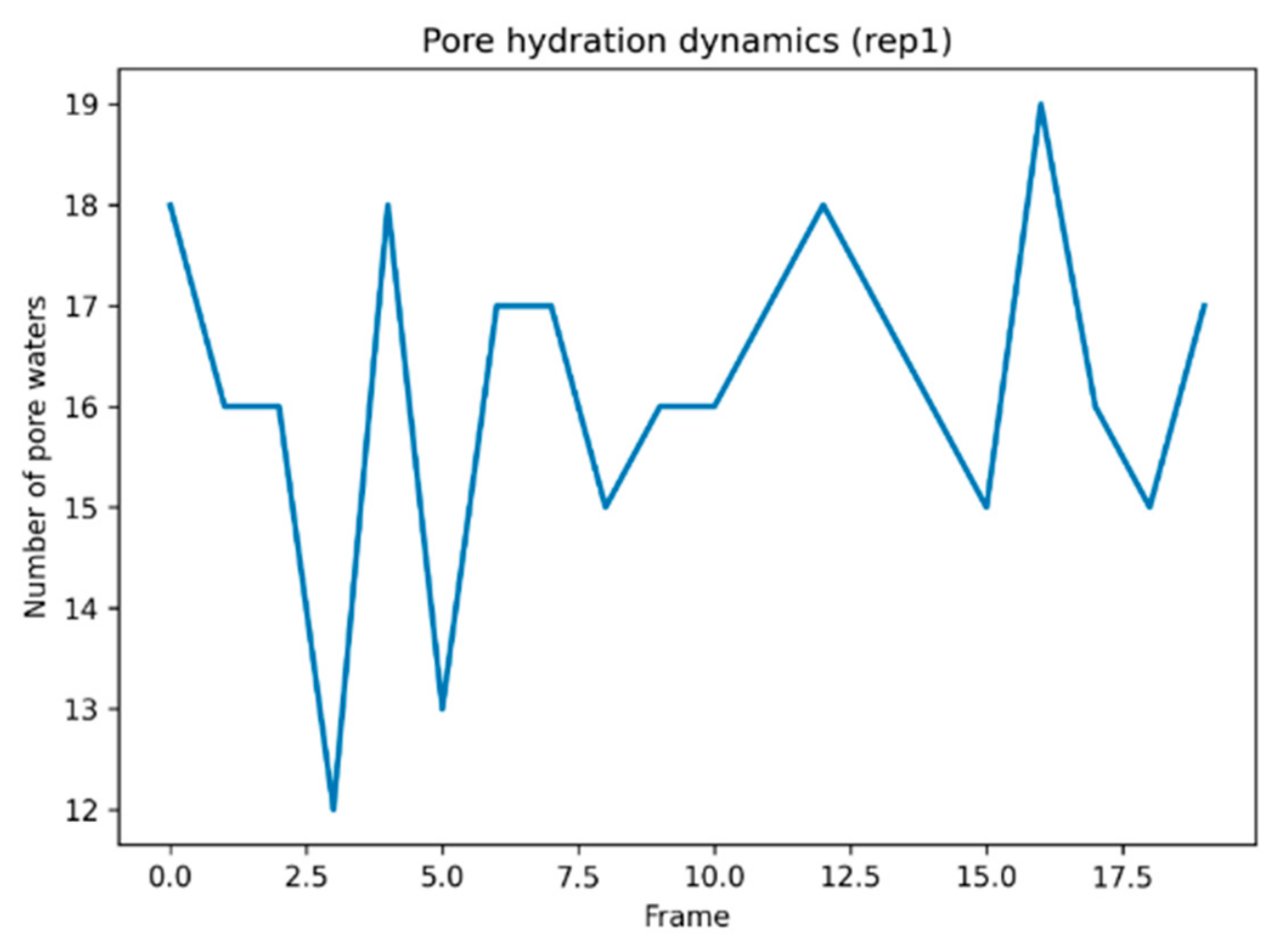
The resulting time series Nwater(t) was used to quantify hydration fluctuations and identify fluctuations in the pore hydration environment. Summary statistics (mean, minimum, and maximum hydration) were computed over the trajectory, and the full time series was visualized as a continuous trace (Figure 2).
2.4. Sodium Ion Coordination Analysis
Sodium ions were identified by selecting atoms with residue name NA. For each Na
+ ion present within the pore microenvironment, coordination numbers were computed by counting neighboring oxygen atoms within a cutoff distance
rc:
where
j runs over oxygen atoms from:
The cutoff distance was set to
rc = 3.2 Å, consistent with the first coordination shell of Na
+ observed in aqueous and protein environments. Coordination numbers were accumulated across all frames and all Na
+ ions sampled in the pore, yielding a distribution of coordination motifs (Figure 3). To verify that the geometric selection region corresponded to the central pore environment, the analysis cylinder was visualized relative to the Nav1.7 structure (
Figure S2). The cylindrical region (radius = 4 Å, height = 10 Å) was centered within the channel cavity and aligned with the simulation box
z-axis. This definition provided a reproducible geometric framework for quantifying pore hydration and ion coordination while minimizing contributions from bulk solvent.
2.5. Microstate Classification and Population Analysis
Na
+ “microstates” were defined as discrete inner-shell coordination environments based on the chemical identity of oxygen ligands within the first coordination shell of the ion. For each Na
+ ion located inside the cylindrical pore microenvironment (
Section 2), we counted oxygen atoms within a cutoff distance
rc = 3.2 Å (
Section 4) and partitioned these ligands into water-derived oxygens (
Nwat) and protein-derived oxygens (
Nprot). Oxygen atoms were assigned as water oxygens if they belonged to water molecules (residue label HOH in the provided topology) and as protein oxygens otherwise (backbone or side-chain oxygens).
Each Na+ observation (ion, frame) was classified into one of three coordination microstates:
W (water-only): Nprot = 0 and Nwat ≥ 1.
PW (mixed protein–water): Nprot ≥ 1 and Nwat ≥ 1.
P (protein-only): Nwat = 0 and Nprot ≥ 1.
The population fraction
Pk of each microstate
k ∈ {W, PW, P} was computed as
where
Nk is the number of Na
+ observations assigned to class
k and
Nobs is the total number of Na
+-in-pore observations across all analyzed frames.
Distributions of
Nwat and
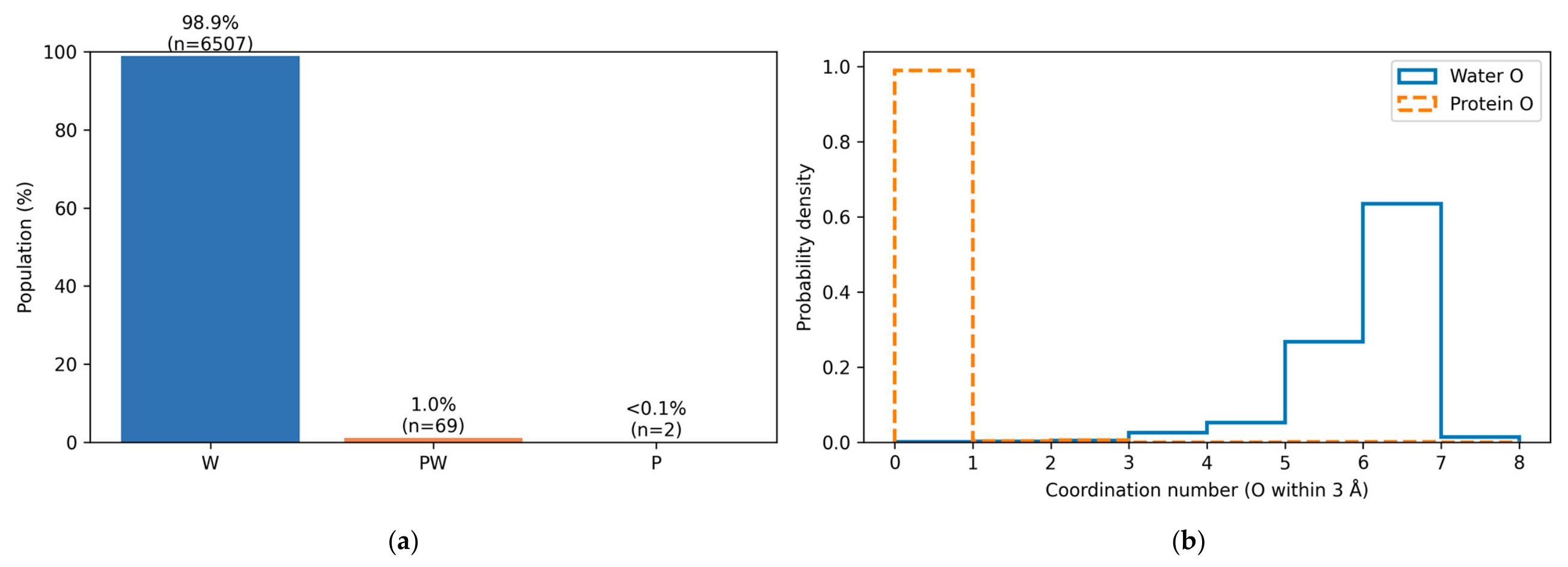
Nprot, along with microstate populations, were visualized in Figure 4. Pore hydration
Npore(
t) (
Section 3) was retained as contextual information to describe the solvent environment in which each Na
+ coordination microstate occurred, but it was not used as the primary microstate label in this classification.
2.6. Radial Distribution Function Analysis
To provide a structural justification for the Na–O coordination cutoff used in the microstate analysis, a radial distribution function (RDF) was computed between sodium ions and water oxygen atoms using MDAnalysis. The RDF was evaluated over the molecular dynamics trajectory using a distance range of 0–6 Å. The first minimum of the RDF was used as an estimate of the boundary of the first sodium coordination shell.
All molecular dynamics trajectory analyses were performed using MDAnalysis v2.9.0, an open-source Python library for the analysis of molecular simulation data [
27]. Numerical operations were carried out using NumPy v1.26, and data visualization was performed using Matplotlib v3.8 [
28,
29]. All scripts were executed using Python v3.12 on a Windows-based workstation. Quantum electronic structure calculations were formulated in second-quantized form using standard quantum chemistry Hamiltonians and evaluated using a Variational Quantum Eigensolver (VQE) framework implemented with open-source quantum software libraries [
23,
24]. Classical optimization routines were employed to minimize the VQE energy expectation values. Molecular structures were visualized and analyzed using UCSF Chimera [
30].
3. Results
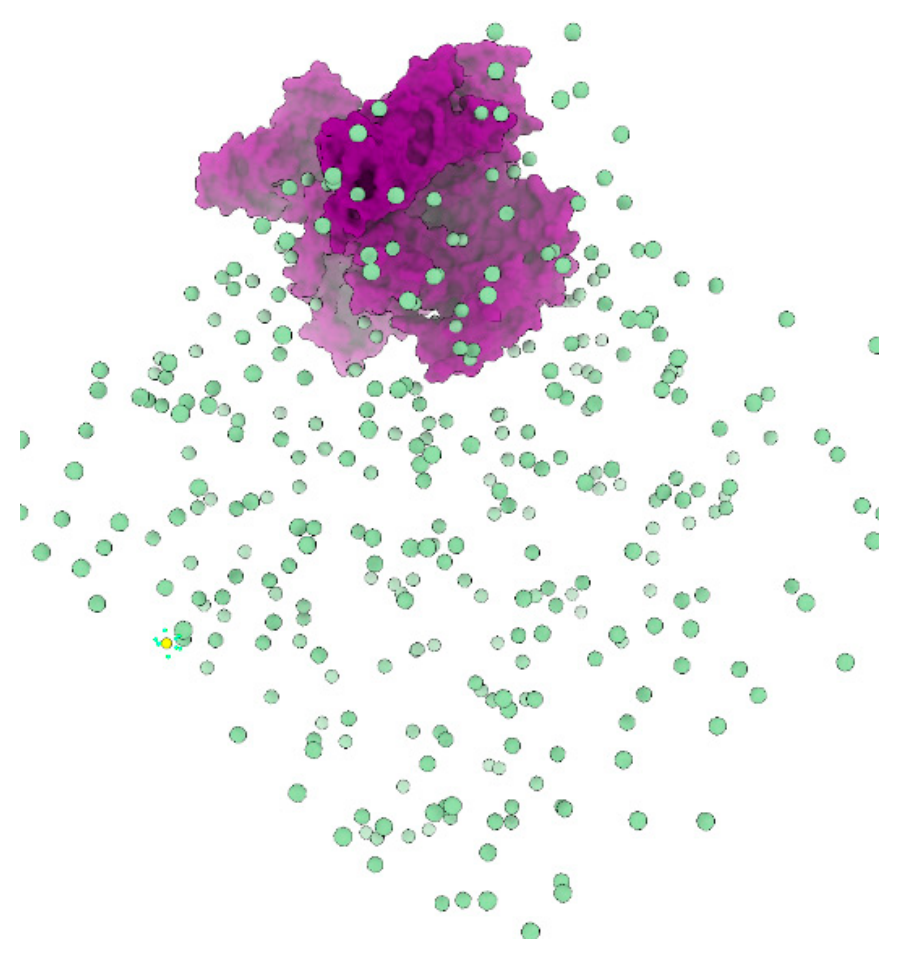
Figure 1 presents a representative molecular dynamics snapshot of a Na
+ ion near the Nav1.7 pore surface, together with nearby water molecules (shown in yellow color surrounded by green color) and the surrounding protein geometry. The image provides structural context for the coordination analyses by illustrating the confined local environment in which hydration and ion-protein contacts are evaluated. Although the system remains fully solvated, only a subset of nearby waters contributes directly to the first coordination shell, emphasizing that local Na
+ hydration is structured rather than spatially uniform. The configuration also illustrates how proximity to the protein surface can distort otherwise bulk-like hydration geometry and create the possibility of transient protein-associated coordination states.
Although
Figure 1 depicts a single configuration, it serves as a structural archetype for recurrent hydration–coordination environments sampled across the trajectory and provides an intuitive basis for the quantitative analyses that follow. Although no complete dewetting transitions are observed within this time window, the pore samples a heterogeneous ensemble of hydration states, motivating coordination-microstate descriptors rather than representation by a single static configuration. These structurally distinct local environments form the starting point for downstream classification and snapshot selection, and they provide a principled rationale for targeted quantum refinement, where small changes in ligand identity and geometry can plausibly alter electronic-structure-sensitive energetics beyond the resolution of fixed-charge MD.
Figure 2 shows the time evolution of pore hydration, defined as the number of water molecules within the predefined cylindrical pore microenvironment. Across the analyzed 2 ns window, pore hydration fluctuates between approximately 12 and 19 water molecules, with a mean value of about 16, indicating that the pore remains persistently hydrated throughout the sampled trajectory.
These fluctuations occur on sub-nanosecond timescales and reflect continuous exchange between pore-resident and bulk solvent waters. No complete dewetting events were observed during this interval. Thus, the pore samples a heterogeneous but consistently solvent-accessible environment, providing an appropriate context for analyzing Na
+ coordination under hydrated confinement rather than under dewetting or permeation-transition conditions. While
Figure 2 characterizes temporal fluctuations in the total number of water molecules within the pore, it does not distinguish whether these waters directly coordinate Na
+ ions or simply occupy nearby volume.
Figure 3 resolves this ambiguity by explicitly decomposing Na
+ coordination into protein- and water-derived contributions.
To resolve the chemical identity of the Na
+ inner-shell environment, the coordination number of each Na
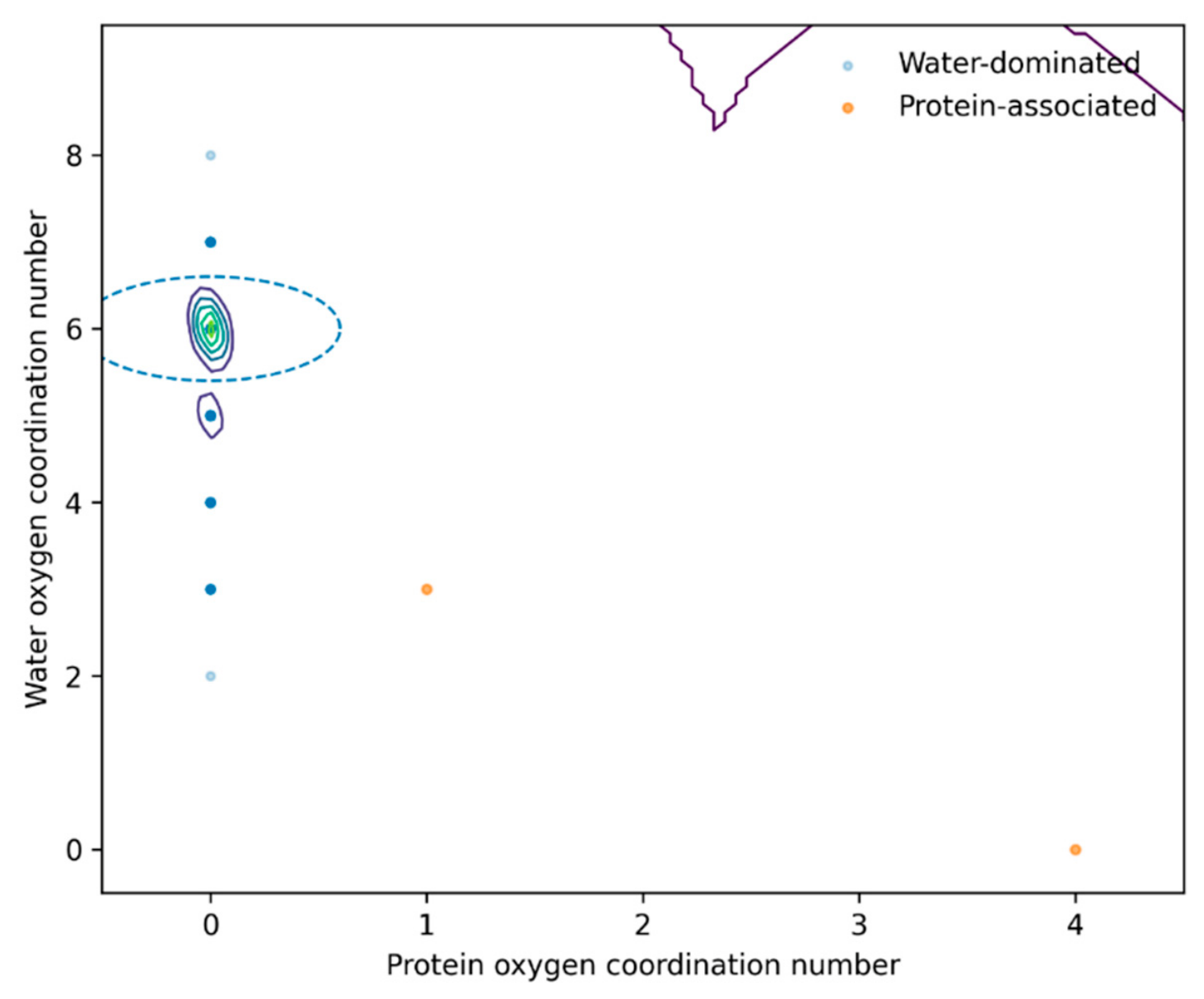
+ ion was decomposed into contributions from water oxygens and protein oxygens using a 3.2 Å Na–O cutoff. The resulting two-dimensional coordination fingerprint is shown in
Figure 3. Most observations cluster near zero protein oxygen contacts and approximately five to six water oxygen ligands, consistent with predominantly water-coordinated, bulk-like hydration. In addition to this dominant population,
Figure 3 reveals a distinct subpopulation of mixed coordination states in which Na
+ simultaneously interacts with both water and protein oxygen atoms. These PW configurations exhibit reduced water coordination relative to fully hydrated states and indicate transient partial dehydration accompanied by direct protein contact. Although they occur less frequently than water-only states, they are clearly resolved from the dominant cluster and recur across the analyzed ensemble. These results show that Na
+ coordination in the pore is not adequately described by hydration number alone. Configurations with similar total coordination counts may still differ chemically according to ligand identity, making a discrete microstate classification more informative than scalar hydration descriptors alone.
Based on ligand identity in the Na
+ inner shell, each observation was classified into one of three coordination microstates: water-only (W), mixed protein-water (PW), and protein-only (P).
Figure 4a shows that W states dominate the analyzed ensemble, whereas PW states occur as a smaller but distinct subpopulation, and P states are negligible within the sampled window. This distribution is consistent with a hydrated pore that nevertheless permits intermittent direct protein coordination.
Figure 4b complements this classification by showing the coordination number distributions for water and protein oxygens. Water coordination peaks around five to six oxygen atoms, consistent with a stable hydrated Na
+ environment, whereas protein coordination events are sparse and generally low in count. Together, these data support a model in which the Nav1.7 pore primarily maintains Na
+ in a water-rich coordination environment while still sampling rarer, chemically distinct protein-contact states.
The Na–O radial distribution function exhibits a pronounced first-shell peak centered near 2.4–2.5 Å, followed by a well-defined minimum at approximately 3.29 Å (
Figure S3). This minimum corresponds to the boundary between the first hydration shell and more distant solvent molecules. Accordingly, a coordination cutoff of 3.2 Å was employed throughout the microstate analysis, consistent with the observed hydration-shell structure.
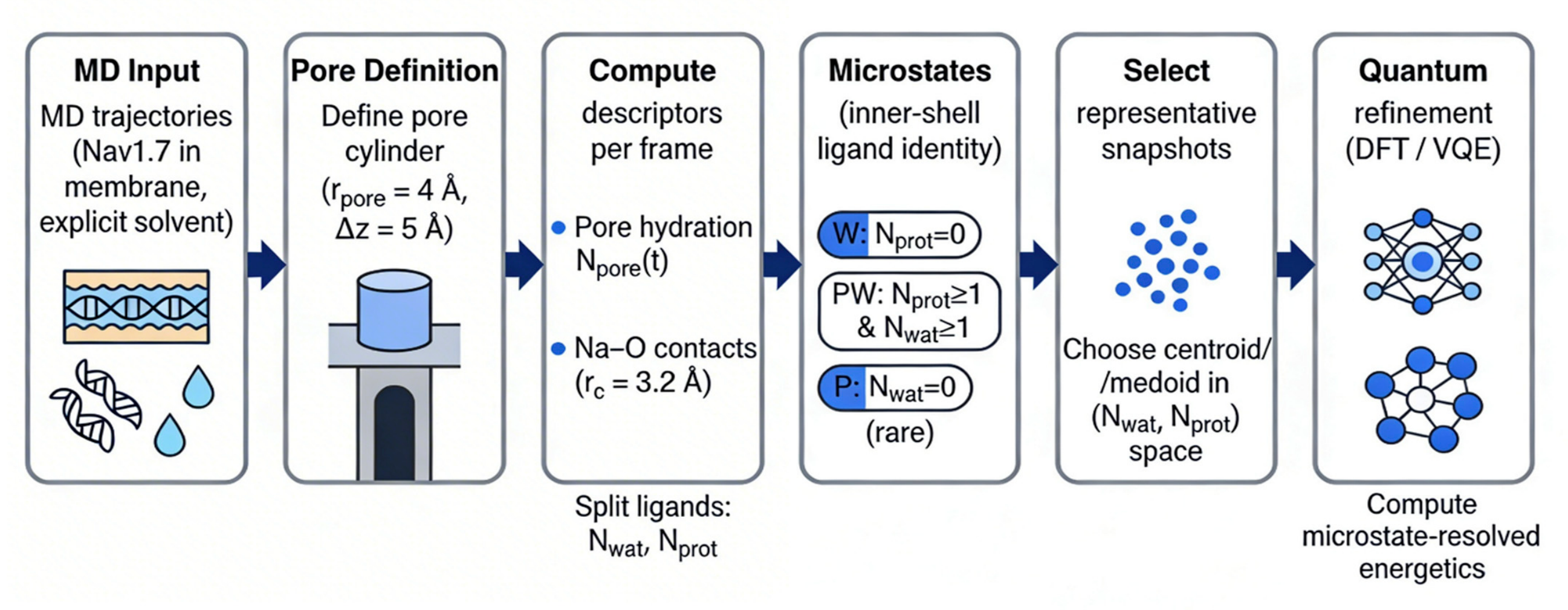
Figure 5 summarizes the full analysis pipeline established in this study, linking classical MD sampling to quantum-ready structural selection. Starting from explicit-solvent Nav1.7 trajectories, the workflow defines a common pore microenvironment, computes pore hydration and Na
+ coordination descriptors, classifies Na
+ observations into W/PW/P microstates, and selects representative snapshots for downstream higher-level refinement. The central result is therefore methodological: a transparent and reproducible route from heterogeneous MD ensembles to a compact set of structurally distinct coordination motifs. By prioritizing ligand identity rather than hydration count alone, the workflow captures the chemically meaningful distinction between dominant water-coordinated states and rarer protein-contact environments that may warrant quantum mechanical treatment.
4. Discussion
This study presents a reproducible workflow for identifying and classifying Na+ hydration–coordination microstates within the Nav1.7 pore from explicit-solvent molecular dynamics simulations. By combining a geometrically defined pore region with ligand-identity-based classification of the Na+ first coordination shell, the approach converts molecular dynamics trajectories into a compact set of chemically interpretable configurations suitable for subsequent electronic-structure calculations. The primary objective of the work is therefore methodological: to establish a transparent procedure for selecting representative ion coordination environments that can serve as starting points for density functional theory (DFT), QM/MM, or quantum-computing-based investigations.
The simulations were initiated from the cryo-EM structure 7XMF after extraction of chain A and removal of non-polymer entities, including the co-crystallized ligand and crystallographic water molecules. This preparation generated a ligand-free Nav1.7 model that was subsequently solvated and equilibrated in an explicit solvent environment. Because 7XMF represents a ligand-bound experimental structure, removal of these components may alter local pore geometry and hydration patterns relative to the original cryo-EM model. Consequently, the present simulations should be interpreted as describing sodium hydration and coordination within a solvated ligand-free structural ensemble rather than establishing a physiologically validated conducting state of Nav1.7. Additional simulations starting from alternative channel conformations and functional validation studies will be required to determine the relationship between the observed coordination environments and ion permeation under physiological conditions. The coordination analysis revealed that Na+ ions occupy multiple chemically distinct local environments despite the overall hydrated character of the pore region. The dominant population corresponded to fully hydrated (W) configurations, whereas a smaller fraction of observations exhibited mixed protein–water coordination (PW). Protein-only coordination states (P) were rare or absent under the present simulation conditions. These results indicate that hydration alone does not fully describe the chemical environment experienced by ions in confined protein pores. Instead, the identity of coordinating ligands provides additional mechanistic information that may be relevant for understanding ion stabilization, transient pore interactions, and the structural determinants of ion selectivity.
An important feature of the workflow is that representative structures are selected using a reproducible and objective procedure rather than manual visual inspection. Representative snapshots were identified from the classified coordination-state populations using defined selection criteria and are provided as supporting data together with the associated analysis scripts and processed datasets. This reproducibility is essential because the selected structures are intended for future electronic-structure calculations, where subtle differences in coordination geometry can significantly influence computed energies, charge distributions, and polarization effects. The present framework is intentionally simple and portable. The analysis relies on a small set of transparent descriptors—ion location within the pore region, protein coordination number, water coordination number, and coordination-state identity—and therefore can be readily applied to other ion channels or pore-forming proteins. Such a reduction in large molecular dynamics datasets into chemically meaningful representative microstates may facilitate integration of classical simulations with higher-level quantum methods while maintaining full traceability between the original trajectory and the selected structures.
Several limitations should be acknowledged. First, the analyzed trajectory is relatively short and was sampled using a limited set of representative frames. Consequently, the reported W/PW/P populations should not be interpreted as converged equilibrium probabilities. Rather, they represent the distribution observed within the analyzed dataset and serve primarily to demonstrate the classification workflow. Second, the pore region was approximated using a fixed cylindrical geometric definition aligned with the channel axis. Although this approach provides a reproducible criterion for ion selection, alternative pore definitions could yield quantitative differences in microstate counts. To address this issue, the pore geometry and sensitivity of the selection parameters are explicitly documented in the
Supplementary Materials. Third, the coordination-state definitions employ fixed distance cutoffs that discretize an inherently continuous coordination landscape. While this improves interpretability and reproducibility, alternative clustering approaches may provide a more detailed description of coordination heterogeneity.
Future work will focus on extending the simulations to longer timescales, incorporating multiple independent replicas, and exploring additional channel conformations to assess the robustness of the identified coordination motifs. The extracted representative microstates provide a practical foundation for subsequent DFT, QM/MM, and variational quantum eigensolver (VQE) calculations aimed at determining whether protein-contact configurations exhibit distinct electronic or energetic properties relative to fully hydrated states. Such studies will help establish where classical force fields remain sufficient and where explicit quantum treatment may be required for accurate characterization of ion-channel microenvironments.
5. Conclusions
This study presents a reproducible workflow for identifying and selecting Na+ hydration–coordination microstates from explicit-solvent molecular dynamics simulations of the Nav1.7 sodium channel. By combining a transparent geometric pore definition with ligand-identity-based classification of the Na+ first coordination shell, the workflow transforms molecular dynamics trajectories into a compact set of chemically interpretable and quantum-ready representative structures. Application of the workflow to a solvated Nav1.7 structural ensemble revealed that sodium ions occupy distinct local coordination environments despite the overall hydrated character of the pore region. The observed predominance of water-coordinated states, together with the occurrence of mixed protein–water coordination environments, demonstrates that ion microenvironments cannot be fully described by hydration counts alone and are more appropriately represented as discrete coordination motifs. The primary contribution of this work is methodological rather than mechanistic. The study establishes a reproducible framework for reducing molecular dynamics ensembles to representative ion-coordination microstates suitable for subsequent electronic-structure calculations. The workflow is transparent, transferable, and readily applicable to other ion channels and pore-forming proteins. By providing representative structures, analysis scripts, and processed datasets, the approach facilitates reproducible integration of classical molecular dynamics simulations with higher-level methods such as DFT, QM/MM, and emerging quantum-computing-based techniques. Future studies employing longer simulations, multiple channel conformations, and direct quantum calculations on the selected microstates will be necessary to evaluate the energetic and electronic consequences of distinct coordination environments and to determine their relevance to ion permeation, selectivity, and drug-channel interactions. More broadly, the present work provides a practical bridge between atomistic molecular dynamics sampling and quantum-level characterization of biologically important ion-channel microenvironments.