Article

Association of ACE I/D and TNF-α-308 Polymorphisms with COVID-19 Severity in a Mexican Population


by
Mayela del Ángel-Martínez
1,
Mauricio Salinas-Santander
1,
Michelle Giovanna Santoyo-Suárez
1,
Lesly González-Flores
1,
Omar Reyes-Torres
1 and
Antonio Morlett-Chávez
1,2,*
1
Laboratory of Molecular Biology, Health Research Department, Medicine School, Autonomous University of Coahuila, Saltillo 25000, Coahuila, Mexico
2
Clinical Laboratory Department, General Hospital No. 2, Mexican Institute of Social Security, Saltillo 25017, Coahuila, Mexico
*
Author to whom correspondence should be addressed.
BioChem 2026, 6(2), 11; https://doi.org/10.3390/biochem6020011
Submission received: 16 January 2026 / Revised: 6 May 2026 / Accepted: 11 May 2026 / Published: 18 May 2026

Abstract

Background: COVID-19 severity shows marked interindividual variability, suggesting a role for host genetic factors. Polymorphisms in genes involved in the renin–angiotensin system and inflammatory response, such as the angiotensin-converting enzyme (ACE) and the tumor necrosis factor-alpha (TNF-α), have been proposed as potential modulators of disease severity. Objectives: To evaluate the association between the ACE I/D (rs4646994) and TNF-α-308 G/A (rs1800629) polymorphisms and COVID-19 severity in a Mexican population. Methods: A total of 235 individuals with RT-PCR–confirmed SARS-CoV-2 infection were included. Patients were classified as hospitalized (severe, n = 155) or non-hospitalized (asymptomatic–mild, n = 80). Genotyping was performed by PCR–RFLP. Genotype distributions were analyzed using χ2 tests under dominant and recessive genetic models, and odds ratios (ORs) with 95% confidence intervals (CIs) were calculated. Results: The ACE I/D polymorphism showed a significant association with COVID-19 severity. Carriers of the I allele (ID + II) had a higher risk of hospitalization compared with DD homozygotes (OR = 2.78, 95% CI: 1.53–5.06, p = 0.001). After adjustment for sex, the association remained significant (adjusted OR = 2.55, 95% CI: 1.38–4.70, p = 0.003). Sex-stratified analysis revealed that this association was significant only in male patients. The DD genotype was more frequent among non-hospitalized individuals, suggesting a potential protective effect in this population. No significant association was observed between the TNF-α-308 G/A polymorphism. Conclusions: The ACE I/D polymorphism is associated with COVID-19 severity in a Mexican population, with a stronger association observed in males. These findings highlight the potential role of host genetic background and sex-specific effects in COVID-19 outcomes.

1. Introduction

Since late 2019, coronavirus disease 2019 (COVID-19), caused by the Severe Acute Respiratory Syndrome Coronavirus-2 (SARS-CoV-2), has posed a major global public health challenge [1,2]. Although most infected individuals developed mild to moderate symptoms, a significant proportion progressed to severe disease characterized by respiratory failure, systemic inflammation, coagulopathy, and increased mortality [3,4,5,6,7]. The clinical course of COVID-19 is highly heterogeneous and influenced by multiple factors, including advanced age, male sex, obesity, smoking, and comorbidities such as diabetes mellitus, hypertension, cardiovascular disease, and cancer [5,8,9]. Beyond these well-established risk factors, host genetic variability has emerged as a key determinant of susceptibility and disease severity [9,10,11,12].
Several studies have reported associations between genetic polymorphisms and COVID-19 severity; in these investigations, the genetic variants influence the progression and outcome of the subjects with SARS-CoV-2 infection [10,13,14]. Genome-wide association studies (GWAS) and candidate gene approaches have identified several genetic associations with severe COVID-19, including the 3p21.31 locus, with population-specific effects [10,11,15]. Among the most extensively studied genes is the ACE pathway, which plays a central role in cardiovascular homeostasis and inflammatory regulation [13,16,17]. ACE-1 catalyzes the conversion of angiotensin I to angiotensin II, a potent vasoconstrictor, whereas ACE-2 counterbalances this effect by converting angiotensin II to angiotensin [17,18,19]. Importantly, ACE-2 also serves as the primary cellular receptor for SARS-CoV-2, facilitating viral entry into host cells [18,19,20]. ACE-2 is expressed in multiple tissues, including lungs, intestine, and heart, and its dysregulation during infection contributes to endothelial dysfunction, inflammation, and thrombotic complications observed in severe COVID-19 cases [19,21]. In parallel, excessive inflammatory responses play a critical role in COVID-19 [7,22,23]. Severe cases are often characterized by a cytokine storm, with elevated levels of pro-inflammatory mediators such as TNF-α and interleukins (IL-1β, IL-6, IL-8) [23,24,25].
Polymorphisms in these genes have been associated with several diseases, like diabetes and hypertension, and now with the progression and severity of COVID-19 disease [21,22]. Variants within the ACE gene, especially the insertion/deletion (I/D) polymorphism (rs4646994), are associated with altered ACE activity and have been implicated in the development of cardiovascular and metabolic diseases [18,21,26,27]. Several studies have suggested a relationship between the ACE I/D polymorphism and COVID-19 severity or mortality; however, results remain inconsistent across populations [26,27]. On the other hand, TNF-α-308 G/A polymorphism (rs1800629) has been associated with increased transcriptional activity of the TNF-α gene and with susceptibility to inflammatory, metabolic, and infectious diseases [28,29]. Recent evidence suggests that this polymorphism may influence COVID-19 severity by modulating the host’s inflammatory response. Despite growing evidence linking ACE and TNF-α polymorphisms to COVID-19 outcomes, data regarding their combined impact in Latin American populations, particularly in Mexico, remain scarce. Recent studies have highlighted the importance of evaluating genetic susceptibility in diverse and admixed populations to understand population-specific effects [30]. Therefore, this study aimed to evaluate the association between the ACE I/D (rs4646994) and TNF-α-308 G/A (rs1800629) polymorphisms and COVID-19 severity in a Mexican population. Understanding the contribution of host genetic factors in admixed populations may provide valuable insights into the biological mechanisms underlying COVID-19 severity.

2. Materials and Methods

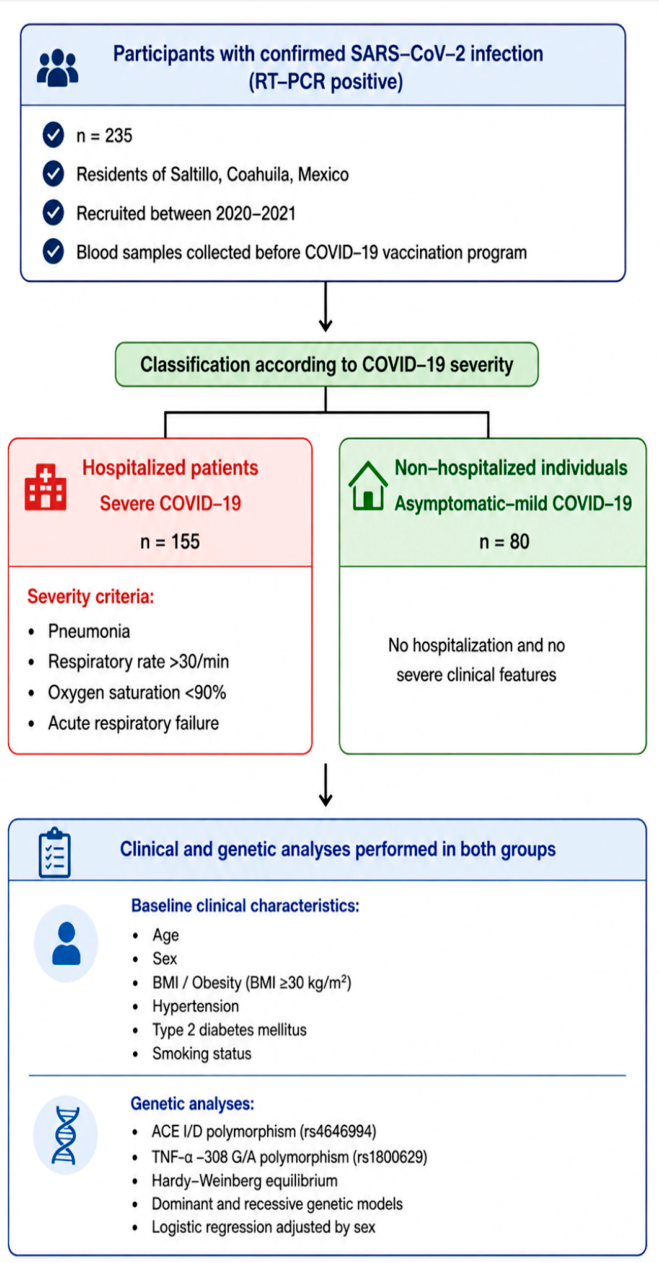
A total of 235 subjects with confirmed SARS-CoV-2 infection by reverse transcription-polymerase chain reaction (RT-PCR) were included in the study. Participants were recruited between 2020 and 2021 and were all native residents of Saltillo, Coahuila, Mexico. The study was divided into two groups according to disease severity. The severe group consisted of 155 hospitalized patients admitted to the COVID-19 unit at Hospital No. 2 of the Instituto Mexicano del Seguro Social (IMSS). Body mass index (BMI) was calculated as weight in kilograms divided by height in meters squared (kg/m2), and obesity was defined as BMI ≥ 30 kg/m2. Hypertension was defined according to the American Heart Association (AHA) criteria as systolic blood pressure ≥ 130 mmHg and/or diastolic blood pressure ≥ 80 mmHg, or current use of antihypertensive medication. Type 2 diabetes mellitus was defined according to the American Diabetes Association (ADA) criteria, including fasting plasma glucose ≥ 126 mg/dL, HbA1c ≥ 6.5%, or use of antidiabetic medication. Severity classification was based on the Mexican Clinical Guide for Treatment of COVID-19. It included the presence of pneumonia, respiratory rate > 30 breaths per minute, oxygen saturation below than 90%, and/or acute respiratory failure, among other criteria [31]. The non-severe group consisted of 80 non-hospitalized individuals with asymptomatic or mild COVID-19 who did not exhibit any of these clinical features (Figure 1). All participants provided written informed consent to enrollment. Blood samples were collected before the initiation of the national COVID-19 vaccination program; therefore, none of the participants had received SARS-CoV-2 vaccination at the time of sampling. The study protocol was approved by the Research Ethics Committee of the General Hospital Saltillo (approval number 17/2023) and conducted in accordance with the ethical principles of the Declaration of Helsinki.

2.1. DNA Extraction and Genotyping

Genomic DNA was extracted from peripheral blood samples using the phenol-chloroform method and precipitated with ethanol. DNA pellets were resuspended in sterile distilled water at a final concentration of 100 ng/µL and stored at −20 °C until analysis. Genotyping of the ACE insertion/deletion (I/D) polymorphisms (rs4646994) was performed using polymerase chain reaction-restriction fragment length polymorphism (PCR-RFLP) analysis, following a previously described protocol with minor modifications [32]. PCR amplification was carried out in a final reaction volume of 25 µL containing 500 ng of genomic DNA, 0.2 mM dNTPs, 2 mM MgCl2, 0.5 µM primers (IDT, Coralville, IA, USA), 2.5 U Taq DNA Polymerase (Invitrogen TM, São Paulo, Brazil), and reaction buffer. The primer sequences were as follows: forward primers 5′-CTGGAGACCACTCCCATCCTTTCT-3′ and reverse 5′-ATCTGACGAATGTGATGGCCAC-3′. PCR conditions consisted of 35 cycles at 94 °C for 1 min, 58 °C for 1 min, and 72 °C for 1 min. PCR products were separated by electrophoresis on a 1.5% agarose gel stained with ethidium bromide and visualized under ultraviolet light using UVP 2UV High-Performance Transilluminator (Upland, CA, USA) coupled to a KODAK Gel Logic 112/212 Imaging Systems using the Carestream Molecular Imaging software (version 5.3.4) [33].
Genotyping of the TNF-α-308 G/A polymorphism (rs1800629) was performed by PCR-RFLP as previously described with modifications [34]. PCR reaction (25 µL) contained 500 ng of genomic DNA, 0.2 mM dNTPs, 1.5 mM MgCl2, 0.5 µM of each primer (IDT, Coralville, IA, USA), and 2.5 U Taq DNA Polymerase (Invitrogen TM, Brazil). Primers sequences were forward primers 5′-GGGACACACAAGCATCAAGG-3′ and reverse 5′-AATAGGTTTTGAGGGCCATG-3′. Amplification conditions consisted of 35 cycles at 94 °C for 30 s, 61 °C for 30 s, and 72 °C for 30 s. Approximately 0.5 µg of PCR product was digested overnight with NcoI (New England Biolabs, Ipswich, MA, USA) at 37 °C. Digested fragments were separated on 2.5% agarose gel electrophoresis, stained with ethidium bromide, and visualized under ultraviolet light using a UVP 2UV High-Performance Transilluminator (Upland, CA, USA) coupled to a KODAK Gel Logic 112/212 Imaging Systems using the Carestream Molecular Imaging software [35].

2.2. Statistical Analysis

Continuous variables are presented as mean ± standard deviation (SD) and were compared between hospitalized and non-hospitalized groups using Student’s t-test. Categorical variables are presented as counts and percentages and were compared using the chi-square (χ2) test when expected cell frequencies were ≥5. Fisher’s exact test was applied when expected frequencies were <5 or when sample sizes were small. Genotype distributions were tested for Hardy–Weinberg equilibrium (HWE) in the non-hospitalized group for both polymorphisms using the χ2 test. Genotype models were coded as follows: dominant model (ID + II vs. DD) and recessive model (II vs. ID + DD). Dominant and recessive genetic models were used to evaluate potential inheritance patterns of the polymorphisms. The dominant model assesses the effect of carrying at least one variant allele, whereas the recessive model evaluates the effect of homozygosity for the variant allele. Allelic frequencies between groups were also compared using the χ2 test, and odds ratios (ORs) with 95% confidence intervals (CIs) were calculated from 2 × 2 contingency tables. A p-value < 0.05 was considered statistically significant. A binary logistic regression analysis was performed to evaluate the independent association between the ACE I/D polymorphism and COVID-19 severity. Hospitalization status (hospitalized vs. non-hospitalized) was used as the dependent variable, and sex was included as a covariate in the model. Additional clinical variables, including age, obesity, hypertension, and diabetes, were not included in the model due to the limited sample size and the high prevalence of these comorbidities in both study groups.

3. Results

Demographic analysis revealed a higher proportion of males in the hospitalized group compared to the non-hospitalized group (63.9% vs. 41.3%). Male sex was significantly associated with an increased risk of hospitalization (OR = 2.51, 95% CI: 1.43–4.41, p = 0.001) (Table 1). Hypertension was significantly more frequent among hospitalized patients (83.2% vs. 56.3%, p < 0.001), whereas no significant differences were observed for age or diabetes. Genotype distributions for ACE deviated from HWE in the non-hospitalized group (p = 0.011), whereas TNF-α was in equilibrium (p = 0.82) (Table 2).
Regarding the ACE genotype, the I/D genotype was the most frequent in the overall population (104/235, 44.3%). In the hospitalized group, the I/D genotype was the most prevalent, followed by the I/I genotype, whereas in the non-hospitalized group, the D/D genotype was the most frequent (Table 2). A significant difference in genotype distribution between hospitalized and non-hospitalized subjects was observed (χ2 = 11.65, p = 0.003) (Table 3). Under a dominant genetic model, individuals carrying at least one I allele (ID + II) showed a significantly increased risk of hospitalization compared with those with the DD genotype (OR = 2.78, 95% CI: 1.53–5.06, p = 0.001). Under the recessive model (II vs. ID + DD), the association was weaker and did not reach statistical significance (OR = 1.39, 95% CI: 0.75–2.57, p = 0.29) (Table 4). Logistic regression analysis adjusted for sex confirmed the association between the ACE I/D polymorphism and hospitalization (adjusted OR = 2.55, 95% CI: 1.38–4.70, p = 0.003) (Table 4).
Sex-stratified analysis revealed that male patients primarily drove the association between ACE genotypes and disease severity. Among males, the dominant model (ID + II vs. DD), male carriers of the I allele showed a significantly increased risk of hospitalization (OR = 3.96, 95% CI: 1.63–9.58, p = 0.002). No significant associations were observed among female participants under any genetic model (Table 5). In the hospitalized group, males represented 63.87% of cases, whereas females accounted for 36.12%.
For the TNF-α-308 G/A polymorphism (rs1800629), genotype distribution in the non-hospitalized group was consistent with HWE (p = 0.82) (Table 1). The GG genotype was the most frequent in both hospitalized (91.6%) and non-hospitalized (95%) groups, while the AA genotype was not observed. Although a higher frequency of the AG genotype was observed among hospitalized patients (8.4%) compared to non-hospitalized individuals (5%), this difference was not statistically significant (OR = 1.74, 95% CI: 0.55–5.52, p = 0.38) (Table 6).

4. Discussion

In this study, we investigated the association between the ACE I/D (rs4646994) and TNF-α-308 G/A (rs1800629) polymorphisms and COVID-19 severity in a Mexican population. Our findings indicate that carriers of the I allele of the ACE polymorphism (ID + II genotypes) had a significantly higher likelihood of hospitalization compared with individuals with the DD genotype. The DD genotype was more frequent among non-hospitalized individuals in our cohort, suggesting a potential protective effect. This observation contrasts with several European studies reporting an association between the DD genotype and increased severity of COVID-19. These findings suggest that the relationship between ACE polymorphism and COVID-19 severity may vary across populations, particularly in genetically admixed populations such as the Mexican population. COVID-19 has resulted in substantial morbidity and mortality worldwide. According to the World Health Organization (WHO), millions of cases and deaths have been reported globally, underscoring the need to understand the factors that contribute to disease severity [1]. While several clinical risk factors, including age, sex, and comorbidities, have been well established, increasing evidence supports a role for host genetic variability in modulating disease outcomes. These findings are consistent with recent large-scale genetic studies highlighting the contribution of host genetic factors to COVID-19 severity [11,12]. In this context, genetic polymorphisms in pathways involved in the renin–angiotensin system and inflammatory response have been proposed as potential contributors to interindividual variability in COVID-19 severity.
The ACE I/D polymorphism has been widely studied due to its functional relevance in the renin–angiotensin system. Variations in the ACE gene may influence circulating ACE levels, which in turn affect angiotensin II production and downstream inflammatory and vasoconstrictive pathways. During SARS-CoV-2 infection, dysregulation of this system has been associated with endothelial dysfunction, pulmonary inflammation, and progression to severe COVID-19. Therefore, genetic variation in ACE may contribute to interindividual differences in disease severity. This observation contrasts with several European studies reporting an association between the DD genotype and increased severity of COVID-19. The ACE I/D polymorphism influences circulating ACE levels, which may modulate angiotensin II activity and downstream inflammatory and vasoconstrictive pathways implicated in COVID-19 pathophysiology [28]. Dysregulation of this system has been associated with lung injury, endothelial dysfunction, and hyperinflammation, all of which are key features of severe COVID-19. Previous studies investigating the association between the ACE I/D polymorphism and coronavirus-related diseases have reported heterogeneous results. However, previous studies have reported no significant association between this polymorphism and susceptibility to SARS-CoV infection or the development of ARDS [32,35]. More recent studies on COVID-19 have also yielded inconsistent findings, with some reporting no association [36], while others, including meta-analyses in European and Asian populations, have suggested that the DD genotype is associated with increased disease severity [18,36,37,38]. The contrasting pattern observed in our study may reflect population-specific genetic backgrounds, differences in linkage disequilibrium patterns, or gene–environment interactions. This is particularly relevant in admixed populations such as the Mexican population, where genetic diversity may influence allele distribution and disease associations, as previously suggested [26,30,38,39,40]. Although deviation from HWE in the non-hospitalized group may raise concerns, several factors may explain this finding. Therefore, this finding does not necessarily invalidate the observed association but should be interpreted with caution. The relatively small sample size may contribute to random deviations. In addition, the Mexican population is characterized by a high degree of genetic admixture, which may lead to population stratification and departure from equilibrium expectations. Furthermore, deviation from HWE has been reported in association studies when a genetic variant is related to disease susceptibility or severity. Therefore, this finding does not necessarily invalidate the observed association but should be interpreted with caution, as deviations from HWE may occur in genetic association studies due to factors such as population stratification, sampling variation, or true disease association [41,42].
To further explore potential sex-related differences in genetic susceptibility, a sex-stratified analysis was performed. Sex-stratified analysis revealed that male patients primarily drove the association between the ACE polymorphism and COVID-19 severity. Male carriers of the I allele exhibited a significantly increased risk of hospitalization, whereas no significant associations were observed among female participants. These findings are consistent with previous reports indicating that males are at higher risk of severe COVID-19 outcomes [43,44]. Furthermore, the association between the ACE I/D polymorphism and disease severity remained significant in males after sex stratification, whereas no significant associations were observed among females. These results are consistent with previous studies reporting sex-specific genetic effects and suggest that hormonal, immunological, or behavioral factors may modulate the impact of ACE polymorphisms on COVID-19 outcomes. Although ACE I/D polymorphisms have been extensively studied in relation to hypertension in Mexican populations, no consistent associations have been established, underscoring the complexity of ACE-related phenotypes [33].
The inflammatory response plays a central role in COVID-19 severity, particularly through the development of a cytokine storm in critically ill patients [24]. Elevated levels of pro-inflammatory cytokines, including TNF-α, have been associated with poor prognosis [38]. In the present study, the TNF-α-308 G/A (rs1800629) polymorphism showed genotype frequencies consistent with those previously reported in Mexican populations [35,38]. The GG genotype was predominant in both hospitalized and non-hospitalized groups, and the AA genotype was not detected. A non-significant association between TNF-α-308 G/A polymorphism and COVID-19 severity was observed. Although a slightly higher frequency of the AG genotypes was found among hospitalized patients, this difference did not reach statistical significance. Previous studies have suggested that carriers of the A allele may have a worse prognosis due to increased TNF-α expression [45]. However, the low frequency of the A allele and the absence of the AA genotype in our cohort may have limited the ability to detect such an association. Similar findings have been reported in studies comparing severe and asymptomatic or mildly symptomatic COVID-19 patients [46]. Rokni et al. demonstrated that the TNF-α A allele is associated with greater disease severity, particularly in AA homozygotes, whereas other cytokine-related polymorphisms were not significantly associated [47]. Taken together, our findings suggest that genetic variation in the ACE pathway may contribute to interindividual differences in COVID-19 severity, particularly among male patients.
Several limitations of this study should be acknowledged. First, the logistic regression analysis was limited to adjustment for sex, as this variable was significantly associated with hospitalization in our cohort. Additional clinical covariates, including age, smoking status, hypertension, diabetes, and obesity, were not included because the limited sample size and high prevalence of some comorbidities could compromise model stability and increase the risk of overfitting. Therefore, residual confounding cannot be excluded, and the observed associations should be interpreted with caution. Second, the relatively small sample size, particularly in the non-hospitalized group, may have reduced the statistical power to detect modest genetic effects, especially for low-frequency alleles such as TNF-α-308 A. In addition, subgroup analyses, particularly those stratified by sex, may have limited statistical power due to reduced sample sizes, as reflected by the relatively wide confidence intervals observed. Furthermore, the absence of a healthy control group precludes differentiation between genetic susceptibility to SARS-CoV-2 infection and determinants of disease severity. Future studies incorporating larger cohorts, more comprehensive clinical data, and fully adjusted multivariable models are needed to validate and extend these findings.

5. Conclusions

The ACE I/D polymorphism is associated with COVID-19 severity in a Mexican population, with a stronger association observed in males. In contrast, no significant association was identified for the TNF-α-308 G/A polymorphism. These findings support the role of host genetic factors in modulating disease severity and underscore the importance of considering sex-specific effects and population genetic background in COVID-19 research. Further studies with larger sample sizes, inclusion of healthy controls, and multivariable analyses are warranted to confirm these associations and to clarify their potential clinical implications.

Author Contributions

Conceptualization, A.M.-C. and M.S.-S.; methodology, M.d.Á.-M. and M.G.S.-S.; software, M.d.Á.-M.; validation, M.d.Á.-M., M.S.-S. and A.M.-C.; formal analysis, M.d.Á.-M.; investigation, M.d.Á.-M., M.G.S.-S., L.G.-F. and O.R.-T.; resources, A.M.-C.; data curation, M.d.Á.-M.; writing—original draft preparation, M.d.Á.-M.; writing—review and editing, A.M.-C. and M.S.-S.; visualization, M.d.Á.-M.; supervision, A.M.-C.; project administration, A.M.-C. All authors have read and agreed to the published version of the manuscript.

Funding

This research received no external funding.

Institutional Review Board Statement

The study protocol was approved by the Research Ethics Committee of the General Hospital of Saltillo, in compliance with NOM-012-SSA3-2012, governing research involving human subjects and human-derived samples (approval No. 17/2023).

Informed Consent Statement

All the patients provided written informed consent to participate in the study.

Data Availability Statement

The datasets analyzed during the current study are available from the corresponding author upon reasonable request.

Acknowledgments

The authors would like to thank all participants involved in this study. We thank the Octavio Pi-mentel (Universidad Autónoma de Coahuila (UAdeC)), and Luis Gutierrez (Research and Graduate Studies at UAdeC), and the highest house of studies in the state of Coahuila for their support.

Conflicts of Interest

The authors declare no conflicts of interest.

Abbreviations

ACEAngiotensin-converting enzyme
COVID-19Coronavirus disease 2019
HWEHardy–Weinberg equilibrium
OROdds ratio
CIConfidence interval
TNF-αTumor necrosis factor alpha
SNPSingle-nucleotide polymorphism

References

  1. World Health Organization. WHO Director-General’s Remarks at the Media Briefing on 2019-nCoV on 11 February 2020. 2020. Available online: https://www.who.int/news-room/speeches/item/who-director-general-s-remarks-at-the-media-briefing-on-2019-ncov-on-11-february-2020 (accessed on 11 May 2023).
  2. Lv, M.; Luo, X.; Estill, J.; Liu, Y.; Ren, M.; Wang, J.; Wang, Q.; Zhao, S.; Wang, X.; Yang, S.; et al. Coronavirus disease (COVID-19): A scoping review. Eurosurveillance 2020, 25, 2000125. [Google Scholar] [CrossRef]
  3. Park, S.E. Epidemiology, virology, and clinical features of severe acute respiratory syndrome coronavirus-2 (SARS-CoV-2). Clin. Exp. Pediatr. 2020, 63, 119–124. [Google Scholar] [CrossRef]
  4. Centers for Disease Control and Prevention. About COVID-19. 2022. Available online: https://www.cdc.gov/covid/about/index.html (accessed on 26 July 2022).
  5. Wolff, D.; Nee, S.; Hickey, N.; Marschollek, M. Risk factors for COVID-19 severity and fatality: A structured literature review. Infection 2021, 49, 15–28. [Google Scholar] [CrossRef] [PubMed]
  6. Banava, S.; Gansky, S.A.; Reddy, M.S. Coronavirus disease update on epidemiology, virology, and prevention. Clin. Exp. Dent. Res. 2021, 42, 280–289. [Google Scholar]
  7. Lu, S.; Huang, X.; Liu, R.; Lan, Y.; Lei, Y.; Zeng, F.; Tang, X.; He, H. Comparison of COVID-19-induced respiratory failure and typical ARDS. Front. Med. 2022, 9, 829771. [Google Scholar] [CrossRef]
  8. Rashedi, J.; Mahdavi Poor, B.; Asgharzadeh, V.; Pourostadi, M.; Samadi Kafil, H.; Vegari, A.; Tayebi-Khosroshani, H.; Asgharzadeh, M. Risk factors for COVID-19. Infez. Med. 2020, 28, 469–474. [Google Scholar]
  9. Chang, M.C.; Park, Y.K.; Kim, B.O.; Park, D. Risk factors for disease progression in COVID-19 patients. BMC Infect. Dis. 2020, 20, 445. [Google Scholar] [CrossRef] [PubMed]
  10. Ferreira, L.C.; Gomes, C.E.; Rodrigues-Neto, J.F.; Jeronimo, S.M. Genome-wide association studies of COVID-19: Connecting the dots. Infect. Genet. Evol. 2022, 106, 105379. [Google Scholar] [CrossRef]
  11. COVID-19 Host Genetics Initiative. Mapping the human genetic architecture of COVID-19. Nature 2023, 621, E7–E26. [Google Scholar] [CrossRef]
  12. Zhang, H.; Penninger, J.M.; Li, Y.; Zhong, N.; Slutsky, A.S. Angiotensin-converting enzyme 2 (ACE2) as a SARS-CoV-2 receptor: Molecular mechanisms and potential therapeutic target. Intensive Care Med. 2020, 46, 586–590. [Google Scholar] [CrossRef]
  13. Guilger-Casagrande, M.; De Barros, C.T.; Antunes, V.A.; De Araujo, D.R.; Lima, R. Perspectives and challenges in the fight against COVID-19: The role of genetic variability. Front. Cell. Infect. Microbiol. 2021, 11, 598875. [Google Scholar] [CrossRef]
  14. Pairo-Castineira, E.; Clohisey, S.; Klaric, L.; Bretherick, A.D.; Rawlik, K.; Pasko, D.; Walker, D.; Parkinson, N.; Head Fourman, M.; Russell, D.; et al. Genetic mechanisms of critical illness in COVID-19. Nature 2021, 591, 92–98. [Google Scholar] [CrossRef]
  15. Chakravarty, S. COVID-19: The effect of host genetic variations on host–virus interactions. J. Proteome Res. 2021, 20, 139–153. [Google Scholar] [CrossRef]
  16. Choudhary, S.; Sreenivasulu, K.; Mitra, P.; Misra, S.; Sharma, P. Role of genetic variants and gene expression in susceptibility and severity of COVID-19. Ann. Lab. Med. 2021, 41, 129–138. [Google Scholar] [CrossRef] [PubMed]
  17. Dos Santos, A.C.M.; Dos Santos, A.C.M.; Dos Santos, B.R.C.; Dos Santos, B.B.; de Moura, E.L.; Ferreira, J.M.; Dos Santos, L.K.C.; Paiva Oliveira, S.; Farias Dias, L.K.; Pereira e Silva, A.C.; et al. Genetic polymorphisms as multi-biomarkers in severe acute respiratory syndrome. Infect. Genet. Evol. 2021, 93, 104846. [Google Scholar] [CrossRef] [PubMed]
  18. Oscanoa, T.; Vidal, X.; Coto, E.; Romero-Ortuno, R. ACE gene I/D polymorphism and severity of SARS-CoV-2 infection: A meta-analysis. Arter. Hypertens. 2021, 25, 112–118. [Google Scholar] [CrossRef]
  19. Möhlendick, B.; Schönfelder, K.; Breuckmann, K.; Elsner, C.; Babel, N.; Balfanz, P.; Dahl, E.; Dreher, M.; Fistera, D.; Herbstreit, F.; et al. ACE2 polymorphism and susceptibility for SARS-CoV-2 infection. Pharmacogenet. Genom. 2021, 31, 165–171. [Google Scholar] [CrossRef] [PubMed]
  20. Sriram, K.; Insel, P.A. A hypothesis for pathobiology and treatment of COVID-19: The centrality of ACE1/ACE2 imbalance. Physiol. Rev. 2023, 103, 7–30. [Google Scholar] [CrossRef]
  21. Singh, H.; Choudhari, R.; Nema, V.; Khan, A.A. ACE2 and TMPRSS2 polymorphisms in diseases and COVID-19. Microb. Pathog. 2021, 150, 104621. [Google Scholar] [CrossRef]
  22. Yuki, K.; Fujiogi, M.; Koutsogiannaki, S. COVID-19 pathophysiology: A review. Clin. Immunol. 2020, 215, 108427. [Google Scholar] [CrossRef]
  23. Marik, P.E.; Iglesias, J.; Varon, J.; Kory, P. A scoping review of COVID-19 pathophysiology. Int. J. Immunopathol. Pharmacol. 2021, 35, 20587384211048026. [Google Scholar] [CrossRef]
  24. Del Valle, D.M.; Kim-Schulze, S.; Huang, H.H.; Beckmann, N.D.; Nirenberg, S.; Wang, B.; Lavin, Y.; Swartz, T.H.; Madduri, D.; Stock, A.; et al. Cytokine signature predicts COVID-19 severity. Nat. Med. 2020, 26, 1636–1643. [Google Scholar] [CrossRef] [PubMed]
  25. Karki, R.; Sharma, B.R.; Tuladhar, S.; Williams, E.P.; Zalduondo, L.; Samir, P.; Zheng, M.; Sundaram, B.; Banoth, B.; Subbarao Malireddi, R.K.; et al. Synergism of TNF-α and IFN-γ triggers inflammatory cell death, tissue damage, and mortality in SARS-CoV-2 infection and cytokine shock syndromes. Cell 2021, 54, 1648–1663. [Google Scholar] [CrossRef] [PubMed]
  26. Zheng, H.; Cao, J.J. Angiotensin-Converting Enzyme Gene Polymorphism and Severe Lung Injury in Patients with Coronavirus Disease 2019. Am. J. Pathol. 2020, 190, 2013–2017. [Google Scholar] [CrossRef]
  27. Aladag, E.; Tas, Z.; Ozdemir, B.S.; Akbaba, T.H.; Akpınar, M.G.; Goker, H.; Unalan-Altintop, T.; Cagkan Inkaya, A.; Alp, A.; Metan, G.; et al. ACE D/I polymorphism and COVID-19 course. J. Renin Angiotensin Aldosterone Syst. 2021, 2021, 5509280. [Google Scholar] [CrossRef] [PubMed]
  28. Abobaker, A.; Nagib, T.; Alsoufi, A. Genetic variants and COVID-19 severity. J. Gene Med. 2021, 23, e3310. [Google Scholar] [CrossRef]
  29. Saleh, A.; Sultan, A.; Elashry, M.A.; Farag, A.; Mortada, M.I.; Ghannam, M.A.; Saed, A.M.; Ghoneem, E. TNF-α G-308A polymorphism and COVID-19 outcome. Immunol. Investig. 2022, 51, 546–557. [Google Scholar] [CrossRef]
  30. Zambrano, A.K.; Cadena-Ullauri, S.; Guevara-Ramírez, P.; Ruiz-Pozo, V.A.; Tamayo-Trujillo, R.; Paz-Cruz, E.; Ibarra-Rodríguez, A.A.; Doménech, N. Genetic diet interactions of ACE: The increased hypertension predisposition in the Latin American population. Front. Nutr. 2023, 10, 1241017. [Google Scholar] [CrossRef]
  31. Instituto Mexicano del Seguro Social. Guía Clínica para el Tratamiento de la COVID-19 en México. Consenso Interinstitucional. 2021. Available online: https://www.gob.mx/ (accessed on 11 May 2023).
  32. Najafi, M.; Mahdavi, M.R. Association investigations between ACE1 and ACE2 polymorphisms and severity of COVID-19 disease. Mol. Genet. Genom. 2023, 298, 27–36. [Google Scholar] [CrossRef]
  33. Papadopoulou, A.; Fragkou, P.C.; Maratou, E.; Dimopoulou, D.; Kominakis, A.; Kokkinopoulou, I.; Kroupis, C.; Nikolaidou, A.; Antonakos, G.; Papaevangelou, V.; et al. Angiotensin-converting-enzyme insertion/deletion polymorphism, ACE activity, and COVID-19: A rather controversial hypothesis. A case-control study. J. Med. Virol. 2022, 94, 1050–1059. [Google Scholar] [CrossRef]
  34. Zazeckyte, G.; Gedvilaite, G.; Vilkeviciute, A.; Kriauciuniene, L.; Balciuniene, V.J.; Mockute, R.; Liutkeviciene, R. Associations of tumor necrosis factor-alpha gene polymorphisms (TNF)-α TNF-863A/C (rs1800630), TNF-308A/G (rs1800629), TNF-238A/G (rs361525), and TNF-alpha serum concentration with age-related macular degeneration. Life 2022, 12, 928. [Google Scholar] [CrossRef]
  35. Fernández-de-Las-Peñas, C.; Díaz-Gil, G.; Gil-Crujera, A.; Gómez-Sánchez, S.M.; Ambite-Quesada, S.; Torres-Macho, J.; Ryan-Murua, P.; Franco-Moreno, A.I.; Pellicer-Valero, O.J.; Arendt-Nielsen, L.; et al. Inflammatory polymorphisms (IL-6 rs1800796, IL-10 rs1800896, TNF-α rs1800629, and IFITM3 rs12252) are not associated with post-COVID symptoms in previously hospitalized COVID-19 survivors. Viruses 2024, 16, 275. [Google Scholar] [CrossRef]
  36. Karakaş Çelik, S.; Çakmak Genç, G.; Pişkin, N.; Açikgöz, B.; Altinsoy, B.; Kurucu İşsiz, B.; Dursun, A. Polymorphisms of ACE (I/D) and ACE2 receptor gene (Rs2106809, Rs2285666) are not related to the clinical course of COVID-19: A case study. J. Med. Virol. 2021, 93, 5947–5952. [Google Scholar] [CrossRef]
  37. Gunal, O.; Sezer, O.; Ustun, G.U.; Ozturk, C.E.; Sen, A.; Yigit, S.; Demirag, M.D. Angiotensin-converting enzyme-1 gene insertion/deletion polymorphism may be associated with COVID-19 clinical severity: A prospective cohort study. Ann. Saudi Med. 2021, 41, 141–146. [Google Scholar] [CrossRef]
  38. Verma, S.; Abbas, M.; Verma, S.; Khan, F.H.; Raza, S.T.; Siddiqi, Z.; Ahmad, I.; Mahdi, F. Impact of I/D polymorphism of angiotensin-converting enzyme 1 (ACE1) gene on the severity of COVID-19 patients. Infect. Genet. Evol. 2021, 91, 104801. [Google Scholar] [CrossRef]
  39. Delanghe, J.R.; Speeckaert, M.M.; De Buyzere, M.L. The host’s angiotensin-converting enzyme polymorphism may explain epidemiological findings in COVID-19 infections. Clin. Chim. Acta 2020, 505, 192–193. [Google Scholar] [CrossRef] [PubMed]
  40. Pabalan, N.; Tharabenjasin, P.; Suntornsaratoon, P.; Jarjanazi, H.; Muanprasat, C. Ethnic and age-specific acute lung injury/acute respiratory distress syndrome risk associated with angiotensin-converting enzyme insertion/deletion polymorphisms, implications for COVID-19: A meta-analysis. Infect. Genet. Evol. 2021, 88, 104682. [Google Scholar] [CrossRef]
  41. Saadat, M. Evaluation of Hardy–Weinberg equilibrium in genetic association studies. Int. J. Immunogenet. 2024, 51, 183–186. [Google Scholar] [CrossRef] [PubMed]
  42. Saadat, M. The importance of examining the Hardy-Weinberg Equilibrium in genetic association studies. Mol. Biol. Res. Commun. 2024, 13, 1–2. [Google Scholar] [CrossRef] [PubMed]
  43. Íñiguez, M.; Pérez-Matute, P.; Villoslada-Blanco, P.; Recio-Fernandez, E.; Ezquerro-Pérez, D.; Alba, J.; Ferreira-Laso, M.L.; Oteo, J.A. ACE variants and risk of severe COVID-19 in patients with hypertension, dyslipidemia or diabetes: A Spanish pilot study. Front. Endocrinol. 2021, 12, 688071. [Google Scholar] [CrossRef]
  44. Gómez, J.; Albaiceta, G.M.; García-Clemente, M.; López-Larrea, C.; Amado-Rodríguez, L.; Lopez-Alonso, I.; Hermida, T.; Enriquez, A.I.; Herrero, P.; Melón, S.; et al. Angiotensin-converting enzymes (ACE, ACE2) gene variants and COVID-19 outcome. Gene 2020, 762, 145102. [Google Scholar] [CrossRef]
  45. Heidari Nia, M.; Rokni, M.; Mirinejad, S.; Kargar, M.; Rahdar, S.; Sargazi, S.; Sarhadi, M.; Saravani, R. Association of polymorphisms in tumor necrosis factors with SARS-CoV-2 infection and mortality rate: A case-control study and in silico analyses. J. Med. Virol. 2022, 94, 1502–1512. [Google Scholar] [CrossRef]
  46. Ali, H.N.; Niranji, S.S.; Al-Jaf, S.M.A. Association of tumor necrosis factor alpha-308 single nucleotide polymorphism with SARS CoV-2 infection in an Iraqi Kurdish population. J. Clin. Lab. Anal. 2022, 36, e24400. [Google Scholar] [CrossRef]
  47. Rokni, M.; Sarhadi, M.; Heidari Nia, M.; Mohamed Khosroshahi, L.; Asghari, S.; Sargazi, S.; Mirinejad, S.; Saravani, R. Single nucleotide polymorphisms located in TNFA, IL1RN, IL6R, and IL6 genes are associated with COVID-19 risk and severity in an Iranian population. Cell Biol. Int. 2022, 46, 1109–1127. [Google Scholar] [CrossRef]
Figure 1. Flow diagram of participant selection and classification according to COVID-19 severity.
Biochem 06 00011 g001
Table 1. Baseline characteristics of the study population.
VariableHospitalized (n = 155)Non-Hospitalized (n = 80)p-Value
Sex 0.001 *
Male, n (%)99 (63.9)33 (41.3)
Female, n (%)56 (36.1)47 (58.7)
Age (years), mean ± SD62, ±3.558, ±1.80.09
Hypertension, n (%) <0.001 *
Yes129 (83.2)45 (56.3)
No26 (16.8)35 (43.7)
Diabetes, n (%) 0.27
Yes135 (87.1)63 (78.8)
No20 (12.9)17 (21.2)
Obesity, n (%) 0.09
Yes119 (76.8)62 (77.5)
No36 (23.2)18 (22.5)
Smoking status, n (%) 0.13
Yes48 (31.0)12 (15.0)
No107 (69.0)68 (85.0)
Obesity was defined as BMI ≥ 30 kg/m2 according to World Health Organization criteria. Hypertension was defined according to American Heart Association (AHA) guidelines. Type 2 diabetes mellitus was defined according to American Diabetes Association (ADA) criteria. Data are presented as mean ± standard deviation or as counts and percentages. Continuous variables were compared using Student’s t-test, and categorical variables were compared using the chi-square test or Fisher’s exact test when appropriate. * A p-value < 0.05 was considered statistically significant.
Table 2. Genetic characteristics and HWE.
PolymorphismGroupGenotypen (%)Allele
Frequency
HWE
p-Value
ACE rs4646994Non-hospitalizedDD32 (40.0)D = 0.5750.011
ID28 (35.0)I = 0.425
II20 (25.0)
ACE rs4646994HospitalizedDD30 (19.4)D = 0.439
ID76 (49.0)I = 0.561
II49 (31.6)
TNF-α rs1800629Non-hospitalizedGG76 (95)G = 0.9750.82
AG4 (5)A = 0.025
TNF-α rs1800629HospitalizedGG142 (91.6)G = 0.961
AG13 (8.4)A = 0.042
Data are presented as counts and percentages. Allele frequencies are shown for each study group. Hardy–Weinberg equilibrium (HWE) was evaluated in the non-hospitalized group using the chi-square (χ2) test.
Table 3. Genotype and allele frequencies of the ACE I/D polymorphism in hospitalized and non-hospitalized COVID-19 patients.
Genetic Distribution
GenotypeHospitalized n (%)Non-Hospitalized n (%)OR95% CIχ2p-Value
DD30 (19.4)32 (40.0)Ref.
ID76 (49.0)28 (35.0)2.891.48–5.64
II49 (31.6)20 (25.0)2.611.25–5.3811.650.003 *
AlleleHospitalized n (%)Non-hospitalized n (%)
I174 (56.1)68 (42.5)1.751.19–2.518.250.004 *
D136 (43.9)92 (57.5) Ref.
Data are presented as counts and percentages. Odds ratios (ORs) and 95% confidence intervals (CIs) were calculated using 2 × 2 contingency tables. Statistical significance was assessed using the chi-square test or Fisher’s exact test when appropriate. * A p-value < 0.05 was considered statistically significant.
Table 4. Genetics models. Odds ratios for COVID-19 hospitalization according to dominant and recessive genetic models for ACE I/D and TNF-α polymorphisms.
Genetic Models
ModelComparisonHospitalizedNon-HospitalizedOR95% CIp-Value
DominantID + II vs. DD125/3048/322.781.53–5.060.001 *
RecessiveII vs. ID + DD49/10620/601.390.75–2.550.29
Adjusted logistic regressionDominant model (adjusted for sex)--2.551.38–4.700.003 *
Odds ratios (ORs) and 95% confidence intervals (CIs) were calculated for dominant and recessive genetic models. Statistical significance was assessed using the chi-square test or logistic regression analysis adjusted for sex. * A p-value < 0.05 was considered statistically significant.
Table 5. Sex-stratified analysis of ACE polymorphism.
Male
ModelComparisonHospitalizedNon-HospitalizedOR95% CIp-Value
DominantID + II vs. DD80/1917/163.961.63–9.580.002 *
RecessiveII vs. ID + DD32/677/261.770.67–4.630.25
Female
ModelComparisonHospitalizedNon-HospitalizedOR95% CIp-Value
DominantID + II vs. DD43/1331/161.710.73–4.010.21
RecessiveII vs. ID + DD15/4113/340.960.39–2.360.93
Sex-stratified analyses were performed separately for male and female participants. Odds ratios (ORs) and 95% confidence intervals (CIs) were calculated using 2 × 2 contingency tables. Statistical significance was assessed using the chi-square test or Fisher’s exact test when appropriate. * A p-value < 0.05 was considered statistically significant.
Table 6. Genotype frequencies of TNF-α V308G/A rs1800629 polymorphisms in COVID-19 hospitalized and non-hospitalized patients.
GenotypeHospitalized n (%)Non-Hospitalized n (%)OR95% CIp-Value
GG142 (91.6)76 (95)Ref.
AG13 (8.4)4 (5)1.740.55–5.520.38
Data are presented as counts and percentages. Odds ratios (ORs) and 95% confidence intervals (CIs) were calculated using 2 × 2 contingency tables. Statistical significance was assessed using the chi-square test or Fisher’s exact test according to expected cell frequencies. A p-value < 0.05 was considered statistically significant.
Disclaimer/Publisher’s Note: The statements, opinions and data contained in all publications are solely those of the individual author(s) and contributor(s) and not of MDPI and/or the editor(s). MDPI and/or the editor(s) disclaim responsibility for any injury to people or property resulting from any ideas, methods, instructions or products referred to in the content.