Article

Causal Effects of Social Vulnerability and Multimorbidity on Tooth Loss in Chile: A National Survey Analysis

by
Jaime Jamett
1,2,*,
Marjorie Borgeat
3,4,5,
Karina Cordero-Torres
1,4,5,
Patricio Meléndez
1,2,6,
Ximena Collao-Ferrada
1,7,8,
María Guerra Zúñiga
8 and
Alejandro Veloz
1,2,7
1
Ph.D. Program Sciences and Engineering for Health, Universidad de Valparaíso, Valparaíso 2540064, Chile
2
School of Biomedical Engineering, Universidad de Valparaíso, Valparaíso 2340000, Chile
3
Inter-University Center for Healthy Aging (CIES), Consortium of State Universities, Talca 3460000, Chile
4
Interdisciplinary Centre for Health Studies (CIESAL), Universidad de Valparaíso, Valparaíso 2540064, Chile
5
School of Dentistry, Universidad de Valparaíso, Valparaíso 2340000, Chile
6
School of Dentistry, Universidad Andrés Bello, Viña del Mar 2520000, Chile
7
Interdisciplinary Center for Biomedical Research and Engineering for Health (MEDING), Universidad de Valparaíso, Valparaíso 2340000, Chile
8
School of Medicine, Universidad de Valparaíso, Valparaíso 2540064, Chile
*
Author to whom correspondence should be addressed.
Oral 2026, 6(3), 72; https://doi.org/10.3390/oral6030072 (registering DOI)
Submission received: 14 March 2026 / Revised: 27 May 2026 / Accepted: 9 June 2026 / Published: 12 June 2026

Highlights

What are the main findings?
  • Social vulnerability showed a stronger and more consistent association with tooth loss than multimorbidity in a national adult population.
  • Socioeconomic gradients persisted after adjustment for behavioral and clinical factors, while model-based age-conditional projections translated regression estimates into clinically interpretable tooth loss trajectories.
What are the implications of the main findings?
  • The findings provide quantitative evidence to inform oral health policies prioritizing social vulnerability as a key upstream determinant of tooth loss.
  • The causal inference framework, integrating g-computation with model-based projections under explicit assumptions, supports the translation of cross-sectional survey data into policy-relevant population health scenarios.

Abstract

Background/Objectives: Tooth loss reflects cumulative biological and social processes across the life course. However, population-level causal evidence on the influence of structural social vulnerability and multimorbidity on tooth-loss severity remains limited in middle-income contexts. This study evaluated the causal impacts of social vulnerability and multimorbidity on tooth-loss severity in Chilean adults under explicit potential-outcomes assumptions. Methods: We analyzed nationally representative data from the Chilean National Health Survey 2016–2017 ( N = 5165 adults aged ≥20 years with oral examination; analytic sample n = 4521 ). Outcomes comprised ordinal severity ( y 1 : functioning dentition, moderate loss, severe loss, edentulism) and continuous tooth count ( y 2 ). Exposures included a Social Vulnerability Index (SVI, 0–1) and Multimorbidity Score (MS, 0–1). We estimated confounder-adjusted proportional-odds and survey-weighted linear regression models. Population-averaged causal contrasts were obtained via g-computation comparing 75th and 25th exposure percentiles, with 95% confidence intervals from probability-proportional-to-size bootstrap (1000 replications). Age-dependent edentulism trajectories were generated using discrete-time Markov projections. Results: In the weighted population, 72.6% retained functional dentition, whereas 5.5% were edentulous. Increasing SVI from 0.091 to 0.345 was associated with a 0.110-point severity increase and 1.95 fewer teeth. Increasing MS from 0.00 to 0.20 was associated with a 0.062-point severity increase and 1.20 fewer teeth. SVI showed larger population-averaged effects than multimorbidity. Conclusions: Within a potential-outcomes framework and under the stated identifying assumptions, structural social vulnerability and multimorbidity each exerted independent effects on tooth-loss severity, with socioeconomic disadvantage showing the stronger distributional gradient across the life course. Because the data are cross-sectional, this causal interpretation is conditional on those assumptions rather than established by the design.

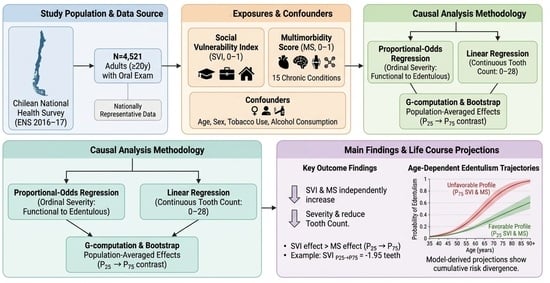
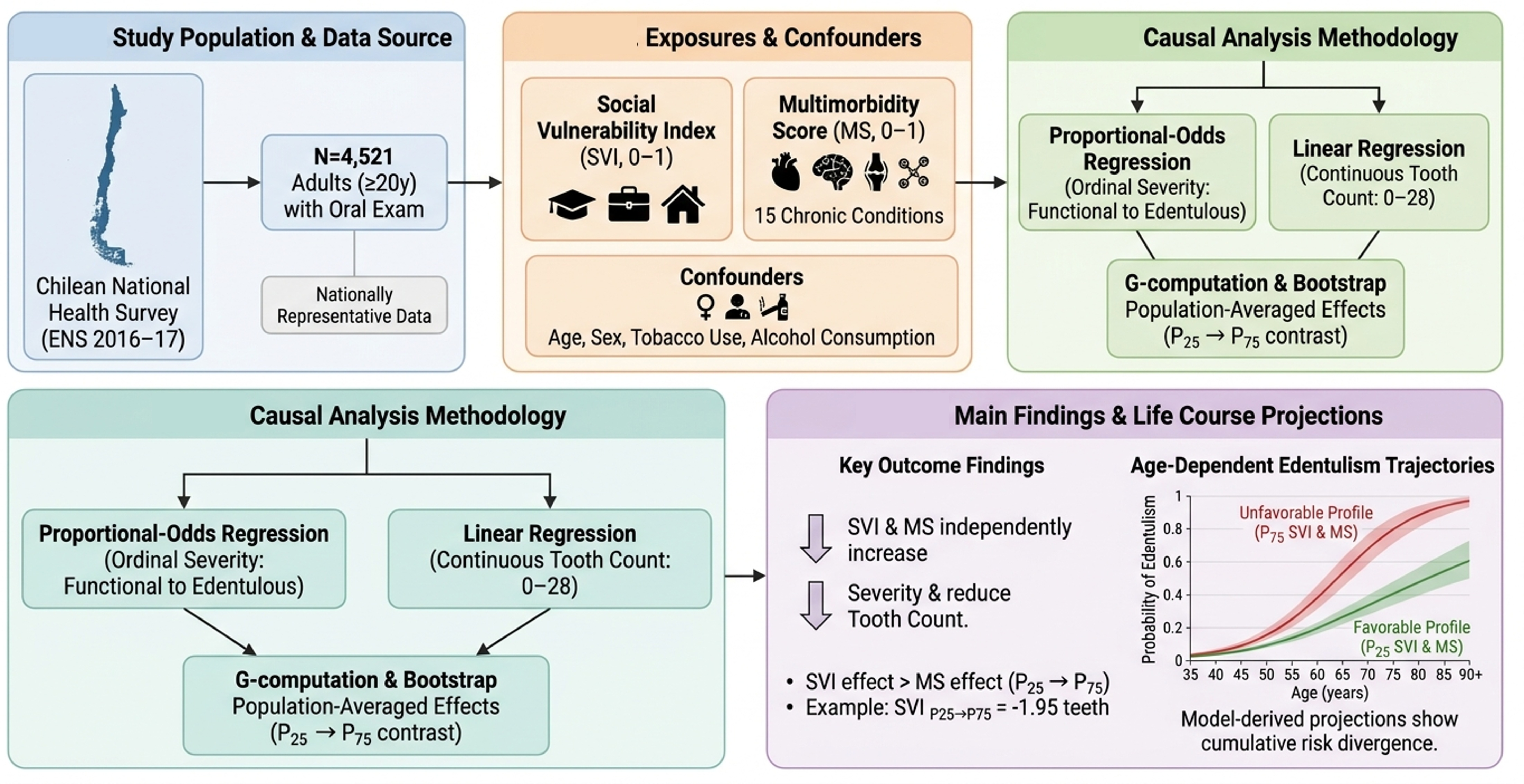
Graphical Abstract

1. Introduction

Tooth loss is among the most prevalent oral health conditions worldwide, reflecting the combined effects of dental caries, periodontal disease, and broader social determinants [1,2]. Despite substantial advances in preventive and restorative care, the population-level burden of severe tooth loss and edentulism has remained persistently high over recent decades. International assessments consistently identify tooth loss as a major contributor to disability and functional limitation, with disproportionately higher prevalence among older adults, women, rural populations, and socioeconomically disadvantaged groups [1,2,3]. This enduring burden the limited capacity of clinical advances alone to address social and structural drivers, underscoring persistent inequalities in oral health outcomes [3,4,5,6]. Although some high-income countries have reported gradual declines, marked global and regional disparities persist [1]. Consequently, tooth loss is widely recognized as both a marker of cumulative oral pathology across life curse [7,8,9,10,11,12,13,14,15] and as a determinant of reduced quality of life and elevated systemic health risks [15,16,17].
These global trends are mirrored in Chile, where rapid population aging and persistent inequalities in access to oral health services shape the national distribution of tooth loss. Data from the Chilean National Health Survey 2016–17 (ENS 2016–17) [18,19] indicates that 91.7% (95% CI: 88.6–94.0) of adults aged 35–44 years have functional dentition. This proportion decreases sharply to 30.2% among adults aged 65–74 years (95% CI: 24.9–36.0). Moderate and severe tooth loss affect 25.4% and 6.9% of adults, respectively, whereas edentulism reaches 4.8%. Furthermore, Chile exhibits high levels of multimorbidity: 54.9% of adults—and 82.4% of older adults—live with two or more chronic diseases. Results from the ENS 2016–17 demonstrate steep gradients in tooth retention by age, educational attainment, and multimorbidity burden, indicating that tooth loss in Chile is embedded within broader patterns of social vulnerability, chronic disease clustering, and unequal access to preventive and restorative care [12,18,19]. Despite ongoing local health-system reforms [20,21,22], pronounced oral-health disparities persist across sociodemographic groups [16].
Understanding the causal determinants of tooth loss in this context is essential for informing prevention strategies. However, establishing causality from observational data presents substantial methodological challenges. Although numerous studies have reported associations between tooth loss and systemic conditions [3,5,9,10], most rely on observational designs vulnerable to confounding, selection bias, and reverse causation. Beyond these methodological limitations, the clinical complexity of tooth loss as an outcome poses additional challenges. Risk patterns vary substantially with age, socioeconomic position, and chronic disease burden [16], and the clinical course spans multiple stages—from functional dentition to edentulism—each with distinct health implications. Simplifying this continuum into binary outcomes may obscure clinically relevant variation and complicate causal interpretation.
Despite these methodological and clinical challenges, recent advances in oral epidemiology—including longitudinal designs [12], fixed-effects estimation [14], as well as the application of directed acyclic graphs (DAGs) [13] have enhanced conceptual clarity regarding probable causal pathways linking tooth loss to systemic health. However, rigorous evidence of population-level causation remains limited, particularly in middle-income countries characterized by pronounced social gradients, elevated multimorbidity, and inequitable healthcare access. Addressing this evidence gap requires clear causal frameworks that explicitly define estimands, specify identifying assumptions, and systematically control for confounding in observational data.
Applying these frameworks to social vulnerability [16] and multimorbidity [12] in observational data presents specific methodological challenges. First, these exposures are not randomly distributed but strongly correlated with age, health behaviors [23], healthcare access, and health status [24], creating complex confounding structures. Second, tooth loss may simultaneously represent an outcome of prior exposures and a marker of accumulated disadvantage [16], raising concerns about reverse causation. Addressing these challenges requires explicit causal estimands, careful confounder identification, and analytic strategies that approximate counterfactual contrasts.
This study aimed to estimate the causal effects of social vulnerability and multimorbidity on tooth loss in the Chilean adult population, examining how these determinants shape both cumulative tooth-loss burden and clinical severity across the life course. By translating causal effect estimates into age-conditional risk profiles, we provide evidence to inform oral health policy and integrated prevention strategies targeting socially and clinically vulnerable populations.

2. Materials and Methods

2.1. Data Source and Study Population

We analyzed data from the Chilean National Health Survey 2016–2017 (ENS 2016–17) [25], a nationally representative survey conducted by the Ministry of Health using a stratified, multistage, cluster sampling design. In total, 6233 individuals completed the baseline survey, of whom 5520 received home visits from trained nurses and 5306 completed oral examinations (see Supplementary Materials).
For the present study, the sample was restricted to adults aged ≥20 years who had completed the oral examination, yielding 5165 individuals. The final analytic sample comprised 4521 adults after additional exclusion of 129 individuals with missing data on alcohol consumption, which was confirmed to follow a missing completely at random (MCAR) [26] mechanism based on negligible differences in age, social vulnerability, multimorbidity burden, and tooth-loss distribution between missing and observed cases. All analyses incorporated the survey weights corresponding to each ENS module to account for the complex sampling design and to ensure national representativeness.

2.2. Variables and Measurements

2.2.1. Tooth–Loss Outcomes

Remaining natural teeth were counted during home-based oral examinations conducted by trained and calibrated nurses (inter-rater reliability κ = 0.85 ) [25]. Tooth loss was operationalized using two outcomes. Severity ( y 1 ) was classified as an ordinal variable with four categories: functional dentition (≥20 teeth), moderate loss (10–19 teeth), severe loss (1–9 teeth), and edentulism (0 teeth). Tooth count ( y 2 ) was analyzed as a continuous variable (range 0–28 teeth).

2.2.2. Explanatory Variables

Variables were organized into three domains: sociodemographic factors, health behaviors, and systemic chronic conditions. Sociodemographic variables included age, sex, region, area of residence (urban/rural), years of schooling, employment status, indigenous ethnicity, and household sanitation index. These were collected via baseline questionnaires. Health behaviors included current tobacco use and alcohol consumption in the past 12 months, assessed during nurse visits. Chronic conditions were identified from self-reported physician diagnoses and laboratory results following ENS standard definitions and diagnostic criteria. Conditions included diabetes mellitus, hypertension, obesity, joint diseases, cardiovascular events, respiratory diseases, chronic renal failure, thyroid disease, depression, cancer, liver disease, reduced mobility, and coagulation disorders. Table 1 presents variable definitions and survey weights.

2.2.3. Socioeconomic Vulnerability Index (SVI)

We constructed a Socioeconomic Vulnerability Index (SVI) based on five indicators representing structural dimensions of social disadvantage. Four components were binary and coded as 1 = vulnerable and 0 = not vulnerable: employment status (unemployed or economically inactive vs. employed), indigenous ethnicity (self-identified membership of an indigenous group), household sanitation (deficient vs. acceptable, according to Chilean Ministry of Social Development and Family criteria [27]), and area of residence (rural vs. urban). Educational attainment was incorporated as a continuous component based on completed years of formal schooling. To ensure comparability with the binary indicators, years of schooling were rescaled to a 0–1 range using min–max normalization and subsequently inverted so that higher values corresponded to greater socioeconomic vulnerability (i.e., fewer years of education). Formally, let V i k denote the k-th vulnerability component for individual i. Binary components take values in { 0 , 1 } , and the education component takes values in [ 0 , 1 ] after normalization and inversion. The SVI for individual i was defined as the unweighted mean of the five components:
SVI i = 1 5 k = 1 5 V i k
By construction, SVI i [ 0 , 1 ] , with higher values indicating greater socioeconomic vulnerability. The index was calculated at the individual level without incorporating survey weights in its construction. Survey weights were applied only when describing component prevalences to account for the complex sampling design. The structural properties of the SVI—including inter-component correlations and the Kaiser–Meyer–Olkin (KMO) [28] measure of sampling adequacy—were evaluated to assess the dimensional validity of the composite index. Table 2 summarizes the SVI components, source variables, and sample characteristics.

2.2.4. Morbidity Score (MS)

We constructed a Multimorbidity Score (MS) to quantify cumulative chronic disease burden at the individual level. Fifteen chronic conditions were included: diabetes mellitus, arterial hypertension, obesity, osteoarthritis, rheumatoid arthritis, chronic renal failure, thyroid disease, depression, acute myocardial infarction, stroke, liver disease, asthma, chronic obstructive pulmonary disease (COPD), reduced mobility, and coagulation disorders. Cancer was excluded from the primary index because valid data were available for only 62.2% of participants; a missingness analysis confirmed a missing at random (MAR) mechanism [26], and a sensitivity analysis including cancer as a 16th condition is reported separately. Each condition was coded as a binary indicator (1 = present, 0 = absent) based on self-reported physician diagnosis and/or laboratory criteria (for diabetes). Let K = 15 denote the total number of included conditions. The count of conditions present for individual i was computed as:
S i = k = 1 K C i k , S i { 0 , 1 , , 15 }
A normalized version of the index was then calculated as:
MS i = S i K , 0 MS i 1
Thus, MS i = 0 indicates no chronic conditions, and MS i = 1 indicates all 15 conditions present. The MS was computed as an unweighted individual-level index; survey expansion factors were applied when describing condition prevalences but were not incorporated into the index calculation itself. The internal consistency and dimensional structure of the MS were evaluated using Cronbach’s α and the Kaiser–Meyer–Olkin (KMO) measure of sampling adequacy [28]. A complete-case approach yielded 4890 participants (94.7% of the 5165 adults with completed oral examination) with valid data across all 15 conditions, excluding cancer. Table 3 summarizes MS components and sample characteristics.

2.2.5. Component Contribution and Interaction Analyses

To evaluate the structural robustness of the composite indices and the relative contribution of key components, we conducted additional analyses at both the index and model levels. First, we performed leave-one-out sensitivity analyses for each index. For the SVI, alternative versions were constructed by sequentially excluding each component, with particular attention to educational attainment given its continuous nature and structural relevance. For the MS, analogous recalculations were performed excluding diabetes mellitus and, separately, including cancer despite its higher missingness. For each alternative specification, we examined both distributional stability and changes in causal effect estimates for tooth-loss outcomes relative to the primary index definitions. Second, to assess the marginal contribution of dominant components, we estimated models in which education (for SVI) and diabetes (for MS) were included explicitly alongside the composite index. This allowed evaluation of whether the observed associations reflected cumulative burden or were primarily driven by a single influential component. Third, effect modification was assessed by introducing interaction terms between SVI and MS in the primary outcome models. Interaction was evaluated on the appropriate model scale and interpreted within the prespecified causal framework. These analyses ensured that the primary exposure definitions used in the causal models were structurally stable and not disproportionately influenced by specific components.

2.3. Causal Framework

Using the primary specifications of SVI and MS (both continuous and scaled 0–1), we estimated causal effects on tooth-loss outcomes within the potential outcomes framework [29,30] under three core assumptions: temporal precedence, conditional exchangeability (no unmeasured confounding), and correct model specification. Temporal precedence is supported by both biological and social ordering. Tooth loss is cumulative and irreversible, whereas key SVI components—educational attainment, employment status, and place of residence—are typically established early in adulthood and remain stable. Similarly, MS reflects the progressive accumulation of chronic conditions over time. Although the ENS 2016–17 data are cross-sectional, the structural and clinical determinants captured by SVI and MS plausibly precede cumulative tooth loss, supporting causal interpretation under a life-course perspective. Conditional exchangeability was addressed by adjusting for age, sex, tobacco use, and alcohol consumption—well-established determinants of both social and clinical exposures and oral health outcomes. These confounders were specified a priori based on epidemiological theory. While residual confounding from unmeasured factors (e.g., access to dental care or oral hygiene practices) cannot be excluded, the robustness of effect estimates to unmeasured confounding was quantified using E-value analysis [31], which estimates the minimum strength of association that an unmeasured confounder would need to have with both the exposure and the outcome to fully explain the observed associations. Under these assumptions, regression coefficients were interpreted as conditional causal effects, and population-averaged contrasts were estimated via parametric g-computation [32], yielding average treatment effects consistent with structural interpretations of intervention effects [33,34].

2.3.1. Multi-Variable Regression Approach

Given that SVI and MS were modeled as continuous exposures (scaled 0–1), we employed regression-based adjustment to estimate conditional exposure–outcome associations while preserving the continuous structure of both indices. This approach allows direct estimation of adjusted effects under the prespecified causal assumptions. For the ordinal severity outcome ( y 1 ), defined as increasing levels of tooth-loss severity, we fitted proportional odds logistic regression models:
logit Pr Y 1 > j S V I , M S , X = α j + β svi S V I + β ms M S + γ X
where j { 0 , 1 , 2 } indexes cumulative severity thresholds, X denotes the confounder vector (age, sex, tobacco use, alcohol consumption), and  β svi and β ms represent adjusted log-odds ratios associated with a one-unit increase in SVI or MS, assuming proportional odds across thresholds. The proportional odds assumption was evaluated using the Brant test [35], which compares model coefficients across binary partitions of the ordinal outcome; results are reported in the sensitivity analyses section. For the continuous outcome ( y 2 ), we estimated survey-weighted linear regression models:
E Y 2 S V I , M S , X = α + β svi S V I + β ms M S + γ X
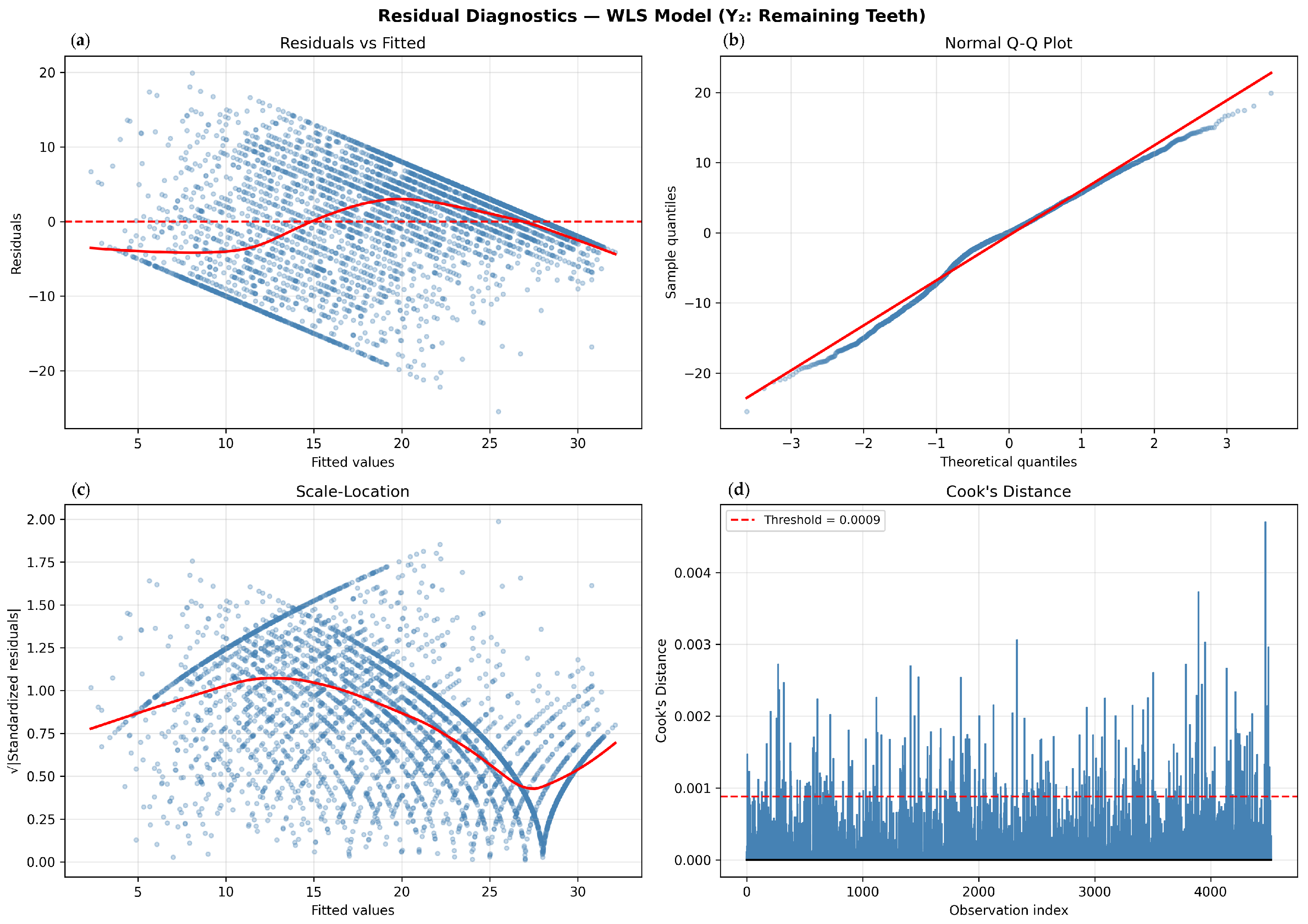
where β svi and β ms represent the expected change in the number of remaining teeth per unit increase in SVI or MS, conditional on covariates. Model fit and residual diagnostics for y 2 —including the Breusch–Pagan test for heteroscedasticity [36], normal Q-Q plot, Scale-Location plot, and assessment of influential observations via Cook’s distance—are reported in the sensitivity analyses section and presented in Figure 1.

2.3.2. Causal Interpretation

Under the assumptions of temporal precedence, no unmeasured confounding, correct model specification, and positivity, the regression coefficients β svi and β ms can be interpreted as conditional causal effects. These assumptions were considered plausible based on: (i) comprehensive confounder measurement within ENS 2016–17; (ii) the biological and social plausibility that cumulative vulnerability and chronic disease burden precede tooth loss; and (iii) adequate overlap in exposure distributions across confounder strata. The robustness of causal effect estimates to potential unmeasured confounding was further assessed using E-value analysis [31], which quantifies the minimum strength of association that an unmeasured confounder would need to have with both the exposure and the outcome to fully explain the observed associations under the null hypothesis.

2.3.3. Average Treatment Effects (ATE) via g-Computation

To complement conditional regression estimates and obtain population-averaged causal contrasts, we estimated Average Treatment Effects (ATEs) using g-computation (standardization). For each exposure (SVI and MS), the ATE was defined as the difference in expected outcomes under two hypothetical exposure levels corresponding to the 75th and 25th percentiles of the observed distribution. Formally, letting a 75 and a 25 denote the 75th and 25th percentile values of the exposure, the estimand was defined as:
ATE = E Y a 75 E Y a 25
The estimator was obtained by standardization over the empirical covariate distribution:
ATE ^ = 1 n i = 1 n E ^ Y A = a 75 , X i E ^ Y A = a 25 , X i
where E ^ ( Y A , X ) denotes predicted values from the fitted regression models and X i represents the observed covariate vector for individual i. This procedure yields marginal (population-averaged) causal contrasts while preserving the continuous nature of the exposures. Confidence intervals for the ATE were estimated using probability-proportional-to-size (PPS) non-parametric bootstrap resampling with 1000 replications, thereby accounting for uncertainty in both model estimation and outcome prediction and ensuring consistency with the survey expansion factor.

2.3.4. Statistical Software and Pipeline

Data management and survey-weighted descriptive analyses were conducted using Stata version 18.0 (Stata Corp., College Station, TX, USA). Causal regression models and g-computation for ATE estimation were implemented in Python (version 3.14.4, Visual Studio Code version 1.117.0) using the following libraries: statsmodels for proportional-odds logistic regression, survey-weighted ordinary least squares, logistic regression for the missingness analysis, Breusch–Pagan heteroscedasticity testing [36], and LOWESS smoothing; numpy and pandas for data management, index construction, standardization, and bootstrap resampling; scipy.stats for residual diagnostics including the Shapiro–Wilk test, inter-item correlations, and chi-squared tests; matplotlib for figure generation; and graphviz for the analytical pipeline diagram. Checkpoint serialization across analytical stages was managed using pickle.
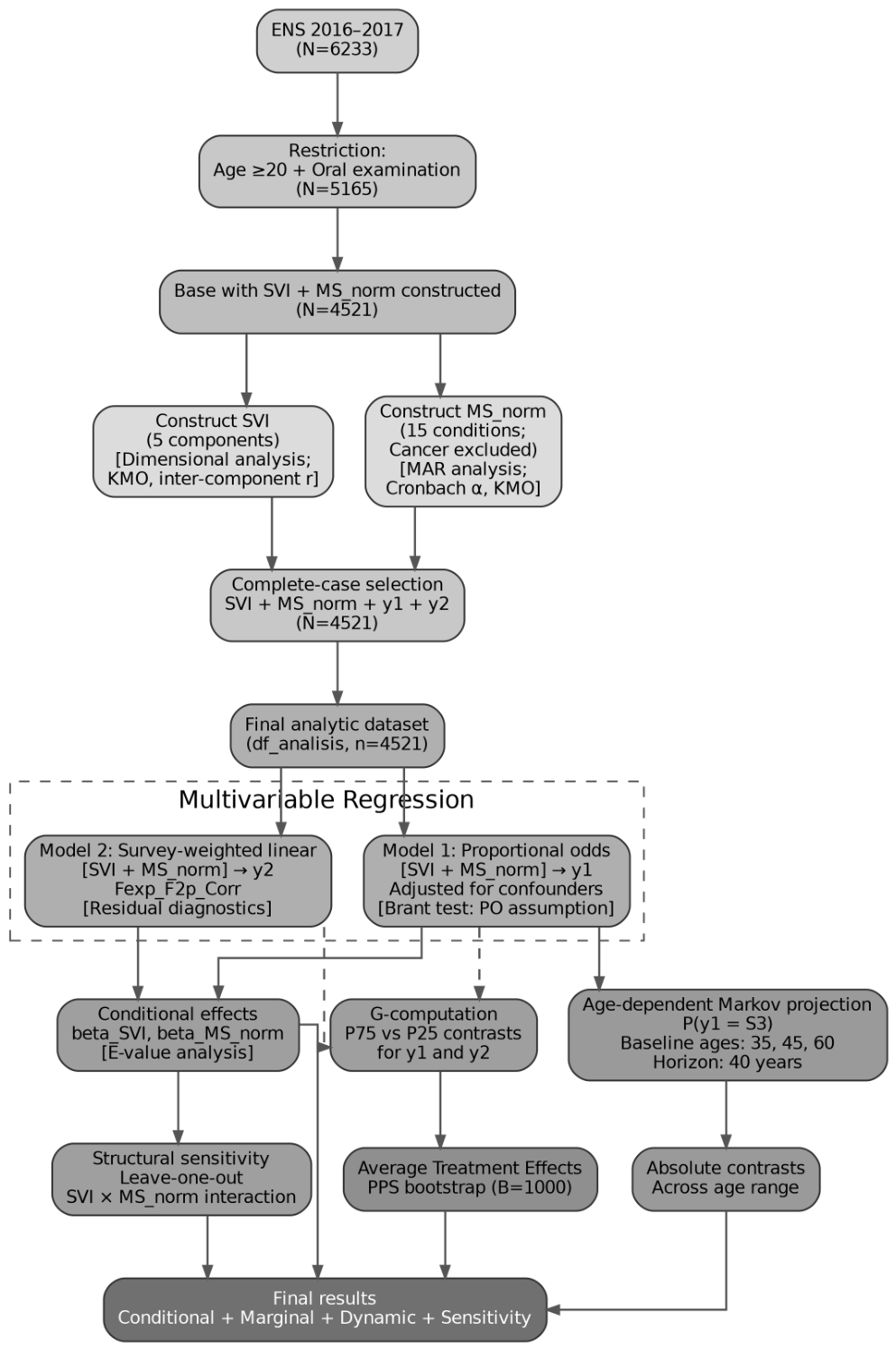
Figure 1 summarizes the causal analysis workflow. Using the ENS 2016–2017 survey, we defined an analytical sample comprising adults aged ≥20 years who completed the oral examination and had complete information on exposures, outcomes, confounders, and the dental expansion factor ( n = 4521 ). Three variable domains were specified a priori on epidemiological and causal grounds. The outcome domain included y 1 , an ordinal indicator of tooth-loss severity, and  y 2 , the continuous number of remaining teeth. The exposure domain comprised SVI and MS, both modeled as continuous variables scaled from 0 to 1. The confounder set included age, sex, tobacco use, and alcohol consumption, selected to satisfy causal assumptions. Multi-variable regression models were fitted to estimate conditional exposure–outcome associations: A proportional-odds logistic regression model for y 1 and a survey-weighted linear regression model for y 2 , incorporating the dental expansion factor (Fexp_F2p_Corr). Regression coefficients ( β svi , β ms ) were interpreted under the assumptions of conditional exchangeability, positivity, and correct model specification. Population-level causal contrasts were obtained using g-computation. For each exposure, ATEs were estimated by contrasting predicted outcomes under hypothetical shifts from the 25th to the 75th percentile of the exposure distribution and averaging over the observed covariate distribution with application of survey weights. Ninety-five percent confidence intervals were derived using probability-proportional-to-size (PPS) non-parametric bootstrap resampling (1000 replications), ensuring consistency with the survey expansion factor.

2.3.5. Age-Dependent Markov Projection

To translate regression-based estimates into clinically interpretable age-dependent projections, we implemented a discrete-time, non-homogeneous Markov extension of the fitted proportional-odds model for y 1 . Let
p k ( a , X ) = Pr y 1 = k a , X , k { 0 , 1 , 2 , 3 }
denote the age-specific predicted probability of each tooth-loss severity state from the ordinal model, where a is age and X represents the determinant profile (SVI, MS norm , and covariates) held constant under each counterfactual scenario. These probabilities were used to parameterize time-dependent transition matrices between severity states ( S 0 S 3 ), with edentulism ( S 3 ) specified as an absorbing state. Let π ( a ) denote the row vector of state probabilities for y 1 at age a. The evolution of the severity distribution was defined as:
π ( a + 1 ) = π ( a ) P ( a )
where P ( a ) is the age-specific transition matrix calibrated to the model-predicted probabilities. Trajectories were simulated over a 40-year horizon under sustained exposure scenarios corresponding to the 25th and 75th percentiles of SVI and MS norm . The initial state distribution at each baseline age (35, 45, and 60 years) was defined by the model-predicted distribution of y 1 at that age. Uncertainty in projected trajectories was quantified using the same PPS bootstrap framework applied in the primary analyses ( B = 1000 replications). These projections represent model-based counterfactual simulations calibrated to cross-sectional age gradients; they serve as mathematical risk exercises under fixed exposure scenarios and should not be misinterpreted as observed longitudinal clinical transitions.

3. Results

The Chilean National Health Survey 2016–2017 included 6233 participants. After restricting the sample to adults aged ≥20 years who completed the oral examination, the intermediate dataset comprised 5165 individuals. The final analytic sample comprised 4521 adults after exclusion of 129 individuals with missing data on alcohol consumption (MCAR; see Section 2.1).

3.1. Sociodemographic Characteristics of the Analytical Sample

The analytical sample comprised 4521 adults aged ≥20 years. The weighted population represented approximately 11.7 million Chilean adults based on the survey expansion factor (Fexp_F1p_Corr). The mean age of participants was 51.0 years (SD = 17.7), with ages ranging from 20 to 98 years. Women accounted for 63.7% of the sample and men for 36.3%. Most individuals resided in urban areas (89.1%), while 10.9% lived in rural areas. Marked territorial heterogeneity was observed across macro-regions: just over half of the population resided in the Central macro-region (50.96%), followed by the Central–South (23.4%) and Austral (18.6%) macro-regions, whereas the Northern macro-region accounted for a smaller share (7.0%). Educational attainment ranged from 0 to 22 completed years of schooling, with a mean of 11.0 years (SD = 4.41), reflecting substantial variability in formal education across the population.
The Socioeconomic Vulnerability Index (SVI) was computed for 4910 participants (95.1% of the 5165 adults with completed oral examination) with complete information on all five components. Employment vulnerability was the most prevalent component (41.2%). Educational vulnerability, derived from normalized years of schooling, had a mean value of 0.54 (SD = 0.20), reflecting substantial dispersion in educational attainment across the population. SVI showed a mean of 0.28 (SD = 0.19), with values ranging from 0 to 1. The distribution was moderately right-skewed, with a median of 0.29 and an inter-quartile range of 0.091–0.355, indicating meaningful heterogeneity in social vulnerability within the study population. Quartile classification demonstrated that 23.9% of participants were in the highest vulnerability quartile, while 25.5% were in the lowest. The structural properties of the SVI were evaluated through inter-component correlations and the KMO measure of sampling adequacy [28]. Inter-component correlations were low to moderate (mean r = 0.16 ; range: −0.03 to 0.64), with the highest correlation observed between rural residence and household sanitation ( r = 0.64 ), which is substantively interpretable given the geographic distribution of sanitation infrastructure in Chile. The correlation between educational attainment and employment status was r = 0.31 , indicating that multicollinearity between these components does not threaten the validity of the composite index. The KMO value of 0.54 reflects the heterogeneous nature of the five structural dimensions captured by the index, consistent with its design as a composite of distinct social disadvantage indicators rather than a single latent factor. The composition and distribution of SVI components are detailed in Table 4.

3.2. Health-Related Behaviors

Health-related behaviors were assessed to characterize lifestyle exposures in the adult population and to contextualize subsequent analyses of morbidity burden and oral health outcomes. After applying survey expansion factors, 33.4% of adults reported current tobacco use, whereas alcohol consumption during the previous 12 months was reported by 77.3% of the population, indicating a high prevalence of behavioral risk factors in the analytical sample (Table 5).
The population-weighted prevalence of chronic conditions indicated a substantial burden of morbidity in the adult population. Obesity (36.7%) and arterial hypertension (30.6%) were the most prevalent conditions, followed by reduced mobility (21.1%) and diabetes mellitus (13.5%). Self-reported cancer showed a prevalence of 4.6%; however, valid data were available for only 62.2% of participants, and this variable was therefore excluded from the primary MS construction. A missingness analysis confirmed a MAR mechanism, and a sensitivity analysis including cancer as a 16th condition is reported in the sensitivity analyses section. Taken together, these results reflect a high prevalence of cardio-metabolic and functional conditions, supporting the relevance of modeling cumulative morbidity burden in subsequent analyses (Table 6).
The morbidity score (MS), constructed from 15 chronic conditions excluding cancer, was calculated for 4890 individuals (94.7% of the 5165 adults with completed oral examinations) with complete information across all components. The unweighted count-based index (range 0–15) showed a mean of 1.81 (SD = 1.72), with a median of 1 condition and an observed range from 0 to 10. When normalized to a 0–1 scale, the mean MS was 0.12 (SD = 0.12), with values ranging from 0.000 to 0.667. The distribution was right-skewed: 26.1% of participants had no chronic conditions, 26.4% had one condition, and 47.4% met the definition of multimorbidity (≥2 conditions). Higher counts of coexisting conditions were progressively less frequent, with fewer than 5% of individuals presenting five or more conditions. The internal consistency of the MS was evaluated using Cronbach’s α ( α = 0.57 ) and KMO = 0.73 [28]. The relatively low α is consistent with published multimorbidity indices, which do not assume a single latent construct but rather reflect the co-occurrence of clinically distinct conditions. The KMO value indicates adequate factor-ability of the item matrix. These results demonstrate a high cumulative burden of chronic disease in the adult population. In subsequent causal analyses, MS was modeled as a continuous exposure (0–1 scale), allowing estimation of dose–response relationships between increasing multimorbidity burden and tooth-loss outcomes through the regression coefficient β MS and population-averaged contrasts derived via g-computation. Table 7 illustrates the distributional characteristics of SVI and MS across the analytical sample. Both indicators demonstrated substantial inter-individual variability, indicating heterogeneity in socioeconomic conditions and cumulative illness load among the adult population.

3.3. Sensitivity Analyses of Composite Indices

To evaluate whether the observed associations reflected cumulative constructs rather than dominance by single components, sensitivity analyses were conducted at both the structural and model levels.

3.3.1. Structural Stability: Leave-One-Out Analyses

Alternative specifications of each index were constructed by sequentially omitting individual components. For the SVI, exclusion of employment, indigenous status, sanitation, education, or rural residence produced highly correlated indices relative to the original specification (all r > 0.85 ), supporting distributional stability. Exclusion of education resulted in r = 0.980 , indicating that although education contributed to variance, the overall structure of the index remained stable. For the MS, exclusion of diabetes yielded r = 0.978 with the original index ( n = 4890 ). Inclusion of cancer—despite valid data available for only 62.2% of participants—produced r = 0.992 but reduced the effective sample to n = 3037 (38% reduction). Given this loss of precision and the MAR missingness mechanism confirmed for cancer, cancer was excluded from the primary MS specification.

3.3.2. Marginal Contribution of Dominant Components

To determine whether specific components disproportionately drove the associations, models were re-estimated, including educational attainment and diabetes mellitus explicitly alongside their respective indices. In the case of SVI, incorporation of education reduced the coefficient by 69.5%, although a statistically significant residual influence remained. In the MS analysis, inclusion of diabetes reduced the MS coefficient by 30.2%, yet both diabetes and the residual MS term remained statistically significant. These findings indicate that education and diabetes contribute substantially to their respective indices but do not fully account for the cumulative associations observed.

3.3.3. Interaction Between SVI and MS

An interaction term ( SVI × MS ) was incorporated to evaluate potential effect modification. The interaction coefficient was negative and statistically significant ( β = 3.547 , p = 0.022 ), indicating antagonistic effects between socioeconomic vulnerability and multimorbidity. The marginal effect of socioeconomic vulnerability diminished with elevated levels of multimorbidity, while the marginal effect of multimorbidity similarly diminished at increased levels of socioeconomic vulnerability. Two mechanisms may account for this antagonistic pattern: first, partial overlap in the causal pathways through which both factors influence outcomes; and second, ceiling or saturation effects, whereby the potential for further deterioration in health outcomes becomes constrained under conditions of extreme cumulative burden. Collectively, these sensitivity analyses support the structural robustness of both indices and substantiate their interpretation as cumulative exposures in subsequent analyses. Both indices represent coherent cumulative constructs, while recognizing the disproportionate influence of schooling within the SVI and diabetes within the MS.

3.3.4. Residual Diagnostics for the Survey-Weighted Linear Regression Model ( y 2 )

Residual diagnostics for the survey-weighted linear regression model ( y 2 : number of remaining natural teeth) are presented in Figure 2. The model explained 52.9% of the variance in remaining teeth ( R 2 = 0.529 ). Panel (a) shows the residuals versus fitted values with a LOWESS smoothing curve; the fan-shaped pattern indicates heteroscedasticity, which is structurally expected given the bounded and discrete nature of the tooth count outcome (range 0–28) and is partially addressed by the WLS specification with survey expansion weights. Panel (b) presents the normal Q-Q plot, which shows adequate approximation to normality in the central quartile range with minor tail deviations consistent with the discrete outcome distribution; with n = 4521 , the central limit theorem guarantees asymptotic validity of inference regardless of residual normality. Panel (c) displays the Scale-Location plot, confirming non-constant variance across the fitted value range. Panel (d) shows Cook’s Distance for each observation; 257 observations (5.7%) exceeded the conventional threshold ( 4 / n = 0.00088 ), with no values approaching 1.0, indicating the absence of dominant influential observations. Throughout all models, inference was based on heteroscedasticity-consistent (HC) standard errors to account for the detected heteroscedasticity.

3.4. Oral Health Outcomes

Oral health outcomes were assessed using two complementary measures: an ordinal indicator of tooth-loss severity ( y 1 ) and a continuous measure representing the cumulative number of remaining natural teeth ( y 2 ). Regarding y 1 , 72.6% of adults presented functional dentition (≥20 remaining teeth), and 5.5% were edentulous. For  y 2 , the mean number of remaining natural teeth was 21.5 (SD = 9.6), with an observed range from 0 to 28 teeth (Table 8).
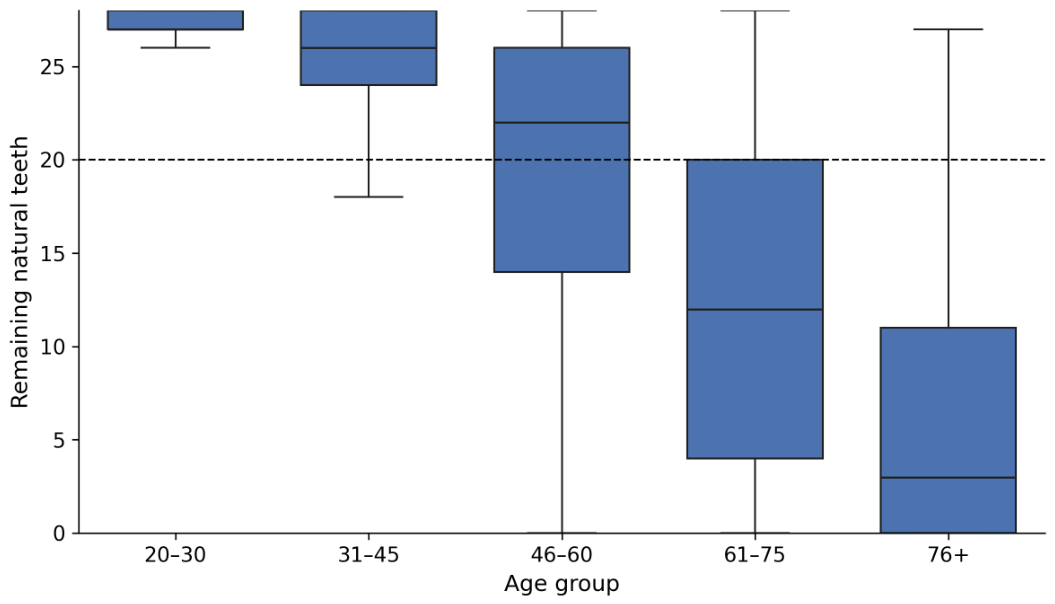
Figure 3 presents the distribution of remaining natural teeth across age groups, illustrating the life-course gradient in tooth retention within the analytical sample. Median tooth count declined progressively with age, with individuals aged 20–30 years exhibiting near-complete dentition, followed by a gradual reduction in the 31–45 and 46–60 age groups. A marked shift was observed from age 61 years onwards, where the median number of remaining teeth fell below the functional dentition threshold (20 teeth). Among participants aged 76 years or older, tooth loss was more advanced, with a high concentration of low tooth counts and edentulism. This age-stratified pattern supports the cumulative nature of tooth loss and reinforces the biological plausibility of modeling age as a key confounder in subsequent causal analyses. While age captures the temporal dimension of cumulative dental loss, it does not account for the structural and clinical determinants that shape differential trajectories across individuals.

3.5. Descriptive Associations and Model-Building Rationale

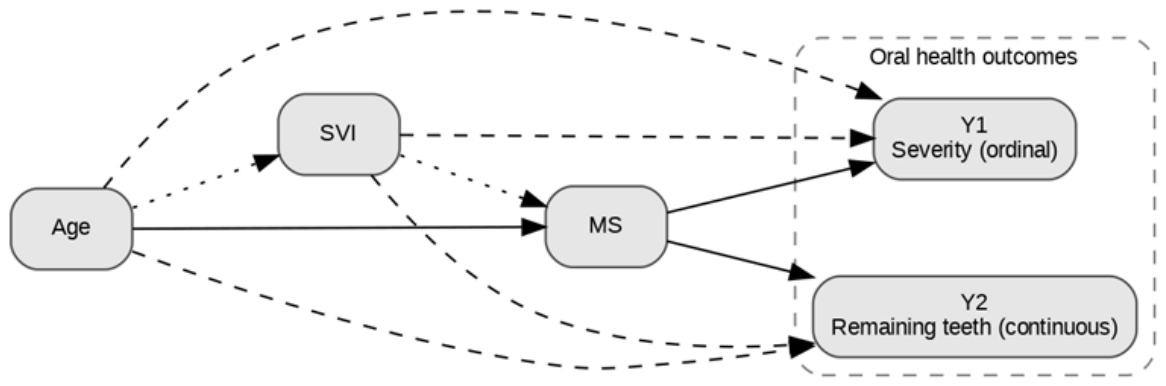
Prior to causal estimation, analyses were conducted to characterize the conditional-dependence structure among age, SVI, MS, and oral health outcomes (Figure 4). This preliminary step aimed to identify relevant statistical associations, inform covariate selection for subsequent causal models, and detect potential effect modification. These descriptive patterns do not constitute causal claims; formal causal inference [32] is presented in subsequent sections after appropriate adjustment for confounding.

3.6. Causal Effects of Social Vulnerability and Multimorbidity on Tooth Loss

We estimated the independent effects of SVI and MS—interpretable as causal under the assumptions stated in Section 2.3—using confounder-adjusted regression models followed by weighted g-computation with probability-proportional-to-size bootstrap (1000 replications).

3.6.1. Conditional Effects

In the proportional-odds model for y 1 , higher SVI was strongly associated with worse clinical categories (OR = 6.09; 95% CI: 4.21–8.81 per unit increase). MS was also independently associated with greater severity (OR = 3.83; 95% CI: 2.06–7.13). Because both indices are scaled from 0 to 1, these odds ratios correspond to the full observed exposure range and should be interpreted as reflecting strong monotonic gradients across the vulnerability and multimorbidity continua. The proportional odds assumption was evaluated using the Brant test [35]. The omnibus test was statistically significant ( χ 2 = 39.46 , df = 12, p < 0.001 ), with threshold-specific heterogeneity confined to SVI and sex. For SVI, coefficients showed a decreasing gradient across thresholds ( β = 2.15 , 1.86, and 0.95 for y 1 1 , y 1 2 , and y 1 3 , respectively), without sign reversal, suggesting that socioeconomic vulnerability exerts a larger effect on the transition from functional dentition to moderate loss than on progression to edentulism. Given the large sample size ( n = 4521 ), the Brant test [35] has high statistical power to detect threshold heterogeneity of limited practical importance; furthermore, population-averaged causal contrasts obtained via g-computation average predictions over the observed covariate distribution and are robust to moderate departures from the proportional odds assumption. For y 2 , both exposures were associated with fewer remaining teeth. Each unit increase in SVI was associated with 7.40 teeth (95% CI: 8.37 to 6.43 ), and each unit increase in MS with 6.02 teeth (95% CI: 7.92 to 4.12 ), after adjustment.

3.6.2. Population-Averaged Effects (P25 → P75)

To obtain population-level causal contrasts under realistic exposure shifts, we estimated ATEs comparing the 25th and 75th percentiles of each exposure distribution (Table 9). For SVI, an increase from 0.091 to 0.355 was associated with a 0.110-point increase in ordinal tooth-loss severity (95% CI: 0.090–0.129) and a reduction of 1.95 remaining teeth (95% CI: 2.318 to 1.671 ). For MS, an increase from 0.00 to 0.20 was associated with a 0.062-point increase in ordinal severity (95% CI: 0.013–0.066) and a reduction of 1.20 remaining teeth (95% CI: 2.080 to 1.052 ). Across both outcomes, SVI demonstrated slightly larger population-averaged effects than MS, indicating that upstream socioeconomic vulnerability may exert a broader influence on tooth-loss burden, independent of chronic disease accumulation. All ATEs were estimated using weighted g-computation with probability-proportional-to-size bootstrap (1000 replications), ensuring consistency with the survey expansion factor for dental outcomes.

3.7. Age-Conditional Counterfactual Trajectories of Tooth-Loss Severity

To translate the estimated causal effects into clinically interpretable age-dependent risk profiles, we derived age-conditional counterfactual trajectories of tooth-loss severity from the fitted proportional-odds model. Tooth-loss severity was represented using four ordered clinical states: functional dentition ( S 0 ), moderate tooth loss ( S 1 ), severe tooth loss ( S 2 ), and edentulism ( S 3 ). Rather than modeling observed longitudinal transitions, predicted outcome probabilities were evaluated across increasing ages while holding determinant profiles constant, yielding age-conditional projections under sustained exposure scenarios.
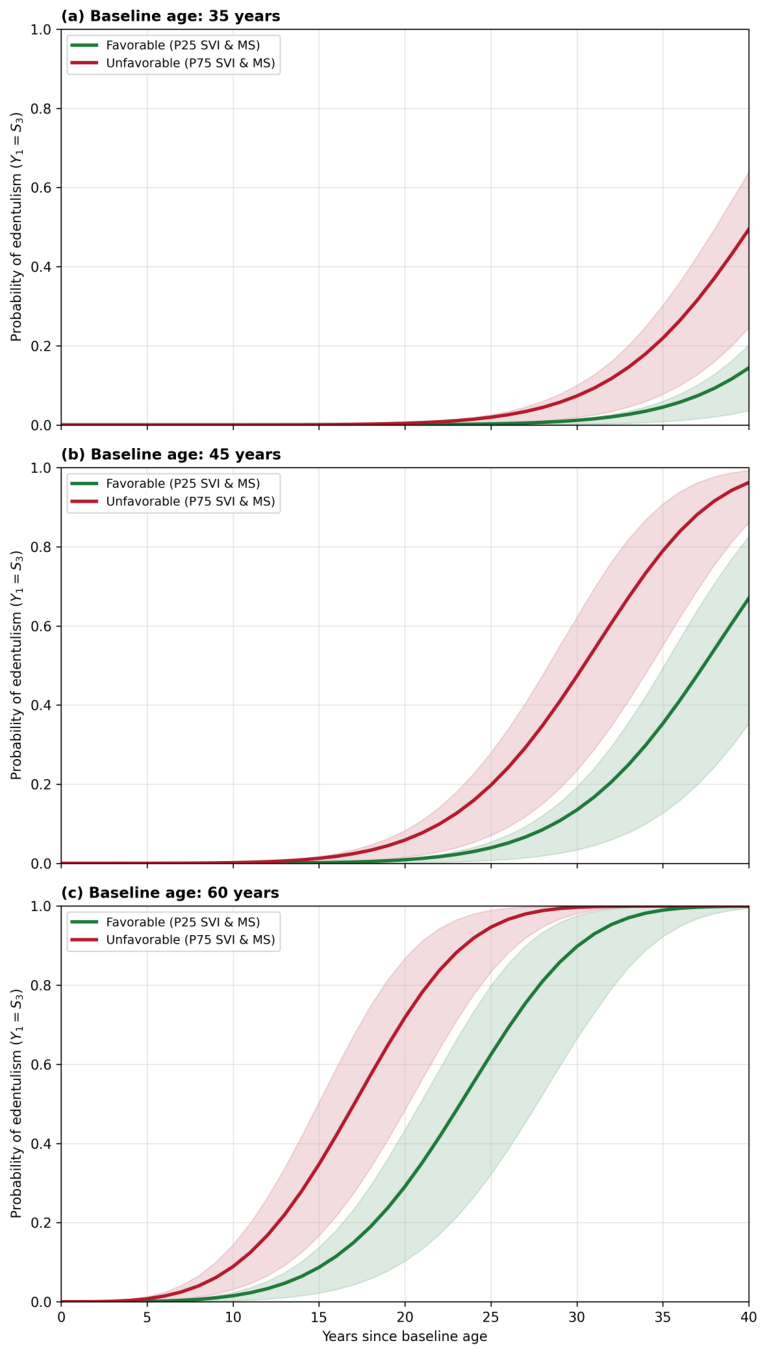
For each baseline age (35, 45, and 60 years), the probability of edentulism ( y 1 = S 3 ) was computed over a 40-year horizon by incrementing age within the fitted ordinal model while fixing exposure profiles. Favorable and unfavorable realistic scenarios were defined empirically using the 25th and 75th percentiles of SVI and MS, respectively, with sex, tobacco use, and alcohol consumption fixed at reference categories. This approach provides a transparent mapping from determinant profiles to age-conditional severity risks without invoking assumptions about underlying transition intensities.
Across all baseline ages, unfavorable profiles were associated with systematically higher predicted probabilities of edentulism than favorable profiles. At a baseline age of 35 years, the predicted probability of edentulism by age 100 was approximately 0.69 under favorable conditions and 0.85 under unfavorable conditions, corresponding to an absolute difference of 0.15. For individuals starting at 45 years, the corresponding probabilities were approximately 0.64 (favorable) and 0.98 (unfavorable), yielding a larger absolute separation at advanced ages. Among those beginning at 60 years, predicted probabilities rose more steeply, approaching unity under unfavorable conditions by late life and remaining elevated even under favorable profiles.
At intermediate target ages, contrasts were also clinically meaningful. For example, at age 90, the absolute difference between unfavorable and favorable profiles exceeded 0.20 across baseline strata, indicating a substantial shift in the population-level risk of complete tooth loss attributable to sustained adverse determinant conditions. The widening separation with increasing age reflects cumulative amplification of risk under fixed high-vulnerability and high-multimorbidity profiles.
Baseline age functioned as a structural modifier of predicted risk: individuals entering the projection at 60 years exhibited markedly higher probabilities throughout the time horizon than those starting at 35 or 45 years under identical determinant profiles. These findings are consistent with the non-linear age gradient estimated in the underlying ordinal model and reinforce the interaction between chronological aging and sustained social and systemic risk exposure.
Figure 5a–c illustrate the age-dependent likelihood of edentulism ( y 1 = S 3 ) over a 40-year period, stratified by baseline age and counterfactual determinant profile. Shaded areas represent 95% bootstrap confidence intervals derived from a probability-proportional-to-size resampling procedure aligned with the survey expansion factors. These trajectories correspond to model-derived, age-conditional projections under fixed exposure scenarios and should not be interpreted as observed longitudinal transitions. Absolute differences between favorable and unfavorable profiles were substantial across all age groups, whereas relative differences diminished at extreme ages as projected probabilities approached their upper bounds, consistent with the logistic functional form of the proportional-odds model. Collectively, these results illustrate how regression-based causal estimates can be translated into age-dependent risk trajectories while remaining consistent with the underlying cross-sectional design.

4. Discussion

This population-based analysis of 4521 Chilean adults provides evidence regarding the independent effects of SVI and MS on tooth-loss severity ( y 1 ) and the number of remaining natural teeth ( y 2 ), under the identifying assumptions of temporal precedence, conditional exchangeability, and correct model specification. In fully adjusted proportional-odds models, a one-unit increase in SVI (0–1 scale) was associated with an odds ratio of 6.09 for transition to a more severe tooth-loss category, whereas MS showed an odds ratio of 3.83. For the continuous outcome, a one-unit increase in SVI was associated with a reduction of 7.40 teeth, and a one-unit increase in MS with a reduction of 6.02 teeth after adjustment for age, sex, tobacco use, and alcohol consumption. Because both indices are scaled from 0 to 1, these coefficients represent gradients across the full observed exposure range. Population-averaged contrasts obtained through weighted g-computation facilitate interpretation at the distributional level. An increase in SVI from the 25th to the 75th percentile (0.091 to 0.355) was associated with a 0.110-point increase in ordinal severity and a reduction of 1.95 remaining teeth. A comparable shift in MS (0.00–0.20) was associated with an increase in severity of 0.062 points and a reduction of 1.20 teeth. Across both outcomes, SVI exhibited slightly larger population-averaged effects than MS, suggesting that socioeconomic vulnerability may exert a broader influence on tooth-loss burden than the accumulation of chronic diseases. Sensitivity analyses assessed the structural stability of both indices. Leave-one-out procedures showed high correlations between alternative and primary SVI specifications (all r > 0.85 ) and between the primary MS and the specification, excluding diabetes ( r = 0.978 ). Including cancer in the MS yielded r = 0.992 but substantially reduced the effective sample size; cancer was, therefore, excluded from the primary specification to preserve statistical precision. When educational attainment was explicitly included alongside SVI, the SVI coefficient decreased by 69.5% but remained statistically significant, indicating that education explains a substantial portion of the SVI effect without fully accounting for it. Similarly, when diabetes was included explicitly alongside MS, the MS coefficient decreased by 30.2%, while both variables remained statistically significant. These findings suggest that the observed associations are not driven by a single component within either index. A statistically significant negative interaction between SVI and MS ( β = 3.547 , p = 0.022 ) was observed, consistent with partial overlap in their contributions to tooth-loss severity. Regression-based estimates were further translated into age-conditional trajectories of edentulism ( y 1 = S 3 ) using a non-homogeneous, age-dependent Markov extension of the fitted ordinal model. Under sustained unfavorable exposure profiles (75th percentiles of SVI and MS), projected probabilities of edentulism increased more rapidly with age than under favorable profiles (25th percentiles). These projections reflect model-derived age gradients calibrated to cross-sectional data and should not be interpreted as observed longitudinal transitions. Overall, the consistency of results across regression models, g-computation contrasts, structural sensitivity analyses, component-specific re-estimation, interaction testing, and age-conditional projections supports the internal coherence of the analytical framework and the stability of the primary findings.
Our results align with prior evidence documenting socioeconomic gradients in tooth loss [1,4,16,37]. Our approach differs from prior studies by modeling socioeconomic disadvantage as a composite index rather than as isolated indicators. Instead of analyzing individual socioeconomic variables separately, we constructed a Social Vulnerability Index (SVI) scaled continuously from 0 to 1. Within this framework, a complete shift across the SVI range corresponded to an odds ratio of 6.09 for progression to a more severe tooth-loss category and a mean reduction of 7.40 remaining teeth. When expressed through inter-quartile contrasts (P25 versus P75), the corresponding population-averaged reduction of 1.95 teeth reflects cumulative structural disadvantage rather than isolated socioeconomic markers.
The substantially larger gradients observed in the present study likely stem from three methodological distinctions. First, the SVI simultaneously captures multiple structural dimensions—including educational attainment, employment status, sanitation infrastructure, indigenous ethnicity, and geographical area of residence—within a unified exposure construct. Second, exposures were modeled on a continuous scale, thereby preserving dose–response information across the entire distribution rather than relying on binary or categorical contrasts. Third, causal contrasts were estimated using g-computation with probability-proportional-to-size bootstrap resampling, yielding distributional-level estimates under explicit percentile shifts rather than conventional regression coefficients alone. These distinctions suggest that the magnitude of the observed gradients reflects the cumulative configuration of structural vulnerability across domains rather than the effect of isolated socioeconomic characteristics.
Santos-López et al. (2024) [12] recently reported an odds ratio of 1.66 (95% CI: 1.04–2.66) for severe tooth loss among adults aged ≥65 years with two or more chronic conditions when analyzing the same ENS 2016–2017 dataset. The present study demonstrates a comparable direction of association between multimorbidity and tooth loss, although important methodological differences should be noted. The conventional approach, as exemplified by Santos-López et al., operationalizes multimorbidity as a simple count of chronic diseases. This binary or categorical specification does not fully capture the cumulative risk arising from the co-occurrence of multiple chronic conditions. In contrast, the morbidity index used here is scaled continuously, reflecting progressive disease burden across the entire distribution. Moreover, the finding that the inclusion of diabetes led to a 30.2% attenuation of the multimorbidity coefficient is consistent with diabetes functioning as a key pathway linking multimorbidity to tooth loss, given the well-established role of diabetes in the progression of periodontal disease [17,38].
While longitudinal associations between tooth loss and chronic conditions are extensively documented [3,5,7,12,15,23,39,40], formal causal evidence remains limited, particularly in middle-income settings. Recent methodological advances include Kiuchi et al. (2022) [14] fixed-effects analysis of oral status and cognitive decline, and Baumeister et al. (2025) [24] instrumental variable approach to estimating smoking effects on tooth loss. Our study extends this emerging causal literature by: (1) focusing on upstream structural social determinants of health and multimorbidity rather than individual behaviors; (2) providing population-representative estimates from a nationally representative middle-income country survey; (3) explicitly defining target estimands within a potential outcomes framework; and (4) translating causal effects into clinically interpretable age-conditional risk trajectories.
The large protective effect of educational attainment operates through multiple interconnected life-course pathways. Education shapes oral health literacy and preventive behaviors from early life, influencing knowledge about caries prevention, periodontal disease, and the importance of routine dental care. Employment status—itself strongly correlated with education—determines income, health insurance coverage, and capacity to afford dental treatment in Chile’s mixed public-private healthcare system. Rural residence is associated with markedly reduced availability of dental services and greater geographical barriers to access [16]. The irreversibility of tooth loss means that disadvantages accumulating across these domains have permanent consequences, with limited opportunity for reversal even if circumstances later improve.
Systemic morbidity affects tooth loss through both biological and behavioral pathways. Chronic diseases generate systemic inflammation that exacerbates periodontal tissue destruction and impairs wound healing [17,38,41]. Diabetes specifically causes metabolic dysregulation, compromising immune function and increasing susceptibility to oral infections [23,42]. Medications used in the management of chronic conditions—particularly antihypertensives, antidepressants, and immunosuppressants—frequently cause xerostomia, reducing saliva’s protective antimicrobial and buffering effects and thereby increasing the risk of caries and periodontal disease [23,38]. Beyond these direct biological mechanisms, multimorbidity may also reduce the capacity for oral self-care through functional limitations, depression-related neglect of hygiene, and mobility constraints affecting access to dental services. Moreover, individuals with limited resources may prioritize management of life-threatening systemic conditions over oral health, creating a “competing demands” dynamic that relegates preventive dental care. Our finding that diabetes accounts for 30.2% of the morbidity effect, while substantial residual effects remain, indicates that integrated chronic disease management addressing both diabetes control and oral health maintenance may be necessary but insufficient; the broader burden of multimorbidity must also be considered.
A methodological contribution of this analysis is the translation of regression-based estimates into age-conditional edentulism trajectories. While odds ratios measure relationships on a relative scale, absolute risk trajectories provide clinically interpretable representations of population-level burden and illustrate the accumulation of effects across the life course. By evaluating model predictions across increasing ages under sustained favorable versus unfavorable exposure conditions, we observed substantial divergence between profiles. These projections should be interpreted as pseudo-temporal representations of effect magnitude rather than predictions of individual outcomes, as they rely on cross-sectional age gradients and assume constant exposure conditions that do not fully represent real-world dynamics. Nevertheless, they clearly illustrate that population-level prevention requires early and sustained intervention to prevent cumulative disadvantage, rather than focusing exclusively on late-stage disease in older adults.
This study has several important strengths. The ENS 2016–2017 provides nationally representative data with extensive measurement of sociodemographic, behavioral, and clinical characteristics, allowing adjustment for a broad set of potential confounders. Our explicit causal framework, grounded in the potential outcomes approach, enables more transparent inference than conventional observational analyses by clearly defining assumptions, estimands, and comparison strategies. The use of continuous composite indices preserves dose–response information that is often lost in categorical analyses. G-computation provides population-averaged causal effects that are directly relevant for public health planning, complementing conditional estimates derived from regression models. Sensitivity analyses confirmed the robustness of findings across alternative model specifications, and E-value analysis indicated that an unmeasured confounder would need to be associated with both SVI and tooth-loss severity by a risk ratio of at least 11.65 (E-value for the point estimate) and 7.89 (E-value for the lower confidence limit) to fully explain the observed association—values substantially exceeding the typical effect size of the strongest known unmeasured confounder in this context (oral hygiene behavior, RR ≈ 1.5–3.0). Residual diagnostics for the survey-weighted linear model ( y 2 ) confirmed adequate model fit ( R 2 = 0.529 ) with structurally expected heteroscedasticity—consistent with the bounded and discrete nature of the tooth count outcome—and no dominant influential observations (Cook’s D < 1.0 for all cases); inference was based throughout on heteroscedasticity-consistent (HC) standard errors. Finally, translating causal estimates into age-conditional trajectories enhances clinical and policy interpretability.
Several limitations should also be acknowledged. First, the cross-sectional design prevents direct observation of temporal sequence and therefore constrains causal inference, despite the application of methods designed to mitigate this limitation. Although the social vulnerability components and multimorbidity burden plausibly precede tooth loss—which is itself largely irreversible—reverse causation cannot be fully excluded (e.g., tooth loss affecting employment or contributing to depression). Accordingly, the term “causal effect” throughout this work denotes a standardized contrast within the potential-outcomes framework under the stated identifying assumptions, rather than causation demonstrated by the study design itself; longitudinal follow-up of ENS participants would be required to confirm temporal ordering. This terminological caution is distinct from the question of unmeasured confounding, which the E-value analysis addresses separately, indicating that an unmeasured confounder is unlikely to fully account for the observed gradients.
Second, unmeasured confounding remains possible. The ENS lacks detailed information on oral hygiene behaviors—including toothbrushing, flossing, and dental attendance—which are key determinants of dental caries and periodontitis leading to tooth loss. These behaviors reflect underlying oral health values (OHV), which shape preventive practices and treatment-seeking patterns [43]. This likely induces bias toward underestimation, as individuals with lower social vulnerability and multimorbidity tend to exhibit stronger OHV and better oral hygiene. Although SVI may partially proxy this dimension through its association with education and health literacy, residual confounding cannot be excluded. To evaluate its potential impact, we used the E-value framework [31], which quantifies the minimum strength of association that an unmeasured confounder would need with both the exposure and the outcome to fully explain the observed effect. Empirical evidence from oral health research suggests that confounders related to preventive care and periodontal status typically exhibit moderate to strong associations (RR ≈ 1.56–3.68) [44]. Within this plausible range, such confounding is unlikely to fully account for the magnitude of the observed associations, supporting the robustness of our estimates.
Third, tooth loss was assessed by trained nurses rather than dentists; however, high inter-rater reliability ( κ = 0.85 ) and the use of simple presence/absence assessment reduce concerns regarding measurement error.
Fourth, self-reported chronic conditions may underestimate true prevalence, potentially biasing morbidity effects toward the null.
Finally, the findings may not be fully generalizable beyond Chile, as social determinants and health system structures vary across settings, although the biological mechanisms linking chronic disease and periodontal health are likely broadly applicable [38,45,46].
These findings have direct implications for oral health policy in Chile and in comparable middle-income settings. Chilean oral health policy has historically prioritized individuals under 20 years of age, leaving adults over 20 years—except pregnant women and those aged 60 years with GES coverage—largely restricted to emergency care services [16,18,22,46]. This prioritization pattern may have contributed to the substantial burden of disease documented in this study, with 27.4% of adults presenting moderate-to-severe tooth loss or edentulism. The 2020 Estrategia de Cuidado Integral Centrado en las Personas (ECICEP) [21]—a shift toward person-centered chronic disease management for individuals aged 15 years and older—represents an important opportunity for integration. However, the ECICEP operational framework does not explicitly include caries or periodontitis, despite their high prevalence as non-communicable diseases, leaving oral health largely peripheral within the strategy. A notable positive element of this policy is the inclusion of periodontal treatment for individuals aged 35–54 years with uncontrolled diabetes, together with the development of dental risk assessment guidelines for adults aged 20 years and older. The cumulative disadvantage framework emphasizes that policies aimed at improving oral health must incorporate upstream interventions addressing structural determinants, including educational attainment and labor conditions. The development of a comprehensive continuum of oral health care—integrating risk stratification based on a social vulnerability index within routine adult care—has the potential to modify tooth-loss trajectories at the population level. At a second level of intervention, public policies should include: (1) ensuring access to preventive services for adults aged ≥20 years; (2) formally integrating oral health assessment within the ECICEP framework; (3) expanding conservative and restorative dental coverage for adults aged 20–59 years; (4) strengthening the oral health care network through university-based training clinics and community outreach programs; (5) improving access in rural and geographically isolated areas through mobile dental units and remote dentistry platforms; (6) developing partnerships with Indigenous communities to co-design culturally appropriate oral health services; and (7) establishing integrated data systems linking oral health indicators with chronic disease registries. Future research should prioritize longitudinal designs following ENS cohorts, pragmatic trials testing integrated chronic disease and oral health interventions, formal causal mediation analyses, investigations of effect heterogeneity across age, sex, and regional subgroups, and economic evaluations of upstream prevention strategies. Comparative studies across Latin American countries would enhance understanding of context-dependent social determinants.


Supplementary Materials

The following supporting information can be downloaded at: https://www.mdpi.com/article/10.3390/oral6030072/s1, Supplementary File S1: Chilean National Health Survey, ENS 2016–2017.

Author Contributions

J.J. conceived and designed the study, oversaw the investigation, developed the methodological framework and causal analysis strategy, conducted the data analysis and software implementation, and drafted the original manuscript. J.J. also coordinated manuscript revisions and serves as the corresponding author. M.B. contributed to the conceptualization of the study and the methodological design, participated in data analysis, assisted in manuscript preparation, and critically reviewed and revised the final version. K.C.-T. contributed to data investigation and validation, drafted relevant sections of the manuscript, and reviewed and refined the text to ensure conceptual consistency and intellectual rigor. P.M. reviewed and validated the results, contributed to writing and editing the manuscript for methodological precision and conceptual clarity, developed and implemented the analytical software procedures, and participated in the statistical analysis of the data. X.C.-F. provided oversight of the methodological framework and analytical strategy, supervised the preparation of the manuscript, and critically reviewed the text to ensure conceptual clarity, methodological rigor, and scientific coherence. M.G.Z. contributed to the methodological design of the study, provided academic oversight of the analytical framework, and critically evaluated the manuscript to ensure methodological rigor and conceptual consistency. A.V. formulated the causal inference framework, contributed to the methodological design of the causal analysis, participated in data analysis and interpretation, and conducted a comprehensive critical revision of the manuscript to ensure coherence of the causal approach and overall scientific integrity. All authors have read and agreed to the published version of the manuscript.

Funding

This work was supported by the National Agency for Research and Development (ANID), Government of Chile, through the Doctoral Scholarship Program (ANID—Subdirección de Capital Humano, Doctorado Nacional 2024, grant number 21240031; Doctorado Nacional 2025, grant number 21250489), and by the Interdisciplinary Center for Health Studies (CIESAL), Universidad de Valparaíso, Valparaíso, Chile.

Institutional Review Board Statement

This study did not require ethical approval, as it involved only secondary analysis of public and anonymized data. The ENS 2016–2017 participants signed an informed consent form and the study was approved by the Scientific Ethics Committee of the Pontificia Universidad Católica de Chile (CEC-UC, 16-019). The database used for the study was conducted in accordance with the Helsinki Declaration.

Informed Consent Statement

Not applicable.

Data Availability Statement

Database used is available from: https://epi.minsal.cl/encuesta-ens-descargable/ (accessed on 8 June 2026).

Acknowledgments

The authors acknowledge the Ministry of Health of Chile and its Department of Epidemiology for the design, implementation, and public release of the Chilean National Health Survey 2016–2017 (ENS 2016–2017), which provided the data infrastructure for this secondary analysis. The authors also thank the National Agency for Research and Development (ANID), Government of Chile, for financial support through the Doctoral Scholarship Program (2024–2025), and to Universidad de Valparaíso for institutional support during the development of this research.

Conflicts of Interest

The authors declare no conflicts of interest.

Abbreviations

The following abbreviations are used in this manuscript:
AMIAcute myocardial infarction
ATEAverage treatment effect
BMIBody mass index
CIConfidence interval
COPDChronic obstructive pulmonary disease
DAGDirected acyclic graph
ECICEPComprehensive Person-Centered Care Strategy
ENSChilean National Health Survey
Fexp_EX1p_CorrSurvey expansion factor (module EX1)
Fexp_F1F2p_CorrCombined survey expansion factor (modules F1 and F2)
Fexp_F1p_CorrSurvey expansion factor (module F1)
Fexp_F2p_CorrSurvey expansion factor (module F2)
GESExplicit Health Guarantees
HCHeteroscedasticity-consistent
IQRInter-quartile range
KMOKaiser–Meyer–Olkin
LOWESSLocally weighted scatterplot smoothing
MARMissing at random
MCARMissing completely at random
MSMultimorbidity Score
NANot available
OHVOral health values
OROdds ratio
P2525th percentile
P7575th percentile
POProportional odds
PPSProbability-proportional-to-size
RRRisk ratio
SDStandard deviation
SVISocioeconomic Vulnerability Index
WLSWeighted least squares

References

  1. GBD 2021 Oral Disorders Collaborators. Trends in the global, regional, and national burden of oral conditions from 1990 to 2021: A systematic analysis for the Global Burden of Disease Study 2021. Lancet 2025, 405, 897–910. [Google Scholar] [CrossRef]
  2. Kassebaum, N.J.; Bernabé, E.; Dahiya, M.; Bhandari, B.; Murray, C.J.L.; Marcenes, W. Global burden of untreated caries: A systematic review and metaregression. J. Dent. Res. 2015, 94, 650–658. [Google Scholar] [CrossRef] [PubMed]
  3. Alobaidi, F.; Heidari, E.; Sabbah, W. Systematic review of longitudinal studies on the association between cluster of health-related behaviors and tooth loss among adults. Acta Odontol. Scand. 2024, 83, 54–68. [Google Scholar] [CrossRef]
  4. Barbato, P.R.; Peres, K.G. Contextual socioeconomic determinants of tooth loss in adults and elderly: A systematic review. Rev. Bras. Epidemiol. 2015, 18, 357–371. [Google Scholar] [CrossRef]
  5. Zelig, R.; Goldstein, S.; Touger-Decker, R.; Firestone, E.; Golden, A.; Johnson, Z.; Kaseta, A.; Sackey, J.; Tomesko, J.; Parrott, J.S. Tooth Loss and Nutritional Status in Older Adults: A Systematic Review and Meta-analysis. JDR Clin. Transl. Res. 2022, 7, 4–15. [Google Scholar] [CrossRef]
  6. Friedman, P.K.; Kaufman, L.B.; Karpas, S.L. Oral health disparity in older adults: Dental decay and tooth loss. Dent. Clin. N. Am. 2014, 58, 757–770. [Google Scholar] [CrossRef]
  7. Asher, S.; Stephen, R.; Mäntylä, P.; Suominen, A.L.; Solomon, A. Periodontal Health, Cognitive Decline, and Dementia: A Systematic Review and Meta-Analysis of Longitudinal Studies. J. Am. Geriatr. Soc. 2022, 70, 2695–2709. [Google Scholar] [CrossRef]
  8. Fagundes, N.C.F.; Couto, R.S.D.; Brandão, A.P.T.; Lima, L.A.d.O.; Bittencourt, L.d.O.; Souza-Rodrigues, R.D.d.; Freire, M.A.M.; Maia, L.C.; Lima, R.R. Association between Tooth Loss and Stroke: A Systematic Review. J. Stroke Cerebrovasc. Dis. 2020, 29, 104873. [Google Scholar] [CrossRef]
  9. Li, L.; Zhang, Q.; Yang, D.; Yang, S.; Zhao, Y.; Jiang, M.; Wang, X.; Zhao, L.; Liu, Q.; Lu, Z.; et al. Tooth loss and the risk of cognitive decline and dementia: A meta-analysis of cohort studies. Front. Neurol. 2023, 14, 1103052. [Google Scholar] [CrossRef] [PubMed]
  10. Xu, K.; Yu, W.; Li, Y.; Li, Y.; Wan, Q.; Chen, L.; Dong, Y.; Tay, F.R.; Niu, L. Association between tooth loss and hypertension: A systematic review and meta-analysis. J. Dent. 2022, 123, 104178. [Google Scholar] [CrossRef] [PubMed]
  11. Souza, M.L.; Massignan, C.; Glazer Peres, K.; Aurélio Peres, M. Association between metabolic syndrome and tooth loss: A systematic review and meta-analysis. J. Am. Dent. Assoc. 2019, 150, 1027–1039.e7. [Google Scholar] [CrossRef]
  12. Santos-López, M.; Gómez-San Martín, P.; Margozzini, P.; Ortuño, D. Multimorbidity and tooth loss: Data from Chilean National Health Survey 2016–2017. BMC Oral Health 2024, 24, 1417. [Google Scholar] [CrossRef]
  13. Alyahya, S.; Hamoud, B.; Alqattan, A.; Almasoud, M.; Almehjan, Y.; Alajmi, R.; Alhazmi, H.; Alqaderi, H. Association Between Cardiovascular Disease and Complete Edentulism in U.S. Adults. J. Clin. Med. 2025, 14, 6035. [Google Scholar] [CrossRef]
  14. Kiuchi, S.; Kusama, T.; Sugiyama, K.; Yamamoto, T.; Cooray, U.; Yamamoto, T.; Kondo, K.; Osaka, K.; Aida, J. Longitudinal Association Between Oral Status and Cognitive Decline Using Fixed-effects Analysis. J. Epidemiol. 2022, 32, 330–336. [Google Scholar] [CrossRef] [PubMed]
  15. Peng, J.; Song, J.; Han, J.; Chen, Z.; Yin, X.; Zhu, J.; Song, J. The relationship between tooth loss and mortality from all causes, cardiovascular diseases, and coronary heart disease in the general population: Systematic review and dose-response meta-analysis of prospective cohort studies. Biosci. Rep. 2019, 39, BSR20181773. [Google Scholar] [CrossRef]
  16. Borgeat Meza, M.; Espinoza, I.; Carvajal, P.; Cuevas, R. Changes in oral health inequalities in adults in Chile. Community Dent. Oral Epidemiol. 2022, 50, 506–512. [Google Scholar] [CrossRef]
  17. Raittio, E.; Lopez, R.; Baelum, V. Restricting Periodontal Treatment Frequency: Impact on Tooth Loss in Danish Adults. Community Dent. Oral Epidemiol. 2025, 53, 205–215. [Google Scholar] [CrossRef]
  18. Ministerio de Salud de Chile, Departamento de Epidemiología. Informe de Salud Bucal: Encuesta Nacional de Salud 2016–2017 (ENS 2016–17). 2021. Available online: https://epi.minsal.cl/wp-content/uploads/2021/03/Informe_Salud_Bucal_ENS_2016_17.pdf (accessed on 24 April 2024).
  19. Gerritsen, A.E.; Allen, P.F.; Witter, D.J.; Bronkhorst, E.M.; Creugers, N.H. Tooth loss and oral health-related quality of life: A systematic review and meta-analysis. Health Qual. Life Outcomes 2010, 8, 126. [Google Scholar] [CrossRef] [PubMed]
  20. Urzua, I.; Mendoza, C.; Arteaga, O.; Rodríguez, G.; Cabello, R.; Faleiros, S.; Carvajal, P.; Muñoz, A.; Espinoza, I.; Aranda, W.; et al. Dental caries prevalence and tooth loss in chilean adult population: First national dental examination survey. Int. J. Dent. 2012, 2012, 810170. [Google Scholar] [CrossRef]
  21. Ministerio de Salud de Chile. Marco Operativo: Estrategia de Cuidado Integral Centrado en las Personas (ECICEP). 2021. Available online: https://www.minsal.cl/wp-content/uploads/2021/06/Marco-operativo_-Estrategia-de-cuidado-integral-centrado-en-las-personas.pdf (accessed on 24 April 2024).
  22. Ministerio de Salud de Chile. Régimen de Garantías en Salud. Ley N° 19.966. 2004. Available online: https://www.leychile.cl/Navegar?idNorma=229834 (accessed on 24 April 2024).
  23. Raju, K.; Taylor, G.W.; Tahir, P.; Hyde, S. Association of tooth loss with morbidity and mortality by diabetes status in older adults: A systematic review. BMC Endocr. Disord. 2021, 21, 205. [Google Scholar] [CrossRef] [PubMed]
  24. Baumeister, S.E.; Listl, S.; Holtfreter, B.; Nascimento, G.G.; Leite, F.R.M. Causal Effect of Smoking and Cessation on Tooth Loss. J. Clin. Periodontol. 2025, 52, 539–546. [Google Scholar] [CrossRef]
  25. Ministerio de Salud de Chile, Departamento de Epidemiología. Encuesta Nacional de Salud de Chile 2016–2017 (ENS 2016–17): Base de Datos Oficial. 2020. Available online: https://epi.minsal.cl/encuesta-ens-descargable/ (accessed on 24 April 2024).
  26. Little, R.J.A.; Rubin, D.B. Statistical Analysis with Missing Data; Wiley: New York, NY, USA, 1987. [Google Scholar]
  27. Ministerio de Desarrollo Social y Familia (Chile). Manual del Investigador CASEN 2017: Guía Práctica Para el Uso y Análisis de Información de la Encuesta de Caracterización Socioeconómica Nacional (CASEN) 2017. 2017. Available online: https://observatorio.ministeriodesarrollosocial.gob.cl/storage/docs/casen/2017/Manual_del_Investigador_Casen_2017.pdf (accessed on 24 April 2024).
  28. Kaiser, H.F. An Index of Factorial Simplicity. Psychometrika 1974, 39, 31–36. [Google Scholar] [CrossRef]
  29. Rubin, D.B. Formal mode of statistical inference for causal effects. J. Stat. Plan. Inference 1990, 25, 279–292. [Google Scholar] [CrossRef]
  30. Robins, J.M. A new approach to causal inference in mortality studies with a sustained exposure period—Application to control of the healthy worker survivor effect. Math. Model. 1986, 7, 1393–1512. [Google Scholar] [CrossRef]
  31. VanderWeele, T.J.; Ding, P. Sensitivity Analysis in Observational Research: Introducing the E-Value. Ann. Intern. Med. 2017, 167, 268–274. [Google Scholar] [CrossRef]
  32. Hernán, M.A.; Robins, J.M. Causal Inference: What If; Chapman & Hall/CRC: Boca Raton, FL, USA, 2020. [Google Scholar]
  33. Pearl, J. An Introduction to Causal Inference. Int. J. Biostat. 2010, 6, 7. [Google Scholar] [CrossRef] [PubMed]
  34. Pearl, J.; Mackenzie, D. The Book of Why: The New Science of Cause and Effect; Basic Books: New York, NY, USA, 2018. [Google Scholar]
  35. Brant, R. Assessing Proportionality in the Proportional Odds Model for Ordinal Logistic Regression. Biometrics 1990, 46, 1171–1178. [Google Scholar] [CrossRef]
  36. Breusch, T.S.; Pagan, A.R. A Simple Test for Heteroscedasticity and Random Coefficient Variation. Econometrica 1979, 47, 1287–1294. [Google Scholar] [CrossRef]
  37. Celeste, R.K.; Darin-Mattsson, A.; Lennartsson, C.; Listl, S.; Peres, M.A.; Fritzell, J. Social Mobility and Tooth Loss: A Systematic Review and Meta-analysis. J. Dent. Res. 2022, 101, 143–150. [Google Scholar] [CrossRef]
  38. Agnese, C.C.D.; Schöffer, C.; Kantorski, K.Z.; Zanatta, F.B.; Susin, C.; Antoniazzi, R.P. Periodontitis and Oral Health-Related Quality of Life: A Systematic Review and Meta-Analysis. J. Clin. Periodontol. 2025, 52, 408–420. [Google Scholar] [CrossRef]
  39. Matsuyama, Y.; Jürges, H.; Listl, S. Causal Effect of Tooth Loss on Cardiovascular Diseases. J. Dent. Res. 2023, 102, 37–44. [Google Scholar] [CrossRef] [PubMed]
  40. Fu, Y.D.; Li, C.L.; Hu, C.L.; Pei, M.D.; Cai, W.Y.; Li, Y.Q.; Xu, L.; Zeng, Y. Meta Analysis of the Correlation between Periodontal Health and Cognitive Impairment in the Older Population. J. Prev. Alzheimer’s Dis. 2024, 11, 1307–1315. [Google Scholar] [CrossRef] [PubMed]
  41. Hasan, F.; Tandon, A.; AlQallaf, H.; John, V.; Sinha, M.; Gibson, M.P. Inflammatory Association between Periodontal Disease and Systemic Health. Inflammation 2025, 48, 3763–3775. [Google Scholar] [CrossRef]
  42. Weijdijk, L.P.M.; Ziukaite, L.; Van der Weijden, G.A.F.; Bakker, E.W.P.; Slot, D.E. The risk of tooth loss in patients with diabetes: A systematic review and meta-analysis. Int. J. Dent. Hyg. 2022, 20, 145–166. [Google Scholar] [CrossRef] [PubMed]
  43. Edwards, C.B.; Randall, C.L.; McNeil, D.W. Development and Validation of the Oral Health Values Scale. Community Dent. Oral Epidemiol. 2021, 49, 454–463. [Google Scholar] [CrossRef]
  44. Roshnee, T.M.; Griffin, P.M.; Griffin, S.O. Exploring the Association Between Prophylaxis and Diabetic Complications Among Adults with Diabetes and Periodontal Disease. J. Am. Dent. Assoc. 2026, 157, 266–275.e2. [Google Scholar] [CrossRef]
  45. Dibello, V.; Zupo, R.; Sardone, R.; Lozupone, M.; Castellana, F.; Dibello, A.; Daniele, A.; Pergola, G.D.; Bortone, I.; Lampignano, L.; et al. Oral frailty and its determinants in older age: A systematic review. Lancet Healthy Longev. 2021, 2, e507–e520. [Google Scholar] [CrossRef]
  46. Eke, P.I.; Wei, L.; Thornton-Evans, G.; Greenlund, K.; Borgnakke, W.S. Missing teeth and all-cause mortality in US adults. Periodontol. 2000 2025, 98, 20–31. [Google Scholar] [CrossRef]
Figure 1. Causal analysis pipeline for tooth-loss determinants. Starting from the ENS 2016–2017 dataset ( N = 6233 ), the analytic sample comprised n = 4521 adults (≥20 years with oral examination; 129 cases excluded due to missing alcohol data, confirmed MCAR). SVI and MS_norm were constructed with evaluation of dimensional structure and cancer missingness (MAR) [26]. Both exposures were analyzed using proportional-odds regression ( y 1 ) and survey-weighted linear regression ( y 2 ), adjusted for age, sex, tobacco use, and alcohol consumption. Model diagnostics included the Brant test [35] (proportional odds assumption) and residual diagnostics for y 2 . Population-averaged effects were estimated via g-computation (P25 vs. P75) with PPS bootstrap ( B = 1000 ). Robustness to unmeasured confounding was assessed using E-value analysis. Age-dependent projections of P ( y 1 = S 3 ) and structural sensitivity analyses completed the framework.
Oral 06 00072 g001
Figure 2. Residual diagnostics for the survey-weighted linear regression model ( y 2 : remaining natural teeth; n = 4521 ). (a): residuals versus fitted values; the solid red line represents the LOWESS smoothing curve. (b): normal Q-Q plot; the solid red line represents the theoretical normal reference line. (c): Scale-Location plot ( | standardized residuals | versus fitted values); the solid red line represents the LOWESS smoothing curve. (d): Cook’s Distance by observation index; the dashed red line indicates the conventional threshold ( 4 / n = 0.00088 ). Diagnostics were computed using an unweighted OLS equivalent for influence measures; all inferential models used heteroscedasticity-consistent (HC) standard errors.
Oral 06 00072 g002
Figure 3. Distribution of remaining natural teeth ( y 2 ) by age group in adults aged ≥20 years (ENS 2016–2017, N = 5165 ). Box-plots display medians, inter-quartile ranges, and extreme values of tooth counts within each age category (20–30, 31–45, 46–60, 61–75, 76+ years). The dashed horizontal line indicates the functional dentition threshold (≥20 teeth). The figure illustrates the progressive decline in tooth retention across the life course.
Oral 06 00072 g003
Figure 4. Conditional-dependence graph among age, SVI, MS, and oral health outcomes. Line types indicate the relative strength of observed conditional associations (solid: stronger; dashed: moderate; dotted: weaker). y 1 denotes ordinal tooth-loss severity and y 2 the number of remaining natural teeth (continuous). This representation characterizes descriptive statistical patterns and does not establish causal relationships. A significant negative interaction between SVI and MS ( β SVI × MS = 3.547 , p = 0.022 ) was detected in sensitivity analyses, indicating non-additive effects consistent with partial overlap in causal pathways and potential saturation effects. Causal effect estimates are presented in the following sections after appropriate adjustment for confounding.
Oral 06 00072 g004
Figure 5. Age-conditional counterfactual trajectories of edentulism probability ( y 1 = S 3 ) over a 40-year horizon, stratified by baseline age: (a) 35 years, (b) 45 years, and (c) 60 years. Trajectories compare favorable (P25 SVI & MS, green) and unfavorable (P75 SVI & MS, red) exposure profiles. Shaded areas represent 95% PPS bootstrap confidence intervals ( B = 1000 replications). These projections are model-derived age-conditional simulations calibrated to cross-sectional age gradients and should not be interpreted as observed longitudinal transitions.
Oral 06 00072 g005
Table 1. Conceptual domains, study variables, and operational definitions used in the causal analysis of tooth loss. ENS, Chile, 2016–17.
Conceptual DomainVariableOperational DefinitionTypen SampleN WeightedSurvey Weights
1. Sociodemographic contextAgeAge in completed years at the time of the survey.Continuous516511,692,408Fexp_F1p_Corr
SexSelf-reported biological sex (male/female).Categorical516511,692,408Fexp_F1p_Corr
RegionAdministrative region of usual residence.Categorical516511,692,408Fexp_F1p_Corr
Area of residenceUrban or rural classification.Categorical516511,692,408Fexp_F1p_Corr
Years of schoolingCompleted years of formal education.Continuous511811,615,702Fexp_F1p_Corr
Employment statusCurrent employment status (employed, unemployed, inactive).Categorical509311,537,266Fexp_F1p_Corr
Indigenous ethnicitySelf-identification as belonging to an indigenous group (yes/no).Categorical516511,692,408Fexp_F1p_Corr
Sanitation indexHousehold sanitation conditions (acceptable/deficient).Categorical502111,476,668Fexp_F1p_Corr
2. Health-related behaviors and lifestylesTobacco use (binary)Current tobacco use (yes/no).Binary516511,476,668Fexp_F1p_Corr
Alcohol consumption (binary)Alcohol use during the last 12 months (yes/no).Binary502312,678,675Fexp_F2p_Corr
3. Systemic chronicconditionsDiabetes mellitusSelf-reported medical diagnosis and blood glucose 126 mg/dL (yes/no).Binary516513,083,296Fexp_EX1p_Corr
Arterial hypertensionSelf-reported treatment for blood pressure and average of three blood pressure readings: systolic  140 and diastolic  90  mmHg (yes/no).Binary515713,080,025Fexp_F1F2p_Corr
ObesityBMI 30 kg/m2 (yes/no).Binary512813,027,276Fexp_F2p_Corr
OsteoarthritisSelf-reported diagnosis (yes/no).Binary513112,994,346Fexp_F2p_Corr
Rheumatoid arthritisSelf-reported diagnosis (yes/no).Binary514113,022,802Fexp_F2p_Corr
Chronic renal failureSelf-reported diagnosis (yes/no).Binary515413,080,905Fexp_F2p_Corr
Thyroid diseaseSelf-reported diagnosis (yes/no).Binary514213,056,503Fexp_F2p_Corr
DepressionSelf-reported medical diagnosis and use of antidepressant medication in the last two weeks (yes/no).Binary510111,574,117Fexp_F1p_Corr
Acute myocardial infarctionSelf-reported diagnosis (yes/no).Binary514111,655,091Fexp_F1p_Corr
StrokeSelf-reported diagnosis (yes/no).Binary513311,649,241Fexp_F1p_Corr
CancerSelf-reported diagnosis (yes/no).Binary33976,527,715Fexp_F2p_Corr
Liver diseaseSelf-reported diagnosis (yes/no).Binary514413,062,027Fexp_F2p_Corr
AsthmaSelf-reported diagnosis (yes/no).Binary514413,048,519Fexp_F2p_Corr
COPDSelf-reported diagnosis (yes/no).Binary515513,080,897Fexp_F2p_Corr
Reduced mobilitySelf-reported reduced mobility (yes/no).Binary516511,692,408Fexp_F1p_Corr
Coagulation disordersSelf-reported diagnosis (yes/no).Binary516513,096,377Fexp_F2p_Corr
4. Clinical tooth-loss severity ( y 1 )Tooth-loss statusOrdinal categorical variable: functional dentition (≥20 teeth), moderate (10–19), severe (1–9), edentulism (0).Ordinal516513,096,377Fexp_F2p_Corr
5. Cumulative tooth-loss burden ( y 2 )Remaining teethTotal number of remaining natural teeth (0–28).Continuous516513,096,377Fexp_F2p_Corr
Notes: Survey weights were applied according to ENS 2016–17 module-specific user manual instructions. The survey weights indicated in this table were used for descriptive and inferential analyses.
Table 2. Components and construction of the Socioeconomic Vulnerability Index (SVI).
SVI ComponentOperational DefinitionTypeN (Sample)Survey Weights
Employment vulnerabilityCurrent employment status: unemployed or economically inactive (vs. employed).Binary5093Fexp_F1p_Corr
Indigenous vulnerabilitySelf-identification as belonging to an indigenous group (yes/no).Binary5165Fexp_F1p_Corr
Sanitation vulnerabilityHousehold sanitation conditions: acceptable or deficient.Binary5021Fexp_F1p_Corr
Educational attainment (normalized)Completed years of formal education, normalized to a 0–1 scale.Continuous (0–1)5118Fexp_F1p_Corr
Rural vulnerabilityUrban or rural classification of area of residence.Binary5165Fexp_F1p_Corr
Notes: N (sample) reflects the number of participants with non-missing data for each component within the analytical sample (5165 adults aged ≥20 years with completed oral examination); variation in N is due to item-level missingness. All components were obtained from the sociodemographic module (F1); weighted estimates were derived using Fexp_F1p_Corr. The composite SVI was calculated as the unweighted mean of the five components (scaled 0–1) using a complete-case approach. A total of 4910 participants (95.1% of the analytical sample) had complete data for all five components and were included in the final SVI computation.
Table 3. Chronic conditions included in the Multimorbidity Score (MS).
MS ComponentOperational DefinitionTypeN (Sample)
Diabetes mellitusSelf-reported medical diagnosis and fasting blood glucose  126  mg/dL (yes/no).Binary5165
Arterial hypertensionSelf-reported treatment for blood pressure and average of three blood pressure readings: systolic 140 and diastolic 90 mmHg (yes/no).Binary5157
ObesityBody mass index 30 kg/m2 (yes/no).Binary5128
Joint diseases (osteoarthritis)Self-reported medical diagnosis (yes/no).Binary5131
Joint diseases (rheumatoid arthritis)Self-reported medical diagnosis (yes/no).Binary5141
Cardiovascular events (acute myocardial infarction)Self-reported medical diagnosis (yes/no).Binary5141
Cardiovascular events (stroke)Self-reported medical diagnosis (yes/no).Binary5133
Respiratory diseases (asthma)Self-reported medical diagnosis (yes/no).Binary5144
Respiratory diseases (COPD)Self-reported medical diagnosis (yes/no).Binary5155
Chronic renal failureSelf-reported medical diagnosis (yes/no).Binary5154
Thyroid diseaseSelf-reported medical diagnosis (yes/no).Binary5142
DepressionSelf-reported medical diagnosis and use of antidepressant medication in the last two weeks (yes/no).Binary5101
Liver diseaseSelf-reported medical diagnosis (yes/no).Binary5144
Reduced mobilitySelf-reported reduced mobility (yes/no).Binary5165
Coagulation disordersSelf-reported medical diagnosis (yes/no).Binary5165
Cancer (*)Self-reported medical diagnosis (yes/no).Binary3397
Notes: (*) Cancer was excluded from the primary MS construction due to substantial missingness (valid data available for 62.2% of participants only). A missingness analysis confirmed a MAR mechanism. A sensitivity analysis, including cancer as a 16th condition, yielded a correlation of r = 0.992 with the primary 15-condition index, confirming structural robustness despite the reduced sample ( n = 3037 ).
Table 4. Components and distribution of the Socioeconomic Vulnerability Index (SVI). ENS, Chile, 2016–2017.
Componentn (Sample)Weighted Prevalence/Mean
Employment vulnerability (unemployed/economically inactive)509341.2%
Indigenous vulnerability (self-identified)51657.7%
Sanitation vulnerability (deficient household sanitation)50219.9%
Educational vulnerability (normalized years of schooling, 0–1)5118Mean 0.54 (SD = 0.20)
Rural vulnerability (rural residence)516510.8%
SVI (composite index, 0–1)4910Mean 0.28 (SD = 0.19)
Notes: SVI was computed as the unweighted mean of five components. Educational vulnerability was derived by normalizing years of schooling to a 0–1 scale and reversing direction so that higher values indicate greater vulnerability. Weighted prevalences were estimated using Fexp_F1p_Corr. Complete-case analysis yielded 4910 individuals (95.1% of the 5165 adults with completed oral examination).
Table 5. Health-related behaviors of the study population. ENS, Chile, 2016–2017.
VariableCategory/Unitn (Sample)N (Weighted)%
Current tobacco usePresent516511,692,40833.4
Alcohol consumption (last 12 months)Present502312,678,67577.3
Notes: Percentages are population-weighted estimates. Tobacco use was weighted using Fexp_F1p_Corr; alcohol consumption was weighted using Fexp_F2p_Corr, according to ENS module-specific expansion factors.
Table 6. Systemic chronic conditions of the study population. ENS, Chile, 2016–2017.
Conditionn (Sample)N (Weighted)Prevalence (%)
Obesity512813,027,27636.7
Arterial hypertension515713,080,02530.6
Reduced mobility516511,692,40821.1
Diabetes mellitus516513,083,29613.5
Joint diseases (osteoarthritis)513112,994,3467.9
Thyroid disease514213,056,5037.6
Depression510111,574,1176.7
Liver disease514413,062,0275.7
Respiratory diseases (asthma)514413,048,5195.1
Cancer (*)32136,527,7154.6
Cardiovascular events (AMI)514111,655,0913.8
Cardiovascular events (stroke)513311,649,2413.0
Joint diseases (rheumatoid arthritis)514113,022,8022.4
Coagulation disorders516513,096,3772.4
Respiratory diseases (COPD)515513,080,8972.1
Chronic renal failure515413,080,9051.8
Notes: Conditions are ordered in descending order of weighted prevalence. Estimates are population-weighted using ENS 2016–2017 module-specific expansion factors. Sample sizes vary due to condition-specific missingness. (*) Cancer presented substantial missing data (valid data for 62.2% of participants only); a missingness analysis confirmed a MAR mechanism. Cancer was excluded from the primary MS construction but is reported descriptively; a sensitivity analysis including cancer as a 16th MS condition is reported separately.
Table 7. Distributional characteristics of SVI and MS. ENS, Chile, 2016–2017.
VariablenMeanSDMedianIQRMinMax
SVI49100.2770.1920.2910.091–0.3550.0001.000
MS48900.1200.1150.0670.000–0.2000.0000.667
Notes: SD, standard deviation; IQR, inter-quartile range. Both SVI and MS are scaled from 0 to 1. Statistics are reported for individuals with complete data on each index. Indices were computed at the individual level without applying survey weights.
Table 8. Oral health outcomes of the study population. ENS, Chile, 2016–2017.
OutcomeCategory/Unitn (Sample)N (Weighted)Mean/%
Tooth-loss severity ( y 1 )Functional dentition (≥20 teeth)516513,096,37772.6
Moderate tooth loss (10–19 teeth)516513,096,37714.4
Severe tooth loss (1–9 teeth)516513,096,3777.5
Edentulism (0 teeth)516513,096,3775.5
Remaining natural teeth ( y 2 )Number of teeth516513,096,37721.5 (SD = 9.6)
Notes: Estimates are population-weighted using the ENS module-specific expansion factor for oral examination data (Fexp_F2p_Corr), and are representative of the Chilean adult population. Percentages correspond to the distribution of the ordinal severity outcome ( n = 5165 adults with completed oral examination). The final analytic sample used in causal models comprised n = 4521 adults; unweighted proportions in this subsample were: functional dentition 61.5%, moderate loss 17.9%, severe loss 11.9%, and edentulism 8.7%.
Table 9. Population-Averaged Causal Effects (PPS bootstrap, B = 1000 ).
ExposureOutcomeContrast (P25 → P75)ATE95% CI
SVI y 1 (severity)0.091 → 0.3550.110[0.090, 0.129]
MS y 1 (severity)0.000 → 0.2000.062[0.013, 0.066]
SVI y 2 (teeth)0.091 → 0.355 1.950 [ 2.318 , 1.671 ]
MS y 2 (teeth)0.000 → 0.200 1.204 [ 2.080 , 1.052 ]
Notes: Average treatment effects (ATEs) were estimated using weighted g-computation. Ninety-five percent confidence intervals were obtained via probability-proportional-to-size (PPS) bootstrap with 1000 replications. All models were adjusted for age, sex, tobacco use, and alcohol consumption. Both SVI and MS were normalized to a 0–1 scale prior to estimation. The analytic sample comprised n = 4521 adults after list-wise deletion of 129 cases with missing alcohol data (MCAR).
Disclaimer/Publisher’s Note: The statements, opinions and data contained in all publications are solely those of the individual author(s) and contributor(s) and not of MDPI and/or the editor(s). MDPI and/or the editor(s) disclaim responsibility for any injury to people or property resulting from any ideas, methods, instructions or products referred to in the content.