Article

The Antibacterial Effect of Eight Selected Essential Oils Against Streptococcus mutans: An In Vitro Pilot Study

by
Iulia Muntean
1,†,
Laura-Cristina Rusu
1,
Lavinia Cosmina Ardelean
2,*,
Codruta Victoria Tigmeanu
2,*,
Alexandra Roi
1,
Stefania Dinu
3,† and
Adina Andreea Mirea
4
1
University Clinic of Oral Pathology, Multidisciplinary Center for Research, Evaluation, Diagnosis and Therapies in Oral Medicine, “Victor Babes” University of Medicine and Pharmacy Timisoara, 2 Eftimie Murgu Sq., 300041 Timisoara, Romania
2
Academic Department of Technology of Materials and Devices in Dental Medicine, Multidisciplinary Center for Research, Evaluation, Diagnosis and Therapies in Oral Medicine, “Victor Babes” University of Medicine and Pharmacy Timisoara, 2 Eftimie Murgu Sq., 300041 Timisoara, Romania
3
University Clinic of Pedodontics, Pediatric Dentistry Research Center, “Victor Babes” University of Medicine and Pharmacy Timisoara, 2 Eftimie Murgu Sq., 300041 Timisoara, Romania
4
Department of Oral Prevention, Faculty of Dental Medicine, University of Medicine and Pharmacy of Craiova, 2 Petru Rares Str., 200349 Craiova, Romania
*
Authors to whom correspondence should be addressed.
These authors contributed equally to the manuscript.
Oral 2025, 5(4), 96; https://doi.org/10.3390/oral5040096 (registering DOI)
Submission received: 1 October 2025 / Revised: 5 November 2025 / Accepted: 18 November 2025 / Published: 1 December 2025

Abstract

Background/Objectives: As antimicrobial dental treatments, based on chemical products, long tested for their efficacy, have been lately associated with developing antimicrobial resistance, there is a growing interest to identify and develop efficient alternatives. The aim of this paper is to assess the antimicrobial potential of eight selected essential oils (EOs): Cinnamon (Cinnamomum verum), Tea tree (Melaleuca alternifolia), Spearmint (Mentha spicata), Rosemary (Rosmarinus officinalis), Clove (Eugenia caryophyllata), Eucalyptus (Eucalyptus radiata), Cedarwood (Juniperus virginiana), and Lemongrass (Cymbopogon flexuosus), more or less recognized and investigated for this particular therapeutic effect, on Streptococcus mutans (S. mutans), a key pathogen involved in oral pathology. Materials and methods: The chemical constituents of the EOs were identified and quantified by Gas Chromatography-Mass Spectrometry (CG-MS) method. Saliva samples, collected from nine patients with active dental caries, were tested in vitro. To assess the bacterial susceptibility of the selected EOs against S. mutans, the inhibition zones (IZ), minimum inhibitory concentrations (MIC), and minimum bactericidal concentrations (MBC) were determined. Results: All EOs tested showed antimicrobial activity against S. mutans, with IZs over 20 mm. The highest antimicrobial efficacy was observed for spearmint, followed by Eucalyptus, Tea tree, and Lemongrass. The next in descending order were Cinnamon Bark, Clove, Rosemary, and Cedarwood. Considering the mean MIC and MBC values, the spearmint EO proved to be the most effective in inhibiting the growth of S. mutans, as well as in annihilating it, followed by the Eucalyptus EO, Tea tree EO and Lemongrass EO. The less effective were determined to be Cinnamon, Clove, Rosemary and Cedarwood EOs. Conclusions: The eight selected EOs demonstrated antimicrobial activity against S. mutans, with Spearmint and Eucalyptus showing the most significant effects, advocating for their potential in dental caries prevention and treatment, and their potential role in oral hygiene applications.

1. Introduction

Medicinal aromatic plants have been used since ancient times and are universally recognized for their nutritional, therapeutic, and cosmetic properties, due to their content in bioactive substances with antioxidant, antifungal and antimicrobial effects [1,2].
Throughout history, they have also been attributed religious and mystical significance [3].
Aromatic plants contain essential oils (EOs), which are organic compounds, volatile at room temperature, produced by specialized internal or external histological structures, such as secretory cells, canals, sacs, or glandular trichomes, and accumulated in various parts of the plant (leaves, seeds, bark, resins, flowers, roots, fruits) [4,5].
Their chemical composition is complex, including terpenes (monoterpenes, diterpenes, sesquiterpenes) and terpenoids (modified, oxygenated terpenes, such as alcohols, aldehydes, ketones, phenols, esters, and ethers), and phenylpropanoids [6,7].
While terpenes and terpenoids represent the main constituents (monoterpenes often account for about 80%), the phenylpropanoid derivatives are responsible for the flavour, odour and piquancy of the EO [7,8,9].
Certain components are known for their antimicrobial properties, while others may display anti-inflammatory, antioxidant or other effects. Terpenes and phenylpropanoids demonstrate strong antimicrobial activity, while terpenoids, such as carvacrol, thymol, eugenol, geraniol, and carvone, found in certain EOs, contribute to enhancing the antimicrobial and antioxidant properties of terpenes. The antimicrobial activity of EOs is often increased by the synergistic interaction between components [10].
From a biochemical perspective, EOs are secondary metabolites composed of numerous molecules. Most constituents are lipophilic, enabling their dissolution in fats, oils and nonpolar solvents, but some components may exhibit hydrophilic properties, leading to water solubility [11]. The lipophilic character and low molecular weight contribute to their volatile nature, enabling easy evaporation and smell detection. EOs emit a strong scent that can be perceived from a distance [12].
The stereochemistry of these metabolites, particularly terpenes, significantly influences the aromatic profile of the plant, resulting in its overall aromatic diversity and leading to different aromatic perception [13,14].
The stereochemistry of terpenes is crucial for their antibacterial, antimicrobial, and antioxidant properties. The same chemical formula may have different isomers with different shapes and properties, meaning they can interact with a biological target in different ways or not at all (one stereoisomer might be a potent antioxidant or antimicrobial agent while another is not) [7].
Their chemical diversity directly contributes to the variability of biological effects (range and type), which depend on the nature of the active constituents [15]. The complex composition enables multi-targeted modes of action, meaning that one EO may affect multiple biological pathways of a certain organism (human, animal, plant, insect, microorganism), leading to a wide range of therapeutic (and other) effects. For example, in humans, they may affect every body part [4].
The chemical composition of EOs is dependent on multiple factors such as plant species, growing conditions, extraction methods, and storing conditions, resulting in variable biological effects [16].
The most important factor is the plant species and its growing conditions, namely its specific genotype, soil composition, climate, altitude, and harvest time.
Depending upon the sources and conditions, EOs can be extracted through several methods, such as steam or hydro distillation, hydro diffusion, cold pressing, solvent extraction (methanol, hexane, and ether are often used solvents in the solvent-based extraction procedure), CO2 extraction, maceration or enfleurage, yielding products with varying chemical composition and purity levels. The selection of the appropriate extraction method is of utmost importance, as it has a high impact on the specific constituent concentrations and directly affects the biological effects and therapeutic properties of the EO. Poor methods of extraction can degrade the bioactivity and natural properties of EOs [17].
The storage conditions (light exposure, temperature, oxygen levels) influence the stability and preservation of the product. Improper storage may lead to degradation and reduction in the EOs’ bioactivity [18,19].
EOs are recognized for their therapeutic uses, including antimicrobial (bacteria, fungi, viruses), anti-inflammatory and pain relief effects. They are also used as respiratory support, as stress and anxiety relief, for fatigue and sleep improvement, mood enhancement, aiding digestive issues, and addressing diverse skin conditions. They are also efficient in preventing or alleviating cardiovascular symptoms, addressing menopause issues, and even relieving complications in cancer patients. Beyond their therapeutic uses, EOs are widely employed in the cosmetic (as odorant or active ingredient) and food industry (as preservative or flavouring) [19,20,21,22,23,24,25].
Streptococcus mutans (S. mutans) is well known as a key pathogen involved in the development of dental caries, being a primary contributor to the formation of plaque biofilm, which adheres to the tooth surface and leads to subsequent demineralization of tooth enamel. However, S. mutans is capable of evading the immune system within body fluids, and subsequently adheres to other tissues, such as vascular endothelium, triggering inflammation and damage of various organs, and potentially leading to systemic diseases, such as endocarditis [26,27,28].
Moreover, maintaining oral health by means of good oral hygiene habits and regular dental examinations is of utmost importance. Conventional treatments, based on chemical products, long tested for their efficacy, have lately been associated with developing antimicrobial resistance, and other negative effects, such as altered taste or tooth staining [29].
Antibiotics used against S. mutans include amoxicillin, penicillin G, vancomycin, chloramphenicol, ampicillin, clindamycin, and erythromicin. However, increased resistance rates of S. mutans against most antibiotics have been recently reported [30,31].
Chlorhexidine, a commonly used antiseptic in mouthwashes, is widely used to control cariogenic pathogens, S. mutans included. However, lately, concerns regarding the growing bacterial resistance to chlorhexidine have also been raised. The controversies about its true role in prevention are augmented by its limits, such as tooth staining, mucosal soreness, taste alteration, and affecting the microbial equilibrium [32].
In this scenario, there is a great interest in identifying and developing efficient antimicrobial alternatives [33,34].
Despite their primary use lying in other areas, diarylureas have been explored for their antimicrobial properties, and have shown promising results in inhibiting biofilm formation and disrupting quorum sensing in S. mutans [32,35].
While not a direct antimicrobial agent, xylitol, mainly used in chewing gums, can reduce S. mutans levels in the mouth by inhibiting its growth and reducing its ability to adhere to the tooth surface [36,37].
As a natural alternative to antibiotics, recent research has focused on herbal extracts, and particularly EOs, which are suitable to be incorporated as active antibacterial ingredients in toothpastes, mouthwashes and chewable tablets, providing promising strategies for the prevention and management of dental caries. The diversity of products and manufacturing technologies, as well as the high microbial diversity, made it possible to publish a variety of studies, and, nevertheless, this research field is widely open [38,39,40,41,42].
The aim of this paper is to assess the antimicrobial potential of eight EOs, more or less recognized and investigated for this particular therapeutic effect, on S. mutans strains, isolated from the saliva of nine different individuals, by measuring the inhibition zone (IZ), minimum inhibitory concentration (MIC) and minimum bactericidal concentration (MBC).

2. Materials and Methods

2.1. Collection of Saliva Samples

Saliva samples from nine patients aged between 23 and 31 years, high school graduates, and entry-level employees, were collected in the University Clinic of Oral Pathology, “Victor Babes” University of Medicine and Pharmacy Timisoara, according to standardized protocols. The study was approved by The Ethics Committee of the “Victor Babes” University of Medicine and Pharmacy from Timisoara, Romania, document number 81/10.09.2021 rev 2024. Informed consent was obtained from all subjects involved. All the patients presented active carious lesions, poor oral hygiene, dental plaque and calculus, tooth loss caused by caries, and clinical signs of gingival inflammation. Saliva was collected using sterile swabs from the surfaces of decayed teeth, from within carious cavities, from the gingival tissue adjacent to the affected teeth, and from areas with significant plaque/calculus accumulation on a surface of approximately 1 cm2. The sampling aimed to obtain saliva specimens contaminated with S. mutans strains. The saliva samples intended for bacteriological examination were stored in sterile containers.

2.2. Characteristics of the Selected EOs

The following eight commercially available pure EOs (manufacturer: doTERRA, Pleasant Grove, UT, USA): Cinnamon (Cinnamomum verum), Tea tree (Melaleuca alternifolia), Spearmint (Mentha spicata), Rosemary (Rosmarinus officinalis), Clove (Eugenia caryophyllata), Eucalyptus (Eucalyptus radiata), Cedarwood (Juniperus virginiana), and Lemongrass (Cymbopogon flexuosus), admitted to having certain antimicrobial properties (Table 1), are tested to determine their composition.
The EOs from doTERRA (Pleasant Grove, UT, USA) are commercialized with the label CPTG (Certified Pure Therapeutic Grade). According to the manufacturer, every batch of EO is subjected to rigorous examination, certifying that it has no fillers or synthetic ingredients in its composition [43].
The Gas Chromatography-Mass Spectrometry (CG-MS) method was used to identify and quantify their constituents. A 7820A Gas Chromatograph, coupled with an MSD 5975 Mass Spectrometer (Agilent Technologies, Santa Clara, CA, USA), were used. The first step was to select the proper solvent, aiming for full solubilization of the EO: methanol, polar, and hexane, nonpolar, depending on the composition and complexity of the EO. The samples injected in the chromatograph were previously diluted to a 1:5 (EO:solvent) ratio. A nonpolar capillary column was used, with helium as an engaging gas. A constant helium debit (1 mL·min−1) and pressure (60 MPa), but three temperature levels (230 °C for 2 h, 240 °C for 2 h and lastly 270°C for 1 h) were used.

2.3. Assessing the Antimicrobial Activity of the Selected EOs

The saliva samples collected were inoculated onto Mitis Salivarius Agar (Sanimed, Calugareni, Romania). After incubation, colonies with morphological characteristics typical of S. mutans were identified using MALDI-TOF MS (Bruker, Billerica, MA, USA) and subsequently subcultured on Columbia agar supplemented with 5% sheep blood (Biomaxima, Lubin, Poland). For the assessment of the antimicrobial activity of the EOs, bacterial suspensions were prepared from colonies grown on Columbia blood agar, a non-selective medium. The bacterial inoculum was standardized in sterile physiological saline to a 0.5 McFarland turbidity standard (corresponding to a density of 108 CFU/mL).
For testing the susceptibility of S. mutans to the selected EOs, the Kirby–Bauer method (diffusimetric method) was used. In cases where antimicrobial activity was observed, further analysis was performed using the broth dilution method to determine the MIC and MBC, which offers further information on the EOs’ ability to completely destroy the bacteria, not only to inhibit their growth. All determinations were made in triplicate to provide certainty of the result through repeatability.

2.3.1. The Kirby–Bauer Method

The bacterial suspension was inoculated on the surface of a solid culture medium (Müller–Hinton supplemented with blood), followed by the placement of 6 mm diameter blank paper discs (Biomaxima, Lubin, Poland) impregnated with 15 µL of EO (which was pipetted onto each disc). The distance was maintained at a minimum of 25 mm between discs and at least 15 mm from the margins of the Petri dish (Figure 1a). As positive control, 5 µg Levofloxacin impregnated discs (Biomaxima, Lubin, Poland) were used, while as negative controls, both non-impregnated discs and discs impregnated with phosphate-buffered saline PBS were used. After incubation at 37 °C for 24 h (Figure 1b), the bacterial sensitivity was assessed based on the diameter of the IZ formed around the discs (Figure 1c).

2.3.2. The Broth Dilution Method

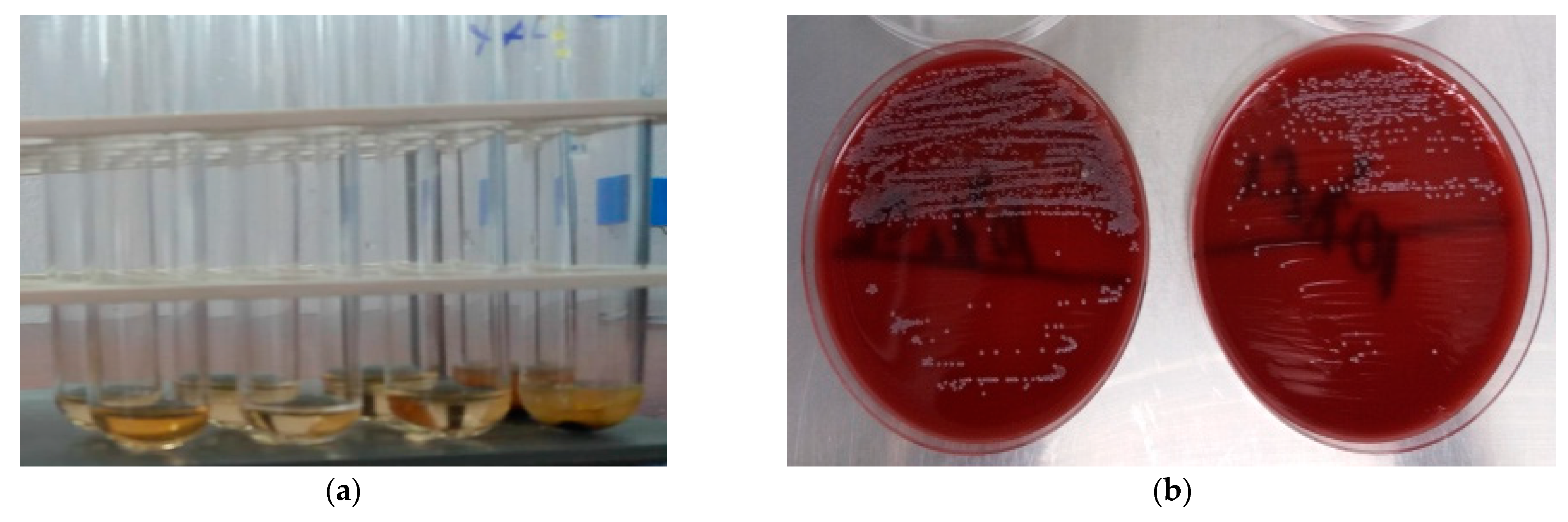
To determine the MIC and the MBC concentration, the broth dilution method was used, in accordance with EUCAST [44] and CLSI [45] guidelines. These standards provide specific recommendations regarding the preparation of microbial suspensions, culture media, and incubation conditions (temperature, time, and atmosphere). The MIC is defined as the lowest concentration of EO which completely inhibits bacterial growth, while the MBC refers to the lowest concentration capable of killing ≥ 99.99% of the bacterial population. The standardized bacterial suspension to a concentration of 0.5 Mac Farland was adjusted by dilution in sterile physiological saline to 105 bacteria/mL. In parallel, five dilutions of EOs were obtained in DMSO, then 100 µL of each dilution, 400 µL Mueller–Hinton broth with horse blood and ß-NAD and 500 µL bacterial suspension were added to the test tubes and incubated overnight at 37 °C. (Figure 2a).
To determine the MBC, 100 μL from the tubes showing no visible growth was subcultured on Columbia agar supplemented with sheep blood, which enables checking the viability of the remaining bacteria (Figure 2b). The plates were then incubated for 24 h at 37 °C. After incubation, the MBC (the appropriate dose necessary for complete eradication of viable bacteria from the initial inoculum) was recorded.

2.4. Statistical Analysis

Statistical analysis was performed using the Stats Kingdom online platform for descriptive statistics and also for statistical tests. All data is gathered in several Excel sheets, grouped in tables for descriptive calculations and also for generating visual elements (i.e., charts). The level of significance was set according to the purpose of each test.
Mean ± standard deviation (SD), variance (S2), interquartile range (IQR), and 95% confidence intervals (CI) are the descriptive statistics performed in this study. To assess the normality of data distribution, determining whether parametric or non-parametric analysis was appropriate, the Shapiro–Wilk (SW) and Kolmogorov–Smirnov (KS) tests were applied on tables needed from Excel files. Oils that had p-values different from normality (p < 0.05) were analyzed using non-parametric methods.
To evaluate relationships between chemical composition and antibacterial activity, the Spearman rank correlation (ρ) was used. This test measures the strength and direction of monotonic associations between variables (e.g., inhibition zone diameter, Shannon diversity index H′, and constituent abundance), without assuming normality.
The Kruskal–Wallis test, a non-parametric analysis, was used to compare the relative abundances of shared constituents among the eight essential oils. The test statistic (H) follows an approximate chi-square (χ2) distribution, with degrees of freedom (df = k − 1), where k is the number of groups. A significant p-value indicates that at least one group differs from the others.
Finally, a Principal Component Analysis (PCA) was applied to the GC–MS compositional dataset to visualize inter-oil variability and identify the compounds contributing most to chemical differentiation. For this PCA, JASP 0.95.4 software was utilized. The first two principal components (PC1 and PC2) were retained for interpretation, representing the major sources of variance.

3. Results

3.1. GC-MS Analysis of the Selected EOs

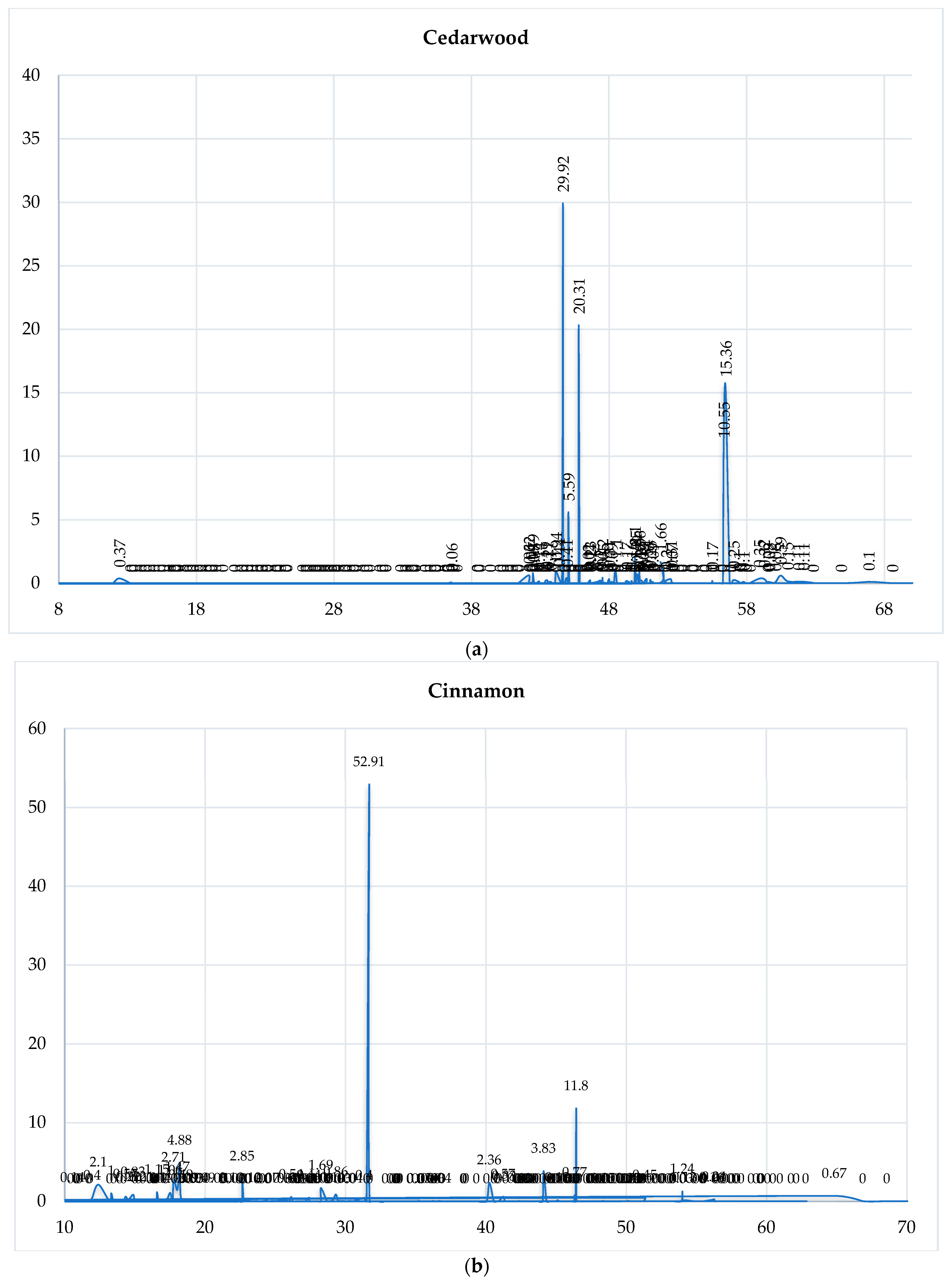
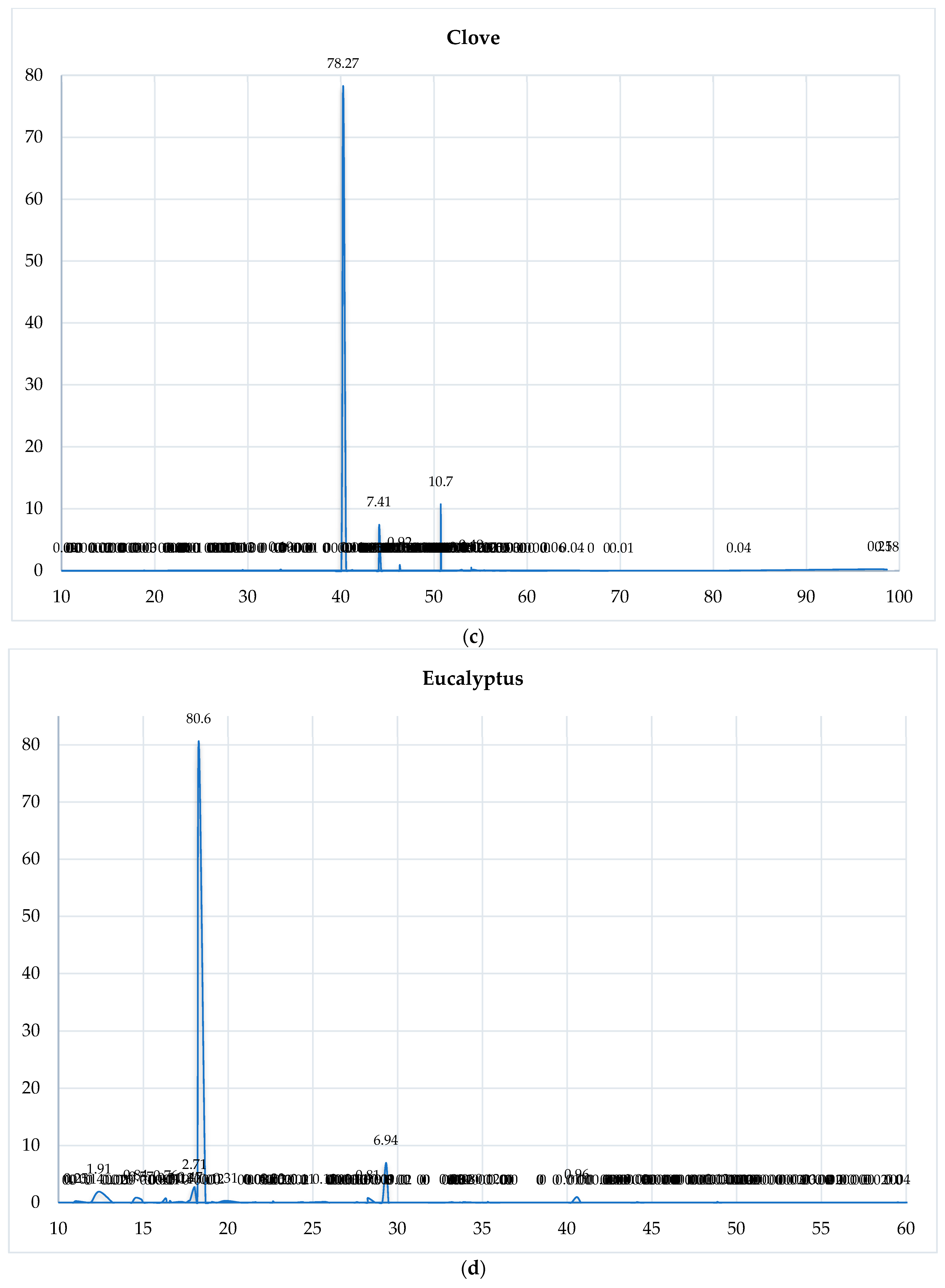
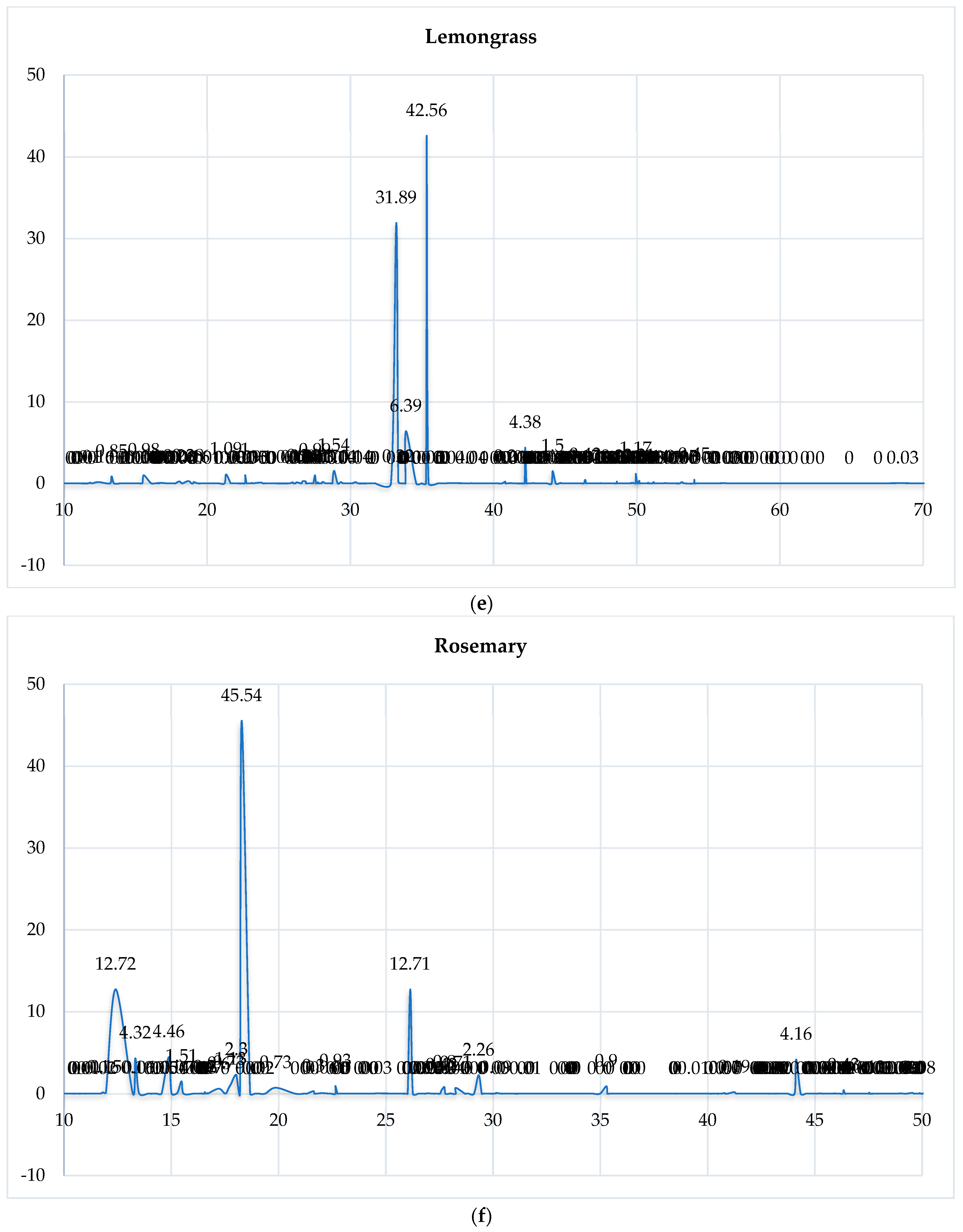
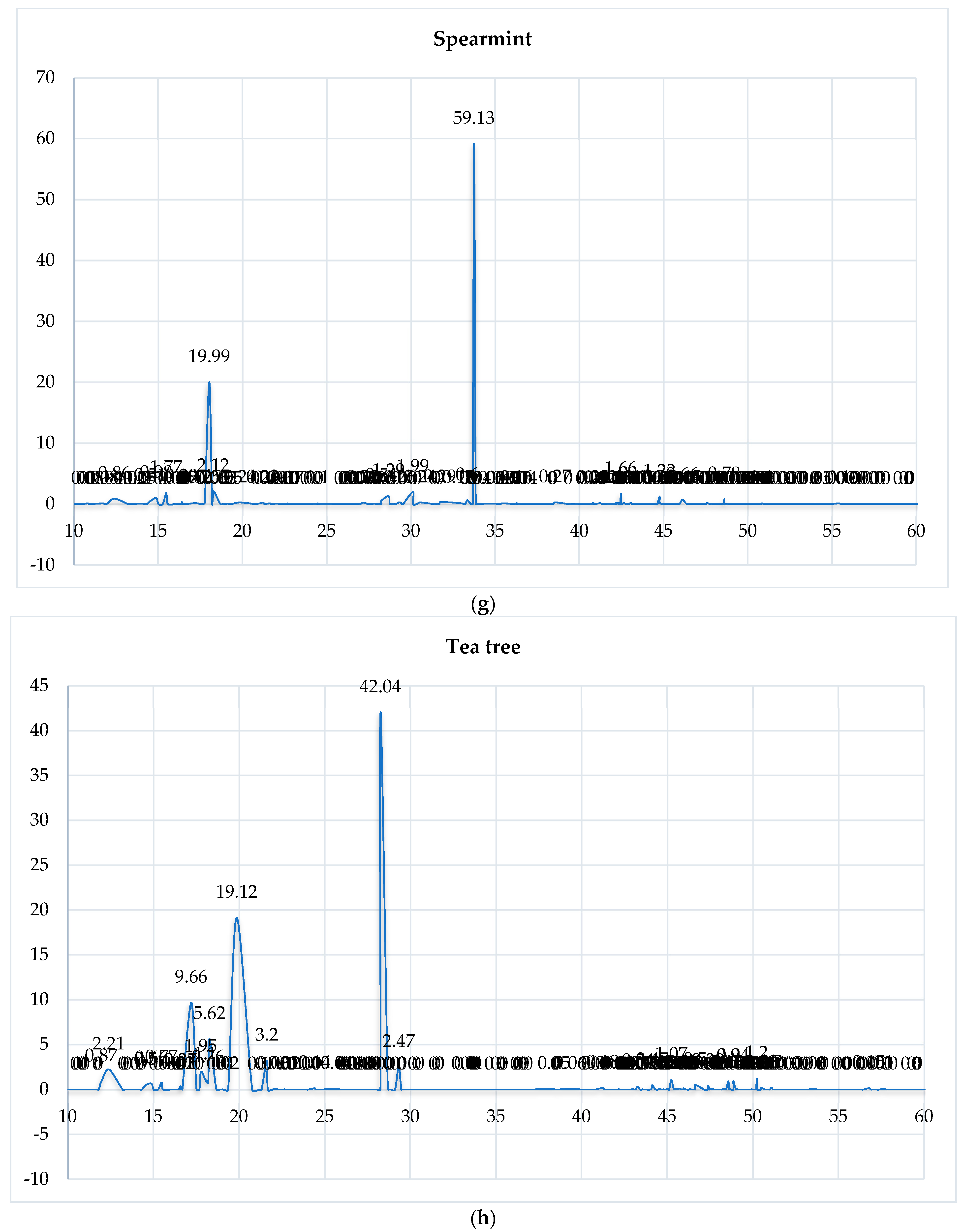
Table A1 shows the chemical composition of the eight selected EOs. Figure A1 depicts the individual chromatograms, reconstructed using the retention time (RT) and relative abundance (%) of all identified compounds obtained from GC–MS integration. The resulting plots represent semi-quantitative chromatographic profiles, illustrating the distribution of major constituents.

3.2. The IZ Determined by the Kirby–Bauer Method

The responsiveness of S. mutans strains at EOs was classified as: susceptible (IZ > 20 mm), intermediate (IZ: 15–19 mm), or non-susceptible (<15 mm).
As all eight selected EOs produced an IZ with a diameter greater than 20 mm against S. mutans, they are to be classified as susceptible.
Based on the IZ diameters, the highest antimicrobial efficacy was observed for Spearmint EO, with a mean IZ value of 41.33 mm, followed by Eucalyptus EO (39.33 mm), Tea tree EO with 32.11 mm, and Lemongrass EO with 31 mm. The next in descending order were Cinnamon bark EO (26.33 mm), Clove EO (24.89 mm), Rosemary EO (24.78 mm), and Cedarwood EO (23.56 mm) (Table 2). The mean IZ diameter for the positive control, Levofloxacin, was 19.89 mm, and the IZ for the negative control was 0.00 mm.

3.3. The MIC and MBC Determined by the Broth Dilution Method

The MIC and the MBC determined for the eight selected EOs are shown in Table 3.
Considering the mean MIC and MBC values, the Spearmint EO proved to be the most effective in inhibiting the growth of S. mutans, as well as in annihilating it, followed by the Eucalyptus EO, which showed the same MBC but a double MIC. Tea tree and Lemongrass followed, the less effective being Cinnamon, Clove, Rosemary and Cedarwood EOs.

3.4. Statistical Analysis

3.4.1. Descriptive Statistics

The IZ diameter measurements for each EO tested against the bacterial strain are shown descriptively in Table 4. There were nine independent observations (n = 9) in each EO group. The tested oils’ varying levels of antibacterial activity were indicated by the minimum and maximum IZ values, which varied from 22 to 44 mm.
Those with the largest mean IZs were Lemongrass (31.00 mm), Tea tree (32.11 mm), Eucalyptus (39.33 mm) and Spearmint (41.33 mm). When compared to the other EOs tested, these values show a noticeably stronger antibacterial effect. Under the same experimental conditions, Cinnamon, Clove, Rosemary, and Cedarwood showed lower mean IZs ranging from 23.55 mm to 26.33 mm, indicating lower antibacterial potency.
The accuracy and dependability of the measured effects are estimated by the 95% Confidence Intervals (CI) for the mean IZ. While slightly wider intervals for oils with smaller means, such as Cedarwood (22.77, 24.33), reflect minor variability within replicates, narrow CI ranges, such as those obtained for Eucalyptus (38.11, 40.54) and Spearmint (39.94, 42.71), indicate high measurement consistency.
The homogeneity of variance and repeatability of the IZ measurements were confirmed by the comparatively low standard deviations (SDs) for each group (ranging from 1.01 to 1.80 mm). Similar trends were seen in the variance (S2) values, with Cedarwood exhibiting the least variability (S2 = 1.02) and Spearmint the most (S2 = 3.25).
The symmetry of the data distribution within each group was validated by the interquartile ranges (IQRs) and quantile values (Q1, median, Q3). With IQRs ranging from 1 to 2 mm, it was clear that there were no noticeable outliers and that most IZ measurements were grouped closely around the central tendency.
The Shapiro–Wilk (SW) and Kolmogorov–Smirnov (KS) tests were used to determine normality. p-values for the majority of EOs were higher than 0.05, suggesting that there was no discernible deviation from normalcy in the distributions. Nonetheless, there were statistically significant departures from normalcy for Clove oil (SW = 0.02; KS = 0.01) and Cedarwood oil (SW = 0.05; KS = 0.004). As a result, non-parametric tests were taken into consideration for group comparisons in general, and these groups were handled cautiously in subsequent inferential analyses.
The quantitative basis for the comparative and inferential statistical analysis that follows is established by these descriptive results.

3.4.2. Chemical Diversity Analysis

To complement the biological findings, the chemical composition of each EO was analyzed based on its GC–MS chromatographic profile. The relative abundance of each identified compound was used to compute the Shannon diversity index (H′), providing a quantitative measure of chemical complexity and evenness within each oil.
The Shannon index values (Table 5) range between 0.85 and 1.72, indicating noticeable variability in compositional diversity across the tested oils. Clove, Cinnamon, and Eucalyptus exhibited the lowest H′ values (≤1.1), reflecting a strong predominance of a single compound—eugenol (78.3%, RT 40.26 min), trans-cinnamaldehyde (52.9%, RT 31.70 min), and 1,8-cineole (80.6%, RT 18.28 min), respectively. In contrast, Rosemary and Cedarwood displayed the highest chemical diversity (H′ > 1.6), consistent with a balanced distribution of numerous monoterpenes and sesquiterpenes such as camphor, α-pinene, and cedrol.
A negative relationship was observed between chemical diversity and antimicrobial potency. Oils dominated by a single phenolic or aldehydic constituent (low H′) generally exhibited stronger inhibitory effects, as reflected by their larger IZs. Conversely, more chemically complex oils demonstrated broader but less intense activity, suggesting potential synergistic but diluted antimicrobial effects.

3.4.3. Chromatographic Reconstruction and Comparison

For each EO, individual chromatograms were reconstructed using the RT and relative abundances (%) of all identified constituents obtained from GC–MS integration. The resulting plots (Figure A1) represent semi-quantitative chromatographic profiles, illustrating the distribution of major constituents rather than absolute detector responses. Although these graphs do not reflect the total ion current (TIC) in its raw form, they provide a reliable visualization of constituent elution order and relative dominance, which are the most relevant features for compositional comparison.
When compared with the TIC chromatograms provided by the manufacturer [46], the reconstructed profiles revealed consistent elution patterns and peak dominance, confirming the analytical validity of the approach. Minor differences in RT or apparent peak intensity were observed, which can be attributed to differences in instrument calibration, column type, or carrier gas flow rates. These discrepancies do not affect the qualitative interpretation of the data.
Overall, the reconstructed chromatograms accurately depict the chemical architecture and relative abundance patterns of each EO, enabling direct comparison across samples and with reference TICs. This approach offers a practical alternative when full detector signal data are unavailable, preserving the interpretive value of chromatographic information while allowing meaningful cross-validation with standard GC–MS profiles.

3.4.4. Correlation Between Chemical Composition and Antimicrobial Activity

To explore the relationship between chemical composition and antimicrobial performance, a correlation analysis was carried out between the mean IZ of each EO and two compositional indicators: the Shannon diversity index (H′) and the relative abundance of dominant constituents. Correlations were calculated using Spearman’s rank coefficient (ρ) to account for non-normal data distribution.
A weak, negative association was observed between chemical diversity and antimicrobial efficacy (ρ = −0.26, p = 0.53), suggesting that a higher number of detectable constituents does not necessarily enhance biological performance. Oils with simpler but chemically focused compositions often showed stronger inhibition effects. For example, Spearmint and Eucalyptus, characterized by high proportions of carvone and 1,8-cineole, exhibited greater IZs, whereas chemically complex oils such as Rosemary or Cedarwood demonstrated more modest activity.
When individual compounds were considered, carvone and 1,8-cineole displayed moderate positive correlations with antimicrobial potential (ρ = 0.58 and ρ = 0.44, respectively), while eugenol, the main constituent of Clove oil, showed a mild inverse relationship (ρ = −0.41). Although these associations did not reach statistical significance, they point to the likelihood that a few major compounds exert a dominant influence on antibacterial performance. Table 6 summarizes the Spearman correlation coefficients between the IZ, chemical diversity (H′), and dominant constituent abundances across the eight EOs.
Taken together, these findings support the hypothesis that chemical specificity, rather than compositional richness, better explains the observed biological effects, emphasizing the role of “driver molecules” in determining antimicrobial potency.

3.4.5. Comparative Statistical Analysis

Principal Component Analysis
Principal Component Analysis (PCA) was applied to the compositional dataset obtained by GC–MS to examine the chemical variability among the eight EOs and to identify the compounds that contributed most to their differentiation. The first two principal components (PC1 and PC2) explained 72.4% of the total variance, effectively capturing the main trends in chemical composition across all samples.
The analysis revealed three main compositional groups. The first group comprises Clove and Cinnamon, both dominated by phenylpropanoid derivatives, with eugenol and trans-cinnamaldehyde as their major constituents. The second group included Tea Tree, Eucalyptus, Spearmint, and Lemongrass, which shared high proportions of oxygenated monoterpenes, such as terpinen-4-ol, 1,8-cineole, and citral-related compounds. The third group consisted of Rosemary and Cedarwood, characterized by a predominance of sesquiterpenes, including camphor, cedrol, and α-cedrene, indicating a more balanced but chemically diverse composition.
The loading values showed that 1,8-cineole, carvone, and eugenol contributed most strongly to the first principal component, indicating that these compounds were major factors in distinguishing between oils with high concentrations of oxygenated monoterpenes and phenylpropanoids. In contrast, camphor and cedrol contributed negatively to PC1, being associated with the more structurally complex but less biologically potent oils.
Overall, the PCA results indicated that specific dominant compounds, rather than the overall number of constituents, played the primary role in defining the chemical identity of each EO. Oils rich in one or two key constituents exhibited clearer compositional distinction, aligning with the trends observed in their antibacterial activity.
Comparative Analysis of Shared Compounds
To statistically assess the chemical variability among oils, a Kruskal–Wallis test was applied to the constituents that were commonly detected across multiple EOs, including α-pinene, β-pinene, limonene, 1,8-cineole, and eugenol. The analysis revealed significant inter-oil differences for several of these shared constituents (Table 7).
The most prominent variations were observed for α-pinene (H = 18.74, p < 0.001), limonene (H = 13.51, p = 0.012), 1,8-cineole (H = 15.66, p = 0.004), and eugenol (H = 21.34, p < 0.001). These differences confirm a high degree of chemical heterogeneity among the tested essential oils, consistent with the clustering observed in the PCA.
Taken together, these results indicate that the relative abundance of specific monoterpenes and phenylpropanoids exerts a more decisive influence on antibacterial activity than overall compositional diversity. This reinforces the interpretation that the biological efficacy of EOs is largely driven by the presence and dominance of key active compounds, rather than by the total number of constituents.

4. Discussion

According to the literature, among the 250 commercially available EOs, about a dozen possess high antimicrobial potential, being a potential alternative to synthetic compounds. A review authored by El-Tarabily provides “evidence that EOs could be an essential component in the fight against antibiotic resistance due to their efficient anti-biofilm activity” [47].
The primary antimicrobial mechanisms of EOs are based on their hydrophobic nature, which enables the penetration of the lipid bilayer of the bacterial cell membrane, leading to leakage of vital components, the inhibition of metabolic processes, and the induction of oxidative stress. Other important mechanisms are due to their capacity to interfere with bacterial Signalling pathways that regulate quorum sensing, preventing the formation of biofilms, to inhibit the synthesis of proteins and nucleic acids, essential for bacterial replication and function and to inhibit the synthesis of the enzyme responsible for generating energy, which is vital for cellular processes [48].
Atazhanova et al., in a recently published comprehensive review, claim that “it has been demonstrated in vitro” that EOs have a marked inhibitory effect on the synthesis of S. mutans polysaccharide matrices and their adhesion to tooth surfaces. The most effective EOs cited are the following: Tea tree, Peppermint, Spearmint, Clove, Oregano, Thyme, Cinnamon, Rosemary, Chamomile, Thai Lime, Bitter orange, Hinoki Cypress, Lemongrass, Eucalyptus, Juniper and Hyssop [49].
According to the extensive literature review of Winska et al. the following EOs display antibacterial effects against S. mutans: Thyme, Peppermint, Chinese cinnamon, Eucalyptus globulus, Sage, and Tea tree [50].
The review of Freires et al. states that “EOs extracted from a variety of aromatic plants worldwide can be considered promising sources of bioactive molecules effective against caries-related microorganisms, particularly S. mutans”, among the most effective being Coriander, Rosemary, Peppermint, and Basil [51].
The study of Chaudhari et al. aimed to assess the antimicrobial activity of nine commercially available EOs against S. mutans, namely Wintergreen, Lime, Cinnamon, Spearmint, Peppermint, Lemongrass, Cedarwood, Clove and Eucalyptus and concluded that the most efficient were Cinnamon, Lemongrass, and Cedarwood, followed by Clove and Eucalyptus. According to their results, Wintergreen, Lime, Peppermint and Spearmint showed no antibacterial activity [52].
Another comprehensive study aimed to assess the antimicrobial effect of twenty-three types of EOs against S. mutans, P. gingivalis and L. rhamnosus, using the disc diffusion method. Thirteen EOs were effective against all three strains. Seventeen EOs were effective against S. mutans KCTC 3065: Myrrh, Ginger, Pine, Basil, Carrot seed, Patchouli, Palmarosa, Ylang, Grapefruit, Cypress, Lemongrass, Cedarwood, Cinnamon, Peppermint, Lavender, Eucalyptus, Tea tree, and Carrot seed. Myrrh, Basil, and Carrot seed showed high antimicrobial activity, with an IZ of 18.34 mm, 18.08 mm, and 17.91 mm, respectively. Rosemary, Neroli, Marjoram, Lemon, Mandarin, and Spearmint showed no effect against S. mutans [53].
The study of Alexa et al. revealed the antibacterial effect exercised by Clove, Bergamote, and Orange EOs on S. mutans. No effect was recorded for Cinnamon. Based on these data, they developed natural emulsion-type preparations with application in dental medicine [54].
EOs which have demonstrated antimicrobial efficacy against dental biofilm, particularly S. mutans, were attempted to be incorporated in different dental hygiene products such as toothpastes, mouthwashes and gels, alone, in combinations with other EOs or with other antibacterial components, such as CHX or xylitol [49,55,56,57,58].
Based on the available literature data, eight EOs with certain antimicrobial potential, more or less investigated so far, were selected for this study (Table 1).
Those with the largest mean IZs were Lemongrass (31.00 mm), Tea tree (32.11 mm), Eucalyptus (39.33 mm) and Spearmint (41.33 mm). When compared to the other EOs tested, these values show a noticeably stronger antibacterial effect. Under the same experimental conditions, Cinnamon, Clove, Rosemary, and Cedarwood showed lower mean IZs ranging from 23.55 mm to 26.33 mm, indicating lower antibacterial potency.
The CG-MS profile shows noticeable variability in compositional diversity across the tested oils. A few major compounds, such as carvone, 1,8-cineole and eugenol, exert a dominant influence on antibacterial performance.
The high antimicrobial activity of Spearmint, Eucalyptus, Tea tree, and Lemongrass EOs is primarily attributed to their monoterpenes content (carvone and limonene in Spearmint; 1,8-cineole, alpha-terpineol, and limonene in Eucalyptus; terpinen-4-ol, alpha-pinene, gama-terpinene and 1,8-cineole in Tea tree; and citral (geranial and neral) in Lemongrass).
The next in descending order of antibacterial efficacy against S. mutans is Cinnamon, due to its high content in phenylpropranoids (trans-cinnamaldehyde, trans-cinnamyl acetate and eugenol), followed by Clove, rich in eugenol, and Rosemary, which contains terpenes and terpenoids (1,8-cineole, alpha-and beta-pinene, and camphor). The least effective of the selected EOs was found to be Cedarwood, rich in sesquiterpenes such as alpha-cedrene, cis-thujopsene, widdrol and cedrol.
Clove, Cinnamon, and Eucalyptus showed a strong predominance of a single compound—eugenol (78.3%, RT 40.26 min), trans-cinnamaldehyde (52.9%, RT 31.70 min), and 1,8-cineole (80.6%, RT 18.28 min), respectively. In contrast, Rosemary and Cedarwood displayed the highest chemical diversity, consistent with a balanced distribution of numerous monoterpenes and sesquiterpenes such as camphor, α-pinene, and cedrol. The relative abundance of specific monoterpenes and phenylpropanoids exerts a more decisive influence on antibacterial activity than overall compositional diversity, the biological efficacy of EOs being largely driven by the presence and dominance of key active compounds, rather than by the total number of constituents.
The statistical trends observed across the PCA, Kruskal–Wallis, and correlation analysis converge toward a coherent interpretation of chemical–biological relationships. Dominant constituents such as eugenol, 1,8-cineole, carvone, and trans-cinnamaldehyde emerged as functional “driver molecules,” each defining the chemotype and antibacterial strength of their respective oils. Conversely, sesquiterpene-rich oils (Rosemary, Cedarwood) exhibited broader but milder profiles, reflecting complex yet less potent mixtures. The observed inverse relationship between the Shannon diversity index (H′) and IZ diameter indicates that EOs with a narrower chemical composition, dominated by one or two principal constituents, tend to exhibit stronger antibacterial effects. In contrast, oils containing a large variety of minor compounds show weaker inhibition, despite their greater compositional richness. This finding suggests that biological efficacy is primarily driven by compositional specificity rather than molecular abundance, emphasizing that the type and dominance of key molecules are more critical than the total number of constituents. From a chemometric standpoint, such evidence highlights the importance of integrating GC–MS compositional profiling with antimicrobial performance metrics. performing so enables the identification of marker compounds that reliably predict bioactivity, thereby supporting the rational standardization and quality control of EOs intended for antimicrobial applications.
Spearmint (Mentha spicata) EO, obtained from the leaves, stems and flowering tops of a perennial plant belonging to the mint family, is traditionally used as a carminative, antispasmodic, diuretic, antibacterial, antifungal, and antioxidant agent, and for the treatment of respiratory tract problems, colds and flu, hemorrhoids, and stomach ache [59].
The GC-MS analysis revealed a high content of carvone (59.13%) and limonene (19.99%). In line with our findings, both carvone and limonene monoterpenes have been, although in variable proportions (40.8% and 20.8%, respectively [59]; 56.6% and 27.3%, respectively [60]), consistently reported as the most abundant constituents of this EO.
Compared to Peppermint (Mentha piperita) EO, Spearmint has been much less investigated. Spearmint has been mentioned to possess an inhibitory effect on S. mutans biofilm formation by the recent comprehensive systematic review of Atazhanova et al. [49].
A recent study aiming to evaluate the inhibitory activity of the commercially available Spearmint EO on S. mutans ATCC 25175 biofilms in vitro, emulating dental plaque conditions, has shown that it exhibits antimicrobial effects (MIC 1.8484 mg/mL) and may have great potential for the development of pharmaceutical and sanitary products for oral health [61].
However, the study by Chaudhari et al., aiming to evaluate the in vitro antibacterial efficacy of nine commercially available EOs against S. mutans ATCC 25175, stated that Spearmint EO, as well as Wintergreen, Lime, and Peppermint EOs, showed no antibacterial activity, with an IZ of 0 mm [52].
The same result was obtained by Park et al., their investigation concluded that Spearmint has no inhibiting effect on S. mutans KCTC 3065 [53].
The results of our study are in line with Landeo–Villanueva et al. findings [61] and opposite to those of Chaudhari et al. [49] and Park et al. [50], as our assessment determined that Spearmint EO has the highest antimicrobial potential against S. mutans, among the eight EOs tested, in terms of IZ, MIC and MBC.
The Eucalyptus genus includes nine hundred species of evergreen flowering plants, the EO being extracted from wood, leaves, roots, flowers, and fruits. Eucalyptus globulus is the most frequently used oil type; however, all Eucalyptus species are accounted for their antibacterial, anti-inflammatory and analgesic properties, being primarily used in the treatment of colds, flu, and other respiratory infections, as well as in rhinitis and sinusitis. When applied topically or in massage oils, it helps alleviate muscle and joint pain. Furthermore, it has shown potential in supporting wound healing. When referring to oral health, eucalyptus can freshen breath and fight oral bacteria. Eucalyptus radiata, which was the EO assessed in this study, serves a comparable role to Eucalyptus globulus [62].
The 1,8-cineole (eucalyptol) is the primary element shared by all Eucalyptus species, the main difference consisting in its quantity [63].
1,8-cineole is an oxygenated monoterpene, and, along with other terpenic compounds, has proven to exhibit strong cytotoxic and antibacterial activity against Gram-negative and Gram-positive species, as well as antifungal activity against Candida albicans [64].
According to our measurements, the 1,8-cineole content represents 80,60% of the assessed EO, Eucalyptus radiata, followed by limonene (2.71%) and alpha-pinene (1.01%). The 1,8-cineole content is higher compared to the values reported in other studies, while the alpha-pinene is much lower. Landeo–Villanueva et al. reported a content of 1,8-Cineole of 65.83% and 18.15% alpha-pinene [61], while Goldbeck et al. reported concentrations of 71.05% and 8.30%, for 1,8-Cineole and alpha-pinene, respectively, for Eucalyptus globulus EO [65].
Čmiková et al. reported a composition of 1,8-cineole (63.10%), p-cimene (7.70%), alpha-pinene (7.30%), alpha-limonene (6.90%), gamma-terpinene (3.60%). According to their study, Eucalyptus globulus has a strong antifungal effect (Candida strains) and antibiofilm activity [63].
Athanasova et al. [49] and Winska et al. [50] also mention the antibacterial effects of Eucalyptus against S. mutans.
The MIC value of Eucalyptus EO against S. mutans ATCC 25175 reported by Landeo–Villanueva et al. is 1.917 mg/mL [61]. The IZ value for Eucalyptus EO, reported by Chaudarri et al., is 3.44 mm [48], ten times lower than the IZ measured in this study (39.33 mm), while Park et al. reported an IZ of 14.75 mm [53].
Eucalyptol is often used as an ingredient in mouthwashes and dental products, due to its fragrance, antimicrobial properties and specific activity against oral bacteria, S. mutans included [55].
Tea tree (Melaleuca alternifolia), extracted from leaves and terminal branches, is well known for its topical antibacterial, antiseptic and anti-inflammatory effects, and is commonly used to treat acne, athlete’s foot, lice, nail fungus and insect bites, and to reduce congestion. Tea tree oil also demonstrated strong antibacterial activity against multidrug-resistant strains and showed enhanced synergistic effects with oxacillin [66].
The GC-MS analysis performed by Oliva et al. found terpinen-4-ol, 1,8-cineole, alpha-pinene, and gama-terpinene to be the most abundant constituents (35.4%, 15.2%, 12.4%, 9.8%, respectively) [66]. The composition of the EO assessed in this study revealed the same constituents (terpinen-4-ol 42.04%, 1,8-cineole 5,62%, alpha-pinene 2.21%, gama-terpinene 19.12%), together with smaller amounts of terpinolene, limonene, para-cymene, aromadendrene and delta-cadinene. It should be noted that individual Melaleuca species have a very diverse content [49].
Due to its high amount of terpenes, Tea tree EO exhibits oral bactericidal activity, prevents plaque formation, reduces dental caries, and alleviates gum bleeding. It is also used in the treatment of herpes simplex, aphthous ulcers, toothaches, periodontitis, oral candidiasis, angular cheilitis, and prosthetic stomatopathy [67].
Tea tree is widely acknowledged for its antimicrobial effect against S. mutans, being frequently mentioned in the literature [49,50].
Park et al. reported an IZ of 17.89 mm for Tea tree against S. mutans [52], much lower compared to the IZ value measured in this study: 32.11 mm.
The study of Song et al. showed that Tea tree EO can reduce S. mutans growth, disrupt biofilm formation, and destroy the integrity of the bacterial cell membrane, suggesting that Tea tree oil is a potential anticariogenic agent. The MIC and MBC values reported were 0.125% and 0.25%, respectively, the bacterial inhibition rate being concentration dependent [68].
Yang et al. showed that a blend of Tea tree oil and Mastic oil significantly inhibited the growth of S. mutans, starting from a concentration of 1.0%, suggesting its potential use as an effective antibacterial agent for dental caries [69].
According to numerous studies, it can be included as an adjuvant in the composition of toothpastes, mouthwashes, coated dental floss, gels, and toothpicks [38,70,71,72].
The study of Salvatori et al. concluded that a mouthwash made from Tea tree oil is effective, being a valuable non-toxic adjunct in the management of gingivitis [73].
The same conclusion was drawn by Khalil et al., who stated that a Tea tree oil mouthwash exhibits antimicrobial activity and may be utilized as a natural substitute to chlorhexidine [74]. Mouthwashes containing 0.2–0.5% Tea tree oil were described by several studies as being effective in reducing dental plaque accumulation [75,76,77].
Lemongrass (Cymbopogon flexuosus) EO, extracted from the leaves and aerial parts of the plant, is known as an insect repellent and for its culinary uses, and also accounts for its antimicrobial, antioxidant, antifungal, antiviral and anti-inflammatory properties, being effective against a wide range of pathogens, including antibiotic-resistant strains [78].
It has been cited for its efficiency against S. mutans in the comprehensive review of Athanasova et al. [49].
It is used in the treatment of arthritis, headaches, digestive issues, infections, antiseptic wound care, and diabetes control. Its role in combating cancer has also been studied lately [79,80].
As stated by Mukarram et al., Lemongrass EO is a cocktail of various terpenes and terpenoids, its major components being geranial (39.05%), neral (28.20%), geraniol (6.33%), geranyl acetate (2.46%), isogeranial (1.49%), citronellal (1.22%), citronellol (1.22%) and isoneral (1.11%), making up about 70–80%. The same authors point out that the antimicrobial activity of Lemongrass is extensively attributed to citral (isomeric mixture of geranial and neral), which can also be used as a quality marker [79].
The GC-MS analysis performed in this study revealed higher amounts of geranial 42.56%, and neral 31.89%, compared to Mukarram et al. [79], which validate the quality of the assessed oil product, and other constituents such as geraniol (6.39%), geranyl-acetate (4.38%), trans-isocitral (1.54%), 4-nonanone (1.09%), linalool (1%), beta-caryophyllene (1.50%), gamma-cardinene (1.17%). The study of Mitrakul et al. reported higher values for the main components of Lemongrass EO: geranial 52.88%, neral 38.13%, and geraniol 3.66% [81].
The IZ value reported by Park et al. for Lemongrass EO against S. mutans is 10.65 mm [53], almost the same as the value measured by Chaudhari et al. (10.07 mm) [52], while our measurements revealed a higher IZ of 31 mm.
The study of Mitrakul et al. aimed to assess the susceptibility of S. mutans ATCC 25175 to different oral spray formulations containing 6%, 4%, and 2% Lemongrass EO. They concluded that all oral spray formulations showed excellent antibacterial activity, exhibiting an inhibitory effect on biofilm formation [81].
Another study, by Tofiño et al., tested the in vitro antibacterial effect of Lemongrass and Lippia Alba EOs against S. mutans ATCC 35668. The Lemongrass EO showed eradication activity against S. mutans biofilms and null cytotoxicity, evidencing its potential in treating and preventing dental caries [82].
A study by Oliveira et al. tested the antimicrobial activity of Lemongrass oil against A. naeslundii, L. acidophilus, S. gordonii, S. mitis, S. mutans, S. sanguinis and S. sobrinus, demonstrating its inhibitory effect on all tested species [83].
Another study by Rego et al. investigated the effect of Lemongrass oil on S. mutans biofilm, indicating inhibition of microorganisms (a MIC value of 0.04 mg/mL) [84]. According to our measurements, the MIC recorded for Lemongrass was 20 µg/mL, which corresponds to 0.02 mg/mL.
A recent study of Mouta et al. aimed to evaluate the effect of Lemongrass EO and its association with chlorhexidine on cariogenic biofilm composition and acidogenic level. They found coincident values of MIC and MBC: 3.12 µL/mL for Lemongrass and 0.080 µL/mL for chlorhexidine. Their results support the association of Lemongrass EO with chlorhexidine for treating polymicrobial biofilms. Their findings might allow for the use of mouthwashes for a shorter period, which may reduce undesirable effects [85].
The MIC and MBC values reported by Mouta et al. [85] are different from the ones measured by us for Lemongrass EO: MIC 20 µL/mL, MBC 40 µL/mL.
Cinnamon EO, obtained from the bark, leaves, fruits and flowers of Cinnamomum verum trees, has a long history of medicinal and culinary use. It has been traditionally employed to treat numerous conditions, including erectile dysfunction, painful menstruation, cold, kidney deficiency, respiratory issues, dizziness, eye redness, abdominal discomfort, and hernia. Modern research has revealed its wide range of pharmacological effects, including antibacterial (against Gram-positive, Gram-negative and fungi), anti-inflammatory, antioxidant, anti-anxiety, anti-tumour, and hypoglycemic activities [86].
Cinnamon EO is also accounted for its antibacterial, antiseptic, and antifungal applications in oral health [87,88].
The main components of Cinnamon EOs are cinnamaldehyde (62–73% to 90%) in bark EO, eugenol (85.7–87.3%) in leaves, cinnamyl acetate (36.6%) and smaller amounts of caryophyllene (1.0%) in fruits and flowers [88].
The CG-MS analysis of the Cinnamon Bark EO revealed a high content of phenylpropranoids: 52.91% cinnamaldehyde, which is lower than the average value (62–73% to 90%) reported by Nabavi et al. [88], 11.80% cinnamyl acetate, 2.36% eugenol, and terpenes: 4.88% beta-phellandrene, 3.83% caryophyllene, 2.85% linalool, 2.71% para-cymene, 2.10% alpha-pinene.
Cinnamon is one of the EOs mentioned in both Athanasowa et al. [49] and Winska et al. [50] reviews as having an antimicrobial effect on S. mutans. A recent review by Touati et al. mentions potent activity against clinically relevant biofilms of cinnamon EOs, including those formed by multidrug-resistant strains [89].
According to the study of Atisakul et al., Cinammon Bark EO exhibits the greatest capacity to inhibit growth and eradicate S. mutans, with MIC and MBC values of 0.039%, when compared to Clove EO (MIC of 0.078% and MBC of 0.156%) [90].
Cinnamon EO also showed the highest activity against S. mutans (IZ 12.51 mm) of the nine EOs compared in the study of Chaudhari et al., followed by Lemongrass oil (10.07 mm) and Cedarwood oil (7.42%) [52]. The IZ value measured in our study for Cinnamon EO is higher: 26.33 mm, while Park et al. measured an IZ of 12.51 mm [53].
Wiwattanarattanabut et al. also reported good antimicrobial properties of cinnamon EO against two cariogenic bacteria: S. mutans KPSK and Lactobacillus casei, with an IZ diameter of 32.17 mm for S. mutans [91].
On the contrary, the study of Alexa et al. stated that, among four tested EOs, only the Cinnamon EO did not prove to have antibacterial properties against S. mutans [54].
According to Yanakiev’s review on Cinnamon’s effects in dentistry, it shows significant antimicrobial activities against oral pathogens, and the attempts made to include it in toothpastes, mouthwashes, denture-cleansing solutions and even specific treatments for toothaches and post-extraction care are supported by its properties [92].
Clove (Eugenia caryophyllata) EO is extracted from the flower buds, leaves and stems of the Syzygium aromaticum tree, and has long been used in food as a flavouring. Its primary constituents are phenylpropanoids, such as eugenol, carvacrol, thymol, and cinnamaldehyde. Among these, eugenol, well known for its antimicrobial properties, represents 70–80%. Other than its antibacterial effect, clove has anti-inflammatory and antioxidant properties. Traditionally used to address digestive issues, its potential as an antidiabetic medication and anticancer activity have also been studied. In dentistry, it is used to treat toothaches, relieve pain, and soothe sore gums, due to its anesthetic properties [49,93].
According to the GC-MS, the Clove EO used in this study has a high content of eugenol (78.27%) and 10.70% eugenol acetate. It also contains 7.41% beta-caryophyllene sesquiterpene, which is also a usual compound.
The in vitro study of Jafri et al. showed that Clove oil and eugenol eradicate S. mutans MTCC497 and S. aureus MTCC3160 biofilm cells [94].
The study of Chaudhari et al. also revealed a good activity of Clove EO against S. mutans, with an IZ of 6.6 mm [52]. However, the IZ value is much lower compared to the IZ value measured in this study (24.89 mm).
According to Atisakul et al. Clove EO shows a MIC of 0.078% and an MBC of 0.156% against S. mutans [90].
Another in vitro study demonstrated that clove EO inhibits the decalcification and/or may promote the remineralization caused by apple acidic beverages [95].
Clove EO, due to its high eugenol content, is a popular ingredient in dental products, such as toothpastes, mouthwashes and temporary dental fillings. The numerous studies which demonstrate the antimicrobial effect of clove and eugenol against S. mutans support its use as a therapeutic agent in preventing plaque formation and dental caries [96,97,98,99].
Alexa et al. developed natural emulsion-type preparations with application in dental medicine, containing Clove, Bergamote, and Orange EOs and demonstrated their effectiveness on S. mutans [54].
De Oliveira Carvalho et al., in their study, stated that Clove, Oregano, Thyme, and Cinnamon EOs may be added to fluoride-free toothpastes to enhance inhibitory effects against dental bacteria [56].
Rosemary (Rosmarinus officinalis) EO is obtained from the leaves, flower buds and stems of the plant. Rosemary has been used in folk medicine to alleviate conditions such as headache, stomach ache, rheumatic pain, epilepsy, nervous agitation, hysteria, depression, as well as physical and mental fatigue. Lately, noticeable scientific interest has been focused on the therapeutic and medicinal properties of rosemary and its compounds, numerous studies advocating its anti-inflammatory, antioxidant, anti-nociceptive, neuroprotective, antidepressant, anti-hysteric, and ameliorative of memory and mental fatigue properties [100,101,102].
Its main constituents are predominantly phenolic di- and triterpenic compounds and terpenoid hydrocarbons. The average primary terpene compounds and their oxygenated derivatives include: 1,8-cineole (15–55%), alpha-pinene (9–26%), camphor (5–21%), camphene (2.5–12%), and smaller amounts of borneol (1.5–5%), beta-pinene (2–9%), and limonene (1.5–5%) [103].
The GC-MS of the Rosemary EO used in this study revealed a comparable content of 1,8-cineole (45.54%), alpha-and beta-pinene (12.72 and 4.46%, respectively), camphor (12.71%), camphene (4.32%), beta-caryophylene (4.16%), limonene (2.30%), and only 0.8% borneol.
Athanasova et al. [49] and Freires et al. [51], based on the reviewed literature, advocated the antimicrobial effect of Rosemary EO against S. mutans.
On the contrary, the study of Park et al. found that Rosemary EO has no effect on S. mutans [53], while Kucia et al. showed that Rosemary EO has antibacterial activity against bacteria causing dental caries and periodontal diseases, such as S. mutans, S. sanguinis, S. pyogenes and P. gingivalis. Being a natural disinfectant, it is often used as a natural component of mouthwashes, helping to remove bad breath. It can prevent gingivitis, cavities, and biofilm formation. Due to its astringent and gentle refreshing effect, it also accelerates wound healing [104].
Based on their findings, which showed that rosemary extract inhibited the growth of S. mutans and showed anti-biofilm effect, Yea et al. tested different formulations of rosemary extract-containing toothpaste and concluded that it inhibits early biofilm formation of S. mutans, potentially preventing dental caries [105].
Valones et al. investigated the action of a toothpaste containing rosemary extract and concluded that it effectively reduced the risk of gingival bleeding and prevented the increase in plaque formation, compared to a conventional toothpaste [106].
Cedarwood (Juniperus virginiana) is a coniferous tree and should not be mistaken with other species also classified as cedarwood (Cedrus atlantica, Cedrus deodara, etc.), each one with its own unique characteristics and uses. The EO is extracted from the wood chips and sawdust. Known for its calming and stress-reducing properties, potentially aiding with anxiety, insomnia, and depression. It may also have antiseptic, astringent and anti-inflammatory effects. However, its antibacterial properties have been poorly investigated, compared with other cedarwood species, as it can be toxic in certain conditions. Cedarwood EO is mainly used for aromatherapy and topical applications, providing a wide range of benefits for the skin [107].
The GC-MS carried out by Zhang et al. revealed a content of alpha-cedrene (28.11%), beta-cedrene (7.81%), thujopsene (17.71%) and cedrol (24.58%) [107].
Korona–Glowniak et al. emphasize that no monoterpenoids have been identified in Cedarwood EO, almost 76% of the components being sesquiterpene hydrocarbons, while the other compounds are sesquiterpene alcohols. The most characteristic compounds found in this EO are alpha-cedrene and thujopsene. Out of the twenty-six different commercial EOs examined in vitro by determining the MIC for the reference strain H. pylori ATCC 43504, the most active was Cedarwood (Juniperus virginiana), advocating for its potential antimicrobial effect [108].
The GC-MS carried out in this study revealed the following main components, all sesquiterpenes: 29.90% alpha-cedrene, 5.59% beta-cedrene, 15.36% cedrol, 20.31% cis-thujopsene, 10.55% widdrol.
The study of Kim et al. investigated the effect of biologically active constituents extracted from Juniperus virginiana leaves against Bifidobacterium bifidum, B. longum, Clostridium perfringens, Escherichia coli, Lactobacillus acidophilus, L. casei, and S. mutans, using the impregnated paper disc agar diffusion method. The observed inhibitory activity of the Juniperus virginiana leaf extracted materials against S. mutans was moderate, but it may be considered as an indication of one of its pharmacological actions [109].
Cedarwood EO has not been acknowledged for its antimicrobial properties and is not intended for dental use, as it has no proven benefits in this regard.
Natural products are not always necessarily safe, and dosages can be important. As EOs are highly concentrated chemical compounds, if used improperly, they can be toxic and cause adverse effects, particularly through ingestion, excessive inhalation, or undiluted topical application. The risks vary within large limits by oil type, concentration, and individual sensitivity [110,111].
Usually, EOs are toxic only if ingested in large amounts. Tea tree and Eucalyptus should never be ingested, as they can cause severe health problems and even be life-threatening if swallowed. Eucalyptus oil is considered highly toxic because of its content of 1,8-cineole; ingestion of ≥5 mL pure oil can lead to severe symptoms, being extremely dangerous and potentially fatal [112].
Despite the fact that relatively limited data are available on its safety and toxicity, Tea tree EO is also considered toxic when ingested in higher doses and can cause serious adverse effects, leading to liver damage, collapse, or death [113].
Side effects of Tea tree oil mouthwashes were minor, with burning sensation most frequently reported, although this was also reported with other mouthwashes tested. However, it is of utmost importance to further assess the safety of Tea tree oil treatments to better understand the risks involved in using products which contain it [114,115].
As for Cedarwood (Juniperus virginiana), swallowing it is considered extremely dangerous and can cause severe symptoms, such as burning in the stomach, convulsions, coma, or even death [116].
Most commercially sold essential oils are not intended for internal consumption and are not regulated for that purpose. Certain EOs, including Spearmint, Cinnamon bark, Clove, Lemongrass, and Rosemary, are; however, marketed as food supplements and intended for internal use, being considered safe for consumption in small amounts or diluted [117,118,119,120,121]. For instance, Clove oil is considered safe if its level does not exceed 0.06% [121].
However, the tiny amounts used in different types of dental products, such as toothpastes or mouthwashes, are significantly lower compared with an undiluted EO [122].
The two major worldwide EO producers, Young Living (Lehi, UT, USA) and doTERRA (Pleasant Grove, UT, USA), have developed and marketed their own lines of dental products, with various EO content, including Spearmint, Cinnamon, Clove, Rosemary, and Eucalyptus (radiata and globulus).
Numerous EOs have demonstrated antimicrobial, anti-inflammatory, and antioxidant properties that contribute to maintaining oral health. Although most of the in vitro and in vivo studies support their therapeutic potential, results are often quite controversial, with a certain EO being categorized as efficient against S. mutans by a number of studies, and with no efficiency by others. These controversial results may be attributed to a number of factors, such as the quality and the purity of the tested EO. To be more specific, the plant’s genetic makeup, the growing conditions (climate, soil, pesticides), how it was harvested and the time of harvest, the specific part of the plant used, the age of the plant, the extraction process, and the conditions under which the final oil is stored and handled to prevent adulteration and degradation [123].
However, clinical trials assessing the long-term efficacy and safety of EOs remain scarce. Future research should focus on dosage and formulations to facilitate proper integration of EOs into dental care products.
This study has several limitations. Being an in vitro study, it does not simulate the dental biofilm, and no determinations were made regarding the effects of the essential oils on bacterial biofilms, nor was their potential cytotoxicity assessed. Further studies to determine the optimal dosage, formulations, administration routes, long-term efficacy and possible side effects of EOs, exploring their interactions with other drugs, as well as their safety in different populations, are needed to facilitate proper integration of EOs into dental care products.

5. Conclusions

The eight selected EOs were characterized as susceptible to S. mutans, based on the measured IZ diameter. Spearmint and Eucalyptus showed the highest antibacterial potential with consistent IZ diameters and low variability, whereas Clove and Cedarwood displayed lower inhibition and a non-normal data distribution.
Following the MIC and MBC determination, the most significant result was obtained for Spearmint EO, followed by Eucalyptus, Tea tree, Lemongrass, Cinnamon, Clove, Rosemary, and Cedarwood.
The biological efficacy of EOs is largely driven by the presence and dominance of key active compounds, rather than by the total number of constituents. A higher number of detectable constituents does not necessarily enhance biological performance. The dominant constituent identity and concentration play a more decisive role in determining the biological activity than overall chemical richness. Oils with simpler but chemically focused compositions showed stronger inhibition effects, as Spearmint and Eucalyptus, which are characterized by high proportions of carvone and 1,8-cineole. These two oils exhibited greater IZs, whereas chemically complex oils such as Rosemary or Cedarwood demonstrated more modest activity. Nonetheless, the presence of multiple secondary components may still contribute to synergistic or stabilizing effects on antimicrobial behaviour.
The PCA supports the fact that specific dominant compounds, rather than the overall number of constituents, play the primary role in defining the chemical identity of each EO. Oils rich in one or two key constituents exhibited clearer compositional distinction, aligning with the trends observed in their antibacterial activity. Chemical specificity, rather than compositional richness, better explains the antimicrobial effects.
In conclusion, the eight selected EOs show antimicrobial activity against S. mutans, making them potentially valuable in the prevention and treatment of dental caries.

Author Contributions

Conceptualization, L.-C.R. and A.R.; methodology, L.-C.R. and A.R.; validation, L.-C.R., A.R., A.A.M. and S.D.; formal analysis, C.V.T.; investigation, I.M., L.-C.R., A.R., A.A.M. and S.D.; resources, I.M., A.R. and C.V.T.; writing—original draft preparation, L.C.A., I.M., C.V.T., L.-C.R., A.A.M., A.R. and S.D.; writing—review and editing, L.C.A. and I.M.; supervision, S.D., A.A.M. and L.-C.R.; project administration, I.M., A.A.M. and S.D. All authors have read and agreed to the published version of the manuscript.

Funding

This research received no external funding.

Institutional Review Board Statement

The study was conducted in accordance with the Declaration of Helsinki, and approved by the Ethics Committee of “Victor Babes” University of Medicine and Pharmacy Timisoara nr. 81/10.09.2021 rev 2024 (10 September 2021).

Informed Consent Statement

Informed consent was obtained from all subjects involved in the study.

Data Availability Statement

The original contributions presented in this study are included in the article. Further inquiries can be directed to the corresponding authors.

Acknowledgments

We would like to acknowledge “Victor Babes” University of Medicine and Pharmacy Timisoara for their support in covering the costs of publication for this research paper. We would also like to acknowledge the contribution of Delia Muntean and Milea Camelia Maria in performing the experimental part.

Conflicts of Interest

The authors declare no conflicts of interest.

Abbreviations

The following abbreviations are used in this manuscript:
EOessential oil
IZinhibition zone
MICminimum inhibitory concentration
MBCminimum bactericidal concentration
CG-MSGas Chromatography-Mass Spectrometry
MALDI-TOF MSMatrix-Assisted Laser Desorption/Ionization Time-of-Flight Mass Spectrometry
EUCASTEuropean Committee on Antimicrobial Susceptibility Testing
CLSIClinical and Laboratory Standards Institute
DMSODimethyl sulfoxide
PBSPhosphate-buffered saline
RTretention time
PCAPrincipal Component Analysis
CHXchlorhexidine

Appendix A

Table A1. The chemical composition of the eight selected EOs.
NameRTCedarwood
(ra%)
Cinnamon
(ra%)
Clove
(ra%)
Eucalyptus
(ra%)
Lemongrass
(ra%)
Rosemary
(ra%)
Spearmint
(ra%)
Tea Tree
(ra%)
Furfural8.108 0.11
2-trans-Hexenal8.728 0.03 0.01
Cyclofenchene + 4-cis-Hexenol9.862 0.01
2-Heptanone10.417 0.02
Styrene10.565 0.14
2,5Diethyl tetrahydrofuran10.809 0.08
Bornylene10.897 0.01
4-Methyl-2-pentyl acetate11.027 0.25
Hashishene11.701 0.020.08
Tricyclene11.812 0.100.16
alpha-Thujene11.956 0.40 0.14 0.150.040.87
alpha-Pinene12.4030.372.10 1.910.1612.720.862.21
alpha-Fenchene13.199 0.01 0.10
Camphene13.324 1.00 0.020.854.320.02
Thuja-2,4(10)-diene13.494 0.01 0.06
Methyl cyclohexanone13.921 0.05
5-Methyl furfural14.211 0.02
Benzaldehyde14.337 0.57
Sabinene14.551 0.22 0.84 0.050.510.50
beta-Pinene14.885 0.83 0.570.014.460.980.66
1-Octen-3-ol15.010 0.04
3-Octanone15.274 0.07
Myrcene15.476 0.21 0.061.511.770.77
6-Methyl-5-hepten-2-one15.573 0.00 0.98
Dehydro-1,8-cineole16.063 0.010.03
Mircene16.325 0.76
Ethyl hexanoate16.388 0.00
3-Octanal16.389 0.39
para-Mentha-1(7)8-diene16.405 0.030.07
para-Mentha-1(7),8-diene16.440 0.01 0.01
Hexenyl acetate16.460 0.01 0.02
trans- Dehydroxy linalool
oxide
16.544 0.05
alpha -Phellandrene16.557 0.20
alpha-Phellandrene16.580 1.15 0.31 0.37
delta-3-Carene16.672 0.10 0.07
n-Octanal16.692 0.04 0.07
alpha-Terpinene17.215 0.14 0.600.129.66
alpha-Terpinolene17.518 1.06
meta-Cymene17.684 0.03 0.31 0.73
para-Cymene17.770 2.71 0.47 1.130.251.95
Limonene18.037 1.47 2.710.232.3019.991.10
beta-Phellandrene18.200 4.88 0.03 0.060.76
1,8-Cineole18.278 0.49 80.60 45.542.125.62
cis-beta-Ocimene18.676 0.09 0.28 0.05
2-Heptyl acetate18.899 0.03
Butyl 2-methyl butyrate19.018 0.03
trans-beta-Ocimene19.059 0.030.000.120.160.020.050.02
Salicylaldehyde19.368 0.04
gamma-Terpinene19.868 0.09 0.310.010.730.2419.12
Acetophenone20.767 0.05
cis-Sabinene hydrate21.210 0.23
4-Nonanone21.317 1.09
Terpinolene21.630 0.10 0.080.030.300.093.20
cis-Linalool oxide (furanoid)21.679 0.03
para-Cymenene22.016 0.03 0.060.030.03
2-Nonanone22.420 0.02
Rosefuran22.648 0.09
Linalool22.650 2.850.010.231.000.930.070.02
Methyl benzoate22.743 0.01
trans-Linalool oxide (furanoid)22.760 0.02
para-Cimenene23.034 0.02
Perillene23.107 0.05
2-Methyl 3-methyl butyl
butyrate
23.168 0.12
alpha-Pinene oxide23.718 0.10
2-Methyl-6-methylen-octa-1,7-diene-3-one23.903 0.01
Isopentyl isovalerate24.075 0.02
cis-para-Menth-2-en-1-ol24.420 0.07 0.11 0.14
3-Octanol acetate24.466 0.10
alpha-Campholenal24.547 0.03
trans-para-Menth-2-en-1-ol25.718 0.06 0.13 0.04
Epiphotocitral A25.954 0.11
3-Methyl benzofuran26.020 0.01
Camphor26.139 0.54 12.71
exo-Isocitral26.262 0.12
trans- beta- Terpineol26.528 0.02
trans-Pinocarveol26.595 0.03
trans-Chrysanthenol26.678 0.26
Citronellal26.884 0.010.22
trans-Pinocamphone26.888 0.04
Pinocarvone27.013 0.03 0.05
Menthone27.151 0.22
2-Benzenepropanal27.413 0.44
Benzyl acetate27.417 0.03
cis-Chrysanthenol27.526 0.99
delta-Terpineol27.598 0.11 0.42
Borneol27.729 0.130.80
Isomenthone27.774 0.06
Ethyl benzoate27.968 0.01
cis-Pinocamphone27.997 0.04
Rosefuran epoxide28.065 0.17
2-Methyl benzofuran28.255 0.03
Terpinen-4-ol28.261 1.69 0.81 0.710.5442.04
Menthol28.685 1.29
para-Mentha-1,5-dien-8-ol28.735 0.01
trans-Isocitral28.855 1.54
Cryptone29.109 0.14 0.09
alpha-Terpineol29.327 0.86 6.940.142.260.262.47
Methyl salicylate29.472 0.12
4-cis-Decenal29.540 0.03
cis-Dihydro carvone30.128 1.99
Verbenone30.130 0.02 0.09
n-Decanal30.372 0.04 0.14
trans-Dihydro carvone30.553 0.24
cis-Cinnamaldehyde31.336 0.40
Bornyl formate31.509 0.01
trans-Cinnamaldehyde31.703 52.91
trans-Carveol31.732 0.29
cis-Carveol32.832 0.17
Neral33.204 0.0831.89
Piperitone33.345 0.020.22 0.600.01
Chavicol33.562 0.19
Methyl phenethyl ketone33.640 0.01
Cumin aldehyde33.682 0.04
Carvone33.750 0.02 59.13
Carvotanacetone33.845 0.04
Geraniol33.882 0.086.39
cis-Carvone oxide34.598 0.05
Isopiperitenone34.980 0.04
Bornyl acetate35.278 0.03 0.90
Geranial35.330 0.1242.56
trans-Carvone oxide35.451 0.05 0.09
Phellandral36.105 0.01
Safrole36.244 0.03
Menthyl acetate36.275 0.16
2-Undecanone36.329 0.01
gamma-Neoclovene36.5360.06
Dihydroedulan36.565 0.04
Carvacrol36.681 0.04
Geranyl formate36.901 0.04
delta-Elemene38.389 0.05
Methyl geranate38.443 0.04
Dihydro carvyl acetate38.578 0.27
alpha-Cubebene39.343 0.01 0.06
2,3-Pinanediol40.057 0.01
Eugenol40.260 2.3678.27
alpha-Terpinyl acetate40.582 0.96
alpha-Ylangene40.809 0.200.07
cis-Carvyl acetate40.817 0.22
Isodene40.936 0.06
alpha-Copaene41.239 0.570.11 0.030.190.120.18
Hydro cinnamyl acetate41.323 0.33
neo-Caryophyllene41.409 0.02
2-epi-alpha-Funebrene42.1700.62
beta-Elemene42.1770.03 0.10 0.180.03
Geranyl acetate42.207 0.024.38
Methyl propenyl hexahydro benzofuran42.294 0.13
alpha-Isocomene42.3460.04
Benzyl pentanoate42.420 0.03
beta-Bourbonene42.465 1.66
alpha-Duprezianene42.4690.79
7-epi-Sesquithujene42.5400.08
alpha -Bourbonene42.649 0.14
beta-Cubebene42.751 0.03
Isolongifolene42.9110.14
Methyl eugenol42.953 0.01 0.03
cis-Jasmone43.069 0.13
cis-Caryophyllene43.104 0.01 0.02
Vanillin43.147 0.05
beta-Maaliene43.297 0.34
beta-Longipinene43.3970.19
alpha-Funebrene43.5250.21
alpha-Gurjunene43.562 0.02
di-epi-alpha-Cedrene43.7280.10
Aristolene44.055 0.03
beta-Caryophyllene44.1270.943.837.410.091.504.16 0.47
2-epi-beta-Funberene44.3400.44
gamma-Maaliene44.582 0.06
alpha-Cedrene44.64829.92
beta-Ylangene44.670 0.02 0.05 0.26
beta- Caryophyllene44.769 1.22
beta-Copaene44.773 0.230.02
beta-Duprezianene44.9150.41
alpha-Maaliene45.021 0.07
beta- Cedrene45.0465.59
trans-Cinnamic acid45.120 0.13
Aromadendrene45.247 0.01 0.04 1.07
Bourbon-1(1)-ene45.370 0.12
alpha-Guaiene45.506 0.05
Selina-5,11-diene45.765 0.12
cis-Muurola-3,5-diene45.790 0.05
cis-Thujopsene45.79720.31
Geranyl acetone45.868 0.02
Spirolepechinene45.944 0.03 0.03
trans-Muurola-3,5-diene45.959 0.14
trans-beta-Farnesene46.123 0.020.66
Isogermacrene D46.303 0.15
alpha-Humulene46.339 0.770.92 0.170.430.060.08
trans-Isoeugenol46.405 0.01 0.43
trans-Cinnamyl acetate46.452 11.80
Amorpha-4,11-diene46.4700.02
beta-Barbatene46.5300.11
trans-beta-Farmasene46.6210.23
Prezizaene46.6400.11
allo-Aromadendrene46.646 0.01 0.50
9-epi-trans- Caryophyllene47.1690.10
alpha-Acoradiene47.3640.20
cis-Cadina-1(6),4-diene47.391 0.39
cis-Muurola-4(14),5-diene47.482 0.03
beta-Acoradiene47.5180.42
trans-Cardina-1(6),4-diene47.530 0.12
trans-Cadina-1(6),4-diene47.5690.05 0.110.03
alpha-Amorphene47.791 0.01
cis-Cardina-1(6),4-diene47.876 0.01
10-epi-beta-Acoradiene47.9960.31
trans-Cardina-1(6),4-diene48.061 0.03
gamma-Curcumene48.1970.09
delta-Selinene48.325 0.12
ar-Curcumene48.364 0.05
beta-Selinene48.4551.10 0.01 0.15
Viridiflorene48.571 0.90
Germacrene D48.610 0.22 0.78
trans-Muurola-4(14),5-diene48.620 0.03 0.12
alpha-Selinene48.853 0.02 0.02
Bicyclogermacrene48.868 0.010.12 0.94
alpha-Muurolene48.993 0.02 0.03 0.16
gamma-Amorphene49.154 0.01
beta-Alaskene49.2800.17
beta-Bisabolene49.550 0.10
epi-Cubebol49.602 0.07
beta-Himachalene49.6280.16
alpha- Muurolene49.726 0.05
trans- trans- alpha-Farnesene49.844 0.04
alpha-Cuprenene49.8802.10
gamma-Cardinene49.886 0.08
Pseudowiddrene49.9201.05
gamma-Cadinene49.930 1.17 0.02
alpha-Chamigrene50.0410.69
delta-Cardinene50.167 0.05 0.310.16
Cuparene50.1971.06
delta-Cadinene50.230 0.02 1.20
alpha-Alaskene50.2500.23
1,2-Dihydro cuparene50.4040.14
gamma- Cadinene50.440 0.02
Nootkatene50.4700.02
trans-Calamenene50.490 0.16
Zonarene50.506 0.21
Alaskene isomer50.7260.34
Eugenol acetate50.738 10.70
Cubebol50.798 0.08
Delta-Cardiene50.827 0.10
trans- Calamenene50.957 0.02
1,4-Dihydro cuparene50.9990.26
trans-Cadine-1,4-diene51.092 0.20
trans-gamma-Bisabolene51.1760.09 0.14
Clove Sesquiterpenoid 151.200 0.01
Clove Sesquiterpenoid 251.242 0.05
trans-ortho-Methoxy
cinnamaldehyde
51.343 0.45
trans-Cadiene-1,4-diene51.587 0.00
gamma- Cuprenene51.7361.66
alpha-Cardinene52.039 0.03
Liguloxide52.1430.20
delta-Cuprenene52.4910.31
Clove Sesquiterpenoid 352.531 0.01
8-14-Cedranoxide52.5600.07
Isocaryophyllene oxide52.670 0.02
Clove Sesquiterpenoid 452.987 0.14
Geranyl butyrate53.149 0.15
alpha-Elemol53.275 0.02
Palustrol53.361 0.03
Sesquirosefuran53.947 0.03
Caryophyllene oxide54.011 1.240.490.030.450.070.05
Clove Sesquiterpenoid 554.043 0.02
Caryophyllene alcohol54.178 0.130.16
Isocaryophyllene alcohol54.846 0.01
Spathulenol54.993 0.02
Viridiflorol55.420 0.07 0.10
allo-Cedrol55.4970.17
Globulol55.527 0.02
cis-Bisabol-11-ol55.556 0.01
Humulene epoxide II56.108 0.160.05 0.03
Tetradecanal56.279 0.24
Widdrol56.32710.55
Cedrol56.47215.36
1-epi-Cubenol56.765 0.01 0.15
Widdrol isomer56.913 0.05
epi-Cedrol57.0520.25
2-epi-alpha-Cedren-3-one57.4340.10
Cubenol57.539 0.10
alpha-Acorenol57.7850.10
Clove Sesquiterpenoid 657.929 0.03
gamma- Eudesmol58.206 0.02
3-Thujopsanone58.9080.35
Cedr-8-en-15-ol59.2700.32
beta-Eudesmol59.543 0.04
epi-beta-Bisabolol59.5710.09
beta- Bisabolol59.6410.08
Acorenone60.0720.06
alpha-Bisabolol60.4640.59
iso-Thujopsanone60.9690.15
cis-Thujopsenal61.7460.11
trans-Thujopsenal62.1330.11
4-Hydroxy-3-methoxy
cinnamaldehyde
62.802 0.06
Benzyl benzoate64.849 0.670.04
Nootkatone66.8590.10
Neophytadiene68.578 0.03
Benzyl salicylate70.204 0.01
Oleic Acid82.764 0.04
Dehydrodieugenol97.894 0.25
Dehydrodiisoeugenol98.655 0.18
RT: retention time; ra%: relative abundance.
Figure A1. Chromatographic profiles of the EOs analyzed: (a) Cedarwood, (b) Cinnamon bark, (c) Clove, (d) Eucalyptus, (e) Lemongrass, (f) Rosemary, (g) Spearmint, and (h) tea tree. Panels illustrate reconstructed chromatograms based on compound relative abundances (%).
Oral 05 00096 g0a1aOral 05 00096 g0a1bOral 05 00096 g0a1cOral 05 00096 g0a1d

References

  1. Bașer, K.H.C.; Buchbauer, G. Handbook of Essential Oils: Science, Technology, and Applications; CRC Press: Boca Raton, FL, USA, 2010; pp. 3–39. [Google Scholar]
  2. Iacob, F.; Ardelean, L.C.; Roi, A.; Tomoiaga, I.; Muntean, D.; Rusu, L.C. Assessment of the Antifungal Effect of Camellia sinensis Extracts on Candida albicans and Candida parapsilosis Strains—An in vitro Study. Pharmacogn. Res. 2025, 17, 70–77. [Google Scholar] [CrossRef]
  3. Thompson, S. Spiritual Practice and Essential Oil Therapy: Exploring the History and Individual Preferences Among Specific Plant Sources. Int. J. Aromather. 2003, 13, 108–113. [Google Scholar] [CrossRef]
  4. Sharifi-Rad, J.; Sureda, A.; Tenore, G.C.; Daglia, M.; Sharifi-Rad, M.; Valussi, M.; Tundis, R.; Sharifi-Rad, M.; Loizzo, M.R.; Ademiluyi, A.O.; et al. Biological Activities of Essential Oils: From Plant Chemoecology to Traditional Healing Systems. Molecules 2017, 22, 70. [Google Scholar] [CrossRef] [PubMed]
  5. Bolouri, P.; Salami, R.; Kouhi, S.; Kordi, M.; Asgari Lajayer, B.; Hadian, J.; Astatkie, T. Applications of Essential Oils and Plant Extracts in Different Industries. Molecules 2022, 27, 8999. [Google Scholar] [CrossRef] [PubMed]
  6. Yu, J. Chemical Composition of Essential Oils and Their Potential Applications in Postharvest Storage of Cereal Grains. Molecules 2025, 30, 683. [Google Scholar] [CrossRef]
  7. Masyita, A.; Mustika Sari, R.; Dwi Astuti, A.; Yasir, B.; Rahma Rumata, N.; Emran, T.B.; Nainu, F.; Simal-Gandara, J. Terpenes and Terpenoids as Main Bioactive Compounds of Essential Oils, their Roles in Human Health and Potential Application as Natural Food Preservatives. Food Chem. X 2022, 19, 100217. [Google Scholar] [CrossRef]
  8. Fokou, J.B.H.; Dongmo, P.M.J.; Boyom, F.F. Essential Oil’s Chemical Composition and Pharmacological Properties. In Essential Oils-Oils of Nature; El-Shemy, H.A., Ed.; IntechOpen: London, UK, 2020. [Google Scholar] [CrossRef]
  9. Siddiqui, T.; Khan, M.U.; Sharma, V.; Gupta, K. Terpenoids in Essential Oils: Chemistry, Classification, and Potential Impact on Human Health and Industry. Phytomed. Plus 2024, 4, 100549. [Google Scholar] [CrossRef]
  10. Mirković, S.; Martinović, M.; Tadić, V.M.; Nešić, I.; Jovanović, A.S.; Žugić, A. Antimicrobial and Antioxidant Activity of Essential Oils from Selected Pinus Species from Bosnia and Herzegovina. Antibiotics 2025, 14, 677. [Google Scholar] [CrossRef]
  11. Martins, M.A.R.; Silva, L.P.; Ferreira, O.; Schröder, B.; Coutinho, J.A.P.; Pinho, S.P. Terpenes Solubility in Water and their Environmental Distribution. J. Mol. Liq. 2017, 241, 996–1002. [Google Scholar] [CrossRef]
  12. Dippong, T.; Senila, L.; Muresan, L.E. Preparation and Characterization of the Composition of Volatile Compounds, Fatty Acids and Thermal Behavior of Paprika. Foods 2023, 12, 2041. [Google Scholar] [CrossRef]
  13. Akbar, R.; Sun, J.; Bo, Y.; Khattak, W.A.; Khan, A.A.; Jin, C.; Zeb, U.; Ullah, N.; Abbas, A.; Liu, W.; et al. Understanding the Influence of Secondary Metabolites in Plant Invasion Strategies: A Comprehensive Review. Plants 2024, 13, 3162. [Google Scholar] [CrossRef]
  14. Kaminski, K.P.; Hoeng, J.; Lach-Falcone, K.; Goffman, F.; Schlage, W.K.; Latino, D. Exploring Aroma and Flavor Diversity in Cannabis sativa L.—A Review of Scientific Developments and Applications. Molecules 2025, 30, 2784. [Google Scholar] [CrossRef]
  15. de Sousa, D.P.; Damasceno, R.O.S.; Amorati, R.; Elshabrawy, H.A.; de Castro, R.D.; Bezerra, D.P.; Nunes, V.R.V.; Gomes, R.C.; Lima, T.C. Essential Oils: Chemistry and Pharmacological Activities. Biomolecules 2023, 13, 1144. [Google Scholar] [CrossRef]
  16. Valarezo, E.; Vullien, A.; Conde-Rojas, D. Variability of the Chemical Composition of the Essential Oil from the Amazonian Ishpingo Species (Ocotea quixos). Molecules 2021, 26, 3961. [Google Scholar] [CrossRef] [PubMed]
  17. Ben Miri, Y. Essential Oils: Chemical Composition and Diverse Biological Activities: A Comprehensive Review. Nat. Prod. Commun. 2025, 20, 101177. [Google Scholar] [CrossRef]
  18. Bin Nabi, M.H.; Ahmed, M.M.; Mia, M.S.; Islam, S.; Zzaman, W. Essential oils: Advances in extraction techniques, chemical composition, bioactivities, and emerging applications. Food Chem. Adv. 2025, 8, 101048. [Google Scholar] [CrossRef]
  19. Tongnuanchan, P.; Benjakul, S. Essential oils: Extraction, Bioactivities, and their Uses for Food Preservation. J. Food Sci. 2014, 79, R1231–R1249. [Google Scholar] [CrossRef]
  20. Bikmoradi, A.; Khaleghverdi, M.; Seddighi, I.; Moradkhani, S.; Soltanian, A.; Cheraghi, F. Effect of Inhalation Aromatherapy with Lavender Essence on Pain Associated with Intravenous Catheter Insertion in Preschool Children: A Quasi-Experimental Study. Complement. Ther. Clin. Pract. 2017, 28, 85–91. [Google Scholar] [CrossRef]
  21. Mahboubi, M. Mentha spicata as Natural Analgesia for Treatment of Pain in Osteoarthritis Patients. Complement. Ther. Clin. Pract. 2017, 26, 1–4. [Google Scholar] [CrossRef] [PubMed]
  22. Soltani, R.; Soheilipour, S.; Hajhashemi, V.; Asghari, G.; Bagheri, M.; Molavi, M. Evaluation of the Effect of Aromatherapy with Lavender Essential Oil on Post-Tonsillectomy Pain in Pediatric Patients: A Randomized Controlled Trial. Int. J. Pediatr. Otorhinolaryngol. 2013, 77, 1579–1581. [Google Scholar] [CrossRef]
  23. Alexa, E.; Sumalan, R.M.; Danciu, C.; Obistioiu, D.; Negrea, M.; Poiana, M.-A.; Rus, C.; Radulov, I.; Pop, G.; Dehelean, C. Synergistic Antifungal, Allelopathic and Anti-Proliferative Potential of Salvia officinalis L. and Thymus vulgaris L. Essential Oils. Molecules 2018, 23, 185. [Google Scholar] [CrossRef]
  24. Vora, L.K.; Gholap, A.D.; Hatvate, N.T.; Naren, P.; Khan, S.; Chavda, V.P.; Balar, P.C.; Gandhi, J.; Khatri, D.K. Essential Oils for Clinical Aromatherapy: A Comprehensive Review. J. Ethnopharmacol. 2024, 330, 118180. [Google Scholar] [CrossRef]
  25. Caballero-Gallardo, K.; Quintero-Rincón, P.; Olivero-Verbel, J. Aromatherapy and Essential Oils: Holistic Strategies in Complementary and Alternative Medicine for Integral Wellbeing. Plants 2025, 14, 400. [Google Scholar] [CrossRef]
  26. Fang, Y.; Chen, X.; Chu, C.H.; Yu, O.Y.; He, J.; Li, M. Roles of Streptococcus mutans in Human Health: Beyond Dental Caries. Front. Microbiol. 2024, 15, 1503657. [Google Scholar] [CrossRef]
  27. Nomura, R.; Otsugu, M.; Hamada, M.; Matayoshi, S.; Teramoto, N.; Iwashita, N.; Naka, S.; Matsumoto-Nakano, M.; Nakano, K. Potential Involvement of Streptococcus mutans Possessing Collagen Binding Protein Cnm in Infective Endocarditis. Sci. Rep. 2020, 10, 19118. [Google Scholar] [CrossRef]
  28. Xiao, H.; Li, Y. From Teeth to Body: The Complex Role of Streptococcus mutans in Systemic Diseases. Mol. Oral Microbiol. 2025, 40, 65–81. [Google Scholar] [CrossRef] [PubMed]
  29. Gloria-Garza, M.A.; Reyna-Martínez, G.R.; Jiménez-Salas, Z.; Campos-Góngora, E.; Kačániová, M.; Aguirre-Cavazos, D.E.; Bautista-Villarreal, M.; Leos-Rivas, C.; Elizondo-Luevano, J.H. Medicinal Plants Against Dental Caries: Research and Application of Their Antibacterial Properties. Plants 2025, 14, 1390. [Google Scholar] [CrossRef] [PubMed]
  30. Al-Shami, I.Z.; Al-Hamzi, M.A.; Al-Shamahy, H.A.; Majeed, A.L.A.A. Efficacy of Some Antibiotics Against Streptococcus mutans Associated with Tooth Decay in Children and their Mothers. J. Dent. Oral Health 2019, 2, 530. [Google Scholar] [CrossRef]
  31. Li, X.; Wang, Y.; Jiang, X.; Zeng, Y.; Zhao, X.; Washio, J.; Takahashi, N.; Zhang, L. Investigation of Drug Resistance of Caries-Related Streptococci to Antimicrobial Peptide GH12. Front. Cell. Infect. Microbiol. 2022, 12, 991938. [Google Scholar] [CrossRef]
  32. Iacopetta, D.; Ceramella, J.; Catalano, A.; D’Amato, A.; Lauria, G.; Saturnino, C.; Andreu, I.; Longo, P.; Sinicropi, M.S. Diarylureas: New Promising Small Molecules against Streptococcus mutans for the Treatment of Dental Caries. Antibiotics 2023, 12, 112. [Google Scholar] [CrossRef] [PubMed]
  33. Soliman, S.S.M.; Alsaadi, A.I.; Youssef, E.G.; Khitrov, G.; Noreddin, A.M.; Husseiny, M.I.; Ibrahim, A.S. Calli Essential Oils Synergize with Lawsone Against Multidrug Resistant Pathogens. Molecules 2017, 22, 2223. [Google Scholar] [CrossRef]
  34. Mo, T.; Os, A. Plant Essential Oil: An Alternative to Emerging Multidrug Resistant Pathogens. J. Microbiol. Exp. 2017, 5, 00163. [Google Scholar] [CrossRef]
  35. Catalano, A.; Iacopetta, D.; Pellegrino, M.; Aquaro, S.; Franchini, C.; Sinicropi, M.S. Diarylureas: Repositioning from Antitumor to Antimicrobials or Multi-Target Agents against New Pandemics. Antibiotics 2021, 10, 92. [Google Scholar] [CrossRef]
  36. Bahador, A.; Lesan, S.; Kashi, N. Effect of Xylitol on Cariogenic and Beneficial Oral Streptococci: A Randomized, Double-Blind Crossover Trial. Iran. J. Microbiol. 2012, 4, 75–81. [Google Scholar]
  37. Haghgoo, R.; Afshari, E.; Ghanaat, T.; Aghazadeh, S. Comparing the Efficacy of Xylitol-containing and Conventional Chewing Gums in Reducing Salivary Counts of Streptococcus mutans: An in vivo Study. J. Int. Soc. Prev. Community Dent. 2015, 5, S112–S117. [Google Scholar] [CrossRef]
  38. Singh, I.; Kaur, P.; Kaushal, U.; Kaur, V.; Shekhar, N. Essential Oils in Treatment and Management of Dental Diseases. Biointerface Res. Appl. Chem. 2022, 12, 7267–7286. [Google Scholar] [CrossRef]
  39. Dagli, N.; Dagli, R.; Mahmoud, R.S.; Baroudi, K. Essential Oils, their Therapeutic Properties, and Implication in Dentistry: A Review. J. Int. Soc. Prev. Community Dent. 2015, 5, 335–340. [Google Scholar] [CrossRef]
  40. Chandrashekar, B.R.; Ramesh, N.; Rupal, S.; Roopesh, T. An in vitro Study on the Anti-Microbial Efficacy of Ten Herbal Extracts on Primary Plaque Colonizers. J. Young Pharm. 2014, 6, 33–39. [Google Scholar] [CrossRef]
  41. Radu, C.-M.; Radu, C.C.; Bochiș, S.-A.; Arbănași, E.M.; Lucan, A.I.; Murvai, V.R.; Zaha, D.C. Revisiting the Therapeutic Effects of Essential Oils on the Oral Microbiome. Pharmacy 2023, 11, 33. [Google Scholar] [CrossRef] [PubMed]
  42. Ulitovsky, S.B.; Kalinina, O.V.; Pankratieva, L.I. Effectiveness Evaluation of Toothpaste Based on the Cedar Essential Oil for Preventing True Oral Pathologic Halitosis. Sci. Notes Pavlov. St. Petersburg State Med. Univ. 2018, 24, 64–67. [Google Scholar] [CrossRef]
  43. Doterra.com. Available online: https://www.doterra.com/US/en/cptg-testing-process (accessed on 29 October 2025).
  44. European Committee on Antimicrobial Susceptibility Testing. Available online: https://www.eucast.org (accessed on 20 September 2025).
  45. CLSI. Performance Standards for Antimicrobial Susceptibility Testing. CLSI Supplement M100, 35th ed.; Clinical and Laboratory Standards Institute: Berwyn, PA, USA, 2025; pp. 304–306. Available online: https://clsi.org/shop/standards/m100 (accessed on 29 October 2025).
  46. doTERRA Source to You. Available online: https://www.sourcetoyou.com/en (accessed on 29 October 2025).
  47. El-Tarabily, K.A.; El-Saadony, M.T.; Alagawany, M.; Arif, M.; Batiha, G.E.; Khafaga, A.F.; Elwan, H.A.M.; Elnesr, S.S.; Abd El-Hack, E.M. Using Essential Oils to Overcome Bacterial Biofilm Formation and Their Antimicrobial Resistance. Saudi J. Biol. Sci. 2021, 28, 5145–5156. [Google Scholar] [CrossRef] [PubMed]
  48. Khwaza, V.; Aderibigbe, B.A. Antibacterial Activity of Selected Essential Oil Components and Their Derivatives: A Review. Antibiotics 2025, 14, 68. [Google Scholar] [CrossRef]
  49. Atazhanova, G.A.; Levaya, Y.K.; Badekova, K.Z.; Ishmuratova, M.Y.; Smagulov, M.K.; Ospanova, Z.O.; Smagulova, E.M. Inhibition of the Biofilm Formation of Plant Streptococcus mutans. Pharmaceuticals 2024, 17, 1613. [Google Scholar] [CrossRef]
  50. Wińska, K.; Mączka, W.; Łyczko, J.; Grabarczyk, M.; Czubaszek, A.; Szumny, A. Essential Oils as Antimicrobial Agents—Myth or Real Alternative? Molecules 2019, 24, 2130. [Google Scholar] [CrossRef] [PubMed]
  51. Freires, I.A.; Denny, C.; Benso, B.; De Alencar, S.M.; Rosalen, P.L. Antibacterial Activity of Essential Oils and Their Isolated Constituents against Cariogenic Bacteria: A Systematic Review. Molecules 2015, 20, 7329–7358. [Google Scholar] [CrossRef]
  52. Chaudhari, L.K.; Jawale, B.A.; Sharma, S.; Sharma, H.; Kumar, C.D.; Kulkarni, P.A. Antimicrobial Activity of Commercially Available Essential Oils Against Streptococcus mutans. J. Contemp. Dent. Pract. 2012, 13, 71–74. [Google Scholar] [CrossRef]
  53. Park, C.; Yoon, H. Antimicrobial activity of essential oil against oral strain. Int. J. Clin. Prev. Dent. 2018, 14, 216–221. [Google Scholar] [CrossRef]
  54. Alexa, V.T.; Galuscan, A.; Popescu, I.; Tirziu, E.; Obistioiu, D.; Floare, A.D.; Perdiou, A.; Jumanca, D. Synergistic/Antagonistic Potential of Natural Preparations Based on Essential Oils Against Streptococcus mutans from the Oral Cavity. Molecules 2019, 24, 4043. [Google Scholar] [CrossRef]
  55. Batista, D.G.; Sganzerla, W.G.; da Silva, L.R.; Vieira, Y.G.S.; Almeida, A.R.; Dominguini, D.; Ceretta, L.; Pinheiro, A.C.; Bertoldi, F.C.; Becker, D.; et al. Antimicrobial and Cytotoxic Potential of Eucalyptus Essential Oil-Based Nanoemulsions for Mouthwashes Application. Antibiotics 2024, 13, 942. [Google Scholar] [CrossRef]
  56. de Oliveira Carvalho, I.; Purgato, G.A.; Píccolo, M.S.; Pizziolo, V.R.; Coelho, R.R.; Díaz-Muñoz, G.; Nogueira Díaz, M.A. In vitro Anticariogenic and Antibiofilm Activities of Toothpastes Formulated with Essential Oils. Arch. Oral Biol. 2020, 117, 104834. [Google Scholar] [CrossRef] [PubMed]
  57. Braga, A.S.; de Melo Simas, L.L.; Pires, J.G.; Souza, B.M.; de Souza Rosa de Melo, F.P.; Saldanha, L.L.; Dokkedal, A.L.; Magalhães, A.C. Antibiofilm and Anti-Caries Effects of an Experimental Mouth Rinse Containing Matricaria chamomilla L. Extract Under Microcosm Biofilm on Enamel. J. Dent. 2020, 99, 103415. [Google Scholar] [CrossRef] [PubMed]
  58. Ma, D.; Chen, B.; Li, Y.; Pang, X.; Fu, Q.; Xiao, Z.; Shi, Z.; Li, X.; Luo, C.; Zhou, Z.-K.; et al. Au@Ag Nanorods-PDMS Wearable Mouthguard as a Visualized Detection Platform for Screening Dental Caries and Periodontal Diseases. Adv. Healthc. Mater. 2022, 11, e2102682. [Google Scholar] [CrossRef] [PubMed]
  59. Snoussi, M.; Noumi, E.; Trabelsi, N.; Flamini, G.; Papetti, A.; De Feo, V. Mentha spicata Essential Oil: Chemical Composition, Antioxidant and Antibacterial Activities Against Planktonic and Biofilm Cultures of Vibrio spp. Strains. Molecules 2015, 20, 14402–14424. [Google Scholar] [CrossRef]
  60. Aggarwal, K.K.; Khanuja, S.P.S.; Ahmad, A.; Gupta, V.K.; Kumar, S. Antimicrobial Activity Profiles of the Two Enantiomers of Limonene and Carvone Isolated from the Oils of Mentha Spicata and Anethum Sowa. Flavour Fragr. J. 2002, 17, 59–63. [Google Scholar] [CrossRef]
  61. Landeo-Villanueva, G.E.; Salazar-Salvatierra, M.E.; Ruiz-Quiroz, J.R.; Zuta-Arriola, N.; Jarama-Soto, B.; Herrera-Calderon, O.; Pari-Olarte, J.B.; Loyola-Gonzales, E. Inhibitory Activity of Essential Oils of Mentha spicata and Eucalyptus globulus on Biofilms of Streptococcus mutans in an in vitro Model. Antibiotics 2023, 12, 369. [Google Scholar] [CrossRef]
  62. Shiekh, R.A.E.; Atwa, A.M.; Elgindy, A.M.; Mustafa, A.M.; Senna, M.M.; Alkabbani, M.A.; Ibrahim, K.M. Therapeutic applications of eucalyptus essential oils. Inflammopharmacology 2025, 33, 163–182. [Google Scholar] [CrossRef]
  63. Čmiková, N.; Galovičová, L.; Schwarzová, M.; Vukic, M.D.; Vukovic, N.L.; Kowalczewski, P.Ł.; Bakay, L.; Kluz, M.I.; Puchalski, C.; Kačániová, M. Chemical Composition and Biological Activities of Eucalyptus globulus Essential Oil. Plants 2023, 12, 1076. [Google Scholar] [CrossRef]
  64. Mączka, W.; Duda-Madej, A.; Górny, A.; Grabarczyk, M.; Wińska, K. Can Eucalyptol Replace Antibiotics? Molecules 2021, 26, 4933. [Google Scholar] [CrossRef]
  65. Goldbeck, J.C.; do Nascimento, J.E.; Jacob, R.G.; Fiorentini, Â.M.; da Silva, W.P. Bioactivity of Essential Oils from Eucalyptus Globulus and Eucalyptus Urograndis against Planktonic Cells and Biofilms of Streptococcus mutans. Ind. Crops Prod. 2014, 60, 304–309. [Google Scholar] [CrossRef]
  66. Oliva, A.; Costantini, S.; De Angelis, M.; Garzoli, S.; Božović, M.; Mascellino, M.T.; Vullo, V.; Ragno, R. High Potency of Melaleuca alternifolia Essential Oil Against Multi-Drug Resistant Gram-Negative Bacteria and Methicillin-resistant Staphylococcus aureus. Molecules 2018, 23, 2584. [Google Scholar] [CrossRef] [PubMed]
  67. Brun, P.; Bernabè, G.; Filippini, R.; Piovan, A. In Vitro Antimicrobial Activities of Commercially Available Tea tree (Melaleuca alternifolia) Essential Oils. Curr. Microbiol. 2019, 76, 108–116. [Google Scholar] [CrossRef]
  68. Song, Y.-M.; Zhou, H.-Y.; Wu, Y.; Wang, J.; Liu, Q.; Mei, Y.-F. In Vitro Evaluation of the Antibacterial Properties of Tea Tree Oil on Planktonic and Biofilm-Forming Streptococcus mutans. AAPS PharmSciTech 2020, 21, 227. [Google Scholar] [CrossRef]
  69. Yang, S.Y.; Lee, S.H.; Park, O.B.; An, H.R.; Yu, Y.H.; Hong, E.B.; Kang, K.H.; Koong, H.S. Antibacterial Effects of Tea Tree Oil and Mastic Oil to Streptococcus mutans. J. Dent. Hyg. Sci. 2023, 23, 51–59. [Google Scholar] [CrossRef]
  70. Wiatrak, K.; Morawiec, T.; Rój, R.; Kownacki, P.; Nitecka-Buchta, A.; Niedzielski, D.; Wychowański, P.; Machorowska-Pieniążek, A.; Cholewka, A.; Baldi, D.; et al. Evaluation of Effectiveness of a Toothpaste Containing Tea Tree Oil and Ethanolic Extract of Propolis on the Improvement of Oral Health in Patients Using Removable Partial Dentures. Molecules 2021, 26, 4071. [Google Scholar] [CrossRef] [PubMed]
  71. Mahapatra, A.; Panda, S.; Tumedei, M.; Panda, S.; Das, A.C.; Kumar, M.; Del Fabbro, M. Clinical and Microbiological Evaluation of 0.2% Tea tree Oil Mouthwash in Prevention of Dental Biofilm-Induced Gingivitis. Dent. J. 2025, 13, 149. [Google Scholar] [CrossRef]
  72. Suriamah, N.; Lessang, R.; Kemal, Y. Effectiveness of Toothpaste Containing Propolis, Tea Tree Oil, and Sodium Monofluorophosphate Against Plaque and Gingivitis. Int. J. Appl. Pharm. 2019, 11, 114–116. [Google Scholar] [CrossRef]
  73. Salvatori, C.; Barchi, L.; Guzzo, F.; Gargari, M. A Comparative Study of Antibacterial and Anti-inflammatory Effects of Mouthrinse Containing Tea Tree Oil. Oral Implantol. 2017, 10, 59–70. [Google Scholar] [CrossRef]
  74. Khalil, A.; Mostafa, M.; El-Araby, S.; El-Bouseary, M. Evaluation of the Effect of Tea tree oil Mouthwash on Streptococcus mutans as Compared with Chlorhexidine in a Group of Egyptian Children. Al-Azhar J. Dent. 2023, 10, 20. [Google Scholar] [CrossRef]
  75. Kamath, N.P.; Tandon, S.; Nayak, R.; Naidu, S.; Anand, P.S.; Kamath, Y.S. The effect of aloe vera and tea tree oil mouthwashes on the oral health of school children. Eur. Arch. Paediatr. Dent. 2020, 21, 61–66. [Google Scholar] [CrossRef]
  76. Bharadwaj, A.N.; Byatappa, V.; Raju, R.; Umakanth, R.; Alayadan, P. Antiplaque and Antigingivitis Effectiveness of Tea tree Oil and Chlorine Dioxide Mouthwashes Among Young Adults: A Randomized Controlled Trial. World J. Dent. 2020, 11, 451–456. [Google Scholar] [CrossRef]
  77. Casarin, M.; Pazinatto, J.; Oliveira, L.M.; Souza, M.E.; Santos, R.C.V.; Zanatta, F.B. Anti-biofilm and Anti-inflammatory Effect of a Herbal Nanoparticle Mouthwash: A Randomized Crossover Trial. Braz. Oral Res. 2019, 33, e062. [Google Scholar] [CrossRef]
  78. Manvitha, K.; Bidya, B. Review on pharmacological activity of Cymbopogon citratus. Int. J. Herb. Med. 2014, 1, 5–7. [Google Scholar]
  79. Mukarram, M.; Choudhary, S.; Khan, M.A.; Poltronieri, P.; Khan, M.M.A.; Ali, J.; Kurjak, D.; Shahid, M. Lemongrass Essential Oil Components with Antimicrobial and Anticancer Activities. Antioxidants 2021, 11, 20. [Google Scholar] [CrossRef]
  80. Helal, G.A.; Sarhan, M.M.; Abu Shahla, A.N.K.; Abou El-Khair, E.K. Effects of Cymbopogon citratus L. Essential Oil on the Growth, Morphogenesis and Aflatoxin Production of Aspergillus flavus ML2-strain. J. Basic Microbiol. 2007, 47, 5–15. [Google Scholar] [CrossRef]
  81. Mitrakul, K.; Srisatjaluk, R.; Srisukh, V.; Lomarat, P.; Vongsawan, K.; Kosanwat, T. Cymbopogon Citratus (Lemongrass Oil) Oral Sprays as Inhibitors of Mutans Streptococci Biofilm Formation. J. Clin. Diagn. Res. 2018, 12, ZC06–ZC12. [Google Scholar] [CrossRef]
  82. Tofiño-Rivera, A.; Ortega-Cuadros, M.; Galvis-Pareja, D.; Jiménez-Rios, H.; Merini, L.J.; Martínez-Pabón, M.C. Effect of Lippia alba and Cymbopogon citratus Essential Oils on Biofilms of Streptococcus mutans and Cytotoxicity in CHO cells. J. Ethnopharmacol. 2016, 194, 749–754. [Google Scholar] [CrossRef]
  83. Oliveira, M.A.C.; Borges, A.C.; Brighenti, F.L.; Salvador, M.J.; Gontijo, A.V.L.; Koga-Ito, C.Y. Cymbopogon citratus Essential Oil: Effect on Polymicrobial Caries-Related Biofilm with Low Cytotoxicity. Braz. Oral Res. 2017, 31, e89. [Google Scholar] [CrossRef] [PubMed]
  84. Rego, C.B.; Silva, A.M.; Gonslves, L.M.; Paschoal, M.A. In vitro Antimicrobial Activity of Essential Oil of Cymbopogon citratus (lemongrass) on Streptococcus mutans Biofilm. Afr. J. Microbiol. Res. 2016, 10, 1224–1228. [Google Scholar] [CrossRef]
  85. Mouta, L.F.G.L.; Marques, R.S.; Koga-Ito, C.Y.; Salvador, M.J.; Giro, E.M.A.; Brighenti, F.L. Cymbopogon citratus Essential Oil Increases the Effect of Digluconate Chlorhexidine on Microcosm Biofilms. Pathogens 2022, 11, 1067. [Google Scholar] [CrossRef] [PubMed]
  86. Guo, J.; Jiang, X.; Tian, Y.; Yan, S.; Liu, J.; Xie, J.; Zhang, F.; Yao, C.; Hao, E. Therapeutic Potential of Cinnamon Oil: Chemical Composition, Pharmacological Actions, and Applications. Pharmaceuticals 2024, 17, 1700. [Google Scholar] [CrossRef]
  87. Abdalla, W.G. Antibacterial and Antifungal Effect of Cinnamon. Microbiol. Res. J. Int. 2018, 23, 1–8. [Google Scholar] [CrossRef]
  88. Nabavi, S.F.; Di Lorenzo, A.; Izadi, M.; Sobarzo-Sánchez, E.; Daglia, M.; Nabavi, S.M. Antibacterial Effects of Cinnamon: From Farm to Food, Cosmetic and Pharmaceutical Industries. Nutrients 2015, 7, 7729–7748. [Google Scholar] [CrossRef] [PubMed]
  89. Touati, A.; Mairi, A.; Ibrahim, N.A.; Idres, T. Essential Oils for Biofilm Control: Mechanisms, Synergies, and Translational Challenges in the Era of Antimicrobial Resistance. Antibiotics 2025, 14, 503. [Google Scholar] [CrossRef]
  90. Atisakul, K.; Saewan, N. The Antibacterial Potential of Essential Oils of Oral Care Thai Herbs against Streptococcus mutans and Solobacterium moorei—In Vitro Approach. Cosmetics 2023, 10, 125. [Google Scholar] [CrossRef]
  91. Wiwattanarattanabut, K.; Choonharuangdej, S.; Srithavaj, T. In vitro Anti-Cariogenic Plaque Effects of Essential Oils Extracted from Culinary Herbs. J. Clin. Diagn. Res. 2017, 11, DC30–DC35. [Google Scholar] [CrossRef] [PubMed]
  92. Yanakiev, S. Effects of Cinnamon (Cinnamomum spp.) in Dentistry: A Review. Molecules 2020, 25, 4184. [Google Scholar] [CrossRef]
  93. Pandey, V.K.; Srivastava, S.; Ashish; Dash, K.K.; Singh, R.; Darl, A.H.; Singh, T.; Farooqui, A.; Shaikh, A.M.; Kovacs, B. Bioactive Properties of Clove (Syzygium aromaticum) Essential Oil Nanoemulsion: A Comprehensive Review. Heliyon 2024, 10, e22437–e22553. [Google Scholar] [CrossRef] [PubMed]
  94. Jafri, H.; Ahmad, I. In Vitro Efficacy of Clove Oil and Eugenol against Staphylococcus spp. and Streptococcus mutans on Hydrophobicity, Hemolysin Production and Biofilms and their Synergy with Antibiotics. Adv. Microbiol. 2021, 11, 117–143. [Google Scholar] [CrossRef]
  95. Marya, C.M.; Satija, G.; Avinash, J.; Nagpal, R.; Kapoor, R.; Ahmad, A. In vitro Inhibitory Effect of Clove Essential Oil and its Two Active Principles on Tooth Decalcification by Apple Juice. Int. J. Dent. 2012, 2012, 759618. [Google Scholar] [CrossRef]
  96. Fatene, N.; Mounaji, K.; Soukri, A. Effect of Eugenol on Streptococcus mutans Adhesion on NiTi Orthodontic Wires: In Vitro and In Vivo Conditions. Eur. J. Gen. Dent. 2021, 10, 151–157. [Google Scholar] [CrossRef]
  97. Evary, Y.M.; Djide, N.J.N.; Aulia, I.N. Discovery of Active Antibacterial Fractions of Different Plant Part Extracts of Clove (Syzigium aromaticum) against Streptoccus mutans. JEBAS 2024, 12, 625–633. [Google Scholar] [CrossRef]
  98. Mirpour, M.; Gholizadeh Siahmazgi, Z.; Sharifi Kiasaraie, M. Antibacterial Activity of Clove, Gall Nut Methanolic and Ethanolic Extracts on Streptococcus mutans PTCC 1683 and Streptococcus salivarius PTCC 1448. J. Oral Biol. Craniofacial Res. 2015, 5, 7–10. [Google Scholar] [CrossRef]
  99. Xu, J.S.; Li, Y.; Cao, X.; Cui, Y. The Effect of Eugenol on the Cariogenic Properties of Streptococcus mutans and Dental Caries Development in Rats. Exp. Ther. Med. 2013, 5, 1667–1670. [Google Scholar] [CrossRef]
  100. Ghasemzadeh Rahbardar, M.; Hosseinzadeh, H. Therapeutic Effects of Rosemary (Rosmarinus officinalis L.) and its Active Constituents on Nervous System Disorders. Iran. J. Basic Med. Sci. 2020, 23, 1100–1112. [Google Scholar] [CrossRef]
  101. Shankar, A.; Ali, A.; Abdullah, H.M.; Balaji, J.; Kaur, J.; Saeed, F.; Wasiq, M.; Imran, A.; Jibraeel, H.; Raheem, M.S.; et al. Nutritional Composition, Phytochemical Profile, Therapeutic Potentials, and Food Applications of Rosemary: A Comprehensive Review. J. Food Compos. Anal. 2024, 135, 106688. [Google Scholar] [CrossRef]
  102. de Macedo, L.M.; Santos, É.M.D.; Militão, L.; Tundisi, L.L.; Ataide, J.A.; Souto, E.B.; Mazzola, P.G. Rosemary (Rosmarinus officinalis L., syn. Salvia rosmarinus Spenn.) and Its Topical Applications: A Review. Plants 2020, 9, 651. [Google Scholar] [CrossRef]
  103. Aziz, E.; Batool, R.; Akhtar, W.; Shahzad, T.; Malik, A.; Shah, M.A.; Iqbal, S.; Rauf, A.; Zengin, G.; Bouyahya, A.; et al. Rosemary Species: A Review of Phytochemicals, Bioactivities and Industrial Applications. S. Afr. J. Bot. 2022, 151, 3–18. [Google Scholar] [CrossRef]
  104. Kucia, M.; Wietrak, E.; Szymczak, M.; Kowalczyk, P. Effect of Ligilactobacillus salivarius and Other Natural Components against Anaerobic Periodontal Bacteria. Molecules 2020, 25, 4519. [Google Scholar] [CrossRef] [PubMed]
  105. Yea, J.; Yoo, H.; Yu, H. Effect of Rosemary Extract on Early Biofilm of Streptococcus mutans. Int. J. Clin. Pediatr. Dent. 2024, 20, 97–104. [Google Scholar] [CrossRef]
  106. Valones, M.A.A.; Silva, I.C.G.; Gueiros, L.A.M.; Leo, J.C.; Caldas, A.F.; Carvalho, A.A.T. Clinical Assessment of Rosemary based Toothpaste (Rosmarinus officinalis Linn.): A Randomized Controlled Double-Blind Study. Braz. Dent. J. 2019, 30, 146–151. [Google Scholar] [CrossRef]
  107. Zhang, K.; Yao, L. The Anxiolytic Effect of Juniperus virginiana L. Essential Oil and Determination of Its Active Constituents. Physiol. Behav. 2018, 189, 50–58. [Google Scholar] [CrossRef]
  108. Korona-Glowniak, I.; Glowniak-Lipa, A.; Ludwiczuk, A.; Baj, T.; Malm, A. The In Vitro Activity of Essential Oils against Helicobacter Pylori Growth and Urease Activity. Molecules 2020, 25, 586. [Google Scholar] [CrossRef]
  109. Kim, M.K.; Kim, Y.M.; Lee, H.S. Growth-inhibiting Effects of Juniperus virginiana Leaf-Extracted Components towards Human Intestinal Bacteria. Food Sci. Biotechnol. 2005, 14, 164–167. [Google Scholar]
  110. Heydari, M.; Rauf, A.; Thiruvengadam, M.; Chen, X.; Hashempur, M.H. Editorial: Clinical Safety of Natural Products, an Evidence-Based Approach. Front. Pharmacol. 2022, 13, 960556. [Google Scholar] [CrossRef] [PubMed]
  111. Lee, K.A.; Harnett, J.E.; Cairns, R. Essential Oil Exposures in Australia: Analysis of Cases Reported to the NSW Poisons Information Centre. Med. J. Aust. 2020, 212, 132–133. [Google Scholar] [CrossRef] [PubMed]
  112. Suresh, D.; VijayaKumar, S.; Pradhan, P.; Balasubramanian, S. Fatal Eucalyptus Oil Poisoning in an Adult Male: A case report with comprehensive autopsy and histopathological findings. Cureus 2025, 17, e83053. [Google Scholar] [CrossRef]
  113. Hammer, K.A.; Carson, C.F.; Riley, T.V.; Nielsen, J.B. A Review of the Toxicity of Melaleuca alternifolia (tea tree) oil. Food Chem. Toxicol. 2006, 44, 616–625. [Google Scholar] [CrossRef]
  114. Hoja, I.; Daskalaki, Z.; Lobanova, L.; Said, R.S.; Cooper, D.M.L.; Arapostathis, K.; Katselis, G.S.; Papagerakis, S.; Papagerakis, P. Tea tree OIL in Inhibiting Oral Cariogenic Bacterial Growth an In Vivo Study for Managing Dental Caries. Sci. Rep. 2025, 15, 31846. [Google Scholar] [CrossRef]
  115. Kairey, L.; Agnew, T.; Bowles, E.J.; Barkla, B.J.; Wardle, J.; Lauche, R. Efficacy and Safety of Melaleuca alternifolia (Tea tree) Oil for Human Health—A Systematic Review of Randomized Controlled Trials. Front. Pharmacol. 2023, 14, 1116077. [Google Scholar] [CrossRef] [PubMed]
  116. Catlin, N.R.; Herbert, R.; Janardhan, K.; Hejtmancik, M.R.; Fomby, L.M.; Vallant, M.; Kissling, G.E.; DeVito, M.J. Dose-Response Assessment of the Dermal Toxicity of Virginia cedarwood oil in F344/N Rats and B6C3F1/N mice. Food Chem. Toxicol. 2016, 98, 159–168. [Google Scholar] [CrossRef]
  117. El Menyiy, N.; Mrabti, H.N.; El Omari, N.; Bakili, A.E.; Bakrim, S.; Mekkaoui, M.; Balahbib, A.; Amiri-Ardekani, E.; Ullah, R.; Alqahtani, A.S.; et al. Medicinal Uses, Phytochemistry, Pharmacology, and Toxicology of Mentha spicata. Evid. Based Complement. Altern. Med. 2022, 2022, 7990508. [Google Scholar] [CrossRef]
  118. Wijesinghe, G.K.; de Oliveira, T.R.; Maia, F.C.; de Feiria, S.N.B.; Barbosa, J.P.; Joia, F.; Boni, G.C.; Höfling, J.F. Efficacy of True Cinnamon (Cinnamomum verum) Leaf Essential Oil as a Therapeutic Alternative for Candida Biofilm Infections. Iran. J. Basic Med. Sci. 2021, 24, 787–795. [Google Scholar] [CrossRef]
  119. Ghasemzadeh Rahbardar, M.; Hosseinzadeh, H. Toxicity and Safety of Rosemary (Rosmarinus officinalis): A Comprehensive Review. Naunyn-Schmiedeberg’s Arch. Pharmacol. 2025, 398, 9–23. [Google Scholar] [CrossRef] [PubMed]
  120. Kusuma, I.Y.; Perdana, M.I.; Vágvölgyi, C.; Csupor, D.; Takó, M. Exploring the Clinical Applications of Lemongrass Essential Oil: A Scoping Review. Pharmaceuticals 2024, 17, 159. [Google Scholar] [CrossRef] [PubMed]
  121. Aksoylu Özbek, Z.; Günç Ergönül, P. Clove (Syzygium aromaticum) and Eugenol Toxicity. In Clove (Syzygium aromaticum); Ramadan, M.F., Ed.; Academic Press: Cambridge, MA, USA, 2022; pp. 267–314. [Google Scholar] [CrossRef]
  122. Neagu, R.; Popovici, V.; Ionescu, L.E.; Ordeanu, V.; Popescu, D.M.; Ozon, E.A.; Gîrd, C.E. Antibacterial and Antibiofilm Effects of Different Samples of Five Commercially Available Essential Oils. Antibiotics 2023, 12, 1191. [Google Scholar] [CrossRef] [PubMed]
  123. Agatonovic-Kustrin, S.; Ristivojevic, P.; Gegechkori, V.; Litvinova, T.M.; Morton, D.W. Essential Oil Quality and Purity Evaluation via FT-IR Spectroscopy and Pattern Recognition Techniques. Appl. Sci. 2020, 10, 7294. [Google Scholar] [CrossRef]
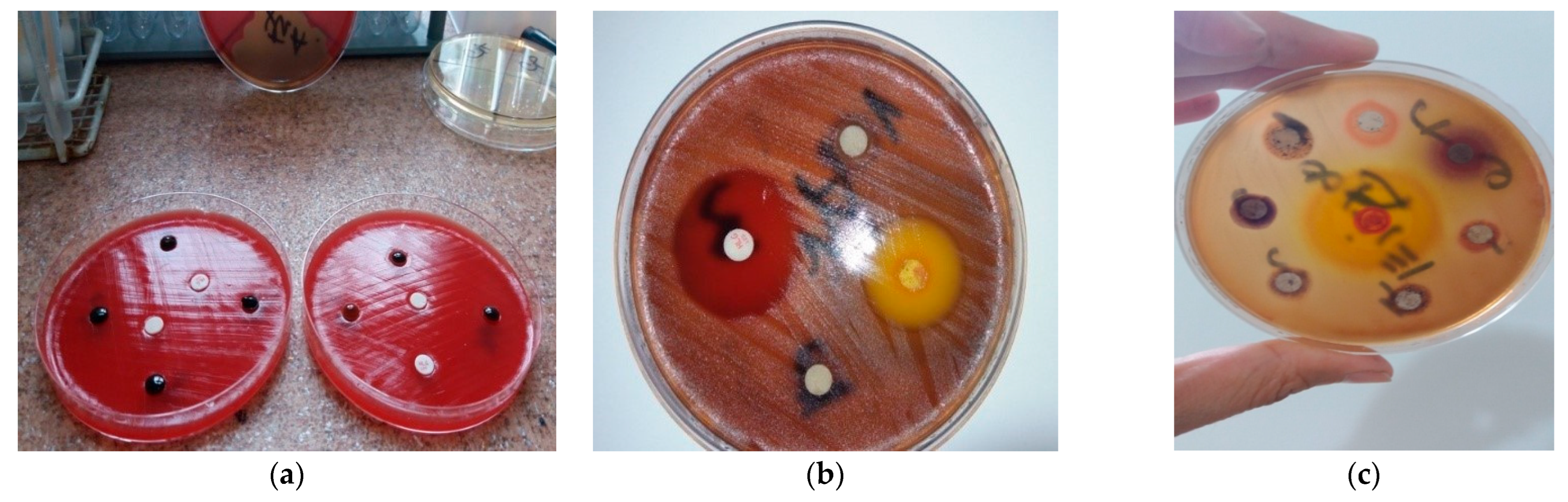
Figure 1. The Kirby–Bauer (diffusimetric) method: (a) preparation of the plates for incubation; (b) the plates after incubation; (c). determination of the IZ.
Oral 05 00096 g001
Figure 2. The broth dilution method (a) determination of MIC; (b) determination of MBC.
Oral 05 00096 g002
Table 1. The pure EOs used for testing.
EO
Common Name
Botanical NameBotanical FamilyExtracted FromBatch Number
CinnamonCinnamomum verumLauraceaebark, leaves, fruits, flowers232472
Tea treeMelaleuca alternifoliaMyrtaceaeleaves, terminal branches233113
SpearmintMentha spicataLamiaceaeleaves, stems, flowering tops231733
RosemaryRosmarinus officinalisLabiataeleaves, flower buds, stems233382
CloveEugenia caryophyllataMyrtaceaedried flower buds, leaves, stems231882
EucalyptusEucalyptus radiataMyrtaceaewood, leaves, roots, flowers, fruits 2331911
CedarwoodJuniperus virginianaCupressaceaewood chips, sawdust240121
LemongrassCymbopogon flexuosusPoaceaeleaves, flowering tops233101
Table 2. The average IZ diameter of the eight selected EOs on S. mutans.
EOMean IZ Diameter (mm)Susceptibility
Classification
Spearmint41.33susceptible
Eucalyptus39.33susceptible
Tea tree32.11susceptible
Lemongrass31.00susceptible
Cinnamon26.33susceptible
Clove24.89susceptible
Rosemary24.78susceptible
Cedarwood23.56susceptible
Table 3. The average MIC and MBC values, determined for the eight selected EOs.
EOMean MIC (μg/mL) Mean MBC (μg/mL)
Spearmint1020
Eucalyptus2020
Tea tree2040
Lemongrass2040
Cinnamon4040
Clove4040
Rosemary4040
Cedarwood4040
Table 4. Descriptive statistics of IZ diameters for each EO tested.
GroupsSpearmintEucalyptusTea TreeLemongrassCinnamonCloveRosemaryCedarwood
N99999999
Minimum3837302925222222
Maximum4442353329262825
Mean ( x - )41.3339.3332.113126.3324.8824.7723.55
Mean Confidence
Interval (95% CI)
[39.94, 42.71][38.11, 40.54][30.81, 33.41][29.91, 32.08][25.31, 27.35][23.91, 25.86][23.40, 26.15][22.77, 24.33]
Standard
Deviation (S)
1.80281.58111.69151.41421.32291.26931.78731.0138
SD Confidence
Interval
[1.21, 3.45][1.06, 3.02][1.14, 3.24][0.95, 2.70][0.89, 2.53][0.85, 2.43][1.20, 3.42][0.68, 1.94]
Variance (S2)3.252.52.8621.751.613.191.02
Standard
Deviation (σ)
1.691.491.591.331.241.191.680.95
Variance (σ2)2.882.222.541.771.551.432.830.91
Q14038313025252423
Median4239323126252524
Q34240333227262624
Interquartile range22222121
SW p-value (W)0.860.950.620.340.130.020.980.05
KS p-value (D)0.370.880.430.340.400.010.900.004
Table 5. Dominant constituents, RT, relative abundances (%), and H′ for each EO.
EODominant ConstituentRT (min)Relative Abundance (%)Shannon Index (H′)
CloveEugenol40.2678.270.85
Cinnamontrans-Cinnamaldehyde31.7052.910.95
Eucalyptus1,8-Cineole18.2880.601.12
SpearmintCarvone33.7559.131.45
LemongrassGeranial35.3342.561.38
Tea TreeTerpinen-4-ol28.2642.041.50
RosemaryCamphor26.1312.711.72
CedarwoodCedrol56.4715.361.61
RT: retention time.
Table 6. Spearman correlation coefficients (ρ) between mean IZ and main compositional parameters of the EOs.
VariableDescriptionρ (Spearman)p-ValueInterpretation
Shannon diversity index (H′)Chemical diversity across all detected constituents−0.260.53Weak negative; higher diversity → lower activity
Carvone (%)Major constituent in Spearmint oil+0.580.09Moderate positive; higher content linked to stronger inhibition
1,8-Cineole (%)Dominant constituent in Eucalyptus and Rosemary oils+0.440.21Mild positive trend
Eugenol (%)Dominant constituent in Clove oil−0.410.24Mild inverse association
Trans-Cinnamaldehyde (%)Major constituent in Cinnamon oil+0.320.34Weak positive, non-significant
Cedrol (%)Key sesquiterpene in Cedarwood oil−0.290.47Weak negative trend
Table 7. Comparative Kruskal–Wallis analysis of shared major constituents across EOs.
Compoundχ2 (H) Statisticdfp-ValueMost Abundant inChemical FamilyBiological Implication
α-Pinene18.747<0.001Eucalyptus,
Spearmint
Monoterpene
Hydrocarbon
Associated with moderate antibacterial potential.
β-Pinene9.3270.048Tea tree,
Eucalyptus
Monoterpene
Hydrocarbon
Contributes to the volatile and oxidative balance.
Limonene13.5170.012Lemongrass,
Spearmint
Monoterpene
Hydrocarbon
Related to solvent-like membrane disruption.
1,8-Cineole15.6670.004Eucalyptus,
Tea Tree
Oxygenated
Monoterpene
Strongly correlated with respiratory antibacterial effect.
Eugenol21.347<0.001Clove,
Cinnamon
Phenylpropanoid DerivativePrincipal driver of high inhibition zones.
Cedrol11.8770.035Cedarwood,
Rosemary
Sesquiterpene
Alcohol
Associated with stability and moderate bioactivity.
χ2 (H) Statistic: Kruskal–Wallis test statistic (H) follows an approximate chi-square (χ2) distribution, df: degree of freedom.
Disclaimer/Publisher’s Note: The statements, opinions and data contained in all publications are solely those of the individual author(s) and contributor(s) and not of MDPI and/or the editor(s). MDPI and/or the editor(s) disclaim responsibility for any injury to people or property resulting from any ideas, methods, instructions or products referred to in the content.