1. Introduction
Transfusion of blood is considered the optimal resuscitative volumizer in severe hemorrhagic shock [
1,
2,
3,
4,
5,
6,
7,
8,
9]. Similar to the intraoperative use of cell saver devices, which collect and return filtered autologous blood during major surgeries, the A-TT applies this concept to the pre-hospital environment by mobilizing the patient’s own vascular reserves. Pre-hospital blood transfusion requires specialized and costly logistics and accessing a vein with a large-bore needle. The allogenic transfused blood is anticoagulated, and its viscoelasticity and Clauss testing showed that patients receiving transfusion had reduced clot stiffness and reduced fibrinogen levels compared to those who did not [
10]. Deceased patients who received transfusions had the lowest stiffness and fibrinogen of any group [
10]. The auto-transfused blood clotting functions have not yet been tested, and this should be done in future prospective controlled studies. Additionally, the contribution of transfused stored blood to oxygen delivery to the tissues is limited due to the depletion of 2,3-DPG and leftward shifting of the O
2–hemoglobin dissociation curve [
11]. Nevertheless, transfusion of stored blood bank blood is considered the best available prehospital therapy for severe hemorrhagic shock, when available. In this review, we describe the hypothesis that when allogenic blood transfusion is not possible, using autologous blood from the patient’s own legs to support the essential organs in the core as an emergency treatment of severe shock, it is a potential alternative that should be tested clinically in prospective clinical studies.
2. Auto-Transfusion
Leg elevation is a simple and quick measure to shift blood from the legs to the core. However, leg elevation shifts only about 45% of the leg’s blood [
12]. The Medical (Military) Anti-Shock Garment (Trousers)—MAST is an off-shoot of the jet-pilot’s anti-G pants [
13,
14,
15,
16]. When inflated, blood is squeezed from the legs and the abdomen to the core. The MAST was in wide use from 1955 to 1985 and was discontinued from medical use due to the inability to remove it gradually, leading to severe rebound of shock [
17]. It was also associated with restricting lung volume and chest motion because of the abdominal compression shifting the diaphragm up and splinting the lower ribs. Mattox’s study showed a lack of superiority of the MAST in terms of mortality. The MAST experience offers a relevant historical perspective: hemodynamic improvement, while encouraging, does not always translate into survival benefit. Prospective survival data will therefore be needed to fully assess the clinical value of the A-TT beyond hemodynamic surrogate endpoints. In addition, beyond the clinical results, operational experience revealed an additional barrier to MAST’s continued use: field personnel frequently cut the garment off patients to facilitate rapid access, effectively destroying a device that was designed and priced for reuse. The resulting failure to replace worn or damaged units contributed to its gradual disappearance from pre-hospital inventories. The A-TT was designed to capture the benefits of autotransfusion without the adverse effects of abdominal compression and the technical limitations of the MAST.
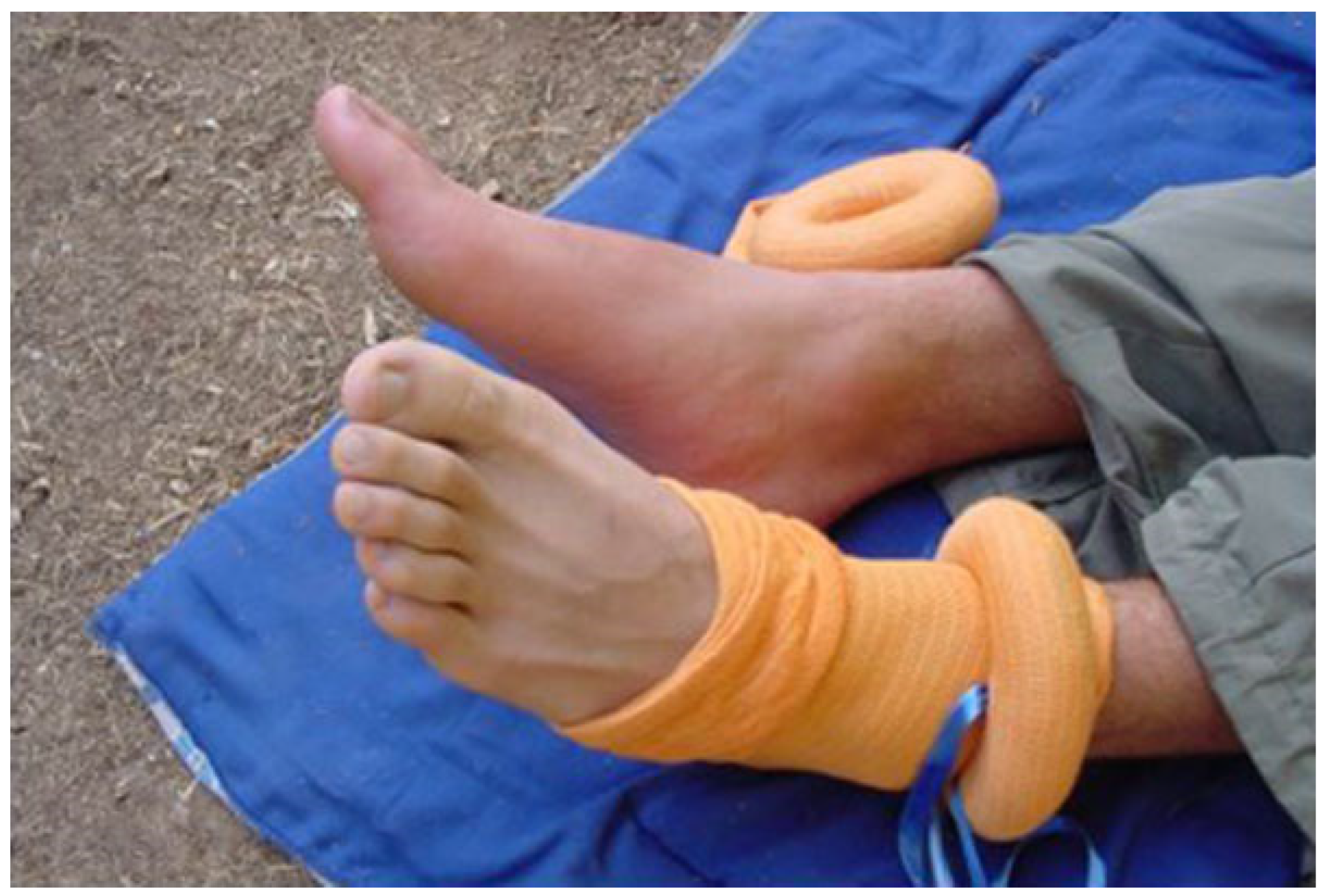
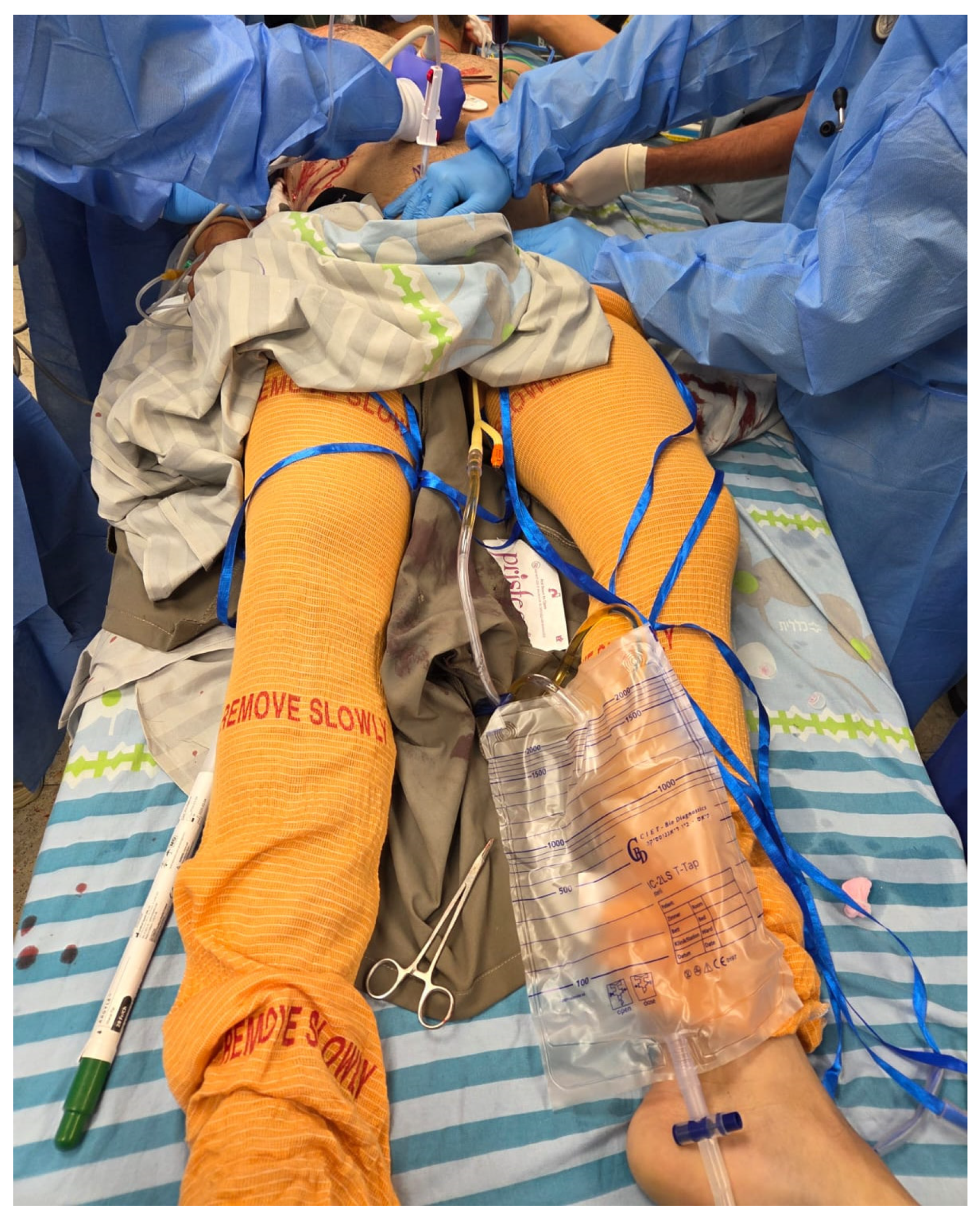
The auto-transfusion tourniquet (A-TT, a.k.a. HemaShock
® www.hemashock.com, accessed on 7 June 2026, Oneg HaKarmel Ltd., Tirat Carmel, Israel) is a torus consisting of a stainless-steel coil wrapped with a tubular elastic sleeve and pull-straps (
Figure 1). When rolled up a leg, it applies a supra-systolic pressure, which is uniform from the foot to the groin area (
Figure 2). By rolling the A-TT up the limb, it expels the blood from the entire soft tissues of the leg (~95%). This was demonstrated in a proof-of-principle study that was performed on 20 volunteers who had the A-TT on for 20 min [
18]. The study showed the effect on blood pressure, and that it takes less than 20 s to apply the A-TT on each leg, and its ability to shift about 500 mL (slightly more than a unit) of fresh blood into core circulation from each leg [
19] without biochemical, respiratory or clinical adverse effects.
3. Clinical Validation of the A-TT
The A-TT shares technology with the HemaClear
® exsanguination tourniquet (
www.hemaclear.com) used in orthopedic limb surgery to provide a bloodless surgical field. The HemaClear has been used in over 2.5 million cases in 52 countries with an impeccable safety track record [
20,
21]. It is applied for up to two hours for all limb cases, including total knee arthroplasty (TKA), trauma, foot and ankle surgery, upper extremity surgery and in pediatric orthopedic surgery. The HemaClear differs from the A-TT by being sterile and by using a silicone ring instead of a stainless-steel coil to be able to cut it at the end of surgery, rather than rolling it down over the surgical incision. The A-TT has been used in severe shock patients, in human volunteers and in swine experiments. In two preliminary proof-of-concept trials, its use uniformly elevated blood pressure [
18] and cardiac output [
22] during short 10 to 20 min applications compared to baseline, with no adverse effects in healthy sthenic volunteers. Preliminary observational data suggest potential benefits in penetrating wounds to the abdomen and legs, including femoral artery gunshot wounds and torso trauma (unpublished case series, data on file). The observational report also suggests potential benefit in non-trauma severe shock (e.g., rupture of splenic artery aneurysm, rupture of aortic aneurysm, rupture of subclavian anastomosis, and severe vaginal bleeding) [
23,
24,
25]. The A-TT showed no benefit in patients with traumatic cardiac rupture (GSW, MVA) but was effective in restoring cardiac activity in an exsanguinated patient in traumatic cardiac arrest who was given internal cardiac massage alongside A-TT.
A-TT has also been demonstrated to be effective as a mechanical vasopressor to restore ROSC in 7 out of 10 cardiac arrest patients and in a 6/12 study group pre-hospital CPR vs. 4/12 in the control group in a randomized prehospital cardiac arrest-controlled study [
26,
27,
28]. The presumed mechanism of action in CPR for cardiac arrest consists of: (a) quick shifting of the blood from the legs to the core, thereby increasing preload; (b) blocking of the flow of blood to the legs, which increases afterload, and peripheral resistance, resulting in the rise in diastolic and coronary perfusion pressures; and (c) limit the distribution of the CPR cardiac output to the center of the body and the essential organs. These mechanisms may also apply to the situation of severe shock reanimation, which will need to be validated in subsequent studies.
4. Discussion and Analysis
An important characteristic of the effectiveness of the reversal of shock is the lactate level. Lactate (lactic acid) buildup is a result of anaerobic metabolism due to reduced blood flow and low PO2 at the distal end of the tissue capillaries, leading to reduced diffusion of O2 to the mitochondria. Once the mitochondrial PO2 falls below 4–4.5 mmHg, they stop producing ATP by aerobic metabolism and move to the much less efficient anaerobic ATP production. The byproduct of the latter is lactic acid. Improving perfusion is critical to preventing and reversing lactic acidosis. Moreover, lactate is removed from the circulation (metabolized) in the liver but reduced visceral perfusion limits the hepatic lactate removal. Again, improving visceral circulation with blood that can deliver oxygen to the tissues can restore the balance between lactate generation and elimination. When planning a prospective clinical study, the lactate level upon ER arrival should be used as a primary endpoint of the study.
The management of severe hemorrhagic shock in the pre-hospital setting remains one of the most pressing challenges in emergency and military medicine. While allogenic whole blood transfusion has emerged as the preferred resuscitative strategy, it presents significant logistical, physical, and economic hurdles that limit its universal applicability.
This review provides a comprehensive comparative analysis between traditional pre-hospital whole blood transfusion and the application of the auto-transfusion tourniquet, systematically evaluating each modality across multiple clinically relevant parameters. By reviewing the existing peer-reviewed literature, this analysis identifies current gaps in the field and highlights the potential of mechanical auto-transfusion as a viable alternative or bridge to definitive care. A summary comparison of the clinical and logistical parameters between the A-TT and allogeneic whole blood transfusion is provided in
Table 1.
5. Logistical Challenges and Time to Administration
The primary goal in treating hemorrhagic shock is the rapid restoration of circulating blood volume to maintain organ perfusion. Recent literature strongly emphasizes that delays in the administration of blood products are directly associated with increased mortality. Torres et al. (2024) demonstrated in a cohort study of 1394 severely hemorrhaging trauma patients that earlier timing of the first whole blood transfusion within 24 h of emergency department arrival was significantly associated with improved survival at both 24 h (adjusted hazard ratio 0.40; 95% CI, 0.22–0.73) and 30 days (adjusted hazard ratio 0.32; 95% CI, 0.22–0.45) [
30]. Similarly, Duchesne et al. (2024) hypothesized a survival benefit when blood is administered within the first 15 min of EMS patient contact in patients with severe hemorrhage [
31]. However, a large multicenter randomized controlled trial in the United Kingdom (the SWIFT trial), recently published in NEJM, found that pre-hospital transfusion of up to two units of whole blood was not superior to standard care with blood components (packed red cells and plasma) in reducing the risk of death or massive transfusion within 24 h among patients with life-threatening traumatic hemorrhage [
32]. Additionally, they found a significantly higher rate of prolonged prothrombin time (PT) in the pre-hospital whole blood transfusion group.
Achieving such rapid transfusion in the pre-hospital environment is fraught with logistical complexities. Whole blood transfusion requires a strict cold chain for storage (1–6 °C) and transport (1–10 °C), necessitating specialized refrigeration, warming, and pressurized infusion equipment [
33]. The total weight of this equipment, including the blood unit itself, ranges from 3 to 5 kg. Furthermore, the administration process involves establishing large-bore intravenous access and utilizing blood warming devices under pressure, a process that can take between 300 and 900 s (5 to 15 min) once vascular access is secured [
34]. The shelf life of stored whole blood is limited to approximately 21 days under optimal conditions, creating significant wastage and supply chain management challenges [
35].
In stark contrast, the A-TT presents negligible logistical requirements. The device has a shelf life of five years, requires no refrigeration or special storage conditions, and weighs only 650 g for a pack of two rings. Crucially, the A-TT can be applied by basic life support (BLS) personnel and trained first responders in less than 20 s per leg, rapidly shifting over 500 mL of the patient’s own blood per leg into the central circulation [
18,
19,
25]. This rapid application directly addresses the critical “time to first intervention” gap identified in current trauma resuscitation protocols, effectively reducing the interval between injury and hemodynamic support to near zero.
6. Removal of the A-TT
Whenever an arterial tourniquet is placed on a limb and perfusion is stopped, the ischemic process starts with the accumulation of ischemic byproducts. These include CO2, H+ ions, potassium, and other molecules. These substances are cardio inhibitory. As such, it is important to remove the A-TT only after the patient’s hemodynamic status has been stabilized and to do it slowly in steps to avoid flooding of the central circulation with these molecules. Furthermore, when removing the A-TT from a limb, the smooth muscles in the walls of the vessels are completely relaxed (“reactive hyperemia”), which is another reason to remove the A-TT gradually. It is recommended to do so in three steps per leg with enough time between steps to measure blood pressure (90–120 s). If blood pressure drops, it is possible to reapply the A-TT to quickly mitigate the drop in BP, while instituting other measures (blood products, etc.).
7. Blood Volume Restoration and Titration
A standard unit of whole blood provides approximately 450 mL of volume, and in most pre-hospital scenarios, only one unit is immediately available for transfusion. The A-TT, when applied to both legs, can shift more than 1000 cc of blood—equivalent to approximately 2.25 units—into the core circulation [
18]. This volume is derived from the patient’s own vascular compartment and does not require cross-matching or blood typing.
A potential advantage of the A-TT is its capacity for titration. The device can be applied to one or both legs, or placed partially along the limb, allowing the clinician to adjust the volume of auto-transfused blood according to the patient’s hemodynamic response. This is particularly important in the context of permissive hypotension strategies, where maintaining systolic blood pressure between 80 and 100 mmHg is desired to avoid exacerbating uncontrolled hemorrhage [
36]. Woodward and Alsabri (2021) reviewed the evidence for permissive hypotension and concluded that limiting blood pressure during uncontrolled hemorrhage while maintaining adequate perfusion positively impacts outcomes [
37]. Once whole blood has been transfused, it cannot be removed, while the A-TT can be rolled down to reduce the auto-transfused volume, providing a reversible and controllable intervention.
8. Oxygen-Carrying Capacity and Tissue Oxygenation
A fundamental limitation of stored whole blood is the progressive degradation of its physiological properties over time, commonly referred to as the “storage lesion.” One of the most significant changes is the rapid depletion of 2,3-diphosphoglycerate (2,3-DPG) within the red blood cells. Beutler et al. [
38] first characterized the depletion and regeneration kinetics of 2,3-DPG in stored red blood cells, demonstrating that levels decline substantially within the first week of storage [
38]. The loss of 2,3-DPG causes a leftward shift in the oxygen–hemoglobin dissociation curve, increasing hemoglobin’s affinity for oxygen and thereby impairing its release at the tissue level [
39].
Donovan et al. [
40] provided compelling evidence that stored blood exhibits compromised oxygen unloading kinetics, noting that since red blood cells have only a few seconds to exchange gases in tissue capillaries, impaired O
2 handling could significantly compromise the efficacy of transfusions, particularly when an urgent need for oxygen delivery exists [
40]. Dumbill et al. further demonstrated in human kidneys that impaired O
2 unloading from stored blood results in diffusion-limited O
2 release at the tissue level, providing direct evidence of the clinical consequences of the storage lesion [
11]. Restoration of 2.3.DPG after transfusion takes 24–72 h, with median restoration occurring at 8–24 h. When a massive transfusion is needed, it is important to use blood that was donated very soon before it is used.
The A-TT circumvents this issue entirely by utilizing the patient’s own fresh, normothermic, circulating blood. The auto-transfused blood retains normal levels of 2,3-DPG, ensuring optimal oxygen unloading kinetics at the tissue capillaries via the normal Bohr effect on the dissociation curve. This physiological advantage could be vital in the acute phase of hemorrhagic shock, where cellular hypoxia drives the progression toward lactic acidosis and irreversible organ failure.
9. Coagulation Integrity and Trauma-Induced Coagulopathy
Trauma-induced coagulopathy (TIC) is a complex hemostatic disorder present in approximately 25% of severely injured patients upon hospital arrival, characterized by impaired clot formation and increased bleeding risk [
41]. Moore et al. described TIC as a multifactorial process driven by tissue injury, shock, and hemodilution, which can be further exacerbated by the administration of certain resuscitative fluids [
42]. Kornblith et al. (2019) further characterized TIC as encompassing multiple phenotypes of impaired hemostasis due to altered biology in clot formation and breakdown [
43].
Stored whole blood is anticoagulated with citrate, which chelates ionized calcium, a crucial cofactor in the coagulation cascade. The impact of citrate on coagulation during massive transfusion has been reviewed extensively, with evidence suggesting that citrate-induced hypocalcemia can further impair hemostasis in already coagulopathic patients [
44]. Gosselin et al. demonstrated through simulation studies that patients receiving transfusion products exhibited reduced clot stiffness and reduced fibrinogen levels compared to those who did not receive transfusion, and that deceased patients who received transfusion had the lowest stiffness and fibrinogen of any group [
10].
The physiological impact of whole blood on coagulation parameters remains a subject of rigorous clinical evaluation. In the SWIFT trial, researchers observed that prothrombin times were above the normal range in 40.7% of participants in the whole-blood group compared to 30.5% of those in the standard-care group [
32]. This finding suggests that while whole blood is intended to provide a more ‘complete’ resuscitation, it actually interferes with the coagulation profiles in the pre-hospital setting. This provides further context for the potential advantages of mechanical auto-transfusion, which utilizes the patient’s own unadulterated blood to preserve native hemostatic competence without the introduction of storage-related variables. The effect of A-TT on the total number of blood units needed to resuscitate a hemorrhagic shock patient has not been studied yet. Also, the rate of TIC after use of the A-TT in the initial phase of care is not known. It is suggested that these two parameters should be high on the list of secondary outcomes in a prospective randomized controlled clinical study. Researchers should also be aware that if using the A-TT will increase the immediate survival of hemorrhagic shock victims, it is possible that more of these patients will need massive transfusion or will develop TIC.
Because the A-TT shifts the patient’s own unadulterated blood, it introduces no exogenous anticoagulants, thereby preserving the native coagulation profile and avoiding the exacerbation of TIC. This represents a significant clinical advantage, particularly in patients with active hemorrhage, where maintaining hemostatic competence is paramount.
10. Limitations, Complications and Safety Profile
Allogeneic blood transfusion carries inherent risks, including acute and delayed hemolytic transfusion reactions, febrile non-hemolytic reactions, allergic reactions, transfusion-related acute lung injury (TRALI), and transfusion-associated circulatory overload (TACO) [
45]. Although the incidence of severe reactions is relatively low, they remain a significant concern in the emergency setting, where patient monitoring may be limited.
The A-TT, by utilizing autologous blood, eliminates the risk of immunological transfusion reactions entirely. The primary contraindication for A-TT use is deep vein thrombosis (DVT), due to the theoretical risk of embolization when compressing the leg. However, DVT is exceedingly rare in the young, active populations most commonly affected by traumatic injury [
46]. On the other hand, stagnated blood from a crush injury of a leg may contain debris, clotting promoters or clots. While technically possible, by applying axial traction, the benefit of using an A-TT on a crushed limb should be weighed against the potential risk of shifting clotted or contaminated blood to the core.
The safe duration of tourniquet application is generally accepted to be two hours, beyond which ischemic damage to the compressed limbs may occur [
47]. Kragh et al. confirmed that animal trials and clinical experience support a two-hour limit for continuous tourniquet use [
48]. After this period, the A-TT must be gradually removed to allow for reperfusion for at least 10 min. It can be reapplied if needed, underscoring its role as a bridge to blood or a bridge to definitive care.
This paper is intended as a call for others to independently conduct studies on the use of A-TT in hemorrhagic shock where pre-hospital blood transfusion is not available. It should be noted that nearly all the publications concerning A-TT use in shock were authored or co-authored by executives in OHK, the manufacturer of the A-TT, who, by default, are conflicted. While independent replication in the indexed literature remains limited, several clinical trials are currently ongoing (
www.clinicaltrial.health.gov.il, Trial Nos. MOH_2026-02-22_015671, MOH_2025-04-28_014059), and peer-reviewed data are expected to become available in the near future.
11. Economic Considerations
The financial burden of pre-hospital blood programs is substantial. The cost of a single unit of whole blood, combined with the necessary storage, transport, warming, and administration equipment, can exceed
$2000 per unit [
1]. A 2024 study published in the American Surgeon reported that any patient receiving a blood transfusion in the emergency department incurred an additional one-time administration fee of
$1922 [
49]. The direct labor costs associated with maintaining blood products for air medical transport services add further to the economic burden [
50].
In contrast, the A-TT is highly cost-effective, priced at under $200 for a two-ring pack. The device can be reused following proper disinfection, further reducing per-use costs. Its minimal weight, extended shelf life, and absence of cold-chain requirements make it particularly suited for resource-limited settings, military deployments, and rural EMS systems where maintaining a blood supply is logistically challenging or economically prohibitive.
12. Identified Gaps and Future Directions
Despite the promising clinical and logistical profile of the A-TT, several gaps in the current literature warrant further investigation. First, while retrospective case series and volunteer studies have demonstrated the hemodynamic benefits of the A-TT, large-scale prospective, randomized controlled trials (RCTs) comparing the A-TT directly with pre-hospital whole blood transfusion are lacking. Second, long-term outcomes of patients treated with the A-TT as a bridge to definitive care have not been systematically studied. Third, the interaction between A-TT application and subsequent blood transfusion, particularly regarding the optimal timing of A-TT removal and initiation of transfusion, remains undefined. Finally, while the regulatory pathway for the A-TT has progressed (with approvals from AMAR, TGA, FDA, CE, and ANVISA), the regulatory framework for pre-hospital blood transfusion programs varies significantly across jurisdictions, creating disparities in access to both modalities.
Additionally, while Low Titer O+ Whole Blood (LTWB) is the current gold standard for pre-hospital resuscitation, its benefits are most clearly demonstrated in young patients with penetrating trauma [
51,
52]. Evidence remains less certain for other cohorts, such as elderly patients or those with multisystem blunt trauma and sepsis. This gap highlights the potential for the A-TT to provide a more universal benefit, as it utilizes the patient’s own fresh, type-compatible, and normothermic blood, regardless of the underlying injury mechanism or patient demographics. Furthermore, a powerful future direction is the complementary use of A-TT with LTWB. Positioning A-TT as a tool for rapid stabilization to stop bleeding before or during LTWB administration creates a “bridge-to-blood” narrative that is very attractive to emergency medicine readers. This review deals primarily with the hypothesis that A-TT can be used when whole blood is not available. Large-scale prospective survival data will be needed before a definitive comparison between the A-TT and whole blood transfusion can be made. Blood and blood components, REBOA, TXA, etc., should all be applied when it is feasible to do so, namely, the products and the personnel to administer them are available. As such, the A-TT is not intended to replace them, but is a bridge to “buy time” until they are available and until definitive care is available.
13. Practical Considerations
When treating hypovolemic shock, and in particular hemorrhagic shock, whether traumatic or non-traumatic, there are three main pathophysiological aspects that must be considered: (a) stressed circulatory volume; (b) oxygen supply to the tissues; and (c) coagulation. In addition, speed of intervention, ease of intervention, and cost are important logistical aspects. Organ perfusion is strongly dependent on circulating volume. As such, restoring core blood volume as soon as possible is essential. The ability of the circulating volume to deliver oxygen to the tissues is the second most important parameter. Crystalloids and plasma only carry dissolved oxygen, which is a small fraction of the oxygen-carrying capacity of hemoglobin. However, the ability to dissociate oxygen from hemoglobin at high enough O
2 partial pressures (PO
2) is important to facilitate diffusive transport of oxygen to the tissue mitochondria. The auto-transfused blood has normal dissociation, while oxygen dissociation of whole blood from the blood bank is slow and low [
11]. The ability of the transfused blood to coagulate normally is essential, particularly in shock due to uncontrolled hemorrhage. Stored whole blood is anticoagulated, typically with citrate. While standard coagulation function tests show results within the normal range, the clot formation and mechanical properties are reduced [
10], which interferes with the ability to induce hemostasis of bleeding vessels. The information in the comparative analysis above shows that, based on physiological and technical deduction, the A-TT does not appear to be inferior to transfusion of whole blood in the immediate reanimation of severe hemorrhagic shock. However, until more validated clinical data are available, the A-TT should be reserved for situations where allogenic whole blood is not available. These include austere or military settings, rural or resource-limited systems, and environments without cold chain capability, mass casualty situations, underdeveloped countries, and when personnel versed in administering blood transfusions are scarce. The speed and ease of application, the ability to titrate blood pressure to avoid excessive increase in blood pressure, and cost are potential advantages of the A-TT use that need to be validated. The use of A-TT may also be preferable in cases where shock is associated with bleeding in a leg, for it has a dual purpose—to stop the bleeding and to reverse the shock. The use of the A-TT does not restore total blood volume, but has a potential place in the process of reanimation and reversal of shock. In the post-hemorrhage anemic patient, transfusion of blood or blood components is the standard of care, even when A-TT has been used.
The use of A-TT is limited to up to two hours. After two hours, it is mandatory to remove the A-TT (down to the ankle(s)) for 10–15 min. This can be done alternatively for each leg. If re-application is needed, it can easily be done by pulling the straps of the same device(s) back up the leg(s).
It is sometimes asked if applying the A-TT can increase uncontrolled bleeding. In a recent swine experiment where the A-TT was applied to the four legs of freely bleeding animals, no increase in bleeding rate was observed by applying the A-TTs [
53]. Nevertheless, we recommend titrating the application of the A-TT in patients in shock due to uncontrolled hemorrhage, while monitoring blood pressure and keeping systolic pressure between 80 and 100 mmHg.
14. Conclusions
This review highlights that while pre-hospital whole blood transfusion remains a critical life-saving intervention, it is hindered by significant logistical, physiological, and economic challenges that limit its universal applicability. The A-TT addresses many of these gaps by providing a potentially rapid and cost-effective method for mobilizing autologous blood volume in the immediate aftermath of severe hemorrhage, with theoretical physiological advantages, including preserved oxygen-carrying capacity and native coagulation competence. The device’s ability to deliver the patient’s own blood without anticoagulants, with normal oxygen-carrying capacity, and with full coagulation competence may offer a paradigm shift in pre-hospital shock management. Future research should focus on prospective, multicenter randomized controlled trials to establish the A-TT’s role within integrated normothermic trauma resuscitation protocols.
In summary, this review compares the properties of the A-TT application to the effects of transfusion of whole blood. Potential advantages of the A-TT are noted across the evaluated parameters, pending prospective clinical validation.
Author Contributions
Conceptualization, N.G. and L.R.M.; investigation, N.G., G.H., J.M., E.G., L.R.M. and J.O.R.; writing—original draft preparation, N.G. and E.G.; writing—review and editing, N.G., G.H., J.M., E.G., L.R.M. and J.O.R.; supervision, N.G.; project administration, E.G.. All authors have read and agreed to the published version of the manuscript.
Funding
This research received no external funding.
Institutional Review Board Statement
This research did not involve patients.
Informed Consent Statement
Not applicable.
Data Availability Statement
No new data were created or analyzed in this study.
Conflicts of Interest
Some of the authors are officers and stakeholders in Oneg HaKarmel Ltd., the manufacturer of the A-TT. The authors Efrat Gavriely and Larry R. Murdock are employees of OHK Medical Devices, Inc.
References
- Schaefer, R.M.D.; Bank, E.A.A.; Krohmer, J.R.; Haskell, A.; Taylor, A.L.; Jenkins, D.H.; Holcomb, J.B. Removing the barriers to prehospital blood: A roadmap to success. J. Trauma Acute Care Surg. 2024, 97, S138–S144. [Google Scholar] [CrossRef] [Scilit] [PubMed]
- Meizoso, J.P.M.; Cotton, B.A.; Lawless, R.A.; Kodadek, L.M.; Lynde, J.M.D.; Russell, N.; Gaspich, J.; Maung, A.; Anderson, C.; Reynolds, J.M.M.; et al. Whole blood resuscitation for injured patients requiring transfusion: A systematic review, meta-analysis, and practice management guideline from the Eastern Association for the Surgery of Trauma. J. Trauma Acute Care Surg. 2024, 97, 460–470. [Google Scholar] [CrossRef] [Scilit] [PubMed]
- Morrison, J.J.M.; Oh, J.; DuBose, J.J.; O’Reilly, D.J.M.; Russell, R.J.F.; Blackbourne, L.H.; Midwinter, M.J.M.; Rasmussen, T.E. En-route care capability from point of injury impacts mortality after severe wartime injury. Ann. Surg. 2013, 257, 330–334. [Google Scholar] [CrossRef] [Scilit] [PubMed]
- Bailey, J.A.; Morrison, J.J.; Rasmussen, T.E. Military trauma system in Afghanistan: Lessons for civil systems? Curr. Opin. Crit. Care 2013, 19, 569–577. [Google Scholar] [PubMed]
- O’Reilly, D.J.; Morrison, J.J.; Jansen, J.O.; Apodaca, A.N.; Rasmussen, T.E.; Midwinter, M.J. Prehospital blood transfusion in the en route management of severe combat trauma: A matched cohort study. J. Trauma Acute Care Surg. 2014, 77, S114–S120. [Google Scholar] [CrossRef] [Scilit] [PubMed]
- Shackelford, S.A.; del Junco, D.J.; Powell-Dunford, N.; Mazuchowski, E.L.; Howard, J.T.; Kotwal, R.S.; Gurney, J.; Butler, F.K.; Gross, K.; Stockinger, Z.T. Association of prehospital blood product transfusion during medical evacuation of combat casualties in Afghanistan with acute and 30-day survival. JAMA 2017, 318, 1581–1591. [Google Scholar] [CrossRef] [Scilit] [PubMed]
- Smith, I.M.; James, R.H.; Dretzke, J.; Midwinter, M.J. Prehospital blood product resuscitation for trauma: A systematic review. Shock 2016, 46, 3–16. [Google Scholar] [CrossRef] [Scilit] [PubMed]
- Ritondale, J.B.; Piehl, M.; Caputo, S.B.; Broome, J.; McLafferty, B.B.; Anderson, A.B.; Belding, C.; Tatum, D.; Duchesne, J.; Damage Control Resuscitation Study Group; et al. The impact of a prehospital exsanguinating airway-breathing-circulation resuscitation sequence in patients with severe hemorrhage. J. Am. Coll. Surg. 2024, 238, 367–373. [Google Scholar] [CrossRef] [Scilit] [PubMed]
- Sperry, J.L.; Guyette, F.X.; Brown, J.B.; Yazer, M.H.; Triulzi, D.J.; Early-Young, B.J.; Adams, P.W.; Daley, B.J.; Miller, R.S.; Harbrecht, B.G.; et al. Prehospital plasma during air medical transport in trauma patients at risk for hemorrhagic shock. N. Engl. J. Med. 2018, 379, 315–326. [Google Scholar] [CrossRef] [Scilit] [PubMed]
- Gosselin, A.; Ahmad, S.; Toussaint, A.; Bargoud, C.; Mathew, S.; Macor, M.; Hanna, J.; Goswami, J.; Tutwiler, V. Simulating the Impact of Transfusion Products on Clotting Kinetics and Patient Outcome. Blood 2024, 144, 5471. [Google Scholar] [CrossRef] [Scilit]
- Dumbill, R.; Rabcuka, J.; Fallon, J.; Knight, S.; Hunter, J.; Voyce, D.; Barrett, J.; Ellen, M.; Weissenbacher, A.; Kurniawan, T.; et al. Impaired O2 unloading from stored blood results in diffusion-limited O2 release at tissues: Evidence from human kidneys. Blood 2024, 143, 721–733. [Google Scholar] [CrossRef] [Scilit] [PubMed]
- Blond, L.; Kirketerp-Møller, K.; Sonne-Holm, S.; Madsen, J.L. Exsanguination of lower limbs in healthy male subjects. Acta Orthop. Scand. 2002, 73, 89–92. [Google Scholar] [CrossRef] [Scilit] [PubMed]
- Chatham, S.-M. MAST Pants; National Center for Biotechnology Information: Bethesda, MD, USA, 2022. [PubMed]
- Mattox, K.L. Permissive Hypotension. trauma.org 2003, 8, 1. Available online: https://web.archive.org/web/20131029203818/http://www.trauma.org/archive/resus/permhypoeditorial.html (accessed on 7 June 2026).
- Bledsoe, B. EMS Myth #1: Medical Anti-Shock Trousers (MAST) autotransfuse a significant amount of blood and save lives. In Proceedings of the EMS World, Las Vegas, NV, USA, 21–25 September 2003. [Google Scholar]
- Roberts, I.G.; Blackhall, K.; Dickinson, K.J. Medical anti-shock trousers (pneumatic anti-shock garments) for circulatory support in patients with trauma. Cochrane Database Syst. Rev. 1999, 4, CD001856. [Google Scholar]
- Mattox, K.L.; Bickell, W.H.; Pepe, P.E.; Mangelsdorff, A.D. Prospective randomized evaluation of antishock MAST in post-traumatic hypotension. J. Trauma 1986, 26, 779–786. [Google Scholar] [CrossRef] [Scilit] [PubMed]
- Gavriely, O.; Nave, T.; Sivan, S.; Shabtai-Musih, Y.; Gavriely, N. Auto Transfusion and Blood Pressure Elevation by Elastic Leg Compression in Normal Subjects; Technion; Israel Institute of Technology: Haifa, Israel, 2000. [Google Scholar]
- Litter, J.; Wood, J.E. The volume distribution of blood in the human leg measured in vivo, I. The effects of graded external pressure. J. Clin. Investig. 1954, 33, 798–806. [Google Scholar] [CrossRef] [Scilit] [PubMed]
- Demirkale, I.; Tecimel, O.; Sesen, H.; Kilicarslan, K.; Altay, M.; Dogan, M. Nondrainage Decreases Blood Transfusion Need and Infection Rate in Bilateral Total Knee Arthroplasty. J. Arthroplast. 2014, 29, 993–997. [Google Scholar] [CrossRef] [Scilit]
- Ved, A.; Kempshall, P.J.; Sharma, H.; Morgan-Jones, R.L. A Comparison of Operative Field Space Between Sterile Single-Use and Re-Useable Pneumatic Tourniquets in Revision Total Knee Arthroplasty. Available online: https://www.orthopaper.com/archives/2015.v1.i1.3/a-comparison-of-operative-field-space-between-sterile-single-use-and-re-useable-pneumatic-tourniquets-in-revision-total-knee-arthroplasty (accessed on 7 June 2026).
- Martin Pallares, P.; David, H.T.; Noam, G. Hemodynamic Effects of Arterial Vs. Venous Legs Compression in Normal Volunteers. J. Anest. Inten. Care Med. 2025, 14, 555876. [Google Scholar] [CrossRef] [Scilit]
- Gavriely, N.; Abadi-Saar, S.; Gavriely, E.; Murdock, L.; Rasanen, J.O. Restoring Core Blood Volume in Severe Haemorrhagic Shock—What are the Options?—A Review. J. Anest. Inten. Care Med. 2025, 13, 555872. [Google Scholar] [CrossRef] [Scilit]
- Perez, M.P.; Tang, D.H.; Gavriely, N. Emergency treatment of severe haemorrhagic shock with Auto-Transfusion Tourniquet—Retrospective chart review of first 10 patients. In Proceedings of the Scientific Proceedings of the 8th IMRUA Emergency Medicine Congress 2026 & 1st Bloodbikes Conference, Maribor, Slovenia, 23–25 April 2026; IMRUA Slovenia: Maribor, Slovenia, 2026; p. 116. Available online: https://heyzine.com/flip-book/21f7dc1849.html#page/116 (accessed on 7 June 2026).
- Tang, D.H.; Olesnicky, B.T.; Eby, M.W.; Heiskell, L.E. Auto-transfusion tourniquets: The next evolution of tourniquets. Open Access Emerg. Med. 2013, 5, 29–32. [Google Scholar] [CrossRef] [Scilit] [PubMed]
- Yang, Z.; Tang, D.; Wu, X.; Hu, X.; Xu, J.; Qian, J.; Yang, M.; Tang, W. A tourniquet assisted cardiopulmonary resuscitation augments myocardial perfusion in a porcine model of cardiac arrest. Resuscitation 2015, 86, 49–53. [Google Scholar] [CrossRef] [Scilit] [PubMed]
- Martin Pallares, P.; David, H.T.; Noam, G. Auto-Transfusion Tourniquet (A-TT) Reanimation of Cardiac Arrest Patients—A Retrospective 002 Chart Review. J. Cardiol. Cardiovasc. Ther. 2024, 19, 556019. [Google Scholar]
- Esih, M.; Gavriely, N.; Strnad, M. Use of Auto Transfusion Tourniquet increases end-tidal-CO2 in out-of-hospital cardiac arrest patients—A feasibility pilot study. Resusc. Plus 2025, 26, 101100. [Google Scholar] [CrossRef] [Scilit] [PubMed]
- Clifford, L.; Jia, Q.; Yadav, H.; Subramanian, A.; Wilson, G.A.; Murphy, S.P.; Pathak, J.; Schroeder, D.R.; Ereth, M.H.; Kor, D.J. Characterizing the epidemiology of perioperative transfusion-associated circulatory overload. Anesthesiology 2015, 122, 21–28. [Google Scholar] [CrossRef] [Scilit] [PubMed]
- Torres, C.M.; Kenzik, K.M.; Saillant, N.N.; Scantling, D.R.; Sanchez, S.E.; Brahmbhatt, T.S.; Dechert, T.A.; Sakran, J.V. Timing to First Whole Blood Transfusion and Survival Following Severe Hemorrhage in Trauma Patients. JAMA Surg. 2024, 159, 374–381. [Google Scholar] [CrossRef] [Scilit] [PubMed]
- Duchesne, J.; McLafferty, B.J.B.; Broome, J.M.; Caputo, S.B.; Ritondale, J.P.B.; Tatum, D.; Taghavi, S.; Jackson-Weaver, O.; Tran, S.; McGrew, P.; et al. Every minute matters: Improving outcomes for penetrating trauma through prehospital advanced resuscitative care. J. Trauma Acute Care Surg. 2024, 97, 710–715. [Google Scholar] [CrossRef] [Scilit] [PubMed]
- Smith, J.E.; Cardigan, R.; Sanderson, E.; Silsby, L.; Rourke, C.; Barnard, E.B.G.; Basham, P.; Antonacci, G.; Charlewood, R.; Dallas, N.; et al. Prehospital whole blood in traumatic hemorrhage—A randomized controlled trial. N. Engl. J. Med. 2026. advance online publication. [Google Scholar] [CrossRef] [Scilit] [PubMed]
- Levy, M.J.; Jenkins, D.H.; Guyette, F.X.; Holcomb, J.B. Bridging the gap: Whole blood and plasma in prehospital hemorrhagic shock resuscitation. Trauma Surg. Acute Care Open 2025, 10, e001828. [Google Scholar] [CrossRef] [Scilit] [PubMed]
- McNeilly, B.; Samsey, K.; Kelly, S.; Pennardt, A.; Guyette, F.X. Prehospital Blood Administration in Traumatic Hemorrhagic Shock. JACEP Open 2025, 6, 100041. [Google Scholar] [CrossRef] [Scilit] [PubMed]
- He, Y.; Zhang, Y.; Liu, W.; Zhang, L.; Xu, Y.; Yuan, Z.; Li, J.; Liu, L.; Cheng, F. Storage damage of cold-stored whole blood in CPDA maintenance fluid during the whole effective storage period. Front. Cell Dev. Biol. 2025, 13, 1610009. [Google Scholar] [CrossRef] [Scilit] [PubMed]
- Das, J.M.; Anosike, K.; Waseem, M. Permissive Hypotension. In StatPearls; StatPearls Publishing: Treasure Island, FL, USA, 2025. [Google Scholar] [PubMed]
- Woodward, L.; Alsabri, M. Permissive Hypotension vs. Conventional Resuscitation in Patients with Trauma or Hemorrhagic Shock: A Review. Cureus 2021, 13, e16487. [Google Scholar] [CrossRef] [Scilit] [PubMed]
- Beutler, E.; Meul, A.; Wood, L.A. Depletion and regeneration of 2,3-diphosphoglyceric acid in stored red blood cells. Transfusion 1969, 9, 109–115. [Google Scholar] [CrossRef] [Scilit] [PubMed]
- Valeri, C.R.; Collins, F.B. Physiologic effects of 2,3-DPG-depleted red cells with high affinity for oxygen. J. Appl. Physiol. 1971, 31, 823–827. [Google Scholar] [CrossRef] [Scilit] [PubMed]
- Donovan, K.; Meli, A.; Cendali, F.; Park, K.C.; Cardigan, R.; Stanworth, S.; McKechnie, S.; D’Alessandro, A.; Smethurst, P.A.; Swietach, P. Stored blood has compromised oxygen unloading kinetics that can be normalized with rejuvenation and predicted from corpuscular side-scatter. Haematologica 2022, 107, 298–302. [Google Scholar] [CrossRef] [Scilit] [PubMed]
- Iba, T.; Helms, J.; Neal, M.D.; Levy, J.H. Mechanisms and management of the coagulopathy of trauma and sepsis: Trauma-induced coagulopathy, sepsis-induced coagulopathy, and disseminated intravascular coagulation. J. Thromb. Haemost. JTH 2023, 21, 3360–3370. [Google Scholar] [CrossRef] [Scilit] [PubMed]
- Moore, E.E.; Moore, H.B.; Kornblith, L.Z.; Neal, M.D.; Hoffman, M.; Mutch, N.J.; Schöchl, H.; Hunt, B.J.; Sauaia, A. Trauma-induced coagulopathy. Nat. Rev. Dis. Primers 2021, 7, 30. [Google Scholar] [CrossRef] [Scilit] [PubMed]
- Kornblith, L.Z.; Moore, H.B.; Cohen, M.J. Trauma-induced coagulopathy: The past, present, and future. J. Thromb. Haemost. JTH 2019, 17, 852–862. [Google Scholar] [CrossRef] [Scilit] [PubMed]
- Schriner, J.B.; Van Gent, J.M.; Meledeo, M.A.; Olson, S.D.; Cotton, B.A.; Cox, C.S., Jr.; Gill, B.S. Impact of Transfused Citrate on Pathophysiology in Massive Transfusion. Crit. Care Explor. 2023, 5, e0925. [Google Scholar] [CrossRef] [Scilit] [PubMed]
- Suddock, J.T.; Crookston, K.P. Transfusion Reactions. In StatPearls; StatPearls Publishing: Treasure Island, FL, USA, 2023. [Google Scholar] [PubMed]
- Rabe, E.; Partsch, H.; Morrison, N.; Meissner, M.H.; Mosti, G.; Lattimer, C.R.; Carpentier, P.H.; Gaillard, S.; Jünger, M.; Urbanek, T.; et al. Risks and contraindications of medical compression treatment—A critical reappraisal. An international consensus statement. Phlebology 2020, 35, 447–460. [Google Scholar] [CrossRef] [Scilit] [PubMed]
- Holcomb, J.B.; Dorlac, W.C.; Drew, B.G.; Butler, F.K.; Gurney, J.M.; Montgomery, H.R.; Shackelford, S.A.; Bank, E.A.; Kerby, J.D.; Kragh, J.F.; et al. Rethinking limb tourniquet conversion in the prehospital environment. J. Trauma Acute Care Surg. 2023, 95, e54–e60. [Google Scholar] [CrossRef] [Scilit] [PubMed]
- Kragh, J.F.; Walters, T.J., Jr.; Baer, D.G.; Fox, C.J.; Wade, C.E.; Salinas, J.; Holcomb, J.B. Survival with emergency tourniquet use to stop bleeding in major limb trauma. Ann. Surg. 2009, 249, 1–7. [Google Scholar] [CrossRef] [Scilit] [PubMed]
- Murphy, R.C.; Johnson, T.W.; Mack, T.J.; Burke, R.E.; Damiano, N.P.; Heger, L.; Minner, N.; German, E.; Wilson, A.; Mount, M.G.; et al. Cost Savings of Whole Blood Versus Component Therapy at a Community Level 1 Trauma Center. Am. Surg. 2024, 90, 2156–2159. [Google Scholar] [CrossRef] [Scilit] [PubMed]
- Szklarski, P.C.; Booth, G.S. The direct labor cost for providing life-saving blood to air medical transport for pre-hospital transfusion. Transfus. Apher. Sci. 2019, 58, 645–646. [Google Scholar] [CrossRef] [Scilit] [PubMed]
- Guyette, F.X.; Zenati, M.; Triulzi, D.J.; Yazer, M.H.; Skroczky, H.; Early, B.J.; Adams, P.W.; Brown, J.B.; Alarcon, L.; Neal, M.D.; et al. Prehospital low titer group O whole blood is feasible and safe: Results of a prospective randomized pilot trial. J. Trauma Acute Care Surg. 2022, 92, 839–847. [Google Scholar] [CrossRef] [Scilit] [PubMed]
- Sperry, J.L.; Guyette, F.X.; Cotton, B.A.; Luther, J.F.; Utarnachitt, R.B.; Kutcher, M.E.; Daley, B.J.; Peetz, A.B.; Patel, M.B.; Goodman, M.D.; et al. Prehospital Resuscitation with Type O Whole Blood for Trauma and Hemorrhage. N. Engl. J. Med. 2026. advance online publication. [Google Scholar] [CrossRef] [Scilit] [PubMed]
- Gavriely, N.; Abadi-Saar, S.; Ometsinski, S.; Gavriely, E.; Rasanen, J.O. Does applying Auto-Transfusion Tourniquets (A-TT) improve the hemodynamic status of swine in severe haemorrhagic shock? Manuscript in review. (Unpublished Work).
| Disclaimer/Publisher’s Note: The statements, opinions and data contained in all publications are solely those of the individual author(s) and contributor(s) and not of MDPI and/or the editor(s). MDPI and/or the editor(s) disclaim responsibility for any injury to people or property resulting from any ideas, methods, instructions or products referred to in the content. |