Review

Next-Generation Polysaccharide-Based Nanocarriers for Precision Medicine: Structure–Property Principles, Responsiveness, and Therapeutic Translation


by
Ioannis Pispas
1,2 and
Aristeidis Papagiannopoulos
1,*
1
Theoretical and Physical Chemistry Institute, National Hellenic Research Foundation, 48 Vassileos Constantinou Avenue, 11635 Athens, Greece
2
Department of Physics, School of Applied Mathematical and Physical Sciences, National Technical University of Athens, Zografou Campus, 15780 Athens, Greece
*
Author to whom correspondence should be addressed.
Macromol 2026, 6(1), 19; https://doi.org/10.3390/macromol6010019

Submission received: 21 January 2026 / Revised: 4 March 2026 / Accepted: 16 March 2026 / Published: 18 March 2026
(This article belongs to the Special Issue Recent Trends in Carbohydrate-Based Therapeutics)

Abstract

Among the most structurally diverse biomacromolecules, polysaccharides have attracted increased attention as nanocarriers for precision medicine due to their inherent biocompatibility and versatility in functionalization. Molecular features, such as monomer composition, glycosidic linkages, charge density, and chemical modification, essentially determine the nanoscale assembly process of these biopolymers, as well as their biological compatibility. This review highlights the role of these properties in the assembly process of polysaccharide-based nanocarriers leading to a variety of self-assembled nanostructures, such as polyelectrolyte complexes, protein–polysaccharide complexes, amphiphilic micelles, vesicles, hybrid systems, and nanogels, which are extensively discussed throughout the review. This review also focuses on the structure–property–function relationships of nanocarriers as applied to the rapidly developing area of precision medicine, emphasizing the problems of sustainability and reproducibility. By combining the principles of molecular engineering, supramolecular assembly, and measurable properties, this work aims to present a unified view of the molecular engineering of polysaccharide-based nanocarriers for enhanced translation potential, as well as to outline a coherent framework for the rational development of next-generation polysaccharide-based nanocarriers with improved clinical relevance.

1. Introduction

The recent advent of precision medicine has drastically changed modern medicine in terms of shifting focus away from a single paradigm towards a more personalized and targeted form. For precision medicine to be effectively implemented across a broad spectrum of human disorders, advanced drug delivery systems are required which can selectively direct therapeutics to diseased tissues, such as tumors, while also minimizing off-target effects on healthy tissue [1,2,3]. This seems to be a challenging task since one of the major setbacks in biomedical research today remains its inability to translate promising research findings into potential therapeutics. This pertains largely to the poor design requirements for promising biocompatible and biodegradable nanocarrier systems, since the existing nanocarrier systems face complex challenges that hinder their translation to clinical use [4,5]. Foremost, existing concerns regarding the safety of nanoparticles exist because of unexpected accumulation in healthy tissues, which may raise cytotoxicity-induced problems that can limit therapeutic efficacy and affect patient safety. This indiscriminate accumulation of nanocarrier particles in healthy tissues such as the liver, heart, and kidneys forms a major limiting factor for clinical translation, since studies have shown that more than 95% of nanoparticle delivery fails to target selected tissues [4,5,6]. Additionally, the existing processes for deliberately controlling nanoparticle properties based on factors such as particle size, charge, surface chemistry, and drug release profiles face incredible scientific design restraints that involve compromising several factors [7,8]. Moreover, scalability and environmental sustainability for nanoparticle generation may form a concern because most of its current forms exist in petroleum-derived synthetic polymers [9].
The promise of polysaccharide-based nanocarriers appears to be the most promising for overcoming such complex problems. Polysaccharide-based nanocarriers possess natural sustainability benefits for negating imperfections inherent in synthetically prepared biomaterials since their components, namely, polysaccharides, are naturally renewable biomacromolecules sourced from plants, algae, and microorganisms [10,11]. Thus, their sustainability can be considered a natural consequence of their biomateriality. Also, because they are naturally existing biomaterials, there is no adverse immunogenic response when used in in-vivo applications. Lastly, another advantage of polysaccharide-based nanocarriers resides in their inherent chemistry [12,13,14]. Their structures possess multiple reactive functional groups for modification without adversely affecting their natural sustainability profile [15,16]. Thus, renewable biomaterials with inherent sustainability benefits along with extraordinary biocompatible properties naturally inherent in polysaccharides make precision medicine with polysaccharide-based nanocarriers a most appropriate choice.
The aim of this review is to offer a thorough summary of the structure–property relationships for polysaccharide and polysaccharide-based nanocarrier systems with a focus on connecting such molecular-level fundamentals with translational opportunities and feasibility. Specifically, this review aims to highlight how a molecular-level appreciation for the role of therapeutic agent chemistry and composition, as well as nanoformulation design and approaches towards therapeutic agent delivery and retention, may be leveraged to accelerate translational efficiency between preliminary research discoveries and subsequent clinical introductions. A wide range of polysaccharide-based systems are considered in connection with several distinct types of nanocarrier designs, such as micelles, nanogels, hybrid lipid–polysaccharide systems, polysaccharide-based complexes, and protein–polysaccharide nanocomplexes. Of critical importance in this review is the consideration of design, development, and translation in connection with regulatory and manufacturing feasibility assessments for successful transitions of promising next-generation systems introduced in a research environment for subsequent clinical introduction.

2. Molecular and Supramolecular Aspects of Polysaccharide Nanocarriers

2.1. Structural Complexity and Molecular Determinants of Polysaccharides

Polysaccharides constitute one of the most structurally diverse classes of natural biomacromolecules, with an intrinsic complexity that characterizes their versatile behavior as nanocarrier biomaterials. Their functionality in drug delivery arises from the combination of their monomeric composition, ionic character, and wide variety of feasible chemical modifications accessible to their functional groups, such as hydroxyls, amines, sulfates, and carboxylates [11,17]. The primary structure of polysaccharides is defined by the nature of monosaccharide units and the configuration of the glycosidic bonds that connect them. Minor variations in the monomer chemical structure or linkage can dramatically alter physicochemical behavior, such as solubility, biodegradability, crystallinity, and responsiveness to ionic environmental stimuli [18,19].
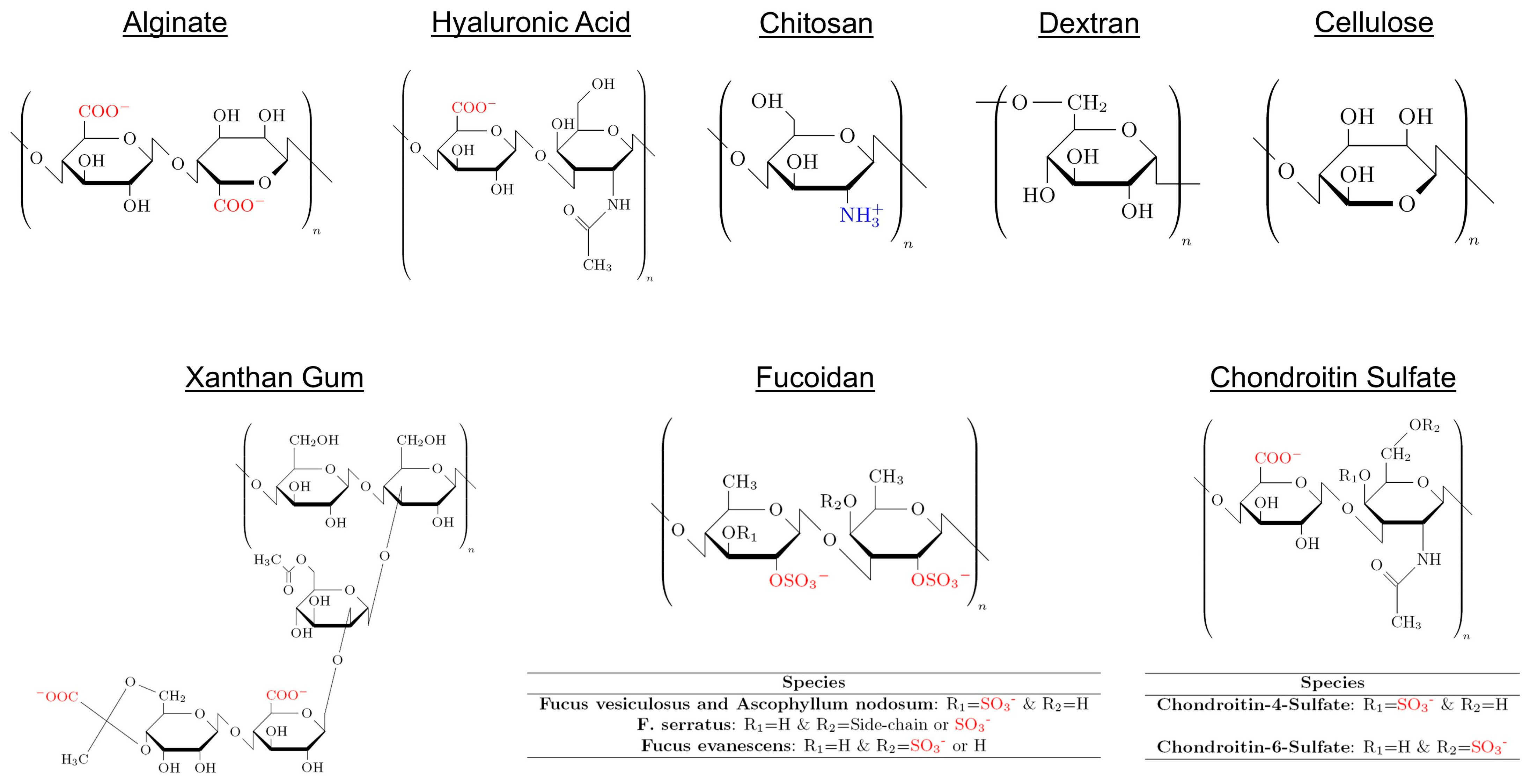
Most well-known polysaccharides, such as xanthan gum (XG) [20], alginate (ALG) [21], chondroitin sulfate (CS) [22], hyaluronic acid (HA) [23], pectin (PCT) [24], dextran (DEX) [25], starch (ST) [26], cellulose (CEL) [27] and chitosan (CHT) [28], exhibit distinct structural characteristics based on their monomer compositions and charge natures. For example, ALG is composed of alternating β-D-mannuronic (MA) and α-L-guluronic acid (GA) residues arranged into MA:MA, GA:GA, or MA:GA/GA:GA blocks, with the GA/MA ratio influencing stiffness, chelation capacity, and gelation kinetics [29,30,31]. In contrast, CHT is comprised of units of β-(1→4)-2-acetamido-d-glucose (N-acetyl-d-glucosamine) and β-(1→4)-2-amino-d-glucose (d-glucosamine), typically with d-glucosamine comprising over 80%, and the N-acetyl-d-glucosamine and d-glucosamine residues are typically randomly distributed and not covalently linked with its degree of deacetylation influencing protonation and solubility characteristics [28,32]. The glycosidic linkage patterns, such as α versus β, 1→3 versus 1→4, and the presence or absence of branching, further impact chain flexibility, hydrogen bonding, and susceptibility to specific glycosidases. Such complexity in each individual polysaccharide renders these macromolecules highly modular and thus amenable to the design of ideal nanocarriers suitable for oral, mucosal, transdermal or parenteral delivery routes [33,34,35,36,37,38]. In Figure 1, the chemical structures of some of the most well-known and most prominent polysaccharides used in nanomedicine are presented, highlighting their functional charged groups and the different arrangements responsible for their appealing characteristics.
Beyond the chemical structure, the three-dimensional conformation of polysaccharide chains determines their ability to assemble into higher-order structures such as hydrogels, nanogels, capsules, beads and polysaccharide complexes in general. Linear versus branched structures influence molecular packing and mechanical properties [39]. Specifically, ALG is capable of forming ionic networks through guluronic acid (GA-block)-mediated calcium (Ca2+) crosslinking, generating the well-known “egg-box” architecture that yields mechanically robust yet simultaneously ion-sensitive hydrogels [40,41]. CHT contains amino groups (-NH2) on its backbone, which protonate under acidic conditions (-NH3+) and enable the ability of CHT macromolecules to assemble into films, fibers, and polyelectrolyte complexes with anionic polysaccharides such as ALG and PCT [42,43,44]. For instance, the formation of ALG/CHT multilayers on layered double hydroxide (LDH) nanoparticles (NPs) enhances colloidal stability and protects protein cargo from acidic degradation while also regulating the release profiles and cellular absorption in Caco-2 epithelial models [33]. Additionally, DEX and HA are some of the most flexible biomacromolecules with adequate water solubility and can assemble into soft hydrogel matrices suitable for encapsulating sensitive therapeutics [45]. Supramolecular organization contributes directly to the properties and functionalities of the nanocarrier performance [19]. Nanostructural organization also affects mechanical rigidity, swelling behavior, and diffusional properties, all of which can be tuned through the monomeric composition, crosslink density, and microenvironmental conditions [19].
The charge density is among the most crucial molecular characteristics of polysaccharide function in nanocarrier systems. It arises from the ionizable functional groups, primarily carboxylates in anionic polysaccharides and amines in cationic ones, along the biopolymer backbone or its side-chains and affects the electrostatic interactions, solvent solubility, chain conformation, and biological behavior of polysaccharides and their self-assemblies [46,47]. Polysaccharides can be broadly classified based on their ionic nature as anionic (e.g., ALG, HA, PCT, XG), cationic (e.g., CHT), or non-ionic (e.g., DEX, CEL). The net charge and its spatial distribution along the biopolymer chain and its side-chain govern electrostatic interactions with therapeutic agents, inorganic nanomaterials, biological membranes, proteins, extracellular matrices and biomimetic systems. Importantly, the charge density is a dynamic property closely affected by the pH conditions, ionic strength, and counterion type, rendering polysaccharides intrinsically stimuli-responsive [33,46,47].
As previously mentioned, anionic polysaccharides derive their charge primarily from carboxylate and sulfate groups [33,46,47]. For instance, XG is a semi-flexible high-molecular-weight polysaccharide [48,49] produced through fermentation by Xanthomonas campestris [20]. This anionic polyelectrolyte has trisaccharide side-chains and mannose groups with a chargeable nature derived from carboxylate groups, attached to a CEL backbone [50,51]. Natural XG produced by Xanthomonas campestris typically has around 90% of the internal mannose units in the side-chains acetylated and 30–50% of the terminal mannose residues pyruvated [52]. In aqueous solutions, XG exhibits characteristics of self-similar viscoelastic fluids [53,54] and can transition into colloidal liquids with adjustable properties when in contact with charged substances, such as cationic surfactants [55], proteins [56,57], and cationic polysaccharides [58,59]. It has been utilized in the nanodelivery of therapeutic agents and as a highly effective viscosity modifier in the food industry [60,61]. Regarding cationic polysaccharides, CHT represents the archetypical cationic polysaccharide, with primary amine groups that become protonated under mildly acidic conditions [28]. The effective charge density of CHT depends on the degree of deacetylation and molecular weight, both of which modulate solubility, chain flexibility, and interaction strength [28,62]. Protonated chitosan interacts readily with negatively charged biomolecules and cell membranes, conferring pronounced mucoadhesive properties and enhanced epithelial transport [63,64]. These features make CHT particularly attractive for oral and mucosal drug delivery applications, where electrostatic interactions with mucus and tight junctions can improve residence time and paracellular transport [65,66].
The presence of reactive sites in polysaccharides enables a wide variety of chemical, physical, and supramolecular modifications to be conducted, while covalent modifications are usually utilized for adjusting the solubility, charge density, hydrophobicity, and biological activity [67]. For instance, carboxylation, sulfation, or phosphorylation can be used to increase the anionic charge density, thereby enhancing interactions with cationic drugs or growth factors [68,69,70]. Conversely, the N-alkylation or quaternization of CHT [13,71] and the amino modification of DEX [72,73] increase permanent positive charge and improve solubility at neutral pH, as well as strengthen electrostatic interactions with nucleic acids or negatively charged biomacromolecules. Representative examples include dextran sulfate (DS) [74] and diethylaminoethyl dextran (DD) [59], which are anionic and cationic derivatives of DEX, respectively. Moreover, hydrophobic modification represents another widely used approach to induce self-assembly. Grafting alkyl chains, fatty acids, or aromatic moieties onto polysaccharide backbones promotes amphiphilicity, enabling the spontaneous formation of micelles, nanogels, or vesicular structures capable of encapsulating hydrophobic drugs [75,76,77]. Such modifications expand the applicability of intrinsically hydrophilic polysaccharides to poorly water-soluble therapeutic agents. Additionally, targeting and biological functionality can be incorporated through ligand conjugation, including peptides, sugars, antibodies, or small-molecule-targeting motifs [78,79]. These strategies endow polysaccharide nanocarriers with receptor-mediated uptake while retaining their biocompatible and biodegradable nature. In Table 1, a concise summary of the discussion surrounding the structural complexity and molecular determinants of polysaccharides is provided.

2.2. Self-Assembly and Nanocarrier Architectures

The main driving force of the self-assembly of polysaccharides in aqueous environments primarily involves a combination of noncovalent interactions, such as electrostatic interactions, hydrophobic interactions, hydrogen bonding, van der Waals interactions, and steric forces [28,47,51,80]. These interactions often occur in a cooperative manner rather than independently, with some being more dominant than others in influencing the self-assembly of polysaccharides. Electrostatic interactions are dominant in charged polysaccharides, such as polyelectrolytes carrying ionizable groups along their backbone and side-chains (e.g., carboxylates, sulfates, and amines) [81,82]. Attractive interactions between oppositely charged species can drive electrostatic complexation [72,73,83,84,85], phase separation [62,86,87], or nanoparticle formation [38,83,88]. The strength and range of these interactions are modulated by the pH, salt concentration, and charge density, as well as by the polymer concentration, conformation, and flexibility [59,72,73,83,89,90]. Electrostatic self-assembly is typically reversible and stimuli-responsive, rendering it attractive for controlled drug delivery systems [56,59,84,91,92,93]. Despite the hydrophilic nature of polysaccharides, hydrophobic interactions are also present either through intrinsic structural motifs, chemical modifications with hydrophobic moieties, or as the result of the electrostatic complexation between oppositely charged polysaccharides [59,67,72,83,92]. Hydrophobic segments in aqueous environments tend to minimize their exposure to water, leading to the aggregation and formation of hydrophobic nanostructures. Hydrophobic interactions are entropy-driven and contribute significantly to the stability of micelles, vesicles, and nanogels derived from amphiphilic polysaccharides [80,92,94,95]. Moreover, hydrogen bonding plays a critical role in polysaccharide self-assembly due to the abundance of hydroxyl, amide, and carboxyl groups along the polymer backbone. Both intra- and intermolecular hydrogen bonds influence chain conformation, crystallinity, and supramolecular organization. Hydrogen bonding can stabilize electrostatically assembled structures and contribute to the formation of physically crosslinked networks and nanogels, as well as enable the interaction of polysaccharides with similarly charged materials, promoting non-electrostatic and mucoadhesive interactions [56,59,96,97]. Furthermore, van der Waals interactions are weak supramolecular interactions which contribute cumulatively to the stabilization of polysaccharide assemblies, particularly at short intermolecular distances. These interactions are induced by transient dipoles and include dispersion forces that become relevant in densely packed systems, such as collapsed polymer domains, hydrophobic cores, or tightly associated complexes. While typically nonspecific, van der Waals interactions complement other noncovalent forces and can influence the assembly morphology, compactness, and long-term structural stability [28,51,98]. Moreover, steric forces originate from the excluded-volume effect of polymer chains and arise when polysaccharide segments of grafted moieties occupy spatial regions that cannot be simultaneously accessed by other molecules. In self-assembled polysaccharide systems, steric repulsion plays a key role in preventing uncontrolled aggregation and in stabilizing colloidal nanostructures against flocculation or phase separation [99,100]. All these interactions, individually and synergistically, can enable the preparation of a wide variety of polysaccharide-based nanocarrier architectures.
One of the most well-known self-assembly architectures of polysaccharides are polysaccharide complexes [101]. Polysaccharide complexes belong to a distinct classification of polyelectrolyte complexes (PECs), which are typically formed via associative interactions between two oppositely charged polyelectrolytes in general [58,88]. These systems can exist as soluble complexes [59,72,73,102], coacervates [103,104], or colloidal nanoparticles [59,105,106,107], depending on the composition and assembly conditions. Key parameters influencing complex formation include the charge and mass ratio of the oppositely charged biopolymers, molecular weight, mixing protocol, salt concentration, and total polymer concentration [59,72,73,103,108]. In the work of Anjar et al. [93], PECs of quaternized CHT, namely, trimethylchitosan, and carboxymethylated karaya gum (KG), namely, carboxymethylkaraya gum, were prepared to coat silver nanoparticles (SNPs). This system was developed as a matrix material for the delivery of 5-fluorouracil (5-FU) and curcumin (CUR), yielding sustained encapsulation and release results for the two drugs and rendering it a promising dual drug delivery system for cancer treatment. In another study by Sun et al. [109], CHT-based NPs were prepared using ionic gelation for the encapsulation and delivery of 5-FU. It was discovered that for a mass ratio of 5-FU over CHT equal to 1:1, stable 5-FU-loaded CHT-based NPs were obtained with an appreciable drug loading and encapsulation efficiency, a nanoscale particle size, and a positive surface charge. Additionally, in-vitro release studies indicated a biphasic release profile, characterized by an initial burst followed by sustained release. In general, PECs are widely investigated for the encapsulation and protection of bioactive compounds [110,111].
Similarly to PECs, polysaccharides can engage electrostatically with more complex polyelectrolytes, such as proteins, leading to the formation of protein–polysaccharide complexes (PPCs) [97,100,112]. PPCs arise from electrostatic attraction, hydrogen bonding, and, in some cases, from hydrophobic interactions between hydrophobic protein patches and polysaccharide chain segments [56,84,97,112]. These complexes can form soluble assemblies or colloidal nanoparticles and are relevant in food science [113,114], drug delivery [91], and biomaterials [83,84]. The assembly behavior is highly sensitive to the pH relative to the protein isoelectric point (pI), as well as to the ionic strength and mixing order [83,115]. Additionally, steric forces play a crucial role in protein–polysaccharide interactions by acting as a physical barrier that hinders the proximity of large polysaccharide molecules [99]. This barrier prevents particle aggregation and clumping and promotes system stability by impeding movement. Unlike the electrostatic repulsion observed in protein layers, the overlapping of polysaccharide layers results in repulsive contact primarily attributed to steric factors. The interaction between larger molecules creates a repelling effect, preventing aggregation and enhancing system stability. These steric forces are highly influenced by the size and configuration of biopolymer species at the interface, promoting repulsion between surfaces and stabilizing the colloidal system through steric hindrance and repulsion mechanisms [99,100]. Additionally, thermal treatment can be used to stabilize the structure of PPCs by relying heavily on the thermally induced protein aggregation of protein molecules inside the complexes, which leads to enhanced hydrophobic and non-electrostatic interactions between the protein molecules and polysaccharide chains [116,117]. In Papagiannopoulos and Vlassi [84], thermal treatment was applied to stabilize electrostatically complexed bovine serum albumin (BSA) and CS NPs against disintegration at neutral pH, where BSA and CS electrostatically repel each other. Stabilization was due to non-reversible BSA-BSA contacts, which also led to swelling–deswelling transitions upon pH or salt content variation. Hierarchical structures followed these transitions at the scale 1–100 nm, as it was revealed by SANS on these NPs [118]. In a recent study by Pispas et al. [83], beta-lactoglobulin (β-LG) and CS NPs were prepared at pH 4 due to electrostatic attractive forces between the protein and the polysaccharide, while thermally treating the NPs up to 85 °C at pH 4 allowed for the preservation and stability of the NPs at pH 7. Furthermore, the addition of biocompatible and non-ionic surfactants, such as Tween 20 and 80, to PPCs is a promising alternative to enhance the hydrophobicity of the as-prepared PPCs by the possible formation of hydrophobic domains inside the complexes, thereby enabling the encapsulation and controlled delivery of hydrophobic compounds [83,119]. Overall, PPCs can enhance protein stability, control release kinetics, and improve bioavailability due to properties of the precursor compounds [97,100,112].
The chemical modification of polysaccharides with hydrophobic groups, such as alkyl chains, aromatic moieties, and fatty acids, yields amphiphilic polymers capable of self-assembling into micellar nanostructures in aqueous solutions, as previously mentioned [80,92,94]. These micelles typically comprise a hydrophobic core and a hydrophilic corona shell capable of encapsulating hydrophobic compounds and maintaining their colloidal stability in aqueous media [80,94,95]. The critical aggregation concentration (CAC), critical micelle concentration (CMC), size, and stability of micelles depend on the degree of substitution, hydrophobic chain length, and polymer backbone rigidity [80,92,94,120,121,122]. In a recent study by Zhang et al. [123], amphiphilic self-assembling micelles were prepared by grafting stearic acid (SA) onto the backbone of burdock root polysaccharide (BRP). Esterification under optimized conditions yielded a moderate degree of substitution, and the successful modification was confirmed by utilizing Fourier transform infrared spectroscopy (FTIR) and proton nuclear magnetic resonance (1H-NMR) analyses. The SA-modified BRP formed uniformly dispersed, roughly spherical micelles with nanoscale dimensions and with particle sizes decreasing as the degree of substitution increased. Overall, esterification reduced polysaccharide solubility and lowered the CMC, facilitating micelle formation and enhancing the solubilization capacity. In another study by Bostanudin et al. [121], a series of hydrophobically grafted pullulan derivatives was prepared via functionalization with 2-(butoxymethyl)oxirane. The resulting materials readily formed monodisperse nanocarriers with a near-spherical morphology and good stability under physiologically relevant pH conditions. The nanocarriers were successfully loaded with the hydrophilic active α-arbutin and exhibited pH-dependent release behavior. In-vitro studies using human keratinocyte cells indicated good cytocompatibility and the enhanced permeation of the encapsulated active across cell monolayers. Overall, amphiphilic polysaccharides and their self-assemblies support the preparation of potential nanocarriers for drug delivery applications.
Under appropriate conditions, amphiphilic polysaccharides or polysaccharide–lipid combinations can form vesicular structures with bilayer assembly [124,125,126]. Polysaccharide vesicles offer increased internal volumes compared to micelles and enable the simultaneous encapsulation of hydrophilic and hydrophobic compounds on their core or inside the bilayer, respectively, while lipid–polysaccharide hybrid systems combine the structural integrity and loading capacity of liposomes with the steric stabilization and biofunctionality of polysaccharides [96,124,125,126,127,128,129]. In a recent work by Sun et al. [96], HA-coated nanoliposomes were evaluated as a possible delivery system of fisetin. It was observed that the adsorption of HA onto the liposomal membrane, mediated by hydrogen bonding, preserved the nanoliposome morphology and modulated the interfacial properties of the phospholipid headgroup region without altering the hydrophobic core. Additionally, the HA coating enhanced the physicochemical stability of the nanoliposomes and improved the digestive stability and bioaccessibility of fisetin. Apart from classical liposome-based hybrids, polysaccharide-based niosomes have emerged as an alternative vesicular platform [130,131]. Niosomes are typically formed from non-ionic surfactants, and the incorporation of polysaccharides, either as surface coatings or as covalently grafted components, confers enhanced steric stabilization, biocompatibility, and functional versatility [130,132,133,134]. Polysaccharide-based niosomes can exhibit improved resistance to aggregation and leakage compared to conventional niosomes while retaining the ability to encapsulate both hydrophobic and hydrophilic compounds. Their tunable surface chemistry also enables modulation of biological interactions, rendering them attractive alternatives for drug delivery and nanomedicine applications [130,131,132,133,134,135]. In the recent work of Parvathi et al. [136], a nano-niosomal delivery platform was developed using iron oxide NPs, ciprofloxacin (CIF), CHT and folic acid (FA). The resulting nano-niosomes exhibited reactive oxygen species (ROS)-responsive drug release, with high release efficiency under conditions representative of the tumor microenvironment, along with favorable biocompatibility. Additionally, the complexation of polysaccharides with charged surfactants can also lead to the formation of vesicular nanostructures. In Papagiannopoulos et al. [137], morphological transitions of didodecyldimethylammonium bromide (DDAB)/HA hybrid vesicles upon addition of negatively charged BSA at pH 7 were investigated. Small-angle neutron scattering (SANS) was used to determine the vesicle size distributions, bilayer thickness, and lamellarity. HA-decorated DDAB vesicles showed stronger interactions with BSA than bare vesicles, resulting in multilamellar structures. The study demonstrated a simple strategy to control protein encapsulation in vesicular nanoassemblies via lamellarity tuning, with implications for protein delivery.
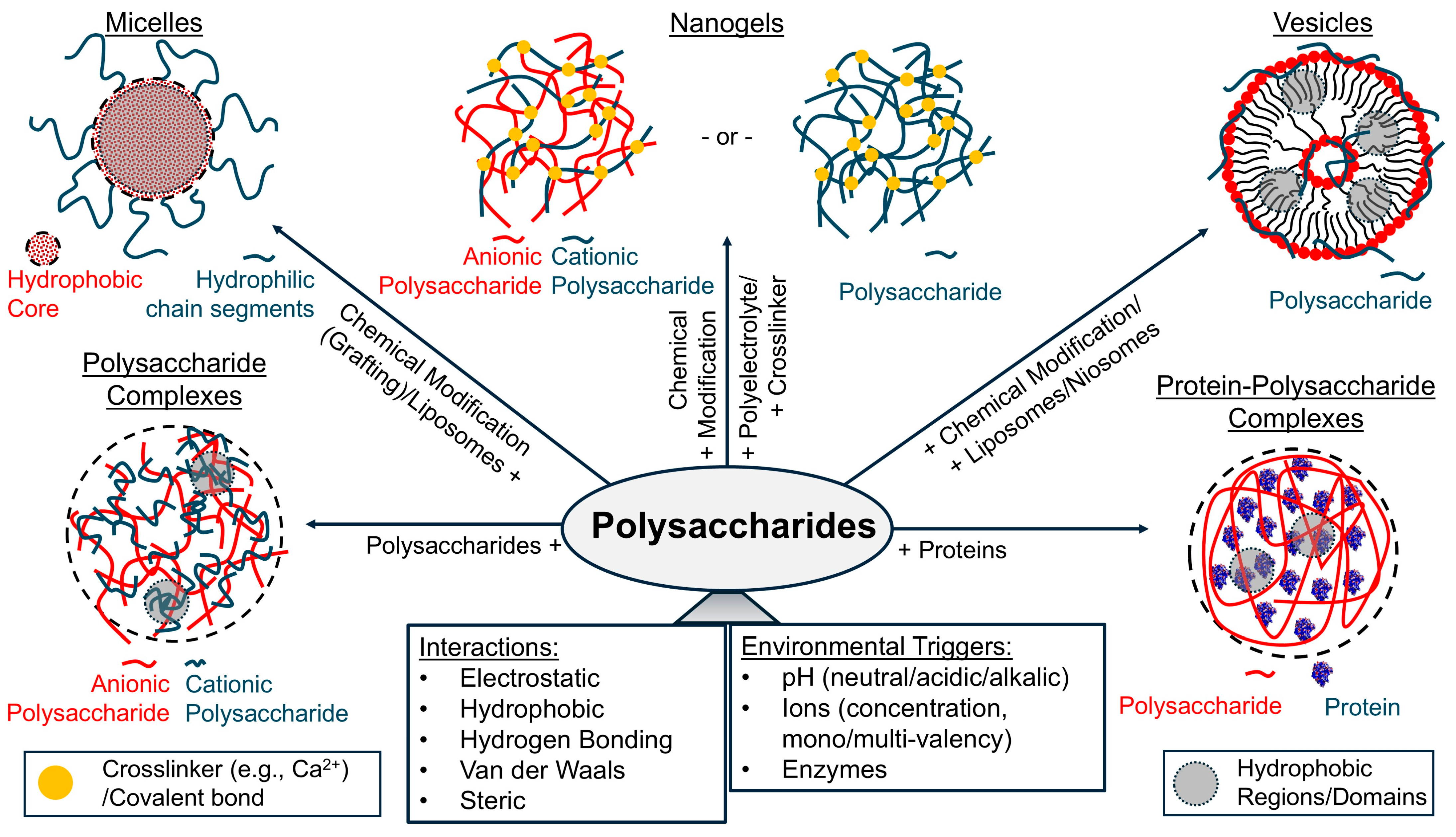
Nanogels are three-dimensional, nanoscale polymer networks capable of retaining large amounts of water while maintaining their structural integrity [86,87,138,139]. Polysaccharide-based nanogels can be formed through physical, such as via hydrogen bonding, ionic interactions and hydrophobic associations, or chemical, such as via covalent bonds, crosslinking [86,140,141,142]. In the recent study of Suhail et al. [142], ALG-based nanogels were developed as a polymeric network for the sustained release of caffeine. The nanogels were prepared via free-radical polymerization, in which ALG was crosslinked with 2-acrylamido-2-methylpropanesulfonic acid (AMPS) using N′,N′,-methylene bisacrylamide (MBA) as the crosslinker. Increased ratios of the polymer, monomer, and crosslinker led to higher gel fractions while swelling and caffeine release were enhanced at pH 4.6 and 7.4 compared to pH 1.2. These results reflected the ionization behavior of the functional groups. Drug loading was influenced by the formulation composition, decreasing with higher crosslinker contents while increasing with higher ALG and AMPS levels. Additionally, in the work of Podgórna et al. [140], gadolinium–ALG nanogels were prepared via reverse microemulsion and physical crosslinking methods as carriers for hydrophilic drugs with magnetic resonance imaging (MRI) traceability. The resulting nanogels exhibited nanoscale dimensions and a uniform morphology, as confirmed by cryo-scanning electron microscopy (Cryo-SEM). Surface modification was achieved using a layer-by-layer (LbL) assembly of natural polyelectrolytes. The encapsulation of the fluorescent model compound, named rhodamine B, demonstrated the loading capability of the nanogel network, while the feasibility of MRI-based visualization was confirmed. Overall, both physical and chemical nanogels are promising platforms for drug delivery, sensing, and tissue engineering. In Figure 2, a schematic representation of important self-assembled structures, fabrication pathways, interactions, and environmental factors related to polysaccharide-based nanocarriers is introduced.
To provide a comparative overview of the structure–processing relationships in polysaccharide-based nanocarriers, Table 2 compiles commonly used experimental preparation methods and strategies together with key formulation parameters. These parameters can regulate electrostatic, hydrophobic, and covalent interactions during self-assembly, thereby controlling the particle size, network density, and hierarchical organization across the complexes, micelles, nanogels, vesicles, and protein–polysaccharide systems mentioned in the paragraphs of Section 2.2. Table 2 also includes selected polysaccharide-based systems reported in the corresponding literature as characteristic examples to demonstrate how these conditions direct self-assembly and structural attributes.

2.3. Structure–Property–Function Relationships

A rigorous understanding of polysaccharide-based nanocarriers requires quantitative insights into their hierarchical architecture, spanning molecular conformation, nanoscale assembly, and mesoscale network formation [146,147,148,149]. Therefore, a combination of scattering and rheological techniques has emerged as a standard approach for structure–property mapping. Small-angle X-ray scattering (SAXS) and small-angle neutron scattering (SANS) provide complementary access to the internal structure of polysaccharide self-assemblies over length scales ranging from a few ångströms (Å) to several hundred nanometers [150,151]. These techniques have been extensively employed to extract structural parameters such as the radius of gyration (Rg), the correlation lengths (ξ), and the domain spacing (d) within nanogels, polysaccharide complexes, and core–shell particles [137,148,152,153,154,155,156]. SANS contrast variation allows for the selective visualization of specific components due to the strong difference in the cross sections between the hydrogen isotopes protium and deuterium, enabling a more subtle interpretation of multicomponent architectures [157,158]. Dynamic and static light scattering (DLS and SLS) remain indispensable techniques for assessing hydrodynamic size distributions, aggregation states, and molar mass scaling in solutions [159,160,161]. While DLS provides rapid, ensemble-averaged information on particle size and colloidal stability, SLS enables determination of absolute and apparent molecular masses and second virial coefficients, as well as the scattering profiles of the solution populations for low-scattering wave vector values (q), i.e., for large length scales, which are critical for understanding interparticle interactions and solvent quality effects [53,59,83,162]. Importantly, the combined use of DLS and SLS allows for differentiation between compact nanoparticles, loosely associated clusters, and percolated networks, which are conditions often overlooked when relying on a single technique for the investigation of a colloidal or hydrogel system [53,59,84,161,162]. Additionally, rheological measurements bridge the nanoscale structure and macroscopic function by probing the viscoelastic response of polysaccharide self-assemblies. They can reveal transitions from dilute dispersions to physically or chemically crosslinked networks, while parameters such as storage (G′) and loss (G″) moduli directly reflect network connectivity, relaxation dynamics, and energy dissipation mechanisms [163,164,165]. When correlated with parameters determined from scattering techniques, rheology enables quantitative structure–property relationships linking nanoscale organization to bulk mechanical performance [163,166,167]. In addition to the standard approaches of the scattering and rheological techniques, the use of other techniques, such as UV–Visible (UV-Vis) spectroscopy, FTIR, fluorescence spectroscopy, transmission electron microscopy (TEM), and differential scanning calorimetry (DSC), are extensively used either individually or in combination with one another to provide further information on the structure–property–function relations of polysaccharide-based systems, as well as other nanosystems [56,59,83,84].
The functional relevance of polysaccharide nanocarriers is critically determined by their stability and responsiveness to physiological and thermal stimuli [89,168,169]. These behaviors are inherently structure-dependent and arise from the dynamic nature of noncovalent interactions and environmentally sensitive chemical moieties [90,170]. pH responsiveness is particularly prominent in polysaccharide systems containing ionizable groups, such as carboxylates or amines, while variations in pH can modulate electrostatic interactions, leading to swelling, disassembly, or structural rearrangements of the nanocarriers [89,90]. In a recent study, Shikuku et al. [89] reported the preparation of biocompatible, size-tunable semi-interpenetrating polymer network (semi-IPN) NPs composed of CHT and pH-responsive polymers via free-radical polymerization, with the aim of developing a pH-dependent anticancer drug delivery system. Successful doxorubicin (DOX) loading into the NPs was confirmed by FTIR and fluorescence spectroscopy, which showed emission behavior comparable to free DOX. The DOX-loaded NPs exhibited sustained and pH-responsive release profiles, with the formulation composition playing a key role in modulating the drug loading and release behavior. Enhanced drug release was observed under acidic conditions representative of the tumor microenvironment, while minimal release occurred at physiological pH. Differences in the entrapment efficiencies among the formulations were attributed to specific molecular interactions, including π-π stacking and electrostatic interactions, which are heavily affected by the pH conditions of the system.
Redox-responsive polysaccharide nanocarriers typically rely on disulfide crosslinks or redox-active conjugates that undergo cleavage under intracellular reducing conditions. Structural characterization under oxidizing versus reducing environments has demonstrated how subtle molecular-level changes translate into pronounced alternations in network integrity and cargo retention [168,169]. In the recent work of Laradji et al. [168], the development of redox-responsive HA-based hydrogels complexed with penetratin for drug delivery to the posterior segment of the eye was investigated. Following topical administration, the nanogels were able to reach retinal pigment epithelial cells and release their cargo in response to the intracellular reducing environment. As a proof of concept, the visual chromophore analogue 9-cis-retinal was encapsulated within the nanogels and demonstrated recovery of photoreceptor function in ex vivo retinal models. Additionally, partial functional restoration in vivo was reported compared to untreated controls. These findings indicated that the proposed delivery system represents a promising alternative for the retinal administration of retinoid-based therapeutics and potentially other drugs, but further optimization is required for clinical relevance.
Enzyme stabilization and immobilization can be modulated through the utilization of the physicochemical properties of polysaccharide-based nanocarrier systems. Immobilization within polysaccharide assemblies can enhance enzyme resistance to thermal denaturation, pH fluctuations, and proteolytic degradation by restricting large-scale conformational motions and creating protective microenvironments [171,172]. At the same time, strong electrostatic binding may limit substrate diffusion and reduce catalytic efficiency [173]. In the recent study of Wu et al. [170], the fabrication of a cage-like nanogel-immobilized transglutamise (CNI-TG) using a sacrificial template approach was reported, resulting in improved enzyme stability and catalytic performance. A high oxidation degree of oxidized sodium ALG enabled efficient covalent conjugation with TG via Schiff base formation. Spectroscopic and structural analyses revealed a multi-crosslinking architecture involving both covalent and noncovalent interactions. The immobilized enzyme retained a substantial proportion of its activity while exhibiting enhanced thermal stability and broad pH tolerance. These features were attributed to conformational confinement and microenvironment buffering effects provided by the nanogel matrix. The incorporation of CNI-TG into whey protein isolate/gelatin hydrogels led to marked improvements in the mechanical and functional properties. Compared to control systems, the resulting hydrogels showed enhanced strength, reflecting synergistic interactions between the nanogel carriers and protein matrix. Overall, the study introduced a versatile enzyme immobilization strategy based on covalent anchoring and electrostatic assembly with potential relevance to applications in food science and biomedical fields.
Thermoresponsive behavior, whether intrinsic or introduced via functionalization, further illustrates the tight interplay between molecular design and supramolecular organization [174,175]. Temperature-induced transitions can affect chain conformation, hydration, and intermolecular associations, thereby modulating nanocarrier stability and permeability [175,176]. In a recent work by Papagiannopoulos et al. [177], NPs based on the electrostatic complexation of hemoglobin (Hb) and CS were prepared as a potential drug carrier utilizing a fully biocompatible and environmentally friendly approach. At acidic pH, spontaneous electrostatic complexation between Hb and CS under and near the charge neutralization ratio produced spherical NPs with narrow size distributions. Thermal treatment was used to stabilize these complexes against subsequent pH increases, as electrostatic attraction forces weakened at neutral pH due to the reduced Hb-positive surface charge. The resulting nanoparticles retained pH-responsive surface charge characteristics and protein-derived hydropathy. Their capacity to encapsulate hydrophobic model compounds, such as CUR and β-carotene, was demonstrated, and both unloaded and loaded NPs exhibited stability at elevated ionic strength. These findings show that protein–polysaccharide complexation combined with thermal stabilization is a viable strategy for the formulation of Hb-based multifunctional nanocarriers for the delivery of drugs, nutrients, and oxygen.
The encapsulation efficiency and release kinetics represent key functional metrics that directly link nanocarrier structure to therapeutic performance. These parameters are governed by a complex interplay between the carrier architecture, cargo properties, and environmental conditions [178]. Structural features such as the network mesh size, core density, and interfacial chemistry strongly influence the loading capacity and retention [179,180]. Estimates derived from the scattering investigation of internal structure length scales, combined with rheological measures of network stiffness, have been correlated with encapsulation efficiency for small molecules, proteins, and nucleic acids [181,182]. In a recent work by Wang et al. [147], the development of a composite nanodelivery system based on zein and carboxymethyl CHT for the co-encapsulation of CUR and resveratrol was studied. Structural analysis indicated that the polyphenolic compounds were predominantly associated with the hydrophobic domains of zein, while carboxymethyl CHT formed a stabilizing outer layer through electrostatic interactions. Formulation optimization resulted in an improved encapsulation efficiency for both bioactives, with their antioxidant activity largely preserved following encapsulation. The carboxymethyl CHT-coated NPs exhibited enhanced storage stability and controlled release behavior under gastrointestinal conditions, leading to improved bioaccessibility. In another recent study by Gao et al. [183], the identification and optimization of a polysaccharide-based nanosystem for efficient small interfering RNA (siRNA) encapsulation and delivery to cardiac tissue were investigated. Using a diversity-oriented formulation screening approach supported by automated microfluidics, a broad range of polysaccharide–cationic material combinations was evaluated for siRNA loading, stability, and delivery performance. The selected nanosystem, termed GluCARDIA, leveraged a β-glucan derivative to enable intrinsic targeting while facilitating efficient siRNA condensation without the need for additional surface functionalization. Through systematic screening, GluCARDIA demonstrated high siRNA encapsulation efficiency and effective gene silencing at reduced nucleic acid and carrier doses compared to the earlier formulation. The incorporation of a cationic amphiphilic peptide enhanced siRNA complexation and cellular uptake, while the polysaccharide component improved biocompatibility and formulation robustness. Encapsulation of therapeutic siRNA targeting interferon regulatory factor 3 enabled the effective modulation of pathological signaling in a myocardial ischemia–reperfusion model, supporting the system’s capacity for targeted nucleic acid delivery.
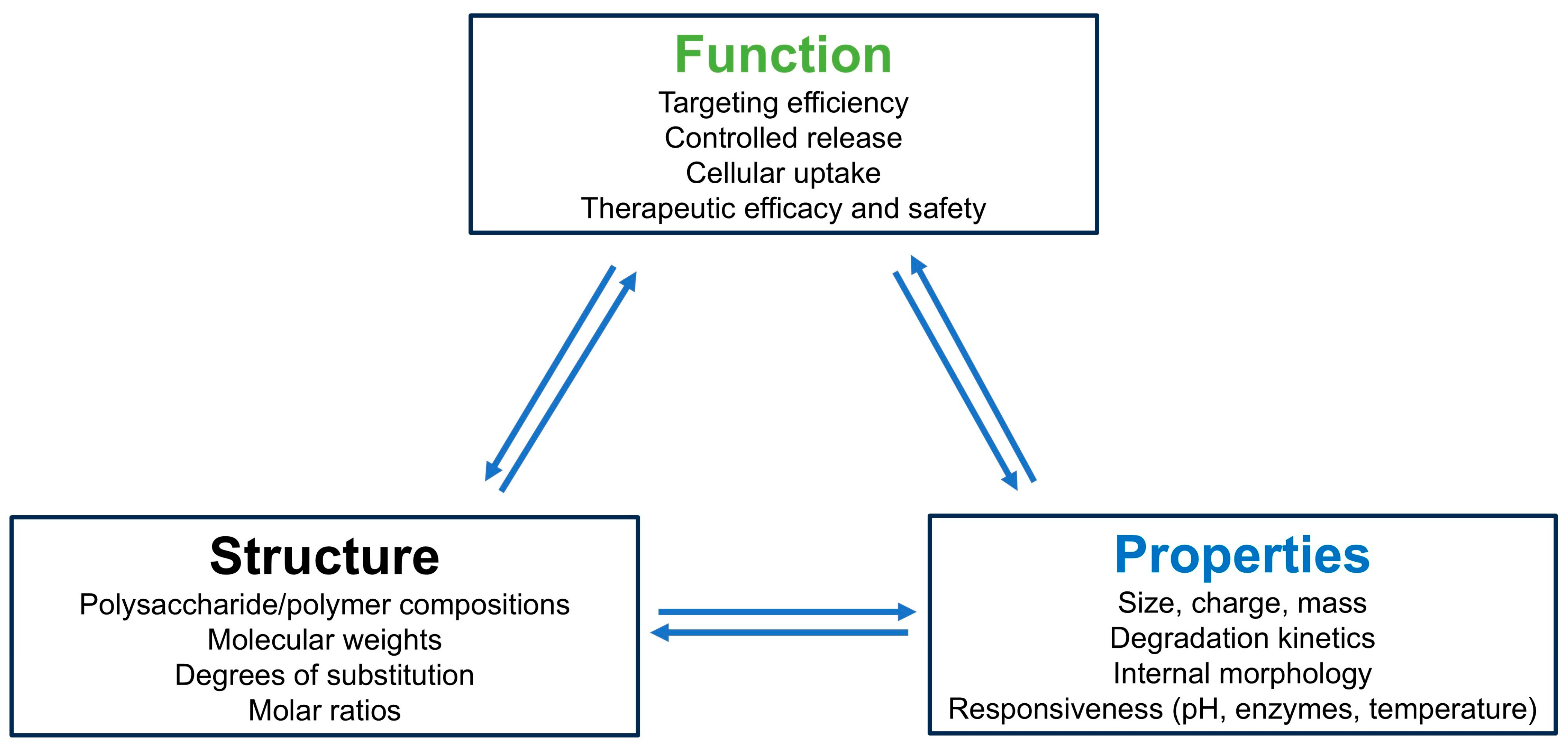
Controlled release behavior is similarly dependent on structure. Diffusion release is typically observed in loosely crosslinked or swollen systems, whereas erosion- or degradation-controlled release emerges in more densely crosslinked or enzyme-sensitive matrices [178,184,185]. Quantitative release models often benefit from integrating structural parameters obtained from SAXS or SANS and rheology, enabling predictive relationships between nanocarrier design and release profiles [19,137,151,186]. In the recent work of Suhail et al. [142], nanogels were formed through polymerization of their constituent components, with FTIR analysis confirming successful crosslinking and material compatibility. Scanning electron microscopy (SEM) imaging revealed a compact surface morphology with limited porosity, and the particles exhibited an average size in the submicron range. Swelling behavior and drug release were enhanced under neutral and mildly acidic conditions compared to strongly acidic environments. Increasing the proportions of ALG, AMPS, and MBA resulted in higher gel fractions and reduced sol fractions. Additionally, drug loading was formulation-dependent, decreasing with higher crosslinker content while increasing with greater ALG and AMPS incorporation. Biocompatibility assessment using the HET-CAM assay indicated suitability for the oral administration of caffeine. A concise schematic overview of the structure–property–function relationships of polysaccharide-based nanoscale assemblies is shown in Figure 3.

3. Polysaccharide Nanocarriers in Precision Medicine: Applications, Translation, and Emerging Opportunities

3.1. Targeted Therapeutic and Diagnostic Applications of Polysaccharide Nanocarriers

Several polysaccharides can target cancerous cells and tissues and, for this reason, have great potential in cancer drug delivery. CD44 is a cell surface adhesion receptor which is overexpressed in many cancers regulating metastasis. It interacts with extracellular-matrix ligands to facilitate tumor cell migration and invasion. It has been identified as a hyaluronan and HA receptor. CD44 is also known to bind additional ligands, such as osteopontins, collagens, and matrix metalloproteinases [187]. Self-assembled NPs from DOX-conjugated CS were prepared, as CS targets CD44. The NPs were loaded with aspirin, which interferes with the platelet-mediated effect in cancer metastasis. In a breast cancer model, tumor was inhibited by more than 80%, as targeting was remarkably high and drug release was significant at acidic pH (tumor microenvironment). Aspirin indeed increased the cytotoxicity in a model that included platelets. In a lung metastasis model, the reduction was more than 90%, as platelet activation and angiogenesis were reduced [188]. In a study of CHT NPs loaded with alpha-mangostin coated with HA [189], drug release was stronger in an acidic environment as well. The targeting of CD44 by HA increased the cytotoxicity in MCF-7 cells in comparison to chitosan nanoparticles with no added HA. This highlighted the potential of the system as an effective breast cancer-specific therapy.
The targeted delivery and tumor microenvironment-enhanced release of Cucurbitaceae-derived Compound 1 was also achieved by fluorinated HA nanocarriers against non-small-cell lung cancer (NSCLC). The combined effect of pH response and targeting led to higher viability for A549 NSCLC cells and lower toxicity to normal BEAS-2B cells in comparison to free Compound 1. Therefore, the system was capable of higher therapeutic efficacy and safety. In addition, fluorescence quenching due to drug–carrier intermolecular interactions and nanocarrier aggregation showed the potential for fluorescence tracking [190]. Fucoidan (FC) is a natural polysaccharide with anticancer and antioxidant properties [191]. The polysaccharide was vectorized by functionalization on iron oxide NPs and tested against human hepatoma cells (Huh-7). The bioactivity of the composite NPs and free FC was tested for cell invasion, migration, reactive oxygen species production and matrix metalloproteinase (MMP-2 and 9) activity and expression. A decrease in all activities was observed for the NPs. Cellular uptake could be estimated by magnetic measurements. Therefore, the system was proposed as a theranostic tool for hepatocellular carcinoma [192]. Targeted therapy of pancreatic ductal adenocarcinoma was proposed via functionalization of zinc–DOX NPs with β-glucans. The orally administered NPs targeted and transpassed microfold cells, passed the intestinal epithelial barrier and were phagocytosed by endogenous macrophages. These “hitchhiking” macrophages destroyed the desmoplastic stromal barrier that modulates the tumor microenvironment to induce apoptosis of tumor cells [193].
Peptide and protein therapeutics represent a rapidly expanding class of biopharmaceuticals that harness naturally occurring or engineered biomolecules to treat diseases with high specificity. They have strong biological activity and reduce off-target effects compared to traditional small-molecule drugs [194]. A multifunctional biomimetic nanocarrier that integrated a novel antimicrobial peptide, CC-19, with the polysaccharide FC was developed to enhance vancomycin delivery against bacterial infections and sepsis. The peptide acted as a therapeutic agent, as it took advantage of vancomycin’s antibacterial activity to improve bacterial killing kinetics and biofilm eradication. FC provided electrostatic interactions for nanoplex formation and, in addition, offered anti-inflammatory and antioxidant properties. Together, the antimicrobial peptide and fucoidan created a stable, biocompatible nanosystem with sustained drug release, significantly improved antibacterial efficacy, and modulation of immune responses [195]. The monoclonal antibody bevacizumab (BVZ) was encapsulated in polysaccharide-based nanocarriers through polyelectrolyte complexation with gellan gum (GG). The nanocarriers were modified on their surfaces by CHT. The aim was to overcome the limitations of BVZ’s parenteral administration and instability in the gastrointestinal tract. The polysaccharides played a pivotal role in NP formation, influencing the particle size (200–400 nm), charge (−16 to −40 mV), stability, and protein association efficiency, while CHT provided charge inversion and enhanced encapsulation. These tailored nanocarriers demonstrated stability over extended periods and highlighted how manipulating polysaccharide interactions could improve the delivery and therapeutic performance of protein-based drugs [196].
Nucleic acid therapeutics are increasingly recognized as powerful tools for silencing oncogenic drivers and reversing drug resistance in cancer. In a recent study [197], HA as a ligand to CD44 was conjugated to mesoporous silica nanoparticles. The nanocarriers delivered siRNA and TWIST protein to ovarian cancer stem cells. HA enhanced the tumor-specific uptake and delivery efficiency. It provided superior selectivity compared to nanoparticles that were not coated by the polysaccharide. The system achieved sustained TWIST knockdown and reduced tumor burden. This demonstrated the therapeutic potential of nucleic acid delivery platforms. In another study [198], HA-modified CHT NPs were developed to deliver siRNA for the targeted therapy of NSCLC. The polysaccharide HA played a key targeting role by binding to the CD44 receptor. HA modification improved the nanoparticle stability, cellular uptake, and tumor selectivity. The HA–CHT NPs successfully delivered siRNA against BCL2 and slowed cancer cell growth in cells and animals. In mice, the HA-coated NPs gathered mainly in tumors, reduced the tumor size, and caused little toxicity. This HA-based system shows strong promise for targeted siRNA cancer therapy. Furthermore, siRNA was combined with CHT–methacrylate complexes and packed into liposome-based nanolipogels in another study [199]. This design allowed for the slow and steady release of siRNA. The crosslinked structure held the siRNA tightly and protected it from breakdown. Release lasted for up to 28 days. Gene silencing remained strong for about two weeks. The system was stable and entered cells efficiently. Overall, this approach supports long-lasting siRNA therapy.
Delivering proteins to the brain is challenging because of the blood–brain barrier. Nose-to-brain delivery offers a direct path. In a recent study [200], CHT NPs were modified with human transferrin (TF) on their surface. TF helped the particles enter nasal cells through receptor binding. The NPs were 110–150 nm in size and positively charged. Higher TF levels on their surfaces led to better cell uptake. The attachment method was mild and did not damage the cargo. This system allowed for the flexible addition of targeting ligands and supported the efficient nose-to-brain delivery of large therapeutic molecules with maintenance of their integrity.
Oral delivery of peptide drugs is limited by the intestinal mucus and epithelial barriers. In the work of Li et al. [201], CHT-coated core–shell NPs were developed to improve exenatide delivery. The NPs contained an ovolecithin, DEX, and albumin core and a CHT outer shell. CHT slightly reduced mucus penetration by 1.1-fold but strongly improved cell interaction. Cellular uptake increased 2.15-fold, and transepithelial transport increased 1.77-fold. Uptake occurred mainly through energy-dependent endocytosis. The drug was protected by the environment of the gastrointestinal tract, and 13.29% of oral bioavailability was achieved. Long-term treatment improved blood glucose, lipid levels and pancreatic function.
Zheng and colleagues [202] developed a nanomotors-in-hydrogel system where HA was an important part of the hydrogel structure. The hydrogel directly contacted the urinary mucus layer. As a polysaccharide, HA helped form a hydrated and flexible matrix at the tissue surface. This environment allowed urea to diffuse through the poloxamer 407 (PLX)/HA composite and create a clear concentration gradient. The gradient provided direction for urease-modified nanomotors to move. This movement occurred even though the nanomotors did not have asymmetric surface designs. The urea gradient strongly drove transport. Nearly 50% of the nanomotors redistributed to the outer region at 300 mM urea. Transmucosal diffusion increased by 1.3- to 5.5-fold at urea concentrations up to 500 mM. By shaping the local chemical and physical environment, HA supported the shift from initial mucus attachment to deeper tissue penetration. This process improved intravesical drug delivery.
In another system [203], the polysaccharide sodium ALG formed the main structure of dissolving microneedle patches. It provided enough mechanical strength for skin insertion. It also created strong mucoadhesive interactions with the oral mucosa. The sodium ALG and polyvinyl alcohol matrix dissolved quickly, within 10 min. This fast dissolution allowed close contact with the mucosal surface. Such contact helped effective drug placement at the target site. The hydrophilic and gel-forming nature of sodium ALG improved drug movement across the tissue. Lidocaine-loaded invasomes showed about 95% cumulative drug release within 24 h. Mucosal permeation reached approximately 99 µg/cm2. By forming a hydrated layer at the epithelial surface, the polysaccharide supported sustained local drug delivery. It also helped promote tissue healing. Overall, sodium ALG played a key role by linking mechanical strength, adhesion, and drug diffusion for efficient oral mucosal delivery.
Multifunctional imaging and therapy systems are being studied as advanced nanomedicines. In these systems, polysaccharide NPs carry drugs and imaging agents together. This allows for real-time tracking and guided treatment. Ryu et al. [204] synthesized a polysaccharide-based platform by the electrostatic complexation of Codium fragile polysaccharide and CHT. Indocyanine green (ICG) was encapsulated, as it is a near-infrared (NIR) dye and photosensitizer. The NPs enabled fluorescence-guided therapy triggered by laser light at 808 nm. They also triggered strong antitumor and antimetastatic immune responses. In animal studies, the treatment greatly suppressed tumor growth. No obvious systemic toxicity was observed. The NPs were made through polysaccharide complexation and ionic interactions. Their size was about 100–200 nm. The presence of CHT gave a positive surface charge. This property helped cellular uptake and tumor accumulation. Hybrid nanogels based on CHT were developed for cancer treatment and imaging [205]. The nanogels were functionalized with cysteine-linked gold NPs. This system combined chemotherapy with computed tomography imaging. The nanogels of the TPP-crosslinked CHT were modified by polyacrylic acid (PA). DOX was incorporated into the nanogels’ interiors by electrostatic interactions. They showed a high DOX loading efficiency of 87%. In acidic tumor-like conditions, the nanogels broke down into smaller units of 30–40 nm. This breakdown helped trigger controlled drug release. Cell studies showed the strong uptake of the nanogels. Loaded nanogels increased intracellular DOX levels by 6.7-fold in CAL-27 cells after 24 h compared with free drug. This led to higher toxicity toward cancer cells. Cell death increased by 3.9-fold. The gold NPs provided strong computed tomography (CT) contrast and allowed for clear tumor imaging. Overall, this hybrid system improved drug delivery, imaging ability, and anticancer effects compared with free DOX.
Iron-functionalized mesoporous polydopamine NPs were coated with biomimetic membranes, which were derived from tumor cells [206]. In this way, a hybrid theranostic system was formed. The coating helped the NPs stay longer in the bloodstream. It also helped them avoid immune clearance. The biomimetic membrane closely mimicked the natural glycocalyx on cell surfaces. This improved biocompatibility and reduced opsonization. As a result, tumor accumulation was much higher than that of uncoated nanoparticles. Systemic exposure was also more sustained. The NPs effectively delivered chemotherapy drugs to tumors. At the same time, the iron component enabled magnetic resonance imaging guidance in vivo. This allowed for the real-time tracking of the NP distribution and treatment response. Both cell and animal studies showed very low toxicity to normal tissues. Strong anticancer effects were observed when combined with photothermal therapy. Overall, the work showed how polysaccharide-like biomimetic coatings can improve circulation times, immune modulation, and multifunctional cancer therapy for future clinical use.
Multifunctional hybrid NPs were built using polysaccharides. Superparamagnetic iron oxide NPs were coated with oxidized DEX and quaternized CHT [207]. This design allowed the particles to carry messenger RNA (mRNA) while keeping the magnetic properties for future MRI use. The iron oxide cores were about 5–10 nm in size by TEM. The hydrodynamic diameter was below 200 nm. The surface charge varied depending on the coating. These features improved stability and cell interaction. In T47D breast cancer cells, oxidized DEX-coated particles showed the best uptake. They produced strong GFP-mRNA expression, as the fluorescence was about 2.5-fold higher than that of the commercial control. Cytotoxicity remained low at 1–10 µg mL−1. Overall, polysaccharide coatings enabled both imaging and gene delivery on one nanoplatform.
Table 3 summarizes representative polysaccharide-based nanocarriers, some of which have been discussed in the paragraphs of Section 3.1, highlighting their therapeutic targets, cargos, mechanisms of action, stimuli responsiveness, and potential for precision medicine. By integrating targeting ligands, microenvironment-responsive release, or theranostic functionalities, these systems exemplify how polysaccharide nanocarriers can be rationally designed to achieve patient-specific therapy, enhance treatment efficacy, and reduce off-target effects.

3.2. Sustainability, Standardization, and Translation

Food- and waste-derived polysaccharides have emerged as sustainable, low-impact materials for nanocarrier design, driven by the upcycling of agricultural and food-processing by-products. Advances in green extraction and eco-friendly chemical modification now enable high-quality polysaccharides to be obtained and functionalized with minimal energy use and without toxic solvents. These developments align polysaccharide-based nanocarriers with circular bioeconomy principles, supporting greener, safer, and more scalable therapeutic platforms [215]. Vargas et al. [216] studied the green extraction of PCT from apple (Malus domestica) pulp and peel using citric acid (CA) and two natural deep eutectic solvents (NADES), namely, CA–glucose–water and lactic acid–glucose–water. Extractions were performed at 80 °C, with NADES applied as a pretreatment followed by aqueous extraction. PCT fractions obtained with NADES gave lower yields (≈4 g/100 g), comparable or higher uronic acid contents (50–63 g/100 g) and comparable or lower degrees of methoxylation (53–71%) in comparison to CA. Ultrasound-assisted NADES pretreatment increased yields and preserved rhamnogalacturonan I domains better. Valorizable biopolymers have enabled the design of controllable self-assembled nanocarriers [217] alongside translationally relevant viscoelastic systems [218].
Polysaccharide-based nanocarriers from CEL, CHT, and PCT offer a sustainable option for drug delivery and functional materials. These biopolymers can be derived by green extraction and waste valorization methods [218,219]. These approaches allow for the tuning of physical and biological properties. In a recent study [220], a deep eutectic solvent and microwave-assisted pretreatment was tested. The goal was to improve cellulose nanofiber extraction from lignocellulosic fibers. A triethylmethylammonium chloride/imidazole solvent system was used. Microwave conditions were optimized using the response surface methodology. Temperature and time of reaction controlled fiber solubility. The solvent selectively removed hemicellulose and lignin. The CEL chemistry remained unchanged. This led to a higher crystallinity index and better thermal stability. High-pressure homogenization then produced cellulose nanofibers. These fibers showed a narrower diameter distribution than untreated samples. The results showed that green solvents and process intensification improve nanocellulose recovery and efficiency.
Baraka et al. [221] reported a green surface modification of cellulose nanofibers (CNFs) via the ring-opening polymerization of N-carboxyanhydride monomers initiated by CNF surface hydroxyls, using a choline chloride:formic acid deep eutectic solvent (DES) as the reaction medium. The process promoted grafting of polypeptide chains onto CNFs, with the grafting amount increasing with the reaction time, reaching ≈12.2% after 3 h. Characterization by FTIR, solid-state NMR, XPS, and SEM/EDX confirmed successful grafting and incorporation of nitrogen. Modified CNFs exhibited a rougher, amorphous surface, enhanced hydrophobicity (water contact angle rising from ~15.7° to ~60°), and altered mechanical properties. This demonstrated how DES-based green chemistry can functionalize nanocellulose more sustainably compared to conventional solvents. Etminanrezaeieh et al. [222] developed a green biocomposite from waste-derived CHT, hydroxyapatite, and PCT using freeze-drying and glutaraldehyde crosslinking. Composites with up to 60 wt% hydroxyapatite showed high crystallinity (~70%) and porosity (8.9–12.5 m2/g). Orange peel PCT improved dispersion, demonstrating the sustainable valorization of agricultural and food waste.
Reproducibility and stable quality are important for polysaccharide-based nanocarriers in precision medicine [10]. Natural polymers can vary and affect particle size, surface charge, and drug delivery. A recent study [223] addressed this issue using microfluidics. PCT-coated liposomes were prepared under well-controlled mixing conditions where the polymer type, polymer concentration and flow rate ratio were systematically changed. Optimal and reproducible conditions were identified. The PCT-to-liposome weight ratio was 0.7. The flow rate ratio was 2:1. DLS showed increased particle size. The size changed from about 100 nm to about 300 nm after coating with PCT. The zeta potential changed from positive to strongly negative. This confirmed complete and stable coating. Different PCTs had varied molecular weights and esterification degrees. Even so, microfluidic processing produced consistent particle sizes and surface charges. Storage studies showed little change over time. This indicated low batch-to-batch variation and high formulation stability.
Scalable manufacturing bridges polysaccharide self-assembly and clinical translation by enabling the precise control of formulation conditions. Advanced mixing regulates key parameters, such as ionic interactions and concentration gradients, that govern nanoparticle formation. This ensures reproducible self-assembly and supports the reliable production of next-generation polysaccharide nanocarriers. Scaling polysaccharide nanocarrier production is often limited by conventional batch mixing, which struggles to deliver consistent size and high throughput. Flash nanocomplexation addresses this by rapidly mixing CHT, tripolyphosphate (TPP), and insulin under turbulent flow (Re > 1600), yielding nanoparticles as small as ≈45 nm with narrow distribution and high encapsulation efficiency (up to ≈90%) compared to bulk mixing, which produces larger, less uniform particles. Flash nanocomplexation provides continuous production at a throughput of ≈5.1 g h−1, significantly improving the reproducibility and scale-up potential of protein-loaded polysaccharide carriers [224]. Achieving scalable, reproducible particle formation without complex equipment remains a key manufacturing challenge. Membrane ionotropic gelation combined CHT and sodium TPP solutions across a 1 µm porous membrane, triggering gelation at the pore interface. The process avoided harsh solvents and allowed for precise control over the particle size (≈176–205 nm or 314–644 nm) by tuning the flow rates and solution ratios, with continuous or recirculating operation modes. This simple ionotropic gelation method demonstrated high throughput with fine size control, offering a feasible path toward polysaccharide NP production compatible with good manufacturing practice [225]. A major scale-up barrier for polysaccharide nanocarriers is achieving reproducibility in large reactors. Using ionotropic gelation in a tank reactor equipped with baffles and a Cowles impeller, CHT and TPP interacted under controlled mixing to form nanoparticles with consistent size, polydispersity, and surface charge. The improved agitation and reactor geometry enhanced uniform gelation throughout the vessel, reducing batch variability and supporting larger volumes. This traditional mixing strategy showcased how ionotropic gelation can be adapted to industrial-scale equipment for reproducible, scalable nanoparticle manufacture [226].
Standardization represents a critical requirement for the successful clinical translation of polysaccharide nanocarriers [227,228]. Due to their biological origin, polysaccharides exhibit inherent variability in their molecular weights, branching, and functional group distributions, which can significantly influence nanocarrier assembly, stability, and biological performance [10]. Establishing standardized protocols for raw material characterization, including molecular-weight distribution, degree of substitution, and purity, is essential to ensure batch-to-batch reproducibility. In parallel, standardized physicochemical and biological evaluation methods, including particle size analysis, surface charge measurement, drug-loading efficiency, and in vitro and in vivo testing, are necessary to enable reliable comparisons across studies. Such standardization is particularly important for precision medicine applications, where reproducible structure–property relationships are required to achieve a predictable therapeutic performance and regulatory approval.
Ensuring the safety of polysaccharide-based nanocarriers is critical for use in precision medicine [229]. Although polysaccharides are generally regarded as biocompatible materials, their biological response is not uniform and strongly depends on the structural and compositional parameters related to the source of the polysaccharide. Consequently, intrinsic differences among polysaccharides can influence the level of nanocarrier biocompatibility. In some cases, systemic exposure and organ buildup can cause toxicity. Chang et al. [3] studied glycol CHT NPs in mice. The particles had sizes of about 265–288 nm. Mice received repeated high doses of 90 mg/kg. The NPs accumulated in the liver, spleen, and heart and triggered inflammatory responses. Tissue fibrosis and signs of heart toxicity were detected. The results showed that even biodegradable polysaccharides can cause harmful effects. These risks appeared at high doses and prolonged exposure. The same study also tracked where the NPs went as time progressed. It showed that long retention in the liver, spleen, and heart was linked to tissue damage. These findings highlight the need to study both particle sizes and clearance rates when setting safe doses. Another in vivo study [230] examined unmodified CHT NPs. These particles were about 100 nm in size. They were injected intravenously into rats at doses of 1, 2, and 4 mg/kg. Most particles accumulated in the liver and lungs. No significant hemolysis or leukocytosis was observed. There was no major organ dysfunction over 14 days. The animals showed only a short delay in weight gain. No pain or distress was reported. These results suggested low acute toxicity at clinically relevant low doses. Overall, the comparison showed that the dose, size, and surface chemistry strongly affect safety and help define safe exposure limits.
The immunogenicity of polysaccharide nanocarriers depends strongly on the surface chemistry and polymer structure. Almalik et al. [231] showed that HA-coated CHT NPs reduced adsorption of serum proteins linked to inflammation. This effect was stronger in comparison to uncoated or ALG-coated particles. The HA coatings produced zeta potentials between −20 and −28 mV. These values indicated stable surfaces that were less likely to trigger immune recognition. In another study [232], high-molecular-weight CHT NPs activated autophagy and inflammasome signaling related to stimulator of interferon genes. This response increased antigen presentation and adaptive immune activity. These results showed that the polysaccharide molecular weight and structure can modulate immune pathways. They may reduce unwanted immune reactions or actively stimulate immunity. Together, these studies demonstrated the importance of careful surface design and polymer architecture. This control is needed to balance safety, biocompatibility, and therapeutic performance in personalized medicine. While most polysaccharides used in nanocarriers display favorable biocompatibility, comparative studies that systematically attribute biological effects to the polysaccharide type or source remain limited. Therefore, elucidating how the polysaccharide chemistry and origin (i.e., animal species, microbial, plant, or marine) modulate nanocarrier–biological system interactions represents an important direction for future research.

3.3. Next-Generation Therapeutic Opportunities

Smart polysaccharide-based nanocarriers are a fast-growing type of drug delivery system. They combine stimuli responsiveness, active targeting, and multiple functions. This design allows for better control over when and where drugs act. Such features improve their potential use in precision medicine. Recent studies focus on nanocarriers that respond to more than one trigger. These triggers can be internal or external. Cai et al. [208] developed HA-based nanomicelles with dual responsiveness. The system responded to acidic tumor pH and NIR light. This design enabled combined photothermal therapy and targeted chemotherapy. The nanomicelles remained stable during blood circulation. At the tumor site, they rapidly released the drug payload. In vivo results showed stronger tumor destruction and lower systemic toxicity. This study shows that multi-stimuli systems can outperform single-trigger designs and improve overall treatment effectiveness. Combining multiple therapies into one polysaccharide nanocarrier is an effective way to overcome drug resistance. It also helps regulate the disease microenvironment. Zhang et al. [209] developed CHT/ALG NPs that carried both DOX and hydroxychloroquine (HCQ). HCQ acted as an autophagy inhibitor. The system was pH-responsive, and it released both drugs together inside cancer cells. This synchronized release reduced drug resistance related to autophagy. As a result, chemotherapy became more effective, leading to animal studies showing that tumor growth was strongly inhibited. These results show the value of multifunctional polysaccharide nanocarriers. Co-delivery platforms like this offer strong potential for future cancer nanomedicine.
Polysaccharides are increasingly used as both building materials and targeting ligands in smart nanocarriers. They help form the structure of the carrier and guide it to specific cells. In a recent study by Luo et al. [210], HA–selenium NPs were developed. These NPs used CD44 receptor-mediated uptake to improve accumulation at spinal cord injury sites. In addition to targeted delivery, the system showed antioxidant activity and reduced inflammation. These effects led to clear functional recovery in animal models. This study showed that receptor-targeted polysaccharide nanocarriers are useful beyond cancer treatment. They have strong potential in inflammatory and neurodegenerative diseases, where precise drug delivery is especially important. There is a clear shift away from simple proof-of-concept work toward polysaccharide nanocarriers designed for real clinical translation. These systems now focus on well-defined physical and chemical properties, while strong in vivo testing is also emphasized. Matějková et al. [233] optimized HA NPs in a systematic way. The goal was to meet key in vivo requirements. These included a narrow size distribution, good colloidal stability, and reproducible production. The study also reported detailed pharmacokinetic data. Biodistribution and safety profiles were carefully evaluated. This helped address major barriers to clinical use. Overall, the study highlights the increasing focus on scalable manufacturing and regulatory readiness in the development of smart polysaccharide nanocarriers.
Personalized nanomedicine seeks to match therapeutic design with patient-specific disease features and treatment responses. Polysaccharide-based nanocarriers are particularly well suited for this goal due to their structural tunability, bioresponsiveness, and compatibility with real-time monitoring strategies. Recent advances demonstrate how these systems integrate targeted delivery, controlled activation, and feedback-guided optimization to enable more precise and adaptive therapeutic interventions. In the work of Ryu et al. [204], the polysaccharide-based NPs enabled real-time imaging during therapy. The system allowed for visualization of the nanoparticle accumulation at tumor sites. This made it possible to monitor the treatment response directly in vivo. Imaging feedback could help adjust the laser dose and treatment timing for individual patients. Tumor regression could be tracked over time. This approach supports patient-specific dose optimization. It also reduces unnecessary exposure and side effects. Overall, the platform links therapy with response monitoring to guide more personalized treatment decisions. In the study by Cai et al. [208], HA nanomicelles were designed to respond to tumor pH and NIR light. The system remained stable during circulation. Drug release was triggered only at the tumor site, and near-infrared irradiation allowed for the precise control of photothermal therapy. The treatment intensity could be adjusted by changing the laser power or exposure time. The tumor response could be evaluated after irradiation. This design supports flexible dose control based on treatment outcomes. Overall, the nanocarrier links have controlled therapy with response-guided treatment, supporting more personalized cancer care. In the study by Luo et al. [210], HA–selenium NPs were designed to target CD44 receptors. This receptor-guided design improved NP accumulation at the injured tissue. Targeted delivery reduced off-target exposure. The approach illustrates how polysaccharide nanocarriers can be tailored to receptor expression for more precise therapy.
Nanocarriers camouflaged with natural cell membranes inherit the membranes’ characteristics. They carry native proteins that help particles evade immune clearance and stay in circulation longer. They also promote homotypic targeting and accumulation at disease sites. This biomimetic cloaking approach uses the host’s own membrane components to improve delivery and reduce immune recognition in vivo [234,235]. Nanocarriers can be engineered with surface ligands that match a tumor’s molecular profile. For example, NPs decorated with anti-EGFR (epidermal growth factor receptor) and anti-PD-L1 (programmed death-ligand1) antibodies showed enhanced binding and uptake in EGFR- and PD-L1-positive cancer cells compared with single-ligand systems. This demonstrated how receptor-guided surface design improves selective targeting and internalization for better therapy [236].
Patient-derived organoids are 3D tissue models grown from a patient’s own tumor. They keep the original tumor’s features and responses to therapy. Researchers can test drug and NP libraries on these organoids outside the body before treatment. This allows for rapid phenotypic screening to find the best formulation and dose for an individual patient. Organoids thus support personalized nanocarrier selection and therapy planning [237]. 3D printing can make custom drug delivery implants tailored to an individual’s treatment needs. One study used polycaprolactone and CHT to print implants that released drugs in controlled ways by adjusting the material content for personalized dosing. The implants showed sustained release profiles up to ~99% over 120 h. This approach demonstrates how 3D-printed devices can be designed for patient-specific drug administration and release control [238].
The integration of computational simulations with experimental nanobiotechnology is increasingly recognized as a key driver for the rational design of advanced polysaccharide-based nanocarriers [239,240]. In the study by Maleki et al. [241], all-atom and coarse-grained molecular dynamics simulations, supported by experimental observations, were used to elucidate the pH-responsive release of paclitaxel from CHT–Eudragit bioresponsive nanocarriers. The carriers exhibited markedly greater structural stability and stronger drug–carrier interactions at neutral to mildly alkaline pH, whereas acidic conditions induced carrier deformation and promoted paclitaxel release. Quantitative interaction metrics showed that, at neutral pH, the drug–carrier contact area was approximately twofold higher, and the number of hydrogen bonds was significantly greater than under acidic conditions. All these results indicated an enhanced level of stability. In contrast, protonation at low pH reduced hydrogen bonding and increased electrostatic repulsion. This ultimately led to a decrease in carrier cohesion and an easier release of the load under conditions relevant to tumors. The simulations reproduced experimentally observed size evolution and stability trends, supporting the fact that CHT–Eudragit nanocarriers can retain paclitaxel at physiological pH yet release it in acidic environments. In another study by Monti et al. [242], CHT–gentamicin-conjugated gold NPs were developed to examine how polymeric embedding influences the structure, dynamics, and antibacterial efficacy of gentamicin. Carrier optimization showed that the NP size and morphology depended strongly on the stabilizer ratio and concentration. Coating with CHT–gentamicin layers reduced the surface ζ-potential relative to bare CHT–gold NPs due to partial charge neutralization within the CHT–gentamicin polyelectrolyte complex. This led to particle elongation and minor aggregation while maintaining overall colloidal stability. This structural variability proved advantageous for drug loading and controlled release. Experimental and modeling analyses indicated that the gentamicin load per particle was low but governed by the carrier size, CHT chain length, and incorporation strategy. Although no direct size–activity correlation was established, the bactericidal performance of the encapsulated drug remained comparable to that of free gentamicin, with the main distinction being a slower and moderated release. Modeling further suggested that the sequential deposition of CHT/gentamicin layers at defined ratios could enable finer control over release kinetics and antimicrobial potency. Overall, the conjugated NP platform effectively sustained gentamicin delivery while preserving antimicrobial activity, highlighting its potential for tunable bio-shielding applications.
AI and machine learning link polysaccharide structure and formulation parameters with self-assembly outcomes. These tools predict nanoparticle properties, stability, and biological performance. This enables the rational design of next-generation polysaccharide nanocarriers with improved precision and reproducibility. Machine learning and automated systems are used to explore large formulation spaces and identify optimal NP compositions [243]. In the study by Zhang et al. [244], a tunable nanoparticle platform guided by artificial intelligence combines robotic formulation screening with a bespoke machine learning (ML) kernel to optimize nanoparticle composition. The platform analyzes both molecular features and component ratios across 1275 formulations. This approach increased successful NP formation by 42.9%. AI-guided design enabled the efficient encapsulation of venetoclax and reduced excipient use in trametinib formulations by 75% by optimizing the composition. The study showed how tailored AI tools can accelerate and improve nanoparticle drug delivery design. In another study by Khakpour et al. [245], an AI framework to predict NP pharmacokinetics with limited data is presented. The model integrates prior knowledge of the nanoparticle size, charge, and biodistribution using a multi-view, cross-attention deep learning approach. Ensemble learning with deep learning, random forest, and XGBoost improved robustness and accuracy. The framework identified key physicochemical drivers of in vivo behavior and linked machine learning with physiologically based pharmacokinetic modeling, supporting the data-efficient design of precision nanomedicines. Furthermore, random forest models were used to predict the protein corona formed on nanoparticles in the work of Vijgen and colleagues [246]. The models used nanoparticle properties, protein features, and experimental conditions to predict protein abundance and enrichment. Protein abundance in serum was the strongest predictor, followed by the zeta potential and particle size. The approach enabled prediction of coronas for new nanoparticles, helping guide nanoparticle design and reduce experimental costs in drug delivery development.
Noorain et al. [247] applied machine learning to guide the design of poly(lactic-co-glycolic acid) (PLGA) NPs for antiviral drug delivery. Data on the particle size, polydispersity index (PDI), drug loading, and encapsulation efficiency were extracted from published studies. A Gaussian Process model was used to predict the drug loading and encapsulation efficiency as a function of the NP size and PDI. The approach revealed non-linear relationships between the formulation parameters and performance. These predictive graphs reduce trial-and-error experimentation and support the data-driven optimization of nanoparticle formulations for antiviral applications. Although PLGA is not a polysaccharide, the strategy is highly relevant and transferable to polysaccharide-based nanocarriers for AI-guided formulation design. Dawoud et al. [248] combined AI with a quality by design approach [249] to optimize lecithin/CHT NPs for drug delivery. Specifically, silymarin was used as a poorly water-soluble drug model for liver cancer, and the process parameters were systematically optimized to control the particle size, polydispersity, and entrapment efficiency. Artificial neural networks accurately predicted drug release profiles over time. The optimized NPs showed a high entrapment efficiency (97%), a small size (161 nm), and an improved cytotoxicity compared with free drug. This work demonstrated how AI-assisted quality by design enables the data-driven design of polysaccharide-based nanocarriers for precision medicine. Another study used machine learning to predict nanoparticle toxicity based on the concentration and NP features [250]. Researchers trained regression and classification models to quantify toxicity outcomes in a nutrient solution. The models achieved high accuracy, recall, and F1-scores in classifying toxicity and a good performance in quantitative prediction. Key predictors included the nanoparticle size and concentration. This approach showed how AI can forecast toxicity without extensive experiments. It supported safer nanocarrier design by reducing reliance on costly laboratory testing.
A microbiome-targeting approach was demonstrated by using probiotics coated with pH-responsive ALG [251]. The coating carried 5-aminosalicylic acid, which protects probiotics from stomach acid. In the intestine, the coating disintegrated to release probiotics and the drug locally. In a colitis mouse model, the gut microbiota diversity was restored, inflammation was reduced, and intestinal barriers were repaired. The system enabled synergistic therapy by combining probiotics and drugs, and it showed promise for precision microbiome-based treatments. Another study targeted the gut microbiota to treat inflammatory bowel disease with microRNA (miRNA)-loaded biomimetic NPs [252]. The NPs were used to decorate bacterial extracellular vesicles with lipid NPs for precise targeting. In colitis models, the system restored the microbiota balance, strengthened intestinal barriers, and reduced inflammation. Combined with 5-aminosalicylic acid, therapeutic outcomes improved. This approach enabled the in-situ manipulation of gut microbes, offering a microbiome-directed strategy for the precision treatment of inflammatory bowel disease (IBD).
A CHT sponge with incorporated tobramycin-loaded calcium ALG microspheres has been proposed as dressing for regenerative wound healing [253]. The porous system provided sustained antibiotic release and strong antibacterial activity. The sponge exhibited high water absorption, permeability, and controlled degradation. It supported fibroblast proliferation and showed good cytocompatibility. By preventing infection while supporting tissue repair, the ALG–CHT composite demonstrated strong potential for regenerative wound dressings. In another study a protein–polysaccharide composite hydrogel for regenerative wound healing was developed [254]. Drug-loaded spirulina protein nanogels were embedded within a carboxymethyl chitosan hydrogel network. The system showed rapid gelation and strong mechanical stability. Drug release was continuous and tunable by the nanogel content. The hydrogel exhibited antibacterial, antioxidant, and anti-inflammatory activity. In full-thickness skin wounds, it accelerated re-epithelialization, collagen deposition, and angiogenesis.
Pan et al. [255] reported an immunomodulatory nanoplatform based on curdlan-modified, pH-responsive liposomes for cancer immunotherapy. The system delivered Plantago asiatica L. acidic polysaccharides selectively to dendritic cells via Dectin-1 recognition. Acidic tumor conditions trigger payload release and enhance cytoplasmic delivery. The nanocarrier promotes dendritic cell maturation, macrophage polarization, and cytotoxic T-cell infiltration. In breast tumor models, it reprograms the immunosuppressive tumor microenvironment and inhibits tumor growth, highlighting polysaccharide-based targeting for immune activation. Additionally, the study by Çetin et al. [256] explores polysaccharide-coated selenium NPs as immunologically relevant anticancer nanocarriers for triple-negative breast cancer. ALG- and CHT-coated ferulic acid-loaded selenium NPs improve drug stability and cellular delivery. Surface chemistry strongly influences biological responses, with alginate coatings inducing DNA damage and CHT coatings promoting apoptosis. Although primarily cytotoxic, these effects can indirectly modulate antitumor immunity by enhancing immunogenic cell stress and death. The work highlights how polysaccharide interfaces regulate nano–bio interactions with potential implications for immune-responsive cancer therapies.
The ongoing development of polysaccharide-based nanocarriers is increasingly aligned with clinical translation towards the next generation of therapeutic strategies. Recent studies and reviews on the translation of polysaccharide nanocarriers emphasize their favorable safety profiles, the ability to scale from natural sources, and their compatibility with clinically relevant routes of administration, including intravenous, oral, and mucosal delivery [257,258,259,260]. While most of the systems described within the paragraphs of Section 3.3 are currently within preclinical and early-stage translational development, further advances in the standardization of formulation compositions, reproducibility of manufacturing processes, and in-vivo pharmacokinetic studies are expected to translate polysaccharide nanocarriers from an experimental modality to clinically relevant therapeutic and tissue-engineering applications in the near future [260,261,262].
Figure 4 depicts the transition of the polysaccharide nanocarrier field from passive delivery systems to adaptive, multi-responsive platforms. Targeted delivery, microbiome-based treatment, immunoregulation, scalable manufacturing, computational simulations, regulatory alignment, and data-driven design are expected to advance polysaccharide nanocarriers to patient-tailored therapeutic strategies.

4. Conclusions and Future Perspectives

The functional properties of polysaccharide nanocarriers arise from their structural and molecular complexity, as well as their ability to self-assemble into hierarchical architectures. Structural features and variations, such as monomer composition, glycosidic linkage, charge density, and chemical modification, contribute to the chain conformation and intermolecular interactions, as well as the morphology and stability of polysaccharide-based nanoscale assemblies. These molecular determinants, whether they are combined with targeted chemical modifications or not, enable access to a broad design space including soft complexes, nanogels, vesicles, and hybrid architectures. A central conclusion is that self-assembly in polysaccharide systems is inherently multiscale and dynamic. It results from a delicate balance and interplay between electrostatic, hydrophobic and hydrogen bonding and steric interactions, while small changes in environmental conditions or formulation parameters can induce pronounced structural transitions, with cascading outcomes to encapsulation capabilities, drug release kinetics, and biological interactions. The predictive design of nanocarriers, in these circumstances, requires quantitative insight into the structure–property–function relationships rather than empirical optimization alone. These relationships can be robustly established through the utilization of scattering, rheological, and spectroscopic techniques for the characterization of polysaccharide-based systems. Such quantitative frameworks are essential for distinguishing between superficially similar nanocarriers and for rationalizing responsiveness to pH, redox conditions, enzyme activity, and temperature. From a translational perspective, sustainability, batch-to-batch consistency, and scaling-up feasibility emerge as immense challenges and opportunities simultaneously. Advances in green extraction, waste-derived polysaccharides, and their processing are consistent with viable pathways toward clinically and environmentally responsible nanocarrier preparation and synthesis. Looking ahead, future progress will depend on unifying molecular-level design with data-driven optimization, relevant performance metrics, and standardized characterization. Conclusively, polysaccharide-based nanocarriers exhibit unique capabilities that render them ideal for advancing the principles of precision medicine, provided that their intricate nature and complexity are harnessed through rational design rather than uncontrolled variability.

Author Contributions

Conceptualization, A.P.; validation, I.P. and A.P.; investigation, I.P. and A.P.; writing—original draft preparation, I.P. and A.P.; writing—review and editing, I.P. and A.P.; visualization, I.P. and A.P.; supervision, A.P. All authors have read and agreed to the published version of the manuscript.

Funding

This work received no external funding.

Institutional Review Board Statement

Not applicable.

Data Availability Statement

No new data was created or analyzed in this study.

Conflicts of Interest

The authors declare no conflicts of interest.

Abbreviations

The following abbreviations in alphabetical order are used in this manuscript:
1H-NMRProton nuclear magnetic resonance
5-FU5-Fluorouracil
ALGAlginate
AMPS2-acrylamido-2-methylpropanesulfonic acid
BRPBurdock root polysaccharide
BSABovine serum albumin
BVZBevacizumab
CACitric acid
CACCritical aggregation concentration
CELCellulose
CHTChitosan
CIFCiprofloxacin
CMCCritical micelle concentration
CNF(s)Cellulose nanofiber(s)
CNI-TGCage-like nanogel-immobilized transglutaminase
CNSCentral nervous system
CSChondroitin sulfate
CTComputed tomography
CURCurcumin
Cryo-SEMCryo-scanning electron microscopy
DDDiethylaminoethyl dextran
DDABDidodecyldimethylammonium bromide
DESDeep eutectic solvent
DEXDextran
DLSDynamic light scattering
DOXDoxorubicin
DSDextran sulfate
DSCDifferential scanning calorimetry
EGFREpidermal growth factor receptor
FAFolic acid
FCFucoidan
FTIRFourier transform infrared spectroscopy
GAGuluronic acid
GGGellan gum
HAHyaluronic acid
HCQHydroxychloroquine
HbHemoglobin
Huh-7Human hepatoma cells
IBDInflammatory bowel disease
KGKaraya gum
LDHLayered double hydroxide
LbLLayer-by-layer
MAMannuronic acid
MBAN’,N’-methylene bisacrylamide
MLMachine learning
MMPMatrix metalloproteinase
MRIMagnetic resonance imaging
NADESNatural eutectic solvent
NIRNear-infrared
NP(s)Nanoparticle(s)
NSCLCNon-small-cell lung cancer
PAPolyacrylic acid
PCTPectin
PD-L1Programmed death-ligand1
PDIPolydispersity index
PEC(s)Polyelectrolyte complex(es)
PLGAPoly(lactic-co-glycolic acid)
PLXPoloxamer 407
PPC(s)Protein–polysaccharide complex(es)
ROSReactive oxygen species
SAStearic acid
SANSSmall-angle neutron scattering
SAXSSmall-angle X-ray scattering
SEMScanning electron microscopy
SLSStatic light scattering
SNP(s)Silver nanoparticle(s)
STStarch
Semi-IPNSemi-interpenetrating polymer network
TEMTransmission electron microscopy
TFTransferrin
TGTransglutamise
TPPTripolyphosphate
UV-VisUV–Visible spectroscopy
XGXanthan gum
mRNAMessenger RNA
miRNAMicroRNA
pIIsoelectric point
siRNASmall interfering RNA
β-LGBeta-lactoglobulin

References

  1. König, I.R.; Fuchs, O.; Hansen, G.; Von Mutius, E.; Kopp, M.V. What Is Precision Medicine? Eur. Respir. J. 2017, 50, 1700391. [Google Scholar] [CrossRef] [PubMed]
  2. Ashley, E.A. Towards Precision Medicine. Nat. Rev. Genet. 2016, 17, 507–522. [Google Scholar] [CrossRef] [PubMed]
  3. Chang, H.; Yhee, J.Y.; Jeon, S.; Shim, M.K.; Yoon, H.Y.; Lee, S.; Kim, K. In Vivo Toxicity Evaluation of Tumor Targeted Glycol Chitosan Nanoparticles in Healthy Mice: Repeated High-Dose of Glycol Chitosan Nanoparticles Potentially Induce Cardiotoxicity. J. Nanobiotechnol. 2023, 21, 82. [Google Scholar] [CrossRef]
  4. Souri, M.; Soltani, M.; Moradi Kashkooli, F.; Kiani Shahvandi, M.; Chiani, M.; Shariati, F.S.; Mehrabi, M.R.; Munn, L.L. Towards Principled Design of Cancer Nanomedicine to Accelerate Clinical Translation. Mater. Today Bio 2022, 13, 100208. [Google Scholar] [CrossRef] [PubMed]
  5. Dai, Q.; Wilhelm, S.; Ding, D.; Syed, A.M.; Sindhwani, S.; Zhang, Y.; Chen, Y.Y.; MacMillan, P.; Chan, W.C.W. Quantifying the Ligand-Coated Nanoparticle Delivery to Cancer Cells in Solid Tumors. ACS Nano 2018, 12, 8423–8435. [Google Scholar] [CrossRef]
  6. Yuan, L.; Chen, Q.; Riviere, J.E.; Lin, Z. Pharmacokinetics and Tumor Delivery of Nanoparticles. J. Drug Deliv. Sci. Technol. 2023, 83, 104404. [Google Scholar] [CrossRef]
  7. Debnath, G.; Vasu, B.; Gorla, R.S.R. Current State-of-the-Art in Multi-Scale Modeling in Nano-Cancer Drug Delivery: Role of AI and Machine Learning. Cancer Nano 2025, 16, 45. [Google Scholar] [CrossRef]
  8. Tenchov, R.; Hughes, K.J.; Ganesan, M.; Iyer, K.A.; Ralhan, K.; Lotti Diaz, L.M.; Bird, R.E.; Ivanov, J.M.; Zhou, Q.A. Transforming Medicine: Cutting-Edge Applications of Nanoscale Materials in Drug Delivery. ACS Nano 2025, 19, 4011–4038. [Google Scholar] [CrossRef]
  9. Tsiros, P.; Chimarios, N.; Zouraris, D.; Tsoumanis, A.; Sarimveis, H.; Melagraki, G.; Lynch, I.; Afantitis, A. Optimizing Nanoparticle-Mediated Drug Delivery: Insights from Compartmental Modeling via the CompSafeNano Cloud Platform. RSC Sustain. 2025, 3, 1494–1506. [Google Scholar] [CrossRef]
  10. Gaikwad, D.; Sutar, R.; Patil, D. Polysaccharide Mediated Nanodrug Delivery: A Review. Int. J. Biol. Macromol. 2024, 261, 129547. [Google Scholar] [CrossRef]
  11. Crawford, C.J.; Seeberger, P.H. Advances in Glycoside and Oligosaccharide Synthesis. Chem. Soc. Rev. 2023, 52, 7773–7801. [Google Scholar] [CrossRef]
  12. Zhang, M.; Ma, H.; Wang, X.; Yu, B.; Cong, H.; Shen, Y. Polysaccharide-Based Nanocarriers for Efficient Transvascular Drug Delivery. J. Control. Release 2023, 354, 167–187. [Google Scholar] [CrossRef]
  13. Zhang, J.; Mohd Said, F.; Lv, R.; Daud, N.F.S.; Jing, Z. Biocompatible Quaternized Chitosan-Based Nanocomposite Hydrogels with Antibacterial and Rapid Hemostatic Properties. RSC Adv. 2025, 15, 30202–30216. [Google Scholar] [CrossRef]
  14. Fu, C.-P.; Cai, X.-Y.; Chen, S.-L.; Yu, H.-W.; Fang, Y.; Feng, X.-C.; Zhang, L.-M.; Li, C.-Y. Hyaluronic Acid-Based Nanocarriers for Anticancer Drug Delivery. Polymers 2023, 15, 2317. [Google Scholar] [CrossRef] [PubMed]
  15. Feng, J.; Wang, Z.; Huang, W.; Zhao, X.; Xu, L.; Teng, C.; Li, Y. Hyaluronic Acid-Decorated Lipid Nanocarriers as Novel Vehicles for Curcumin: Improved Stability, Cellular Absorption, and Anti-Inflammatory Effects. Food Chem. 2025, 463, 141420. [Google Scholar] [CrossRef]
  16. Gonciarz, W.; Balcerczak, E.; Brzeziński, M.; Jeleń, A.; Pietrzyk-Brzezińska, A.J.; Narayanan, V.H.B.; Chmiela, M. Chitosan-Based Formulations for Therapeutic Applications. A Recent Overview. J. Biomed. Sci. 2025, 32, 62. [Google Scholar] [CrossRef]
  17. Elango, B.; Shirley, C.P.; Okram, G.S.; Ramesh, T.; Seralathan, K.-K.; Mathanmohun, M. Structural Diversity, Functional Versatility and Applications in Industrial, Environmental and Biomedical Sciences of Polysaccharides and Its Derivatives—A Review. Int. J. Biol. Macromol. 2023, 250, 126193. [Google Scholar] [CrossRef]
  18. Banerjee, R.; Kumar, K.J.; Kennedy, J.F. Structure and Drug Delivery Relationship of Acidic Polysaccharides: A Review. Int. J. Biol. Macromol. 2023, 243, 125092. [Google Scholar] [CrossRef] [PubMed]
  19. Rumon, M.M.H.; Akib, A.A.; Sarkar, S.D.; Khan, M.A.R.; Uddin, M.M.; Nasrin, D.; Roy, C.K. Polysaccharide-Based Hydrogels for Advanced Biomedical Engineering Applications. ACS Polym. Au 2024, 4, 463–486. [Google Scholar] [CrossRef] [PubMed]
  20. Sworn, G. Xanthan Gum. In Food Stabilisers, Thickeners and Gelling Agents; Imeson, A., Ed.; Wiley: Hoboken, NJ, USA, 2009; pp. 325–342. ISBN 978-1-4051-3267-1. [Google Scholar]
  21. Umoren, S.A.; Solomon, M.M.; Saji, V.S. Alginate and Its Derivatives. In Polymeric Materials in Corrosion Inhibition; Elsevier: Amsterdam, The Netherlands, 2022; pp. 271–286. ISBN 978-0-12-823854-7. [Google Scholar]
  22. Sharma, R.; Kuche, K.; Thakor, P.; Bhavana, V.; Srivastava, S.; Mehra, N.K.; Jain, S. Chondroitin Sulfate: Emerging Biomaterial for Biopharmaceutical Purpose and Tissue Engineering. Carbohydr. Polym. 2022, 286, 119305. [Google Scholar] [CrossRef]
  23. Moreira, T.D.; Martins, V.B.; Da Silva Júnior, A.H.; Sayer, C.; De Araújo, P.H.H.; Immich, A.P.S. New Insights into Biomaterials for Wound Dressings and Care: Challenges and Trends. Prog. Org. Coat. 2024, 187, 108118. [Google Scholar] [CrossRef]
  24. Yadav, K.; Yadav, S.; Anand, G.; Yadav, P.K.; Yadav, D. Hydrolysis of Complex Pectin Structures: Biocatalysis and Bioproducts. In Polysaccharide-Degrading Biocatalysts; Elsevier: Amsterdam, The Netherlands, 2023; pp. 205–225. ISBN 978-0-323-99986-1. [Google Scholar]
  25. Priya, S.; Choudhari, M.; Tomar, Y.; Desai, V.M.; Innani, S.; Dubey, S.K.; Singhvi, G. Exploring Polysaccharide-Based Bio-Adhesive Topical Film as a Potential Platform for Wound Dressing Application: A Review. Carbohydr. Polym. 2024, 327, 121655. [Google Scholar] [CrossRef]
  26. Zhang, Z.; Ortiz, O.; Goyal, R.; Kohn, J. Biodegradable Polymers. In Principles of Tissue Engineering; Elsevier: Amsterdam, The Netherlands, 2014; pp. 441–473. ISBN 978-0-12-398358-9. [Google Scholar]
  27. Tang, Z.; Lin, X.; Yu, M.; Mondal, A.K.; Wu, H. Recent Advances in TEMPO-Oxidized Cellulose Nanofibers: Oxidation Mechanism, Characterization, Properties and Applications. Int. J. Biol. Macromol. 2024, 259, 129081. [Google Scholar] [CrossRef]
  28. Thadathil, N.; Velappan, S.P. Recent Developments in Chitosanase Research and Its Biotechnological Applications: A Review. Food Chem. 2014, 150, 392–399. [Google Scholar] [CrossRef]
  29. Wang, H.; Yang, L.; Yang, Y. A Review of Sodium Alginate-Based Hydrogels: Structure, Mechanisms, Applications, and Perspectives. Int. J. Biol. Macromol. 2025, 292, 139151. [Google Scholar] [CrossRef]
  30. Wang, H.; Liu, J.; Fan, X.; Ren, J.; Liu, Q.; Kong, B. Fabrication, Characterisation, and Application of Green Crosslinked Sodium Alginate Hydrogel Films by Natural Crab-Shell Powders to Achieve Drug Sustained Release. LWT 2022, 171, 114147. [Google Scholar] [CrossRef]
  31. Murab, S.; Gupta, A.; Włodarczyk-Biegun, M.K.; Kumar, A.; Van Rijn, P.; Whitlock, P.; Han, S.S.; Agrawal, G. Alginate Based Hydrogel Inks for 3D Bioprinting of Engineered Orthopedic Tissues. Carbohydr. Polym. 2022, 296, 119964. [Google Scholar] [CrossRef] [PubMed]
  32. Zitouni, M.; Fortin, M.; Scheerle, R.K.; Letzel, T.; Matteau, D.; Rodrigue, S.; Brzezinski, R. Biochemical and Molecular Characterization of a Thermostable Chitosanase Produced by the Strain Paenibacillus Sp. 1794 Newly Isolated from Compost. Appl. Microbiol. Biotechnol. 2013, 97, 5801–5813. [Google Scholar] [CrossRef]
  33. Pang, H.; Wu, Y.; Chen, Y.; Chen, C.; Nie, X.; Li, P.; Huang, G.; Xu, Z.P.; Han, F.Y. Development of Polysaccharide-Coated Layered Double Hydroxide Nanocomposites for Enhanced Oral Insulin Delivery. Drug Deliv. Transl. Res. 2024, 14, 2345–2355. [Google Scholar] [CrossRef] [PubMed]
  34. Kurczewska, J. Recent Reports on Polysaccharide-Based Materials for Drug Delivery. Polymers 2022, 14, 4189. [Google Scholar] [CrossRef]
  35. Yuan, H.; Guo, C.; Liu, L.; Zhao, L.; Zhang, Y.; Yin, T.; He, H.; Gou, J.; Pan, B.; Tang, X. Progress and Prospects of Polysaccharide-Based Nanocarriers for Oral Delivery of Proteins/Peptides. Carbohydr. Polym. 2023, 312, 120838. [Google Scholar] [CrossRef]
  36. Zhou, S.; Deng, H.; Zhang, Y.; Wu, P.; He, B.; Dai, W.; Zhang, H.; Zhang, Q.; Zhao, R.; Wang, X. Thiolated Nanoparticles Overcome the Mucus Barrier and Epithelial Barrier for Oral Delivery of Insulin. Mol. Pharm. 2020, 17, 239–250. [Google Scholar] [CrossRef] [PubMed]
  37. Javaid, A.; Singh, A.; Sharma, K.K.; Abutwaibe, K.A.; Arora, K.; Verma, A.; Mudavath, S.L. Transdermal Delivery of Niacin Through Polysaccharide Films Ameliorates Cutaneous Flushing in Experimental Wistar Rats. AAPS PharmSciTech 2024, 25, 101. [Google Scholar] [CrossRef] [PubMed]
  38. Cao, P.; Han, F.Y.; Grøndahl, L.; Xu, Z.P.; Li, L. Enhanced Oral Vaccine Efficacy of Polysaccharide-Coated Calcium Phosphate Nanoparticles. ACS Omega 2020, 5, 18185–18197. [Google Scholar] [CrossRef]
  39. Wang, C.-S.; Virgilio, N.; Carreau, P.J.; Heuzey, M.-C. Understanding the Effect of Conformational Rigidity on Rheological Behavior and Formation of Polysaccharide-Based Hybrid Hydrogels. Biomacromolecules 2021, 22, 4016–4026. [Google Scholar] [CrossRef]
  40. Wang, Y.; Zhao, Y.; He, J.; Sun, C.; Lu, W.; Zhang, Y.; Fang, Y. Doubling Growth of Egg-Box Structure during Calcium-Mediated Molecular Assembly of Alginate. J. Colloid Interface Sci. 2023, 634, 747–756. [Google Scholar] [CrossRef]
  41. Makarova, A.O.; Derkach, S.R.; Khair, T.; Kazantseva, M.A.; Zuev, Y.F.; Zueva, O.S. Ion-Induced Polysaccharide Gelation: Peculiarities of Alginate Egg-Box Association with Different Divalent Cations. Polymers 2023, 15, 1243. [Google Scholar] [CrossRef]
  42. Jadhav, S.; Khivansara, R.; Sherje, A.P. Chitosan-Pectin Complexes: A New Frontier in Biopolymer-Based Drug Delivery Systems. J. Biomater. Sci. Polym. Ed. 2025, 1–32. [Google Scholar] [CrossRef] [PubMed]
  43. Moorlach, B.W.; Sede, A.R.; Hermann, K.M.; Levanova, A.A.; Poranen, M.M.; Westphal, M.; Wortmann, M.; Stepula, E.; Jakobs-Schönwandt, D.; Heinlein, M.; et al. Interpolyelectrolyte Complexes of in Vivo Produced dsRNA with Chitosan and Alginate for Enhanced Plant Protection against Tobacco Mosaic Virus. Int. J. Biol. Macromol. 2025, 306, 141579. [Google Scholar] [CrossRef] [PubMed]
  44. García-Jiménez, A.; Román-Guerrero, A.; Pérez-Alonso, C.; Fouconnier, B. Liquid-Liquid and Liquid-Solid Separation in Self-Assembled Chitosan-Alginate and Chitosan-Pectin Complexes. Int. J. Biol. Macromol. 2022, 223, 1368–1380. [Google Scholar] [CrossRef]
  45. Lupu, A.; Gradinaru, L.M.; Gradinaru, V.R.; Bercea, M. Diversity of Bioinspired Hydrogels: From Structure to Applications. Gels 2023, 9, 376. [Google Scholar] [CrossRef]
  46. Zhang, J.; Wu, G.; Bobrin, V.A. Nanocarrier Strategies for Deep Tumour Penetration. RSC Appl. Polym. 2025, 3, 1403–1427. [Google Scholar] [CrossRef]
  47. Damiri, F.; Fatimi, A.; Santos, A.C.P.; Varma, R.S.; Berrada, M. Smart Stimuli-Responsive Polysaccharide Nanohydrogels for Drug Delivery: A Review. J. Mater. Chem. B 2023, 11, 10538–10565. [Google Scholar] [CrossRef] [PubMed]
  48. Pelletier, E.; Viebke, C.; Meadows, J.; Williams, P.A. A Rheological Study of the Order-Disorder Conformational Transition of Xanthan Gum. Biopolymers 2001, 59, 339–346. [Google Scholar] [CrossRef]
  49. Wyatt, N.B.; Liberatore, M.W. The Effect of Counterion Size and Valency on the Increase in Viscosity in Polyelectrolyte Solutions. Soft Matter 2010, 6, 3346. [Google Scholar] [CrossRef]
  50. Born, K.; Langendorff, V.; Boulenguer, P. Xanthan. In Biopolymers Online; Steinbüchel, A., Ed.; Wiley: Hoboken, NJ, USA, 2002; ISBN 978-3-527-30290-1. [Google Scholar]
  51. Meng, Y.; Qiu, C.; Li, X.; McClements, D.J.; Sang, S.; Jiao, A.; Jin, Z. Polysaccharide-Based Nano-Delivery Systems for Encapsulation, Delivery, and pH-Responsive Release of Bioactive Ingredients. Crit. Rev. Food Sci. Nutr. 2024, 64, 187–201. [Google Scholar] [CrossRef]
  52. Wu, M.; Qu, J.; Tian, X.; Zhao, X.; Shen, Y.; Shi, Z.; Chen, P.; Li, G.; Ma, T. Tailor-Made Polysaccharides Containing Uniformly Distributed Repeating Units Based on the Xanthan Gum Skeleton. Int. J. Biol. Macromol. 2019, 131, 646–653. [Google Scholar] [CrossRef]
  53. Papagiannopoulos, A.; Sotiropoulos, K.; Radulescu, A. Scattering Investigation of Multiscale Organization in Aqueous Solutions of Native Xanthan. Carbohydr. Polym. 2016, 153, 196–202. [Google Scholar] [CrossRef]
  54. Papagiannopoulos, A.; Sotiropoulos, K.; Pispas, S. Particle Tracking Microrheology of the Power-Law Viscoelasticity of Xanthan Solutions. Food Hydrocoll. 2016, 61, 201–210. [Google Scholar] [CrossRef]
  55. Sotiropoulos, K.; Papagiannopoulos, A. Modification of Xanthan Solution Properties by the Cationic Surfactant DTMAB. Int. J. Biol. Macromol. 2017, 105, 1213–1219. [Google Scholar] [CrossRef] [PubMed]
  56. Papagiannopoulos, A.; Sklapani, A. Xanthan-Based Polysaccharide/Protein Nanoparticles: Preparation, Characterization, Encapsulation and Stabilization of Curcumin. Carbohydr. Polym. Technol. Appl. 2021, 2, 100075. [Google Scholar] [CrossRef]
  57. Zhu, Y.; Sun, X.; Ding, J.; Fan, F.; Li, P.; Xia, J.; Luo, X.; Fang, Y. Physicochemical and Functional Properties of a Novel Xanthan Gum-Lysozyme Nanoparticle Material Prepared by High Pressure Homogenization. LWT 2021, 143, 111136. [Google Scholar] [CrossRef]
  58. Mendes, A.C.; Strohmenger, T.; Goycoolea, F.; Chronakis, I.S. Electrostatic Self-Assembly of Polysaccharides into Nanofibers. Colloids Surf. A Physicochem. Eng. Asp. 2017, 531, 182–188. [Google Scholar] [CrossRef]
  59. Pispas, I.; Pavlova, E.; Slouf, M.; Papagiannopoulos, A. Xanthan-Based Nanocomplexes: Modulating Colloidal Properties, Model Compound Encapsulation and Mucoadhesion via Diethylaminoethyl Dextran. Int. J. Biol. Macromol. 2025, 329, 147766. [Google Scholar] [CrossRef] [PubMed]
  60. Shiledar, R.R.; Tagalpallewar, A.A.; Kokare, C.R. Formulation and in Vitro Evaluation of Xanthan Gum-Based Bilayered Mucoadhesive Buccal Patches of Zolmitriptan. Carbohydr. Polym. 2014, 101, 1234–1242. [Google Scholar] [CrossRef]
  61. Sinha, V.R.; Kumria, R. Binders for Colon Specific Drug Delivery: An in Vitro Evaluation. Int. J. Pharm. 2002, 249, 23–31. [Google Scholar] [CrossRef] [PubMed]
  62. Sharkawy, A.; Barreiro, M.F.; Rodrigues, A.E. Chitosan-Based Pickering Emulsions and Their Applications: A Review. Carbohydr. Polym. 2020, 250, 116885. [Google Scholar] [CrossRef]
  63. Mawazi, S.M.; Kumar, M.; Ahmad, N.; Ge, Y.; Mahmood, S. Recent Applications of Chitosan and Its Derivatives in Antibacterial, Anticancer, Wound Healing, and Tissue Engineering Fields. Polymers 2024, 16, 1351. [Google Scholar] [CrossRef] [PubMed]
  64. Wibel, R.; Braun, D.E.; Hämmerle, L.; Jörgensen, A.M.; Knoll, P.; Salvenmoser, W.; Steinbring, C.; Bernkop-Schnürch, A. In Vitro Investigation of Thiolated Chitosan Derivatives as Mucoadhesive Coating Materials for Solid Lipid Nanoparticles. Biomacromolecules 2021, 22, 3980–3991. [Google Scholar] [CrossRef]
  65. Mustafa, A.; Indiran, M.A.; Ramalingam, K.; Perumal, E.; Shanmugham, R.; Karobari, M.I. Anticancer Potential of Thiocolchicoside and Lauric Acid Loaded Chitosan Nanogel against Oral Cancer Cell Lines: A Comprehensive Study. Sci. Rep. 2024, 14, 9270. [Google Scholar] [CrossRef] [PubMed]
  66. Le-Vinh, B.; Le, N.-M.N.; Nazir, I.; Matuszczak, B.; Bernkop-Schnürch, A. Chitosan Based Micelle with Zeta Potential Changing Property for Effective Mucosal Drug Delivery. Int. J. Biol. Macromol. 2019, 133, 647–655. [Google Scholar] [CrossRef] [PubMed]
  67. Zhao, T.; Yang, M.; Ma, L.; Liu, X.; Ding, Q.; Chai, G.; Lu, Y.; Wei, H.; Zhang, S.; Ding, C. Structural Modification and Biological Activity of Polysaccharides. Molecules 2023, 28, 5416. [Google Scholar] [CrossRef] [PubMed]
  68. Zhang, M.; Su, N.; Huang, Q.; Zhang, Q.; Wang, Y.; Li, J.; Ye, M. Phosphorylation and Antiaging Activity of Polysaccharide from Trichosanthes Peel. J. Food Drug Anal. 2017, 25, 976–983. [Google Scholar] [CrossRef]
  69. Xu, Y.; Song, S.; Wei, Y.; Wang, F.; Zhao, M.; Guo, J.; Zhang, J. Sulfated Modification of the Polysaccharide from Sphallerocarpus Gracilis and Its Antioxidant Activities. Int. J. Biol. Macromol. 2016, 87, 180–190. [Google Scholar] [CrossRef]
  70. Li, Y.; Yuan, Y.; Lei, L.; Li, F.; Zhang, Y.; Chen, J.; Zhao, G.; Wu, S.; Yin, R.; Ming, J. Carboxymethylation of Polysaccharide from Morchella Angusticepes Peck Enhances Its Cholesterol-Lowering Activity in Rats. Carbohydr. Polym. 2017, 172, 85–92. [Google Scholar] [CrossRef]
  71. Chen, Z.; Yao, X.; Liu, L.; Guan, J.; Liu, M.; Li, Z.; Yang, J.; Huang, S.; Wu, J.; Tian, F.; et al. Blood Coagulation Evaluation of N -Alkylated Chitosan. Carbohydr. Polym. 2017, 173, 259–268. [Google Scholar] [CrossRef] [PubMed]
  72. Le, H.V.; Dulong, V.; Picton, L.; Le Cerf, D. Polyelectrolyte Complexes of Hyaluronic Acid and Diethylaminoethyl Dextran: Formation, Stability and Hydrophobicity. Colloids Surf. A Physicochem. Eng. Asp. 2021, 629, 127485. [Google Scholar] [CrossRef]
  73. Le Cerf, D.; Pepin, A.S.; Niang, P.M.; Cristea, M.; Karakasyan-Dia, C.; Picton, L. Formation of Polyelectrolyte Complexes with Diethylaminoethyl Dextran: Charge Ratio and Molar Mass Effect. Carbohydr. Polym. 2014, 113, 217–224. [Google Scholar] [CrossRef]
  74. Guarino, V.A.; Blau, A.; Alvarenga, J.; Loscalzo, J.; Zhang, Y.-Y. A Crosslinked Dextran Sulfate-Chitosan Nanoparticle for Delivery of Therapeutic Heparin-Binding Proteins. Int. J. Pharm. 2021, 610, 121287. [Google Scholar] [CrossRef]
  75. Matelová, A.; Huerta-Angeles, G.; Šmejkalová, D.; Brůnová, Z.; Dušek, J.; Vícha, R.; Velebný, V. Synthesis of Novel Amphiphilic Hyaluronan Containing-Aromatic Fatty Acids for Fabrication of Polymeric Micelles. Carbohydr. Polym. 2016, 151, 1175–1183. [Google Scholar] [CrossRef]
  76. Kou, Z.; Dou, D.; Lan, L.; Zhang, J.; Lan, P.; Yu, Q.; Zhang, Y. Preparation, Characterization, and Performance Analysis of Starch-Based Nanomicelles. Int. J. Biol. Macromol. 2020, 145, 655–662. [Google Scholar] [CrossRef] [PubMed]
  77. Hashemi Gahruie, H.; Mostaghimi, M.; Ghiasi, F.; Tavakoli, S.; Naseri, M.; Hosseini, S.M.H. The Effects of Fatty Acids Chain Length on the Techno-Functional Properties of Basil Seed Gum-Based Edible Films. Int. J. Biol. Macromol. 2020, 160, 245–251. [Google Scholar] [CrossRef]
  78. Large, D.E.; Soucy, J.R.; Hebert, J.; Auguste, D.T. Advances in Receptor-Mediated, Tumor-Targeted Drug Delivery. Adv. Ther. 2019, 2, 1800091. [Google Scholar] [CrossRef] [PubMed]
  79. Yan, S.; Na, J.; Liu, X.; Wu, P. Different Targeting Ligands-Mediated Drug Delivery Systems for Tumor Therapy. Pharmaceutics 2024, 16, 248. [Google Scholar] [CrossRef]
  80. Perumal, S.; Atchudan, R.; Lee, W. A Review of Polymeric Micelles and Their Applications. Polymers 2022, 14, 2510. [Google Scholar] [CrossRef] [PubMed]
  81. Rubinstein, M.; Liao, Q.; Panyukov, S. Structure of Liquid Coacervates Formed by Oppositely Charged Polyelectrolytes. Macromolecules 2018, 51, 9572–9588. [Google Scholar] [CrossRef]
  82. Dobrynin, A.V.; Colby, R.H.; Rubinstein, M. Scaling Theory of Polyelectrolyte Solutions. Macromolecules 1995, 28, 1859–1871. [Google Scholar] [CrossRef]
  83. Pispas, I.; Spiliopoulos, N.; Papagiannopoulos, A. Biocompatible Preparation of Beta-Lactoglobulin/Chondroitin Sulfate Carrier Nanoparticles and Modification of Their Colloidal and Hydropathic Properties by Tween 80. Polymers 2024, 16, 1995. [Google Scholar] [CrossRef]
  84. Papagiannopoulos, A.; Vlassi, E. Stimuli-Responsive Nanoparticles by Thermal Treatment of Bovine Serum Albumin inside Its Complexes with Chondroitin Sulfate. Food Hydrocoll. 2019, 87, 602–610. [Google Scholar] [CrossRef]
  85. Katsenou, N.; Spiliopoulos, N.; Anastassopoulos, D.L.; Papagiannopoulos, A.; Toprakcioglu, C. pH-response of Protein-polysaccharide Multilayers Adsorbed on a Flat Gold Surface: A Surface Plasmon Resonance Study. Biopolymers 2024, 115, e23609. [Google Scholar] [CrossRef]
  86. Papagiannopoulos, A.; Sotiropoulos, K. Current Advances of Polysaccharide-Based Nanogels and Microgels in Food and Biomedical Sciences. Polymers 2022, 14, 813. [Google Scholar] [CrossRef]
  87. Papagiannopoulos, A.; Stefanopoulou, E. Nanogels as Theranostic Platforms: Drug Delivery, Targeting, and Imaging. In Advanced Nanoformulations; Elsevier: Amsterdam, The Netherlands, 2023; pp. 181–208. ISBN 978-0-323-85785-7. [Google Scholar]
  88. Plucinski, A.; Lyu, Z.; Schmidt, B.V.K.J. Polysaccharide Nanoparticles: From Fabrication to Applications. J. Mater. Chem. B 2021, 9, 7030–7062. [Google Scholar] [CrossRef]
  89. Shikuku, R.; Hasnat, M.A.; Mashrur, S.B.A.; Haque, P.; Rahman, M.M.; Khan, M.N. Chitosan-Based pH-Sensitive Semi-Interpenetrating Network Nanoparticles as a Sustained Release Matrix for Anticancer Drug Delivery. Carbohydr. Polym. Technol. Appl. 2024, 7, 100515. [Google Scholar] [CrossRef]
  90. Myint, S.S.; Laomeephol, C.; Thamnium, S.; Chamni, S.; Luckanagul, J.A. Hyaluronic Acid Nanogels: A Promising Platform for Therapeutic and Theranostic Applications. Pharmaceutics 2023, 15, 2671. [Google Scholar] [CrossRef] [PubMed]
  91. Lohcharoenkal, W.; Wang, L.; Chen, Y.C.; Rojanasakul, Y. Protein Nanoparticles as Drug Delivery Carriers for Cancer Therapy. BioMed Res. Int. 2014, 2014, 180549. [Google Scholar] [CrossRef] [PubMed]
  92. Wu, Z.; Li, H.; Zhao, X.; Ye, F.; Zhao, G. Hydrophobically Modified Polysaccharides and Their Self-Assembled Systems: A Review on Structures and Food Applications. Carbohydr. Polym. 2022, 284, 119182. [Google Scholar] [CrossRef] [PubMed]
  93. Anjar, R.; Mahadev, M.; Charyulu, R.N.; Badalamoole, V. Development of a Novel Polyelectrolyte Complex Nanocomposite of Modified Chitosan and Karaya Gum for Co-Delivery of 5-Fluorouracil and Curcumin for Cancer Therapy. J. Mater. Chem. B 2025, 13, 3602–3617. [Google Scholar] [CrossRef]
  94. Ma, Y.; Liu, J.; Ye, F.; Zhao, G. Solubilization of β-Carotene with Oat β-Glucan Octenylsuccinate Micelles and Their Freeze-Thaw, Thermal and Storage Stability. LWT 2016, 65, 845–851. [Google Scholar] [CrossRef]
  95. Bu, X.; Ji, N.; Dai, L.; Dong, X.; Chen, M.; Xiong, L.; Sun, Q. Self-Assembled Micelles Based on Amphiphilic Biopolymers for Delivery of Functional Ingredients. Trends Food Sci. Technol. 2021, 114, 386–398. [Google Scholar] [CrossRef]
  96. Sun, Y.; Shen, X.; Yang, J.; Tan, C. Hyaluronic Acid-Coated Nanoliposomes as Delivery Systems for Fisetin: Stability, Membrane Fluidity, and Bioavailability. Foods 2024, 13, 2406. [Google Scholar] [CrossRef]
  97. Wang, F.; Yang, Y.; Ju, X.; Udenigwe, C.C.; He, R. Polyelectrolyte Complex Nanoparticles from Chitosan and Acylated Rapeseed Cruciferin Protein for Curcumin Delivery. J. Agric. Food Chem. 2018, 66, 2685–2693. [Google Scholar] [CrossRef]
  98. Huang, D.; Shen, L.; Yu, H. Two-Dimensional Nanomaterials for Polymer-Based Packaging Applications: A Colloidal Perspective. Nanomaterials 2025, 15, 359. [Google Scholar] [CrossRef]
  99. Ettelaie, R.; Akinshina, A. Colloidal Interactions Induced by Overlap of Mixed Protein+polysaccharide Interfacial Layers. Food Hydrocoll. 2014, 42, 106–117. [Google Scholar] [CrossRef]
  100. Babu, A.; Shams, R.; Dash, K.K.; Shaikh, A.M.; Kovács, B. Protein-Polysaccharide Complexes and Conjugates: Structural Modifications and Interactions under Diverse Treatments. J. Agric. Food Res. 2024, 18, 101510. [Google Scholar] [CrossRef]
  101. Dingalwar, A.A. Polyelectrolyte Complex-Based Multiparticulate Drug Delivery System: A Special Emphasis on Chitosan and Alginate. Asian J. Pharm. 2024, 18. [Google Scholar] [CrossRef]
  102. Olea, A.F.; Carrasco, H.; Santana, F.; Navarro, L.; Guajardo-Maturana, R.; Linares-Flores, C.; Alvarado, N. Formation and Characterization of Chitosan-Based Polyelectrolyte Complex Containing Antifungal Phenylpropanoids. Polymers 2024, 16, 3348. [Google Scholar] [CrossRef] [PubMed]
  103. Wang, Q.; Schlenoff, J.B. The Polyelectrolyte Complex/Coacervate Continuum. Macromolecules 2014, 47, 3108–3116. [Google Scholar] [CrossRef]
  104. Vecchies, F.; Sacco, P.; Decleva, E.; Menegazzi, R.; Porrelli, D.; Donati, I.; Turco, G.; Paoletti, S.; Marsich, E. Complex Coacervates between a Lactose-Modified Chitosan and Hyaluronic Acid as Radical-Scavenging Drug Carriers. Biomacromolecules 2018, 19, 3936–3944. [Google Scholar] [CrossRef] [PubMed]
  105. Raik, S.V.; Gasilova, E.R.; Dubashynskaya, N.V.; Dobrodumov, A.V.; Skorik, Y.A. Diethylaminoethyl Chitosan–Hyaluronic Acid Polyelectrolyte Complexes. Int. J. Biol. Macromol. 2020, 146, 1161–1168. [Google Scholar] [CrossRef]
  106. Müller, M.; Keßler, B.; Fröhlich, J.; Poeschla, S.; Torger, B. Polyelectrolyte Complex Nanoparticles of Poly(Ethyleneimine) and Poly(Acrylic Acid): Preparation and Applications. Polymers 2011, 3, 762–778. [Google Scholar] [CrossRef]
  107. Perry, S.L.; Leon, L.; Hoffmann, K.Q.; Kade, M.J.; Priftis, D.; Black, K.A.; Wong, D.; Klein, R.A.; Pierce, C.F.; Margossian, K.O.; et al. Chirality-Selected Phase Behaviour in Ionic Polypeptide Complexes. Nat. Commun. 2015, 6, 6052. [Google Scholar] [CrossRef]
  108. Schatz, C.; Lucas, J.-M.; Viton, C.; Domard, A.; Pichot, C.; Delair, T. Formation and Properties of Positively Charged Colloids Based on Polyelectrolyte Complexes of Biopolymers. Langmuir 2004, 20, 7766–7778. [Google Scholar] [CrossRef]
  109. Sun, L.; Chen, Y.; Zhou, Y.; Guo, D.; Fan, Y.; Guo, F.; Zheng, Y.; Chen, W. Preparation of 5-Fluorouracil-Loaded Chitosan Nanoparticles and Study of the Sustained Release in Vitro and in Vivo. Asian J. Pharm. Sci. 2017, 12, 418–423. [Google Scholar] [CrossRef]
  110. Yin, A.-Y.; Xu, J.; Yang, C.-S.; Hsu, S. Antiviral and Antibacterial Sulfated Polysaccharide–Chitosan Nanocomposite Particles as a Drug Carrier. Molecules 2023, 28, 2105. [Google Scholar] [CrossRef]
  111. Wang, K.; Li, Y.; Zhao, X.; Zhu, T.; Luo, L.; Zhang, H.; Wang, Y.; Zhang, J.; Wang, C.; Zhang, W. Preparation of pH-Sensitive Astragalus Polysaccharide Nanoparticles Loaded with Paclitaxel and Evaluation of Antitumor Activity. J. Pharm. Innov. 2025, 20, 22. [Google Scholar] [CrossRef]
  112. Gao, S.; Holkar, A.; Srivastava, S. Protein–Polyelectrolyte Complexes and Micellar Assemblies. Polymers 2019, 11, 1097. [Google Scholar] [CrossRef] [PubMed]
  113. Kučuk, N.; Primožič, M.; Knez, Ž.; Leitgeb, M. Sustainable Biodegradable Biopolymer-Based Nanoparticles for Healthcare Applications. Int. J. Mol. Sci. 2023, 24, 3188. [Google Scholar] [CrossRef]
  114. Harish, V.; Tewari, D.; Gaur, M.; Yadav, A.B.; Swaroop, S.; Bechelany, M.; Barhoum, A. Review on Nanoparticles and Nanostructured Materials: Bioimaging, Biosensing, Drug Delivery, Tissue Engineering, Antimicrobial, and Agro-Food Applications. Nanomaterials 2022, 12, 457. [Google Scholar] [CrossRef] [PubMed]
  115. Weiss, J.; Salminen, H.; Moll, P.; Schmitt, C. Use of Molecular Interactions and Mesoscopic Scale Transitions to Modulate Protein-Polysaccharide Structures. Adv. Colloid Interface Sci. 2019, 271, 101987. [Google Scholar] [CrossRef] [PubMed]
  116. Jones, O.G.; McClements, D.J. Biopolymer Nanoparticles from Heat-Treated Electrostatic Protein–Polysaccharide Complexes: Factors Affecting Particle Characteristics. J. Food Sci. 2010, 75, N36–N43. [Google Scholar] [CrossRef]
  117. Ke, C.; Li, L. Influence Mechanism of Polysaccharides Induced Maillard Reaction on Plant Proteins Structure and Functional Properties: A Review. Carbohydr. Polym. 2023, 302, 120430. [Google Scholar] [CrossRef]
  118. Papagiannopoulos, A.; Vlassi, E.; Radulescu, A. Reorganizations inside Thermally Stabilized Protein/Polysaccharide Nanocarriers Investigated by Small Angle Neutron Scattering. Carbohydr. Polym. 2019, 218, 218–225. [Google Scholar] [CrossRef]
  119. Sheikhzadeh, S.; Alizadeh, M.; Rezazad, M.; Hamishehkar, H. Application of Response Surface Methodology and Spectroscopic Approach for Investigating of Curcumin Nanoencapsulation Using Natural Biopolymers and Nonionic Surfactant. J. Food Sci. Technol. 2016, 53, 3904–3915. [Google Scholar] [CrossRef]
  120. Mabrouk, M.M.; Hamed, N.A.; Mansour, F.R. Physicochemical and Electrochemical Methods for Determination of Critical Micelle Concentrations of Surfactants: A Comprehensive Review. Monatsh. Chem. 2022, 153, 125–138. [Google Scholar] [CrossRef]
  121. Bostanudin, M.F.; Barbu, E.; Liew, K.B. Hydrophobically Grafted Pullulan Nanocarriers for Percutaneous Delivery: Preparation and Preliminary In Vitro Characterisation. Polymers 2021, 13, 2852. [Google Scholar] [CrossRef] [PubMed]
  122. Gu, C.; Le, V.; Lang, M.; Liu, J. Preparation of Polysaccharide Derivates Chitosan-Graft-Poly(ɛ-Caprolactone) Amphiphilic Copolymer Micelles for 5-Fluorouracil Drug Delivery. Colloids Surf. B Biointerfaces 2014, 116, 745–750. [Google Scholar] [CrossRef]
  123. Zhang, C.; Wang, H.; Zhang, Y.; Song, J.; Li, Y. Preparation and Characterization of Self-Aggregating Micelles from Stearic Acid-Modified Burdock Root Polysaccharide. Food Prod. Process. Nutr. 2024, 6, 11. [Google Scholar] [CrossRef]
  124. Tan, C.; Wang, J.; Sun, B. Biopolymer-Liposome Hybrid Systems for Controlled Delivery of Bioactive Compounds: Recent Advances. Biotechnol. Adv. 2021, 48, 107727. [Google Scholar] [CrossRef]
  125. Filipczak, N.; Pan, J.; Yalamarty, S.S.K.; Torchilin, V.P. Recent Advancements in Liposome Technology. Adv. Drug Deliv. Rev. 2020, 156, 4–22. [Google Scholar] [CrossRef]
  126. Akbarzadeh, A.; Rezaei-Sadabady, R.; Davaran, S.; Joo, S.W.; Zarghami, N.; Hanifehpour, Y.; Samiei, M.; Kouhi, M.; Nejati-Koshki, K. Liposome: Classification, Preparation, and Applications. Nanoscale Res. Lett. 2013, 8, 102. [Google Scholar] [CrossRef] [PubMed]
  127. Huang, J.; Guo, J.; Dong, Y.; Xiao, H.; Yang, P.; Liu, Y.; Liu, S.; Cheng, S.; Song, J.; Su, Y.; et al. Self-Assembled Hyaluronic Acid-Coated Nanocomplexes for Targeted Delivery of Curcumin Alleviate Acute Kidney Injury. Int. J. Biol. Macromol. 2023, 226, 1192–1202. [Google Scholar] [CrossRef]
  128. Uma Maheswari, R.T.; Ajithkumar, V.; Varalakshmi, P.; Rajan, M. CD44 Tagged Hyaluronic Acid—Chitosan Liposome Carrier for the Delivery of Berberine and Doxorubicin into Lung Cancer Cells. Int. J. Biol. Macromol. 2023, 253, 126599. [Google Scholar] [CrossRef] [PubMed]
  129. Ramasamy, T.; Haidar, Z.S.; Tran, T.H.; Choi, J.Y.; Jeong, J.-H.; Shin, B.S.; Choi, H.-G.; Yong, C.S.; Kim, J.O. Layer-by-Layer Assembly of Liposomal Nanoparticles with PEGylated Polyelectrolytes Enhances Systemic Delivery of Multiple Anticancer Drugs. Acta Biomater. 2014, 10, 5116–5127. [Google Scholar] [CrossRef]
  130. Iacob, A.-T.; Ababei-Bobu, A.; Chirliu, O.-M.; Lupascu, F.G.; Vasincu, I.-M.; Apotrosoaei, M.; Profire, B.-S.; Tauser, G.-R.; Lupascu, D.; Profire, L. A State-of-the-Art Review on Recent Biomedical Application of Polysaccharide-Based Niosomes as Drug Delivery Systems. Polymers 2025, 17, 1566. [Google Scholar] [CrossRef]
  131. Al Zubaidi, Z.M.; Nsairat, H.; Shalan, N.M.; Al-Asfoor, L.; Alqudah, D.A.; Mrahleh, M.; Alshaer, W. Hyaluronic Acid—Coated Niosomes for Curcumin Targeted Delivery into Breast Cancer Cells. ChemistrySelect 2024, 9, e202304649. [Google Scholar] [CrossRef]
  132. Chauhan, A.; Chauhan, C. Emerging Trends of Nanotechnology in Beauty Solutions: A Review. Mater. Today Proc. 2023, 81, 1052–1059. [Google Scholar] [CrossRef]
  133. Mawazi, S.M.; Ann, T.J.; Widodo, R.T. Exploring the Evolution of Niosomes: From Past Techniques to Future Advances in Preparation Methods—A Comprehensive Review. BioNanoScience 2024, 14, 1854–1875. [Google Scholar] [CrossRef]
  134. Mohamadi, N.; Soltanian, S.; Raeiszadeh, M.; Moeinzadeh, M.; Ohadi, M.; Sharifi, F.; Pardakhty, A.; Sharififar, F. Characteristics and in Vitro Anti Skin Aging Activity and UV Radiation Protection of Morin Loaded in Niosomes. J. Cosmet. Dermatol. 2022, 21, 6326–6335. [Google Scholar] [CrossRef] [PubMed]
  135. Sajeev, D.; Rajesh, A.; Nethish Kumaar, R.; Aswin, D.; Jayakumar, R.; Nair, S.C. Chemically Modified Chitosan as a Functional Biomaterial for Drug Delivery System. Carbohydr. Res. 2025, 548, 109351. [Google Scholar] [CrossRef] [PubMed]
  136. Parvathi, K.; Kesavan, M.P.; Bhaskar, R.; Renukadevi, C.R.; Ayyanaar, S. Targeted Drug Release and in Vitro Anticancer Activities of Iron Oxide@folic Acid/Chitosan-Based Nano-Niosomes. Colloids Surf. A Physicochem. Eng. Asp. 2024, 686, 133366. [Google Scholar] [CrossRef]
  137. Papagiannopoulos, A.; Sklapani, A.; Len, A.; Radulescu, A.; Pavlova, E.; Slouf, M. Protein-Induced Transformation of Unilamellar to Multilamellar Vesicles Triggered by a Polysaccharide. Carbohydr. Polym. 2023, 303, 120478. [Google Scholar] [CrossRef]
  138. Karg, M.; Pich, A.; Hellweg, T.; Hoare, T.; Lyon, L.A.; Crassous, J.J.; Suzuki, D.; Gumerov, R.A.; Schneider, S.; Potemkin, I.I.; et al. Nanogels and Microgels: From Model Colloids to Applications, Recent Developments, and Future Trends. Langmuir 2019, 35, 6231–6255. [Google Scholar] [CrossRef]
  139. Strozyk, M.S.; Carregal-Romero, S.; Henriksen-Lacey, M.; Brust, M.; Liz-Marzán, L.M. Biocompatible, Multiresponsive Nanogel Composites for Codelivery of Antiangiogenic and Chemotherapeutic Agents. Chem. Mater. 2017, 29, 2303–2313. [Google Scholar] [CrossRef]
  140. Podgórna, K.; Szczepanowicz, K.; Piotrowski, M.; Gajdošová, M.; Štěpánek, F.; Warszyński, P. Gadolinium Alginate Nanogels for Theranostic Applications. Colloids Surf. B Biointerfaces 2017, 153, 183–189. [Google Scholar] [CrossRef]
  141. Peng, N.; Ding, X.; Wang, Z.; Cheng, Y.; Gong, Z.; Xu, X.; Gao, X.; Cai, Q.; Huang, S.; Liu, Y. Novel Dual Responsive Alginate-Based Magnetic Nanogels for Onco-Theranostics. Carbohydr. Polym. 2019, 204, 32–41. [Google Scholar] [CrossRef] [PubMed]
  142. Suhail, M.; Fang, C.-W.; Chiu, I.-H.; Khan, A.; Wu, Y.-C.; Lin, I.-L.; Tsai, M.-J.; Wu, P.-C. Synthesis and Evaluation of Alginate-Based Nanogels as Sustained Drug Carriers for Caffeine. ACS Omega 2023, 8, 23991–24002. [Google Scholar] [CrossRef] [PubMed]
  143. Çavuşoğlu, S.; Mehmetoğlu Al, A.; Yıldırım, Y. The Preparation and In-Vitro Release Studies of the Novel Chlorhexidine Gluconate Loaded Dual Polysaccharide Nanogel Systems. J. Nanopart. Res. 2025, 27, 182. [Google Scholar] [CrossRef]
  144. Picone, C.S.F.; Cunha, R.L. Chitosan–Gellan Electrostatic Complexes: Influence of Preparation Conditions and Surfactant Presence. Carbohydr. Polym. 2013, 94, 695–703. [Google Scholar] [CrossRef]
  145. Zhang, W.; Zhang, Q.; Yang, Y.; Chen, Y.; Wei, J.; Lu, F.; Li, D. Multi-Functional Chitosan Polymeric Micelles for Improving the Oral Bioavailability of Paclitaxel Based on Synergistic Effect. Drug Deliv. Transl. Res. 2025, 15, 312–324. [Google Scholar] [CrossRef]
  146. Xing, X.; Cheng, W.; Zhou, S.; Liu, H.; Wu, Z. Recent Advances in Small-Angle Scattering Techniques for MOF Colloidal Materials. Adv. Colloid Interface Sci. 2024, 329, 103162. [Google Scholar] [CrossRef]
  147. Wang, P.; Yin, Y.; Zhang, Y.; Shao, J. Fabrication and Characterization of Zein/Carboxymethyl Chitosan Nanoparticles for Co-Encapsulation of Curcumin and Resveratrol. Front. Nutr. 2025, 12, 1641620. [Google Scholar] [CrossRef]
  148. Podshivalov, A.; Litvinov, M.; Kashurin, A.; Danilova, K. Size and Shape of Primary (Bio)Polyelectrolyte Complexes Chitosan/Gelatin: Study Using Small-Angle X-Ray Scattering from Synchrotron Radiation. Polymers 2025, 17, 1236. [Google Scholar] [CrossRef]
  149. Hamley, I.W.; Castelletto, V. Small-Angle Scattering Techniques for Peptide and Peptide Hybrid Nanostructures and Peptide-Based Biomaterials. Adv. Colloid Interface Sci. 2023, 318, 102959. [Google Scholar] [CrossRef]
  150. Da Vela, S.; Svergun, D.I. Methods, Development and Applications of Small-Angle X-Ray Scattering to Characterize Biological Macromolecules in Solution. Curr. Res. Struct. Biol. 2020, 2, 164–170. [Google Scholar] [CrossRef]
  151. Fanova, A.; Sotiropoulos, K.; Radulescu, A.; Papagiannopoulos, A. Advances in Small Angle Neutron Scattering on Polysaccharide Materials. Polymers 2024, 16, 490. [Google Scholar] [CrossRef] [PubMed]
  152. Hamley, I.W. Small-Angle Scattering: Theory, Instrumentation, Data, and Applications; John Wiley & Sons, Inc.: Hoboken, NJ, USA, 2021; ISBN 978-1-119-76836-4. [Google Scholar]
  153. Pedersen, J.S. Analysis of Small-Angle Scattering Data from Colloids and Polymer Solutions: Modeling and Least-Squares Fitting. Adv. Colloid Interface Sci. 1997, 70, 171–210. [Google Scholar] [CrossRef]
  154. Li, M.; Heller, W.T.; Liu, C.-H.; Gao, C.Y.; Cai, Y.; Hou, Y.; Nieh, M.-P. Effects of Fluidity and Charge Density on the Morphology of a Bicellar Mixture—A SANS Study. Biochim. Biophys. Acta (BBA)—Biomembr. 2020, 1862, 183315. [Google Scholar] [CrossRef] [PubMed]
  155. Hossain, L.; Raghuwanshi, V.S.; Tanner, J.; Wu, C.-M.; Kleinerman, O.; Cohen, Y.; Garnier, G. Structure and Swelling of Cross-Linked Nanocellulose Foams. J. Colloid Interface Sci. 2020, 568, 234–244. [Google Scholar] [CrossRef]
  156. Clementino, A.R.; Pellegrini, G.; Banella, S.; Colombo, G.; Cantù, L.; Sonvico, F.; Del Favero, E. Structure and Fate of Nanoparticles Designed for the Nasal Delivery of Poorly Soluble Drugs. Mol. Pharm. 2021, 18, 3132–3146. [Google Scholar] [CrossRef]
  157. Okuda, A.; Inoue, R.; Morishima, K.; Saio, T.; Yunoki, Y.; Yagi-Utsumi, M.; Yagi, H.; Shimizu, M.; Sato, N.; Urade, R.; et al. Deuteration Aiming for Neutron Scattering. Biophys. Physicobiol. 2021, 18, 16–27. [Google Scholar] [CrossRef]
  158. Duff, A.P.; Cagnes, M.; Darwish, T.A.; Krause-Heuer, A.M.; Moir, M.; Recsei, C.; Rekas, A.; Russell, R.A.; Wilde, K.L.; Yepuri, N.R. Deuteration for Biological SANS: Case Studies, Success and Challenges in Chemistry and Biology. In Methods in Enzymology; Elsevier: Amsterdam, The Netherlands, 2022; Volume 677, pp. 85–126. ISBN 978-0-323-99179-7. [Google Scholar]
  159. Chu, B. Laser Light Scattering: Basic Principles and Practise; Courier Corporation: North Chelmsford, MA, USA, 2007. [Google Scholar]
  160. Berne, B.J.; Pecora, R. Dynamic Light Scattering: With Applications to Chemistry, Biology, and Physics; Dover Publications Inc.: Mineola, NY, USA, 2000. [Google Scholar]
  161. Filippov, S.K.; Khusnutdinov, R.; Murmiliuk, A.; Inam, W.; Zakharova, L.Y.; Zhang, H.; Khutoryanskiy, V.V. Dynamic Light Scattering and Transmission Electron Microscopy in Drug Delivery: A Roadmap for Correct Characterization of Nanoparticles and Interpretation of Results. Mater. Horiz. 2023, 10, 5354–5370. [Google Scholar] [CrossRef]
  162. Wishard, A.; Gibb, B.C. Dynamic Light Scattering—An All-Purpose Guide for the Supramolecular Chemist. Supramol. Chem. 2019, 31, 608–615. [Google Scholar] [CrossRef]
  163. Papagiannopoulos, A.; Vlassi, E.; Pispas, S.; Tsitsilianis, C.; Radulescu, A. Polyethylene Oxide Hydrogels Crosslinked by Peroxide for the Controlled Release of Proteins. Macromol 2020, 1, 37–48. [Google Scholar] [CrossRef]
  164. Calabrese, V.; Da Silva, M.A.; Porcar, L.; Bryant, S.J.; Hossain, K.M.Z.; Scott, J.L.; Edler, K.J. Filler Size Effect in an Attractive Fibrillated Network: A Structural and Rheological Perspective. Soft Matter 2020, 16, 3303–3310. [Google Scholar] [CrossRef] [PubMed]
  165. Papagiannopoulos, A.; Nikolakis, S.-P.; Pamvouxoglou, A.; Koutsopoulou, E. Physicochemical Properties of Electrostatically Crosslinked Carrageenan/Chitosan Hydrogels and Carrageenan/Chitosan/Laponite Nanocomposite Hydrogels. Int. J. Biol. Macromol. 2023, 225, 565–573. [Google Scholar] [CrossRef]
  166. Majcher, M.J.; Himbert, S.; Vito, F.; Campea, M.A.; Dave, R.; Vetergaard Jensen, G.; Rheinstadter, M.C.; Smeets, N.M.B.; Hoare, T. Investigating the Kinetics and Structure of Network Formation in Ultraviolet-Photopolymerizable Starch Nanogel Network Hydrogels via Very Small-Angle Neutron Scattering and Small-Amplitude Oscillatory Shear Rheology. Macromolecules 2022, 55, 7303–7317. [Google Scholar] [CrossRef]
  167. Lopez, C.G.; Colby, R.H.; Cabral, J.T. Electrostatic and Hydrophobic Interactions in NaCMC Aqueous Solutions: Effect of Degree of Substitution. Macromolecules 2018, 51, 3165–3175. [Google Scholar] [CrossRef]
  168. Laradji, A.M.; Kolesnikov, A.V.; Karakoçak, B.B.; Kefalov, V.J.; Ravi, N. Redox-Responsive Hyaluronic Acid-Based Nanogels for the Topical Delivery of the Visual Chromophore to Retinal Photoreceptors. ACS Omega 2021, 6, 6172–6184. [Google Scholar] [CrossRef]
  169. Sun, W.; Jang, M.-S.; Zhan, S.; Liu, C.; Sheng, L.; Lee, J.H.; Fu, Y.; Yang, H.Y. Tumor-Targeting and Redox-Responsive Photo-Cross-Linked Nanogel Derived from Multifunctional Hyaluronic Acid-Lipoic Acid Conjugates for Enhanced in Vivo Protein Delivery. Int. J. Biol. Macromol. 2025, 314, 144444. [Google Scholar] [CrossRef]
  170. Wu, S.-J.; Feng, R.; Meng, R.; Ji, Q.-Y.; Tao, H.; Zhang, B. Nanogel Cage Based on Oxidized Sodium Alginate Sacrificial Template: Enhanced Stability and Protein Crosslinking Performance of Immobilized TGase. Carbohydr. Polym. 2025, 370, 124368. [Google Scholar] [CrossRef]
  171. Huang, X.; Li, J.; Araki, Y.; Wada, T.; Xu, Y.; Takai, M. Enzyme Stability in Polymer Hydrogel–Enzyme Hybrid Nanocarrier Containing Phosphorylcholine Group. RSC Adv. 2024, 14, 18807–18814. [Google Scholar] [CrossRef]
  172. Guzik, U.; Hupert-Kocurek, K.; Wojcieszyńska, D. Immobilization as a Strategy for Improving Enzyme Properties-Application to Oxidoreductases. Molecules 2014, 19, 8995–9018. [Google Scholar] [CrossRef]
  173. Khongkomolsakul, W.; Yang, E.; Dadmohammadi, Y.; Dong, H.; Lin, T.; Huang, Y.; Abbaspourrad, A. Enzyme Immobilization with Plant-Based Polysaccharides through Complex Coacervation. LWT 2025, 219, 117537. [Google Scholar] [CrossRef]
  174. Beach, M.A.; Nayanathara, U.; Gao, Y.; Zhang, C.; Xiong, Y.; Wang, Y.; Such, G.K. Polymeric Nanoparticles for Drug Delivery. Chem. Rev. 2024, 124, 5505–5616. [Google Scholar] [CrossRef] [PubMed]
  175. Nunziata, G.; Nava, M.; Lacroce, E.; Pizzetti, F.; Rossi, F. Thermo-Responsive Polymer-Based Nanoparticles: From Chemical Design to Advanced Applications. Macromol. Rapid Commun. 2025, 46, 2401127. [Google Scholar] [CrossRef] [PubMed]
  176. Yu, Y.; Cheng, Y.; Tong, J.; Zhang, L.; Wei, Y.; Tian, M. Recent Advances in Thermo-Sensitive Hydrogels for Drug Delivery. J. Mater. Chem. B 2021, 9, 2979–2992. [Google Scholar] [CrossRef] [PubMed]
  177. Papagiannopoulos, A.; Sklapani, A.; Spiliopoulos, N. Thermally Stabilized Chondroitin Sulfate-Hemoglobin Nanoparticles and Their Interaction with Bioactive Compounds. Biophys. Chem. 2024, 304, 107127. [Google Scholar] [CrossRef]
  178. Hlaing, S.P.; Cao, J.; Lee, J.; Kim, J.; Saparbayeva, A.; Kwak, D.; Kim, H.; Hwang, S.; Yun, H.; Moon, H.R.; et al. Hyaluronic Acid-Conjugated PLGA Nanoparticles Alleviate Ulcerative Colitis via CD44-Mediated Dual Targeting to Inflamed Colitis Tissue and Macrophages. Pharmaceutics 2022, 14, 2118. [Google Scholar] [CrossRef]
  179. Floyd, T.G.; Gurnani, P.; Rho, J.Y. Characterisation of Polymeric Nanoparticles for Drug Delivery. Nanoscale 2025, 17, 7738–7752. [Google Scholar] [CrossRef]
  180. Kotenkova, E.; Kotov, A.; Nikitin, M. Polysaccharide-Based Nanocarriers for Natural Antimicrobials: A Review. Polymers 2025, 17, 1750. [Google Scholar] [CrossRef]
  181. Li, H.; Chen, X.; Rao, S.; Zhou, M.; Lu, J.; Liang, D.; Zhu, B.; Meng, L.; Lin, J.; Ding, X.; et al. Recent Development of Micro-Nano Carriers for Oral Antineoplastic Drug Delivery. Mater. Today Bio 2025, 30, 101445. [Google Scholar] [CrossRef] [PubMed]
  182. Caselli, L.; Conti, L.; De Santis, I.; Berti, D. Small-Angle X-Ray and Neutron Scattering Applied to Lipid-Based Nanoparticles: Recent Advancements across Different Length Scales. Adv. Colloid Interface Sci. 2024, 327, 103156. [Google Scholar] [CrossRef]
  183. Gao, H.; Li, S.; Lan, Z.; Pan, D.; Naidu, G.S.; Peer, D.; Ye, C.; Chen, H.; Ma, M.; Liu, Z.; et al. Comparative Optimization of Polysaccharide-Based Nanoformulations for Cardiac RNAi Therapy. Nat. Commun. 2024, 15, 5398. [Google Scholar] [CrossRef]
  184. Bayer, I.S. Controlled Drug Release from Nanoengineered Polysaccharides. Pharmaceutics 2023, 15, 1364. [Google Scholar] [CrossRef]
  185. Lee, J.H.; Yeo, Y. Controlled Drug Release from Pharmaceutical Nanocarriers. Chem. Eng. Sci. 2015, 125, 75–84. [Google Scholar] [CrossRef]
  186. Mezzasalma, S.A.; Abrami, M.; Grassi, G.; Grassi, M. Towards a Universal Size Distribution in a Polymer Network. Implications for Drug Delivery and Plasmonic Nanoparticle Transport Phenomena in Polysaccharide and Synthetic Hydrogels. Int. J. Biol. Macromol. 2025, 317, 144741. [Google Scholar] [CrossRef]
  187. Senbanjo, L.T.; Chellaiah, M.A. CD44: A Multifunctional Cell Surface Adhesion Receptor Is a Regulator of Progression and Metastasis of Cancer Cells. Front. Cell Dev. Biol. 2017, 5, 18. [Google Scholar] [CrossRef]
  188. Ma, X.; Xiao, L.; Zhao, M.; Sun, S.; Du, Y.; Xiu, Y.; Yan, K.; Li, Z.; Li, W.; Wu, J. Co-Loaded Aspirin and Doxorubicin by Chondroitin Sulphate Nanoparticles Inhibited Metastasis of Breast Cancer by Squelching Circulating Tumor Microemboli. Colloids Surf. B Biointerfaces 2025, 255, 114942. [Google Scholar] [CrossRef]
  189. Meylina, L.; Muchtaridi, M.; Joni, I.M.; Elamin, K.M.; Wathoni, N. Hyaluronic Acid-Coated Chitosan Nanoparticles as an Active Targeted Carrier of Alpha Mangostin for Breast Cancer Cells. Polymers 2023, 15, 1025. [Google Scholar] [CrossRef] [PubMed]
  190. Hou, P.; Tang, C.; Zhao, W.; Li, Z. Preparation and Characterization of Polysaccharide-Derived Smart Nanocarriers for Stimuli-Responsive Delivery of Natural Extracts in NSCLC Therapy. Carbohydr. Res. 2025, 558, 109670. [Google Scholar] [CrossRef] [PubMed]
  191. Zayed, A.; El-Aasr, M.; Ibrahim, A.-R.S.; Ulber, R. Fucoidan Characterization: Determination of Purity and Physicochemical and Chemical Properties. Mar. Drugs 2020, 18, 571. [Google Scholar] [CrossRef]
  192. Geinguenaud, F.; Sainte-Catherine, O.; Poirier, F.; Besnard, V.; Haddad, O.; Chaubet, F.; Lalatonne, Y.; Lutomski, D.; Sutton, A.; Motte, L. Iron Oxide Nanoparticles Functionalized with Fucoidan: A Potential Theranostic Nanotool for Hepatocellular Carcinoma. ChemBioChem 2022, 23, e202200265. [Google Scholar] [CrossRef] [PubMed]
  193. Chen, K.; Nguyen, N.; Huang, T.; Lin, Y.; Yu, Y.; Song, H.; Wang, J.; Nguyen, V.K.; Chen, H.; Chu, L.; et al. Macrophage-Hitchhiked Orally Administered β-Glucans-Functionalized Nanoparticles as “Precision-Guided Stealth Missiles” for Targeted Pancreatic Cancer Therapy. Adv. Mater. 2023, 35, 2304735. [Google Scholar] [CrossRef] [PubMed]
  194. Liu, M.; Svirskis, D.; Proft, T.; Loh, J.; Yin, N.; Li, H.; Li, D.; Zhou, Y.; Chen, S.; Song, L.; et al. Progress in Peptide and Protein Therapeutics: Challenges and Strategies. Acta Pharm. Sin. B 2025, 15, 6342–6381. [Google Scholar] [CrossRef] [PubMed]
  195. Gafar, M.A.; Omolo, C.A.; Ibrahim, U.H.; Peters, X.Q.; Ismail, E.A.; Khan, R.; Govender, T. Antimicrobial Peptide-Fucoidan Nanoplexes: A Novel Multifunctional Biomimetic Nanocarrier for Enhanced Vancomycin Delivery against Bacterial Infections and Sepsis. Int. J. Pharm. 2025, 672, 125344. [Google Scholar] [CrossRef]
  196. Carvalho, S.G.; Dos Santos, A.M.; Cardoso, A.J.R.; Meneguin, A.B.; Ferreira, L.M.B.; Chorilli, M.; Gremião, M.P.D. Rational Design of Polyelectrolyte Complexes Based on Bevacizumab and Gellan Gum with a Surface Modified with Chitosan. Mater. Today Commun. 2024, 40, 110147. [Google Scholar] [CrossRef]
  197. Shahin, S.A.; Wang, R.; Simargi, S.I.; Contreras, A.; Parra Echavarria, L.; Qu, L.; Wen, W.; Dellinger, T.; Unternaehrer, J.; Tamanoi, F.; et al. Hyaluronic Acid Conjugated Nanoparticle Delivery of siRNA against TWIST Reduces Tumor Burden and Enhances Sensitivity to Cisplatin in Ovarian Cancer. Nanomed. Nanotechnol. Biol. Med. 2018, 14, 1381–1394. [Google Scholar] [CrossRef]
  198. Zhang, W.; Xu, W.; Lan, Y.; He, X.; Liu, K.; Liang, Y. Antitumor Effect of Hyaluronic-Acid-Modified Chitosan Nanoparticles Loaded with siRNA for Targeted Therapy for Non-Small Cell Lung Cancer. Int. J. Nanomed. 2019, 14, 5287–5301. [Google Scholar] [CrossRef]
  199. Cao, Y.; Tan, Y.F.; Wong, Y.S.; Aminuddin, M.; Ramya, B.; Liew, M.W.J.; Liu, J.; Venkatraman, S.S. Designing siRNA/Chitosan-Methacrylate Complex Nanolipogel for Prolonged Gene Silencing Effects. Sci. Rep. 2022, 12, 3527. [Google Scholar] [CrossRef]
  200. Gabold, B.; Adams, F.; Brameyer, S.; Jung, K.; Ried, C.L.; Merdan, T.; Merkel, O.M. Transferrin-Modified Chitosan Nanoparticles for Targeted Nose-to-Brain Delivery of Proteins. Drug Deliv. Transl. Res. 2023, 13, 822–838. [Google Scholar] [CrossRef]
  201. Li, Y.; Tian, H.; Zeng, H.; Zhang, Y.; Yin, T.; He, H.; Gou, J.; Tang, X. Chitosan Based Surface Modulation of Core-Shell Nanoparticles for Oral Delivery of Exenatide via Balancing Mucus Penetration and Cellular Uptake. Int. J. Pharm. 2025, 672, 125319. [Google Scholar] [CrossRef]
  202. Zheng, B.; Zhang, H.; Wang, J.; Qin, X.; Xu, W.; Wang, H.; Liu, Z.; Liu, Y.; Mou, Y.; Lai, W.-F.; et al. A Mucoadhesive-to-Penetrating Nanomotors-in-Hydrogel System for Urothelium-Oriented Intravesical Drug Delivery. J. Nanobiotechnol. 2024, 22, 560. [Google Scholar] [CrossRef] [PubMed]
  203. Elhabal, S.F.; Farahat, M.S.; Teaima, M.H.; Elzohairy, N.A.; El-Nabarawi, M. Innovate Sodium Alginate Microneedle Patches Integrated with Soft Lidocaine Invasomes: Advanced Strategies for Oral Ulcerative Mucositis Treatment via TNF-α/NF-κB Pathways. Drug Deliv. Transl. Res. 2025, 16, 635–660. [Google Scholar] [CrossRef]
  204. Ryu, D.; Park, H.-B.; An, E.-K.; Kim, S.-J.; Kim, D.Y.; Lim, D.; Hwang, J.; Kwak, M.; Im, W.; Ryu, J.-H.; et al. Photoimmunotherapy Using Indocyanine Green-Loaded Codium Fragile Polysaccharide and Chitosan Nanoparticles Suppresses Tumor Growth and Metastasis. J. Nanobiotechnol. 2024, 22, 650. [Google Scholar] [CrossRef]
  205. Liu, Z.; Zhou, D.; Yan, X.; Xiao, L.; Wang, P.; Wei, J.; Liao, L. Gold Nanoparticle-Incorporated Chitosan Nanogels as a Theranostic Nanoplatform for CT Imaging and Tumour Chemotherapy. Int. J. Nanomed. 2022, 17, 4757–4772. [Google Scholar] [CrossRef] [PubMed]
  206. Bigaj-Józefowska, M.J.; Coy, E.; Załęski, K.; Zalewski, T.; Grabowska, M.; Jaskot, K.; Perrigue, P.; Mrówczyński, R.; Grześkowiak, B.F. Biomimetic Theranostic Nanoparticles for Effective Anticancer Therapy and MRI Imaging. J. Photochem. Photobiol. B Biol. 2023, 249, 112813. [Google Scholar] [CrossRef] [PubMed]
  207. Tsave, O.; Psarrou, M.; Kastrinaki, G.; Papachristou, E.; Papi, R.; Zaspalis, V.; Nalbandian, L.; Sarafidis, C.; Choli-Papadopoulou, T.; Vamvakaki, M.; et al. Functional Polysaccharide-Coated SPIONs for in Vitro mRNA Delivery in Breast Cancer Cells. Mater. Adv. 2024, 5, 5410–5432. [Google Scholar] [CrossRef]
  208. Cai, L.; Ni, R.; Ma, X.; Huang, R.; Tang, Z.; Xu, J.; Han, Y.; Guo, Y.; Gu, Z. Hyaluronic Acid-Based Dual-Responsive Nanomicelles Mediated Mutually Synergistic Photothermal and Molecular Targeting Therapies. Nano Res. 2022, 15, 6361–6371. [Google Scholar] [CrossRef]
  209. Zhang, H.; Xue, Q.; Zhou, Z.; He, N.; Li, S.; Zhao, C. Co-Delivery of Doxorubicin and Hydroxychloroquine via Chitosan/Alginate Nanoparticles for Blocking Autophagy and Enhancing Chemotherapy in Breast Cancer Therapy. Front. Pharmacol. 2023, 14, 1176232. [Google Scholar] [CrossRef]
  210. Luo, W.; Li, Y.; Zhao, J.; Niu, R.; Xiang, C.; Zhang, M.; Xiao, C.; Liu, W.; Gu, R. CD44-Targeting Hyaluronic Acid-Selenium Nanoparticles Boost Functional Recovery Following Spinal Cord Injury. J. Nanobiotechnol. 2024, 22, 37. [Google Scholar] [CrossRef]
  211. Dalmoro, A.; Bochicchio, S.; Nasibullin, S.F.; Bertoncin, P.; Lamberti, G.; Barba, A.A.; Moustafine, R.I. Polymer-Lipid Hybrid Nanoparticles as Enhanced Indomethacin Delivery Systems. Eur. J. Pharm. Sci. 2018, 121, 16–28. [Google Scholar] [CrossRef] [PubMed]
  212. Meoli, C.M.; Riccardi, D.; Baldino, L. Optimization of Chitosan-Coated Niosomes Encapsulating Doxycycline Hyclate for pH-Responsive Drug Release. Ind. Eng. Chem. Res. 2025, 64, 6292–6301. [Google Scholar] [CrossRef]
  213. Fiani, S.; Maestrelli, F.; Micheli, L.; Cirri, M.; Mennini, N.; Mura, P. Curcumin’s Niosomes Coated with Chitosan for the Treatment of Osteoarthritis: Effect of Cyclodextrin Complexation. Int. J. Pharm. 2025, 682, 125933. [Google Scholar] [CrossRef]
  214. Kozhikhova, K.V.; Ivantsova, M.N.; Tokareva, M.I.; Shulepov, I.D.; Tretiyakov, A.V.; Shaidarov, L.V.; Rusinov, V.L.; Mironov, M.A. Preparation of Chitosan-Coated Liposomes as a Novel Carrier System for the Antiviral Drug Triazavirin. Pharm. Dev. Technol. 2018, 23, 334–342. [Google Scholar] [CrossRef]
  215. Behrooznia, Z.; Nourmohammadi, J. Polysaccharide-Based Materials as an Eco-Friendly Alternative in Biomedical, Environmental, and Food Packaging. Giant 2024, 19, 100301. [Google Scholar] [CrossRef]
  216. Gómez Vargas, C.; Ponce, N.M.A.; Stortz, C.A.; Fissore, E.N.; Bonelli, P.; Otálora González, C.M.; Gerschenson, L.N. Pectin Obtention from Agroindustrial Wastes of Malus Domestica Using Green Solvents (Citric Acid and Natural Deep Eutectic Solvents). Chemical, Thermal, and Rheological Characterization. Front. Chem. 2025, 12, 1504582. [Google Scholar] [CrossRef] [PubMed]
  217. Papagiannopoulos, A.; Sklapani, A.; Tsouko, E.; Spiliopoulos, N. Green Preparation of Nanoparticles with Potential as Nanocarriers for Bioactive Compounds Using the Valorisable Biopolymers Hyaluronic Acid and Hemoglobin. Food Biosci. 2024, 61, 104912. [Google Scholar] [CrossRef]
  218. Pilafidis, S.; Tsouko, E.; Diamantopoulou, P.; Gkatzionis, K.; Sarris, D.; Papagiannopoulos, A. Viscoelastic Profile of Exopolysaccharides Produced from Schizophyllum Commune in Bioreactor Cultures Utilizing Brewer’s Spent Grain: A Sustainable Bioprocess. Int. J. Biol. Macromol. 2025, 323, 147004. [Google Scholar] [CrossRef]
  219. Chaudhary, R.; Kumar, S.; Sharma, V. Agricultural Biowaste Valorization towards Circular Economy: Nanoparticles Synthesis and Biopolymers Extraction for Wastewater Remediation. Bioresour. Technol. Rep. 2025, 32, 102357. [Google Scholar] [CrossRef]
  220. Baraka, F.; Erdocia, X.; Velazco-Cabral, I.; Hernández-Ramos, F.; Dávila-Rodríguez, I.; Maugin, M.; Labidi, J. Impact of Deep Eutectic Solvent Pre-Treatment on the Extraction of Cellulose Nanofibers. Cellulose 2024, 31, 9645–9660. [Google Scholar] [CrossRef]
  221. Baraka, F.; Santos, J.I.; Langari, M.M.; Rivilla, I.; Labidi, J. Green Procedure for Grafting Polypeptide onto Cellulose Nanofibers. Chem. Eng. J. 2025, 506, 160349. [Google Scholar] [CrossRef]
  222. Etminanrezaeieh, S.; Rezazadeh, K.; Jalilnejad, E.; Rafiee, R. Preparation and Characterization of Bio-Waste Derived Chitosan/Hydroxyapatite/Pectin Green Biocomposite. Sci. Rep. 2025, 15, 24450. [Google Scholar] [CrossRef]
  223. Lutta, A.; Liu, Q.; Pedersen, G.K.; Dong, M.; Grohganz, H.; Nielsen, L.H.; Schmidt, S.T. Microfluidic Fabrication of Pectin-Coated Liposomes for Drug Delivery. Drug Deliv. Transl. Res. 2025, 15, 2941–2950. [Google Scholar] [CrossRef]
  224. He, Z.; Santos, J.L.; Tian, H.; Huang, H.; Hu, Y.; Liu, L.; Leong, K.W.; Chen, Y.; Mao, H.-Q. Scalable Fabrication of Size-Controlled Chitosan Nanoparticles for Oral Delivery of Insulin. Biomaterials 2017, 130, 28–41. [Google Scholar] [CrossRef]
  225. Russo, B.; Piacentini, E.; Bazzarelli, F.; Calderoni, G.; Vacca, P.; Figoli, A.; Giorno, L. Scalable Production of Chitosan Sub-Micron Particles by Membrane Ionotropic Gelation Process. Carbohydr. Polym. 2023, 318, 121125. [Google Scholar] [CrossRef]
  226. Sipoli, C.C.; Santana, N.; Shimojo, A.A.M.; Azzoni, A.; De La Torre, L.G. Scalable Production of Highly Concentrated Chitosan/TPP Nanoparticles in Different pHs and Evaluation of the in Vitro Transfection Efficiency. Biochem. Eng. J. 2015, 94, 65–73. [Google Scholar] [CrossRef]
  227. Sharifi, S.; Mahmoud, N.N.; Voke, E.; Landry, M.P.; Mahmoudi, M. Importance of Standardizing Analytical Characterization Methodology for Improved Reliability of the Nanomedicine Literature. Nano-Micro Lett. 2022, 14, 172. [Google Scholar] [CrossRef]
  228. Caputo, F.; Favre, G.; Borchard, G.; Calzolai, L.; Fisicaro, P.; Frejafon, E.; Günday-Türeli, N.; Koltsov, D.; Minelli, C.; Nelson, B.C.; et al. Toward an International Standardisation Roadmap for Nanomedicine. Drug Deliv. Transl. Res. 2024, 14, 2578–2588. [Google Scholar] [CrossRef]
  229. Li, Y.; Wang, S.; Ju, D. Toxicity of Polymeric Nanomaterials. In Nanotoxicity; Elsevier: Amsterdam, The Netherlands, 2020; pp. 167–191. ISBN 978-0-12-819943-5. [Google Scholar]
  230. Sonin, D.; Pochkaeva, E.; Zhuravskii, S.; Postnov, V.; Korolev, D.; Vasina, L.; Kostina, D.; Mukhametdinova, D.; Zelinskaya, I.; Skorik, Y.; et al. Biological Safety and Biodistribution of Chitosan Nanoparticles. Nanomaterials 2020, 10, 810. [Google Scholar] [CrossRef]
  231. Almalik, A.; Benabdelkamel, H.; Masood, A.; Alanazi, I.O.; Alradwan, I.; Majrashi, M.A.; Alfadda, A.A.; Alghamdi, W.M.; Alrabiah, H.; Tirelli, N.; et al. Hyaluronic Acid Coated Chitosan Nanoparticles Reduced the Immunogenicity of the Formed Protein Corona. Sci. Rep. 2017, 7, 10542. [Google Scholar] [CrossRef]
  232. Wu, Y.; Liang, X.; Mao, C.; Jiang, Y. The Distinct Properties of Polysaccharide Nanoparticles Tune Immune Responses against mRNA Antigen via Stimulator of Interferon Genes-Mediated Autophagy and Inflammasome. ACS Nano 2023, 17, 21782–21798. [Google Scholar] [CrossRef]
  233. Matějková, N.; Korecká, L.; Šálek, P.; Kočková, O.; Pavlova, E.; Kašparová, J.; Obořilová, R.; Farka, Z.; Frolich, K.; Adam, M.; et al. Hyaluronic Acid Nanoparticles with Parameters Required for In Vivo Applications: From Synthesis to Parametrization. Biomacromolecules 2024, 25, 4934–4945. [Google Scholar] [CrossRef]
  234. Vijayan, V.; Uthaman, S.; Park, I.-K. Cell Membrane-Camouflaged Nanoparticles: A Promising Biomimetic Strategy for Cancer Theragnostics. Polymers 2018, 10, 983. [Google Scholar] [CrossRef]
  235. Zeng, S.; Tang, Q.; Xiao, M.; Tong, X.; Yang, T.; Yin, D.; Lei, L.; Li, S. Cell Membrane-Coated Nanomaterials for Cancer Therapy. Mater. Today Bio 2023, 20, 100633. [Google Scholar] [CrossRef]
  236. Emami, F.; Duwa, R.; Banstola, A.; Woo, S.M.; Kwon, T.K.; Yook, S. Dual Receptor Specific Nanoparticles Targeting EGFR and PD-L1 for Enhanced Delivery of Docetaxel in Cancer Therapy. Biomed. Pharmacother. 2023, 165, 115023. [Google Scholar] [CrossRef]
  237. Zou, J.; Wang, S.; Chai, N.; Yue, H.; Ye, P.; Guo, P.; Li, F.; Wei, B.; Ma, G.; Wei, W.; et al. Construction of Gastric Cancer Patient-Derived Organoids and Their Utilization in a Comparative Study of Clinically Used Paclitaxel Nanoformulations. J. Nanobiotechnol. 2022, 20, 233. [Google Scholar] [CrossRef]
  238. Yang, Y.; Wu, H.; Fu, Q.; Xie, X.; Song, Y.; Xu, M.; Li, J. 3D-Printed Polycaprolactone-Chitosan Based Drug Delivery Implants for Personalized Administration. Mater. Des. 2022, 214, 110394. [Google Scholar] [CrossRef]
  239. Chaparro, D.; Goudeli, E. Design of Engineered Nanoparticles for Biomedical Applications by Computational Modeling. Nanoscale 2025, 17, 9705–9737. [Google Scholar] [CrossRef]
  240. Zheng, J.-J.; Li, Q.-Z.; Wang, Z.; Wang, X.; Zhao, Y.; Gao, X. Computer-Aided Nanodrug Discovery: Recent Progress and Future Prospects. Chem. Soc. Rev. 2024, 53, 9059–9132. [Google Scholar] [CrossRef]
  241. Maleki, R.; Khedri, M.; Rezvantalab, S.; Beheshtizadeh, N. Investigation of pH-Dependent Paclitaxel Delivery Mechanism Employing Chitosan-Eudragit Bioresponsive Nanocarriers: A Molecular Dynamics Simulation. J. Biol. Eng. 2024, 18, 49. [Google Scholar] [CrossRef]
  242. Monti, S.; Jose, J.; Sahajan, A.; Kalarikkal, N.; Thomas, S. Structure and Dynamics of Gold Nanoparticles Decorated with Chitosan–Gentamicin Conjugates: ReaxFF Molecular Dynamics Simulations to Disclose Drug Delivery. Phys. Chem. Chem. Phys. 2019, 21, 13099–13108. [Google Scholar] [CrossRef]
  243. Mim, J.J.; Mamun, A.A.; Nayem, M.H.; Mahmud, S.; Nath, A.; Rahman, S.M.; Fidal, S.A.; Hossain, N. Machine Learning-Driven Advances in Nanotechnology: From Materials Design to Process Optimization—A Review. Mater. Today Commun. 2026, 50, 114485. [Google Scholar] [CrossRef]
  244. Zhang, Z.; Xiang, Y.; Laforet, J.; Spasojevic, I.; Fan, P.; Heffernan, A.; Eyler, C.E.; Wood, K.C.; Hartman, Z.C.; Reker, D. TuNa-AI: A Hybrid Kernel Machine To Design Tunable Nanoparticles for Drug Delivery. ACS Nano 2025, 19, 33288–33296. [Google Scholar] [CrossRef]
  245. Khakpour, A.; Florescu, L.; Tilley, R.; Jiang, H.; Iyer, K.S.; Carneiro, G. AI-Powered Prediction of Nanoparticle Pharmacokinetics: A Multi-View Learning Approach. Mater. Today Commun. 2025, 49, 113742. [Google Scholar] [CrossRef]
  246. Vijgen, N.; Poulsen, K.M.; Macias, G.S.; Payne, C.K. Predicting the Protein Corona on Nanoparticles Using Random Forest Models with Nanoparticle, Protein, and Experimental Features. Nanoscale Adv. 2025, 7, 5612–5624. [Google Scholar] [CrossRef]
  247. Noorain, L.; Nguyen, V.; Kim, H.-W.; Nguyen, L.T.B. A Machine Learning Approach for PLGA Nanoparticles in Antiviral Drug Delivery. Pharmaceutics 2023, 15, 495. [Google Scholar] [CrossRef]
  248. Dawoud, M.H.S.; Mannaa, I.S.; Abdel-Daim, A.; Sweed, N.M. Integrating Artificial Intelligence with Quality by Design in the Formulation of Lecithin/Chitosan Nanoparticles of a Poorly Water-Soluble Drug. AAPS PharmSciTech 2023, 24, 169. [Google Scholar] [CrossRef]
  249. Juran, J.M. Juran on Quality by Design: The New Steps for Planning Quality into Goods and Services; Free Press: Washington, DC, USA; Maxwell Macmillan Canada: Toronto, ON, Canada; Maxwell Macmillan International: Basingtoke, UK, 1992; ISBN 978-0-02-916683-3. [Google Scholar]
  250. Khokhlov, I.; Legashev, L.; Bolodurina, I.; Shukhman, A.; Shoshin, D.; Kolesnik, S. Prediction of Dynamic Toxicity of Nanoparticles Using Machine Learning. Toxics 2024, 12, 750. [Google Scholar] [CrossRef]
  251. Peng, P.; Feng, T.; Yang, X.; Nie, C.; Yu, L.; Ding, R.; Zhou, Q.; Jiang, X.; Li, P. Gastrointestinal Microenvironment Responsive Nanoencapsulation of Probiotics and Drugs for Synergistic Therapy of Intestinal Diseases. ACS Nano 2023, 17, 14718–14730. [Google Scholar] [CrossRef]
  252. Liu, W.; Yang, J.; Wei, Z.; Kong, W.; Dong, Z.; Wei, Y.; Zhuang, J.; Qi, J. miRNA-Loaded Biomimetic Nanoparticles Orchestrate Gut Microbe to Ameliorate Inflammatory Bowel Disease. Sci. Adv. 2025, 11, eadw5984. [Google Scholar] [CrossRef]
  253. Ma, R.; Shi, X.; Wang, X.; Si, C.; Gong, Y.; Jian, W.; Zhou, C.; Yang, H.; Xu, L.; Zhang, H. Development of a Tobramycin-Loaded Calcium Alginate Microsphere/Chitosan Composite Sponge with Antibacterial Effects as a Wound Dressing. Biomed. Mater. 2024, 19, 045030. [Google Scholar] [CrossRef]
  254. Mao, Y.; Zhao, B.; Xu, L.; Wang, Y.; Qiu, X.; Sun, Y.; Yang, C. Protein-Polysaccharide Based Nanogel/Hydrogel Composite with Controlled Continuous Delivery of Drug for Enhanced Wound Healing. Carbohydr. Polym. 2025, 356, 123407. [Google Scholar] [CrossRef]
  255. Pan, W.; Li, C.; Zhou, X.; Liu, W.; Liu, J.; Lin, Q.; Huang, J.; Hao, Z.; Jiang, Y.; Lin, J. Dectin-1-Targeted pH-Responsive Liposomal Nanoplatform Delivering Plantago asiatica L. Acidic Polysaccharide for Immunomodulation and Immunosuppressive Breast Cancer Microenvironment Reprogramming. J. Nanobiotechnol. 2025, 23, 597. [Google Scholar] [CrossRef]
  256. Çetin, D.P.; Seçme, M.; İlhan, H.; Sağlam, N. Alginate and Chitosan-Coated Ferulic Acid-Loaded Selenium Nanoparticles: Synthesis, Characterization, and Anticancer Activity against MDA-MB-231 Breast Cancer Cells. Med. Oncol. 2025, 42, 198. [Google Scholar] [CrossRef]
  257. Jafernik, K.; Ładniak, A.; Blicharska, E.; Czarnek, K.; Ekiert, H.; Wiącek, A.E.; Szopa, A. Chitosan-Based Nanoparticles as Effective Drug Delivery Systems—A Review. Molecules 2023, 28, 1963. [Google Scholar] [CrossRef]
  258. Wang, T.-J.; Rethi, L.; Ku, M.-Y.; Nguyen, H.T.; Chuang, A.E.-Y. A Review on Revolutionizing Ophthalmic Therapy: Unveiling the Potential of Chitosan, Hyaluronic Acid, Cellulose, Cyclodextrin, and Poloxamer in Eye Disease Treatments. Int. J. Biol. Macromol. 2024, 273, 132700. [Google Scholar] [CrossRef]
  259. Hsu, C.-Y.; Allela, O.Q.B.; Hussein, A.M.; Mustafa, M.A.; Kaur, M.; Alaraj, M.; Al-Hussainy, A.F.; Radi, U.K.; Ubaid, M.; Idan, A.H.; et al. Recent Advances in Polysaccharide-Based Drug Delivery Systems for Cancer Therapy: A Comprehensive Review. Artif. Cells Nanomed. Biotechnol. 2024, 52, 564–586. [Google Scholar] [CrossRef]
  260. Nabizadeh, Z.; Nasrollahzadeh, M.; Heidari, F.; Nasrabadi, D. A Drug-Loaded Nano Chitosan/Hyaluronic Acid Hydrogel System as a Cartilage Tissue Engineering Scaffold for Drug Delivery. Int. J. Biol. Macromol. 2024, 283, 137314. [Google Scholar] [CrossRef]
  261. Song, M.; Aipire, A.; Dilxat, E.; Li, J.; Xia, G.; Jiang, Z.; Fan, Z.; Li, J. Research Progress of Polysaccharide-Gold Nanocomplexes in Drug Delivery. Pharmaceutics 2024, 16, 88. [Google Scholar] [CrossRef]
  262. Visan, A.I.; Cristescu, R. Polysaccharide-Based Coatings as Drug Delivery Systems. Pharmaceutics 2023, 15, 2227. [Google Scholar] [CrossRef]
Figure 1. Structural motifs of polysaccharides used in nanomedicine.
Macromol 06 00019 g001
Figure 2. Self-assembly and fabrication pathways of polysaccharide-based nanocarriers.
Macromol 06 00019 g002
Figure 3. Structure–property–function relationships of polysaccharide-based nanocarriers.
Macromol 06 00019 g003
Figure 4. Future roadmap for polysaccharide nanocarriers in precision medicine.
Macromol 06 00019 g004
Table 1. Synopsis on structural complexity and molecular determinants of polysaccharides.
Structural FeatureMolecular OriginFunctional Outcome
Monomeric compositionType of monosaccharide units (e.g., glucosamine, mannuronic acids, guluronic acids)Determines charge, biodegradability, biocompatibility, ion-binding capacity
Glycosidic linkageα/β configuration, linkage positionControls chain rigidity, crystallinity, enzymatic susceptibility
Block distributionSequence of monomer units (e.g., GA/MA blocks in ALG)Modulates gel stiffness, porosity, ionotropic crosslinking
Chain conformationLinear versus branched structureInfluences self-assembly, mechanical properties, diffusion
Charge densityIonizable groups (e.g., -COO, -NH3+, -SO3)Governs electrostatic interactions, mucoadhesion, cellular uptake
Chemical modificationCovalent functionalizationIntroduces amphiphilicity, targeting, stimuli responsiveness
Table 2. Experimental preparation methods and physicochemical conditions governing self-assembly of selected polysaccharide-based nanocarriers.
Polysaccharide-Based System/NanocarrierExperimental Preparation Method and ConditionsSelf-Assembly Control MechanismStructure ObtainedReference
CHT and ALG nanogelsIonic gelation: CHT dissolved in 0.5% acetic acid solution (pH = 4–5), tripolyphosphate added dropwise; ALG dissolved in pure water, CaCl2 solution added under stirring; CHT nanogel added to ALG solution to prepare ALG-coated CHT nanogels; ALG nanogels added to CHT solution to prepare CHT-coated ALG nanogelsElectrostatic crosslinking density controlled by pH and mixing ratio and rateNanogels/nanoparticles[143]
CHT and gellan polyelectrolyte complexesElectrostatic complexation at varying CHT/gellan ratios; optional surfactantCharge ratio and mixing protocol tune particle size/chargePolysaccharide complexes/nanoparticles[144]
CS/β-LG nanoparticles modified via Tween 80Electrostatic complexation: mixing biopolymers in different charge ratios; thermal treatment for pH change regulation; introduction of non-ionic surfactant via hydrophobic interactionsElectrostatic attraction forces controlled by pH and mixing ratioProtein–polysaccharide complexes/nanoparticles[83]
SA-grafted CHT micellesCHT-SA synthesis; film-sonication dispersion in aqueous phaseLong-chain fatty acid aggregation; graft hydrophobicity controls CMC and stabilityMicelles[145]
HA-coated nanoliposomesThin-film evaporation method: dissolution in ethanol, followed by solvent evaporation; hydration in pH 7; ultrasonication in ice bathHydrogen bonding and electrostatic adsorption of HA onto phospholipid headgroups; HA molar weight and concentration regulate membrane rigidity, interfacial polarity, and vesicle stabilityNanoliposomes/nanovesicles[96]
Iron oxide/CHT-based nano-niosomesCo-precipitation method for biogenic synthesis of iron oxide NPs; dropwise addition of FA in iron oxide NPs; in-situ filling process for incorporation of CHT and drugElectrostatic interaction of CHT with iron oxide surface forming polymer shell; FA grafting provides targeting ligand; drug retained via hydrogen bonding/electrostatic interactionsNano-niosomes/nanovesicles/nanoparticles[136]
Table 3. Representative polysaccharide nanocarriers: mechanisms, stimuli responsiveness, and personalization.
Polysaccharide/Carrier TypeTherapeutic Target/CargoMechanism/Stimuli ResponsivenessPrecision Medicine Potential/Targeted FunctionReference
CS-DOX NPsCD44-overexpressing tumor cells/DOX + aspirinCD44-mediated tumor targeting; pH-triggered drug release in tumor microenvironment; platelet inhibition enhances antimetastatic effectTumor-specific targeting based on CD44 expression; microenvironment-adapted therapy[188]
HA-coated CHT NPsBreast cancer cells/alpha-mangostinCD44-mediated uptake; acidic pH-triggered cytotoxicityBreast cancer-specific therapy; enhanced selectivity[189]
Fluorinated HA NPsNSCLC cells (A549)/Cucurbitaceae-derived Compound 1Tumor-targeted delivery; pH-responsive release; fluorescence tracking for imagingReduced off-target toxicity; tumor microenvironment-responsive precision therapy[190]
FC-functionalized iron oxideHepatocellular carcinoma (Huh-7)/FCAntimetastatic, anti-ROS, anti-MMP; magnetic targeting for imagingTheranostic platform; simultaneous treatment and imaging; patient-specific monitoring[192]
β-Glucan functionalized Zn-DOXPancreatic ductal adenocarcinoma/DOXOral delivery; macrophage-mediated transport; tumor microenvironment modulationTargeted oral delivery; tumor microenvironment-adapted therapy[193]
Peptide/FC nanoplexBacteria (MRSA biofilms)/vancomycinElectrostatic nanoplex formation; sustained release; anti-inflammatory and antioxidant activityEnhanced antibacterial efficacy; adaptable to pathogen-specific profiles[195]
HA-modified silica NPsOvarian cancer cells/siRNA + TWIST proteinCD44-mediated tumor targeting; sustained gene silencingTumor-specific RNAi therapy; precise gene-targeted intervention[197]
CHT–methacrylate liposomal nanolipogelsHuman foreskin fibroblasts/siRNASustained siRNA release; protection from degradation; long-term gene silencingProlonged, patient-specific gene therapy; adaptable dosing[199]
HA nanomicellesTumor cells/chemotherapy + photothermal agentDual pH and NIR stimuli-responsive release; combined chemo–photothermal therapyTumor microenvironment-triggered therapy; precise spatiotemporal control[208]
CHT/ALG NPsCancer cells/DOX + hydroxychloroquinepH-responsive co-delivery; autophagy inhibitionTumor-specific combination therapy; personalized overcoming of drug resistance[209]
HA–selenium NPsInjured spinal cord cells/antioxidantsCD44-mediated targeting; antioxidant and anti-inflammatory activityTissue-specific targeting; precision neuroregenerative therapy[210]
CHT-coated hybrid nanogelsTumor cells/DOX + indocyanine greenAcidic tumor-triggered disassembly; enhanced uptake; imaging-guided therapyPersonalized imaging-guided therapy; precise drug release monitoring[205]
Superparamagnetic iron oxide DEX/CHT coatingBreast cancer cells/mRNAGene delivery with MRI tracking; endocytosis-enhanced uptakePatient-specific gene therapy and imaging; targeted cell-specific delivery[207]
CHT/ALG microneedle patchesOral mucosa/lidocaineMechanical insertion; mucoadhesion; fast dissolution; enhanced transmucosal deliveryNon-invasive, site-specific delivery; precise dosing control[203]
HA-based TF-modified NPsBrain/proteins/peptidesNose-to-brain delivery; receptor-mediated uptake; preserves cargo integrityPersonalized central nervous system (CNS) delivery; ligand-guided precision transport[200]
CHT–lipid hybrid nanovesiclesIndomethacin for inflammatory diseasespH-dependent gastro-retentive release from CHT coatingReduced gastrointestinal toxicity; prolonged oral indomethacin delivery[211]
CHT-coated niosomesDoxycycline (antibacterial/anti-inflammatory)pH-responsive vesicle swelling; intestinal/colonic releaseColon-targeted delivery for inflammatory disease[212]
CHT-coated niosomesCurcumin (anti-inflammatory; osteoarthritis therapy)Mucoadhesive + solubility-enhancing vesicular encapsulationJoint inflammation modulation/osteoarthritis[213]
CHT-coated liposomesTriazavirin (antiviral drug)CHT and liposomal bilayer stabilization; sustained releaseImproved stability and intracellular delivery[214]
Disclaimer/Publisher’s Note: The statements, opinions and data contained in all publications are solely those of the individual author(s) and contributor(s) and not of MDPI and/or the editor(s). MDPI and/or the editor(s) disclaim responsibility for any injury to people or property resulting from any ideas, methods, instructions or products referred to in the content.