Article

NAD-Mediated Protection by Nicotinamide Against UVB-Induced Oxidative Damage in HaCaT Cells

Department of Health Science, Università del Piemonte Orientale, Via Paolo Solaroli, 17, 28100 Novara, Italy
*
Author to whom correspondence should be addressed.
Submission received: 30 December 2025 / Revised: 23 January 2026 / Accepted: 30 January 2026 / Published: 3 February 2026
(This article belongs to the Special Issue Systemic Photoprotection: New Insights and Novel Approaches)

Abstract

Background/Objectives. Ultraviolet B (UVB) radiation is a key etiological factor for skin cancer, inducing oxidative stress, DNA damage and apoptosis. Nicotinamide (NAM), a NAD+ precursor, has shown photoprotective properties, although the mechanisms underlying this effect have not been fully elucidated. This study sought to elucidate the role of NAM in counteracting UVB-induced oxidative damage in HaCaT cells and to assess the contribution of NAD+ metabolism to these effects. Methods. HaCaT were exposed to low-dose UVB irradiation (40 mJ/cm2) and treated with NAM (25 μM), alone or in combination with the NAMPT inhibitor FK866 (1 nM) for 4 and 24 h. Oxidative stress, lipid peroxidation and DNA damage were evaluated by DCFDA assay, TBARS assay and comet assay, respectively. Cell proliferation, cell cycle progression and apoptosis were assessed using Ki67 immunofluorescence, flow cytometry analysis and Annexin V/PI staining. Transcriptional activity for oxidative stress- and apoptosis-related markers was analyzed by RT-qPCR. Results. NAM significantly reduced UVB-induced ROS production at both 4 and 24 h post-irradiation in an NAD+-dependent manner, as demonstrated by the reversal of its effects following NAMPT inhibition. NAM also decreased oxidative DNA damage accompanied by reduced OGG1 expression, a marker of oxidative stress. Moreover, NAM restored HaCaT proliferation and reduced early apoptosis, particularly at 24 h post-UVB exposure. These protective effects were mediated by NAD+. Conclusions. Our results show that NAM confers robust protection to HaCaT cells from UVB-induced oxidative stress and cellular damage, largely mediated by NAD+-dependent pathways, supporting its potential role as a systemic photoprotective agent in skin cancer prevention.

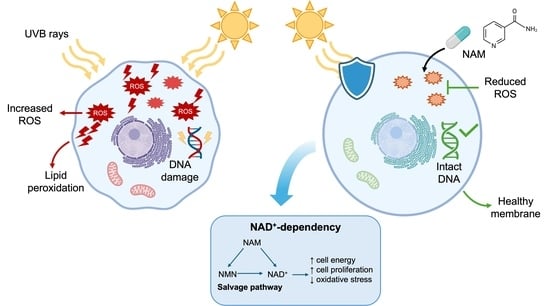
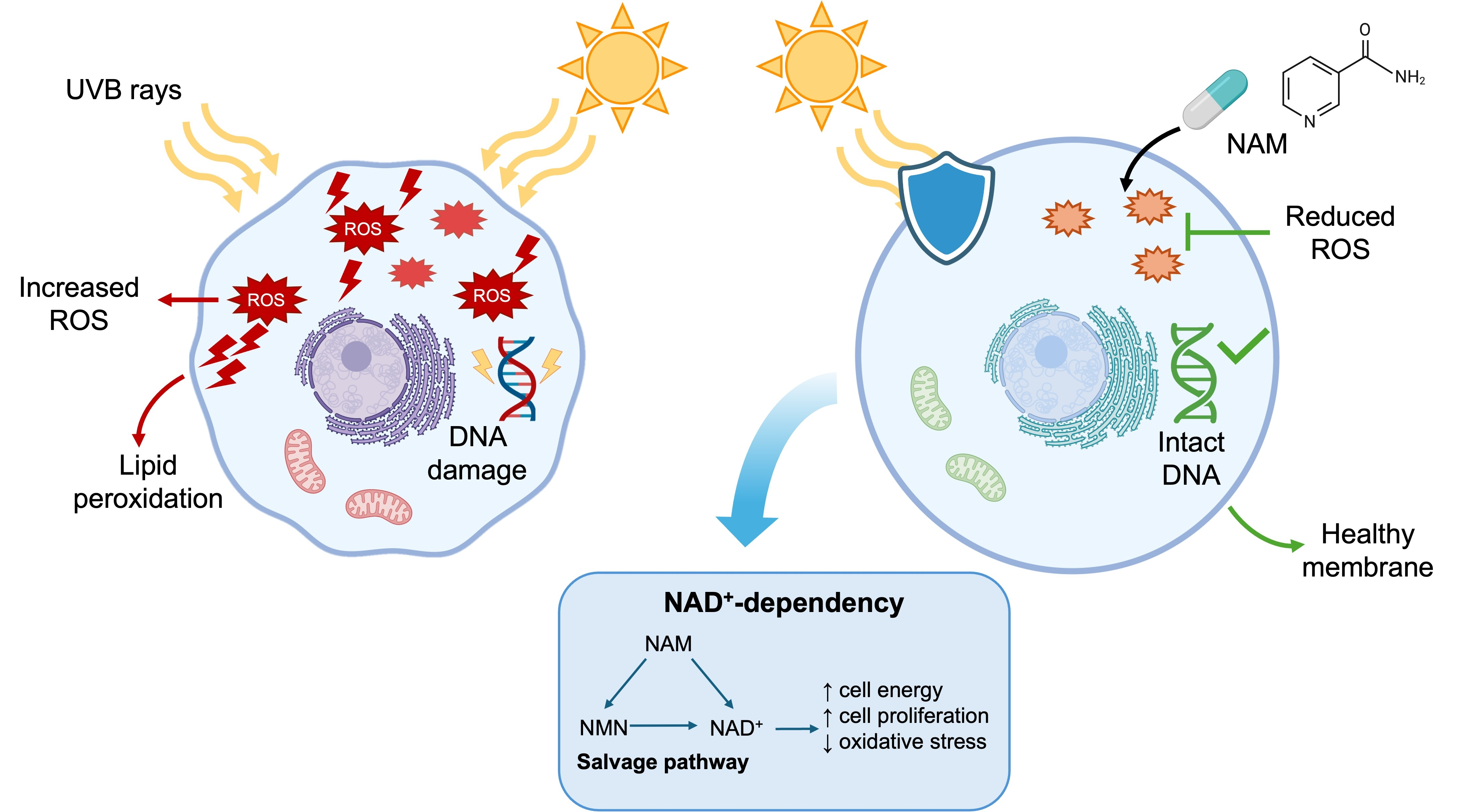
Graphical Abstract

1. Introduction

Malignant skin tumors are among the most diagnosed cancers in the Caucasian population. The main forms include malignant melanoma (MM), originating from melanocytes, and non-melanoma skin cancers (NMSCs), which arise from keratinocytes [1]. The primary environmental factor responsible for skin cancer development is ultraviolet radiation (UVR) exposure [2]. UVR is classified based on wavelengths of UVC (100–280 nm), UVB (280–320 nm) and UVA (320–400 nm). While UVC is completely blocked by the ozone layer, about 95% of the UVR reaching the Earth’s surface consists of UVA, and approximately 5% is UVB [3]. UVA and UVB significantly affects the skin. While UVA is largely absorbed by the dermis and drives photoaging, UVB is responsible for DNA damage and mutations, ultimately promoting skin carcinogenesis [4]. Moreover, UVB exposure triggers immunosuppression, oxidative stress and inflammation, leading to DNA alterations and protein and lipid peroxidation [5]. In recent years, the incidence of both MM and NMSC has risen steadily, mainly due to increased outdoor occupational and recreational activities, as well as the use of sunbeds [6]. Thus, the management of cutaneous cancers constitutes a significant burden to the National Health System, highlighting their impact on public health [7]. To mitigate and prevent both MM and NMSC, various protective strategies have been developed, including systemic photoprotection [8]. Systemic photoprotector agents are orally administered compounds that reduce the harmful effects induced by ultraviolet, visible and infrared radiation. These agents may act alone or in combination with topical sunscreens, exerting anti-inflammatory, immunomodulatory, antioxidant and DNA repair-enhancing effects [9,10,11]. Among systemic photoprotective agents, nicotinamide (NAM)—the amide derivative of vitamin B3—plays a central role. It is a precursor of nicotinamide adenine dinucleotide (NAD+), a vital coenzyme that drives metabolic redox reactions, including glycolysis, oxidative phosphorylation and ATP generation. [12]. NAD+ is also a substrate for energy-dependent enzymes, including poly (ADP-ribose) polymerases (PARPs) and silent information regulators (SIRT), which regulate DNA repair [13,14,15]. NAD+ levels are maintained through de novo synthesis from tryptophan, the Preiss–Handler pathway and the salvage pathway [15]. The latter provides rapid NAD+ replenishment by converting NAM into nicotinamide mononucleotide (NMN) via the enzyme nicotinamide phosphoribosyl transferase (NAMPT), which is subsequently converted into NAD+ by nicotinamide mononucleotide adenylyl transferase (NMNAT) [15,16]. Following UVR exposure, activation of DNA damage repair (DDR) enzymes, along with inflammation and oxidative stress, leads to rapid NAD+ depletion and a substantial reduction in cellular energy, thereby increasing reactive oxygen species (ROS) production and promoting further DNA damage [17,18]. Nevertheless, NAM supplementation rapidly replenishes NAD+ levels via the salvage pathway, restoring ATP production and enhancing DNA repair [8,19]. Furthermore, NAM modulates inflammatory cytokines and ROS release thereby protecting cells from their potential detrimental effects [15]. Its role in oxidative stress is of particular interest, as the mechanisms by which this molecule counteracts ROS production are not fully understood. Indeed, although some papers suggest a weak ROS/free-radical scavenging activity of NAM in vitro [20], it has been hypothesized that its antioxidant activity is indirectly due to a NAD-mediated increase in SIRT1 deacetylation activity that eventually favors the transcription of antioxidant genes [21,22,23,24]. In this study, we demonstrated that NAM efficiently protected HaCaT keratinocytes from UVB-induced oxidative stress, reducing ROS production and oxidative DNA damage both 4 and 24 h after irradiation through a NAD+-dependent mechanism. Interestingly, NAM also attenuated apoptosis and promoted cell cycle recovery, especially at the latest time point (24 h), which was mediated by NAD+.

2. Materials and Methods

2.1. Cell Culture

HaCaT cells were obtained from Cytion (cat. No. 300493, Heidelberg, Germany) and cultured in Dulbecco’s Modified Eagle Medium (DMEM; Euroclone, Pero, Italy) supplemented with 10% fetal bovine serum (FBS, Euroclone), 1% penicillin/streptomycin (Euroclone) and 4 mM glutamine (Euroclone).

2.2. UVB Irradiation and Cell Stimulation

The culture medium was removed, and cells were washed with PBS 1×. A thin layer of PBS was added, and cells were exposed to UVB irradiation (40 mJ/cm2) using a VL6M lamp (280–320 nm, peak at 312 nm; Montepaone, Turin, Italy). UVB intensity was monitored with a quantum photo/radiometer (HD9021, Montepaone). After irradiation, PBS was replaced with fresh culture medium, and cells were incubated for 4 and 24 h with/without NAM 25 μM (Merck KGaA, Darmstadt, Germany) or 1 nM FK866 (Cayman Chemical, Ann Arbor, MI, USA) immediately after UVB exposure. UVB dose and NAM concentration were determined according to data from our previously published work [25,26,27].

2.3. MTT Assay

HaCaT cells (7 × 10³ cells/well) were seeded in a 96-well plate and treated as previously described. MTT (0.5 mg/mL, Merck KGaA) was added, and cells were incubated for 2 h at 37 °C, 5% CO2. Formazan crystals were dissolved with DMSO (Merck KGaA), and absorbance was measured at 570 nm using Victor X Multilabel Plate Readers (PerkinElmer, Milan, Italy).

2.4. Intracellular ROS Quantification

HaCaT cells (2 × 10⁴ cells/well) were seeded into a 96-well plate and stimulated as previously described. After removing the culture medium, cells were incubated with 10 μM of 2′,7′-dichlorofluoresein diacetate (DCFDA) (Abcam, Cambridge, UK) for 45 min at 37 °C. DCFDA was then removed, and fresh PBS was added. The intensity of DCFDA fluorescence was measured using a Victor X Multilabel Plate Reader (PerkinElmer) at 495/529 nm excitation/emission.

2.5. Flow Cytometry Cell Cycle Analysis

HaCaT cells (1 × 10⁵ cells/well) were seeded in 12-well plates and stimulated as previously described. Apoptotic cells were collected, and adherent cells were detached with trypsin/EDTA solution, then neutralized with DMEM containing 10% FBS. Cells were harvested, centrifuged and fixed with cold ethanol 70% and stored at −20 °C overnight. After centrifugation, cells were washed twice with PBS 1× and incubated for 15 min at 37 °C with 100 μg/mL propidium iodide (PI) (Immunological Sciences, Rome, Italy) and 25 μg/mL of RNAse A (Immunological Sciences). A total of 20,000 stained cells were acquired using an Attune NxT FACS (Thermo Fisher, Waltham, MA, USA). Data are presented as percentages of cells in each phase of the cell cycle: G1, M, G2 and SubG1 (apoptotic cells).

2.6. Flow Cytometry Analysis of Apoptosis with Annexin V/PI Assay

HaCaT cells (1 NxT FACS 105 cells/well) were seeded into a 12-well plate and treated as previously described. Cell medium was collected, and adherent cells were detached using trypsin/EDTA, centrifuged and washed twice with PBS 1×. Cells were then stained using an annexin V-FITC/PI assay kit (Immunological Sciences) according to the manufacturer’s instructions. Stained cells were analyzed with an Attune NxT FACS (Thermo Fisher), and data are presented as the percentage of early apoptotic cells (annexin V + /PI−cells) and late apoptotic cells (annexin V+/PI + cells).

2.7. Comet Assay (Single-Cell Gel Electrophoresis)

A comet assay was performed as described by Clementi et al. [28]. Briefly, HaCaT cells (1 × 10² cells/well) were seeded into a 12-well plate and stimulated as previously described. Cells were detached with trypsin/EDTA, centrifuged and resuspended with cold PBS 1×. Cells were then mixed with 1% low melting agarose (Fisher Molecular Biology, Rome, Italy), spread onto microscope slides coated with normal agarose and incubated overnight at 4 °C in lysis buffer. Electrophoresis was carried out using a Comet Assay Tank (Cleaver Scientific, Rugby, UK) filled with electrophoresis buffer at 21 V and 400 mA for 30 min. After rinsing with dH2O, cells were stained with 10 μg/mL PI (Immunological Sciences) for 20 min at RT, protected from light. Photos were taken using a Leica fluorescence microscope, and comet tail analysis was performed using CometScore 2.0 software (TrikTek, Berlin, Germany). Results are expressed as the olive tail moment.

2.8. Indirect Immunofluorescence

HaCaT cells (1 × 10⁴ cells/well) were seeded on sterile rounded glasses and stimulated as previously described. Cells were fixed with 4% paraformaldehyde and blocked for 1 h and incubated with primary antibody mouse monoclonal anti-Ki67 (1:100 Abcam, cat. No. ab8191, RRID: AB_306346) for 2 h. Subsequently, cells were incubated with secondary antibody anti-mouse Alexa Fluor-546 (1:500 Thermo Fisher) and DAPI (1:1000, Merck KGaA) for 45 min at RT, protected from light. Images were acquired with a Leica fluorescent microscope and data were expressed as the percentage of Ki67-positive cells out of the total DAPI-stained cells.

2.9. TBARS Assay

The TBARS assay was performed using a TBARS assay kit (Cayman Chemical, Ann Arbor, MI, USA) according to the manufacturer’s instructions. Briefly, HaCaT cells (5 × 10⁵ cells/well) were seeded in 6-well plates and stimulated as previously described. Cells were mechanically detached and lysed and 100 μL of each sample was added to 100 μL of TCA assay reagent and 800 μL of Color Reagent. Samples were then boiled for 1 h, immediately incubated on ice for 10 min to stop the reaction and centrifuged for 10 min at 1600× g at 4 °C. A total of 200 μL of each sample was transferred on a 96-well plate and the absorbance was read at 530 nm using a spectrophotometer Victor X Multilabel Plate Reader (PerkinElmer). Results are expressed as μM of malondialdehyde (MDA).

2.10. Reverse Transcription Quantitative PCR (RT-qPCR)

HaCaT cells (2 × 10⁵ cells/well) were seeded in a 12-well plate and stimulated as previously described. Cells were detached and lysed in TRIzol (Fisher Molecular Biology, Rome, Italy). RNA concentration was measured using a NanoDrop spectrophotometer (Thermo Fisher), and purity was assessed by the 260/280 nm absorbance ratio. Complementary DNA (cDNA) was synthesized from RNA using a reverse transcription kit (Applied Biosystems, Foster City, CA, USA) according to the manufacturer’s protocol. Quantitative PCR was then carried out by a two-step cycling protocol in a final reaction volume of 10 µL per sample, performed in Multiply Optical Strips (Sarstedt, Nümbrecht, Germany). Each reaction contained 1 µL of cDNA, 400 nM forward primer, reverse primer and SensiFast SYBR No-ROX Master Mix (Bioline, London, UK). Primer sequences are provided in Table S1. Gene expression levels were normalized to the housekeeping gene GAPDH, and relative expression was calculated using the 2−∆∆CT method.

2.11. Statistical Analysis

Statistical analyses were performed using GraphPad Prism software version 10.2.0 for MacOS (GraphPad Software, Boston, MA, USA). Data are presented as mean ± standard error (SEM). Normality was assessed using the Shapiro–Wilk test. For normally distributed data, Student’s t-test was performed. Statistical significance was defined as p < 0.05.

3. Results

3.1. Nicotinamide Counteracts ROS Production, Lipid Peroxidation and Oxidative DNA Damages

We first evaluated the time required for low-dose UVB irradiation (40 mJ/cm2) to induce oxidative stress in HaCaT cells (Figure S1). We found that UVB exposure significantly increased ROS production at 4 and 24 h compared with untreated control cells. We therefore decided to test the ability of NAM to counteract oxidative stress and its related damage at these two time points.
As illustrated in Figure 1A, NAM markedly decreased ROS production induced by UVB at 4 and 24 h after irradiation. This protective effect was eliminated by the addition of the NAMPT inhibitor (FK866), demonstrating that NAM-mediated ROS reduction is due to the increase in NAD+ levels. Furthermore, NAM protected cells from UVB-induced lipid peroxidation, particularly 24 h post-irradiation, although this effect appeared to be independent of NAD+ production, since statistical analysis showed no significant effect (p-value 0.320) (Figure 1B). We also investigated the gene expression of two antioxidants, GPX1 (Figure 1C) and SOD1 (Figure 1D). We found increased expression of GPX1 after UVB exposure, an effect that was not reversed in the presence of NAM. In contrast, SOD1 expression was not significantly altered.
UVB and ROS can damage the DNA, resulting in single-strand DNA breaks and oxidative lesions [29]. We therefore investigated whether NAM could protect cells from DNA damage as well and whether this effect was NAD+-dependent. In line with the ROS results, NAM-treated cells exhibited reduced DNA damage at both 4 and 24 h post-irradiation (Figure 1E). This protective effect was eliminated in the presence of FK866, confirming that NAM protects cells from oxidative stress and damage by increasing NAD+ levels. Additionally, it has been assessed that OGG1 gene expression was a marker of oxidative DNA damage [30] (Figure 1F). We observed an increased expression of this gene, particularly after 24 h of irradiation, which was reduced in the presence of NAM. Again, co-stimulation with FK866 led to the elimination of NAM-mediated effects.

3.2. Nicotinamide Restores Cell Proliferation and Improves Cell Apoptosis

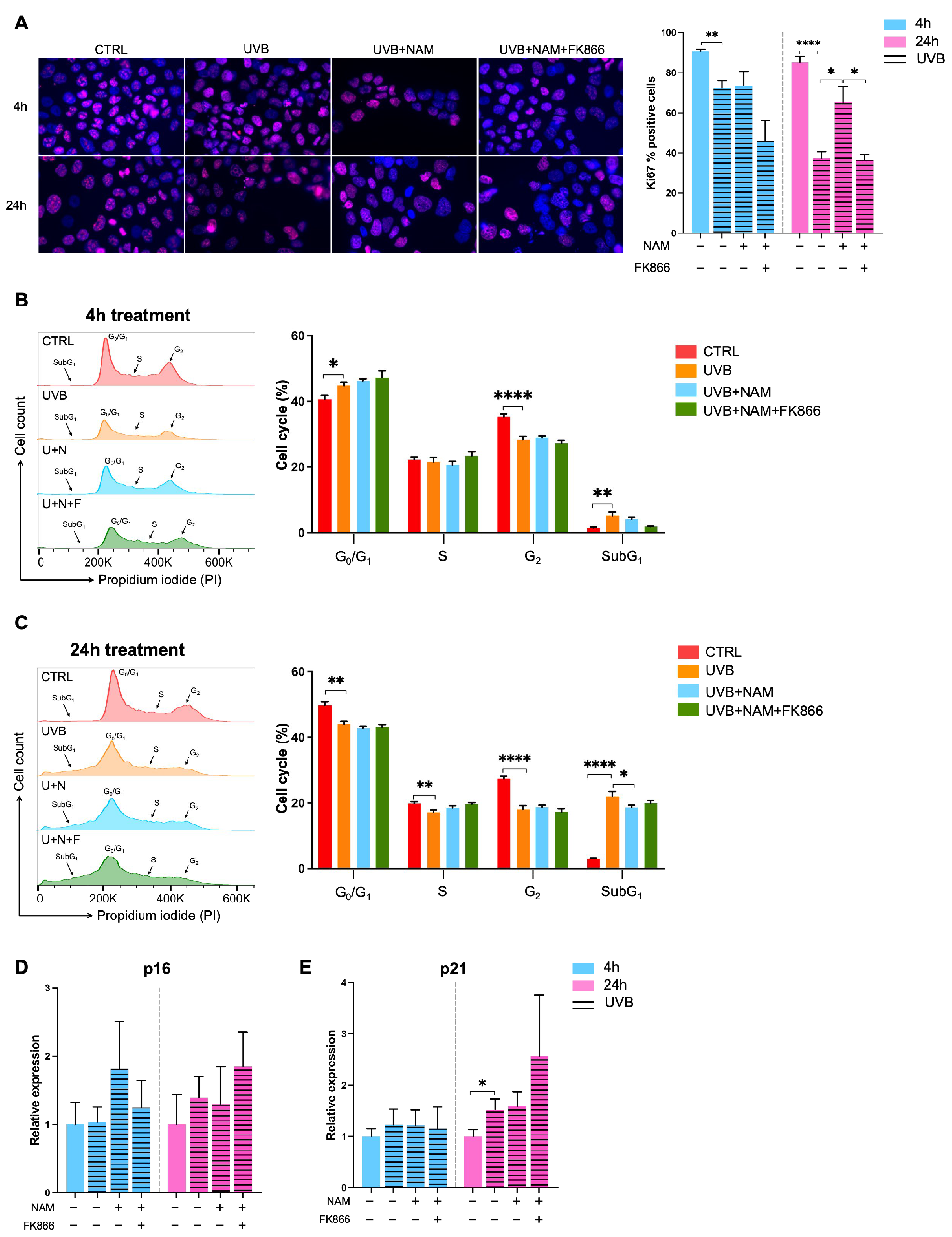
Since UVB exposure reduces cell proliferation [31], we investigated whether NAM could exert a protective effect and whether this effect was NAD+-dependent. As shown in Figure 2A, UVB significantly decreased Ki67 expression at both time points. However, NAM efficiently improved cell proliferation at 24 h post-irradiation, whereas this effect was completely abolished in the presence of FK866. These results indicate that NAM can restore cell proliferation in an NAD+-dependent manner.
We then examined whether this NAM-mediated effect was also reflected in cell cycle progression. Four hours after UVB exposure (Figure 2B), we observed an increase in the percentage of cells in the G0/G1 phase and SubG1 population (dead cells), accompanied by a decrease in cells in the G2 phase. At this time point, NAM treatment did not produce significant effects. By 24 h post-irradiation, UVB caused a significant reduction in the percentages of cells in the G0/G1, S and G2 phases, reflecting a marked increase in dead cells (Figure 2C). This effect was reduced in the presence of NAM; however, co-treatment with FK866 did not significantly affect the NAM-mediated response (p value 0.262) (Figure 2C).
Finally, we assessed the expression of p16 (Figure 2D) and p21 (Figure 2E), observing an overexpression of p21, particularly at 24 h post-irradiation, while NAM did not induce significant changes. Overall, these results suggest that NAM improves cell proliferation by enhancing NAD+ production. Moreover, NAM treatment reduces cell apoptosis, an effect that was unaffected by FK866.

3.3. Nicotinamide Reduces Early Apoptosis Induced by UVB After 24 H Post-Irradiation

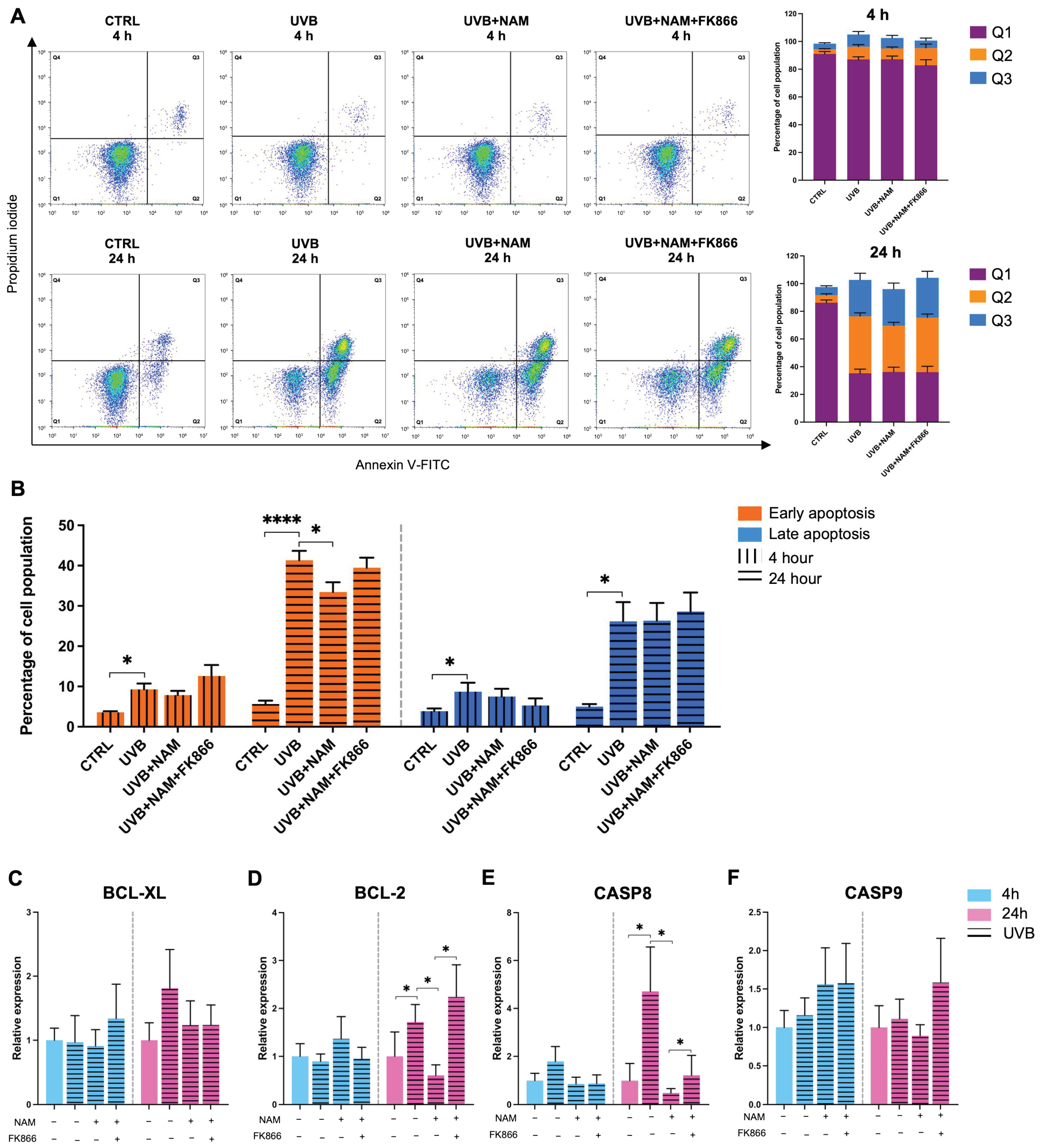
To better elucidate the effects of NAM on cell death, apoptosis was assessed by flow cytometry using Annexin V-FITC and propidium iodide staining (Figure 3A). Early apoptotic cells were defined as Annexin V+/PI, whereas late apoptotic/necrotic cells were Annexin V+/PI+. Figure 3B shows that UVB exposure markedly elevated both early and late apoptosis cell populations. In contrast, NAM treatment significantly reduced early apoptosis, especially at 24 h post-irradiation. This effect correlated with an overexpression of BCL-2 (Figure 3D) and CASP8 (Figure 3E) at 24 h, which was induced by UVB exposure and reversed by NAM. Interestingly, FK866 reverted NAM-mediated reduction in BCL-2 and CASP8. No significant changes were observed in BCL-XL (Figure 3C) and CASP9 (Figure 3F) expression.

4. Discussion

In this study, we demonstrate that NAM mitigates the detrimental effects induced by UVB in HaCaT cells, including ROS production, lipid peroxidation, DNA damage and apoptosis, while simultaneously supporting cell proliferation. Notably, many of these protective effects are NAD+-dependent, as evidenced by the reversal of NAM activity in the presence of the NAMPT inhibitor FK866. Specifically, NAM efficiently reduced ROS levels at early (4 h) and late (24 h) time points, which in turn led to lower MDA concentration and oxidative DNA damage, as indicated by lower OGG1 gene expression. These observations align with previous studies reporting the antioxidant properties of NAM in HaCaT cells exposed to particulate matter [32], in primary keratinocytes exposed to low [33] or high doses of UVB [33] and other cell types [15]. However, our findings extend previous observations by demonstrating a clear time-dependent response and the involvement of NAD+ in the attenuation of oxidative stress. Indeed, NAD+ and its phosphorylated form NADP+ play a central role in numerous redox reactions, including the regeneration of antioxidants such as glutathione, eventually leading to reduced ROS production [34]. Moreover, adequate NAD+ levels promote the activation of NAD+-dependent sirtuins, which mitigate oxidative stress by controlling the expression of multiple antioxidant genes and limiting mitochondrial ROS generation [24]. Lastly, NAD+ promotes DNA repair as a substrate of PARP1, an enzyme typically activated by pronounced DNA damage and oxidative stress [35]. Here, we demonstrate that the administration of NAM immediately after UVB exposure allows a rapid production of NAD+ through the salvage pathway, thereby restoring antioxidant defenses and redox balance. Overall, our results confirm that NAM-mediated antioxidant activity mainly acts as a precursor for NAD+ biosynthesis rather than having any direct ROS-scavenging property, which appears negligible, or ability to influence antioxidant expression [36].
In addition, we provide evidence that NAM promotes cell proliferation in UVB-irradiated HaCaT in a NAD+-dependent manner, particularly at 24 h post-irradiation as indicated by the increased Ki67-positive cells. Consistent with these findings, we have previously demonstrated that NAM promotes cell proliferation in UVB-irradiated fibroblasts [25] and in the melanoma cell line A375 [27]. To our knowledge, no studies have yet evaluated Ki67 expression in keratinocytes following UVB exposure. Therefore, our results provide novel experimental evidence that NAM can restore cell proliferation by increasing intracellular NAD+ levels.
After UVB exposure, the percentage of cells in the G1 and G2 phases is strongly reduced due mainly to the arrest of the controlled cell cycle, as demonstrated by the increased expression of p21 [37]. This mechanism allows cells to repair and remove potentially dangerous DNA damage or, in the case of severe mutations, to trigger apoptosis [38]. In this work, we found that NAM treatment led to reduced cell death, identified as early apoptosis, and demonstrated in reduced expression of the BCL-2 and CASP8 genes.
Our results align with previous works reporting an involvement of caspase 8 in UVB-induced apoptosis, although no other works have investigated whether NAM can affect CASP8 expression [39,40,41]. Conversely, our results regarding Bcl-XL are partially in contrast with the existing literature. Bcl-XL is an anti-apoptotic protein, part of the Bcl-2 family, which protects cells from UV-induced apoptosis [42]. Its role in keratinocytes is not completely clear. Indeed, some works have observed a downregulation of Bcl-XL in UVB-irradiated HaCaT cells at both the protein [43,44,45] and gene [46] levels. However, our results are consistent with those reported by Lim et al. [47], who demonstrated that exposure to low UVB doses induces an overexpression of Bcl-XL at the protein level. To possibly explain this phenomenon, we hypothesize that, 24 h post-irradiation, cells activate several survival pathways—such as NF-κB, MAPK and EGFR—to counteract UVB-induced apoptosis, thereby regulating the expression of pro-survival target genes [48]. Consequently, in the presence of NAM, cells are protected from UVB-induced apoptosis, and upregulation of Bcl-XL is no longer required.
Of particular interest is the NAD+-independent reduction in early apoptosis. Indeed, we found that the inhibition of the salvage pathway did not alter NAM-mediated effects, resembling lipid peroxidation results. A possible explanation for this biological event could be the involvement of NAM’s metabolite N-methylnicotinamide (NMN). Beyond its role as NAD+ precursor and inhibitor of SIRT and PARP, NAM can be metabolized by nicotinamide-N-methyltransferase into NMN [49], which activates nuclear factor erythroid 2-related factor 2 (NRF2), which in turn induces antioxidant gene expression, including SOD and catalase [50]. The consequent reduction in ROS production inhibits apoptosis signaling regulated kinase 1 (ASK1) activity, which is an upstream signal of p38-MAPK, leading to reduced apoptosis [51,52] and, hypothetically, protection from oxidative damage, like lipid peroxidation [53]. Based on these considerations, it can be suggested that NAM protects cells from UVB-induced oxidative stress through direct restoration of NAD+ levels via the salvage pathway and, indirectly, through its metabolite NMN and the inhibition of p38-MAPK. Further studies will be required to fully elucidate the molecular mechanisms underlying these observations and to potentially confirm our hypotheses.
This study presents some limitations. First, it was conducted exclusively in a single keratinocyte cell line, which does not fully recapitulate the complexity of human skin and its physiology. Second, the analysis of apoptotic markers was primarily based on gene expression data, and further analysis of protein expression and its possible cleavage would strengthen our findings. Although these limitations should be considered, our data indicate that NAM exerts a protective effect against UVB-induced damage.

5. Conclusions

In summary, NAM effectively shields keratinocytes from UVB-induced oxidative stress, DNA damage, lipid peroxidation and apoptosis, largely through its role in boosting NAD+ levels. Furthermore, we provide novel evidence that NAM modulates early apoptotic signaling at the gene level, including CASP8 expression, and promotes cell proliferation in UVB-irradiated HaCaT cells. Collectively, these results reinforce the role of nicotinamide as a systemic photoprotective agent and contribute to better elucidating the molecular mechanisms underlying its antioxidant activity.

Supplementary Materials

The following supporting information can be downloaded at https://www.mdpi.com/article/10.3390/dermato6010007/s1, Figure S1: Correlation between cell viability and oxidative stress; Table S1: RT-qPCR primers.

Author Contributions

Conceptualization, L.C., E.Z. and P.S.; methodology, L.C.; software, L.C.; validation, L.C., E.Z. and P.S.; formal analysis, L.C.; investigation, L.C.; resources, P.S.; data curation, L.C.; writing—original draft preparation, L.C.; writing—review and editing, L.C., E.Z. and P.S.; visualization, E.Z.; supervision, E.Z. and P.S.; project administration, P.S.; funding acquisition, E.Z. and P.S. All authors have read and agreed to the published version of the manuscript.

Funding

This research received no external funding.

Institutional Review Board Statement

Not applicable.

Informed Consent Statement

Not applicable.

Data Availability Statement

The original contributions presented in this study are included in the article/Supplementary Materials. Further inquiries can be directed to the corresponding author.

Conflicts of Interest

The authors declare no conflicts of interest.

Abbreviations

The following abbreviations are used in this manuscript:
MMMalignant melanoma
NMSCNon-melanoma skin cancer
UVBUltraviolet B
NADNicotinamide adenine dinucleotide
ROSReactive oxygen species
NAMNicotinamide
SODSuperoxide dismutase
GPXGlutathione peroxidase
CASPCaspase
PIPropidium iodide

References

  1. Leiter, U.; Keim, U.; Garbe, C. Epidemiology of Skin Cancer: Update 2019. In Sunlight, Vitamin D and Skin Cancer; Reichrath, J., Ed.; Advances in Experimental Medicine and Biology; Springer International Publishing: Cham, Switzerland, 2020; Volume 1268, pp. 123–139. ISBN 978-3-030-46226-0. [Google Scholar]
  2. Krutmann, J.; Schikowski, T.; Morita, A.; Berneburg, M. Environmentally-Induced (Extrinsic) Skin Aging: Exposomal Factors and Underlying Mechanisms. J. Investig. Dermatol. 2021, 141, 1096–1103. [Google Scholar] [CrossRef] [PubMed]
  3. Maverakis, E.; Miyamura, Y.; Bowen, M.P.; Correa, G.; Ono, Y.; Goodarzi, H. Light, Including Ultraviolet. J. Autoimmun. 2010, 34, J247–J257. [Google Scholar] [CrossRef] [PubMed]
  4. Takeuchi, H.; Rünger, T.M. Longwave UV Light Induces the Aging-Associated Progerin. J. Investig. Dermatol. 2013, 133, 1857–1862. [Google Scholar] [CrossRef] [PubMed]
  5. Bagde, A.; Mondal, A.; Singh, M. Drug Delivery Strategies for Chemoprevention of UVB-induced Skin Cancer: A Review. Photoderm. Photoimm. Photomed. 2018, 34, 60–68. [Google Scholar] [CrossRef]
  6. Modenese, A.; Farnetani, F.; Andreoli, A.; Pellacani, G.; Gobba, F. Questionnaire-based Evaluation of Occupational and Non-occupational Solar Radiation Exposure in a Sample of Italian Patients Treated for Actinic Keratosis and Other Non-melanoma Skin Cancers. Acad. Dermatol. Venereol. 2016, 30, 21–26. [Google Scholar] [CrossRef]
  7. Wang, R.; Chen, Y.; Shao, X.; Chen, T.; Zhong, J.; Ou, Y.; Chen, J. Burden of Skin Cancer in Older Adults from 1990 to 2021 and Modelled Projection to 2050. JAMA Dermatol. 2025, 161, 715. [Google Scholar] [CrossRef]
  8. Hyeraci, M.; Papanikolau, E.S.; Grimaldi, M.; Ricci, F.; Pallotta, S.; Monetta, R.; Minafò, Y.A.; Di Lella, G.; Galdo, G.; Abeni, D.; et al. Systemic Photoprotection in Melanoma and Non-Melanoma Skin Cancer. Biomolecules 2023, 13, 1067. [Google Scholar] [CrossRef]
  9. Searle, T.; Ali, F.R.; Al-Niaimi, F. Systemic Photoprotection in 2021. Clin. Exp. Dermatol. 2021, 46, 1189–1204. [Google Scholar] [CrossRef]
  10. Chen, A.C.; Damian, D.L.; Halliday, G.M. Oral and Systemic Photoprotection. Photoderm. Photoimm. Photomed. 2014, 30, 102–111. [Google Scholar] [CrossRef]
  11. Hartmann, D.; Valenzuela, F. Sunproofing from within: A Deep Dive into Oral Photoprotection Strategies in Dermatology. Photoderm. Photoimm. Photomed. 2024, 40, e12985. [Google Scholar] [CrossRef]
  12. Houtkooper, R.H.; Cantó, C.; Wanders, R.J.; Auwerx, J. The Secret Life of NAD+: An Old Metabolite Controlling New Metabolic Signaling Pathways. Endocr. Rev. 2010, 31, 194–223. [Google Scholar] [CrossRef]
  13. Cantó, C.; Sauve, A.A.; Bai, P. Crosstalk between Poly(ADP-Ribose) Polymerase and Sirtuin Enzymes. Mol. Asp. Med. 2013, 34, 1168–1201. [Google Scholar] [CrossRef] [PubMed]
  14. Su, M.; Qiu, F.; Li, Y.; Che, T.; Li, N.; Zhang, S. Mechanisms of the NAD+ Salvage Pathway in Enhancing Skeletal Muscle Function. Front. Cell Dev. Biol. 2024, 12, 1464815. [Google Scholar] [CrossRef]
  15. Camillo, L.; Zavattaro, E.; Savoia, P. Nicotinamide: A Multifaceted Molecule in Skin Health and Beyond. Medicina 2025, 61, 254. [Google Scholar] [CrossRef]
  16. Braidy, N.; Berg, J.; Clement, J.; Khorshidi, F.; Poljak, A.; Jayasena, T.; Grant, R.; Sachdev, P. Role of Nicotinamide Adenine Dinucleotide and Related Precursors as Therapeutic Targets for Age-Related Degenerative Diseases: Rationale, Biochemistry, Pharmacokinetics, and Outcomes. Antioxid. Redox Signal. 2019, 30, 251–294. [Google Scholar] [CrossRef]
  17. Oblong, J.E. The Evolving Role of the NAD+/Nicotinamide Metabolome in Skin Homeostasis, Cellular Bioenergetics, and Aging. DNA Repair. 2014, 23, 59–63. [Google Scholar] [CrossRef] [PubMed]
  18. Surjana, D.; Halliday, G.M.; Damian, D.L. Nicotinamide Enhances Repair of Ultraviolet Radiation-Induced DNA Damage in Human Keratinocytes and Ex Vivo Skin. Carcinogenesis 2013, 34, 1144–1149. [Google Scholar] [CrossRef]
  19. Fania, L.; Mazzanti, C.; Campione, E.; Candi, E.; Abeni, D.; Dellambra, E. Role of Nicotinamide in Genomic Stability and Skin Cancer Chemoprevention. Int. J. Mol. Sci. 2019, 20, 5946. [Google Scholar] [CrossRef] [PubMed]
  20. Boo, Y.C. Mechanistic Basis and Clinical Evidence for the Applications of Nicotinamide (Niacinamide) to Control Skin Aging and Pigmentation. Antioxidants 2021, 10, 1315. [Google Scholar] [CrossRef]
  21. Poljsak, B.; Milisav, I. NAD+ as the Link Between Oxidative Stress, Inflammation, Caloric Restriction, Exercise, DNA Repair, Longevity, and Health Span. Rejuvenation Res. 2016, 19, 406–413. [Google Scholar] [CrossRef]
  22. Kwak, J.Y.; Ham, H.J.; Kim, C.M.; Hwang, E.S. Nicotinamide Exerts Antioxidative Effects on Senescent Cells. Mol. Cells 2015, 38, 229–235. [Google Scholar] [CrossRef] [PubMed]
  23. Hwang, E.S.; Song, S.B. Nicotinamide Is an Inhibitor of SIRT1 in Vitro, but Can Be a Stimulator in Cells. Cell. Mol. Life Sci. 2017, 74, 3347–3362. [Google Scholar] [CrossRef] [PubMed]
  24. Singh, C.K.; Chhabra, G.; Ndiaye, M.A.; Garcia-Peterson, L.M.; Mack, N.J.; Ahmad, N. The Role of Sirtuins in Antioxidant and Redox Signaling. Antioxid. Redox Signal. 2018, 28, 643–661. [Google Scholar] [CrossRef] [PubMed]
  25. Camillo, L.; Gironi, L.C.; Esposto, E.; Zavattaro, E.; Savoia, P. Nicotinamide and Calcipotriol Counteract UVB-Induced Photoaging on Primary Human Dermal Fibroblasts. J. Photochem. Photobiol. 2022, 12, 100158. [Google Scholar] [CrossRef]
  26. Camillo, L.; Gironi, L.C.; Zavattaro, E.; Esposto, E.; Savoia, P. Nicotinamide Attenuates UV-Induced Stress Damage in Human Primary Keratinocytes from Cancerization Fields. J. Investig. Dermatol. 2022, 142, 1466–1477.e1. [Google Scholar] [CrossRef]
  27. Camillo, L.; Esposto, E.; Gironi, L.C.; Zavattaro, E.; Savoia, P. Nicotinamide Counteracts Ultraviolet-B-Induced Cytotoxic Effects and Aquaporins Overexpression in the A375 Melanoma Cell Line. Dermato 2025, 5, 3. [Google Scholar] [CrossRef]
  28. Clementi, E.; Garajova, Z.; Markkanen, E. Measuring DNA Damage Using the Alkaline Comet Assay in Cultured Cells. BIO-Protocol 2021, 11, e4119. [Google Scholar] [CrossRef]
  29. Mullenders, L.H.F. Solar UV Damage to Cellular DNA: From Mechanisms to Biological Effects. Photochem. Photobiol. Sci. 2018, 17, 1842–1852. [Google Scholar] [CrossRef]
  30. Miglani, K.; Kumar, S.; Yadav, A.; Aggarwal, N.; Gupta, R. OGG1 DNA Repair Gene Polymorphism As a Biomarker of Oxidative and Genotoxic DNA Damage. Iran. Biomed. J. 2021, 25, 47–53. [Google Scholar] [CrossRef]
  31. Fernandez, T.L.; Van Lonkhuyzen, D.R.; Dawson, R.A.; Kimlin, M.G.; Upton, Z. Characterization of a Human Skin Equivalent Model to Study the Effects of Ultraviolet B Radiation on Keratinocytes. Tissue Eng. Part C Methods 2014, 20, 588–598. [Google Scholar] [CrossRef]
  32. Zhen, A.X.; Piao, M.J.; Kang, K.A.; Fernando, P.D.S.M.; Kang, H.K.; Koh, Y.S.; Yi, J.M.; Hyun, J.W. Niacinamide Protects Skin Cells from Oxidative Stress Induced by Particulate Matter. Biomol. Ther. 2019, 27, 562–569. [Google Scholar] [CrossRef] [PubMed]
  33. Tan, C.Y.R.; Tan, C.L.; Chin, T.; Morenc, M.; Ho, C.Y.; Rovito, H.A.; Quek, L.S.; Soon, A.L.; Lim, J.S.Y.; Dreesen, O.; et al. Nicotinamide Prevents UVB- and Oxidative Stress—Induced Photoaging in Human Primary Keratinocytes. J. Investig. Dermatol. 2022, 142, 1670–1681.e12. [Google Scholar] [CrossRef]
  34. Xie, N.; Zhang, L.; Gao, W.; Huang, C.; Huber, P.E.; Zhou, X.; Li, C.; Shen, G.; Zou, B. NAD+ Metabolism: Pathophysiologic Mechanisms and Therapeutic Potential. Sig. Transduct. Target. Ther. 2020, 5, 227. [Google Scholar] [CrossRef]
  35. Ying, W. Roles of NAD+, PARP-1, and Sirtuins in Cell Death, Ischemic Brain Injury, and Synchrotron Radiation X-Ray-Induced Tissue Injury. Scientifica 2013, 2013, 691251. [Google Scholar] [CrossRef]
  36. Sikora, A.; Szajerski, P.; Piotrowski, Ł.; Zielonka, J.; Adamus, J.; Marcinek, A.; Gębicki, J. Radical Scavenging Properties of Nicotinamide and Its Metabolites. Radiat. Phys. Chem. 2008, 77, 259–266. [Google Scholar] [CrossRef]
  37. Chen, J. The Cell-Cycle Arrest and Apoptotic Functions of P53 in Tumor Initiation and Progression. Cold Spring Harb. Perspect. Med. 2016, 6, a026104. [Google Scholar] [CrossRef]
  38. Roos, W.P.; Kaina, B. DNA Damage-Induced Cell Death by Apoptosis. Trends Mol. Med. 2006, 12, 440–450. [Google Scholar] [CrossRef]
  39. Tummers, B.; Green, D.R. Caspase-8: Regulating Life and Death. Immunol. Rev. 2017, 277, 76–89. [Google Scholar] [CrossRef]
  40. Loftus, S.N.; Gharaee-Kermani, M.; Xu, B.; Moore, T.M.; Hannoudi, A.; Mallbris, M.J.; Klein, B.; Gudjonsson, J.E.; Kahlenberg, J.M. Interferon Alpha Promotes Caspase-8 Dependent Ultraviolet Light-Mediated Keratinocyte Apoptosis via Interferon Regulatory Factor 1. Front. Immunol. 2024, 15, 1384606. [Google Scholar] [CrossRef] [PubMed]
  41. Takasawa, R.; Nakamura, H.; Mori, T.; Tanuma, S. Differential Apoptotic Pathways in Human Keratinocyte HaCaT Cells Exposed to UVB and UVC. Apoptosis 2005, 10, 1121–1130. [Google Scholar] [CrossRef] [PubMed]
  42. Taylor, J.K.; Zhang, Q.Q.; Monia, B.P.; Marcusson, E.G.; Dean, N.M. Inhibition of Bcl-xL Expression Sensitizes Normal Human Keratinocytes and Epithelial Cells to Apoptotic Stimuli. Oncogene 1999, 18, 4495–4504. [Google Scholar] [CrossRef]
  43. Kirindage, K.G.I.S.; Jayasinghe, A.M.K.; Ko, C.-I.; Ahn, Y.-S.; Heo, S.-J.; Kim, E.-A.; Cho, N.-K.; Ahn, G. Photoprotective Effect of Ultrasonic-Assisted Ethanol Extract from Sargassum Horneri on UVB-Exposed HaCaT Keratinocytes. Antioxidants 2024, 13, 1342. [Google Scholar] [CrossRef]
  44. Reagan-Shaw, S.; Breur, J.; Ahmad, N. Enhancement of UVB Radiation–Mediated Apoptosis by Sanguinarine in HaCaT Human Immortalized Keratinocytes. Mol. Cancer Ther. 2006, 5, 418–429. [Google Scholar] [CrossRef]
  45. Afaq, F.; Syed, D.N.; Malik, A.; Hadi, N.; Sarfaraz, S.; Kweon, M.-H.; Khan, N.; Zaid, M.A.; Mukhtar, H. Delphinidin, an Anthocyanidin in Pigmented Fruits and Vegetables, Protects Human HaCaT Keratinocytes and Mouse Skin Against UVB-Mediated Oxidative Stress and Apoptosis. J. Investig. Dermatol. 2007, 127, 222–232. [Google Scholar] [CrossRef] [PubMed]
  46. Muzaffer, U.; Paul, V.I.; Prasad, N.R.; Karthikeyan, R. Juglans regia L. Protects against UVB Induced Apoptosis in Human Epidermal Keratinocytes. Biochem. Biophys. Rep. 2018, 13, 109–115. [Google Scholar] [CrossRef]
  47. Lim, H.S.; Simon, S.E.; Yow, Y.-Y.; Saidur, R.; Tan, K.O. Photoprotective Activities of Lignosus Rhinocerus in UV-Irradiated Human Keratinocytes. J. Ethnopharmacol. 2022, 299, 115621. [Google Scholar] [CrossRef] [PubMed]
  48. Feehan, R.P.; Shantz, L.M. Molecular Signaling Cascades Involved in Nonmelanoma Skin Carcinogenesis. Biochem. J. 2016, 473, 2973–2994. [Google Scholar] [CrossRef] [PubMed]
  49. Gebicki, J.; Sysa-Jedrzejowska, A.; Adamus, J.; Woźniacka, A.; Rybak, M.; Zielonka, J. 1-Methylnicotinamide: A Potent Anti-Inflammatory Agent of Vitamin Origin. Pol. J. Pharmacol. 2003, 55, 109–112. [Google Scholar]
  50. Jawaria; Zarlashat, Y.; Philippovich, M.; Dósa, E. Nicotinamide N-Methyltransferase in Cardiovascular Diseases: Metabolic Regulator and Emerging Therapeutic Target. Biomolecules 2025, 15, 1281. [Google Scholar] [CrossRef]
  51. Li, X.-Y.; Pi, Y.-N.; Chen, Y.; Zhu, Q.; Xia, B.-R. Nicotinamide N-Methyltransferase: A Promising Biomarker and Target for Human Cancer Therapy. Front. Oncol. 2022, 12, 894744. [Google Scholar] [CrossRef]
  52. Wang, T.; Pang, L.; He, M.; Wang, Z. Small-Molecule Inhibitors Targeting Apoptosis Signal-Regulated Kinase 1. Eur. J. Med. Chem. 2023, 262, 115889. [Google Scholar] [CrossRef] [PubMed]
  53. Watała, C.; Kaźmierczak, P.; Dobaczewski, M.; Przygodzki, T.; Bartuś, M.; Łomnicka, M.; Słomińska, E.M.; Duračkova, Z.; Chłopicki, S. Anti-Diabetic Effects of 1-Methylnicotinamide (MNA) in Streptozocin-Induced Diabetes in Rats. Pharmacol. Rep. 2009, 61, 86–98. [Google Scholar] [CrossRef] [PubMed]
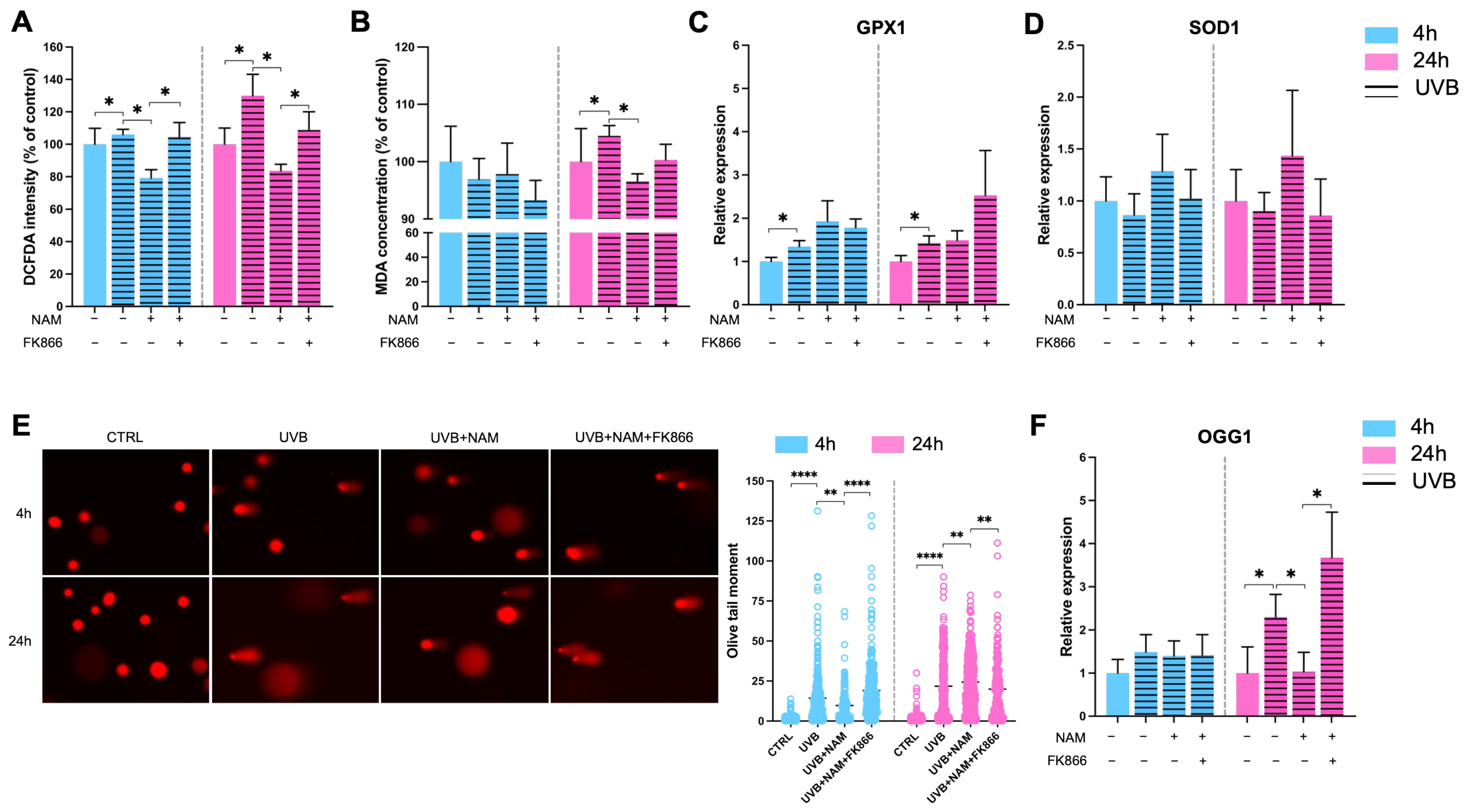
Figure 1. Nicotinamide reduces oxidative stress induced by UVB by increasing NAD+ levels. HaCaT cells were exposed to UVB (40 mJ/cm2) and treated with NAM (25 μM) and FK866 (1 nM) for 4 and 24 h. (A) ROS levels were determined using a DCFDA fluorescent probe, with data reported as mean ± SEM of 5 independent experiments. (B) Lipid peroxidation was evaluated using the TBARS assay. Data are indicated as the percentage of MDA concentration of the control of 4 independent experiments (mean ± SEM). (C) GPX1 and (D) SOD1 gene expression was quantified by RT-qPCR, and data are expressed as mean ± SEM of 11 independent experiments. (E) DNA damage was evaluated through comet assay and quantified as the olive tail moment. Data are expressed as mean ± SEM of three independent experiments. Representative comet assay photos were acquired at 200×. (F) OGG1 gene expression was quantified by RT-qPCR, and data are presented as mean ± SEM of 11 independent experiments. * p < 0.05, ** p < 0.01, **** p < 0.0001. NAM, nicotinamide; UVB, ultraviolet B; MDA, malondialdehyde; CTRL, untreated cells; DCFDA, 2′,7′-dichlorofluoresein diacetate.
Dermato 06 00007 g001
Figure 2. Nicotinamide improves cell proliferation and reduces cell apoptosis. HaCaT cells were exposed to UVB (40 mJ/cm2) and treated with NAM (25 μM) and FK866 (1 nM) for 4 h and 24 h. (A) Ki67 levels were determined by indirect immunofluorescence, and positive cells were quantified as a percentage of the total cell population. Data represent mean ± SEM of three independent experiments. IF pictures were taken using a 630x. Cell cycle analysis (B) 4 h and (C) 24 h post-irradiation was evaluated with flowcytometry. Data are expressed as mean ± SEM of 7 independent experiments. (D) p16 and (E) p21 gene expression was measured with RT-qPCR, and data are expressed as mean ± SEM of 11 independent experiments. * p < 0.05, ** p < 0.01, **** p < 0.0001. NAM, nicotinamide; UVB, ultraviolet B; CTRL, untreated cells; U, UVB; N, NAM; F, FK866.
Dermato 06 00007 g002
Figure 3. Nicotinamide improves early apoptosis in an NAD+-dependent way. HaCaT cells were exposed to UVB (40 mJ/cm2), NAM (25 μM) and FK866 (1 nM) for 4 and 24 h. (A) Cell apoptosis was quantified by flow cytometry following staining with Annexin V-FITC and propidium iodide staining. Q1: Annexin/PI cells; Q2: Annexin V+/PI cells (early apoptosis); Q3: Annexin V+/PI+ cells (late apoptosis). (B) Quantification of early and late apoptotic cells expressed as mean ± SEM of 6 independent experiments. Gene expression of (C) BCL-XL, (D) BCL-2, (E) CASP8 and (F) CASP9 was measured by RT-qPCR. Data are expressed as mean ± SEM of 11 independent experiments. * p < 0.05, **** p < 0.0001. NAM, nicotinamide; UVB, ultraviolet B; CASP, caspase.; CTRL, untreated cells.
Dermato 06 00007 g003
Disclaimer/Publisher’s Note: The statements, opinions and data contained in all publications are solely those of the individual author(s) and contributor(s) and not of MDPI and/or the editor(s). MDPI and/or the editor(s) disclaim responsibility for any injury to people or property resulting from any ideas, methods, instructions or products referred to in the content.