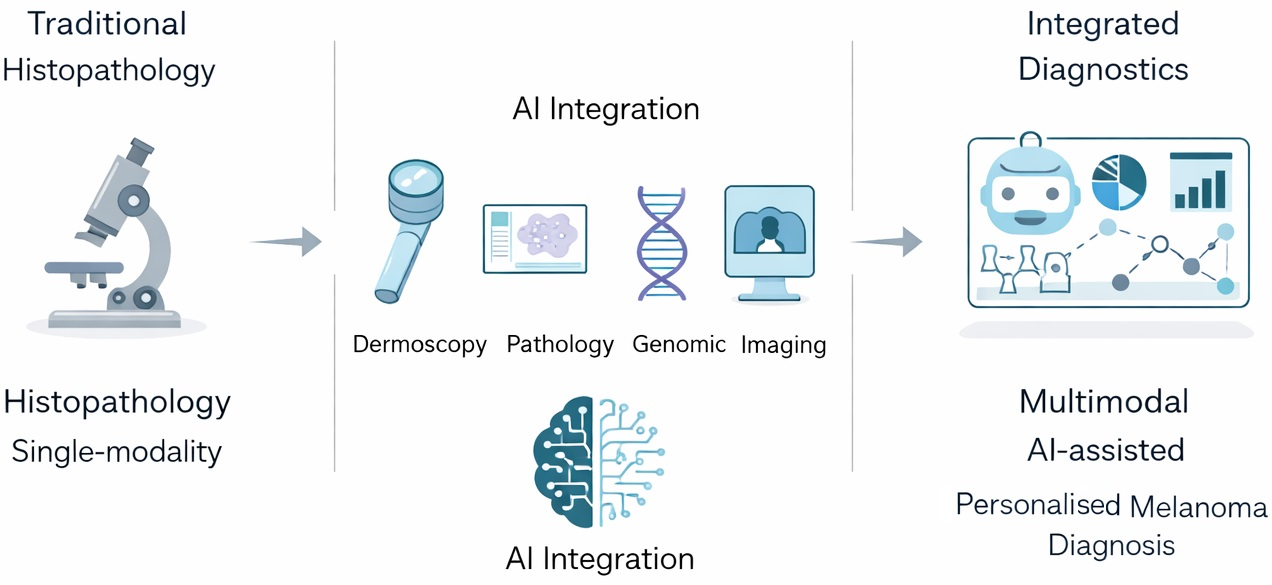

Melanoma Beyond the Microscope in the Era of AI and Integrated Diagnostics


Abstract
1. Introduction
2. Epidemiology and Prevention
3. Advances in Early Detection and Imaging
3.1. Clinical Examination and Dermoscopy
3.2. Advanced Imaging Modal
3.3. Strengths and Limitations of Current Imaging Approaches
3.4. Implications for Early Diagnosis
4. Histopathology and Prognostic Biomarkers
4.1. Tumor Microenvironment and Immune
4.2. Molecular and Gene Expression-Based Prognostic
4.3. Epigenetic and Emerging
4.4. Limitations of Current Prognostic
5. Genetic and Epigenetic Causes of Melanoma
5.1. Key Genetic Alterations and Molecular Subtypes
5.2. Epigenetic Regulation and Tumor
5.3. Genetic Heterogeneity and Clonal Evolution
5.4. Implications for Integrated Diagnostics and AI-Based Analysis
6. Artificial Intelligence in Melanoma Diagnosis
6.1. AI in Clinical Imaging and Dermoscopy
6.2. AI in Digital Pathology
6.3. Integration of AI with Molecular and Clinical Data
6.4. Ethical, Regulatory, and Implementation
6.5. Future Perspectives
7. AI-Guided Therapy and Personalized Medicine in Melanoma
8. Conclusions
Author Contributions
Funding
Institutional Review Board Statement
Informed Consent Statement
Data Availability Statement
Conflicts of Interest
References
- Caraviello, C.; Nazzaro, G.; Tavoletti, G.; Boggio, F.; Denaro, N.; Murgia, G.; Passoni, E.; Benzecry Mancin, V.; Marzano, A.V. Melanoma Skin Cancer: A Comprehensive Review of Current Knowledge. Cancers 2025, 17, 2920. [Google Scholar] [CrossRef]
- Arnold, M.; Singh, D.; Laversanne, M.; Vignat, J.; Vaccarella, S.; Meheus, F.; Cust, A.E.; De Vries, E.; Whiteman, D.C.; Bray, F. Global Burden of Cutaneous Melanoma in 2020 and Projections to 2040. JAMA Dermatol. 2022, 158, 495. [Google Scholar] [CrossRef]
- Erdmann, F.; Lortet-Tieulent, J.; Schüz, J.; Zeeb, H.; Greinert, R.; Breitbart, E.W.; Bray, F. International Trends in the Incidence of Malignant Melanoma 1953–2008—Are Recent Generations at Higher or Lower Risk? Int. J. Cancer 2013, 132, 385–400. [Google Scholar] [CrossRef] [PubMed]
- Levine, A.; Markowitz, O. Introduction to Reflectance Confocal Microscopy and Its Use in Clinical Practice. JAAD Case Rep. 2018, 4, 1014–1023. [Google Scholar] [CrossRef]
- Garutti, M.; Bruno, R.; Polesel, J.; Pizzichetta, M.A.; Puglisi, F. Role of Tumor-Infiltrating Lymphocytes in Melanoma Prognosis and Treatment Strategies: A Systematic Review and Meta-Analysis. Heliyon 2024, 10, e32433. [Google Scholar] [CrossRef] [PubMed]
- Barragan-Estudillo, Z.; Brito, J.; Chavez-Bourgeois, M.; Alejo, B.; Alos, L.; García, A.P.; Puig, S.; Malvehy, J.; Carrera, C. Dermoscopy And Reflectance Confocal Microscopy To Estimate Breslow Index And Mitotic Rate in Primary Melanoma. Dermatol. Pract. Concept. 2022, 12, e2022174. [Google Scholar] [CrossRef]
- Kalidindi, S. The Role of Artificial Intelligence in the Diagnosis of Melanoma. Cureus 2024, 16, e69818. [Google Scholar] [CrossRef] [PubMed]
- Alam, F.; Ullah, A.; Shah, D.; Ali, S.; Tahir, M. Artificial Intelligence in Melanoma Detection: A Review of Current Technologies and Future Directions. Int. J. Intell. Syst. 2025, 2025, 3164952. [Google Scholar] [CrossRef]
- Veronesi, G.; Curti, N.; Gardini, A.; Querzoli, G.; Castellani, G.; Dika, E. Machine Learning to Detect Melanoma Exploiting Nuclei Morphology and Spatial Organization. Sci. Rep. 2025, 15, 21594. [Google Scholar] [CrossRef]
- Górecki, S.; Tatka, A.; Brusey, J. Artificial Intelligence and New Technologies in Melanoma Diagnosis: A Narrative Review. Cancers 2025, 17, 3896. [Google Scholar] [CrossRef]
- Saginala, K.; Barsouk, A.; Aluru, J.S.; Rawla, P.; Barsouk, A. Epidemiology of Melanoma. Med. Sci. 2021, 9, 63. [Google Scholar] [CrossRef] [PubMed]
- Waseh, S.; Lee, J.B. Advances in Melanoma: Epidemiology, Diagnosis, and Prognosis. Front. Med. 2023, 10, 1268479. [Google Scholar] [CrossRef]
- Bordeaux, J.S.; Lu, K.Q.; Cooper, K.D. Melanoma: Prevention and Early Detection. Semin. Oncol. 2007, 34, 460–466. [Google Scholar] [CrossRef]
- Chen, S.T.; Geller, A.C.; Tsao, H. Update on the Epidemiology of Melanoma. Curr. Dermatol. Rep. 2013, 2, 24–34. [Google Scholar] [CrossRef]
- Karp, P.; Karp, K.; Kądziela, M.; Zajdel, R.; Żebrowska, A. The Importance of Early Detection and Prevention of Atypical Skin Lesions and Other Melanoma Risk Factors in a Younger Population. Cancers 2024, 16, 4264. [Google Scholar] [CrossRef]
- Ali, Z.; Yousaf, N.; Larkin, J. Melanoma Epidemiology, Biology and Prognosis. Eur. J. Cancer Suppl. 2013, 11, 81–91. [Google Scholar] [CrossRef] [PubMed]
- Whiteman, D.C.; Green, A.C.; Olsen, C.M. The Growing Burden of Invasive Melanoma: Projections of Incidence Rates and Numbers of New Cases in Six Susceptible Populations through 2031. J. Investig. Dermatol. 2016, 136, 1161–1171. [Google Scholar] [CrossRef]
- Leiter, U.; Keim, U.; Eigentler, T.; Katalinic, A.; Holleczek, B.; Martus, P.; Garbe, C. Incidence, Mortality, and Trends of Nonmelanoma Skin Cancer in Germany. J. Investig. Dermatol. 2017, 137, 1860–1867. [Google Scholar] [CrossRef] [PubMed]
- Welch, H.G.; Mazer, B.L.; Adamson, A.S. The Rapid Rise in Cutaneous Melanoma Diagnoses. N. Engl. J. Med. 2021, 384, 72–79. [Google Scholar] [CrossRef]
- Kittler, H.; Pehamberger, H.; Wolff, K.; Binder, M. Diagnostic Accuracy of Dermoscopy. Lancet Oncol. 2002, 3, 159–165. [Google Scholar] [CrossRef]
- Vestergaard, M.E.; Macaskill, P.; Holt, P.E.; Menzies, S.W. Dermoscopy Compared with Naked Eye Examination for the Diagnosis of Primary Melanoma: A Meta-Analysis of Studies Performed in a Clinical Setting. Br. J. Dermatol. 2008, 159, 669–676. [Google Scholar] [CrossRef] [PubMed]
- Argenziano, G.; Soyer, H.P. Dermoscopy of Pigmented Skin Lesions—A Valuable Tool for Early. Lancet Oncol. 2001, 2, 443–449. [Google Scholar] [CrossRef]
- Pellacani, G.; Guitera, P.; Longo, C.; Avramidis, M.; Seidenari, S.; Menzies, S. The Impact of In Vivo Reflectance Confocal Microscopy for the Diagnostic Accuracy of Melanoma and Equivocal Melanocytic Lesions. J. Investig. Dermatol. 2007, 127, 2759–2765. [Google Scholar] [CrossRef] [PubMed]
- Stevenson, A.D.; Mickan, S.; Mallett, S.; Ayya, M. Systematic Review of Diagnostic Accuracy of Reflectance Confocal Microscopy for Melanoma Diagnosis in Patients with Clinically Equivocal Skin Lesions. Dermatol. Pract. Concept. 2013, 3, 19–27. [Google Scholar] [CrossRef]
- Salerni, G.; Carrera, C.; Lovatto, L.; Puig-Butille, J.A.; Badenas, C.; Plana, E.; Puig, S.; Malvehy, J. Benefits of Total Body Photography and Digital Dermatoscopy (“Two-Step Method of Digital Follow-up”) in the Early Diagnosis of Melanoma in Patients at High Risk for Melanoma. J. Am. Acad. Dermatol. 2012, 67, e17–e27. [Google Scholar] [CrossRef] [PubMed]
- Boone, M.A.L.M.; Norrenberg, S.; Jemec, G.B.E.; Del Marmol, V. High-Definition Optical Coherence Tomography Imaging of Melanocytic Lesions: A Pilot Study. Arch. Dermatol. Res. 2014, 306, 11–26. [Google Scholar] [CrossRef]
- Carrera, C.; Marchetti, M.A.; Dusza, S.W.; Argenziano, G.; Braun, R.P.; Halpern, A.C.; Jaimes, N.; Kittler, H.J.; Malvehy, J.; Menzies, S.W.; et al. Validity and Reliability of Dermoscopic Criteria Used to Differentiate Nevi from Melanoma: A Web-Based International Dermoscopy Society Study. JAMA Dermatol. 2016, 152, 798. [Google Scholar] [CrossRef]
- Goldman-Lévy, G.; Barnhill, R.; Bastian, B.C.; Kempf, W.; Elder, D.; Gerami, P.; Grayson, W.; Kazakov, D.; Massi, D.; Messina, J.; et al. WHO Classification of Skin Tumours: Key Updates in the Fifth Edition. Histopathology 2025, 88, 555–568. [Google Scholar] [CrossRef]
- Ferris, L.K.; Harris, R.J. New Diagnostic Aids for Melanoma. Dermatol. Clin. 2012, 30, 535–545. [Google Scholar] [CrossRef]
- Gershenwald, J.E.; Scolyer, R.A. Melanoma Staging: American Joint Committee on Cancer (AJCC) 8th Edition and Beyond. Ann. Surg. Oncol. 2018, 25, 2105–2110. [Google Scholar] [CrossRef]
- Balch, C.M.; Gershenwald, J.E.; Soong, S.; Thompson, J.F.; Atkins, M.B.; Byrd, D.R.; Buzaid, A.C.; Cochran, A.J.; Coit, D.G.; Ding, S.; et al. Final Version of 2009 AJCC Melanoma Staging and Classification. J. Clin. Oncol. 2009, 27, 6199–6206. [Google Scholar] [CrossRef]
- Breslow, A. Thickness, Cross-Sectional Areas and Depth of Invasion in the Prognosis of Cutaneous Melanoma. Ann. Surg. 1970, 172, 902–908. [Google Scholar] [CrossRef]
- Farmer, E.R.; Gonin, R.; Hanna, M.P. Discordance in the Histopathologic Diagnosis of Melanoma and Melanocytic Nevi between Expert Pathologists. Hum. Pathol. 1996, 27, 528–531. [Google Scholar] [CrossRef]
- Lovly, C.M.; Salama, A.K.S.; Salgia, R. Tumor Heterogeneity and Therapeutic Resistance. Am. Soc. Clin. Oncol. Educ. Book 2016, 35, e585–e593. [Google Scholar] [CrossRef] [PubMed]
- Fu, Q.; Chen, N.; Ge, C.; Li, R.; Li, Z.; Zeng, B.; Li, C.; Wang, Y.; Xue, Y.; Song, X.; et al. Prognostic Value of Tumor-Infiltrating Lymphocytes in Melanoma: A Systematic Review and Meta-Analysis. OncoImmunology 2019, 8, e1593806. [Google Scholar] [CrossRef]
- Fridman, W.H.; Zitvogel, L.; Sautès-Fridman, C.; Kroemer, G. The Immune Contexture in Cancer Prognosis and Treatment. Nat. Rev. Clin. Oncol. 2017, 14, 717–734. [Google Scholar] [CrossRef] [PubMed]
- Topalian, S.L.; Taube, J.M.; Anders, R.A.; Pardoll, D.M. Mechanism-Driven Biomarkers to Guide Immune Checkpoint Blockade in Cancer Therapy. Nat. Rev. Cancer 2016, 16, 275–287. [Google Scholar] [CrossRef] [PubMed]
- Sunshine, J.; Taube, J.M. PD-1/PD-L1 Inhibitors. Curr. Opin. Pharmacol. 2015, 23, 32–38. [Google Scholar] [CrossRef]
- Gerami, P.; Cook, R.W.; Russell, M.C.; Wilkinson, J.; Amaria, R.N.; Gonzalez, R.; Lyle, S.; Jackson, G.L.; Greisinger, A.J.; Johnson, C.E.; et al. Gene Expression Profiling for Molecular Staging of Cutaneous Melanoma in Patients Undergoing Sentinel Lymph Node Biopsy. J. Am. Acad. Dermatol. 2015, 72, 780–785.e3. [Google Scholar] [CrossRef]
- Johansson, I.; Tempel, D.; Dwarkasing, J.T.; Rentroia-Pacheco, B.; Mattsson, J.; Ny, L.; Olofsson Bagge, R. Validation of a Clinicopathological and Gene Expression Profile Model to Identify Patients with Cutaneous Melanoma Where Sentinel Lymph Node Biopsy Is Unnecessary. Eur. J. Surg. Oncol. 2022, 48, 320–325. [Google Scholar] [CrossRef]
- Mulder, E.E.A.P.; Dwarkasing, J.T.; Tempel, D.; Spek, A.; Bosman, L.; Verver, D.; Mooyaart, A.L.; Veldt, A.A.M.; Verhoef, C.; Nijsten, T.E.C.; et al. Validation of a Clinicopathological and Gene Expression Profile Model for Sentinel Lymph Node Metastasis in Primary Cutaneous Melanoma. Br. J. Dermatol. 2021, 184, 944–951. [Google Scholar] [CrossRef]
- Grossman, D.; Kim, C.C.; Hartman, R.I.; Berry, E.; Nelson, K.C.; Okwundu, N.; Curiel-Lewandrowski, C.; Leachman, S.A.; Swetter, S.M. Prognostic Gene Expression Profiling in Melanoma: Necessary Steps to Incorporate into Clinical Practice. Melanoma Manag. 2019, 6, MMT32. [Google Scholar] [CrossRef]
- Schinke, C.; Mo, Y.; Yu, Y.; Amiri, K.; Sosman, J.; Greally, J.; Verma, A. Aberrant DNA Methylation in Malignant Melanoma. Melanoma Res. 2010, 20, 253–265. [Google Scholar] [CrossRef]
- Lian, C.G.; Xu, Y.; Ceol, C.; Wu, F.; Larson, A.; Dresser, K.; Xu, W.; Tan, L.; Hu, Y.; Zhan, Q.; et al. Loss of 5-Hydroxymethylcytosine Is an Epigenetic Hallmark of Melanoma. Cell 2012, 150, 1135–1146. [Google Scholar] [CrossRef]
- Wouters, J.; Vizoso, M.; Martinez-Cardus, A.; Carmona, F.J.; Govaere, O.; Laguna, T.; Joseph, J.; Dynoodt, P.; Aura, C.; Foth, M.; et al. Comprehensive DNA Methylation Study Identifies Novel Progression-Related and Prognostic Markers for Cutaneous Melanoma. BMC Med. 2017, 15, 101. [Google Scholar] [CrossRef]
- Kudchadkar, R.; Gibney, G.; Sondak, V.K. Integrating Molecular Biomarkers into Current Clinical Management in Melanoma. In Molecular Diagnostics for Melanoma; Thurin, M., Marincola, F.M., Eds.; Methods in Molecular Biology; Humana Press: Totowa, NJ, USA, 2014; Volume 1102, pp. 27–42. [Google Scholar]
- Akbani, R.; Akdemir, K.C.; Aksoy, B.A.; Albert, M.; Ally, A.; Amin, S.B.; Arachchi, H.; Arora, A.; Auman, J.T.; Ayala, B.; et al. Genomic Classification of Cutaneous Melanoma. Cell 2015, 161, 1681–1696. [Google Scholar] [CrossRef] [PubMed]
- Davies, H.; Bignell, G.R.; Cox, C.; Stephens, P.; Edkins, S.; Clegg, S.; Teague, J.; Woffendin, H.; Garnett, M.J.; Bottomley, W.; et al. Mutations of the BRAF Gene in Human Cancer. Nature 2002, 417, 949–954. [Google Scholar] [CrossRef] [PubMed]
- Hodis, E.; Watson, I.R.; Kryukov, G.V.; Arold, S.T.; Imielinski, M.; Theurillat, J.-P.; Nickerson, E.; Auclair, D.; Li, L.; Place, C.; et al. A Landscape of Driver Mutations in Melanoma. Cell 2012, 150, 251–263. [Google Scholar] [CrossRef] [PubMed]
- Tirosh, I.; Izar, B.; Prakadan, S.M.; Wadsworth, M.H.; Treacy, D.; Trombetta, J.J.; Rotem, A.; Rodman, C.; Lian, C.; Murphy, G.; et al. Dissecting the Multicellular Ecosystem of Metastatic Melanoma by Single-Cell RNA-Seq. Science 2016, 352, 189–196. [Google Scholar] [CrossRef] [PubMed]
- Rambow, F.; Rogiers, A.; Marin-Bejar, O.; Aibar, S.; Femel, J.; Dewaele, M.; Karras, P.; Brown, D.; Chang, Y.H.; Debiec-Rychter, M.; et al. Toward Minimal Residual Disease-Directed Therapy in Melanoma. Cell 2018, 174, 843–855.e19. [Google Scholar] [CrossRef] [PubMed]
- McGranahan, N.; Swanton, C. Clonal Heterogeneity and Tumor Evolution: Past, Present, and the Future. Cell 2017, 168, 613–628. [Google Scholar] [CrossRef] [PubMed]
- Dagogo-Jack, I.; Shaw, A.T. Tumour Heterogeneity and Resistance to Cancer Therapies. Nat. Rev. Clin. Oncol. 2018, 15, 81–94. [Google Scholar] [CrossRef] [PubMed]
- Esteva, A.; Robicquet, A.; Ramsundar, B.; Kuleshov, V.; DePristo, M.; Chou, K.; Cui, C.; Corrado, G.; Thrun, S.; Dean, J. A Guide to Deep Learning in Healthcare. Nat. Med. 2019, 25, 24–29. [Google Scholar] [CrossRef]
- Kather, J.N.; Pearson, A.T.; Halama, N.; Jäger, D.; Krause, J.; Loosen, S.H.; Marx, A.; Boor, P.; Tacke, F.; Neumann, U.P.; et al. Deep Learning Can Predict Microsatellite Instability Directly from Histology in Gastrointestinal Cancer. Nat. Med. 2019, 25, 1054–1056. [Google Scholar] [CrossRef] [PubMed]
- Topol, E.J. High-Performance Medicine: The Convergence of Human and Artificial Intelligence. Nat. Med. 2019, 25, 44–56. [Google Scholar] [CrossRef]
- Esteva, A.; Kuprel, B.; Novoa, R.A.; Ko, J.; Swetter, S.M.; Blau, H.M.; Thrun, S. Dermatologist-Level Classification of Skin Cancer with Deep Neural Networks. Nature 2017, 542, 115–118. [Google Scholar] [CrossRef]
- Haenssle, H.A.; Fink, C.; Schneiderbauer, R.; Toberer, F.; Buhl, T.; Blum, A.; Kalloo, A.; Hassen, A.B.H.; Thomas, L.; Enk, A.; et al. Man against Machine: Diagnostic Performance of a Deep Learning Convolutional Neural Network for Dermoscopic Melanoma Recognition in Comparison to 58 Dermatologists. Ann. Oncol. 2018, 29, 1836–1842. [Google Scholar] [CrossRef] [PubMed]
- Brinker, T.J.; Hekler, A.; Enk, A.H.; Berking, C.; Haferkamp, S.; Hauschild, A.; Weichenthal, M.; Klode, J.; Schadendorf, D.; Holland-Letz, T.; et al. Deep Neural Networks Are Superior to Dermatologists in Melanoma Image Classification. Eur. J. Cancer 2019, 119, 11–17. [Google Scholar] [CrossRef]
- Adamson, A.S.; Smith, A. Machine Learning and Health Care Disparities in Dermatology. JAMA Dermatol. 2018, 154, 1247. [Google Scholar] [CrossRef]
- Tschandl, P.; Codella, N.; Akay, B.N.; Argenziano, G.; Braun, R.P.; Cabo, H.; Gutman, D.; Halpern, A.; Helba, B.; Hofmann-Wellenhof, R.; et al. Comparison of the Accuracy of Human Readers versus Machine-Learning Algorithms for Pigmented Skin Lesion Classification: An Open, Web-Based, International, Diagnostic Study. Lancet Oncol. 2019, 20, 938–947. [Google Scholar] [CrossRef]
- Bera, K.; Schalper, K.A.; Rimm, D.L.; Velcheti, V.; Madabhushi, A. Artificial Intelligence in Digital Pathology—New Tools for Diagnosis and Precision Oncology. Nat. Rev. Clin. Oncol. 2019, 16, 703–715. [Google Scholar] [CrossRef]
- Fu, Y.; Jung, A.W.; Torne, R.V.; Gonzalez, S.; Vöhringer, H.; Shmatko, A.; Yates, L.R.; Jimenez-Linan, M.; Moore, L.; Gerstung, M. Pan-Cancer Computational Histopathology Reveals Mutations, Tumor Composition and Prognosis. Nat. Cancer 2020, 1, 800–810. [Google Scholar] [CrossRef]
- Pantanowitz, L.; Quiroga-Garza, G.M.; Bien, L.; Heled, R.; Laifenfeld, D.; Linhart, C.; Sandbank, J.; Albrecht Shach, A.; Shalev, V.; Vecsler, M.; et al. An Artificial Intelligence Algorithm for Prostate Cancer Diagnosis in Whole Slide Images of Core Needle Biopsies: A Blinded Clinical Validation and Deployment Study. Lancet Digit. Health 2020, 2, e407–e416. [Google Scholar] [CrossRef] [PubMed]
- Mobadersany, P.; Yousefi, S.; Amgad, M.; Gutman, D.A.; Barnholtz-Sloan, J.S.; Velázquez Vega, J.E.; Brat, D.J.; Cooper, L.A.D. Predicting Cancer Outcomes from Histology and Genomics Using Convolutional Networks. Proc. Natl. Acad. Sci. USA 2018, 115, E2970–E2979. [Google Scholar] [CrossRef] [PubMed]
- Rajkomar, A.; Dean, J.; Kohane, I. Machine Learning in Medicine. N. Engl. J. Med. 2019, 380, 1347–1358. [Google Scholar] [CrossRef]
- Ribeiro, M.T.; Singh, S.; Guestrin, C. “Why Should I Trust You?”: Explaining the Predictions of Any Classifier. In Proceedings of the 22nd ACM SIGKDD International Conference on Knowledge Discovery and Data Mining, San Francisco, CA, USA, 13–17 August 2016; ACM: New York, NY, USA, 2016; pp. 1135–1144. [Google Scholar]
- Kelly, C.J.; Karthikesalingam, A.; Suleyman, M.; Corrado, G.; King, D. Key Challenges for Delivering Clinical Impact with Artificial Intelligence. BMC Med. 2019, 17, 195. [Google Scholar] [CrossRef]
- Van Allen, E.M.; Wagle, N.; Sucker, A.; Treacy, D.J.; Johannessen, C.M.; Goetz, E.M.; Place, C.S.; Taylor-Weiner, A.; Whittaker, S.; Kryukov, G.V.; et al. The Genetic Landscape of Clinical Resistance to RAF Inhibition in Metastatic Melanoma. Cancer Discov. 2014, 4, 94–109. [Google Scholar] [CrossRef] [PubMed]
- Palmieri, G.; Colombino, M.; Sini, M.C.; Manca, A.; Ascierto, P.A.; Cossu, A. Resistance to Targeted Therapies in Melanoma: New Insights. EMJ Dermatol. 2013, 1, 24–37. [Google Scholar] [CrossRef]
- Azuaje, F. Artificial Intelligence for Precision Oncology: Beyond Patient Stratification. npj Precis. Oncol. 2019, 3, 6. [Google Scholar] [CrossRef]
- Long, G.V.; Stroyakovskiy, D.; Gogas, H.; Levchenko, E.; De Braud, F.; Larkin, J.; Garbe, C.; Jouary, T.; Hauschild, A.; Grob, J.-J.; et al. Dabrafenib and Trametinib versus Dabrafenib and Placebo for Val600 BRAF-Mutant Melanoma: A Multicentre, Double-Blind, Phase 3 Randomised Controlled Trial. Lancet 2015, 386, 444–451. [Google Scholar] [CrossRef]
- Wagle, N.; Van Allen, E.M.; Treacy, D.J.; Frederick, D.T.; Cooper, Z.A.; Taylor-Weiner, A.; Rosenberg, M.; Goetz, E.M.; Sullivan, R.J.; Farlow, D.N.; et al. MAP Kinase Pathway Alterations in BRAF -Mutant Melanoma Patients with Acquired Resistance to Combined RAF/MEK Inhibition. Cancer Discov. 2014, 4, 61–68. [Google Scholar] [CrossRef]
- Robert, C.; Schachter, J.; Long, G.V.; Arance, A.; Grob, J.J.; Mortier, L.; Daud, A.; Carlino, M.S.; McNeil, C.; Lotem, M.; et al. Pembrolizumab versus Ipilimumab in Advanced Melanoma. N. Engl. J. Med. 2015, 372, 2521–2532. [Google Scholar] [CrossRef]
- Larkin, J.; Chiarion-Sileni, V.; Gonzalez, R.; Grob, J.J.; Cowey, C.L.; Lao, C.D.; Schadendorf, D.; Dummer, R.; Smylie, M.; Rutkowski, P.; et al. Combined Nivolumab and Ipilimumab or Monotherapy in Untreated Melanoma. N. Engl. J. Med. 2015, 373, 23–34. [Google Scholar] [CrossRef]
- Tawbi, H.A.; Schadendorf, D.; Lipson, E.J.; Ascierto, P.A.; Matamala, L.; Castillo Gutiérrez, E.; Rutkowski, P.; Gogas, H.J.; Lao, C.D.; De Menezes, J.J.; et al. Relatlimab and Nivolumab versus Nivolumab in Untreated Advanced Melanoma. N. Engl. J. Med. 2022, 386, 24–34. [Google Scholar] [CrossRef] [PubMed]
- Chauvin, J.-M.; Zarour, H.M. TIGIT in Cancer Immunotherapy. J. Immunother. Cancer 2020, 8, e000957. [Google Scholar] [CrossRef]
- Jerby-Arnon, L.; Shah, P.; Cuoco, M.S.; Rodman, C.; Su, M.-J.; Melms, J.C.; Leeson, R.; Kanodia, A.; Mei, S.; Lin, J.-R.; et al. A Cancer Cell Program Promotes T Cell Exclusion and Resistance to Checkpoint Blockade. Cell 2018, 175, 984–997.e24. [Google Scholar] [CrossRef] [PubMed]
- Sun, R.; Limkin, E.J.; Vakalopoulou, M.; Dercle, L.; Champiat, S.; Han, S.R.; Verlingue, L.; Brandao, D.; Lancia, A.; Ammari, S.; et al. A Radiomics Approach to Assess Tumour-Infiltrating CD8 Cells and Response to Anti-PD-1 or Anti-PD-L1 Immunotherapy: An Imaging Biomarker, Retrospective Multicohort Study. Lancet Oncol. 2018, 19, 1180–1191. [Google Scholar] [CrossRef]
- Van Allen, E.M.; Miao, D.; Schilling, B.; Shukla, S.A.; Blank, C.; Zimmer, L.; Sucker, A.; Hillen, U.; Geukes Foppen, M.H.; Goldinger, S.M.; et al. Genomic Correlates of Response to CTLA-4 Blockade in Metastatic Melanoma. Science 2015, 350, 207–211. [Google Scholar] [CrossRef]
- Hugo, W.; Zaretsky, J.M.; Sun, L.; Song, C.; Moreno, B.H.; Hu-Lieskovan, S.; Berent-Maoz, B.; Pang, J.; Chmielowski, B.; Cherry, G.; et al. Genomic and Transcriptomic Features of Response to Anti-PD-1 Therapy in Metastatic Melanoma. Cell 2016, 165, 35–44. [Google Scholar] [CrossRef] [PubMed]
- Dinnes, J.; Deeks, J.J.; Saleh, D.; Chuchu, N.; Bayliss, S.E.; Patel, L.; Davenport, C.; Takwoingi, Y.; Godfrey, K.; Matin, R.N.; et al. Reflectance Confocal Microscopy for Diagnosing Cutaneous Melanoma in Adults. Cochrane Database Syst. Rev. 2018, 12, CD013190. [Google Scholar] [CrossRef]
- Campanella, G.; Navarrete-Dechent, C.; Liopyris, K.; Monnier, J.; Aleissa, S.; Minhas, B.; Scope, A.; Longo, C.; Guitera, P.; Pellacani, G.; et al. Deep Learning for Basal Cell Carcinoma Detection for Reflectance Confocal Microscopy. J. Investig. Dermatol. 2022, 142, 97–103. [Google Scholar] [CrossRef] [PubMed]
- Ayers, M.; Lunceford, J.; Nebozhyn, M.; Murphy, E.; Loboda, A.; Kaufman, D.R.; Albright, A.; Cheng, J.D.; Kang, S.P.; Shankaran, V.; et al. IFN-γ–Related mRNA Profile Predicts Clinical Response to PD-1 Blockade. J. Clin. Investig. 2017, 127, 2930–2940. [Google Scholar] [CrossRef]
- Lipkova, J.; Chen, R.J.; Chen, B.; Lu, M.Y.; Barbieri, M.; Shao, D.; Vaidya, A.J.; Chen, C.; Zhuang, L.; Williamson, D.F.K.; et al. Artificial Intelligence for Multimodal Data Integration in Oncology. Cancer Cell 2022, 40, 1095–1110. [Google Scholar] [CrossRef]
- Aksoy, S.; Demircioglu, P.; Bogrekci, I. Deep Learning-Based Web Application for Automated Skin Lesion Classification and Analysis. Dermato 2025, 5, 7. [Google Scholar] [CrossRef]
- Holzinger, A.; Biemann, C.; Pattichis, C.S.; Kell, D.B. What Do We Need to Build Explainable AI Systems for the Medical Domain? arXiv 2017, arXiv:1712.09923. [Google Scholar] [CrossRef]
- Atomwise, Inc. Available online: https://numerionlabs.ai/ (accessed on 15 December 2025).
- Exscientia. Available online: https://ir.recursion.com/news-releases/news-release-details/recursion-and-exscientia-enter-definitive-agreement-create (accessed on 15 December 2025).
- Insilico Medicine. Available online: https://insilico.com/ (accessed on 15 December 2025).
- Schrödinger. Available online: https://www.schrodinger.com/ (accessed on 15 December 2025).
- Relay Therapeutics. Available online: https://relaytx.com/ (accessed on 15 December 2025).
- DeepMind AlphaFold. Available online: https://deepmind.google/science/alphafold/ (accessed on 15 December 2025).
- Schadendorf, D.; Fisher, D.E.; Garbe, C.; Gershenwald, J.E.; Grob, J.-J.; Halpern, A.; Herlyn, M.; Marchetti, M.A.; McArthur, G.; Ribas, A.; et al. Melanoma. Nat. Rev. Dis. Primer 2015, 1, 15003. [Google Scholar] [CrossRef]
- Cozzolino, C.; Buja, A.; Rugge, M.; Miatton, A.; Zorzi, M.; Vecchiato, A.; Del Fiore, P.; Tropea, S.; Brazzale, A.; Damiani, G.; et al. Machine Learning to Predict Overall Short-Term Mortality in Cutaneous Melanoma. Discov. Oncol. 2023, 14, 13. [Google Scholar] [CrossRef]
- Tschandl, P.; Rinner, C.; Apalla, Z.; Argenziano, G.; Codella, N.; Halpern, A.; Janda, M.; Lallas, A.; Longo, C.; Malvehy, J.; et al. Human–Computer Collaboration for Skin Cancer Recognition. Nat. Med. 2020, 26, 1229–1234. [Google Scholar] [CrossRef]
- Daneshjou, R.; Vodrahalli, K.; Novoa, R.A.; Jenkins, M.; Liang, W.; Rotemberg, V.; Ko, J.; Swetter, S.M.; Bailey, E.E.; Gevaert, O.; et al. Disparities in Dermatology AI Performance on a Diverse, Curated Clinical Image Set. Sci. Adv. 2022, 8, eabq6147. [Google Scholar] [CrossRef]
- Comes, M.C.; Fucci, L.; Mele, F.; Bove, S.; Cristofaro, C.; De Risi, I.; Fanizzi, A.; Milella, M.; Strippoli, S.; Zito, A.; et al. A Deep Learning Model Based on Whole Slide Images to Predict Disease-Free Survival in Cutaneous Melanoma Patients. Sci. Rep. 2022, 12, 20366. [Google Scholar] [CrossRef]
- Aksoy, S.; Demircioglu, P.; Bogrekci, I. Advanced Artificial Intelligence Techniques for Comprehensive Dermatological Image Analysis and Diagnosis. Dermato 2024, 4, 173–186. [Google Scholar] [CrossRef]
- Salgado, C.; Oosting, J.; Janssen, B.; Kumar, R.; Gruis, N.; Van Doorn, R. Genome-wide Characterization of 5-hydoxymethylcytosine in Melanoma Reveals Major Differences with Nevus. Genes. Chromosomes Cancer 2020, 59, 366–374. [Google Scholar] [CrossRef] [PubMed]
- Gide, T.N.; Quek, C.; Menzies, A.M.; Tasker, A.T.; Shang, P.; Holst, J.; Madore, J.; Lim, S.Y.; Velickovic, R.; Wongchenko, M.; et al. Distinct Immune Cell Populations Define Response to Anti-PD-1 Monotherapy and Anti-PD-1/Anti-CTLA-4 Combined Therapy. Cancer Cell 2019, 35, 238–255.e6. [Google Scholar] [CrossRef] [PubMed]


| Factor/Component | Key Point/Mechanism | Clinical Relevance | Limitations/Notes |
|---|---|---|---|
| Geography | High incidence in AU/NA/EU | Identifies high-burden regions | UV + phenotype interplay |
| Host phenotype | Fitzpatrick I–II, high nevus count | Stratifies individual risk | Not modifiable |
| Genetics | MC1R, CDKN2A variants | Familial screening subsets | Low detection in population |
| UV Exposure | Sunburns, tanning beds | Primary modifiable risk | Behavioral variability |
| Age/Sex | Younger F incidence; older M mortality | Screening + prevention targeting | Mixed bio-behavioral drivers |
| Prevention | Sunscreen, education, exams | ↓ incidence & late-stage detection | Adherence + access gap |
| Factor/Component | Key Point/Mechanism | Clinical Relevance | Limitations/Notes |
|---|---|---|---|
| Clinical exam | Visual triage | First-line assessment | Subjective, low specificity |
| Dermoscopy | Micro-pattern assessment | ↑ Detection accuracy | Operator-dependent |
| RCM | Cellular imaging | Reduces unnecessary biopsies | Cost + limited availability |
| TBP | Longitudinal digital follow-up | Aids high-risk surveillance | Compliance + infrastructure |
| OCT | Micro-architectural imaging | Adjunct assessment | Melanoma validation limited |
| Factor/Component | Key Point/Mechanism | Clinical Relevance | Limitations/Notes |
|---|---|---|---|
| Breslow thickness | Vertical tumor invasion depth | Strongest survival predictor | Static metric |
| Ulceration | Loss of epidermal continuity | Indicates aggressive disease | Interobserver variation |
| TIL density | Tumor immune infiltration | Predicts ICI response | No standardized scoring |
| GEP assays | Transcriptional risk profiling | SLN & recurrence prediction | Limited guideline adoption |
| 5-hmC loss | Epigenetic deregulation | Marker of aggressive biology | No routine assay |
| Factor/Component | Key Point/Mechanism | Clinical Relevance | Limitations/Notes |
|---|---|---|---|
| BRAF V600E/K | MAPK pathway activation | Targeted therapy eligibility | Resistance mechanisms |
| NRAS Q61 | MAPK/PI3K signaling | Therapeutic stratification | No direct inhibitors |
| CDKN2A loss | Cell cycle deregulation | Familial melanoma risk | Variable penetrance |
| 5-hmC loss | TET dysfunction | Poor prognosis | Lab–clinic translation gap |
| Intratumoral heterogeneity | Multi-clonal evolution | ICI/TT resistance | Requires multi-omics |
| Factor/Component | Key Point/Mechanism | Clinical Relevance | Limitations/Notes |
|---|---|---|---|
| Dermoscopy AI | CNN image classification | Early detection support | Dataset bias |
| Digital pathology AI | WSI mitotic/TIL quantification | Prognostic automation | High compute cost |
| Radiomics | Feature extraction + ML modeling | ICI response prediction | Standardization lacking |
| Genomics ML | Sequence-based clustering | Therapy selection | Tumor heterogeneity |
| Multimodal fusion | Image + omics + clinical | Precision oncology | Data harmonization |
| Class | Target/ Mechanism | Indications | Clinical Benefit | Resistance Mechanisms | Notes |
|---|---|---|---|---|---|
| BRAF inhibitors (e.g., Vemurafenib, Dabrafenib) | BRAF V600E/K | BRAF+ advanced melanoma | Rapid responses | MAPK reactivation, NRAS mutations | Often combined with MEKi |
| MEK inhibitors (e.g., Trametinib) | MEK1/2 | BRAF+ melanoma | Synergistic w/BRAFi | ERK feedback, RTK signaling | Combo standard |
| PD-1 inhibitors (e.g., Pembrolizumab, Nivolumab) | T-cell immune checkpoint | Advanced/ metastatic melanoma | Durable responses | T-cell exhaustion, low IFN-γ signature | First-line IO |
| CTLA-4 inhibitors (e.g., Ipilimumab) | T-cell activation | Metastatic melanoma | Long-term survival in subset | Immune escape | High toxicity |
| LAG-3/TIGIT agents (emerging) | Immune checkpoints | IO-resistant settings | Emerging clinical benefit | Unclear, immune adaptation | Under investigation |
| Data Domain | Key Parameters | AI/ Computational Approach | Clinical Relevance | Main Limitations | Key Refs. |
|---|---|---|---|---|---|
| Clinical parameters | Age; sex; AJCC stage; ulceration; Lactate Dehydrogenase (LDH) | Survival ML models; Cox-based ML; gradient boosting | Risk stratification; prognosis | Retrospective bias; missing data | [30] |
| Dermoscopy imaging | Asymmetry; color; border; pixel-level texture | CNNs; deep learning classifiers | Early melanoma detection | Dataset imbalance; skin-type bias | [57] |
| Reflectance confocal microscopy | Cellular morphology; pagetoid cells; junctional nests | Pattern recognition; hybrid ML | Non-invasive diagnosis | Limited availability; operator dependence | [82] |
| Digital pathology | Breslow thickness; mitoses; TIL density; nuclear features | Deep CNNs; attention-based models | Prognosis; response prediction | Computational cost; regulation | [83] |
| Radiomics | Texture; shape; intensity features | Feature extraction + ML | Therapy response prediction | Lack of standardization | [79] |
| Genomics | BRAF; NRAS; NF1; TMB | Multi-omics ML integration | Targeted therapy selection | Tumor heterogeneity | [47] |
| Transcriptomics | Immune gene signatures; IFN-γ score | ML-based response models | Immunotherapy response | Platform variability | [84] |
| Epigenomics | DNA methylation; 5-hmC loss | Unsupervised ML; clustering | Prognosis; progression risk | Limited clinical validation | [44] |
| Tumor microenvironment | Immune cell composition; T-cell exclusion | Single-cell analysis; AI clustering | Resistance mechanisms | High complexity | [78] |
| Multi-modal integration | Imaging+ pathology+ omics+ clinical | Deep multimodal learning | Personalized diagnostics | Data harmonization | [85] |
| Longitudinal outcome modeling | Response kinetics; survival curves | Temporal ML; adaptive models | Therapy optimization | Lack of prospective trials | [51] |
| Domain | Key Technology | Clinical Relevance | Limitations | Refs. |
|---|---|---|---|---|
| Epidemiology & Prevention | UV exposure, fair skin phenotype, nevi burden | Identifies high-risk populations & informs prevention strategies | Compliance barriers, geographic variability | [11,12,13,14,15,16] |
| Early Detection | Dermoscopy | Improved diagnostic sensitivity vs. naked-eye exam | Operator-dependent; variability in accuracy | [20,21,22] |
| Early Detection | Reflectance Confocal Microscopy (RCM) | Near-histologic non-invasive imaging for equivocal lesions | Limited availability, cost, training needs | [23,24] |
| Surveillance | Total Body Photography & Digital Dermoscopy | Enables longitudinal mole monitoring & early melanoma detection | Requires infrastructure & patient compliance | [25] |
| Histopathology | Breslow Thickness | Strongest independent prognostic factor; staging utility | Static measurement; does not capture tumor heterogeneity | [30,31,32] |
| Immune Biomarkers | Tumor-Infiltrating Lymphocytes (TILs) | Predictive response to immunotherapy & survival | No standardized scoring system | [35,36,37] |
| Molecular Biomarkers | Gene Expression Profiling (GEP) | Predicts SLN metastasis and recurrence risk | Limited external validation; cost; guideline variability | [39,40,41,42] |
| Epigenetics | DNA methylation & 5-hmC loss | Associated with aggressiveness & poor prognosis | Clinical assays not standardized | [43,44,45] |
| Genetics | BRAF, NRAS, KIT mutations | Guides targeted therapy selection | Intratumoral heterogeneity & resistance | [47,48,49] |
| AI in Imaging | CNN-based dermoscopy classifiers | Diagnostic performance comparable to dermatologists | Dataset bias; lack of generalizability | [57,58,59,60,61,86] |
| AI in Pathology | Digital WSI-based feature extraction | Quantitative prognostics; mitosis/TIL detection | Digitization cost; regulatory barriers | [62,63,64] |
| Integrated Diagnostics | Multi-modal AI (imaging + omics + clinical) | Supports personalized therapy & risk stratification | Data harmonization, interoperability, ethics | [65,66,67,68] |
| Therapy & Precision Oncology | Targeted & Immune Therapies | Improved survival in BRAF+ and immunotherapy-responsive patients | Resistance, toxicity, variable response | [51,69,70,71,72,73,74,76,77] |
| Future Direction | Explainable & Clinically Validated AI | Enhances adoption, safety, and regulatory approval | Requires multi-center validation & bias mitigation | [85,87] |
| Company/Platform | AI Function | Notes |
|---|---|---|
| Atomwise [88] | Virtual screening | CNN-based docking |
| Exscientia [89] | Generative drug design | First AI drug to phase I |
| Insilico Medicine [90] | Target ID + generative chemistry | Multi-omics + GNN |
| Schrödinger [91] | ML-assisted docking | Pharma integrations |
| Relay Therapeutics [92] | Molecular dynamics + ML | Structure-based design |
| DeepMind AlphaFold [93] | Protein structure prediction | Facilitates target design |
Disclaimer/Publisher’s Note: The statements, opinions and data contained in all publications are solely those of the individual author(s) and contributor(s) and not of MDPI and/or the editor(s). MDPI and/or the editor(s) disclaim responsibility for any injury to people or property resulting from any ideas, methods, instructions or products referred to in the content. |
© 2026 by the authors. Licensee MDPI, Basel, Switzerland. This article is an open access article distributed under the terms and conditions of the Creative Commons Attribution (CC BY) license.
Share and Cite
Aksoy, S.; Demircioglu, P.; Bogrekci, I. Melanoma Beyond the Microscope in the Era of AI and Integrated Diagnostics. Dermato 2026, 6, 6. https://doi.org/10.3390/dermato6010006
Aksoy S, Demircioglu P, Bogrekci I. Melanoma Beyond the Microscope in the Era of AI and Integrated Diagnostics. Dermato. 2026; 6(1):6. https://doi.org/10.3390/dermato6010006
Chicago/Turabian StyleAksoy, Serra, Pinar Demircioglu, and Ismail Bogrekci. 2026. "Melanoma Beyond the Microscope in the Era of AI and Integrated Diagnostics" Dermato 6, no. 1: 6. https://doi.org/10.3390/dermato6010006
APA StyleAksoy, S., Demircioglu, P., & Bogrekci, I. (2026). Melanoma Beyond the Microscope in the Era of AI and Integrated Diagnostics. Dermato, 6(1), 6. https://doi.org/10.3390/dermato6010006