1. Introduction
Rapid technological advancement has fundamentally transformed the global tourism industry, reshaping how tourists search for information, evaluate accommodation alternatives, and make hotel booking decisions. The widespread adoption of the Internet, smartphones, and digital platforms has accelerated the transition from traditional offline reservation systems to online hotel booking, making online booking channels an integral part of contemporary tourism consumption (
Amin et al., 2021;
Salameh et al., 2022). At the same time, the rapid expansion of online travel agencies (OTAs), such as Booking.com, Agoda, and Expedia, has intensified competition in digital tourism by providing travelers with real-time access to price comparisons, customer reviews, and personalized recommendations. Consequently, online hotel booking has evolved into a more complex decision-making process in which travelers evaluate large volumes of digital information under conditions of uncertainty and perceived risk. Understanding the factors that shape online hotel booking intention has therefore become increasingly important for both tourism researchers and industry practitioners seeking to understand consumer behavior in highly competitive digital environments (
Saha & Biswas, 2024). Accordingly, understanding online hotel booking intention requires consideration of multiple technological, experiential, and relational factors rather than relying on a single perspective. Because consumers cannot physically evaluate accommodation before purchase, their booking decisions are increasingly influenced by technological, experiential, and social factors embedded within digital platforms. In contemporary online tourism markets, tourists increasingly rely on electronic word of mouth (E-WOM). Online and other forms of consumer-generated content play an important role in shaping tourists’ perceptions of hotel brands and service quality (
Jeong et al., 2022). Consequently, electronic word of mouth (E-WOM) has become an influential source of social information that affects tourists’ online hotel booking decisions (
Saha & Biswas, 2024;
Salameh et al., 2022).
Online hotel booking behavior has become increasingly complex and can no longer be adequately explained by a single factor or a single theoretical perspective. Rather, booking intention emerges from the interaction of technological, experiential, relational, and marketing-related dimensions operating simultaneously within digital tourism environments (
Bilan et al., 2024). Consequently, three important gaps remain in the existing literature. Previous studies have primarily relied on symmetric analytical approaches, such as regression analysis and structural equation modeling (SEM), to examine the net effects of individual predictors on online hotel booking intention (
Terrah et al., 2024). Although these approaches provide valuable insights into direct relationships, they generally assume linear and independent effects among predictors and therefore provide only a limited understanding of causal complexity and equifinality in online booking behavior. Furthermore, existing studies have typically examined technological, experiential, relational, and social influence factors in isolation rather than integrating them within a comprehensive theoretical framework (
Amin et al., 2021;
Salameh et al., 2022;
Saha & Biswas, 2024). As a result, current evidence remains limited in explaining how technological, experiential, relational, and marketing-related factors interact to shape online hotel booking intention. In addition, empirical evidence from emerging tourism markets remains relatively scarce, particularly in Thailand, where rapid digital transformation and the increasing adoption of online booking platforms may influence consumer behavior differently from that observed in developed economies (
Sharafuddin et al., 2024).
This study aims to explain online hotel booking intention among Thai tourists by integrating partial least squares structural equation modeling (PLS-SEM) and fuzzy-set Qualitative Comparative Analysis (fsQCA) within a unified theoretical framework combining the Technology Acceptance Model (TAM), the Stimulus–Organism–Response (S-O-R) framework, and Signaling Theory. Specifically, the study examines how technological, experiential, relational, and marketing-related factors jointly shape online hotel booking intention through both symmetric and configurational causal relationships.
This study makes three primary contributions to the literature. First, this study extends the literature on online hotel booking behavior by integrating TAM, the S-O-R framework, and Signaling Theory into a unified explanatory framework. Rather than treating technological, experiential, relational, and marketing-related factors independently, the proposed framework explains how these complementary perspectives jointly contribute to online hotel booking intention.
Second, this study combines PLS-SEM and fsQCA to capture both net effects and configurational causality. While PLS-SEM identifies the relative importance of individual predictors, fsQCA reveals multiple causal pathways leading to the same behavioral outcome, thereby providing a more comprehensive understanding of online hotel booking intention.
Third, the findings provide practical insights for hotels, online travel agencies (OTAs), and digital marketers by demonstrating how technological functionality, customer experience, trust, electronic word of mouth, and digital marketing activities should be considered and managed as complementary rather than independent drivers of online hotel booking intention.
2. Literature Review and Hypotheses Development
2.1. Online Hotel Booking Intention (OBI)
OBI reflects consumers’ willingness to reserve accommodation via digital platforms and is a key outcome in electronic commerce and digital tourism (
Chan et al., 2025). Previous studies have demonstrated that online hotel booking intention is influence by a wide range of technological, promotional, and Experiential factors including website quality, online reviews, perceived trust, promotional offers, and website convenience (
Saha & Biswas, 2024;
Amin et al., 2021). However, previous studies have generally examined these drivers independently, limiting understanding of how they interact to shape online hotel booking intention (
Amin et al., 2021;
Salameh et al., 2022). Accordingly, this study conceptualizes OBI as the outcome of interacting technological, experiential, relational, and market-signaling mechanisms rather than isolated determinants. This perspective provides the conceptual foundation for integrating TAM, the S-O-R framework, and Signaling Theory within the proposed research framework.
2.2. Technology Acceptance Model (TAM): PEOU and PU
The TAM posits that perceived ease of use (PEOU) enhances PU, which in turn drives behavioral intention (
Davis, 1989). In online booking, easy-to-use platforms improve task efficiency perceptions and increase adoption likelihood (
Davis, 1989;
Nuryyev et al., 2021). Trust can further enhance PU by increasing consumers’ confidence in the effectiveness and reliability of online booking platforms (
Azhar et al., 2025).
Although TAM provides the technological foundation for explaining OBI, it does not explicitly explain the psychological and market-signaling mechanisms underlying online hotel booking decisions. Therefore, TAM is integrated with the S-O-R framework and Signaling Theory in the proposed theoretical framework.
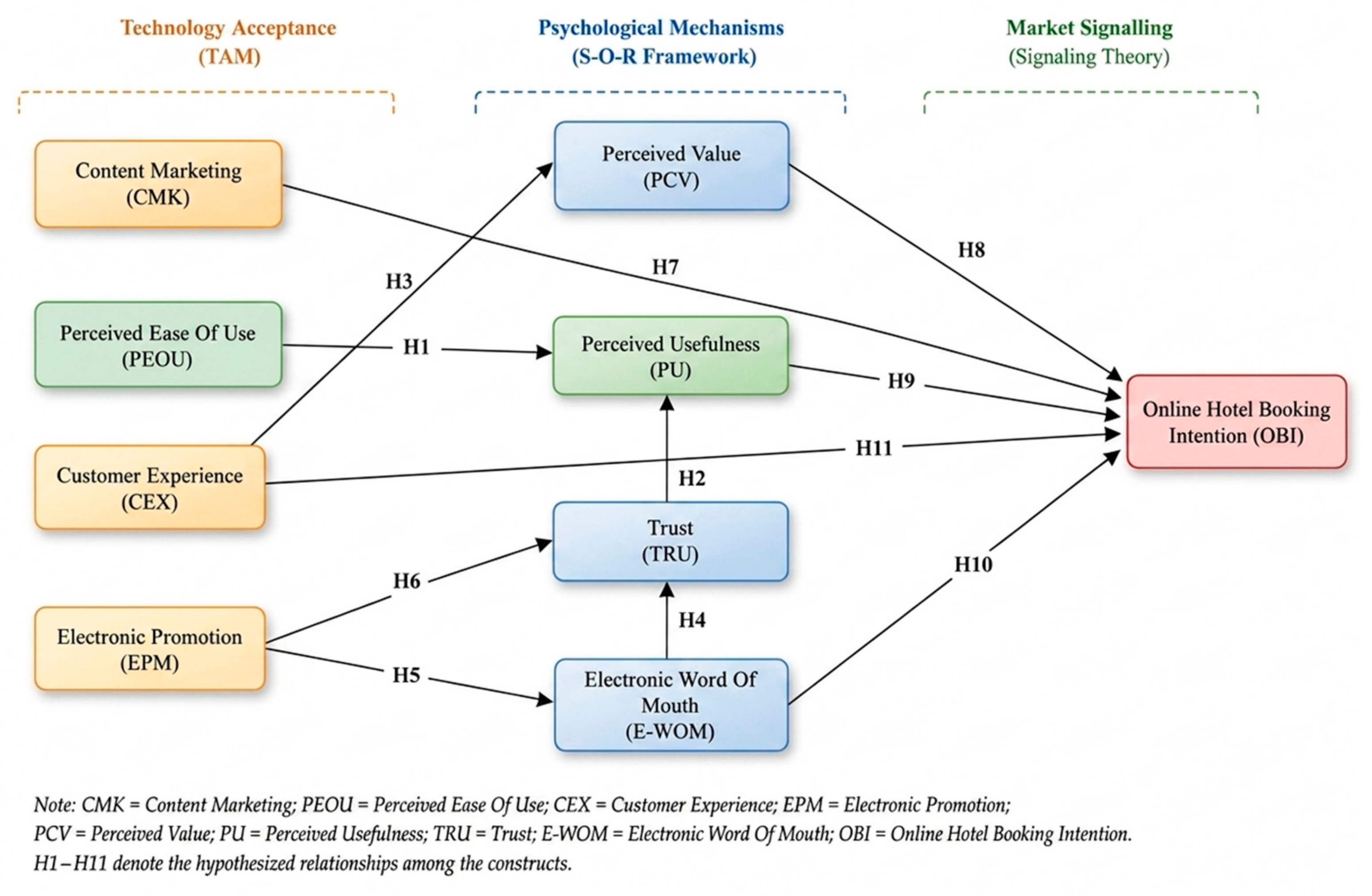
H1. PEOU positively influences PU.
H2. TRU positively influences PU.
H9. PU positively influences OBI.
2.3. Customer Experience (CEX) and Perceived Value (PCV)
CEX encompasses usability, service quality, and affective responses throughout the booking journey. Positive customer experiences enhance PCV, reflecting consumers’ evaluation of the trade-off between benefits and costs, thereby increasing intention (
Hoo et al., 2024). CEX may also directly influence OBI by improving satisfaction and engagement (
Amer, 2021). From the S-O-R perspective, CEX and PCV represent experiential mechanisms that complement the technological perspective of TAM within the proposed integrated theoretical framework.
H3. CEX positively influences PCV.
H8. PCV positively influences OBI.
H11. CEX positively influences OBI.
2.4. Electronic Word of Mouth (E-WOM) and Trust (TRU)
E-WOM, including online reviews, ratings, and peer recommendations, reduces uncertainty and exerts strong social influence in high-involvement services such as hotel booking (
Garg & Kumar, 2021). Positive E-WOM enhances TRU, which in turn facilitates information acceptance and decision-making (
Onobrakpeya & Otutuadum, 2024). E-WOM also directly increases booking intention due to its credibility (
Saha & Biswas, 2024;
Salameh et al., 2022). Within the proposed integrated theoretical framework, E-WOM and TRU represent relational mechanisms that complement the technological and experiential perspectives in explaining OBI.
H4. E-WOM positively influences TRU.
H10. E-WOM positively influences OBI.
2.5. Electronic Promotion (EPM) and Content Marketing (CMK)
EPM includes online advertising, discounts, and campaigns that signal value and quality (
Velázquez et al., 2023). Rather than directly influencing OBI, EPM primarily operates indirectly by strengthening TRU and stimulating positive E-WOM (
Anastasiei et al., 2024). Content marketing (CMK) refers to informative and engaging content created by a firm, which can directly motivate OBI by increasing awareness and purchase intention (
Camilleri & Kozak, 2022). Within the proposed integrated theoretical framework, EPM and CMK represent market-signaling mechanisms that complement the technological, experiential, and relational perspectives in explaining OBI.
H5. EPM has a positive influence on E-WOM.
H6. EPM has a positive influence on TRU.
H7. CMK has a positive influence on OBI.
2.6. Theoretical Integration: TAM, S-O-R, and Signaling Theory
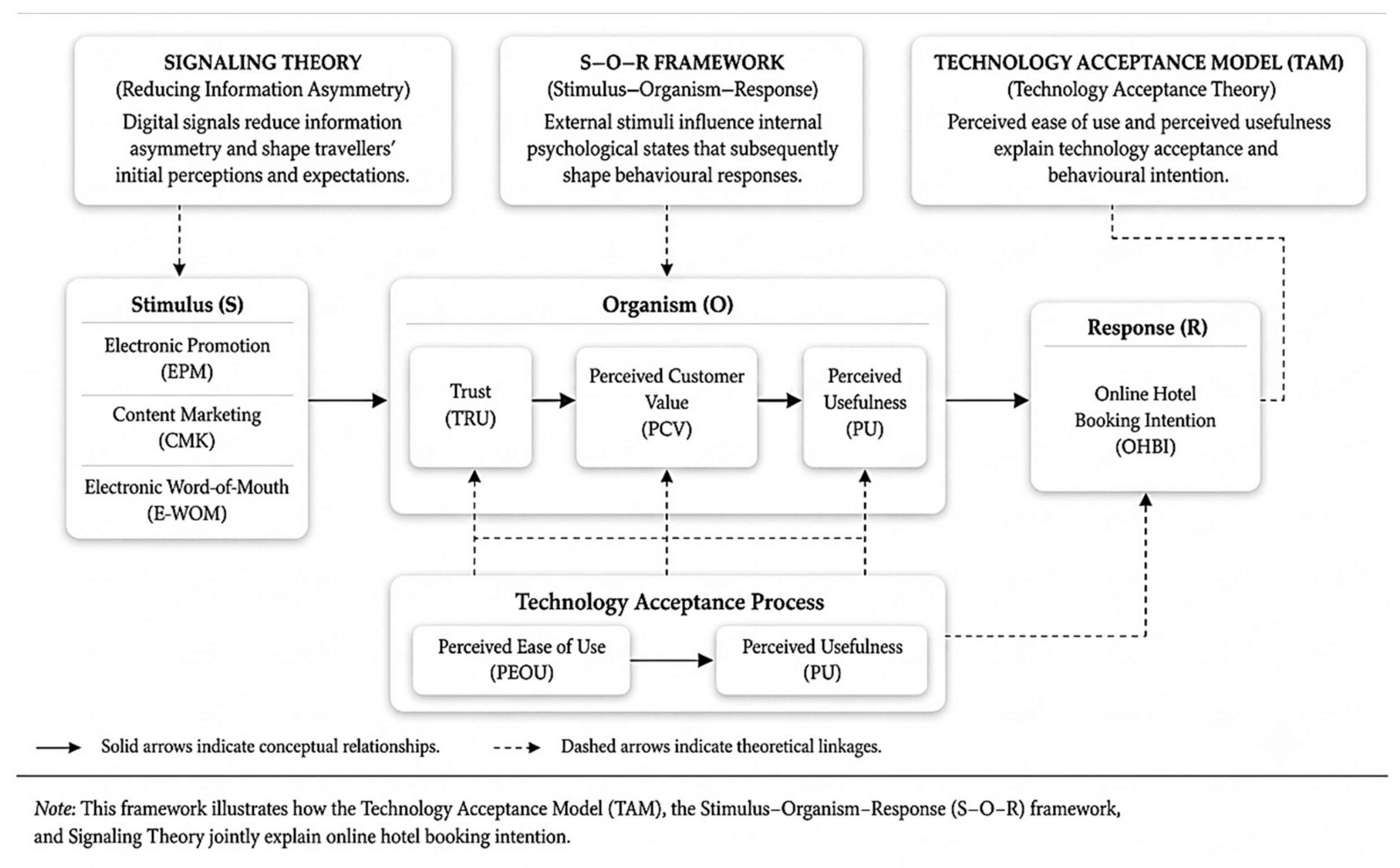
This study integrates three complementary theoretical perspectives to explain online hotel booking intention.
- (1)
The Technology Acceptance Model (TAM) explains how technological perceptions, particularly perceived ease of use (PEOU) and perceived usefulness (PU), influence technology acceptance and behavioral intention (
Davis, 1989;
Li et al., 2024).
- (2)
The S-O-R framework explains that external stimuli, such as EPM, E-WOM, and CMK, influence internal psychological states, including trust (TRU), perceived customer value (PCV), and perceived usefulness (PU), that ultimately shape online hotel booking intention (OBI) (
Yuen et al., 2022).
- (3)
Together, these three theoretical perspectives provide a comprehensive explanation of online hotel booking intention by integrating technological, psychological, and market-signaling mechanisms within a unified conceptual framework. Rather than offering three parallel theoretical explanations, the integrated framework demonstrates how these complementary perspectives collectively explain different dimensions of tourists’ online hotel booking decisions.
The integrated relationships among these complementary theoretical perspectives are illustrated in
Figure 1.
2.7. Methodological Integration: PLS-SEM and fsQCA
PLS-SEM explains the net effects of individual predictors on online hotel booking intention. However, consumer decision-making in digital tourism often results from multiple interacting conditions rather than independent linear effects (
Chen & Ye, 2023). Accordingly, fsQCA complements PLS-SEM by identifying multiple causal configurations leading to the same behavioral outcome, thereby recognising causal complexity and equifinality (
Kumar et al., 2022). Therefore, integrating PLS-SEM and fsQCA enables the simultaneous examination of both net effects and configurational causality, thereby providing complementary insights into online hotel booking intention that cannot be achieved using either analytical approach alone.
Conceptual Framework
Drawing upon the integrated theoretical framework presented in
Figure 1, this study proposes a conceptual framework explaining how technological, psychological, and market-signaling mechanisms jointly shape online hotel booking intention. Consistent with TAM, perceived ease of use enhances perceived usefulness, which subsequently influences online hotel booking intention (
Davis, 1989;
Li et al., 2024). Within the S-O-R framework, external stimuli influence internal psychological states that ultimately shape behavioral intentions (
Yuen et al., 2022), whereas Signaling Theory explains how digital signals reduce information asymmetry and strengthen consumer confidence (
Palamidovska-Sterjadovska et al., 2024). Based on this integrated theoretical perspective, the proposed conceptual framework specifies the hypothesized relationships among the study constructs. Specifically, perceived ease of use is proposed to enhance perceived usefulness, while customer experience strengthens perceived customer value and directly influences online hotel booking intention (
Amoako et al., 2021). Electronic word of mouth contributes to trust and directly influences online hotel booking intention (
Saha & Biswas, 2024;
Salameh et al., 2022), whereas electronic promotion indirectly influences booking intention through trust and electronic word of mouth (
Anastasiei et al., 2024). In addition, content marketing is proposed to directly enhance online hotel booking intention by increasing consumer awareness and engagement (
Camilleri & Kozak, 2022).
Overall, the proposed conceptual framework suggests that online hotel booking intention is jointly influenced by technological acceptance, psychological evaluations, and market-signaling mechanisms. These hypothesized relationships are subsequently examined using PLS-SEM to estimate net effects and fsQCA to identify multiple configurational pathways leading to online hotel booking intention.
The proposed conceptual framework derived from the integrated theoretical framework is presented in
Figure 2. The model illustrates the hypothesized relationships (H1–H11) among the study constructs that are subsequently examined using PLS-SEM and fsQCA.
3. Materials and Methods
3.1. Research Design
This study employed a quantitative research design to examine the determinants of OBI among Thai tourists. A cross-sectional survey approach was adopted to collect empirical data from respondents at a single point in time. A quantitative approach was appropriate because the study sought to test the hypothesized relationships among multiple latent constructs and evaluate the proposed theoretical framework empirically. Furthermore, PLS-SEM and fsQCA were integrated to capture both net effects and configurational causality, providing complementary insights into the determinants of OBI (
Rasoolimanesh et al., 2021).
3.2. Population and Sample
The target population comprised Thai tourists with prior experience using online hotel booking platforms. Eligible participants were required to have previously searched for, compared, or booked hotel accommodations through digital platforms, such as online travel agencies (OTAs) or hotel booking applications, within the previous 12 months. Purposive sampling was initially applied to ensure that respondents met these eligibility criteria. Following participant identification, convenience sampling was used to recruit eligible respondents for the online survey.
A total of 2030 questionnaires were returned. After applying the eligibility criteria and screening procedures, 146 questionnaires were excluded, resulting in 1884 valid responses for the final analyses. The final sample size was considered adequate for estimating the proposed PLS-SEM model and conducting robust configurational analyses using fsQCA (
Sabol et al., 2023;
Knight et al., 2021;
Nguyen et al., 2023).
3.3. Measurement Development
The questionnaire was developed based on the proposed conceptual framework, relevant literature, and findings from a Fuzzy Delphi process involving 21 experts on online hotel booking intention among Thai tourists. Measurement items were adapted from previously validated scales reported in the tourism, hospitality, and information systems literature and were subsequently refined to align with the study objectives and conceptual framework. The draft questionnaire was reviewed by the research supervisors to improve its accuracy, clarity, and consistency with the study objectives. Prior to the main survey, the questionnaire was pilot-tested with 30 respondents who met the study eligibility criteria. Based on their feedback, minor wording revisions were made to improve clarity and comprehensibility without changing the underlying meaning of the measurement items. Internal consistency reliability was assessed using Cronbach’s alpha, yielding an overall coefficient of 0.95, indicating excellent reliability. The final questionnaire measured nine constructs: perceived ease of use (PEOU), perceived usefulness (PU), customer experience (CEX), perceived customer value (PCV), trust (TRU), electronic word of mouth (E-WOM), electronic promotion (EPM), content marketing (CMK), and online hotel booking intention (OBI). All constructs were measured using a seven-point Likert scale ranging from 1 (strongly disagree) to 7 (strongly agree).
3.4. Data Collection
Data were collected between November 2025 and January 2026 using an online questionnaire administered through Google Forms (Google LLC, Mountain View, CA, USA). The survey link was distributed through Facebook (Meta Platforms, Inc., Menlo Park, CA, USA) travel communities, LINE groups (LY Corporation, Tokyo, Japan), and online travel agency (OTA)-related communities. Screening questions were included at the beginning of the questionnaire to verify participant eligibility before survey completion.
A total of 2030 questionnaires were returned. After screening the returned questionnaires, 146 questionnaires were excluded because of incomplete responses, failure to meet the eligibility criteria, or duplicate submissions, resulting in 1884 valid questionnaires for the final analyses.
To improve data quality, all completed questionnaires were screened for duplicate submissions and inconsistent response patterns before analysis. Ethical approval was obtained from the Ethics Committee of Rangsit University and received approval from the Institutional Review Board (IRB) on 7 July 2025 (Protocol No. RSUERB2025156). All participants provided informed consent prior to participation. Participation was voluntary, and all responses were collected anonymously and treated confidentially. The complete questionnaire used for data collection is provided in
Appendix A.
3.5. Assessment of Common Method Bias
Because this study employed a cross-sectional survey using single-source self-reported data collected from a single source, the potential influence of common method bias (CMB) was assessed. Following the recommendations of
Podsakoff et al. (
2003), both procedural and statistical remedies were implemented. Procedurally, respondents were assured of anonymity and confidentiality, and measurement items were adapted from previously validated scales. Statistically, common method bias was assessed using Harman’s single-factor test and indicator variance inflation factor (VIF) values. The results of these assessments are presented in
Section 4.
Descriptive statistical analyses and respondent profiling were performed using IBM SPSS Statistics version 21 (IBM Corp., Armonk, NY, USA). Measurement model assessment and structural model analysis were subsequently conducted using SmartPLS version 4.1.1.6 (SmartPLS GmbH, Oststeinbek, Germany), while configurational analysis was performed using fsQCA software version 4.1 (University of California, Irvine, CA, USA).
3.6. PLS-SEM Analysis
PLS-SEM analysis was employed to examine the hypothesized relationships among the study constructs. The analysis was conducted using SmartPLS version 4.1.1.6 (SmartPLS GmbH, Oststeinbek, Germany). PLS-SEM was considered appropriate because the study involved multiple latent constructs, predictive relationships, and a complex research framework integrating technological, experiential, relational, and marketing factors (
Sabol et al., 2023).
The analysis was conducted in two stages. First, the measurement model was evaluated to assess reliability and validity using indicator loadings, Cronbach’s alpha, composite reliability (CR), average variance extracted (AVE), and discriminant validity (
Hair et al., 2024;
Henseler et al., 2016). Second, the structural model was assessed by examining path coefficients, coefficient of determination (R
2), model fit indices, and the significance of hypothesized relationships. This approach enabled the study to evaluate both the measurement quality and the predictive capability of the proposed research model.
- (1)
Measurement Model Assessment
The measurement model assessment was conducted to evaluate the reliability and validity of the latent variables included in the proposed framework. Indicator reliability was first examined using factor loadings, where values above the recommended criterion indicated satisfactory item reliability (
Hair et al., 2024). Internal consistency reliability was assessed using Cronbach’s alpha and CR, with values exceeding the recommended criterion of 0.70 considered acceptable.
Convergent validity was evaluated using the AVE (
Hair et al., 2024). AVE values greater than 0.50 indicated that the variables explained more than half of the variance of their respective indicators. Discriminant validity was assessed using the Fornell–Larcker criterion by comparing the square root of the AVE for each construct with its correlations with other variables (
Fornell & Larcker, 1981). Discriminant validity was considered satisfactory when the square root of the AVE exceeded the inter-construct correlations.
- (2)
Structural Model Assessment
The structural model assessment was performed to examine the hypothesized relationships among the variables within the proposed framework. Path coefficients were analyzed to evaluate the strength and direction of the relationships between variables (
Hair et al., 2024). The significance of the structural relationships was assessed using bootstrapping procedures. The predictive capability of the model was evaluated using the coefficient of determination (R
2), which indicates the proportion of variance explained by the predictor variables. Higher R
2 values indicate stronger explanatory power of the model (
Hair et al., 2024).
In addition, model fit was assessed using standardized root mean square residual (SRMR) and normed fit index (NFI). An SRMR value below the recommended criterion indicated acceptable model fit, while NFI values were used to evaluate the overall fit of the proposed structural model (
Hair et al., 2024).
3.7. fsQCA Methodology
To complement the symmetric analysis provided by PLS-SEM, this study employed fsQCA to examine asymmetric and configurational relationships associated with OBI. fsQCA is particularly suitable for investigating complex causal relationships because consumer decision-making in digital tourism environments often results from multiple interacting conditions rather than single independent effects (
Fang et al., 2024). Unlike conventional symmetric approaches, fsQCA recognizes causal complexity, equifinality, and asymmetric relationships, allowing different combinations of conditions to produce the same outcome. The fsQCA analysis was conducted using fsQCA software version 4.1 (University of California, Irvine, CA, USA) and followed three major stages (
Manosuthi et al., 2022;
Slager et al., 2023): calibration, truth table construction, and sufficiency analysis.
(1) Calibration: all variables were calibrated into fuzzy-set membership scores ranging from 0 to 1 using the direct calibration method proposed by Charles Ragin (
Ragin, 2008;
Rihoux & Ragin, 2009). In the direct calibration procedure, the values of 0.95, 0.50, and 0.05 were used as the three qualitative anchors representing full membership, crossover point, and full non-membership, respectively. Following prior fsQCA studies, the calibration thresholds were determined using percentile values derived from the dataset. Specifically, the 95th percentile represented full membership, the 50th percentile represented the crossover point, and the 5th percentile represented full non-membership. This percentile-based calibration approach reflects the empirical distribution of the data and provides context-sensitive membership classification for large-sample survey research.
The percentile values were calculated using IBM SPSS Statistics version 21 (IBM Corp., Armonk, NY, USA) prior to calibration in fsQCA software version 4.1. This procedure enabled the transformation of latent construct scores into fuzzy-set membership values suitable for configurational analysis (
Hossain et al., 2022).
(2) Truth table construction: a truth table was constructed to identify combinations of causal conditions associated with high OBI. The truth table analysis employed a frequency threshold of 5 and a consistency threshold of 0.88. The frequency threshold was used to eliminate configurations with insufficient empirical representation, while the consistency threshold ensured that only highly consistent causal configurations were retained for further analysis (
Liozu et al., 2021;
Villani et al., 2023).
(3) Sufficiency analysis: the sufficiency analysis was conducted to identify multiple causal configurations leading to high OBI. Unlike symmetric approaches that examine the independent net effects of variables, fsQCA focuses on the combined influence of interacting conditions. The intermediate solution was selected because it provides theoretically meaningful yet parsimonious causal interpretations while incorporating directional expectations derived from the conceptual framework (
Islam et al., 2024).
The analysis evaluated raw coverage, unique coverage, and solution consistency for each causal configuration. Raw coverage indicates the proportion of the outcome explained by a configuration, whereas unique coverage reflects the distinct explanatory contribution of a specific pathway (
Ragin, 2008;
Rihoux & Ragin, 2009). Solution consistency assesses the degree to which the identified configurations consistently lead to high OBI (
Terrah et al., 2024).
4. Results
4.1. Respondent Profile
Table 1 presents the demographic characteristics of the respondents included in the study. A total of 1884 valid responses from Thai tourists with prior online hotel booking experience were analyzed. The respondent profile summarizes the gender and age distributions of the respondents.
Table 1 summarizes the demographic characteristics of the respondents. The sample consisted predominantly of female participants and young adults aged 18–29 years. These characteristics are broadly consistent with the demographic profile of users of online hotel booking platforms in Thailand.
To assess the potential influence of common method bias, Harman’s single-factor test and indicator variance inflation factor (VIF) values were examined. Harman’s single-factor test indicated that the first unrotated factor explained 35.395% of the total variance, which is below the recommended threshold of 50%. Furthermore, all indicator VIF values ranged from 1.326 to 2.834, remaining below the recommended threshold. These findings indicate that common method bias is unlikely to threaten the validity of the measurement model or the subsequent structural analyses.
4.2. Measurement Model Results
The measurement model was assessed to evaluate the reliability and convergent validity of the constructs included in the proposed framework. Reliability was examined using factor loadings, Cronbach’s alpha, and composite reliability (CR), while convergent validity was assessed using the average variance extracted (AVE). As presented in
Table 2, all factor loadings exceeded the recommended threshold, indicating satisfactory indicator reliability. In addition, the Cronbach’s alpha and CR values for all constructs were above the recommended threshold of 0.70, confirming satisfactory internal consistency reliability. Convergent validity was also supported, as all AVE values exceeded the recommended threshold of 0.50, indicating that the constructs explained a substantial proportion of variance in their indicators. Overall, the results demonstrate that the measurement model possesses satisfactory reliability and convergent validity.
Table 2 presents the measurement model assessment results, including factor loadings, Cronbach’s alpha, CR, and AVE. The results indicate that all factor loadings exceeded the recommended threshold of 0.60, ranging from 0.655 to 0.862, confirming satisfactory indicator reliability. Although the loading of CMK1 (0.655) was slightly lower than the remaining indicators, it remained within the acceptable range for exploratory and consumer behavior research. Furthermore, all Cronbach’s alpha values ranged from 0.804 to 0.887, while CR values ranged from 0.863 to 0.917, exceeding the recommended threshold of 0.70. These findings confirm satisfactory internal consistency reliability across all constructs. In addition, the AVE values ranged from 0.559 to 0.689, all above the recommended threshold of 0.50, indicating adequate convergent validity. Collectively, these findings support the adequacy of the measurement model for subsequent structural model analysis.
4.3. Discriminant Validity Assessment
Discriminant validity was assessed using both the Fornell–Larcker criteria and the heterotrait–monotrait ratio (HTMT). According to
Fornell and Larcker (
1981), discriminant validity is established when the square root of the average variance extracted (AVE) for each construct exceeds its correlations with other constructs. HTMT was further employed to provide a more rigorous assessment of discriminant validity, with values below the recommended threshold indicating that the constructs are empirically distinct.
Table 3 presents the results of the discriminant validity assessment using the Fornell–Larcker criterion. The diagonal values represent the square root of the AVE for each construct, while the off-diagonal values represent the correlations among variables. The results indicate that all square root AVE values were greater than the corresponding inter-construct correlations, satisfying the recommended Fornell–Larcker criterion for discriminant validity. Discriminant validity was further assessed using the heterotrait–monotrait ratio (HTMT). HTMT values ranged from 0.022 to 0.841, all below the recommended threshold of 0.90, providing additional evidence that the constructs are empirically distinct and that the measurement model demonstrates satisfactory discriminant validity. Collectively, these findings confirm that each construct has a unique conceptual domain and is empirically distinguishable from the other constructs, supporting the suitability of the measurement model for subsequent structural model analysis.
4.4. Structural Model Results
4.4.1. Estimated PLS-SEM Structural Model
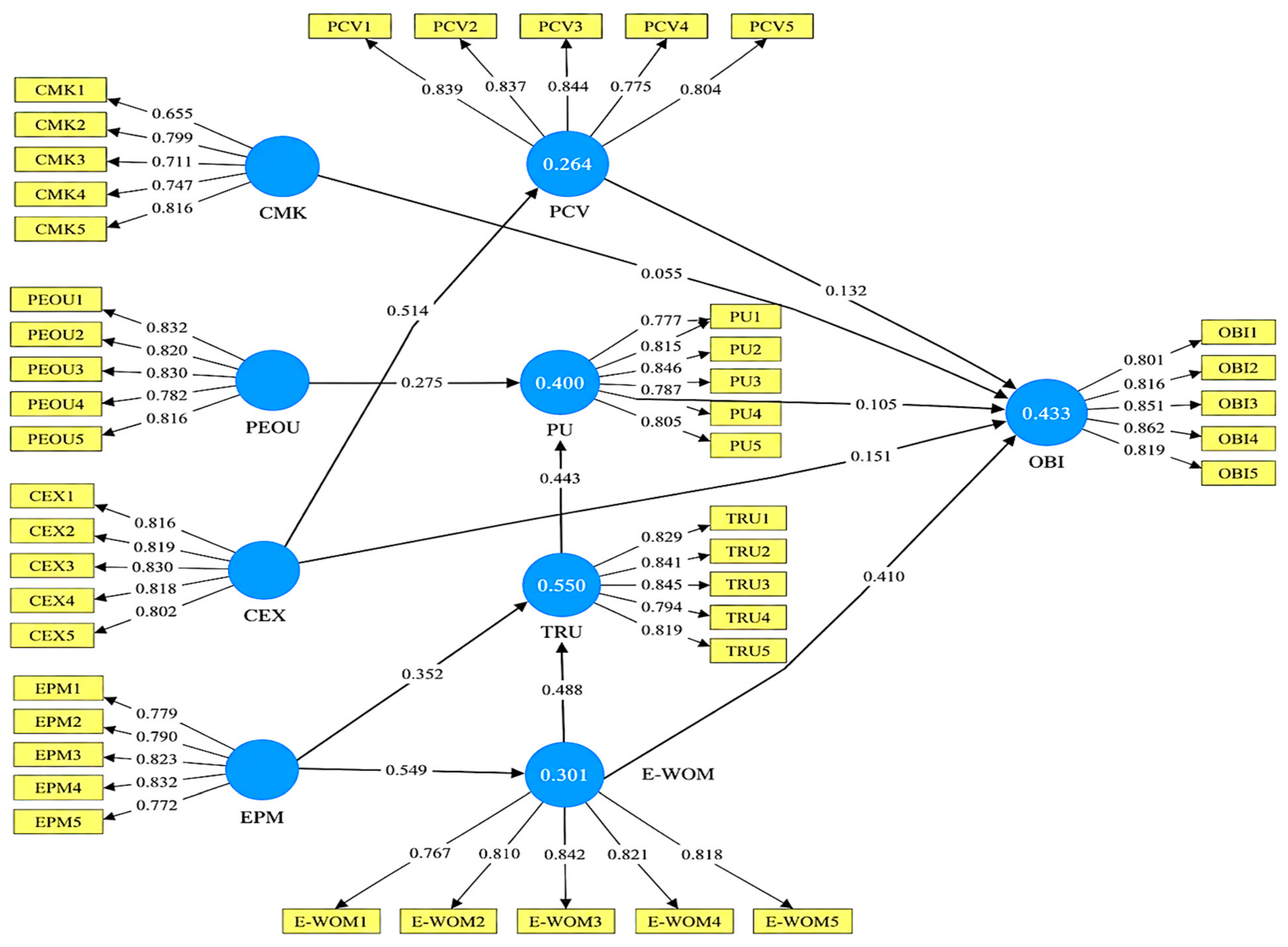
The structural model was estimated using partial least squares structural equation modeling (PLS-SEM) in SmartPLS to examine the hypothesized relationships among the proposed constructs.
Figure 3 presents the estimated PLS-SEM structural model with standardized path coefficients, factor loadings, and coefficients of determination (R
2) for the endogenous variables. The estimated model demonstrates satisfactory explanatory capability for OBI among Thai tourists. The results indicate that technological, experiential, relational, and marketing factors encourage OBI within the digital tourism context.
4.4.2. Hypothesis Testing
Table 4 shows the structural model results, including the standardized path coefficients (β), t-values, and
p-values for the hypothesized relationships. The results indicate that all hypothesized relationships were statistically significant, providing support for all proposed hypotheses.
Among the structural relationships, E-WOM demonstrated the strongest direct effect on OBI (β = 0.410, t = 17.302, p < 0.001). CEX exerted the strongest effect on PCV (β = 0.514, t = 25.179, p < 0.001), while TRU significantly influenced PU (β = 0.443, t = 19.538, p < 0.001). In addition, EPM significantly enhanced both E-WOM (β = 0.549, t = 30.008, p < 0.001) and TRU (β = 0.352, t = 16.740, p < 0.001), suggesting that promotional activities indirectly strengthen OBI through relational and social influence mechanisms.
Furthermore, PCV (β = 0.132, t = 5.400, p < 0.001), PU (β = 0.105, t = 4.349, p < 0.001), CEX (β = 0.151, t = 6.301, p < 0.001), and CMK (β = 0.055, t = 3.407, p < 0.01) also positively influenced OBI. Overall, the findings support all proposed hypotheses and demonstrate that technological, experiential, relational, and marketing factors collectively explain OBI among Thai tourists.
4.5. Coefficient of Determination (R2)
The coefficient of determination (R
2) was used to assess the explanatory power of the proposed structural model. As presented in
Table 5, the proposed framework demonstrated satisfactory explanatory capability across the endogenous constructs.
Among the endogenous constructs, TRU exhibited the highest explanatory power (R2 = 0.550), followed by OBI (R2 = 0.433), PU (R2 = 0.400), E-WOM (R2 = 0.301), and PCV (R2 = 0.246). The model explained 43.3% of the variance in OBI, indicating that technological, experiential, relational, and marketing factors jointly contribute to tourists’ online booking intention. Overall, these findings demonstrate satisfactory explanatory capability for OBI among Thai tourists.
4.6. Model Fit and Predictive Assessment
4.6.1. Model Fit
Model fit was assessed using the standardized root mean square residual (SRMR) and the normed fit index (NFI). As presented in
Table 6, the estimated model achieved an SRMR value of 0.079, which is below the recommended threshold of 0.08, indicating acceptable model fit. The model also achieved an NFI value of 0.870, indicating an acceptable level of overall model fit (
Hair et al., 2024). Overall, these results support the adequacy of the proposed structural model.
4.6.2. Predictive Assessment (PLS Predict)
The predictive capability of the proposed model was further evaluated using the PLS predict procedure. All endogenous constructs produced positive Q2predict values, ranging from 0.261 to 0.383, indicating satisfactory out-of-sample predictive relevance. Among the endogenous constructs, TRU demonstrated the highest predictive capability (Q2predict = 0.383), followed by PU (Q2predict = 0.336) and E-WOM (Q2predict = 0.300). Overall, these findings indicate that the proposed model demonstrates satisfactory out-of-sample predictive performance.
4.7. Effect Size (f2)
Effect size (f2) was assessed to evaluate the relative contribution of each exogenous construct to the endogenous constructs. The largest effect sizes were observed for the relationships between EPM → E-WOM (f2 = 0.431), E-WOM → TRU (f2 = 0.370), and CEX → PCV (f2 = 0.359), indicating large effects. Moderate effect sizes were identified for TRU → PU (f2 = 0.235), EPM → TRU (f2 = 0.192), and E-WOM → OBI (f2 = 0.184). The remaining structural relationships demonstrated small or negligible effect sizes. Overall, these findings indicate that the proposed structural model includes relationships with varying levels of practical significance, ranging from negligible to large effects.
4.8. fsQCA Results
The fsQCA analysis was conducted to identify multiple configurational pathways leading to high OBI among Thai tourists. All study constructs were calibrated into fuzzy-set membership scores using the direct calibration method. The results identified multiple sufficient configurations associated with high OBI, supporting the principle of equifinality and indicating that tourists may achieve high booking intention through alternative combinations of technological, experiential, relational, and marketing conditions. The findings also demonstrate causal complexity, suggesting that the influence of an individual condition relies on its interaction with other causal conditions within specific configurations. In addition, E-WOM, TRU, CEX, and EPM usually appeared as core causal conditions, highlighting their central role in the digital tourism context. The overall solution coverage was 0.763, indicating that the identified configurations explained a substantial proportion of the cases associated with high OBI, while the overall solution consistency of 0.815 demonstrated acceptable configurational consistency.
4.8.1. Calibration and Necessity Analysis
Prior to the fsQCA analysis, all variables were calibrated into fuzzy-set membership scores ranging from 0 to 1 using the direct calibration method. Following recommended fsQCA procedures, three qualitative anchors were specified for each construct: full non-membership, the crossover point, and full membership.
Table 7 presents the calibration threshold used in this study. Following calibration, necessity analysis was conducted to determine whether any single condition was necessary for high OBI. According to fsQCA guidelines, a condition is considered necessary when the consistency value exceeds 0.90. The results indicated that none of the individual conditions exceeded the recommended threshold, suggesting that no single factor was necessary to explain high OBI. These findings support the configurational logic of fsQCA and indicate that booking intention emerges from multiple combinations of technological, experiential, relational, and marketing conditions.
4.8.2. Sufficient Configurations
Table 8 presents the sufficient configurational pathways associated with high OBI. The results demonstrate that multiple combinations of causal conditions can jointly produce the same outcome, supporting the principle of equifinality in fsQCA analysis.
Configurations 3 and 4 exhibited the highest raw coverage values, indicating that these pathways explain the largest proportion of cases associated with high OBI. Both configurations consistently included E-WOM, TRU, PU, PCV, and CEX, suggesting that the simultaneous presence of relational, technological, and experiential factors plays a critical role in shaping tourists’ booking decisions. Across all identified configurations, E-WOM, TRU, PU, PCV, CEX, and EPM frequently appeared as important causal conditions, highlighting their central role in explaining high OBI. Overall, the solution coverage of 0.763 and solution consistency of 0.815 indicate satisfactory configurational performance, demonstrating that multiple alternative combinations of technological, experiential, relational, and marketing conditions can explain high OBI among Thai tourists.
5. Discussion
5.1. Discussion of PLS-SEM Structural Results
5.1.1. TAM Perspective
The findings support the Technology Acceptance Model (TAM) by demonstrating that perceived ease of use positively influences perceived usefulness, while perceived usefulness positively affects OBI (
Li et al., 2024). These results indicate that tourists are more likely to adopt online hotel booking platforms when the systems are perceived as user-friendly and functionally beneficial. The significant relationship between perceived usefulness and booking intention further indicates that technological functionality remains an important determinant of online consumer behavior in digital tourism environments (
Terrah et al., 2024). However, technological perceptions alone were insufficient to fully explain OBI. Although PU significantly influenced booking intention, its effect size was smaller than those of E-WOM and CEX (
Baydeniz et al., 2024;
Salameh et al., 2022). This finding suggests that online hotel booking behavior extends beyond technological evaluations and encompasses broader experiential and relational dimensions.
5.1.2. S-O-R Perspective
The findings support the Stimulus–Organism–Response (S-O-R) framework (
Morrison et al., 2023). CEX, EPM, and E-WOM, as external stimuli, significantly influenced tourists’ internal states, such as TRU, PCV, and PU, which subsequently influenced OBI (
Al-Saad et al., 2024). In particular, CEX exerted a strong positive effect on PCV, suggesting that favorable digital interactions enhance tourists’ perceptions of the overall value of online booking platforms (
Bouchareb, 2025). Furthermore, TRU significantly strengthened PU, indicating that tourists are more likely to perceive booking platforms as useful when they trust the platform and its information. E-WOM also positively influenced TRU and OBI, highlighting the important role of social interaction and peer-generated information within digital tourism decision-making processes. Collectively, these findings indicate that OBI is shaped by experiential and relational mechanisms in addition to technological factors, supporting the central proposition of the S-O-R framework (
González-Mohíno et al., 2024).
5.1.3. Signaling Theory Perspective
The findings are also consistent with Signaling Theory by demonstrating the significant effects of EPM and CMK on OBI (
Sharma et al., 2023). EPM positively influenced both TRU and E-WOM, indicating that promotional activities function as important informational signals that reduce uncertainty and strengthen tourists’ confidence in online booking platforms (
Garg & Kumar, 2021). In digital tourism environments characterized by information asymmetry, promotional communication serves as an important mechanism for enhancing platform credibility and encouraging consumer engagement. In addition, CMK positively influenced online booking intention, although with a relatively smaller effect size. This finding suggests that informative and persuasive digital content contributes to tourists’ booking decisions by improving information transparency and strengthening platform attractiveness. Collectively, these findings support the central proposition of Signaling Theory, demonstrating that digital marketing signals reduce information asymmetry and encourage OBI (
Chandra & Mishra, 2025).
5.2. Discussion of fsQCA Findings
5.2.1. Technology-Driven Configurations
The findings support the Technology Acceptance Model (TAM) by demonstrating that PU and PEOU frequently appeared in sufficient configurations leading to high OBI (
Davis, 1989). These findings suggest that tourists are more likely to develop high OBI when booking platforms are perceived as useful and easy to use. Configurations involving PU and PEOU indicate that technological functionality remains an important pathway to online booking intention within digital tourism environments (
Mohamad et al., 2021;
Terrah et al., 2024). However, the fsQCA results further indicate that technological perceptions alone were insufficient to explain high OBI. In several configurations, high booking intention emerged only when technological conditions interacted with experiential, relational, or marketing-related conditions. These findings highlight the configurational complexity of online hotel booking behavior, whereby technological conditions operate in combination with other causal conditions rather than as isolated determinants (
Saha & Biswas, 2025;
Salameh et al., 2022).
5.2.2. Experience-Centered Configurations
Multiple sufficient configurations highlighted the combined roles of CEX, PCV, and TRU, supporting the S-O-R framework (
Gahler et al., 2022). CEX appeared frequently across the identified pathways, indicating that positive digital experiences represent a central mechanism influencing tourists’ booking decisions. In addition, PCV and TRU jointly contributed to high OBI in several configurations, emphasizing the importance of internal psychological states within online tourism environments (
Tiamiyu et al., 2022). The findings further demonstrate that high OBI can emerge even when certain technological conditions are absent, provided that strong experiential and relational conditions are present (
Baydeniz et al., 2024). These findings reinforce the importance of experiential and relational mechanisms in shaping tourists’ online booking decisions.
5.2.3. Social Influence and Signaling Configurations
E-WOM, EPM, and CMK frequently appeared across the sufficient configurations, highlighting the importance of social influence and signaling mechanisms in online hotel booking behavior (
Chen & Ye, 2023). E-WOM consistently appeared in several high-coverage pathways, indicating that online reviews and user-generated content strongly shape tourists’ perceptions and booking decisions (
Adekuajo et al., 2023). Furthermore, EPM and CMK functioned as important market signals that reduced uncertainty and strengthened tourists’ confidence in booking platforms (
Warintarawej et al., 2024). The fsQCA findings also support the principle of equifinality, demonstrating that multiple alternative combinations of technological, experiential, relational, and marketing conditions can jointly produce high OBI (
Terrah et al., 2024). These findings further highlight the causal complexity of online hotel booking behavior and complement the symmetric relationships identified through PLS-SEM analysis.
5.2.4. Comparison Between PLS-SEM and fsQCA Findings
The integration of PLS-SEM and fsQCA provides complementary insights into OBI by explaining both net effects and configurational causality. The PLS-SEM findings identified E-WOM as the strongest direct predictor of online booking intention, while fsQCA further confirmed that E-WOM consistently appeared across several sufficient configurations. This convergence suggests that E-WOM functions as a critical conversion trigger in digital tourism environments, supporting the important role of social influence and user-generated information in consumer decision-making (
Aghazada, 2023;
Tùng & My, 2023).
TRU and CEX also demonstrated complementary findings across both analytical approaches. PLS-SEM revealed that trust significantly enhanced PU, while CEX positively influenced PCV and OBI. The fsQCA results showed that TRU, CEX, and PCV usually appeared together in multiple configurations leading to high booking intention. These findings indicate that online booking behavior is shaped not only by isolated relationships but also by the interaction of experiential and relational conditions within broader causal structures (
Amin et al., 2021;
Emam & Abdelaal, 2021).
The comparison between SEM and fsQCA highlights the methodological value of adopting a hybrid analytical approach in online tourism research. While PLS-SEM explains the strength and significance of individual relationships, fsQCA captures the configurational complexity and equifinality underlying consumer behavior by identifying multiple pathways leading to high OBI. Together, these complementary approaches provide a more comprehensive understanding of digital consumer decision-making in online hotel booking platforms, thereby strengthening the methodological contributions of this study and providing richer theoretical insights into online hotel booking intention (
Hair et al., 2024;
Terrah et al., 2024).
6. Limitations and Future Research
Despite its contributions, this study has several limitations that should be acknowledged. First, the study employed a cross-sectional research design, which limits the ability to establish causal relationships among the investigated constructs. Future studies may adopt longitudinal or experimental designs to examine how tourists’ online hotel booking intention evolves over time.
Second, the data were collected exclusively from Thai tourists. Although this provides important empirical evidence within the Thai tourism context, the generalizability of the findings to other cultural and tourism settings may be limited. Future research should validate the proposed framework across different countries and tourism markets to examine its cross-cultural applicability.
Third, the study relied on self-reported questionnaire data. Although common method bias was assessed and found not to pose a significant concern, future studies may benefit from incorporating multiple data sources or behavioral data to further strengthen the robustness of the findings.
Finally, this study examined online hotel booking intention across online booking platforms without distinguishing among specific platforms or service providers. Future research could compare different online travel agencies (OTAs) and booking platforms to determine whether technological, experiential, relational, and marketing factors operate differently across digital tourism environments.
Overall, future studies are encouraged to extend the present framework by incorporating additional contextual factors, diverse research settings, and longitudinal evidence to further advance the understanding of online hotel booking behavior.
7. Conclusions
This study examined the determinants of online hotel booking intention (OBI) among Thai tourists by integrating PLS-SEM and fsQCA within a unified framework based on the Technology Acceptance Model (TAM), the Stimulus–Organism–Response (S-O-R) framework, and Signaling Theory. The findings demonstrate that technological, experiential, relational, and marketing factors jointly influence OBI within digital tourism environments. The PLS-SEM analysis identified E-WOM as the strongest direct predictor of OBI, while CEX significantly enhanced PCV, TRU strengthened PU, and EPM indirectly influenced OBI through TRU and E-WOM. Complementing these findings, the fsQCA analysis demonstrated that multiple configurational pathways can lead to high OBI, supporting the principles of equifinality and causal complexity. Rather than being driven by a single dominant factor, high OBI emerged through different combinations of technological, experiential, relational, and marketing conditions, with E-WOM, TRU, CEX, and EPM frequently appearing across the identified configurations. Theoretically, this study extends the literature by integrating TAM, the S-O-R framework, and Signaling Theory to explain online hotel booking behavior within a unified conceptual framework. Methodologically, the findings demonstrate the complementary value of combining PLS-SEM and fsQCA, providing insights into both net effects and configurational causality. Practically, the findings suggest that hotel businesses and online booking platforms should prioritize customer experience, trust-building strategies, E-WOM management, and digital promotional activities to strengthen tourists’ online booking intention. In addition, this study provides empirical evidence from the Thai tourism context, contributing to a broader understanding of online consumer behavior in emerging digital tourism markets.
Author Contributions
Conceptualization, N.P., S.L. and S.P.; Methodology, N.P., S.L. and S.P.; Software, N.P. and S.L.; Validation, N.P., S.L. and S.P.; Formal analysis, N.P., S.L. and S.P.; Investigation, N.P., S.L. and S.P.; Resources, N.P. and S.L.; Data curation, N.P. and S.L.; Writing—original draft, N.P.; Writing—review and editing, S.L. and S.P.; Visualization, N.P. and S.L. All authors have read and agreed to the published version of the manuscript.
Funding
This research received no external funding.
Institutional Review Board Statement
The study was conducted in accordance with the Declaration of Helsinki and approved by the Institutional Review Board of Rangsit University (Approval No. RSUERB2025-156, 7 July 2025).
Informed Consent Statement
Informed consent was obtained from all participants prior to their participation through an online consent form.
Data Availability Statement
The data presented in this study are available upon reasonable request from the corresponding author due to privacy and ethical considerations.
Acknowledgments
During the preparation of this work, the author(s) used ChatGPT (OpenAI, GPT-5.5) to assist with language editing, paraphrasing, and improving the clarity of the manuscript. After using this tool, the author(s) carefully reviewed and revised the content as necessary and take full responsibility for the content of the published article.
Conflicts of Interest
The authors declare no conflicts of interest.
Appendix A
Full Questionnaire
1. Online Hotel Booking Intention
Online hotel booking intention refers to tourists’ willingness, expectation, and future plans to use online hotel booking platforms, reflecting repeated usage behavior and confidence in online booking systems.
| Code | Questionnaire Item |
| OBI1 | You intend to use online hotel booking services regularly. |
| OBI2 | You are willing to use online hotel booking services for your next booking. |
| OBI3 | You are highly likely to book hotels through online systems within the next few months. |
| OBI4 | You plan to use online hotel booking services within the next 12 months. |
| OBI5 | You are likely to continue using online hotel booking services in the future. |
2. Electronic Word of Mouth (eWOM)
Electronic word of mouth refers to tourists’ tendency to communicate, recommend, review, or share positive information about online hotel booking experiences through online channels or interpersonal communication.
| Code | Questionnaire Item |
| E-WOM1 | You often say positive things about online hotel booking. |
| E-WOM2 | You often provide positive comments about online hotel booking. |
| E-WOM3 | You often write positive reviews about hotel rooms booked through online hotel booking systems. |
| E-WOM4 | You often recommend online hotel booking services to others. |
| E-WOM5 | You often share information about online hotel booking. |
3. Trust
Trust refers to tourists’ confidence in online hotel booking systems regarding reliability, booking security, payment security, and receiving the reserved accommodation as promised.
| Code | Questionnaire Item |
| TRU1 | You trust online hotel booking systems. |
| TRU2 | You trust that you will receive the room that matches your expectations when booking online. |
| TRU3 | You trust that you will definitely receive a room when booking through online systems. |
| TRU4 | You trust the payment system used in online hotel booking. |
| TRU5 | You trust the protection of personal information in online hotel booking systems. |
4. Electronic Promotion
Electronic promotion refers to tourists’ perceptions of marketing activities used by online hotel booking platforms to stimulate booking decisions, such as discounts, seasonal promotions, loyalty programs, and special partner offers.
| Code | Questionnaire Item |
| EPM1 | You think online hotel booking platforms provide promotions during tourism seasons. |
| EPM2 | You think online hotel booking platforms provide special offers for new customers. |
| EPM3 | You think online hotel booking platforms provide special travel packages. |
| EPM4 | You think online hotel booking platforms provide reward points for future discounts. |
| EPM5 | You think online hotel booking platforms provide promotions in collaboration with credit cards. |
5. Content Marketing
Content marketing refers to marketing strategies used by online hotel booking platforms to present multimedia content such as images, videos, descriptions, and user reviews to enhance information value and stimulate booking intention.
| Code | Questionnaire Item |
| CMK1 | You think online hotel booking platforms provide attractive room images. |
| CMK2 | You think online hotel booking platforms provide appealing hotel images. |
| CMK3 | You think online hotel booking platforms provide interesting room videos. |
| CMK4 | You think online hotel booking platforms provide clear room information and details. |
| CMK5 | You think online hotel booking platforms provide review ratings from previous guests. |
6. Perceived Ease of Use
Perceived ease of use refers to the degree to which tourists perceive online hotel booking systems as easy to understand and operate without requiring much effort or technological skill.
| Code | Questionnaire Item |
| PEOU1 | You think online hotel booking systems are easy to use. |
| PEOU2 | You think the online hotel booking process is easy to understand. |
| PEOU3 | You think booking hotels through online systems is simple. |
| PEOU4 | You think interacting with online hotel booking systems is easy. |
| PEOU5 | You think using online hotel booking systems requires little effort. |
7. Perceived Usefulness
Perceived usefulness refers to the extent to which tourists believe that online hotel booking systems improve travel planning efficiency by enabling convenient hotel searching, comparison, and booking anytime and anywhere.
| Code | Questionnaire Item |
| PU1 | You think online hotel booking is useful for searching hotels. |
| PU2 | You think online hotel booking is convenient for selecting hotels. |
| PU3 | You think online hotel booking can be done anytime and anywhere. |
| PU4 | You think online hotel booking reduces booking time. |
| PU5 | You think online hotel booking helps compare room prices quickly. |
8. Perceive Value
Perceive value refers to tourists’ perception that hotel room prices on online booking platforms are reasonable, worthwhile, and appropriate under current economic conditions.
| Code | Questionnaire Item |
| PCV1 | You think hotel room booking prices through online systems are not too expensive. |
| PCV2 | You think hotel room booking prices through online systems are reasonable. |
| PCV3 | You think hotel room booking prices through online systems are worth the money paid. |
| PCV4 | You think hotel room booking prices through online systems are acceptable. |
| PCV5 | You think hotel room booking prices through online systems are appropriate for current economic conditions. |
9. Customer Experience
Customer experience refers to tourists’ impressions resulting from interactions with online hotel booking systems, considering convenience, service speed, responsiveness to problems, and overall service quality throughout the booking process.
| Code | Questionnaire Item |
| CEX1 | You have a positive experience with online hotel booking platforms that offer a variety of room choices. |
| CEX2 | You have a positive experience with online hotel booking platforms that provide quick responses to inquiries. |
| CEX3 | You have a positive experience with online hotel booking platforms that solve problems promptly. |
| CEX4 | You have a positive experience with online hotel booking platforms with uncomplicated procedures. |
| CEX5 | You have a positive experience using various online hotel booking platforms. |
References
- Adekuajo, I. O., Fakeyede, O. G., Udeh, C. A., & Daraojimba, C. (2023). The digital evolution in hospitality: A global review and its potential transformative impact on U.S. tourism. International Journal of Applied Research in Social Sciences, 5(10), 440–462. [Google Scholar] [CrossRef]
- Aghazada, K. (2023). Digital word-of-mouth and its effect on tourists’ destination decision-making process. Vytautas Magnus University. Available online: https://hdl.handle.net/20.500.12259/263909 (accessed on 26 July 2026).
- Al-Saad, S., Alzghoul, Y. A., & Harb, A. (2024). The effects of the antecedents of eWOM on tourists’ decision-making: Perceived trust as a mediator. Tourism and Hospitality Management, 30(4), 555–567. [Google Scholar] [CrossRef]
- Amer, S. M. (2021). The effect of e-servicescape, website trust and perceived value on consumer online booking intentions: The moderating role of online booking experience. International Business Research, 14(6), 133–145. [Google Scholar] [CrossRef]
- Amin, M., Ryu, K., Çobanoğlu, C., & Nizam, A. (2021). Determinants of online hotel booking intentions: Website quality, social presence, affective commitment, and e-trust. Journal of Hospitality Marketing & Management, 30(7), 845–870. [Google Scholar] [CrossRef]
- Amoako, G. K., Doe, J., & Neequaye, E. K. (2021). Online innovation and repurchase intentions in hotels: The mediating effect of customer experience. International Hospitality Review, 37(1), 28–47. [Google Scholar] [CrossRef]
- Anastasiei, B., Dospinescu, N., & Dospinescu, O. (2024). Individual and product-related antecedents of electronic word-of-mouth. Aslib Journal of Information Management. Advance online publication. [Google Scholar] [CrossRef]
- Azhar, N. B. A., Zahari, M. S. M., Ferdian, F., & Hanafiah, M. H. (2025). Unpacking the power of trust: How relative advantage, compatibility, ease of use and usefulness drive hotel self-directed bookings. Consumer Behavior in Tourism and Hospitality, 20(1), 148–163. [Google Scholar] [CrossRef]
- Baydeniz, E., Türkoğlu, T., & Kart, N. (2024). Psychological factors influencing online booking intentions among resort tourism service users. Worldwide Hospitality and Tourism Themes, 16(6), 706–724. [Google Scholar] [CrossRef]
- Bilan, Y., Tovmasyan, G., & Dallakyan, S. (2024). The impact of digital technologies on tourists’ travel choices and overall experience. Journal of Tourism and Services, 15(29), 153–175. [Google Scholar] [CrossRef]
- Bouchareb, N. (2025). Accommodation inventory sources for startup online travel agencies. Tourism and Hospitality Management, 31(4). [Google Scholar] [CrossRef]
- Camilleri, M. A., & Kozak, M. (2022). Utilitarian motivations to engage with travel websites: An interactive technology adoption model. Journal of Services Marketing, 37(1), 96–109. [Google Scholar] [CrossRef]
- Chan, S., Amin, M., Rasool, S., & Syed, O. R. (2025). From click to confirmation: The effect of hotel website quality and online reviews in fostering booking intentions. International Journal of Quality and Service Sciences, 17(2), 220–242. [Google Scholar] [CrossRef]
- Chandra, N., & Mishra, M. (2025). Digital marketing strategies in the hotel industry: A bibliometric review (1998–2025). Journal of Management and Entrepreneurship, 9(4), 30–43. [Google Scholar] [CrossRef]
- Chen, S., & Ye, J. (2023). Understanding consumers’ intentions to purchase smart clothing using PLS-SEM and fsQCA. PLoS ONE, 18(9), e0291870. [Google Scholar] [CrossRef] [PubMed]
- Davis, F. D. (1989). Perceived usefulness, perceived ease of use, and user acceptance of information technology. MIS Quarterly, 13(3), 319–340. [Google Scholar] [CrossRef] [PubMed]
- Emam, H. E. E.-D. M., & Abdelaal, F. M. (2021). Factors influencing intentions in hotel booking through online travel intermediaries’ applications. Journal of Association of Arab Universities for Tourism and Hospitality, 21(3), 101–134. [Google Scholar] [CrossRef]
- Fang, X., Chatzipanagiotou, K., & Veloutsou, C. (2024). Untangling the complex and idiosyncratic nature of tourist destination brand equity. Journal of Travel Research. Advance online publication. [Google Scholar] [CrossRef]
- Fornell, C., & Larcker, D. F. (1981). Evaluating structural equation models with unobservable variables and measurement error. Journal of Marketing Research, 18(1), 39–50. [Google Scholar] [CrossRef]
- Gahler, M., Klein, J. F., & Paul, M. (2022). Customer experience: Conceptualization, measurement, and application in omnichannel environments. Journal of Service Research, 26(2), 191–211. [Google Scholar] [CrossRef]
- Garg, A., & Kumar, J. (2021). Social media marketing influence on boutique hotel customers’ purchase intention in Malaysia. Tourism & Management Studies, 17(3), 51–62. [Google Scholar] [CrossRef]
- González-Mohíno, M., Donate, M. J., Cañizares, S. M. S., & Cabeza-Ramírez, L. J. (2024). Transactive memory systems for improving the innovation capability of hotel establishments and their online reputation. Journal of the Knowledge Economy. Advance online publication. [Google Scholar] [CrossRef]
- Hair, J. F., Sarstedt, M., Ringle, C. M., Sharma, P. N., & Liengaard, B. D. (2024). Going beyond the untold facts in PLS-SEM and moving forward. European Journal of Marketing, 58(13), 81–106. [Google Scholar] [CrossRef]
- Henseler, J., Hubona, G., & Ray, P. A. (2016). Using PLS path modeling in new technology research: Updated guidelines. Industrial Management & Data Systems, 116(1), 2–20. [Google Scholar] [CrossRef]
- Hoo, W. C., Poh, N. M., & Khan, M. K. (2024). Factors influencing consumer behavior towards intention and the selection of luxury hotels in Malaysia using theory of planned behavior. Innovative Marketing, 20(3), 81–96. [Google Scholar] [CrossRef]
- Hossain, M. A., Quaddus, M., Hossain, M. M., & Gopakumar, G. (2022). Data-driven innovation development: An empirical analysis of the antecedents using PLS-SEM and fsQCA. Annals of Operations Research, 333, 895–937. [Google Scholar] [CrossRef]
- Islam, M. Z., Jilani, M. M. A. K., & Karim, M. R. (2024). Enhancing post-training evaluation of annual performance agreement training: A fusion of fsQCA and artificial neural network approach. PLoS ONE, 19(6), e0305916. [Google Scholar] [CrossRef] [PubMed]
- Jeong, M., Shin, H. H., Lee, M., & Lee, J. (2022). Assessing brand performance consistency from consumer-generated media: The U.S. hotel industry. International Journal of Contemporary Hospitality Management, 35(6), 2056–2083. [Google Scholar] [CrossRef]
- Knight, H., Haddoud, M. Y., & Megicks, P. (2021). Determinants of corporate sustainability message sharing on social media: A configuration approach. Business Strategy and the Environment, 31(2), 633–647. [Google Scholar] [CrossRef]
- Kumar, S., Sahoo, S., Lim, W. M., Kraus, S., & Bamel, U. (2022). Fuzzy-set qualitative comparative analysis (fsQCA) in business and management research: A contemporary overview. Technological Forecasting and Social Change, 178, 121599. [Google Scholar] [CrossRef]
- Li, F., Zhu, D., Lin, M.-T., & Kim, P. B. (2024). The Technology Acceptance Model and hospitality and tourism consumers’ intention to use mobile technologies: Meta-analysis and structural equation modeling. Cornell Hospitality Quarterly, 65(4), 461–477. [Google Scholar] [CrossRef]
- Liozu, S. M., Feurer, S., Hinterhuber, A., & Woodside, A. G. (2021). Configurational theory and practices of firms employing multiple pricing policies: Assessing effective and ineffective pricing recipes in multiple firm contexts. Journal of Revenue and Pricing Management, 20(4), 420–435. [Google Scholar] [CrossRef]
- Manosuthi, N., Lee, J., & Han, H. (2022). Green behavior at work of hospitality and tourism employees: Evidence from IGSCA-SEM and fsQCA. Journal of Sustainable Tourism, 32(1), 85–107. [Google Scholar] [CrossRef]
- Mohamad, M. A., Radzi, S. M., & Hanafiah, M. H. (2021). Understanding tourist mobile hotel booking behavior: Incorporating perceived enjoyment and perceived price value in the modified technology acceptance model. Tourism & Management Studies, 17(1), 19–30. [Google Scholar] [CrossRef]
- Morrison, A. M., Bag, S., & Mandal, K. (2023). Virtual reality’s impact on destination visits intentions and the moderating role of amateur photography. Tourism Review, 79(2), 355–377. [Google Scholar] [CrossRef]
- Nguyen, A. T. V., Halibas, A., McClelland, R., & Thuan, N. H. (2023). Configurational analysis of conditions influencing customers’ channel switching intention in omnichannel retailing: A fuzzy-set analysis. Quality & Quantity, 58(1), 141–178. [Google Scholar] [CrossRef] [PubMed]
- Nuryyev, G., Spyridou, A., Yeh, S., & Lo, C.-C. (2021). Factors of digital payment adoption in hospitality businesses: A conceptual approach. European Journal of Tourism Research, 29, 2905. [Google Scholar] [CrossRef]
- Onobrakpeya, S. A., & Otutuadum, D. O. (2024). Electronic word-of-mouth and customer purchase intention for hotel services in Delta State, Nigeria. International Journal of Management & Entrepreneurship Research, 6(3), 752–769. [Google Scholar] [CrossRef]
- Palamidovska-Sterjadovska, N., Prodanova, J., & Ciunova-Shuleska, A. (2024). Why do customers value m-banking apps? A stimulus-organism-response perspective. Spanish Journal of Marketing—ESIC, 28(4), 481–499. [Google Scholar] [CrossRef]
- Podsakoff, P. M., MacKenzie, S. B., Lee, J.-Y., & Podsakoff, N. P. (2003). Common method biases in behavioral research: A critical review of the literature and recommended remedies. Journal of Applied Psychology, 88(5), 879–903. [Google Scholar] [CrossRef] [PubMed]
- Ragin, C. C. (2008). Redesigning social inquiry: Fuzzy sets and beyond. University of Chicago Press. [Google Scholar]
- Rasoolimanesh, S. M., Ringle, C. M., Sarstedt, M., & Olya, H. (2021). The combined use of symmetric and asymmetric approaches: Partial least squares-structural equation modeling and fuzzy-set qualitative comparative analysis. International Journal of Contemporary Hospitality Management, 33(5), 1571–1592. [Google Scholar] [CrossRef]
- Rihoux, B., & Ragin, C. C. (2009). Configurational comparative methods: Qualitative comparative analysis (QCA) and related techniques. Sage Publications. [Google Scholar] [CrossRef]
- Sabol, M. A., Hair, J. F., Cepeda-Carrión, G., Roldán, J. L., & Chong, A. Y. (2023). PLS-SEM in information systems: Seizing the opportunity and marching ahead full speed to adopt methodological updates. Industrial Management & Data Systems, 123(12), 2997–3017. [Google Scholar] [CrossRef]
- Saha, P., & Biswas, A. (2024). Seal the deal: Unleashing the magnitude of online reviews, website quality and trust for seamless hotel reservations. International Journal of Productivity and Performance Management, 74(4), 1125–1155. [Google Scholar] [CrossRef]
- Saha, P., & Biswas, A. (2025). Unraveling your dream stay with a click: The interplay of emotions, aesthetics, interactivity and opportunistic behavior in online hotel reservations. The TQM Journal, 1–19, Advance online publication. [Google Scholar] [CrossRef]
- Salameh, A. A., Mamun, A. A., Hayat, N., & Ali, M. H. (2022). Modelling the significance of website quality and online reviews to predict the intention and usage of online hotel booking platforms. Heliyon, 8(9), e10735. [Google Scholar] [CrossRef] [PubMed]
- Sharafuddin, M. A., Madhavan, M., & Wangtueai, S. (2024). Assessing the effectiveness of digital marketing in enhancing tourist experiences and satisfaction: A study of Thailand’s tourism services. Administrative Sciences, 14(11), 273. [Google Scholar] [CrossRef]
- Sharma, A., Santa-María, M. J., & Nicolau, J. L. (2023). The effect of tangible promotions on an intangible environment. Journal of Travel Research. Advance online publication. [Google Scholar] [CrossRef]
- Slager, R., Chuah, K., Gond, J., Furnari, S., & Homanen, M. (2023). Tailor-to-target: Configuring collaborative shareholder engagements on climate change. Management Science, 69(12), 7693–7718. [Google Scholar] [CrossRef]
- Terrah, A., Ali, F., Abbasi, G. A., Doğan, S., & Çobanoğlu, C. (2024). Determinants of users’ intentions to use AI-enabled technological innovations in hotels: A hybrid approach using PLS-SEM and fsQCA. Advances in Hospitality and Tourism Research, 12(2), 200–228. [Google Scholar] [CrossRef]
- Tiamiyu, T., Quoquab, F., & Mohammad, J. (2022). Antecedents of guest booking intention in the home-sharing industry: Lessons learned from Airbnb. International Journal of Hospitality & Tourism Administration, 25(2), 277–305. [Google Scholar] [CrossRef]
- Tùng, L. T., & My, D. T. H. (2023). Electronic Word of Mouth, Attitude, Motivation, and Travel Intention in the Post-COVID-19 Pandemic. Journal of Tourism and Services, 14(27), 181–196. [Google Scholar] [CrossRef]
- Velázquez, B. M., Blasco, M. F., & Saura, I. G. (2023). Motivations and attitudes towards consulting eWOM when booking accommodation. Service Business, 17(2), 557–578. [Google Scholar] [CrossRef]
- Villani, E., Linder, C., De Massis, A., & Eddleston, K. (2023). Employee incentives and family firm innovation: A configurational approach. Journal of Management, 50(5), 1797–1835. [Google Scholar] [CrossRef]
- Warintarawej, P., Seksan, J., & Thongsri, N. (2024). Utilizing machine learning for analysing digital marketing’s influence on Gen-Z travellers’ destination selection. Journal of Tourism and Services, 15(29), 206–226. [Google Scholar] [CrossRef]
- Yuen, K. F., Cai, L., Lim, Y. G., & Wang, X. (2022). Consumer acceptance of autonomous delivery robots for last-mile delivery: Technological and health perspectives. Frontiers in Psychology, 13, 953370. [Google Scholar] [CrossRef] [PubMed]
| Disclaimer/Publisher’s Note: The statements, opinions and data contained in all publications are solely those of the individual author(s) and contributor(s) and not of MDPI and/or the editor(s). MDPI and/or the editor(s) disclaim responsibility for any injury to people or property resulting from any ideas, methods, instructions or products referred to in the content. |