
Article

From Belonging to Booking: The Authenticity Commodification Cycle in Platform-Based Tourism—The Case of Airbnb (2007–2026)


by
Andrés Romero Montero
1,2
1
Faculty of Economics and Business, International University of La Rioja (UNIR), 26006 Logroño, Spain
2
Asiri Marketing SL, 28013 Madrid, Spain
Tour. Hosp. 2026, 7(8), 220; https://doi.org/10.3390/tourhosp7080220
Submission received: 27 June 2026 / Revised: 22 July 2026 / Accepted: 23 July 2026 / Published: 28 July 2026

Highlights

What are the main findings?
  • Across six phases (2007–2026), Airbnb’s Ratio A/F falls from the absolute predominance of authenticity discourse to 0.06, yet authenticity is never abandoned—it is preserved and strategically redeployed as narrative capital.
  • A within-genre check on the coded corporate “About Us” self-presentation units reproduces the same downward trajectory, indicating the pattern is not an artifact of the shift in document genres across phases, while the full annual source series (2007–2026) is documented separately in Table A2.
What are the implications of the main findings?
  • The paper proposes “authenticity washing”—an authenticity-narrative analogue of greenwashing—as an analytical tool for platform-based tourism.
  • Regulatory and destination-governance frameworks designed for the sharing economy may be insufficient for a platform that now operates as a full-fledged tourism intermediary.

Abstract

Since its founding in 2007, Airbnb has articulated its corporate identity around the mission “Belong Anywhere”, anchoring its brand promise in peer-to-peer hospitality, host empowerment, and authentic local experience. While this declared mission has remained stable, the platform’s economic, operational, and symbolic architecture has changed substantially: by 2026 it incorporates boutique hotels, car rentals, grocery delivery, and global sporting experiences while launching rural campaigns framed as territorial revitalization. This paper introduces the Authenticity Commodification Cycle (ACC), a conceptual framework that traces Airbnb’s discursive evolution across six phases (2007–2026) through the lens of corporate authenticity discourse and platform financialization. Drawing on a qualitative content analysis of a purpose-built corpus of 23 coded documentary units (derived from 33 retrieved source captures, with 3 contextual sources), and supported by an interpretive Ratio A/F index, the findings suggest that authenticity is not abandoned as the platform financializes but preserved and strategically redeployed as narrative capital. This dynamic is interpreted as a proposed form of “authenticity washing”—a symbolic legitimacy mechanism analogous to greenwashing in hospitality. The ACC contributes to research on platform tourism, brand authenticity, the collaborative economy, and destination governance, with implications for the regulation of platform-based tourism.

1. Introduction

Peer-to-peer digital accommodation platforms have profoundly transformed the global tourism sector, reconfiguring relationships between hosts, guests, and destinations, and challenging established intermediation models (Guttentag, 2015; Gyódi, 2019; Hall et al., 2022). Airbnb constitutes a particularly significant case of this evolution: it was founded in 2007 as an informal peer-to-peer accommodation solution and, since December 2020, has operated as a Nasdaq-listed company. With more than 9 million active listings in over 220 countries and regions and more than 2.5 billion cumulative guest arrivals (Airbnb, 2025b), the platform has redefined expectations about the tourist accommodation experience for nearly two decades. Its founding promise, later synthesized in the idea of “Belong Anywhere,” rested on three principles closely tied to the collaborative economy imaginary: local authenticity, peer-to-peer (P2P) community, and P2P hospitality as an alternative to conventional hotel accommodation (Belk, 2014; Bucher et al., 2018; Guttentag, 2015). However, by 2026 the same platform has incorporated car rentals, grocery delivery, boutique hotels in twenty global cities, and exclusive World Cup experiences into its offering (Airbnb, 2026a). While Airbnb’s declared mission has remained stable, its economic, operational, and symbolic architecture has changed substantially.
This transformation has not gone unnoticed by academic research. The literature has rigorously documented several of its constitutive processes: the professionalization and concentration of accommodation supply (Gil & Sequera, 2022; Zhang et al., 2023), the progressive abandonment of the original collaborative economy principles (Gyódi, 2019; Vallas & Schor, 2020), the erosion of the peer-to-peer model in European urban contexts and rural regions (Gyódi, 2019; Leick et al., 2024), and the financial institutionalization stemming from the December 2020 initial public offering (IPO) (Montalban et al., 2019; van Doorn & Badger, 2020). However, a significant gap persists: to the best of our knowledge, no study has systematically and longitudinally examined the evolution of Airbnb’s corporate discourse from its founding to the most recent available corporate communications (2007–2026). This gap connects three debates that are usually treated separately: tourism authenticity (MacCannell, 1973; Cohen, 1988; Wang, 1999), brand authenticity and digital storytelling (Södergren, 2021; Lund et al., 2018), and forms of symbolic legitimation closely related to greenwashing (Majeed & Kim, 2023; Meenakshi et al., 2025). What is new here is therefore not the documentation of professionalization or financialization, which prior studies have addressed, but the longitudinal analysis of Airbnb’s official corporate discourse across the full period, the systematic comparison of authenticity and financialization discourse within the same corpus, and the proposal of authenticity washing as an analytical construct; the Ratio A/F serves as a supporting interpretive index for that analysis rather than as a contribution in its own right.
Moreover, the existing literature on Airbnb has predominantly adopted a sectoral and synchronic perspective, without addressing the longitudinal coherence between corporate discourse and the platform’s actual strategic evolution (Kuhzady et al., 2022). In Airbnb’s case, authenticity does not operate solely as an experiential attribute, but as a narrative resource, a brand asset, and a mechanism of competitive differentiation vis-à-vis hotels, online travel agencies (OTAs), and other tourism intermediaries.
This article addresses this gap through the following research question: How has Airbnb’s corporate discourse evolved between 2007 and 2026 in relation to its founding values of authenticity and the collaborative economy, and what implications does this evolution have for understanding platform capitalism in tourism?
To answer this question, the study makes three contributions: it proposes the Authenticity Commodification Cycle (ACC) as an original theoretical construct, with the Ratio A/F as a supporting interpretive index; it presents a longitudinal content analysis of 23 coded documentary units (drawn from 33 source captures of Airbnb’s corporate and strategic communication) spanning 2007 to 2026; and it introduces authenticity washing as an analytical tool by analogy with greenwashing (Majeed & Kim, 2023; Meenakshi et al., 2025). This contribution does not seek to replace classical frameworks of tourism authenticity, but to extend them toward the analysis of platform brands that turn authenticity into a scalable, communicable, and financially exploitable resource. In doing so, the study speaks directly to the experience–competitiveness–sustainability nexus: it treats authenticity as an experiential promise mobilized as a source of competitiveness and differentiation, examines how platform intermediation reshapes the engagement of hosts, guests, and investors as simultaneous and partially contradictory audiences, and draws out the destination-governance and territorial-sustainability questions that arise when platform expansion is framed through rural-authenticity narratives. From the outset, two clarifications frame this contribution: the ACC is an interpretive model developed from a single case study, with potential applicability to other platform-based cases but without claiming universal validity; and the Ratio A/F is a heuristic indicator of the direction of discursive change rather than a statistical measure. The article is structured into six sections: theoretical framework, materials and methods, results, discussion, and conclusions.

2. Theoretical Framework

2.1. Tourism Experience, Authenticity, and Competitiveness in Digital Platforms

Tourism experience has become a central category for value creation and competitive differentiation. Contemporary literature shows that visitors consume complex experiential systems involving emotions, memories, social relationships, and expectations of personal transformation (Pine & Gilmore, 1998; Oh et al., 2007; Tung & Ritchie, 2011; Kim et al., 2012). In digitalized tourism markets, experience is not only lived at the destination, but is anticipated, compared, and evaluated through platforms and brand discourses (Capineri & Romano, 2021). In this context, authenticity operates as a strategic dimension of experience: a promise of differentiation, emotional connection, and competitive advantage. MacCannell (1973) conceptualized the search for authenticity as structurally frustrated by “staged authenticity”; Cohen (1988) showed that commodification can generate “emergent authenticity”; and Wang (1999) proposed a tripartite typology—objective, constructive, and existential—that is especially relevant for Airbnb: the platform promises not objectively authentic accommodations, but an existentially authentic experience—living like a local, connecting with real hosts—that can be activated regardless of the accommodation’s material characteristics. Södergren (2021) shows that authenticity also operates as a scalable brand asset, which sets the stage for the central argument of the ACC.

2.2. The Collaborative Economy and Peer-to-Peer Hospitality: Authenticity as a Structural Condition

The collaborative economy was conceptualized as an alternative to conventional consumption models, based on temporary access to underutilized resources (Botsman & Rogers, 2010; Belk, 2014; Cheng, 2016). Airbnb presented itself as the paradigmatic case in tourist accommodation (Guttentag, 2015; Dolnicar & Talebi, 2020), and Tussyadiah and Pesonen (2016) showed that its use modifies travel patterns, reinforcing the coherence between discursive authenticity and lived experience. Bucher et al. (2018) show that authenticity mitigates the tensions of situational closeness, legitimizing the amateur as proof of genuineness. This function depended on specific structural conditions—non-professionalized hosts, a facilitating platform—that have been progressively eroded in European urban contexts (Gyódi, 2019; Gil & Sequera, 2022) and in rural regions (Leick et al., 2024).

2.3. Brand Authenticity, Storytelling, and Narrative Legitimacy in Digital Tourism

Lund et al. (2018) show that destination brands are increasingly the result of stories circulated in digital environments. Singh and Sonnenburg (2012) propose the concept of brand performance to describe how brands are co-performed by the organization and its communities. The “Belong Anywhere” narrative facilitated a narrative ecosystem in which millions of micro-stories reinforced a global promise of belonging (DesignStudio, 2014). Södergren (2021) identifies the legitimizing function of authenticity as the most relevant one as Airbnb moves away from its founding conditions: storytelling operates as symbolic governance vis-à-vis three simultaneous and partially contradictory audiences—consumers, hosts, and investors.

2.4. Platform Capitalism, Professionalization, and the Financialization of Airbnb

Montalban et al. (2019) describe the platform economy as a new form of capitalism that draws community or domestic resources into commercial exchange. Sadowski (2020) analyzes it as rentier capitalism; Vallas and Schor (2020) speak of “permissive potentates”; and Capineri and Romano (2021) show how platformization turns tourism experience into a manageable, scalable category. The empirical literature documents the erosion of the collaborative model: Gyódi (2019), Gil and Sequera (2022), Zhang et al. (2023), and Leick et al. (2024). The December 2020 IPO added the pressure of financial markets (SEC, 2020; Airbnb, 2021; van Doorn & Badger, 2020).

2.5. From Greenwashing to Authenticity Washing: Symbolic Legitimation in Tourism Platforms

Authenticity washing—a concept proposed in this article—is defined as the strategic use of narratives of authenticity, community, or localism when the structural conditions that made them materially credible have been substantially eroded. By analogy with greenwashing (Majeed & Kim, 2023; Meenakshi et al., 2025), it points to a growing gap between symbolic promise and the material structure of the model. At a systemic and longitudinal level, this gap becomes analytically visible. In rural territories, authenticity washing is not merely a communicative inconsistency: it is a tension between tourism experience, territorial sustainability, and platform governance (López-Sanz et al., 2021).

2.6. Synthesis: The Authenticity Commodification Cycle (ACC)

The ACC describes how authenticity is preserved, amplified, and strategically reconfigured as a narrative, competitive, and financial asset across six distinguishable phases. The Ratio A/F—the ratio between the intensity of authenticity discourse (Dimension A) and that of financialization discourse (Dimension B)—operates as a supporting interpretive index for qualitative analysis. In Phase 0 (2007), it functions as a pre-financialized baseline. In cases where Dimension B scores zero, the ratio is not expressed as a numerical value, but as the absolute qualitative predominance of Dimension A, thereby avoiding artificial mathematical interpretations. The ACC contributes to the literature by extending frameworks of tourism authenticity (MacCannell, 1973; Wang, 1999; Cohen, 1988; Tung & Ritchie, 2011; Kim et al., 2012) to the diachronic analysis of platforms’ corporate discourse; by linking the literature on platform capitalism (Montalban et al., 2019; Capineri & Romano, 2021) with brand authenticity (Södergren, 2021); and by introducing authenticity washing as a critical tool for platform-based tourism.

3. Materials and Methods

3.1. Research Design

This study adopts a longitudinal documentary research design based on qualitative content analysis (QCA) as its main methodology. Document analysis constitutes a legitimate and rigorous form of qualitative research when documents are treated not merely as containers of information but as objects of analysis in their own right, capable of revealing the perspectives, values, and intentions of their producers (Bowen, 2009). At the organizational level, official corporate documents—press releases, shareholder letters, regulatory prospectuses, and brand identity materials—constitute primary sources of institutional self-presentation that allow the evolution of strategic discourse to be reconstructed over time (Bowen, 2009). QCA enables the systematic examination of textual materials in order to produce systematic, traceable, and theoretically grounded inferences about the contexts in which texts are produced (Krippendorff, 2004; Mayring, 2014; Schreier, 2012).
This methodology is particularly well suited to the object of study for three reasons. First, the analytical corpus is composed entirely of publicly available primary corporate documents, whose textual nature constitutes the relevant unit of analysis for examining the evolution of brand discourse over time. Second, the study’s temporal horizon—nineteen years, from 2007 to 2026—requires a diachronic approach capable of identifying discursive transformations that are not visible in cross-sectional studies. Third, the study’s interest does not lie in the raw frequency of terms but in the configuration of semantic fields and the evolution of their relative weight, which calls for analytical and interpretive coding procedures (Saldaña, 2021) rather than automatic counting.

3.2. Corpus Construction

The corpus comprises 23 coded documentary units, derived from 33 retrieved source captures of Airbnb’s corporate and strategic communication, together with 3 contextual third-party sources, distributed across the ACC phases (see Table 1). This reliance on official corporate documents is a deliberate design choice: the study’s object is Airbnb’s institutional self-presentation over time—how the company narrates itself to guests, hosts, and investors—for which its own corporate communications are the appropriate primary source, rather than user or host perceptions, which lie outside the present scope and are identified as a priority for future research (Section 5.5). The coded units were selected according to three criteria: official corporate provenance or direct association with Airbnb’s official rebranding process (published directly by Airbnb, Inc. through Airbnb Newsroom or investors.airbnb.com, or filed with the United States Securities and Exchange Commission); temporal representativeness (coverage of the most relevant strategic moments in Airbnb’s evolution between 2007 and 2026, without seeking a statistically homogeneous distribution across phases, but rather sufficient documentary coverage of each inflection point of the ACC); and discursive centrality (documents that explicitly address the company’s identity, mission, values, community, or strategic direction, excluding materials of a strictly operational nature). The initial pool was assembled by reviewing the self-presentation, brand, strategic, financial, and regulatory communications retrievable for the study period from Airbnb Newsroom, investors.airbnb.com, and the Securities and Exchange Commission (SEC) EDGAR; routine operational notices, product help pages, and purely promotional posts without identity, mission, or strategic content were excluded, yielding the 23 units judged to represent Airbnb’s corporate and strategic self-presentation across the ACC phases. Three items are treated as contextual sources—the DesignStudio “Belong Anywhere” case study (DesignStudio, 2014), the Fortune trade-press feature (Gallagher, 2016), and the RentalScaleUp (2025) analysis of the rural campaign: they inform the interpretation as external readings of Airbnb’s communications, but they are not scored and are not counted in the Ratio A/F.
The corpus includes four types of primary sources. The first comprises archived versions of Airbnb’s corporate self-presentation page (successively titled “story,” “About,” and “About Us”): the corporate self-presentation page as published by Airbnb in each year, consulted through the Internet Archive Wayback Machine (web.archive.org) on 17 June 2026. The full series—twenty yearly versions spanning 2007–2026, with the source URL of the page and the capture date for each year—is reported in Appendix A (Table A2); the coded “About Us” documentary units in Table A1 are grouped from representative versions within this series. Notably, the archived source URL itself migrates over time—from airbedandbreakfast.com/story.html (accessed on 17 June 2026) (2007–2008) to airbnb.com/home/about (accessed on 17 June 2026) (2009–2012), airbnb.com/about (accessed on 17 June 2026) (2013), www.airbnb.com/about/about-us (accessed on 17 June 2026) (2014–2018), and news.airbnb.com/about-us/ (accessed on 17 June 2026) (2019–2026)—a shift from a founding narrative page to a corporate press-room genre that materially mirrors the institutional transformation the ACC describes. This set constitutes a primary source of longitudinal corporate self-presentation unprecedented in the academic literature on Airbnb. Table A2 is a source-provenance table, not a coding matrix: it assigns no codes and does not enter the Ratio A/F. The 2008 record is subsumed within the grouped founding unit “About Us [2007–2008]”, while the 2026 record is documented in Table A2 but not added as a coded unit, since the coding matrix remains fixed at n = 23. The second comprises brand identity and strategy documents: the official timeline (Airbnb, 2007–2026; see Table A2), Chesky’s letter on the 21st-century company (Airbnb, 2018b), and the “10 Years of Community” communiqué (Airbnb, 2018a). The third comprises financial and regulatory documents: the S-1 prospectus filed with the SEC (2020), four quarterly shareholder letters, and the Q1 2026 results. The fourth comprises recent strategic communiqués: the 2019, 2025, and 2026 Summer Releases.
A consequence of this corpus design must be made explicit: document type covaries with ACC phase. The early phases rest on self-presentation and brand genres (the “About Us” page, the official timeline), whereas the later phases rest on financial and regulatory genres (the S-1, the shareholder letters, the quarterly results). This covariation is not a selection artifact but is endogenous to the phenomenon under study: Airbnb did not issue shareholder letters or an S-1 before its December 2020 IPO, because it was not yet a listed company. The shift in the available documentary universe—from blog and brand genres to financial and regulatory ones—is therefore itself part of the transformation that the ACC describes, not a bias introduced by the researcher. To ensure that the observed decline of the Ratio A/F is not merely an artifact of this genre shift, Section 4.7 reports a within-genre robustness check on the one document type available across the whole period: the corporate “About Us” page.

3.3. Coding System

The coding system was developed inductively and deductively (Elo & Kyngäs, 2008): the theoretical categories were derived from the ACC’s conceptual framework (deductive) and were refined through exploratory reading of the corpus (inductive). Elo and Kyngäs (2008) distinguish between inductive analysis, appropriate when no prior studies exist on the phenomenon or when available theory is fragmentary, and deductive analysis, indicated when the goal is to apply a prior theoretical framework to new situations or periods. The present study combines both approaches: the ACC provides the initial analytical dimensions, while the reading of the corpus made it possible to adjust the operational definitions and add empirically grounded textual indicators.
The system comprises ten codes across two theoretical dimensions (see Table 2). Each code was operationally defined with explicit textual indicators and assignment criteria, following the coding-frame construction procedure described by Schreier (2012) and the qualitative coding principles of Saldaña (2021). Presence scoring follows a three-level scale: 0 (absent: the code’s semantic field does not appear in the document), 1 (present: the code appears recognizably but does not constitute the dominant register), and 2 (dominant: the code constitutes the document’s predominant discursive register, appears in the opening and closing paragraphs, in more than three differentiated passages, and with greater lexical density than any other code). The Ratio A/F is calculated as the quotient between the arithmetic mean of Dimension A scores and that of Dimension B scores for the set of documents in each phase. A ratio above 1 indicates the predominance of authenticity discourse; below 1, the predominance of financialization discourse. In cases where Dimension B scores zero, the ratio is not expressed as a numerical value, but as the absolute qualitative predominance of Dimension A, thereby avoiding artificial mathematical interpretations. The Ratio A/F should be understood as a supporting interpretive index for qualitative analysis, not as a universal, predictive, or causal metric.

3.4. Analytical Procedure

The analytical procedure followed three sequential stages. The first consisted of a close reading of each document in chronological order, identifying the dominant discursive register, recurring lexical formations, and framing shifts between documents within the same phase and between consecutive phases. The second consisted of systematic coding using the system’s ten codes, the selection of representative textual passages as evidence for each assignment, and the calculation of the Ratio A/F per phase. The third consisted of an interpretive synthesis by ACC phase, connecting the coding patterns with relevant corporate and contextual events. A subsample of documents was recoded by the same researcher after a two-week interval, in order to review the internal consistency of the assignments and detect possible interpretive drift between the first and second rounds (Saldaña, 2021). Coding consistency, source verification, and the independent human reliability assessment are detailed in Section 3.5.

3.5. Coding Consistency, Source Verification, and Reliability Assessment

Because the primary coding was carried out by a single analyst, three complementary procedures were applied to limit interpretive drift, strengthen source verification, and assess the reliability of the coding scheme. First, a subsample of documents was recoded by the author after a two-week interval (test–retest), to check the internal stability of the assignments (Saldaña, 2021). Second, after the author’s initial coding and test–retest review, a GenAI-based diagnostic check was used only to flag potentially ambiguous passages for manual re-examination: a large language model (Claude Sonnet 4.5, Anthropic) was prompted with the author’s existing ten-code scheme and 0–2 scale and asked to indicate, in the financial and strategic documents, passages whose coding might merit a second look. Its output served solely as a screening aid; it was not treated as an independent expert coder, it did not assign final scores, compute the Ratio A/F, or determine the interpretation of the findings, and no coding decision followed automatically from it. All final coding decisions were made by the author through manual re-examination of the original source texts. This screening procedure is not treated as intercoder reliability and yields no reliability coefficient of its own; inter-coder reliability was instead assessed with independent human coders, as reported below.
This screening proved useful in one respect: it flagged, for the author’s manual re-examination, several passages in the financial documents—host-earnings and “one-of-a-kind” framing in the shareholder letters, and the founders’ letter of the S-1—where community-, host-, or authenticity-related discourse was present but had initially been scored as absent. On re-examining these passages against the source texts, the author adjusted the relevant Dimension A codings where such discourse was indeed present; conversely, source verification of the Q1 2026 results confirmed a purely financial register with no community, host, or authenticity content, and the Dimension A codes for that unit were set to zero. The corrected, source-verified codings are those reported in Table 3 and Table A1. The persistence of a subordinate authenticity register within most financial communications is itself substantive: it is consistent with the ACC thesis that authenticity is preserved as narrative capital rather than abandoned. Inter-coder reliability was assessed separately through independent human recoding. A stratified subsample of 14 documentary units—spanning all ACC phases and all four source genres, comprising 140 code-level decisions—was independently recoded by two trained coders (two independent researchers with experience in qualitative content analysis, not involved in the study), each working blind to the author’s assignments and to one another, using the same ten-code scheme, the 0–2 scale, and the codebook (Table 2); the blind coding instrument and the coders’ scores are provided as Supplementary Materials (Section S6). Agreement between the two independent coders was high: raw agreement was 87.1%, and Krippendorff’s α—computed with the ordinal difference metric appropriate to the 0–2 intensity scale—was 0.87 (nominal α = 0.78; quadratic-weighted Cohen’s κ = 0.85). Agreement on the presence-versus-absence decision was 94.3%. Residual disagreement was concentrated in the distinction between “present” (1) and “dominant” (2), and in particular in code B2 (inventory/scale), whose operational definition has accordingly been sharpened (Table 2). Following Krippendorff (2004), α in this range indicates satisfactory reliability. The coding reported throughout the analysis (Table 3 and Table A1) is the author’s primary coding; the Ratio A/F is interpreted as a heuristic indicator of the direction of discursive change rather than as a precise statistical measure. As a sensitivity consideration, inter-coder disagreement concentrated in the present-versus-dominant distinction rather than in presence-versus-absence (94.3% agreement on the latter); the large phase-level movement of the Ratio A/F—from the absolute predominance of Dimension A to 0.06—is therefore robust to ±1 differences in individual code scores, and the within-genre check (Table 4) reproduces the same trajectory on a single genre.

3.6. Rigor Criteria and Methodological Limitations

The credibility and rigor of the study are ensured through the following mechanisms. First, documentary triangulation across the four types of primary sources described in Section 3.2, which contributes constructive validity to the analysis (Bowen, 2009). Second, an explicit coding protocol with operational definitions, textual indicators, and corpus examples for each code, which allows for independent auditing of analytical decisions (Schreier, 2012). Third, the maintenance of a coding-decision log documenting the criteria applied in borderline cases, contributing to the traceability of the process (Krippendorff, 2004). Fourth, the systematic selection of direct textual quotations as evidence for each assignment. Fifth, the coding-consistency, source-verification, and reliability-assessment procedures reported in Section 3.5, including a two-week test–retest recoding, a GenAI-based diagnostic screening used only for manual re-examination, and an independent human reliability assessment on a stratified subsample.
The study presents four methodological limitations that should be acknowledged. First, the analysis is based exclusively on official corporate documents, and therefore does not directly capture the perceptions of guests, hosts, or local communities; the findings describe the evolution of Airbnb’s institutional discourse, not the subjective experience of its users or the platform’s territorial impact. Second, the single-case design limits direct generalization of the findings to other tourism platforms, although the ACC is formulated as a transferable framework whose applicability to other contexts remains a line for future research. Third, the primary coding matrix relied on a single coder. This limitation was mitigated through several traceability mechanisms: a two-week test–retest recoding by the author, source verification against the original documents, an explicit coding protocol with operational definitions and indicators, and a coding-decision log; a GenAI-based diagnostic check (Section 3.5) provided only a minor, post-coding screening aid that flagged passages for the author’s manual re-examination, and was not a substitute for expert human coding. Inter-coder reliability was assessed on a stratified subsample recoded by two independent trained coders, yielding satisfactory agreement (Krippendorff’s α = 0.87; Section 3.5); extending this assessment to a larger subsample and to additional coders remains desirable. To support full auditability, the complete coding matrix, representative textual excerpts, coding-decision log, and reliability subsample are provided as Supplementary Materials, so that each coding decision can be independently inspected and traced. Fourth, the Ratio A/F is a supporting interpretive index, not a statistical measure; its values should not be interpreted as precise or absolutely comparable indicators, but rather as a heuristic tool that visualizes the general direction of discursive displacement across the ACC phases. Relatedly, document type covaries with ACC phase; this genre confound, inherent to the endogenous evolution of Airbnb’s documentary output (Section 3.2), is addressed through the within-genre robustness check reported in Section 4.7 and could be further mitigated in future work by a fully genre-matched corpus across the entire period.

4. Results

The findings are organized into six subsections corresponding to the ACC phases. Before presenting them, it should be noted that the Ratio A/F is not interpreted as an autonomous statistical measure, but as a heuristic synthesis of the qualitative coding process. Accordingly, each phase is analyzed by combining three elements: the mean score of Dimensions A and B, the identification of dominant discursive shifts, and the textual analysis of representative passages from the corpus. Table 3 presents the aggregated results by phase; the synthetic version of the coding matrix, with scores aggregated by documentary unit and phase, is presented in Appendix A; representative textual excerpts and interpretive observations are provided as Supplementary Materials.

4.1. Phase 0 (October 2007): Pre-Institutional Spontaneous Hospitality

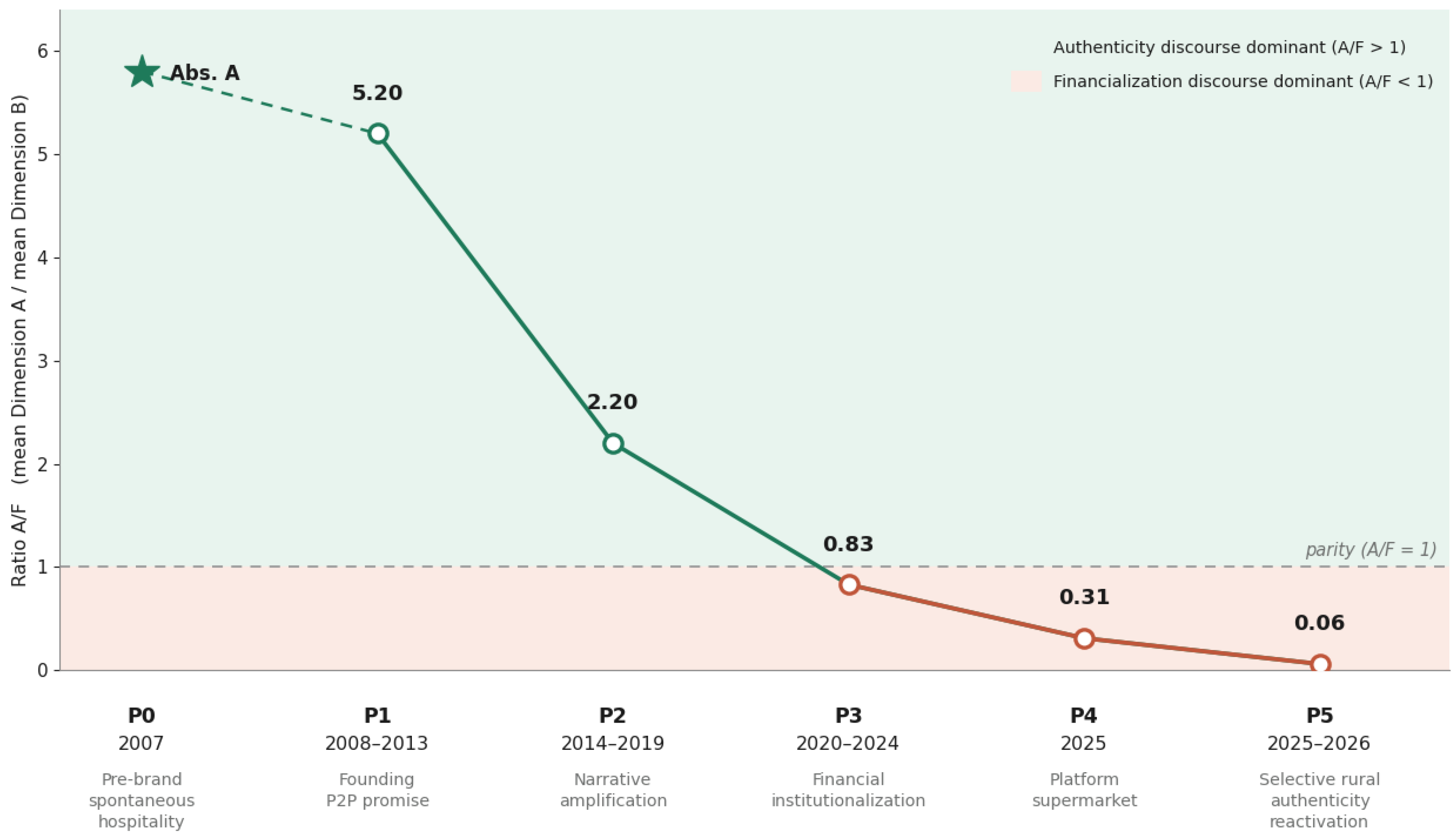
Phase 0 corresponds to the founding episode of October 2007: two designers in San Francisco offer three air mattresses to attendees of a local design conference. This act of spontaneous hospitality is documented contemporaneously in the company’s own 2007 “story” page (Airbnb, 2007) (then airbedandbreakfast.com/story.html (accessed on 17 June 2026); Table A2), which narrates the founding episode in the company’s own voice, and is echoed in the later official timeline—with no declared mission, financial language, or brand strategy. Codes A1 (community/belonging) and A2 (authentic experience) score at the maximum level (2), while all Dimension B codes are absent (0). Since Dimension B is zero, the Ratio A/F is not expressed as a numerical value, but as the absolute qualitative predominance of Dimension A: a total absence of financial discourse alongside the dominant presence of spontaneous authenticity discourse. This moment constitutes the ACC’s pre-financialized baseline, the initial reference point against which subsequent discursive shifts will be measured.

4.2. Phase 1 (2008–2013): The Founding P2P Promise

Between 2008 and 2013, Airbnb grew from an informal peer-to-peer accommodation solution into a global platform present in more than 80,000 cities with 500,000 active listings (Airbnb, 2007–2026; see Table A2). Archived versions of “About Us” from this period show a discourse centered on trust between strangers, shared domestic accommodation, and the idea of a global community of hosts and guests. The 2009 self-description already states this founding promise in the company’s own contemporaneous words—the site as “an online marketplace for peer-to-peer traveling” (Airbnb, 2009) (Table A2)—and by 2011 the same page foregrounds building real connections between guests and hosts and immersion in local culture. Codes A1, A3, and A4 score at the maximum level (2). Dimension B shows incipient presence, with scores of 1 on B1 and B2, reflecting operational growth but without the predominance of financial language. The Ratio A/F for this phase is 5.20, one of the main indications supporting the interpretation of a genuinely collaborative discourse during this period. The official timeline records the 2009 renaming milestone, when the platform changed its name from “AirBed & Breakfast” to “Airbnb,” and documents the first Airbnb Open in 2013—a host community event in San Francisco—by which time the company already had 10 million cumulative guest arrivals.

4.3. Phase 2 (2014–2019): Narrative Amplification of Authenticity

Phase 2 represents the period of greatest discursive investment in the authenticity narrative. The launch of the Bélo symbol and the “Belong Anywhere” tagline in July 2014 constituted the central milestone. The 2014 DesignStudio strategic document—treated here as a contextual source—describes the brand-building process in terms that can be interpreted as constitutive of the company’s authenticity discourse:
“Belonging the world over was Airbnb’s truth and its differentiator. […] From our learnings and research we defined Airbnb’s brand mission as ‘Belong Anywhere’. This higher purpose gave Airbnb a clear reason for everything they did throughout the business”.
According to contemporary trade-press coverage, Airbnb’s brand-research process—led by the brand consultant Douglas Atkin—produced a finding that would become the company’s central narrative thread: guests reported that “the last thing they wanted to be is tourists” (Gallagher, 2016). This insight grounded the reorientation toward “belonging” as the brand’s core theme. However, this phase also records the first signs of strategic displacement. The “More Hotels are Using Airbnb” communiqué of January 2019 introduces the OTA platform framing: “we are focused on creating an end-to-end travel platform that will handle every part of your trip” (Airbnb, 2019b). This framing recurs in the company’s own words: the Airbnb 2019 Business Update opens by describing hosts and guests as being “loyal to Airbnb because we treat them like members of a community, not commodities,” immediately followed by language of “driving strong sustained growth” and “creating new businesses that will power long-term success” (Airbnb, 2019a). The coexistence of the mission of belonging with the language of “strong sustained growth” and “new businesses” can be interpreted as one of the first textual signs of the ACC’s constitutive tension. The Ratio A/F for the coded documents of this phase is 2.20, still showing the predominance of authenticity discourse, although with a notable increase in the weight of Dimension B relative to previous phases.

4.4. Phase 3 (2020–2024): Financial Institutionalization

Airbnb’s IPO in December 2020 constitutes the ACC’s structural turning point. The S-1 prospectus (SEC, 2020) introduces a set of new discursive actors—shareholders, financial markets, institutional investors—whose presence transforms the dominant register of corporate communication. Although the founders’ letter within the S-1 retains language of community and belonging, the document as a whole is structured around financial performance metrics: Gross Booking Value (GBV), Adjusted EBITDA, and Free Cash Flow.
The first quarterly shareholder letter (Q4 2020) illustrates the dual audience that defines this phase: “we want to thank our Hosts and guests, without whom we wouldn’t exist. […] Finally, we would like to thank […] our thousands of new Airbnb shareholders for joining us on this journey” (Airbnb, 2021). The juxtaposition of “Hosts and guests” with “new Airbnb shareholders” can be interpreted as a textual manifestation of the tension between community discourse and the financial logic that characterizes this phase. In subsequent years, Dimension B progressively gains centrality: the Q4 2022 letter opens with “2022 was another record year for Airbnb. Revenue of $8.4 billion grew 40% year over year” (Airbnb, 2023), and notes that this was “our first profitable full year on a GAAP basis.” The Q4 2023 letter reports that “Hosts earned more than $57 billion” and announces that the company is “ready to embark on our next chapter” with expansion into new categories (Airbnb, 2024). Codes B1, B2, and B3 score at the maximum level (2) in the financial documents from this phase; importantly, however, Dimension A does not fall to zero. Host- and community-related discourse persists in a subordinate register within the shareholder letters and the founders’ letter of the S-1, so that the phase mean for Dimension A (0.90) remains non-trivial. The Ratio A/F stands at 0.83 in this phase: financialization discourse becomes predominant, yet authenticity is retained as narrative capital rather than abandoned, marking the inflection at which the Ratio crosses below parity.

4.5. Phase 4 (2025): Convergence Toward the Platform Supermarket

The May 2025 Summer Release introduces the most significant expansion of the business model since the company’s founding: Airbnb Services (in-home domestic and personal services), Airbnb Experiences, and a fully redesigned app. Brian Chesky’s statement at the launch condenses the ACC’s central paradox:
“Seventeen years ago, we changed the way people travel. More than two billion guests later, Airbnb is synonymous with a place to stay. With the launch of services and experiences, we’re changing travel again. Now you can Airbnb more than an Airbnb”.
(Brian Chesky, Airbnb, 2025a)
The expression “more than an Airbnb” can be interpreted as Phase 4’s discursive emblem: it activates the symbolic capital accumulated over seventeen years while simultaneously announcing the break with the P2P accommodation model. The Summer Release also includes the addition of boutique and independent hotels as a new supply category, justified by the claim that “bringing more hotels onto the platform can increase our total addressable market” (Airbnb, 2025c). The platform that was born as an alternative to conventional hotels thus begins a strategy of convergence with them. Codes B4 (platform expansion) and B5 (technology/AI) score at the maximum level (2), while Dimension A codes stand at 0–1. The Ratio A/F drops to 0.31, marking the point at which financialization and expansion discourse most clearly outweighs the authenticity register in the coded corpus; the interpretive implications of this pattern are discussed in Section 5.3.

4.6. Phase 5 (2025–2026): Selective Reactivation of Territorial Authenticity Under Platform Expansion

Phase 5 is characterized by the coexistence of two simultaneous discursive movements: the acceleration of the expansion toward the platform supermarket and the selective reactivation of authenticity discourse in rural and nature-based contexts. The May 2026 Summer Release consolidates the model’s structural transformation by incorporating car rentals, grocery delivery, airport pickups, boutique hotels in twenty global cities, and exclusive FIFA World Cup 2026 experiences:
“Introducing car rentals, grocery delivery, airport pickups, exclusive FIFA World Cup 2026™ Experiences, boutique hotels, and more—making your entire trip even better”.
In parallel, the Q1 2026 financial results show that the expansion strategy is reflected in growth indicators: revenue grew 18% year over year to $2.7 billion, with GBV growing 19% (Airbnb, 2026b), reinforcing the interpretation of a model oriented toward shareholder value maximization. On source verification, the Q1 2026 results document was found to deploy a purely financial register, with no community, host, or authenticity content; its Dimension A codes are accordingly zero (see Section 3.5 and Table A1).
At the same time, the November 2025 rural tourism campaign introduces a specific form of reactivation of authenticity discourse. According to the analysis by RentalScaleUp (2025), a specialized contextual source used as an external reading of Airbnb’s communications, the campaign’s advertisements contrast nature-based accommodation with the coldness of conventional hotels, deploying images of forests, cabins, and wildlife. From an analytical perspective, this campaign can be interpreted as a mechanism for attracting supply and competitive differentiation, rather than as a simple continuation of the original collaborative model: code A2 (authentic experience) scores 1 in this phase in the 2026 Summer Release, indicating presence but not dominance of authenticity discourse in the official corporate corpus. Phase 5’s Ratio A/F, calculated over the coded corpus, stands at 0.06. The selective reactivation of authenticity is therefore not visible as a rebound in the aggregate Ratio—which continues its consistent overall downward trajectory across the cycle—but operates at the level of campaign content (code A2 in the 2026 Summer Release and the rural advertising read by RentalScaleUp, 2025), confirming that financialization discourse remains predominant even when the platform selectively deploys territorial authenticity narratives.

4.7. Robustness Check: The Within-Genre Trajectory of Corporate Self-Presentation

Because document type covaries with phase (Section 3.2), a key validity question is whether the decline of the Ratio A/F reflects a genuine discursive shift or merely the change in documentary genre across phases. This change in document genre is itself part of what the ACC describes: it reflects the evolution of Airbnb’s own communication—from founding self-presentation to investor-facing financial reporting—rather than a limitation of the sampling strategy. To rule out a purely genre-driven artifact, the corporate “About Us” page provides a built-in control: institutional self-presentation is the one genre available across the entire study period, which holds document type constant. The full annual source series for this genre is documented in Table A2 (2007–2026); Table 4 is not a full annual chronology but a within-genre robustness check computed only over the coded “About Us” units already included in Table A1. Restricting the analysis to these coded self-presentation units yields the same consistent overall downward trajectory observed for the full corpus (Table 4): from the absolute predominance of Dimension A at the founding baseline (2007) to near-parity in the most recent coded versions. Holding genre constant, authenticity discourse still loses its dominance as the business diversifies, which indicates that the ACC pattern is not an artifact of the shift from brand to financial genres. Moreover, the self-presentation page itself displays the gap intra-document: across its more recent versions it continues to describe stays that let guests “connect with communities in a more authentic way” on the very same page that reports climbing host earnings—from $110B+ in 2021 to $380B+ in 2026—and the newly added services category (Table A2), an intra-genre, intra-document instance of the gap theorized in this article as authenticity washing. The convergence between the full-corpus trajectory (Table 3) and this genre-controlled trajectory strengthens the longitudinal interpretation against the document-type confound (Figure 1).
Across its 2012–2017 versions, the “About Us” page sustained the same formula—“trusted community marketplace … unique travel experiences” coupled with “monetize their extra space”—while its headline scale grew from tens of thousands of cities and ~200,000 listings to 200M+ cumulative guests and 3M+ listings (Table A2): a within-genre persistence of community framing alongside intensifying commercial scale.

5. Discussion

The results make it possible to answer the research question by showing that Airbnb’s corporate discourse does not evolve through a linear substitution of authenticity through financialization, but through a strategic coexistence between both dimensions. Authenticity remains a narrative capital and a source of legitimacy across the six ACC phases, while the platform’s operational architecture progressively shifts toward logics of scale, diversification, and financial performance. This coexistence is neither incidental nor static: its configuration changes in each phase, and the relative weight of both dimensions—reflected in the evolution of the Ratio A/F—makes it possible to trace the diachronic trajectory of the process that the ACC terms authenticity commodification.

5.1. Answer to the Research Question and the Contribution of the ACC

The ACC does not simply describe a loss of authenticity but a strategic reconfiguration of authenticity within platform capitalism. The results are consistent with the arguments found in the literature on platform capitalism (Montalban et al., 2019; Sadowski, 2020), which anticipate that processes of financial institutionalization and supply scaling tend to subordinate collaborative logic to market logic. However, the present study shows that this shift also engages with the literature on brand authenticity (Södergren, 2021): financialization does not suppress the collaborative narrative but rather preserves and redeploys it as symbolic capital before multiple audiences—consumers, hosts, and investors—with differentiated functions at each stage of the ACC. The source-verification review of the financial documents (Section 3.5) reinforces this reading: the systematic presence of a subordinate authenticity register within most financial communications, initially under-detected, is precisely what the ACC predicts.
From the perspective of tourism experience, the central finding is not merely that Airbnb has changed its business model but that an experiential promise originally grounded in proximity, domesticity, local life, and peer-to-peer interaction is progressively transformed into a scalable brand resource. This shifts authenticity from the domain of relational experience to the domain of strategic differentiation management. This transformation is relevant not only for research on digital platforms but for understanding how an authentic tourism experience—in the sense of Wang (1999) and MacCannell (1973)—can be appropriated, encoded, and redistributed as a brand promise within the logic of digital platforms (Capineri & Romano, 2021).

5.2. Brand Authenticity, Tourism Experience, and Narrative Legitimacy

Phase 2 of the ACC—the one with the greatest investment in the authenticity narrative—coincides with the first signs of strategic displacement: the language of “end-to-end travel platform” and the addition of boutique hotels (2019) appear in the same period as the founding letter on the 21st-century company. This coexistence is consistent with what Södergren (2021) calls the legitimizing function of authenticity: brands can mobilize narratives of origin, community, and purpose to build credibility with their audiences, regardless of whether operational practices are fully consistent with those narratives. In Airbnb’s case, this Phase 2 can be interpreted as the moment when authenticity ceases to be an emergent condition of the P2P model and becomes a strategically managed brand asset.
This transition has direct implications for the platform’s competitiveness. Airbnb turned an experiential promise—the possibility of feeling at home anywhere, interacting with local hosts, and accessing authentic ways of living—into a brand narrative architecture capable of operating at global scale. Lund et al. (2018) and Singh and Sonnenburg (2012) have shown that destination brands depend on symbolic continuity to sustain their position before diverse audiences. Airbnb has maintained that continuity for nearly two decades by keeping its declared mission—“Belong Anywhere”—unchanged while transforming its operational architecture. Phase 5 represents the point of maximum tension in this strategy: the platform expands its offering toward car rentals, grocery delivery, and global experiences while retaining narrative elements of differentiation from conventional hotel accommodation. The impact of this tension on consumer and host perceptions constitutes a highly relevant line for future research.

5.3. Authenticity Washing as a Mechanism of Symbolic Legitimation

The concept of authenticity washing proposed in this article finds its theoretical anchoring in the analogy with greenwashing, although it presents significant differences that justify treating it as an independent construct. Majeed and Kim (2023) and Meenakshi et al. (2025) have shown that greenwashing in the hospitality sector does not necessarily imply deliberate falsehood, but can arise from the gap between declared aspirations and actual practices, or from the generic use of sustainability attributes without operational evidence to support them. Authenticity washing shares this structure: this study’s argument is not that Airbnb falsifies its founding history or that the experiences offered on its platform are inauthentic in a subjective sense. The argument is that this study documents a discursive persistence of authenticity directly, while the systemic erosion of the structural conditions that originally made that narrative credible is one argued in the secondary literature on professionalization and platform capitalism (Gil & Sequera, 2022; Gyódi, 2019; Zhang et al., 2023; Leick et al., 2024) rather than measured here. The gap that authenticity washing names is, in this sense, the growing distance between a sustained and strategically intensified authenticity narrative and an operational structure documented as departing from its founding conditions. Accordingly, authenticity washing is advanced here as a proposed analytical construct rather than an empirically demonstrated fact: the study documents the persistence and strategic redeployment of authenticity discourse, whereas the erosion of the material conditions of the original peer-to-peer model is inferred from the combination of this corpus with prior literature on professionalization, platform capitalism, and supply concentration; the analysis makes no claim about corporate intent or deliberate deception.
What differentiates authenticity washing from greenwashing is the domain in which it operates and the difficulty of its verification. Greenwashing acts upon environmental attributes that are, in principle, potentially verifiable through external indicators. Authenticity washing operates upon the traveler’s subjective experience, which is by nature individual, contextual, and difficult to falsify universally. This asymmetry makes it a particularly effective legitimation mechanism in platform-based tourism: the platform can respond to any challenge with examples of genuine experiences—which exist and are individually verifiable—without needing to address the systemic question of what proportion of its model makes them possible or what structural conditions sustain them. Södergren (2021) points in this direction by noting that certain forms of “washing” in the branding domain function as strategies in which products appeal to consumer conscience without the claimed values being integrated into the brand’s operational core.

5.4. Implications for Competitiveness, Destination Governance, and Territorial Sustainability

The implications of authenticity washing extend beyond brand communication to destination competitiveness and the sustainability of their tourism models. When Airbnb deploys narratives of rural authenticity, territorial revitalization, and local hospitality to expand its offering in low-density territories, the question relevant to destination managers is not only whether the discourse is consistent with any individual experience, but who captures the value generated and how benefits are distributed among the platform, hosts, and host communities (López-Sanz et al., 2021). For destinations, this implies that it is not enough to evaluate the number of listings, arrivals, or revenue generated by the platform. It is also necessary to analyze the ownership structure of listings, the degree of host professionalization, the location of value capture, the pressure on local housing and services, and the consistency between the territorial authenticity narrative and the benefits actually retained by the community. Because the present study analyzes corporate discourse rather than territorial or user-level outcomes, these are best read as areas that warrant further empirical investigation rather than as impacts demonstrated here.
From the perspective of Dolnicar and Talebi (2020), this issue acquires an additional dimension. If the original P2P model allowed hosts to obtain experiential benefits similar to those of tourists—social connection, cultural exchange, social recognition—the professionalization documented by Gil and Sequera (2022), Zhang et al. (2023), and Leick et al. (2024) can be interpreted as an erosion of that experiential reciprocity for hosts as well: the platform retains the narrative of community and belonging when the conditions that made that reciprocity possible have been substantially altered for a growing proportion of its host base.
Regarding governance, the findings of this study suggest that regulatory frameworks designed for the sharing-economy era—based on hospitality between private individuals and the activation of underutilized domestic resources—may prove insufficient to regulate a model that increasingly operates as a full-fledged tourism intermediary. The convergence documented in Phases 4 and 5 between Airbnb and conventional digital tourism distribution models invites a reassessment of whether the specific regulatory and fiscal frameworks the platform has historically obtained in different jurisdictions remain appropriate for a model that has undergone a structural transformation of this magnitude. This reflection does not seek to pass judgment on the company’s strategy, but rather to point to a tension between regulatory categorization and the model’s operational reality.

5.5. Limitations of the Discussion and Future Research Agenda

The results and interpretations of this article are subject to the methodological limitations set out in Section 3.6. In particular, the analysis is based exclusively on Airbnb’s official corporate discourse, so the findings cannot be directly extrapolated to the perceptions of guests, hosts, or local communities. The results describe the evolution of the institutional narrative, not the subjective experience of the system’s actors.
Several priority lines of research remain open. First, validating the ACC through comparative analysis applied to other digital tourism intermediation platforms, both of collaborative and conventional origin, such as Vrbo, Booking.com, or Expedia. Second, extending the analysis to user discourse: future research should examine how guests and hosts perceive the gap between the founding promise and the current operational reality, including variables such as perceived authenticity, trust in the platform, booking intention, willingness to pay, tolerance for supply professionalization, and perceived consistency between the brand promise and the actual experience. Third, operationalizing the Ratio A/F through additional independent expert human coders and larger reliability subsamples would make it possible to extend the inter-rater reliability assessment already conducted on a stratified subsample (Krippendorff’s α = 0.87; Section 3.5) and further strengthen the construct’s metric dimension. Fourth, analyzing the effects of authenticity washing on territorial development in rural destinations, assessing the actual distribution of the value generated between the platform and host communities (López-Sanz et al., 2021; Leick et al., 2024).

6. Conclusions

This article has analyzed the evolution of Airbnb’s corporate discourse between 2007 and 2026 from the perspective of the Authenticity Commodification Cycle (ACC). The results show that this discourse has not evolved through a linear substitution of authenticity by financialization, but through a strategic coexistence between both dimensions: authenticity remains a narrative capital and a source of legitimacy across the six ACC phases, while the platform’s operational architecture shifts toward logics of scale, diversification, and full tourism intermediation. The decline in the Ratio A/F—from the absolute qualitative predominance of Dimension A in Phase 0 to values of 0.31 and 0.06 in Phases 4 and 5—offers a relevant interpretive indication supporting this longitudinal reading; the trajectory shows a consistent overall downward movement across the six phases, and authenticity discourse, although subordinated, never disappears entirely.
The study makes three contributions to research on platform-based tourism. First, it introduces the ACC as an original theoretical construct that articulates, to the best of this review’s knowledge in a novel way within the academic literature on Airbnb, the longitudinal evolution of corporate discourse with the platform’s operational and financial transformations. The ACC extends frameworks of tourism authenticity (MacCannell, 1973; Wang, 1999; Cohen, 1988) and memorable experience (Tung & Ritchie, 2011; Kim et al., 2012) to the diachronic analysis of digital platforms’ brand discourse, an area in which these frameworks have been less developed from a longitudinal and discursive perspective. From this standpoint, the study contributes to understanding how an authentic tourism experience can shift from being a situated relational practice to becoming a scalable brand asset within global digital platforms. Second, it presents a longitudinal content analysis based on an ad hoc corpus of 23 coded documentary units (drawn from 33 source captures) that includes, among other sources, the full annual “About Us” source series documented in Table A2 (2007–2026) and grouped into coded units in Table A1, as published by Airbnb and consulted via the Internet Archive. Third, it proposes the concept of authenticity washing as an analytical tool for examining the gap between experiential promise and operational structure in platform-mediated tourism by analogy with greenwashing but attending to the specificities of the experiential domain (Majeed & Kim, 2023; Meenakshi et al., 2025).
From a practical perspective, the findings have implications for destination management and platform governance. The documented convergence between Airbnb and conventional digital tourism distribution models points to the need to revisit regulatory frameworks designed for the sharing-economy era, which may prove insufficient for a model that operates as a full-fledged tourism intermediary. For destination managers, the results suggest that the analysis of platforms such as Airbnb needs to go beyond arrival and revenue metrics to examine the ownership structure of listings, the degree of host professionalization, and the consistency between the territorial authenticity narrative and the benefits actually retained by host communities (López-Sanz et al., 2021; Leick et al., 2024).
The study’s main limitations—the exclusive use of official corporate documents, the single-case design, the single-coder primary matrix, partially mitigated by independent human recoding of a stratified subsample, and the heuristic nature of the Ratio A/F—have been detailed in Section 3.6 and Section 5.5, to which the reader is referred. These limitations do not invalidate the findings, but they determine the study’s interpretive scope and guide the future research agenda. In particular, future research should validate the ACC through independent expert human coders and through comparative application to other platform cases, such as Vrbo, Booking.com, or Expedia.
Ultimately, the Airbnb case shows that authenticity does not necessarily disappear when a platform financializes: it can become a persistent narrative resource, capable of legitimizing new forms of tourism intermediation under the language of belonging, community, and local experience. Understanding this mechanism is fundamental for analyzing how digital platforms shape contemporary tourism experience, mold the expectations of travelers and hosts, and influence the sustainability of destinations.

Supplementary Materials

The following supporting information can be downloaded at: https://www.mdpi.com/article/10.3390/tourhosp7080220/s1, Table S1. ACC coding system: dimensions, codes, operational definitions, and assignment criteria. Table S2. Retrieved source captures and provenance. Table S3. Complete coding matrix (n = 23 coded documentary units; 3 contextual sources, unscored). A/F is the unit-level Ratio A/F; Abs. A = absolute qualitative predominance of Dimension A. Table S4. Observed-signal log by source capture. Table S5. Representative textual excerpts by ACC phase. Table S6. Independent recoding of the reliability subsample (each cell: Coder A/Coder B). Shaded cells indicate disagreement.

Funding

This research received no external funding.

Institutional Review Board Statement

Not applicable. This study analyzes publicly accessible corporate documents and does not involve humans or animals.

Informed Consent Statement

Not applicable.

Data Availability Statement

The corporate and strategic Airbnb documents analyzed in this study are publicly available through Airbnb Newsroom, Airbnb Investor Relations, SEC EDGAR (https://www.sec.gov, accessed on 17 June 2026), and, where applicable, the Internet Archive Wayback Machine (https://web.archive.org, accessed on 17 June 2026). The coding matrix, coding protocol, representative textual excerpts, coding-decision log, and independent human reliability subsample are provided as Supplementary Materials. Additional archival captures or audit materials that cannot be included for reasons of length or third-party rights are available from the corresponding author upon reasonable request.

Acknowledgments

During the preparation of this manuscript, the author used Claude Sonnet 4.5 (Anthropic) as an assistive diagnostic tool to flag potentially ambiguous coding decisions in a subset of financial and strategic documents for manual re-examination and for language-editing and formatting support. The tool was not used as an independent coder, and no coding decision followed automatically from its output. All source verification, final coding decisions, interpretation of the findings, manuscript revisions, and final approval were conducted by the author, who reviewed and edited all AI-assisted outputs and takes full responsibility for the content of this publication.

Conflicts of Interest

Author Andrés Romero Montero is employed by Asiri Marketing SL. The author declares that the research was conducted in the absence of any commercial or financial relationships that could be construed as a potential conflict of interest.

Abbreviations

The following abbreviations are used in this manuscript:
ACCAuthenticity Commodification Cycle
AIArtificial Intelligence
GBVGross Booking Value
IPOInitial Public Offering
OTAOnline Travel Agency
P2PPeer-to-Peer
QCAQualitative Content Analysis
SECUnited States Securities and Exchange Commission

Appendix A. Synthetic Version of the Coding Matrix by Phase and Source Type

Table A1 presents the structure of the coding matrix. Since including the complete matrix would exceed the manuscript’s editorial limits, the table below shows a synthetic version of the matrix, grouping homogeneous documentary units by period and source type. Representative textual excerpts and the coding-decision log are provided as Supplementary Materials; the complete coding matrix is likewise provided as Supplementary Materials, since its full length exceeds the manuscript’s editorial limits.
Table A1. Synthetic version of the coding matrix by phase and source type (n = 23 coded documentary units, grouped from 33 source captures; 3 contextual sources excluded from the Ratio A/F calculation). Rows for the financial and strategic documents reflect the source-verified coding adopted after the consistency review (Section 3.5).
DocumentYrPhTypeA1A2A3A4A5B1B2B3B4B5M.AM.BA/F
About Us [2007–2008]20070Self-pres.22220000001.600.00Abs. A
About Us [2009–2011]2009–20111Self-pres.22221100001.800.209.00
About Us [2012–2014]2012–20141Self-pres.22211110001.600.404.00
Airbnb Story Timeline20181Brand22221110001.800.404.50
DesignStudio/Belong Anywhere20142Context.
Gallagher (Fortune)20162Context.
10 Years of Community20182Corporate22212110001.800.404.50
Open Letter 21st Century20182Corporate21212100001.600.208.00
About Us [2015–2017]2015–20172Self-pres.22111110001.400.403.50
2019 Business Update20192Corporate21102210111.201.001.20
More Hotels are Using Airbnb20192Corporate11001210200.601.000.60
S-1 SEC Registration20203SEC reg.22211222111.601.601.00
Q4 2020 Shareholder Letter20213Financial11201212011.001.200.83
About Us [2019–2020]2019–20203Self-pres.11101111000.800.601.33
About Us [2020]20203Self-pres.11101111000.800.601.33
About Us [2020–2022]2020–20223Self-pres.11101111100.800.801.00
Q4 2022 Shareholder Letter20233Financial11200222110.801.600.50
Q4 2023 Shareholder Letter20243SEC reg.11210222221.002.000.50
About Us [2022]20223Self-pres.11101111000.800.601.33
About Us [2023]20233Self-pres.11101111000.800.601.33
About Us [2024–2025]2024–20253Self-pres.11100121110.601.200.50
Q4 2025 Shareholder Letter20264Financial11100222220.602.000.30
2025 Summer Release20254Corporate01100110220.401.200.33
Q1 2026 Financial Results20265Financial00000221220.001.800.00
2026 Summer Release20265Corporate01000221220.201.800.11
RentalScaleUp (contextual)20255Context.
Note. M.A = mean Dimension A; M.B = mean Dimension B; A/F = Ratio A/F. Representative textual excerpts and interpretive observations are provided as Supplementary Materials. Contextual sources (DesignStudio, 2014; Gallagher, 2016; RentalScaleUp, 2025) are not counted in the coded corpus or in the Ratio A/F calculation; their score cells appear with dashes. Coding scale: 0 = absent, 1 = present, 2 = dominant. The table shows a synthetic version; the complete matrix is available as Supplementary Materials.
Table A2. The Airbnb corporate “About Us”/self-presentation page by year: source URL and capture date, consulted via the Internet Archive Wayback Machine (accessed 20 June 2026). Descriptive source record for the “About Us” genre; not a coding matrix.
YearSource URL (Airbnb “About Us” Page)Capture DateKey Self-Presentation Markers
2007airbedandbreakfast.com/story.html14 October 2007AB&B founding “story”; no mission or financial language
2008airbedandbreakfast.com/story.html21 August 2008Same AB&B “story” page
2009airbnb.com/home/about12 September 2009“AirBed & Breakfast: About”; “peer-to-peer traveling”
2010airbnb.com/home/about3 December 20108000+ cities; 160+ countries; 183M user miles
2011airbnb.com/home/about15 August 201116,000+ cities; 186 countries; 2M+ nights
2012airbnb.com/home/about20 June 20125M+ nights; 100,000+ listings; 19,000 cities
2013airbnb.com/about2 August 201310M+ nights; 300,000+ listings; 33,000 cities; 192 countries
2014www.airbnb.com/about/about-us12 February 2014“trusted community marketplace”; 600,000+ listings; 34,000 cities; 190 countries
2015www.airbnb.com/about/about-us4 June 201525M+ guests; 1,000,000+ listings; 34,000+ cities; 190+ countries
2016www.airbnb.com/about/about-us8 July 201634,000+ cities; 191+ countries; 60M+ guests; 2M+ listings
2017www.airbnb.com/about/about-us27 August 201765,000+ cities; 191+ countries; 200M+ guests; 3M+ listings
2018www.airbnb.com/about/about-us12 January 201865,000 cities; 200M+ guests; 3M+ listings
2019news.airbnb.com/about-us/7 Nov 20197M accommodations; 40,000 activities; “half a billion” arrivals
2020news.airbnb.com/about-us/19 Nov 2020“Business of connection”; 800M arrivals; 220+ countries
2021news.airbnb.com/about-us/23 October 20215.6M+ listings; $110B+ host earnings; “one-of-a-kind”; “authentic”
2022news.airbnb.com/about-us/7 November 20226M listings; $150B+ host earnings; $13.8K typical US host
2023news.airbnb.com/about-us/4 October 2023>7M listings; 1.5B+ arrivals; $180B+ host earnings
2024news.airbnb.com/about-us/20 August 20248M+ listings; $250B+ host earnings; 5M+ hosts
2025news.airbnb.com/about-us/16 October 20258M+ listings; 2B+ arrivals; $300B+; “authentic”
2026news.airbnb.com/about-us/2026 (current)9M+ listings; 5.5M+ hosts; $380B+; “services”
Note. Source: the Airbnb corporate “About Us” page in each year, consulted via the Internet Archive Wayback Machine (web.archive.org) on 17 June 2026. “Capture date” is the snapshot date of the archived version; full archived URLs follow the pattern https://web.archive.org/web/<timestamp>/<source URL> (accessed on 17 June 2026, exact timestamps for the 2019 and 2020 versions are 20191107200103 and 20201119015104, respectively). The page’s source URL evolves over the period—from a founding “story” page to a corporate press-room page—mirroring the institutional transformation analyzed in the ACC. This table documents source provenance and traceability only: it assigns no codes and does not enter the Ratio A/F; the coded “About Us” units in Table A1 are grouped from representative yearly versions within this series.

References

  1. Airbnb. (2007). Story [Archived version of AirBed & breakfast’s founding page]. Internet Archive Wayback Machine. Available online: https://airbedandbreakfast.com/story.html (accessed on 17 June 2026).
  2. Airbnb. (2007–2026). About us [Corporate self-presentation page; successive yearly versions]. Archived at the Internet Archive Wayback Machine. Available online: https://web.archive.org (accessed on 17 June 2026).
  3. Airbnb. (2009). About [Archived version]. Internet Archive Wayback Machine. Available online: https://airbnb.com/home/about (accessed on 17 June 2026).
  4. Airbnb. (2018a). 10 years of community. Airbnb Newsroom. Available online: https://news.airbnb.com/10-years-of-community (accessed on 17 June 2026).
  5. Airbnb. (2018b). Open letter to the Airbnb community about building a 21st century company. Airbnb Newsroom. Available online: https://news.airbnb.com/brian-cheskys-open-letter-to-the-airbnb-community-about-building-a-21st-century-company (accessed on 17 June 2026).
  6. Airbnb. (2019a). Airbnb 2019 business update. Airbnb Newsroom. Available online: https://news.airbnb.com/airbnb-2019-business-update (accessed on 17 June 2026).
  7. Airbnb. (2019b). More hotels are using Airbnb. Airbnb Newsroom. Available online: https://news.airbnb.com/more-hotels-are-using-airbnb (accessed on 17 June 2026).
  8. Airbnb. (2021). Q4 2020 shareholder letter. Available online: https://s26.q4cdn.com/656283129/files/doc_financials/2020/q4/Airbnb_Q4-2020-Shareholder-Letter_Final.pdf (accessed on 17 June 2026).
  9. Airbnb. (2023). Q4 2022 shareholder letter. Available online: https://s26.q4cdn.com/656283129/files/doc_financials/2022/q4/Airbnb_Q4-2022-Shareholder-Letter_Final.pdf (accessed on 17 June 2026).
  10. Airbnb. (2024). Q4 2023 shareholder letter [SEC Exhibit 99.1]. Available online: https://www.sec.gov/Archives/edgar/data/1559720/000119312524033706/d646462dex991.htm (accessed on 17 June 2026).
  11. Airbnb. (2025a). 2025 summer release: Now you can Airbnb more than an Airbnb. Airbnb Newsroom. Available online: https://news.airbnb.com/airbnb-2025-summer-release (accessed on 17 June 2026).
  12. Airbnb. (2025b). About us. Airbnb Newsroom. Available online: https://news.airbnb.com/about-us (accessed on 17 June 2026).
  13. Airbnb. (2025c). Q4 2025 shareholder letter. Available online: https://s26.q4cdn.com/656283129/files/doc_financials/2025/q4/Airbnb_Q4-2025-Shareholder-Letter.pdf (accessed on 17 June 2026).
  14. Airbnb. (2026a). 2026 summer release: Now there’s even more to Airbnb. Airbnb Newsroom. Available online: https://news.airbnb.com/airbnb-2026-summer-release (accessed on 17 June 2026).
  15. Airbnb. (2026b). Q1 2026 financial results. Airbnb Newsroom. Available online: https://news.airbnb.com/airbnb-q1-2026-financial-results (accessed on 17 June 2026).
  16. Belk, R. (2014). You are what you can access: Sharing and collaborative consumption online. Journal of Business Research, 67(8), 1595–1600. [Google Scholar] [CrossRef]
  17. Botsman, R., & Rogers, R. (2010). What’s mine is yours: The rise of collaborative consumption. Harper Business. [Google Scholar]
  18. Bowen, G. A. (2009). Document analysis as a qualitative research method. Qualitative Research Journal, 9(2), 27–40. [Google Scholar] [CrossRef]
  19. Bucher, E., Fieseler, C., Fleck, M., & Lutz, C. (2018). Authenticity and the sharing economy. Academy of Management Discoveries, 4(3), 294–313. [Google Scholar] [CrossRef]
  20. Capineri, C., & Romano, A. (2021). The platformization of tourism: From accommodation to experiences. Digital Geography and Society, 2, 100012. [Google Scholar] [CrossRef]
  21. Cheng, M. (2016). Sharing economy: A review and agenda for future research. International Journal of Hospitality Management, 57, 60–70. [Google Scholar] [CrossRef]
  22. Cohen, E. (1988). Authenticity and commoditization in tourism. Annals of Tourism Research, 15(3), 371–386. [Google Scholar] [CrossRef]
  23. DesignStudio. (2014). Developing “Belong Anywhere” branding strategy for Airbnb [Case study]. Available online: https://www.further.group/work/airbnb (accessed on 17 June 2026).
  24. Dolnicar, S., & Talebi, H. (2020). Does hosting on Airbnb offer hosts vacation-like benefits? Journal of Hospitality and Tourism Management, 43, 111–119. [Google Scholar] [CrossRef]
  25. Elo, S., & Kyngäs, H. (2008). The qualitative content analysis process. Journal of Advanced Nursing, 62(1), 107–115. [Google Scholar] [CrossRef] [PubMed]
  26. Gallagher, L. (2016). How Airbnb found a mission—And a brand. Fortune. Available online: https://fortune.com/longform/airbnb-travel-mission-brand/ (accessed on 17 June 2026).
  27. Gil, J., & Sequera, J. (2022). The professionalization of Airbnb in Madrid: Far from a collaborative economy. Current Issues in Tourism, 25(20), 3343–3362. [Google Scholar] [CrossRef]
  28. Guttentag, D. (2015). Airbnb: Disruptive innovation and the rise of an informal tourism accommodation sector. Current Issues in Tourism, 18(12), 1192–1217. [Google Scholar] [CrossRef]
  29. Gyódi, K. (2019). Airbnb in European cities: Business as usual or true sharing economy? Journal of Cleaner Production, 221, 536–551. [Google Scholar] [CrossRef]
  30. Hall, C. M., Prayag, G., Fieger, P., & Dyason, D. (2022). Airbnb and the sharing economy. Current Issues in Tourism, 25(19), 3057–3067. [Google Scholar] [CrossRef]
  31. Kim, J.-H., Ritchie, J. R. B., & McCormick, B. (2012). Development of a scale to measure memorable tourism experiences. Journal of Travel Research, 51(1), 12–25. [Google Scholar] [CrossRef]
  32. Krippendorff, K. (2004). Content analysis: An introduction to its methodology (2nd ed.). Sage. [Google Scholar]
  33. Kuhzady, S., Seyfi, S., & Béal, L. (2022). Peer-to-peer accommodation in the sharing economy: A review. Current Issues in Tourism, 25(19), 3115–3130. [Google Scholar] [CrossRef]
  34. Leick, B., Mitchell, S. B., Borowiecki, K. J., Vinogradov, E., Gunnarsdóttir, G. Þ., Zhang, J., Gretzinger, S., & Vilhjálmsdóttir, V. (2024). Professionalisation and performance of Airbnb hosts in rural regions. International Journal of Hospitality Management, 118, 103680. [Google Scholar] [CrossRef]
  35. López-Sanz, J. M., Penelas-Leguía, A., Gutiérrez-Rodríguez, P., & Cuesta-Valiño, P. (2021). Sustainable development and rural tourism in depopulated areas. Land, 10(9), 985. [Google Scholar] [CrossRef]
  36. Lund, N. F., Cohen, S. A., & Scarles, C. (2018). The power of social media storytelling in destination branding. Journal of Destination Marketing & Management, 8, 271–280. [Google Scholar] [CrossRef]
  37. MacCannell, D. (1973). Staged authenticity: Arrangements of social space in tourist settings. American Journal of Sociology, 79(3), 589–603. [Google Scholar] [CrossRef] [PubMed]
  38. Majeed, S., & Kim, W. G. (2023). A reflection of greenwashing practices in the hospitality industry: A scoping review. International Journal of Contemporary Hospitality Management, 35(3), 1125–1146. [Google Scholar] [CrossRef]
  39. Mayring, P. (2014). Qualitative content analysis: Theoretical foundation, basic procedures and software solution. GESIS. Available online: http://nbn-resolving.de/urn:nbn:de:0168-ssoar-395173 (accessed on 17 June 2026).
  40. Meenakshi, N., Dhir, A., Shah, P., Nicolau, J. L., & Kaur, P. (2025). Conceptualization of greenwashing in the hospitality industry. International Journal of Hospitality Management, 131, 104255. [Google Scholar] [CrossRef]
  41. Montalban, M., Frigant, V., & Jullien, B. (2019). Platform economy as a new form of capitalism. Cambridge Journal of Economics, 43(4), 805–824. [Google Scholar] [CrossRef]
  42. Oh, H., Fiore, A. M., & Jeoung, M. (2007). Measuring experience economy concepts: Tourism applications. Journal of Travel Research, 46(2), 119–132. [Google Scholar] [CrossRef]
  43. Pine, B. J., & Gilmore, J. H. (1998). Welcome to the experience economy. Harvard Business Review, 76(4), 97–105. [Google Scholar] [PubMed]
  44. RentalScaleUp. (2025, November 24). La última campaña publicitaria de Airbnb apunta a anfitriones casuales [Analysis by S. Parghan]. Available online: https://www.rentalscaleup.com/es/la-ultima-campana-publicitaria-de-airbnb (accessed on 17 June 2026).
  45. Sadowski, J. (2020). The internet of landlords: Digital platforms and new mechanisms of rentier capitalism. Antipode, 52(2), 562–580. [Google Scholar] [CrossRef]
  46. Saldaña, J. (2021). The coding manual for qualitative researchers (4th ed.). SAGE. [Google Scholar]
  47. Schreier, M. (2012). Qualitative content analysis in practice. SAGE. [Google Scholar] [CrossRef]
  48. SEC. (2020). Airbnb, Inc. Form S-1 registration statement. U.S. Securities and Exchange Commission (SEC). Available online: https://www.sec.gov/Archives/edgar/data/0001559720/000119312520294801/d81668ds1.htm (accessed on 17 June 2026).
  49. Singh, S., & Sonnenburg, S. (2012). Brand performances in social media. Journal of Interactive Marketing, 26(4), 189–197. [Google Scholar] [CrossRef]
  50. Södergren, J. (2021). Brand authenticity: 25 years of research. International Journal of Consumer Studies, 45(4), 645–663. [Google Scholar] [CrossRef]
  51. Tung, V. W. S., & Ritchie, J. R. B. (2011). Exploring the essence of memorable tourism experiences. Annals of Tourism Research, 38(4), 1367–1386. [Google Scholar] [CrossRef]
  52. Tussyadiah, I. P., & Pesonen, J. (2016). Impacts of peer-to-peer accommodation use on travel patterns. Journal of Travel Research, 55(8), 1022–1040. [Google Scholar] [CrossRef]
  53. Vallas, S., & Schor, J. B. (2020). What do platforms do? Understanding the gig economy. Annual Review of Sociology, 46, 273–294. [Google Scholar] [CrossRef]
  54. van Doorn, N., & Badger, A. (2020). Platform capitalism’s hidden abode. Antipode, 52(5), 1475–1495. [Google Scholar] [CrossRef]
  55. Wang, N. (1999). Rethinking authenticity in tourism experience. Annals of Tourism Research, 26(2), 349–370. [Google Scholar] [CrossRef]
  56. Zhang, H., Zach, F. J., & Xiang, Z. (2023). Design standardization by Airbnb multi-unit hosts. Annals of Tourism Research, 98, 103523. [Google Scholar] [CrossRef]
Figure 1. The Authenticity Commodification Cycle (ACC): evolution of the Ratio A/F across six discursive phases of Airbnb’s corporate communication, 2007–2026. In Phase 0 the ratio is not numerical and is shown as the absolute qualitative predominance of Dimension A (Abs. A). Ratio A/F = ratio of mean Dimension A (authenticity discourse) to mean Dimension B (financialization discourse). Source: own elaboration based on the content analysis described in Section 3. The star (★) denotes Phase 0’s non-numerical value (Abs. A); the dashed segment linking Phase 0 to Phase 1 indicates this qualitative-to-quantitative transition, as distinct from the solid line connecting the five calculated ratios (Phases 1–5). Marker color indicates which side of parity each phase falls on: green markers correspond to phases where Ratio A/F > 1 (shaded green), and orange markers to phases where Ratio A/F < 1 (shaded pink), consistent with the background shading.
Tourismhosp 07 00220 g001
Table 1. Documentary corpus: description by Authenticity Commodification Cycle (ACC) phase (n = 23 coded documentary units derived from 33 retrieved source captures; contextual sources n = 3).
Main SourceNDocument TypePeriodACC Phase
Airbnb “About Us” page (via Internet Archive)1“About Us” capture (founding)2007–2008Phase 0
Airbnb “About Us” page (via Internet Archive)3“About Us” captures + official timeline2009–2013Phase 1
Airbnb Newsroom; “About Us” (Internet Archive)5Brand strategy, founding letters, communiqués2014–2019Phase 2
SEC EDGAR; investors.airbnb.com; “About Us” (IA)10SEC S-1, “About Us” captures, shareholder letters2020–2024Phase 3
Airbnb Newsroom4Summer Releases, Q1 2026 financial results2025–2026Phases 4–5
232007–2026Total coded
DesignStudio/Fortune/RentalScaleUp3DesignStudio case study; Fortune feature; rural-campaign analysis2014–2025Contextual sources
Note. The coded documentary units (23) are grouped from 33 retrieved source captures publicly available at news.airbnb.com, investors.airbnb.com, and SEC EDGAR (https://www.sec.gov, accessed on 17 June 2026). The corporate “About Us” page published by Airbnb in each year was consulted through the Internet Archive Wayback Machine (web.archive.org, accessed on 17 June 2026) on 20 June 2026; the source URL and capture date for each year are documented in Appendix A (Table A2), and the coded “About Us” units are grouped from representative yearly versions as shown in Table A1. The three contextual sources (DesignStudio, 2014; Gallagher, 2016; RentalScaleUp, 2025) are not counted in the coded corpus or in the Ratio A/F calculation. Financial documents were assigned to the phase corresponding to the strategic/fiscal period they report on, not necessarily to their exact publication date. Phases 4 and 5 do not correspond to complete calendar years, but to differentiated strategic moments within Airbnb’s discursive and operational evolution. SEC = United States Securities and Exchange Commission.
Table 2. ACC coding system: dimensions, codes, operational definitions, and assignment criteria.
0/1/2 CriterionTextual IndicatorsOperational DefinitionDimensionCode
0: absent; 1: 1–2 passages; 2: opening/closing and ≥3 passagescommunity, belong, connection, trust, strangers, home, welcomeCommunity, belonging, and trust between hosts and guests as a central valueA—Authenticity and CommunityA1
0: absent; 1: experiential context; 2: central argumentauthentic, local, live like a local, real, unique, genuine, insiderAuthentic experiences, local life, uniqueness of the accommodation, rejection of standardized tourismA—Authenticity and CommunityA2
0: absent; 1: functional mention; 2: host as central subjecthost, hosts, earn, share your home, hosting, superhostThe host as active protagonist and driver of the model; economic and social empowermentA—Authenticity and CommunityA3
0: absent; 1: conceptual mention; 2: dominant framesharing, sharing economy, peer-to-peer, collaborative, spare spaceCollaborative economy, P2P, and sharing underutilized resources as a founding principleA—Authenticity and CommunityA4
0: absent; 1: reference to mission; 2: mission structures doc.mission, belong anywhere, purpose, values, why we existStatements of mission, purpose, and values linked to community and belongingA—Authenticity and CommunityA5
0: absent; 1: metrics present; 2: structure the doc.revenue, growth, GBV, bookings, billion, profit, EBITDA, free cash flowRevenue, financial growth, GBV, and performance metrics for investorsB—Financialization and ScaleB1
0: absent; 1: scale figures as evidence of growth/reach; 2: inventory framed as a managed asset structuring the documentlistings, supply, inventory, scale, active listings, propertiesAccommodation as a scalable, manageable platform asset: inventory to be grown, optimized, or reported to investorsB—Financialization and ScaleB2
0: absent; 1: mention of investors; 2: shareholders main audienceshareholders, investors, Nasdaq, IPO, stock, equity, repurchaseShareholders, financial markets, IPO, and investor returnsB—Financialization and ScaleB3
0: absent; 1: category expansion; 2: expansion is central argumenthotels, services, car rental, grocery delivery, boutiqueExpansion beyond P2P accommodation into services, hotels, new categoriesB—Financialization and ScaleB4
0: absent; 1: instrumental mention; 2: technology/AI dominantplatform, technology, AI, data, app, marketplace, algorithmTechnology, AI, and algorithmic capabilities as growth driversB—Financialization and ScaleB5
Note. The scoring scale is: 0 = absent, 1 = present, 2 = dominant. The dominance criterion (2) requires the code to appear in opening and closing paragraphs, in ≥3 differentiated passages, and with greater lexical density than any other code in the same document. GBV = Gross Booking Value; P2P = peer-to-peer; AI = artificial intelligence.
Table 3. Content analysis results by ACC phase: mean scores per dimension and Ratio A/F (n = 23 coded documentary units).
Representative Excerpt from Primary CorpusDominant DiscourseRatio A/FMean BMean APeriodPhase
“not your typical bed and breakfast” (Airbnb, 2007; see Table A2)Spontaneous hospitalityAbs. A01.620070
“an online marketplace for peer-to-peer traveling” (Airbnb, 2009; see Table A2)Founding P2P promise5.20.331.732008–20131
“build a 21st Century Company” (Airbnb, 2018b)Narrative amplification2.20.61.322014–20192
“Our first profitable full year on a GAAP basis” (Airbnb, 2023)Financial institutionalization0.831.080.92020–20243
“Now you can Airbnb more than an Airbnb” (Airbnb, 2025a)Platform supermarket0.311.60.520254
“Introducing car rentals, grocery delivery […] FIFA World Cup 2026™ Experiences” (Airbnb, 2026a)Selective rural authenticity reactivation0.061.80.12025–20265
Note. Abs. A = absolute qualitative predominance of Dimension A (Dimension B = 0; ratio not expressed as a numerical value). Means are computed over the documentary units of the coding matrix (Appendix A) on the 0–2 scale of the five codes in each dimension; Table 3 is therefore directly reproducible from Table A1. Phase medians for Dimension A are 1.60, 1.80, 1.40, 0.80, 0.50, and 0.10; phase medians for Dimension B are 0.00, 0.40, 0.40, 1.00, 1.60, and 1.80 (Phases 0–5, respectively). The Ratio A/F is a heuristic index supporting qualitative analysis, not a statistical measure. Ratio A/F = ratio of mean Dimension A to mean Dimension B; GBV = Gross Booking Value. Contextual sources (DesignStudio, 2014; Gallagher, 2016; RentalScaleUp, 2025) are not counted in the Ratio A/F or in these averages.
Table 4. Within-genre robustness check: Ratio A/F computed over the coded corporate “About Us” self-presentation units only.
nRatio A/F (“About Us” Only)Mean BMean APeriodPhase
1Abs. A01.62007–20080
25.670.31.72009–20141
13.50.41.42015–20172
61.050.730.772019–20253
Note. Computed over the coded “About Us” rows of Table A1 only. The underlying annual source series is documented separately in Table A2, including the 2008 and 2026 records. The 2008 record is included within the grouped founding unit “About Us [2007–2008]”, represented in the robustness check by the 2007 baseline. The 2026 “About Us” record is reported in Table A2 as source-provenance evidence and is discussed descriptively, but it is not included in the Ratio A/F calculation, because the robustness check is restricted to the coded Table A1 units. Brand, financial, and regulatory documents are excluded here by design. The consistent overall downward trajectory mirrors the full-corpus trajectory of Table 3, indicating that the ACC pattern is not driven by the covariation between document type and phase. Abs. A = absolute qualitative predominance of Dimension A.
Disclaimer/Publisher’s Note: The statements, opinions and data contained in all publications are solely those of the individual author(s) and contributor(s) and not of MDPI and/or the editor(s). MDPI and/or the editor(s) disclaim responsibility for any injury to people or property resulting from any ideas, methods, instructions or products referred to in the content.