


Digital Tools and Rural Tourism Competitiveness Under Conditions of Tourism Disruption: Evidence from Consumer Perspectives

 ,
,  ,
,
Abstract
1. Introduction
1.1. Tourism Risk Environment and Conditions of Tourism Disruption
1.2. Rural Tourism Vulnerability and the Latvian Context
1.3. Digital Tools in Rural Tourism Under Conditions of Uncertainty
1.4. Research Questions
2. Theoretical and Contextual Background
2.1. Risks and Vulnerability in Tourism
2.2. Rural Tourism Development Under Structural Constraints
2.3. Latvian Context: Tourism Flows, Regional Disparities and Rural Tourism Conditions
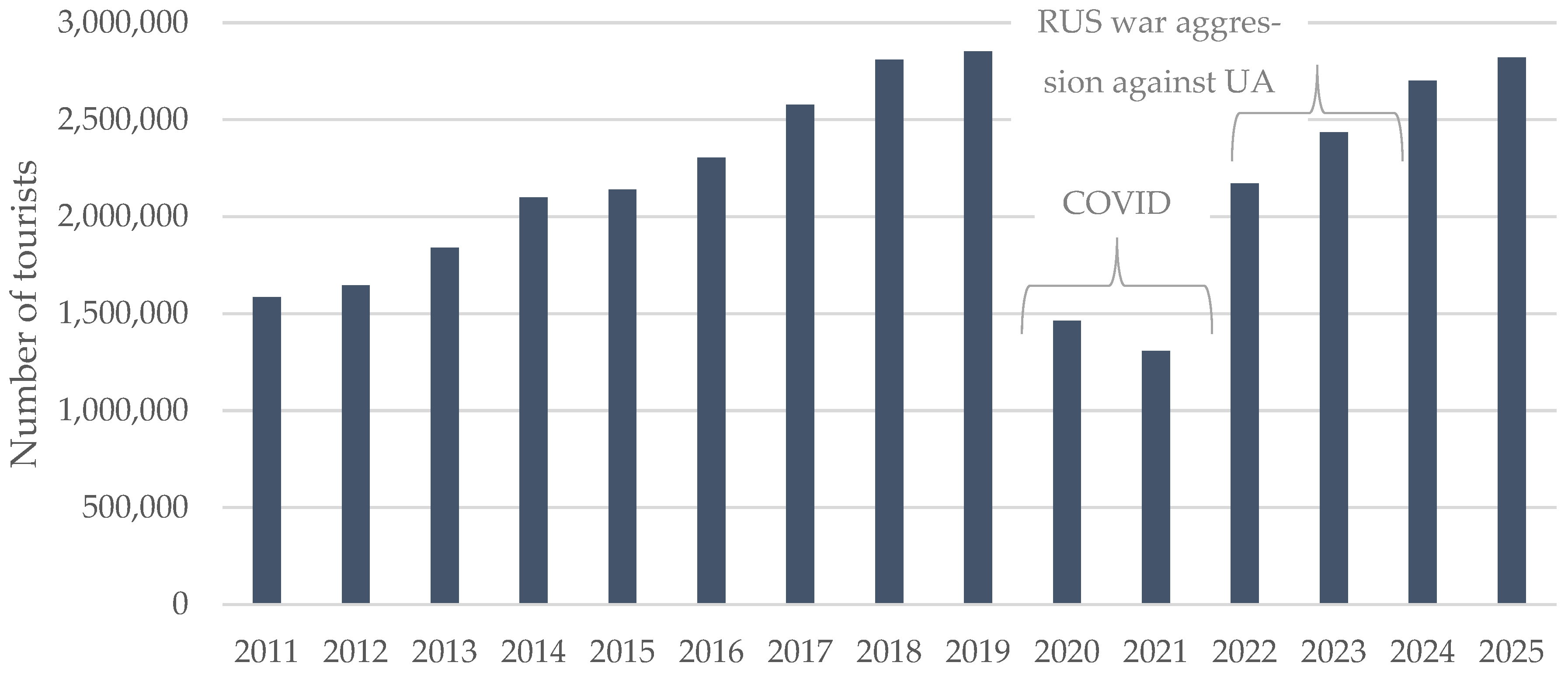
2.3.1. Tourism Flows and Recovery in Latvia
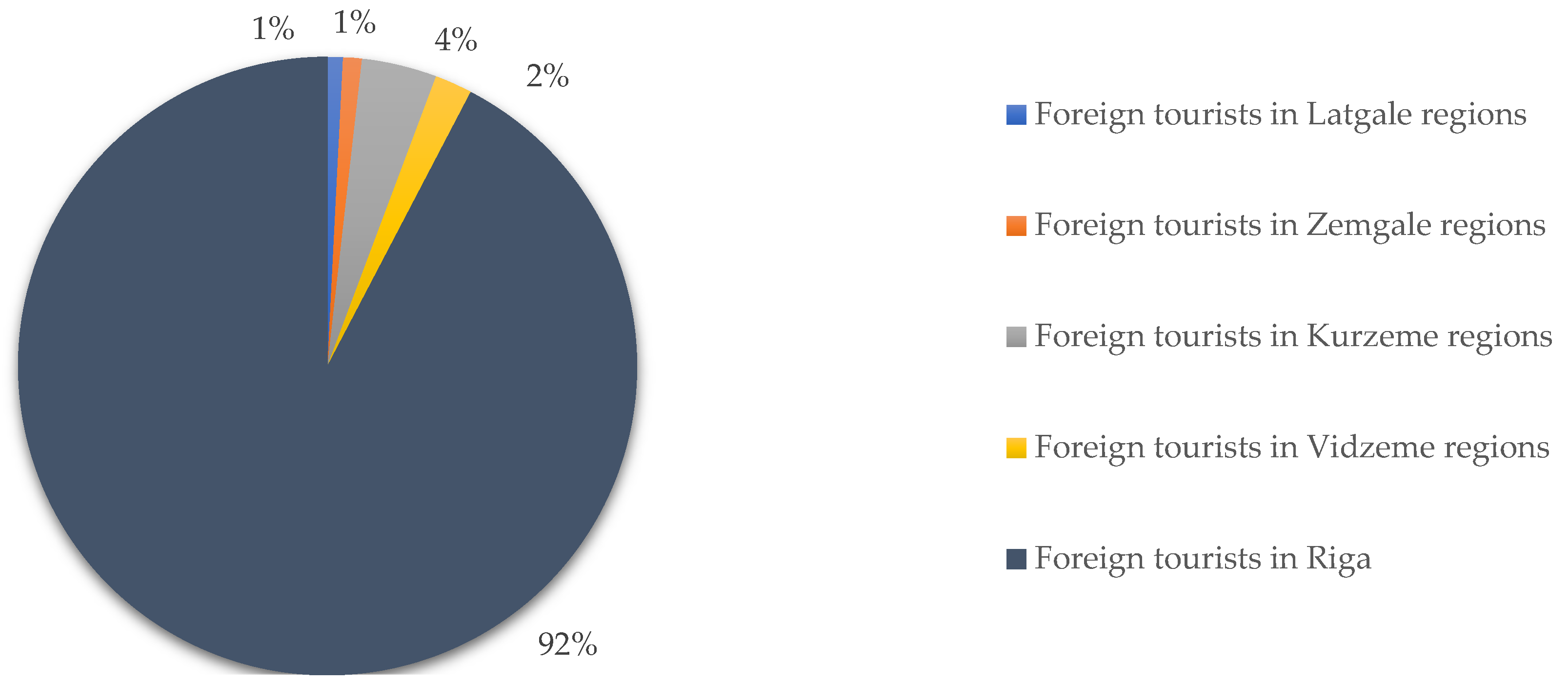
2.3.2. Regional Disparities and Rural Tourism Conditions
2.4. Digital Tools and Competitiveness in Rural Tourism
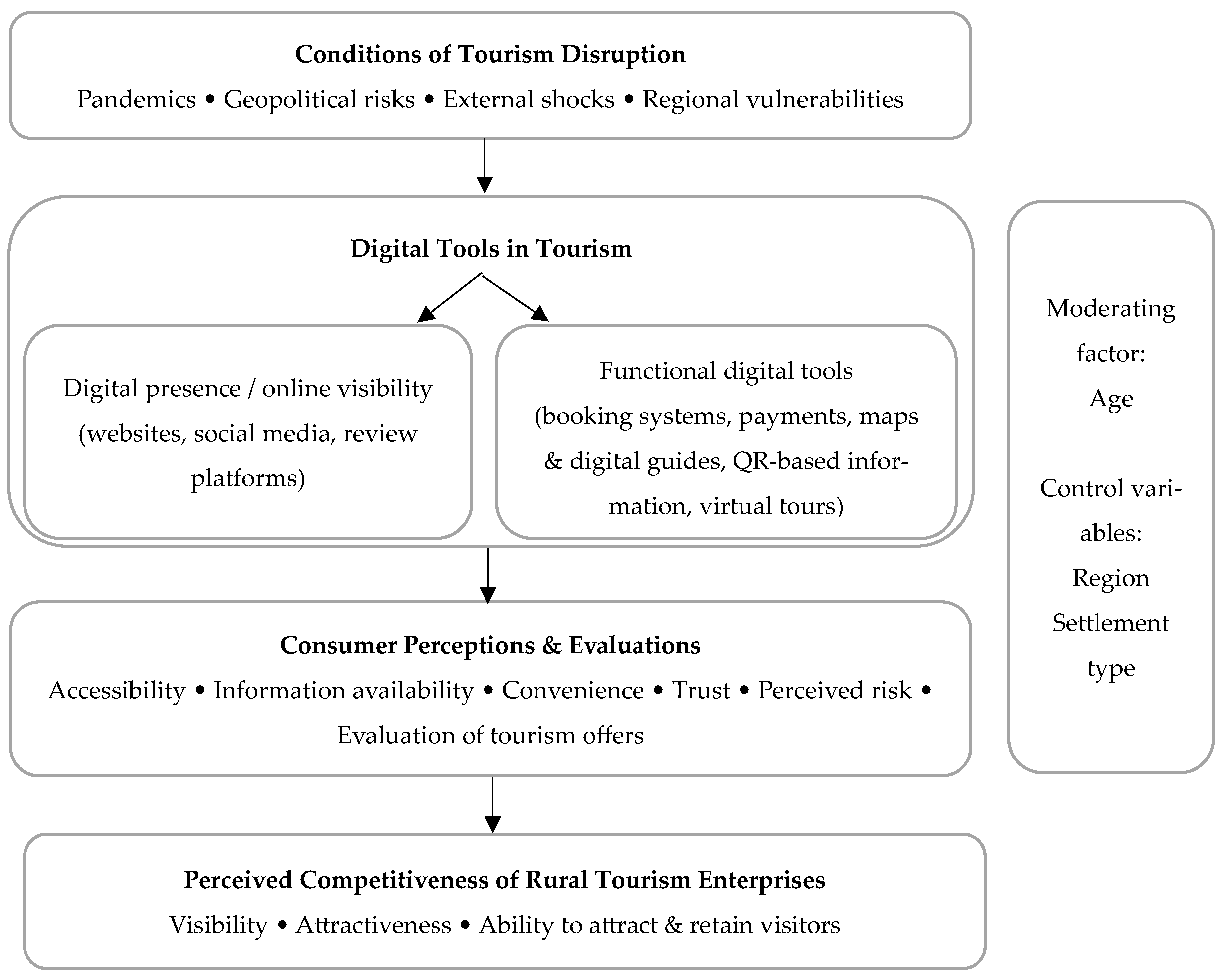
2.5. Conceptual Framework of the Study
3. Methodology
3.1. Research Design
3.2. Survey Design and Data Collection
- Socio-demographic variables (age group, region, settlement type);
- Closed-ended items on perceptions of digital tools in rural tourism enterprises measured using Likert-type scales (Likert, 1932);
- Behavioural and attitudinal indicators (including perceived importance of digitalisation);
- Open-ended questions on digitalisation, competitiveness, and desired improvements in rural tourism.
3.3. Quantitative Analysis
3.4. Qualitative Analysis
Data Inclusion and Handling of Non-Substantive Responses
3.5. Ethical Considerations
4. Results
4.1. Sample Characteristics
4.2. Age-Related Differences in Perceived Importance of Digital Tools in Rural Tourism
4.2.1. Perceived Use of Advanced Digital Solutions in Rural Tourism Enterprises
4.2.2. Perceived Importance of Technological Innovations and Digital Opportunities
4.2.3. Age Differentiation Across Specific Digital Tools
- Virtual tours showed the strongest age-related differentiation. Maximum ratings were most frequent among respondents aged 35–54, while younger and oldest respondents showed greater dispersion. The linear trend was highly significant (p < 0.001), with the strongest correlations among the analysed tools (Pearson r = 0.178; Spearman ρ = 0.271).
- Digital guides and maps also showed a significant age gradient. Respondents aged 25–44 most frequently assigned maximum importance, whereas younger and older groups displayed greater variation. The association was statistically significant (p < 0.001), with moderate correlations (Pearson r = 0.117; Spearman ρ = 0.158).
- Digital review platforms were valued across all age groups, but respondents aged 35–54 most frequently gave maximum ratings. The correlations were weak but statistically significant (Pearson r = 0.107; Spearman ρ = 0.153; both p < 0.001), indicating limited but systematic variation by age.
- Online booking and digital payments were highly valued in all age groups. Descriptively, respondents aged 35–54 most often assigned maximum importance, while older groups again showed greater dispersion. Although the linear association was significant (p = 0.003), the correlations were weak (Pearson r = 0.092; Spearman ρ = 0.095).
- QR code–based information showed a non-linear pattern. Respondents aged 25–54 generally evaluated QR-based tools positively, whereas younger and older respondents showed more fragmented assessments. Pearson’s coefficient was statistically significant (r = 0.124, p < 0.001), but Spearman’s coefficient was non-significant (ρ = 0.004, p = 0.892), indicating no clear monotonic age trend.
4.2.4. Perceptions of Whether Rural Tourism Enterprises Take Customer Preferences into Account
4.3. Regional and Settlement-Type Convergence of Digital Expectations
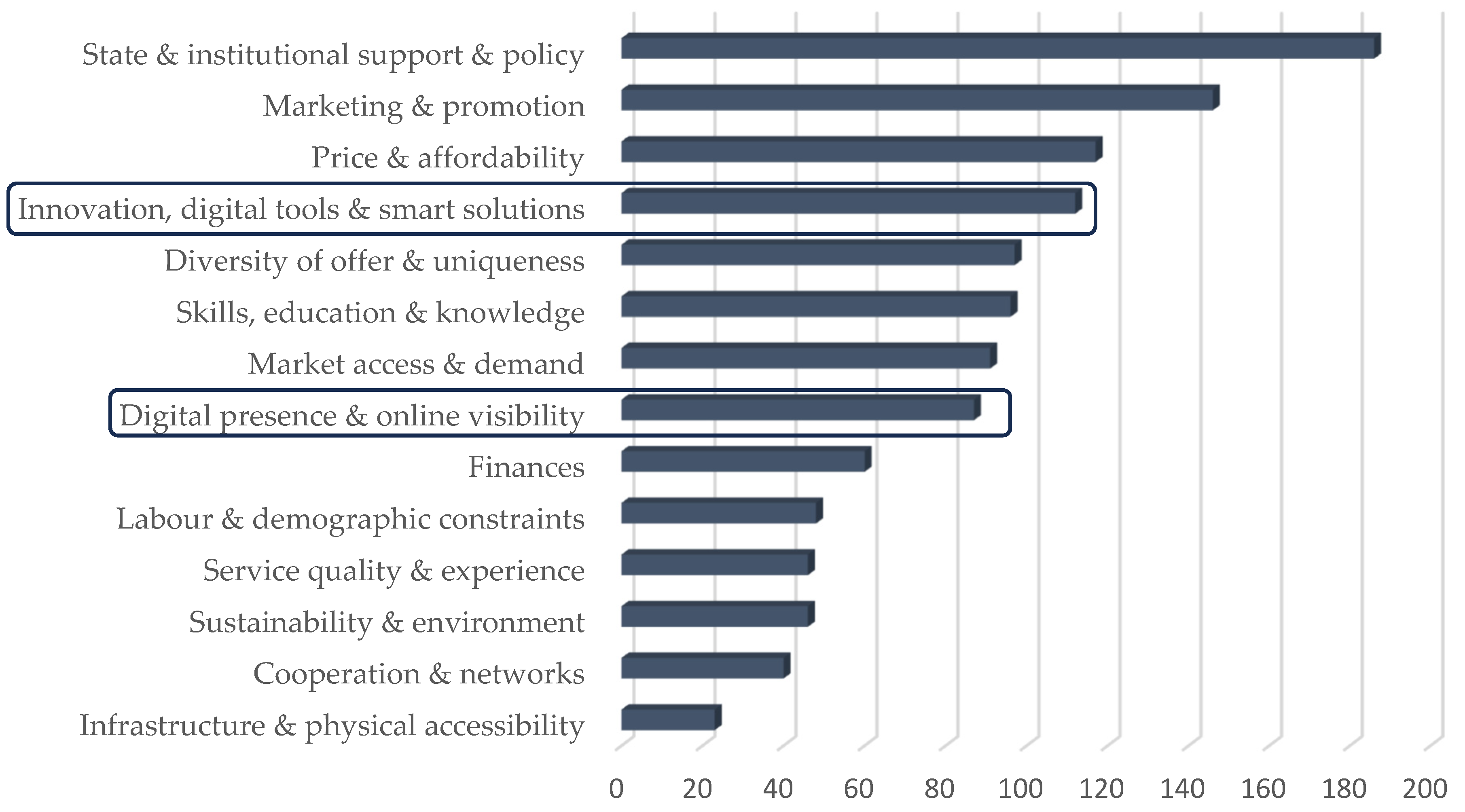
4.4. Qualitative Results: Open-Ended Responses on Competitiveness
4.5. Expected Improvements in Rural Tourism
5. Discussion
5.1. Digital Tools as Visibility and Functional Mechanisms in the Consumer Travel Journey
5.2. Digital Visibility and the Role of Promotion in Rural Tourism Competitiveness
5.3. Institutional Support and Skills in Shaping Competitiveness
5.4. Experience, Value and Structural Conditions of Rural Tourism Competitiveness
5.5. Integrating Quantitative and Qualitative Evidence in Understanding Rural Tourism Competitiveness
6. Conclusions and Implications
6.1. Conclusions
6.2. Theoretical Implications
6.3. Managerial Implications
6.4. Policy Implications
6.5. Limitations and Future Research
Author Contributions
Funding
Institutional Review Board Statement
Informed Consent Statement
Data Availability Statement
Acknowledgments
Conflicts of Interest
References
- Akhtar, N., Khan, N., Khan, M. M., Ashraf, S., Hashmi, M. S., Khan, M. M., & Hishan, S. S. (2021). Post-COVID-19 tourism: Will digital tourism replace mass tourism? Sustainability, 13(10), 5352. [Google Scholar] [CrossRef]
- Akmentina, L. (2023). Country profile of Latvia. Hannover. = ARL country profiles. Available online: https://www.arl-international.com/knowledge/country-profiles/latvia/rev/4352 (accessed on 18 January 2026).
- Alonso, N., Vicent, L., & Trillo, D. (2024). Digitalisation and rural tourism development in Europe. Tourism & Management Studies, 20, 33–44. [Google Scholar] [CrossRef]
- Aryapranata, A., Al Rasyid, Y., Agsena, Y. P., Hermanto, S., & Habibie, F. H. (2025). Leveraging digital transformation for sustainable rural tourism in Indonesia. KnE Social Sciences, 10(29), 396–405. [Google Scholar] [CrossRef]
- Bekele, H., & Raj, S. (2025). Digitalisation and digital transformation in the tourism industry: A bibliometric review and research agenda. Tourism Review, 80(4), 894–913. [Google Scholar] [CrossRef]
- Beták, N., Csapó, J., Horváth, Á., & Dávid, L. D. (2023). Virtual tour as a virtual experience of destination management organisations in Slovakia. GeoJournal of Tourism and Geosites, 47(2), 508–514. [Google Scholar] [CrossRef]
- Biardeau, L., Rosselló, J., Sahli, M., & Santana-Gallego, M. (2026). Natural disasters and global tourism flows: Intensity, vulnerability and moderating factors. Tourism Management, 114, 105390. [Google Scholar] [CrossRef]
- BMZ (The Federal Ministry for Economic Cooperation and Development). (2024). An opportunity for sustainable development. Available online: https://www.bmz.de/en/issues/tourism (accessed on 18 January 2026).
- Bogers, M. L. A. M., Garud, R., Thomas, L. D. W., Tuertscher, P., & Yoo, Y. (2022). Digital innovation: Transforming research and practice. Innovation, 24(1), 4–12. [Google Scholar] [CrossRef]
- Bohl, D., Hanna, T., Mapes, B., Moyer, J., Narayan, K., & Wasif, K. (2017). Understanding and forecasting geopolitical risk and benefits. Frederick S. Pardee Center for International Futures, Josef Korbel School of Global and Public Affairs, University of Denver. [Google Scholar] [CrossRef]
- Bondarenko, S., Kalaman, O., & Danilova, O. (2025). Digital transformation of the tourism business in an open economy: A comprehensive approach to travel planning and partnerships. Tourism, Hospitality and Catering, (4), 1–19. [Google Scholar] [CrossRef]
- Braun, V., & Clarke, V. (2021). Thematic analysis: A practical guide. Sage. [Google Scholar]
- Bravaglieri, S., Åberg, H. E., Bertuca, A., & de Luca, C. (2025). Multi-actor rural innovation ecosystems: Definition, dynamics, and spatial relations. Journal of Rural Studies, 114, 103492. [Google Scholar] [CrossRef]
- Bryman, A. (2016). Social research methods (5th ed.). Oxford University Press. [Google Scholar]
- Caldara, D., & Iacoviello, M. (2022). Measuring geopolitical risk. American Economic Review, 112(4), 1194–1225. [Google Scholar] [CrossRef]
- Cárdenas-García, P. J., Brida, J. G., & Segarra, V. (2024). Modeling the link between tourism and economic development: Evidence from homogeneous panels of countries. Humanities and Social Sciences Communications, 11, 308. [Google Scholar] [CrossRef]
- Central Statistical Bureau of Latvia. (2024). Statistical regions. Available online: https://stat.gov.lv/en/statistics-themes/environment/nature-resources/publications-and-infographics/21408-statistical (accessed on 12 January 2026).
- Central Statistical Bureau of Latvia. (2025a). In 2024 the number of guest nights booked via collaborative economy platforms in Latvia has risen by 15.1%. Available online: https://stat.gov.lv/en/statistics-themes/business-sectors/tourism/press-releases/27998-guest-nights-offered-booking-airbnb (accessed on 15 January 2026).
- Central Statistical Bureau of Latvia. (2025b). Residents’ travel in Latvia increased by almost 16% last year. Official Statistics Portal. Available online: https://stat.gov.lv/lv/statistikas-temas/noz/turisms/preses-relizes/22905-latvijas-iedzivotaju-celojumi-pa-latviju-2024 (accessed on 7 April 2026).
- Central Statistical Bureau of Latvia. (2025c). Tourism statistics highlights 2025. Official Statistics Portal. Available online: https://stat.gov.lv/system/files/publication/2025-04/Nr_18_Turisma_statistikas_aktualitates_2025_%2825_00%29_LV.pdf (accessed on 7 April 2026).
- Central Statistical Bureau of Latvia. (2026). Capacity and occupancy of tourist accommodation establishments by region, city and municipality (TUV050m) 2022 M01—2025 M11. Available online: https://data.stat.gov.lv/pxweb/lv/OSP_PUB/START__NOZ__TU__TUV/TUV050m/table/tableViewLayout1/ (accessed on 19 January 2026).
- Chamboko-Mpotaringa, M., & Tichaawa, T. M. (2021). Tourism digital marketing tools and views on future trends: A systematic review of literature. African Journal of Hospitality, Tourism and Leisure, 10(1), 712–726. [Google Scholar] [CrossRef]
- Chouykaew, T., Kim, L., & Issayeva, G. (2024). How perceived ease of use, trust, and perceived usefulness influence tourists’ decision to book homestay services online. GeoJournal of Tourism and Geosites, 56(4), 1609–1616. [Google Scholar] [CrossRef]
- Christou, E., Giannopoulos, A., & Simeli, I. (2025). The evolution of digital tourism marketing: From hashtags to AI-immersive journeys in the metaverse era. Sustainability, 17(13), 6016. [Google Scholar] [CrossRef]
- Creswell, J. W., & Plano Clark, V. L. (2018). Designing and conducting mixed methods research (3rd ed.). SAGE. [Google Scholar]
- Crouch, G. I., & Ritchie, J. R. B. (2003). The competitive destination: A sustainable tourism perspective. CABI. [Google Scholar]
- Dai, M. L., Fan, D. X. F., Wang, R., Ou, Y. H., & Ma, X. L. (2023). Does rural tourism revitalize the countryside? An exploration of the spatial reconstruction through the lens of cultural connotations of rurality. Journal of Destination Marketing & Management, 29, 100801. [Google Scholar] [CrossRef]
- Dumitru, I. M., & Cosma, S. A. (2023). A measurement of rural tourism destinations’ competitiveness. Studia UBB Negotia, 68(1), 81–97. [Google Scholar] [CrossRef]
- European Commission. (2021). A long-term vision for the EU’s rural areas—Towards stronger, connected, resilient and prosperous rural areas by 2040 (Communication from the commission to the European parliament, the council, the European economic and social committee and the committee of the regions empty). European Commission. Available online: https://eur-lex.europa.eu/legal-content/EN/TXT/?uri=COM%3A2021%3A345%3AFIN&qid=1625178285970 (accessed on 21 January 2024).
- Fernández-Cavia, J., Vinyals-Mirabent, S., Fernández-Planells, A., Weber, W., & Pedraza-Jiménez, R. (2020). Tourist information sources at different stages of the travel experience. El Profesional de la Información, 29(2), e290219. [Google Scholar] [CrossRef]
- Field, A. P. (2018). Discovering statistics using IBM SPSS statistics (5th ed.). Sage. [Google Scholar]
- Fraccastoro, S., Gabrielsson, M., & Pullins, E. B. (2021). The integrated use of social media, digital, and traditional communication tools in the B2B sales process of international SMEs. International Business Review, 30(4), 101776. [Google Scholar] [CrossRef]
- Gozgor, G., Lau, M. C. K., Zeng, Y., Yan, C., & Lin, Z. (2022). The impact of geopolitical risks on tourism supply in developing economies: The moderating role of social globalization. Journal of Travel Research, 61(4), 872–886. [Google Scholar] [CrossRef]
- Grigoriadis, P., Salepaki, A., Angelou, I., & Kourkouridis, D. (2025). Risk and resilience in tourism: How political instability and social conditions influence destination choices. Tourism and Hospitality, 6(2), 83. [Google Scholar] [CrossRef]
- Hailemariam, A., & Ivanovski, K. (2021). The impact of geopolitical risk on tourism. Current Issues in Tourism, 24(22), 3134–3140. [Google Scholar] [CrossRef]
- Hair, J. F., Babin, B. J., Anderson, R. E., & Black, W. C. (2019). Multivariate data analysis (8th ed.). Pearson Prentice. [Google Scholar]
- Haryono, J., Nurbaeti, Sulartiningrum, S., Arafah, W., & Ingkadijaya, R. (2025). Digital transformation of rural tourism villages: A systematic literature review on strategies, challenges, and opportunities for sustainable tourism development. Technium Social Sciences Journal, 73, 359–369. [Google Scholar] [CrossRef]
- Jacobsen, J. K. S., & Munar, A. M. (2012). Tourist information search and destination choice in a digital age. Tourism Management Perspectives, 1, 39–47. [Google Scholar] [CrossRef]
- Jurkane, K. (2021). Impact of COVID-19 on the tourism industry in Latvia. In Individual society state, proceedings of the international scientific and practical conference (pp. 41–47). RTU Rezekne Academy. [Google Scholar] [CrossRef]
- Kaszas, N., & Keller, K. (2022). The emergence of safety and security in the tourism strategies of EU member states. GeoJournal of Tourism and Geosites, 45, 1717–1725. [Google Scholar] [CrossRef]
- Khalid, U., Okafor, L., & Burzynska, K. (2024). Sanctions and tourist flows: The roles of religion and geography. Annals of Tourism Research Empirical Insights, 5(2), 100–143. [Google Scholar] [CrossRef]
- Klepers, A., & Druva-Druvaskalne, I. (2020). Rural landscapes in Latvia: A comparative analysis of representations and perceptions. Folia Geographica, 18, 81–91. [Google Scholar] [CrossRef]
- Kumar, S., & Shekhar. (2020). Digitalization: A strategic approach for development of tourism industry in India. Paradigm, 24(1), 93–108. [Google Scholar] [CrossRef]
- Lečić, B., Issakov, Y., Dávid, L. D., & Gajić, T. (2025). Risk and safety in tourism: How trust in information sources shapes travel risk tolerance across national contexts. Hotel and Tourism Management, 13(2), 47–64. [Google Scholar] [CrossRef]
- Lieberthal, B., Jackson, S., & de Urioste-Stone, S. (2024). Risk perceptions and behaviors concerning rural tourism and economic-political drivers of COVID-19 policy in 2020. PLoS ONE, 19(4), e0299841. [Google Scholar] [CrossRef]
- Likert, R. (1932). A technique for the measurement of attitudes. Archives of Psychology, 140, 1–55. [Google Scholar]
- Liu, Y. L., Chiang, J. T., & Ko, P. F. (2023). The benefits of tourism for rural community development. Humanities and Social Sciences Communications, 10, 137. [Google Scholar] [CrossRef]
- Lusena-Ezera, I., Bikse, V., Pusaudze, S., Rivza, B., & Pole, L. (2023). The role of sustainable leadership in promoting the visibility of the territories represented by the tourism information centres of Latvian State Cities. Sustainability, 15(10), 7852. [Google Scholar] [CrossRef]
- Makkonen, T., & Williams, A. M. (2024). Cross-border tourism and innovation system failures. Annals of Tourism Research, 105, 103735. [Google Scholar] [CrossRef]
- Marakova, V., Wolak-Tuzimek, A., Brożek, K., Sieradzka, K., & Kristofik, P. (2025). The contribution of digital technologies to improving the competitiveness of the tourism sector in European Union countries. Administrative Sciences, 15(12), 486. [Google Scholar] [CrossRef]
- Ministry of Economics. (2019). Latvijas tūrisma attīstības rīcības plāns 2021–2027. gadam [Tourism development plan of Latvia 2021–2027]. Available online: https://www.em.gov.lv/sites/em/files/turisma_ricibas_plans_2021_202720brandtour_final201.pdf (accessed on 14 February 2026).
- Money, R. B., & Crotts, J. C. (2003). The effect of uncertainty avoidance on information search, planning, and purchases of international travel vacations. Tourism Management, 24(2), 191–202. [Google Scholar] [CrossRef]
- Neumeier, S., & Pollermann, K. (2014). Rural tourism as promoter of rural development—Prospects and limitations: Case study findings from a pilot project promoting village tourism. European Countryside, 6(4), 270–296. [Google Scholar] [CrossRef]
- Nowell, L. S., Norris, J. M., White, D. E., & Moules, N. J. (2017). Thematic analysis: Striving to meet the trustworthiness criteria. International Journal of Qualitative Methods, 16(1), 1609406917733847. [Google Scholar] [CrossRef]
- OECD (Organisation for Economic Co-operation and Development). (2020). OECD tourism trends and policies 2020. OECD Publishing. [Google Scholar] [CrossRef]
- OECD (Organisation for Economic Co-operation and Development). (2022). OECD tourism trends and policies 2022. OECD Publishing. [Google Scholar] [CrossRef]
- OECD (Organisation for Economic Co-operation and Development). (2024). Tourism: Policy issues. Available online: https://www.oecd.org/en/topics/policy-issues/tourism.html (accessed on 11 January 2026).
- Palos-Sanchez, P., Saura, J. R., Velicia-Martin, F., & Cepeda-Carrion, G. (2021). A business model adoption based on tourism innovation: Applying a gratification theory to mobile applications. European Research on Management and Business Economics, 27(2), 100149. [Google Scholar] [CrossRef]
- Papagianni, E., Evgenidis, A., Tsagkanos, A., & Megalooikonomou, V. (2024). Tourism demand in the face of geopolitical risk: Insights from a cross-country analysis. Journal of Travel Research, 63(8), 2094–2119. [Google Scholar] [CrossRef]
- Parray, W. A., Soudager, M. A., Ahmad, Z., Yasmin, E., & Darzi, T. A. (2023). Impact of geopolitical risk on tourism demand: Evidence from asymmetric NARDL approach. Journal of Hospitality and Tourism Insights, 7(2), 2546–2559. [Google Scholar] [CrossRef]
- Pole, L., Rivza, B., & Zeverte-Rivza, S. (2025, May 14–16). The impact socio-economic and geopolitical changes on rural tourism flow. Proceedings of the 31st International Scientific Conference Research for Rural Development (pp. 429–435), Jelgava, Latvia. [Google Scholar] [CrossRef]
- Polukhina, A., Sheresheva, M., Napolskikh, D., & Lezhnin, V. (2025). Digital solutions in tourism as a way to boost sustainable development: Evidence from a transition economy. Sustainability, 17(3), 877. [Google Scholar] [CrossRef]
- Raga, J. (2020). Tourism informatics. Society Publishing. [Google Scholar]
- Saeima. (1998). Tourism law. Available online: https://likumi.lv/ta/id/50026-turisma-likums (accessed on 10 April 2026).
- Shikhri, R., & Lanir, J. (2024). Virtual tourism: Towards better user experience in online virtual tours. In Proceedings of the workshop on advanced visual interfaces and interactions in cultural heritage (AVICH 2024). CEUR Workshop Proceedings. [Google Scholar]
- Starcevic, S., & Konjikusic, S. (2018). Why millenials as digital travelers transformed marketing strategy in tourism industry. In International thematic monograph tourism in function of development of the Republic of Serbia, tourism in the era of digital transformation (pp. 221–224). University of Kragujevac. [Google Scholar]
- Statista Inc. (2025). Travel and tourism worldwide—Statistics & facts. Available online: https://www.statista.com/topics/962/global-tourism/ (accessed on 12 January 2026).
- Streimikiene, D., & Bilan, Y. (2015). Review of rural tourism development theories. Transformations in Business & Economics, 14(2/35), 21–34. Available online: https://www.transformations.knf.vu.lt/35/ge35.pdf (accessed on 3 January 2026).
- Tashakkori, A., & Teddlie, C. (2010). Mixed methodology: Combining qualitative and quantitative approaches. SAGE Publications. [Google Scholar]
- Thomas, G. (2024). Challenges and trends of digital innovation in the tourism sector: Contemporary literature review. Open Journal of Business and Management, 12, 179–190. [Google Scholar] [CrossRef]
- Tomej, K., Bilynets, I., & Koval, O. (2023). Tourism business resilience in the time of war: The first three months following Russia’s invasion of Ukraine. Annals of Tourism Research, 99, 103–547. [Google Scholar] [CrossRef]
- Ukpabi, D. C., & Karjaluoto, H. (2018). What drives travelers’ adoption of user-generated content? A literature review. Tourism Management Perspectives, 28, 251–273. [Google Scholar] [CrossRef]
- UN Tourism (The United Nations World Tourism Organization). (2023). Tourism and rural development: A policy perspective. UN Tourism. [Google Scholar] [CrossRef]
- UN Tourism (The United Nations World Tourism Organization). (2025a). Why tourism? Available online: https://www.untourism.int/why-tourism (accessed on 11 January 2026).
- UN Tourism (The United Nations World Tourism Organization). (2025b). World tourism barometer (Vol. 23, pp. 1–9). Available online: https://pre-webunwto.s3.eu-west-1.amazonaws.com/s3fs-public/2025-01/UNWTO_Barom25_01_January_EXCERPT_v3.pdf?VersionId=AzILN6U4VW.RbM2oMF2DBpGQreisL4Xa (accessed on 18 January 2026).
- Van der Steina, A., Rozite, M., & Jarvis, J. (2023). Inbound tourism in Latvia during three decades of independence: Development phases, key drivers and challenges. Folia Geographica, 20, 136–146. [Google Scholar] [CrossRef]
- Verbeek, P.-P. (2006). Materializing morality: Design ethics and technological mediation. Science, Technology, & Human Values, 31(3), 361–380. [Google Scholar] [CrossRef]
- Verhoef, P. C., Broekhuizen, T., Bart, Y., Bhattacharya, A., Dong, J. Q., Fabian, N., & Haenlein, M. (2021). Digital transformation: A multidisciplinary reflection and research agenda. Journal of Business Research, 122, 889–901. [Google Scholar] [CrossRef]
- Wang, M., & Wang, J. (2022). Uncertainty models in the integration path of rural tourism information construction and smart tourism based on big data technology. International Journal of Electronics and Communications (AEÜ), 152, 170320. [Google Scholar] [CrossRef]
- Wei, W., Qi, R., & Zhang, L. (2019). Effects of virtual reality on theme park visitors’ experience and behaviors: A presence perspective. Tourism Management, 71, 282–293. [Google Scholar] [CrossRef]
- Xiang, Z., Magnini, V. P., & Fesenmaier, D. R. (2015). Information technology and consumer behavior in travel and tourism: Insights from travel planning using the Internet. Journal of Retailing and Consumer Services, 22, 244–249. [Google Scholar] [CrossRef]
- Xie, W. (2023). The impact of geopolitical risks and international relations on inbound tourism—Evidence from China and key source countries. Cogent Social Sciences, 9(2), 2285244. [Google Scholar] [CrossRef]
- Yu, R., Cheng, J., Su, X., & Liang, L. (2023). Tourism smallholders’ perceived risks, resilience, and response strategies in the upper reaches of the Yihe River, China. Ecological Indicators, 154, 110–491. [Google Scholar] [CrossRef]
- Zeverte-Rivza, S., Furmanova, K., Grinberga-Zalite, G., Rivza, B., Paula, L., & Kindzule-Millere, I. (2025). Dataset for a general population survey regarding green and digital innovations in rural SMEs (version 1) [dataset]. Available online: https://dv.dataverse.lv/dataset.xhtml?persistentId=doi:10.71782/DATA/MISWCM (accessed on 15 February 2026).
- Zhang, Y. (2023). Analysis of the digital transformation development path for travel enterprises. Open Journal of Applied Sciences, 13, 1370–1386. [Google Scholar] [CrossRef]
- Zhou, H., Ibrahim, J. A. B., & Mohamed, A. E. B. (2022). Exploring the impact of perceived risk and trust on tourist acceptance intentions in the post-COVID era: A case study of Hainan residents. Frontiers in Psychology, 13, 1047580. [Google Scholar] [CrossRef]



| Digital Solution | Linear Trend (Statistics) | Strength of Age Effect | Descriptive Summary |
|---|---|---|---|
| Virtual tours | Spearman ρ = 0.271, Pearson r = 0.178, p < 0.001 | Moderately strong | Showed the strongest age-related differentiation, with higher ratings most frequently observed among respondents aged 35–54. |
| Digital guides & maps | Spearman ρ = 0.158, Pearson r = 0.117, p < 0.001 | Moderate | Showed age-related variation, with the highest ratings more frequently observed among respondents aged 25–44. |
| Digital review platforms | Spearman ρ = 0.153, Pearson r = 0.107, p < 0.001 | Moderate | Were evaluated positively across age groups, with higher ratings more frequently observed among respondents aged 35–54. |
| Online booking & digital payments | Spearman ρ = 0.095, Pearson r = 0.092, p = 0.003 | Weak–moderate | Were highly valued across all age groups, with only modest age-related variation. |
| QR codes */e-information | Spearman ρ = 0.004 (n.s.), Pearson r = 0.124, p < 0.001 | Weak/non-linear | Showed uneven evaluations across age groups, without a clear monotonic age pattern. |
| Competitiveness Dimension | Respondents (n) | % of Respondents * | Descriptive Summary | Indicative Analytical Alignment |
|---|---|---|---|---|
| State & institutional support and policy | 186 | 18.5% | Taxation, bureaucracy, regulation, public support instruments and infrastructure investment. | Institutional support |
| Marketing and promotion (without explicit digital reference) | 146 | 14.5% | General promotion, advertising, events, traditional media, and visibility through non-specified or non-digital channels. | Awareness/perceived attractiveness |
| Price and affordability | 117 | 11.7% | Price levels, affordability and price–quality balance. | Perceived value |
| Innovation, digital tools & smart solutions | 112 | 11.2% | Online booking, payments, QR-based information, digital guides, virtual tours, Wi-Fi, and automation. | Information accessibility/perceived usefulness |
| Diversity of offer and uniqueness | 97 | 9.7% | Broader, more distinctive, or more varied tourism offers, activities, and experiences. | Perceived attractiveness/perceived value |
| Skills, education and knowledge | 96 | 9.6% | Training, education, competences, including digital skills, and exchange of experience. | Capability conditions |
| Market access and demand conditions | 91 | 9.1% | Seasonality, market size, and limits of tourism demand. | Demand conditions |
| Digital presence and online visibility | 87 | 8.7% | Online visibility, accessible information, websites, social media, and platform presence. | Information accessibility/awareness |
| Finances | 60 | 6.0% | Funding, liquidity, investment capacity, and financial constraints. | Capability conditions/resource capacity |
| Labour and demographic constraints | 48 | 4.8% | Labour shortages, youth outmigration, ageing, and human resource limitations. | Capability conditions/structural constraints |
| Service quality and experience | 46 | 4.6% | Hospitality, responsiveness, customer orientation, and service experience. | Service quality |
| Sustainability and environmental aspects | 46 | 4.6% | Environmental responsibility, nature protection, and sustainable practices. | Perceived value/sustainability-related quality |
| Cooperation and networks | 40 | 4.0% | Cooperation, shared platforms, partnerships, and joint offers. | Social capital |
| Infrastructure & physical accessibility | 23 | 2.3% | Roads, transport access, signage, other physical access conditions and basic facilities. | Accessibility |
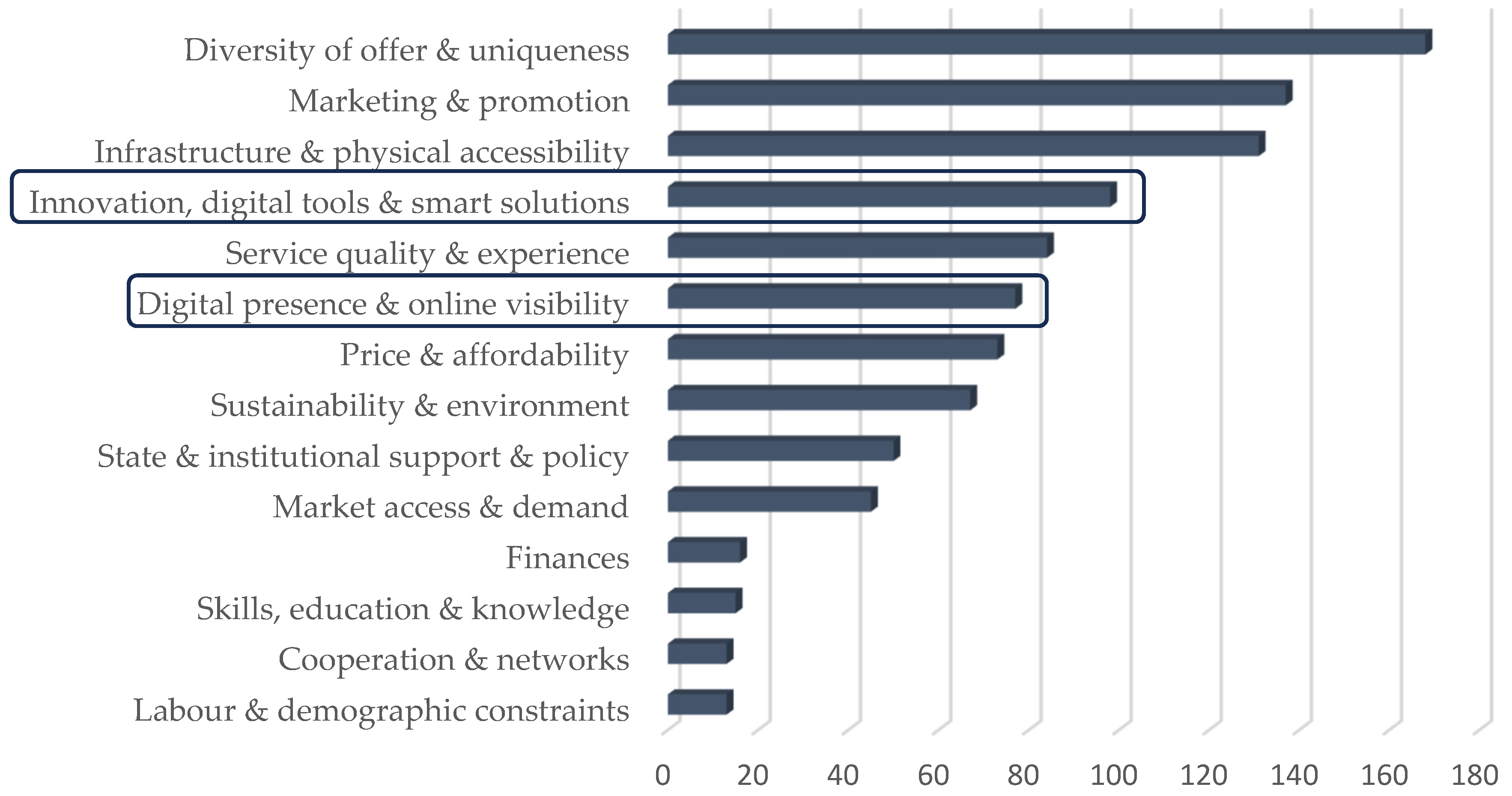
| Competitiveness Dimension | Importance (n) | % | Expected Improvements (n) | % |
|---|---|---|---|---|
| Digital presence & online visibility | 87 | 8.7% | 77 | 7.7% |
| Innovation, digital tools & smart solutions | 112 | 11.2% | 98 | 9.8% |
| Marketing & promotion (offline/non-digital) | 146 | 14.6% | 137 | 13.7% |
| Price & affordability | 117 | 11.7% | 73 | 7.3% |
| Market access & demand | 91 | 9.1% | 45 | 4.5% |
| Service quality & experience | 46 | 4.6% | 84 | 8.4% |
| Infrastructure & physical accessibility | 23 | 2.3% | 131 | 13.1% |
| Diversity of offer & uniqueness | 97 | 9.7% | 168 | 16.7% |
| Sustainability & environment | 46 | 4.6% | 67 | 6.7% |
| State & institutional support & policy | 186 | 18.6% | 50 | 5.0% |
| Finances | 60 | 6.0% | 16 | 1.6% |
| Skills, education & knowledge | 96 | 9.6% | 15 | 1.5% |
| Cooperation & networks | 41 | 4.1% | 13 | 1.3% |
| Labour & demographic constraints | 48 | 4.8% | 13 | 1.3% |
Disclaimer/Publisher’s Note: The statements, opinions and data contained in all publications are solely those of the individual author(s) and contributor(s) and not of MDPI and/or the editor(s). MDPI and/or the editor(s) disclaim responsibility for any injury to people or property resulting from any ideas, methods, instructions or products referred to in the content. |
© 2026 by the authors. Licensee MDPI, Basel, Switzerland. This article is an open access article distributed under the terms and conditions of the Creative Commons Attribution (CC BY) license.
Share and Cite
Rivza, B.; Kindzule-Millere, I.; Pole, L.; Zeverte-Rivza, S.; Grinberga-Zalite, G.; Furmanova, K.; Paula, L. Digital Tools and Rural Tourism Competitiveness Under Conditions of Tourism Disruption: Evidence from Consumer Perspectives. Tour. Hosp. 2026, 7, 133. https://doi.org/10.3390/tourhosp7050133
Rivza B, Kindzule-Millere I, Pole L, Zeverte-Rivza S, Grinberga-Zalite G, Furmanova K, Paula L. Digital Tools and Rural Tourism Competitiveness Under Conditions of Tourism Disruption: Evidence from Consumer Perspectives. Tourism and Hospitality. 2026; 7(5):133. https://doi.org/10.3390/tourhosp7050133
Chicago/Turabian StyleRivza, Baiba, Inita Kindzule-Millere, Laura Pole, Sandija Zeverte-Rivza, Gunta Grinberga-Zalite, Ksenija Furmanova, and Liga Paula. 2026. "Digital Tools and Rural Tourism Competitiveness Under Conditions of Tourism Disruption: Evidence from Consumer Perspectives" Tourism and Hospitality 7, no. 5: 133. https://doi.org/10.3390/tourhosp7050133
APA StyleRivza, B., Kindzule-Millere, I., Pole, L., Zeverte-Rivza, S., Grinberga-Zalite, G., Furmanova, K., & Paula, L. (2026). Digital Tools and Rural Tourism Competitiveness Under Conditions of Tourism Disruption: Evidence from Consumer Perspectives. Tourism and Hospitality, 7(5), 133. https://doi.org/10.3390/tourhosp7050133