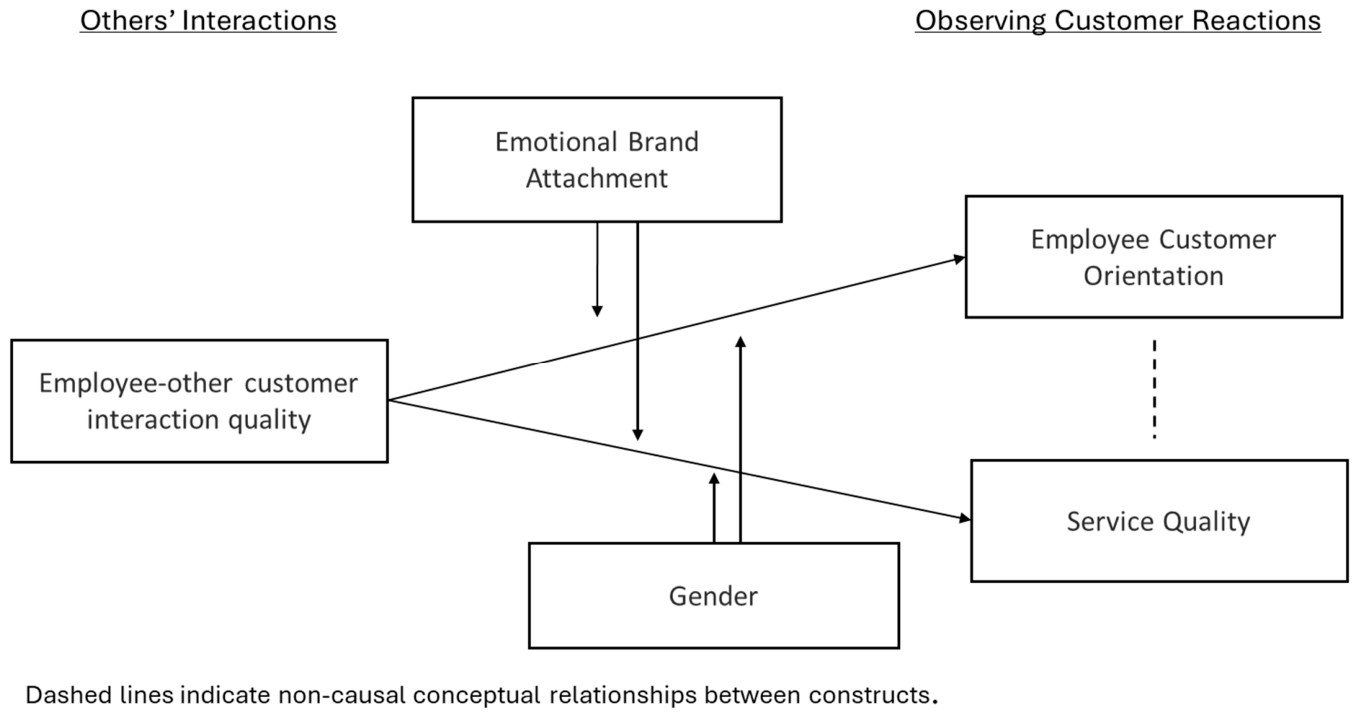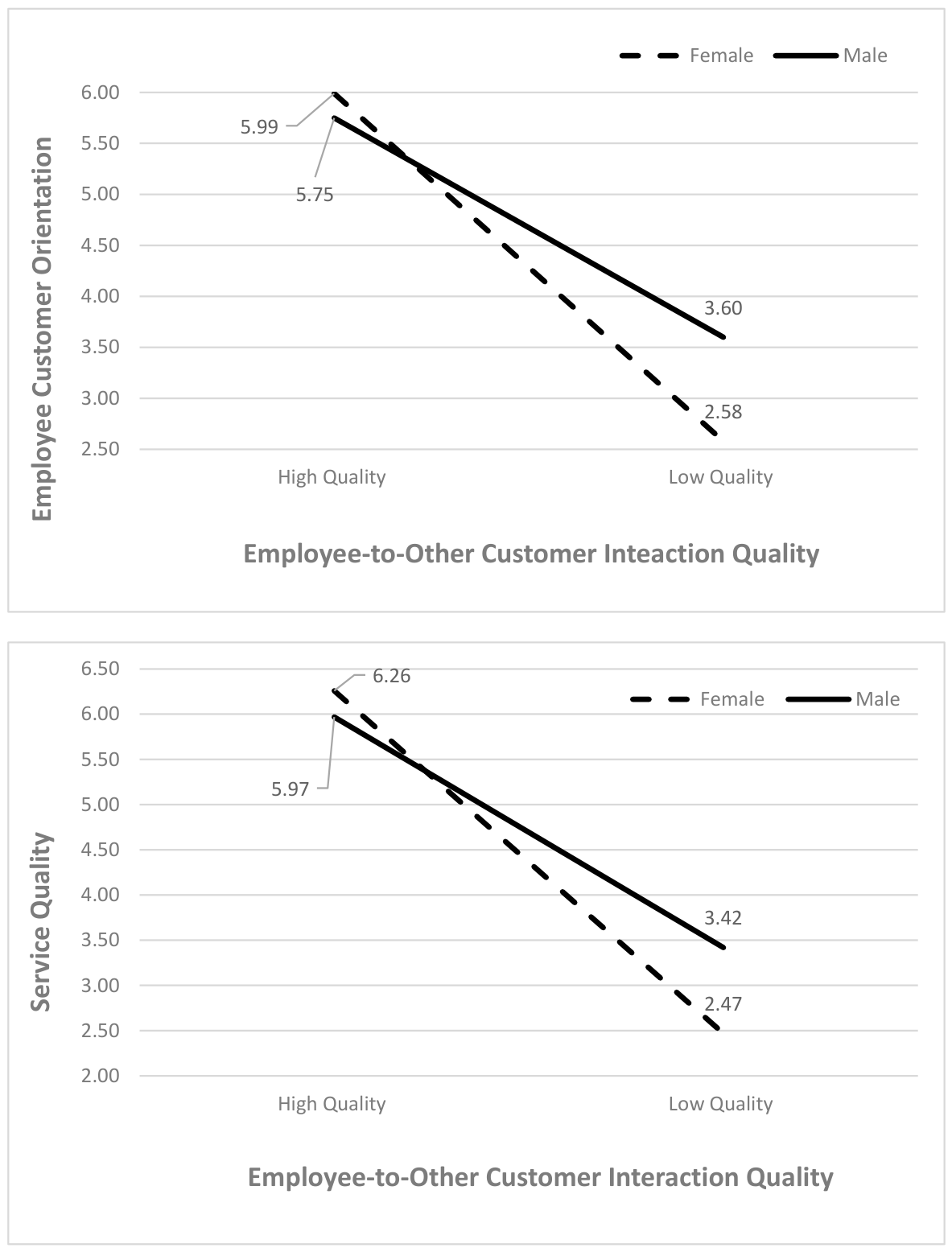


Managing Multiple Customer Interactions: Exploring Customer Reactions and Gender Differences in Response to Employee-to-Other Customer Interaction Quality in the Social Servicescape


Abstract
1. Introduction
2. Literature Review and Hypothesis Development
2.1. Social Influence Theories in Service Context
2.2. Interaction Quality
2.3. Perceived Customer Orientation
2.4. Perceived Service Quality
2.5. Moderating Roles of Gender and Emotional Brand Attachment
3. Methodology
3.1. Research Design and Data Collection
3.2. Measures
3.3. Results
3.3.1. Sample and Manipulation Check
3.3.2. Hypothesis Testing
4. Conclusions and Implications
5. Limitations
Author Contributions
Funding
Institutional Review Board Statement
Informed Consent Statement
Data Availability Statement
Conflicts of Interest
References
- Adams, J. S. (1965). Inequity in social exchange. In L. Berkowitz (Ed.), Advances in experimental social psychology. Academic Press. [Google Scholar]
- Albrecht, C. M., Hattula, S., Bornemann, T., & Hoyer, W. D. (2016). Customer response to interactional service experience: The role of interaction environment. Journal of Service Management, 27(5), 704–729. [Google Scholar] [CrossRef]
- Ashley, C., & Leonard, H. A. (2009). Betrayed by the buzz? Covert content and consumer–brand relationships. Journal of Public Policy & Marketing, 28(2), 212–220. [Google Scholar] [CrossRef]
- Baker, M. A., & Magnini, V. P. (2016). The evolution of services marketing, hospitality marketing and building the constituency model for hospitality marketing. International Journal of Contemporary Hospitality Management, 28(8), 1510–1534. [Google Scholar] [CrossRef]
- Barsade, S. G. (2002). The ripple effect: Emotional contagion and its influence on group behavior. Administrative Science Quarterly, 47(4), 644–675. [Google Scholar] [CrossRef]
- Becker, L., & Jaakkola, E. (2020). Customer experience: Fundamental premises and implications for research. Journal of the Academy of Marketing Science, 48, 630–648. [Google Scholar] [CrossRef]
- Bitner, M. J. (1992). Servicescapes: The impact of physical surroundings on customers and employees. Journal of Marketing, 56(2), 57–71. [Google Scholar] [CrossRef]
- Brady, M. K., & Cronin, J. J., Jr. (2001). Some new thoughts on conceptualizing perceived service quality: A hierarchical approach. Journal of Marketing, 65(3), 34–49. [Google Scholar] [CrossRef]
- Brown, T. J., Mowen, J. C., Donavan, D. T., & Licata, J. W. (2002). The customer orientation of service workers: Personality trait effects on self-and supervisor performance ratings. Journal of Marketing Research, 39(1), 110–119. [Google Scholar] [CrossRef]
- Cho, M., Bonn, M. A., Han, S. J., & Lee, K. H. (2016). Workplace incivility and its effect upon restaurant frontline service employee emotions and service performance. International Journal of Contemporary Hospitality Management, 28(12), 2888–2912. [Google Scholar] [CrossRef]
- Choi, B. J., & Kim, H. S. (2013). The impact of outcome quality, interaction quality, and peer-to-peer quality on customer satisfaction with a hospital service. Managing Service Quality, 23(3), 188–204. [Google Scholar] [CrossRef]
- Colquitt, J. A. (2004). Does the justice of the one interact with the justice of the many? Reactions to procedural justice in teams. Journal of Applied Psychology, 89(4), 633–646. [Google Scholar] [CrossRef]
- Davis, M. H. (1983). Measuring individual differences in empathy: Evidence for a multidimensional approach. Journal of Personality and Social Psychology, 44(1), 113–126. [Google Scholar] [CrossRef]
- Eagly, A. H., Wood, W., & Diekman, A. B. (2000). Social role theory of sex differences and similarities. In The developmental social psychology of gender. Lawrence Erlbaum Associates Publishers. [Google Scholar]
- Eisenberg, N., & Miller, P. A. (1987). The relation of empathy to prosocial behavior. Psychological Bulletin, 101(1), 91–119. [Google Scholar] [CrossRef]
- Ekinci, Y., & Dawes, P. L. (2009). Consumer perceptions of frontline service employee personality traits, interaction quality, and consumer satisfaction. The Service Industries Iournal, 29(4), 503–521. [Google Scholar] [CrossRef]
- Fornell, C., & Larcker, D. F. (1981). Evaluating structural equation models with unobservable variables and measurement error. Journal of Marketing Research, 18(1), 39–50. [Google Scholar] [CrossRef]
- Grégoire, Y., & Fisher, R. J. (2008). Customer betrayal and retaliation: When your best customers become your worst enemies. Journal of the Academy of Marketing Science, 36(2), 247–261. [Google Scholar] [CrossRef]
- Groth, M., Hennig-Thurau, T., & Walsh, G. (2009). Customer reactions to emotional labor: The roles of employee acting strategies and customer detection accuracy. Academy of Management Journal, 52(5), 958–974. [Google Scholar] [CrossRef]
- Grönroos, C. (1982). An applied service marketing theory. European Journal of Marketing, 16(7), 30–41. [Google Scholar] [CrossRef]
- Hatfield, E., Cacioppo, J. T., & Rapson, R. L. (1993). Emotional contagion. Current Directions in Psychological Science, 2(3), 96–100. [Google Scholar] [CrossRef]
- Hennig-Thurau, T. (2004). Customer orientation of service employees: Its impact on customer satisfaction, commitment, and retention. International Journal of Service Industry Management, 15(5), 460–478. [Google Scholar] [CrossRef]
- Her, E., & Seo, S. (2018). Why not eat alone? The effect of other consumers on solo dining intentions and the mechanism. International Journal of Hospitality Management, 70, 16–24. [Google Scholar] [CrossRef]
- Japutra, A., Ekinci, Y., & Simkin, L. (2018). Positive and negative behaviours resulting from brand attachment. European Journal of Marketing, 52(5/6), 1185–1202. [Google Scholar] [CrossRef]
- Kattara, H. S., Weheba, D., & El-Said, O. A. (2008). The impact of employee behaviour on customers’ service quality perceptions and overall satisfaction. Tourism and Hospitality Research, 8(4), 309–323. [Google Scholar] [CrossRef]
- Keiningham, T., Aksoy, L., Bruce, H. L., Cadet, F., Clennell, N., Hodgkinson, I. R., & Kearney, T. (2020). Customer experience driven business model innovation. Journal of Business Research, 116, 431–440. [Google Scholar] [CrossRef]
- Keller, K. L. (2001). Building customer-based brand equity: A blueprint for creating strong brands (pp. 3–27). Marketing Science Institute. [Google Scholar]
- Kelman, H. C. (1958). Compliance, identification, and internalization three processes of attitude change. Journal of Conflict Resolution, 2(1), 51–60. [Google Scholar] [CrossRef]
- Khamitov, M., Wang, X., & Thomson, M. (2019). How well do consumer-brand relationships drive customer brand loyalty? Generalizations from a meta-analysis of brand relationship elasticities. Journal of Consumer Research, 46(3), 435–459. [Google Scholar] [CrossRef]
- Kim, H., & Qu, H. (2020). Effects of employees’ social exchange and the mediating role of customer orientation in the restaurant industry. International Journal of Hospitality Management, 89, 102577. [Google Scholar] [CrossRef]
- Kim, H. S., & Choi, B. (2016). The effects of three customer-to-customer interaction quality types on customer experience quality and citizenship behavior in mass service settings. Journal of Services Marketing, 30(4), 384–397. [Google Scholar] [CrossRef]
- Kim, K., & Baker, M. A. (2019). How the employee looks and looks at you: Building customer–employee rapport. Journal of Hospitality & Tourism Research, 43(1), 20–40. [Google Scholar]
- Kim, Y. S., & Baker, M. A. (2019). Observer reactions to other customer incivility: Emotional labor, gratitude, loyalty to employee and tipping intention. International Journal of Contemporary Hospitality Management, 31(3), 1292–1308. [Google Scholar] [CrossRef]
- Kim, Y. S., & Baker, M. A. (2020). Customers’ reactions to other customer caused service failures: The effects of tie strength on customer loyalty. Journal of Hospitality Marketing & Management, 29(6), 682–701. [Google Scholar]
- Latané, B. (1981). The psychology of social impact. American Psychologist, 36(4), 343–365. [Google Scholar] [CrossRef]
- Lemon, K. N., & Verhoef, P. C. (2016). Understanding customer experience throughout the customer journey. Journal of Marketing, 80(6), 69–96. [Google Scholar] [CrossRef]
- Lin, N. P., Chiu, H. C., & Hsieh, Y. C. (2001). Investigating the relationship between service providers’ personality and customers’ perceptions of service quality across gender. Total Quality Management, 12(1), 57–67. [Google Scholar] [CrossRef]
- Lin, W. B. (2010). Service recovery expectation model–from the perspectives of consumers. The Service Industries Journal, 30(6), 873–889. [Google Scholar] [CrossRef]
- Liu, X. Y., Chi, N. W., & Gremler, D. D. (2019). Emotion cycles in services: Emotional contagion and emotional labor effects. Journal of Service Research, 22(3), 285–300. [Google Scholar] [CrossRef]
- Mattila, A. S. (2010). Do women like options more than men? An examination in the context of service recovery. Journal of Services Marketing, 24(7), 499–508. [Google Scholar] [CrossRef]
- McColl-Kennedy, J. R., & Sparks, B. A. (2003). Application of fairness theory to service failures and service recovery. Journal of Service Research, 5(3), 251–266. [Google Scholar] [CrossRef]
- Miao, L. (2014). Self-regulation and “other consumers” at service encounters: A sociometer perspective. International Journal of Hospitality Management, 39, 122–129. [Google Scholar] [CrossRef]
- Miao, L., & Mattila, A. S. (2013). The impact of other customers on customer experiences: A psychological distance perspective. Journal of Hospitality & Tourism Research, 37(1), 77–99. [Google Scholar]
- Moussa, S., & Touzani, M. (2017). The moderating role of attachment styles in emotional bonding with service providers. Journal of Consumer Behaviour, 16(2), 145–160. [Google Scholar] [CrossRef]
- Nguyen, H., Groth, M., Walsh, G., & Hennig-Thurau, T. (2014). The impact of service scripts on customer citizenship behavior and the moderating role of employee customer orientation. Psychology & Marketing, 31(12), 1096–1109. [Google Scholar] [CrossRef]
- Oliver, R. L., & Swan, J. E. (1989). Consumer perceptions of interpersonal equity and satisfaction in transactions: A field survey approach. Journal of Marketing, 53(2), 21–35. [Google Scholar] [CrossRef]
- Powell, T. C. (1995). Total quality management as competitive advantage: A review and empirical study. Strategic Management Journal, 16(1), 15–37. [Google Scholar] [CrossRef]
- Pugh, S. D. (2001). Service with a smile: Emotional contagion in the service encounter. Academy of Management Journal, 44(5), 1018–1027. [Google Scholar] [CrossRef]
- Saavedra Torres, J. L., Rawal, M., & Bagherzadeh, R. (2020). Role of brand attachment in customers’ evaluation of service failure. Journal of Product & Brand Management, 30(3), 377–391. [Google Scholar] [CrossRef]
- Shin, H., Casidy, R., & Mattila, A. S. (2018). Service recovery, justice perception, and forgiveness: The “other customers” perspectives. Services Marketing Quarterly, 39(1), 1–21. [Google Scholar] [CrossRef]
- Spathis, C., Petridou, E., & Glaveli, N. (2004). Managing service quality in banks: Customers’ gender effects. Managing Service Quality, 14(1), 90–102. [Google Scholar] [CrossRef]
- Spencer, S., & Rupp, D. E. (2009). Angry, guilty, and conflicted: Injustice toward coworkers heightens emotional labor through cognitive and emotional mechanisms. Journal of Applied Psychology, 94(2), 429–444. [Google Scholar] [CrossRef]
- Sridhar, S., & Srinivasan, R. (2012). Social influence effects in online product ratings. Journal of Marketing, 76(5), 70–88. [Google Scholar] [CrossRef]
- Tao, C. B., Deng, B., & Sun, J. (2024). Memorable interactive experiences between hosts and guests in B&Bs and their generation process: The host perspective. Tourism Management, 102, 104861. [Google Scholar]
- Tombs, A., & McColl-Kennedy, J. R. (2003). Social-servicescape conceptual model. Marketing Theory, 3(4), 447–475. [Google Scholar] [CrossRef]
- Tomkins, S. S. (1978). Script theory: Differential magnification of affects. In Nebraska symposium on motivation. University of Nebraska Press. [Google Scholar]
- Voorhees, C. M., Fombelle, P. W., Gregoire, Y., Bone, S., Gustafsson, A., Sousa, R., & Walkowiak, T. (2017). Service encounters, experiences and the customer journey: Defining the field and a call to expand our lens. Journal of Business Research, 79, 269–280. [Google Scholar] [CrossRef]
- Wu, L., Gao, Y., & Mattila, A. S. (2017). The impact of fellow consumers’ presence, appeal type, and action observability on consumers’ donation behaviors. Cornell Hospitality Quarterly, 58(2), 203–213. [Google Scholar] [CrossRef]
- Zeithaml, V. A., Parasuraman, A., & Berry, L. L. (1990). Delivering quality service: Balancing customer perceptions and expectations. Simon and Schuster. [Google Scholar]
- Zhang, M., Sun, L., Qin, F., & Wang, G. A. (2021). E-service quality on live streaming platforms: Swift guanxi perspective. Journal of Services Marketing, 35(3), 312–324. [Google Scholar] [CrossRef]
- Zhang, X., Li, S., Burke, R. R., & Leykin, A. (2014). An examination of social influence on shopper behavior using video tracking data. Journal of Marketing, 78(5), 24–41. [Google Scholar] [CrossRef]
- Zwilling, M. (2014, March 10). ‘Customer experience’ is today’s business benchmark. Forbes. Available online: https://www.forbes.com (accessed on 1 March 2021).



| Construct | Items | Cronbach α | Factor Loading | CR | AVE |
|---|---|---|---|---|---|
| Employee Customer Orientation | The restaurant employee tries to help customers achieve their goals. | 0.95 | |||
| The restaurant employee achieves his/her own goals by satisfying customers. | 0.96 | 0.92 | 0.96 | 0.86 | |
| The restaurant employee gets customers to talk about their service needs with him/her. | 0.94 | ||||
| The restaurant employee takes a problem-solving approach with their customers. | 0.90 | ||||
| The restaurant employee keeps the best interests of the customer in mind. | 0.91 | ||||
| Service Quality | I would say that the restaurant provides superior service. | 0.97 | 0.97 | 0.97 | 0.95 |
| I believe the restaurant offers excellent service. | 0.98 |
| Source | Multivariate | Univariate | ||||||
|---|---|---|---|---|---|---|---|---|
| Pillai’s Trace | F | p Value | DV | F | df | p Value | η2 | |
| IQ | 0.584 | 263.628 | 0.000 | ECO | 440.338 | 1, 376 | 0.000 | 0.539 |
| SQ | 478.494 | 1, 376 | 0.000 | 0.560 | ||||
| EBA | 0.019 | 3.689 | 0.026 | ECO | 0.645 | 1, 376 | 0.422 | 0.002 |
| SQ | 5.463 | 1, 376 | 0.020 | 0.014 | ||||
| Gender | 0.023 | 4.343 | 0.014 | ECO | 8.690 | 1, 376 | 0.003 | 0.023 |
| SQ | 5.188 | 1, 376 | 0.023 | 0.014 | ||||
| IQ × EBA | 0.003 | 0.514 | 0.599 | ECO | 0.976 | 1, 376 | 0.324 | 0.003 |
| SQ | 0.332 | 1, 376 | 0.565 | 0.001 | ||||
| IQ × Gender | 0.060 | 11.892 | 0.000 | ECO | 22.690 | 1, 376 | 0.000 | 0.057 |
| SQ | 18.121 | 1, 376 | 0.000 | 0.046 | ||||
| IQ × EBA × Gender | 0.003 | 0.64 | 0.528 | ECO | 1.032 | 1, 376 | 0.310 | 0.003 |
| SQ | 1.188 | 1, 376 | 0.277 | 0.003 | ||||
Disclaimer/Publisher’s Note: The statements, opinions and data contained in all publications are solely those of the individual author(s) and contributor(s) and not of MDPI and/or the editor(s). MDPI and/or the editor(s) disclaim responsibility for any injury to people or property resulting from any ideas, methods, instructions or products referred to in the content. |
© 2026 by the authors. Licensee MDPI, Basel, Switzerland. This article is an open access article distributed under the terms and conditions of the Creative Commons Attribution (CC BY) license.
Share and Cite
Kim, Y.S.; Yoo, B.; Wang, D.; Kim, S.J.; Song, C. Managing Multiple Customer Interactions: Exploring Customer Reactions and Gender Differences in Response to Employee-to-Other Customer Interaction Quality in the Social Servicescape. Tour. Hosp. 2026, 7, 131. https://doi.org/10.3390/tourhosp7050131
Kim YS, Yoo B, Wang D, Kim SJ, Song C. Managing Multiple Customer Interactions: Exploring Customer Reactions and Gender Differences in Response to Employee-to-Other Customer Interaction Quality in the Social Servicescape. Tourism and Hospitality. 2026; 7(5):131. https://doi.org/10.3390/tourhosp7050131
Chicago/Turabian StyleKim, Youngsun Sean, Bosul Yoo, Danni Wang, Se Jin Kim, and Chanho Song. 2026. "Managing Multiple Customer Interactions: Exploring Customer Reactions and Gender Differences in Response to Employee-to-Other Customer Interaction Quality in the Social Servicescape" Tourism and Hospitality 7, no. 5: 131. https://doi.org/10.3390/tourhosp7050131
APA StyleKim, Y. S., Yoo, B., Wang, D., Kim, S. J., & Song, C. (2026). Managing Multiple Customer Interactions: Exploring Customer Reactions and Gender Differences in Response to Employee-to-Other Customer Interaction Quality in the Social Servicescape. Tourism and Hospitality, 7(5), 131. https://doi.org/10.3390/tourhosp7050131