1. Introduction
In many countries, rural tourism destinations are promoted as strategic tools to diversify local economies, create jobs, preserve cultural heritage, and support inclusive regional development (
Paiva et al., 2025;
Hu et al., 2025). In this context, destination competitiveness is essential not only for attracting visitors, but also for transforming local resource potential into sustainable economic value for communities (
González-Rodríguez et al., 2023). Achieving sustainable competitiveness requires destinations to maintain high experience quality, manage resources adaptively, and respond to changing market conditions without compromising the socio-ecological foundations of rural areas (
Pavluković et al., 2026).
Despite this potential, many rural destinations continue to face structural challenges in developing and sustaining competitiveness, including volatile visitation, reliance on narrow market segments, limited product differentiation, and weak managerial and digital capacities (
Agustin et al., 2022;
Parte, 2021;
Fu et al., 2025;
Rashid et al., 2025). These constraints undermine the competitive position of tourism villages and restrict their contribution to local economic development (LED), particularly in developing countries where tourism village enterprises and institutions remain fragmented, benefits are distributed unequally, programme synergies and governance are weak, and village-level tourism management mechanisms are underdeveloped (
Mutmainah et al., 2025;
Piras & Pedes, 2025;
Matris, 2023;
Muryanti, 2023;
Putu et al., 2024).
In Indonesia, rural tourism has been increasingly prioritised through tourism village programmes as a key instrument of rural economic policy and a central pillar of national tourism development since 2021 (
Ministry of Tourism and Creative Economy of Indonesia, 2020). A tourism village can be understood as a rural area developed as a community-based tourism destination, integrating local attractions, accommodation, and supporting facilities with the social and cultural life of the community (
Suyatna et al., 2024). Although tourism villages have grown rapidly, many still struggle to articulate a distinctive value proposition, integrate MSMEs into coherent visitor packages, diversify revenue streams beyond entrance fees, and ensure equitable benefit distribution within the community (
Handiman et al., 2024). These challenges reflect limited managerial and governance capacities among tourism village managers, as well as constraints in mobilising economic and financial resources (
Ariyani & Fauzi, 2024). Moreover, tourism villages should not be viewed solely through the lens of community management; effective tourism village development also depends on an enabling institutional role played by village governments and BUMDes, which are expected to set policy direction, coordinate stakeholders, mobilise resources, and strengthen managerial and commercial capacities (
Revida et al., 2022;
Roekminiati, 2026).
The development of tourism villages in rural areas is a complex governance process involving multiple stakeholders, including local communities, destination managers, MSMEs, tourism actors, local authorities, and digital platform providers (
Wahyuningrat & Harsanto, 2025;
Kusumastuti et al., 2024). This process is shaped by several interdependent dimensions, such as value proposition differentiation, MSME integration, revenue diversification, benefit-sharing mechanisms, market segmentation, partnership networks, digital marketing, managerial capacity, and the coordination of public funding (
Ariyani & Fauzi, 2023;
Haryono et al., 2025;
Szromek, 2022;
Purnomo & Purwandari, 2025;
Nosratabadi & Drejeris, 2016). Because these dimensions are tightly interconnected, a change in any one of them can influence the others (
Jakulin, 2017). A systemic analytical framework is therefore required to capture cross-impact relationships within tourism village development (
Kurniawan et al., 2022), highlighting the need for further research to examine these interdependencies more comprehensively.
Although research on tourism village development has expanded, most studies still rely on descriptive analyses, literature reviews, programme evaluations, or linear cause–effect models that focus on partial relationships (
Yanan et al., 2024;
Gedecho et al., 2025;
Baggio, 2020;
Franziska & Alina, 2024). Scenario planning approaches that explicitly investigate mutual influences among core elements of tourism village development systems remain relatively scarce, particularly in developing-country contexts (
Ariyani et al., 2025). This methodological gap is significant because rural tourism systems are complex and highly interconnected, and their success depends on the coherence and mutual reinforcement of elements within the tourism village development system (
Cordova-Pozo & Rouwette, 2023). Accordingly, there is a need for an approach that can map cross-impact interactions and systemic configurations across different scenario horizons while remaining aligned with a long-term development vision (
Jakulin, 2017;
Cordova-Pozo & Rouwette, 2023;
Gemar et al., 2023), such as Cross Impact Balance (CIB) analysis (
Weimer-Jehle, 2006;
Zhao, 2023).
Scenario planning and CIB analysis have been widely employed to explore future pathways in complex systems characterised by uncertainty, interdependence, and feedback relationships. In tourism research, scenario-based methods have been used to identify alternative development trajectories, assess the implications of different structural conditions, and inform strategic decision-making. For instance, Gössling and Scott applied scenario approaches to examine future tourism pathways under climate and sustainability pressures (
Gössling & Scott, 2012), while Mai and Smith demonstrated that tourism development is shaped over time by feedback relationships among system components (
Mai & Smith, 2018). Zheng used CIB to analyse a rural tourism value chain and showed that internally consistent combinations of key variables can reinforce the coupling between tourism development and rural transformation (
Zheng et al., 2021). Similarly, Taherkhani et al. employed scenario planning to identify the main drivers and uncertainties influencing future tourism development (
Taherkhani et al., 2025). Collectively, these studies indicate that scenario-based methods are effective for identifying robust development configurations, clarifying system coherence, and revealing how key variables interact within a future-oriented planning framework. Building on this body of work, the present study applies CIB to tourism villages in a developing-country context and extends previous research by explicitly linking scenario coherence to both competitiveness and local economic development.
In this context, the study sought to design tourism village development scenarios that systematically integrate key elements of destination competitiveness and local economic development. It also aimed to identify combinations of tourism village development system components that serve as key drivers and leverage points for strengthening tourism village competitiveness and maximising multiplier effects in the local economy. Specifically, the study addressed two main research questions: (1) Which configurations of tourism village development scenarios are most consistent with optimising destination competitiveness and local economic development (LED)? (2) Which combinations of tourism village development system elements act as key drivers and leverage points within these scenarios to enhance tourism village competitiveness and maximise local economic benefits?
3. Results
3.1. Generation and Selection of Consistent Scenarios
The CIB analysis generated 18 tourism village development scenarios from 13 descriptors and 52 states, with a maximum inconsistency value of 1. Four scenarios showed positive consistency scores and were therefore retained as internally coherent configurations. In CIB, consistency indicates internal self-support, whereas the Total Impact Score (TIS) reflects the overall strength of the impact structure. The retained scenarios were therefore evaluated using both measures to identify the most robust development pathways.
Table 2 shows a graded spectrum of scenarios.
Table 2 shows that the four consistent scenarios form a graded spectrum of development pathways. Scenario 1 (A4–M4) obtained the highest consistency score (11) and the highest TIS (471), indicating the strongest and most coherent configuration. Scenario 2 (A2–M2) recorded a consistency score of 10 and a TIS of 380, suggesting an emerging but still limited development pathway. Scenario 3 (A1–M1) also achieved a consistency score of 10, but with a higher TIS of 463, indicating a stable low-equilibrium configuration with stronger systemic impact than Scenario 2. Scenario 4 (A3–M3) had a consistency score of 9 and a TIS of 463, showing a relatively advanced configuration, but with lower internal coherence than Scenario 3 despite the same TIS. Overall, the results indicate that structural advancement does not always correspond to higher consistency; rather, the scenarios represent distinct development logics with different levels of internal stability and systemic strength.
3.2. Structural Interpretation of the Scenarios
The four consistent scenarios represent qualitatively different development pathways for the tourism village system. Rather than being interpreted as a simple linear progression, they should be understood as alternative structural configurations arising from different combinations of descriptor states. These configurations reveal the main mechanisms that shape the system’s development, particularly in relation to value proposition, local enterprise integration, revenue diversification, governance, market positioning, and competitiveness.
3.2.1. Scenario 1: High-Road, Competitive and Pro-Local Economic Development Pathway (A4–M4)
Scenario 1 represents the most advanced and internally coherent tourism village configuration. All descriptors are at their highest variants (A4–M4), indicating a fully developed system. The tourism village possesses a distinctive and widely recognised value proposition, while MSMEs and local products are fully integrated into curated tourism packages. Revenue is generated through a diversified portfolio of sources, including entrance fees, accommodation, experiential activities, and local products, and the resulting economic benefits are distributed transparently across households and village institutions.
This scenario is further characterised by clear market segmentation, active digital marketing, a structured booking and information system, and well-designed visitor experiences. Managerial capacity is strong, supported by digital competence, product innovation, transparent governance, and active networking with government, private actors, and community partners. As a result, competitiveness reaches its highest level and the tourism village becomes a major contributor to local economic development. With the highest consistency score and TIS, Scenario 1 represents the preferred high-road pathway for sustainable tourism village transformation. Compared with Scenario 2, Scenario 1 shows stronger integration, higher coherence, and greater local economic spillover.
3.2.2. Scenario 2: Basic but Emerging Configuration (A2–M2)
Scenario 2 represents an early yet emerging stage of development. All descriptors are at their second variants (A2–M2), indicating that the system has moved beyond an initial low-equilibrium state but remains only partially developed. The tourism village has a general, though weakly defined, value proposition. MSMEs and local products are only modestly integrated into tourism packages, and revenue diversification is still limited. While benefits now reach a broader group of residents, their distribution remains uneven.
Market segmentation is broad and poorly specified, and marketing and digital visibility are irregular rather than systematic. The booking and information system, along with visitor experience design, remains basic and poorly integrated. Managerial and digital capacities are still at an early stage, product innovation is minimal, and networking is restricted to a small set of partners or government programmes. As a result, competitiveness is modest and the local economic impact remains limited. Although Scenario 2 is internally coherent, its lower TIS indicates that it is structurally weaker than Scenarios 3 and 4.
3.2.3. Scenario 3: Conventional Low-Equilibrium Configuration (A1–M1)
Scenario 3 represents a conventional, low-equilibrium configuration in which all descriptors remain at their initial variants (A1–M1). The value proposition is weak and largely imitates competing destinations, and MSMEs and local products are only marginally integrated into formal tourism packages. Revenue is derived mainly from basic charges such as entrance and parking fees, while benefits are captured by a small group of actors, with few mechanisms for redistribution.
There is no clear market segmentation; marketing relies mostly on word of mouth and simple media, and both booking systems and visitor experience design remain passive. Managerial capacity is very limited, core activities and product innovation are weak, and networking or strategic partnerships are almost nonexistent. As a result, competitiveness is low and the economic impact on local livelihoods is minimal. Although this configuration reflects an underperforming pathway, its relatively high consistency and TIS suggest that it is internally stable and likely to persist without targeted intervention, effectively functioning as a business-as-usual trajectory.
3.2.4. Scenario 4: Advanced but Not Yet Optimal Configuration (A3–M3)
Scenario 4 reflects a relatively advanced development stage, with most descriptors at their third variant (A3–M3). The tourism village has a clear value proposition embedded in structured tourism packages, and MSMEs as well as local products are integrated into curated offerings that form a significant part of the visitor experience. Revenue is diversified across several tourism activities, although the relative contribution of each source is not yet well balanced. Economic benefits are shared fairly among key actors—such as homestay operators, guides, and MSMEs—but have not yet reached all groups optimally.
Market segmentation is clearly defined, digital marketing is active and increasingly professional, and the booking and information system, together with visitor experience design, is being developed more systematically through educational and recreational activities. Managerial capacity is relatively strong, core activities and product innovation are more firmly established, and networking with tour operators, government agencies, and universities is active. This configuration supports high competitiveness at the district or regional level and generates a tangible, though not yet dominant, local economic impact. However, its lower consistency score indicates remaining internal tensions, especially in combinations that push the system toward the highest variants. As a result, further progress toward Scenario 1 would require more careful coordination and governance. Scenario 4 is therefore more advanced than Scenarios 2 and 3, but less internally coherent than Scenario 1.
3.3. Main Findings from the Scenario Structure
Taken together, the four consistent scenarios show that tourism village development does not follow a single linear path. Instead, the system reflects three broad developmental logics: a low-equilibrium, business-as-usual pathway (Scenario 3); an emerging yet still fragile pathway (Scenario 2); and an advanced pathway that can either become coherent and high-performing (Scenario 1) or relatively advanced but less internally stable (Scenario 4). The main structural differentiators across scenarios are: clarity of the value proposition; the extent of MSME and local product integration; revenue diversification; the quality of governance and managerial capacity; the intensity of networking; and the level of competitiveness.
The analysis indicates that moving towards a high-road tourism village requires not only improvements in individual descriptors, but also their alignment into a coherent system. The strongest scenario is marked by the joint development of market orientation, digital capability, innovation, transparent governance, and institutional networking. These dimensions form the key leverage points for enhancing tourism village performance and increasing its contribution to local economic development.
3.4. Map Scenario
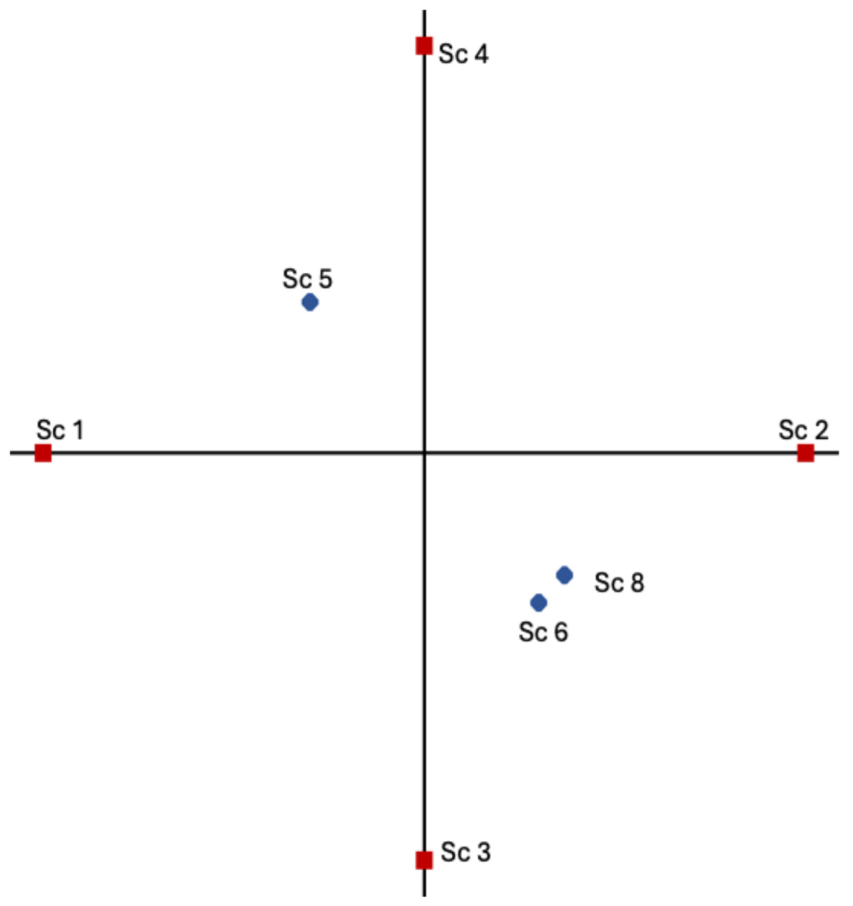
The scenario map shows where the consistent scenarios are located within a two-dimensional space defined by the most discriminating combinations of descriptors. It visually depicts the structural similarities and contrasts among scenarios and helps reveal the main developmental pathways identified by the CIB analysis. As shown in
Figure 3, the four retained scenarios occupy the outer ends of the axes, underscoring their structural distinctiveness: Scenario 1 (A4–M4) lies at one horizontal extreme, Scenario 2 (A2–M2) at the opposite horizontal extreme, Scenario 3 (A1–M1) at one vertical extreme, and Scenario 4 (A3–M3) at the opposite vertical extreme. Other scenarios, such as Scenarios 5, 6, and 8, are positioned along the axes relative to these extremes.
The key differentiating factors are how clearly the value proposition is defined, how deeply MSMEs and local products are embedded in tourism activities, how diversified revenue sources are, the robustness of managerial capacity, and the intensity of networking and partnerships. Scenario 1 represents the most advanced and coherent configuration. Scenarios 2, 3, and 4 are alternative structural states, each with distinct levels of development, stability, and systemic strength. The spatial distance between scenarios thus signals fundamental differences in how the tourism village system is organised, rather than minor performance gaps. The central blue dots indicate additional consistent scenarios that are structurally similar to each other and therefore less distinctive. Overall, the map shows that tourism village development proceeds along a few clearly differentiated pathways, rather than a single, uniform trajectory.
3.5. Scenario Comparison and Leverage Points
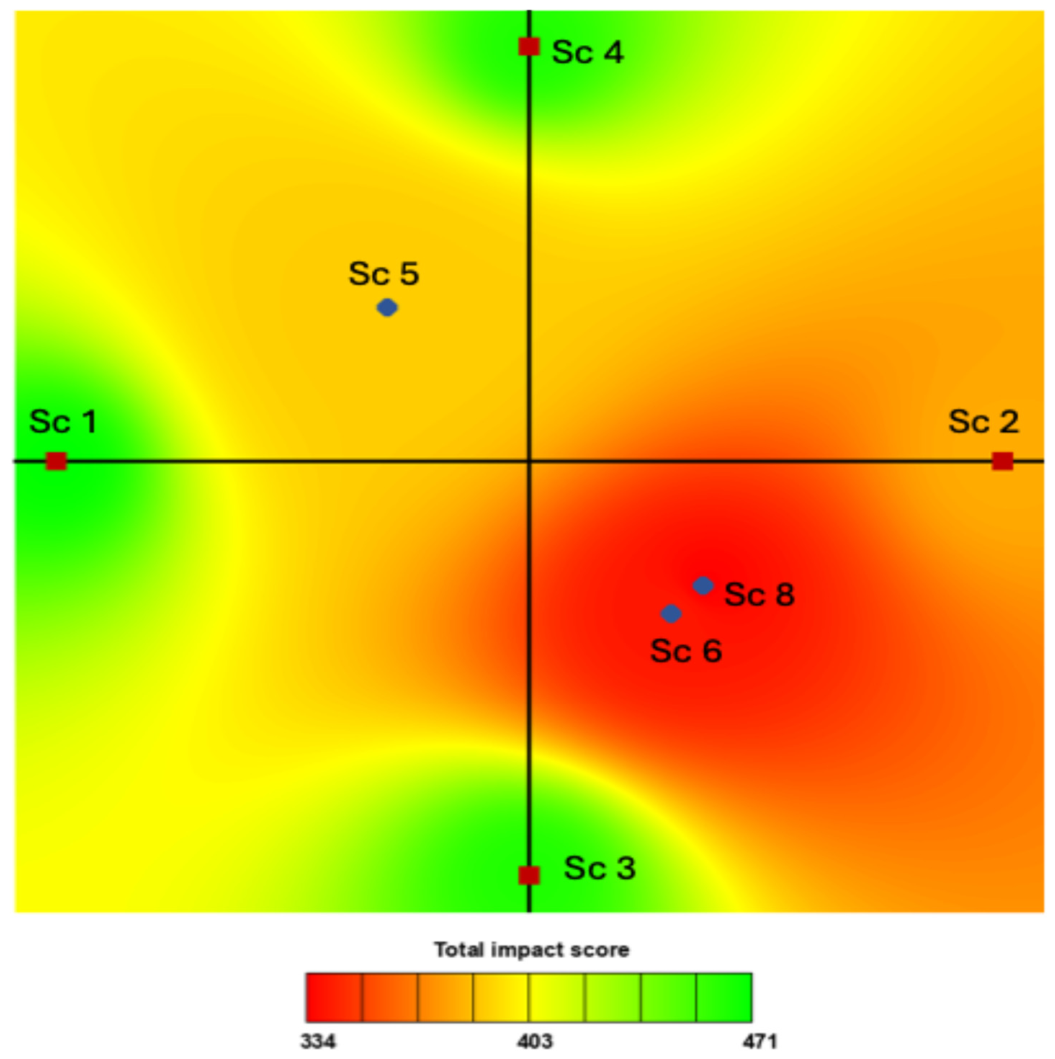
This subsection compares the consistent scenarios to identify their main structural differences and the key leverage points relevant to RQ2. The Total Impact Score (TIS) map positions scenarios according to the magnitude of their systemic impact, using colours from red to green to indicate increasing levels of self-reinforcing influence (
Weimer-Jehle, 2006). Thus, the map not only shows relative scores but also captures the strength of the internal impact structure associated with each scenario.
The TIS map (
Figure 4) shows that Scenario 1 (A4–M4), Scenario 3 (A1–M1), and Scenario 4 (A3–M3) fall in the green zone, indicating high TIS values and strong systemic stability. Among these, Scenario 1 has the highest score, confirming that the high-road configuration is not only the most internally consistent but also the most influential and self-reinforcing. Scenario 3 and Scenario 4, although they share the second-highest score (463), remain inferior to Scenario 1.
In contrast, Scenario 2 (A2–M2) appears in the red–orange zone, reflecting weaker systemic influence and lower overall stability. The remaining consistent scenarios, shown as blue dots, represent additional configurations relative to Scenarios 1–4. For example, Scenario 5 is located in the upper left corner, indicating that its characteristics are similar to those of Scenarios 1 and 4. Likewise, other alternative consistent scenarios with low TIS in the red zone—such as Scenario 6 and Scenario 8, located in the lower right corner—are positioned close to Scenarios 2 and 3.
The comparison suggests that stronger configurations emerge when several descriptors improve together in a coherent way. In particular, the key leverage points are a clear value proposition, MSME and local product integration, diversified revenue streams, capable management, active digital marketing, and strategic partnerships. Strengthening these areas is likely to increase both internal coherence and developmental impact.
The results also show that advanced configurations are not automatically stable. Scenario 4, although more developed than the low-equilibrium pathway, does not match Scenario 1 in systemic strength unless its components are better aligned. This indicates that transition towards a stronger tourism village model depends on coordinated improvement rather than isolated upgrades.
3.6. Pathway Analysis
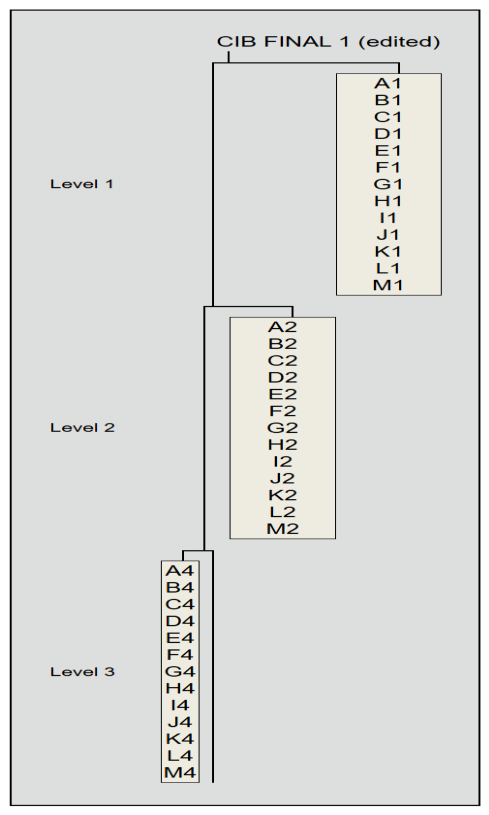
The pathway analysis traces the directional changes shown in the branching tree diagram and explains how the tourism village development system may move from an initial low-equilibrium configuration towards more desirable scenarios. Within the CIB framework, the branching tree is useful because it shows how combinations of descriptor states evolve across levels of development, thereby making the transition logic between scenarios more explicit.
Figure 5 therefore complements the scenario map and TIS analysis by revealing not only which configurations are consistent, but also how movement between configurations may occur.
At Level 1, all descriptors remain at their initial states (A1–M1), representing a low-equilibrium condition. At this stage, the value proposition is unclear and tends to imitate other destinations (A1), integration of MSMEs and local products into tourism packages is minimal (B1), revenue depends mainly on basic sources such as entrance tickets and parking (C1), and the distribution of economic benefits is concentrated in a limited number of actors (D1). Market segmentation is absent (E1), marketing and digital visibility are weak (F1), booking and information systems are unstructured (G1), and visitor experience design remains passive (H1). Managerial business and digital capacity is very limited (I1), core activities and product innovation are weak (J1), and networking and strategic partnerships are almost absent (K1). As a result, competitiveness remains low (L1), and local economic impact is negligible (M1). This level represents a trapped configuration, in which the system is stable but poorly performing.
Level 2 represents an intermediate configuration in which all descriptors move to their second states (A2–M2). Here, the tourism village begins to develop a more general but still weakly articulated value proposition (A2), while MSME integration becomes more visible but remains complementary rather than central (B2). Revenue sources increase but still depend on a limited number of main items (C2), and benefit distribution expands to more residents, although not evenly (D2). Market segmentation, marketing channels, and digital visibility begin to emerge, but remain basic and fragmented (E2, F2). Booking systems and visitor experience design also begin to take shape (G2, H2), managerial capacity is still modest (I2), product innovation is occasional rather than continuous (J2), and partnerships are only starting to form (K2). Competitiveness improves to a moderate level (L2), and local economic impact begins to appear, although it is still limited (M2). This level reflects a realistic transitional stage that many tourism villages may pass through before reaching a more advanced configuration.
Level 3 shows the most advanced combination of states (A4–M4), which corresponds to the high-road scenario identified earlier. At this level, the tourism village has a distinctive and widely recognised value proposition (A4), strong integration of MSMEs and local products into tourism packages (B4), diversified and relatively balanced revenue sources (C4), and transparent benefit-sharing mechanisms that reach most households and village institutions (D4). Market segmentation is clear and professionally managed (E4), marketing channels and digital visibility are active and strategic (F4), booking and information systems are highly structured (G4), and visitor experience design is based on co-creation and engagement (H4). Managers demonstrate strong business and digital capacity (I4), core activities and product innovation are continuous (J4), and networking is extensive and well coordinated across multiple stakeholders (K4). Consequently, competitiveness reaches a very high level (L4), and the tourism village becomes an important driver of local economic impact (M4). This level therefore represents the most desirable pathway, but it also shows that such an outcome requires simultaneous strengthening across multiple descriptors rather than isolated improvement in a single area.
Overall, the branching tree indicates that transformation follows a structured pathway from weak and fragmented configurations towards integrated and competitive ones. The main leverage points are the value proposition, MSME integration, revenue diversification, managerial capacity, networking, competitiveness, and local economic impact. These findings suggest that policy interventions should be sequenced gradually and focused on strengthening these descriptors in a mutually reinforcing manner.
3.7. Main Drivers of the Tourism Village Development System
The main drivers of the tourism village development system are the descriptors that exert the greatest structural influence on the cross-impact network. They are not independent variables, but mutually connected elements whose interactions shape the direction of change in tourism village development. Based on the active–passive analysis, four descriptors emerged as the main drivers: K, C, A, and M. Their influence values indicate that these descriptors differ in their roles within the system, with K acting as the strongest active driver, C functioning as a key connector, A providing identity differentiation, and M operating primarily as a reinforcing outcome with feedback effects (
Table 3).
Among these, K—networking and strategic partnerships—emerged as the strongest driver. Its highest total and active values indicate that it occupies a central position in the influence network and acts as a hub connecting the tourism village with external actors, resources, and market opportunities. When networking is strong, it can stimulate other dimensions such as marketing channels, digital visibility, core activities, product innovation, and market access. At the same time, its substantial passive value shows that networking is also shaped by the quality of the village’s value proposition, revenue structure, and competitiveness. This means that partnerships should be understood not as an optional programme component, but as a structural condition for tourism village development.
C—diversification of revenue sources—ranked second and showed a balanced active and passive profile. This suggests that revenue diversification functions as a connecting variable between product development and benefit distribution. A tourism village that depends only on entrance fees or parking tends to have limited development capacity, whereas a village that combines homestays, educational packages, culinary products, local goods, and experience-based activities is more likely to generate a broader economic multiplier effect. Its influence is therefore both economic and structural: it supports sustainability, strengthens local enterprises, and improves the distribution of benefits within the village. For this reason, development programmes should focus on building a portfolio of revenue sources rather than relying on a single income stream.
A—uniqueness of value proposition—ranked third and plays a defining role in shaping the identity of the tourism village. A clear and distinctive value proposition gives the village a recognisable place in the market and provides the basis for product packaging, storytelling, segmentation, and promotion. When this descriptor is strong, it tends to activate other elements of the system, including thematic MSMEs, visitor experience design, and digital marketing. Its relatively high passive value also indicates that the value proposition cannot be imposed in a top-down manner; rather, it emerges through interactions among local assets, product innovation, community participation, and external linkages. This makes A a key driver of differentiation and market positioning.
M—local economic impact—ranked fourth. Although it is often treated as an outcome variable, its influence values show that it also functions as a reinforcing driver in the system. A stronger local economic impact increases community confidence, investment capacity, and bargaining power, which in turn can support innovation, collaboration, and further development. In mature scenarios, M becomes part of a virtuous cycle: as the tourism village contributes more strongly to the local economy, the system gains more capacity to strengthen partnerships, diversify activities, and improve competitiveness. This dual role means that M should be treated both as a development outcome and as a feedback variable that helps sustain long-term transformation.
Taken together, these four descriptors form the backbone of the tourism village development system. They explain why the scenario structure differs across the low-equilibrium, emerging, advanced, and high-road pathways identified in the previous sections. In practical terms, the findings suggest that development strategies should prioritise the strengthening of value proposition, revenue diversification, networking, and local economic impact as mutually reinforcing leverage points.
The four driving descriptors are not independent variables but form a mutually reinforcing system. K creates relational access to markets, partners, and resources, which enables A to be recognised and operationalised in the market. A, in turn, gives meaning and differentiation to C by shaping the type of products and services that can be monetised. C converts this identity into multiple revenue streams, which strengthen M through wider benefit distribution and higher local multipliers. M then feeds back into the system by improving community confidence, investment capacity, and institutional legitimacy, thereby reinforcing K and A. The differences in influence values show that K has the strongest active role, C functions as the main connector, A provides identity differentiation, and M acts primarily as a reinforcing outcome with feedback effects. Together, these descriptors explain not only the direction of change but also the relative weight of each driver in shaping tourism village competitiveness and local economic development.
4. Discussion
4.1. Main Findings and Novelty
This study demonstrates that tourism village competitiveness and local economic development are shaped not by isolated factors, but by a coherent configuration of mutually reinforcing descriptors. The CIB analysis identified the high-road configuration, A4–M4, as the most stable and systemically strong pathway, whereas the other scenarios represented lower or transitional development states. This finding is consistent with prior research showing that tourism village competitiveness is multidimensional and contingent on the interaction of identity, management capacity, market positioning, and local enterprise participation. The present study advances this literature by showing more explicitly how these elements operate as a system rather than as separate determinants (
Ariyanto et al., 2026).
The main novelty of this study lies in identifying the structural drivers of tourism village development through scenario consistency and influence patterns, rather than relying solely on conventional performance indicators. In particular, the active–passive analysis highlighted four principal drivers: uniqueness of value proposition (A), diversification of revenue sources (C), networking and strategic partnerships (K), and local economic impact (M). This differs from much of the existing literature, which tends to focus on visible destination attributes or operational performance measures. By contrast, the present findings suggest that the more fundamental issue is the extent to which these elements are aligned within a coherent development structure (
Bader, 2025).
4.2. Comparison with Tourism Village Competitiveness Studies
Earlier studies on tourism village competitiveness generally emphasise attractions, accessibility, amenities, service quality, community participation, and digital promotion. These studies have been valuable in identifying relevant performance dimensions, but many remain descriptive and do not fully explain how one dimension shapes another. The present findings address this limitation by showing that competitiveness emerges from the interaction among value proposition, MSME integration, revenue diversification, managerial capacity, networking, and local economic impact (
Muryanti, 2023).
A key difference from prior studies is that the present analysis shows why partial improvements often generate only limited gains. For example, better marketing or stronger infrastructure alone does not necessarily produce high competitiveness if the village lacks a clear identity, diversified income streams, or effective partnerships. In this respect, the study responds to a recurring limitation in the literature: the tendency to treat competitiveness as a set of independent indicators rather than as a system of interdependent relations. The high-road scenario identified here demonstrates that competitiveness becomes robust only when the core descriptors evolve together in a consistent configuration.
4.3. Comparison with Scenario Planning and CIB Studies
The findings are also consistent with previous scenario planning studies, which show that tourism futures are shaped by interacting drivers and by the way uncertainties combine over time. However, many scenario-based tourism studies stop at identifying alternative futures and do not fully explain the mechanism through which specific drivers interact to produce those futures. This study contributes to that discussion by using Cross-Impact Balance to identify not only consistent scenarios, but also the structural relationships that make them internally coherent.
Compared with earlier applications of CIB, this study places greater emphasis on the developmental meaning of the scenarios. Previous CIB studies have often focused on selecting the most plausible future configuration. Here, the method is used to explain how the interaction among A, C, K, and M shapes the trajectory from low-equilibrium to high-road development. This is important because it shows that CIB is not only a scenario-selection tool, but also a way to uncover the structural logic of tourism village transformation.
These studies (e.g.,
Yeoman, 2012;
Daniel Scott et al., 2012;
Dwyer et al., 2020;
Page et al., 2025;
Postma & Yeoman, 2020) consistently show that tourism futures arise not from single trends, but from the interaction of multiple drivers and from how critical uncertainties (economic, technological, political, environmental, social) combine and unfold over time within scenario frameworks.
4.4. Research Gap and Contribution
The literature on tourism village development still has two major gaps. First, many studies discuss competitiveness and local economic development separately, even though they are closely linked in practice. Second, existing studies often identify important factors, but do not sufficiently explain how those factors interact to generate development pathways. This study addresses both gaps by integrating competitiveness and local economic development within a single scenario-based framework and by showing that the two are connected through a small number of mutually reinforcing descriptors.
The study also contributes to the literature by showing that local economic development is not merely an outcome of tourism growth, but part of a feedback system. In mature configurations, local economic impact strengthens community confidence, investment capacity, and bargaining power, which in turn reinforce partnerships, innovation, and competitiveness. This feedback logic is essential for understanding why some tourism villages progress while others remain trapped in low-equilibrium states.
4.5. Meaning for Local Economic Development
The findings suggest that local economic development in tourism villages depends on system coherence rather than isolated intervention. The high-road scenario shows that substantial economic benefits emerge only when a clear value proposition, strong MSME integration, diversified income sources, inclusive benefit distribution, capable management, and strategic partnerships are aligned in one configuration. By contrast, partial improvements in only one or two areas tend to produce moderate competitiveness and limited local economic gains.
This means that tourism village development should be understood as a process of building an integrated local economy, not merely increasing tourist arrivals or short-term revenue. A distinctive identity attracts the market, diversified revenue spreads economic opportunities, partnerships expand access to resources, and local economic impact strengthens the village’s capacity to sustain further development. In this sense, local economic impact is not only an outcome, but also part of a reinforcing cycle that supports future competitiveness.
4.6. Policy and Managerial Implications
The results imply that policy support should move beyond infrastructure-only approaches and focus more strongly on the system elements that generate coherence. Priority should be given to strengthening the uniqueness of value proposition, MSME and local product integration, revenue diversification, managerial and digital capacity, and networking and strategic partnerships. These are the leverage points most likely to shift tourism villages from business-as-usual trajectories towards more advanced and locally beneficial development pathways.
From a managerial perspective, tourism village development should be treated as an orchestration of the entire value system. Village managers need to align product design, local enterprise participation, revenue models, digital marketing, booking systems, and partnerships in a coordinated way. When these elements are managed as a single development structure, tourism villages are more likely to achieve both competitiveness and local economic benefits.
5. Conclusions
This study identified the scenario configurations most conducive to strengthening tourism village competitiveness and local economic development, and clarified the system elements that function as the principal drivers and leverage points. Using the Cross-Impact Balance approach, the analysis generated four internally consistent scenarios, among which the high-road configuration, A4–M4, emerged as the most robust pathway because it combined the highest consistency with the strongest systemic support for competitiveness and local economic impact.
The results show that tourism village development depends not on isolated improvements but on a coherent configuration of mutually reinforcing descriptors. The most influential drivers are the uniqueness of the value proposition, diversification of revenue sources, networking and strategic partnerships, and local economic impact. When these elements are aligned with strong MSME integration, managerial and digital capability, and effective governance, tourism villages are more likely to sustain competitiveness and generate wider local economic benefits.
This study contributes a scenario-based framework that conceptualises tourism village development as a structural system rather than a set of independent indicators. The main practical implication is that policy and management should prioritise system coherence through stronger identity building, diversified revenue design, partnership development, and institutional capacity strengthening. Future research should test these scenario pathways through longitudinal and comparative studies in other tourism village contexts.