Article

Is My Pet a Travel Partner? Understanding How Pet Owners’ Tourism Constraints Shape Travel Intention Through Learned Helplessness


by
Fulden Nuray Küçükergin
Department of Tourism Guiding, Faculty of Tourism, Ankara Hacı Bayram Veli University, Ankara 06830, Turkey
Tour. Hosp. 2026, 7(4), 108; https://doi.org/10.3390/tourhosp7040108
Submission received: 3 March 2026 / Revised: 4 April 2026 / Accepted: 6 April 2026 / Published: 13 April 2026

Abstract

Given the growing popularity of pet ownership, this study aimed to examine the effects of pet owners’ tourism constraints on learned helplessness, travel avoidance with pets and behavioural intentions to travel with pets. The relationship between learned helplessness and travel avoidance with pets was also analysed. More importantly, the serial paths from pet owners’ tourism constraints to travel intentions with pets were tested. Considering the importance of decision-making style (i.e., head vs. heart), it was used as a moderator. Data were collected in Türkiye from 341 pet owners who owned at least one dog, one cat, or both. Data analysis was conducted using PLS-SEM. The results showed that the indirect effects of the pet’s specific constraints, the pet’s interpersonal constraints, and the pet’s structural constraints on behavioural intention to travel with pets via learned helplessness and travel avoidance were significant. However, decision type did not have a moderating role. Both pet attachment and guilt over leaving pets alone had positive and significant effects on behavioural intention to travel with pets. The findings contributed to the understanding of both pet owners’ tourism constraints and learned helplessness through examining serial mediation paths.

1. Introduction

The global tourism and hospitality industry is constantly being reshaped by socio-demographic transformations and profound shifts in consumer behaviour of the 21st century (Moral-Cuadra et al., 2025; Veas-González et al., 2025). One of the most pronounced and statistically measurable of these transformations is the evolution in household structures and the rising rates of pet ownership that accompany it (Albert & Bulcroft, 1988; Ramos-Ruiz et al., 2024). The Travel Trends 2026 report, published by Amadeus and analysing the macro trends that will shape the future of the global travel industry, has introduced the concept of ‘The Pawprint Economy’ into the literature. According to the report, the global pet industry is projected to reach a volume of US $500 billion by 2030, with a significant proportion of travellers planning their holidays with the well-being of their pets at the centre. In developed markets such as the UK and the US, 27% of pet owners are expected to travel with their pets for the first time by 2025, and the aviation and hospitality sectors are developing specialised loyalty programmes (such as AKA Hotels’ Canine Club initiative) and in-cabin travel arrangements tailored to this demographic (Amadeus, 2026).
A clearer understanding of the extent of this sociological transformation in Türkiye can be gained by examining the latest figures on pet ownership and the pet population. The requirement for pets to be registered via microchipping in Türkiye came into force in 2021; according to data from the Ministry of Agriculture and Forestry’s Pet Registration System (PETVET), there are approximately 2.5 million officially registered cats and dogs in Turkish households (Çelik et al., 2025). However, as the registration system is still very new, it is stated that these official figures may not fully reflect the actual population and that the number is likely much higher (Çelik et al., 2025). Indeed, data published by the Federation of the European Pet Food Industry (FEDIAF) indicate that there are approximately 4.7 million pet cats and 1.4 million pet dogs in Türkiye (FEDIAF, 2025; Rowan & Rowan, 2024).
With the rise in pet ownership, it is possible people to see their pets as their best friends (Zilcha-Mano et al., 2011) and one of their family members (Kim et al., 2025; Meehan et al., 2017). Furthermore, pet owners may wish to spend their leisure time with their pets (Carr & Cohen, 2009). In other words, pets can be seen as “travel partners” (Ying et al., 2021, p. 1). Even if there is an increase in pet ownership, travel decisions can be affected by several constraints (H. J. Chen et al., 2013; Dilek et al., 2020; Nyaupane & Andereck, 2008). It should be noted that travelling always is not a suitable option for some pets (Crozet et al., 2022; Uchendu et al., 2022). However, tourism studies analysed several constraints. For instance, Popp et al. (2024) revealed that financial restrictions were very widespread constraints among non-travellers. Other studies also have shown that travel constraints may shape traveller’s evaluations and intentions (e.g., H. J. Chen et al., 2013; Mangoch et al., 2025). More specifically, although the pets are family members (Meehan et al., 2017), owning a pet may lead potential tourists to feel helplessness by creating travel constraints (Ying et al., 2021). However, research focusing on the effect of pet owners’ travel constraints on learned helplessness is scarce, indicating a research gap. Furthermore, van der Merwe et al. (2026) found that some factors of dog owners’ perceived pet constraints had a negative effect on participation in tourism activities, whereas other studies did not indicate a significant effect (Quan et al., 2024; Ying et al., 2021). Hence, this study aims to shed light on this issue by analysing the direct effect mentioned. In a different context, the mechanism from travel constraints to intention travel via learned helplessness and travel avoidance was tested, but serial mediation was not analysed (Wang & Yoon, 2025). This indicates a research gap. To understand how travel constraints shape the travel intentions of pet owners, this study investigates the serial mediation effects.
The attachment between pet owners and their pets has been studied (Meehan et al., 2017; Yilmaz, 2023). However, the role of this attachment in travelling with pets has not been sufficiently studied except for some studies (Tang et al., 2022; van der Merwe et al., 2026). In fact, going on holiday with pets is seen as a difficult decision, since people may be highly attached to their pets (A. H. Chen et al., 2011). Therefore, the research model of this study examines the relationship between pet attachment and travel intention with pets. Beyond this, some pet owners may feel guilty about leaving their pets at home (Kogan et al., 2022). When they visit tourism destinations, they sometimes need to leave their pets for more than 24 h. This situation may potentially trigger feelings of guilt among tourists. For instance, Dilek et al. (2020) found that avoiding feelings of guilt due to leaving pets behind was one of the factors for travelling with pets. However, to the best of the author’s knowledge, the guilt over leaving pets alone has not been integrated into research models, except the study by Kim et al. (2025). By integrating the guilt over leaving pets alone into the research model, the dynamics of travelling with pets will be clearer. Finally, it can be expected that the bond between the owner and pet may affect their decision-making style (head vs. heart). Thus, this study analyses the moderating effect of decision-making style (head vs. heart), which was tested in different contexts (Shiv & Fedorikhin, 1999). The absence of these concepts in current research highlights a significant gap in the literature.
The contributions of this study can be summarised in two main points. First, drawing on learned helplessness theory (Seligman, 1975), Lee et al. (2012) underscore that if a person repeatedly encounters an obstacle, they come to believe that the situation cannot be resolved and begin to avoid that behaviour. The conceptual framework of leisure constraints posits that constraints may limit people (Crawford & Godbey, 1987). Building on this background, the present study aims to contribute theoretically by examining the significance of serial pathways from constraints to behavioural intention via learned helplessness and travel avoidance for pet owners. Hence, learned helplessness and tourism constraints are analysed in a model through a series of integrated steps. Although similar models have been tested in different contexts (Yoon & Wang, 2025), serial mediation has not been investigated. Second, the moderating effect of decision-type (head vs. heart) has not been considered in previous studies, although the emotional bond between pets and owners has been emphasized in some studies (Meehan et al., 2017; Yilmaz, 2023). This study aims to contribute to the existing literature by demonstrating whether decision-making style is an important variable when travelling with pets. Similarly, the decision to travel with pets can be examined more accurately under the influence of attachment and guilt over leaving pets alone, which makes the problem fully complex. In fact, it is possible to argue that examining travel with pets through a single perspective may present an incomplete picture.

2. Literature Review

2.1. Pet Owners’ Tourism Constraints

Although the tourism industry welcomes millions of tourists (World Tourism Organization, 2024), some people may still suffer from general or specific tourism constraints (Melo & Gomes, 2017; Popp et al., 2024; Ying et al., 2021). These constraints are in the centre of analysing travelling intentions (Popp et al., 2024). In their seminal paper, Crawford and Godbey (1987) suggested a conceptual framework for leisure barriers that focused on family leisure participation. Three types of barriers were identified: intrapersonal, interpersonal, and structural barriers. By advancing their conceptual framework, several studies analysed different types of travel constraints and tested their effects on different concepts (e.g., Funk et al., 2009; Nyaupane & Andereck, 2008; Zhang et al., 2016).
Potential tourists who own pets may encounter difficulties in their travel plans. Although some studies analysed the role of pets in tourism activities (Carr & Cohen, 2009; Dotson et al., 2010), A. H. Chen et al. (2014)’s comprehensive study shed light on these constraints through a scale development process, which suggests three main constraints. The first construct, pet’s specific constraints, is about the pet’s abilities, such as having self-control. The second, the pet’s interpersonal constraints, refers to the reactions of others to pets. Third, the pet’s structural constraints, signifies the additional efforts required to bring pets along on tourism activities, such as time consumption and lack of information. Moreover, structural barriers included items indicating the absence of a nearby destination and destinations which are not suitable for pets (A. H. Chen et al., 2014).

2.2. Pet Owners’ Tourism Constraints and Learned Helplessness

Travel constraints may lead people to feel restricted and helpless. Indeed, some studies integrated learned helplessness to their conceptual models (Lee et al., 2012; Wang & Yoon, 2025; Ying et al., 2021). Learned helplessness is about “learning that an aversive event cannot be avoided or escaped” (Martin et al., 2013, p. 502) and “the feeling of powerlessness” (Kara & Min, 2024, p. 129). Lee et al. (2012), based on the theory of learned helplessness (Seligman, 1975), stated that when a person is restricted from behaving freely, it is possible for them to behave in a more determined way. However, the authors argued that “if they are repeatedly prevented from doing so”, they may believe that the situation cannot be resolved. Hence, in order not to experience unpleasantness, they may give up trying to accomplish it and may feel helpless (Lee et al., 2012, p. 572). Although their study was intended to understand the travel constraints faced by individuals with disabilities, it provides a sound background for analysing the effects of constraints experienced by pet owners on learned helplessness.
To offer a framework for constraint negotiation in the context of travelling with pets, Ying et al. (2021) found several themes including learned helplessness. They underscored that, when potential tourists are restricted by pet-related constraints, they may perceive it as a hopeless situation, thereby leading to learned helplessness. Furthermore, their quantitative study indicated that all factors of pet’s specific constraints separately and positively affected learned helplessness. Work by Lee et al. (2012) discovered that, while helplessness was influenced by intrinsic and environmental constraints, it was not significantly influenced by interactional constraints. This study focused on people with disabilities. In a different context, Wang and Yoon (2025) displayed that structural constraints did not affect learned helplessness, whereas interpersonal constraints, interactional constraints and intrinsic constraints positively and significantly affected learned helplessness in the context of family travel. It should be emphasised that the participants were parents of young children. Wen (2020) studied parents travelling with their children and found that travel constraints may stimulate helplessness. In another context, it was found that young Indian consumers’ perceived constraints for mindful consumption in buying fashion products triggered a positive effect on learned helplessness (Kour et al., 2025). Wen et al. (2020) found that only perceived incapability, which is one of four different constraints determined in their study, positively affected learned helplessness. It is important to note that having children, being a person with disabilities, or owning a pet might not entail similar types of constraints or emotions. Nonetheless, these findings indicate that, with some exceptions, constraints may impact learned helplessness. Thus, these hypotheses were proposed:
H1a: 
Pet’s specific constraints positively affect learned helplessness.
H1b: 
Ppet’s interpersonal constraintspositively affect learned helplessness.
H1c: 
Pet’s structural constraints positively affect learned helplessness.

2.3. Pet Owners’ Tourism Constraints, Travel Avoidance with Pets, and Behavioural Intentions to Travel with Pets

Along with the emergence of constraints and learned helplessness (Ying et al., 2021), avoidance may emerge as a factor, as well as different ways of coping with the situation (Lazarus & Folkman, 1984). At an extreme point, it may correspond to a self-protective mechanism against travel associated with touraphobia (Braun et al., 2026). Braun et al. (2026) argued, based on a review of the literature (e.g., Çakar, 2021; Elliot, 2006; Farmaki et al., 2019), that avoidance and intention to travel differ in three key aspects. Braun et al. (2026) stated that avoidance requires an active decision, is related to pre-emptive protection, and may arise under the influence of negative emotions. Additionally, it was mentioned that a lack of intention can be emotionally neutral. Simply, while travel avoidance is associated with postponing or even forgoing travel opportunities, travel intention is a concept related to the willingness to travel in the future (Yoon & Wang, 2025). Behavioural intention to travel with pets was covered in terms of desire to travel with a pet in the future and the potential contribution a pet could make to the overall vacation experience (Quan et al., 2024). Thus, they are considered two different concepts in tourism studies (Braun et al., 2026; Wang & Yoon, 2025).
Research on the effect of constraints on travel intentions yielded different results. More specifically, Ying et al. (2021) did not show any significant effects of the factors of pet owners’ tourism constraints on their intention to travel with the pets. A recent study, which compared pet owners and non-pet owners, revealed that perceived pet constraints had no impact on behavioural intention with pet(s) for pet owners, whereas this impact was significant and positive for non-pet owners. However, the invariance test did not indicate a significant difference (Quan et al., 2024). Contrary to these findings, another study showed that perceived pet constraints for dog owners negatively affected participation (Hung et al., 2016). Recently, a study conducted to analyse dog owners’ intention to travel with their pets displayed that pet’s specific constraints and structural constraints directly and negatively impacted pet tourism intention, while interpersonal constraints were not found to be related to pet tourism intention (van der Merwe et al., 2026).
In order to widely analyse how travel constraints shape travel intention, studies conducted in different contexts of tourism were examined. For instance, Li et al. (2025) showed that external constraints negatively affected revisit intention, whereas internal constraints did not affect it. Another study found that travel constraints had a negative effect on travel intention for women in the context of mountaineering-based adventure tourism (Mangoch et al., 2025). A study conducted with potential visitors to India revealed that interpersonal constraints and intrapersonal constraints had significant negative effects on visit intention, whereas structural constraints did not have a significant effect (Khan et al., 2019). Although these studies showed that the aforementioned relationships do not always lead to similar results, it can be expected that pet owners’ tourism constraints may increase travel avoidance with pets, and reduce behavioural intention to travel with pets. Given this background, these hypotheses were suggested:
H2a: 
Pet’s specific constraints positively affect travel avoidance with pets.
H2b: 
Pet’s interpersonal constraints positively affect travel avoidance with pets.
H2c: 
Pet’s structural constraints positively affect travel avoidance with pets.
H3a: 
Pet’s specific constraints negatively affect behavioural intention to travel with pets.
H3b: 
Pet’s interpersonal constraints negatively affect behavioural intention to travel with pets.
H3c: 
A pet’s structural constraints negatively affect behavioural intention to travel with pets.
Although travel avoidance is not always a significant predictor of travel intentions (Kucukergin & Kiliclar, 2025), for pet owners, it can be expected that travel avoidance and behavioural intention to travel with pets are related. The potential tourist’s avoidance of travelling may be a significant factor in certain situations, as has been observed during the COVID-19 period (Agag et al., 2024). To support this argument, there is research showing that travel avoidance has a negative impact on intentions. For instance, Wang and Yoon (2025) indicated that travel avoidance negatively affected travel intention. To distinguish between a decrease in travel intentions and travel avoidance, Braun et al. (2026) conducted studies and found that general travel avoidance and short-term travel avoidance were correlated with the intention to travel. Hence, the following hypothesis was suggested:
H4: 
Travel avoidance with pets negatively affects behavioural intention to travel with pets.

2.4. Learned Helplessness and Travel Avoidance with Pets

Consumer behaviour and tourism studies have analysed how learned helplessness shapes several outcome variables. In fact, learned helplessness may cause the potential intention regarding this feeling to become less likely to occur (Kara & Min, 2024; Kour et al., 2025; Wang & Yoon, 2025). Put simply, learned helplessness may cause people to be passive, thereby decreasing their intention to pursue the relevant behaviour (Kara & Min, 2024). Although this study considers avoidance and behavioural intentions as two related but separate concepts, it is noteworthy to mention that Ying et al. (2021) found a negative effect of learned helplessness on intentions to travel with pets. Another study indicated that learned helplessness positively affected travel avoidance (Wang & Yoon, 2025). To predict residents’ hosting intention in peer-to-peer accommodation, Mahajan et al. (2025) used learned helplessness, among other variables, and revealed that learned helplessness negatively impacted the hosting intention. Considering this background, the following hypothesis was suggested:
H5: 
Learned helplessness positively affects travel avoidance with pets.

2.5. Pet Attachment and Behavioural Intention to Travel with Pets

The relationship between pet owners and their pets can be analysed through the concept of attachment (Meehan et al., 2017). An attachment can form between pets and owners based on a sense of acceptance and love. This can foster confidence in the support that can be provided by the pet when needed. Individual differences in pet attachment can affect the behaviour of pet owners (Zilcha-Mano et al., 2011). This may especially be seen in the formation of behavioural intentions to travel with pets. Given the existing body of knowledge, Hung et al. (2016) pointed to the negative impact of constraints on travel intention, while referring to the expected positive impact of pet attachment and testing its effect on motivation. Yilmaz (2023) showed that when higher emotional attachment to pets was observed, it is more likely to see a higher possibility of travelling with pets. A study found that, for Chinese pet owners who travelled with their pets, pet attachment was positively related to intention to travel with pets (Tang et al., 2022). van der Merwe et al. (2026) considered pet attachment, perceived travel benefits for dogs, and reciprocity as bond-related motives, which are part of a dual-category motivation concept. It should be noted that the authors also included owner-related motives. They collected a data sample from South African dog owners and found that pet attachment had a positive effect on pet tourism intention. To sum it up, research suggests that attachment may have a negative impact on leaving the pet behind when travelling. Taking this background information into account, the following hypotheses were suggested:
H6: 
Pet attachment positively affects behavioural intention to travel with pets.

2.6. Guilt over Leaving Pets Alone and Behavioural Intention to Travel with Pets

When tourists embark on holidays, they frequently encounter the challenge of leaving their pets behind. This decision may evoke feelings of guilt and a strong sense of longing for their pets, among other emotional responses. Consequently, these sentiments may lead them to reduce the length of their vacations (Yilmaz, 2023). Despite the importance of pet owners’ guilt (Kogan et al., 2022), research on guilt and travel intentions is scarce. For instance, a recent study by Kim et al. (2025) demonstrated that unaccompanied guilt positively affected the intention to travel with pets. Tang et al. (2022) developed a scale regarding pet owners’ motivations for travelling with them. One of these factors is compensation and reciprocation. The authors underscored that travelling with pets may decrease their feeling of guilt about spending time without their pets while at work. To avoid feeling guilt, pet owners may consider travelling with their pets. Hence, this hypothesis was proposed:
H7: 
Guilt over leaving pets alone positively affects behavioural intention to travel with pets.

2.7. The Serial Mediation Mechanism from Pet Owners’ Tourism Constraints to Behavioural Intention to Travel with Pets

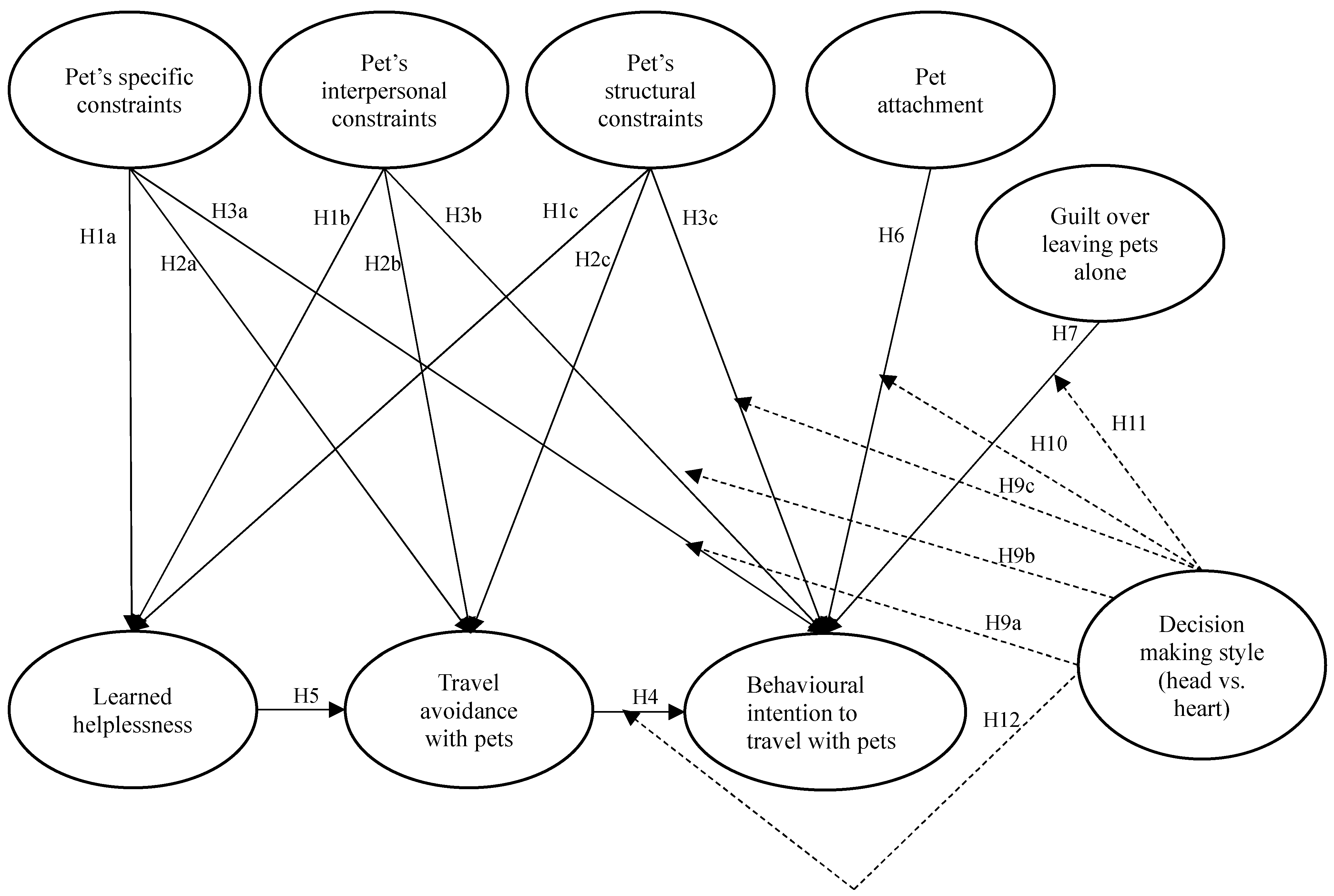
Apart from the direct effect of constraints on intentions, analysing the serial mediation paths from pet owners’ tourism constraints to behavioural intention to travel is important. Seligman (1975) claimed that it can be learned that the outcome is not related to the responses of the person and, the expectation is the “causal condition” of it (Seligman, 1975, p. 48). Parallel to this, Ying et al. (2021) stated that constraints are not expected to directly lead to travel intentions, although they may be impactful via negative emotions. According to the authors, these emotions can be understood based on learned helplessness. This finding by the authors suggests a mediation path. They indicated that helplessness may reduce a pet owner’s sense of freedom, thereby diminishing intention to travel with pets. Moreover, they observed that learned helplessness was a significant mediator in the relationship between pet-related tourism constraints and intention to travel with pets. The conceptual model of this study (see Figure 1) included a sequential mediation mechanism from pet owners’ tourism constraints to behavioural intention to travel with pets via learned helplessness and travel avoidance with pets. Yoon and Wang (2025)’s model included the same mechanism used in the current study in a different context. They declared that constraints did not have any indirect effect on travel intention via learned helplessness. However, they emphasized that constraints were considered key predictors of learned helplessness. Learned helplessness had the potential to convert these constraints into travel avoidance and reduce intention. It should also be noted that avoidance and intentions are not the same concepts (Braun et al., 2026). Theoretical explanations regarding the leisure constraints (A. H. Chen et al., 2014; Crawford & Godbey, 1987) and learned helplessness (Seligman, 1975; Ying et al., 2021) provide a sound theoretical framework and testing opportunity for understanding how pet owners’ tourism constraints influence their behavioural intention to travel with pets (i.e., pet owners’ tourism constraints -> learned helplessness -> avoidance of travelling with pets -> behavioural intention to travel with pets). This showed that there is an important research gap regarding the serial mediation mentioned above, which was not tested in previous studies. Hence, this study aimed to test a sequential mediation mechanism based on these hypotheses:
H8a: 
Learned helplessness and travel avoidance with pets sequentially mediate the impact of pet’s specific constraints on behavioural intention to travel with pets.
H8b: 
Learned helplessness and travel avoidance with pets sequentially mediate the impact of pet’s interpersonal constraints on behavioural intention to travel with pets.
H8c: 
Learned helplessness and travel avoidance with pets sequentially mediate the impact of pet’s structural constraints on behavioural intention to travel with pets.
Figure 1. Conceptual model.
Tourismhosp 07 00108 g001

2.8. The Moderating Role of Decision-Making Style (Head vs. Heart)

It is crucial to understand how tourists make their decisions (McCabe et al., 2016). Given the nature of tourism, it is accurate to describe the tourist’s decision-making mechanism as complex. In fact, tourists may have to make several decisions when planning their future holiday and during their holiday. More importantly, a significant portion of what may occur during the experience cannot be predicted (McCabe et al., 2016; Smallman & Moore, 2010). Decision-making regarding holidays can be seen as being more difficult for pet owners. As explained above, they may be undecided about taking pets on holiday for several reasons. Considering the bond between pet owners and their pets (Azkona, 2025; Lopes et al., 2026), it is important to understand how potential tourists shape their travel intentions with pets in terms of emotions and rationality. Although they may be described in different terms, emotions can be seen as the driving force behind the decision-making process (Lerner et al., 2015). Pets may provide several positive psychological benefits, as well as physical benefits (McConnell et al., 2011). It is possible to view pets as an emotional extension of their owners. In other words, they may be “emotionally involved” with their owners (Hirschman, 1994, p. 622). Analysing consumer decisions based only on their cognitions may not explain whole details of the entire process (Shiv & Fedorikhin, 1999). Hence, this study aims to discover how decision-making style (head vs. heart) moderates the effects of the variables which are expected to affect the behavioural intention to travel with pets, suggesting the following hypotheses:
H9a: 
Decision-making style (head vs. heart) moderates the relationship between pet’s specific constraints and behavioural intention to travel with pets.
H9b: 
Decision-making style (head vs. heart) moderates the relationship between a pet’s interpersonal constraints and behavioural intention to travel with pets.
H9c: 
Decision-making style (head vs. heart) moderates the relationship between a pet’s structural constraints and behavioural intention to travel with pets.
H10: 
Decision-making style (head vs. heart) moderates the relationship between pet attachment and behavioural intention to travel with pets.
H11: 
Decision-making style (head vs. heart) moderates the relationship between guilt over leaving their pet alone and behavioural intention to travel with pets.
H12: 
Decision-making style (head vs. heart) moderates the relationship between travel avoidance with pets and behavioural intention to travel with pets.

3. Methods

3.1. Measurement Instrument

Since participants who owned at least a dog, a cat, or both joined this study, the term pet was used to include these pets, although some of the original items were developed considering dogs only. A screening question was used to ensure that only dog and/or cat owners joined this study. Thus, the items were revised for these types of ownerships. Other details are provided in the sampling and sample profile section. Unless otherwise stated, a 7-point Likert scale was used to measure the items (see all the items in Table A1). In order to measure pet owners’ tourism constraints, the Pet Owners’ Tourism Constraints Scale, which was developed by A. H. Chen et al. (2014), was slightly adapted to the context of this study. This scale consists of three factors: pet’s specific constraints (4 items), pet’s interpersonal constraints (3 items), and pet’s structural constraints (6 items). Pet attachment was measured with a 6-item scale adapted by Hidalgo-Fernández et al. (2023). These items were prepared for people who own dogs. Therefore, they were adapted to consider all pet owners. Five items were borrowed from the study by Ying et al. (2021) to measure learned helplessness. The authors benefited from Lee et al. (2012)’s study to prepare these items. Following the instructions of Bruner (2013), based on the study by Shiv and Fedorikhin (1999), in which the items were adapted from other studies, decision-making style (head vs. heart) was measured with 5 items using a 7-point scale for general decision-making situations. The lowest value represented the purely logical side, while the highest value represented the purely emotional side. Guilt over leaving pets alone was measured by adapting two items of the dog owner’s guilt items (Kogan et al., 2022) into the context of this study. Other guilts on the scale generally encompass other guilts related to pets. To measure travel avoidance with pets, three items were adapted from the study by Wang and Yoon (2025). The authors prepared the items based on the study by Ying et al. (2021); however, their focus was on travelling with children. Hence, these items were adapted to fit the context of this study. Behavioural intention to travel with pets was assessed with three items from the study by Quan et al. (2024), who benefited from of the study by Ying et al. (2021). An instructional manipulation check question (i.e., asking participants to select “4”) was used to avoid problems such as straight lining (F. Kock et al., 2019; Paas et al., 2018). In addition to these questions, other questions were also included to measure demographics and other variables. The back-translation was used to convert the items into their Turkish version (Brislin, 1976). Also, two experts provided opinions to ensure that the items were clear and appropriate for their intended purpose. Common method bias was controlled through a full collinearity procedure recommended by N. Kock and Lynn (2012). It was seen that VIF values were between 1.389 and 1.922, thereby showing that CMB was not observed (N. Kock & Lynn, 2012).

3.2. Sampling and Sample Profile

Data were gathered through an online survey. Convenience sampling was used to collect data via several social media platforms. Screening questions were used ensure that the participants were eligible for the study. The minimum sample size was calculated to be 127 (α = 0.05; power: 0.80; and effect size: 0.15) (Faul et al., 2007), based on the number of predictors. Considering potential problems in data collection, more participants than the determined value were targeted. A total of 409 participants joined the study between October and November 2025. However, some participants did not pass the initial screening assessment. A total of 68 participants were removed from the study for several reasons. The reasons for exclusion were negative responses to the question of informed consent, not being a resident of Türkiye, not having travelled at least once in the last two years, not passing the criteria of having at least one dog, cat, or both, or not checking the IMC question (did not select 4). The requirement to have travelled at least once in the past two years was added to ensure participants have recent travel experience. Hence, 341 valid responses were included in the data analysis. Ethical permission was granted by the university with which the author of the study is affiliated (E-11054618-302.08.01-377508).
While 37.2% of the participants were female, 49% held a bachelor’s degree. Of the respondents, 26.1% had an income between 43,001 and 63,000 TL, and 54.8% were married. A total of 56.9% had only cat(s), 35.8% had only dog(s), and 7.3% had both cats and dogs. The majority of participants (66.3%) had experience travelling with their pets, while the rest did not. Regarding the question on pet responsibility, a five-point scale was used, where 5 corresponded to the highest level of responsibility, and the most frequently chosen option was 4 (42.2%). The average age of the oldest pet was found to be 4.72 years. A total of 66.3% of the participants own the home they live in, and 81.2% indicated that, when they travelled, they could not find a trustworthy person to look after their cat, dog, or both pets at their own home. The variables used as control variables and their effects are provided below (see Table A2 in Appendix A for more details).

3.3. Data Analysis

To test the proposed hypotheses, Partial Least Squares Structural Equation Modelling (PLS-SEM) was used with SmartPLS4 (Ringle et al., 2022). It is a useful tool for testing complex models (Sarstedt et al., 2020) similar to this study’s model, including moderation and mediation effects and complex relations. PLS-SEM is eligible for predictive purposes (Hair et al., 2017). Predictive strength of the model can be analysed using CVPAT (Liengaard et al., 2021). In the first phase, the measurement model was analysed. Second, the structural model was tested with direct, indirect, and interaction effects (Hair et al., 2022).

4. Results

4.1. Measurement Model

The measurement model that included all components was assessed (see Table 1). This model consisted of reflective items; hence, reflective model assessment guidelines were followed. To analyse indicator reliability, all outer loadings provided by the PLS-SEM were examined. It was seen that four items’ values were lower than 0.4, which indicated low indicator reliability. Hence, these items were removed. The remaining items with loadings that were found to range between 0.4 and 0.7 were carefully analysed. Two additional items were excluded from the model (Hair et al., 2022). Although this decision led to satisfying results for internal consistency reliability and convergent validity, there was still a problem with discriminant validity. The HTMT values calculated for the pet’s interpersonal constraints and the pet’s structural constraints were higher than the threshold (i.e., 0.9). As suggested by Hair et al. (2022, p. 125), the procedure for increasing “the average monotrait-heteromethod correlations” and decreasing “the average heteromethod-heterotrait correlations” was followed. Two items were removed from the model, and discriminant validity was established. It should be noted that the two constructs measured the same main concept (i.e., pet owners’ tourism constraints); thus, this decision did not create a problem for content validity. More specifically, as the name suggests, pet’s specific constraints refer to constraints inherent to the pet itself, while interpersonal and structural constraints pertain to the pet’s adaptation to the environment and others. They may be perceived as being closely related by the participants. The remaining items correspond to the concepts intended to be measured for both dimensions. Consequently, the original conceptualisation of the three constructs was retained. In other words, merging the constructs was not considered a solution to this problem. All the items used in this study are provided in Table A1 in Appendix A.
Taking the lastly determined measurement model into consideration, the indicator reliability was met, since most of the items’ loadings were higher than 0.7, although some of them were ranged between 0.4 and 0.7; this did not lead to a violation of the average variance extracted (AVE) and composite reliability (CR). The CR values were satisfactory, as they were between 0.70 and 0.95 (Hair et al., 2022). All AVE values were higher than the threshold of 0.5, which fulfiled the recommendation of Fornell and Larcker (1981). Discriminant validity was met (see Table 2), as explained above, since there were no HTMT values higher than 0.9 (Henseler et al., 2015).

4.2. Structural Model

The structural model was assessed by checking the VIF values to inspect whether collinearity issues existed. The highest VIF value was found to be 2.572 for the effect of learned helplessness on travel avoidance with pets. This was below the limit of five; hence, collinearity was not a problem (Hair et al., 2022).
The results of the hypothesis regarding the direct effects were obtained by testing the proposed model with 10,000 sub-samples using the bootstrapping technique (Streukens & Leroi-Werelds, 2016). In investigating the effect size, values of 0.02, 0.15, and 0.35 were identified as representing small, medium, and large effects, respectively (Cohen, 1992).
Gender, age, age of the oldest pet owned, and property status did not significantly affect the behavioural intention to travel with pets (p < 0.05). However, having travel experience with pets (which is coded as yes (0) and no (1)) (β = −0.165, CI: −0.331–0.009) and being able to leave the pets with someone who can look after them in their own place when travelling (which is coded as 1; the opposite situation is coded as 0) had a significant negative effect (β = −0.239, CI: −0.400; −0.068).
As shown in Table 3, the direct effects of pet’s specific constraints (β = 0.369, [0.285; 0.452], ƒ2 = 0.267), the pet’s interpersonal constraints (β = 0.103, [0.009; 0.189], ƒ2 = 0.017), and the pet’s structural constraints (β = 0.466, [0.360; 0.568], ƒ2 = 0.307) on learned helplessness were found to be positive and significant; hence, H1a, H1b, and H1c were supported. While pet’s specific constraints had a positive and significant effect on travel avoidance with pets (β = 0.226, [0.131; 0.319], ƒ2 = 0.075), neither the pet’s interpersonal constraints (β = 0.052, [−0.033; 0.136]) nor the pet’s structural constraints (β = 0.075, [−0.039; 0.185]) had a significant effect on travel avoidance with pets. H2a was supported; however, H2b and H2c were not supported. Both pet’s specific constraints (β = −0.147, [−0.229; −0.056], ƒ2 = 0.036) and the pet’s structural constraints (β = −0.281, [−0.379; −0.185], ƒ2 = 0.108) negatively affected the behavioural intention to travel with pets, whereas the pet’s interpersonal constraints did not significantly affect it (β = −0.062, [−0.151; 0.023]). H3a and H3c were supported by the findings, yet H3b was not supported.
Because the negative effect of travel avoidance with pets on the behavioural intention to travel with pets was significant (β = −0.213, [−0.320; −0.113], ƒ2 = 0.088), H4 was supported. Learned helplessness had a positive and significant effect on travel avoidance with pets (β = 0.525, [0.403; 0.644], ƒ2 = 0.271), supporting H5. The positive effect of pet attachment on the behavioural intention to travel with pets was significant (β = 0.179, [0.104; 0.246], ƒ2 = 0.058), thus supporting H6. Guilt over leaving the pet alone had a positive effect on behavioural intention to travel with pets (β = 0.209, [0.129; 0.295], ƒ2 = 0.088). Hence, H7 was supported.
The indirect effect of pet’s specific constraints on the behavioural intention to travel with pets via learned helplessness and travel avoidance with pets was significant, because confidence intervals did not include zero (β = −0.041, [−0.071; −0.017]). This finding supported H8a. It should be noted that the direct effect was also significant, thus this mediation was categorised as a partial mediation (Hair et al., 2022). Given the indirect effect indicating that learned helplessness and travel avoidance sequentially mediated the effect of the pet’s interpersonal constraints on behavioural intention to travel with pets (β = −0.011, [−0.026; −0.001]), H8b was supported. Considering that the direct effect was not significant, this was a full mediation (Hair et al., 2022). Learned helplessness and travel avoidance with pets serially mediated the effect of the pet’s structural constraints on behavioural intention to travel with pets (β = −0.052, [−0.087; −0.023]). Hence, H8c was supported. This was a partial mediation because the direct effect was also significant.
As seen in Table 4, none of the interaction terms were significant. In other words, the relations mentioned in the moderation hypotheses were not moderated by decision type. Hence; H9a, H9b, H9c, H10, H11, and H12, were not supported.
To provide more information on explanatory power, R2 values were provided, as well as the f2 values given above. When the R2 values were compared to existing studies, it was important to analyse (Wang & Yoon, 2025)’s study, although their analysis was on family travel. Travel constraints explained 48.4% of the variance in learned helplessness in their study; for this study, it was 59.5%, which is a bit higher. Ying et al. (2021) found that R2 value of learned helplessness to be 0.186. While travel avoidance was predicted by only learned helplessness in Wang and Yoon (2025)’s study, with a 27.4% explained variance, it was 58.5% in this study (see Table 3). R2 value of travel intention was 49.1 in Wang and Yoon (2025)’ study, while R2 value of behavioural intention to travel with pets was found to be 64.6 in this study. It should be noted that this variable was predicted by different variables in two studies, though travel avoidance was included in the studies. Ying et al. (2021) reported the R2 value as 0.248 in their model developed based on pet-related tourism constraints and willingness to negotiate.
Behavioural intention to travel with pets was determined to be the target variable in the predictive model assessment. Accordingly, the PLS average loss values were significantly lower than the IA benchmark for the key variable (average loss difference: −1.555, p < 0.05). However, the criterion was not met for the comparison between the PLS average loss values and the linear model loss values. Hence, the model fulfilled the minimum criteria for predictive validity (P. N. Sharma et al., 2023).

5. Conclusions and Discussion

The sequence starting from pet owners’ tourism constraints leading to behavioural intention to travel with pets (pet owners’ tourism constraints → learned helplessness → travel avoidance with pets → behavioural intention to travel with pets) were analysed and found to be significant for both direct and specific indirect effects of proposed hypotheses. However, only pet’s specific constraints had a significant impact on travel avoidance with pets. Furthermore, the direct path from the pet’s interpersonal constraints to behavioural intention to travel with pets was not significant, thereby showing full mediation. Consistent with the proposed hypotheses, pet attachment and guilt over leaving pets alone positively affected behavioural intention to travel with pets. Finally, the results did not show any significant moderating effect of the decision type (head vs. heart). In summary, these findings revealed how perceived tourism constraints regarding pets influence travel intention with pets, underscoring the role of learned helplessness to complete the mechanism from constraints to intention, while indicating that feelings of guilt and attachment may have an impact on intentions.

5.1. Discussion of Findings

As proposed in the hypotheses, all dimensions of pet owners’ tourism constraints predicted learned helplessness. This is consistent with the mechanism and findings suggested by several studies (Kour et al., 2025; Lee et al., 2012; Wang & Yoon, 2025; Wen, 2020). In addition to the alignment with different contexts, the sense of helplessness that may arise due to pet-related constraints leading to hopelessness, as emphasised by Ying et al. (2021), was demonstrated in both the present study and the literature.
As shown in Table 3, pet’s specific constraints and a pet’s structural constraints were found to be two significant predictors of behavioural intentions to travel with pets, whereas a pet’s interpersonal constraints did not have the same effect. This finding suggests that, while travel intentions are being shaped, the pet’s relationships with other people did not have a direct effect; rather, factors related directly to the pet itself come to the forefront. Even if structural constraints emphasise the elements of the destinations (A. H. Chen et al., 2014), ultimately, they concern the pet’s adaptation to that place. As the pet’s interaction with other people is examined within the scope of interpersonal constraints (A. H. Chen et al., 2014), participants did not directly consider this factor in their travel decision. This finding is consistent with van der Merwe et al. (2026)’s study, which demonstrated that, while the same variables similarly influenced travel intentions with pets, interpersonal constraints had no effect. Accordingly, pet owners primarily shape their travel intention by considering their pets and their pets’ structural compatibility. However, travel avoidance with pets was predicted by pet’s specific constraints and learned helplessness. When the indirect paths were analysed, it was seen that the paths from pet owners’ tourism constraints to travel intentions with pets via learned helplessness and travel avoidance with pets were significant. Nevertheless, the significance of the indirect path from interpersonal constraints to behavioural intention with pets is particularly important, since it has no direct effect. People may initially experience learned helplessness through their pets’ relationships with others, which can then trigger travel avoidance and subsequently reduce their intention to travel with their pets. Even if they do not seem to make decisions directly related to their pets’ interactions with other people, this indirect mechanism in the background actually provides an important clue that constraints have an effect. Dotson and Hyatt (2008) explored that people may be willing to change many aspects of their lives for dogs. Emphasising the changes in lifestyle, it is possible that the pet itself becomes prominent in tourists’ perceptions of tourism constraints.
While research on travel avoidance and travel intentions has yielded contrasting results (Kucukergin & Kiliclar, 2025), the current study demonstrated that travel avoidance with pets had a negative effect on behavioural intention to travel with pets, which was consistent with existing studies (Braun et al., 2026; Wang & Yoon, 2025). In particular, avoidance intention influenced by learned helplessness, with a medium effect size, can discourage potential tourists from travelling with pets.
Despite the anticipated negative impacts of avoidance and constraints on behavioural intention to travel with pets (Kim et al., 2025; Tang et al., 2022; van der Merwe et al., 2026; Yilmaz, 2023), two components—pet attachment and guilt over leaving pet alone—were identified as positively influential elements. The increasing attachment to pets revealed the potential to transform keeping them nearby into a desirable action, even when travelling. What is more, leaving a pet alone at home may trigger the desire to travel with the pets despite the effects of potential constraints. In other words, the findings showed that, while constraints had negative impacts on behavioural intention to travel with pets, attachment and guilt over leaving them alone could make the final decision challenging.
Ruiz and Sicilia (2004, p. 662) stated that “affective and cognitive processing systems can operate independent but also interactively (combination processors)”. Their study focused on advertising appeals. In addition, Shiv and Fedorikhin (1999) asserted that cognitive elements alone cannot sufficiently explain consumer decisions. Hence, the moderating role of decision-making style (head vs. heart) was tested, yet it was found to be insignificant. The complex structure of decision-making may be the reason for these findings. Using the pet’s name or picture in future studies may help better understand this complex process.

5.2. Theoretical Implications

These findings have several theoretical implications. First, the existing theoretical background supports the effects of pet-specific travel constraints on travel intentions. However, this enriched the literature by testing the serial mediation path via learned helplessness and travel avoidance with pets. These findings thus advance what Lee et al. (2012) underscored with the theory of learned helplessness (Seligman, 1975) in the context of individuals with disabilities. Repeated restrictions faced by pet owners may negatively affect their behavioural intentions to travel with pets through learned helplessness and avoidance. In this way, the aspect mentioned by Lee et al. (2012) was also associated with travelling with pets.
Second, the moderating effect of decision-type (head vs. heart) was not significant. This shows that decision-making style does not change the strength of the predictor of the behavioural intention to travel with pets. Nevertheless, pet attachment, which comprises a sense of acceptance and love, in addition to other elements (Zilcha-Mano et al., 2011), may encourage potential tourists to travel with their pets. Despite the moderating role of decision-making style not being significant, the emotional bond between pets and owners may impact tourists’ behavioural intentions. Data were collected from individuals who owned at least one dog and/or cat. However, future studies may focus on people who have had relationships with their pets for more than 10 years, considering studies analysing the attachment and duration of relationships in different contexts (Halat & Hovardaoǧlu, 2011; Kirkpatrich & Hazan, 1994; Weinfield et al., 2004). Furthermore, when the effect of the decision type was tested in a specific scenario involving the pet, a different outcome may be observed. For instance, A. Sharma et al. (2024) analysed the effect of message appeal in the context of pet influencers. They discovered that participants who had less experience were found to be more influenced by rational messages, whereas participants with more experience did not exhibit a marked preference. Conducting studies examining different types of pets and varying levels of ownership experience could help provide a better understanding of the moderation effect of the decision type.
Third, Braun et al. (2026) recently asserted that avoidance is an active decision, whereas travel intention is conceptualised as a willingness to travel in the future (Yoon & Wang, 2025). In this study, it was demonstrated that avoidance triggered by learned helplessness in pet owners reduces future willingness to travel. Although avoidance and intention may seem like similar concepts in this respect, they can be seen as different concepts. The findings of the present study, in addition to what Braun et al. (2026) expressed, expanded the existing knowledge by showing that these two different concepts, which can pertain to pets as challenging travel companions, might exist theoretically within the same flow. Furthermore, if future studies on travelling with pets integrate both general travel avoidance and short-term travel avoidance (Braun et al., 2026) with two different temporal perspectives, it may be possible to achieve greater theoretical insight for travelling with pets.

5.3. Practical Implications

Based on the findings of the current study, several practical implications can be suggested. First, given the important role of learned helplessness, travel agencies targeting prospective tourist with pets should be aware of the effect of learned helplessness. For instance, Yoon and Wang (2025) suggested strategies such as anxiety-reduction programmes to reduce learned helplessness in the parents of young children. For pet owners, it would be useful to offer programmes to show how it would be possible to travel with pets.
Second, the direct effect of a pet’s interpersonal constraints on behavioural intent to travel with pets was not significant, although its indirect effect was significant. This means that interpersonal constraints may induce helplessness, and thus, it affects intentions through avoidance. However, since the pet’s interactions with others does not directly influence travel intentions, while the importance of this variable remains constant within the scope of the first practical implications, it may be beneficial to focus more on the aspects of the destination and informative elements regarding travelling with pets in promotional materials for pet owners. Again, specifically for pets, obtaining veterinary opinions regarding the pet’s potential adaptation to the environment may also be beneficial for the pet owners.
Third, pet attachment and guilt over leaving pets alone were two predictors of behavioural intention to travel with pets. Hotels and travel agencies may provide social media posts showing how travelling with pets may increase the bond between pets and the owner. Nevertheless, travelling may not be suitable for some pets and may cause problems (see Crozet et al., 2022; Uchendu et al., 2022). Hence, the professional opinions of veterinarians must be considered, and this type of vital information should be provided in all materials created for pet owners.
Fourth, when the topic of study was examined through a popular destination in Türkiye (Çeşme), the pet acceptance rate was determined to be 52%. Hotels may impose restrictions regarding weight and may require additional fees (Yaman et al., 2025). These findings, which reflect a pattern consistent with the impact of existing restrictions, highlight the significance of the challenges associated with travelling with pets in practice. Destination management organisations and hotel managers should operate with a policy that demonstrates how each constraint is addressed. The presence of locations and travelling where pets can comfortably stay within specific rules and participate in daily recreational activities can be advantages for a destination. As Yaman et al. (2025) also noted, this pet-friendly tourism can offer significant opportunities. These opportunities can also be effective on a destination-specific basis.

5.4. Limitations and Future Research

This study has several limitations that offer new research possibilities for future studies. Learned helplessness can play a moderating role (Hansen & Thomsen, 2013), albeit in the findings of Kara and Min (2024). Potential tourists with children may experience additional difficulties, which were not controlled for in this study. Pets with serious problems may also limit the travelling intentions of pet owners, which should be considered in future studies. Lopes et al. (2026) indicated that emotional closeness to pets did not vary according to the type of owner (i.e., dogs, cats, and both). To understand whether attachment varies among different types of owners, researchers may analyse its moderating role. The sample for this study, as stated below, comprised Turkish pet owners. Despite the popularity of pets in Türkiye (Çelik et al., 2025), similar models should be tested in different contexts to determine whether the results are consistent. Furthermore, future research may test the moderating role of having different types of pets such as cats, dogs, birds, and other pets for all relationships in the model. The role of travel avoidance in different models can be tested, and comparisons can be made based on CVPAT (P. N. Sharma et al., 2023). Since the findings of this study showed that prior travel experience with pets is a significant predictor, future research may conduct a more detailed analysis regarding this by asking how their last trip was with their pets. This approach may reveal details such as the length of the journey, the destination, the purpose of the visit, and more. Since this is a cross-sectional study, longitudinal studies may provide valuable insights. Mixed method studies also may provide additional insights with innovative data collection techniques (Huang et al., 2025). Finally, it can be asserted that some pet owners may consider not travelling to stay with their pets. Since the participants who joined this study had travelled at least once in the past two years, some potential tourists with ongoing pet-related constraints might not be represented.

Funding

This research received no external funding.

Institutional Review Board Statement

The study was conducted in accordance with the Declaration of Helsinki and approved by the Ethics Committee of Ankara Hacı Bayram Veli University (protocol code: E-11054618-302.08.01-377508 and date of approval: 27 August 2025).

Informed Consent Statement

Informed consent was obtained from all individual participants included in the study.

Data Availability Statement

The original contributions presented in this study are included in the article. Further inquiries can be directed to the corresponding author.

Acknowledgments

To increase the readability of the paper, Paperpal was used.

Conflicts of Interest

The authors declare no conflicts of interest.

Appendix A

Table A1. Measurement Items.
Pet’s specific constraints (M: 3.27 SD: 1.59)
PET_SPEC1My pet lacks of self-control during the trip (e.g., over-excited and aggressive)
PET_SPEC2My pet is not suitable for travel.
PET_SPEC3My pet does not like to go out.
PET_SPEC4My pet gets tired easily. (Removed)
Pet’s interpersonal constraints (M: 4.50 SD: 1.51)
PET_INTER1Because some of the participants do not like animals, I feel uncomfortable when participating in this activity with my pet
PET_INTER2No other participants in the activity take their pets
PET_INTER3My pet can be unfriendly to other human/animal participants. (Removed)
Pet’s structural constraints (M: 3.90 SD: 1.42)
PET_STRUC1Taking pets to tourism activities involves greater costs (e.g., dining, accommodation and transportation). (Removed)
PET_STRUC2I do not know anyone or any companies who can provide me information about how to take my pet to participate in tourism activities. (Removed)
PET_STRUC3The destination that I want to visit is not fitting for my pet (e.g., unclean environment).
PET_STRUC4Taking my pet to tourism activities is time consuming.
PET_STRUC5I cannot participate in tourism activities because I have to take care of my pet at the same time.
PET_STRUC6There are no such areas/destinations near me. (Removed)
Pet Attachment (M: 5.17 SD: 1.13)
PET_ATC1Having a pet helps me improve my health.
PET_ATC2No family is complete until there is a pet in it.
PET_ATC3I take my pet when I visit friends and/or family.
PET_ATC4Pets must have the same rights and/or privileges as family members.
PET_ATC5I have a picture of my pet in my wallet and/or at my home or office. (Removed)
PET_ATC6I like my pet because he is more loyal than many people. (Removed)
Guilt of leave alone (M: 4.51 SD: 1.61)
GUILT1I feel guilty when I leave the house for short periods of time (less than 2 h) and leave my pet at home.
GUILT2I feel guilty when I leave my pet alone.
Learned Helplessness (M: 3.22 SD: 1.61)
L_HELP1Traveling with pets will not be a kind of thing for me to enjoy.
L_HELP2Traveling with pets will only give me a pain
L_HELP3Traveling with pets will make me in a gloomy mood
L_HELP4Traveling with pets is not suitable for me
L_HELP5Comfortable traveling with pets does not exist for me
Decision-Making Style (Head vs. Heart) (M: 4.10 SD: 1.49)
My thoughtsMy thoughts/my feelings
WillpowerMy willpower/my desire
Prudent selfMy prudent self/my impulsive self (Removed)
The rational side of meThe rational side of me/the emotional side of me
My headMy head/my heart.
Travel avoidance with pets (M: 4.05 SD: 1.38)
AVO_1I try to avoid traveling with my pet
AVO_2I am postponing my decision to travel with my pet
AVO_3I will only travel with my pet when it is absolutely necessary
Behavioural intention to travel with pets (M: 4.61 SD: 1.74)
BITWP_1I would like to take my pet on a trip.
BITWP_2I would like to take my pet on a leisure trip within a year.
BITWP_3I believe that traveling with my pet would enhance my overall vacation experience.
Note: The items removed from the final model were indicated as “Removed”.
Table A2. Descriptive statistics.
Categoriesn%Categoriesn%
GenderMarital status
Female12737.2Single15445.2
Male21462.8Married18754.8
EducationIncome
Secondary School20.60–23,000 TL4412.9
Highschool7923.223,001 TL–43,000 TL6519.1
Associate degree4814.143,001 TL–63,000 TL8926.1
Bachelor’s degree1674963,001 TL– 83,000 TL6519.1
Postgraduate4513.283,001 TL–103,000 TL298.5
103,001 TL–123,000 TL185.3
123,001 TL and more319.1
The type of pet owned Housing tenure
Only cat(s)19456.9Owner22666.3
Only dog(s)12235.8Rent11533.7
Both cat(s) and dog(s)257.3
Travel Pet Care Arrangement Travelling experience with cats
When traveling, I can usually find a reliable person to care for my cat, dog, or both at my own home6418.8Yes22666.3
When traveling, I cannot usually find a reliable person to care for my cat, dog, or both at my own home27781.2No11533.7
Mean Age: 34.43 SD: 12.68
Table A3. Correlation matrix.
123456789
Pet attachment (1)
Travel avoidance with pets (2)−0.281
Behavioural intention to travel with pets (3)0.515−0.599
Guilt of leave alone(4)0.444−0.1140.399
Pet’s interpersonal constraints (5)−0.3390.405−0.456−0.078
Decision-Making Style (6)0.2110.0300.1100.276−0.015
Learned Helplessness (7)−0.3440.739−0.777−0.2230.4720.026
Pet’s specific constraints (8)−0.1020.593−0.486−0.0650.2740.0990.608
Pet’s structural constraints (9)−0.3750.570−0.638−0.1380.576−0.0200.6920.452

References

  1. Agag, G., Abdelmoety, Z. H., & Eid, R. (2024). Understanding the factors affecting travel avoidance behavior during the COVID-19 pandemic: Findings from a mixed method approach. Journal of Travel Research, 63(4), 858–882. [Google Scholar] [CrossRef]
  2. Albert, A., & Bulcroft, K. (1988). Pets, families, and the life course. Journal of Marriage and the Family, 50(2), 552. [Google Scholar] [CrossRef]
  3. Amadeus. (2026). Travel trends 2026: Global overview and trends. Amadeus. Available online: https://amadeus.com/en/resources/research/travel-trends (accessed on 28 March 2026).
  4. Azkona, G. (2025). The impact of psychosocial factors on the human—Pet bond: Insights from cat and dog owners. Animals, 15(13), 1895. [Google Scholar] [CrossRef]
  5. Braun, E., Gyimóthy, S., & Zenker, S. (2026). To travel or not? Developing the distinct construct of travel avoidance. Tourism Management, 113, 105295. [Google Scholar] [CrossRef]
  6. Brislin, R. W. (1976). Comparative research methodology: Cross-cultural studies. International Journal of Psychology, 11(3), 215–229. [Google Scholar] [CrossRef]
  7. Bruner, G. C., II. (2013). Marketing scales handbook: Multi-item measures for consumer insight research (Vol. 7). GCBII Productions, LLC. [Google Scholar]
  8. Carr, N., & Cohen, S. (2009). Holidaying with the family pet: No dogs allowed! Tourism and Hospitality Research, 9(4), 290–304. [Google Scholar] [CrossRef]
  9. Chen, A. H., Hung, K., & Peng, N. (2011). Planned leisure behaviour and pet attachment. Annals of Tourism Research, 38(4), 1657–1662. [Google Scholar] [CrossRef]
  10. Chen, A. H., Peng, N., & Hung, K. P. (2014). Developing a pet owners’ tourism constraints scale—The constraints to take dogs to tourism activities. International Journal of Tourism Research, 16(4), 315–324. [Google Scholar] [CrossRef]
  11. Chen, H. J., Chen, P. J., & Okumus, F. (2013). The relationship between travel constraints and destination image: A case study of Brunei. Tourism Management, 35, 198–208. [Google Scholar] [CrossRef]
  12. Cohen, J. (1992). A power primer. Psychological Bulletin, 112(1), 155–159. [Google Scholar] [CrossRef]
  13. Crawford, D. W., & Godbey, G. (1987). Reconceptualizing barriers to family leisure. Leisure Sciences, 9(2), 119–127. [Google Scholar] [CrossRef]
  14. Crozet, G., Lacoste, M. L., Rivière, J., Robardet, E., Cliquet, F., & Dufour, B. (2022). Management practices of dog and cat owners in France (pet traveling, animal contact rates and medical monitoring): Impacts on the introduction and the spread of directly transmitted infectious pet diseases. Transboundary and Emerging Diseases, 69, 1256–1273. [Google Scholar] [CrossRef]
  15. Çakar, K. (2021). Tourophobia: Fear of travel resulting from man-made or natural disasters. Tourism Review, 76(1), 103–124. [Google Scholar] [CrossRef]
  16. Çelik, S., Muruz, H., Çelik, S., Can, M. F., & Çelik, M. (2025). Current perspectives and practices of pet owners in Türkiye on animal care, nutrition, and welfare. Veterinary Sciences, 12(9), 904. [Google Scholar] [CrossRef]
  17. Dilek, S. E., Dilek, N. K., & Fennell, D. A. (2020). Travelling companions: A constraint analysis of pet owners in turkey. Journal of Tourism Leisure and Hospitality, 2(1), 4–13. [Google Scholar]
  18. Dotson, M. J., & Hyatt, E. M. (2008). Understanding dog–human companionship. Journal of Business Research, 61(5), 457–466. [Google Scholar] [CrossRef]
  19. Dotson, M. J., Hyatt, E. M., & Clark, J. D. (2010). Traveling with the family dog: Targeting an emerging segment. Journal of Hospitality Marketing and Management, 20(1), 1–23. [Google Scholar] [CrossRef]
  20. Elliot, A. J. (2006). The hierarchical model of approach-avoidance motivation. Motivation and Emotion, 30(2), 111–116. [Google Scholar] [CrossRef]
  21. Farmaki, A., Khalilzadeh, J., & Altinay, L. (2019). Travel motivation and demotivation within politically unstable nations. Tourism Management Perspectives, 29, 118–130. [Google Scholar] [CrossRef]
  22. Faul, F., Erdfelder, E., Lang, A.-G., & Buchner, A. (2007). G*Power 3: A flexible statistical power analysis program for the social, behavioral, and biomedical sciences. Behavior Research Methods, 39(2), 175–191. [Google Scholar] [CrossRef] [PubMed]
  23. FEDIAF. (2025). The voice of the European pet food industry. Available online: https://europeanpetfood.org/wp-content/uploads/2025/06/FEDIAF-Facts-Figures-2025.pdf (accessed on 28 March 2026).
  24. Fornell, C., & Larcker, D. F. (1981). Evaluating structural equation models with unobservable variables and measurement error. Journal of Marketing Research, 18(1), 39. [Google Scholar] [CrossRef]
  25. Funk, D. C., Alexandris, K., & Ping, Y. (2009). To go or stay home and watch: Exploring the balance between motives and perceived constraints for major events: A case study of the 2008 Beijing Olympic games. International Journal of Tourism Research, 11(1), 41–53. [Google Scholar] [CrossRef]
  26. Hair, J., Hollingsworth, C. L., Randolph, A. B., & Chong, A. Y. L. (2017). An updated and expanded assessment of PLS-SEM in information systems research. Industrial Management & Data Systems, 117(3), 442–458. [Google Scholar] [CrossRef]
  27. Hair, J., Hult, G. T. M., Ringle, C. M., & Sarstedt, M. (2022). A primer on partial least squares structural equation modelling (PLS-SEM) (3rd ed.). Sage. [Google Scholar]
  28. Halat, M. I., & Hovardaoǧlu, S. (2011). The relationship between forms and durations of relationships and attachment styles of couples. Procedia—Social and Behavioral Sciences, 30(4), 2567–2574. [Google Scholar] [CrossRef]
  29. Hansen, T., & Thomsen, T. U. (2013). I know what I know, but I will probably fail anyway: How learned helplessness moderates the knowledge calibration-dietary choice quality relationship. Psychology and Marketing, 30(11), 1008–1028. [Google Scholar] [CrossRef]
  30. Henseler, J., Ringle, C. M., & Sarstedt, M. (2015). A new criterion for assessing discriminant validity in variance-based structural equation modeling. Journal of the Academy of Marketing Science, 43(1), 115–135. [Google Scholar] [CrossRef]
  31. Hidalgo-Fernández, A., Moral-Cuadra, S., Menor-Campos, A., & Lopez-Guzman, T. (2023). Pet tourism: Motivations and assessment in the destinations. Consumer Behavior in Tourism and Hospitality, 18(3), 335–350. [Google Scholar] [CrossRef]
  32. Hirschman, E. C. (1994). Consumers and their animal companions. Journal of Consumer Research, 20(4), 616–632. [Google Scholar] [CrossRef]
  33. Huang, L., Zan, J., Lv, K., & Zhao, X. (2025). A systematic review of mixed methods research in tourism and hospitality. Journal of Hospitality and Tourism Management, 63, 163–176. [Google Scholar] [CrossRef]
  34. Hung, K. P., Chen, A., & Peng, N. (2016). Taking dogs to tourism activities: Incorporating attachment into a pet-related constraint-negotiation model. Journal of Hospitality and Tourism Research, 40(3), 364–395. [Google Scholar] [CrossRef]
  35. Kara, A., & Min, M. K. (2024). Gen Z consumers’ sustainable consumption behaviors: Influencers and moderators. International Journal of Sustainability in Higher Education, 25(1), 124–142. [Google Scholar] [CrossRef]
  36. Khan, M. J., Chelliah, S., & Ahmed, S. (2019). Intention to visit India among potential travellers: Role of travel motivation, perceived travel risks, and travel constraints. Tourism and Hospitality Research, 19(3), 351–367. [Google Scholar] [CrossRef]
  37. Kim, B. H., Lee, T. J., & Hyun, S. S. (2025). Effects of pet anthropomorphism on the intention to travel with pets. Asia Pacific Journal of Tourism Research, 30(7), 902–922. [Google Scholar] [CrossRef]
  38. Kirkpatrich, L. A., & Hazan, C. (1994). Attachment styles and close relationships: A four-year prospective study. Personal Relationships, 1(2), 123–142. [Google Scholar] [CrossRef]
  39. Kock, F., Josiassen, A., & Assaf, A. G. (2019). The xenophobic tourist. Annals of Tourism Research, 74, 155–166. [Google Scholar] [CrossRef]
  40. Kock, N., & Lynn, G. S. (2012). Lateral collinearity and misleading results in variance-based SEM: An illustration and recommendations. Journal of the Association for Information Systems, 13(7), 546–580. [Google Scholar] [CrossRef]
  41. Kogan, L. R., Bussolari, C., Currin-Mcculloch, J., Packman, W., & Erdman, P. (2022). Disenfranchised guilt—Pet owners’ burden. Animals, 12(13), 1690. [Google Scholar] [CrossRef] [PubMed]
  42. Kour, A., Mahajan, H., Arora, N., & Dogra, N. (2025). Young consumers and mindful choices: Negotiating perceived constraints and role of learned helplessness. Young Consumers: Insight and Ideas for Responsible Marketers, 26(6), 1090–1110. [Google Scholar] [CrossRef]
  43. Kucukergin, F. N., & Kiliclar, A. (2025). Is it important for tourists to say, “This is my destination?”. Journal of Vacation Marketing, 31(4), 983–999. [Google Scholar] [CrossRef]
  44. Lazarus, R. S., & Folkman, S. (1984). Stress, appraisal, and coping. Spring Publishing Company. [Google Scholar]
  45. Lee, B. K., Agarwal, S., & Kim, H. J. (2012). Influences of travel constraints on the people with disabilities’ intention to travel: An application of Seligman’s helplessness theory. Tourism Management, 33(3), 569–579. [Google Scholar] [CrossRef]
  46. Lerner, J. S., Li, Y., Valdesolo, P., & Kassam, K. S. (2015). Emotion and decision making. Annual Review of Psychology, 66, 799–823. [Google Scholar] [CrossRef]
  47. Li, H., Chen, S., He, B., & Huang, G. (2025). What drives Zen meditation tourism? Evidence from PLS-SEM and fsQCA based on push–pull-constraints framework. Journal of Vacation Marketing. Online first. [Google Scholar] [CrossRef]
  48. Liengaard, B. D., Sharma, P. N., Hult, G. T. M., Jensen, M. B., Sarstedt, M., Hair, J. F., & Ringle, C. M. (2021). Prediction: Coveted, yet forsaken? Introducing a cross-validated predictive ability test in partial least squares path modeling. Decision Sciences, 52(2), 362–392. [Google Scholar] [CrossRef]
  49. Lopes, L. F. D., Lopes, E. G., de Souza Cabral, F. G., Saragozo, R. A., Pegoraro, D., de Oliveira, R. C., & Sangioni, L. A. (2026). Perceived social support and pet-tutor relationship through the Pet-owner Relationship Scale (PORS): Predictors and implications for the human-animal bond. Journal of Veterinary Behavior, 83(6), 83–91. [Google Scholar] [CrossRef]
  50. Mahajan, H., Kour, A., & Arora, N. (2025). Residents’ peer-to-peer accommodation hosting intentions: Constraints, negotiation and learned helplessness. Tourism Review, 80(10), 1701–1716. [Google Scholar] [CrossRef]
  51. Mangoch, S., Tiwari, R., & Jain, D. (2025). Women in mountaineering-based adventure tourism: Exploring travel constraints, motivation, and destination choices. Asia Pacific Journal of Tourism Research, 31(2), 371–393. [Google Scholar] [CrossRef]
  52. Martin, G. N., Carlson, N. R., & Buskist, W. (2013). Psychology. Pearson. [Google Scholar]
  53. McCabe, S., Li, C., & Chen, Z. (2016). Time for a radical reappraisal of tourist decision making? Toward a new conceptual model. Journal of Travel Research, 55(1), 3–15. [Google Scholar] [CrossRef]
  54. McConnell, A. R., Brown, C. M., Shoda, T. M., Stayton, L. E., & Martin, C. E. (2011). Friends with benefits: On the positive consequences of pet ownership. Journal of Personality and Social Psychology, 101(6), 1239–1252. [Google Scholar] [CrossRef] [PubMed]
  55. Meehan, M., Massavelli, B., & Pachana, N. (2017). Using attachment theory and social support theory to examine and measure pets as sources of social support and attachment figures. Anthrozoos, 30(2), 273–289. [Google Scholar] [CrossRef]
  56. Melo, R., & Gomes, R. (2017). Nature sports participation: Understanding demand, practice profile, motivations and constraints. European Journal of Tourism Research, 16, 108–135. [Google Scholar] [CrossRef]
  57. Moral-Cuadra, S., Solano-Sánchez, M. Á., Aguilar-Rivero, M., & López-Guzmán, T. (2025). Travelling with dogs: Modelling tourist profiles through attitudes and behaviours. Tourism & Management Studies, 21(2), 127–141. [Google Scholar] [CrossRef]
  58. Nyaupane, G. P., & Andereck, K. L. (2008). Understanding travel constraints: Application and extension of a leisure constraints model. Journal of Travel Research, 46(4), 433–439. [Google Scholar] [CrossRef]
  59. Paas, L. J., Dolnicar, S., & Karlsson, L. (2018). Instructional manipulation checks: A longitudinal analysis with implications for MTurk. International Journal of Research in Marketing, 35(2), 258–269. [Google Scholar] [CrossRef]
  60. Popp, M., Schmude, J., Passauer, M., Karl, M., & Bauer, A. (2024). Why don’t they travel? The role of constraints and motivation for non-participation in tourism. Leisure Sciences, 46(3), 211–236. [Google Scholar] [CrossRef]
  61. Quan, W., Kim, S., Baah, N. G., Kim, H., & Han, H. (2024). Perceptions of pet-accompanying tourism: Pet owners vs. nonpet owners. Journal of Vacation Marketing, 32(2), 522–543. [Google Scholar] [CrossRef]
  62. Ramos-Ruiz, J. E., Aguilar-Rivero, M., Aja-Valle, J., & Castaño-Prieto, L. (2024). An analysis of the demand for tourist accommodation to travel with dogs in Spain. Societies, 14(2), 18. [Google Scholar] [CrossRef]
  63. Ringle, C. M., Wende, S., & Becker, J.-M. (2022). SmartPLS4. SmartPLS. Available online: https://www.smartpls.com (accessed on 20 November 2025).
  64. Rowan, A. D., & Rowan, K. (2024). Turkey’s new law on homeless dogs. Wellbeingintlstudiesrepository. Available online: https://www.wellbeingintlstudiesrepository.org/cgi/viewcontent.cgi?params=/context/wbn/article/1191/&path_info=Turkey_s_New_Law_on_Homeless_Dogs.pdf (accessed on 28 March 2026).
  65. Ruiz, S., & Sicilia, M. (2004). The impact of cognitive and/or affective processing styles on consumer response to advertising appeals. Journal of Business Research, 57(6), 657–664. [Google Scholar] [CrossRef]
  66. Sarstedt, M., Ringle, C. M., Cheah, J. H., Ting, H., Moisescu, O. I., & Radomir, L. (2020). Structural model robustness checks in PLS-SEM. Tourism Economics, 26(4), 531–554. [Google Scholar] [CrossRef]
  67. Seligman, M. E. P. (1975). Helplessness: On depression, development and death. W. H. FREEMAN. [Google Scholar]
  68. Sharma, A., Singh, D., & Misra, R. (2024). The role of positive anticipated emotions in influencing purchase intentions of battery electric cars in emerging markets. Journal of International Consumer Marketing, 36(2), 132–150. [Google Scholar] [CrossRef]
  69. Sharma, P. N., Liengaard, B. D., Hair, J. F., Sarstedt, M., & Ringle, C. M. (2023). Predictive model assessment and selection in composite-based modeling using PLS-SEM: Extensions and guidelines for using CVPAT. European Journal of Marketing, 57(6), 1662–1677. [Google Scholar] [CrossRef]
  70. Shiv, B., & Fedorikhin, A. (1999). Heart and mind in conflict: The interplay of affect and cognition in consumer decision making. Journal of Consumer Research, 26(3), 278–292. [Google Scholar] [CrossRef]
  71. Smallman, C., & Moore, K. (2010). Process studies of tourists’ decision-making. Annals of Tourism Research, 37(2), 397–422. [Google Scholar] [CrossRef]
  72. Streukens, S., & Leroi-Werelds, S. (2016). Bootstrapping and PLS-SEM: A step-by-step guide to get more out of your bootstrap results. European Management Journal, 34(6), 618–632. [Google Scholar] [CrossRef]
  73. Tang, J., Ying, T., & Ye, S. (2022). Chinese pet owners traveling with pets: Motivation-based segmentation. Journal of Hospitality and Tourism Management, 50, 31–43. [Google Scholar] [CrossRef]
  74. Uchendu, C., Ayo, J. O., Tekdek, L. B., & Zakari, F. O. (2022). Impact of road transportation on physiological and oxidative stress biomarkers in puppies: Beneficial effect of melatonin. Journal of Thermal Biology, 110, 103376. [Google Scholar] [CrossRef]
  75. van der Merwe, M. C., Kotze, T. G., & Mostert, P. (2026). Exploring the motives and constraints shaping dog owners’ pet tourism intentions for overnight stays. Tourism and Hospitality Research. Online first. [CrossRef]
  76. Veas-González, I., Escobar-Farfán, M., Carrión-Bósquez, N., Bernal-Peralta, J., García-Salirrosas, E. E., Romero-Contreras, S., & Díaz-Díaz, C. (2025). Determinants of pet-friendly tourism behavior: An empirical analysis from Chile. Animals, 15(12), 1741. [Google Scholar] [CrossRef] [PubMed]
  77. Wang, S., & Yoon, T. H. (2025). Beyond the challenges: Exploring the influence of travel constraints on family travel dynamics with young children. International Journal of Tourism Research, 27(2), e70009. [Google Scholar] [CrossRef]
  78. Weinfield, N. S., Whaley, G. J. L., & Egeland, B. (2004). Continuity, discontinuity, and coherence in attachment from infancy to late adolescence: Sequelae of organization and disorganization. Attachment and Human Development, 6(1), 73–97. [Google Scholar] [CrossRef]
  79. Wen, J. (2020). Do parents enjoy travelling with their young children? An application of learned helplessness theory. Anatolia, 31(3), 511–513. [Google Scholar] [CrossRef]
  80. Wen, J., Huang, S., & Goh, E. (2020). Effects of perceived constraints and negotiation on learned helplessness: A study of Chinese senior outbound tourists. Tourism Management, 78, 104059. [Google Scholar] [CrossRef]
  81. World Tourism Organization. (2024). International tourism highlights, 2024 edition. UN Tourism. [Google Scholar] [CrossRef]
  82. Yaman, İ., İlayda Başol, C., & Yüksel, T. G. (2025, April 30–May 3). Pet-friendly tourism in çeşme: Exploring hotel policies. The 6th Conference on Managing Tourism Across Continents-Tourism for a Better World (MTCON’25), Istanbul, Turkey. [Google Scholar]
  83. Yilmaz, B. S. (2023). Travelling with pets… or not. Pressacademia, 17(1), 105–112. [Google Scholar] [CrossRef]
  84. Ying, T., Tang, J., Wen, J., Ye, S., Zhou, Y., & Li, F. (2021). Traveling with pets: Constraints, negotiation, and learned helplessness. Tourism Management, 82, 104183. [Google Scholar] [CrossRef]
  85. Yoon, T. H., & Wang, S. (2025). When constraints become demotivators: Uncovering the psychological mechanisms behind parental travel avoidance and intention using PLS-SEM and NCA. International Journal of Tourism Research, 27(6), e70155. [Google Scholar] [CrossRef]
  86. Zhang, H., Yang, Y., Zheng, C., & Zhang, J. (2016). Too dark to revisit? The role of past experiences and intrapersonal constraints. Tourism Management, 54, 452–464. [Google Scholar] [CrossRef]
  87. Zilcha-Mano, S., Mikulincer, M., & Shaver, P. R. (2011). An attachment perspective on human–pet relationships: Conceptualization and assessment of pet attachment orientations. Journal of Research in Personality, 45(4), 345–357. [Google Scholar] [CrossRef]
Table 1. Measurement model assessment.
ItemsOuter LoadingsCRAVE
Pet’s specific constraints0.8430.655
PET_SPEC10.906
PET_SPEC20.937
PET_SPEC30.518
Pet’s interpersonal constraints0.8280.707
PET_INTER10.893
PET_INTER20.784
Pet’s structural constraints0.8320.627
PET_STRUC30.633
PET_STRUC40.872
PET_STRUC50.849
Pet attachment0.8080.516
PET_ATC10.592
PET_ATC20.758
PET_ATC30.724
PET_ATC40.783
Guilt over leaving pets alone0.9030.823
GUILT10.929
GUILT20.885
Learned helplessness0.9520.800
L_HELP10.852
L_HELP20.930
L_HELP30.837
L_HELP40.930
L_HELP50.919
Travel avoidance with pets0.8410.647
AVO_10.924
AVO_20.865
AVO_30.582
Behavioural intention to travel with pets0.9500.863
BITWP_10.921
BITWP_20.948
BITWP_30.917
Decision-making style (head vs. heart)0.9130.726
My head0.905
My thoughts0.855
Willpower0.732
The rational side of me0.905
Table 2. Discriminant validity (HTMT).
123456789
Pet attachment (1)
Travel avoidance with pets (2)0.382
Behavioural intention to travel with pets (3)0.5940.699
Guilt over leaving pets alone (4)0.5550.2080.462
Pet’s interpersonal constraints (5)0.4810.6150.6100.168
Decision-making style (6)0.2530.1100.1160.3140.066
Learned helplessness (7)0.3760.8470.8350.2590.6170.053
Pet’s specific constraints (8)0.2370.7590.5150.1140.3890.1370.667
Pet’s structural constraints (9)0.4760.7720.7530.2060.8900.0800.8190.562
Table 3. Direct effects.
HypothesisPathβpConfidence Intervals
Direct effects
H1aPet’s specific constraints -> Learned helplessness0.3690.0000.285; 0.452
H1bPet’s interpersonal constraints -> Learned helplessness0.1030.0260.009; 0.189
H1cPet’s structural constraints -> Learned helplessness0.4660.0000.360; 0.568
H2aPet’s specific constraints -> Travel avoidance with pets0.2260.0000.131; 0.319
H2bPet’s interpersonal constraints -> Travel avoidance with pets0.0520.227−0.033; 0.136
H2cPet’s structural constraints -> Travel avoidance with pets0.0750.187−0.039; 0.185
H3aPet’s specific constraints -> Behavioural intention to travel with pets−0.1470.001−0.229; −0.056
H3bPet’s interpersonal constraints -> Behavioural intention to travel with pets−0.0620.161−0.151; 0.023
H3cPet’s structural constraints -> Behavioural intention to travel with pets−0.2810.000−0.379; −0.185
H4Travel avoidance with pets -> Behavioural intention to travel with pets−0.2130.000−0.320; −0.113
H5Learned helplessness -> Travel avoidance with pets0.5250.0000.403; 0.644
H6Pet attachment -> Behavioural intention to travel with pets0.1790.0000.104; 0.246
H7Guilt over leaving pets alone -> Behavioural intention to travel with pets0.2090.0000.129; 0.295
R2 Learned helplessness: 0.595; travel avoidance with pets: 0.585; and behavioural intention to travel with pets: 0.646
Table 4. Moderation effects.
Moderation Effects
HypothesisPathβpConfidence Intervals
H9aDecision Type X: Pet’s specific constraints -> Behavioural intention to travel with pets−0.0160.709−0.097; 0.069
H9bDecision Type X: Pet’s interpersonal constraints -> Behavioural intention to travel with pets0.0040.940−0.089; 0.101
H9cDecision Type X: Pet’s structural constraints -> Behavioural intention to travel with pets−0.0440.404−0.145; 0.064
H10Decision Type X: Pet attachment -> Behavioural intention to travel with pets−0.0730.078−0.149; 0.013
H11Decision Type X: Pet-related guilts -> Behavioural intention to travel with pets−0.0040.920−0.081; 0.082
H12Decision Type X: Travel avoidance with pets -> Behavioural intention to travel with pets0.0760.151−0.038; 0.174
Disclaimer/Publisher’s Note: The statements, opinions and data contained in all publications are solely those of the individual author(s) and contributor(s) and not of MDPI and/or the editor(s). MDPI and/or the editor(s) disclaim responsibility for any injury to people or property resulting from any ideas, methods, instructions or products referred to in the content.