
Article

The Representation of Luxury Wine Hotels on the Social Network Facebook
1
Escola Superior de Gestão, Hotelaria e Turismo (ESGHT), Universidade do Algarve, 8005-139 Faro, Portugal
2
Escola Superior de Gestão, Hotelaria e Turismo (ESGHT) and Centre for Tourism Development and Innovation (CiTUR), Universidade do Algarve, 8005-139 Faro, Portugal
3
Research Centre for Tourism, Sustainability and Well-being (CinTurs) and Escola Superior de Gestão, Hotelaria e Turismo (ESGHT), Universidade do Algarve, 8005-139 Faro, Portugal
*
Author to whom correspondence should be addressed.
Tour. Hosp. 2026, 7(2), 49; https://doi.org/10.3390/tourhosp7020049
Submission received: 3 December 2025 / Revised: 29 January 2026 / Accepted: 9 February 2026 / Published: 14 February 2026
(This article belongs to the Special Issue Tourism Event and Management)

Abstract

Social networks are now integral to corporate strategy and daily social life. They enable the rapid and extensive dissemination of information, proving highly effective for promoting hotel marketing content. Consequently, they facilitate interaction and engagement between hotels and their customers, serving both advertising and evaluation purposes. This study aims to analyse the use of the Facebook social network by luxury wine hotels located in countries associated with the Mediterranean Diet. An analytical model examining the variables of content, interactivity, and visibility was employed. A total of 17 luxury hotel pages were analysed, with data collected using the Karma Fanpage platform, an online tool for social media analysis and monitoring. The findings indicate that the majority of profile posts were photographs, and that this format generated the highest number of user reactions. It is recommended that hotels publish more photographic content to foster greater engagement and conduct further analysis of the specific types of posts that elicit the most reactions.

1. Introduction

The emergence of digital technologies has changed the competitive landscape of companies. But they soon recognised the importance of social media platforms for commercial purposes (Arrigo, 2018). The Internet has evolved into a participatory platform that allows people to collaborate and share information themselves, rather than the media. Travellers have embraced social media to research, organise, and share their travel experiences (Leung et al., 2013). They have become dependent on digital channels in the buying process, comparing alternatives and considering the information shared by other customers to be more reliable than that provided by hotels (Hu & Olivieri, 2021; Plidtookpai & Yoopetch, 2021).
In the hotel industry, social networks have become indispensable tools for promoting products and services, as well as for strengthening brand ties with customers and encouraging sales (Ferrer-Rosell et al., 2020). The urgent need to examine the prevalence and effectiveness of Facebook usage among upscale hotels associated with wine—a growing market within the luxury and culinary tourism industry—justifies the study’s undertaking.
The focus on countries associated with the Mediterranean Diet is not merely geographical but is grounded in a central conceptual premise for this study. Recognised by UNESCO as an Intangible Cultural Heritage of Humanity (UNESCO, 2025), the Mediterranean Diet transcends a dietary pattern, representing a cultural system that values socialisation at the table, sustainability, a connection to the land, and the moderate consumption of wine as an integral part of a lifestyle and regional identity. This unique cultural context provides a rich and authentic narrative that luxury hotels specialising in wine tourism can leverage in their digital strategies. Within the social media ecosystem, and particularly on Facebook, this intangible heritage becomes a tangible asset for marketing communication. Content that embodies these values—such as imagery of shared gastronomic experiences, connections to vineyards and landscapes, or the celebration of indigenous grape varieties—has the potential to foster deeper, more emotional engagement with users (Dimitrios et al., 2023). By framing their luxury services within this prestigious cultural narrative, hotels promote not just a service but an aspirational, authentic lifestyle. Therefore, analysing the representation of these hotels on Facebook within the context of the Mediterranean Diet allows for an examination of how translating specific cultural values into digital content can enhance communication effectiveness, brand differentiation, and ultimately, competitiveness in a growing market niche.
In a world where social media has evolved into essential tools for customer connection, promotion, and loyalty development (Leung et al., 2013; Hu & Olivieri, 2021), determining which content formats result in the most significant user engagement is crucial. Mapping the digital tactics used and measuring their effects offers an essential prescription for improving online communication in these businesses. This study fills a gap in the literature regarding social media strategies in this luxury market by providing insights that may enhance their digital visibility and competitiveness (Ferrer-Rosell et al., 2020).
This study aims to address a theoretical and practical gap by empirically analysing Facebook strategies in luxury wine hotels located in Mediterranean Diet countries, applying a validated analytical model to uncover how content formats drive engagement in this still underexplored niche, thereby providing targeted contributions to digital competitiveness in a growing tourism sector. To this end, the Facebook pages of luxury hotels were analysed, using the same model used in the study of Huertas et al. (2015). The hotel consortium of Leading Hotels of the World was chosen to select the hotels with the desired profile. “Created by hoteliers for hoteliers”, The Leading Hotels of the World was founded in 1928 (LHW, 2024). Its commitment is to connect a community of travellers and enable members to remain independent. Currently, more than 400 independent hotels in more than 80 countries are part of this community. Only five-star hotels can be integrated; this is the only global collection consisting only of 5-star luxury brands and hotels (LHW, 2024).
This article is divided into four sections. The first step comprises the introduction, where the research study is presented. In the Section 2, the literature review is elaborated in accordance with the aim and the associated concepts, covering the luxury hotel industry, wine tourism experience, social networks in the hotel context, the importance of Facebook, and the profile of the wine sector in Mediterranean diet countries are addressed. In the Section 3, the research model considered in the study is presented, along with the criteria applied in the filtering process. In the Section 4, the results obtained are presented and analysed. Finally, in the last part, the final conclusion of the study is carried out, where the practical and theoretical implications are discussed, also addressing the limitations experienced during the investigation and future work is carried out to develop this research.

2. Theoretical Framework

2.1. Luxury Hospitality and the Wine Tourism Experience

The luxury segment of the hotel industry has seen substantial growth (Correia et al., 2022; Yang & Mattila, 2016). Recent reports indicate that the luxury hospitality segment market, valued at USD 154.32 billion in the year 2024, is expected to reach USD 369.36 billion by 2032 (Fortune Business Insights, 2024). These values demonstrate a strong interest on the part of consumers in luxury experiences (Bell, 2022; D’Arpizio et al., 2021). The luxury hotel industry offers accommodation, food, drinks and other services. It comprises a prestigious image, superior service quality, premium prices, exclusivity, elegance, and unique and personalised consumer experiences (Jain et al., 2023).
The tourism sector has undergone significant changes in recent years, influencing the development of new tourism products, particularly those related to the rural world. In an increasingly competitive market, destinations are seeking unique qualities that can provide them with competitive advantages, such as gastronomy and wine tourism (Sánchez-Martín et al., 2024). The latter has registered significant growth in recent years, especially in rural areas, contributing to the economic development of the wine regions (D. Almeida et al., 2023b). Wine is taking centre stage in people’s lifestyles, and interest in visiting the places where it is produced is consequently growing (Molina et al., 2015; Seyitoğlu & Ivanov, 2020).
The exponential growth of the luxury hotel sector and the demand for unique and personalised experiences, such as wine tourism, have created an ideal scenario for social networks to become fundamental strategic tools. These platforms are the perfect stage for hotels to visually display their prestigious image, exclusivity, and the premium services that characterise this segment, translating the tangible experience of luxury and wine into aspirational digital content (Balabanis & Chatzopoulou, 2025). The relationship is so strong that social media has become the primary channel for inspiration in the context of wine tourism, which is growing increasingly popular. Internet platforms enable hotels situated in wine regions to showcase the authenticity of their offerings, from wine tastings to the scenery, attracting a global audience. This approach is vital, as it shifts the focus from mere presence to storytelling; for luxury hotels, an effective digital strategy now involves crafting an immersive narrative that establishes the property as a lifestyle brand, where gastronomy and wine are fundamental components (Dimitrios et al., 2023).

2.2. Social Networks in the Hotel Context

Social networks have become crucial since their emergence, both for companies and brands, as well as for people’s social lives, thus increasing their relevance in the tourism sector, as they have transformed the way information is generated and distributed (Sánchez Jiménez et al., 2024). Regarding the customer journey, they are fundamental at all stages. They serve as motivation for choosing the hotel. During their stay, they share experiences, and in the post-consumption phase, they can use these experiences to create a review or continue sharing their experiences (Hu & Olivieri, 2021). In addition, they enable information to spread quickly and widely and are also useful for hotels that wish to disseminate commercial and institutional content, as well as general news about the hotel (Ciasullo et al., 2024). They also enable hotels to achieve specific objectives, such as recognising new business opportunities (Arrigo, 2018; Cervellon & Galipienzo, 2015; Zhang et al., 2022).
Social networks play a pivotal role when it comes to digital marketing, as they incorporate fast and interactive online marketing techniques that can reach a large number of people compared to traditional marketing (Zhang et al., 2022). Through the use of these social sharing networks, which have become indispensable in everyday life, companies can reach a very wide audience with their brands and products (Undey et al., 2019). By acting as engines for the dissemination of their products, they establish a connection between users and visitors. It therefore facilitates interaction and sharing of opinions about hotels, serving advertising and evaluation purposes, thus helping to improve commercial capabilities (Inversini & Masiero, 2014). They are not only considered a means of communication with the customer, but also a potential way to boost demand, allowing information to be obtained for various purposes (Garrido-Moreno & Lockett, 2016).
According to Boukhaoua and Habbache (2024), social networks have a positive impact on customer satisfaction, influencing the performance of hotel establishments. Active interaction with customers and monitoring their electronic reviews on social media platforms enables the hotel to identify areas that need improvement and contribute to enhancing its reputation.
Within this digital ecosystem, Facebook maintains a singular importance for the hotel industry. Its massive and multifaceted nature allows it to comprehensively fulfil all the functions described: from inspiring the purchase decision through visual content and reviews, to facilitating interaction during the stay and encouraging the sharing of experiences post-consumption.

2.3. The Importance of Facebook

Facebook is the most used social network worldwide, with about 3070 million monthly active users in February 2025, ahead of Instagram with about 3000 million and YouTube with about 2580 million (Statisca, 2025). The social network Facebook provides several ways to share information through original posts, campaign and event posts, and commercial information (Luttrell, 2025). Likewise, customers can share their experiences through photo and video posts, as well as post reviews on the social network itself (Bowman et al., 2020). In this way, Facebook can indirectly increase the hotel’s recurring sales and bookings by staying in touch with customers (Dimitrios et al., 2023).
As a key communication tool for hotels, the platform not only promotes offers but also builds relationships and fosters guest loyalty through direct and personalised communication, excelling in this regard (Maghembe & Magasi, 2024). Additionally, it is essential for reaching a specific target audience with a high return on investment because of its sophisticated advertising targeting capabilities. The fact that “despite the rise of newer platforms, Facebook continues to be the backbone of the digital marketing strategy for the majority of hotels, due to its diverse demographic reach and its robust advertising tools” (Hotel Management, 2023) supports this approach by enabling the active monitoring of reviews, which has a direct impact on customer satisfaction and establishment performance, in addition to the distribution of commercial content.

2.4. The Profile of the Wine Sector in the Mediterranean Diet Countries

In 2010, the Mediterranean Diet was recognised by UNESCO as Intangible Cultural Heritage of Humanity (Bonaccio et al., 2022). Initially, registration was carried out by four Mediterranean countries: Spain, Greece, Italy, and Morocco. Later in 2013, a new application was launched with the participation of Portugal, Cyprus, and Croatia, which joined the other countries (UNESCO, 2025). The Mediterranean Diet integrates a healthy eating pattern, through practices that enhance the preservation of the planet. Other characteristics to consider are socialising at the table, with family or friends, and sharing knowledge (APN, 2019). The Mediterranean Diet is considered one of the healthiest diets in the world, characterised by local and cultural variations (UNESCO, 2025). The main aspects are a high intake of plant products, a moderate intake of fish and white meat, a reduced intake of dairy products and a moderate intake of wine, preferably consumed with meals (CEEV, 2021). Barros et al. (2013) describe the Mediterranean Diet as an ancient cultural heritage, as the Mediterranean is the cradle of civilisations that have influenced humanity. Mediterranean societies transformed natural landscapes into ploughed land, vineyards, olive groves, orchards, and fig trees. New production technologies have been developed. Certain foods, such as cereals and bread, olive oil and wine, among others, received sacred values, being present in ritualisation practices (UNESCO, 2025).
The diversity of soils, climates and grape varieties in Mediterranean countries results in the production of wines with unique characteristics, reflecting a rich cultural heritage. Viticulture is deeply rooted in local traditions and makes a significant contribution to food and wine tourism, as well as the rural economy (Bek et al., 2007; ConnollyCove, 2023).
Spain is one of the largest wine-producing countries, with a particular emphasis on the regions of Rioja and Ribera del Duero, where the Tempranillo grape variety is widely cultivated (Ramos & Martínez de Toda, 2019). In Greece, viticulture is renowned for producing high-quality wines, such as those made from the Assyrtiko and Xinomavro grape varieties (Karampatea et al., 2025). The preservation of native varieties has been essential for the country’s agricultural sustainability and biodiversity (Koufos et al., 2022). Italy is the world’s largest wine producer, with notable regions including Tuscany and Piedmont. The country has invested in sustainable practices to address climate challenges, such as the use of resistant grape varieties and innovative irrigation methods (Marín et al., 2021). Portugal stands out for its Port Wine and Vinho Verde, with a growing focus on sustainable practices and the recovery of indigenous grape varieties, aiming to mitigate the effects of climate change (Pinto et al., 2024). Serra et al. (2021) praised Algarve gastronomy by developing a pairing model to pair Algarve wines with regional Algarve food. By using regional products, produced and marketed by companies and individuals in the region, it generates a more efficient, environmentally friendly, socially fair and sustainable local economy. Croatian viticulture, particularly in the Dalmatian and Istrian regions, has invested in the production of organic and sustainable wines, promoting indigenous grape varieties such as Plavac Mali and Malvazija (Omazić et al., 2020). In short, the wine profile of Mediterranean countries reflects the intersection between tradition, innovation and sustainability. These countries have invested in the preservation of biodiversity and adaptation to climate change, aligning themselves with the principles of the Mediterranean diet and its classification as Intangible Heritage of Humanity (Medina, 2021).
Regarding the estimates for wine production values in 2023, Italy is expected to produce 43.9 million hectoliters of wine. Right behind, with a production of 30.7 million hectoliters (hl), is Spain. Portugal occupies tenth place in these estimates, with a production of 7.4 million hectares. Wine production in Greece is estimated to be 1.1 million hectoliters (hl) and Croatia’s 0.4 million hl (International Organisation of Vine and Wine, 2023).
Social media emerges as an essential strategic channel in this context of the mutually beneficial rise in wine tourism and luxury. They serve as a digital exhibit that transforms the unique and sensory experience of wine into captivating visual and narrative information. These platforms are essential for luxury hotels in wine areas to convey not only services but also a sophisticated and genuine way of life. Establishments can attract a global audience with high purchasing power that values memorable and shareable experiences by creating immersive narratives around wine culture through a strategic social media presence that highlights breathtaking landscapes, exclusive tasting experiences, and the connection to the land. To turn attention into reservations and strengthen the hotel’s position in the competitive luxury travel industry, the ability to create an online community and cultivate desire through digital storytelling is essential.
The strategic connection between the concepts of luxury hospitality, social networks, Facebook, and the wine sector in Mediterranean Diet countries lies in the unique narrative and experiential value that wine-related content providers. Unlike generic luxury content, which often focuses on standard amenities, design, or impeccable service, wine-centred content enables a deeper and more authentic narrative. It encapsulates not only a premium consumable product but also a cultural heritage, a connection to the land (terroir), and a lifestyle associated with health, pleasure, and socialisation—core principles of the Mediterranean Diet. Within the context of Facebook, this specificity becomes a powerful tool for segmentation and engagement. Posts about grape harvests, exclusive cellar tastings, vineyard landscapes, or pairing with regional gastronomy do not merely promote a hotel service; they tell a cultural and sensory story. This narrative resonates with a target audience seeking authentic, immersive, and ‘Instagram-worthy’ travel experiences that transcend mere displays of opulence. Consequently, wine-related content positions the hotel not just as luxury accommodation, but as a cultural and epicurean hub, strengthening its brand, justifying its premium pricing, and creating a stronger, more distinctive emotional connection with current and potential guests.

3. Methodological Procedures

The objective of this study is to conduct a data analysis of social network usage, utilising the analysis model outlined below. The data presented, covering a three-month period from 1 June to 1 September 2024, will be collected through the Karma Fan Page platform (Fanpage Karma, 2024). This study has an exploratory character in order to understand the use of the social network Facebook by luxury hotels with a connection to wine. The decision to focus exclusively on Facebook for this analysis is a deliberate methodological choice justified by several factors pertinent to the study’s exploratory and comparative aims. While the prominence of visually oriented platforms like Instagram in the luxury and wine tourism sectors is acknowledged, Facebook was selected as the primary unit of analysis for its distinctive characteristics. As the world’s most extensive social network with a diverse demographic reach, Facebook supports a wide variety of content formats (including photo, video, link, and text posts) within a single platform. This allows for a more comprehensive baseline analysis of content strategy diversity and user engagement patterns using a single, validated analytical model (Huertas et al., 2015). Furthermore, Facebook’s robust, publicly accessible metrics, available through tools like Fanpage Karma, provide consistent, granular data on interactivity and visibility that are essential for a comparative study of this nature. This focused, single-platform approach enables a deeper, controlled investigation into the foundational content strategies within this niche, establishing a benchmark for future research that could expand into comparative cross-platform analyses with Instagram or TikTok. For this analysis, we used the same model employed by Huertas et al. (2015), which included the following variables: Content, Interactivity, and Visibility (Table 1).
While the analytical model from Huertas et al. (2015) provides a foundational and validated tripartite framework (Content, Interactivity, Visibility), its application in this study is not a static adoption but a strategic adaptation to a contemporary context. The core variables of the model remain pertinent as they capture the fundamental dimensions of social media engagement, what is published, how the audience reacts, and the resulting reach—which are universal despite platform evolution. Crucially, our operationalisation of these variables accounts for recent developments; for instance, the ‘Content’ analysis explicitly includes and quantifies modern formats like Reels, and ‘Interactivity’ metrics capture engagement patterns shaped by current algorithms. This approach aligns with recent scholarly practice, where established frameworks are utilised and updated to investigate new phenomena within dynamic digital environments (e.g., Sánchez Jiménez et al., 2024, who analyse social media’s evolving impact in hospitality using adapted models). Regarding the unique market niche, the justification for a distinct lens lies in the confluence of three high-involvement domains: luxury (purchasing based on intangible symbolic value), wine tourism (an experiential and cultural activity), and the Mediterranean Diet (a UNESCO-recognised cultural heritage). This intersection creates a specific context in which social media content must perform the complex task of translating a multi-sensory, culturally rooted premium experience into digital artefacts, thereby differentiating it from the communication goals of standard luxury hotels or generic wine tourism (Dimitrios et al., 2023).
As argued by Flick (2022), qualitative and exploratory research is crucial in the early stages of studying a specific market niche, enabling the generation of contextual understanding and the identification of relevant variables for subsequent research.
Regarding the variable content, we will check the content format used in the publications. If hotels publish more photos, or opt for videos, reels, or links. Another important indicator is the frequency of publications, which can be determined by knowing the average number of publications per day. Regarding the interactivity variable, the indicators to be explored include the reactions, comments, and shares generated by fans, as well as the average engagement value. As for the visibility variable, it will be analysed using indicators related to the number of fans, the average number of publications per day, the average number of interactions, the time of the publications and the preferences of days (Huertas et al., 2015).
To select the hotels with the desired profile, the Leading Hotels of the World hotel consortium was chosen (LHW, 2024), which includes 414 hotels. First, we only selected hotels from countries that are part of the Mediterranean diet (UNESCO, 2013). This was then followed by filtering using the criteria listed below. Therefore, hotels had to offer one or more of the following: wine production, a vineyard, a wine cellar, or wine experiences as a highlight. The goal of this filtering was to obtain a sample that was as comprehensive and representative as possible. Consequently, 17 hotels that met the criteria and had active Facebook accounts were identified (Table 2). The countries where these hotels are located are Italy, Spain, Portugal, Greece and Croatia.
The FanPage Karma collects and counts public information available on Facebook pages, which would otherwise be very time-consuming to obtain and manually count (Huertas & Marine-Roig, 2016). This online tool has been used in several studies. Gutiérrez Montoya et al. (2018) analysed the activity and effectiveness of social networks as a driver of promotion of Ibero-American countries. C. M. Almeida et al. (2023a) conducted a study analysing the social networks of wine certifying entities in Portugal as communication channels. Wozniak et al. (2017) investigated the return on investment in social media by tourism organisations. Paladines et al. (2020) studied digital communication by the main companies in the tourism and gastronomic sector in Ecuador. C. M. Almeida et al. (2024) analysed the presence of Algarve wine producers on Facebook before and during the COVID pandemic.
This research is consciously limited to the Facebook platform, selected for its established role as a multifaceted social network that supports a wide range of content formats (photos, videos, links, text) and detailed public metric analysis, providing a comprehensive baseline for studying content strategy and engagement. While acknowledging the prominence of visually centric platforms like Instagram and TikTok, particularly in the luxury segment, this focused approach enables a deeper, platform-specific investigation using a validated analytical model. Furthermore, the chosen three-month period (June to August 2024) aligns with the peak operational and promotional season for the hotels analysed in Mediterranean countries. This window was strategically selected to capture social media activity at its most intensive and competitive phase, thereby revealing the content strategies deployed when audience attention and engagement potential are theoretically highest. It is recognised that this snapshot does not account for seasonal variations or activity during lower-demand periods. These defined boundaries underscore the exploratory nature of this study.

4. Results

4.1. Content

We begin our analysis by examining the content variable, as presented in Table 3. The Fonteverde hotel’s profile presented the highest average frequency of posts per day, at 0.6, and the highest total number of posts, 53. Next was the profile of Abbey Retuerta LeDomaine with an average post frequency per day of 0.5 and a total number of posts of 43. Three hotel profiles have a post frequency of 0.4 posts per day, namely Sun Garden Dubrovnik, with a total of 40 posts, and Vila Vita Parc and Borgo San Pietro, each with 36 posts. The profiles with the lowest frequency of publications per day were Quinta do Paral, São Lourenço do Barrocal, L’Andana—Tenuta La Badiola, and Castel Monastero, Tuscan Retreat & Spa, with 0.1 publications per day. Relais San Maurizio did not publish any publications during the period under study.
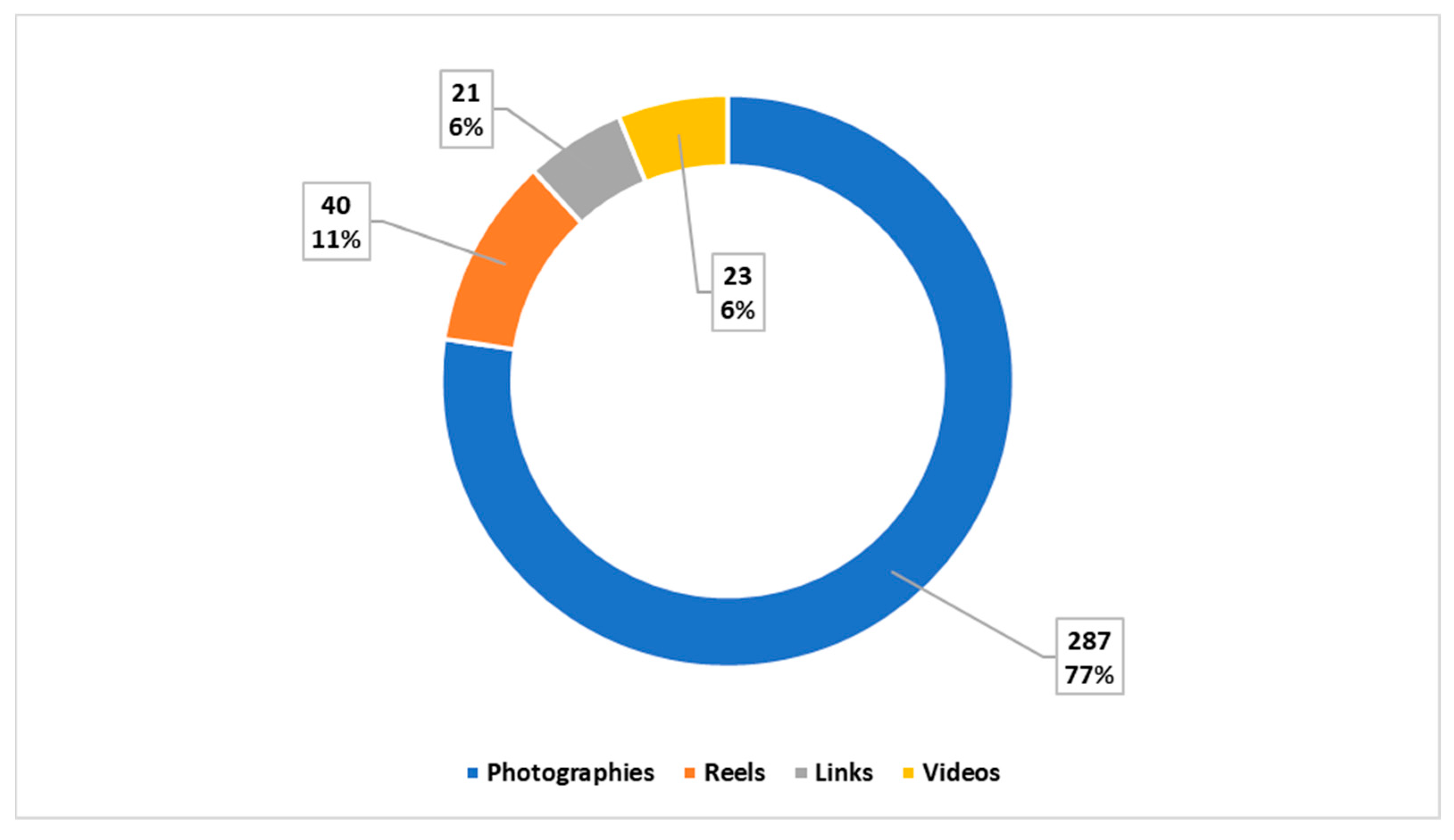
Regarding the format of the publications, photography is undeniably the format of choice, corresponding to a percentage of 77% and totaling 287 photographs published, as represented in Figure 1.
The three hotels with the most photo publications were Fonteverde, with 38 photos, Abadia Retuerta LeDomaine, with 37 photos, and Vila Vita Parc, with 34 photos. Next comes the reels format, with 11%, which corresponds to 40 publications of this type. Practically all hotels preferred to publish photos, except for the Borgo San Pietro, which bet on reels during the period under study. This hotel published 26 reels and only six photographs. In short, this result corroborates the study carried out by Peruta and Shields (2017), in which photographs were the main format of publications, having received greater relative engagement.

4.2. Interactivity

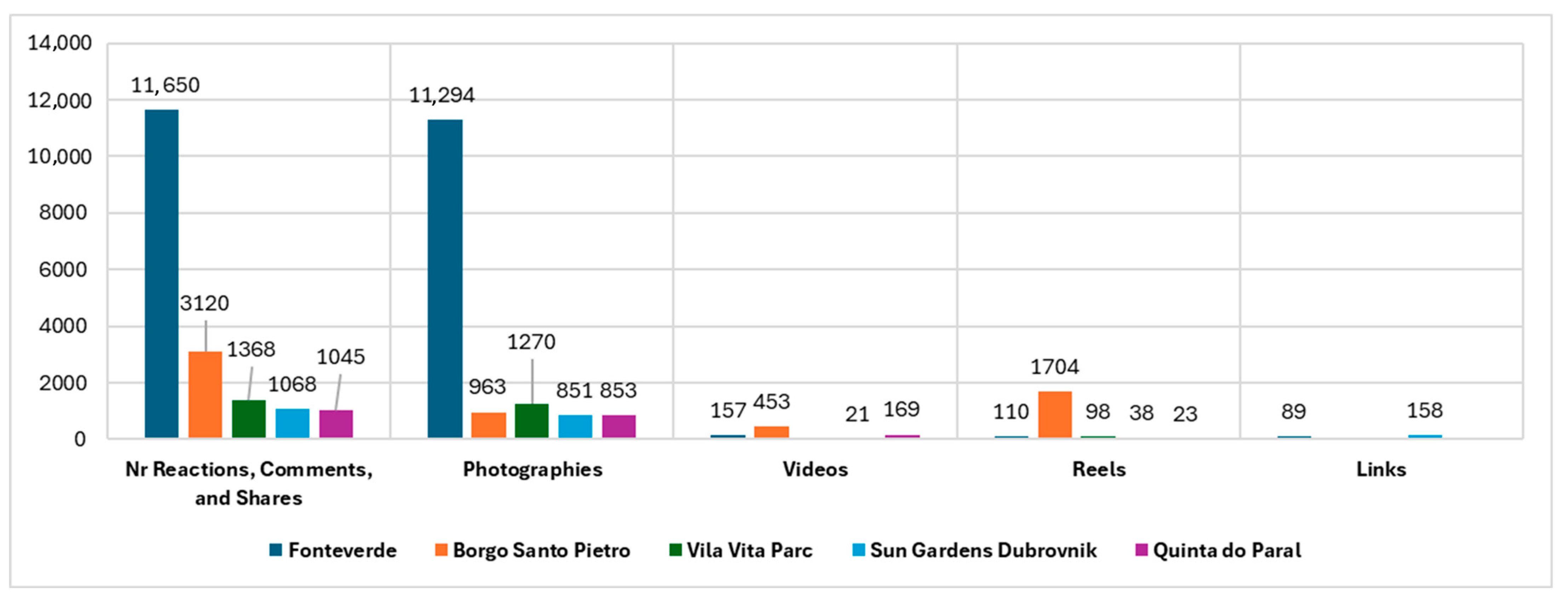
Regarding the interactivity variable, we start by analysing the users’ reactions. The Fonteverde hotel stands out with 11,650 reactions, comments, and shares, having almost four times more than the next profile, the Borgo Santo Pietro, with 3120. Then we find three more hotels with a few reactions, comments, and shares greater than a thousand: Vila Vita Parc with 1368, Sun Gardens Dubrovnik with 1068, and Quinta do Paral with 1045. The remaining hotels have numbers below a thousand. The profile of Vinha Boutique Hotel received no reaction to its only publication. And finally, the Relais San Maurizio does not present values, as it did not publish any information during the period under study.
When we analyse Figure 2, which identifies the Top 5 profiles with the most interactions, photos are again distinguished as the type of publication that can provoke the most reactions, comments, and shares. In the case of the Fonteverde hotel, of the 11,650 interactions, 11,294 correspond to interactions regarding published photographs. Only the Borgo Santo Pietro profile achieved more interactions with reel publications, obtaining 1704 interactions, that is, more than half of the interactions are related to reels. The remaining profiles generally obtained more interactions with photo publications, proving the study carried out by Soares and Monteiro (2015), that photo publications tend to provoke more interactions. In this Top 5, the reels format is in second place, as the format with the most interactions received.
Another point to analyse is engagement. In this study, engagement can be manifested passively or actively. The passive form corresponds to the consumption of a profile’s content, specifically viewing photos, videos, and other types of publications. The active form therefore requires direct interaction—commenting, sharing and/or reacting (Fernandes & Castro, 2020). Regarding involvement, we can observe that Fonteverde’s profile has the highest percentage, at 0.23%, as presented in Table 4. Next comes the profile of Borgo Santo Pietro with 0.19%. The Villa Eden—The Private Retreat, Merano, and Quinta do Paral profiles have the same percentage of commitment, at 0.12%. It is verified that the profiles with the highest engagement rates, Fonteverde and Borgo Santo Pietro, are the same ones that obtained the highest interaction values. However, when we analyse the interaction rate of publications, Quinta do Paral is in first place with 0.9%, and Fonteverde’s profile is in seventh place with a rate of 0.4%. Engagement values indicate the efficiency of the profile, but the quality of posts is measured by the ratio of posts. When a profile has a high engagement value, but the post ratio is low, it means that it will be necessary for that profile to post more often to be able to enjoy your high-quality posts more (Fanpage Karma Academy, 2022).

4.3. Visibility

The visibility variable refers to the extent to which a profile is visible (Araújo, 2018). One of the main indices is the number of fans. In Table 5, we can check the Top 10 profiles with the most fans. In first place comes the profile of Fonteverde with 55,284 fans. In second place is Vila Vita Parc with 30,505 fans, and in third place is Borgo Santo Pietro with 17,733. The remaining profiles have over 10,000 fans, except for the Quinta do Paral profile, which has 9606 fans.
Regarding the index of publications per day, the Fonteverde profile averages 0.57 publications per day, placing it in first place. Then follow the profiles of the Abbey Retuerta LeDomaine (0.46 publications per day) and Sun Gardens Dubrovnik (0.43). In the last places are the profiles of L’Andana—Tenuta La Badiola and Danai Beach Resort & Villas, with respective averages of 0.11 and 0.04. It should be noted that Abbey Retuerta LeDomaine, which ranks second in average daily publications, is fourth in terms of fans. We can thus confirm that there is not necessarily a cause-and-effect relationship between the number of publications and the number of fans (Caballero-Escusol et al., 2021).
Other relevant indices for measuring visibility are the average of reactions, the average of comments and the average of shares per post. The Fonteverde profile presents the highest values, with an average of 210.47 reactions. Next comes the profile of Borgo Santo Pietro with an average reaction of 80.31. It is interesting to highlight the profile of Quinta do Paral, which received an average of 65.92 reactions per publication, corresponding to the third profile with the highest average. However, this profile ranks last in terms of the number of fans, with only 9606. Regarding the average number of comments per post, the same profiles remain in the first two places: Fonteverde, with an average of 3.53 comments, and Borgo Santo Pietro, with an average of 2.58 comments. Third place is Danai Beach Resort & Villas with an average of 1.75 comments per post. When looking at the average shares per post, we find that Quinta do Paral has the highest average value of shares with 19.58, despite having the lowest number of fans. Also noteworthy is the Vila Vita Parc profile with an average of 6.92 shares per post and the Fonteverde profile with an average of 5.79. With these results we found that profiles with more fans do not necessarily have more reactions, comments and shares.
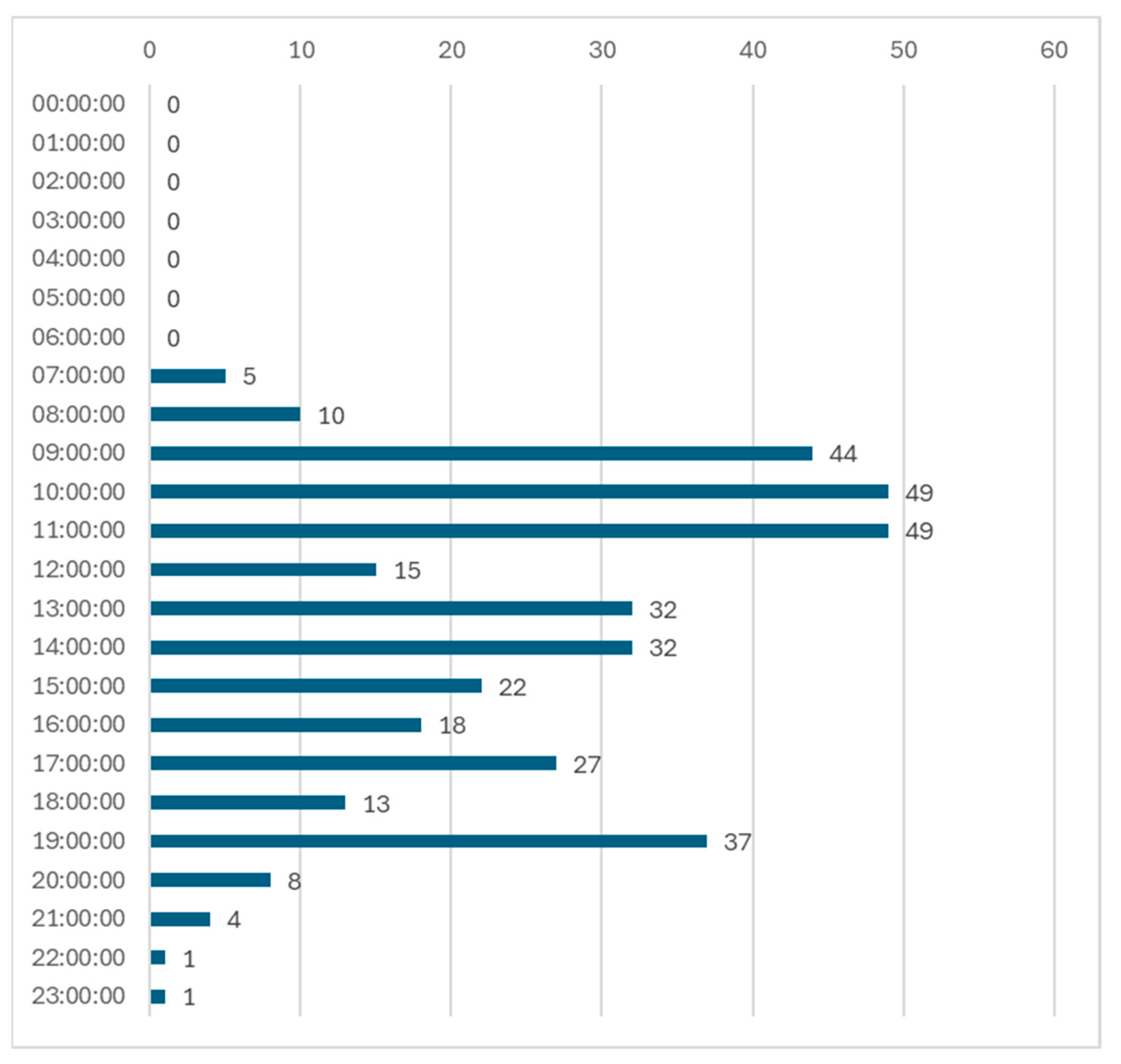
When analysing the days of the week with the most publications, presented in Table 6, we can say that Thursday is the preferred day, with 75 publications, thus strengthening a study carried out by Hu and Olivieri (2021). This is followed by Wednesday, with 70 publications, and Friday, with 61 publications. The day with the fewest publications is Sunday. Figure 3 shows the number of publications over time, revealing that the period between 9:00 a.m. and 12:00 p.m. has the highest number of publications. Therefore, the morning period is preferred for publishing.
While this descriptive analysis provides a foundational overview of content formats and aggregate engagement metrics, it is acknowledged that the findings present a macro-level perspective. The conclusion that photographs generate greater interaction, though statistically evident in this sample, is inherently broad. As rightfully noted, engagement is a multivariate phenomenon influenced by factors beyond format—such as caption narrative, hashtag strategy, language use, paid promotion, and, crucially, the specific thematic content of the imagery itself (e.g., wine-centric vs. generic luxury visuals). This study’s scope did not encompass a qualitative content analysis to categorise photographic themes (e.g., vineyard landscapes, wine tastings, gastronomy, room aesthetics) or to decode storytelling elements. Therefore, while the data confirms the predominance and relative effectiveness of the photographic format, it does not delineate which specific visual narratives resonate most within the wine tourism context. This presents a significant avenue for subsequent research, where a mixed-methods approach combining the quantitative metrics presented here with a qualitative content analysis of the images and their accompanying text would yield deeper, more actionable insights into the drivers of engagement in this niche.

5. Discussion and Conclusions

In this study, the Facebook pages of luxury hotels linked to wine were analysed to determine whether they had an active, efficient presence. If hotels were taking advantage of this social network’s potential. The results enabled us to identify a significant and active presence of most hotels’ pages on Facebook.
The analysis reveals a clear, yet nuanced, picture of the digital presence of luxury wine hotels on Facebook. The dominance of the photographic format (77% of posts) and its correlation with the highest levels of interaction confirm, within the specific context of wine-associated luxury, general principles of digital marketing on social networks (Peruta & Shields, 2017). However, the data goes beyond this confirmation. The extreme variability in performance—from the dominant case of Fonteverde to hotels with minimal activity—underscores that mere presence and adoption of the “correct” format are necessary but insufficient conditions. Success appears to depend less on the format itself and more on the narrative quality and consistency with which it is used, a hypothesis that the descriptive analysis suggests but cannot confirm.
Regarding the interactivity variable, we begin by analysing the users’ reactions. The Fonteverde hotel stood out again, with 11,650 reactions, comments, and shares, having almost four times more than the next profile, Borgo Santo Pietro, with 3120. Photos stand out as the type of publication that can provoke the most reactions, comments and shares. In the specific case of the Fonteverde hotel, of the 11,650 interactions, 11,294 correspond to interactions regarding published photographs. Following the analysis of this variable, Fonteverde’s profile obtained the highest value in relation to engagement, with a value of 0.23. A predictable fact, as the Fanpage Karma calculates it by adding the number of all interactions for each post, as well as comments and shares. For each post, the sum of interactions is divided by the number of followers at the time of posting. Then add up the values of all publications and divide this sum by the number of days in the period.
The last variable analysed was visibility. Almost all profiles have more than 10,000 fans, except Quinta do Paral, which features a total of 9606 fans. This may be due to the fact that it is a relatively new hotel, having opened its doors in June 2024. The profile with the most fans was Fonteverde, with 55,284 fans, posting an average of 0.57 times per day and achieving the highest value of reactions per post. Then we have the profile of Vila Vita Parc, which occupies second place in terms of number of fans, with 30,505. However, in terms of reactions per publication, it presents a low number, indicating that its content needs improvement to increase reactions.
These results allow us to advance the conceptual link proposed in the theoretical framework. The superiority of photographs aligns with the notion that contemporary luxury, and particularly wine tourism, is built upon sensory experiences and narratives of authenticity (Yang & Mattila, 2016). A photograph of a vineyard at dawn or a tasting in the cellar is not merely an advertisement; it is a vector for storytelling that encapsulates terroir, craftsmanship, and an epicurean lifestyle—the intangible pillars these hotels sell. This contrasts with generic luxury content, which is more focused on tangible attributes (Cervellon & Galipienzo, 2015). The exception of Borgo Santo Pietro, which achieved significant engagement through reels, introduces a crucial nuance: the immersive and dynamic narrative of short-form video can further enhance this emotional connection, suggesting an evolution in audience preferences. Thus, our findings specify and contextualise the existing literature on social networks in hospitality (Leung et al., 2013), arguing that, in this niche, effective content is that which can translate a complex cultural and sensory experience into simple, shareable digital artefacts.
For hotel and marketing managers, the results offer more nuanced guidance than the simple injunction to ‘post more photographs’. The priority should be curating a narrative-based content strategy and crafting visual content that tells a coherent story about the hotel’s wine identity. An editorial plan is recommended, one that balances lifestyle photography (tastings, dinners) with behind-the-scenes content (vineyard, harvest, chef/sommelier) to build authenticity and depth.
Furthermore, while photographs are the foundation, the success case of reels indicates that intelligent experimentation with short, dynamic video can capture new audiences and increase sharing. It is suggested that high-performing photographic themes (e.g., the harvest) be converted into video formats.
Additionally, for hotels with low engagement—such as many of those analysed—we recommend a detailed, qualitative competitive analysis of high-performing profiles (like Fonteverde). This should focus not on how much they post, but on what and how: the themes of the photos, the tone of the text, the use of hashtags, and posting times.
Moreover, geography and market contextualisation is crucial. Hotels in less-represented countries (e.g., Greece, Croatia) should adapt these ideas by highlighting their unique grape varieties and winemaking traditions as a competitive differentiator in the news feed, potentially cutting through the digital noise of more saturated destinations.
This study consciously adopted a contextual and inductive approach in its theoretical framework, prioritising the synthesis of industry-specific literature (luxury hospitality, wine tourism, social media trends) to map the unique intersection that defines its niche. While this provides essential grounding, it is acknowledged that the framework is primarily descriptive and does not integrate formal theoretical lenses from disciplines such as communication studies (e.g., Uses and Gratifications Theory) or psychology (e.g., Narrative Transportation Theory). This choice aligns with the research’s exploratory nature, which aimed first to identify and describe prevailing patterns and practices. Consequently, the interpretation of the underlying mechanisms driving engagement—such as user motivations, psychological immersion, or identity projection—remains speculative. This represents a recognised limitation and a pivotal avenue for future research. Subsequent studies should aim to build on these descriptive findings by applying and testing established theories, thereby significantly deepening the explanatory power and theoretical contribution of research in this domain.
This research acknowledges the inherent limitations regarding sample size and geographical distribution. The analysis of 17 hotels, while sufficient for an exploratory investigation into a niche segment, indeed restricts the statistical generalisability of the findings. The concentration of properties in Italy and the varying levels of Facebook activity, including one dominant case (Fonteverde), are recognised as factors that influence the aggregate metrics. These aspects stem from the stringent, multi-layered selection criteria applied—requiring affiliation with The Leading Hotels of the World, a presence in Mediterranean Diet countries, and a demonstrable emphasis on wine tourism—which naturally resulted in a small, specialised population rather than a broad sample. Consequently, this research does not seek to present universally generalisable norms but rather to offer an in-depth, comparative snapshot of digital practices within this specific and under-researched context. The findings, including the pronounced effectiveness of photographic content, are interpreted as indicative trends and strategic insights relevant to this luxury wine hotel niche. Future research should aim to validate these observations with a larger, more balanced sample encompassing all relevant countries and a broader range of hotel collections to enhance external validity and should also expand this foundational work by conducting comparative cross-platform analyses (e.g., Facebook vs. Instagram) and implementing longitudinal studies over a full annual cycle. Such designs would illuminate platform-specific nuances and the impact of seasonality on digital communication strategies within this niche sector.

Author Contributions

Conceptualization, C.A. and M.S.; methodology, C.A., M.S. and D.C.; software, D.C.; validation, C.A., C.M.Q.R. and M.S.; investigation, D.C.; writing—original draft preparation, D.C.; writing—review and editing, C.M.Q.R.; supervision, C.A. and M.S. All authors have read and agreed to the published version of the manuscript.

Funding

This work is financed by National Funds provided by FCT—Foundation for Science and Technology through project UID/04020/2025 (CinTurs) with DOI https://doi.org/10.54499/UID/04020/2025. This work is financed by national funds through FCT—Foundation for Science and Technology, under the Project UID/04470/2025 (CiTUR) with DOI https://doi.org/10.54499/UID/04470/2025.

Institutional Review Board Statement

Not applicable.

Informed Consent Statement

Not applicable.

Data Availability Statement

The raw data supporting the conclusions of this article will be made available by the authors on request.

Conflicts of Interest

Author Diana Cabeça was employed by the company Land of Alandroal. The remaining authors declare that the research was conducted in the absence of any commercial or financial relationships that could be construed as a potential conflict of interest.

References

  1. Almeida, C. M., Afonso, C. M., Serra, M., & Antonio, N. (2023a). Analysis of Portugal’s wine certifying entities’ social networks as communication channels. In C. M. Q. Ramos, C. M. R. Sousa, N. M. S. Matos, & R. I. Ashqar (Eds.), Advances in hospitality, tourism, and the services industry (pp. 121–160). IGI Global. [Google Scholar] [CrossRef]
  2. Almeida, C. M., Afonso, C. M., Serra, M., & António, N. (2024). The presence of Algarve wine producers on Facebook between pre-COVID-19 and COVID-19 periods. Tourism and Hospitality International Journal, 22(1), 27–62. [Google Scholar] [CrossRef]
  3. Almeida, D., Massuça, J., Fialho, A., & Dionisio, A. (2023b). Sustainable wine tourism as a diversification strategy: A different approach in a rural cooperative. The CASE Journal, 19(2), 204–231. [Google Scholar] [CrossRef]
  4. APN. (2019). Dieta mediterrânica. Associação Portuguesa de Nutrição (APN). Available online: https://www.apn.org.pt/v0D0O0F/dieta-mediterranica (accessed on 12 April 2025).
  5. Araújo, R. F. (2018). Marketing científico digital e métricas de mídias sociais: Indicadores-chave de desempenho de periódicos no Facebook. Informação & Sociedade: Estudos, 28(1), 7–22. [Google Scholar] [CrossRef]
  6. Arrigo, E. (2018). Social media marketing in luxury brands. Management Research Review, 41(6), 657–679. [Google Scholar] [CrossRef]
  7. Balabanis, J., & Chatzopoulou, E. (2025). The value of social media content to browsing and searching consumers of luxury products on Instagram. European Journal of Marketing, 59(5), 1227–1259. [Google Scholar] [CrossRef]
  8. Barros, V., Carrageta, M., Graça, P., Queiroz, J., & Sarmento, M. (2013). Dieta mediterrânica: Um património civilizacional partilhado. Available online: https://hdl.handle.net/10216/72082 (accessed on 20 April 2025).
  9. Bek, D., McEwan, C., & Bek, K. (2007). Ethical trading and socioeconomic transformation: Critical reflections on the South African wine industry. Environment & Planning, 39(2), 301–319. [Google Scholar] [CrossRef]
  10. Bell, C. (2022, April 14). Treat them like royalty: Customer experience lessons from luxury brands. Forbes. Available online: https://www.forbes.com/sites/chipbell/2022/04/14/treat-them-like-royalty-customer-experience-lessons-from-luxury-brands/ (accessed on 6 September 2024).
  11. Bonaccio, M., Iacoviello, L., Donati, M. B., & de Gaetano, G. (2022). The tenth anniversary as a UNESCO world cultural heritage: An unmissable opportunity to get back to the cultural roots of the Mediterranean diet. European Journal of Clinical Nutrition, 76(2), 179–183. [Google Scholar] [CrossRef]
  12. Boukhaoua, A., & Habbache, F. (2024). The importance of communication through social media in building clients satisfaction for hotel institutions. Journal of Innovations and Sustainability, 8(1), 2. [Google Scholar] [CrossRef]
  13. Bowman, B. L., Settle, Q., Tomas, S., & Riggs, A. (2020). Facebook activity of Oklahoma agritourism Facebook pages. Journal of Applied Communications, 104(2), 1–17. [Google Scholar] [CrossRef]
  14. Caballero-Escusol, A., Nicolas-Sans, R., & Díaz, J. B. (2021). El impacto de las plataformas de podcast en redes sociales: Estudio de caso en las cuentas oficiales de iVoox y anchor en Instagram, Facebook y Twitter. aDResearch ESIC International Journal of Communication Research, 25(25), 92–105. [Google Scholar] [CrossRef]
  15. CEEV. (2021). Dieta mediterrânica—Com ou sem vinho? Comité Européen des Entreprises Vins (CEEV). Available online: https://www.acibev.pt/multimedia/1/documentos/2999/CEEV%20Sintese%20-%20Vinho%20e%20Dieta%20Mediterranica%20-%20PT.pdf (accessed on 6 September 2024).
  16. Cervellon, M.-C., & Galipienzo, D. (2015). Facebook pages content, does it really matter? Consumers’ responses to luxury hotel posts with emotional and informational content. Journal of Travel & Tourism Marketing, 32(4), 428–437. [Google Scholar] [CrossRef]
  17. Ciasullo, M. V., Montera, R., & Palumbo, R. (2024). Online content responsiveness strategies in the hospitality context: Exploratory insights and a research agenda. The TQM Journal, 36(9), 234–254. [Google Scholar] [CrossRef]
  18. ConnollyCove. (2023). The wine regions of the world: Exploring global viticulture hotspots. ConnollyCove. Available online: https://www.connollycove.com (accessed on 10 January 2025).
  19. Correia, A., Reis, H., Moro, S., & Kozak, M. (2022). Meaning of luxury in hospitality: An analysis of multiple destinations. Journal of Hospitality and Tourism Management, 52, 392–402. [Google Scholar] [CrossRef]
  20. D’Arpizio, C., Levato, F., Gault, C., de Montgolfier, J., & Jaroudi, L. (2021, December 20). From surging recovery to elegant advance: The evolving future of luxury. Bain. Available online: https://www.bain.com/insights/from-surging-recovery-to-elegant-advance-the-evolving-future-of-luxury/ (accessed on 5 September 2024).
  21. Dimitrios, B., Ioannis, R., Angelos, N., & Nikolaos, T. (2023). Digital marketing: The case of digital marketing strategies on luxurious hotels. Procedia Computer Science, 219, 688–696. [Google Scholar] [CrossRef]
  22. Fanpage Karma. (2024). Fanpage Karma. Available online: https://www.fanpagekarma.com (accessed on 16 April 2025).
  23. Fanpage Karma Academy. (2022). Metrics overview. Fanpage Karma Academy. Available online: https://academy.fanpagekarma.com/en/metrics/ (accessed on 24 April 2025).
  24. Fernandes, T., & Castro, A. (2020). Understanding drivers and outcomes of lurking vs. Posting engagement behaviours in social media-based brand communities. Journal of Marketing Management, 36(7–8), 660–681. [Google Scholar] [CrossRef]
  25. Ferrer-Rosell, B., Martin-Fuentes, E., & Marine-Roig, E. (2020). Diverse and emotional: Facebook content strategies by Spanish hotels. Information Technology & Tourism, 22(1), 53–74. [Google Scholar] [CrossRef]
  26. Flick, U. (2022). Doing qualitative research: Design in qualitative research. In U. Flick (Ed.), The SAGE handbook of qualitative research design (Vol. 1, pp. 3–26). SAGE Publications. [Google Scholar]
  27. Fortune Business Insights. (2024). Luxury hotel market size, sharegrowth analysis report, 2032. Available online: https://www.fortunebusinessinsights.com/luxury-hotel-market-104408 (accessed on 25 September 2024).
  28. Garrido-Moreno, A., & Lockett, N. (2016). Social media use in European hotels: Benefits and main challenges. Tourism & Management Studies, 12(1), 172–179. [Google Scholar] [CrossRef]
  29. Gutiérrez Montoya, G. A., Sánchez Jiménez, M. Á., & Galiano Coronil, A. (2018). Redes sociales como medio de promoción turística en los países iberoamericanos. RETOS. Revista de Ciencias de la Administración y Economía, 8(15), 135–150. [Google Scholar] [CrossRef]
  30. Hotel Management. (2023, August 15). The enduring power of Facebook in the hotelier’s marketing toolkit. Hotel Management. Available online: https://www.hotelmanagement.net (accessed on 8 February 2025).
  31. Hu, L., & Olivieri, M. (2021). Social media management in the traveller’s customer journey: An analysis of the hospitality sector. Current Issues in Tourism, 24(12), 1768–1779. [Google Scholar] [CrossRef]
  32. Huertas, A., & Marine-Roig, E. (2016). User reactions to destination brand contents in social media. Information Technology & Tourism, 15(4), 291–315. [Google Scholar] [CrossRef]
  33. Huertas, A., Setó-Pàmies, D., & Míguez-González, M.-I. (2015). Comunicación de destinos turísticos a través de los medios sociales. Profesional de la Información, 24(1), 15–21. [Google Scholar] [CrossRef]
  34. International Organisation of Vine and Wine. (2023). Statistics. OIV. Available online: https://www.oiv.int/index.php/what-we-do/statistics (accessed on 5 September 2024).
  35. Inversini, A., & Masiero, L. (2014). Selling rooms online: The use of social media and online travel agents. International Journal of Contemporary Hospitality Management, 26(2), 272–292. [Google Scholar] [CrossRef]
  36. Jain, V., Wirtz, J., Salunke, P., Nunkoo, R., & Sharma, A. (2023). Luxury hospitality: A systematic literature review and research agenda. International Journal of Hospitality Management, 115, 103597. [Google Scholar] [CrossRef]
  37. Karampatea, A., Vrentzou, E., Skendi, A., & Bouloumpasi, E. (2025). Effect of vineyard location on assyrtiko grape ripening in Santorini and its wine’s characteristics. Biology and Life Sciences Forum, 40(1), 47. [Google Scholar] [CrossRef]
  38. Koufos, G. C., Mavromatis, T., Koundouras, S., Fyllas, N. M., Theocharis, S., & Jones, G. V. (2022). Greek wine quality assessment and relationships with climate: Trends, future projections and uncertainties. Water, 14(4), 573. [Google Scholar] [CrossRef]
  39. Leung, D., Law, R., Van Hoof, H., & Buhalis, D. (2013). Social media in tourism and hospitality: A literature review. Journal of Travel & Tourism Marketing, 30(1–2), 3–22. [Google Scholar] [CrossRef]
  40. LHW. (2024). Leading hotels of the world. LHW. Available online: https://www.lhw.com (accessed on 12 January 2025).
  41. Luttrell, R. (2025). Social media: How to engage, share, and connect. Bloomsbury Publishing. [Google Scholar]
  42. Maghembe, M., & Magasi, C. (2024). The role of customer perceived value, brand trust and service personalization in shaping customer loyalty. International Journal of Management, Accounting & Economics, 11(9), 1197–1219. [Google Scholar] [CrossRef]
  43. Marín, D., Armengol, J., Carbonell-Bejerano, P., Escalona, J. M., Gramaje, D., Hernández-Montes, E., & De Herralde, F. (2021). Challenges of viticulture adaptation to global change: Tackling the issue from the roots. Australian Journal of Grape and Wine Research, 27(1), 8–25. [Google Scholar] [CrossRef]
  44. Medina, F. X. (2021). Looking for commensality: On culture, health, heritage, and the Mediterranean diet. International Journal of Environmental Research and Public Health, 18(5), 2605. [Google Scholar] [CrossRef]
  45. Molina, A., Gómez, M., González-Díaz, B., & Esteban, Á. (2015). Market segmentation in wine tourism: Strategies for wineries and destinations in Spain. Journal of Wine Research, 26(3), 192–224. [Google Scholar] [CrossRef]
  46. Omazić, B., Telišman Prtenjak, M., Prša, I., Belušić Vozila, A., Vučetić, V., Karoglan, M., & Güttler, I. (2020). Climate change impacts on viticulture in Croatia: Viticultural zoning and future potential. International Journal of Climatology, 40(13), 5634–5655. [Google Scholar] [CrossRef]
  47. Paladines, F., Valarezo, K., Velásquez Benavides, A., & Torres, S. (2020). Gestión de la comunicación estratégica digital de las principales empresas del sector turístico y gastronómico del Ecuador. Revista Ibérica de Sistemas e Tecnologias de Informação, (E35), 586–599. [Google Scholar]
  48. Peruta, A., & Shields, A. B. (2017). Social media in higher education: Understanding how colleges and universities use Facebook. Journal of Marketing for Higher Education, 27(1), 131–143. [Google Scholar] [CrossRef]
  49. Pinto, L. M. C., Ramísio, P. J., & Lourenço-Gomes, L. (2024). Resilience to climate change: Lessons learned from the douro wine terroir. Environmental History, 29(3), 568–578. [Google Scholar] [CrossRef]
  50. Plidtookpai, N., & Yoopetch, C. (2021). The electronic word-of-mouth (eWOM) trustworthiness, brand image and other determinants of purchase intention of the middle class to luxury hotel services. Kasetsart Journal of Social Sciences, 42(1), 61–68. [Google Scholar] [CrossRef]
  51. Ramos, M. C., & Martínez de Toda, F. (2019). Variability of tempranillo grape composition in the Rioja DOCa (Spain) related to soil and climatic characteristics. Journal of the Science of Food and Agriculture, 99(3), 1153–1165. [Google Scholar] [CrossRef]
  52. Sánchez Jiménez, M. Á., Gómez Carmona, D., & Moral Moral, M. (2024). Evolution of the impact of social media in hospitality: A bibliometric analysis. Journal of Destination Marketing & Management, 31, 100868. [Google Scholar] [CrossRef]
  53. Sánchez-Martín, J. M., Guillén-Peñafiel, R., Flores-García, P., & García-Berzosa, M. J. (2024). Conceptualization and potential of Agritourism in Extremadura (Spain) from the perspective of tourism demand. Agriculture, 14(5), 716. [Google Scholar] [CrossRef]
  54. Serra, M., Antonio, N., Henriques, C., & Afonso, C. M. (2021). Promoting sustainability through regional food and wine pairing. Sustainability, 13(24), 13759. [Google Scholar] [CrossRef]
  55. Seyitoğlu, F., & Ivanov, S. (2020). A conceptual study of the strategic role of gastronomy in tourism destinations. International Journal of Gastronomy and Food Science, 21, 100230. [Google Scholar] [CrossRef]
  56. Soares, F., & Monteiro, P. (2015). Marketing digital e marketing de relacionamento: Interação e engajamento como determinantes do crescimento de páginas do Facebook. Navus Revista de Gestão e Tecnologia, 5, 42–59. [Google Scholar] [CrossRef]
  57. Statisca. (2025). Most popular social networks worldwide as of February 2025, by number of monthly active users. Statista. Available online: https://www.statista.com/statistics/272014/global-social-networks-ranked-by-number-of-users/ (accessed on 15 January 2026).
  58. Undey, N., Koroglu, I., & Duran, E. (2019). Instagram usage in hospitality sector as a social media marketing strategy. Proceedings of the International Scientific and Practical Conference “Bulgaria of Regions”, 2(1), 639–653. Available online: https://science.uard.bg/index.php/regions/article/view/652 (accessed on 20 December 2024).
  59. UNESCO. (2013). UNESCO—Decision of the intergovernmental committee: 8.COM 8.10. Available online: https://ich.unesco.org/en/decisions (accessed on 20 January 2025).
  60. UNESCO. (2025). The mediterranean diet. UNESCO. Available online: https://mediterraneandietunesco.org/ (accessed on 20 January 2025).
  61. Wozniak, T., Stangl, B., Schegg, R., & Liebrich, A. (2017). The return on tourism organizations’ social media investments: Preliminary evidence from Belgium, France, and Switzerland. Information Technology & Tourism, 17(1), 75–100. [Google Scholar] [CrossRef]
  62. Yang, W., & Mattila, A. S. (2016). Why do we buy luxury experiences? International Journal of Contemporary Hospitality Management, 28(9), 1848–1867. [Google Scholar] [CrossRef]
  63. Zhang, M., Wang, Y., & Olya, H. (2022). Shaping social media analytics in the pursuit of organisational agility: A real options theory perspective. Tourism Management, 88, 104415. [Google Scholar] [CrossRef]
Figure 1. Total number of publications and their respective percentage. Source: Author’s elaboration.
Tourismhosp 07 00049 g001
Figure 2. Average Top 5 reactions by post type. Source: Author’s elaboration.
Tourismhosp 07 00049 g002
Figure 3. Number of posts per hour of the day. Source: Author’s elaboration.
Tourismhosp 07 00049 g003
Table 1. Variables and Indicators Used in Page Analysis.
ContentInteractivityVisibility
Content format and frequency of publicationsFan reactions, comments and
shares and engagement
(commitment and fidelity)
Number of fans, posts per day,
average reactions, average comments,
average shares, time of publication and
preference of days to publish
Source: Adapted from Huertas et al. (2015, pp. 17–19).
Table 2. Facebook pages of luxury hotels belonging to the countries that are part of the Mediterranean Diet.
HotelsFacebook LinkAccess Date
Abadía Retuerta LeDomainehttps://www.facebook.com/AbadiaRetuertaLeDomaine/October 2011
Borgo Santo Pietrohttps://www.facebook.com/borgosantopietroApril 2011
Castel Monasterohttps://www.facebook.com/CastelMonasteroAugust 2011
Fonteverdehttps://www.facebook.com/fonteverdespaOctober 2009
Grand Hotel Continental Sienahttps://www.facebook.com/hotelcontinentalsienaApril 2011
Hotel La Perlahttps://www.facebook.com/laperlacorvaraMarch 2011
L’Andana—Tenuta La Badiolahttps://www.facebook.com/tenutalabadiolaAugust 2011
Quinta do Paralhttps://www.facebook.com/quintadoparalSeptember 2018
Relais San Maurizio 1619https://www.facebook.com/relaissanmaurizio1619January 2011
Sun Gardens Dubrovnikhttps://www.facebook.com/sungardensdbkFebruary 2010
São Lourenço do Barrocalhttps://www.facebook.com/saolourencodobarrocalNovember 2010
The Danai Resorthttps://www.facebook.com/danairesortMay 2010
Villa Dubrovnikhttps://www.facebook.com/hotelvilladubrovnikJanuary 2011
Villa Eden—The Private Retreat, Meranohttps://www.facebook.com/villaedenMarch 2010
Villa La Massahttps://www.facebook.com/villalamassaMarch 2022
Vila Vita Parchttps://www.facebook.com/vilavitaparcOctober 2009
Vinha Boutique Hotel https://www.facebook.com/vinhaboutiquehotelDecember 2019
Source: Author’s elaboration.
Table 3. Number of publications by type and frequency of publications daily.
PhotographyVideoReelsLinkTotal
Publications
Publications per Day
Hotel Abadia Retuerta LeDomaine37 6 430.50
Borgo Santo Pietro6426 360.40
Castel Monastero, Tuscan Retreat & Spa8 80.10
Fonteverde38429530.60
Grand Hotel Continental Siena—Starhotels Collezione (IT)29 290.30
Hotel La Perla18 180.20
L’Andana—Tenuta La Badiola10 100.10
Quinta Do Paral1011 120.10
Relais San Maurizio0 00.00
Sun Gardens Dubrovnik29227400.40
São Lourenço do Barrocal11 110.10
The Danai Beach Resort & Villas4 40.04
Villa Dubrovnik181 190.20
Villa Eden—The Private Retreat, Merano19112230.20
Villa La Massa169 250.30
Vila Vita Parc34 2 360.40
Vinha Boutique Hotel01 10.01
Source: Author’s elaboration.
Table 4. Indicators of the interactivity variable.
HotelNr. Reactions, Comments & SharesInteractions
(%)
Engagement (%)
Fonteverde11,6500.40%0.23%
Borgo Santo Pietro31200.50%0.19%
Vila Vita Parc13680.13%0.05%
Sun Gardens Dubrovnik10680.16%0.07%
Quinta Do Paral10450.91%0.12%
Villa Eden—The Private Retreat, Merano7910.50%0.12%
Abadia Retuerta LeDomaine6890.09%0.04%
Hotel La Perla6500.47%0.09%
Villa La Massa4410.56%0.05%
São Lourenço do Barrocal3150.22%0.03%
L’Andana—Tenuta La Badiola3090.27%0.03%
Danai Beach Resort & Villas2690.77%0.01%
Villa Dubrovnik2510.31%0.02%
Castel Monastero, Tuscan Retreat & Spa1820.28%0.02%
Grand Hotel Continental Siena—Starhotels Collezione (IT)1530.04%0.01%
Relais San Maurizio00.00%0.00%
Vinha Boutique Hotel00.00%0.00%
Source: Author’s elaboration.
Table 5. Visibility Indicators—Top 10.
FansPublications per DayReactions by PublicationComments per PostShares per Post
Fonteverde55,284.00.57210.493.535.79
Vila Vita Parc30,505.00.3930.420.676.92
Borgo Santo Pietro17,733.00.3980.312.583.78
Abadia Retuerta LeDomaine17,320.00.4614.350.651.02
Sun Gardens Dubrovnik16,759.00.4324.331.430.95
Grand Hotel Continental Siena—Starhotels Collezione (IT)14,204.00.315.030.030.21
São Lourenço do Barrocal13,216.00.1226.640.551.45
L’Andana—Tenuta La Badiola11,513.00.1128.701.001.20
Danai Beach Resort & Villas11,199.00.0463.251.752.25
Quinta Do Paral9606.00.1365.921.5819.58
Average19,733.90.2954.941.384.32
Source: Author’s elaboration.
Table 6. Preferred day of the week to post.
Day of the WeekNumber of Publications
Monday63
Tuesday47
Wednesday70
Thursday75
Friday61
Saturday31
Sunday24
Source: Author’s elaboration.
Disclaimer/Publisher’s Note: The statements, opinions and data contained in all publications are solely those of the individual author(s) and contributor(s) and not of MDPI and/or the editor(s). MDPI and/or the editor(s) disclaim responsibility for any injury to people or property resulting from any ideas, methods, instructions or products referred to in the content.