Article

Adoption of Artificial Intelligence in Micro and Small Hospitality Enterprises: The Role of Organisational Characteristics and Managers’ Attitudes Toward AI in Relation to Operating Revenues

Faculty of Tourism Studies-TURISTICA, University of Primorska, Obala 11a, 6320 Portorož, Slovenia
*
Author to whom correspondence should be addressed.
Tour. Hosp. 2025, 6(5), 268; https://doi.org/10.3390/tourhosp6050268
Submission received: 6 October 2025 / Revised: 27 November 2025 / Accepted: 3 December 2025 / Published: 6 December 2025
(This article belongs to the Special Issue Digital Transformation in Hospitality and Tourism)

Abstract

This study examines the adoption of artificial intelligence (AI) among micro and small hospitality enterprises in Slovenia, a small EU economy where digital transformation remains limited. It explores how organisational characteristics and managers’ attitudes toward AI are related to its adoption and firms’ operating revenues. Data were collected from 286 accommodation and food-and-beverage enterprises through a structured questionnaire completed by managers or owner–managers, complemented by secondary official financial data. Using ordinary least squares regression, the analysis examined associations among organisational characteristics, managerial attitudes, AI use intention and adoption, and financial performance. The results indicate that firm size and structural features alone are not closely linked to digital transformation. AI adoption shows stronger associations with managers’ positive attitudes and with factors such as non-family ownership and smaller firm size. The overall General Attitudes toward AI Scale (GAAIS) score showed no direct relationship with revenue, but two specific items—enthusiasm for AI and recognition of business opportunities—were positively associated with higher revenues. Among AI tools, only smart text editors and CRM systems were statistically associated with revenues, suggesting that better-performing firms are more likely to use simpler, more affordable technologies. The study provides contextual evidence on behavioural and organisational dimensions of AI adoption in resource-constrained hospitality SMEs.

1. Introduction

While previous studies at the European (EU) level have demonstrated that artificial intelligence (AI) adoption is positively associated with small and medium-sized enterprises (SMEs) revenues (Ardito et al., 2024), this study examines whether the same effect holds in small hospitality economies such as the Republic of Slovenia, where structural constraints may alter the strength of this relationship. Tourism is one of the most significant economic pillars in the EU, accounting for nearly 10% of the Gross Domestic Product (GDP). Specifically, in Slovenia, it contributes more than 9% and is dominated by micro and small enterprises (Government Communication Office, 2025), which account for 99.8% of the sector (in this study, the term SMEs refers exclusively to micro and small hospitality enterprises). These businesses are essential drivers of regional development, innovation, and sustainable growth, yet they operate with limited financial, human, and technological resources (Camilleri et al., 2023; T. Planinc et al., 2023). Such resource limitations are particularly evident in small economies like Slovenia, where hospitality SMEs typically generate only modest annual revenues, further constraining their ability to invest in advanced digital tools. For broader comparison, the average revenue per enterprise in Slovenia as of 31 December 2023 was €2.04 million (Slovenski Podjetniški Sklad, 2025), whereas hospitality SMEs in our sample generated significantly lower revenues (mean (M): €0.88 million; median: €0.50 million).
At the EU level, policy documents are increasingly emphasising the close connection between tourism and digital transformation. The EU Tourism Agenda 2030 outlines sustainability, resilience, and digital innovation as key priorities for the sector’s future (Directorate-General for Internal Market, Industry, Entrepreneurship and SMEs, 2022). In parallel, the EU SME Strategy for a Sustainable and Digital EU emphasises that SMEs require additional support to adopt digital tools and remain competitive, which is particularly crucial for tourism, a sector dominated by SMEs (European Commission, 2020). Looking more broadly, the Digital Compass 2030 lays down clear targets for the EU’s digital decade, including ambitious goals for SMEs to integrate advanced technologies such as AI (European Commission, 2021).
At the same time, AI has emerged as a transformative force in the tourism and hospitality sectors. According to the recently adopted AI Act, “‘AI system’ means a machine-based system that is designed to operate with varying levels of autonomy and that may exhibit adaptiveness after deployment, and that, for explicit or implicit objectives, infers, from the input it receives, how to generate outputs such as predictions, content, recommendations, or decisions that can influence physical or virtual environments” (Regulation-EU-2024/1689-EN-EUR-Lex, 2024). Applications ranging from booking engines and chatbots to predictive analytics, AR/VR tools, and service robots promise to optimise operations, reduce costs, enhance decision-making, and elevate customer experiences (Fouad et al., 2024; Kim et al., 2024; López-Naranjo et al., 2025; Mariani & Borghi, 2024; Pergelova et al., 2026). Industry analyses indicate that generative AI has become a top technology priority in the travel industry, with widespread experimentation and plans for near-term scaling (Amadeus, 2024).
However, AI adoption among hospitality SMEs remains modest. The literature consistently highlights structural barriers, including limited capital, outdated infrastructure, and low digital literacy, as well as concerns about privacy, cybersecurity, and the erosion of the “human touch” in service encounters (Cozzio et al., 2025; Kukanja, 2024; Schwaeke et al., 2025). Syntheses of recent research further show that a constellation of factors shapes managers’ attitudes toward AI: individual (technology knowledge, prior experience, self-efficacy), organisational (top management commitment, organisational readiness, employee adaptability, culture), technological (perceived usefulness and ease of use vs. complexity), and environmental (competitive pressure, regulation and government support, vendor partnerships) (Badghish & Soomro, 2024; Horani et al., 2025; Ivanov & Webster, 2024; S. Planinc & Kukanja, 2025; Tamanine et al., 2024). In hospitality, managers tend to prefer delegating to AI tasks that are low in emotional labour and high in routinisation, while maintaining human control where empathy and nuanced service recovery are critical; persistent labour shortages also make AI solutions attractive, albeit cautiously implemented to preserve service quality (Ivanov & Webster, 2024; Law et al., 2024; Pergelova et al., 2026).
Despite accelerating interest, bibliometric reviews conclude that tourism AI research continues to underrepresent SMEs and remains at an early stage compared to other sectors across the EU (Fouad et al., 2024; García-Madurga & Grilló-Méndez, 2023). Existing empirical evidence on tourism SMEs is often fragmented and context-specific, and findings regarding the influence of environmental pressures, such as competition and external support, vary considerably across settings (Tamanine et al., 2024; Worek & Aaltonen, 2025). This gap underscores the need for comprehensive, evidence-based research that integrates multiple theoretical perspectives and provides empirical validation in small tourism economies. By addressing this need, the present study offers both conceptual and empirical novelty. It develops a multi-framework approach that connects organisational “hard” factors with managerial “soft” factors, extending established models (Resource-Based View (RBV), Technology Organisation Environment (TOE), Technology Acceptance Model (TAM) and the Unified Theory of Acceptance and Use of Technology (UTAUT)) to explain how AI adoption shapes financial performance among hospitality SMEs in Slovenia.
Furthermore, EU policy is undergoing a rapid transformation in its regulatory framework. The recently adopted AI Act establishes the world’s first comprehensive legal framework for AI, with direct implications for SMEs in the tourism and hospitality sectors (Regulation-EU-2024/1689-EN-EUR-Lex, 2024). This regulatory context underscores the importance of examining how SMEs navigate both the opportunities and risks associated with AI.
Within this broader context, Slovenia, given its small size, concentrated SME base, and pronounced exposure to these structural conditions, offers a particularly suitable setting for examining how organisational and attitudinal factors shape AI adoption in the hospitality sector. Despite the growing academic interest in digital transformation, only a few studies have empirically examined AI adoption in hospitality SMEs (Alharbi et al., 2025; Kukanja, 2024; Mariani & Borghi, 2024). Previous research has primarily focused on large hotel chains or industry-wide technological readiness (e.g., Buhalis et al., 2024; Chakraborty, 2025; Jerez-Jerez, 2025; Saputra et al., 2024), often neglecting the unique organisational and managerial constraints faced by micro and small hospitality firms. Consequently, little is known about how “hard” structural characteristics and “soft” managerial attitudes jointly shape AI adoption in this context.
This study contributes to the literature by extending existing theoretical perspectives on AI adoption to the hospitality SME context. It also provides novel empirical evidence from a small EU economy, thereby broadening the geographical and contextual scope of previous AI adoption research (Cicero et al., 2025; Schepman & Rodway, 2023).
Conceptually, the study is grounded in four complementary frameworks: RBV explains how organisational resources and capabilities condition innovation outcomes; the TOE framework captures structural and contextual factors that enable or constrain technological adoption; and TAM and UTAUT address individual and attitudinal drivers influencing managers’ willingness to adopt AI. Together, these perspectives provide a coherent foundation for examining both organisational (“hard”) and managerial (“soft”) determinants of AI adoption and their performance implications.
In addition to this conceptual foundation, the study addresses a theoretical gap related to how managerial attitudes are conceptualised within RBV, TOE, TAM, and UTAUT frameworks. Although these perspectives acknowledge the importance of attitudinal factors in shaping technology adoption, they typically treat managerial attitudes as a single, uniform construct. This study responds to this gap by examining the attitudinal structure in greater detail. Specifically, it explores whether specific components of managerial attitudes may play differentiated roles in the AI adoption process within hospitality SMEs.
Accordingly, the purpose of this research is to examine how the adoption of AI and managers’ attitudes towards its use influence the financial performance of hospitality SMEs in Slovenia. Drawing on RBV, TOE, TAM, and UTAUT, the study explores the combined effects of organisational and managerial factors on AI adoption. Based on this conceptual foundation, the research addresses the following research questions (RQs):
(1)
Which organisational characteristics foster the adoption of AI technologies among hospitality SMEs?
(2)
How do managers’ attitudes towards AI affect its adoption and use?
(3)
To what extent does AI adoption relate to firms’ operating revenues?
By addressing these questions, the study contributes to a better understanding of digital transformation processes among hospitality SMEs and provides a basis for evidence-based managerial and policy decisions. This study distinguishes between AI adoption (actual use of technologies) and AI intention (future likelihood of use). For robustness and comparability with earlier studies, a combined adoption–intention index is also analysed, but the main results are based on separate measures (see Section 3.3.3).
Guided by these RQs, the following section develops four testable hypotheses (H1–H4) based on the aforementioned frameworks. Each hypothesis corresponds to one or more RQs and is empirically examined using a quantitative design, as detailed in the Methodology section.

2. Literature Review and Hypotheses Development

2.1. Evidence Synthesis

Research on AI adoption in hospitality and tourism indicates that managers’ attitudes are shaped by a constellation of interrelated influences spanning the individual, organisational, technological, and environmental domains. This interplay is evident in hospitality SMEs, where scarce resources and the centrality of service quality make the adoption of new technologies both promising and challenging.
At the individual level, demographic variables such as age, gender, or education appear to play only a minor role in explaining attitudes toward AI (Ivanov & Webster, 2024). Far more influential are psychological and experience-based characteristics. Studies consistently show that technological knowledge and self-efficacy predict stronger intentions to adopt AI solutions (Ho et al., 2022). Prior exposure to AI may lower uncertainty and build familiarity, yet it can also generate “reasons against” adoption when it heightens technology-related anxiety (M. A. Islam et al., 2023). Across contexts, a lack of managerial knowledge emerges as one of the most persistent obstacles, particularly in service robotisation (Oldemeyer et al., 2025).
At the organisational level, firm characteristics substantially reinforce or constrain these personal perceptions. Leadership commitment and visible support from top management are repeatedly identified as decisive drivers of positive managerial attitudes (Tamanine et al., 2024). SMEs with greater organisational readiness, stronger information intensity, and more developed market capabilities tend to exhibit more favourable perceptions of AI adoption. However, in many contexts, cost considerations remain a factor that can temper enthusiasm (Badghish & Soomro, 2024). In addition, perceived organisational support has been shown to buffer the negative impact of AI-induced stress by strengthening employees’ psychological capital, thereby indirectly supporting engagement with AI systems (Hou & Fan, 2024).
At the technological level, classic predictors such as perceived usefulness and ease of use remain among the most robust and consistent determinants of AI attitudes (Song et al., 2025; Tamanine et al., 2024). In addition, when managers recognise clear functional and strategic benefits, their evaluations of AI become more positive, whereas perceptions of excessive complexity can have the opposite effect (Dogan et al., 2024). Equally important, reliability and performance have been identified as critical technological factors, as SME managers are more willing to adopt AI systems when they can trust them to operate dependably and deliver consistent outcomes (Oldemeyer et al., 2025).
These individual, organisational, and technological drivers are embedded in a broader environmental context that exerts its own pressures. Competitive intensity has often been highlighted as a significant determinant of AI adoption, prompting firms to innovate in order to sustain their market position (Horani et al., 2025). However, competition alone is insufficient without supportive institutional conditions. Research highlights that regulatory frameworks, government initiatives, and external support mechanisms reduce uncertainty and build the confidence required for SMEs to invest in AI (Badghish & Soomro, 2024).
In the EU policy context, these environmental factors are reinforced by several strategic initiatives. The EU SME Strategy for a Sustainable and Digital EU emphasises the need for targeted support to strengthen digital adoption among small firms (European Commission, 2020). The Digital Compass 2030 (European Commission, 2021) sets measurable objectives for AI and digital transformation across the Union, with SMEs identified as a priority group. The EU Tourism Agenda 2030 emphasises digital innovation as a key pillar of resilience and competitiveness in the hospitality sector (Directorate-General for Internal Market, Industry, Entrepreneurship and SMEs, 2022). Most recently, the AI Act established the world’s first comprehensive legal framework for AI, creating both obligations and opportunities for SMEs in the tourism sector (Regulation-EU-2024/1689-EN-EUR-Lex, 2024). Together, these frameworks indicate that policy support and regulatory change are not peripheral influences but central components of the environment that shape AI adoption in hospitality SMEs.
Complementing these policy initiatives, Dyduch and Brzozowska (2025) propose the SmartTourAI framework, which illustrates how AI tools, such as machine learning, process automation, and recommendation systems, can enhance efficiency, personalisation, and competitiveness in tourism enterprises. Their findings highlight both opportunities (improved customer satisfaction and loyalty) and challenges (financial and privacy constraints). While the SmartTourAI framework addresses tourism enterprises more broadly, its insights are particularly relevant for hospitality SMEs, where resource constraints and customer service intensity make the balance between efficiency gains and authentic experiences even more critical.
In this view, the hospitality sector itself adds yet another layer of complexity, given its unique reliance on service quality and human interaction. Managers are generally willing to delegate routinised, low-emotion labour tasks to AI, but remain cautious about substituting human empathy in complex guest interactions (Ivanov & Webster, 2024; Pergelova et al., 2026). According to the OECD (2024), AI offers significant potential for innovation and sustainable development in tourism. However, its adoption must be approached responsibly to support employees rather than replace them and ensure that authentic service experiences are preserved.
A recent bibliometric study further illustrates these gaps. To and Yu (2025) analysed over 900 AI-related publications in tourism and hospitality, identifying four dominant research streams: machine learning and sentiment analysis of reviews; AI adoption, including robots and ChatGPT; neural networks for demand forecasting; and random forest models in travel. While the field has expanded rapidly, particularly with the rise of generative AI, evidence remains fragmented, with limited focus on hospitality SMEs in smaller EU economies.
This body of work demonstrates a strong conceptual foundation in established theoretical frameworks, including the RBV (Barney et al., 2001), TOE (Tornatzky, 1990), TAM (Davis, 1989), and UTAUT (Venkatesh et al., 2003). At the same time, the empirical evidence remains fragmented and highly context-specific, with much of the existing research situated outside the EU (e.g., Ho et al., 2022; Horani et al., 2025; Hou & Fan, 2024; Huang et al., 2024; N. Islam et al., 2025; Soluk et al., 2025; Xu & Chen, 2025; Yılmaz & Şahin, 2024; Zhang et al., 2018). SMEs in smaller EU hospitality economies, in particular, remain underrepresented (e.g., Ivanov & Webster, 2024; S. Planinc & Kukanja, 2025). Replication and context-sensitive testing are therefore crucial for validating, refining, and extending our understanding of how organisational and managerial factors shape AI adoption in this sector.
Viewed as a whole, the reviewed frameworks reveal a clear sequence that helps explain how AI-related decisions emerge within hospitality SMEs. Organisational resources and structural conditions shape the attitudes that managers develop toward new technologies; these attitudes influence the extent to which AI tools are adopted, and adoption is then reflected in operational practices and, eventually, in financial outcomes. This integrated view (resources, attitudes, adoption, and performance) provides a more coherent link between concepts that are often examined separately.
Building on this conceptual foundation, the present study integrates four complementary theoretical frameworks to explain how organisational (“hard”) and managerial (“soft”) factors shape AI adoption and performance outcomes in hospitality SMEs. Specifically, RBV and TOE describe how resources, structure, and contextual readiness enable or constrain adoption, while TAM and UTAUT offer a behavioural perspective that helps explain how managerial perceptions and intentions translate these organisational preconditions into actual adoption and related performance outcomes. Based on this foundation, the following sections develop and test hypotheses (H1–H4) linking these constructs to AI adoption and operating revenues in Slovenian hospitality SMEs.

2.2. Organisational Characteristics and Managerial Attitudes Toward AI (H1)

Building on the evidence reviewed above, organisational characteristics stand out as particularly powerful influences on managerial perceptions. For example, the RBV and TOE theoretical models emphasise that “hard” conditions such as firm size, governance structure, and resource endowment are key prerequisites for technological innovation (Barney et al., 2001; Tornatzky, 1990). Empirical studies in tourism SMEs confirm that organisational readiness, market capabilities, and financial capacity strengthen positive managerial attitudes, while resource constraints can limit them (Badghish & Soomro, 2024; Mariani & Borghi, 2024). Leadership commitment and top management support further enhance openness to AI adoption (Tamanine et al., 2024).
Evidence from EU hospitality SMEs indicates that micro and family-owned firms often face greater hesitation, primarily due to limited resources and a stronger attachment to traditional practices (Schwaeke et al., 2025). Prior work in Slovenia also indicates that such structural profiles are associated with more cautious attitudes toward AI (S. Planinc & Kukanja, 2025). Building on this stream, the present study conceptualises the relationship between organisational characteristics and managerial perceptions as both a replication and an elaboration within a broader adoption–performance framework. Accordingly, we pose our first hypothesis (H1):
H1. 
Specific organisational characteristics of hospitality SMEs, such as size, ownership, and resource capacity, are positively associated with managerial attitudes toward AI.

2.3. Managerial Attitudes and AI Adoption (H2)

While organisational structures set the conditions, managerial attitudes often function as the cognitive mechanism that translates potential into action. The TAM and UTAUT models have long established that perceived usefulness and ease of use shape actual adoption behaviours (Davis, 1989; Venkatesh et al., 2003). More recent hospitality research adds that enthusiasm, perceived opportunities, and managerial willingness consistently predict adoption of AI-powered tools (Ho et al., 2022; M. A. Islam et al., 2023).
Within hospitality SMEs, this relationship has already been validated: managers with more positive attitudes are more likely to introduce booking engines, chatbots, and analytics into daily operations (S. Planinc & Kukanja, 2025). The present study does not aim to retheorise this link but rather to confirm its robustness in an extended adoption–performance model. Building on this reasoning, we propose hypothesis (H2):
H2. 
Managers with more positive attitudes toward AI are more likely to adopt AI tools.

2.4. Organisational Characteristics and AI Adoption (H3)

Although attitudes are central, structural factors may also exert a more direct influence on adoption. TOE theory suggests that organisational size, infrastructure, and financial capacity can facilitate adoption regardless of managerial perceptions (Tornatzky, 1990). Empirical findings confirm this: in SMEs, resource availability and IT readiness strongly predict the likelihood of AI adoption (Oldemeyer et al., 2025). Moreover, firms with stronger governance, aligned digital strategies, and greater market capabilities are better positioned to explore and adopt AI initiatives (Horani et al., 2025).
Despite this conceptual expectation, only a few studies have empirically tested the direct link between organisational characteristics and AI adoption in hospitality SMEs (Kukanja, 2024; Shah Alam et al., 2024). This lack of empirical evidence leaves open the question of whether structural endowments matter only indirectly through perceptions or also directly through capacity. In the EU context, this link is reinforced by policy frameworks such as the SME Strategy (European Commission, 2020) and the Digital Compass 2030 (European Commission, 2021), both of which emphasise organisational readiness and resource capacity as prerequisites for digital transformation. Testing this pathway, therefore, represents an important empirical contribution. Extending this argument, we formulate hypothesis (H3):
H3. 
Organisational characteristics affect AI adoption in hospitality SMEs.

2.5. AI Adoption and Operating Revenues (H4)

Once technologies are adopted, the critical question becomes whether they deliver measurable performance improvements. Research demonstrates that AI adoption is positively associated with SME revenues, particularly when combined with complementary digital tools, such as the Internet of Things (IoT) and data analytics (Horani et al., 2025). In hospitality SMEs, AI technologies are increasingly positively associated with smoother operations, lower staffing costs, and more personalised guest experiences. When combined with complementary tools like IoT and data analytics, these applications can directly support revenue growth (Ardito et al., 2024; Kim et al., 2024).
However, most of these findings derive from large-scale surveys or industry reports and have not been systematically tested in small EU hospitality economies. Whether revenue effects hold under conditions of seasonality, family ownership, and resource scarcity remains an open question. EU strategies, such as the EU Tourism Agenda 2030 (European Commission, 2021), explicitly link digital innovation with competitiveness and revenue growth, suggesting that performance outcomes are a central policy priority for SMEs in the hospitality sector. This study addresses this gap by explicitly linking AI adoption to financial performance in hospitality SMEs. In line with the preceding discussion, we suggest hypothesis (H4):
H4. 
AI adoption is positively associated with operating revenues.
Table 1 provides a concise overview of the proposed hypotheses, their types, and their contributions.
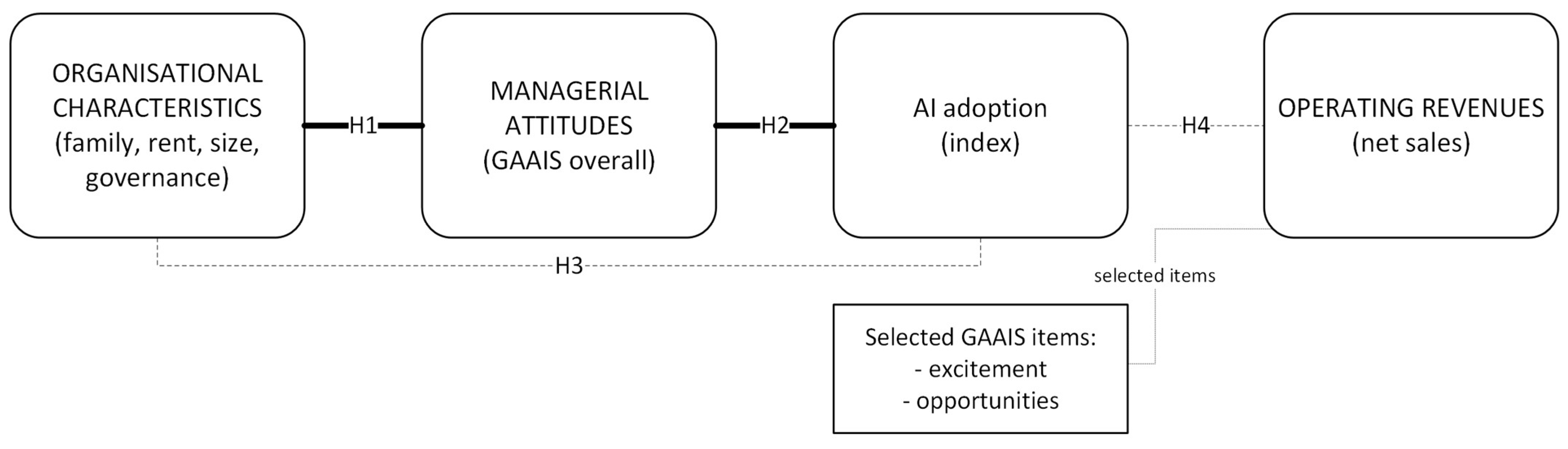
Figure 1 shows the hypothesised associations between organisational characteristics, managerial attitudes, AI adoption, and operating revenues. Specifically, organisational characteristics are associated with managerial attitudes (H1) and may also be related to AI adoption (H3). Positive managerial attitudes are associated with a higher likelihood of AI adoption (H2). Finally, AI adoption is expected to be positively associated with operating revenues (H4).

3. Materials and Methods

3.1. Research Design

This study applies a quantitative, cross-sectional design to examine managerial attitudes toward AI and its adoption among hospitality SMEs in Slovenia. The analysis is based on four established theoretical perspectives: the RBV (Barney et al., 2001), the TOE framework (Tornatzky, 1990), and two behavioural models—TAM (Davis, 1989) and UTAUT (Venkatesh et al., 2003). Together, these frameworks provide a broad basis for analysing how organisational (“hard”) and managerial (“soft”) factors are linked with AI adoption and financial outcomes. The conceptual framework (Figure 1) outlines the main associations between organisational and managerial factors, AI adoption, and operating revenues, drawing on the RBV, TOE, TAM, and UTAUT frameworks.

3.2. Sample and Data Collection

The research population consisted of SMEs registered under NACE sections I55 (Accommodation) and I56 (Food and Beverage (F&B) Service Activities) in Slovenia. According to the Agency of the Republic of Slovenia for Public Legal Records and Related Services (AJPES), a total of 8304 such firms operated in 2024 (Statistical Office of the Republic of Slovenia, 2025). The sample was limited to enterprises that generated revenue exclusively from these two sectors, including hotels, guesthouses, inns, restaurants, and bars.
In line with the EU definition, SMEs comprise micro, small, and medium-sized enterprises; however, this study focused exclusively on micro enterprises (<10 employees) and small enterprises (10–49 employees), while medium-sized firms were excluded.
Primary data were collected between January and July 2025 using a structured questionnaire. The sampling procedure involved three stages.
First, SMEs with their primary registered activity under NACE I55 or I56 were pre-selected.
Second, convenience sampling was applied, as organisational characteristics of SMEs are not publicly available—an approach commonly used in hospitality SME research (e.g., Badghish & Soomro, 2024).
Third, trained interviewers contacted managers directly and verified whether each enterprise derived its operating revenues solely from hospitality activities. If an enterprise did not meet this criterion or declined participation, the next eligible SME was approached.
Questionnaires were primarily administered through in-person interviews; when respondents preferred, interviewers left the questionnaire at the enterprise and later collected the completed form. In total, 286 valid responses were obtained, representing approximately 3.4% of the target population.
Respondents (see also Section 4.1) were owners or managers of hospitality SMEs who are directly responsible for operational and strategic decisions, including technology adoption. Given the centralised decision-making typical of such firms, they are the most knowledgeable and appropriate informants for assessing organisational characteristics and managerial attitudes toward AI.
To ensure methodological transparency, Table 2 summarises the key aspects of the data collection procedure.

3.3. Measures

3.3.1. Organisational Characteristics (Hard Factors)

Organisational determinants of adoption were measured in line with the RBV and the TOE frameworks (Barney et al., 2001; Tornatzky, 1990). Following prior hospitality SME research (Badghish & Soomro, 2024; Kukanja, 2024; T. Planinc et al., 2023; Schwaeke et al., 2025), the analysis included the following variables: firm size (micro vs. small), ownership type (family vs. non-family business), rental status (with vs. without rental obligations), and governance structure (owner–manager vs. professional manager). These organisational characteristics reflect available resources and ownership structure, which may influence how firms approach AI adoption.

3.3.2. Managerial Attitudes (GAAIS; Soft Factors)

Managerial attitudes toward AI were measured using the validated 20-item General Attitudes toward AI Scale (GAAIS) (Schepman & Rodway, 2023). The scale consists of 12 positive and 8 negative items (reverse-coded), each rated on a five-point ordinal Likert-type scale (1 = strongly disagree, 5 = strongly agree). The GAAIS is a validated instrument with well-established psychometric properties. In our sample, the scale again showed good internal consistency (Cronbach’s α = 0.803).

3.3.3. AI Adoption

AI adoption was measured across eleven tools frequently discussed in recent hospitality and tourism research (Dogan et al., 2024; Ivanov & Webster, 2024; Kim et al., 2024; Sousa et al., 2024). These included booking and delivery platforms (e.g., Booking, Wolt), chatbots (e.g., ChatGPT), business analytics tools, facial recognition systems, CRM software, voice-recognition tools, robots, and AR/VR applications.
For each tool, respondents indicated (a) whether they already used it (“already using” = 1, otherwise = 0) and (b) their intention to use it on a five-point ordinal Likert-type scale (1 = not planning to use, 5 = very likely to use). This dual structure allowed us to distinguish between actual adoption and the likelihood of future adoption.
In line with previous research, the AI intention index was used as the primary measure of adoption propensity, as it reflects firms’ readiness and willingness to engage with AI rather than their current technological state (Horani et al., 2025; Hardinata et al., 2024). The binary adoption index (proportion of tools already used) and the combined adoption–intention index were also included as robustness checks.
Since the adoption–intention index represents a composite indicator combining different AI tools rather than a unidimensional latent construct, internal consistency measures (e.g., Cronbach’s α) are not meaningful. The pattern of results remained stable across all three measures, confirming the robustness of the findings. Therefore, the primary analyses are based on the intention index, while the binary and combined measures are reported in Appendix A Table A1.

3.3.4. Business Performance

Business performance was measured using operating (net sales) revenues from secondary financial data (Ajpes, 2025), following the approach used in previous SME research (Horani et al., 2025; T. Planinc et al., 2023). Specifically, we used fiscal year 2024 revenues.

3.3.5. Managerial Demographics

Demographic data were collected for age, gender, education, years of managerial experience in hospitality, and managerial function (owner–manager vs. professional manager). These were included for descriptive purposes and robustness checks (Ivanov & Webster, 2024; S. Planinc & Kukanja, 2025).

3.4. Data Analysis

The data analysis proceeded in two main steps. Because multiple relationships were tested, the Benjamini–Hochberg false discovery rate (FDR) correction (q = 0.10) was applied to control the false-positive rate. Throughout the paper, FDR-adjusted p-values are reported where relevant.
In the first step, we examined the associations between operating revenues and key variables using Spearman’s rho (ρ) correlation. This nonparametric method was appropriate because the revenues were not normally distributed and several predictors were categorical. We tested correlations with (i) the AI adoption–intention index, (ii) individual items from the GAAIS, and (iii) organisational characteristics. Standard significance thresholds of 0.05 and 0.01 were applied.
In the second step, we compared groups of firms along four organisational dimensions identified by previous research as critical in hospitality SMEs: family versus non-family ownership, rental obligations versus no rent, micro versus small firms (≥10 employees), and owner-managed versus professionally managed governance. These categories were coded in binary form using survey responses and secondary data from AJPES. Group sizes ranged between 87 and 171 firms (median = 139). Rather than using exploratory clustering techniques, we relied on these theory-driven categories to ensure comparability with earlier studies.
To examine differences across organisational groups, we applied the Mann–Whitney U test. We compared the adoption–intention index, revenues, and managerial attitudes across ownership type, rental status, firm size, and governance. This approach allowed us to assess whether firm characteristics are systematically linked to variation in adoption and revenue outcomes.
As an additional robustness check, ordinary OLS regression with robust standard errors was used to test associative relationships between variables. OLS was selected as an appropriate and parsimonious method for cross-sectional data of this size, providing reliable estimates without modelling latent constructs or causal pathways. In these models, operating revenues served as the dependent variable, the adoption–intention index was the primary predictor, and firm size and age, ownership type, rental status, type of establishment, manager’s age, and work experience were included as control variables (see Appendix A Table A2).
Three OLS regression models with robust standard errors were estimated. Correlation diagnostics and inspection of standard errors indicated no signs of problematic multicollinearity among the predictors. Given the cross-sectional design, the identified relationships are interpreted as associative rather than causal, and potential endogeneity cannot be ruled out.
All analyses were conducted in IBM SPSS Statistics (Version 29.0) and Microsoft Excel.

3.5. Ethical Considerations

Participation in the study was voluntary, and respondents were assured of complete anonymity and confidentiality. All participants provided oral informed consent prior to the survey. The study design and procedures were conducted in accordance with the ethical standards (see also the Ethical statement).
To link survey data with financial performance, temporary identifiers were assigned to each responding firm. These identifiers were used solely to merge questionnaire responses with publicly available operating revenues from the AJPES database. Once the datasets were merged, the identifiers and any other potentially identifying information (e.g., enterprise name, address) were permanently removed. Analyses were conducted exclusively on the anonymised dataset, and no individual firm can be identified from the results.

4. Results

4.1. Sample Characteristics

The study draws on 286 valid responses from Slovenian hospitality SMEs, encompassing both accommodation providers and F&B businesses. Just over half of the firms were microenterprises (56.4%), while the remaining 43.6% were small enterprises employing 10 or more people. Family ownership was widespread, accounting for approximately 61% of the sample. About 43% of the businesses operated in rented premises, with the remainder utilising their own facilities.
The managerial profile reflected a relatively experienced cohort. The median age of respondents was 45 years, with the largest share belonging to the 46–55 age group (34%). Men predominated, while women represented roughly one-third of the sample. In terms of education, the majority of managers had completed secondary school (59%), followed by those with higher education degrees (32%) and university qualifications (9%).
Financial data obtained from AJPES indicated substantial variation across firms. The mean annual revenue was €0.88 million, while the median was considerably lower at €0.50 million, consistent with the typically right-skewed distribution of SME revenues. Family-owned and micro firms tended to report lower turnover, whereas non-family and small enterprises generally achieved stronger financial performance.
Patterns of digital adoption also varied noticeably across tools (see Table 3). Booking and food-delivery platforms emerged as the most widely used AI-based applications. Smart (AI-enabled) text editors, CRM systems, voice recognition apps, and business analytics tools showed moderate uptake, being present in many businesses but not dominant. In contrast, advanced and capital-intensive solutions such as AR/VR applications and service robots remained marginal, underscoring the sector’s reliance on accessible, lower-cost digital technologies.
The results indicate that Slovenian hospitality SMEs rely most heavily on widely available booking and food delivery platforms, which are firmly embedded in their daily operations. A second tier of tools, including smart text editors, CRM systems, voice recognition, and business analytics, shows moderate levels of adoption, suggesting that firms are gradually experimenting with technologies that directly support management and customer relations. By contrast, more advanced or capital-intensive solutions, such as chatbots, AI-enabled self-service kiosks, facial recognition, AR/VR applications, and service robots, remain at the margins. This pattern highlights the sector’s pragmatic orientation toward affordable, off-the-shelf solutions rather than high-cost innovations.
Overall, the sample broadly reflects the main structural features of the national population of hospitality SMEs. According to AJPES and the Statistical Office of the Republic of Slovenia (2025), most hospitality enterprises are micro- and family-owned, operate on modest revenues, and employ fewer than 10 people. The proportions of firm size, ownership, and sectoral composition in our sample, therefore, appear consistent with these national patterns. Given the small size of the Slovenian market and the relative homogeneity of the hospitality sector, the sample is reasonably representative of the target population. A closer comparison between micro and small enterprises further shows that small firms report higher revenues and slightly greater use of AI tools, reflecting their stronger resource base and higher operational capacity.

4.2. Group Comparisons by Organisational Characteristics and Correlation Analysis

4.2.1. Organisational Characteristics and Managerial Attitudes (H1)

To capture differences among hospitality SMEs, a stratified subgroup analysis was conducted across ownership, rental status, firm size, and governance. Based on these groups, Mann–Whitney U tests confirmed that organisational characteristics are associated with managerial attitudes toward AI. Family-owned and owner-managed businesses expressed more negative attitudes, while non-family and professionally managed firms showed more positive views. Micro firms reported more cautious attitudes compared to small firms. Effect sizes ranged from 0.18 to 0.25, with 95% confidence intervals excluding zero, indicating small-to-moderate differences. Accordingly, H1 is supported. Across all four characteristics, structurally stronger firms (non-family, no-rent, small, and professionally managed) consistently outperformed their counterparts, in some cases by substantial margins. For example, professionally managed firms reported nearly three times the revenue of owner-managed businesses.
Table 4 summarises descriptive statistics (revenues, attitudes, and adoption) across ownership, rental status, firm size, and governance groups and reports the corresponding p-values from the Mann–Whitney U tests. The full U and r statistics are described in Section 4.2.1 and Section 4.2.3.

4.2.2. Managerial Attitudes and AI Adoption (H2)

As shown in Table 5, managers expressed moderately positive attitudes toward AI, though they varied across respondents. The highest mean values were observed for “There are many useful applications of AI”, “AI can provide new economic opportunities”, and “AI is exciting”, while the lowest were for “I prefer using AI systems over humans”, “I would like to use AI at work”, and “AI systems can help people feel happier”. This pattern suggests that managers view AI as useful and promising but remain cautious about its everyday implementation.
Spearman correlations revealed that positive managerial attitudes were associated with a higher propensity to adopt AI. After FDR adjustment (q = 0.10), two individual GAAIS items remained significantly associated with revenues: “AI can provide new economic opportunities” (ρ = 0.16, 95% CI [0.04, 0.27], p = 0.007, FDR adj.) and “I am excited about what AI can do” (ρ = 0.17, 95% CI [0.05, 0.28], p = 0.005, FDR adj.). Accordingly, H2 is supported. Consistent with H2, the overall GAAIS mean was positively associated with the adoption–intention index but showed no direct association with revenue.

4.2.3. Organisational Characteristics and AI Adoption (H3)

Mann–Whitney U tests showed significant group differences in the AI adoption–intention index across ownership, rental status, firm size, and governance (descriptive group means are reported in Table 4, while U test results are described in the text). For example, small firms scored higher than micro firms (U = 7792.5, p = 0.021, FDR adj.; r = 0.24, 95% CI [0.12, 0.36]). Similarly, non-family firms, firms without rental obligations, and professionally managed firms reported higher adoption. These findings partially support H3, indicating subgroup-specific differences in AI adoption.

4.2.4. Group Differences in Adoption-Performance (H4)

Stratified Spearman correlations were used to examine whether the association between AI adoption and operating revenues varied across organisational groups. Results (Table 6, FDR-adjusted) revealed stronger associations among small firms (ρ = 0.31, 95% CI [0.12, 0.47], p < 0.01), non-family firms (ρ = 0.21, 95% CI [0.02, 0.37], p = 0.027), and firms with rental obligations (ρ = 0.38, 95% CI [0.21, 0.53], p = 0.001). Associations were weak and non-significant among micro, family-owned, and no-rent firms. These subgroup-specific effects provide partial support for H4, indicating that the adoption–revenue relationship depends on specific organisational conditions.
To ensure robustness, we re-estimated the models using an OLS regression with robust errors. The AI intention index, used as the primary measure of adoption propensity, remained positive and highly significant (B = 0.145, p < 0.001), implying roughly a 15% higher revenue for each one-unit increase in the index. Among control variables, only firm size was significant (B = 0.327, p < 0.001), while others were not (see Appendix A Table A2). To provide greater clarity on the relative strength of predictors, the OLS results show that the two largest coefficients in the model were firm size (B = 0.327) and the AI intention index (B = 0.145). In contrast, all remaining organisational and demographic variables displayed small and statistically non-significant effects. These findings suggest that, after accounting for structural characteristics, firm size and propensity for AI adoption are the only significant predictors of revenue variation in the sample.

4.2.5. AI Adoption and Revenues

Several items displayed significant, though weak, positive correlations with revenues after FDR adjustment: smart text editors (ρ = 0.20, p = 0.012) and CRM applications (ρ = 0.17, p = 0.050). By contrast, other tools, including chatbots, booking/delivery platforms, facial recognition, business analytics, and AR/VR devices, showed no significant associations with revenues. The AI intention index (primary measure) was also not significant after FDR adjustment (ρ = 0.13, p = 0.091) (see Table 7). Robustness checks using the binary adoption index and the combined adoption–intention index (reported in Appendix A Table A1) confirmed that the associations did not differ significantly across the alternative measures.
Main research findings are summarised in Figure 2.
As shown in Figure 2, organisational characteristics are associated with managerial attitudes toward AI (H1, supported) and show partial, subgroup-specific associations with AI adoption (H3, dashed line). Positive managerial attitudes are positively associated with adoption (H2, supported). Adoption of specific AI tools (text editors and CRM applications) is positively associated with operating revenues, while the overall intention index shows no significant direct effect (H4, partially supported). Other tools (e.g., booking platforms, chatbots, analytics) did not show significant associations after FDR adjustment (see Table 7). Taken together, H1 and H2 are supported, whereas H3 and H4 receive only partial support.

5. Discussion

This study provides one of the first large-scale insights into AI adoption among hospitality SMEs in a small EU economy. The analysis of 286 firms shows how organisational characteristics and managerial attitudes shape AI intention and actual adoption, and how these patterns relate to operating revenues (see Figure 1 and Figure 2). AI adoption refers to the actual use of tools in daily operations, while AI intention captures managers’ readiness and likelihood of future use (Ayinaddis, 2025; Mariani & Borghi, 2024).
The results show that firm size and organisational characteristics alone do not explain digital transformation outcomes, as previously reported by Camilleri et al. (2023). This finding could be interpreted as evidence that positive managerial attitudes play a more decisive role, particularly in SMEs where personal motivation and openness to experimentation are critical for progress (see Appendix A Table A1). Within this group, small firms generally reported higher readiness for AI adoption than micro enterprises, suggesting that even a minimal increase in organisational capacity can enhance managers’ ability to translate enthusiasm into practical action. This finding provides evidence for H1 and addresses RQ1. The overall GAAIS score showed no direct link to operating revenues. However, two attitudinal components—enthusiasm and recognition of opportunities—were positively associated with higher revenues. This evidence confirms H2 and clarifies RQ2: positive managerial attitudes appear more decisive than technological factors themselves.
These findings suggest that managerial attitudes toward AI should not be viewed as a single, general construct. In our study, two separate components emerged (enthusiasm and opportunity recognition), which highlights that managers approach AI from different perspectives that may play distinct roles in the adoption process. Specifically, enthusiasm may encourage greater openness, exploratory behaviour and willingness to experiment, whereas opportunity recognition appears to support a more practical assessment of how AI could be used in daily operations. In this view, adoption seems to be the stage at which attitudinal differences become visible in firms’ operating revenues. Although two attitudinal components are associated with higher revenues, these differences appear to emerge primarily through adoption, rather than at the level of attitudes themselves.
Overall, the study offers a novel contribution by showing that managerial attitudes toward AI are not only multidimensional, but also context-dependent, and that their influence becomes visible mainly once they are reflected in actual adoption, rather than at the level of attitudes alone.
This pattern aligns with the TAM (Davis, 1989) and the UTAUT models (Venkatesh et al., 2003), which emphasise perceived usefulness and engagement as key drivers of adoption. Similar evidence from hospitality and tourism research shows that enthusiasm and openness to innovation encourage experimentation with digital tools (Ho et al., 2022; M. A. Islam et al., 2023; N. Islam et al., 2025). However, our findings refine this evidence by showing that such attitudes must be translated into concrete managerial action before measurable outcomes appear. A possible explanation is that enthusiasm toward AI increases awareness and the willingness to experiment, but performance effects emerge only once these attitudes are reflected in actual business practices. This nuance supports earlier observations that attitudes toward automation and service robotisation remain fragmented and context-dependent (Oldemeyer et al., 2025).
Taken together, the findings extend the RBV and TOE frameworks by illustrating that even limited resources can, under favourable managerial conditions, translate into measurable performance benefits, which may be because strategic intent and managerial readiness (i.e., openness and preparedness for AI-driven change) can partly compensate for limited organisational capacity, allowing resource-constrained firms to achieve visible results despite modest investments. Accordingly, this finding provides a context-sensitive behavioural explanation of how digital transformation unfolds in resource-limited environments.
This context sensitivity is particularly relevant for hospitality SMEs, which operate under persistent financial and human resource constraints. The differentiated attitudinal pathways identified in this study appear to be amplified in such environments, where managerial judgement, personal initiative and opportunity recognition play a comparatively stronger role than formal organisational capabilities. In small, owner-managed firms, affective engagement and opportunity-oriented decision-making may therefore function as practical microfoundations that shape the speed and direction of AI uptake. These findings contribute to a more nuanced theoretical understanding of AI adoption by showing that the relative weight of specific attitudinal components depends on structural limitations, governance arrangements, and the market conditions that characterise hospitality SMEs.
When compared with the limited EU-level evidence (e.g., Ardito et al., 2024), the findings of this study likewise indicate that AI use is associated with performance improvements. However, the associations observed among Slovenian hospitality SMEs are relatively small and not evenly distributed across firms. These findings suggest that EU-level patterns do not fully translate to micro and small hospitality businesses, where structural and resource constraints are more pronounced. The Slovenian context, therefore, contributes to existing research by showing that the observed associations between AI adoption and business performance vary according to firm size, ownership, and operational characteristics. In this way, the findings provide a context-sensitive addition to existing knowledge by showing that resource limitations and organisational characteristics are associated with the AI adoption and revenue patterns observed among hospitality SMEs.
The extent to which these attitudinal differences are reflected in actual AI use appears to depend on the organisational context. In micro enterprises with limited staffing, family ownership structures, or rental-based operations, this connection is noticeably weaker. By contrast, small firms tend to show more visible adoption and related revenue differences, which helps explain why attitudinal pathways vary across hospitality SMEs.
However, organisational characteristics primarily act as boundary conditions (see Table 4 and Appendix A Table A2). Non-family firms, smaller businesses, and firms operating under rental obligations show relatively stronger relationships between AI intention, adoption, and operating revenues. This finding could be explained by managers’ higher flexibility and less conservative governance, which may facilitate quicker adaptation to digital tools. Specifically, this finding addresses RQ3 and offers partial support for H3 and H4. While larger, resource-rich firms are typically expected to gain the most from digitalisation (Barney et al., 2001; Sánchez et al., 2025), our results suggest that smaller, more agile enterprises may realise relatively greater efficiency gains from adopting simple AI tools. Simple and affordable tools, such as text editors and CRM systems, are associated with noticeable revenue differences (see Table 3 and Appendix A Table A3). In contrast, more complex solutions, such as booking engines, chatbots, or analytics tools, did not show significant effects. This pattern is consistent with prior research indicating that hospitality managers remain cautious toward more advanced AI applications, which require higher investment and technical expertise (Ivanov & Webster, 2024; Law et al., 2024).
Smaller and non-family firms, particularly those operating under rental conditions, may approach AI adoption in a pragmatic, survival-oriented manner, focusing on modest, low-risk automation or data-driven tools that yield meaningful efficiency gains without requiring substantial capital investment. This pattern aligns with the TOE and RBV frameworks, which emphasise that internal capabilities and organisational context shape digital outcomes (Tornatzky, 1990; Barney et al., 2001; Badghish & Soomro, 2024).
A similar pattern is visible when ownership structure is considered. Family ownership and conservative governance may help to explain more limited openness to innovation (S. Planinc & Kukanja, 2025; Schwaeke et al., 2025; Soluk et al., 2025), while firms adopting even modest AI solutions tend to show proportionally stronger associations with revenues. One possible interpretation is that cautious family governance reduces risk-taking, whereas more open management structures can facilitate a quicker conversion of digital experimentation into financial outcomes. Limited financial and human resources, together with operational inertia, may further contribute to heterogeneous outcomes despite similar levels of managerial awareness about AI and its potential (see Appendix A Table A2).
Under such conditions, digital progress in hospitality SMEs largely depends on managers who are willing and motivated to test and use simple, practical tools. In this view, even limited experimentation with accessible digital tools can be linked to higher revenues (see Table 3 and Appendix A Table A3), suggesting that managerial readiness is likely an important condition for digital advancement.
Finally, these findings should be interpreted within the specific context of Slovenian hospitality SMEs, where resource scarcity and cautious investment behaviour are common. AI adoption remains limited, and most firms operate with modest budgets. Support for digitalisation should therefore be pragmatic (e.g., small grants, mentoring, best-practice examples, and targeted workshops) and focused. This approach is consistent with the EU Digital Compass 2030 objectives, which emphasise SME digital readiness and skills development, and aligns with the principles of the EU AI Act (Regulation-EU-2024/1689-EN-EUR-Lex, 2024), which promote responsible and proportionate AI use in small businesses and tourism contexts.

6. Conclusions

This study examined how organisational characteristics and managerial attitudes shape AI adoption and financial performance among hospitality SMEs in Slovenia, an EU tourism economy dominated by micro and small family firms. The analysis addressed three RQs focused on (1) the role of managerial attitudes, (2) the influence of organisational characteristics, and (3) the link between AI adoption and operating revenues. Four hypotheses (H1–H4) were tested using data from 286 firms.
The results show that not all attitudes are equally important. Consistent with H1 and H2, two specific attitudinal components (enthusiasm and recognition of opportunities) were positively and significantly associated with both AI intention and operating revenues. H3 and H4 received only partial support, as organisational characteristics such as ownership, firm size, and rental status influenced outcomes differently. Small and non-family firms, as well as those paying rent, reported the most substantial revenue effects. These findings confirm that the benefits of AI adoption are not uniform but depend on organisational conditions.
The results also confirm that managerial attitudes primarily affect financial outcomes through AI intention rather than current adoption. This pathway reflects the early stage of AI use among Slovenian SMEs, where intention represents a reliable indicator of future adoption. Firms that recognise opportunities and approach AI with enthusiasm tend to perform better, even when actual adoption remains limited.
In practice, digital progress begins with managers who are prepared and motivated to use simple, practical tools. Even basic applications, such as text editors or CRM systems, were linked to higher revenues, whereas more complex tools showed no significant effect. Building readiness and maintaining managers’ enthusiasm are the most effective ways to strengthen competitiveness and support a gradual digital transformation in this context. For policymakers, targeted mentoring, training, and small-scale support programmes appear more effective than broad, standardised digital initiatives. These findings are consistent with recent OECD (2024) evidence showing that tourism SMEs across the EU face similar financial and skill-related constraints and that progress depends largely on managerial openness and the use of simple, affordable AI tools.
The study has several limitations. It used cross-sectional data and convenience sampling, which limits causal interpretation and generalisability. Managers’ responses were self-reported and reflect perceptions rather than objective outcomes. The focus on one small EU economy, where the sector is relatively uniform, may also influence results. These limitations also provide helpful guidance for future research. Future studies should further validate this conceptual framework in other tourism contexts, apply longitudinal or mixed-method designs, and examine how changes in managerial attitudes and organisational conditions influence AI adoption and performance over time. Future research could also explore potential causal pathways using structural equation modelling (SEM) or related longitudinal methods to better capture the dynamics among key constructs.
In short, the results suggest that when managers are enthusiastic, recognise opportunities, and are ready to use practical AI tools, even small steps in adoption may be linked to incremental improvements in financial performance among hospitality SMEs in small tourism economies such as Slovenia.


Author Contributions

Conceptualisation, M.K. and T.P.; methodology, M.K. and T.P.; software, M.K. and T.P.; validation, M.K. and T.P.; formal analysis, M.K. and T.P.; investigation, M.K. and T.P.; resources, M.K.; data curation, M.K. and T.P.; writing—original draft preparation, M.K.; writing—review and editing, M.K.; visualisation, M.K. and T.P.; supervision, M.K.; project administration, M.K.; funding acquisition, M.K. All authors have read and agreed to the published version of the manuscript.

Funding

This research was partially funded by the Innovative Sustainable Tourism (INOTTUR) project, funded by the Rector’s Fund of the University of Primorska, 2021–2026.

Institutional Review Board Statement

Ethical review and approval were waived for this study due to the Commission for Ethics in Human Subjects Research at the University of Primorska (Document No. 002-25/24, 17 July 2024, Article 5a).

Informed Consent Statement

Informed consent was obtained from all subjects involved in the study.

Data Availability Statement

The original contributions presented in the study are included in the article, further inquiries can be directed to the corresponding author.

Conflicts of Interest

The authors declare no conflicts of interest.

Appendix A

Table A1. Robustness checks: alternative operationalisations of AI adoption.
Operationalisation of AdoptionnSpearman’s ρ95% CI (Lower)95% CI (Upper)p-Value
AI intention index (primary measure)2740.2080.0830.3290.001
Binary adoption index (already using)2740.1980.0650.3270.003
Combined adoption–intention index 2420.1920.0590.3150.004
Note: All three operationalisations show consistent positive associations with operating revenues. The p-values are two-tailed and significant at p < 0.01.
Table A2. OLS regression of log operating revenue.
Items (Predictors)BSE95% CI Lower95% CI Upperp-Value
Constant11.4850.20711.07711.894<0.001
AI adoption–intention index0.1450.0410.0650.224<0.001
No. Employees (standardised)0.3270.0590.2120.442<0.001
Family firm (dummy)−0.0860.061−0.2060.0340.160
Rent (dummy)−0.0480.058−0.1630.0660.409
Type of establishment (dummy)0.0330.047−0.0600.1260.488
Years of age (standardised)−0.0210.044−0.1070.0650.639
Work experience (standardised)0.0140.042−0.0680.0950.741
Years of business activity (standardised)−0.0170.046−0.1080.0740.714
Note: Dependent variable (log operating revenues). Robust standard errors (HC3).
Table A3. FDR corrections across AI tools (q = 0.10).
AI MeasurenSpearman’s ρp (FDR)FDR Sig.
Index2860.1280.0908False
Text editors2740.1980.0119True
Chatbots2090.1380.1108False
Facial recognition2250.1020.1898False
Smart booking systems2180.090.2228False
CRM apps2380.1710.0495True
Voice assistants2430.0870.2228False
Business analytics2250.1050.1898False
Virtual assistants2340.10.1898False
Robotics2440.0290.7065False
Self-service kiosks2130.0170.809False
AR/VR apps2250.160.0644False
Note: Spearman correlations between each AI tool and operating revenues. FDR applied at q = 0.10.

References

  1. Ajpes. (2025). Letna in druga poročila. Informacije. Available online: https://www.ajpes.si/Letna_porocila/Informacije (accessed on 13 May 2025).
  2. Alharbi, A. A., Elshamly, A., Shawky, N. M. A., & Mahgoub, I. G. (2025). Unlocking Sustainable performance in SMES: The interplay of green AI Management, pro-environmental behaviour in the tourism and hospitality sector: UK. Journal of Posthumanism, 5(4), 271–290. [Google Scholar] [CrossRef]
  3. Amadeus. (2024). Navigating the future: How generative artificial intelligence is transforming the travel industry. Available online: https://amadeus.com/en/resources/research/generative-ai-travel-industry (accessed on 10 September 2025).
  4. Ardito, L., Filieri, R., Raguseo, E., & Vitari, C. (2024). Artificial intelligence adoption and revenue growth in European SMEs: Synergies with IoT and big data analytics. Internet Research, 35, 1508–1534. [Google Scholar] [CrossRef]
  5. Ayinaddis, S. G. (2025). Artificial intelligence adoption dynamics and knowledge in SMEs and large firms: A systematic review and bibliometric analysis. Journal of Innovation & Knowledge, 10(3), 100682. [Google Scholar] [CrossRef]
  6. Badghish, S., & Soomro, Y. A. (2024). Artificial intelligence adoption by SMEs to achieve sustainable business performance: Application of technology–organization–environment framework. Sustainability, 16(5), 1864. [Google Scholar] [CrossRef]
  7. Barney, J., Wright, M., & Ketchen, D. J. (2001). The resource-based view of the firm: Ten years after 1991. Journal of Management, 27(6), 625–641. [Google Scholar] [CrossRef]
  8. Buhalis, D., Efthymiou, L., Uzunboylu, N., & Thrassou, A. (2024). Charting the progress of technology adoption in tourism and hospitality in the era of industry 4.0. EuroMed Journal of Business, 19(1), 1–20. [Google Scholar] [CrossRef]
  9. Camilleri, M. A., Troise, C., Strazzullo, S., & Bresciani, S. (2023). Creating shared value through open innovation approaches: Opportunities and challenges for corporate sustainability. Business Strategy and the Environment, 32, 4485–4502. [Google Scholar] [CrossRef]
  10. Chakraborty, D. (2025). Generative AI (GAI) adoption in hotels and resorts: Understanding competitive advantage using longitudinal & multi-group study. Current Issues in Tourism, 1–20. [Google Scholar] [CrossRef]
  11. Cicero, L., Russo, A., Di Stefano, G., & Zammitti, A. (2025). The General Attitudes towards Artificial Intelligence Scale (GAAIS): Validation and psychometric properties analysis in the Italian context. BMC Psychology, 13, 641. [Google Scholar] [CrossRef]
  12. Cozzio, C., Santos Arteaga, F. J., & Maurer, O. (2025). Artificial intelligence adoption in hospitality: Challenges and opportunities across hierarchical levels. Tourism Review, 1–18. [Google Scholar] [CrossRef]
  13. Davis, F. D. (1989). Perceived Usefulness, Perceived Ease of Use, and User Acceptance of Information Technology. MIS Quarterly, 13(3), 319–340. [Google Scholar] [CrossRef]
  14. Directorate-General for Internal Market, Industry, Entrepreneurship and SMEs. (2022). European Tourism Agenda 2030: Commission welcomes the commitment of EU countries to make tourism greener, more digital and resilient. Internal Market, Industry, Entrepreneurship and SMEs. Available online: https://single-market-economy.ec.europa.eu/news/european-tourism-agenda-2030-commission-welcomes-commitment-eu-countries-make-tourism-greener-more-2022-12-02_en (accessed on 23 September 2025).
  15. Dogan, S., Mistry, T. G., & Nanu, L. (2024). Revolutionising getaways: Automation and artificial intelligence’s transformative journey in tourism and hospitality. Worldwide Hospitality and Tourism Themes, 16(2), 248–251. [Google Scholar] [CrossRef]
  16. Dyduch, W., & Brzozowska, A. (2025). Artificial intelligence in tourism management: Theoretical underpinnings, empirical tests and the SmartTourAI framework. Central European Management Journal, 1–17. [Google Scholar] [CrossRef]
  17. European Commission. (2020). An SME strategy for a sustainable and digital Europe. European Commission. Available online: https://eur-lex.europa.eu/legal-content/EN/TXT/HTML/?uri=CELEX:52020DC0103 (accessed on 20 September 2025).
  18. European Commission. (2021). 2030 digital compass: The European way for the digital decade. European Commission. Available online: https://eufordigital.eu/library/2030-digital-compass-the-european-way-for-the-digital-decade/ (accessed on 20 September 2025).
  19. Fouad, A., Salem, I., & Fathy, E. (2024). Generative AI insights in tourism and hospitality: A comprehensive review and strategic research roadmap. Tourism and Hospitality Research, 1–20. [Google Scholar] [CrossRef]
  20. García-Madurga, M.-Á., & Grilló-Méndez, A.-J. (2023). Artificial Intelligence in the Tourism Industry: An Overview of Reviews. Administrative Sciences, 13(8), 172. [Google Scholar] [CrossRef]
  21. Government Communication Office. (2025). Small and medium-sized enterprises. Portal GOV.SI. Available online: https://www.gov.si/en/topics/small-and-medium-sized-enterprises/ (accessed on 20 September 2025).
  22. Hardinata, S., Utami, C. W., & Sumaji, Y. M. (2024). The factors analysis shaping SMEs: Adoption intention of artificial intelligence technology. Review of Management and Entrepreneurship, 8(2), 114–127. [Google Scholar] [CrossRef]
  23. Ho, Y.-H., Alam, S. S., Masukujjaman, M., Lin, C.-Y., Susmit, S., & Susmit, S. (2022). Intention to adopt AI-powered online service among tourism and hospitality companies. International Journal of Technology and Human Interaction, 18(1), 1–19. [Google Scholar] [CrossRef]
  24. Horani, O. M., Al-Adwan, A. S., Yaseen, H., Hmoud, H., Al-Rahmi, W. M., & Alkhalifah, A. (2025). The critical determinants impacting artificial intelligence adoption at the organisational level. Information Development, 41(3), 1055–1079. [Google Scholar] [CrossRef]
  25. Hou, Y., & Fan, L. (2024). Working with AI: The effect of job stress on hotel employees’ work engagement. Behavioral Sciences, 14(11), 1076. [Google Scholar] [CrossRef]
  26. Huang, A., Ozturk, A. B., Zhang, T., de la Mora Velasco, E., & Haney, A. (2024). Unpacking AI for hospitality and tourism services: Exploring the role of perceived enjoyment on future use intentions. International Journal of Hospitality Management, 119, 103693. [Google Scholar] [CrossRef]
  27. Islam, M. A., Aldaihani, F. M. F., & Saatchi, S. G. (2023). Artificial intelligence adoption among human resource professionals: Does market turbulence play a role? Global Business and Organizational Excellence, 42(6), 59–74. [Google Scholar] [CrossRef]
  28. Islam, N., Rakshit, S., & Paul, T. (2025). Antecedents and consequences of social robots adoption for SMEs—Reimaging emerging technologies in the context of the new normal. Technological Forecasting and Social Change, 210, 123887. [Google Scholar] [CrossRef]
  29. Ivanov, S., & Webster, C. (2024). Automated decision-making: Hoteliers’ perceptions. Technology in Society, 76, 102430. [Google Scholar] [CrossRef]
  30. Jerez-Jerez, M. J. (2025). A study of employee attitudes towards AI, its effect on sustainable development goals and non-financial performance in independent hotels. International Journal of Hospitality Management, 124, 103987. [Google Scholar] [CrossRef]
  31. Kim, H., So, K. K. F., Shin, S., & Li, J. (2024). Artificial intelligence in hospitality and tourism: Insights from industry practices, research literature, and expert opinions. Journal of Hospitality & Tourism Research, 49(2), 366–385. [Google Scholar] [CrossRef]
  32. Kukanja, M. (2024). Examining the impact of entrepreneurial orientation, self-efficacy, and perceived business performance on managers’ attitudes towards ai and its adoption in hospitality SMEs. Systems, 12(12), 526. [Google Scholar] [CrossRef]
  33. Law, R., Lin, K. J., Ye, H., & Fong, D. K. C. (2024). Artificial intelligence research in hospitality: A state-of-the-art review and future directions. International Journal of Contemporary Hospitality Management, 36(6), 2049–2068. [Google Scholar] [CrossRef]
  34. López-Naranjo, A. L., Puente-Riofrio, M. I., Carrasco-Salazar, V. A., Erazo-Rodríguez, J. D., & Buñay-Guisñan, P. A. (2025). Artificial intelligence in the tourism business: A systematic review. Frontiers in Artificial Intelligence, 8, 1599391. [Google Scholar] [CrossRef]
  35. Mariani, M. M., & Borghi, M. (2024). Artificial intelligence in service industries: Customers’ assessment of service production and resilient service operations. International Journal of Production Research, 62(15), 5400–5416. [Google Scholar] [CrossRef]
  36. OECD. (2024). Artificial intelligence and tourism: G7/OECD policy paper. OECD. [Google Scholar] [CrossRef]
  37. Oldemeyer, L., Jede, A., & Teuteberg, F. (2025). Investigation of artificial intelligence in SMEs: A systematic review of the state of the art and the main implementation challenges. Management Review Quarterly, 75(2), 1185–1227. [Google Scholar] [CrossRef]
  38. Pergelova, A., Beck, S., Stylos, N., & Zwiegelaar, J. (2026). A balancing act: Smart technology for SMEs in the hospitality industry. International Journal of Hospitality Management, 132, 104384. [Google Scholar] [CrossRef]
  39. Planinc, S., & Kukanja, M. (2025). Insights into Slovenian hospitality SME managers’ attitudes toward AI. Academica Turistica—Tourism and Innovation Journal, 18(1), 57–72. [Google Scholar] [CrossRef]
  40. Planinc, T., Žnidaršič, A., & Kukanja, M. (2023). The interplay among restaurant SMEs’ financial, quality, and managers’ perceived business performance: A balanced scorecard approach. Tourism, 71(2), 270–284. [Google Scholar] [CrossRef]
  41. Regulation-EU-2024/1689-EN-EUR-Lex. (2024). EUR-Lex. Available online: https://eur-lex.europa.eu/eli/reg/2024/1689/oj/eng (accessed on 1 October 2025).
  42. Saputra, F. E., Buhalis, D., Augustyn, M. M., & Marangos, S. (2024). Anthropomorphism-based artificial intelligence (AI) robots typology in hospitality and tourism. Journal of Hospitality and Tourism Technology, 15(5), 790–807. [Google Scholar] [CrossRef]
  43. Sánchez, E., Calderón, R., & Herrera, F. (2025). Artificial intelligence adoption in SMEs: Survey based on TOE–DOI framework, primary methodology and challenges. Applied Sciences, 15(12), 6465. [Google Scholar] [CrossRef]
  44. Schepman, A., & Rodway, P. (2023). The General Attitudes towards Artificial Intelligence Scale (GAAIS): Confirmatory validation and associations with personality, corporate distrust, and general trust. International Journal of Human–Computer Interaction, 39(13), 2724–2741. [Google Scholar] [CrossRef]
  45. Schwaeke, J., Peters, A., Kanbach, D. K., Kraus, S., & Jones, P. (2025). The new normal: The status quo of AI adoption in SMEs. Journal of Small Business Management, 63(3), 1297–1331. [Google Scholar] [CrossRef]
  46. Shah Alam, S., Ahsan, M. N., Masukujjaman, M., Kokash, H. A., & Ahmed, S. (2024). Adoption of big data analytics and artificial intelligence among hospitality and tourism companies: Perceive performance perspective. Journal of Quality Assurance in Hospitality & Tourism, 1–35. [Google Scholar] [CrossRef]
  47. Slovenski Podjetniški Sklad. (2025). Track record 2024—Pregled učinkov 2020–2023. Javni sklad Republike Slovenije za podjetništvo. Available online: https://www.podjetniskisklad.si/wp-content/uploads/2025/03/TRACK-RECORD-2024-Dec.-2024.pdf (accessed on 25 September 2025).
  48. Soluk, J., Miroshnychenko, I., & Nambisan, S. (2025). AI adoption in family firms: A mixed-methods study on the paradoxical roles of passive and active family involvement. Journal of Product Innovation Management, 1–35. [Google Scholar] [CrossRef]
  49. Song, Y., Qiu, X., & Liu, J. (2025). The impact of artificial intelligence adoption on organizational decision-making: An empirical study based on the technology acceptance model in business management. Systems, 13, 683. [Google Scholar] [CrossRef]
  50. Sousa, A. E., Cardoso, P., & Dias, F. (2024). The use of artificial intelligence systems in tourism and hospitality: The tourists’ perspective. Administrative Sciences, 14, 165. [Google Scholar] [CrossRef]
  51. Statistical Office of the Republic of Slovenia. (2025). Enterprises by activities (NACE Rev. 2) and size class by number of employees and self-employed persons, Slovenia, annually. SiStat. Available online: https://pxweb.stat.si:443/SiStatDataSiStatData/pxweb/en/Data/-/1418801S.px/ (accessed on 1 October 2025).
  52. Tamanine, R., Fahim, I., Houssas, M., Elkandoussi, F., & Baazizi, Y. (2024). Assessing the determinants of AI integration in tourism SMEs. International Journal of Business and Management Research, 13(11), 138–147. [Google Scholar] [CrossRef]
  53. To, W. M., & Yu, B. T. W. (2025). Artificial intelligence research in tourism and hospitality journals: Trends, emerging themes, and the rise of generative ai. Tourism and Hospitality, 6(2), 63. [Google Scholar] [CrossRef]
  54. Tornatzky, L. G. (1990). The processes of technological innovation. Lexington Books. [Google Scholar]
  55. Venkatesh, V., Morris, M., Davis, G., & Davis, F. (2003). User acceptance of information technology: Toward a unified view. MIS Quarterly, 27(3), 425–478. [Google Scholar] [CrossRef]
  56. Worek, M., & Aaltonen, P. (2025). AI adoption challenges in family-owned firms: A case study. In P. Aaltonen, & E. Kurvinen (Eds.), Contemporary issues in industry 5.0: Towards an AI integrated society (pp. 221–262). Springer Nature. [Google Scholar] [CrossRef]
  57. Xu, X., & Chen, Y. (2025). Exploring customer intention of chatbot in tourism and hospitality sectors: A systematic review and way forward. Tourism Recreation Research, 1–14. [Google Scholar] [CrossRef]
  58. Yılmaz, G., & Şahin, A. (2024). An overview of chatbots in tourism and hospitality using bibliometric and thematic content analysis. Worldwide Hospitality and Tourism Themes, 16(2), 232–247. [Google Scholar] [CrossRef]
  59. Zhang, Y., Li, J., Jiang, W., Zhang, H., Hu, Y., & Liu, M. (2018). Organisational structure, slack resources and sustainable corporate socially responsible performance. Corporate Social Responsibility and Environmental Management, 25(6), 1099–1107. [Google Scholar] [CrossRef]
Figure 1. Conceptual associations and hypotheses (H1–H4). Note: The framework illustrates hypothesised associations and does not imply causal effects.
Tourismhosp 06 00268 g001
Figure 2. Research findings. Legend: solid = supported; dashed = partial (subgroup-specific); dotted = selected items significant. Note: The figure summarises statistical associations derived from OLS regression, Spearman correlation, and Mann–Whitney tests, and does not imply causal effects.
Tourismhosp 06 00268 g002
Table 1. Overview of hypotheses.
HTheoretical FoundationTypeContribution
H1RBV (Barney et al., 2001); TOE (Tornatzky, 1990); SME/hospitality studies (Badghish & Soomro, 2024; Mariani & Borghi, 2024; S. Planinc & Kukanja, 2025; Schwaeke et al., 2025)Replication & extensionConfirms the link between organisational characteristics and managerial attitudes in hospitality SMEs
H2TAM (Davis, 1989); UTAUT (Venkatesh et al., 2003); hospitality AI adoption (Ho et al., 2022; M. A. Islam et al., 2023; S. Planinc & Kukanja, 2025)Robustness checkTests the robustness of the attitude–adoption relationship in Slovenian hospitality SMEs
H3TOE (Tornatzky, 1990); organisational capacity/readiness (Horani et al., 2025; Kukanja, 2024; Oldemeyer et al., 2025; Shah Alam et al., 2024)New testProvides new evidence on organisational characteristics affecting AI adoption
H4Digitalisation–performance link (Ardito et al., 2024; Directorate-General for Internal Market, Industry, Entrepreneurship and SMEs, 2022; Horani et al., 2025; Kim et al., 2024)First contextual analysisShows the financial impact of AI adoption in a small EU hospitality economy
Table 2. Data collection procedure.
AspectDescription
Pre-check:Preliminary screening of SMEs’ characteristics and NACE classification (January 2025) to create a list of eligible firms.
Data collection period:Primary data collected between January and July 2025; secondary data gathered during August–September 2025.
Mode of administration:Structured questionnaire administered through in-person interviews. In some cases, respondents completed the questionnaire independently, and interviewers collected it afterwards.
Interviewers:All interviewers received prior training to ensure ethical conduct, consistency, and accurate verification of SME eligibility.
Eligibility check:In-person verification that each enterprise generated revenues solely from NACE I55–I56 activities before inclusion.
Respondent profile:Manager or owner–manager of the SME (only one response per enterprise).
Table 3. AI adoption among Slovenian hospitality SMEs (n = 286).
Items (AI)MSD
Smart booking platforms and/or online food ordering apps3.821.58
Interactive chatbot2.471.63
Virtual assistants2.791.61
Smart text editors2.941.60
Facial recognition apps2.441.65
Voice command recognition apps2.561.64
Smart Customer Relationship Management (CRM) apps2.771.55
Robots in the workplace1.901.27
AI-enabled self-service kiosks2.301.52
Augmented Reality (AR) and Virtual Reality (VR) apps1.791.15
Smart business analytics apps2.761.55
Note: Scale 1–5 (1 = not planning, 5 = already using). Responses “do not know” were treated as missing.
Table 4. Group comparison results for organisational characteristics, managerial AI attitudes (GAAIS), AI adoption, and revenues.
FactorGroup (n)Revenues
(M in €/ρ)
AI Attitudes
(M/ρ)
AI Adoption
(M/ρ)
OwnershipFamily (n = 173)695,931/0.0452.72/0.0032.19/0.189
Non-family (n = 111)1,149,937 2.972.36
Rental statusPaying rent (n = 123)700,616/0.0502.73/0.0342.16/0.146
No rent (n = 161)1,011,9852.892.33
Firm sizeMicro (<10, n = 154)382,994/0.0002.75/0.0172.08/0.044
Small (≥10, n = 121)1,462,9632.912.44
GovernanceOwner–manager (n = 169)545,881/0.0002.76/0.0162.14/0.033
Professional manager (n = 87)1,631,003 2.952.52
Note: The table reports group means (M) and corresponding p-values from two-sided Mann–Whitney U tests.
Table 5. Managerial attitudes (GAAIS).
GAAIS ItemValencenMSD
I prefer using AI systems over humans+2861.981.26
AI can provide new economic opportunities.+2862.941.23
Organisations use AI unethically.2842.831.13
AI systems can help people feel happier.+2842.431.21
I am excited about what AI can do.+2863.071.32
AI systems make many mistakes.2843.101.11
Interest in using AI in daily life+2862.551.23
AI is sinister2852.851.22
AI could take control over people.2863.071.42
I think AI is dangerous.2843.081.29
AI can positively impact people’s well-being.+2842.881.05
AI is exciting+2852.971.15
AI would be better than employees.+2852.431.32
There are many useful applications of AI.+2843.361.14
I get chills thinking about AI use in the future.2862.971.31
AI systems can perform better than humans.+2832.481.23
Society will benefit from AI in the future.+2852.981.15
I would like to use AI at work.+2862.361.25
People like me will suffer if AI use increases.2862.841.31
AI is used for spying on people.2853.021.33
Note: Positive items (+) are scored directly. Negative items (−) are reverse-coded, ensuring that, across all items, higher values indicate more positive attitudes toward AI. Totals may not sum to 286 due to missing data.
Table 6. Stratified correlations between the AI intention index and operating revenues by organisational characteristics.
Organisational Factornρp (FDR-adj.)
Non-family firms1110.2100.027
Firms paying rent (tenants)1230.3800.001
Small firms1210.3100.008
Note: Spearman’s ρ correlations computed within groups. Reported values refer to the association between the AI intention index (primary measure) and operating revenues in each subgroup. Totals may not sum to 286 due to missing data.
Table 7. Correlations between AI adoption and operating revenues.
AI Measurenρp (FDR-adj.)
AI intention index (primary measure)2860.1280.091
Binary adoption index (robustness check)286see Appendix A Table A1see Appendix A Table A1
Smart text editors2740.1980.012
Chatbots2090.1380.111
Facial recognition2250.1020.190
Smart booking systems2180.0900.223
Smart CRM apps2380.1710.050
Voice assistants2430.0870.223
Business analytics2250.1050.190
Virtual assistants2340.1000.190
Robotics2440.0290.707
Self-service kiosks2130.0170.809
AR/VR apps2250.1600.064
Note: Spearman correlations (ρ) with FDR-adjusted p-values (q = 0.10). The binary adoption index is coded as 0 for firms that did not use any AI tools and 1 for firms that adopted at least one AI tool. Robustness checks using alternative indices are reported in Appendix A Table A1.
Disclaimer/Publisher’s Note: The statements, opinions and data contained in all publications are solely those of the individual author(s) and contributor(s) and not of MDPI and/or the editor(s). MDPI and/or the editor(s) disclaim responsibility for any injury to people or property resulting from any ideas, methods, instructions or products referred to in the content.