1. Introduction
Traditional foods (TFs) are increasingly recognized as a crucial link between local gastronomy, cultural heritage, and sustainable development (
Wägeli & Hamm, 2016;
Hełdak et al., 2020;
Soare et al., 2023). Their core characteristics, such as long-established preparation methods, reliance on local resources, and the preservation of regional identity, have further strengthened their importance within tourism and hospitality. This growing importance has also been reinforced by various European Union policies, most notably the “Farm to Fork” strategy (
Borelli et al., 2020;
Ghisellini et al., 2023). Tourist interest in authentic, local, and sustainable food is steadily increasing, and TFs are often perceived as safer, tastier, and more trustworthy than industrially produced alternatives (
Hempel & Hamm, 2016;
Balogh et al., 2016;
Rai et al., 2023). However, their higher prices and seasonal availability continue to pose challenges for both producers and hospitality providers (
Caputo et al., 2017;
Ditlevsen et al., 2019;
Kovács et al., 2022;
Rita et al., 2023;
Peulić et al., 2023).
Although research on TF consumption has expanded in recent years, most studies have focused on the retail sector, while the hospitality context remains underexplored (
Stalmirska, 2021;
Sutanto & Antonio, 2023;
Daraboina et al., 2024). Despite their growing prominence in public policies and sustainable development strategies, little is known about how tourists perceive and decide to purchase dishes prepared with TFs in hospitality settings, particularly in relation to their cultural, ecological, and economic meanings (
Kalenjuk Pivarski et al., 2022;
Régnier et al., 2022). Hospitality, however, represents a crucial channel for introducing tourists to TFs, since restaurant choices are influenced by perceptual, emotional, and situational factors that differ markedly from retail-oriented decision-making (
Kalenjuk Pivarski et al., 2023a;
Zhou et al., 2024).
This research gap limits comprehensive understanding of the multidimensional drivers that shape tourists’ attitudes and behaviors toward TF-based dishes, as well as the interplay between sustainability-oriented values and actual purchasing patterns. Recent developments in sustainable tourist behavior and post-pandemic transformations of the hospitality sector suggest new mechanisms that may influence these decisions but remain insufficiently examined in TF literature (
Li et al., 2022;
Rakitovac & Urošević, 2023;
Sageena & Kumar, 2025). To address this gap, the present study applies an integrated perceptual model (TPP-TF) and multivariate statistical techniques to a regional hospitality sample from the Autonomous Province of Vojvodina, a multiethnic region of Serbia with a rich and diverse gastronomic heritage. By doing so, it contributes updated empirical insights and practical recommendations for advancing theory and policy in food-based tourism.
Accordingly, the objective of this study is to identify the perceptual and socio-demographic factors that influence tourist attitudes and purchasing decisions regarding TFs in hospitality contexts. The study seeks to answer the following research questions, developed from the analysis of similar research (
Balogh et al., 2016;
Shahabi Ahangarkolaee & Gorton, 2021;
Fibri et al., 2022;
Šmugović et al., 2024) and designed to support the development of the study’s hypotheses presented in the literature review:
Q1: Which elements can be identified as key in shaping tourist attitudes toward dishes made with TFs in hospitality establishments?
Q2: How do tourists perceive the cultural, ecological, and economic relevance of TFs as part of hospitality offerings?
Q3: To what extent do socio-demographic characteristics and the identified factors influence purchasing decisions related to TFs among tourists in hospitality establishments?
3. Methodology
3.1. Research Model Design
Understanding TF consumption in hospitality requires a multidimensional research approach. For this reason, two key frameworks were developed to enhance the methodological foundation and construct validity:
− the Tourist Perception and Preferences Model in the Context of Traditional Foods (TPP-TF model), with
− the Perceptual Factors Scale for Traditional Food Consumption (PFS-TFC).
The research model design consisted of three phases:
The final version of the questionnaire consisted of three main sections:
Socio-demographic characteristics—gender, age, education level and field, employment status, monthly income, and place of residence—designed to profile the sample and examine the distribution of respondents across key socio-demographic groups.
Tourist perception scale—based on the Perceptual Factors Scale for Traditional Food Consumption (PFS-TFC), developed to measure attitudes across three conceptual dimensions: socio-cultural, ecological, and economic. Each dimension was represented by 5statements (a total of 15 research statements), formulated from relevant literature (
Caputo et al., 2017;
Hsu et al., 2018;
Nguyen et al., 2018;
Ahmad et al., 2019;
Wierzbiński et al., 2021). All statements were measured using a five-point Likert scale ranging from 1 (“strongly disagree”) to 5 (“strongly agree”).
Purchase decision—a binary (Yes/No) section asking respondents whether they would choose dishes made with TFs.
3.2. Reliability Testing and Validation
To ensure content validity, the initial version of the questionnaire was reviewed by a small group of domain experts, including university researchers with experience in tourist behavior, hospitality, and sustainable food systems. Each of the 15 items was evaluated for clarity and relevance. This evaluation was conducted using structured informal feedback, focusing on the degree to which each item accurately reflected the intended construct. Minor wording revisions were made based on the experts’ suggestions, particularly to enhance semantic clarity and ensure conceptual alignment prior to the pilot testing phase.
The pilot study was conducted in the South Bačka administrative region of Vojvodina on a sample of 30 respondents (n = 30). Internal consistency was assessed using Cronbach’s alpha, which yielded a value of 0.89, indicating high reliability of the scale. All items had corrected item-total correlations above 0.30, and none showed negative effects on the overall reliability when removed. Based on these results and their theoretical relevance, all 15 items were retained in the final version of the questionnaire.
3.3. Research Location and Timeline
The research was conducted in the Autonomous Province of Vojvodina, located in northern Serbia and widely recognized for its rich gastronomic heritage and multicultural culinary traditions. The region reflects the intertwined influences of Serbian, Hungarian, Slovak, Romanian, and Croatian cuisines, which together form a distinctive gastronomic mosaic (
Petrović et al., 2011). Home to more than twenty ethnic groups, Vojvodina’s culinary identity embodies the blending of Central European and Balkan elements, resulting in a diverse range of traditional dishes that illustrate the region’s cultural complexity.
Representative examples include
čorba od pasulja (bean stew),
svinjski perkelt (pork stew in paprika sauce),
pileći paprikaš (chicken paprikash),
sarma (cabbage rolls filled with minced meat and rice),
rezanci sa makom (poppy seed noodles), and
štrudla sa orasima (walnut strudel). These dishes are commonly prepared in hospitality establishments across the region using locally sourced ingredients such as paprika, wheat flour, and dairy products, reinforcing the strong connection between local production and gastronomic expression (
Vuković & Terzić, 2020;
Šmugović et al., 2023;
Kalenjuk Pivarski et al., 2024).
From a socio-demographic perspective, previous studies (
Grubor et al., 2022;
Šmugović et al., 2024) indicate that the region’s population structure, characterized by a relatively balanced gender distribution and a high share of urban residents, plays a significant role in shaping consumer behavior and food choices. These contextual characteristics justify the selection of Vojvodina as an appropriate case study for examining how socio-demographic and perceptual factors jointly affect tourist attitudes toward traditional foods in hospitality settings.
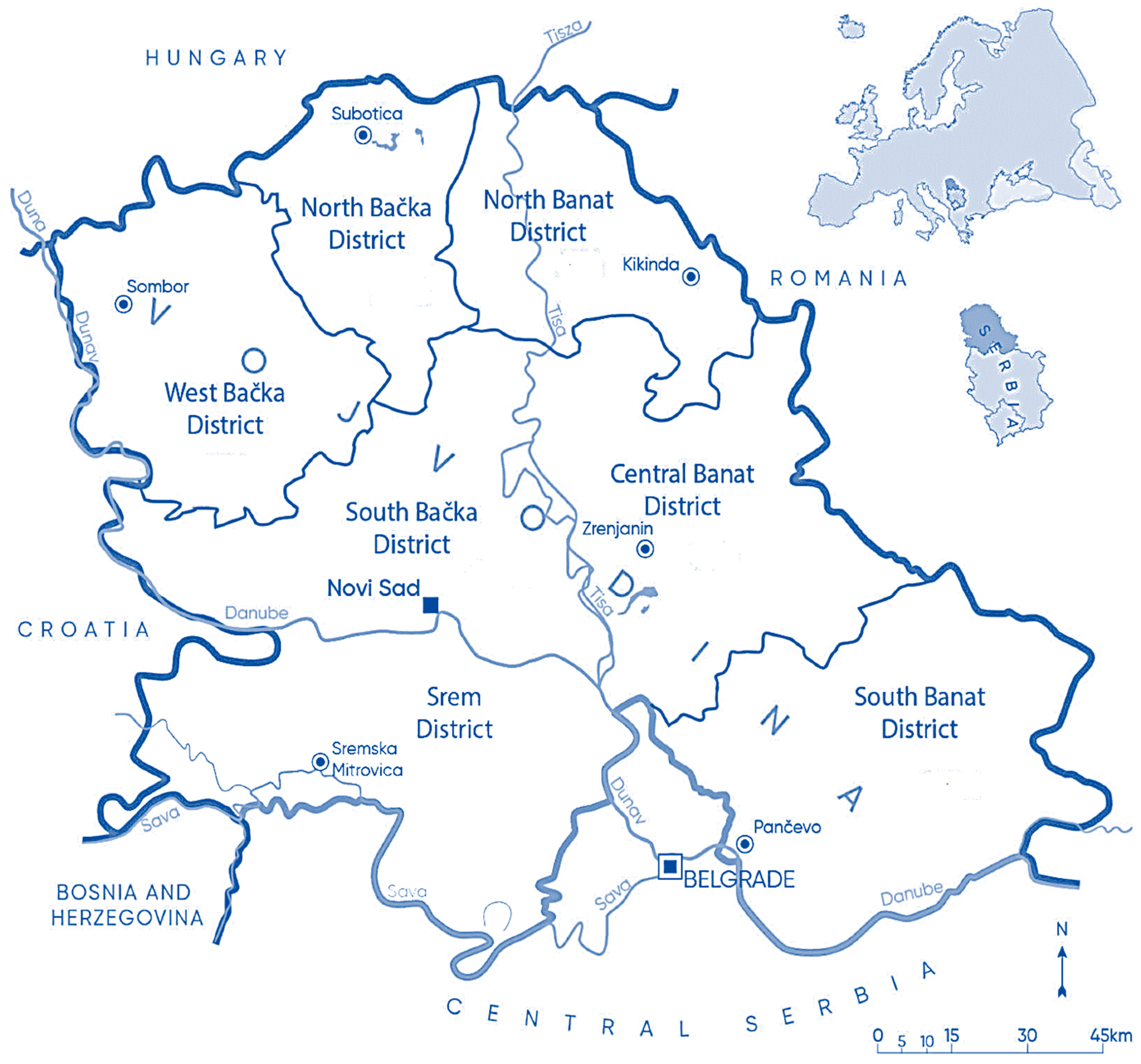
The research was conducted between January and March 2025. The research location is presented in
Figure 1.
3.4. Research Procedure
The survey was carried out in person across various hospitality venues, including restaurants, inns, taverns, and cafés, located in both urban and rural areas of the Autonomous Province of Vojvodina. Data collection took place during the summer season of 2024, when tourist activity in the region is at its peak. Questionnaires were distributed with the assistance of hospitality staff and filled out on-site. Participation was voluntary and anonymous, with prior informed consent. Respondents were recruited using a non-probability convenience sampling approach, depending on guest willingness and availability, which is considered suitable for exploratory research of this type. To ensure sample diversity, data were collected from different categories of establishments (from traditional inns to fine-dining restaurants) and among both domestic and international visitors. All participants were adults (18+) with previous experience consuming traditional food dishes in hospitality settings.
3.5. Sample Size and Validity
The sample was proportionally distributed across all districts based on official 2022 Census data (
Statistical Office of the Republic of Serbia, 2022). Through data analysis, the study provided insights into tourist perceptions from various geographical areas, including both urban and rural settings, which enabled the identification of potential differences in attitudes and preferences. Due to logistical limitations and the nature of the study, which was conducted in real-life hospitality settings, a convenience sampling method was employed. Although not probabilistic, this approach is commonly used in exploratory behavioral research.
Of the 800 distributed questionnaires, 507 were completed and valid, resulting in a completion rate of approximately 63.4%. As the survey relied on convenience recruitment in real-life hospitality settings, this rate reflects the proportion of distributed questionnaires that were completed, rather than a population response rate. Due to the non-probability nature of the sample, the results cannot be considered statistically representative of the entire tourist population. However, the achieved sample size was compared with Cochran’s formula solely as an order-of-magnitude check, confirming that the number of valid responses was sufficient for the planned exploratory and inferential analyses, but not as evidence of population representativeness. The calculated minimum sample size for a 95% confidence level and a 5% margin of error (n = 384) was used only as a benchmark for adequacy, not for representativeness.
3.6. Statistical Data Analysis
Within the scope of statistical data analysis, basic descriptive statistics were first calculated to gain an overview of the collected responses. Subsequently, an Exploratory Factor Analysis (EFA) was conducted with the aim of reducing variables to a smaller number of interrelated latent factors. To assess the suitability of the data for factor analysis, Bartlett’s Test of Sphericity and the Kaiser–Meyer–Olkin (KMO) Measure of Sampling Adequacy were applied, in accordance with the recommendations of
Field (
2013). The factor analysis was performed using the Principal Axis Factoring (PAF) extraction method, which is appropriate for identifying latent constructs rather than data reduction. An Oblimin rotation was applied to allow for correlations among factors, in line with the theoretical expectation of interrelated constructs. The number of retained factors was determined using parallel analysis and the eigenvalue-greater-than-one criterion. The results indicated a three-factor solution explaining a satisfactory proportion of the total variance. All factors demonstrated high internal consistency, and cross-loadings above 0.30 were examined following the guidelines of
Tabachnick and Fidell (
2019). Since all cross-loadings were below this threshold and theoretically interpretable, all items were retained in the final factor structure.
3.7. Confirmatory Factor Analysis and Logistic Regression
Following the exploratory phase, Confirmatory Factor Analysis (CFA) was conducted to assess the adequacy of the factor structure derived from the EFA. The CFA was performed on the same data set to evaluate model fit, serving as a model adequacy check rather than full cross-validation, due to sample size limitations. Model fit was assessed using multiple indices, including the χ
2/df ratio, NFI, NNFI, CFI, TLI, RFI, GFI, AGFI, and RMSEA. Values close to or above 0.90 were considered indicative of good fit (
Kline, 2016), while RMSEA values below 0.08 were considered acceptable (
Schreiber et al., 2006). In addition to global fit indices, composite reliability (CR) and average variance extracted (AVE) were computed to assess construct-level validity. All three latent constructs exceeded the threshold for CR (CR > 0.70) and AVE (AVE > 0.50), confirming satisfactory convergent validity and internal consistency. Discriminant validity was further evaluated using the HTMT criterion. Although the HTMT ratios were moderately high, all 95% bootstrapped confidence intervals remained below 1.0, indicating that the constructs are empirically distinguishable despite being theoretically correlated. Upon establishing adequate model fit, binary logistic regression analysis was applied to identify the key socio-demographic and latent factors (extracted from the EFA) that significantly influence respondents’ decisions to purchase dishes prepared with TFs in hospitality establishments. The regression was estimated on the full sample (N = 507) to ensure model robustness and avoid bias associated with subsampling.
This method is based on cumulative logistic probability functions, where the dependent variable assumes a dichotomous value (0/1). The probability of belonging to a given category is modeled through odds ratios (OR), calculated using the formula:
After logarithmic transformation, the logistic regression (logit) model provides a linear interpretation of the odds:
Here, β coefficients represent the degree of influence of the independent variables on the dependent variable. This model allows for the prediction of the probability of an event occurring based on the values of the predictors (
Hosmer et al., 2013). Since the logit can assume values in the (−∞, +∞) interval, while probability is bounded in the [0,1] interval, logit transformation is considered optimal for modeling binary outcomes (
Menard, 2002).
Given the imbalance between purchasers and non-purchasers, model performance was primarily evaluated using the Area Under the ROC Curve (AUC), which provides a more robust and class-insensitive measure than overall accuracy or raw classification rate. Sensitivity and specificity were additionally examined to assess the model’s ability to correctly classify both positive and negative cases.
4. Results
4.1. Analysis of Socio-Demographic Characteristics of Respondents
To ensure a comprehensive analysis of the collected data, the process begins with an examination of the socio-demographic characteristics of the respondents. The results are presented in
Table 1. Based on the descriptive statistical analysis, 39.1% of participants were male, while 60.9% were female. Regarding the age distribution, the largest group of respondents was under the age of 30 (48.3%), followed by those aged 31–45 (26.8%) and 46–60 years (18.7%), and the smallest share was among respondents over 60 years of age (6.1%).
In terms of education level, the highest share of respondents had completed higher education or university studies (44.4%), followed by those with completed secondary education (39.3%), while the smallest share (16.4%) had completed master’s or doctoral studies. Regarding the field of education, 17.6% of respondents held qualifications in hospitality or tourism, 27.6% in economics, law, or management, 12.8% in food technology, agriculture, or chemistry, 11% in medicine or veterinary medicine, and another 11% in IT, mechanical engineering, or construction. Additionally, 5.5% held qualifications in education, and 14.4% reported a background in other fields.
Most respondents (70.1%) were employed, 19.5% were students, 5.1% were currently unemployed, and 4.9% were retirees. Approximately one-quarter of the respondents (24.1%) reported a monthly income of up to 47,154 RSD, while another quarter earned between 71,000 and 91,000 RSD. A further 36.1% of respondents reported earnings above 91,000 RSD, and 13.8% fell within the income range of 47,155 to 71,000 RSD.
The majority of respondents (76.1%) resided in urban areas, while 23.9% came from rural environments. The highest proportion of respondents was from the South Bačka District (34.3%), followed by the Srem District (16.2%), the South Banat District (15.0%), the West Bačka District (9.3%), the North Bačka District (9.1%), the Central Banat District (8.9%), and the smallest share was from the North Banat District (7.3%). This distribution aligns with the actual population settlement patterns of the region’s administrative districts.
4.2. Exploratory and Confirmatory Factor Analysis
The results of the descriptive statistical analysis for the items investigated within the developed research scales are presented in
Table 2.
Based on the results presented in the previous table, it is evident that respondents expressed the highest level of agreement with the statements that the offering of dishes prepared with TFs provides an opportunity for guests to become familiar with the locality (Mean = 4.367) and that it contributes to the promotion of local products (Mean = 4.314). The lowest level of agreement was observed for the statement that offering of such dishes is profitable (Mean = 3.803). The greatest variability in responses was recorded for the item stating that the use of TFs reduces the environmental impact of transportation (SD = 1.068).
Prior to conducting factor analysis, the suitability of the data was assessed using the Kaiser–Meyer–Olkin (KMO) measure and Bartlett’s test of sphericity (
Table 3).
The obtained KMO value was 0.96, which significantly exceeds the recommended threshold of 0.6, indicating that the data is suitable for factor analysis for a given set of variables. Bartlett’s test of sphericity was also statistically significant (p < 0.05), suggesting sufficient correlations among the variables. Furthermore, the correlation matrix revealed enough coefficients above 0.3 and statistically significant values.
Exploratory Factor Analysis (EFA) was performed using the Principal Axis Factoring (PAF) extraction method, which is suitable for identifying latent constructs rather than maximizing explained variance (as in PCA). The Oblimin rotation was applied, allowing for correlations among factors, given the theoretical expectation that socio-economic, cultural, and environmental dimensions of attitudes are interrelated. Accordingly, the extracted factors should be interpreted as correlated but conceptually distinct dimensions of tourist perception. The parallel analysis and the Eigenvalue-greater-than-one criterion both supported the retention of three factors, which jointly explained 61.5% of the total variance. Items with loadings below 0.50 or with cross-loadings below 0.20 were examined; none were removed, as all contributed meaningfully to the theoretical interpretation of the constructs (
Table 4).
Based on the results presented in
Table 4, three correlated but conceptually distinct factors were identified, reflecting interrelated dimensions of respondents’ attitudes toward dishes prepared with traditional foods (TFs). The first factor is defined by the highest loadings for seven statements (s4–s10) and represents the Socio-Cultural Dimension, which captures the perception of TFs as elements that promote local identity, strengthen community ties, and contribute to regional development. The second factor includes five statements (s11–s15) referring to environmental awareness and sustainable practices, thus representing the Ecological Dimension. The third factor comprises three items (s1–s3) related to profitability and market effects, which together form the Economic Dimension of attitudes toward TFs in hospitality.
The highest loading within the Socio-Cultural Dimension was observed for the statement “The offering of dishes made from TFs contributes to the promotion of local products” (loading = 0.984), indicating its central role in shaping this factor. The Ecological Dimension was most strongly represented by the statement “The use of TFs reduces the negative impact of transportation on environmental pollution” (loading = 0.906), while the Economic Dimension showed the highest saturation for “The offering of dishes made from TFs significantly influences the sales value of dishes” (loading = 0.782). Overall, all factor loadings exceeded the recommended minimum threshold of 0.50, confirming a clear and theoretically coherent factor structure.
The reliability analysis further confirmed the robustness of these dimensions, with Cronbach’s alpha values ranging from 0.85 to 0.95, indicating excellent internal consistency across all factors.
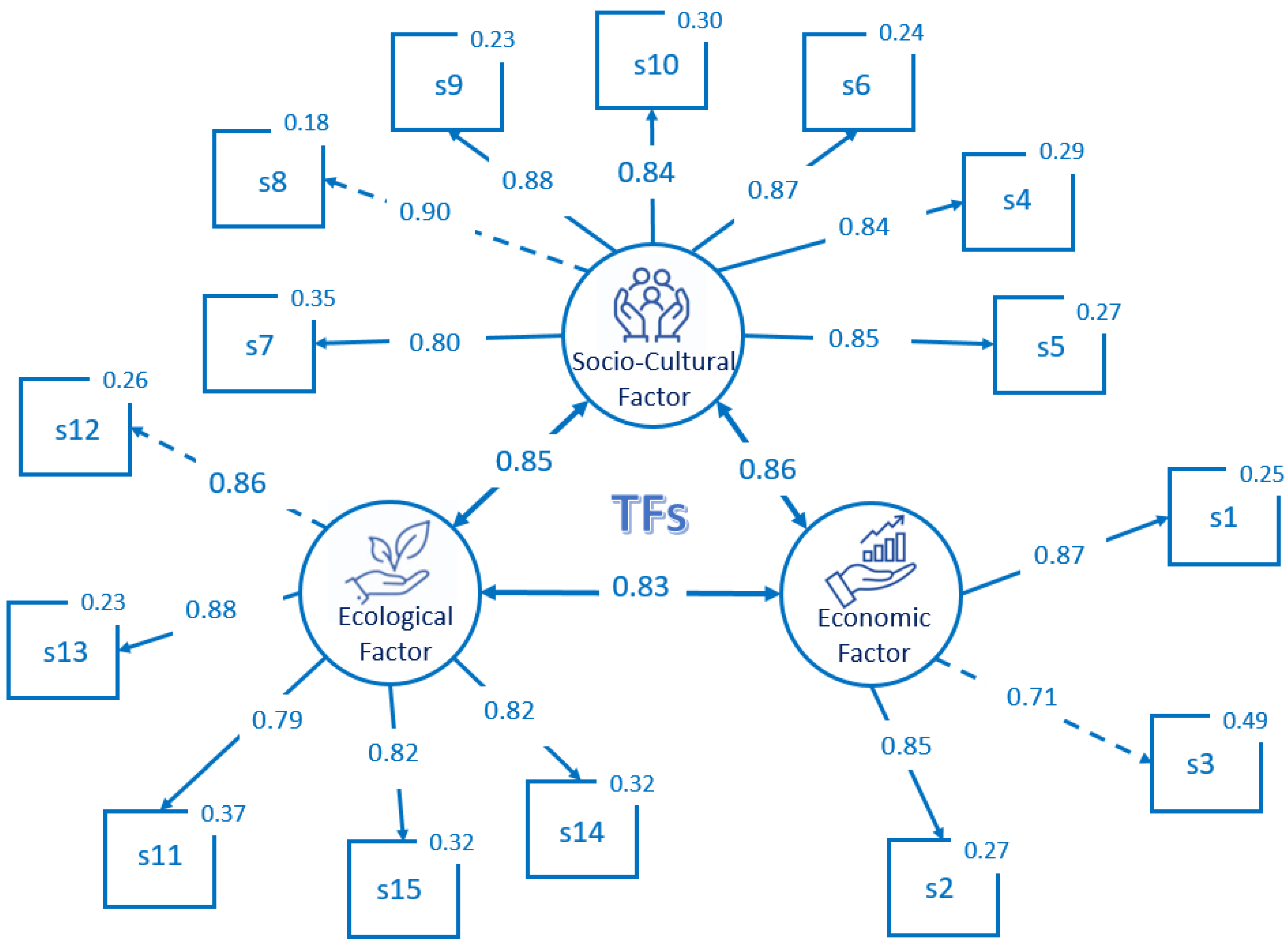
In the next part of the research, confirmatory factor analysis (CFA) was conducted to assess the adequacy of the three-factor structure identified through the EFA (results shown in
Figure 2). Because the CFA was performed on the same dataset, its purpose was not to provide external validation, but to examine how well the proposed measurement model reproduces the observed covariance structure. The three-factor model demonstrated an overall acceptable fit (
Table 5). The fit indices met common guidelines for adequate modeling: NFI = 0.938, NNFI = 0.939, CFI = 0.949, TLI = 0.939, RFI = 0.925, GFI = 0.976, AGFI = 0.883, and RMSEA = 0.060. The χ
2/df ratio was 3.96 (344.472/87), which falls within the acceptable range (<5.0). These indicators jointly support the internal adequacy of the proposed three-factor structure.
In addition to the overall model fit, construct-level reliability and convergent validity were evaluated through Cronbach’s alpha, Composite Reliability (CR), and Average Variance Extracted (AVE) values, as presented in
Table 6.
The results presented in
Table 6 confirm high internal consistency and convergent validity across all latent constructs. Cronbach’s alpha values ranged between 0.845 and 0.950, indicating excellent reliability. The Composite Reliability (CR) values for all constructs exceeded the recommended threshold of 0.70, confirming construct reliability. Moreover, the Average Variance Extracted (AVE) values were all above 0.50, demonstrating that each construct explains more than half of the variance of its indicators.
To further confirm discriminant validity, the Heterotrait–Monotrait (HTMT) ratio of correlations was calculated for all construct pairs (
Henseler et al., 2015).
The results, obtained through 2000 Monte Carlo bootstrapped replications using the MLR estimator, are presented in
Table 7.
The HTMT values between the constructs ranged from 0.893 to 0.914, which are above more conservative heuristics (e.g., 0.85 or 0.90). However, this pattern is fully expected in models where latent factors are theoretically and empirically correlated, as is the case in the present study, which was based on an oblique factor solution in the EFA.
To evaluate discriminant validity more rigorously, we examined the bootstrapped 95% confidence intervals for each HTMT ratio. For all construct pairs, the confidence intervals (Socio-Cultural–Ecological: 0.84–0.94; Socio-Cultural–Economic: 0.86–0.96; Ecological–Economic: 0.83–0.93) did not include the value 1.0, indicating that no pair of constructs approached perfect correlation. According to
Henseler et al. (
2015), the absence of 1.0 within these intervals provides strong evidence that the constructs are empirically distinct, even when HTMT values are moderately high.
Thus, although the factors are correlated—as theoretically expected—the HTMT confidence interval criterion confirms that the constructs retain sufficient discriminant validity and represent meaningfully different dimensions of attitudes toward TFs.
4.3. Preliminary Cross-Tabulation Analysis
Before estimating the logistic regression, preliminary cross-tabulation analyses were conducted to explore the relationship between the extracted perceptual factors and the binary purchase decision (purchase vs. non-purchase). The results presented in
Table 8 show that tourists with higher socio-cultural and economic factor scores were somewhat more likely to purchase TF-based dishes compared to those with lower scores. However, these associations were not statistically significant (
p > 0.05) and should be interpreted as descriptive, serving primarily as a validity check for the subsequent regression analysis.
4.4. Binary Logistic Regression
Binary logistic regression was used to examine the influence of socio-demographic variables and perceptual factors on tourist decisions to purchase TFs. The model’s classification performance and calibration were additionally evaluated using standard diagnostic indicators, including sensitivity, specificity, and the Hosmer–Lemeshow goodness-of-fit test. The full-sample model was statistically significant (Omnibus χ
2 = 42.68,
df = 28,
p = 0.037), indicating that the independent variables collectively contribute to explaining purchase decisions. The model showed a satisfactory fit (Hosmer–Lemeshow χ
2 = 10.92,
p = 0.206) and moderate explanatory power (Nagelkerke R
2 = 0.17). The decision threshold was set at 0.50, corresponding to the default probability cutoff commonly applied in logistic regression. Given the strong imbalance between purchasers and non-purchasers, overall accuracy (89.9%) cannot be interpreted as an informative indicator of model quality. Instead, emphasis was placed on the Area Under the ROC Curve (AUC) as the primary performance metric. The classification results showed very high sensitivity (0.996) but very low specificity (0.039), indicating that the model classified almost all observations into the majority class (purchasers) and had limited ability to correctly identify non-purchasers (
Table 9). This pattern is typical for imbalanced datasets and requires cautious interpretation. The AUC value of 0.76 (95% CI: 0.68–0.84) confirmed acceptable discriminative ability, providing a more balanced assessment of model performance than accuracy or raw classification rates. The detailed results of the logistic regression model, including estimated coefficients, standard errors, odds ratios, and confidence intervals, are presented in
Table 10.
As shown in
Table 10, the logistic regression analysis indicated that monthly income and place of residence were statistically significant predictors of tourists’ decisions to purchase traditional foods. However, these associations should be interpreted with caution given the model’s limited specificity and class imbalance. Higher-income tourists were considerably more likely to purchase TFs compared to those with the lowest income levels (
p < 0.05). The odds ratios (ORs) ranged between 3.22 and 5.97. These values indicate a positive directional association, although their magnitude may be inflated due to the model’s low ability to correctly classify non-purchasers. The place of residence variable showed a negative and statistically significant effect (B = –0.85,
p = 0.018), suggesting that urban residents were less likely to purchase TFs relative to rural respondents (OR = 0.43; 95% CI [0.21–0.87]). This finding is consistent in direction, but—in light of the classification imbalance—its predictive strength should be viewed as tentative rather than definitive. Among other variables, the field of education (specifically IT and engineering disciplines) approached significance (
p = 0.064), indicating a potentially higher inclination toward TF consumption among respondents with technical backgrounds. However, this should not be overinterpreted given the model’s performance characteristics. All three perceptual factors (Socio-Cultural, Ecological, and Economic) did not reach statistical significance in the multivariate model. This does not necessarily imply the absence of influence; rather, it suggests that within this dataset—and under the constraints of the applied model—socioeconomic variables demonstrated stronger associations than perceptual constructs.
5. Discussion
The research findings indicate that tourists perceive the range of dishes prepared with TFs as an opportunity to learn more about the local area, further confirming that respondents widely recognize gastronomy as a means of experiencing local culture and traditions. This aligns with
Lin et al. (
2021), who found that traditional foods enhance tourists’ understanding of local heritage. Specifically, the quality and variety of the gastronomic offer significantly contribute to the visitors’ perception of the destination, and incorporating TFs into the hospitality offerings can significantly enrich the tourist experience (
Ivanović et al., 2022).
Moreover, there was a high level of agreement with the statements suggesting that the offer of dishes made from TFs contributes to the promotion of local products, strengthens community pride, and represents an effective marketing strategy. These findings are consistent with
Parimala and Dinesh (
2023), who reported that tourists widely perceive traditional foods as a key factor in destination choice and cultural engagement. Similarly,
Gallagher and Mckevitt (
2019) highlighted the socio-cultural benefits of promoting local food products in tourism. These results underscore the significant potential of gastronomy as a tool for enhancing the economic and cultural development of local communities.
Conversely, the lowest level of agreement was recorded for the statement suggesting that the range of dishes made from TFs is profitable. This outcome aligns with
Caputo et al. (
2017), who noted that the high production costs of traditional foods limit profitability, confirming that economic considerations often lag behind cultural and ecological values in tourist food choices. Based on these results, H
1 was confirmed.
The research also identified the three theoretically expected factors—Socio-Cultural, Ecological, and Economic—thereby confirming the H
2. The socio-cultural factor was dominant, confirming that tourists view TFs as symbols of local identity and cultural heritage (
Gallagher & Mckevitt, 2019), with particular emphasis on the role of TF-based dishes in promoting local products. Similar results were reported in research conducted in Hungary (
Báti, 2024) and Japan (
Kim & Iwashita, 2016), confirming the Socio-Cultural Factor as one of the most globally recognized in the context of TFs. Although this factor showed the strongest contribution, its effects should be interpreted in relation to the ecological and economic dimensions, given that the factors are statistically correlated under the oblique rotation used in the EFA.
The second identified factor contains five statements related to the ecological aspects of TFs. Particularly prominent were the statements indicating that the use of TFs reduces the negative impact of transportation. However, awareness of preserving indigenous varieties was low, despite literature highlighting its importance (
Striebig et al., 2019). Nevertheless, this does not undermine the internal coherence of the ecological factor, as all loadings remained above the recommended threshold and the factor structure was supported by the EFA results.
Although ecological values were highly rated at the attitudinal level, the regression analysis did not confirm their statistically significant influence on purchasing behavior. This suggests that while tourists express environmental awareness, such attitudes do not necessarily translate into actual choices within hospitality settings. This finding supports the existence of the attitude–behavior gap, where external factors such as price, availability, or lack of eco-certification may prevent environmentally conscious tourists from acting according to their ecological beliefs (
Juvan & Dolnicar, 2014;
Guerrero et al., 2010). Additionally, tourists may associate the concepts of “local” and “traditional” primarily with authenticity rather than with environmental responsibility, particularly in the absence of standardized eco-labels or transparent production information (
Wirsig & Lenz, 2023;
Elshaer et al., 2023).
The third factor, comprising three statements, pertains to the economic aspect of offering TFs. The strongest saturation within this dimension was recorded for the statement “The offering of dishes made from TFs significantly influences the sales value of dishes”, followed by “The offering of dishes made from TFs increases the demand for dishes”. However, this factor exhibited the lowest overall factor loadings, indicating that tourists primarily value TFs through cultural and ecological dimensions, with its economic significance being secondary. This observation is in line with
Nurhayati (
2025), who highlighted that economic incentives are often secondary to cultural and ecological motivations in the consumption of traditional foods.
Regarding socio-demographic characteristics, the logistic regression analysis indicated that monthly income and place of residence were statistically significant variables associated with tourists’ decisions to purchase TFs. However, these associations should be interpreted with caution given the model’s low specificity and strong class imbalance, which limits the ability to reliably distinguish non-purchasers from purchasers. Respondents with higher incomes demonstrated greater tendency to purchase TFs, suggesting that purchasing power plays a crucial role in shaping tourist decisions. These findings may appear counterintuitive, as TFs are often priced higher than industrial products, primarily due to their production methods, but also because of smaller production volumes (
Vlontzos et al., 2018). However, research indicates that tourists with lower income are often more inclined toward local products, perceiving them as offering better value for money (
Andriyanty & Wahab, 2019). This pattern is supported by research conducted in Indonesia (
O’Neill, 2024), which found that while higher income increases the likelihood of choosing local and TFs, even low-income groups show a strong preference for local products, particularly when purchased through conventional markets rather than online platforms.
In addition to income, place of residence proved to be a significant socio-demographic factor. Respondents from rural areas more frequently purchased TFs compared to urban residents, which aligns with
Rokpelnis et al. (
2018) and
Kalenjuk Pivarski et al. (
2023a), who noted that rural populations have higher exposure, accessibility, and cultural familiarity with traditional foods, enhancing purchase propensity.
Differences were also evident across administrative districts. Tourists from the West Bačka District were less inclined to purchase TFs than those from Central Banat, which can likely be attributed to the higher rural population density in Central Banat. This greater rural presence may increase both the availability of TFs and the cultural familiarity with them, as rural communities are more directly engaged in local food production and traditional culinary practices. Consequently, tourists in areas with higher rural representation may have stronger preferences for TFs due to greater exposure, accessibility, and integration of these products into daily dietary habits (
Kalenjuk Pivarski et al., 2023b).
Other socio-demographic variables, including gender, age, education level, and employment status, were not statistically significant predictors in this model specification. However, this absence of significance should not be interpreted as evidence of no effect, as the model’s limited discriminative capacity may mask weaker associations. Based on these considerations, H3 was partially confirmed, but the strength of the observed relationships must be interpreted with methodological caution.
6. Conclusions
The research revealed that tourists highly value the offer of dishes made from TFs as a means of exploring local culture, promoting engagement, and enhancing the destination’s identity. Elements such as cultural significance, local authenticity, and shared identity emerged as the key determinants in shaping positive tourist attitudes toward this type of gastronomic offering.
Although tourists do not prioritize economic factors when evaluating TFs, their symbolic and emotional value appears to outweigh price considerations, underscoring the unique position of TF as cultural rather than purely commercial asset.
The study identified socio-cultural, ecological, and economic factors as key dimensions shaping tourist attitudes. This highlights an opportunity for stakeholders in tourism and hospitality to present TFs not merely as food products but as cultural artifacts and ecological resources that reflect local identity and sustainable values. Although ecological aspects were positively perceived at the attitudinal level, they did not have a statistically significant influence on purchasing behavior, indicating that ecological awareness among tourists does not necessarily translate into concrete actions. Tourists primarily value TFs through cultural and symbolic dimensions, while their economic significance is perceived as secondary.
The analysis of socio-demographic and perceptual determinants indicated that income and place of residence emerged as statistically significant variables associated with purchasing decisions. However, these findings should be interpreted with caution due to the model’s low specificity and class imbalance, which reduce confidence in the precise magnitude of these effects. Respondents with higher incomes, as well as those from rural areas, showed a greater tendency to consume TFs. Regional differences were also observed, partly explained by the higher rural prevalence of TF consumption in certain areas. Other demographic characteristics did not reach statistical significance in this model, though this result may partly reflect methodological constraints rather than the true absence of influence.
Furthermore, although ecological attitudes were positively rated, their lack of predictive power highlights the attitude–behavior gap and the need for clearer communication of sustainability practices. To bridge this gap between intentions and behavior, future initiatives should aim to strengthen the tourist connection with TFs through storytelling about product origin, greater transparency in production processes, and a stronger presence in everyday consumption contexts.
The preservation of gastronomic traditions in Vojvodina is deeply rooted in intergenerational transmission of culinary knowledge and practices and is passed from mothers to daughters and from fathers to sons, ensuring the continuity of culinary heritage over time. Such transmission not only safeguards traditional recipes and preparation techniques but also strengthens the collective memory and cultural identity of local communities. By maintaining these practices, the region fosters a sense of belonging and authenticity that enhances its attractiveness as a sustainable gastronomic destination. Consequently, preserving and promoting traditional food culture contributes both to cultural sustainability and to the long-term development of rural and hospitality sectors in Vojvodina.
The theoretical and practical implications of these findings, as well as the study’s limitations and directions for future research, are discussed in the following subsections.
6.1. Theoretical Contribution
This research contributes to the theoretical foundation in the domain of TFs through the development and application of the TPP-TF model, which provides a structured framework for understanding tourist perception and the identification of key factors that influence tourist behavior across ecological, economic, and socio-cultural dimensions. In contrast to traditional models that primarily emphasize rational–economic motives, the TPP-TF model highlights the symbolic and affective dimensions of food choice, which are particularly significant for understanding TF consumption.
Furthermore, this study expands the scope of the Theory of Planned Behavior by demonstrating that socio-cultural and affective factors can outweigh rational–economic determinants in shaping tourist decision-making within hospitality contexts. The findings reveal that the perception of traditional foods is rooted more in emotional attachment and cultural identity than in utilitarian motives, suggesting that existing behavioral frameworks should integrate cultural and experiential constructs.
Additionally, the research contributes through conceptual integration of value orientations and the perception of authenticity in analyzing tourist behavior, emphasizing the role of symbolic and cultural values in shaping attitudes and predicting actual TF purchase decisions. By linking cultural identity with tourist decision-making, this study introduces a novel interdisciplinary perspective that combines insights from tourist psychology, food studies, and cultural sociology. Such an approach enables a deeper understanding of how tourists assign meaning to TFs, transcending their purely utilitarian function.
6.2. Practical Implications
Based on the results obtained, it can be concluded that TFs hold multidimensional significance for tourists; however, economic conditions and availability remain key factors in their actual choice. This underscores the need for implementing measures aimed at improving economic accessibility, such as subsidies, tax incentives for certified TFs, or financial support for producers who operate in line with sustainability principles. Furthermore, the creation of public–private partnerships with the goal of reducing distribution costs and developing local supply networks could enhance the availability of TFs, particularly in urban areas. This highlights the need for the development of specific strategies that link cultural values and ecological benefits to more economically accessible offerings.
The findings also indicate that promotional activities must be strategically targeted, focusing on educating urban and highly educated tourists, as well as supporting local producers in maintaining market competitiveness. Educational campaigns could be carried out through the formal education system, tourism events, gastronomic festivals, and digital platforms to raise awareness about the importance of TFs for cultural heritage preservation and local economic development. Support for producers may include training in digital marketing, assistance with certification processes, the adoption of eco-friendly practices, and improved market access through collaborations with the tourism and hospitality sectors.
In addition, the establishment of short, local supply chains connecting producers with hospitality providers is recommended, as this could reduce costs and increase availability. Such an approach would contribute to the stronger inclusion of rural communities in the tourism offerings and stimulate local economic development. Evidence from countries such as Italy and Austria demonstrates that short supply chains and territorially based branding of TF increase visibility and sales, offering valuable guidelines for the regional context of this research (
Serrano-Cruz et al., 2018).
Considering the observed discrepancy between positive attitudes and actual purchase decisions, marketing strategies should not only emphasize cultural values, but also focus on reducing psychological and practical barriers such as price, availability, and lack of information. Promoting quality labels, ecological orientation, and using of storytelling in marketing, along with experiential approaches (e.g., tastings, producer visits, and tourist involvement in production), can help strengthen tourist engagement.
Finally, the results highlight the need for cross-sectoral cooperation between the tourism, agriculture, and education sectors to develop integrated policies that promote sustainable consumption and the preservation of gastronomic heritage through institutional support.
6.3. Methodological Limitations
While the study provides valuable insights, certain methodological limitations should be acknowledged. First, the use of convenience sampling, although common in hospitality research, limits the representativeness of the findings and restricts the generalizability of the results beyond the study context. The sample was skewed toward younger respondents (48% under 30 years) and urban residents (76%), which may not fully reflect the preferences of the broader population. As a result, the generalizability of the conclusions is restricted, particularly in relation to older and rural tourists. Nevertheless, in order to examine whether these imbalances substantially affect the findings, we conducted additional subgroup analyses. By comparing purchase decisions between urban and rural respondents, as well as between younger (≤30 years) and older (≥31 years) respondents, and applying χ2 tests of independence, we confirmed significant differences between groups. Urban and older respondents were more likely to purchase TFs, yet the general pattern of results remained consistent. This robustness check suggests that, despite the sample imbalance, the main conclusions of the study can still be considered reliable.
Second, the dependent variable used in this study—binary purchase decision (Yes/No)—captures only a simplified dimension of tourist behavior. Important aspects such as purchase frequency, willingness to pay a price premium, and contextual influences were not measured. This reduces the ability to interpret the complexity of tourist decision-making in hospitality settings. Future research should address this issue by employing Likert-type or ordinal measures that can better reflect the intensity and diversity of purchasing intentions and behaviors.
Third, although the Exploratory Factor Analysis was conducted using the Principal Axis Factoring (PAF) method with Oblimin rotation—appropriate for identifying latent constructs and allowing for correlations among factors—this choice also introduces certain interpretative limitations. The resulting factors, while statistically distinct, are not entirely independent, which may lead to overlapping conceptual domains. Furthermore, the retained three-factor solution, although supported by parallel analysis, should be interpreted with caution and verified through future studies using confirmatory factor analysis on independent samples.
Fourth, the confirmatory factor analysis was performed on the same dataset used for the exploratory analysis. Although this approach provides a useful check of model adequacy, it does not allow for full cross-validation. Therefore, the CFA results should be interpreted as an internal adequacy assessment rather than full validation, and future studies should replicate the CFA on an independent sample to confirm the stability of the factor structure.
6.4. Indications for Future Research
Further research could enrich this topic through the analysis of regional differences in tourist perception and behavior towards TFs, particularly by comparing different parts of Serbia, as well as the broader Balkan or European context. Longitudinal studies would be valuable for monitoring changes in tourist attitudes over time, especially in the context of socio-economic changes, inflation, and trends in sustainable eating. In addition to quantitative methods, future studies may include qualitative approaches, such as in-depth interviews or focus groups, which would provide a deeper understanding of the emotional, cultural, and symbolic aspects related to the consumption of TFs. Finally, research could be expanded to include other actors in the value chain (hospitality providers, local producers, tourists), which would provide a more comprehensive picture of the role of TFs in the local economy and sustainable development.




 ,
,