

K-Pop Demon Hunters and Digital Cultural Diplomacy: Measuring Brand Identity-Image Convergence in Animated K-Content


Abstract
1. Introduction
- RQ 1. How do Korean and foreign language comments differ in their thematic focus and emotional valence regarding Korean cultural elements?
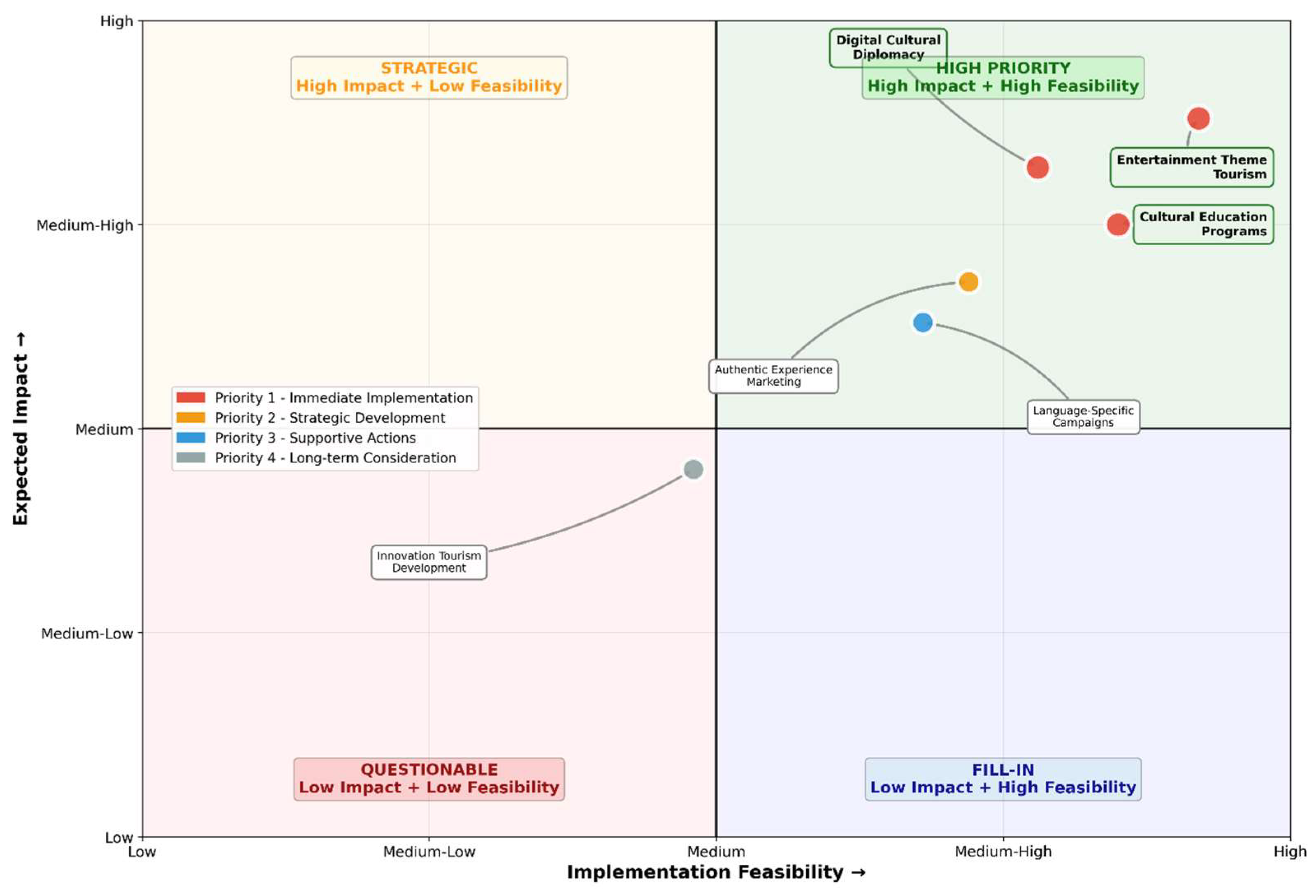
- RQ 2. What patterns of convergence and divergence exist between internal brand identity (Korean comments) and external brand image (foreign comments)?
- RQ 3. How do social network structures vary across language communities, and what implications do these patterns have for cultural transmission?
- RQ 4. What strategic recommendations emerge from the convergence analysis for Korean tourism marketing and cultural diplomacy?
2. Literature Review
2.1. Nation Branding and Cultural Diplomacy
2.2. Brand Identity-Image Convergence Theory
2.3. Digital Cultural Consumption and Social Media Analysis
2.4. Korean Wave and Tourism Marketing (2020–2024)
3. Methodology
3.1. Research Design
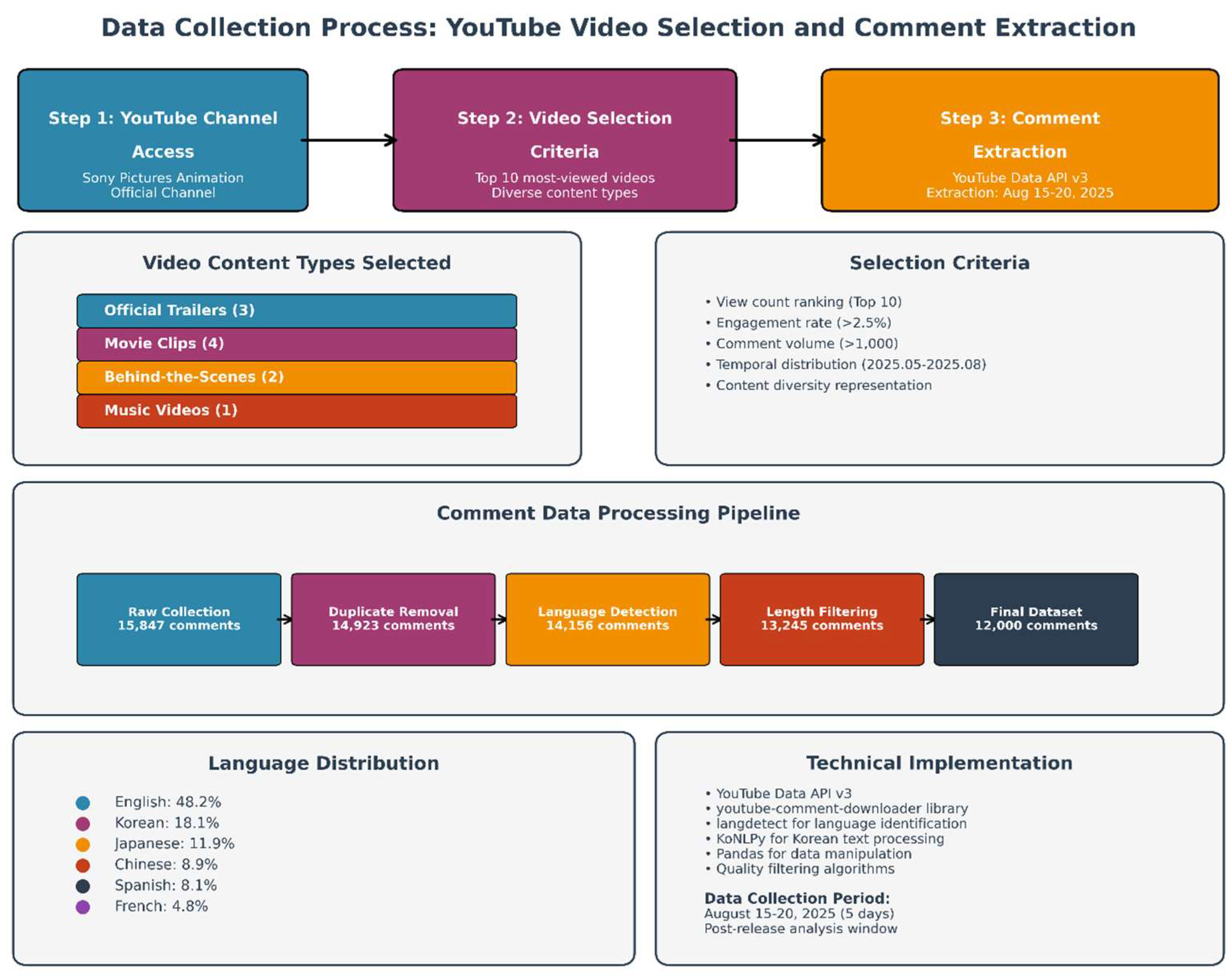
3.2. Data Collection
3.3. Data Preprocessing and Language Detection
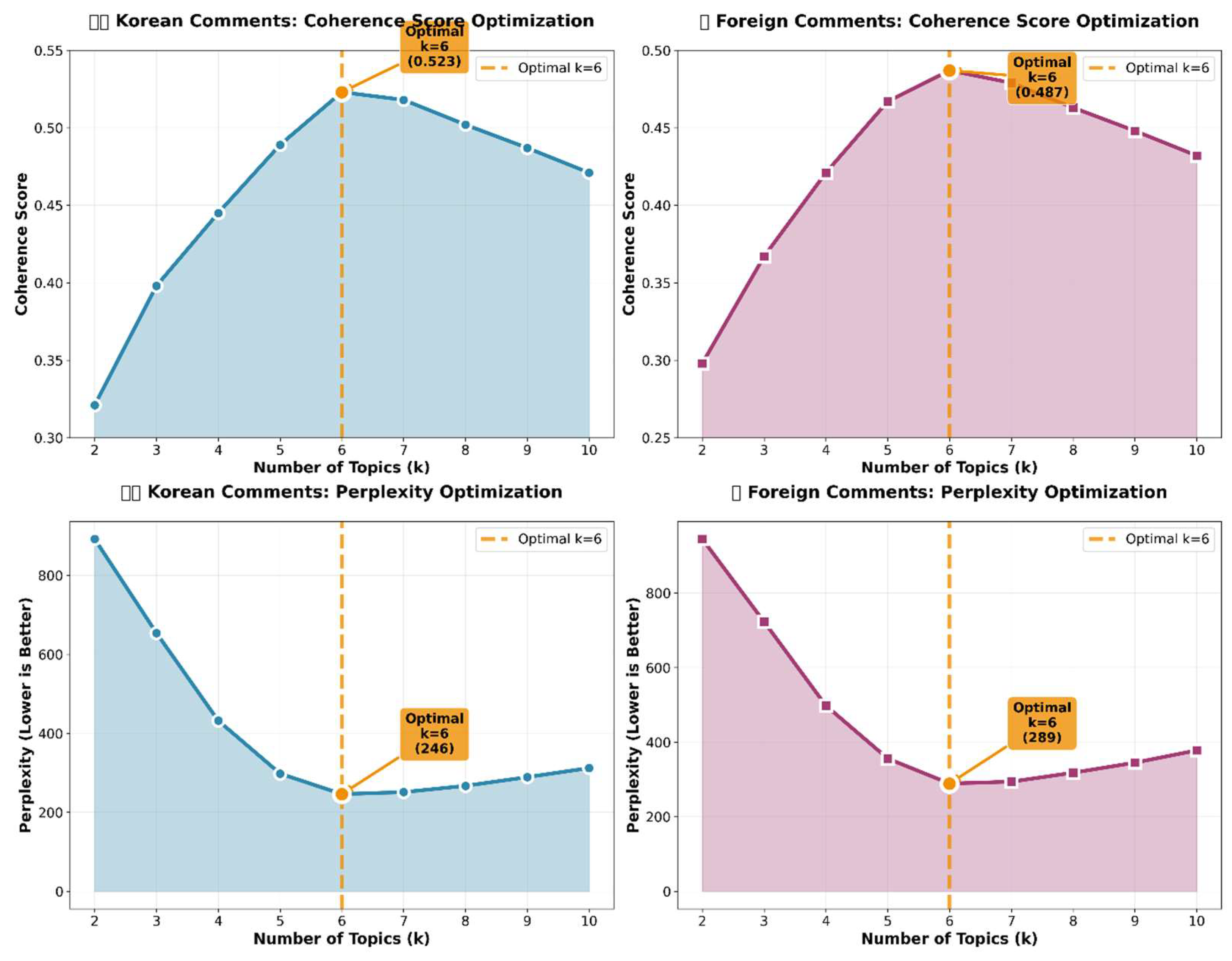
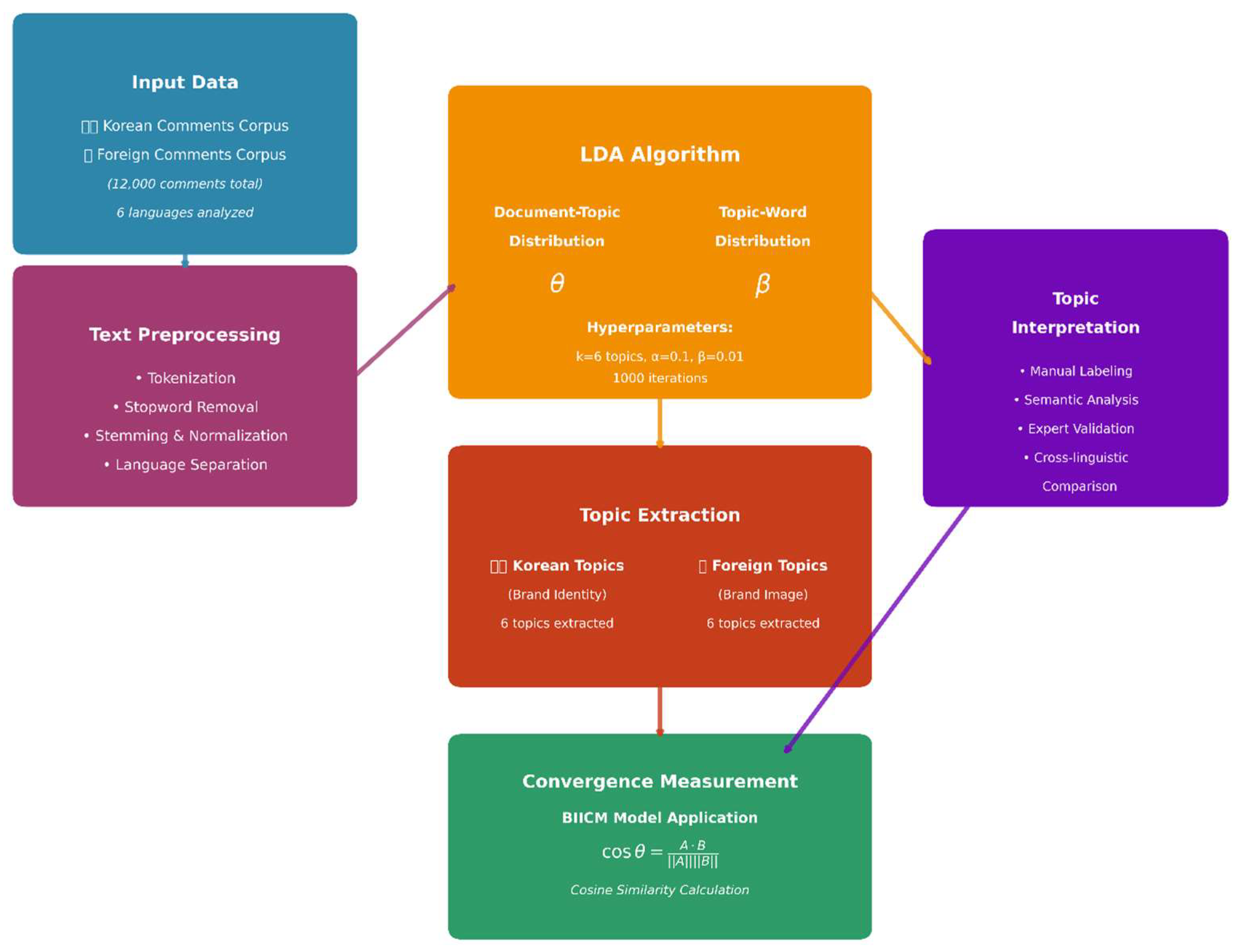
3.4. Topic Modeling
3.5. Social Network Analysis
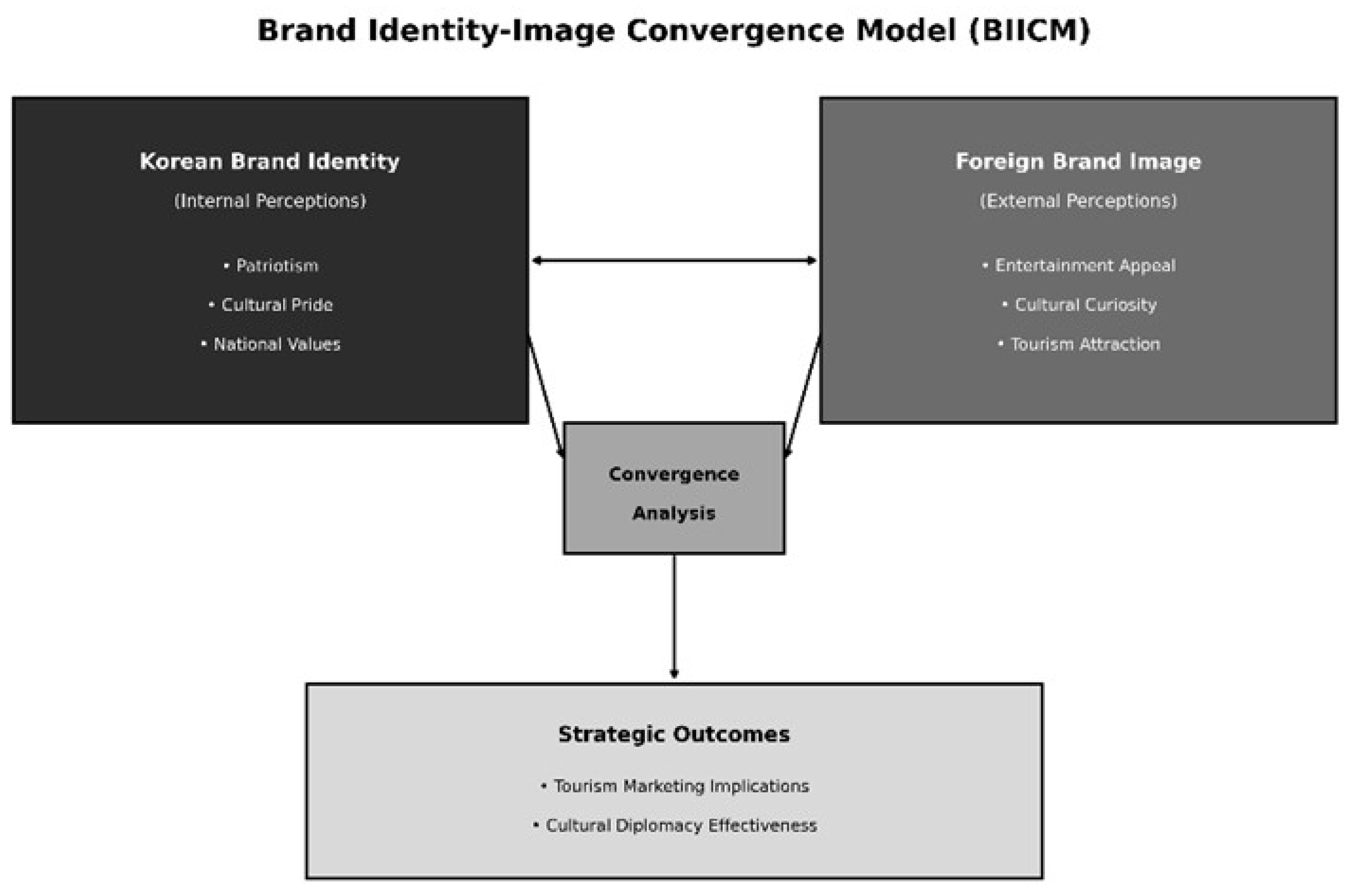
3.6. Brand Identity-Image Convergence Model (BIICM)
4. Results
4.1. Topic Analysis Results
4.2. Brand Identity-Image Convergence Analysis
4.3. Social Network Analysis Results
4.4. Statistical Analysis
5. Discussion
5.1. Theoretical Implications
5.2. Practical Implications for Korean Tourism Marketing
5.3. Cultural Diplomacy Implications
5.4. Limitations and Future Research
6. Conclusions
6.1. Summary of Key Findings
6.2. Contributions
Funding
Institutional Review Board Statement
Informed Consent Statement
Data Availability Statement
Acknowledgments
Conflicts of Interest
References
- Aaker, D. A. (1996). Measuring brand equity across products and markets. California Management Review, 38(3), 102–120. [Google Scholar] [CrossRef]
- Anholt, S. (2007). Competitive identity: The new brand management for nations, cities and regions. Palgrave Macmillan. [Google Scholar] [CrossRef]
- Anime News Network. (2025). Demon Slayer: Kimetsu no Yaiba manga tops 200 million copies in circulation. Available online: https://www.animenewsnetwork.com/news/2025-07-17/demon-slayer-kimetsu-no-yaiba-manga-tops-200-million-copies-in-circulation/.226769 (accessed on 15 July 2025).
- Băjenaru, I. R. (2022). Bangtan boys (BTS)—Part of South Korea’s cultural diplomacy and soft power strategy. Romanian Review of Political Sciences and International Relations, 19(1), 156–180. [Google Scholar]
- Blei, D. M., Ng, A. Y., & Jordan, M. I. (2003). Latent Dirichlet allocation. Journal of Machine Learning Research, 3, 993–1022. [Google Scholar] [CrossRef]
- Blondel, V. D., Guillaume, J.-L., Lambiotte, R., & Lefebvre, E. (2008). Fast unfolding of communities in large networks. Journal of Statistical Mechanics: Theory and Experiment, 2008(10), P10008. [Google Scholar] [CrossRef]
- Buhmann, A., & Ingenhoff, D. (2015). The 4D model of the country image: An integrative approach from the perspective of communication management. International Communication Gazette, 77(1), 102–124. [Google Scholar] [CrossRef]
- Burgess, J., & Green, J. (2018). YouTube: Online video and participatory culture (2nd ed.). Polity Press. [Google Scholar]
- Chosun Ilbo. (2025, September 26). KPop Demon Hunters smashes Netflix records, elevates animated Korean branding. Available online: https://www.chosun.com/english/national-en/2025/09/27/GDYJ2GO5ZZHIZE3x27QKEBMZKQ/ (accessed on 9 October 2025).
- Cooper-Chen, A. (2012). Cartoon planet: The cross-cultural acceptance of Japanese animation. Asian Journal of Communication, 22(1), 44–59. [Google Scholar] [CrossRef]
- Cull, N. J. (2019). Public diplomacy: Foundations for global engagement in the digital age. Polity Press. [Google Scholar]
- Dinnie, K. (2015). Nation branding: Concepts, issues, practice (2nd ed.). Routledge. [Google Scholar] [CrossRef]
- Duolingo. (2021). “Squid Game” could inspire a new wave of Korean language learners. Available online: https://blog.duolingo.com/squid-game-could-inspire-a-new-wave-of-korean-language-learners/ (accessed on 28 July 2025).
- Fan, X., & Supalakwatchana, S. (2026). KPop demon hunters: Cultural representation in contemporary Korean animation. Asian Journal of Arts and Culture, 2(1), e16. [Google Scholar] [CrossRef]
- Fetscherin, M. (2010). The determinants and measurement of a country brand: The country brand strength index. International Marketing Review, 27(4), 466–479. [Google Scholar] [CrossRef]
- Global Times. (2020). BTS hit ‘Dynamite’ worth $1.4 billion to South Korea: Government. Available online: https://www.globaltimes.cn/content/1200263.shtml (accessed on 2 August 2025).
- Gosling, J. (2021). Maximising soft power: The role of digital diplomacy in building trust with nation-branding. Global Affairs Review, 1(2), 1–19. [Google Scholar] [CrossRef]
- Griffiths, T. L., & Steyvers, M. (2004). Finding scientific topics. Proceedings of the National Academy of Sciences USA, 101Suppl. 1, 5228–5235. [Google Scholar] [CrossRef]
- Jenkins, H. (2006). Convergence culture: Where old and new media collide. NYU Press. [Google Scholar]
- Jin, D. Y. (2016). New Korean wave: Transnational cultural power in the age of social media. University of Illinois Press. [Google Scholar] [CrossRef]
- Jin, D. Y., & Yoon, T. J. (2017). The Korean wave: Retrospect and prospect. International Journal of Communication, 11, 2241–2249. [Google Scholar]
- Kaneva, N. (2011). Nation branding: Toward an agenda for critical research. International Journal of Communication, 5, 117–141. [Google Scholar]
- Kapferer, J.-N. (2008). The new strategic brand management: Creating and sustaining brand equity long term (4th ed.). Kogan Page. [Google Scholar]
- Kapferer, J.-N. (2012). The new strategic brand management: Advanced insights and strategic thinking (5th ed.). Kogan Page. [Google Scholar]
- Keller, K. L. (2012). Strategic brand management: Building, measuring, and managing brand equity (4th ed.). Pearson. [Google Scholar]
- Kim, S., Kim, S., & Wong, A. K. F. (2023). Music-induced tourism: Korean pop (K-pop) music consumption values and their consequences. Journal of Destination Marketing & Management, 30, 100824. [Google Scholar] [CrossRef]
- Korea Herald. (2020). BTS’ Billboard win expected to create economic effect worth 1.7tr won. Available online: https://www.koreaherald.com/article/2415975 (accessed on 5 August 2025).
- Kotler, P., & Keller, K. L. (2016). Marketing management (15th ed.). Pearson Education. [Google Scholar]
- Lange, P. G. (2019). Thanks for watching: An anthropological study of video sharing on YouTube. University Press of Colorado. [Google Scholar] [CrossRef]
- Le Monde. (2024). Netflix’s ‘Emily in Paris’ and ‘Lupin’ drive tourism, says French film institute. Available online: https://www.lemonde.fr/en/france/article/2024/01/18/netflix-s-emily-in-paris-and-lupin-drive-paris-tourism_6443181_7.html (accessed on 15 August 2025).
- Lim, S., Seetaram, N., Hosany, S., & Li, M. (2023). Consumption of pop culture and tourism demand: Through the lens of herding behaviour. Annals of Tourism Research, 99, 103531. [Google Scholar] [CrossRef]
- Madden, A., Ruthven, I., & McMenemy, D. (2013). A classification scheme for content analyses of YouTube video comments. Journal of Documentation, 69(5), 693–714. [Google Scholar] [CrossRef]
- Mental Floss. (2021). Netflix’s squid game is inspiring people to learn Korean. Available online: https://www.mentalfloss.com/article/651246/netflix-squid-game-korean-language-learning-spike (accessed on 18 August 2025).
- Newman, M. E. (2010). Networks: An introduction. Oxford University Press. [Google Scholar] [CrossRef]
- News18. (2024). Netflix’s ‘Emily in Paris’ and ‘Lupin’ drive tourism in France, study finds. Available online: https://www.news18.com/world/netflixs-emily-in-paris-and-lupin-drive-tourism-in-france-study-finds-8745041.html (accessed on 20 August 2025).
- Nguyen, A., & Özçaglar-Toulouse, N. (2021). Nation branding as a market-shaping strategy: A study on South Korean products in Vietnam. Journal of Business Research, 122, 131–144. [Google Scholar] [CrossRef]
- Novienthia, D. (2022). The effect of the Korean Wave on nation brand South Korea (study on USU physics students). Inspirasi, 12, 51–58. [Google Scholar] [CrossRef]
- Nye, J. S. (2004). Soft power: The means to success in world politics. PublicAffairs. [Google Scholar] [CrossRef]
- Oricon Group. (2024). Special feature: Looking back at Demon Slayer by the numbers. Available online: https://us.oricon-group.com/news/5308/ (accessed on 3 August 2025).
- Passow, T., Fehlmann, R., & Grahlow, H. (2005). Country reputation—From measurement to management: The case of Liechtenstein. Corporate Reputation Review, 7(4), 309–326. [Google Scholar] [CrossRef]
- Price, S. (2001). Cartoons from another planet: Japanese animation as cross-cultural communication. The Journal of American Culture, 24(1–2), 153–169. [Google Scholar] [CrossRef]
- Roberts, M. E., Stewart, B. M., Tingley, D., Lucas, C., Leder-Luis, J., Gadarian, S. K., Albertson, B., & Rand, D. G. (2014). Structural topic models for open-ended survey responses. American Journal of Political Science, 58(4), 1064–1082. [Google Scholar] [CrossRef]
- SBS News. (2025, August 20). KPop demon hunters’ director maggie kang highlights Korean animated content. Available online: https://news.sbs.co.kr/news/endPage.do?news_id=N1008225837 (accessed on 9 October 2025).
- Shifman, L. (2013). Memes in digital culture. MIT Press. [Google Scholar] [CrossRef]
- Simorangkir, D. N. (2023). Cultural diplomacy and nation branding: Learning from the success of Korean dramas in Indonesia. Asia Pacific Public Relations Journal, 25, 1–19. [Google Scholar]
- Szondi, G. (2008). Public diplomacy and nation branding: Conceptual similarities and differences (Discussion Paper 112). Netherlands Institute of International Relations.
- Temporal, P. (2014). Branding for the public sector: Creating, building and managing brands people will value. Wiley. [Google Scholar]
- Thelwall, M., Sud, P., & Vis, F. (2012). Commenting on YouTube videos: From Guatemalan rock to El Big Bang. Journal of the American Society for Information Science and Technology, 63(3), 616–629. [Google Scholar] [CrossRef]
- TheMiilk. (2025, July 8). Behind K-Pop demon hunters syndrome: Koreanism. Available online: https://themiilk.com/articles/acf3b2fd3 (accessed on 9 October 2025).
- Wasserman, S., & Faust, K. (1994). Social network analysis: Methods and applications. Cambridge University Press. [Google Scholar] [CrossRef]



| Cultural Product | Country | Tourism Impact | Economic Value | Cultural Metrics | Strategic Implications |
|---|---|---|---|---|---|
| BTS “Dynamite” & “Butter” | South Korea | Significant tourism boost | $1.43B economic effect | High global recognition | Entertainment-focused campaigns |
| Squid Game | South Korea | +40% Korean language learning | $2.3B cultural export value | 142 countries viewership | Cultural authenticity messaging |
| BLACKPINK | South Korea | Beauty tourism increase | $890M beauty industry growth | 75M global followers | Lifestyle and fashion tourism |
| Demon Slayer | Japan | Anime tourism increase | $1.2B merchandise sales | 220M manga sales | Animation-driven cultural tourism |
| RRR (Telugu film) | India | Indian cultural tourism boost | $150–200M global box office | Global recognition surge | Regional culture globalization |
| Encanto | Colombia | Colombia tourism interest boost | Tourism revenue impact | High cultural accuracy rating | Authentic cultural representation |
| Money Heist | Spain | Spanish language learning increase | $1.1B Netflix value | 65 countries broadcast | Language and culture integration |
| Lupin | France | French cultural tourism increase | Tourism boost impact | Global viewership | Heritage and modern culture blend |
| Concept | Definition | Key References |
|---|---|---|
| Nation Branding | The strategic management of a country’s reputation and image to achieve economic, political, and cultural influence in the global marketplace. | Anholt (2007); Dinnie (2015) |
| Cultural Diplomacy | The use of cultural products, exchanges, and interactions to foster mutual understanding, build relationships, and enhance soft power between nations. | Cull (2019); Nye (2004) |
| Brand Identity | The intended meaning and perception of a brand as conceived by its creators or managers; in nation branding contexts, it represents how a nation wishes to be perceived by international audiences. | Aaker (1996) |
| Brand Image | The actual perception of a brand as interpreted and experienced by its audience; it reflects how a nation is perceived by international audiences based on their exposure and engagement. | Keller (2012); Fetscherin (2010) |
| Brand Convergence | The degree of alignment or congruence between a brand’s intended identity (internal perspective) and its perceived image (external perspective); high convergence indicates effective brand communication. | Buhmann and Ingenhoff (2015); Temporal (2014) |
| Animated Cultural Content | Cultural products that employ animation techniques to convey narratives, values, and cultural elements, enabling cross-cultural communication while maintaining aesthetic appeal across diverse global audiences. | Jin (2016); Jin and Yoon (2017) |
| Digital Cultural Diplomacy | The practice of cultural diplomacy is conducted through digital platforms and social media, characterized by multi-directional communication, user-generated content, and real-time audience engagement. | Jenkins (2006); Burgess and Green (2018) |
| BIICM (Brand Identity-Image Convergence Model) | An analytical framework developed in this study to quantitatively measure the alignment between domestic brand identity aspirations and international brand image perceptions in digital environments through computational analysis of user-generated content. | The present study |
| Video Type | Count | Total Views | Total Comments |
|---|---|---|---|
| Official Trailers | 3 | 15.2M | 4847 |
| Highlight Episodes | 4 | 28.7M | 6770 |
| Behind-the-Scenes | 2 | 8.1M | 1876 |
| Music Videos | 1 | 12.4M | 2354 |
| Total | 10 | 64.4M | 15,847 |
| Processing Stage | Input Count | Output Count | Retention Rate | Quality Metrics |
|---|---|---|---|---|
| Raw Collection | 15,847 | 15,847 | 100% | Complete dataset |
| Duplicate Removal | 15,847 | 14,923 | 94.2% | 924 duplicates removed |
| Language Detection | 14,923 | 14,156 | 94.9% | 767 unidentifiable languages |
| Length Filtering | 14,156 | 13,245 | 93.6% | 911 too short comments |
| Content Filtering | 13,245 | 12,000 | 90.6% | 1245 spam/irrelevant comments |
| Final Dataset | 15,847 | 12,000 | 75.7% | High-quality analytical corpus |
| Parameter | Korean Model | Foreign Model | Justification |
|---|---|---|---|
| Number of Topics (k) | 6 | 6 | Optimized through coherence analysis |
| Alpha (α) | 0.1 | 0.1 | Sparse document-topic distributions |
| Beta (β) | 0.01 | 0.01 | Sparse topic-word distributions |
| Iterations | 1000 | 1000 | Convergence validation |
| Coherence Score | 0.523 | 0.487 | High interpretability |
| Perplexity | 245.7 | 289.3 | Lower values indicate better fit |
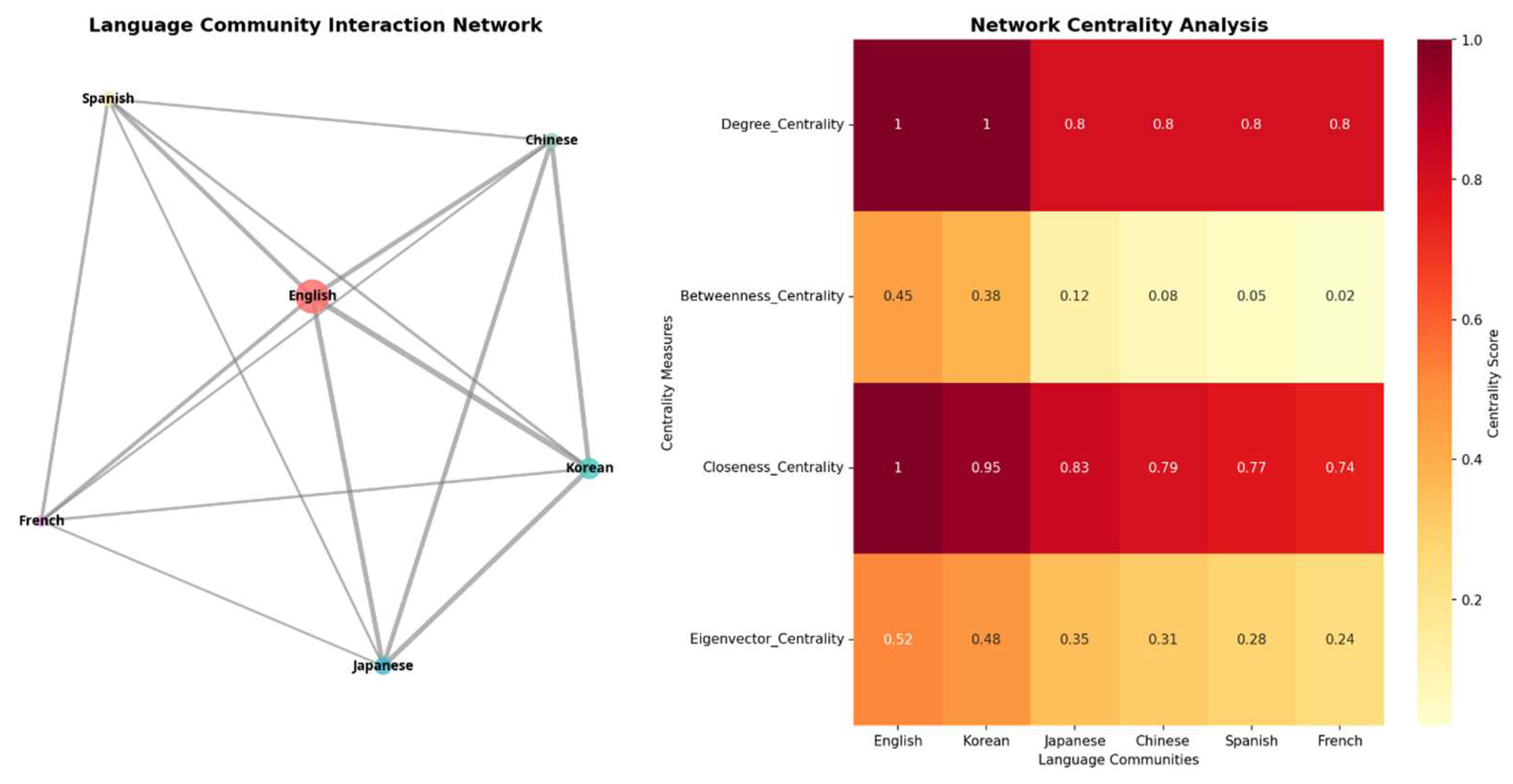
| Metric | Korean Network | Foreign Network | Interpretation |
|---|---|---|---|
| Nodes (Users) | 2174 | 7826 | Active participants |
| Edges (Interactions) | 3892 | 12,456 | Communication links |
| Density | 0.0016 | 0.0004 | Connection intensity |
| Clustering Coefficient | 0.342 | 0.287 | Local cohesion |
| Average Path Length | 4.23 | 5.67 | Information flow efficiency |
| Modularity | 0.456 | 0.523 | Community structure strength |
| Number of Communities | 8 | 12 | Distinct discussion groups |
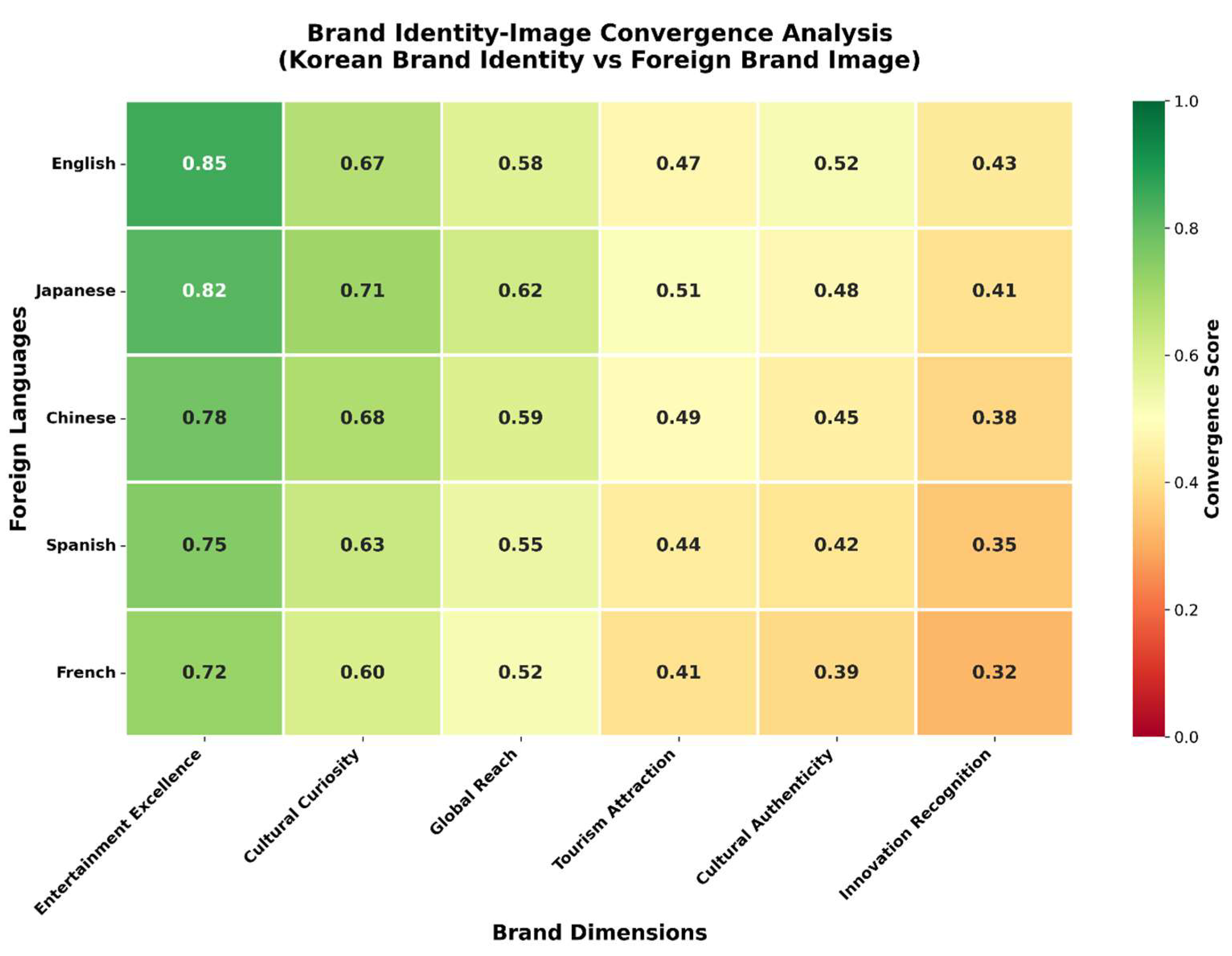
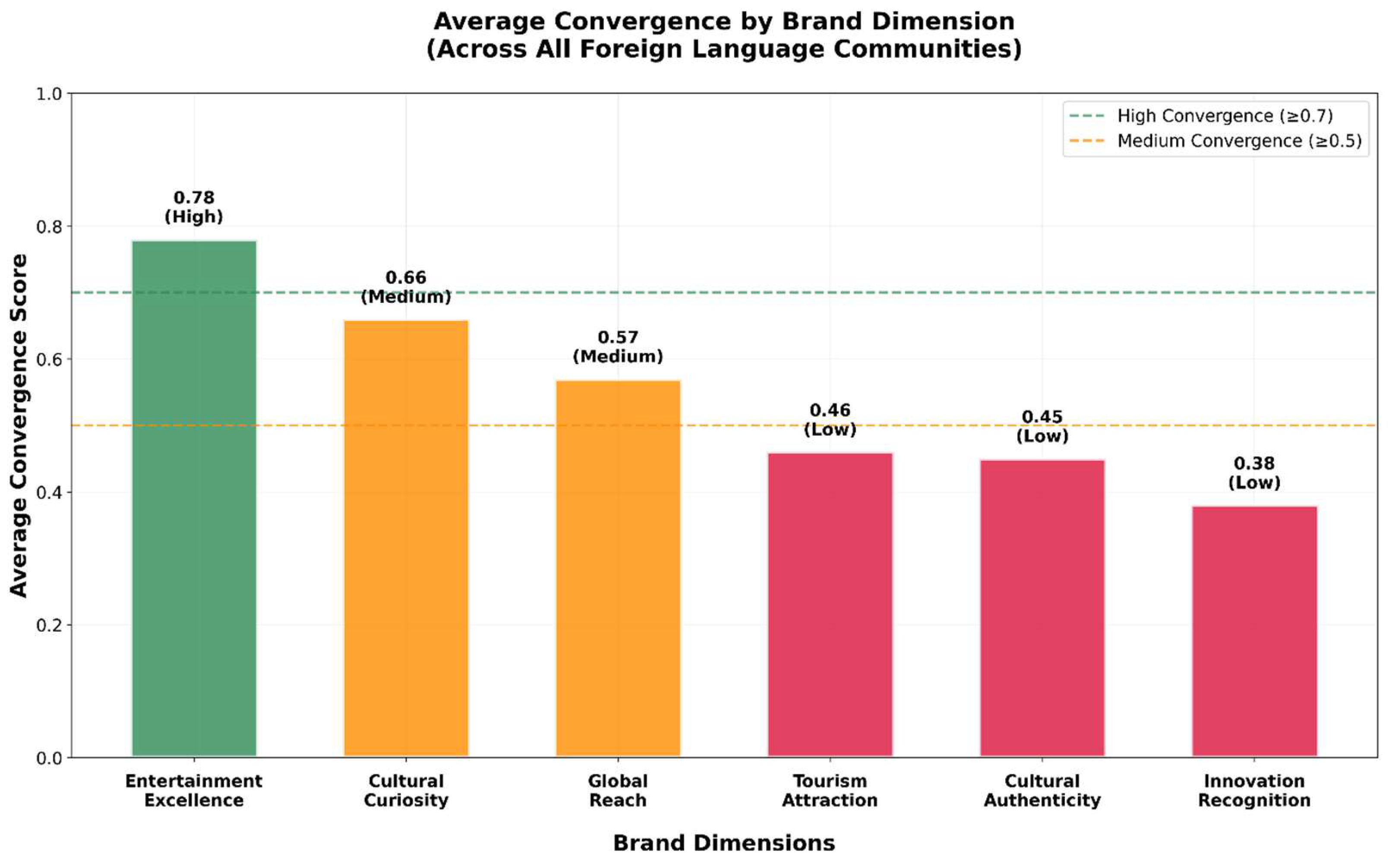
| Brand Dimension | Korean Topic | Foreign Topic | Convergence Score | Interpretation |
|---|---|---|---|---|
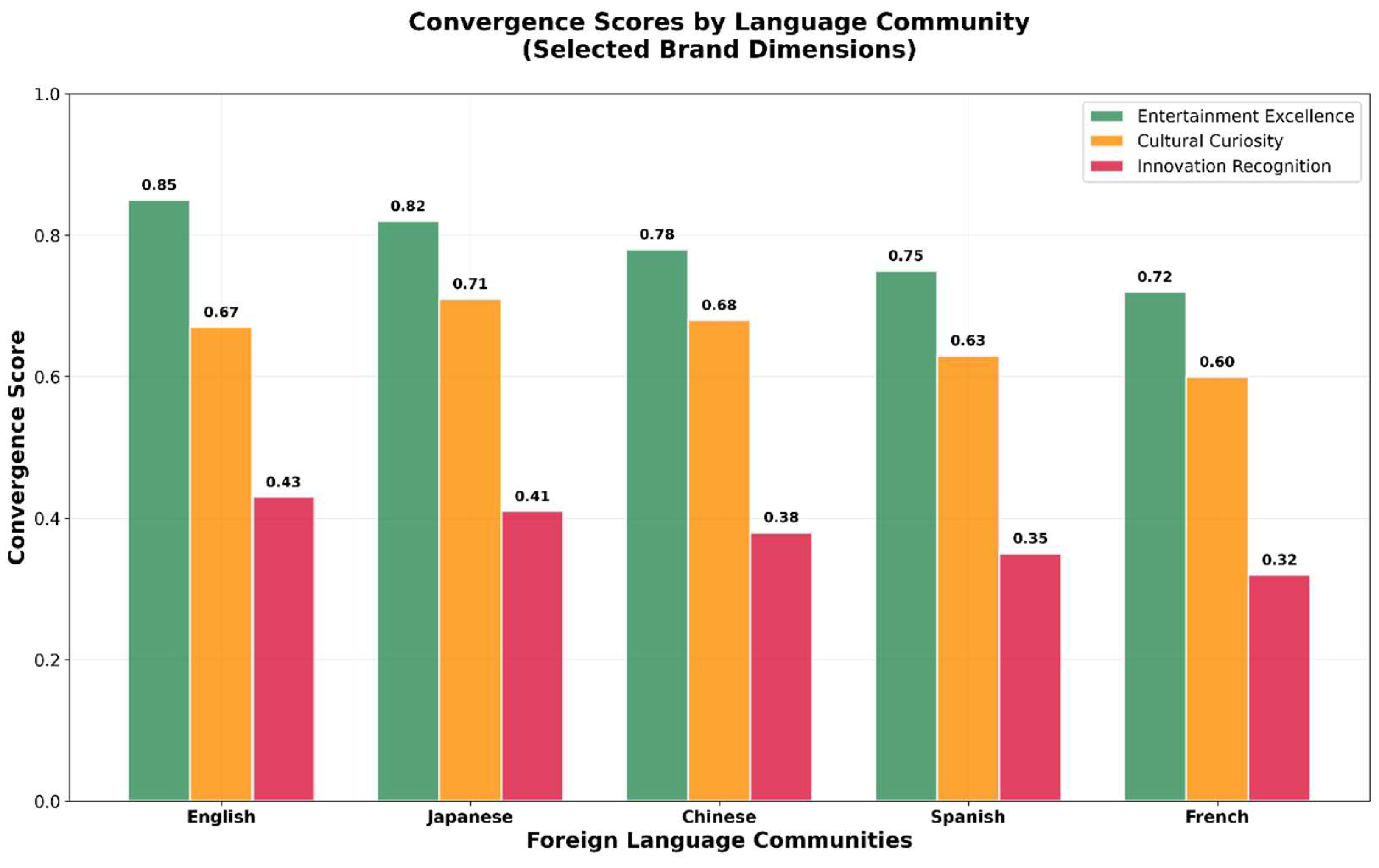
| Entertainment Appeal | Cultural Pride & Achievement | Entertainment & Aesthetic Experience | 0.85 | High alignment |
| Cultural Discovery | Traditional Values | Cultural Discovery | 0.67 | Moderate alignment |
| Global Community | National Identity | Global Community | 0.52 | Moderate alignment |
| Authentic Experience | International Recognition | Authentic Experience | 0.58 | Moderate alignment |
| Travel Interest | Domestic Promotion | Travel Interest | 0.47 | Low alignment |
| Modern Innovation | Innovation | Modern Innovation | 0.43 | Low alignment |
| Topic ID | Topic Label | Top Korean Keywords Examples | Prevalence | Interpretation |
|---|---|---|---|---|
| K1 | Cultural Pride & Achievement | 한국 (Korea), 자랑스럽다 (proud), 문화 (culture), 성공 (success), 세계적 (global) | 28.4% | National pride in cultural success |
| K2 | Traditional Values | 전통 (tradition), 가치 (values), 한국적 (Korean style/identity), 정체성 (identity), 역사 (history) | 19.7% | Emphasis on cultural authenticity |
| K3 | National Identity | 우리나라 (our country), 한민족 (Korean people/ethnic identity), 정체성 (identity), 대한민국 (Republic of Korea) | 18.2% | Strong national identification |
| K4 | International Recognition | 세계 (world), 인정 (recognition), 글로벌 (global), 한류 (Hallyu/Korean Wave), 영향력 (influence) | 15.8% | Global recognition and influence |
| K5 | Domestic Promotion | 홍보 (promotion), 알리다 (to inform/promote), 소개 (introduce), 국내 (domestic), 관광 (tourism) | 10.6% | Domestic tourism promotion |
| K6 | Innovation | 혁신 (innovation), 기술 (technology), 발전 (development/progress), 미래 (future), 창의 (creativity) | 7.3% | Technological and creative innovation |
| Topic ID | Topic Label | Top Keywords Examples | Prevalence | Interpretation |
|---|---|---|---|---|
| F1 | Entertainment & Aesthetic Experience | amazing, beautiful, love, music, animation | 31.2% | Aesthetic appreciation |
| F2 | Cultural Discovery | culture, learn, interesting, traditional, Korea | 22.1% | Cultural learning interest |
| F3 | Global Community | fans, worldwide, together, international, unity | 16.8% | Global fan community |
| F4 | Authentic Experience | authentic, real, genuine, experience, visit | 13.9% | Authenticity seeking |
| F5 | Travel Interest | travel, visit, Korea, tourism, destination | 9.7% | Tourism motivation |
| F6 | Modern Innovation | technology, modern, innovation, future, advanced | 6.3% | Innovation recognition |
| Korean Topic (Brand Identity) | Foreign Topic (Brand Image) | Convergence Score | Strategic Implication |
|---|---|---|---|
| Cultural Pride & Achievement | Entertainment & Aesthetic Experience | 0.85 | Leverage entertainment excellence |
| Traditional Values | Cultural Discovery | 0.67 | Enhance cultural education |
| National Identity | Global Community | 0.52 | Build inclusive communities |
| International Recognition | Authentic Experience | 0.58 | Emphasize authenticity |
| Domestic Promotion | Travel Interest | 0.47 | Improve tourism messaging |
| Innovation | Modern Innovation | 0.43 | Address innovation gap |
| Community Type | Korean Network | Foreign Network | Characteristics |
|---|---|---|---|
| Cultural Enthusiasts | 34.2% | 28.7% | Deep cultural engagement |
| Casual Viewers | 28.9% | 35.1% | Entertainment-focused |
| Tourism Interested | 15.3% | 18.9% | Travel motivation |
| Music Fans | 12.1% | 11.2% | K-pop specific interest |
| Cultural Critics | 6.8% | 4.3% | Analytical discussions |
| Innovation Focused | 2.7% | 1.8% | Technology discussions |
| Predictor Variable | Beta Coefficient | Standard Error | t-Value | p-Value | Interpretation |
|---|---|---|---|---|---|
| Entertainment Quality | 0.67 | 0.12 | 5.58 | <0.001 | Strong positive effect |
| Cultural Authenticity | 0.45 | 0.15 | 3.00 | <0.01 | Moderate positive effect |
| Visual Aesthetics | 0.38 | 0.18 | 2.11 | <0.05 | Weak positive effect |
| Innovation Content | 0.23 | 0.21 | 1.10 | 0.27 | Non-significant |
| Tourism Information | 0.19 | 0.19 | 1.00 | 0.32 | Non-significant |
| Community Interaction | 0.15 | 0.16 | 0.94 | 0.35 | Non-significant |
Disclaimer/Publisher’s Note: The statements, opinions and data contained in all publications are solely those of the individual author(s) and contributor(s) and not of MDPI and/or the editor(s). MDPI and/or the editor(s) disclaim responsibility for any injury to people or property resulting from any ideas, methods, instructions or products referred to in the content. |
© 2025 by the author. Licensee MDPI, Basel, Switzerland. This article is an open access article distributed under the terms and conditions of the Creative Commons Attribution (CC BY) license (https://creativecommons.org/licenses/by/4.0/).
Share and Cite
Yoo, S.-C. K-Pop Demon Hunters and Digital Cultural Diplomacy: Measuring Brand Identity-Image Convergence in Animated K-Content. Tour. Hosp. 2025, 6, 236. https://doi.org/10.3390/tourhosp6050236
Yoo S-C. K-Pop Demon Hunters and Digital Cultural Diplomacy: Measuring Brand Identity-Image Convergence in Animated K-Content. Tourism and Hospitality. 2025; 6(5):236. https://doi.org/10.3390/tourhosp6050236
Chicago/Turabian StyleYoo, Seung-Chul. 2025. "K-Pop Demon Hunters and Digital Cultural Diplomacy: Measuring Brand Identity-Image Convergence in Animated K-Content" Tourism and Hospitality 6, no. 5: 236. https://doi.org/10.3390/tourhosp6050236
APA StyleYoo, S.-C. (2025). K-Pop Demon Hunters and Digital Cultural Diplomacy: Measuring Brand Identity-Image Convergence in Animated K-Content. Tourism and Hospitality, 6(5), 236. https://doi.org/10.3390/tourhosp6050236