Article

A Glycan-Based Ligands for Phenotypic Profiling and Selective Immunomodulation of Alveolar Macrophage for Resolution of Inflammation


by
Igor D. Zlotnikov
1,*,
Alexander A. Ezhov
2 and
Elena V. Kudryashova
1,*
1
Faculty of Chemistry, Lomonosov Moscow State University, Leninskie Gory, 1/3, 119991 Moscow, Russia
2
Faculty of Physics, Lomonosov Moscow State University, Leninskie Gory, 1/2, 119991 Moscow, Russia
*
Authors to whom correspondence should be addressed.
Submission received: 23 November 2025 / Revised: 13 January 2026 / Accepted: 16 January 2026 / Published: 20 January 2026

Abstract

The balance of alveolar macrophage (AM) polarization is severely disrupted in chronic inflammatory diseases like bronchiectasis, where a persistent pro-inflammatory (M1) phenotype perpetuates inflammation. To address this, we developed a high-throughput platform using a series of synthetic glycoligands (L1-L5) on a polyethyleneimine (PEI) scaffold. These ligands, which have varying affinities for macrophage lectin-like receptors, were used for phenotypic “fingerprinting” of AM subpopulations from pediatric bronchiectasis patients and a healthy control. Analysis of bronchoalveolar lavage fluid (BALF) revealed a pathogenic, M1-dominant profile (55% M1) in patients, confirming a state of chronic inflammation, which starkly contrasted with the quiescent, M0-dominant profile in the healthy control. We then leveraged this platform for targeted immunomodulation, using a drug-ligand conjugate to steer the dysregulated macrophage population toward a healthy state. The most potent conjugate, Dox-L5, dramatically suppressed the pathogenic M1 population (from 55% to 16%). This M1 suppression was accompanied by a significant shift toward the M2a (tissue-repair) phenotype and the emergence of a quiescent M0-like population, effectively remodeling the AM profile. This work validates a glycan-based platform for both diagnosing and correcting pathological macrophage imbalances. Our targeted approach offers a precise strategy to resolve chronic inflammation in bronchiectasis by suppressing M1 macrophages and promoting a pro-resolving M0/M2 phenotype, thereby restoring lung homeostasis.

1. Introduction

Macrophages are recognized as versatile innate immune cells integral to tissue homeostasis, immune surveillance, and repair mechanisms [1,2,3,4,5]. Their functional status is highly plastic, shifting along a spectrum defined by two classic extremes: the classically activated (M1) phenotype, characterized by pro-inflammatory cytokine production and microbicidal activity [6,7,8]; and the alternatively activated (M2) phenotype, typically involved in immunosuppression, tissue remodeling, and resolution of inflammation [9,10,11]. The specific balance of M1 and M2 phenotypes within a tissue microenvironment often dictates the progression and outcome of diseases ranging from pulmonary inflammation and fibrosis to malignant transformation [12,13,14].
Alveolar macrophages (AMs), resident in the lung, continuously interact with external factors and represent a critical sentinel population [15,16,17,18]. Phenotyping of AM subpopulations is necessary for diagnosing local immune status and for developing targeted interventions aimed at correcting pathological M1/M2 imbalances, such as the excessive accumulation of M2-like tumor-associated macrophages (TAMs) that promote tumor growth [19,20,21]. The role of TAMs is now well-established. They constitute a critical component of the tumor microenvironment (TME) [22,23], typically exhibiting an M2-like phenotype characterized by immunosuppressive activities that foster tumor growth, angiogenesis, and metastasis, while suppressing anti-tumor immune responses. This impact on TAMs can be harnessed to reprogram from «cold» to «hot» TME of tumors [24,25], such as through the use of Paclitaxel, but similar approaches can be employed for various other conditions involving macrophages.
Many therapeutic agents have secondary immunomodulatory properties that influence macrophage polarization. For example, some anti-inflammatory drugs like curcumin [26,27,28] and coumarin are known to reduce the pro-inflammatory M1 population, making them relevant for treating M1-dominant diseases like bronchiectasis. Doxorubicin [29,30,31,32,33], a widely used chemotherapeutic, also exerts such effects and is known to reprogram pro-inflammatory M1 macrophages toward an anti-inflammatory M2 phenotype. Given that bronchiectasis is characterized by an M1-skewed profile and chronic inflammation, we selected doxorubicin as a model drug to achieve targeted therapeutic remodeling.
Our research aims to reveal the possibility of anti-inflammatory drugs conjugated with targeted ligands to reprogram alveolar macrophages (AMs) from a dysfunctional state back to a healthy one. Within the context of pulmonary diseases, our objective is to regulate AMs to reduce inflammation and restore their protective functions. Local delivery using targeted methods provides a more precise approach for this regulation compared to systemic administration [34,35,36,37,38,39].
To analyze this cellular reprogramming, we use “macrophage fingerprinting”. This analytical approach allows us to classify macrophages into distinct functional states based on their surface markers and cytokine profiles. The three primary phenotypes are the resting state (M0), the pro-inflammatory state (M1), and the tissue-remodeling or anti-inflammatory state (M2). By generating a detailed “fingerprint”, we can map the macrophage phenotype populations to distinguish between healthy and diseased states and measure the effectiveness of our intervention.
Our previous work built upon this foundation, developing a more refined method for creating phenotypic profiles of macrophage populations [40,41]. This approach allows us to identify specific subpopulations within the M1, M2a, M2b, M2c, and M2d categories, as well as M3. However, it is important to note that there is a continuous spectrum of variations within these categories. Now, we are advancing this idea from profiling to targeted intervention. Our current research aims to leverage this understanding to identify the specific “good” (balanced) and “bad” (pathogenic M1) profiles within patient samples and, crucially, to selectively correct these imbalances. This is achieved by employing specific ligands, engineered to carry Dox, which can engage particular macrophage subsets and reprogram them toward a more beneficial state.
Therapeutic strategies aimed at modulating M1/M2 AMs balance. However, a major challenge is the lack of tools to accurately assess the composition of macrophage populations directly in patient-derived samples. To address this, we have developed a novel diagnostic platform consisting of a panel of synthetic ligands designed to create a “fingerprint” or profile of the macrophage populations present.
C-type lectin receptors (CLRs) on the macrophage surface not only mediate pathogen recognition but also play fundamental roles in regulating macrophage polarization [42,43,44,45]. The Mannose Receptor (CD206), a canonical M2a marker, is a key target for ligands featuring mannose or complex mannosylated clusters [42,46,47]. Conversely, the Macrophage Galactose-type Lectin (MGL/CD301) is associated with M2 subsets and typically binds N-acetylgalactosamine and certain galactose structures [48,49]. To create a comprehensive phenotypic profile, this study utilized a panel of five synthetic glycoligands (L1-L5) built on a polyethyleneimine (PEI) polymer scaffold, which provides multivalency necessary for high-affinity CLR binding. These ligands include linear mannose (L1), cyclic mannose (L2), linear galactose (L3), cyclic galactose (L4), and a complex GlcNAc2-trimannoside cluster (L5). The application of this panel allows for the generation of a quantitative binding profile, providing a molecular basis for phenotypic deconvolution.
Firstly, we propose that our glycoligands can selectively deliver anti-inflammatory drugs to specific macrophage subsets. We hypothesize that direct interactions between the glycan structure of these ligands and C-type Lectin Receptors (CLRs) trigger intracellular signaling, which is predicted to influence the M1/M2 polarization state of macrophages. The core of our work is to use this glycoligand platform to address macrophage polarization imbalances. For instance, in diseases like bronchiectasis (M1-dominant profile) or tumors (M2-dominant profile), our platform serves a dual purpose: identifying the imbalance and tracking its correction during therapy.
This study’s primary goal was to validate our macrophage profiling system’s sensitivity. We aimed to (1) establish a baseline profile of alveolar macrophages (AMs) from BALF and (2) track their remodeling after Dox treatment. Additionally, we investigated whether these ligands could selectively target and eliminate or reprogram specific macrophage subsets, thus demonstrating a proof-of-concept for ‘correcting’ dysfunctional profiles.
This platform could be developed into a diagnostic test. Such a system would assess patient samples to determine therapeutic efficacy and identify the most suitable treatment for various diseases.

2. Materials and Methods

2.1. Patient Case and Bronchoalveolar Lavage (BAL) Fluid Collection

The study was conducted in accordance with the Declaration of Helsinki, and the protocol was approved by the local Ethics Committee. Written informed consent was obtained from the patient’s legal guardian.
BALF samples were collected from three pediatric patients undergoing diagnostic bronchoscopy. All procedures were performed after obtaining informed consent from the patients’ legal guardians, following protocols approved by the local ethics committee. The patients presented with chronic respiratory symptoms and underlying lung conditions.
BALF was obtained during flexible bronchoscopy performed under general anesthesia. Lavage was performed according to standard procedures, typically involving the instillation and aspiration of sterile saline solution from affected lung segments identified during the procedure or via prior imaging. Samples were processed immediately for subsequent analysis, including cytological examination and ex vivo cell culture experiments.

2.2. Reagents

Polyethyleneimine (PEI, 1.8 kDa), mannan, α-D-mannose (Man), methyl α-D-mannoside (Me-Man), D-galactose, D-lactose, and fluorescein isothiocyanate (FITC) were purchased from Sigma Aldrich (St. Louis, MO, USA). Mannotriose-di-(N-acetyl-D-glucosamine) (triMan-GlcNAc2) was obtained from Dayang Chem Co., Ltd. (Hangzhou, China). Carbonyldiimidazole (CDI) was acquired from GL Biochem Ltd. (Shanghai, China). All other chemicals and solvents, including DMSO, NaBH3CN, and buffer components, were of chemically pure grade and sourced from Reakhim Production (Moscow, Russia).

2.3. Synthesis of FITC-Labeled Profiling Ligands

The synthesis of profiling ligands has been described previously [40]. Briefly, PEI (1.8 kDa) was dissolved in 0.01 M HCl, and the pH was adjusted to 9.2 with sodium borate buffer. A solution of FITC in DMSO was added dropwise to achieve an equimolar ratio with PEI. The resulting PEI-FITC conjugate was purified by dialysis (MWCO 3.5 kDa) against water.
For conjugation with carbohydrates via reductive amination (mannose, galactose, lactose, triMan-GlcNAc2), the respective saccharide was added to the PEI-FITC solution in a 20-fold molar excess, along with NaBH3CN. The pH was adjusted to 5.0, and the reaction proceeded for 12 h at 50 °C. For methyl-α-mannoside (Me-Man), its 6-OH group was first activated with CDI in DMSO. This activated sugar was then added to the PEI-FITC solution (pH 7.4) and incubated for 6 h at 50 °C. All final conjugates were purified by extensive dialysis (MWCO 3.5 kDa) and lyophilized.

2.4. Synthesis of Doxorubicin-Conjugated Remodeling Ligands

To synthesize the remodeling ligands, doxorubicin (Dox) was first activated. Dox was dissolved (1 mg/mL) in sodium borate buffer (pH 9.2), and a 2-fold molar excess of carbonyldiimidazole (CDI) in DMSO was added. The mixture was incubated for 2 h at 40 °C to form an activated Dox intermediate. This solution was then slowly added to a solution of PEI (1.8 kDa) in the same buffer and stirred for 6 h at 50 °C to form the PEI-Dox conjugate. The product was purified by dialysis (MWCO 3.5 kDa) against water.
The subsequent conjugation of the five carbohydrate moieties (L1-L5) to the PEI-Dox backbone was carried out using the same reductive amination and CDI-activation protocols described for the FITC-labeled ligands in the section above. All final Dox-conjugated ligands were purified by dialysis and lyophilized before use.

2.5. Physicochemical Characterization of Glycoligand Conjugates

FTIR Spectroscopy. Spectra of the conjugates were recorded using a Bruker Tensor 27 spectrometer (Bruker, Bremen, Germany) for solutions and a MICRAN-3 FTIR microscope (Simex, Novosibirsk, Russia) for solid films to confirm the covalent attachment of the carbohydrate and Dox/FITC moieties to the PEI backbone.NMR Spectroscopy. 1H NMR spectra were recorded on a Bruker DRX-500 instrument (Bruker, Bremen, Germany). Samples (10–15 mg) were dissolved in D2O to confirm the presence of signals corresponding to both the polymer and the conjugated carbohydrate structures.
Dynamic Light Scattering (DLS). The hydrodynamic diameter and ζ-potential of the ligand particles in PBS were measured using a Zetasizer Nano S (Malvern, Worcestershire, UK) to determine their size and surface charge characteristics.
Determination of ligand dissociation constants (Kd) by FTIR spectroscopy and receptor affinity classification. Dissociation constants (Kd) for ligand-Concanavalin A (ConA) interactions were determined via FTIR spectroscopic titration at 37 °C using methodology adapted from previous studies [50,51]. ConA solution (C = 33 μM, tetrameric form) was prepared in PBS (C = 0.05 M, pH 7.4, 0.5 M NaCl, 1 mM CaCl2, 1 mM MnCl2) and titrated with sequential aliquots of glycoligand stock solutions (L1-L5, 0.2–20 μL per addition, total additions n = 8–15) at 37 °C (±0.5 °C) in a thermostated FTIR cuvette (path length 50 μm). After each addition, FTIR spectra were recorded (region 3000–850 cm−1, 64 scans, resolution 1 cm−1) to monitor ligand-induced conformational changes in ConA. The degree of complexation was quantified by analyzing changes in the Amide II band intensity (1520–1580 cm−1) normalized to the Amide I band (1620–1690 cm−1) to account for sample thickness variations. The resulting binding isotherms were fitted to the Hill equation ξ = ξ0 + (ξ∞ − ξ0) · [ligand]ⁿ/([ligand]ⁿ + Kₙ), the Hill plot was constructed by plotting lg[θ/(1−θ)] versus lg[ligand], where θ = |ξ − ξ0|/|ξ∞ − ξ0| is the fractional binding. Linear regression of the Hill plot yielded the slope (= n, Hill coefficient) and x-intercept (= −lg Kd), from which Kd was calculated.
Molecular dynamics and neural network affinity predictions. Molecular dynamics simulations were performed for CD206 (PDB 7JUE [52]) over 100 ns using NAMD/AMBER ff14SB (3 replicates) [53], with binding free energies calculated via MM-PBSA (r = 0.68 vs. experimental FTIR pKd). ConA was validated as a CD206 model (r > 0.90 correlation). For all three receptors (CD206, CD301 PDB 6PY1 [54], CD209 PDB 2IT5 [55]), the Pafnucy neural network (3D-CNN trained on PDBbind2020, r = 0.82 test accuracy; r = 0.80 for CD206) was applied to predict ligand affinities using voxel grid representations (20 × 20 × 20 Å, 0.5 Å resolution) and energy normalization (Kd = exp((ΔG + α)/(R·T)).

2.6. Macrophage Cell Culture and Polarization

2.6.1. Primary Human Monocytes

Primary human monocytes (CD14+) were isolated from peripheral blood mononuclear cells (PBMCs) obtained from healthy donors with informed consent in accordance with institutional ethical guidelines. Whole blood samples were collected in EDTA anticoagulant tubes and PBMCs were isolated using density gradient centrifugation with Ficoll-Paque Plus (GE Healthcare, Chicago, IL, USA) according to established protocols. Isolated PBMCs were subsequently enriched for monocytes using magnetic bead selection with anti-CD14 monoclonal antibodies and the MACS system (Miltenyi Biotec, Bergisch Gladbach, Germany) following the manufacturer’s instructions. The purity of isolated CD14+ monocytes was confirmed to be ≥95% by flow cytometry. Isolated monocytes were cultured in basal RPMI-1640 medium (Gibco, Thermo Fisher Scientific, Waltham, MA, USA) supplemented with 10% heat-inactivated fetal bovine serum (FBS; Gibco) and 1% penicillin-streptomycin (Gibco).

2.6.2. In Vitro Macrophage Polarization

Reference macrophage phenotypes were generated via stimulation with defined cytokine combinations following established protocols. All polarization experiments were conducted in 6-well tissue culture plates at a density of 1 × 10⁶ cells/mL at 37 °C, 5% CO2. Resting M0 macrophages were obtained by culturing differentiated PBMCs cells in basal RPMI-1640 medium supplemented with macrophage colony-stimulating factor (M-CSF, 50 ng/mL; R&D Systems, Minneapolis, MN, USA) for 7 days without additional stimulation. This condition established the baseline M0 phenotype, characterized by low pro-inflammatory and low alternative activation marker expression.
Pro-inflammatory M1 macrophages were generated by stimulating differentiated PBMCs cells with lipopolysaccharide (LPS, 100 ng/mL; Escherichia coli serotype O111:B4; Sigma-Aldrich, St. Louis, MO, USA) and interferon-gamma (IFN-γ, 20 ng/mL; R&D Systems) for 24 h. This condition promoted the M1 phenotype characterized by high expression of CD11c, CD86, TNF-α production, and low expression of CD206 and CD163.
Tissue-remodeling M2a macrophages were induced by stimulating differentiated PBMCS cells with interleukin-4 (IL-4, 20 ng/mL; R&D Systems) and interleukin-13 (IL-13, 20 ng/mL; R&D Systems) for 24–48 h. This condition promoted the anti-inflammatory M2a phenotype characterized by high expression of CD206, CD209, CD163, and arginase-1 with low expression of pro-inflammatory markers.

2.6.3. Phenotypic Verification of Polarized Macrophages

Phenotypic identity of polarized macrophage populations was confirmed via flow cytometry using a comprehensive marker panel including CD14, CD11c, CD86, CD206, CD209, CD163, CD64, and CD68 on a BD FACSAria™ III Cell Sorter instrument. Cytokine secretion profiles were quantified from culture supernatants via multiplexed cytokine array measuring TNF-α, IL-6, IL-10, and IL-1β.

2.7. Isolation and Culture of Alveolar Macrophages from BALF

The collected BALF was centrifuged at 4000× g for 10 min at 4 °C to pellet the cellular components. The cell pellet was washed twice with sterile phosphate-buffered saline (PBS) and resuspended in PBS for Quantitative Analysis and Imaging Experiments or in RPMI-1640 medium supplemented with 10% fetal bovine serum and 1% penicillin-streptomycin for remodeling experiments.

2.8. Macrophage Remodeling and Phenotypic Profiling Assay

Isolated AMs were seeded into 96-well plates at a density of 5 × 10⁵ cells per well and allowed to adhere for 2 h. The cells were then incubated for 24 h with the five different Dox-conjugated remodeling ligands (Dox-L1 to Dox-L5) at a final concentration of 10 µg/mL. A control group was incubated with medium alone (intact cells).
After the 24 h remodeling period, the wells were washed three times with PBS to remove unbound conjugates and non-adherent cells. The remaining adherent cells were then profiled by incubating them for 2 h with the panel of five FITC-labeled profiling ligands (FITC-L1 to FITC-L5) at a concentration of 5 µg/mL.

2.9. Quantitative Analysis and Imaging

The fluorescence intensity of the bound L1-L5 FITC-ligands was measured using a plate fluorometer (Ex/Em = 485/520 nm). The percentage of bound ligand was calculated relative to the initial fluorescence added to each well. For competitive binding assays, cells were pre-incubated with 1 mg/mL mannan for 30 min before the addition of FITC-ligands (ML1-ML5).
For visualization, cells were cultured on glass-bottom dishes and processed using the same remodeling and profiling protocol. Confocal laser scanning microscopy (CLSM) was performed to visualize FITC fluorescence (ligand binding) and the intrinsic Dox fluorescence (drug delivery & remodeling).

2.10. Deconvolution Analysis of Macrophage Subpopulations

The quantitative binding profiles of the treated BALF samples were analyzed using a non-negative least squares (NNLS) deconvolution algorithm [56,57]. This analysis calculated the relative contribution of three reference macrophage phenotypes (M0 monocytes, M1-polarized macrophages, and M2a-polarized macrophages) to the observed experimental binding profile, allowing for a quantitative assessment of the macrophage polarization state.
Reference M0, M1, and M2a macrophages were profiled using the identical assay protocol applied to patient-derived BALF macrophages: incubation with FITC-labeled ligands (FITC-L1 to FITC-L5, 5 μg/mL, 2 h, 37 °C) and parallel competitive inhibition assays with mannan (1 mg/mL, 30 min) to generate ML1-ML5 binding profiles reflecting non-mannose-receptor-mediated binding. Fluorescence intensity was quantified using a plate fluorometer (Ex485/Em520 nm), with results expressed as a percentage of total ligand added (0–100% binding scale). This procedure generated two reference binding matrices: matrix A (L1-L5) reflecting all receptor types, and matrix B (ML1-ML5) reflecting non-mannose receptors (CD301-mediated), enabling independent validation through comparison of deconvolution outcomes across binding modalities.
The quantitative binding profiles of patient-derived BALF macrophages were analyzed using NNLS deconvolution to determine the relative proportions of M0, M1, and M2a macrophages. The deconvolution problem was formulated as: minimize ||Ax – b||22 subject to x ≥ 0, where A is the reference binding matrix (rows: 10 binding measurements comprising L1-L5 and ML1-ML5; columns: 3 reference phenotypes M0, M1, M2a), x is the vector of unknown phenotype proportions, and b is the observed BALF binding profile. The NNLS optimization was implemented in MATLAB R2022b. Deconvolution was performed independently across three scenarios: (1) L1-L5 measurements only (5 × 3 matrix), (2) ML1-ML5 measurements only (5 × 3 matrix), and (3) combined L1-L5 and ML1-ML5 data (10 × 3 matrix), with the combined analysis (Scenario 3) serving as the primary result. The proportion of M2b-c-d macrophages (residual M2 subtypes not explicitly deconvolved) was calculated as M2b-c-d = 100% − (M0 + M1 + M2a). Phenotypic changes induced by Dox treatment (ΔM1, ΔM2a, etc.) were calculated as absolute differences, and the statistical significance of binding profile changes was assessed via paired t-tests and Cohen’s d effect sizes applied to the underlying binding data. Pooled analyses across multiple patients utilized the arithmetic mean ± standard deviation.

2.11. Fluorescence Microscopy and Immunostaining

2.11.1. Immunofluorescence Staining Protocol

Fixed BALF cells or differentiated macrophage preparations were processed for immunofluorescence microscopy following a standardized blocking and staining protocol. Cells were initially incubated with a blocking solution consisting of 10% normal goat serum (Sigma-Aldrich, St. Louis, MO, USA) in phosphate-buffered saline (PBS) containing 1% bovine serum albumin (BSA; PanEco, Moscow, Russia) for 1 h at room temperature to prevent non-specific antibody binding. Following blocking, cells were incubated with primary antibodies diluted in PBS-BSA: anti-CD206 antibody (ab64693, Abcam, Cambridge, UK; mouse monoclonal; 1:100 dilution) to detect CD206 mannose receptor expression on macrophage surfaces, and rabbit polyclonal control IgG (910801, BioLegend, San Diego, CA, USA; 1:100 dilution) as an isotype control. Primary antibody incubation was performed for 2 h at room temperature in a humidified chamber. After three PBS washes, cells were incubated with Goat anti-Rabbit IgG conjugated to Alexa Fluor 594 (A11037, Invitrogen, Carlsbad, CA, USA; 1:1000 dilution) for 1 h at room temperature in the dark, enabling visualization of CD206 expression via red fluorescence at 594 nm emission. Cell nuclei were labeled with 4’,6-diamidino-2-phenylindole (DAPI, 1 µg/mL in PBS; Sigma-Aldrich) for 5 min at room temperature to visualize nuclei in the blue channel.

2.11.2. Confocal Laser Scanning Microscopy (CLSM)

Fluorescence images were acquired using an Olympus FluoView FV1000 confocal laser scanning microscope (Olympus, Tokyo, Japan) equipped with a spectral scan unit (emission detectors) and a transmitted light detector. The CLSM system was based on an Olympus IX82 motorized inverted microscope. Excitation was provided by multiple laser lines: 405 nm (diode laser) for DAPI nuclear counterstaining, 488 nm (multiline argon laser) for FITC-conjugated glycoligands, and imaging was performed using an Olympus UPLSAPO 40× (NA 0.90) dry objective lens. Laser power, sampling speed, and line averaging were kept constant for all acquisitions to ensure quantitative comparability across experimental conditions and biological replicates. The scan area was 80 × 80 μm2. For immunofluorescence experiments: DAPI-stained nuclei, CD206 immunostaining (Alexa Fluor 594), and FITC-conjugated glycoligands were collected in the 425–475 nm, 590–680 nm, and 510–540 nm emission windows, respectively. For remodeling experiments the following parameters were used: (1) FITC fluorescence (green, excitation: 488 nm, emission: 505–535 nm) indicating the distribution of the profiling glycan ligand; (2) Doxorubicin fluorescence (red, excitation: 515 nm, emission: 575–675 nm) indicating the intracellular localization of the delivered drug; (3) Brightfield microscopy for cellular morphology; and (4) A merged overlay of all channels to assess co-localization.
Detector settings were adjusted to ensure that signals were within the linear dynamic range of the photomultiplier tubes. Image acquisition and processing were performed using Olympus FV10-ASW software (version 1.7).

2.11.3. Quantitative Colocalization Analysis

Quantitative spatial colocalization between CD206 (red channel, 594 nm) and FITC-ligand (green channel, 488 nm) signals was determined using Pearson’s correlation coefficient (r) calculated on a per-cell basis using established methodology. Raw images in TIFF format were imported into ImageJ/Fiji software (NIH, Bethesda, MD, USA, version 1.54p), and for each cell of interest, a region-of-interest (ROI) was manually drawn around the cell boundary using the brightfield transmitted light reference image and three-dimensional volumetric data from the z-stack. Automatic local threshold calculation using the Otsu method was applied to generate binary masks of cell boundaries, which served as references for manual ROI refinement. Within each defined ROI, Pearson’s correlation coefficient (r) was calculated using the Colocalization Finder plugin, which computes pixel-by-pixel correlation between intensity values in the red channel (CD206, Alexa 594) and green channel (FITC-ligand, 488 nm) across all pixels within the ROI. Pearson’s r values range from −1 (perfect inverse correlation) to +1 (perfect positive correlation), with r = 0 indicating no correlation. Pearson’s r values for all cells within a condition were compiled and reported as mean ± standard deviation (SD). Strong positive colocalization (r > 0.6) was interpreted as evidence of receptor-mediated ligand binding; moderate colocalization (r = 0.3–0.6) suggested partial receptor engagement; and weak or absent colocalization (r < 0.3) was consistent with non-specific or alternative receptor engagement.

2.12. Flow Cytometry

Flow cytometric analysis was performed using a BD FACSAria™ III Cell Sorter (BD Biosciences, Franklin Lakes, NJ, USA). The cellular uptake of the FITC-conjugated polymer was quantified by measuring fluorescence intensity in the FITC channel. Variations in the percentage of FITC-positive cells were recorded across experimental groups. Untreated cells, incubated in the absence of the sample solution, served as a negative control to establish baseline autofluorescence and gating parameters.

2.13. Statistical Analysis

All ligand-binding experiments were performed with 3 replicates n = 3 per condition. Fluorometric data exhibited a coefficient of variation ≤10% across replicates. Statistical significance was determined using two-tailed Student’s t-tests. Results are presented as mean ± standard deviation with 95% confidence intervals (95% CI). Statistical significance was defined as p < 0.05, with p < 0.01 and p < 0.001 indicating highly significant differences. All statistical analyses were conducted using OriginPro 2024 software.

3. Results and Discussion

3.1. Fluorescent Ligands for Macrophage Receptor Profiling and Targeted Remodeling

3.1.1. Synthesis of Fluorescent Ligands

Characterization of macrophage phenotypes within BALF is crucial for understanding immune responses in various pulmonary conditions. While antibodies are traditionally used for receptor identification, their limited availability for specific targets poses a constraint. As a viable and expandable alternative, fluorescent ligand-based probes offer a powerful approach to probe macrophage receptor expression. Unlike antibodies, polymeric ligands are synthesized with substantial variations in their molecular architecture and composition, allowing for the generation of an “unlimited” library of probes. This intrinsic tunability significantly expands the parameters available for detailed fingerprint analysis of macrophage populations. By employing a diverse set of labels with distinct affinities, we can perform a comprehensive fingerprint analysis, examining the binding patterns of macrophage cells with a curated panel of ligands.
In this study, we developed two distinct types of fluorescently labeled ligands:
  • FITC-conjugated ligands for quantitative profiling of macrophage receptors (assessing ligand binding percentages),
  • Doxorubicin (Dox)-conjugated ligands designed for selective macrophage remodeling.
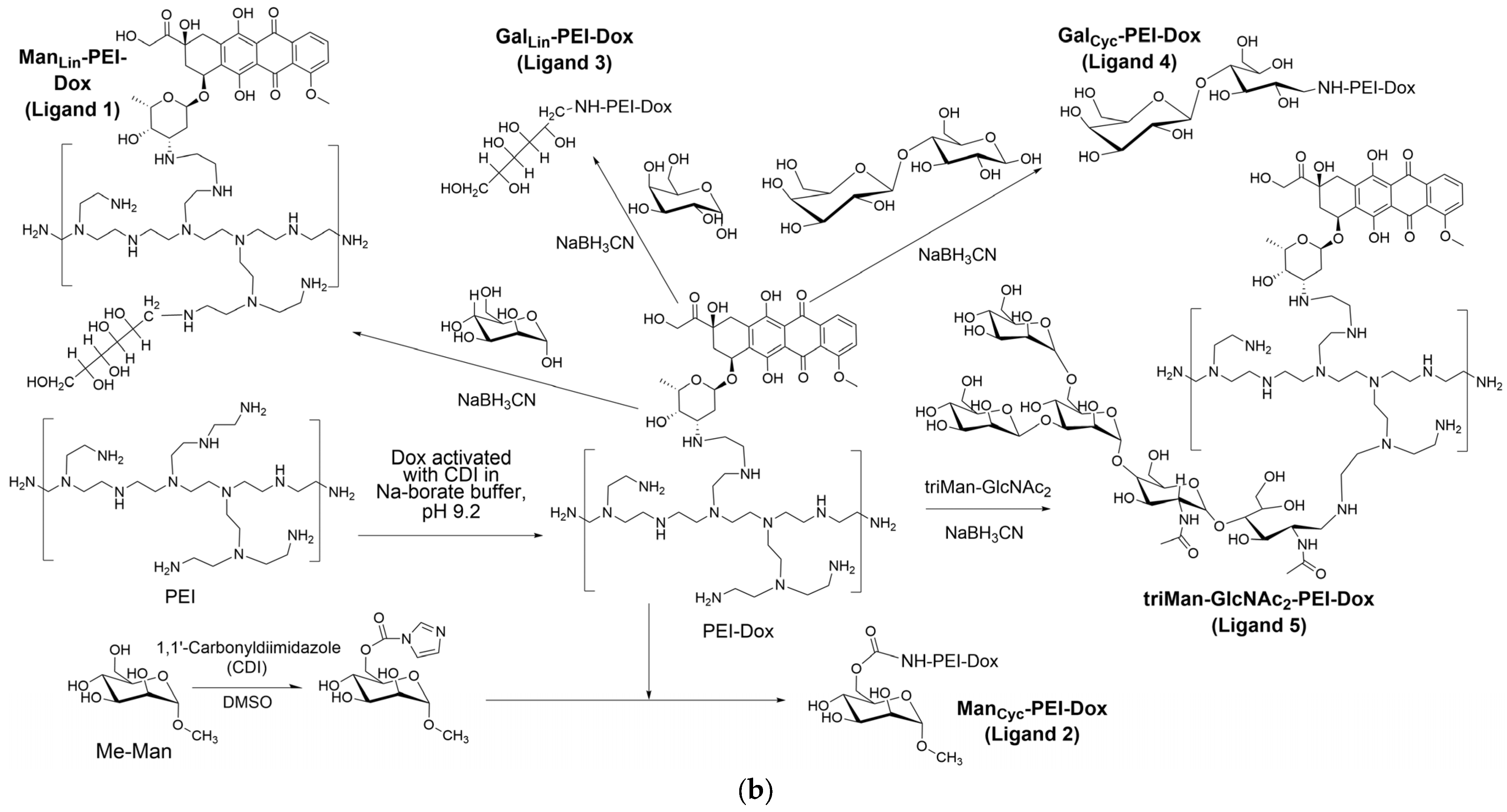
The series of FITC-labeled ligands, specifically developed for profiling, has been previously described in our recent publication [40]. The synthesis process for these fluorescent markers, incorporating five distinct types of carbohydrate tags, is exemplified in Figure 1a,b.

3.1.2. Spectral Characterization of Fluorescent Ligand Structures

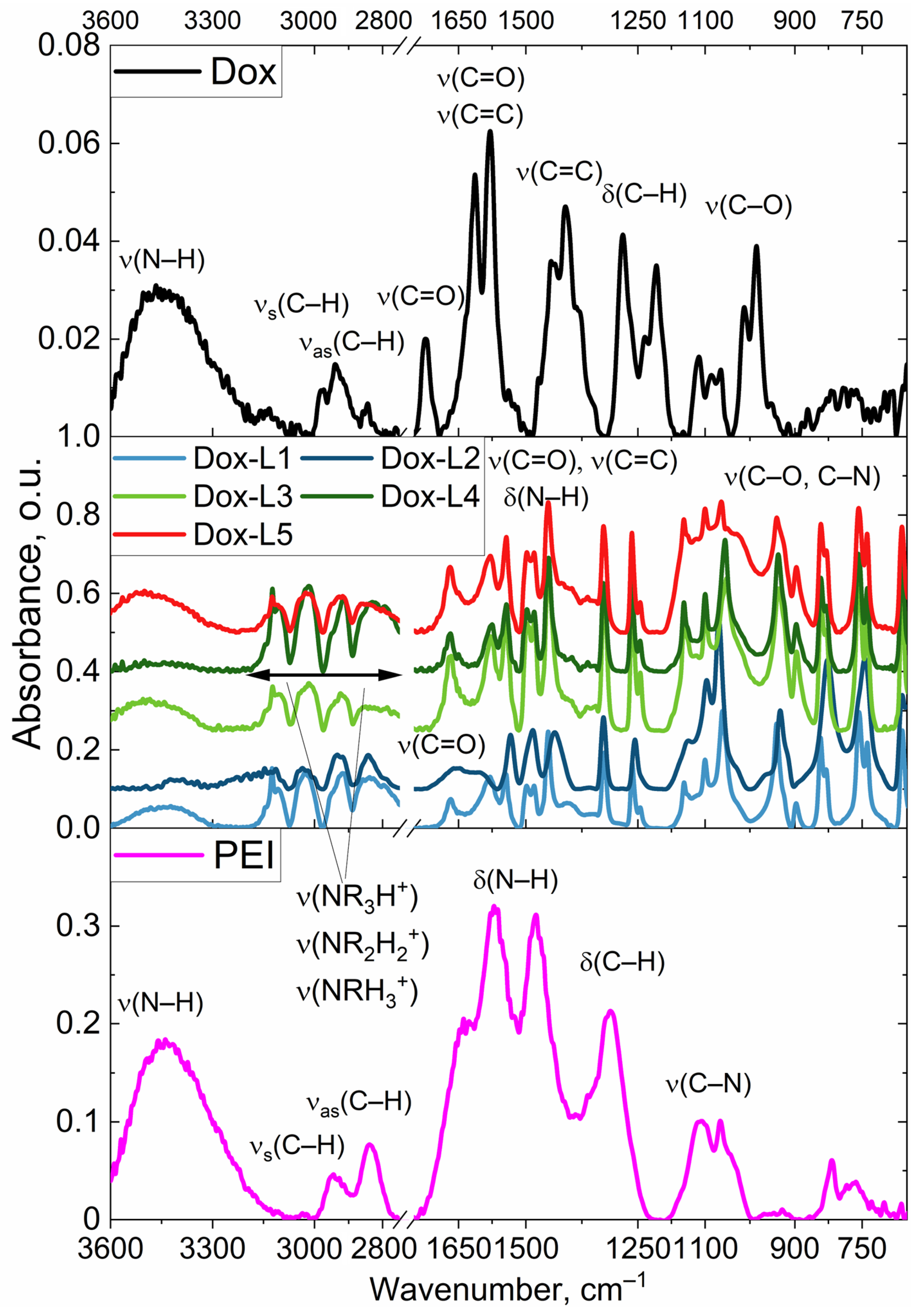
Figure 2 presents FTIR spectra of PEI-Dox conjugates featuring linear mannose (L1), cyclic mannose (L2), linear galactose (L3), cyclic galactose (L4), and a complex GlcNAc2-trimannoside cluster (L5). The spectrum of pure Dox exhibits characteristic absorption bands corresponding to valence oscillations of ketone groups at ~1730 and ~1620 cm−1, valence oscillations of bonds in aromatic rings at frequencies ranging from ~1580 to 1620 cm−1, and a broad band of valence oscillations at ~3440 cm−1. The spectrum of PEI is characterized by a broad band representing valence oscillations (~3360 cm−1), oscillations in the range of 2800–3000 cm−1 corresponding to valences of C-H bonds, and a distinct band for deformation oscillations at 1580 cm−1. In the FTIR spectra of all five conjugates, a superposition of distinctive bands characteristic of both the PEI polymer and the doxorubicin molecule can be observed. Specifically, the presence of doxorubicin in the conjugates is validated by the presence of a strong absorption in the region of 1580–1730 cm−1, which is attributed to fluctuations in carbonyl groups and the aromatic core of the molecule. The most significant indication of the successful attachment of the carbohydrate ligands L1-L5 is the emergence of a novel, pronounced, and complex absorption band within the range of 950–1250 cm−1. This band is associated with the valence oscillations of C–O and C–C bonds within the pyranose rings of the carbohydrates. Moreover, the formation of covalent amide bonds between the components is supported by the widening and modification of the bands within the region of 1620–1650 cm−1, where the valence fluctuations of the ν(C=O) amide group (Amide I band) and deformation oscillations of δ(N–H) (Amide II) overlap with the intrinsic signals of Dox.
Figure S1 similarly presents FTIR spectra of PEI-FITC conjugates. The FTIR analysis revealed characteristic absorption bands: strong oscillatory bands of CH2 groups in the PEI backbone (2980–2800 cm−1), specific peaks for the FITC label at 1580 and 1450 cm−1 (C=C oscillations), and bands between 1200–1000 cm−1 corresponding to C-N bonds in PEI and C-O-C bonds in the saccharide components. Thus, the comprehensive analysis of the acquired near-infrared spectroscopy data unequivocally establishes the successful establishment of covalent interactions and the synthesis of targeted PEI-Dox and PEI-FITC conjugates decorated with carbohydrate moieties.
Further structural validation was achieved through 1H nuclear magnetic resonance (NMR) spectroscopy, which confirmed the successful synthesis of polymer conjugates. Figure S2a,b present representative NMR spectra for triMan and triMan-PEI, demonstrating characteristic sugar proton signals, such as H1 and H2–H5, which appear between 3.9 and 5.3 ppm for mannose, and distinct signals ranging from 2.5 to 2.9 ppm assigned to the PEI polymer. The successful conjugation of triMan with PEI is evident from these spectra. Similar observations have been reported for other conjugates. Minor shifts in the position of carbohydrate proton signals, for example, H5, between 5.1 and 5.3 ppm, suggest conformational changes after conjugation, indicating either linear or cyclic structures at the reducing end of the oligosaccharide. For Gal-PEI and Man-PEI conjugates, NMR analysis also confirmed the presence of both carbohydrate moieties (galactose protons between 3.5 and 4.5 ppm) and PEI units, notably lacking the anomeric proton signal (H-1), which typically appears at 5 to 5.5 ppm following sugar modification.

3.1.3. Physico-Chemical Parameters of Fluorescent Ligands

Table 1 presents a comprehensive summary of the physicochemical properties of the synthesized macrophage-targeting ligands, including both FITC-labeled variants for phenotypic profiling and Doxorubicin (Dox)-conjugated analogs for immunomodulatory remodeling. All ligands were constructed using a polyethylenimine (PEI) scaffold, functionally modified with a diverse panel of carbohydrate moieties: linear and cyclic mannose (ManLin, ManCyc), linear and cyclic galactose (GalLin, GalCyc), and the complex glycan triMan-GlcNAc2. Dynamic light scattering (DLS) analysis revealed that the conjugates possess hydrodynamic diameters ranging from 105 to 130 nm, with zeta potentials exhibiting a consistent slight positive charge (+10 ± 2 mV).
Lectin-binding measurements using concanavalin A (ConA), a well-characterized mannose/glucose-specific lectin used as a model for CD206 mannose receptor [43,51,58], revealed pronounced structure-activity relationships across the ligand series (Table 1). The dissociation constants (Kdis) for ligand-Concanavalin A (ConA) interactions were determined by monitoring ligand-induced conformational changes in ConA using FTIR [43,59,60]. This approach exploits characteristic changes in the protein’s amide I (1620–1690 cm−1, C=O stretch) and amide II (1520–1580 cm−1, N–H bend) absorption bands, which respond sensitively to changes in protein secondary structure and backbone conformation upon ligand binding. By quantifying the magnitude of these spectroscopic changes as a function of ligand concentration, we derived binding isotherms and calculated the corresponding dissociation constants using analysis based on cooperative binding models. Apparent dissociation constants determined for the ConA-ligand interaction (Kdis, ConA–ligand) spanned several orders of magnitude and identified triMan-GlcNAc2-PEI (L5) as the highest-affinity construct (2.5 × 10⁻⁷ M), whereas galactose-based ligands (L3-L4) displayed weak ConA binding (Table 1). The ConA-derived affinity ranking supports the conclusion that increasing mannose epitope complexity and multivalent presentation enhances mannose-lectin engagement, which is consistent with ConA’s established recognition of core trimannoside structures.
To contextualize potential receptor selectivity, predicted propensities toward macrophage-associated CLRs (CD206, CD209, CD301) are therefore presented separately in Table 1 as neural-network–based categorical affinity ratings (from +++ to –). This data on in silico CLR binding predictions avoids over-attribution of specificity while still providing a coherent framework for linking glycan architecture (e.g., L5) to functional targeting hypotheses in macrophage systems.
In order to exclude nonspecific effects, or artifacts, in the investigation of the influence of ligands on macrophage polarization, the toxicity of the PEI scaffold was evaluated through the use of viability assays based on flow cytometry. While unmodified PEI induced significant cell death after 3 h of incubation (42% viability; Table S1), all saccharide-modified conjugates—including PEI-mannose, PEI-trimannose, and PEI-galactose—demonstrated excellent biocompatibility, maintaining viability levels above 88%.
As illustrated in Figure S3a, the polycationic nature of unmodified PEI-FITC facilitates rapid, non-selective cytoplasmic localization via electrostatic interactions, independent of CD206 engagement. Nonetheless, a critical disparity in cellular response became evident upon prolonged exposure (three hours), a phenomenon that has also been previously observed, for instance, in the article [61]. While unmodified PEI caused substantial cell death (Table S1) characterized by morphological disruption (Figure S3b), all saccharide-modified conjugates preserved cellular integrity and viability at levels comparable to untreated controls (Figure 3 vs. Figure S3). So, the use of biocompatible saccharide-modified scaffolds allows for a clearer interpretation of cellular responses.

3.2. Nanoscale Receptor Mapping and Ligand Binding Specificity for CD206+ Macrophages

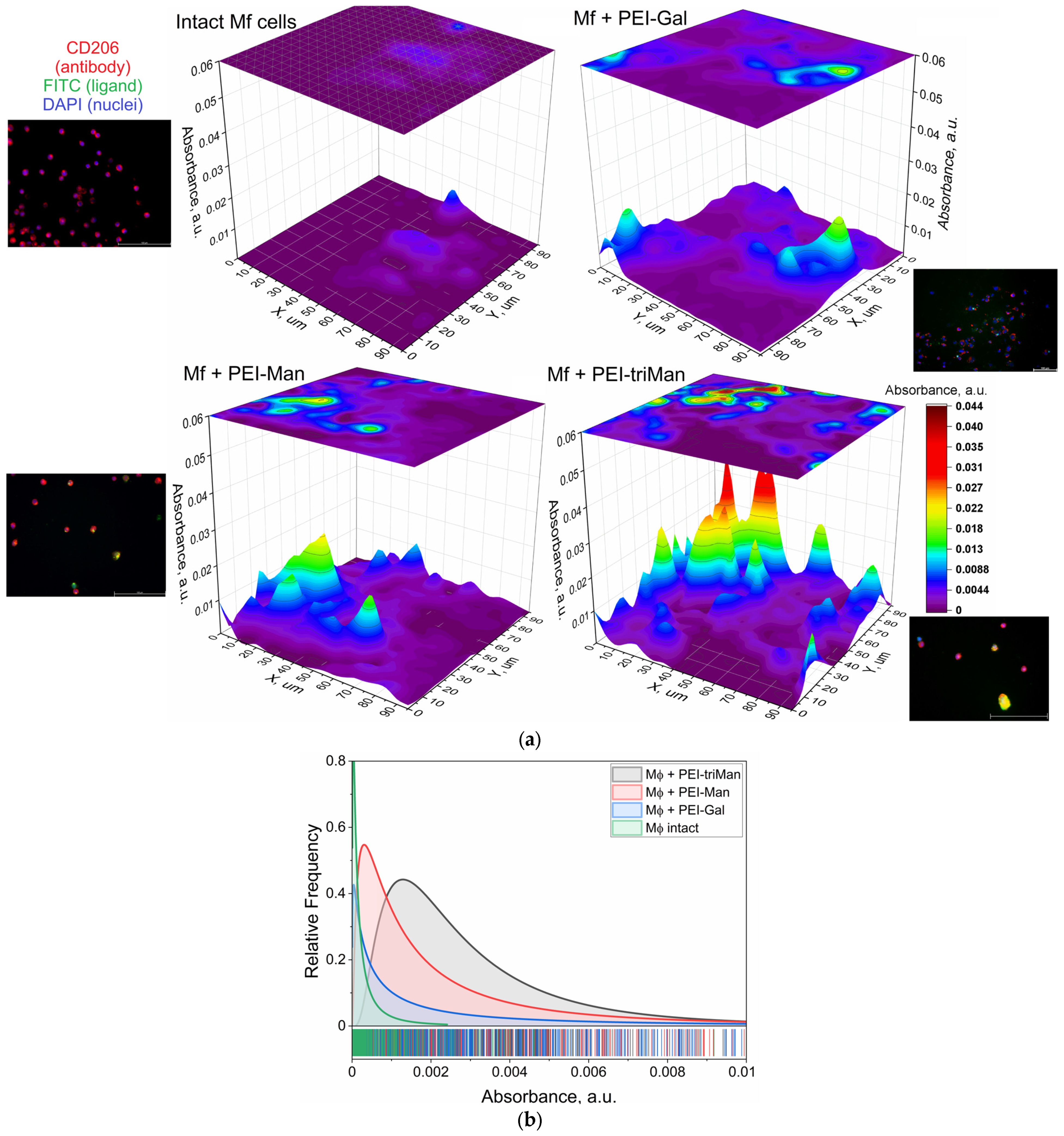
The objective of this study was to precisely map the distribution and quantify the interaction of our synthesized glycan ligands with specific receptors on individual alveolar macrophages. To achieve this, we employed nanoscale FTIR microscopy to characterize the binding patterns of selected ligands at the single-cell level, enabling us to visualize receptor positioning and compare binding efficiencies across different ligands.
Our glycan-based labeling strategy revealed differential affinities for specific macrophage receptor populations, as evidenced by varying binding intensities. Ligands L2 (cyclic mannose), L3 (linear galactose), and L5 (GlcNAc2-trimannoside cluster) were selected for detailed investigation due to their hypothesized interaction with CD206 (mannose receptor), a key marker predominantly found on M2-polarized macrophages. As depicted in Figure 3, FTIR microscopy provided distinct binding signatures for these ligands on the macrophage surface. We quantified ligand-specific binding by measuring the combined signal from the PEI-polymer backbone (I1000) and the characteristic IR absorption of the carbohydrate moiety (I1650). Notably, L2 and L5 exhibited significant and distinct binding patterns, suggesting substantial interaction with CD206+ cells within the BALF population. Ligand L3 also showed detectable binding, though its distribution implies either a lower affinity or interaction with a receptor subset subtly different from those targeted by L2 and L5.
The mechanism was further confirmed through competitive inhibition assays using mannan (1 mg/mL) as a receptor blocker. Pre-incubation with mannan led to a significant reduction in L5 binding by 1.5–2 times, a result independently cross-validated by both flow cytometry and FTIR microscopy mapping, which showed a corresponding attenuation of the spectroscopic signatures of L5 within the macrophages, confirming competition for a finite number of receptor sites.
To definitively establish the molecular specificity of glycan-lectin interactions, dual-channel immunofluorescence microscopy was performed on BALF cell preparations (Figure 3a, insert). CD206 surface expression was visualized using anti-CD206 antibodies (ab64693; 1:100), revealing a heterogeneous distribution across the macrophage population. Spatial colocalization between the CD206 immunosignal (Alexa Fluor 594) and FITC-labeled ligands (488 nm) was quantified using Pearson’s correlation coefficient (r), calculated on a per-cell basis (n ≥ 15).
Mannose-functionalized conjugates exhibited colocalization with CD206-positive regions. Specifically, the cyclic mannose derivative (L2) yielded r = 0.62, while the triMan-GlcNAc2 cluster (L5) demonstrated the highest degree of association at r = 0.87, indicating highly efficient receptor-mediated recognition. In contrast, the galactose-based ligand (L3) showed significantly lower correlation (r = 0.20), suggesting preferential engagement of alternative galactose-type lectins (CD301/MGL) rather than CD206. The absence of detectable correlation in vehicle-treated samples (r ≈ 0) and negligible colocalization for unmodified PEI controls confirm that binding selectivity is governed by glycan architecture rather than non-specific electrostatic interactions or polymer-induced membrane perturbation.
To further provide mechanistic evidence of CD206-mediated uptake, competitive inhibition assays were conducted using mannan—a high-affinity natural ligand for the mannose receptor. BALF cells were pre-incubated with mannan to saturate CD206 binding sites prior to the addition of FITC-labeled ligands.
Quantitative fluorescence analysis revealed a receptor-specific inhibition profile. Binding of the triMan-GlcNAc2 conjugate (L5) was significantly attenuated by 35% in the presence of the competitor (decreasing from 26 ± 2% to 17 ± 1%), providing unequivocal evidence of CD206-specific recognition. In sharp contrast, the binding of the galactose-functionalized ligand (L3) remained entirely unaffected by mannan (8 ± 1% in both conditions).
This differential inhibition pattern—where mannan selectively blocks L5 but not L3, despite both ligands being presented on identical multivalent PEI scaffolds—excludes non-specific multivalency as the driver of binding. The selective blockade of L5 demonstrates that the interaction occurs through specific carbohydrate-recognition-domain (CRD) engagement.

3.3. Sandwich-Like Assay System for Profiling Macrophage Subpopulations in Patients

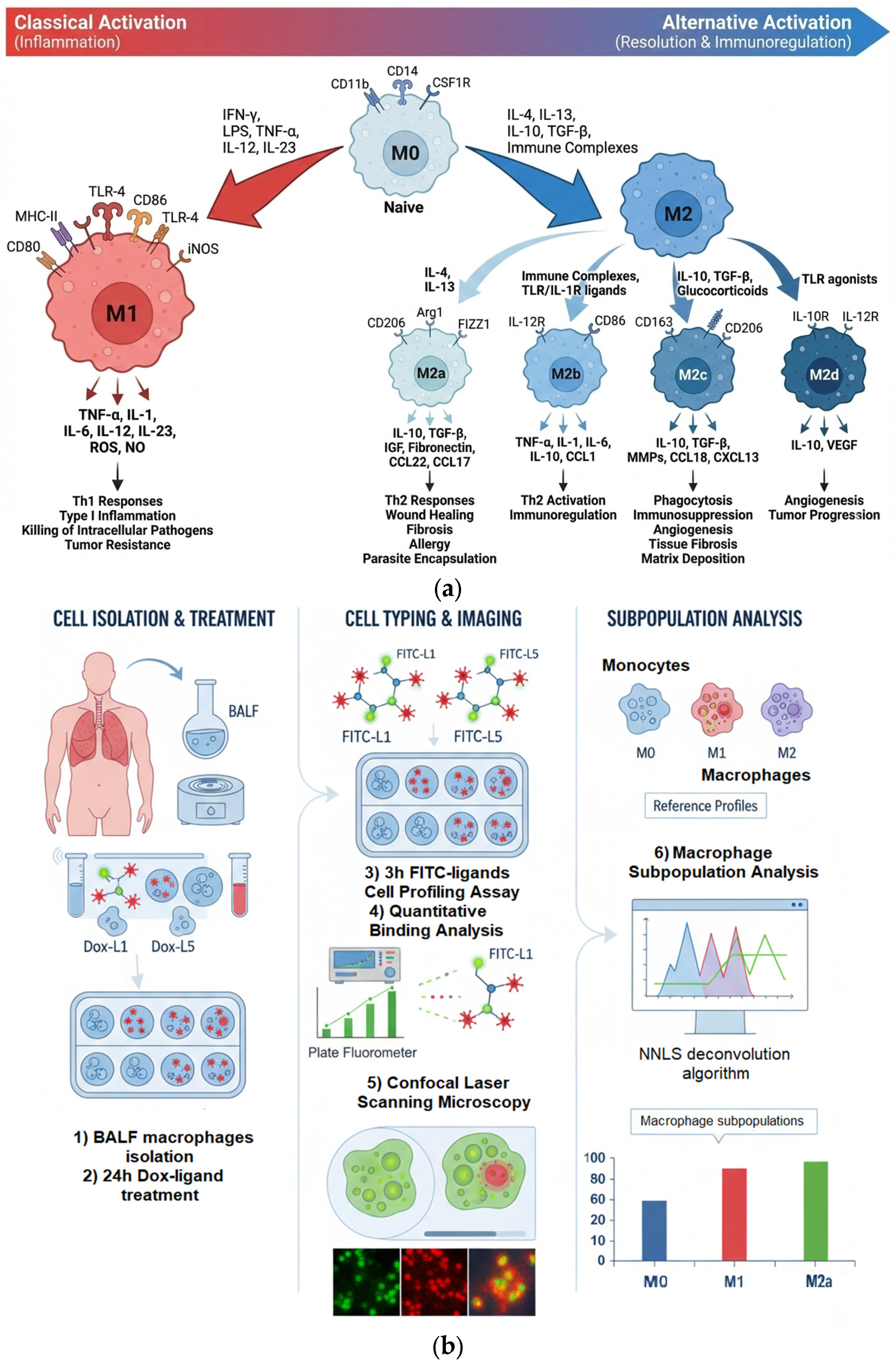
AMs are crucial for maintaining lung homeostasis, but they also play a critical role in the pathogenesis of chronic inflammatory lung diseases, such as bronchiectasis. The delicate balance between the pro-inflammatory M1 and anti-inflammatory/resolving M2 macrophage phenotypes determines the course of disease progression (Figure 4a). M0 macrophages are undifferentiated cells that can shift their function depending on cues from their environment; M1 macrophages are polarized toward a pro-inflammatory role, defending against pathogens and tumors; M2 macrophages are alternatively activated, mainly supporting anti-inflammatory processes, tissue repair, and immune regulation, with further subtypes specialized for wound healing and inflammation resolution.
In order to explore the capacity of our testing system to implement profiling and identify imbalances, we first developed a sandwich-like assay, as depicted in Figure 4b. This assay serves as a foundation for subsequent selective reprogramming of macrophages. This assay consists of a series of five unique glycan-based ligands, L1-L5, synthesized using a branched polyethyleneimine (PEI) backbone (Figure 1, Table 1). Each ligand is designed with a distinct carbohydrate moiety—linear D-mannose (L1), cyclic D-mannose (L2), linear D-galactose (L3), cyclic D-galactose (L4), or a synthetic GlcNAc2-trimannoside cluster (L5)—intended to interact with specific lectin receptors on macrophages.
To assess the in situ cellular response and quantify the resulting macrophage profile, we employed a cell-based profiling assay. Alveolar macrophages (AMs) were incubated with a panel of FITC-labeled synthetic glycol-ligands (FITC-L1 to FITC-L5). The fluorescence intensity of bound FITC-ligands was quantified using a plate fluorometer. To enhance the diagnostic power of this “fingerprint” analysis, we incorporated competitive binding assays with mannan—that provides additional information regarding the selectivity of our ligands, particularly their interaction with mannose-specific receptors.
To translate these observed binding “fingerprints” into a clinically relevant measure of macrophage polarization, we established standardized reference binding profiles for distinct macrophage subpopulations: M0 (quiescent), M1 (pro-inflammatory), and M2 (pro-resolving/tissue-repair). These reference populations were generated by ex vivo differentiation of peripheral blood monocytes, providing a well-defined and reproducible standard for comparison against the heterogeneous patient-derived samples.
We then applied a non-negative least squares (NNLS) deconvolution algorithm to the binding data obtained from patient-derived BALF samples [56,57]. This algorithm deconvolved the complex experimental profiles, allowing us to determine the relative proportions of M0, M1, and M2 subpopulations within the patient samples. This quantitative deconvolution enabled us to assess the baseline macrophage phenotype in bronchiectasis patients and, subsequently, to monitor the dynamic remodeling of this profile following targeted therapeutic intervention with Dox-conjugated ligands.

3.4. Baseline Macrophage Receptor Profiling and Its Significance in Bronchiectasis

3.4.1. Establishing Baseline Macrophage Receptor Profiles in Bronchiectasis

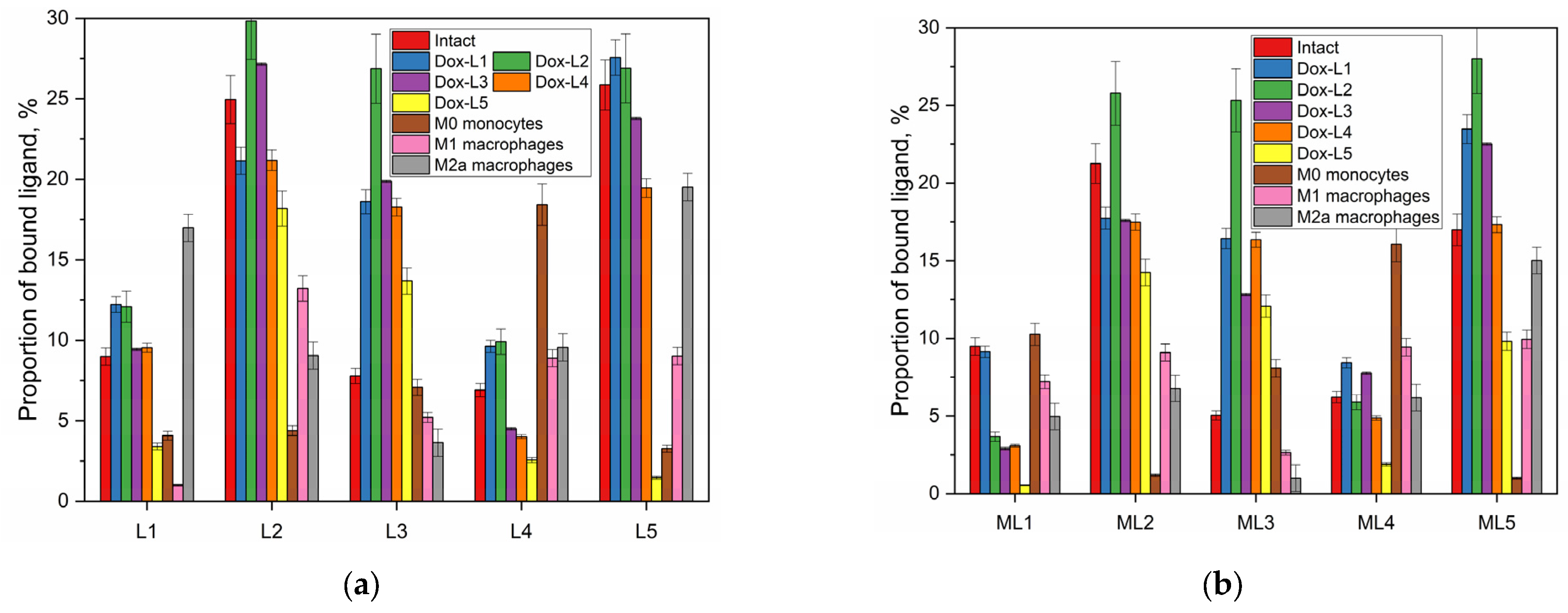
To establish the baseline macrophage phenotype in bronchiectasis, alveolar macrophages (AMs) isolated from the bronchoalveolar lavage fluid (BALF) of patients were analyzed and compared against a healthy control. A panel of five distinct FITC-labeled, glycan-based ligands (L1-L5) was applied to the cells to profile their surface receptor expression. The resulting binding affinities are presented numerically in Table 2, with the binding patterns and their statistical distributions visualized across Figure 5.
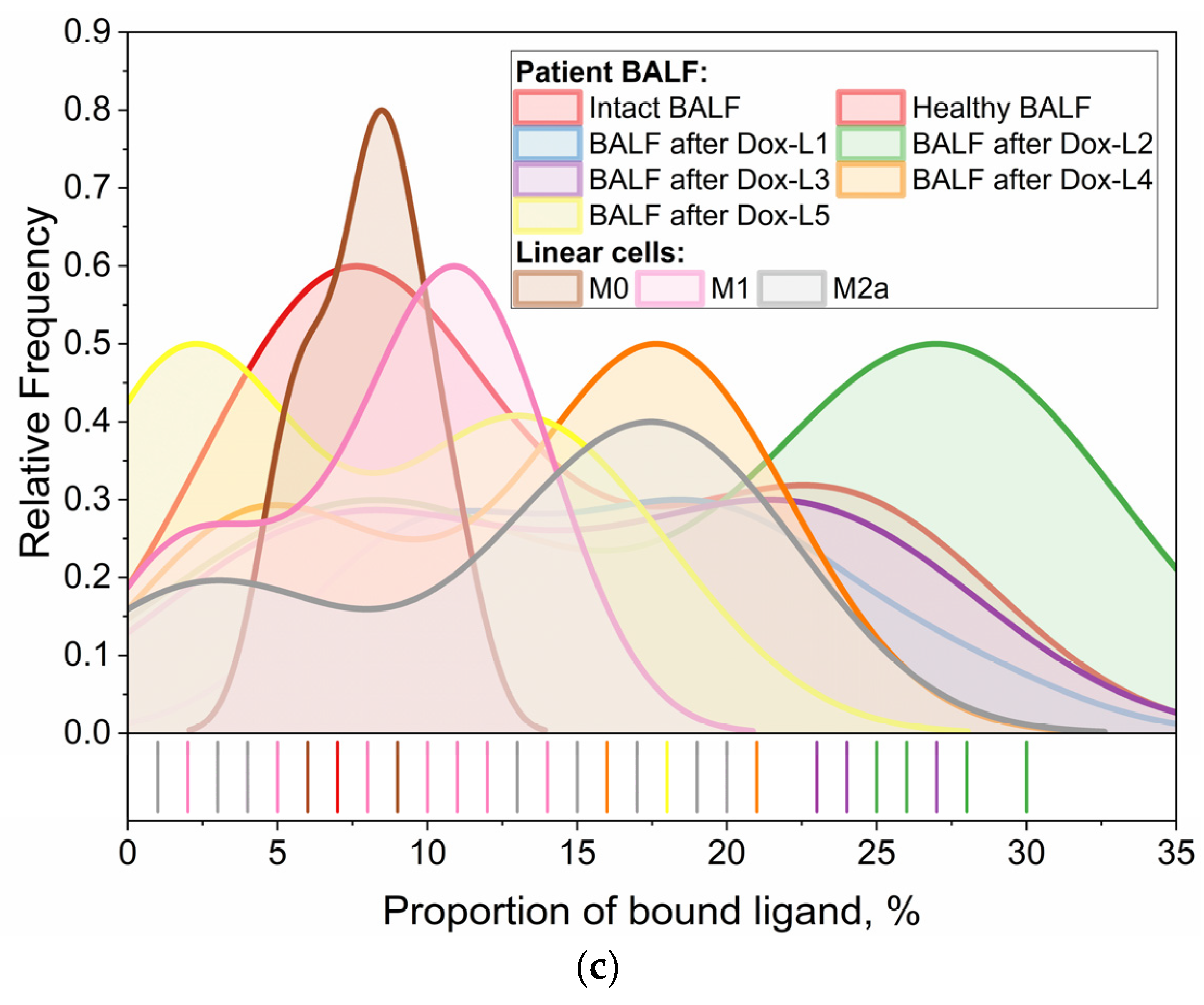
The analysis revealed a starkly different binding profile for AMs from bronchiectasis patients compared to the healthy control, as depicted in Figure 5 and quantified in Table 2. Specifically, patient-derived AMs showed a pronounced binding affinity for ligands L2 (cyclic mannose) and L5 (GlcNAc2-trimannoside cluster), with binding percentages of 25% and 26%, respectively. The kernel density distributions shown in Figure 5c further illustrate the prevalence of these specific binding events, visually, this is represented by the distinctive shift of the population density peaks toward higher fluorescence intensity values for the patient group. This affinity was significantly higher than the binding observed for these same ligands in the healthy control (5% for L2 and 2% for L5, Table 2). This imbalanced receptor profile, characterized by a strong preference for binding of the complex mannose structures, is indicative of a pathogenic, pro-inflammatory state.
To confirm the specificity of these ligand-receptor interactions, a competitive inhibition assay was performed on the patient’s AMs using mannan. As shown graphically in Figure 5b and detailed numerically in Table 2, the presence of mannan significantly reduced the binding of L5 (from 26% to 17%) and L2 (from 25% to 21%). This result strongly suggests that ligands L2 and L5 primarily engage with mannose-specific receptors, such as the Mannose Receptor (CD206). In contrast, the binding of galactose-based ligands (L3, L4) and linear mannose (L1) was largely unaffected, confirming their interaction with different receptor types.
Initial profiling of the ex vivo AMs obtained from the patient (Intact BALF column) revealed a binding pattern that did not align with any of the standardized in vitro control phenotypes (M0, M1, or M2a; Table 2, right panel). This quantitative discrepancy indicates that the patient’s AMs possess a unique, mixed pathological phenotype characteristic of chronic inflammation in bronchiectasis, distinct from the clear-cut polarization states observed in laboratory models.
A comprehensive statistical comparison between the Intact BALF (baseline) and the Dox-L5-treated macrophages demonstrates the formulation’s potent reprogramming capability. The most significant shift was observed in the specific trimannoside uptake (L5), where binding affinity decreased from 26 ± 2% in the intact cells to 1 ± 0.5% post-treatment (p < 0.001), representing a near-total abrogation of the pathological signal. Similarly, linear mannose binding (L1) was significantly reduced from 9 ± 1% to 3 ± 1% (p < 0.001).
Interestingly, the treatment did not uniformly suppress all receptors, which rules out generalized cell death. While L2 (cyclic mannose) showed a moderate but significant reduction (25 ± 2% vs. 18 ± 2%, p < 0.01), the binding of linear galactose (L3) exhibited a highly statistically significant increase8 ± 1% to 14 ± 1%, p < 0.001). This divergent behavior—significant downregulation of mannose-specific receptors (L1, L5) alongside the upregulation of galactose targets (L3)—statistically confirms a specific phenotypic shift rather than non-specific cytotoxicity.
To elucidate the mechanism of action, competitive inhibition assays with mannan were performed (rows FITC-ML1 to ML5). Even in the presence of mannan, significant differences were observed compared to the intact state. For instance, the Dox-L5-treated cells showed a significant reduction in ML5 binding (10 ± 1%) compared to the Intact group (17 ± 1%, p < 0.001), indicating deep phenotypic changes that persist even under competitive blockade.
Ultimately, the post-treatment binding profile of the patient’s AMs (specifically L5 binding of 1%) became statistically indistinguishable from the anti-inflammatory M2a reference control (L5 = 1%; Table 2). This indicates that the Dox-L5 formulation successfully reprogrammed the pathological macrophages towards a phenotype functionally equivalent to the healthy, anti-inflammatory M2a state.

3.4.2. Interpretation and Implications of Dox-Glyco-Ligand Effects in Bronchiectasis

Bronchiectasis is a chronic inflammatory condition that is frequently sustained by a surplus of pro-inflammatory macrophages of the M1 phenotype. Consequently, there is an unmet need to develop a therapeutic approach that can specifically target and suppress these M1 cell populations.
Dox, a well-established chemotherapeutic agent, is known to possess immunomodulatory properties that can impact macrophage behavior. While its cytostatic effects on tumor cells are widely studied, a key characteristic relevant to our work is its ability to shift macrophage polarization, often promoting a transition from pro-inflammatory M1 macrophages towards an M2-like phenotype [65,66]. While this phenomenon may contribute to immune suppression during cancer treatment, it serves as a powerful model for investigating the impact on conditions characterized by chronic inflammation. We leverage this property to investigate the potential for targeted delivery and selective remodeling of specific macrophage subpopulations. We aimed to test the hypothesis that Dox, delivered via our glycan ligands, can reduce the pro-inflammatory M1 population, thereby addressing the macrophage imbalance that drives chronic inflammation in conditions like bronchiectasis.
To explore this, we investigated the ex vivo effects of Dox-conjugated ligands (Dox-L1 to Dox-L5) (Figure 1) on AMs obtained from the BALF of a pediatric patient with traction bronchiectasis (BALF1).
Analysis of ligand binding before and after pre-incubation with the corresponding Dox-conjugated formulations revealed significant modulatory effects on macrophage receptor engagement (Figure 5). Pre-incubation with Dox-L5, which targets the high-affinity CD206 receptor, almost completely abolished subsequent FITC-L5 binding (a sharp decrease from 26% to 1%). This dramatic reduction strongly suggests efficient targeting, saturation, and/or internalization of CD206 by the Dox-L5 formulation, indicating successful delivery of Dox to these M2-associated receptor populations.
In contrast to the decrease in L5 binding observed after pre-treatment with Dox-L5, pre-treatment with Dox-L3 (linear galactose), a ligand with lower intrinsic binding affinity, unexpectedly enhanced the binding of FITC-L3 (from 8% to 27%). This suggests that the Dox-L3 formulation might prime or activate the macrophages, possibly by altering membrane properties or indirectly upregulating receptor expression, thereby increasing the accessibility or affinity for other ligands. Pre-treatment with Dox-L1 and Dox-L4 induced negligible changes. Dox-L2 showed only a minor increase in L2 binding (25% to 30%), close to the experimental error margin. These findings highlight the ligand-specific nature of Dox formulation effects on macrophage receptor availability.
These results demonstrate that our glyco-ligand platform can serve as a vehicle for targeted drug delivery, capable of inducing distinct modulatory effects on macrophage receptor expression and potentially cellular phenotype based on ligand affinity. For instance, this platform could be adapted to test the efficacy of alternative anti-inflammatory agents, such as curcumin or some of terpenoids, which is increasingly recognized for its relevance in treating chronic inflammatory conditions like bronchiectasis, thereby guiding optimal therapeutic choices.

3.5. Deconvolution Analysis Reveals Doxorubicin Formulation-Induced Modulation of Alveolar Macrophage Subpopulations in Bronchiectasis

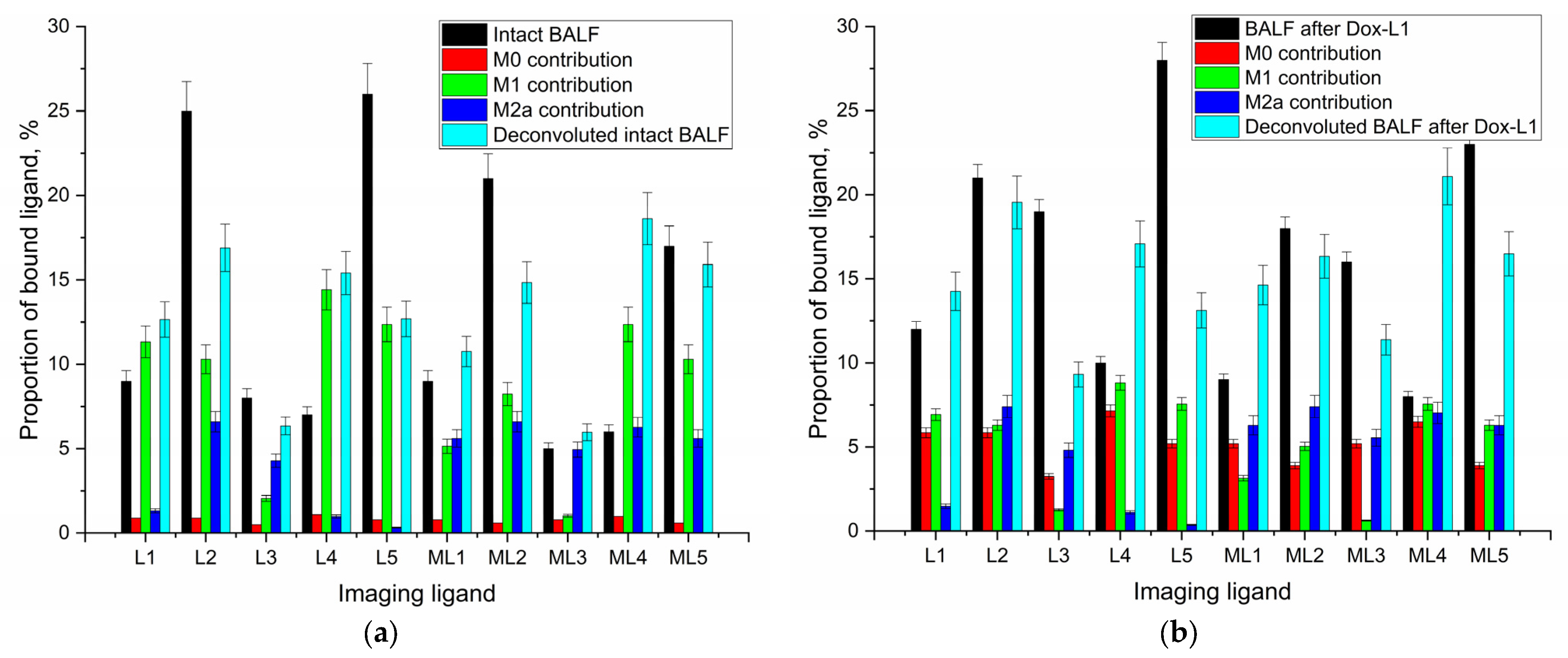
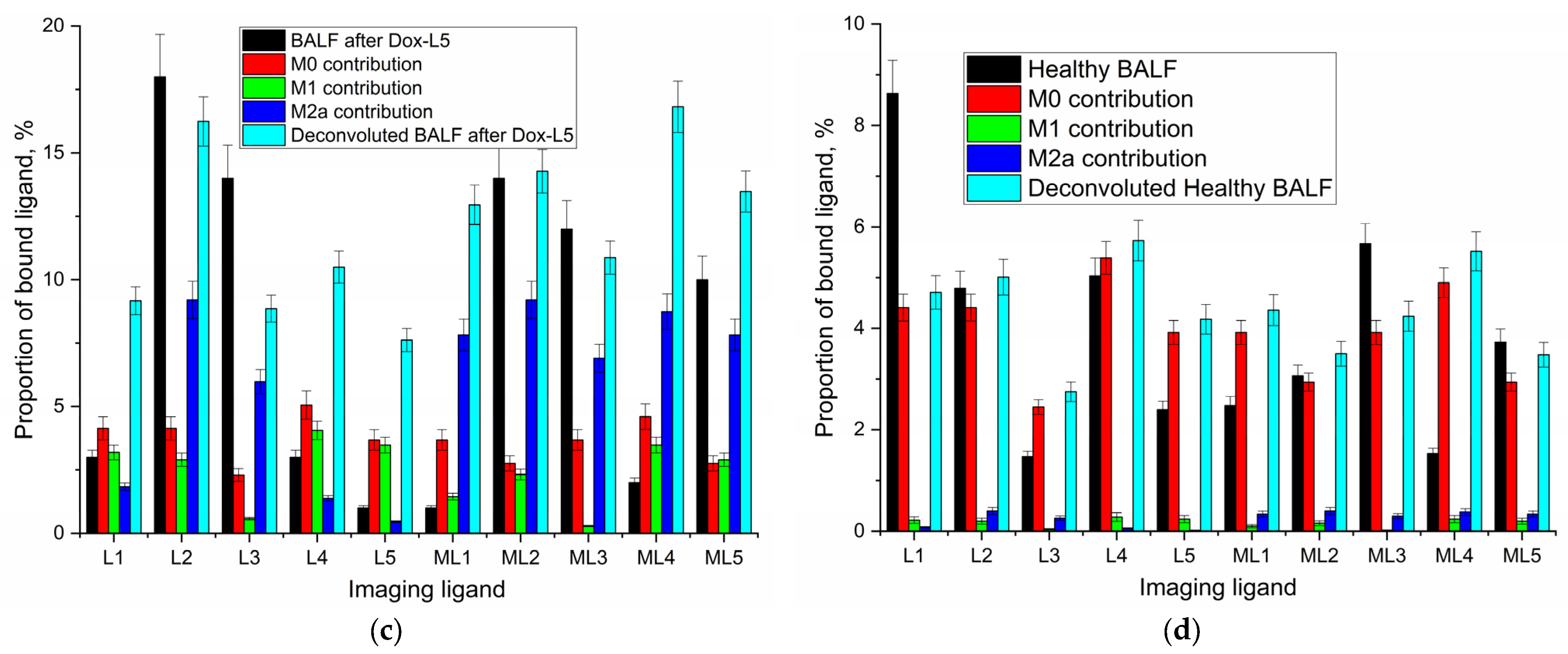
To quantitatively assess the impact of the targeted Dox formulations on alveolar macrophage polarization, a deconvolution algorithm was employed. This algorithm leveraged the binding profiles generated by ligands L1-L5 and their mannan-competed counterparts (ML1-ML5). The analysis aimed to determine the relative contributions of monocyte-derived M0, pro-inflammatory M1, and anti-inflammatory/tissue repair M2 (further subtyped into M2a and a residual M2b-c-d component) to the overall binding patterns observed in BALF macrophages from a patient with bronchiectasis, both before and after treatment with five distinct Dox formulations (Figure 6).
Analysis of alveolar macrophages (AMs) from the BALF of a healthy control established a homeostatic baseline characterized by a dominant quiescent M0 phenotype (63%) and a minor M2 component (28%), with virtually no pro inflammatory M1 cells detected (<1%). This pattern, presented in the “Healthy control” rows of Table 3, reflects the balanced immune state of a normal lung, where inflammatory activity is tightly regulated. Competitive inhibition with mannan demonstrated that glycan ligands specifically interact with mannose-containing receptors such as CD206.
In contrast, BALF-derived cells from a patient with bronchiectasis exhibited a macrophage profile strongly skewed toward the pro inflammatory M1 state (55%), with the virtual absence of M0 monocytes (<1%) (Table 3). The pronounced prevalence of M1 macrophages underscores the chronic, unresolved inflammation typical of the disease.
Following this baseline comparison, we explored whether targeted doxorubicin (Dox) glycoconjugates could restore a balanced macrophage composition. The effects of five formulations (Dox-L1 to Dox-L5) were evaluated using deconvolution of M0, M1, and M2 subsets (Table 3).
The targeted reprogramming of alveolar macrophage plasticity via CD206-directed doxorubicin conjugates (Dox-L1-L5) constitutes a fundamental advance in the resolution of chronic airway inflammation. As elucidated in Table 3, the immunomodulatory potency of these conjugates is governed by a precise structure-activity relationship, wherein the complex GlcNAc2-trimannoside moiety (Dox-L5) demonstrates superior efficacy. This formulation achieved a profound reversal of the pathogenic M1-dominant profile, reducing inflammatory markers to a physiological nadir (16%, p < 0.001) while orchestrating the resurgence of the quiescent M0 surveillance population (25%) and stabilizing regulatory M2 subsets. This shift represents not merely a suppression of pathology, but a reinstatement of the homeostatic immune equilibrium characteristic of healthy pulmonary tissue, validating the therapeutic potential of glycan-mediated targeting.
Deconvolution in the presence of mannan (ML1-ML5 data) confirmed receptor-specific involvement of mannose recognition.
We confirmed that this phenotypic restoration is driven primarily by receptor-mediated repolarization rather than selective cytotoxicity. While free doxorubicin caused substantial non-specific cell death (viability ~67%), the targeted Dox-L5 conjugate maintained high cellular viability (72 ± 4%) despite the near-complete suppression of M1 markers. This decoupling of therapeutic efficacy from cytotoxicity indicates that approximately 75% of the observed M1 reduction arises from functional “re-education” of the macrophages. Specificity was corroborated by reference population assays showing strict CD206-dependent susceptibility, proving that the conjugate utilizes the receptor not just as a docking site, but as a gateway for intracellular modulation.
Collectively, these findings establish a new precision-medicine paradigm for the management of bronchiectasis. By harnessing the plasticity of the alveolar macrophage pool, Dox-L5 resolves inflammation through an endogenous regulatory loop without compromising the viability of the host defense system. This contrasts sharply with broad-spectrum immunosuppressants that often impair pulmonary immunity. The ability to precisely tune the M1/M2 axis using multivalent glycan architectures highlights the transformative potential of carbohydrate-based therapeutics in restoring mucosal immunity and preventing the progression of chronic respiratory diseases.
These results demonstrate that glycan-targeted Dox conjugates remodel the pathogenic macrophage landscape in bronchiectasis. Dox-L5, carrying the GlcNAc2-trimannoside cluster directed at the CD206 receptor, was the most effective, restoring an M0/M2-dominant composition close to the healthy baseline and highlighting its potential for immunomodulatory therapy

3.6. Deconvolution Analysis for the Control Ex Vivo Polarization Remodeling by Free Doxorubicin

In order to elucidate the effects of glycan-targeted conjugates on remodeling, we conducted an assessment of the immunomodulatory influence of free Dox, serving as a control. So, we analyzed BALF samples from three pediatric patients with distinct underlying pathologies leading to chronic lung inflammation and bronchiectasis: traction bronchiectasis (BALF1), bronchiectasis secondary to primary immunodeficiency post-HSCT (BALF2), and obliterative bronchiolitis secondary to chronic aspiration (BALF3). The aim was to determine if free Dox alters macrophage polarization ex vivo and whether these effects vary depending on the patient’s specific clinical context. The baseline macrophage polarization profiles and the changes following ex vivo treatment with free Dox are summarized in Table 4.
The therapeutic impact of free Doxorubicin in the ex vivo BALF model was strictly dictated by the underlying pathophysiology of the donor’s diagnosis. In the context of classic inflammatory pathologies—Bronchiectasis (J47, BALF1) and Immunodeficiency with bronchiectasis complications (BALF2)—the baseline macrophage phenotype was defined by a pathogenic M1 dominance (55% and 29%, respectively), which drives the chronic neutrophilic destruction typical of these diseases. Here, Doxorubicin acted as a potent pro-resolving agent: it significantly dismantled the inflammatory M1 plateau (p < 0.01) and functionally reprogrammed the population toward a reparative M2a phenotype (+11% shift). For patients with Bronchiectasis or immunodeficiency, where natural resolution mechanisms are often impaired, this suggests that Doxorubicin can break the “vicious cycle” of inflammation and promote tissue repair independent of the host’s compromised immune signaling.
However, the results from the Obliterative Bronchiolitis sample (J84.8, BALF3) expose the critical risks of non-targeted therapy (free Dox) in distinct etiologies. This patient presented with a fibrotic, regulatory baseline (M2b/c/d-high, 55%) rather than acute inflammation. While Doxorubicin successfully reduced this potentially pro-fibrotic M2 population (to 29%, p < 0.001), it did so at the cost of inducing a severe inflammatory stress response, evidenced by a paradoxical surge in M1 macrophages (20% → 34%) and undifferentiated M0 cells. Clinically, transforming a “fibrotic” lung environment into an “acutely inflamed” one could trigger rapid exacerbations. This stark divergence—healing in bronchiectasis but potentially aggravating in bronchiolitis—validates the necessity for the developed CD206-targeted conjugates (Dox-L series), which are designed to deliver cytotoxic payload specifically to M2-like cells without provoking the generalized inflammatory stress seen here with the free drug.

3.7. Therapeutic Remodeling of Macrophage Phenotype in Bronchiectasis Using Targeted Doxorubicin Formulations

To therapeutically remodel the pathogenic macrophage populations characteristic of bronchiectasis, we investigated the effects of our Dox-ligand conjugates on BALF cells obtained from a patient diagnosed with this chronic inflammatory lung disease. Initial deconvolution analysis of the patient’s BALF revealed a macrophage population heavily skewed towards a pro-inflammatory M1 phenotype (55%), accompanied by contributions from M2a (18%) and M2b-c-d (27%) subtypes, with no detectable non-activated M0 monocytes (Table 4). This M1-dominant profile is consistent with the chronic, unresolved inflammatory state typical of bronchiectasis, and our objective was to determine if our Dox-ligand conjugates could effectively remodel this profile towards a healthier, more homeostatic state.
The raw deconvolution data, presented in Table 3, demonstrates a profound and ligand-specific shift in the macrophage populations following treatment with the Dox-conjugated formulations. Subsequent analysis (Table 5) of this data highlights the proposed mechanism of action for each formulation, linking observed phenotypic shifts to specific glycan-receptor interactions and demonstrating the ability of targeted Dox-ligands to therapeutically correct the dysregulated M1-dominant profile.
Dox-L5 conjugate achieved a near-complete polarization to the M2a phenotype (99% in Table 3), indicating highly specific targeting and effective remodeling of M1-skewed macrophages towards an M2 state. This outcome strongly suggests saturation and/or internalization of the cognate CD206 receptors.
Dox-L3 conjugate unexpectedly enhanced subsequent FITC-L3 binding (from 8% to 27%). This suggests a priming or upregulation of certain receptors, indicating a different mechanism of interaction compared to direct saturation.
Other conjugates (Dox-L1, Dox-L2, Dox-L4) exhibited only minor modulatory effects, likely reflecting weaker or less specific binding of these ligand constructs to macrophage surface receptors. This observation underscores the ligand-dependent nature of the immunomodulatory response. Thus, we demonstrate the capacity of our glycan-ligand platform to deliver Doxorubicin selectively and induce differential therapeutic remodeling of macrophage phenotypes, offering a potent strategy to address the chronic inflammation in bronchiectasis.

3.8. Efficacy of Targeted vs. Non-Targeted Macrophage Remodeling

The therapeutic superiority of glycan-targeted delivery over the administration of free Dox is demonstrated by a more profound and beneficial remodeling of the macrophage population (Table 6). While free Dox provided a modest reduction in the M1 phenotype, the Dox-ligand conjugates achieved a more potent M1 suppression. Critically, only the targeted conjugates were able to induce the re-emergence of a quiescent, M0-like macrophage population, a key indicator of a return toward a healthy, non-inflammatory state. This suggests that targeted delivery not only enhances the drug’s efficacy but fundamentally alters its immunomodulatory action, enabling a more complete restoration of immune homeostasis.
The structural characteristics of the glycan ligands were pivotal in determining therapeutic success. Ligands designed to engage the Mannose Receptor (CD206)—particularly those with multivalent or conformationally constrained structures like Dox-L5 and Dox-L2—were most effective, confirming CD206 as a key therapeutic target on pathogenic M1 macrophages. Unexpectedly, the cyclic galactose conjugate (Dox-L4) also showed high efficacy, suggesting that its cyclic structure allows it to mimic mannose and engage CD206. This “structural mimicry” reveals a novel targeting strategy, indicating that conformational design is as important as the type of saccharide used.

3.9. CLSM and Fluorescence Microscopy Analysis of Glycoligand-Conjugate Uptake in BALF-Derived Alveolar Macrophages

3.9.1. Fluorescence Microscopy Screening Analysis

Following our quantitative analysis of binding profiles and Doxorubicin’s reprogramming effects, we employed fluorescence microscopy to directly visualize ligand selectivity and assess Dox cellular uptake by BALF-derived alveolar macrophages. This approach aimed to confirm whether the glycan ligands enable selective targeting and deliver Dox effectively, thereby influencing macrophage reprogramming.
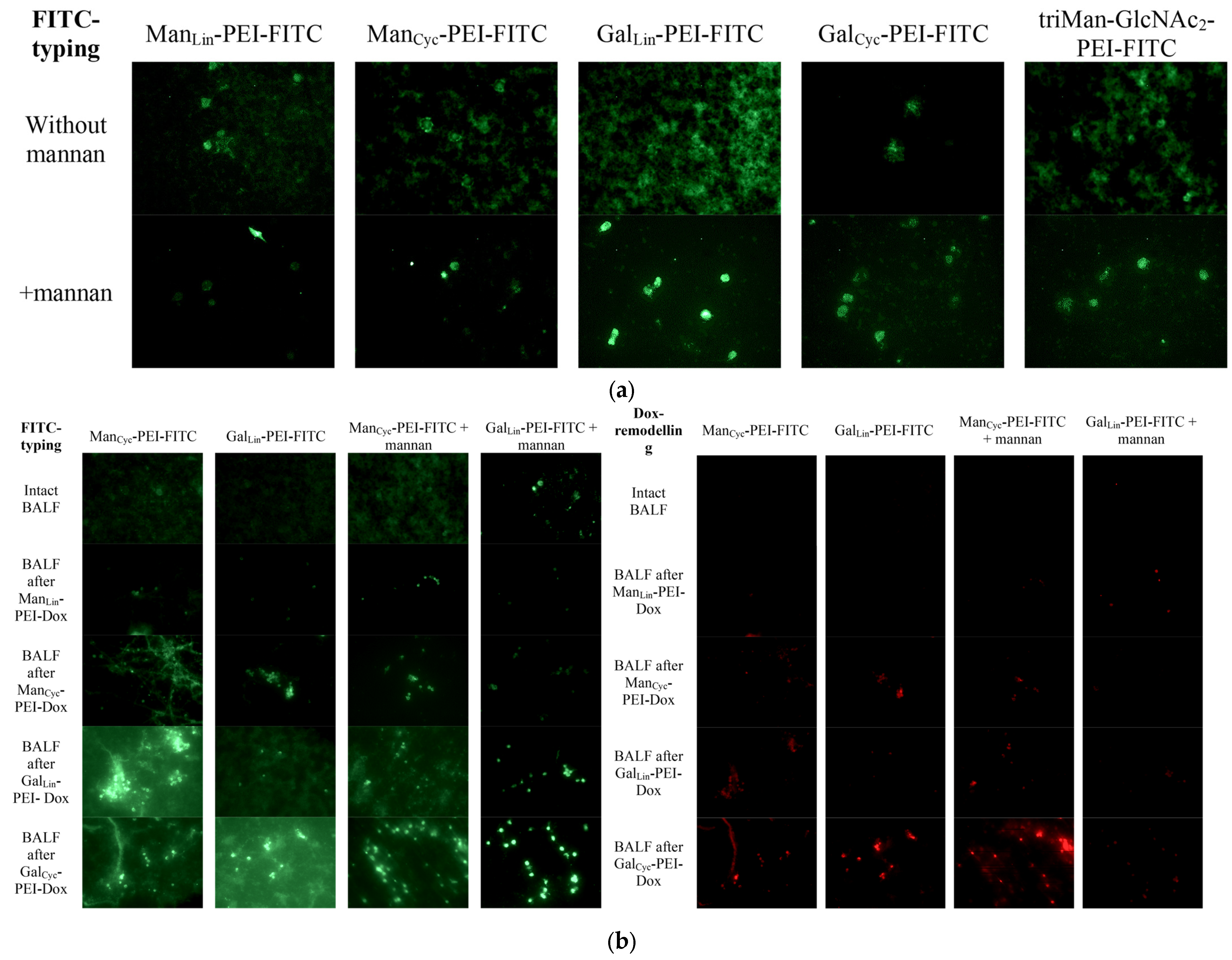
Fluorescence microscopy screening analysis was conducted to visually verify carbohydrate ligand binding to BALF1 cells isolated from a patient with bronchiectasis (ICD-10: J47) (Figure 7). The differential binding profiles of carbohydrate ligands to BALF cells from bronchiectasis patients demonstrate marked receptor-mediated selectivity that correlates with both the structural organization of glycan-binding domains and the inflammatory phenotype of airway macrophages in this chronic, destructive lung disease.
Fluorescence microscopy analysis (Figure 7a) revealed that ManLin-PEI-FITC and GalLin-PEI-FITC conjugates exhibited substantially higher cellular uptake compared to their corresponding cyclic counterparts (ManCyc-PEI-FITC and GalCyc-PEI-FITC), indicating that linear presentation of carbohydrate epitopes provides enhanced accessibility to lectin binding domains on the macrophage cell surface. The initial fluorescence microscopy screen (“Without mannan” row in Figure 7a) reveals a striking differential in green channel (FITC) signal localization between discrete cellular objects and diffuse extracellular background. Analysis of the images shows that distinct punctate green fluorescence signals correspond to individual round or ovoid cells with clearly demarcated cell boundaries, whereas surrounding regions display minimal background fluorescence, yielding a notably high signal-to-noise ratio (SNR) with cellular fluorescence intensity approximately 15–20 fold above the extracellular background. This optical contrast reflects the specific binding of carbohydrate ligands to cell-surface glycan receptors. In particular, ManLin-PEI-FITC and GalLin-PEI-FITC conjugates exhibit robust binding predominantly to alveolar macrophages (large, ~15–25 μm cells with characteristic round morphology), whereas ManCyc-PEI-FITC and GalCycPEI-FITC show lower binding affinity of cyclic versus linear glycan scaffolds for mannose and galactose receptors. Critically, the triManGlcNAc2-PEI-FITC ligand displays intermediate green fluorescence with a distinctly punctate intracellular pattern, suggesting that the high-affinity oligomannose structure achieves rapid receptor-mediated endocytosis and intracellular compartmentalization in baseline BALF macrophages. The absence of green signal from the extracellular space—where mucins, extracellular matrix proteins, and aggregated cell debris would be expected in bronchiectasis BALF—provides direct visual confirmation that the ligands exhibit high selectivity for cell-surface carbohydrate receptors and do not non-specifically bind to soluble or immobilized mucin glycoproteins that characteristically form irregular, fiber-like networks in inflammatory airways.
When mannan competition is applied (“+ mannan” row in Figure 7b), green fluorescence from ManLin-PEI-FITC, ManCyc-PEI-FITC, and triManGlcNAc2-PEI-FITC on macrophages is dramatically quenched. The signal intensity drops to near or below background levels, indicating that these ligands compete for a shared, mannan-sensitive receptor system, most likely the mannose receptor (CD206/MR). In contrast, binding of the galactose-based ligands is preserved and remains associated with a distinct cellular population. This pattern unambiguously supports engagement of separate galactose-specific lectin receptors, such as the macrophage galactose lectin (MGL/CD301).
Macrophage remodeling-dependent blockade patterns reveal phenotype-selective drug internalization (Figure 7b). The sequential displacement assay in panel (b) tracks the functional consequences of pre-incubating BALF cells with doxorubicin-conjugated therapeutic ligands (Dox-conjugates, red channel) followed by diagnostic FITC-ligand staining (green channel). This two-step protocol directly demonstrates receptor-mediated drug delivery coupled with phenotypic remodeling. In the “Intact BALF” control row, robust green signals from both ManCyc-PEI-FITC and GalLin-PEI-FITC indicate baseline receptor availability on distinct macrophage subsets. Following pretreatment with ManCyc-PEI-Dox, the corresponding FITC-channel image shows a dramatic reduction in ManCyc-PEI-FITC binding (third row, left panel), with green fluorescence intensity diminishing to near-background levels, while GalLin-PEI-FITC binding persists, confirming that the Dox-conjugated ligand saturates or internalizes the available mannose receptors without affecting galactose receptor availability.
Critically, the “Dox remodeling” panel (right column, red channel, Figure 7b) reveals the intracellular fate of drug-conjugated ligands. Following Dox-L5 (trimannoside-PEI-Dox) pretreatment, cells display intense red fluorescence in a distinctly punctate endosomal/lysosomal pattern concentrated within macrophage cytoplasm rather than diffusely distributed in the extracellular space, indicating efficient receptor-mediated endocytosis and subcellular compartmentalization. The high signal-to-noise ratio in the red channel (bright red punctate vesicles against a completely dark extracellular background) confirms that doxorubicin is accumulated intracellularly within acidified endosomal and lysosomal compartments—a microenvironment known to enhance doxorubicin fluorescence quantum yield by approximately two-fold compared to cytoplasmic or extracellular free drug. Dox-L4 (cyclic galactose) produces a similarly intense red signal restricted to the N/M subset. Dox-L2 (cyclic mannose) shows comparatively weaker red fluorescence but with similar vesicular localization, reflecting differences in uptake efficiency across ligand variants and macrophage subsets.
The selective blocking observed in rows 4–5 (GalLin-PEI-Dox pretreatment) demonstrates that galactose-targeted therapeutics achieve even more efficient intracellular accumulation than mannose-targeted analogs, as evidenced by the brighter red channel signal and its more uniform distribution across the larger alveolar macrophage population. When GalLin-PEI-Dox is applied prior to FITC staining, subsequent green-channel imaging shows nearly complete blockade of GalLin-PEI-FITC binding (row 5, left panel), while Man_cyc-PEI-FITC continues to bind, thereby conclusively demonstrating that linear galactose-presenting scaffolds achieve superior receptor occupancy and perhaps faster internalization compared to their cyclic counterparts, allowing for more efficient displacement of diagnostic ligands and consequently more pronounced macrophage phenotypic remodeling toward the M2a state. In the corresponding red-channel images, the extraordinarily high intracellular concentration of red fluorescence from GalLin-PEI-Dox—combined with the absence of extracellular red signal or background fluorescence—underscores the exceptional specificity and efficiency of galactose receptor-mediated delivery to these cells, substantially superior to that achieved by mannose-based vectors in the same BALF sample.
So, the specificity and effectiveness of targeting ligands conjugated with doxorubicin on BAL cells were studied by pretreating with Dox-conjugated ligands. First, we re-model the cells, then we look at how the binding profile to the ligands has changed compared to the original one (Figure 7a). The near-complete suppression of FITC-ligand binding following Dox-conjugate pretreatment, coupled with the quantitative shift from a mixed M1/M2 phenotype (Table 2, intact BALF baseline ~70% M1/30% M2) to a predominantly M2a phenotype (99% M2a following Dox-L5 treatment, Table 2) without proportionate cell loss (72% viability maintained, Table S2), provides evidence that the phenotypic remodeling is driven by CD206-mediated or MGL-mediated uptake of the trimannoside or galactose-conjugated doxorubicin vectors, respectively. The fact that receptor saturation by the Dox conjugate prevents subsequent binding of the diagnostic FITC ligand to the same receptor demonstrates a fundamental principle: both ligands compete for limited, saturable receptor binding sites on the macrophage surface and endocytic pathway. Critically, the visual difference between panels Figure 7a,b)—the shift from predominantly surface-associated green fluorescence in (a) to predominantly intracellular red fluorescence in (b), combined with the appearance of punctate vesicular patterns characteristic of receptor-mediated endosomal/lysosomal trafficking—reveals that doxorubicin-conjugated ligands are not merely binding to the cell surface but are actively internalized through clathrin-dependent endocytosis, a process that may itself transduce repolarization signals to the macrophage. In the inflammatory microenvironment of bronchiectasis BALF, where glycan receptor expression patterns are substantially remodeled in comparison to healthy controls—with mannose receptor expression downregulated and alternative lectin pathways potentially upregulated—the enhanced efficacy of galactose and oligomannose-based vectors compared to simple monomannose ligands reflects a fundamental shift in the lectin-binding landscape of airway macrophages in chronic suppurative disease.
Finally, differential uptake selectivity—with GalLin-PEI-Dox showing superior fluorescence intensity compared to ManCyc-PEI-Dox—suggests that in the inflammatory microenvironment of bronchiectasis BALF, where macrophage phenotype and lectin expression patterns are substantially remodeled, the galactose-binding lectin pathways may represent more abundant or constitutively active endocytic routes compared to the mannose receptor, which is known to be downregulated in bronchiectasis-associated inflammation.

3.9.2. Mechanistic Validation: Integrating Quantitative Deconvolution with Imaging Evidence

To link the deconvolution shifts in Table 3 to a defined molecular mechanism, ligand-receptor interactions were examined directly in BALF cells by fluorescence microscopy. Screening of BALF with FITC-labeled ligands showed that mannose-containing probes (ManCyc-FITC, triMan-FITC) bound selectively to a discrete subset of large alveolar macrophages, whereas galactose-based ligands labeled a partially distinct population. Competitive inhibition with soluble mannan abolished the signals from all mannose-based ligands but did not affect the binding of galactose-derived probes, demonstrating that the mannose ligands engage a mannan-sensitive receptor system, most likely CD206, while galactose ligands use a different lectin pathway. The complete loss of mannose-derived fluorescence in the presence of mannan, together with preserved cellular morphology, indicates that the quantitative changes detected by spectral deconvolution reflect genuine alterations in receptor occupancy rather than nonspecific toxicity or cell loss.
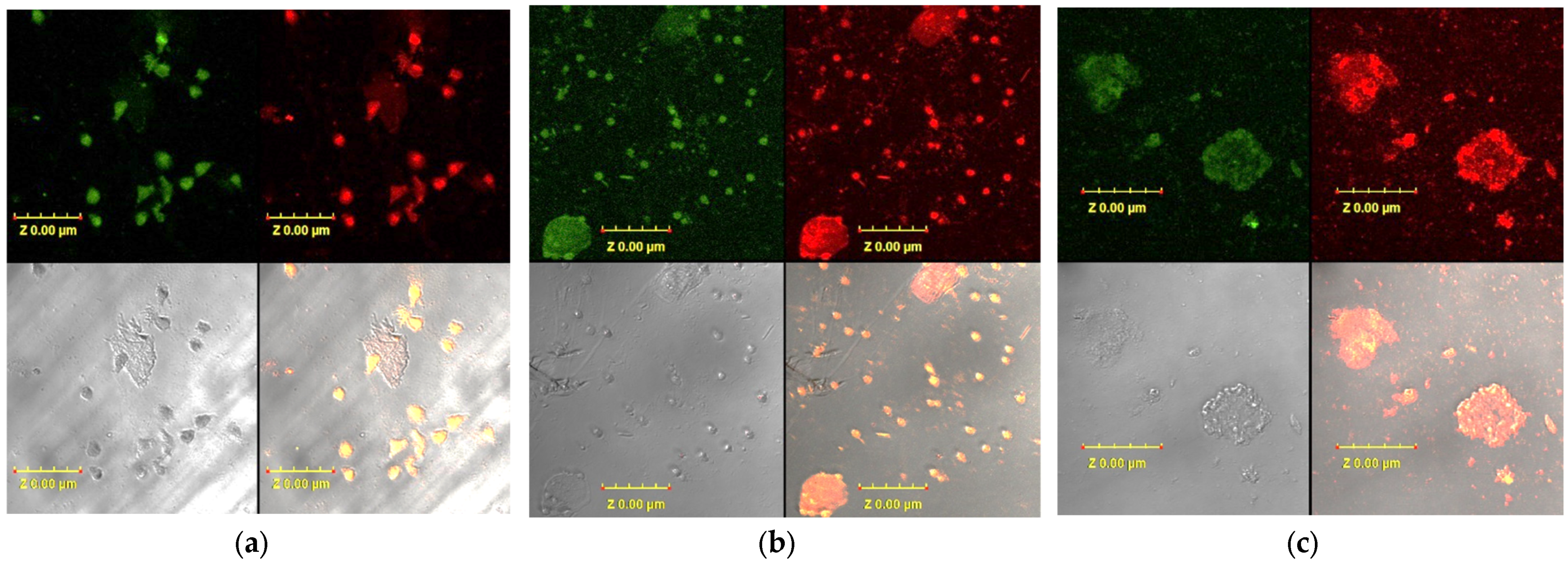
Sequential displacement experiments provided a direct mechanistic bridge between diagnostic profiling and therapeutic delivery (Figure 7b). Pre-incubation of BALF cells with ManCyc-PEI-Dox or triMan-PEI-Dox produced a strong intracellular red signal corresponding to doxorubicin fluorescence, confined to the same macrophage subset that had bound the mannose FITC probes. Subsequent addition of the corresponding FITC-labeled ligand led to a marked reduction or complete loss of green fluorescence on these cells, consistent with receptor saturation and/or internalization by the Dox-conjugated ligand. Confocal microscopy further refined this picture: Dox-L5 (trimannoside) accumulated in a punctate intracellular pattern within morphologically intact alveolar macrophages (Figure 8), compatible with receptor-mediated endocytosis into endosomal/lysosomal compartments, while cell viability remained high (72% at 24 h, Table S2). Quantitatively, Dox-L5 pretreatment reduced binding of the corresponding FITC-L5 probe from 26% to 1% of BALF cells and was accompanied by an almost complete shift of the macrophage population toward the M2a phenotype (99% M2a with Dox-L5), without disproportionate loss of other subsets (Table 2, Table 3 and Table S2). The convergence of mannan-competition specificity, displacement of FITC ligands by Dox conjugates, and visualization of subcellular drug accumulation provides coherent, orthogonal validation that the observed phenotypic remodeling is driven by CD206-mediated uptake of the trimannoside vector rather than by selective survival of pre-existing macrophage subsets.

3.9.3. CLSM Features of BALF Cell Profiles: Spatial Resolution of Ligand Binding

After establishing population-level binding patterns, CLSM was used to resolve the spatial and morphological context of ligand recognition in BALF cells (Figure 8). Dual-color imaging combined the profiling ligand L2-FITC (cyclic mannose, green channel) with therapeutic Dox-conjugated ligands (L4-Dox, L2-Dox, or L5-Dox, red channel). This approach allowed simultaneous identification of cells expressing receptors for simple mannose, assessment of drug delivery by Dox conjugates, and evaluation of intracellular localization. CLSM revealed a heterogeneous BALF cell population comprising large, adherent alveolar macrophages and a distinct subset of smaller, non-adherent myeloid cells. On the basis of previous immunological characterization, these small cells are interpreted as immature, actively secreting macrophages rather than classical neutrophils; however, for operational clarity, they are referred to here as N/M cells. Differences in fluorescence intensity between these subsets in Figure 8 support the working hypothesis that they possess distinct glycan receptor repertoires, an interpretation that is consistent with prior flow-cytometric data from the same cohort.
When BALF cells were sequentially incubated with L4-Dox (cyclic galactose) followed by L2-FITC (cyclic mannose), both red and green signals were confined to the N/M subset, with extensive yellow/orange overlap in the merged images. An analogous pattern was seen in the control combination of L2-Dox with L2-FITC, confirming that both mono-mannose and mono-galactose ligands predominantly target the small N/M population and exhibit high degrees of co-localization within these cells. In contrast, the large alveolar macrophages remained largely negative for L2-FITC and showed only weak or absent labeling with L4-based constructs, indicating that simple mono-saccharide ligands have limited access to the dominant receptor systems on mature AMs in bronchiectasis BALF. To test whether multivalent oligomannose structures might preferentially address these macrophages, cells were treated with L5-Dox (trimannoside conjugate) in combination with L2-FITC. Under these conditions the L2-FITC signal remained restricted to N/M cells, whereas intense punctate red fluorescence from L5-Dox appeared almost exclusively in large macrophage clusters. The granular red pattern, clearly separated from the plasma membrane in z-stacks, is characteristic of intracellular vesicular accumulation and is consistent with receptor-mediated endocytosis of the trimannoside construct. In BALF from the bronchiectasis patient analyzed, where flow cytometry indicated a predominance of pro-inflammatory, M1-like AMs that were efficiently repolarized toward M2a by L5-based formulations (Table 2), this selective uptake by AMs provides a direct spatial correlate of the functional remodeling.
Taken together, CLSM analysis divides the BALF compartment into two functionally distinct populations on the basis of their glycan-binding profiles. The N/M subset robustly internalizes simple mono-mannose and mono-galactose ligands but shows little response to the trimannoside construct, whereas alveolar macrophages exhibit the opposite pattern, displaying minimal binding of L2 and L4 yet efficient internalization of L5-Dox. In the context of bronchiectasis, this means that vectors based on simple mannose or galactose would primarily deliver cargo to N/M cells and provide poor access to the macrophages that dominate the inflammatory niche. By contrast, the trimannoside ligand L5 functions as a highly selective carrier for doxorubicin into alveolar macrophages, enabling targeted modulation of their activation state and offering a rational basis for AM-focused therapeutic strategies aimed at correcting macrophage-driven remodeling in chronic suppurative lung disease.

4. Conclusions

The finely orchestrated equilibrium among alveolar macrophage (AM) phenotypes—M0, M1, and M2—is pivotal in governing inflammatory trajectories and dictating disease outcomes. In persistent inflammatory pathologies such as bronchiectasis, a dysregulated macrophage (Mf) profile, typified by a preponderance of pro-inflammatory M1 macrophages, serves as a cardinal indicator of disease progression and amplifies the risk of adverse clinical sequelae.
Here, we developed a glycan-based ligand panel capable of profiling and selectively modulating alveolar macrophage phenotypes in chronic inflammatory lung disease. Using BALF samples from pediatric bronchiectasis patients, we reveal a strongly M1-skewed macrophage landscape that contrasts sharply with the homeostatic M0/M2 balance found in healthy lungs. The synthetic glycoligands bind distinct lectin receptors, producing a phenotypic “fingerprint” that enables quantitative deconvolution of macrophage subpopulations. When these ligands are conjugated with doxorubicin, they selectively target macrophage subsets and induce phenotype remodeling rather than nonspecific cytotoxicity. Among them, the multivalent mannose-cluster conjugate (Dox-L5) most effectively suppresses pathogenic M1 cells while promoting restorative M2 and M0 populations.
We developed a sophisticated platform leveraging precisely engineered glyco-ligands conjugated to Doxorubicin (Dox) for highly targeted immunomodulation. This integrated system not only facilitates sensitive phenotypic profiling of Mf subpopulations but, more critically, enables precise therapeutic intervention to recalibrate a healthy Mf balance. Our investigations unequivocally demonstrate that dysregulated Mf profiles are amenable to therapeutic re-polarization through selective engagement of specific glycan receptors.
Employing Dox as a benchmark therapeutic agent, we rigorously validated the efficacy of our target strategy. We observed that the Dox-conjugates, by judiciously exploiting specific glycan-ligand interactions, robustly altered Mf polarization dynamics. Notably, Dox conjugates engineered to target the Mannose Receptor (MR, CD206/CD209) via a high-affinity trimannoside structure (Dox-L5) achieved profound therapeutic success. In a preclinical bronchiectasis model, this specific formulation proficiently attenuated the pathogenic M1 population from a dysregulated (55%) to a substantially reduced (15%), with instances even demonstrating complete eradication (0%) of M1 cells. This targeted reprogramming was concurrently marked by an induction of M0-like cells and a decisive phenotypic shift towards the reparative M2 anti-inflammatory phenotype, thereby fostering the resolution of inflammation.
This work establishes glycan-directed immunomodulation as a viable strategy for precision medicine, with dual diagnostic-therapeutic capability: quantitative assessment of macrophage imbalance coupled with targeted therapeutic delivery to restore healthy phenotypes and resolve chronic inflammation.

Supplementary Materials

The following supporting information can be downloaded at: https://www.mdpi.com/article/10.3390/immuno6010009/s1, Figure S1. FTIR spectra of fluorescent markers with different affinity to CD206 macrophage receptors X-PEI-FITC. PBS (0.01 M, pH 7.4). T = 37 °C. Figure S2. (a) 1H NMR spectra of triMan-(GlcNAc)2. D2O. T = 22 °C. (b) 1H NMR spectra of triMan-(GlcNAc)2-PEI as a polymer for fluorescent markers. D2O. T = 22 °C. Figure S3. Fluorescence image of THP-1-derived macrophages stained with PEI-FITC (0.1 mg/mL): (a) after 45 min of incubation, and (b) after 3 h of incubation. CD206 is labeled in red with anti-CD206 antibodies (ab64693, Abcam; 1:100), nuclei are counterstained in blue with DAPI, and PEI-associated FITC signal is shown in green. Scale bar is 100 µm. Table S1. Flow cytometry viability assessment of macrophages exposed to unmodified PEI and saccharide-modified PEI conjugates. THP-1 macrophages were incubated with polymers (50 μg/mL) for 3 h at 37 °C, 5% CO2. * p < 0.001 vs. untreated control. Table S2. Cell viability (%) of BAL-derived alveolar macrophages and THP-1 reference macrophage populations exposed to doxorubicin (1 μM).

Author Contributions

Conceptualization, E.V.K. and I.D.Z.; methodology, I.D.Z. and E.V.K.; formal analysis, I.D.Z. and A.A.E.; investigation, I.D.Z., A.A.E. and E.V.K.; data curation, I.D.Z.; writing—original draft preparation, I.D.Z.; writing—review and editing, E.V.K.; project supervision, E.V.K.; funding acquisition, E.V.K. All authors have read and agreed to the published version of the manuscript.

Funding

This research received no external funding.

Institutional Review Board Statement

Cell lines were obtained from Lomonosov Moscow State University Depository of Live Systems Collection (Moscow, Russia).

Informed Consent Statement

BALF samples were obtained following patient consent and strict adherence to ethical guidelines (approved by the Local Ethics Committee, Protocol #2024-15A).

Data Availability Statement

The data presented in this study are available in the main text and in the Supplementary Materials.

Acknowledgments

This work was performed using the following equipment from the program for the development of Moscow State University: the MICRAN-3 FTIR microscope, Jasco J-815 CD spectrometer, NTEGRA II AFM microscope, Olympus FluoView FV1000 confocal laser scanning microscope and Olympus IX81 motorized inverted microscope.

Conflicts of Interest

The authors declare no conflicts of interest.

Abbreviations

The following abbreviations are used in this manuscript:
AMsAlveolar macrophages
BALBronchoalveolar lavage
BALFBronchoalveolar lavage fluid
CLSMConfocal laser scanning microscopy
FTIRFourier-transformed infrared spectroscopy
Mf or MφMacrophages

References

  1. Alizadeh, D.; Zhang, L.; Hwang, J.; Schluep, T.; Badie, B. Tumor-Associated Macrophages Are Predominant Carriers of Cyclodextrin-Based Nanoparticles into Gliomas. Nanomedicine 2010, 6, 382–390. [Google Scholar] [CrossRef] [PubMed]
  2. Savchenko, I.V.; Zlotnikov, I.D.; Kudryashova, E.V. Biomimetic Systems Involving Macrophages and Their Potential for Targeted Drug Delivery. Biomimetics 2023, 8, 543. [Google Scholar] [CrossRef] [PubMed]
  3. Lepekha, L.N.; Erokhina, M.V. Pulmonary Macrophages and Dendritic Cells. Respir. Med. Man. 2024, 1, 249–263. [Google Scholar] [CrossRef]
  4. Mills, C.D. Anatomy of a Discovery: M1 and M2 Macrophages. Front. Immunol. 2015, 6, 212. [Google Scholar] [CrossRef]
  5. Papachristoforou, E.; Ramachandran, P. Macrophages as Key Regulators of Liver Health and Disease. In International Review of Cell and Molecular Biology; Elsevier: Amsterdam, The Netherlands, 2022; pp. 143–212. [Google Scholar]
  6. Peng, Y.; Zhou, M.; Yang, H.; Qu, R.; Qiu, Y.; Hao, J.; Bi, H.; Guo, D. Regulatory Mechanism of M1/M2 Macrophage Polarization in the Development of Autoimmune Diseases. Mediat. Inflamm. 2023, 2023, 8821610. [Google Scholar] [CrossRef] [PubMed]
  7. Kwon, D.H.; Lee, H.; Park, C.; Hong, S.H.; Hong, S.H.; Kim, G.Y.; Cha, H.J.; Kim, S.; Kim, H.S.; Hwang, H.J.; et al. Glutathione Induced Immune-Stimulatory Activity by Promoting M1-like Macrophages Polarization via Potential ROS Scavenging Capacity. Antioxidants 2019, 8, 413. [Google Scholar] [CrossRef] [PubMed]
  8. Wang, P.; Wang, H.; Huang, Q.; Peng, C.; Yao, L.; Chen, H.; Qiu, Z.; Wu, Y.; Wang, L.; Chen, W. Exosomes from M1-Polarized Macrophages Enhance Paclitaxel Antitumor Activity by Activating Macrophages-Mediated Inflammation. Theranostics 2019, 9, 1714–1727. [Google Scholar] [CrossRef] [PubMed]
  9. Italiani, P.; Boraschi, D. From Monocytes to M1/M2 Macrophages: Phenotypical vs. Functional Differentiation. Front. Immunol. 2014, 5, 514. [Google Scholar] [CrossRef]
  10. Cutolo, M.; Campitiello, R.; Gotelli, E.; Soldano, S. The Role of M1/M2 Macrophage Polarization in Rheumatoid Arthritis Synovitis. Front. Immunol. 2022, 13, 867260. [Google Scholar] [CrossRef]
  11. Strizova, Z.; Benesova, I.; Bartolini, R.; Novysedlak, R.; Cecrdlova, E.; Foley, L.K.; Striz, I. M1/M2 Macrophages and Their Overlaps—Myth or Reality? Clin. Sci. 2023, 137, 1067–1093. [Google Scholar] [CrossRef]
  12. Zhang, H.; Zhang, S.; Dang, X.; Lin, L.; Ren, L.; Song, R. GPNMB Plays an Active Role in the M1/M2 Balance. Tissue Cell 2022, 74, 101683. [Google Scholar] [CrossRef] [PubMed]
  13. Cho, D.; Kim, M.R.; Jeong, H.; Jeong, H.C.; Jeong, M.H.; Yoon, S.H.; Kim, Y.S.; Ahn, Y. Mesenchymal Stem Cells Reciprocally Regulate the M1 / M2 Balance in Mouse Bone Marrow-Derived Macrophages. Exp. Mol. Med. 2014, 46, e70. [Google Scholar] [CrossRef] [PubMed]
  14. Mills, C.D.; Drouet, C. Modulators of the Balance between M1 and M2 Macrophages during Pregnancy. Front. Immunol. 2017, 8, 120. [Google Scholar] [CrossRef] [PubMed]
  15. Nikonova, A.A.; Ataullakhanov, R.I.; Khaitov, R.M.; Khaitov, M.R. Characteristics and Role of Macrophages in Pathogenesis of Acute and Chronic Lung Disease. Immunologiya 2017, 6, 657–672. [Google Scholar] [CrossRef][Green Version]
  16. Yuan, R.; Ma, Y.; Yang, C.; Li, L. Plasticity of Monocytes/Macrophages: Phenotypic Changes during Disease Progression. Front. Immunol. 2023, 14, 1328382. [Google Scholar] [CrossRef]
  17. St-Laurent, J.; Turmel, V.; Boulet, L.P.; Bissonnette, E. Alveolar Macrophage Subpopulations in Bronchoalveolar Lavage and Induced Sputum of Asthmatic and Control Subjects. J. Asthma 2009, 46, 1–8. [Google Scholar] [CrossRef] [PubMed]
  18. Yu, W.; Liu, C.; Liu, Y.; Zhang, N.; Xu, W. Mannan-Modified Solid Lipid Nanoparticles for Targeted Gene Delivery to Alveolar Macrophages. Pharm. Res. 2010, 27, 1584–1596. [Google Scholar] [CrossRef] [PubMed]
  19. Zhang, Z.; Zhu, Y.; Xu, D.; Li, T.E.; Li, J.H.; Xiao, Z.T.; Chen, M.; Yang, X.; Jia, H.L.; Dong, Q.Z.; et al. IFN-a Facilitates the Effect of Sorafenib via Shifting the M2-like Polarization of TAM in Hepatocellular Carcinoma. Am. J. Transl. Res. 2021, 13, 301–313. [Google Scholar] [PubMed]
  20. Ding, L.; Liang, G.; Yao, Z.; Zhang, J.; Liu, R.; Chen, H.; Zhou, Y.; Wu, H.; Yang, B.; He, Q. Metformin Prevents Cancer Metastasis by Inhibiting M2-like Polarization of Tumor Associated Macrophages. Oncotarget 2015, 6, 36441–36455. [Google Scholar] [CrossRef]
  21. Mantovani, A.; Marchesi, F.; Malesci, A.; Laghi, L.; Allavena, P. Tumour-Associated Macrophages as Treatment Targets in Oncology. Nat. Rev. Clin. Oncol. 2017, 14, 399–416. [Google Scholar] [CrossRef]
  22. Brancewicz, J.; Wójcik, N.; Sarnowska, Z.; Robak, J.; Król, M. The Multifaceted Role of Macrophages in Biology and Diseases. Int. J. Mol. Sci. 2025, 26, 2107. [Google Scholar] [CrossRef]
  23. Kashyap, B.K.; Singh, V.V.; Solanki, M.K.; Kumar, A.; Ruokolainen, J.; Kesari, K.K. Smart Nanomaterials in Cancer Theranostics: Challenges and Opportunities. ACS Omega 2023, 8, 14290–14320. [Google Scholar] [CrossRef]
  24. Ullman, N.A.; Burchard, P.R.; Dunne, R.F.; Linehan, D.C. Immunologic Strategies in Pancreatic Cancer: Making Cold Tumors Hot. J. Clin. Oncol. 2022, 40, 2789–2805. [Google Scholar] [CrossRef]
  25. Fan, Z.; Liu, H.; Xue, Y.; Lin, J.; Fu, Y.; Xia, Z.; Pan, D.; Zhang, J.; Qiao, K.; Zhang, Z.; et al. Reversing Cold Tumors to Hot: An Immunoadjuvant-Functionalized Metal-Organic Framework for Multimodal Imaging-Guided Synergistic Photo-Immunotherapy. Bioact. Mater. 2021, 6, 312–325. [Google Scholar] [CrossRef] [PubMed]
  26. Zhou, Y.; Zhang, T.; Wang, X.; Wei, X.; Chen, Y.; Guo, L.; Zhang, J.; Wang, C. Curcumin Modulates Macrophage Polarization Through the Inhibition of the Toll-Like Receptor 4 Expression and Its Signaling Pathways. Cell. Physiol. Biochem. 2015, 36, 631–641. [Google Scholar] [CrossRef] [PubMed]
  27. Gao, S.; Zhou, J.; Liu, N.; Wang, L.; Gao, Q.; Wu, Y.; Zhao, Q.; Liu, P.; Wang, S.; Liu, Y.; et al. Curcumin Induces M2 Macrophage Polarization by Secretion IL-4 and/or IL-13. J. Mol. Cell Cardiol. 2015, 85, 131–139. [Google Scholar] [CrossRef] [PubMed]
  28. Sahu, A.; Kasoju, N.; Goswami, P.; Bora, U. Encapsulation of Curcumin in Pluronic Block Copolymer Micelles for Drug Delivery Applications. J. Biomater. Appl. 2011, 25, 619–639. [Google Scholar] [CrossRef]
  29. Aslzad, S.; Heydari, P.; Abdolahinia, E.D.; Amiryaghoubi, N.; Safary, A.; Fathi, M.; Erfan-Niya, H. Chitosan/Gelatin Hybrid Nanogel Containing Doxorubicin as Enzyme-Responsive Drug Delivery System for Breast Cancer Treatment. Colloid. Polym. Sci. 2023, 301, 273–281. [Google Scholar] [CrossRef]
  30. Lukyanov, A.N.; Elbayoumi, T.A.; Chakilam, A.R.; Torchilin, V.P. Tumor-Targeted Liposomes: Doxorubicin-Loaded Long-Circulating Liposomes Modified with Anti-Cancer Antibody. J. Control. Release 2004, 100, 135–144. [Google Scholar] [CrossRef]
  31. Carvalho, C.; Santos, R.; Cardoso, S.; Correia, S.; Oliveira, P.; Santos, M.; Moreira, P. Doxorubicin: The Good, the Bad and the Ugly Effect. Curr. Med. Chem. 2009, 16, 3267–3285. [Google Scholar] [CrossRef] [PubMed]
  32. Lee, J.J.; Liao, A.T.; Wang, S.L. L-Asparaginase, Doxorubicin, Vincristine, and Prednisolone (Lhop) Chemotherapy as a First-Line Treatment for Dogs with Multicentric Lymphoma. Animals 2021, 11, 2199. [Google Scholar] [CrossRef] [PubMed]
  33. Sritharan, S.; Sivalingam, N. A Comprehensive Review on Time-Tested Anticancer Drug Doxorubicin. Life Sci. 2021, 278, 119527. [Google Scholar] [CrossRef] [PubMed]
  34. Reyfman, P.A.; Malsin, E.S.; Khuder, B.; Joshi, N.; Gadhvi, G.; Flozak, A.S.; Carns, M.A.; Aren, K.; Goldberg, I.A.; Kim, S.; et al. A Novel MIP-1–Expressing Macrophage Subtype in BAL Fluid from Healthy Volunteers. Am. J. Respir. Cell Mol. Biol. 2023, 68, 176–185. [Google Scholar] [CrossRef] [PubMed]
  35. Todd, J.L.; Weber, J.M.; Kelly, F.L.; Neely, M.L.; Mulder, H.; Frankel, C.W.; Nagler, A.; McCrae, C.; Newbold, P.; Kreindler, J.; et al. BAL Fluid Eosinophilia Associates with Chronic Lung Allograft Dysfunction Risk: A Multicenter Study. Chest 2023, 164, 670–681. [Google Scholar] [CrossRef] [PubMed]
  36. Lee, J.; Arisi, I.; Puxeddu, E.; Mramba, L.K.; Amicosante, M.; Swaisgood, C.M.; Pallante, M.; Brantly, M.L.; Sköld, C.M.; Saltini, C. Bronchoalveolar Lavage (BAL) Cells in Idiopathic Pulmonary Fibrosis Express a Complex pro-Inflammatory, pro-Repair, Angiogenic Activation Pattern, Likely Associated with Macrophage Iron Accumulation. PLoS ONE 2018, 13, e0194803. [Google Scholar] [CrossRef] [PubMed]
  37. d’Alessandro, M.; Carleo, A.; Cameli, P.; Bergantini, L.; Perrone, A.; Vietri, L.; Lanzarone, N.; Vagaggini, C.; Sestini, P.; Bargagli, E. BAL Biomarkers’ Panel for Differential Diagnosis of Interstitial Lung Diseases. Clin. Exp. Med. 2020, 20, 207–216. [Google Scholar] [CrossRef]
  38. Gao, C.A.; Cuttica, M.J.; Malsin, E.S.; Argento, A.C.; Wunderink, R.G.; Smith, S.B. Comparing Nasopharyngeal and BAL SARS-CoV-2 Assays in Respiratory Failure. Am. J. Respir. Crit. Care Med. 2021, 203, 127–129. [Google Scholar] [CrossRef]
  39. Bratke, K.; Weise, M.; Stoll, P.; Virchow, J.C.; Lommatzsch, M. Flow Cytometry as an Alternative to Microscopy for the Differentiation of BAL Fluid Leukocytes. Chest 2024, 166, 793–801. [Google Scholar] [CrossRef]
  40. Zlotnikov, I.D.; Kudryashova, E.V. Polymeric Infrared and Fluorescent Probes to Assess Macrophage Diversity in Bronchoalveolar Lavage Fluid of Asthma and Other Pulmonary Disease Patients. Polymers 2024, 16, 3427. [Google Scholar] [CrossRef]
  41. Zlotnikov, I.D.; Kolganova, N.I.; Gitinov, S.A.; Ovsyannikov, D.Y.; Kudryashova, E.V. The Role of CD68+ Cells in Bronchoalveolar Lavage Fluid for the Diagnosis of Respiratory Diseases. Immuno 2025, 5, 43. [Google Scholar] [CrossRef]
  42. Kurynina, A.V.; Erokhina, M.V.; Makarevich, O.A.; Sysoeva, V.Y.; Lepekha, L.N.; Kuznetsov, S.A.; Onishchenko, G.E. Plasticity of Human THP–1 Cell Phagocytic Activity during Macrophagic Differentiation. Biochemistry 2018, 83, 200–214. [Google Scholar] [CrossRef] [PubMed]
  43. Zlotnikov, I.D.; Vigovskiy, M.A.; Davydova, M.P.; Danilov, M.R.; Dyachkova, U.D.; Grigorieva, O.A.; Kudryashova, E.V. Mannosylated Systems for Targeted Delivery of Antibacterial Drugs to Activated Macrophages. Int. J. Mol. Sci. 2022, 23, 16144. [Google Scholar] [CrossRef] [PubMed]
  44. Zlotnikov, I.D.; Kudryashova, E.V. Mannose Receptors of Alveolar Macrophages as a Target for the Addressed Delivery of Medicines to the Lungs. Russ. J. Bioorg Chem. 2022, 48, 46–75. [Google Scholar] [CrossRef]
  45. Lepenies, B.; Lee, J.; Sonkaria, S. Targeting C-Type Lectin Receptors with Multivalent Carbohydrate Ligands. Adv. Drug Deliv. Rev. 2013, 65, 1271–1281. [Google Scholar] [CrossRef] [PubMed]
  46. East, L.; Isacke, C.M. The Mannose Receptor Family. Biochim. Biophys. Acta Gen. Subj. 2002, 1572, 364–386. [Google Scholar] [CrossRef] [PubMed]
  47. Zlotnikov, I.D.; Ezhov, A.A.; Kolganova, N.I.; Ovsyannikov, D.Y.; Belogurova, N.G.; Kudryashova, E.V. Optical Methods for Determining the Phagocytic Activity Profile of CD206-Positive Macrophages Extracted from Bronchoalveolar Lavage by Specific Mannosylated Polymeric Ligands. Polymers 2025, 17, 65. [Google Scholar] [CrossRef] [PubMed]
  48. Chung, Y.; Hong, J.Y.; Lei, J.; Chen, Q.; Bentley, J.K.; Hershenson, M.B. Rhinovirus Infection Induces Interleukin-13 Production from CD11b-Positive, M2-Polarized Exudative Macrophages. Am. J. Respir. Cell Mol. Biol. 2015, 52, 205–216. [Google Scholar] [CrossRef][Green Version]
  49. Hong, J.Y.; Chung, Y.; Steenrod, J.; Chen, Q.; Lei, J.; Comstock, A.T.; Goldsmith, A.M.; Bentley, J.K.; Sajjan, U.S.; Hershenson, M.B. Macrophage Activation State Determines the Response to Rhinovirus Infection in a Mouse Model of Allergic Asthma. Respir. Res. 2014, 15, 63. [Google Scholar] [CrossRef]
  50. Zlotnikov, I.D.; Kudryashova, E.V. Spectroscopy Approach for Highly-Efficient Screening of Lectin-Ligand Interactions in Application for Mannose Receptor and Molecular Containers for Antibacterial Drugs. Pharmaceuticals 2022, 15, 625. [Google Scholar] [CrossRef]
  51. Cunha, D.R.; Segundo, M.A.; Quinaz, M.B. Impedimetric biosensor based on gold nanostructures and concanavalin a for glycoproteins detection. Bioelectrochemistry 2025, 166, 109042. [Google Scholar] [CrossRef]
  52. Feinberg, H.; Jégouzo, S.A.F.; Lasanajak, Y.; Smith, D.F.; Drickamer, K.; Weis, W.I.; Taylor, M.E. Structural Analysis of Carbohydrate Binding by the Macrophage Mannose Receptor CD206. J. Biol. Chem. 2021, 296, 100368. [Google Scholar] [CrossRef] [PubMed]
  53. Zlotnikov, I.D.; Kudryashova, E.V. Computer Simulation of the Receptor–Ligand Interactions of Mannose Receptor CD206 in Comparison with the Lectin Concanavalin A Model. Biochemistry 2022, 87, 54–69. [Google Scholar] [CrossRef] [PubMed]
  54. Gabba, A.; Bogucka, A.; Luz, J.G.; Diniz, A.; Coelho, H.; Corzana, F.; Cañada, F.J.; Marcelo, F.; Murphy, P.V.; Birrane, G. Crystal Structure of the Carbohydrate Recognition Domain of the Human Macrophage Galactose C-Type Lectin Bound to GalNAc and the Tumor-Associated Tn Antigen. Biochemistry 2021, 60, 1327–1336. [Google Scholar] [CrossRef] [PubMed]
  55. Feinberg, H.; Castelli, R.; Drickamer, K.; Seeberger, P.H.; Weis, W.I. Multiple Modes of Binding Enhance the Affinity of DC-SIGN for High Mannose N-Linked Glycans Found on Viral Glycoproteins. J. Biol. Chem. 2007, 282, 4202–4209. [Google Scholar] [CrossRef]
  56. Zhao, W.; Ai, X.; Xiao, W.; Chen, Y.; Li, J.; Zhao, H.; Chen, W. Applications of the Non-Negative Least-Squares Deconvolution Method to Analyze Energy-Dispersive x-Ray Fluorescence Spectra. Appl. Opt. 2023, 62, 5556. [Google Scholar] [CrossRef]
  57. Nguyen, T.T.; Idier, J.; Soussen, C.; Djermoune, E.H. Non-Negative Orthogonal Greedy Algorithms. IEEE Trans. Signal Process. 2019, 67, 5643–5658. [Google Scholar] [CrossRef]
  58. Zlotnikov, I.D.; Ezhov, A.A.; Petrov, R.A.; Vigovskiy, M.A.; Grigorieva, O.A.; Belogurova, N.G.; Kudryashova, E.V. Mannosylated Polymeric Ligands for Targeted Delivery of Antibacterials and Their Adjuvants to Macrophages for the Enhancement of the Drug Efficiency. Pharmaceuticals 2022, 15, 1172. [Google Scholar] [CrossRef] [PubMed]
  59. Coulibaly, F.S.; Youan, B.-B.C. Concanavalin A–Polysaccharides binding affinity analysis using a quartz crystal microbalance. Biosens. Bioelectron 2014, 59, 404–411. [Google Scholar] [CrossRef] [PubMed]
  60. Zlotnikov, I.D.; Vanichkin, D.A.; Kudryashova, E.V. Methods for Determining the Parameters of Receptor-Ligand Interactions on the Model of Concanavalin A and Mannosylated Chitosans Promising Carriers for Drug Delivery to Alveolar Macrophages. Biotekhnologiya 2021, 37, 28–40. [Google Scholar] [CrossRef]
  61. Beyerle, A.; Irmler, M.; Beckers, J.; Kissel, T.; Stoeger, T. Toxicity Pathway Focused Gene Expression Profiling of PEI-Based Polymers for Pulmonary Applications. Mol. Pharm. 2010, 7, 727–737. [Google Scholar] [CrossRef]
  62. Murray, P.J. Macrophage Polarization. Annu. Rev. Physiol. 2017, 79, 541–566. [Google Scholar] [CrossRef]
  63. Martinez, F.O.; Gordon, S. The M1 and M2 Paradigm of Macrophage Activation: Time for Reassessment. F1000Prime Rep. 2014, 6, 13. [Google Scholar] [CrossRef]
  64. Luo, M.; Zhao, F.; Cheng, H.; Su, M.; Wang, Y. Macrophage Polarization: An Important Role in Inflammatory Diseases. Front. Immunol. 2024, 15, 1352946. [Google Scholar] [CrossRef]
  65. Hughes, R.; Qian, B.; Rowan, C.; Muthana, M.; Keklikoglou, I.; Olson, O.C.; Tazzyman, S.; Danson, S.; Addison, C.; Clemons, M.; et al. Perivascular M2 Macrophages Stimulate Tumor Relapse after Chemotherapy. Cancer Res. 2015, 75, 3479–3491. [Google Scholar] [CrossRef]
  66. Nakasone, E.S.; Askautrud, H.A.; Kees, T.; Park, J.H.; Plaks, V.; Ewald, A.J.; Fein, M.; Rasch, M.G.; Tan, Y.X.; Qiu, J.; et al. Imaging Tumor-Stroma Interactions during Chemotherapy Reveals Contributions of the Microenvironment to Resistance. Cancer Cell 2012, 21, 488–503. [Google Scholar] [CrossRef]
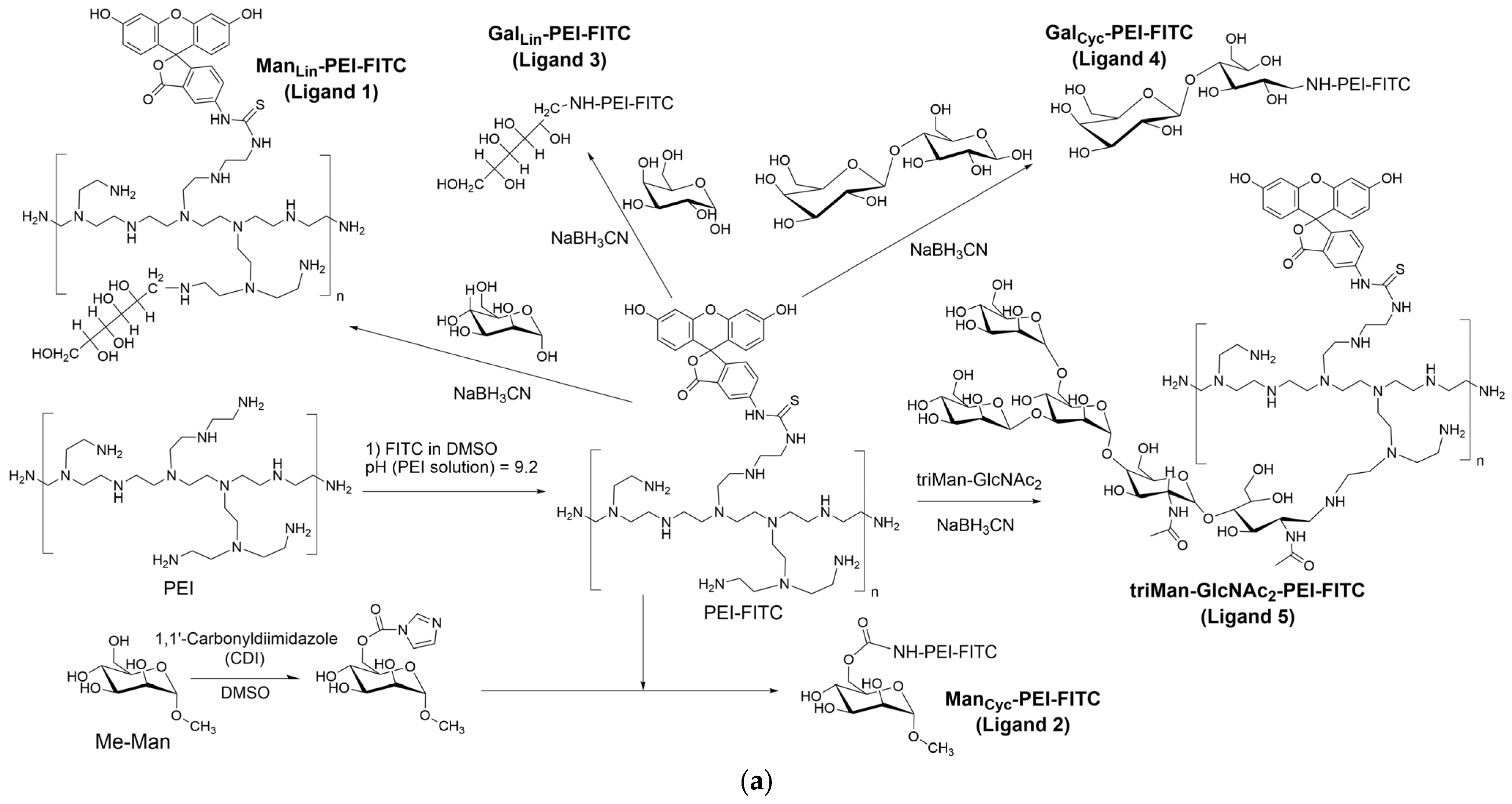
Figure 1. The scheme of synthesis of (a) a series of macrophage phenotype profiling (FITC) ligands and (b) a series of macrophage remodeling (Dox) ligands.
Immuno 06 00009 g001aImmuno 06 00009 g001b
Figure 2. FTIR spectra of the dried films from the PBS buffer solution of initial components—doxorubicin (Dox) and polyethylenimine (PEI), as well as the target conjugates L1-L5 with Dox. The region between 2750 and 1800 cm−1 has been excised, as there are no peaks of analytical significance in this range.
Immuno 06 00009 g002
Figure 3. FTIR microscopy-based analysis of glycan ligand selectivity for CD206+ macrophages (Mf) derived from BALF obtained from a patient with bronchiectasis. (a) Integrated IR signal intensity maps (I1650 × I1000) representing the combined signal from the carbohydrate moiety and the PEI backbone, for the indicated ligands: PEI-Man (L2, cyclic mannose), PEI-Gal (L3, linear galactose), and PEI-triMan (L5, GlcNAc2-trimannoside cluster). These signals reflect the binding of the ligands to BALF cells, with higher intensities indicating greater ligand-receptor engagement, particularly with CD206-expressing macrophages. For each FTIR map, an inset fluorescence image is provided showing immunostaining and ligand-associated fluorescence: CD206 is labeled in red with anti-CD206 antibodies (ab64693, Abcam; 1:100), nuclei are counterstained in blue with DAPI, and ligand-associated FITC signal is shown in green. Scale bar is 100 µm. (b) Intensity distribution histograms derived from the corresponding IR maps in (a). Peaks in the intensity maps correspond to individual BALF cells. Imaging was performed using FTIR microscopy with a 5 µm scanning step.
Immuno 06 00009 g003
Figure 4. (a) Macrophage polarization: M0, M1, and M2 subtypes overview. Adapted from works [62,63,64]. (b) A scheme for isolating macrophages from BALF, remodeling oligosaccharide-PEI-Dox (L1-L5 with Dox), and profiling them with FITC-labeled L1-L5 ligands.
Immuno 06 00009 g004
Figure 5. Binding data, expressed as a percentage in the range from 0 to 100, (a) for ligands 1–5 in the absence (L1-L5) and (b) in the presence of mannan (ML1-ML5), respectively, for macrophage cells derived from BALF obtained from a patient with bronchiectasis—before and after administration five targeted Dox drugs. Similar data on the binding of reference lines of monocytes M0, macrophages M1 and M2 are also shown. The experimental error did not exceed 10%. (c) Kernel smooth distributions of 10 binding parameters (L1-L5 and ML1-ML5) with BALF cells before and after exposure to 5 targeted Dox formulations.
Immuno 06 00009 g005aImmuno 06 00009 g005b
Figure 6. Examples of deconvolution of binding data profiles of macrophage cells derived from BALF obtained from a patient with bronchiectasis, on reference profiles of monocyte lines M0, macrophage M1, and M2: (a) Deconvolution of the profile of intact BALF; (b) Deconvolution of the BALF profile after administration of the remodeling Dox-L1 ligand. (c) Deconvolution of BALF profile after administration of the remodeling Dox-L5 ligand. (d) Example of deconvolution of binding data profiles of macrophage cells derived from BALF obtained from a healthy donor, on reference profiles of monocyte lines M0, macrophage M1, and M2.
Immuno 06 00009 g006aImmuno 06 00009 g006b
Figure 7. (a) Profiles of carbohydrate ligand binding to BALF cells. Fluorescence microscopy images demonstrating the specific binding of five different FITC-labeled carbohydrate ligands to cells isolated from the BAL of a patient with bronchiectasis. The top panel (“Without mannan”) shows the basic ligand binding. The bottom panel (“+ mannan”) demonstrates the effect of competitive inhibition by soluble mannan on ligand binding. (b) The specificity and effectiveness of targeting ligands conjugated with doxorubicin on BAL cells. Fluorescence microscopy images illustrating an experiment on sequential modification and diagnostic profiling of BAL cells in bronchiectasis. The left block (“FITC typing”, green channel) shows fluorescence from FITC-labeled diagnostic ligands. The right block (“Dox remodeling”, red channel) shows fluorescence from therapeutic ligands conjugated with doxorubicin. The first line (“Intact BALF”) serves as a control. The following lines demonstrate the specific blocking of the binding of the FITC ligand after pretreatment with the corresponding Dox conjugated ligand. The width of the micrographs is 100 microns.
Immuno 06 00009 g007
Figure 8. Confocal Laser Scanning Microscopy (CLSM) analysis of glycan ligand binding and doxorubicin delivery to alveolar macrophages from bronchiectasis patients. Representative CLSM images are presented for alveolar macrophages (Mf) derived from BALF. Cells were treated with Dox-conjugated glycan ligands: (a) L4-Dox (cyclic galactose -PEI-Dox); (b) L2-Dox (cyclic mannose -PEI-Dox); (c) L5-Dox (trimannoside-PEI-Dox). FITC-labeled ligands used for tracking: L2-FITC. Images display 4 imaging modalities: (1) FITC fluorescence (green, excitation: 488 nm, emission: 505–535 nm) indicating the distribution of the profiling glycan ligand; (2) Doxorubicin fluorescence (red, excitation: 515 nm, emission: 575–675 nm) indicating the intracellular localization of the delivered drug; (3) Brightfield microscopy for cellular morphology; and (4) A merged overlay of all channels to assess co-localization. Scale bar represents 50 µm.
Immuno 06 00009 g008
Table 1. Physico-chemical parameters of a series of macrophage phenotype profiling (FITC) ligands and a series of macrophage remodeling (Dox) ligands. PBS (0.01 M, pH 7.4). T = 37 °C.
CodeLigandMolar Ratio of ConstituentsHydrodynamic Diameter *, nmζ-Potential *, mVKdis (ConA-Ligand), M **CD206 Affinity ***CD209 Affinity ***CD301 Affinity ***
L1ManLin-PEI FITC or Dox15:1:1105 ± 10+10 ± 2(7 ± 2) × 10−4+
L2ManCyc-PEI FITC or Dox18:1:1115 ± 15(5 ± 1) × 10−6++±
L3GalLin-PEI FITC or Dox16:1:1110 ± 15(3 ± 1) × 10−3±
L4GalCyc-PEI FITC or Dox13:1:1115 ± 10(9 ± 1) × 10−5++
L5triMan-GlcNAc2-PEI FITC or Dox10:1:1130 ± 20(2.5 ± 0.3) × 10−7+++++
* measured by DLS; ** ConA—a model for CD206 receptor; *** CD209 (DC-SIGN) and CD301 (MGL) affinities represent in silico neural-network-based binding predictions using Pafnucy neural network. Predicted pKd values were binned as: +++ (High, pKd~7), ++ (Medium, pKd~6), + (Low, pKd~4–5), ± (Very low, pKd ~ 3), –(None).
Table 2. Ligand binding data for alveolar macrophages derived from BALF of a healthy donor and a bronchiectasis patient (Intact vs. post-Dox formulations), compared to standard phenotypes (M0, M1, M2a). Values are expressed as Mean ± SD (n = 3). Statistical analysis performed using Student’s t-test comparing each treatment group vs. the corresponding Intact BALF value in the same row. Significance levels: * p < 0.05; ** p < 0.01; *** p < 0.001.
Ligand/ConditionIntact BALF (Patient)BALF after Dox-L1BALF after Dox-L2BALF after Dox-L3BALF after Dox-L4BALF After Dox-L5Healthy BALFM0M1M2a
FITC-L19 ± 112 ± 1 **12 ± 1 **9 ± 110 ± 13 ± 1 ***9 ± 19 ± 111 ± 14 ± 1
FITC-L225 ± 221 ± 2 *30 ± 3 *27 ± 221 ± 2 *18 ± 2 **5 ± 19 ± 110 ± 120 ± 2
FITC-L38 ± 119 ± 2 ***27 ± 2 ***20 ± 2 ***18 ± 1 ***14 ± 1 ***1 ± 0.55 ± 12 ± 0.513 ± 1
FITC-L47 ± 110 ± 1 *10 ± 1 *5 ± 1 *4 ± 1 **3 ± 1 ***5 ± 111 ± 114 ± 23 ± 1
FITC-L526 ± 228 ± 227 ± 224 ± 219 ± 2 **1 ± 0.5 ***2 ± 0.58 ± 112 ± 11 ± 0.5
FITC-ML19 ± 19 ± 14 ± 1 **3 ± 1 ***3 ± 1 ***1 ± 0.5 ***2 ± 0.58 ± 15 ± 117 ± 2
FITC-ML221 ± 218 ± 226 ± 2 *18 ± 1 *17 ± 1 *14 ± 1 **3 ± 16 ± 18 ± 120 ± 2
FITC-ML35 ± 116 ± 1 ***25 ± 2 ***13 ± 1 ***16 ± 1 ***12 ± 1 ***6 ± 18 ± 11 ± 0.515 ± 2
FITC-ML46 ± 18 ± 1 *6 ± 18 ± 1 *5 ± 12 ± 0.5 **2 ± 0.510 ± 112 ± 119 ± 2
FITC-ML517 ± 123 ± 2 **28 ± 2 ***23 ± 2 **17 ± 210 ± 1 ***4 ± 16 ± 110 ± 117 ± 2
Table 3. Deconvolution of macrophage subsets (M0, M1, M2a, M2b-c-d) across Intact (Baseline) and Dox-conjugate treated groups. Values are presented as mean relative contribution (%) ± Standard Deviation (SD). Asterisks indicate statistical significance compared to the Intact Baseline for each subset (*p < 0.05, ** p < 0.01, *** p < 0.001).
Relative Contribution, %Deconvolution Based on L1-L5 DataDeconvolution Based on ML1-ML5 DataDeconvolution Based on Both L1-L5 and ML1-ML5 Data
BALF Cells/ReferenceM0M1M2aM2b-c-dM0M1M2aM2b-c-dM0M1M2aM2b-c-d
Intact<150 ± 527 ± 323 ± 3<135 ± 443 ± 522 ± 3<155 ± 518 ± 327 ± 4
Dox-L131 ± 4 ***24 ± 4 ***22 ± 323 ± 3<1<1 ***82 ± 6 ***18 ± 329 ± 4 ***28 ± 4 ***17 ± 326 ± 3
Dox-L241 ± 5 ***6 ± 2 ***37 ± 4 *16 ± 3 *<1<1 ***60 ± 5 ***40 ± 4 ***23 ± 3 ***16 ± 3 ***24 ± 3 *36 ± 4 *
Dox-L3<134 ± 4 *46 ± 5 ***20 ± 3<130 ± 441 ± 429 ± 3<139 ± 5 **27 ± 3 *34 ± 4 *
Dox-L420 ± 3 ***20 ± 3 ***42 ± 4 ***19 ± 3<1<1 ***67 ± 5 ***33 ± 4 *24 ± 3 ***15 ± 3 ***24 ± 3 *36 ± 4 *
Dox-L5 (Lead)<1<1 ***99 ± 1 ***<1 ***<1<1 ***50 ± 550 ± 5 ***25 ± 3 ***16 ± 3 ***25 ± 3 *35 ± 4 *
Healthy Control77 ± 6 ***<1 ***<1 ***23 ± 318 ± 3 ***<1 ***15 ± 3 ***28 ± 363 ± 6 ***<1 ***<1 ***28 ± 4
Table 4. Immunomodulatory effects of free Doxorubicin on human ex vivo BALF macrophage subpopulations across specific clinical diagnoses. Data for individual samples (BALF1-3) are presented as Mean ± SD (n = 3). Statistical significance indicates difference from the respective Intact baseline: * p < 0.05, ** p < 0.01, *** p < 0.001.
Diagnosis/SampleConditionM0 (%)
(Undiff.)
M1 (%)
(Pro-Inflam.)
M2a (%)
(Wound Healing)
M2b/c/d (%)
(Regulatory)
BALF1
(Bronchiectasis, J47)
Intact<155 ± 418 ± 327 ± 3
+Dox<140 ± 4 **29 ± 4 **31 ± 4
BALF2
(Immunodeficiency, complicated by bronchiectasis, chronic bronchitis)
Intact<129 ± 332 ± 339 ± 4
+Dox<118 ± 2 **43 ± 4 **39 ± 4
BALF3
(Obliterative bronchiolitis, J84.8)
Intact17 ± 320 ± 38 ± 255 ± 5
+Dox25 ± 3 *34 ± 4 **12 ± 229 ± 4 ***
Averaged
(Pooled Cohort)
Intact6 ± 1035 ± 1819 ± 1240 ± 14
+Dox8 ± 1431 ± 1128 ± 1633 ± 5
Healthy ControlIntact63<1<128
Table 5. Summary of phenotypic remodeling and proposed mechanisms of Dox-ligand conjugates on BALF macrophages. Data obtained from n = 3 replicates per condition (coefficient of variation ≤10%). Statistical analysis by two-tailed Student’s t-test (p and Cohen’s d reported in Results).
Ligand CodeLigand StructurePhenotypic Profile, %Proposed Primary Target Mechanism
M0M1M2aM2b-c-d
Intact BALF0551827-Bronchiectasis is characterized by chronic bronchial inflammation
Free Dox-0402931DNAFor AMs, remodeling in M2.
Dox-L1ManLin-PEI-Dox28172627Mannose receptors (MRs, CD206, CD209)Moderate affinity of linear mannose for MRs drives uptake and signaling, leading to partial M1 suppression
Dox-L2ManCyc-PEI-Dox16243626Cyclic conformation likely increases binding affinity to MR’s carbohydrate-recognition domain (CRD) vs. linear L1
Dox-L3GalLin-PEI-Dox39273436Macrophage galactose lectin (MGL, CD301)Ineffective remodeling. Suggests MGL is a poor target for repolarization or is lowly expressed in this patient’s M1 cells
Dox-L4GalCyc-PEI-Dox15243634CD301 and CD206Potent, MR-mediated effect. The cyclic galactose likely mimics mannose, demonstrating structural cross-reactivity
Dox-L5triMan-GlcNAc2-PEI-Dox16253536CD206, CD209 and CD301High-affinity multivalent binding. The tri-antennary mannose structure is a classic high-affinity MR ligand, driving potent internalization and signaling
Table 6. Summary of Immunomodulatory Outcomes Demonstrating the Superiority of Targeted Glycan-Mediated Delivery for Macrophage Phenotype Remodeling.
FeatureFree DoxorubicinTargeted Dox-Ligand Conjugates
M1 SuppressionModest reduction in pro-inflammatory M1 cellsSignificant suppression of pathogenic M1 cells
M2 PolarizationModerate shift towards the M2 phenotypeStrong promotion of the pro-resolving M2a phenotype
M0 InductionNo induction of quiescent M0 cellsSuccessful induction of an M0-like population, indicating a return to homeostasis
Overall EfficacyLimited therapeutic remodelingSuperior and more complete immunomodulatory effect
Disclaimer/Publisher’s Note: The statements, opinions and data contained in all publications are solely those of the individual author(s) and contributor(s) and not of MDPI and/or the editor(s). MDPI and/or the editor(s) disclaim responsibility for any injury to people or property resulting from any ideas, methods, instructions or products referred to in the content.