1. Introduction
Postpartum depression and anxiety (PPD/A) are a major health crisis for parents and families. For example, a study found that in a sample of 613 birthing parents, 23% indicated experiencing anxiety symptoms while 25% indicated experiencing depression symptoms [
1]. Additionally, this study indicated that postpartum individuals with anxiety were 26 times more likely to indicate depression symptomatology [
1]. These statistics likely only capture a portion of cases of PPD/A for multiple reasons. In addition to infrequent screening practices, PPD/A is not defined as a distinct mood disorder. While there is no section in the
Diagnostic and Statistical Manual of Mental Disorders for postpartum depression specifically, the diagnostic criteria for postpartum depression are equivalent to those of major depressive disorder, with the addition of a peripartum onset specifier [
2]. There is no section in the
Diagnostic and Statistical Manual of Mental Disorders for postpartum anxiety, nor is there a specifier for peripartum onset, and thus postpartum anxiety is regarded as a variation in generalized anxiety disorder [
2].
Symptoms associated with PPD can be detrimental. A cross-sectional study published in 2025 found that roughly 22% of women who participated in midwife conducted PPD screening indicated thoughts of self-harm [
3]. Alongside intense symptoms, individuals with PPD also experience intense stigma. An experiment conducted in 2024 found that when presented with vignettes of a new mother, participants were highly judgmental of the vignettes that described postpartum disorders [
4]. Thus, when women experience PPD, many struggle to disclose their true emotions, fearing judgment from healthcare providers, as shown through interview data [
5]. The conjunction of both overwhelming emotional distress and a perceived lack of support leads to challenges in recovery from PPD/A for many women.
Understanding the prevalence of PPD/A in women is often considered key for supporting the health and development of infants during the postnatal period. Maternal PPD is associated with delays in language development, social skills, fine motor skills, and gross motor skills in infants up to two years old, as shown by a nationwide cohort study [
6]. Additionally, according to a cohort study of over 700 mother-child dyads, the incidence of long-term maternal PPD is associated with internalizing problems in children at age six [
7]. The incidence of maternal PPD/A does not just concern the mother herself—it has direct implications for the well-being of her child. Infant development should not be treated as something that occurs separately from the mother, as infant development and the health of the mother during the postpartum period are two joint circumstances.
Thus, it is logical to explore how the prevalence of PPD/A is related to strains in other familial relationships, such as the dynamic between birthing and non-birthing parents during the perinatal period. A cohort study of 151 pregnant women demonstrated a negative association between relationship satisfaction and incidence of PPD [
8].
There is, however, a gap in knowledge surrounding how PPD/A pertains to non-birthing caregivers. Much of the research exploring the implications of PPD/A is centered on the mother. While research on maternal PPD/A is more robust, rates of paternal PPD remain substantial. A cross-sectional study on early paternity in 2022 found that 21% of participants experienced temporary anxiety symptoms, 26% experienced long-term anxiety symptoms, and 13% experienced depressive symptoms [
9]. Separately, a mixed-methods study of over 500 men found that maternal PPD, marital strife, sleep deprivation, and stress about adhering to gender roles were associated with the incidence of paternal PPD [
10]. Male expression of depressive symptoms may influence the degree to which paternal PPD is recognized.
When exploring the associations between one family member’s PPD/A diagnosis and the overall well-being of other family members, it is crucial for postpartum researchers to keep in mind the association between maternal and paternal PPD/A. The co-occurrence of these diagnoses within one household is likely to create difficulties when partners rely on each other as their main source of emotional support during the postpartum period.
One theoretical framework through which correlated cases of maternal and paternal postpartum depression may be explored is that of Bowen’s Family Systems Theory. Clinically, Bowen’s Family Systems Theory refers to the idea that the emotional lives of each individual are highly connected to that of their family members [
11]. A change that occurs in one member of the family inevitably results in changes in another family member [
11], such that one member’s emotional well-being can impact the emotional well-being of their entire family. Even if mothers do not initially experience PPD/A, Bowen’s Family Systems Theory suggests that undiagnosed and untreated cases of paternal PPD/A could potentially lead to more cases of maternal PPD/A. Though emotionality and clinical diagnosis are distinct concepts, we argue that an individual’s emotionality may influence their partner’s experiences with mood disorders, given that personal affect may restrict the degree to which an individual can be a source of support for their partner.
Working within Bowen’s model of the Family Systems Theory, treating the members of a family unit as entwined emotional entities, this study aims to explore how the occurrence of PPD/A in one partner may be predictive of the occurrence of PPD/A in the other partner. Additionally, this study seeks to determine if the co-occurrence of maternal and paternal PPD/A has a relationship with the perceived level of support respondents report in their partnership. It was hypothesized that participants would be more likely to experience PPD/A if their partner experiences PPD/A. It was also hypothesized that co-occurring experiences of PPD/A in parenting partners minimizes the mitigating effects of partner support during the onset of PPD/A.
2. Materials and Methods
2.1. Participants
In the summer of 2024, a Google Forms survey assessing personal experiences with PPD/A was distributed online. The survey was open to birthing and non-birthing caregivers of children aged 5 years or younger. More than 1000 individuals opened the survey link and were able to review the study information and eligibility criteria. A total of 907 respondents provided at least some survey data. Because of the sensitive nature of the survey content, partial responses were retained and included in analyses where data were available.
2.2. Measures
The Edinburgh Postnatal Depression Scale (EPDS) (Cronbach’s α > 0.84) [
12] was used to measure PPD/A among participants. A shortened version of the EPDS was included in the survey. The six-item shortened EPDS demonstrated acceptable internal consistency in this sample (Cronbach’s α = 0.75). For this study, PPD and PPA were assessed jointly, considering that both disorders are measured by the EPDS.
Participants reported how frequently they could relate to six statements on a 4-point Likert scale: “I was able to laugh and see the funny side of things,” “I blamed myself unnecessarily when things went wrong,” “I was anxious or worried for no good reason,” “I felt overwhelmed with rage for no good reason,” “I felt scared or panicky for no good reason,” and “I felt sad or miserable.” These items were included in the shortened version of the EPDS since they were most relevant to our line of inquiry. Postpartum depression (PPD) and anxiety (PPA) subscales were created from the version of the EPDS administered. In the PPD subscale, items such as “I felt sad or miserable,” were included to match depressive affect, and in the PPA subscale, items such as “I felt scared or panicky for no good reason,” were included to reflect anxiety-related symptoms. Questions about traumatic birth experiences were also included in this survey.
2.3. Procedures
Institutional Review Board approval was granted by New York University. Additionally, all research was conducted in accordance with the Declaration of Helsinki.
A Google Forms survey containing several components was administered to each participant. On the full EPDS, a score of 13/30 (43%) is a specific cutoff for the indication of PPD [
13]. For the shortened version of the EPDS administered in this survey, a score of 8 (approximately 43% of 18 possible total points) was used as an indicator of the incidence of PPD. From here, four quartiles of scores were created for the EPDS, EPDS PPD subscale, and EPDS PPA subscale: far below the cutoff (0–27%), slightly below the cutoff (33–38%), slightly above the cutoff (44–50%), and far above the cutoff (55–100%).
In addition to the shortened version of the EPDS, the survey included several multiple choice and open-ended questions about the postpartum experience. The overall incidence of PPD/A, PPD, and PPA symptoms in both the participant and their partner was investigated; for precision, instances of PPA, PPD, and combined PPD/A are reported in
Section 3.
2.4. Statistical Methods
Bivariate correlations were conducted to examine the relationship between the occurrence of mood disorders in a participant and the occurrence of mood disorders in their partner. Two-tailed tests of significance were conducted to determine the statistical significance of this relationship. Additionally, the prevalence of medical screening for PPD/A was examined for both the participant and the partner. This method relies on the respondent’s report of the partner’s experience with screening, symptoms, and diagnoses, rather than self-reports from partners.
Cross-tabulations were used to determine how many of each response option from the survey fell into each EPDS score quartile. Logistic regressions were conducted to determine the statistical significance of the relationships between variables explored in cross-tabulations, controlling for income and relationship status. Brant’s tests were used to test the proportional odds assumption.
Multinomial regressions were used to determine where participants were likely to fall in the EPDS quartiles based on whether they listed their partner as their main source of support and if they indicated that their partner had PPD/A. The interaction between these three variables was included in the multinomial regression to holistically examine the relationship. A t-test was used to determine the statistical significance of this interaction.
2.5. Qualitative Data Analysis
Additionally, seventeen (
n = 17) semi-structured interviews were conducted with participants who indicated their desire to participate through an item on the survey. The purpose of the interviews was framed as an opportunity for participants to provide more detailed descriptions of the challenges they experienced during the postpartum period. Interviews were conducted via an audio-recorded video conference with the lead author and lasted approximately 30 min each. After all interviews were conducted, each was individually transcribed and then reviewed for accuracy by the research team. Transcripts of the interviews were then coded through a two-phase process. First, emergent codes were created from recurring themes. These codes were refined after discussions with the interviewer and other co-authors; all codes reached established thresholds for inter-rater reliability (κ = 0.85). In the second phase, the authors identified content-rich quotations that best represented themes. Please see
Table 1 for the coding scheme and exemplar quotes.
Quantitative and qualitative findings were triangulated through narrative integration, allowing for elaboration and extension of quantitative patterns with participants’ lived experiences.
3. Results
3.1. Demographic Information of Participants
Among the participants, 90.3% identified as white, 2.2% identified as Hispanic, 1.8% identified as Asian/Pacific Islander, 0.1% identified as Black/African American, 4.7% identified as multiple racial-ethnic identities or other, and 0.99% did not record their race. Additionally, 99.1% of participants identified as female, 0.3% as male and 0.6% did not record their gender.
In terms of income, 2.8% of participants reported an annual income of
$0–
$30,000, 4.6% reported an annual income of
$31,000–
$60,000, 12.6% reported an annual income of
$61,000–
$90,000, 17.8% reported an annual income of
$91,000–
$120,000, 58.9% reported an annual income of
$120,000+ and 3.4% chose not to report their income. 91.2% of the participants were married, 6.5% were cohabiting with their partner (not married), 0.2% were partnered and not cohabiting, 0.8% were separated/divorced, 0.9% were single parents, 0.1% were widowed, and 0.3% did not record their relationship status. 98.9% of participants were the birthing parent, 0.4% were partners of the birthing parent, 0.2% had children via adoption, 0.1% had children via surrogacy, and 0.3% did not report their parental status. See
Table 2 for a display of participant demographic information.
3.2. Overall Incidence of PPD/A
78.5% (
n = 713) of participants indicated that they had experienced at least one mood disorder postpartum. 35.6% (
n = 323) of participants indicated that their partner had experienced at least one mood disorder postpartum. 53.2% (
n = 483) of participants indicated that they experienced postpartum depression. 24% (
n = 218) of participants indicated that their partner experienced postpartum depression. 69.2% (
n = 628) of participants indicated that they experienced postpartum anxiety. 25.9% (
n = 235) indicated that their partners experienced postpartum anxiety (see
Table 3). This suggests that challenges are not only common among birthing individuals but also impact a substantial proportion of their partners.
Qualitative data reinforced this quantitative pattern, particularly in revealing gaps in awareness. 23.5% (n = 4/17) of participants indicated that they initially were unaware that fathers could experience postpartum mood disorders. For example, one participant indicated that “[It] would have made such a big difference for us…having it be public knowledge that dads can be impacted by postpartum depression and anxiety, too. I know toxic masculinity, the former, has run its course and people roll their eyes at it now, but I think that’s definitely a part of it as well.”
3.3. Prevalence of Screening
66.4% (
n = 602) of participants reported having been screened for PPD/A. 24% (
n = 218) of participants reported having been screened for PPD/A once while 42.3% (
n = 384) reported having been screened for PPD/A multiple times. Only 1.8% (
n = 16) of participants indicated that their partner was screened for PPD/A, with 1.2% (
n = 11) indicating that the screening occurred once and 0.6% (
n = 5) indicating that the screening occurred more than once (see
Table 4). These findings highlight the degree to which parents, particularly non-birthing parents, are routinely neglected in terms of screening for PPD/A.
Qualitative data further emphasized the exclusion of non-birthing parents in screening. 47.1% (n = 8/17) of participants indicated that non-birthing parents were neglected in the process of identifying PPD/A diagnoses. As one participant directly stated, “there’s really no support offered to the other spouse as well in terms of therapy or checkups from their primary care doctor. Nobody really is checking in with them.” While recalling her husband’s experience with PPD, another participant exclaimed, “nobody told [her husband] that there are chemical changes that happen in dads’ brains when they become fathers. Nobody told him there are physiological changes that happen to him. Nobody talked about what his health would do or how it would change once I gave birth.” Finally, a third participant disclosed her disappointment that, despite having experienced PPD/A herself, her husband’s potential for experiencing PPD/A was never acknowledged. She shared, “I clearly was struggling with postpartum depression and anxiety with both of my pregnancies. It was never even brought up that it was a possibility that my husband could be as well…There’s really no talk on how the non-birthing partner probably goes through something very similar as their spouse.”
3.4. Correlations Between Instances of PPD/A Among Partners
There was evidence of a positive association between the incidence of at least one postpartum mood disorder in the participant and at least one postpartum mood disorder in the participant’s partner,
r (905) = 0.105,
p = 0.002. This correlation, although statistically significant, is weak, suggesting a minimal association. There was a positive association between the incidence of PPD in the participant and the incidence of PPD in their partner,
r (905) = 0.163,
p < 0.001. There was also a slight association between the incidence of PPA in the participant and the incidence of PPA in their partner,
r (905) = 0.136,
p < 0.001. See
Table 5 for a display of these correlations.
One interviewee reported how the incidence of postpartum anxiety in both her and her husband strained her marriage. She claimed: “I remember asking my husband ‘Things are really bad right now. What do you think is the most challenging aspect of our marriage right now?’ Because I knew it was our communication, and I knew it was both of us struggling and not really doing anything about it. But he took it as, ‘Oh, I think it’s your anxiety.’ ‘Yes. Well, I’m sure my anxiety is playing into this, but I believe yours is, too.’”
3.5. Partner Support Used by Participants, Partner Support Desired by Participants, and Difficulty of Disclosing Feelings with Partner
A substantial proportion of participants reported relying primarily on their partner for emotional support during the postpartum period. Overall, 75.0% (n = 681) indicated that their partner was their biggest source of support. Ordinal logistic regressions identified that partner support was associated with a reduction in EPDS scores (OR: 0.54, CI [0.39–0.73], p < 0.001). Participants with partner support were less likely to score in the higher EPDS quartiles than participants without partner support (Brant test p = 0.79).
For fathers, partner support may be a primary source of emotional support during the postpartum period due to a lack of parenting resources tailored specifically to men. One participant stated that “Books are mostly written for women…it just didn’t even feel like a space he would engage in because none of it was for him.”
27.1% (n = 246) of participants indicated a desire for increased support from a partner. Ordinal logistic regressions found an association between participant desire for increased partner support and higher placement in EPDS score quartiles (OR = 2.75, CI [2.02–3.77], p < 0.001). These findings indicate an association between elevated PPD/A symptom severity and participants’ desire for greater partner support (Brant test p = 0.25).
Please see
Table 6 for a display of logistic regressions.
One interviewee mentioned that she desired more support from her partner but felt that the lack of paid paternity leave created a barrier. She stated that “I really wished that I had my husband there as well so that we could tag team the care of the twins because that part was hard…I feel like having more paternity leave would have been really nice.”
Difficulty communicating about emotional struggles may serve as both a consequence and a contributing factor to PPD/A symptoms.
Qualitative data revealed insight into these struggles. A participant mentioned that generally, it can be difficult to discuss feelings of depression and anxiety during the postpartum period because of deep feelings of shame. She mentioned, “You internalize those things, and you feel so bad and so guilty when everyone’s like, it’s the most beautiful thing in the world. But it feels like it’s the worst thing in the world.”
3.6. Interactions Between Partner as Biggest Source of Support, Participants’ Self-Report of PPD/A Incidence in Partner, and EPDS Scores
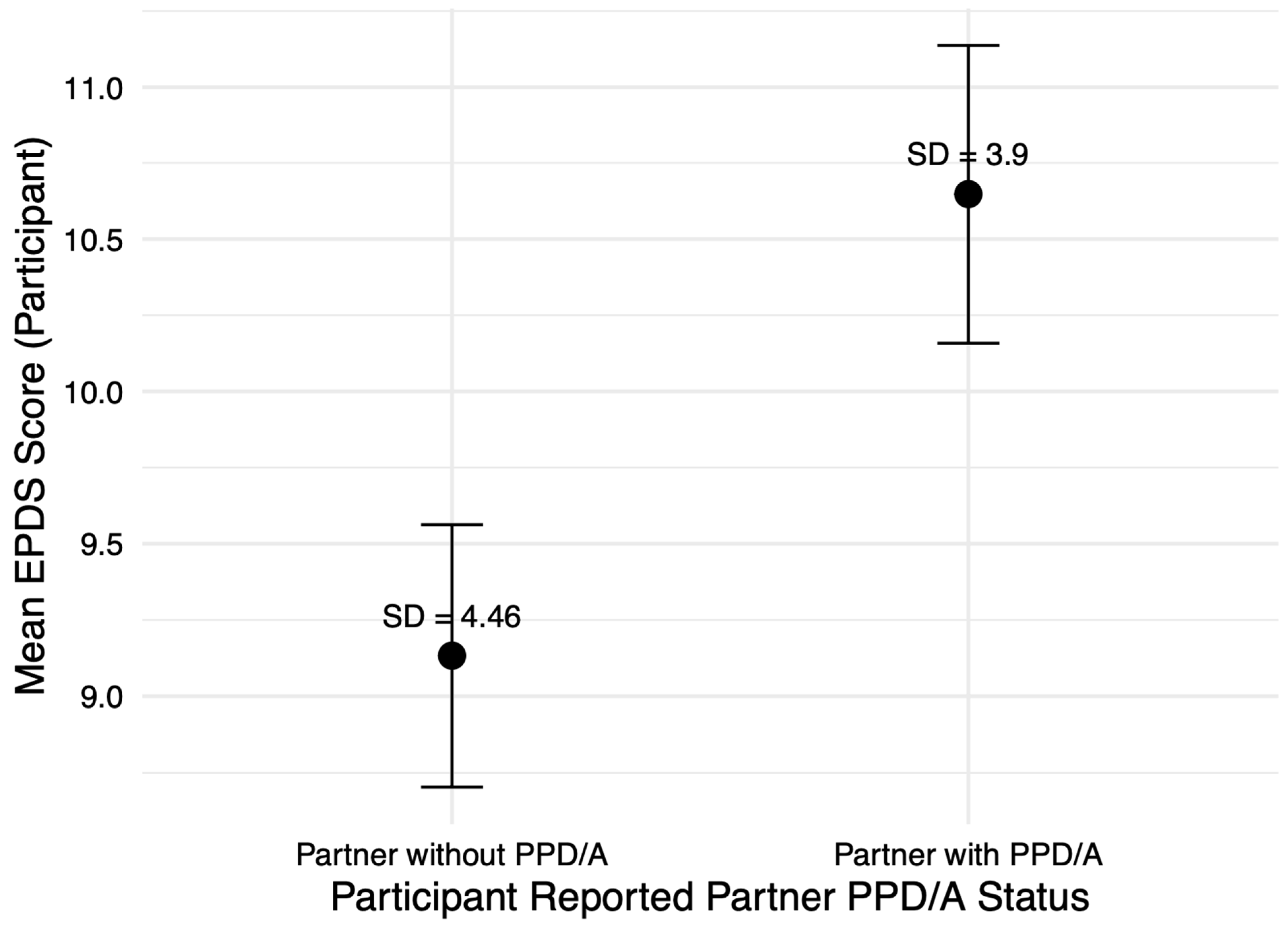
Among those who had listed their partner as a main source of support, those who reported that their partner did not experience PPD/A had lower EPDS scores on average (M = 9.13, SD = 4.46, CI [8.70–9.56]), while those who reported that their partner did experience PPD/A scored higher on average (M = 10.6, SD = 3.90, CI [10.2–11.1]) (see
Figure 1). This difference was statistically significant (
t (564.32) = −4.56,
p < 0.001). Co-occurring experiences of PPD/A may limit a partner’s capacity to provide consistent or emotionally attuned support, which may exacerbate symptoms for both caregivers.
Interviews provide further support for this pattern. As one participant explained, “if it was more acknowledged that all of this happened to both partners and that it’s a really hard time, then maybe more people would get through it together than do.” Another participant remarked that, “of all of the pre-baby preparation, you read all this stuff about preparing for the baby, but what you really need to be doing is preparing your mental state and your communication with your partner.”
4. Discussion
According to Bowen’s Family Systems Theory, individual psychological functioning cannot be separated from the emotional field of the family unit, such that distress experienced by one member can reverberate across the system [
11]. Consistent with this framework, participants in the present study described relational disconnection, guilt, and communication breakdowns in the context of postpartum mental health struggles, particularly when both partners were experiencing distress. Qualitative accounts highlighted how partners often lacked the language, resources, or institutional support needed to recognize or address one another’s emotional challenges. Feelings of shame and emotional suppression, especially among male partners, were frequently cited as barriers to help-seeking, aligning with the results of a recent meta-analysis on traditional masculinity norms [
14]. Notably, participants with PPD appeared to benefit from partner support only when their partner was not also experiencing PPD, suggesting that emotional interdependence may become a liability rather than a protective factor when both partners are distressed.
This invisibility of non-birthing partners is a structural issue rooted in narrow definitions of caregiving and in a clinical paradigm that treats postpartum mental health as an individual issue rather than as a shared, systemic challenge. Despite growing recognition of paternal and partner mental health as critical for family well-being, non-birthing parents remain neglected in both research and practice. Previous research indicates that a substantial percentage of fathers experience PPD and PPA [
9]. Yet routine screening practices focus almost exclusively on birthing individuals, and mental health resources rarely target fathers [
15]. The present study expands this literature by demonstrating a weak significant correlation between participant-reported PPD/A and perceived PPD/A in partners. Based on the given results, it is possible that when both parents experience PPD/A symptoms, the protective buffer of partner support appears weakened. This may in turn result in higher depressive and anxiety symptom scores for the birthing parent.
Our findings suggest that perinatal screening protocols may be expanded to include non-birthing caregivers, regardless of gender or biological relation. Though a meta-analysis concluded that the EPDS adequately assesses paternal PPD [
16], there is a dearth of research regarding postpartum screening for other non-birthing caregivers. Instruments such as the EPDS and its subscales may also be adapted for use with such populations. The lack of inclusivity in current screening practices is suggested by the finding that 98.2% of partners in this study were reported as never having been screened, though this phenomenon required further testing and analysis. Thus, beyond screening, the findings suggest a possible need for family-centered approaches that address dyadic communication, emotional reciprocity, and shared parenting stress. Programs [
17] offer promising initial models for improving partner support and reducing conflict during the postpartum transition and should be extended.
Future studies should directly engage non-birthing caregivers, including fathers, nonbinary partners, and adoptive or surrogate parents. Mixed-methods studies that incorporate both partners’ perspectives would offer richer insight into the relational dynamics of postpartum mental health.
Several limitations should be noted. The sample lacked racial and gender diversity, with 90% of participants identifying as white and 99% as female, resulting in a participant group that is highly homogeneous. Due to the online format of this study, there may have been a substantial uptick in positive responses, in that those who have salient experiences with PPD/A are increasingly likely to respond. Further, the majority of participants in this sample reported incomes that exceed $120,000, indicating significant financial stability. Thus, these individuals’ postpartum experiences of stress and perinatal care may not be representative of that of a more economically diverse population. Additionally, the reliance on self-report data and the self-selection of participants for qualitative interviews may introduce bias. It is possible that those experiencing higher levels of distress or stronger interest in PPD/A were more likely to participate, which could overrepresent certain experiences or themes. Considering information about a participant’s partner came from the participant’s perception of their postpartum experience, there is a potential for bias in interpreting the co-occurrence of perinatal mood disorders. Participants may have projected their own emotional experience, or have experienced recall bias, when discussing the diagnoses received by their partner. Lastly, the observed associations are relatively weak. These findings require replication to determine the presence of substantial trends in postpartum mood and anxiety disorders.
Finally, these findings highlight a possible need for a systemic response to postpartum mental health that extends beyond screening alone. Although maternal perinatal mental health screening is a routine element of gynecological care, detection without adequate structural support potentially risks placing responsibility for recovery on families already experiencing significant strain. Policy and funding frameworks should recognize family mental health as a public health priority, supported through integrated perinatal mental health services and broader policies that reduce caregiving stress during the postpartum period, such as paid parental leave [
18]. It is possible that without sustained systemic investment, families may continue to absorb the costs of inadequate support, often at the expense of parental well-being, relationship stability, and child development.
Overall, this study identifies a slight association of PPD/A occurrences between partners, in tandem with a potential reduction in support perceived when partners experience perinatal mental health diagnoses. These findings suggest that PPD/A may be a relational, not just an individual, phenomenon. Through the lens of Bowen’s Family Systems Theory, we see that co-occurring PPD/A symptoms among couples are perhaps part of a broader pattern of interdependent emotional distress not limited to birthing caregivers. Addressing this challenge will possibly require structural shifts in how screening, intervention, and support are designed, resourced, and delivered for the full ecology of family caregiving.