
Systematic Review

Comparative Efficacy of rTMS and Psychosurgery in Severe OCD: A Systematic Review and Meta-Analysis of Responder Rates

by
Andrés Vega-Rosas
1,*,
Naomi G. Santos-Jacinto
2,
Sergio Martinez-del Angel
2 and
Andrea Granados-Juárez
3
1
Pain Management Center, Hospital Angeles Mocel, Mexico City 11850, Mexico
2
National School of Medicine and Homeopathy, National Polytechnic Institute, Mexico City 07320, Mexico
3
Faculty of Medicine, National Autonomous University of Mexico, Mexico City 04360, Mexico
*
Author to whom correspondence should be addressed.
Psychiatry Int. 2026, 7(3), 96; https://doi.org/10.3390/psychiatryint7030096
Submission received: 24 November 2025 / Revised: 24 April 2026 / Accepted: 27 April 2026 / Published: 3 May 2026

Abstract

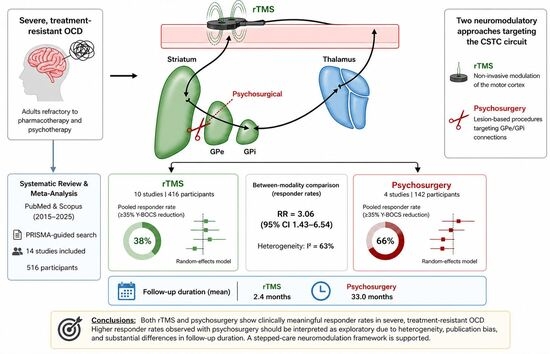
Background: Severe, treatment-resistant Obsessive–Compulsive Disorder (OCD) remains a major clinical challenge. When conventional pharmacological and psychotherapeutic strategies fail, neuromodulatory interventions such as repetitive transcranial magnetic stimulation (rTMS) and psychosurgical approaches are increasingly considered. Although both modalities target nodes within the cortico-striato-thalamo-cortical (CSTC) circuit, their relative effectiveness has not been examined within a unified analytical framework. Objective: We aimed to compare responder rates between rTMS and psychosurgical interventions in adults with treatment-resistant OCD through a systematic review and meta-analysis. Methods: A PRISMA-guided search of PubMed and Scopus (2015–2025) identified clinical studies reporting treatment response. Pooled responder rates were estimated separately for each modality using random-effects models. Between-study heterogeneity and publication bias were systematically assessed. Results: Fourteen studies met inclusion criteria, including 10 rTMS studies (416 participants) and four lesion-based psychosurgical studies (142 participants). Both modalities demonstrated clinically meaningful responder rates. Pooled analyses suggested higher responder proportions in psychosurgical cohorts (RR = 3.06, 95% CI 1.43–6.54); however, this finding was accompanied by substantial heterogeneity (I2 = 63%) and signals of publication bias. Follow-up duration differed markedly between modalities (mean 2.4 months for rTMS vs. 33.0 months for psychosurgery), reflecting fundamentally different study designs and outcome assessment timepoints. Conclusions: Differences in pooled responder rates should be interpreted as exploratory rather than as evidence of comparative efficacy. The lack of a shared comparator, differences in patient selection, and large discrepancies in follow-up limit direct comparisons between modalities. These findings support a stepped-care framework for neuromodulation in treatment-resistant OCD and highlight the need for methodologically harmonized studies to better define the role of each intervention across distinct clinical profiles of treatment resistance.

Graphical Abstract

1. Introduction

Obsessive–Compulsive Disorder (OCD) is a neuropsychiatric condition that, in its severe and treatment-resistant forms, poses a major clinical challenge, particularly when accompanied by psychiatric comorbidities [1]. Although its core features include intrusive obsessions and compulsive behaviors, its phenotypic expression varies widely according to age of onset, sensory phenomena, level of insight, depressive comorbidity, clinical course, and treatment response [2,3]. Numerous neurobiological alterations have been implicated in the pathophysiology of OCD. Among these, disruptions in functional connectivity appear particularly relevant for understanding clinical heterogeneity and predicting treatment response. For instance, reduced cortical thickness in temporal, parietal, and insular regions has been associated with profiles where obsessive beliefs predominate over non-planning impulsivity [4,5]. Moreover, patients who respond to cognitive–behavioral therapy exhibit decreased resting-state functional connectivity between amygdalar subregions and the visual association cortices, alongside increased connectivity with the right inferior parietal lobe [6]. In the absence of robust biological biomarkers, treatment response in OCD is typically defined using clinical scales, most commonly as a ≥35% reduction in the total Yale–Brown Obsessive–Compulsive Scale (Y-BOCS) score relative to baseline [7]. Clinically, treatment resistance is typically characterized by an inadequate response to at least two adequate trials of serotonin reuptake inhibitors and cognitive–behavioral therapy. However, this operational definition encompasses a heterogeneous group of patients with markedly diverse symptom profiles, illness severity, comorbidities, and trajectories, underscoring the clinical complexity of treatment-resistant OCD and the limitations inherent to purely scale-based outcome definitions.
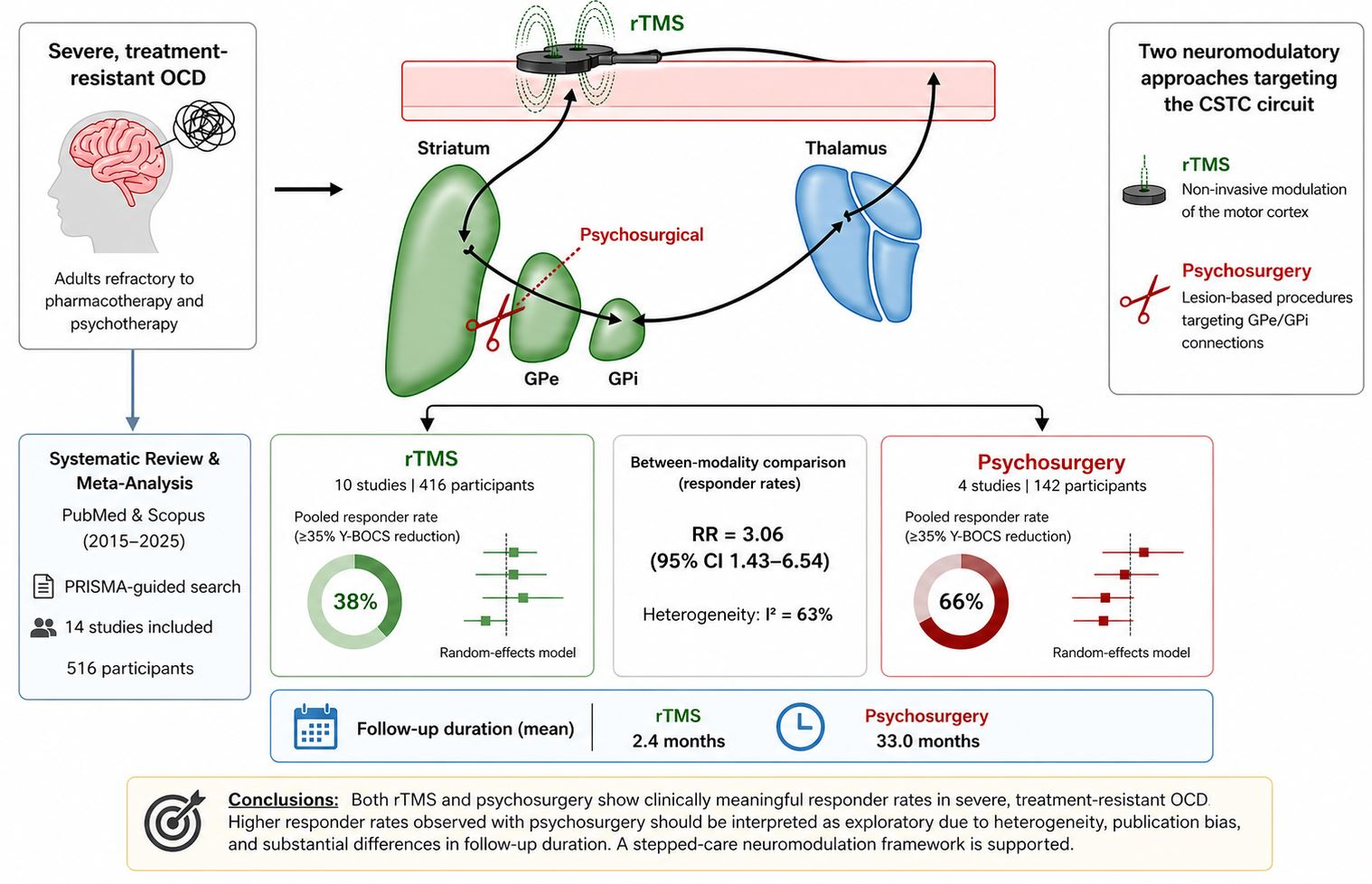
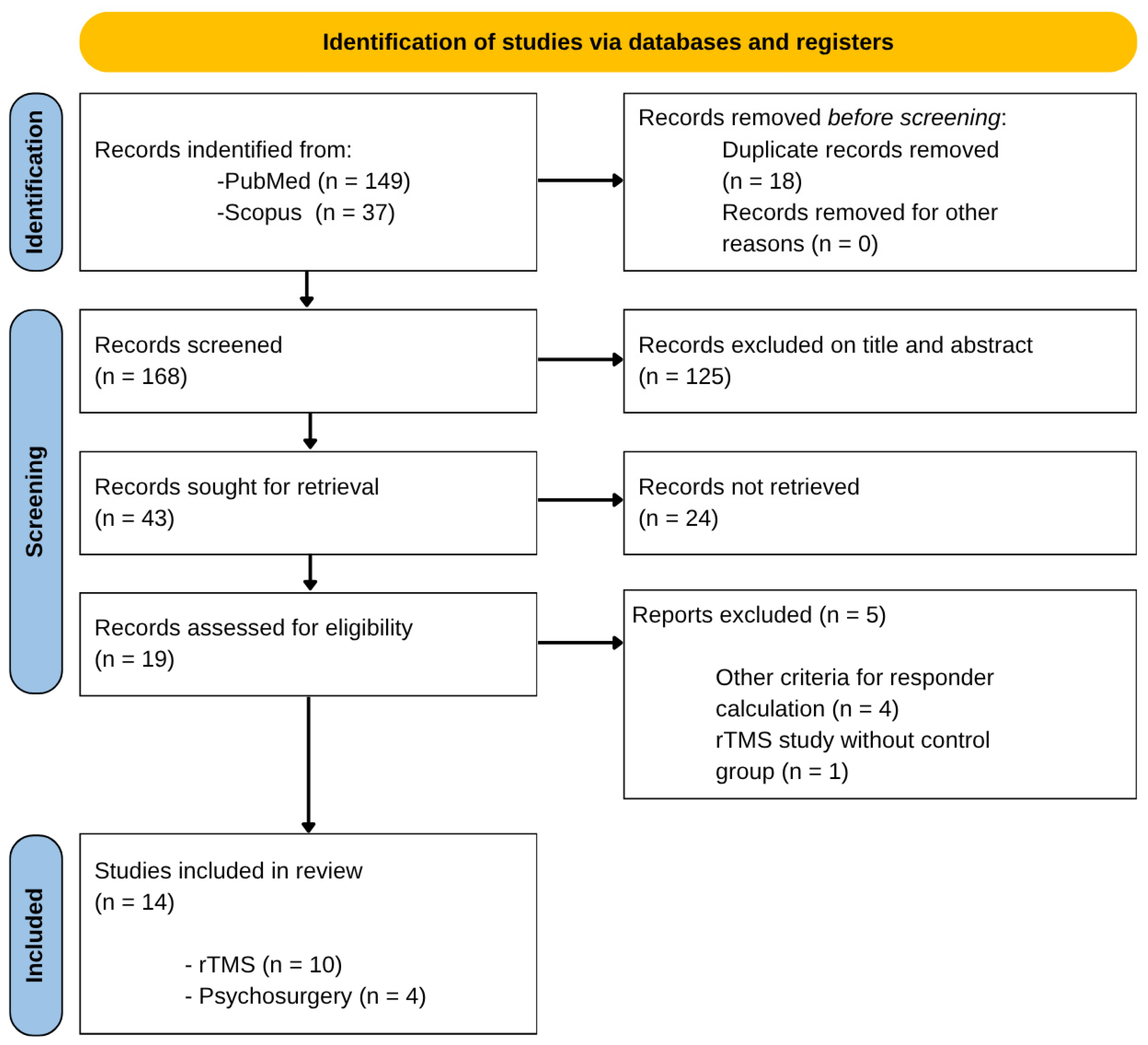
Neurobiological models of OCD involve abnormalities within the cortico-striato-thalamo-cortical (CSTC) circuit, including increased activity in the orbitofrontal cortex, anterior cingulate cortex, and striatum [8,9]. These regions participate in error monitoring, inhibitory control, and the selection of goal-directed behavior. When this circuit becomes dysregulated, intrusive thoughts and repetitive actions are likely to persist. Interventions such as repetitive transcranial magnetic stimulation (rTMS) and neurosurgical procedures have been developed with the aim of modifying activity in these nodes. rTMS applied to cortical targets relevant to OCD—particularly the medial prefrontal cortex, anterior cingulate cortex, and supplementary motor area—has demonstrated reductions in symptom severity in randomized, sham-controlled trials, including studies using deep TMS coils and conventional figure-of-eight coils [10,11,12]. Neurosurgical approaches, including anterior capsulotomy, cingulotomy, and deep brain stimulation (DBS), act on subcortical pathways related to the CSTC loop, especially the anterior limb of the internal capsule, where fibers connecting prefrontal and thalamic regions converge [13,14,15]. Although these strategies differ in technique and degree of invasiveness, both target the same dysfunctional circuit that characterizes severe and treatment-resistant OCD (Figure 1).
Randomized controlled trials of rTMS for OCD have increased over the past decade. Meta-analyses show that active stimulation produces greater symptom improvement than sham, although the magnitude of benefit varies across studies [16,17,18]. Differences in stimulation parameters, coil type, cortical target, and treatment duration contribute to this variability. In addition, follow-up periods are usually short, limiting conclusions about long-term effects. Neurosurgical treatments are supported mainly by observational studies with extended follow-up. Capsulotomy has shown stable reductions in Y-BOCS scores over many years, although cognitive adverse effects have been reported in a minority of cases [13]. Reviews comparing ablative procedures with DBS report response rates of around 40–60%, but highlight wide variability in patient selection, surgical technique, and outcome reporting [14,15]. Because the available evidence for both rTMS and neurosurgery comes from methodologically diverse studies, direct comparisons between the two modalities remain difficult. These limitations underscore the value of systematic analyses that evaluate their relative effectiveness.
Advances in technology have progressively introduced more refined therapeutic strategies for managing severe, treatment-resistant OCD. Despite these developments, the literature remains limited regarding direct comparative analyses of the effectiveness of rTMS and psychosurgical interventions. Both modalities have emerged as promising options for patients who fail to respond to conventional treatments; however, their relative efficacy has not been clearly delineated, largely due to patient heterogeneity, methodological variability, and the scarcity of studies evaluating both approaches within the same analytical framework. Clarifying their comparative therapeutic potential is important for guiding clinical decision-making in this population. We hypothesized that both rTMS and psychosurgical interventions would demonstrate clinically meaningful efficacy in treatment-resistant OCD, with differences in response rates reflecting fundamental clinical distinctions between patients selected for each modality, particularly illness severity. Accordingly, the objective was to compare response rates among these neuromodulatory approaches in order to delineate the relative strengths and limitations of these distinct neuromodulatory approaches across different clinical profiles.

2. Materials and Methods

2.1. Data Sources

A systematic literature review was conducted following the PRISMA guidelines [19]. The complete PRISMA checklist is provided in the Supplementary Materials. The review protocol was registered on PROSPERO (registration ID is PROSPERO 1300744) and is publicly accessible. The search strategy was designed to identify clinical trials that included adult patients diagnosed with severe OCD, refractory to conventional treatments, who had undergone rTMS or psychosurgery.
Two electronic databases were consulted: PubMed (NCBI) and Scopus. The search was conducted on November 10, 2025, and was restricted to articles published within the last 10 years. Controlled vocabulary (MeSH and equivalent terms) was used whenever possible. Search strategies included the following combinations:
  • PubMed: (“Obsessive–Compulsive Disorder”[Mesh]) AND “Transcranial Magnetic Stimulation”[Mesh]; (Obsessive–Compulsive Disorder OR OCD) AND (psychosurgery OR transcranial magnetic stimulation OR TMS OR lesioning OR cingulotomy OR capsulotomy OR limbic leucotomy OR subcaudate tractotomy OR deep brain stimulation OR DBS) AND (adult OR human) NOT animal.
  • Scopus: Obsessive–Compulsive Disorder OR OCD AND psychosurgery OR transcranial magnetic stimulation OR TMS OR lesioning OR cingulotomy OR capsulotomy OR limbic leucotomy OR subcaudate tractotomy OR deep brain stimulation OR DBS AND adult OR human NOT animal.
Studies were included if they enrolled adult patients (≥18 years) with a confirmed diagnosis of treatment-resistant OCD who underwent neuromodulatory interventions using either rTMS or psychosurgical approaches, including ablative procedures and DBS. Eligible studies were required to assess and report OCD symptom severity using the Y-BOCS and explicitly report treatment response, defined as a ≥35% reduction in total Y-BOCS score from baseline following the intervention.

2.2. Study Selection

After removing duplicates, two authors (NGSJ and SMA) independently conducted the initial review of titles and abstracts to determine article eligibility. Studies that did not meet the inclusion criteria were excluded at this stage. The full texts of potentially relevant articles were independently assessed by two other researchers (AVR and AGJ), verifying whether they met the methodological criteria and adequately included rTMS or psychosurgery interventions. Discrepancies between reviewers were resolved through discussion, and consensus was reached in all cases. Articles were excluded if they: did not report the responder rate, defined response using criteria other than the 35% Y-BOCS cutoff, did not include any of the interventions of interest, or considered only animal models.

2.3. Data Extraction

The following variables were extracted for each included study: principal author and year of publication, country of origin of the study, total sample size and sample size per group (intervention and control, when applicable), proportion of responders in each study arm, type of intervention (rTMS or specific type of psychosurgery), mean age of participants, proportion of women, duration of follow-up and frequency of measurements, pre- and post-treatment Y-BOCS scores. The primary outcome was the responder rate, defined as a ≥35% decrease in Y-BOCS. Changes in the total Y-BOCS score at the end of the trial were considered as a secondary outcome.

2.4. Statistical Analysis

Statistical analysis followed standard meta-analytic methods. First, all sociodemographic and clinical variables from the included studies were summarized using descriptive statistics, expressing means and standard deviations for continuous variables, and frequencies and percentages for categorical variables. For each study, the proportions of responders in the intervention groups and, when available, in the control groups were extracted. In studies without a control group, only data from the intervention group were included. The reported relative risk reflects an across-modality ratio of pooled responder proportions derived from the separate selected studies, rather than a comparator-anchored or causal effect estimate. Pooled estimates were generated separately for rTMS and psychosurgical studies based on reported responder proportions. Accordingly, any across-modality comparison should be regarded as descriptive and exploratory rather than a causal estimate of treatment efficacy. Statistical heterogeneity between studies was assessed using the I2 index, which quantifies the proportion of variability attributable to real heterogeneity beyond chance. I2 values were interpreted according to the criteria suggested in the literature. A publication bias assessment was also performed by constructing funnel plots and visually reviewing their skewness. A sensitivity analysis excluding studies with zero events in the control arms was performed using a random-effects model. Statistical comparisons were performed using comprehensive Meta-Analysis: GraphPad Prism (version 10.3.1; GraphPad Software LLC, San Diego, CA, USA), and MetaAnalysisOnline (web-based platform; A5 Genetics Ltd., Kutaso, Hungary) [20]. All analyses were performed at a significance level of p ≤ 0.05.

3. Results

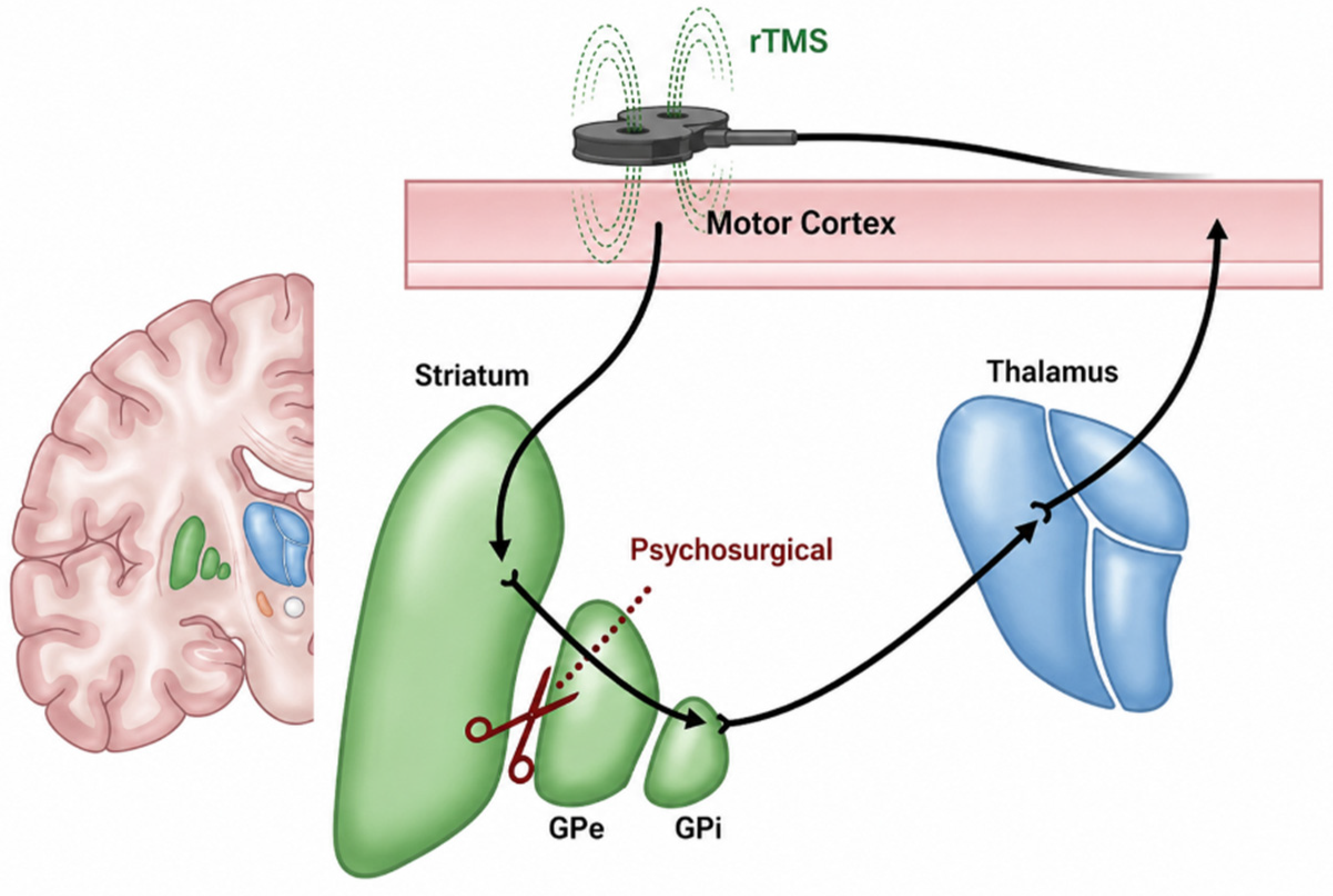
Following our search strategy as outlined above, from the initial 186 records retrieved, only 14 were ultimately included in the final analysis (Figure 2): 10 for rTMS and 4 for psychosurgery.
In total, 10 studies comprising 416 participants treated with rTMS were included in the analysis. Additionally, four studies evaluating lesion-based psychosurgical interventions were identified, including a total of 142 patients and lacking control groups. The clinical and sociodemographic characteristics of all included participants are summarized in Table 1.
When analyzing the differences between both therapeutic approaches, differences were found in the maximum follow-up time in months (2.4 ± 1.45 for rTMS vs. 33.02 ± 20.4 for psychosurgery, p < 0.0001, 95% CI −31.9090 to −14.4619) and the initial Y-BOCS score (26.74 ± 3.58 vs. 32.27 ± 3.15, p = 0.0091, 95% CI −9.4774 to −1.5946), which in both cases were higher in patients who received psychosurgery; but these differences were not observed based on the sample size, the average age, the proportion of women, the final Y-BOCS score, or the proportion of responders. However, this finding is likely underpowered due to the small number of psychosurgical studies included which were exclusively lesion-based procedures, without DBS cohorts, due to a lack of available studies addressing this modality.
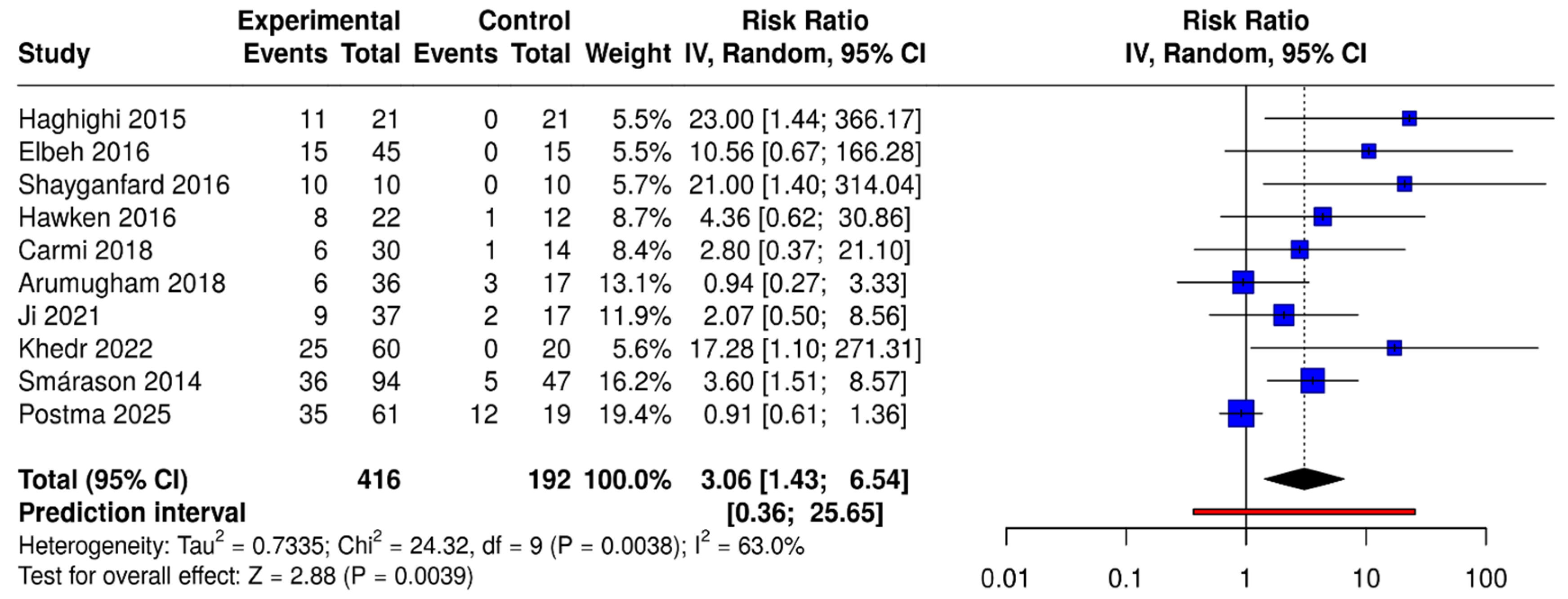
The meta-analysis included studies that met the pre-established criteria and allowed for a quantitative comparison of clinical response rates between patients undergoing rTMS and those treated with psychosurgical procedures. Using a random-effects model with the inverse variance method, the overall effect size was estimated based on relative risk. The overall relative risk was RR = 3.06 (95% CI 1.43–6.54), suggesting a higher probability of response in surgically treated patients than those treated with rTMS. The overall effect size analysis demonstrated statistical significance (p < 0.05), reinforcing this difference. However, when assessing the consistency of the included studies, significant heterogeneity was identified. The Q test showed values consistent with real variability between studies (p < 0.01), and the I2 value was 63%, indicating that the observed variability is due to methodological or clinical differences between studies, rather than chance (Figure 3).
A sensitivity analysis was performed, excluding all studies in which zero events were reported in the control group, in order to evaluate potential inflation of the pooled risk ratio. This analysis included six studies, comprising a total of 280 participants in the experimental cohort and 126 participants in the control cohort. Using a random-effects model with the inverse variance method, the pooled RR was attenuated to 1.75 (95% CI 0.90–3.42), and the overall effect was no longer statistically significant (Z = 1.64, p = 0.1011). Moderate heterogeneity persisted (τ2 = 0.3311; χ2 = 10.94, df = 5, p = 0.0526; I2 = 54.3%). Although the direction of effect continued to favor the experimental intervention, the attenuation of the estimate indicates that zero-event control studies contributed to inflation of the primary pooled effect.
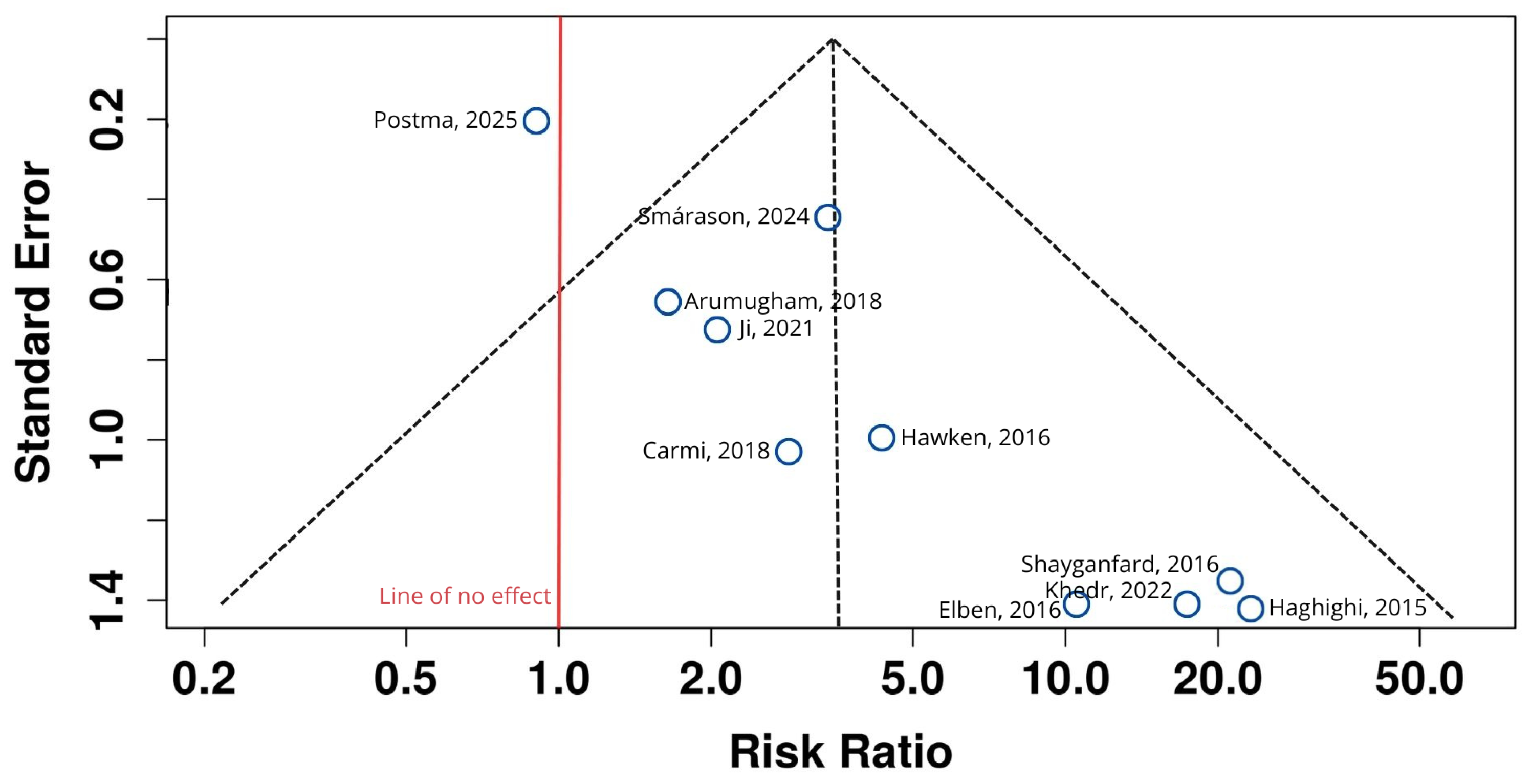
Likewise, the publication bias analysis suggested possible asymmetry. Visual inspection of the funnel plot suggested a not completely symmetric distribution of effect sizes, which prompted the use of additional statistical tests. The Egger test confirmed this trend, showing an intercept of 2.1 (95% CI: 1.19 to 3) with a t-value of 4.549 and p = 0.002, indicating asymmetry and suggesting the possible presence of small studies with extreme effects or an underrepresentation of studies with null or negative results (Figure 4). Overall, these findings suggest that although psychosurgery shows greater relative effectiveness in terms of response rates, heterogeneity between studies and indications of publication bias should be carefully considered when interpreting the magnitude of the observed effect.
Regarding clinical reports involving surgical interventions, the articles extracted are shown in the lower portion of Table 1. Of the targets used for psychosurgery, the anterior capsule was the most frequently used, in 75% of cases, and in the remaining cases, the anterior portion of the cingulate gyrus was used; these were addressed through ventral gamma capsulotomy [31], anterior capsulotomy [32] with magnetic resonance-guided focused ultrasound [34], and cingulotomy with lesions in responding patients located more superiorly and posteriorly along the cingulate sulcus (one-way ANOVA, p = 0.003) [33]. With this approach, patients responded at an average rate of 63.25 ± 14.65 pooled responder percentage, with a 95% CI of 45.06 to 81.45, demonstrating considerable effectiveness for this therapeutic approach. However, since these studies were not clinical trials that included a control group or a second arm, the proportion of responders cannot be compared in the same way as with rTMS, and therefore, a Forest plot is not presented.

4. Discussion

Overall, the results of this meta-analysis, which focused on the main neuromodulation-based therapeutic alternatives for treatment-resistant OCD, show that although the pooled relative risk estimate favored psychosurgical cohorts, this estimate reflects an exploratory across-modality contrast rather than a causal comparison of treatment efficacy. This reflects substantial heterogeneity, major differences in follow-up duration, and non-comparable study designs, as well as distinct clinical indications and eligibility criteria for psychosurgical interventions and rTMS, which are fundamentally different. However, this estimate was accompanied by substantial between-study heterogeneity, suggesting that the magnitude of the effect varies considerably across studies, and the presence of asymmetry in the funnel plot, which suggests possible publication bias. Furthermore, surgical studies have significantly longer follow-up periods, while the evidence for rTMS comes primarily from short and heterogeneous trials in terms of stimulation parameters. In the clinical context, these findings suggest that both rTMS and psychosurgery act on nodes of the same CSTC circuit and may be valid options for severe cases; however, the lack of methodological uniformity and the disparity in follow-up underline the need for more rigorous comparative studies that allow for a more precise delimitation of their relative effectiveness and guide evidence-based therapeutic decisions.
Sensitivity analyses excluding studies with zero events attenuated the pooled effect and eliminated statistical significance. The direction of effect remained similar, but the findings highlight the influence of sparse event data. This finding indicates that part of the apparent superiority signal observed in the primary analysis was influenced by control-arm zero-event inflation. Although the direction of effect remained consistent, the loss of statistical significance underscores the exploratory nature of the cross-modality comparison and highlights the vulnerability of pooled relative risk estimates to sparse event data in small neuromodulation trials.
rTMS exerts its effects through activity-dependent plasticity in fronto-cortical and fronto-striatal circuits. Preclinical work and translational reviews indicate that repeated stimulation can induce long-lasting changes in excitatory and inhibitory neurotransmission and synaptic markers within frontal networks, providing a biological basis for persistent modulation of large-scale circuits beyond the stimulation period [35]. Frontiers in major depressive disorder, observational cohorts and meta-analyses suggest that, after an acute rTMS course, approximately half of responders maintain clinical benefit for up to 6–12 months when continuing pharmacotherapy and, in some cases, maintenance or retreatment rTMS are available [36,37]. In substance use disorders, deep rTMS targeting lateral prefrontal and insular cortices has produced higher abstinence rates than sham, with a proportion of patients remaining abstinent at 6-month follow-up in smoking cessation trials, and broader reviews report sustained reductions in craving and consumption across several substances [38,39]. By contrast, the rTMS studies included in our meta-analysis of OCD relied on relatively short follow-up periods (on average around 2–3 months) and psychiatry OCD, so the responder rates we report primarily reflect short-term change. The more extensive longitudinal data available on depression and addiction suggest that rTMS can support longer-term symptom control when delivered with adequate dosing and maintenance strategies. Still, this possibility remains largely untested in OCD and should be addressed in future trials with extended follow-up.
In previous meta-analyses on rTMS, Liang et al. [40], who included twenty-two eligible randomized controlled trials, concluded that stimulation offers a modest benefit over sham, with small-to-moderate effects when stimulating with low-frequency rTMS over the dorsolateral prefrontal cortex (DLPFC) and supplementary motor area (SMA), as well as high-frequency rTMS over the DLPFC, showing good tolerability, but high variability and “very low” quality evidence, similar to what we reported with aggregated response rates (~30–50% in most studies). On the other hand, Kar et al. [41] showed that most meta-analyses agree that rTMS targeting the DLPFC and SMA reduces symptoms, but with high heterogeneity in 9 of 12 studies, highlighting notable variability in treatment duration and different protocols. In contrast, Steuber et al. [42] report that rTMS produces a moderate effect (g = 0.65) and an RR = 3.15 compared to sham; however, it is worth noting that they emphasize that the benefit of rTMS is enhanced when comorbid depression improves, suggesting that some of the apparent inferiority of rTMS could be due to differences in the clinical composition of the samples. Our meta-analysis extends these findings by showing that, when directly compared to rTMS within the same analytical framework, the magnitude of the benefit appears considerably greater in the primary pooled analysis, although this difference was attenuated and no longer statistically significant in sensitivity analyses excluding zero-event control studies; thus, this difference should be interpreted with caution.
Our findings on psychosurgical interventions should be interpreted with caution; we could not perform the same type of analysis as with rTMS. The meta-analysis by Hageman et al. [16] reported response rates of 48–56% for ablative techniques and 53–57% for DBS, with no significant differences between modalities, while Gadot et al. [43] described a mean reduction of 47% in Y-BOCS and a 66% responder rate at the last follow-up, confirming a clinical benefit. Similarly, Balachander et al. [18] noted that both ablation and DBS achieve improvement in approximately half of appropriately selected patients. Our results show aggregate response rates for surgery of 63.2%, placing them within the upper range of previously reported findings and thus confirming the overall efficacy of surgical approaches. However, our analysis qualifies this literature by demonstrating that, while the relative risk of response is three to four times higher than with rTMS, this effect is influenced by moderate-to-high heterogeneity and considerably longer follow-up in the surgical cohorts (≈33 months vs. 2.4 months for rTMS).
Both rTMS and psychosurgical procedures target elements of the cortico-striato-thalamo-cortical (CSTC) circuitry that underlie the pathophysiology of OCD, which may explain the comparable response rates observed across modalities. Neuroimaging studies consistently demonstrate hyperactivity in orbitofrontal, anterior cingulate, and striatal regions in severe OCD, along with abnormal functional coupling between these nodes [9,16]. rTMS applied to medial prefrontal or supplementary motor areas can modulate these networks indirectly by altering cortical excitability and downstream fronto-striatal connectivity, producing measurable reductions in activity within circuits linked to compulsivity [12]. Psychosurgical techniques such as anterior capsulotomy or deep brain stimulation act more directly on subcortical fibers connecting the prefrontal cortex and thalamus, thereby disrupting pathological feedback loops within the same CSTC system [14,16]. Although their mechanisms differ in invasiveness and anatomical entry point, both interventions ultimately converge on modulating fronto-striatal transmission and reducing the maladaptive network dynamics that sustain obsessive–compulsive symptoms. This convergence may explain the similar therapeutic effects observed in this analysis.
The most important limitation of the present study is the marked disparity in follow-up duration between rTMS and psychosurgical cohorts, which constitutes a primary threat to the internal validity of any cross-modality comparison. Surgical cohorts routinely report outcomes across many years, with several studies following patients for 5 to more than 40 years, allowing an evaluation of long-term stability and delayed therapeutic effects. Long-term capsulotomy series and deep brain stimulation registries consistently show maintained clinical improvement over extended periods [14,44,45], suggesting durable modulation of fronto-striatal circuits. By contrast, the rTMS trials included in this review used short follow-up intervals, typically 4 to 6 weeks after treatment [4,24], providing information only about early symptom change. Long-term studies of DBS in treatment-resistant OCD have demonstrated sustained symptom reduction over follow-up periods ranging from 4 to 8 years, mean durations exceeding 6 years, and even up to 9 years in selected cohorts, supporting the durability of neuromodulatory effects in appropriately selected patients [46,47,48]. By contrast, the rTMS trials included in the present analysis relied predominantly on short follow-up intervals, typically limited to weeks or a few months after treatment. This fundamental difference in outcome timing precludes defensible inferences regarding comparative efficacy.
In clinical practice, these data support a stepped intervention model, in which rTMS is considered a preliminary step due to its less invasive nature, increasing availability, and more favorable risk profile. In patients who are not candidates for surgery, rTMS could be used as maintenance therapy or a reasonable alternative before escalating to ablative approaches or DBS. Furthermore, risk perception, costs, and required infrastructure differ widely between the two modalities, so these findings can help inform shared decision-making, contextualizing that surgical efficacy is accompanied by greater technical complexity and restricted accessibility.
Several methodological limitations should be considered when interpreting these findings. First, the number of eligible psychosurgery studies was small, which limits the precision of the estimates, and the lack of blinded, controlled clinical trials prevents the same type of analysis from being performed. In addition, it must be considered that the limited number of psychosurgical studies substantially reduces statistical power, increasing the risk of Type II error and precluding conclusions regarding therapeutic equivalence. For rTMS, there was substantial heterogeneity among studies, affecting the comparability between interventions. Most included studies did not report race or ethnicity, precluding analysis of potential differential treatment effects across populations. Additionally, the lack of individual patient data prevents analyses adjusted for relevant clinical variables. A formal structured quality assessment (e.g., Cochrane risk of bias tools) was not performed due to the inclusion of heterogeneous study designs, including observational surgical cohorts; this limitation is acknowledged. Finally, the detection of potential publication bias suggests that the effects may be overestimated; however, these limitations do not invalidate the consistent signal of observed efficacy, but rather define the degree of certainty with which the conclusions should be interpreted. On the other hand, the analysis used a DerSimonian–Laird model under a random-effects approach and logit estimation of proportions and appropriate approaches for synthesizing clinically heterogeneous studies. Additionally, sensitivity analyses demonstrated that pooled comparative estimates were sensitive to the inclusion of studies with zero events in control arms, further limiting the stability of cross-modality inferences. Furthermore, this work offers an exploratory approach between rTMS and psychosurgery, an analysis that is scarce in the literature and highly relevant for real-world clinical decisions. The systematic review was comprehensive, using indexed databases and strict eligibility criteria, which strengthens the validity and reproducibility of the study.
A formal meta-regression was not performed due to the limited number of included studies, which would likely yield unstable estimates. Cumulative meta-analysis was also not conducted, given the heterogeneity in study design and follow-up duration. These considerations further support the exploratory interpretation of the findings.
Future research should include controlled trials that directly compare rTMS versus surgical procedures (both ablative and DBS), ideally with long-term follow-up and standardized measures. Future studies should address key sources of bias identified in this analysis, including pre-registration, improved control conditions, standardized outcome definitions, and harmonized follow-up. Additionally, multimodal studies combining neuroimaging, functional connectivity, and biomarkers will help elucidate the shared and differentiating mechanisms of both modalities. Furthermore, standardizing rTMS protocols and establishing uniform criteria for defining clinical response will reduce heterogeneity and improve the interpretation of relative efficacy.

5. Conclusions

This systematic review and meta-analysis indicate that both rTMS and lesion-based psychosurgical interventions are associated with clinically meaningful symptom improvement in carefully selected individuals with treatment-resistant OCD. Although pooled responder rates appeared higher in psychosurgical cohorts, this finding reflects exploratory contrasts between fundamentally different evidence bases rather than comparative treatment efficacy, given marked heterogeneity, non-comparable study designs, and substantial disparities in follow-up duration. The results support a stepped-care clinical framework in which rTMS represents a less invasive and more accessible option for severe OCD, while psychosurgical approaches remain effective alternatives for highly refractory cases meeting stringent eligibility criteria. Future research should prioritize methodologically harmonized studies with standardized outcome definitions, comparable follow-up intervals, and long-term assessments to better delineate the role of neuromodulatory interventions across distinct clinical profiles of treatment-resistant OCD.

Supplementary Materials

The following supporting information can be downloaded at https://www.mdpi.com/article/10.3390/psychiatryint7030096/s1. Table S1: PRISMA 2020 Checklist.

Author Contributions

Conceptualization, A.V.-R., N.G.S.-J. and S.M.-d.A.; methodology, A.V.-R.; software, A.V.-R.; validation, A.V.-R. and A.G.-J.; formal analysis, A.V.-R.; investigation, N.G.S.-J. and S.M.-d.A.; resources, A.V.-R.; data curation, A.V.-R. and A.G.-J.; writing—original draft preparation, A.V.-R., N.G.S.-J., S.M.-d.A. and A.G.-J.; writing—review and editing, A.V.-R. and A.G.-J.; visualization, A.V.-R. and A.G.-J.; supervision, A.V.-R. and A.G.-J.; project administration, A.V.-R.; funding acquisition, A.V.-R. All authors have read and agreed to the published version of the manuscript.

Funding

This research received no external funding.

Institutional Review Board Statement

Not applicable.

Informed Consent Statement

Not applicable.

Data Availability Statement

All data used in this systematic review and meta-analysis were obtained from previously published studies available in public databases (PubMed and Scopus). No new datasets were generated or analyzed during the current study. Therefore, all data supporting the findings of this study are included within the published articles cited in this manuscript.

Conflicts of Interest

The authors declare no conflicts of interest.

Abbreviations

The following abbreviations are used in this manuscript:
OCDObsessive–compulsive disorder
rTMSRepetitive transcranial magnetic stimulation
Y-BOCSYale–Brown Obsessive–Compulsive Scale
CSTCCortico-striato-thalamo-cortical circuit
DBSDeep brain stimulation
DLPFCDorsolateral prefrontal cortex
SMASupplementary motor area

References

  1. Hinduja, S.; Darzi, A.; Ertugrul, I.O.; Provenza, N.; Gadot, R.; Storch, E.A.; Sheth, S.A.; Goodman, W.K.; Cohn, J.F. Multimodal Prediction of Obsessive-Compulsive Disorder and Comorbid Depression Severity and Energy Delivered by Deep Brain Electrodes. IEEE Trans. Affect. Comput. 2024, 15, 2025–2041. [Google Scholar] [CrossRef]
  2. Vellozo, A.P.; Fontenelle, L.F.; Torresan, R.C.; Shavitt, R.G.; Ferrão, Y.A.; Rosário, M.C.; Miguel, E.C.; Torres, A.R. Symmetry Dimension in Obsessive-Compulsive Disorder: Prevalence, Severity and Clinical Correlates. J. Clin. Med. 2021, 10, 274. [Google Scholar] [CrossRef]
  3. Guillén-Font, M.A.; Cervera, M.; Puigoriol, E.; Foguet-Boreu, Q.; Arrufat, F.X.; Serra-Millàs, M. Insight in Obsessive-Compulsive Disorder: Relationship With Sociodemographic and Clinical Characteristics. J. Psychiatr. Pract. 2021, 27, 427–438. [Google Scholar] [CrossRef] [PubMed]
  4. Shan, H.D.; Liu, Y.F.; Zhao, Q.; Wang, Y.; Wang, Y.-M.; Cheung, E.F.; Chan, R.C.; Wang, Z. Distinct clinical manifestations of obsessive-compulsive disorder are associated with cortical thickness alteration. Aust. N. Z. J. Psychiatry 2022, 56, 186–196. [Google Scholar] [CrossRef]
  5. Zhou, Z.; Li, B.; Jiang, J.; Li, H.; Cao, L.; Zhang, S.; Gao, Y.; Zhang, L.; Qiu, C.; Huang, X.; et al. Abnormal resting-state functional connectivity of the insula in medication-free patients with obsessive-compulsive disorder. BMC Psychiatry 2022, 22, 742. [Google Scholar] [CrossRef]
  6. Gao, J.; Yang, X.; Chen, X.; Liu, R.; Wang, P.; Meng, F.; Li, Z.; Zhou, Y. Resting-state functional connectivity of the amygdala subregions in unmedicated patients with obsessive-compulsive disorder before and after cognitive behavioural therapy. J. Psychiatry Neurosci. 2021, 46, E628–E638. [Google Scholar] [CrossRef]
  7. Mataix-Cols, D.; Fernández de la Cruz, L.; Nordsletten, A.E.; Lenhard, F.; Isomura, K.; Simpson, H.B. Towards an international expert consensus for defining treatment response, remission, recovery and relapse in obsessive-compulsive disorder. World Psychiatry 2016, 15, 80–81. [Google Scholar] [CrossRef]
  8. Saxena, S.; Rauch, S.L. Functional neuroimaging and the neuroanatomy of obsessive-compulsive disorder. Psychiatr. Clin. N. Am. 2000, 23, 563–586. [Google Scholar] [CrossRef] [PubMed]
  9. Pauls, D.L.; Abramovitch, A.; Rauch, S.L.; Geller, D.A. Obsessive-compulsive disorder: An integrative genetic and neurobiological perspective. Nat. Rev. Neurosci. 2014, 15, 410–424. [Google Scholar] [CrossRef] [PubMed]
  10. Gomes, P.V.; Brasil-Neto, J.P.; Allam, N.; Rodrigues de Souza, E. A randomized, double-blind trial of repetitive transcranial magnetic stimulation in obsessive-compulsive disorder with three-month follow-up. J. Neuropsychiatry Clin. Neurosci. 2012, 24, 437–443. [Google Scholar] [CrossRef] [PubMed]
  11. Perera, M.P.N.; Mallawaarachchi, S.; Miljevic, A.; Bailey, N.W.; Herring, S.E.; Fitzgerald, P.B. Repetitive Transcranial Magnetic Stimulation for Obsessive-Compulsive Disorder: A Meta-analysis of Randomized, Sham-Controlled Trials. Biol. Psychiatry Cogn. Neurosci. Neuroimaging 2021, 6, 947–960. [Google Scholar] [CrossRef] [PubMed]
  12. Carmi, L.; Tendler, A.; Bystritsky, A.; Hollander, E.; Blumberger, D.M.; Daskalakis, J.; Ward, H.; Lapidus, K.; Goodman, W.; Casuto, L.; et al. Efficacy and Safety of Deep Transcranial Magnetic Stimulation for Obsessive-Compulsive Disorder: A Prospective Multicenter Randomized Double-Blind Placebo-Controlled Trial. Am. J. Psychiatry 2019, 176, 931–938. [Google Scholar] [CrossRef] [PubMed]
  13. Fitzsimmons, S.M.D.D.; van der Werf, Y.D.; van Campen, A.D.; Arns, M.; Sack, A.T.; Hoogendoorn, A.W.; other members of the TETRO Consortium; van den Heuvel, O.A. Repetitive transcranial magnetic stimulation for obsessive-compulsive disorder: A systematic review and pairwise/network meta-analysis. J. Affect. Disord. 2022, 302, 302–312. [Google Scholar] [CrossRef] [PubMed]
  14. Rück, C.; Karlsson, A.; Steele, J.D.; Edman, G.; Meyerson, B.A.; Ericson, K.; Nyman, H.; Asberg, M.; Svanborg, P. Capsulotomy for obsessive-compulsive disorder: Long-term follow-up of 25 patients. Arch. Gen. Psychiatry 2008, 65, 914–921. [Google Scholar] [CrossRef] [PubMed]
  15. Trevizol, A.P.; Shiozawa, P.; Cook, I.A.; Sato, I.A.; Kaku, C.B.; Guimarães, F.B.; Sachdev, P.; Sarkhel, S.; Cordeiro, Q. Transcranial Magnetic Stimulation for Obsessive-Compulsive Disorder: An Updated Systematic Review and Meta-analysis. J. ECT 2016, 32, 262–266. [Google Scholar] [CrossRef] [PubMed]
  16. Hageman, S.B.; van Rooijen, G.; Bergfeld, I.O.; Schirmbeck, F.; de Koning, P.; Schuurman, P.R.; Denys, D. Deep brain stimulation versus ablative surgery for treatment-refractory obsessive-compulsive disorder: A meta-analysis. Acta Psychiatr. Scand. 2021, 143, 307–318. [Google Scholar] [CrossRef] [PubMed]
  17. Pepper, J.; Hariz, M.; Zrinzo, L. Deep brain stimulation versus anterior capsulotomy for obsessive-compulsive disorder: A review of the literature. J. Neurosurg. 2015, 122, 1028–1037. [Google Scholar] [CrossRef] [PubMed]
  18. Balachander, S.; Arumugham, S.S.; Srinivas, D. Ablative neurosurgery and deep brain stimulation for obsessive-compulsive disorder. Indian J. Psychiatry 2019, 61, S77–S84. [Google Scholar] [CrossRef] [PubMed] [PubMed Central]
  19. Page, M.J.; McKenzie, J.E.; Bossuyt, P.M.; Boutron, I.; Hoffmann, T.C.; Mulrow, C.D.; Shamseer, L.; Tetzlaff, J.M.; Akl, E.A.; Brennan, S.E.; et al. The PRISMA 2020 statement: An updated guideline for reporting systematic reviews. BMJ 2021, 372, n71. [Google Scholar] [CrossRef]
  20. Fekete, J.T.; Gyorffy, B. MetaAnalysisOnline.com: An Online Tool for the Rapid Meta-Analysis of Clinical and Epidemiological Studies. J. Med. Internet Res. 2025, 27, e64016. [Google Scholar] [CrossRef]
  21. Haghighi, M.; Shayganfard, M.; Jahangard, L.; Ahmadpanah, M.; Bajoghli, H.; Pirdehghan, A.; Holsboer-Trachsler, E.; Brand, S. Repetitive Transcranial Magnetic Stimulation (rTMS) improves symptoms and reduces clinical illness in patients suffering from OCD—Results from a single-blind, randomized clinical trial with sham cross-over condition. J. Psychiatr. Res. 2015, 68, 238–244. [Google Scholar] [CrossRef] [PubMed]
  22. Elbeh, K.A.M.; Elserogy, Y.M.B.; Khalifa, H.E.; Ahmed, M.A.; Hafez, M.H.; Khedr, E.M. Repetitive transcranial magnetic stimulation in the treatment of obsessive-compulsive disorders: Double blind randomized clinical trial. Psychiatry Res. 2016, 238, 264–269. [Google Scholar] [CrossRef]
  23. Shayganfard, M.; Jahangard, L.; Nazaribadie, M.; Haghighi, M.; Ahmadpanah, M.; Bahmani, D.S.; Bajoghli, H.; Holsboer-Trachsler, E.; Brand, S. Repetitive Transcranial Magnetic Stimulation Improved Symptoms of Obsessive-Compulsive Disorders but Not Executive Functions: Results from a Randomized Clinical Trial with Crossover Design and Sham Condition. Neuropsychobiology 2016, 74, 115–124. [Google Scholar] [CrossRef] [PubMed]
  24. Hawken, E.R.; Dilkov, D.; Kaludiev, E.; Simek, S.; Zhang, F.; Milev, R. Transcranial Magnetic Stimulation of the Supplementary Motor Area in the Treatment of Obsessive-Compulsive Disorder: A Multi-Site Study. Int. J. Mol. Sci. 2016, 17, 420. [Google Scholar] [CrossRef]
  25. Carmi, L.; Alyagon, U.; Barnea-Ygael, N.; Zohar, J.; Dar, R.; Zangen, A. Clinical and electrophysiological outcomes of deep TMS over the medial prefrontal and anterior cingulate cortices in OCD patients. Brain Stimul. 2018, 11, 158–165. [Google Scholar] [CrossRef]
  26. Arumugham, S.S.; Subhasini, V.S.; Madhuri, H.N.; Vinay, B.; Ravi, M.; Sharma, E.; Thirthalli, J.; Reddy, Y.J. Augmentation Effect of Low-Frequency Repetitive Transcranial Magnetic Stimulation Over Presupplementary Motor Area in Obsessive-Compulsive Disorder: A Randomized Controlled Trial. J. ECT 2018, 34, 253–257. [Google Scholar] [CrossRef]
  27. Ji, G.J.; Xie, W.; Yang, T.; Wu, Q.; Sui, P.; Bai, T.; Chen, L.; Chen, X.; Dong, Y.; Wang, A.; et al. Pre-supplementary motor network connectivity and clinical outcome of magnetic stimulation in obsessive-compulsive disorder. Hum. Brain Mapp. 2021, 42, 3833–3844. [Google Scholar] [CrossRef] [PubMed]
  28. Khedr, E.M.; Elbeh, K.; Saber, M.; Abdelrady, Z.; Abdelwarith, A. A double blind randomized clinical trial of the effectiveness of low frequency rTMS over right DLPFC or OFC for treatment of obsessive-compulsive disorder. J. Psychiatr. Res. 2022, 156, 122–131. [Google Scholar] [CrossRef]
  29. Smárason, O.; Boedeker, P.J.; Guzick, A.G.; Tendler, A.; Sheth, S.A.; Goodman, W.K.; Storch, E.A. Depressive symptoms during deep transcranial magnetic stimulation or sham treatment for obsessive-compulsive disorder. J. Affect. Disord. 2024, 344, 466–472. [Google Scholar] [CrossRef]
  30. Postma, T.S.; Fitzsimmons, S.M.D.D.; Vriend, C.; Batelaan, N.M.; van der Werf, Y.D.; van den Heuvel, O.A. Transcranial Magnetic Stimulation-Induced Plasticity Improving Cognitive Control in Obsessive-Compulsive Disorder, Part II: Task-Based Neural Predictors of Treatment Response. Biol. Psychiatry 2025, 97, 688–697. [Google Scholar] [CrossRef]
  31. Rasmussen, S.A.; Noren, G.; Greenberg, B.D.; Marsland, R.; McLaughlin, N.C.; Malloy, P.J.; Salloway, S.P.; Strong, D.R.; Eisen, J.L.; Jenike, M.A.; et al. Gamma Ventral Capsulotomy in Intractable Obsessive-Compulsive Disorder. Biol. Psychiatry 2018, 84, 355–364. [Google Scholar] [CrossRef] [PubMed]
  32. Gong, F.; Li, B.; Zhang, S.; Wang, Y.; Gao, Y.; Xu, Y.; Wang, X.; Xiong, B.; Li, D.; Wen, R.; et al. The Suitability of Different Subtypes and Dimensions of Obsessive-Compulsive Disorder for Treatment with Anterior Capsulotomy: A Long-Term Follow-Up Study. Stereotact. Funct. Neurosurg. 2019, 97, 319–336. [Google Scholar] [CrossRef]
  33. Starkweather, C.K.; Bick, S.K.; McHugh, J.M.; Dougherty, D.D.; Williams, Z.M. Lesion location and outcome following cingulotomy for obsessive-compulsive disorder. J. Neurosurg. 2021, 136, 221–230. [Google Scholar] [CrossRef] [PubMed]
  34. Hamani, C.; Davidson, B.; Rabin, J.S.; Goubran, M.; Boone, L.; Hynynen, K.; De Schlichting, E.; Meng, Y.; Huang, Y.; Jones, R.M.; et al. Long-Term Safety and Efficacy of Focused Ultrasound Capsulotomy for Obsessive-Compulsive Disorder and Major Depressive Disorder. Biol. Psychiatry 2025, 97, 698–706. [Google Scholar] [CrossRef]
  35. Turi, Z.; Normann, C.; Domschke, K.; Vlachos, A. Transcranial Magnetic Stimulation in Psychiatry: Is There a Need for Electric Field Standardization? Front. Hum. Neurosci. 2021, 15, 639640. [Google Scholar] [CrossRef] [PubMed] [PubMed Central]
  36. Dunner, D.L.; Aaronson, S.T.; Sackeim, H.A.; Janicak, P.G.; Carpenter, L.L.; Boyadjis, T.; Brock, D.G.; Bonneh-Barkay, D.; Cook, I.A.; Lanocha, K.; et al. A multisite, naturalistic, observational study of transcranial magnetic stimulation for patients with pharmacoresistant major depressive disorder: Durability of benefit over a 1-year follow-up period. J. Clin. Psychiatry 2014, 75, 1394–1401. [Google Scholar] [CrossRef] [PubMed]
  37. Senova, S.; Cotovio, G.; Pascual-Leone, A.; Oliveira-Maia, A.J. Durability of antidepressant response to repetitive transcranial magnetic stimulation: Systematic review and meta-analysis. Brain Stimul. 2019, 12, 119–128. [Google Scholar] [CrossRef] [PubMed]
  38. Dinur-Klein, L.; Dannon, P.; Hadar, A.; Rosenberg, O.; Roth, Y.; Kotler, M.; Zangen, A. Smoking cessation induced by deep repetitive transcranial magnetic stimulation of the prefrontal and insular cortices: A prospective, randomized controlled trial. Biol. Psychiatry 2014, 76, 742–749. [Google Scholar] [CrossRef] [PubMed]
  39. Coles, A.S.; Kozak, K.; George, T.P. A review of brain stimulation methods to treat substance use disorders. Am. J. Addict. 2018, 27, 71–91. [Google Scholar] [CrossRef] [PubMed] [PubMed Central]
  40. Liang, K.; Li, H.; Bu, X.; Li, X.; Cao, L.; Liu, J.; Gao, Y.; Li, B.; Qiu, C.; Bao, W.; et al. Efficacy and tolerability of repetitive transcranial magnetic stimulation for the treatment of obsessive-compulsive disorder in adults: A systematic review and network meta-analysis. Transl. Psychiatry 2021, 11, 332. [Google Scholar] [CrossRef] [PubMed]
  41. Kar, S.K.; Agrawal, A.; Silva-Dos-Santos, A.; Gupta, Y.; Deng, Z.D. The Efficacy of Transcranial Magnetic Stimulation in the Treatment of Obsessive-Compulsive Disorder: An Umbrella Review of Meta-Analyses. CNS Spectr. 2024, 29, 109–118. [Google Scholar] [CrossRef] [PubMed]
  42. Steuber, E.R.; McGuire, J.F. A Meta-analysis of Transcranial Magnetic Stimulation in Obsessive-Compulsive Disorder. Biol. Psychiatry Cogn. Neurosci. Neuroimaging 2023, 8, 1145–1155. [Google Scholar] [CrossRef] [PubMed]
  43. Gadot, R.; Najera, R.; Hirani, S.; Anand, A.; Storch, E.; Goodman, W.K.; Shofty, B.; Sheth, S.A. Efficacy of deep brain stimulation for treatment-resistant obsessive-compulsive disorder: Systematic review and meta-analysis. J. Neurol. Neurosurg. Psychiatry 2022, 93, 1166–1173. [Google Scholar] [CrossRef]
  44. Rück, C.; Larsson, J.K.; Mataix-Cols, D.; Ljung, R. A register-based 13-year to 43-year follow-up of 70 patients with obsessive-compulsive disorder treated with capsulotomy. BMJ Open 2017, 7, e013133. [Google Scholar] [CrossRef] [PubMed] [PubMed Central]
  45. Zhan, S.; Liu, W.; Li, D.; Pan, S.; Pan, Y.; Li, Y.; Lin, G.; Sun, B. Long-term follow-up of bilateral anterior capsulotomy in patients with refractory obsessive-compulsive disorder. Clin. Neurol. Neurosurg. 2014, 119, 91–95. [Google Scholar] [CrossRef] [PubMed]
  46. Mar-Barrutia, L.; Ibarrondo, O.; Mar, J.; Real, E.; Segalàs, C.; Bertolín, S.; Aparicio, M.A.; Plans, G.; Menchón, J.M.; Alonso, P. Long-term comparative effectiveness of deep brain stimulation in severe obsessive-compulsive disorder. Brain Stimul. 2022, 15, 1128–1138. [Google Scholar] [CrossRef]
  47. Winter, L.; Saryyeva, A.; Schwabe, K.; Heissler, H.E.; Runge, J.; Alam, M.; Heitland, I.; Kahl, K.G.; Krauss, J.K. Long-Term Deep Brain Stimulation in Treatment-Resistant Obsessive-Compulsive Disorder: Outcome and Quality of Life at Four to Eight Years Follow-Up. Neuromodulation 2021, 24, 324–330. [Google Scholar] [CrossRef]
  48. Fayad, S.M.; Guzick, A.G.; Reid, A.M.; Mason, D.M.; Bertone, A.; Foote, K.D.; Okun, M.S.; Goodman, W.K.; Ward, H.E. Six-Nine Year Follow-Up of Deep Brain Stimulation for Obsessive-Compulsive Disorder. PLoS ONE 2016, 11, e0167875. [Google Scholar] [CrossRef] [PubMed]
Figure 1. CSTC circuit and main targets of rTMS and psychosurgical interventions. The diagram illustrates the core components of the CSTC circuit, including motor and supplementary motor cortical areas, the striatum, basal ganglia nuclei, and thalamic relays. Cortical inputs from the motor cortex and supplementary motor area (SMA) project to the striatum, which modulates basal ganglia output through direct and indirect pathways involving the globus pallidus internus (GPi) and externus (GPe). Thalamic nuclei, particularly the mediodorsal (MD) and parafascicular (Pf) nuclei, relay basal ganglia output back to cortical motor regions, completing the CSTC loop. Repetitive transcranial magnetic stimulation (rTMS) primarily targets cortical nodes of the circuit, especially the SMA and motor cortex, whereas psychosurgical interventions modulate subcortical components of the CSTC circuit, including striatal and pallidal regions. Highlighting these shared but distinct targets supports the rationale for comparing both interventions within a common circuit-based framework.
Psychiatryint 07 00096 g001
Figure 2. Studies included in systematic analysis.
Psychiatryint 07 00096 g002
Figure 3. Forest plot of rTMS responder rates [21,22,23,24,25,26,27,28,29,30].
Psychiatryint 07 00096 g003
Figure 4. Funnel plot of rTMS responder rates [21,22,23,24,25,26,27,28,29,30].
Psychiatryint 07 00096 g004
Table 1. Characteristics of studies included in meta-analysis.
StudySample (n)Age (Years)Females (%)Follow-Up Duration (Months)Follow-Up Frequency (Months)Y-BOCS Pre-TreatmentY-BOCS Post-TreatmentTreatment Responders (%)
rTMSHaghighi, M. et al. 2015 [21]2135.86 ± 115710.75, 1302052.4
Elbeh, K. A. M. et al., 2016 [22]4527.1 ± 4.53331, 326.7 ± 6.5 (1 Hz); 25.3 ± 4.7 (10 Hz)15.7 ± 7.9 (1 Hz); 22.8 ± 5.1 (10 Hz)50
Shayganfard, M. et al., 2016 [23]1033.10 ± 7.067010.5, 131.00 ± 6.5221.20 ± 7.7640
Hawken, E. R. et al. 2016 [24]2233 ± 10503.50.5, 1, 1.5, 2, 3.523–355–1980
Carmi, L. et al. 2018 [25]3036 ± 2.143.7520.5, 1, 1.25, 228 ± 0.719.643.75
Arumugham, S. S. et al. 2018 [26]3627.74 ± 7.8815.7940.25, 0.5, 0.75, 325.0519.2632
Ji, G. J. et al. 2021 [27]3727.75 ± 1.58250.460.4621.0 ± 5.0414.75 ± 5.3345
Khedr, E. M. et al. 2022 [28]6035.4 ± 10.353.330, 1.5, 322.51570
Smárason, O. et al. 2024 [29]9445 ± 23-2.50.25, 0.5, 0.75, 1, 1.25, 1.75, 2.527.332180
Postma, T. S. et al. 2025 [30]6137.25 ±12.846551, 2, 3, 528 ± 4.417.257.4
Psycho surgeryRasmussen, S. A. et al. 2018 [31]5533.6 ± 10.536.4603, 6, 12, 24, 36Single shot: 33.27 ± 4.82 Double shot: 34.18 ± 3.15Single shot: 19.29 Double shot: 16.78Single shot: 46.67 Double shot: 75
Gong, F. et al. 2019 [32]5433.55 ± 957.4361, 3, 6, 12, 3627.03 ± 5.598.50 ± 7.3679.6
Starkweather, C. K. et al. 2021 [33]1842.7 ± 18.338.912.081, 635 ± 4.372250
Hamani, C. et al. 2025 [34]1541.9 ± 3.640246, 12, 18, 2431.9 ± 1.220.7 ± 1.767
Disclaimer/Publisher’s Note: The statements, opinions and data contained in all publications are solely those of the individual author(s) and contributor(s) and not of MDPI and/or the editor(s). MDPI and/or the editor(s) disclaim responsibility for any injury to people or property resulting from any ideas, methods, instructions or products referred to in the content.