1. Introduction
A refugee is defined as a person who has fled their country of origin and is unable to seek protection there due to a well-founded fear of persecution based on race, religion, nationality, membership in a particular social group, or political opinion [
1]. According to the United Nations High Commissioner for Refugees (UNHCR), more than 108.4 million people were forcibly displaced by the end of 2022, including refugees and internally displaced persons [
2]. Approximately 70% of all individuals in need of international protection originate from Syria, Afghanistan, Venezuela, Ukraine, and South Sudan [
3].
Due to its geographical position, Serbia serves as a major transit route on the Balkan migration corridor [
4]. Despite being primarily a transit country, as many as 577,995 refugees expressed an intention to seek asylum in Serbia in 2015 [
5]. Many remain in reception or asylum centers for extended periods, often facing socioeconomic hardship, legal uncertainty, and limited access to specialized mental health care [
2].
Refugees are exposed to traumatic and stressful events before departure, during transit, and after arrival in host countries [
6]. These cumulative stressors significantly increase the risk of psychiatric morbidity, particularly post-traumatic stress disorder (PTSD), depressive disorders, and anxiety disorders [
7,
8]. Depressive symptoms are the most frequently reported mental health difficulties among refugees [
9,
10]. A meta-analysis by Lindert reported that 44% of refugees experienced depressive symptomatology [
11]. However, prevalence varies substantially across settings, with lower rates reported in high-income countries—such as 14.5% in Germany [
12], and higher rates in low- and middle-income host countries, including 37.4% in Turkey [
13] and 43% in Lebanon [
14]. These differences may reflect variations in living conditions, access to care, and host-country support structures.
Sociodemographic characteristics further shape mental health outcomes in refugee populations. Older age, female gender, lower educational attainment, unemployment, prolonged residence in refugee camps, family separation, and insufficient social support are consistently associated with higher levels of depressive symptoms [
15,
16,
17]. Untreated depression among refugees may lead to chronic disability, impaired social functioning, poor integration into host societies, diminished employability, and increased healthcare utilization, underscoring its public-health relevance.
Despite growing interest in refugee mental health, research on health-related quality of life (HQoL) in this population remains limited. Quality of life reflects subjective perceptions of physical, psychological, social, and environmental well-being and is closely intertwined with mental health. Depression is associated with poorer HQoL through diminished energy, impaired social functioning, and reduced overall life satisfaction [
18]. A systematic review by van der Boor demonstrated that depressive symptoms strongly reduced HQoL among refugees, whereas social networks and social integration were linked to better quality of life [
19]. Matanov et al. demonstrated that older age, unemployment, and collective accommodation lowered quality of life among refugees from the former Yugoslavia in Western Europe, with long-lasting effects years after the end of the conflict [
20]. Similarly, a study by Al Masri in Germany reported reduced quality of life across all domains, associated with socioeconomic factors such as housing conditions, duration of asylum procedures, and marital status, highlighting the need for structural interventions to improve living conditions [
21].
Although existing studies indicate that migrants and refugees have lower quality-of-life scores and higher vulnerability to depression, there is still a lack of research comprehensively examining the interplay between sociodemographic characteristics, quality-of-life parameters, and depressive symptoms, particularly in the context of the Balkan region and Serbia. Little is known about how these factors interact within refugee populations residing in Serbian reception centers.
Therefore, the aim of this study was to assess the prevalence and severity of depressive symptoms among refugees in Serbia and to examine their associations with sociodemographic characteristics, migration-related factors, and health-related quality of life (HQoL).
To ensure analytical precision and to avoid hypothesis inflation, the study hypotheses were specified a priori and structured into three distinct domains.
H1. (Sociodemographic and migration-related domain).
Adverse sociodemographic conditions (e.g., unemployment, lower educational attainment) and exposure to migration-related stressors (e.g., threats to personal safety, family separation) will be associated with higher levels of depressive symptoms, as measured by PHQ-9 scores.
Lower scores across HQoL domains, particularly those reflecting psychosocial functioning (e.g., vitality, social functioning, emotional well-being), will be associated with higher levels of depressive symptoms.
H3. (Incremental explanatory contribution).
HQoL domains will explain a statistically significant incremental proportion of variance in depressive symptom severity beyond that accounted for by sociodemographic, trauma-related, and psychosocial variables in multivariable regression models.
All hypotheses were formulated in terms of associations, consistent with the cross-sectional design. Hierarchical regression models were used to examine the relative contribution of sociodemographic, migration-related, psychosocial, and HQoL variables to depressive symptom severity.
The incremental contribution of HQoL domains was evaluated as the change in explained variance (ΔR2) following the addition of HQoL variables to the hierarchical regression model.
Our hypothesis was based on consistent findings from previous international studies showing that socioeconomic hardship, unstable living conditions, family separation, and limited social support, which reduced quality of life in refugee populations, are strongly associated with increased depressive burden.
2. Materials and Methods
2.1. Study Design and Population
A cross-sectional study was conducted among 324 adult refugees residing in four refugee reception centers in the Republic of Serbia (Krnjača, Obrenovac, Sombor, and Subotica). Approval to conduct the survey was obtained from the Commissariat for Refugees and Migration of the Republic of Serbia on 18 March 2023. Ethical approval was granted by the Ethics Committee of the Faculty of Medicine, University of Belgrade (No. 17/IV-15), on 11 April 2023.
2.2. Sampling Procedure
A convenience sampling strategy was applied. All individuals residing in the selected centers during the data collection period who met the eligibility criteria were invited to participate. Of the 462 refugees approached, 362 agreed to participate (response rate 78.4%), and 324 provided complete datasets suitable for analysis.
Inclusion criteria were: age ≥ 18 years, residence in an asylum or refugee center in the Republic of Serbia, ability to provide informed consent, and absence of current psychiatric treatment.
Exclusion criteria included: age < 18 years, cognitive or language-related difficulties affecting comprehension, and inability to provide informed consent.
Given the non-probabilistic sampling strategy, findings should not be interpreted as representative of the broader refugee population in Serbia. In addition, potential selection bias cannot be excluded, as no systematic data were available regarding individuals who declined participation or provided incomplete responses.
Although no a priori power analysis was conducted, the analytical sample size was evaluated against established methodological thresholds for stable estimation in regression models. The linear regression model (N = 313, k = 10 predictors) corresponded to 31.3 cases per predictor, within or above commonly recommended thresholds proposed by Green (1991) and Harrell (2015) for stable coefficient estimation. The logistic regression model (134 events, k = 6 predictors) corresponded to 22.3 events per predictor, satisfying the threshold of ≥10 events per predictor proposed by Peduzzi et al. (1996).
2.3. Data Collection Procedures
Data were collected from the 15 April 2023 to November 2024, using self-report questionnaires translated into the respondents’ spoken languages (Arabic, Urdu, and English). The sociodemographic questionnaire was translated by certified translators from the Oxford Academy Translation Center (Belgrade), following standard translation and back-translation procedures to ensure linguistic and cultural accuracy. Although previously translated versions of the SF-36 and PHQ-9 were used, full psychometric validation within the present refugee sample was not conducted. Given the linguistic and cultural diversity of participants, this may have influenced item interpretation and contributed to variability in internal consistency.
Questionnaires were administered on-site in designated rooms within the refugee centers. Trained research assistants were present to provide clarification if needed, without influencing responses. Participation was voluntary, anonymous, and conducted individually. Completion required approximately 20–30 min.
2.4. Confidentiality and Data Security
No personal identifiers were collected. Completed questionnaires were stored in sealed envelopes, transferred to a secure location, and later entered into a password-protected electronic database accessible only to the research team.
2.5. Measures
2.5.1. Sociodemographic Questionnaire
The sociodemographic questionnaire [
22,
23,
24,
25,
26] collected data on gender, age, educational level, occupation, marital status, lifestyle habits (smoking, alcohol use, diet), chronic diseases, migration-related factors (reasons for migration, duration of stay, living arrangements, asylum-seeking status), traumatic events during migration, perceived discrimination, sources of psychological support, and self-assessed physical and mental health before and after migration. Several complex constructs, including discrimination, trauma exposure, social support, and self-perceived health, were assessed using single-item measures developed for the purposes of this study. While this approach enabled coverage of multiple domains within a constrained field setting, it may have limited measurement precision and the ability to capture the multidimensional nature of these constructs.
2.5.2. SF-36 Health Survey
Health-related quality of life (HQoL) was assessed using the SF-36 questionnaire. The instrument consists of 36 items grouped into eight domains: physical functioning, role limitations due to physical problems, bodily pain, general health, vitality, social functioning, role limitations due to emotional problems, and mental health. These domains generate two composite scores (Physical Component Summary and Mental Component Summary). Scores range from 0 (worst health) to 100 (best health), calculated using standardized scoring algorithms [
27,
28]. The SF-36 has been culturally adapted and validated in various migrant populations [
29]. Variables derived from SF-36 subscales with reduced internal consistency were retained due to their conceptual relevance, but were interpreted cautiously given their psychometric limitations. Although previously translated versions of the SF-36 were used, formal psychometric validation of the Arabic- and Urdu-language versions within the present refugee sample in Serbia was not conducted.
2.5.3. Patient Health Questionnaire-9 (PHQ-9)
Depressive symptoms were assessed using the PHQ-9, a nine-item self-administered screening tool [
30]. Each item is rated on a 0–3 scale based on symptom frequency over the past two weeks, yielding a total score from 0 to 27. Cut-off points of 5, 10, 15, and 20 indicate mild, moderate, moderately severe, and severe depression. The PHQ-9 has been translated and validated across multiple migrant populations [
31,
32].
All instruments used in this study had previously been translated into Arabic and Urdu and applied in comparable research among migrant populations [
29,
31,
32].
2.6. Statistical Analysis
Data were analyzed using Python (version 3.12) with the scipy, numpy, and pandas libraries for descriptive statistics, reliability analysis, correlation analysis, and linear regression. Binary logistic regression was conducted using the statsmodels package (version 0.14.6). Bootstrap confidence intervals for Spearman correlations were computed using a custom percentile bootstrap with 2000 resamples and a fixed random seed (seed = 42). All statistical tests were two-tailed, with a significance level of p < 0.05 unless otherwise specified. Questionnaires with more than 20% missing items were excluded during data collection. For the remaining analyses, listwise deletion was applied within each statistical procedure, resulting in an effective sample of n= 313 for multivariate regression analyses (11 cases were excluded due to missing values across instruments).
Descriptive statistics were computed for all study variables. Continuous variables were summarized as means and standard deviations (M ± SD), with medians and interquartile ranges reported for SF-36 domain scores. Categorical variables were presented as frequencies and percentages. For multiple-response items (e.g., migration reasons, traumatic experiences, sources of support), percentages were calculated relative to the total sample and may exceed 100%. Internal consistency reliability was assessed using Cronbach’s alpha (α) with 95% confidence intervals estimated via Feldt’s (1965) F-distribution method for the PHQ-9 total scale and each SF-36 subscale. Cronbach’s alpha values below 0.50 are generally considered unreliable, further supporting the need for cautious interpretation. McDonald’s ω was additionally computed for the PHQ-9 total scale and each SF-36 subscale from a one-factor maximum-likelihood model as an alternative internal-consistency index that does not assume tau-equivalence of items. Prior to reliability analysis, SF-36 items were reverse-coded according to the standard RAND SF-36 scoring algorithm, so that higher scores consistently indicate better health status across all items.
Preliminary analyses were conducted prior to the main statistical procedures. Distributional properties were assessed using both formal statistical tests (Shapiro–Wilk) and descriptive indicators, including skewness and kurtosis. Given the sensitivity of normality tests in moderate-to-large samples, greater emphasis was placed on descriptive criteria. Values of |skewness| < 1 and |kurtosis| < 3 were considered indicative of approximate normality, consistent with commonly applied guidelines [
33]. However, these thresholds were interpreted as approximate rather than definitive and were considered alongside sample size and graphical inspection of distributions. In addition, the robustness of parametric tests under moderate deviations from normality was considered. Homogeneity of variances across depression severity groups was assessed using Levene’s test (median-centered). Multicollinearity among SF-36 domain scores was evaluated through Spearman inter-domain correlations and, in regression models, through variance inflation factors (VIF), with VIF > 5 considered indicative of problematic multicollinearity.
Bivariate associations between depressive symptom severity (PHQ-9 total score) and SF-36 domain scores were examined using Pearson product-moment correlations with 95% confidence intervals derived via Fisher’s z-transformation. For the Bodily Pain domain, which exhibited significant negative skewness (skewness = −1.11), Spearman’s rank correlation was used, with 95% confidence intervals estimated through bootstrap resampling (2000 iterations). To identify factors associated with clinically significant depression, participants were classified into two groups based on the standard PHQ-9 cutoff: no/mild depressive symptoms (PHQ-9 < 10) and moderate/severe depressive symptoms (PHQ-9 ≥ 10). Predictor selection was informed by both theoretical considerations and exploratory bivariate associations. This approach may introduce a degree of model uncertainty and increase the risk of data-driven specification, which is acknowledged in the interpretation of results. Group differences on continuous variables were assessed using independent-samples t-tests (Mann–Whitney U for non-normally distributed variables), and on categorical variables using Pearson’s chi-square test (Fisher’s exact test when any expected cell frequency was <5). Effect sizes were reported as Cohen’s d for continuous variables and Cramér’s V (or phi coefficient, φ, for 2 × 2 tables) for categorical variables. These findings should be interpreted cautiously.
A hierarchical (blockwise) multiple linear regression analysis was performed to examine the independent and incremental contributions of sociodemographic, migration-related, psychosocial, and quality-of-life variables to depressive symptom severity, measured as the continuous PHQ-9 total score. Predictors were entered in four sequential blocks based on theoretical considerations: Block 1 included demographic variables (education level); Block 2 added migration and trauma-related variables (personal safety threats, death threats, poor family situation, lack of food and water, war participation); Block 3 added current psychosocial variables (sedative use, support from migrant friends); and Block 4 added SF-36 quality-of-life domains (Energy/Fatigue and Bodily Pain). Variables were selected for inclusion based on bivariate significance at p < 0.10 and theoretical relevance established in prior literature. The change in R2 (ΔR2) and corresponding F-change statistic were evaluated at each step to assess the incremental explanatory contribution of each block. For the final model, unstandardized (B) and standardized (β) regression coefficients, standard errors, t-values, and p-values were reported. Regression assumptions were evaluated through inspection of residual normality (Shapiro–Wilk test, skewness, and kurtosis), homoscedasticity (Breusch–Pagan test), independence of errors (Durbin–Watson statistic), influential observations (Cook’s distance), and multicollinearity (VIF).
Binary logistic regression was conducted to identify independent predictors of clinically significant depression (PHQ-9 ≥ 10 vs. <10). A two-stage variable selection procedure was employed: first, univariate logistic regressions were performed for all candidate predictors, and variables significant at p < 0.10 were entered into a multivariate model; second, non-significant variables (p ≥ 0.10 in the multivariate context) were removed to yield a trimmed final model. Results were expressed as adjusted odds ratios (OR) with 95% confidence intervals and Wald statistics. Model fit was evaluated using the likelihood ratio chi-square test, McFadden’s pseudo R2, the Hosmer–Lemeshow goodness-of-fit test, and the area under the receiver operating characteristic curve (AUC-ROC). Classification performance was reported as sensitivity, specificity, and overall accuracy at the 0.5 probability threshold.
3. Results
3.1. Sample Characteristics
The sociodemographic, migration-related, and clinical characteristics of the study sample are presented in
Table 1.
The sample consisted of 324 adult refugees, predominantly male (88.0%), with a mean age of 30.02 ± 7.34 years. Most participants were either single (40.9%) or in a relationship (26.0%), while 23.2% were married. More than half of the participants reported having children (56.5%).
In terms of socioeconomic characteristics, the majority of participants had primary or secondary education, while only a minority had higher education (12.7%). Unemployment was highly prevalent (96.3%). Regarding migration characteristics, nearly half of the participants originated from Syria (48.8%), followed by Iraq and other countries. Most participants had been in Serbia for a short period (≤3 months: 73.1%) and were predominantly living alone (72.4%), with a smaller proportion living with others (27.6%). Migration motives were most commonly related to safety concerns (62.0%) and family-related factors (59.9%), followed by economic or educational reasons (37.3%).
A substantial proportion of participants were current smokers (63.2%), while 21.9% reported having a chronic illness.
Self-rated physical and mental health were moderately high, with mean scores of 6.67 ± 2.40 and 7.19 ± 2.29, respectively.
Exposure to traumatic events was common. Severe forms of trauma (including torture, imprisonment, or kidnapping) were reported by 68.8% of participants, while 29.6% reported threat-related experiences such as death threats or persecution. Experiences related to deprivation (23.5%) and family disruption (23.5%) were also frequently reported.
With regard to post-migration experiences, the majority of participants reported being treated with kindness or support (65.1%), while 27.5% reported negative experiences, including discrimination or unfair treatment. A smaller proportion reported physical violence (3.1%).
Institutional support was the most frequently reported source of support (43.2%), followed by peer support (34.0%). Notably, 23.1% of participants reported having no available support.
The majority of participants had never used mental health services (75.9%), and most reported no current need for professional help or felt able to cope independently (71.9%). Sedative use was relatively uncommon, with 14.2% reporting occasional or daily use.
Findings involving variables derived from single-item measures should be interpreted with caution due to potential limitations in measurement reliability.
3.2. Depressive Symptoms
The distribution and severity of depressive symptoms are presented in
Table 2 (Panel A). The mean PHQ-9 score was 8.67 (SD = 5.91), corresponding to mild-to-moderate depressive symptomatology. Total scores ranged from 0 to 25, indicating substantial variability in symptom severity. Clinically significant depressive symptoms (PHQ-9 ≥ 10) were present in 41.4% of participants (n = 134). Among these, 24.1% scored in the moderate range (10–14), 12.3% in the moderately severe range (15–19), and 4.9% in the severe range (20–27). Only 9.6% of participants reported no depressive symptoms, while an additional 18.2% reported minimal symptoms (1–4). The largest single category was mild depression (30.9%).
At the item level (
Table 2, Panel B), the most frequently endorsed symptoms were negative self-perception (M = 1.20), hopelessness (M = 1.19), and difficulty concentrating (M = 1.17). The least endorsed symptom was suicidal ideation (M = 0.40), although 29.3% of participants reported at least some suicidal thoughts (score ≥ 1), and 7.7% reported such thoughts on more than half the days. The PHQ-9 demonstrated good internal consistency in this sample (Cronbach’s α = 0.875, 95% CI [0.853, 0.894]), with all corrected item–total correlations exceeding 0.42.
3.3. Health-Related Quality of Life
The SF-36 domain scores are presented in
Table 3. A notable discrepancy emerged between physical and psychosocial domains.
Physical Functioning (M = 75.5, SD = 22.4) and Bodily Pain (M = 80.5, SD = 24.5) showed the highest mean scores, suggesting relatively preserved physical capacity. In contrast, psychosocial domains were consistently lower: Vitality (M = 54.6), Mental Health (M = 53.6), and Role Emotional (M = 53.9) all scored near the midpoint of the 0–100 scale. Substantial floor and ceiling effects were observed: 48.8% of participants scored at the ceiling on Bodily Pain, while 22.2% scored at the floor on Role Emotional.
Internal consistency varied considerably across SF-36 subscales. Physical Functioning (α = 0.846) and Bodily Pain (α = 0.748) demonstrated good-to-acceptable reliability, with Role Physical (α = 0.673) and Role Emotional (α = 0.671) falling in the questionable range. However, several psychosocial subscales exhibited poor internal consistency: Vitality (α = 0.447), Social Functioning (α = 0.409), General Health (α = 0.494), and Mental Health (α = 0.552) all fell below the commonly accepted threshold of 0.70, indicating limited reliability. McDonald’s ω yielded values nearly identical to α across all subscales (all |ω − α| < 0.015): Vitality ω = 0.444, General Health ω = 0.507, Mental Health ω = 0.549, Social Functioning ω = α = 0.409 (a 2-item scale, mathematically constrained to ω = α). The convergence of α and ω suggests that the low reliability values likely reflect limited coherence of the underlying constructs within this heterogeneous sample rather than violation of α’s tau-equivalence assumption.
The low internal consistency observed in several SF-36 subscales represents a substantial methodological limitation. These reliability issues likely reflect a combination of cross-cultural measurement challenges and population heterogeneity. As a result, associations involving these domains may be influenced by measurement error and should be interpreted as exploratory rather than confirmatory findings. Consequently, analyses involving these domains should be interpreted with caution, as measurement error may attenuate or distort observed associations. Reduced internal consistency observed in several SF-36 subscales should be interpreted in light of potential cross-cultural measurement limitations.
3.4. Preliminary Analyses
Shapiro–Wilk tests were significant for all continuous variables (all p < 0.05), which is expected given the sample size. Distributional properties were assessed using both formal statistical tests and descriptive indicators (skewness and kurtosis). These metrics were used to characterize the shape of the distributions rather than as strict criteria for determining the appropriateness of parametric analyses.
The PHQ-9 was treated as an ordinal measure, and several variables, including selected SF-36 domains, exhibited floor or ceiling effects. Therefore, the choice of statistical methods was based on a combination of distributional characteristics, sample size considerations, and the known robustness of parametric methods to moderate deviations from normality.
Where substantial deviations were observed (Bodily Pain (skewness = −1.11), non-parametric methods were applied.
Levene’s tests confirmed homogeneity of variances across depression severity groups for all continuous variables (all p > 0.05). Spearman inter-domain correlations among SF-36 subscales ranged from ρ = 0.02 to ρ = 0.61, with only Physical Functioning and Role Physical exceeding ρ = 0.50. No domain pairs exceeded ρ = 0.70, and all variance inflation factors in the regression models were below 1.14, indicating no multicollinearity concerns.
3.5. Associations Between Depressive Symptoms and Quality of Life
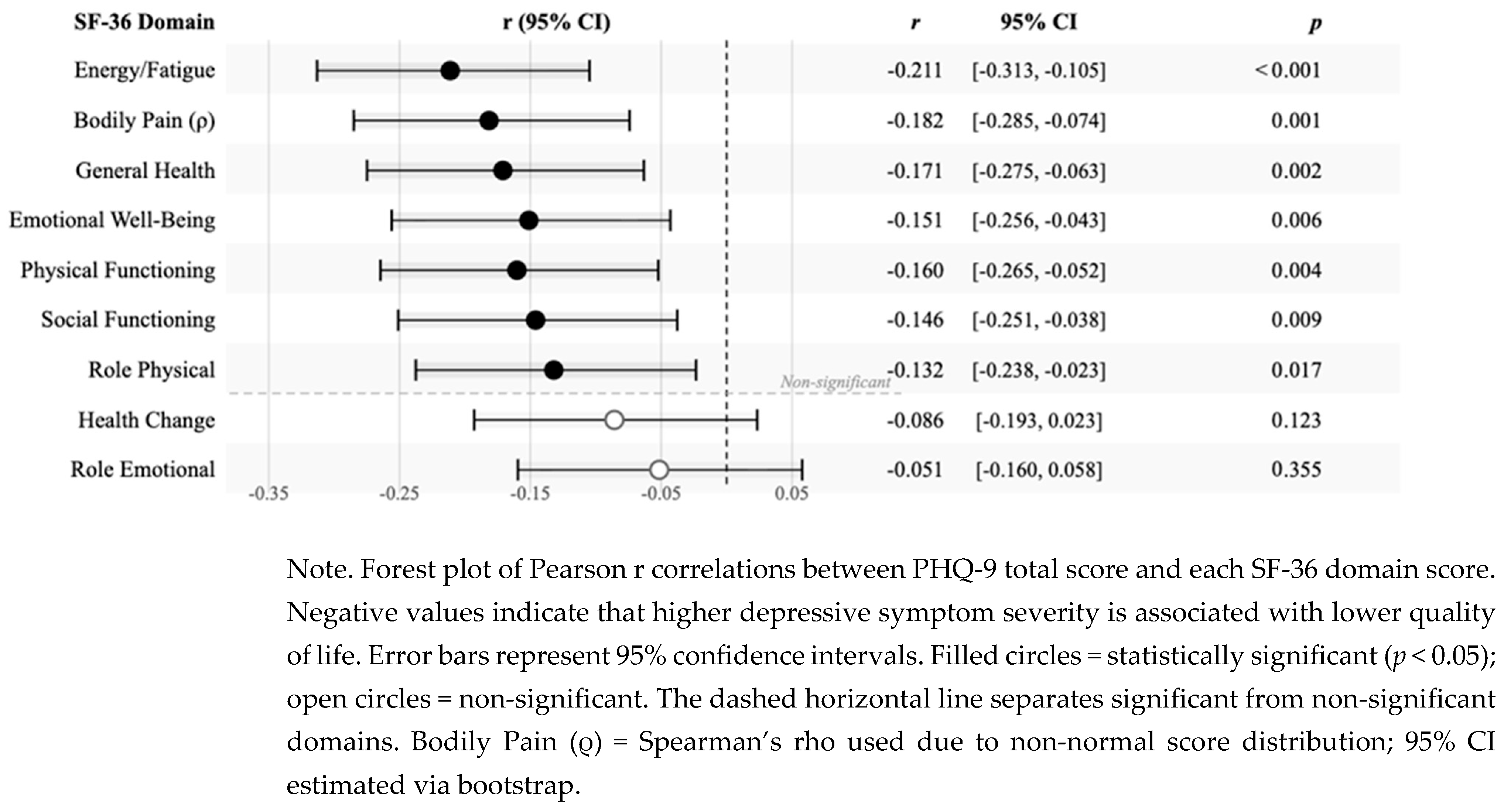
Correlations between PHQ-9 scores and SF-36 domain scores are displayed in
Figure 1. Seven of nine SF-36 domains were significantly and negatively correlated with depressive symptom severity. The largest observed association was observed for the Energy/Fatigue domain (r = −0.211, 95% CI [−0.313, −0.105],
p < 0.001), followed by General Health (r = −0.171,
p = 0.002), Physical Functioning (r = −0.160,
p = 0.004), Emotional Well-Being (r = −0.151,
p = 0.006), Bodily Pain (ρ = −0.147,
p = 0.008), Social Functioning (r = −0.146,
p = 0.009), and Role Physical (r = −0.132,
p = 0.017). Role Emotional (r = −0.052,
p = 0.355) and Health Change (r = −0.086,
p = 0.123) were not significantly associated with depression. All significant correlations were small in magnitude, with effect sizes ranging from r = −0.13 to −0.21.
3.6. Hierarchical Linear Regression: Predictors of Depressive Symptom Severity
A hierarchical linear regression was conducted to examine the incremental contributions of demographic, migration/trauma, psychosocial, and quality-of-life variables to depressive symptom severity (
Table 4). The analysis included 313 participants with complete data across all variables.
In the first block, education level alone explained 1.1% of the variance in PHQ-9 scores (ΔR2 = 0.011, p = 0.061). The addition of migration and trauma variables in Block 2 significantly increased the explained variance by 6.4% (ΔR2 = 0.064, F-change = 4.22, p = 0.001). Block 3, comprising current psychosocial variables, contributed an additional 4.0% (ΔR2 = 0.040, F-change = 6.90, p = 0.001). Critically, the inclusion of SF-36 quality-of-life domains in Block 4 explained an additional 6.3% of variance in depressive symptoms beyond all other factors (ΔR2 = 0.063, F-change = 11.65, p < 0.001), representing a modest contribution. The overall model was statistically significant, F(10, 302) = 6.56, p < 0.001, explaining 17.8% of the total variance (R2 = 0.178, adjusted R2 = 0.151). The model accounted for 17.8% of the variance in depressive symptom severity (R2 = 0.178), indicating a limited explanatory capacity.
Several predictors demonstrated statistically significant associations; however, effect sizes were small (β ≈ 0.12), indicating limited individual contributions. In the final model, the most prominent independent predictor of depressive symptom severity was the SF-36 Energy/Fatigue domain (β = −0.196, p < 0.001), indicating that lower vitality was associated with more severe depressive symptoms. Perceived threats to personal safety were the second strongest predictor (β = 0.171, p = 0.002), followed by sedative use (β = 0.145, p = 0.006), SF-36 Bodily Pain (β = −0.137, p = 0.011), education level (β = −0.133, p = 0.012), support from migrant friends (β = −0.125, p = 0.019), war participation (β = −0.123, p = 0.020), and lack of food and water during migration (β = 0.121, p = 0.023). Death threats (β = 0.086, p = 0.109) and poor family situation (β = 0.108, p = 0.051) did not reach statistical significance. Regression diagnostics indicated acceptable model assumptions: residuals were approximately normally distributed (skewness = 0.32, kurtosis = −0.21), the Breusch–Pagan test was non-significant (p = 0.166), the Durbin–Watson statistic was 2.11, and all VIF values were below 1.14.
3.7. Binary Logistic Regression: Predictors of Clinically Significant Depression
Binary logistic regression was conducted to identify independent predictors of clinically significant depression (PHQ-9 ≥ 10;
Table 5).
Univariate screening identified 14 candidate predictors at p < 0.10, including education, four migration/psychosocial variables, and all seven SF-36 domains. After multivariate entry and backward trimming, six variables were retained in the final model.
The trimmed model was statistically significant (LR χ2(6) = 40.64, p < 0.001; pseudo R2 = 0.096). The Hosmer–Lemeshow test indicated adequate model fit (χ2(8) = 11.76, p = 0.162). Perceived threats to personal safety (OR = 2.11, 95% CI [1.25, 3.54], p = 0.005) and death threats (OR = 2.06, 95% CI [1.19, 3.56], p = 0.010) were both associated with approximately twice the odds of clinically significant depression. Having friends in Serbia was also associated with increased odds (OR = 2.53, 95% CI [1.15, 5.54], p = 0.021), a finding discussed further below. Higher education level was protective (OR = 0.77, 95% CI [0.63, 0.92], p = 0.005), as was each unit increase in SF-36 Energy/Fatigue score (OR = 0.98, 95% CI [0.96, 0.99], p = 0.001). Support from migrant friends did not reach statistical significance (OR = 0.60, 95% CI [0.33, 1.08], p = 0.089). The model demonstrated an overall classification accuracy of 69.0% overall, with high specificity (84.4%) but modest sensitivity (46.5%), and the area under the ROC curve was 0.705. The observed asymmetry between sensitivity and specificity at the conventional 0.5 probability cutoff likely reflects several characteristics of the dataset and model structure rather than necessarily indicating model inadequacy. First, the prevalence of clinically significant depressive symptoms in the analytical sample (41.4%) was below 50%, which may contribute to classification favoring the larger non-depressed group when a standard 0.5 cutoff is applied. Second, the model demonstrated only moderate discriminative performance (AUC = 0.705), suggesting partial overlap in predicted probabilities between groups. Under such conditions, the conventional cutoff may preferentially identify cases with higher predicted probabilities while reducing sensitivity for less distinct cases. In addition, the 0.5 threshold represents a commonly used default rather than a threshold optimized for the specific balance between sensitivity and specificity in this sample. Alternative cutoff values could potentially produce a different trade-off between these indices. For this reason, the AUC value may provide a more stable overall indication of the model’s discriminative performance across thresholds. At the same time, the observed individual regression coefficients were generally small in magnitude, and their contributions should therefore be interpreted cautiously within a broader multifactorial context.
3.8. Convergence Across Regression Approaches
Both regression analyses converged on several key findings. The SF-36 Energy/Fatigue domain emerged as the most prominent quality-of-life predictor in both the linear model (β = −0.196) and the logistic model (OR = 0.98 per unit), consistently indicating that reduced vitality can be closely linked to depressive symptoms regardless of the analytical approach. Perceived safety threats and death threats were prominent predictors across both models, and education level was consistently protective. The linear model additionally identified bodily pain, sedative use, lack of food and water, war participation, and migrant friend support as significant predictors, likely reflecting the greater sensitivity of the continuous PHQ-9 score to detect smaller effects. The observed association between PHQ-9 scores and the SF-36 Vitality domain could be interpreted in light of partial overlap in fatigue-related content across instruments. To address this potential conceptual overlap between PHQ-9 item 4 (“feeling tired or having little energy”) and the SF-36 Vitality subscale (which contains content-related fatigue items), we conducted a sensitivity analysis recomputing the PHQ-9 total score with item 4 removed (PHQ-8f, sum of items 1–3 and 5–9). The fatigue item correlated r = −0.20 with SF-36 Vitality (3.9% shared variance) but more strongly with the other PHQ-9 items (mean r ≈ 0.50), indicating that within this sample item 4 functions more as a depressive symptom than as a vitality indicator. Re-fitting the hierarchical regression with PHQ-8f as the dependent variable produced essentially unchanged results: the SF-36 Energy/Fatigue coefficient was attenuated only modestly (β = −0.196 → −0.185, both p < 0.001), the SF-36 block ΔR2 remained highly significant (0.063 → 0.059, F-change = 10.72, p < 0.001), and all other significant predictors retained their direction, magnitude, and statistical significance. Based on these results, the conclusion that the Energy/Fatigue association is not an artefact of content overlap with the PHQ-9 fatigue item, could be drawn. But for a definitive conclusion, a more robust study design is necessary. The logistic model uniquely identified the paradoxical association between local friendships in Serbia and increased depression risk, which may reflect help-seeking behavior among more distressed individuals rather than a causal relationship.
4. Discussion
This study examined the prevalence and severity of depressive symptoms, health-related quality of life, and their interrelationships among 324 adult refugees residing in reception centers in Serbia. The findings reveal a substantial burden of depressive symptomatology, with 41.4% of participants meeting the threshold for clinically significant depression. Health-related quality of life was characterized by a marked divergence between relatively preserved physical functioning and notably impaired psychosocial well-being. Critically, the hierarchical regression analysis demonstrated that quality-of-life domains, particularly energy/fatigue and bodily pain, were associated with additional variance in depressive symptoms (ΔR2 = 0.063) beyond what demographic, trauma-related, and psychosocial variables accounted for.
The SF-36 Energy/Fatigue domain emerged as the largest independent association observed in the model of both depressive symptom severity and clinically significant depression across both analytical approaches. To our knowledge, besides the results reflecting a small incremental contribution and modest explanatory value, this work represents one of the few studies to systematically examine the incremental contribution of quality-of-life parameters to depression in a refugee population within the Balkan migration context.
4.1. Prevalence and Severity of Depressive Symptoms
The prevalence of clinically significant depressive symptoms in our sample (41.4%) is broadly consistent with existing estimates from refugee populations. A meta-analysis by Lindert et al. [
11] reported that 44% of refugees experienced depressive symptomatology, while Bedaso and Duko [
32] found that approximately one in four displaced individuals met criteria for moderate-to-severe depression, and Verhülsdonk et al. [
34] reported a prevalence as high as 68% among refugees in immigration detention. Our findings align more closely with studies conducted in transit or low-resource host settings, such as Turkey (37.4%) [
13] and Lebanon (43%) [
14], than with those from high-income resettlement countries such as Germany (14.5%) [
12]. In contrast, Foo et al. reported substantially lower prevalence (15.6%) in a broader migrant meta-analysis, highlighting the importance of distinguishing between refugee and voluntary migrant populations [
35]. These discrepancies may reflect variations in study populations, assessment tools, and host-country conditions [
36], as well as the particular stressors associated with prolonged uncertainty, limited integration opportunities, and constrained access to mental health services that characterize transit settings like Serbia.
The distribution of depressive symptom severity is noteworthy. Although 41.4% of participants exceeded the threshold for clinically significant depressive symptoms, the majority fell within the moderate range (24.1%), while fewer participants reported moderately severe (12.3%) or severe symptoms (4.9%). These findings indicate substantial variability in symptom burden within the study population and suggest that mental health needs may differ in intensity across individuals.
Similar findings were reported by Naal et al., who also used the PHQ-9 and observed that most participants exhibited no or only mild depressive symptoms [
37]. The wide variability in PHQ-9 scores (range 0–25, SD = 5.91) further underscores the heterogeneity of mental health outcomes among refugees and supports the importance of individualized and stratified approaches to psychosocial assessment.
At the symptom level, the most frequently endorsed complaints—negative self-perception, hopelessness, and concentration difficulties—may reflect the broader psychological impact of displacement, uncertainty, and prolonged psychosocial stress, consistent with previous descriptions of displacement-related demoralization in refugee populations [
38].
A substantial proportion of variance in depressive symptoms remained unexplained, underscoring the complexity of mental health outcomes in refugee populations. Depressive symptoms in refugee populations are unlikely to represent a static phenomenon and may evolve over time in response to changing post-migration conditions, uncertainty, social integration, and cumulative stress exposure. However, the cross-sectional design of the present study does not permit evaluation of temporal trajectories or stage-like patterns of depressive symptom development. Longitudinal research is therefore needed to clarify how depressive symptoms change across different phases of displacement and adaptation. The overall explanatory capacity of the model was limited, suggesting that depressive symptom severity is influenced by a range of factors not fully captured in the present analysis.
4.2. Gender Differences
No significant association between gender and depressive symptom severity was observed in the present study. However, this finding should be interpreted with considerable caution, given the markedly imbalanced gender distribution of the sample, in which men comprised 88% of participants.
The predominance of male participants substantially limits statistical power for detecting gender-related effects and restricts the interpretability and generalizability of gender comparisons. Accordingly, the absence of observed gender differences should not be interpreted as evidence that gender is unrelated to depressive symptoms in refugee populations.
Previous studies have frequently reported higher levels of depressive symptoms among female refugees [
35,
39,
40,
41], although findings vary across sociocultural and migration contexts. The discrepancy between the present findings and prior literature may therefore reflect sampling limitations rather than true differences in gender-related vulnerability.
Given the limited representation of women in the present sample, future studies should aim to include more gender-balanced refugee populations in order to enable more reliable examination of gender-related mental health differences.
4.3. Quality of Life: Physical Versus Psychosocial Divergence
A central descriptive finding of this study is the pronounced discrepancy between physical and psychosocial dimensions of quality of life. Physical Functioning (
M = 75.5) and Bodily Pain (
M = 80.5) were the highest-scoring domains, indicating relatively preserved physical capacity, whereas Vitality (
M = 54.6), Emotional Well-Being (
M = 53.6), and Role Emotional (
M = 53.9) clustered near the scale midpoint, reflecting substantial psychosocial impairment. This pattern is consistent with the broader “healthy migrant” phenomenon, in which younger, physically robust individuals self-select for migration, maintaining physical health while accumulating psychological burden through displacement-related stressors [
42]. Our findings align with a recent SF-36 meta-analysis among refugees [
43] and with reports from Germany [
21] and the Netherlands [
44] showing similar physical–psychosocial divergences.
The substantial ceiling effect observed for the Bodily Pain domain (48.8% scoring at the maximum) imposes a meaningful constraint on the interpretation of this subscale. With nearly half of participants saturating the upper end of the scale, the variable’s effective discriminative range is sharply reduced, and the resulting regression coefficient should be understood as reflecting primarily the contrast between participants reporting no pain and those reporting any pain, rather than a fine-grained dose–response relationship across the full pain continuum. Ceiling effects of this magnitude reduce variance and may attenuate observed correlations [
45], while also introducing potential non-linearity in the predictor–outcome relationship. The statistically significant Bodily Pain coefficient (β = −0.137,
p = 0.011) indicates that an association is present, but its precise magnitude and functional form cannot be reliably characterized from these data and should be interpreted with appropriate caution.
The poor internal consistency observed for several psychosocial SF-36 subscales, particularly Vitality (α = 0.447), Social Functioning (α = 0.409), and General Health (α = 0.494), is a notable finding in itself. In addition, McDonald’s ω yielded values nearly identical to α across all subscales, indicating that the low α values reflect a genuinely weak common factor in this sample. This low reliability is consistent with previously documented cross-cultural variability in SF-36 reliability among non-Western and translated samples [
29,
46,
47]. The observed variability in internal consistency across SF-36 subscales can be attributed to cross-cultural measurement limitations, including differences in language, cultural interpretation of items, and population heterogeneity, rather than to underlying psychological ambiguity. However, it is important to note that low reliability attenuates observed correlations toward zero [
45], so the associations reported here likely underestimate the true magnitudes of the relationships between SF-36 psychosocial subscales and depressive symptoms. Although the SF-36 quality-of-life block contributed the highest increment to explained variance in the hierarchical regression (ΔR
2 = 0.063), this contribution is small in absolute terms and should nonetheless be interpreted with caution given the limited internal consistency observed for several of the underlying subscales.
4.4. Depression and Quality of Life: Energy/Fatigue as the Central Link
The most important analytical finding of this study is the moderate association between the SF-36 Energy/Fatigue domain and depressive symptoms. Energy/Fatigue was a significant correlate of PHQ-9 scores (r = −0.211), and demonstrated moderate but highest predictive power in the hierarchical linear regression (β = −0.196, p < 0.001), and the relatively modest quality-of-life predictive power in the logistic regression (OR = 0.98 per unit, p = 0.001). The Hierarchical analysis further demonstrated that the SF-36 quality-of-life block explained an additional 6.3% of variance in depressive symptoms beyond demographics, trauma history, and psychosocial factors, indicating that functional impairment in daily life independently contributes to depression beyond what stressor exposure alone explains. However, the explanatory power of the regression model was limited (R2 = 0.178, adjusted R2 = 0.151), indicating that depressive symptom severity in this population is influenced by a range of factors not fully captured in the present analysis.
One of the more consistent findings in the present study was the association between the SF-36 Energy/Fatigue domain and depressive symptom severity. However, this relationship should be interpreted cautiously.
The observed association was modest in magnitude and may partly reflect conceptual and content overlap between the PHQ-9 and the SF-36 Vitality domain, as both instruments include fatigue-related symptom content. Consequently, the relationship observed between these measures cannot be interpreted as fully independent.
In addition, the overall explanatory contribution of HQoL variables to the regression model was limited (ΔR2 = 0.063), indicating that quality-of-life domains accounted for only a modest proportion of variance in depressive symptom severity beyond sociodemographic and psychosocial factors.
Fatigue-related experiences in refugee populations are likely multidetermined and may reflect a combination of psychological distress, chronic stress exposure, disrupted sleep, physical exhaustion, and adverse living conditions. However, given the cross-sectional design, measurement overlap, and psychometric limitations of several SF-36 subscales, the present findings should be interpreted as exploratory rather than indicative of a robust or specific predictive relationship.
Bodily Pain also demonstrated a modest association in the linear regression (β = −0.137,
p = 0.011) with depressive symptoms. This finding is broadly consistent with prior literature describing interactions between physical pain and psychological distress in trauma-exposed populations [
48,
49]. The bidirectional relationship between pain and depression, each exacerbating the other in a reinforcing cycle, has been documented [
50] and highlights the importance of integrated care models. Pain and depression interact through shared neurobiological pathways, and in migration contexts characterized by uncertainty, separation from family, and limited access to healthcare, pain may serve as a critical link between physical and psychological suffering [
51,
52]. Nevertheless, the substantial ceiling effect observed in the Bodily Pain domain and the modest magnitude of the regression coefficient limit the strength of conclusions that can be drawn regarding its clinical relevance. The non-significance of the Role Emotional domain in all analyses merits discussion. This domain showed no association with depressive symptoms despite its face validity. This null finding likely reflects the domain’s poor reliability in this sample (α = 0.671 with only three dichotomous items), its crude yes/no response format that limits variance, and potential cultural differences in how emotional role impairment is conceptualized and reported. It may also reflect adaptive coping strategies in which refugees maintain functional roles despite emotional distress, possibly motivated by the necessity of managing daily survival tasks irrespective of mood state.
4.5. Trauma, Safety Threats, and the Primacy of Current Stressors
Perceived threats to personal safety and experiences of death threats were associated with higher levels of depressive symptoms across analyses (OR = 2.11 and 2.06, respectively) and have a certain significance as predictors in the linear model (β = 0.171 for safety threats), although the magnitude of these effects was modest.
In the logistic regression model, these variables were associated with approximately twofold higher odds of clinically significant depressive symptoms, while regression coefficients in the linear model remained within a small-to-moderate range. Given the limited explanatory capacity of the overall model, these findings should be interpreted cautiously and within a broader multifactorial context.
Nevertheless, the observed associations are broadly consistent with previous literature linking exposure to threat-related experiences with adverse mental health outcomes in refugee populations [
53,
54]. Such experiences may contribute to persistent insecurity, reduced perceived control, and chronic psychosocial stress.
Importantly, the variables examined in the present study may reflect both prior traumatic experiences and ongoing perceptions of insecurity within the migration context. However, given the cross-sectional design and the exploratory nature of the analyses, no conclusions regarding causal or temporal relationships can be drawn.
A notable finding was the absence of a statistically significant association between reported torture exposure and depressive symptom severity. Torture exposure was highly prevalent within the sample (51.5%), yet it was not significantly associated with PHQ-9 scores in either bivariate or multivariable analyses.
One possible explanation is that the high prevalence of torture exposure reduced the discriminatory capacity of this variable within the present sample. In addition, the psychological consequences of traumatic experiences may vary considerably across individuals depending on multiple factors, including time since exposure, coping mechanisms, social support, and current living conditions.
However, given the cross-sectional design and the limitations of the available measures, the present study cannot determine the relative contribution or temporal significance of different traumatic or stress-related experiences. Accordingly, these findings should be interpreted cautiously and considered exploratory.
A statistically significant negative association between war participation and depressive symptom severity was observed in the regression analysis (β = −0.123,
p = 0.020), which contrasts with much of the existing literature [
55,
56]. However, this finding should be interpreted with substantial caution.
The observed effect size was small, and the overall explanatory capacity of the model was limited. In addition, the inclusion of multiple conceptually related trauma variables may have affected coefficient stability and interpretability.
Given the exploratory nature of the analyses, the cross-sectional design, and the absence of direct assessment of relevant psychological constructs, the present study cannot provide a substantive explanation for this association. It is therefore possible that the finding reflects statistical instability, residual confounding, or sample-specific variation rather than a reliable underlying relationship.
Accordingly, this result should be considered exploratory and interpreted cautiously until replicated in longitudinal studies using more comprehensive assessment approaches.
The association involving war participation should be interpreted cautiously, given the modest coefficient magnitude and exploratory nature of the model.
4.6. Education, Employment, Social Support, and Family Context
Education level was consistently protective across both regression models, with each step up in educational attainment reducing the odds of clinical depression by approximately 23% (OR = 0.77). This finding aligns with recent literature indicating that education confers multiple protective mechanisms: enhanced cognitive coping strategies, greater problem-solving capacity, improved access to information and services, facilitated language acquisition, and better navigation of host-country systems [
11,
16]. In the context of displacement, higher education may also buffer against the loss of social status and identity that contributes to depressive demoralization. Refugees with lower education may face greater barriers to employment and social integration, increasing feelings of marginalization and loss of control.
Employment status warrants discussion despite the limited variability in our sample (96.3% unemployed). Employment as a reason for migration was strongly protective in univariate logistic analysis (OR = 0.42,
p = 0.001), suggesting that refugees who migrated with economic goals—rather than fleeing violence—may have a more agentic, goal-directed orientation that is protective against depression. Although this variable did not survive multivariate adjustment, the finding is consistent with the literature demonstrating strong associations between unemployment and depression among refugees [
38,
57,
58]. Employment provides not only financial stability but also structure, purpose, social interaction, and a sense of usefulness, all of which are protective against depression [
59]. The near-universal unemployment in our sample limits our ability to test direct employment effects, but it underscores the importance of vocational support as a potential mental health intervention.
Different forms of social support demonstrated distinct associations with depressive symptoms. Support from migrant peers was associated with lower depressive symptom severity in the linear model (β = −0.125,
p = 0.019) and showed a similar trend in the logistic regression analysis (OR = 0.60,
p = 0.089). One possible explanation is that relationships formed within refugee communities may provide emotional understanding, shared experiences, and practical assistance in the context of displacement and uncertainty [
60,
61]. However, given the cultural and national heterogeneity of the sample, these findings should not be interpreted as reflecting a uniform sociocultural pattern.
In contrast, having friends in Serbia was associated with higher odds of clinically significant depressive symptoms (OR = 2.53, p = 0.021). Given the cross-sectional design, this finding may reflect reverse causation, whereby individuals experiencing greater psychological distress are more likely to seek local social connections or support. Alternatively, such relationships may emerge in the context of increased psychosocial vulnerability or unmet support needs. However, the present study design does not permit conclusions regarding the directionality or underlying mechanisms of these associations. Accordingly, these findings should be interpreted cautiously and considered exploratory pending replication in longitudinal studies.
Poor family situation showed a trend toward significance in the linear regression (β = 0.108,
p = 0.051), consistent with the original analysis of these data and with literature emphasizing family as a primary source of emotional and practical support in collectivist cultures [
62]. Family instability, separation, or conflict can intensify feelings of loss, loneliness, and uncertainty, particularly among refugees from Middle Eastern and South Asian backgrounds, where family constitutes the central organizing structure of social life. These findings reinforce the importance of family-centered approaches and interventions aimed at strengthening family functioning and reunification efforts where possible.
Sedative use was significantly associated with higher depressive symptom severity in the linear model (β = 0.145,
p = 0.006). This association most likely reflects a severity marker rather than a causal effect: refugees prescribed anxiolytics represent a subgroup with more severe or chronic psychological distress, comorbid anxiety or insomnia, and limited access to structured psychotherapeutic interventions. Prolonged use of benzodiazepines may additionally contribute to emotional blunting, reduced motivation, and fatigue [
63], potentially exacerbating rather than alleviating depressive symptoms. These findings highlight the importance of comprehensive mental health care that incorporates psychosocial interventions alongside pharmacotherapy.
4.7. The Self-Rated Health Paradox
An incidental but clinically significant finding is that self-rated physical health (M = 6.67/10) and self-rated mental health (M = 7.19/10) did not differ between depressed and non-depressed groups (both p > 0.77). Even participants meeting the PHQ-9 threshold for clinical depression rated their mental health as above average. This disconnect between structured screening results and subjective self-assessment has important implications: it suggests that refugees may not recognize, label, or acknowledge their depressive symptoms through conventional health self-evaluation frameworks. Cultural differences in the conceptualization of mental health, stigma surrounding mental illness, a normalization of distress in the context of displacement, or a tendency toward socially desirable responding may all contribute. This finding reinforces the argument for systematic screening with validated instruments such as the PHQ-9 in refugee reception settings, as reliance on self-reported health status alone would fail to identify the majority of individuals with clinically significant symptoms.
4.8. Clinical and Public Health Implications
Several practical considerations emerge from the present findings, which are similar to conclusions from other authors [
64], although they should be interpreted cautiously given the cross-sectional and exploratory nature of the study.
First, the PHQ-9 demonstrated acceptable internal consistency within this sample and may represent a feasible screening instrument for depressive symptoms in multilingual refugee settings. However, this should be interpreted separately from the lower reliability observed in several SF-36 subscales, which substantially limits the interpretability of some HQoL-related findings.
Second, the observed associations involving fatigue-related and psychosocial quality-of-life domains may indicate areas warranting further clinical attention and future investigation. However, given the overlap between PHQ-9 fatigue content and the SF-36 Vitality domain, as well as the modest effect sizes observed, these findings should not be interpreted as indicating specific therapeutic targets or intervention priorities.
Third, associations involving perceived safety concerns, social support, education, and employment-related variables suggest that broader psychosocial and environmental factors may be relevant to mental health outcomes in refugee populations. However, the present study does not permit conclusions regarding causality, temporal relationships, or comparative intervention effectiveness.
Finally, the poor internal consistency of several SF-36 psychosocial subscales in this population suggests that culturally adapted quality-of-life measures may be needed for valid assessment of subjective well-being among refugees from Middle Eastern and South Asian contexts. Accordingly, these findings should be considered hypothesis-generating and may help inform future longitudinal and intervention-based research.
5. Limitations
Several limitations should be acknowledged. The cross-sectional design precludes causal inference, which is particularly relevant for the observed association between quality of life and depression (the directionality of which cannot be established) and the paradoxical findings regarding local friendships and war participation. The reliance on self-report measures may have introduced social desirability bias, cultural response style effects, and recall bias. Although validated translations of all instruments were used, subtle differences in the cultural interpretation of items may have contributed to the low reliability observed for certain SF-36 subscales. The absence of formal psychometric validation of the SF-36 and PHQ-9 within this specific refugee population represents an important limitation. Future studies should prioritize the use of culturally adapted and validated instruments to improve measurement reliability and validity. The convenience sampling strategy and restriction to four reception centers may limit generalizability to the broader refugee population in Serbia or elsewhere. The predominantly male participants (88%) substantially limit gender-related inference, and limit the extent to which findings can be generalized to female refugees. The use of exploratory variable selection procedures and conceptually related predictors may have influenced the stability and interpretability of regression estimates.
The explained variance in both regression models was modest (R2 = 0.178 for the linear model; pseudo R2 = 0.096 for the logistic model), indicating that a substantial proportion of variability in depressive symptoms remains unexplained. Factors not captured in this study, such as personality traits, individual coping styles, pre-migration mental health history, specific asylum process experiences, language proficiency, and duration of displacement, likely contribute to this unexplained variance. The poor reliability of several SF-36 psychosocial subscales may have influenced the magnitude and stability of observed associations involving these domains. The direct content overlap between the PHQ-9 fatigue item and the SF-36 Energy/Fatigue domain should also be acknowledged as a potential source of inflated association, although the consistency of the Energy/Fatigue finding across multiple analytical approaches and the significance of Bodily Pain (which shares no content with the PHQ-9). Nevertheless, the consistency of certain findings across analytical approaches suggests that the observed associations may not be solely attributable to measurement overlap. The use of single-item measures for complex constructs represents an important limitation. Such measures may not adequately capture the multidimensional nature of constructs such as discrimination, trauma exposure, or social support and may introduce measurement error. Accordingly, associations involving these variables should be interpreted as exploratory. Single-item measures may also contribute to attenuation or instability of observed associations. The cultural heterogeneity of the sample limits broader sociocultural interpretation of psychosocial variables. The study design does not permit inference regarding intervention effectiveness or therapeutic prioritization. Finally, the reduction from 324 to 313 participants due to listwise deletion in regression analyses, while minor, may have introduced some selection bias.
6. Conclusions
This study demonstrates that depressive symptoms are highly prevalent among refugees in Serbian reception centers and are closely intertwined with impaired health-related quality of life, particularly reduced vitality and increased bodily pain. Quality-of-life domains explained additional variance in depressive symptoms beyond demographic, trauma-related, and psychosocial factors, with the Energy/Fatigue dimension emerging as the most prominent independent correlate across all analytical approaches. Current psychosocial stressors, especially perceived threats to personal safety, were more strongly associated with depression than historical trauma exposure, reinforcing the need for interventions that address ongoing insecurity alongside past experiences. Education level was consistently protective, while social support from within the refugee community appeared to buffer against depression.
These findings underscore the urgent need for systematic mental health screening in refugee reception settings and support the development of integrated, culturally sensitive interventions that address both depressive symptoms and functional well-being. Programs targeting vitality, through physical activity, sleep improvement, nutritional support, and psychoeducation, may represent particularly effective and acceptable entry points for mental health care in this population. Addressing ongoing insecurity, strengthening social networks within refugee communities, facilitating educational and vocational opportunities, and improving access to coordinated mental health care should be considered central components of public health strategies targeting displaced populations in transit settings.




 ,
,