1. Introduction
In Applied Behavior Analysis (ABA), behavioral principles and procedures are widely used to teach verbal and non-verbal skills that are often impaired in children diagnosed with autism spectrum disorder (ASD). One of the most used instructional arrangements is discrete trial teaching (DTT) in a structured environment involving one-to-one interactions between interventionist and learner. Skills training concerns up to five steps: (1) provision of a verbal instruction (discriminative stimulus) to the learner; (2) provision of a prompt if needed; (3) response emission by the learner; (4) differential consequence to the learner’s response (either a correction procedure or reinforcer delivery upon an incorrect or correct response, respectively); and (5) provision of an interval between teaching trials [
1,
2]. Although DTT has been shown to be effective in establishing a wide range of repertoires, there is increasing interest in identifying strategies that may enhance its instructional efficiency [
3].
One such strategy is instructive feedback (IF), which involves embedding additional, non-target information (secondary targets) within instructional trials focused on a primary learning objective. In this procedure, the learner receives reinforcement contingent on correct responding to the primary target, followed by the presentation of additional information that is not directly required for responding. In the end, learners may acquire both directly taught responses and untaught secondary repertoires without additional instructional trials. As an example, an interventionist provides differential reinforcement when a learner points to the picture of a dog from an array with several pictures and under control of the instruction “touch dog”. In addition to a reinforcer stimulus (e.g., praise), a new information (IF) (e.g., “the dog is an animal”) is delivered in the consequent portion of the contingency. As a result, in addition to the acquisition of what was directly taught (the primary target), the learner may demonstrate the emergence of one or more new skills or secondary targets (e.g., by saying “the dog is an animal” under the control of a picture of a dog; by pointing to the picture of the dog in response to the verbal instruction “show me animal”) [
1,
3].
From a behavior-analytic perspective, mechanisms may account for the effects of IF. These include stimulus control transfer, in which secondary stimuli acquire control over responding through repeated pairing with reinforced primary targets, as well as observational learning processes, in which learners attend to and encode additional information presented during instruction. Additionally, IF may facilitate the formation of functional stimulus classes, allowing for the emergence of untrained relations among stimuli [
1,
3,
4,
5,
6,
7,
8,
9,
10,
11,
12,
13,
14,
15]. However, the relative contribution of these mechanisms remains unclear, highlighting the need for further empirical investigation.
Previous research has demonstrated that IF may enhance both the effectiveness and efficiency of instruction. Effectiveness refers to the extent to which a procedure produces the desired learning outcome, whereas efficiency relates to the amount of instructional time required to achieve that outcome. Studies have shown that learners may acquire multiple repertoires, including both primary and secondary targets, within a reduced number of teaching trials when IF is implemented [
3,
4,
5,
6,
7]. However, findings across studies have not been entirely consistent, suggesting that variables such as prior learning history, familiarity with IF procedures, and task characteristics may influence responsiveness.
In addition to individual instructional arrangements, IF has been evaluated in group-based formats and through telehealth delivery models, with some evidence indicating that learners may acquire both their own targets and those presented to peers through observation [
7,
8,
9,
10,
11]. Furthermore, recent research has extended the application of IF to contexts such as second-language learning, demonstrating generalization across novel stimuli for some participants [
12]. Despite these advances, variability in outcomes remains, particularly regarding the emergence of secondary targets and maintenance of acquired repertoires.
Studies examining the effects of IF on multiple secondary targets have shown mixed results. In some cases, learners demonstrated acquisition of several untaught repertoires following training with IF [
13,
14], whereas in other cases, emergence was observed for only a subset of participants [
15]. These inconsistencies suggest that factors such as prior exposure to IF, familiarity with the primary target, and individual learner characteristics may influence outcomes [
13,
14]. Moreover, some studies did not assess maintenance [
15] or included participants with prior experience with IF [
14], limiting the generalizability of findings.
The present study was designed to address these gaps in the literature. Specifically, it evaluated the effects of IF on the acquisition of a primary target (simple tact) and the emergence of multiple secondary targets in children with ASD who had no prior exposure to either the primary target or the IF procedure. The selection of four secondary targets was based on their functional relation to the primary target within the domain of verbal operants, allowing for the assessment of generative learning across multiple response classes.
The four secondary targets were selected because they represented distinct verbal and stimulus control repertoires functionally related to the primary target. Listener responding according to category and tact according to category involved discriminative control by categorical relations, whereas arbitrary visual matching-to-sample required conditional visual discrimination, and intraverbal responding according to category involved more complex verbally mediated responding. The inclusion of these different repertoires allowed evaluation of emergence across multiple response classes that may differ in complexity and stimulus control requirements.
In addition, the study included a maintenance assessment to evaluate the durability of both directly taught and emergent repertoires. By examining outcomes in learners unfamiliar with IF, the present study contributes to the literature by isolating the effects of the procedure without potential confounds related to prior exposure.
It was hypothesized that: (1) the primary target would be acquired following training with IF; (2) secondary targets would emerge without direct instruction; and (3) both primary and secondary targets would be maintained over time. Furthermore, it was expected that variability in responsiveness across participants might be observed, consistent with previous findings in the literature.
2. Materials and Methods
2.1. Participants
Three white boys between 6 and 8 years old (P1, P2 and P3) from low-income families participated. All children, regardless of the research, received interventions based on Applied Behavior Analysis (ABA) once a week for 1 h and 30 min in rooms of a Brazilian university-based laboratory. They were all enrolled in regular schools, but they did not have any curriculum adaptation program. Before the onset of the current study, the children had already been shown the following skills, which represented an inclusion criterion: tact of objects, pictures and actions regarding an average of 200 stimuli; identification of at least 250 objects and pictures as listeners (selecting them in arrays upon their dictated names); over 70 fill-in-the-blank vocal intraverbals and cases of answering questions of varying complexity; identity and arbitrary matching-to-sample involving visual stimuli at a generalized level; over 70 listener responses under the control of instructions on function, feature and class to which common pictures and objects are related. If a given child did not demonstrate skills at a level similar to or below that described here, they would be excluded from the research.
All participants had a prior diagnosis of ASD established by qualified professionals according to clinical criteria. Although standardized measures of ASD severity and cognitive or language functioning were not systematically collected, participants were enrolled in ABA-based intervention programs and demonstrated repertoires consistent with the inclusion criteria described above.
2.2. Setting
Data collection with each child participant occurred in a room from a Brazilian university laboratory. The room was equipped with a table and three chairs. Throughout the study conditions, a child sat on one chair and an experimenter, who performed procedures and collected data, sat on another chair facing the child. In one part of the sessions, considering the different research conditions, a second observer (research assistant) sat on the third chair to collect data along with the experimenter and subsequently establish a level of agreement between observers.
2.3. Materials
Throughout the research conditions involving baseline and intervention with primary target and probes with four secondary targets, the experimenter used laminated pictures measuring 7 cm × 10 cm with images representing stimuli that form classes. For P1, P2 and P3, stimuli consisted of pictures portraying Brazilian soccer teams and pictures of Brazilian states to which they belong. More specifically, the pictures used represented the teams known as Figueirense, Avaí and Chapecoense (and related picture of the state of Santa Catarina) and the teams known as Paysandu, Remi and Castanhal (and related picture of the state of Pará).
Figure 1 shows all pictures used. Although culturally relevant stimuli (e.g., Brazilian soccer teams) were used, efforts were made to minimize prior familiarity by selecting stimuli that were not part of the participants’ instructional history. However, the potential influence of prior exposure cannot be completely ruled out. Stimulus sets were not counterbalanced across participants, which may limit conclusions regarding stimulus-specific learning effects.
2.4. Dependent Variable
For each participant, one of the dependent variables (DVs) corresponded to the number of correct responses representing a primary target, that is, simple tact (e.g., saying “Figueirense” under control of the picture portraying the Figueirense team), across sessions of 12 trials. Other DVs were the number of correct responses representing the following secondary targets across sessions of 12 trials: listener responding according to category (e.g., pointing to the picture of Figueirense following the instruction “show me a team from the state of Santa Catarina”); tact according to category (e.g., saying “Santa Catarina” under the control of the picture of Figueirense and the question “what state is the Figueirense team from?”); intraverbal according to category (e.g., saying “Figueirense, Avaí and Chapecoense” under the control of the instruction “name soccer teams from the state of Santa Catarina”); and arbitrary visual matching-to-sample (e.g., pairing the picture of Santa Catarina to the picture of Figueirense team as the model stimulus).
2.5. Independent Variable
The independent variable (IV) in the current research consisted of teaching the primary target (i.e., simple tact) with the provision of praise and the instructive feedback (IF) information in the consequent portion of the contingency across sessions with 12 trials (e.g., saying “Figueirense” under the control of the picture of the Figueirense team. Thereafter, the experimenter provided praise, showed the picture of Santa Catarina and delivered the IF information “Figueirense is a team from the state of Santa Catarina”). The effects of teaching the primary target with IF information were assessed on the acquisition of both the primary and related secondary targets defined as DVs.
Table 1 shows examples of DVs and IVs for the three participants in the study.
2.6. Experimental Design
In this research, the effects of teaching the primary target with IF information delivered in the consequent portion of the contingency were measured on the acquisition of both the primary (simple tact) and secondary targets (listener responding according to category, tact according to category, arbitrary visual matching-to-sample and intraverbal according to category), which were not directly taught and were probed for emergence.
Experimental control was established via a type of single case research design, that is, concurrent multiple baseline design across participants. The number of baseline sessions varied across participants to allow for staggered introduction of the intervention, consistent with multiple baseline design logic for demonstrating experimental control. Consistent with WWC recommendations for single-case research, stability of responding and replication across tiers were prioritized over arbitrary baseline length requirements. The intervention was introduced at different time points across participants to control for potential coincidental changes and to demonstrate replication of effects across tiers [
16,
17].
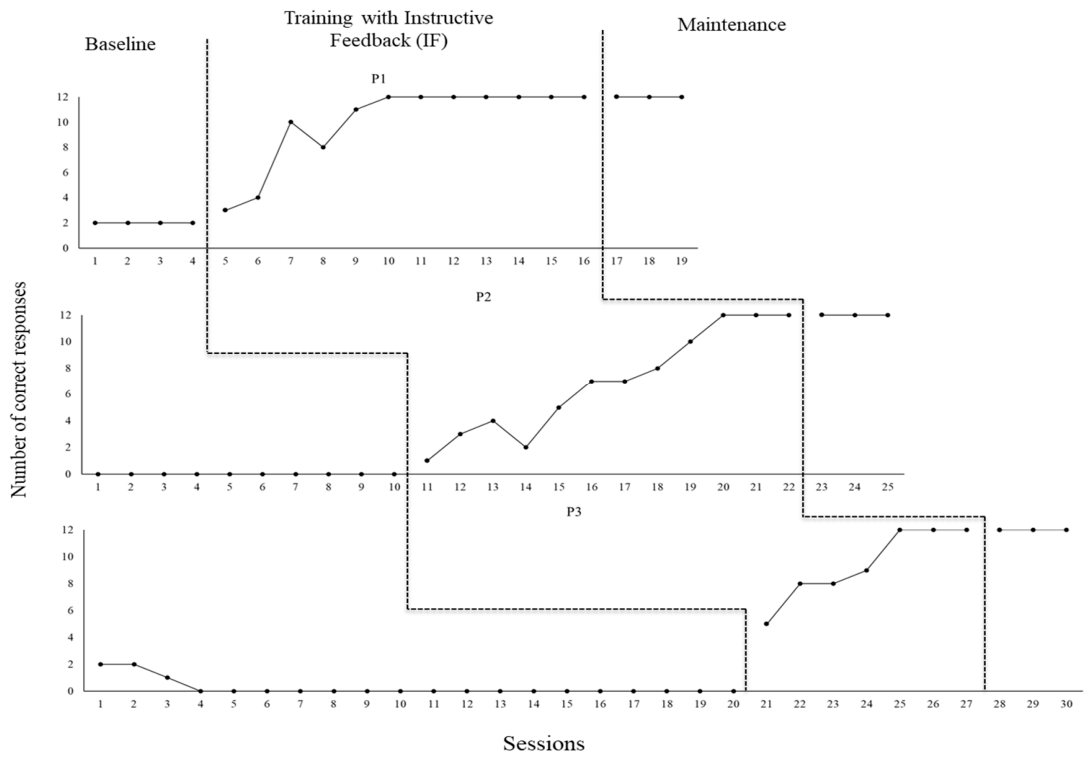
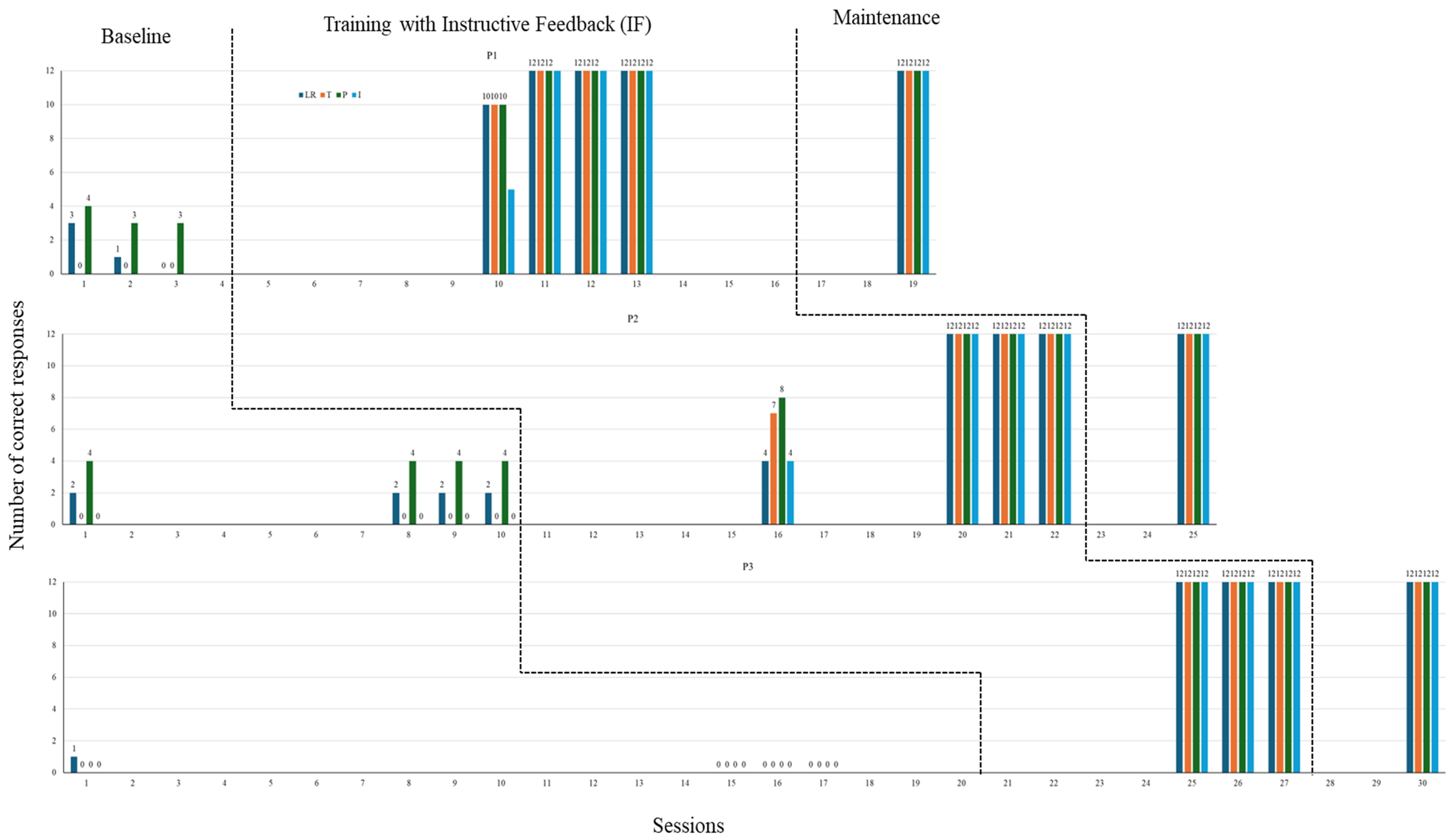
Regarding the primary target, correct responses were measured across sessions related to two conditions per participant, that is, baseline and intervention. Baseline began concurrently for P1, P2 and P3. After low performance was demonstrated with stability, the IV was first applied to P1 whereas baseline continued for the remaining participants. When performance improved for P1, the IV was applied to P2 and baseline continued for P3. Likewise, when performance improved for P2, then IV was applied to P3 until an improvement in performance was also demonstrated. During baseline and intervention conditions with the primary target, intermittent probe sessions were established to measure correct responses on secondary targets to which the IF information provided was related. These probes were used to measure the possible emergence of these secondary repertoires after training the primary target with IF.
2.7. Procedures
Data was collected on a trial-by-trial basis and later summarized at the session level for visual analysis. Sessions were conducted in a structured discrete-trial format with consistent sequencing of instructional components across trials. Although the exact timing of individual trials was not recorded, all sessions followed the same pacing and instructional structure. Sessions involving baseline, intervention, and maintenance conditions for the primary target lasted approximately 5 min on average. Participant P1 was exposed to 12 intervention sessions, although mastery criterion was achieved after 8 sessions. Participant P2 required 12 intervention sessions to meet mastery criterion, whereas P3 achieved criterion after 7 intervention sessions.
Primary target baseline. Each baseline session involved the presentation of 12 trials to assess simple tact. In each trial, after the experimenter presented a picture and question (e.g., a picture of the Figueirense team and the question “what is this?”), the participating child had up to 5 s to emit a response (e.g., saying “Figueirense”). There were no differential consequences programmed for either correct or incorrect responses. A low and stable performance across sessions (three consecutive at least) represented the criterion to terminate baseline condition per participant. The baseline stability was defined as low variability and absence of an increasing trend across at least three consecutive sessions, based on visual inspection of the data.
Primary target training. As in the baseline, sessions consisted of 12 trials. In each trial, the experimenter showed a picture and a question, and the participant had up to 5 s to respond (e.g., saying “Figueirense” in the presence of the picture of the Figueirense team and the question “what is this?”). However, unlike the baseline, differential consequences were programmed for correct and incorrect responses. After a correct response/simple tact by the participant, the experimenter delivered verbal praise, the picture of the state (e.g., a picture portraying the state of Santa Catarina) of the previous labeled picture and IF information on the category (e.g., “Figueirense is a team from the state of Santa Catarina”). In the event of an incorrect response or failure to respond within the 5 s period allowed for the trial an error correction procedure would be applied. In this case, the experimenter provided the response (e.g., say “Figueirense”) so the participant could repeat it. The criterion to terminate the training condition per participant consisted of at least three consecutive sessions without errors.
Primary target maintenance. As in the baseline, sessions consisted of 12 trials. In each trial, the experimenter showed a picture and question, and the participant had up to 5 s to respond (e.g., saying “Figueirense” in the presence of the picture of the Figueirense team and the question “what is this?”). As in the baseline, no differential consequences were programmed for correct and incorrect responses. This condition involved three sessions per participant.
Secondary target probes. Intermittent probe sessions to assess the emission of secondary targets were intermittently conducted throughout all phases aimed at measuring the primary target/simple tact (i.e., baseline, primary target training with IF, maintenance). Regarding each case of secondary target probe session, each participant had up to 5 s to emit a response after an instruction was provided by the experimenter in each of 12 trials. No differential consequences were programmed for correct and incorrect responses. In the case of listener responding according to category, an array of pictures portraying soccer teams and instruction on the category were provided, so the participant had the opportunity to point to the corresponding picture from the array (e.g., pointing to the picture of Figueirense after “show me a team from the state of Santa Catarina”).
In the case of tact according to category, a picture and question related to category were provided. Then, the participant had the opportunity to state the category to which the picture belongs (e.g., saying “Santa Catarina” under the control of the picture of Figueirense and the question “what state is the Figueirense team from?”). Secondary target of arbitrary visual matching-to-sample involved the provision of an array of pictures portraying states and another picture representing a soccer team as model. Thereafter, the participant had to point to the picture in the array that corresponded to the model (e.g., pairing the picture of the state of Santa Catarina to the picture of the Figueirense team). Finally, the case of intraverbal according to category involved the provision of a verbal instruction in which the experimenter asked the participant to name soccer teams from a given state. The participant, then, had the opportunity to name soccer teams (e.g., saying “Figueirense, Avaí and Chapecoense” under the control of “name soccer teams from the state of Santa Catarina”).
Probe sessions for secondary targets were conducted systematically at predetermined intervals, independent of participant performance on the primary target. Repeated exposure to probe trials may have contributed to incidental learning; however, probe sessions were designed to minimize instructional feedback (e.g., no reinforcement or correction procedures were provided).
Social validity assessment. After data collection with the participating children was finished, their parents answered a Likert scale questionnaire containing the following questions: (1) I believe that the procedures from the study helped my child to communicate more; (2) I consider the skills that my child developed in the research important; (3) I believe that the procedures used in the study may be important to teach new skills that will benefit my child in everyday interactions; (4) I wish that the procedure be used with my child outside the context of research; and (5) I recommend the procedure used with my child for new children with atypical development. Each question involved alternatives ranging from “1”, meaning “I completely disagree”, to “5”, meaning “I completely agree”.
Procedural fidelity was not formally measured during the study. However, all intervention sessions were conducted by trained interventionists following standardized protocols. Future studies should include systematic measures of treatment integrity to strengthen internal validity.
2.8. Interobserver Agreement (IOA)
In part of the research, a second observer/research assistant, in addition to the experimenter, also collected data on participants’ performance across conditions involving primary and secondary targets to establish levels of interobserver agreement (IOA). On each trial within sessions, an agreement was verified when both observers recorded the same type of response, whether correct or incorrect. For all participants IOA, regarding the primary target, was determined in approximately 20% of the sessions (four, five and six sessions for P1, P2 and P3, respectively). And, regarding the secondary targets, IOA was determined in 50% (four), 55% (five) and 75% (six) of the sessions for P1, P2 and P3, respectively. For all participants, IOA level corresponded to 100%. Observers were not blinded to experimental conditions, which may represent a limitation.
2.9. Ethical Procedures
This study was part of a broader research project approved by the Human Research Ethics Committee of the Federal University of Maranhão, Brazil (approval number: 4.284.271). The project was approved on 17 September 2020, with a planned duration of five years. The present study was conducted in 2023. Participants and their parents or legal guardians signed informed consent forms prior to participation. Participant identities were kept confidential, and participation in the study could be discontinued at any time without any negative consequences.
4. Discussion
The present study evaluated the effects of instructive feedback (IF) on the acquisition of a primary target and the emergence of multiple untaught secondary targets in children with autism spectrum disorder (ASD) with no prior exposure to IF. Overall, the findings support the effectiveness of IF in promoting both direct learning and emergent responding, extending previous research in this area [
3,
4,
5,
6,
7,
8,
9,
10,
11,
12,
13,
14,
15].
4.1. Primary Target Acquisition
Consistent with the prior literature, the introduction of IF was associated with clear improvements in performance on the primary target [
3,
4,
5,
6,
7,
8,
9,
10,
11,
12,
13,
14,
15]. Visual analysis indicated immediate changes in level, increasing trends during intervention, and stable high performance following mastery. The presence of strong immediacy of effect, minimal overlap between baseline and intervention phases, and consistent replication across participants supports the existence of a functional relation between IF and skill acquisition within a multiple baseline design framework [
16,
17]. The findings in this investigation replicate and extend previous studies demonstrating that embedding additional stimuli during instruction does not interfere with acquisition of the primary target and may enhance overall instructional outcomes [
3,
4,
5,
6,
7,
8,
9,
10,
11,
12,
13,
14,
15].
4.2. Emergence of Secondary Targets
A central contribution of the present study lies in the demonstration of emergent responding across multiple secondary targets without direct instruction. All participants exhibited substantial increases in correct responding following exposure to IF contingencies, suggesting that learning extended beyond directly reinforced responses. These findings are consistent with previous research indicating that IF may facilitate the emergence of untaught behaviors through mechanisms such as stimulus control transfer, observational learning, and functional stimulus class formation. From a behavior-analytic perspective, repeated exposure to secondary stimuli during instructional trials may promote the formation of functional stimulus classes, allowing untaught responses to emerge under similar stimulus conditions [
13,
14,
15]. Importantly, although increases in responding were evident across all targets, some variability across probe sessions suggests gradual acquisition patterns rather than immediate full emergence. Differences in acquisition patterns across secondary targets may reflect distinct stimulus control and verbal response requirements. For example, intraverbal responding according to category may involve more complex verbally mediated responding than listener responding or visual matching-to-sample repertoires. This finding highlights that emergent learning may occur progressively, rather than as an abrupt, all-or-none phenomenon.
4.3. Effectiveness Versus Efficiency
The distinction between effectiveness and efficiency is particularly relevant in interpreting the present findings. Effectiveness refers to the extent to which a procedure produces the desired learning outcome, whereas efficiency relates to the amount of instructional time required to achieve that outcome [
3,
4,
5,
6,
7]. Although the present study clearly demonstrated effectiveness, conclusions regarding efficiency should be interpreted cautiously.
While the simultaneous acquisition of multiple repertoires suggests potential efficiency gains, the study did not include direct comparisons of instructional conditions or formal measures of instructional efficiency. Although instructional efficiency was not directly measured through comparative analyses or formal trials-to-criterion evaluation, some participants achieved mastery within a relatively limited number of sessions during intervention with the primary target, suggesting that IF may represent a promising strategy for embedding multiple learning opportunities within ongoing instruction.
Previous research has emphasized the importance of directly evaluating efficiency across instructional procedures and has shown that instructive feedback may increase learning opportunities within instructional sessions [
5,
18]. In the present study, the simultaneous emergence of multiple secondary targets suggests that IF may allow practitioners to address multiple learning objectives within the same instructional session, potentially increasing instructional opportunities within ongoing teaching sessions.
4.4. Individual Variability
Although all participants demonstrated positive outcomes, some variability was observed in baseline performance and response patterns. This variability is consistent with prior findings indicating that responsiveness to IF may differ across learners [
3,
4,
5,
6,
7,
8,
9,
10,
11,
12,
13,
14,
15]. Such differences may be influenced by variables such as prior learning history, attentional control, or existing verbal repertoires. Future research should further examine individual differences in responsiveness to IF to identify potential predictors of treatment outcomes.
4.5. Maintenance of Learning
Participants maintained high levels of performance on both primary and secondary targets during the maintenance phase, suggesting short-term durability of learning. However, the relatively brief maintenance period limits conclusions regarding long-term retention. Future studies should include extended follow-up assessments to evaluate the persistence of learning over time.
4.6. Limitations
Several limitations should be considered when interpreting the findings. First, the absence of procedural fidelity measures limits confidence in the consistency of implementation of the intervention. Variability in implementation of prompts, delivery of IF statements, or reinforcement procedures across sessions may have influenced acquisition of the directly taught primary target as well as emergence of secondary targets. Therefore, the absence of systematic procedural fidelity measures limits certainty regarding the consistency with which the intervention was implemented across participants and sessions. Future studies should include systematic fidelity assessment to strengthen internal validity.
Second, generalization across settings, stimuli, and response topographies was not evaluated. The absence of generalization data limits conclusions regarding the applicability of IF across settings, communication partners and stimuli, which is critical for real-world implementation in ABA. Future research should incorporate systematic generalization probes. Third, although culturally specific stimuli were used, their potential influence on prior familiarity cannot be ruled out. Future research should systematically control stimulus familiarity to better isolate intervention effects. Finally, although the multiple baseline design supports internal validity, additional replications may be important to strengthen external validity. Nevertheless, the study incorporated several features consistent with WWC recommendations for single-case research, including replication across participants, staggered introduction of intervention, and visual analysis of experimental effects [
16,
17].
4.7. Practical Implications
The findings have important implications for ABA practice. In the present study, all participants acquired the directly taught primary target and demonstrated emergence of multiple untaught secondary repertoires following exposure to IF contingencies. IF may represent a valuable instructional strategy by embedding additional learning opportunities within ongoing teaching trials.
From a feasibility perspective, IF can be incorporated into existing DTT procedures without requiring additional instructional time, which may facilitate its adoption in applied settings. This approach may facilitate the incorporation of multiple learning objectives within ongoing instruction, particularly in contexts where several repertoires must be addressed simultaneously.
4.8. Future Directions
Future research, involving the definition of multiple secondary targets, should experimentally compare IF with standard instructional procedures to directly evaluate efficiency, systematically assess procedural fidelity, and include measures of generalization across settings, stimuli and communication partners. Additionally, studies should examine learner characteristics associated with differential responsiveness to IF.