Article

Problematic Social Media Use in Psychiatric Adolescents: Clinical Vulnerability and Maladaptive Engagement Patterns


Unit of Child and Adolescent Neuropsychiatry, Department of Human Neuroscience, Sapienza University of Rome, Via dei Sabelli 108, 00185 Rome, Italy
*
Author to whom correspondence should be addressed.
Psychiatry Int. 2026, 7(3), 125; https://doi.org/10.3390/psychiatryint7030125
Submission received: 15 March 2026 / Revised: 27 April 2026 / Accepted: 29 May 2026 / Published: 4 June 2026
(This article belongs to the Section Developmental Psychiatry and Early-Life Mental Health)

Abstract

Background: Problematic social media use (PSMU) has been increasingly conceptualized as a form of behavioral addiction, characterized by loss of control and continued engagement despite negative consequences. Adolescents with psychiatric disorders may represent a particularly vulnerable group, yet clinical evidence remains limited. This study examined the prevalence of PSMU in help-seeking adolescents and investigated how psychological vulnerabilities influence social media (SM) engagement, platform selection, and content preferences. Methods: A cross-sectional study was conducted on 265 adolescents (12–18 years) undergoing psychiatric evaluation. Participants completed validated measures of PSMU (Social Media Disorder Scale-9) and perceived stress, along with items assessing screen time, platform usage, engagement style (active vs. passive), and content preferences. Diagnostic data were retrieved from clinical assessments. Results: PSMU prevalence was 14.4%, rising to 19.2% among adolescents with internalizing disorders. Female and gender-diverse adolescents showed significantly higher PSMU scores. PSMU was associated with greater screen time (OR = 2.41) and nearly threefold higher odds of intensive TikTok use. Overall, SM engagement was predominantly passive, particularly among adolescents with depressive disorders, while those with neurodevelopmental disorders more frequently engaged actively. Higher stress levels were linked to greater SM use, especially on TikTok and Instagram. Conclusions: PSMU appeared to be relatively prevalent among adolescents receiving psychiatric care, particularly those with mood and anxiety disorders and high stress levels. Findings highlight the importance of assessing PSMU in these groups of adolescents and analyzing qualitative patterns of SM engagement to identify at-risk youth and inform targeted clinical interventions.

1. Introduction

In the digital era, social media (SM) have become a defining feature of adolescents’ developmental environment. These platforms allow users to create personal profiles, share diverse forms of content, and engage within virtual communities [1]. Over the past decade, SM have undergone substantial transformations, shifting from primarily text-based and static formats to short-form, algorithm-driven video or photo feeds, such as those characterizing TikTok and Instagram, which prioritize immediacy, novelty, and high emotional impact [2].
Within this rapidly evolving digital landscape, problematic social media use (PSMU) has increasingly been conceptualized as a form of behavioral addiction, characterized by impaired control over use, preoccupation, and continued engagement despite negative psychological or functional consequences [3]. Similar to other non-substance-related addictive behaviors, PSMU has been associated with compulsive engagement patterns and heightened reward sensitivity [4]. However, consistent with a growing body of literature, PSMU may also be understood as a maladaptive coping strategy linked to emotion dysregulation and perceived stress [5,6]. Based on these findings, PSMU symptoms may be better understood within a broader psychosocial framework, rather than solely as indicative of a distinct categorical disorder.
Despite growing interest, the definition of problematic use remains debated and the terminology inconsistent across studies. Prevalence estimates among European adolescents range from 10% to 30%, with recent Italian data indicating a prevalence of approximately 13.5% [7].
Adolescence is a developmental stage marked by heightened needs for belonging, increased sensitivity to peer evaluation, and greater psychological vulnerability [8]. In the digital age, adolescents’ drive for connection often extends into online contexts: while a strong sense of online belonging may be protective, a discrepancy between limited offline connectedness and heightened online affiliation may signal vulnerability to maladaptive patterns of SM use [9]. In parallel, epidemiological evidence has documented a substantial rise in adolescent psychological distress, including depression, anxiety, and self-harm, since the early 2010s, a trend that predates and was further amplified by the COVID-19 pandemic [10].
Consistent with this developmental context, SM have become deeply embedded in adolescents’ daily lives, reshaping how young people interact, communicate, and construct narratives about themselves [1]. More than 80% of European adolescents report daily SM use [11], and U.S. survey data indicate that nearly all adolescents use the Internet daily, with almost half reporting being online “almost constantly.” Similarly, Italian epidemiological data show that SM use is nearly universal, with approximately four out of five adolescents engaging with SM on a daily basis [12]. TikTok and Instagram are currently among the most widely used platforms, followed by Snapchat, while Facebook seems to play a more marginal role [13]. Platform preferences also vary by gender, with girls more likely to use TikTok, Instagram, and Snapchat, and boys showing greater engagement with platforms such as YouTube, Twitch, and Reddit [14].
These widespread patterns of use are not merely descriptive but may carry important psychological implications. Alongside this pervasive digital engagement, concerns about adolescent mental health have intensified. Large-scale studies and meta-analyses consistently link heavy SM use to higher levels of stress, anxiety, depression, and body dissatisfaction, often in a dose-response manner and with stronger associations observed among girls [15]. Passive and frequent use has been associated with increased social comparison, exposure to idealized content, and symptom contagion [16]. At the same time, evidence suggests that more active and intentional forms of engagement may support creativity, self-expression, and social connection, highlighting the importance of considering not only the quantity but also the quality of SM use [17].
From a developmental and clinical perspective, adolescence may represent a particularly sensitive period for the emergence of addictive behaviors, due to ongoing neurobiological maturation, heightened responsiveness to social rewards, and increased exposure to emotionally salient digital environments [18]. Moreover, internalizing conditions such as depressive, anxiety, and eating disorders are characterized by negative affectivity, heightened stress reactivity, and maladaptive coping strategies, features that have been implicated in the onset and maintenance of behavioral addictions [19]. In this context, SM platforms may function not merely as communication tools, but as readily accessible means of emotion regulation, avoidance, and reassurance seeking, potentially reinforcing compulsive patterns of engagement [20].
Platform-specific characteristics may further amplify these vulnerabilities. Algorithm-driven platforms such as TikTok and Instagram provide rapid, emotionally salient, and socially evaluative content, which may strengthen reinforcement learning processes and promote repetitive, compulsive engagement, especially among psychologically vulnerable adolescents [21].
Although a growing body of research has examined associations between SM use and mental health outcomes in adolescence, most studies have focused on community-based samples and relied primarily on quantitative indicators such as total screen time [22]. By contrast, far less is known about problematic SM use in clinically referred adolescents, despite evidence suggesting that youth with psychiatric conditions may engage more intensely and qualitatively differently with digital platforms [23].
Against this background, the present study aimed to examine PSMU in a large clinical sample of help-seeking adolescents.
Specifically, we sought to: (1) estimate the prevalence of PSMU in a psychiatric adolescent population; (2) examine its clinical and psychological correlates, with particular attention to perceived stress and diagnostic profiles, and to explore whether these variables independently predict PSMU in a multivariable model; and (3) investigate whether patterns of SM engagement and platform use reflect addiction-relevant behaviors in this vulnerable group.

2. Materials and Methods

2.1. Study Design

We conducted a cross-sectional study to examine the association between SM use and psychological well-being in youth who underwent psychiatric evaluation, either as inpatients or outpatients, at a single tertiary care center for child and adolescent neuropsychiatry in Italy. The study was developed between 2024 and 2025, including literature review, study design, and questionnaire development. Data collection was conducted between May 2025 and January 2026, following approval from the Territorial Ethics Committee of Latium Area 1 (protocol code 7875, approved on 3 May 2025).
The research was conducted in accordance with the ethical standards of the responsible committee on human experimentation and the Declaration of Helsinki (1975, revised 2013) [24]. A written and verbal informed consent form for use of the patients’ information and material for scientific purposes was signed by patients and their parents/legal guardians, in accordance with current practice in our Institution. The informed consent was placed in the patients’ hospital charts. All data collected was anonymized and stored in a password-protected database, ensuring strict anonymity.

2.2. Participants

Eligibility criteria included: (1) age between 12 and 18 years; (2) completion of a neuropsychiatric evaluation, either as inpatients or outpatients; (3) ability to complete self-report questionnaires independently. Exclusions applied to those with Intelligence quotient (IQ) < 70 or diagnoses of Schizophrenia Spectrum Disorders.

2.3. Data Collection

Data regarding demographic information (age, sex, gender identity) were extracted from a study-specific questionnaire. In accordance with the diagnostic protocol currently adopted in our clinical Unit, each patient underwent a comprehensive standardized psychodiagnostics assessment, including clinical interviews (i.e., Kiddie Schedule for Affective Disorders and Schizophrenia, K-SADS) and appropriate standardized questionnaires to evaluate symptomatology and the severity of current psychiatric conditions. The diagnoses resulting from this procedure were obtained from the analysis of hospital records.

2.4. Measurements

2.4.1. Primary Outcome

PSMU was assessed using the Italian validated version of the Social Media Disorder Scale (SMDS). The SMDS consists of 9 items and measures SM addiction in adolescents aged 10 to 17 years. Responses are recorded in a binary format (yes/no) and refer to behaviors occurring over the past 12 months; scores ≥ 5 are considered suggestive of PSMU. The scale has demonstrated good internal consistency, with Cronbach’s α ranging from 0.76 to 0.82 [25] and has been widely used in epidemiological research on PSMU in Italian adolescent populations [11]. In the present sample, the SMDS demonstrated good internal consistency (Cronbach’s α = 0.75).

2.4.2. Secondary Outcome

Original, non-standardized questions were used to assess patients’ screen time and SM usage patterns. These items covered total screen time, types of activities (e.g., gaming, SM use, video streaming), specific platforms accessed, content preferences, and style of engagement, distinguishing between active use (e.g., posting, commenting) and passive use (e.g., scrolling). The selection of these items was informed by previous literature on adolescent digital media use, with the aim of capturing dimensions identified as particularly relevant in prior studies [13,26]. We also classified patients based on their reported screen time, both overall and for each platform, distinguishing heavy users (≥3 h/day) from light users (<3 h/day). This threshold was selected based on previous literature identifying ≥3 h per day as a clinically meaningful cutoff associated with increased risk of internalizing symptoms in adolescents [27]. This original section of the questionnaire is available as Supplementary Table S1.
Additionally, the severity of perceived stress was measured using the Italian version of the 10-item Perceived Stress Scale (PSS-10) [28], which demonstrated robust psychometric properties, including a two-factor structure (perceived helplessness and perceived self-efficacy), good internal reliability (α = 0.74), and test-retest reliability (r > 0.60), and measurement invariance across gender. Given the absence of defined cut-offs in adolescents, however, PSS-10 scores should be interpreted as continuous measures of perceived stress.

2.5. Statistical Analysis

Baseline demographics and clinical characteristics were summarized descriptively. The Shapiro–Wilk test was used to assess the normality of continuous variables. Continuous variables were described using means and standard deviations (SD) or medians and interquartile ranges (IQR), as appropriate. Between-group differences were assessed using independent-samples t-tests or Mann–Whitney U tests depending on distributional assumptions, with effect sizes reported as Cohen’s d. Categorical variables were presented as frequencies and percentages and evaluated using Fisher’s exact test or chi-square tests where appropriate. Correlational analyses employed Pearson’s correlation for normally distributed variables and Spearman’s rho for non-normally distributed ones. To account for multiple testing, false discovery rate (FDR) correction was applied using the Benjamini–Hochberg procedure within predefined families of analyses (e.g., diagnostic associations, platform use patterns, and content preferences). Only associations that remained significant after correction are presented. The sample size calculation was performed based on the primary objective. Based on a conservative estimate of PSMU prevalence at 13.5% in the general adolescent population [11], we calculated the sample size required to estimate this proportion within a 5% margin of error at a 95% confidence level. Using the standard formula for proportion estimation, a minimum of 180 participants was deemed necessary. All results are presented with 95% confidence intervals and p-values. The statistical significance level was set at 0.05, with two-sided testing throughout the analyses. Missing data were handled using a list-wise deletion approach, given the low proportion of incomplete cases and the cross-sectional nature of the analyses. Given the sample size, parametric tests were considered appropriate despite deviations from normality. All statistical computations were performed using Jamovi statistical software (version 2.3.28) based on the R language [29]. To further examine the independent contribution of clinical and behavioral variables to PSMU, a multivariable linear regression analysis was performed with the SMDS-9 total score as the dependent variable. Assumptions of linear regression were evaluated by inspecting residual normality (Shapiro–Wilk test), multicollinearity (variance inflation factor, VIF), and independence of errors (Durbin–Watson statistic). Given the sample size, minor deviations from normality were considered acceptable. Standardized regression coefficients (β), standard errors (SE), and p-values are reported.

3. Results

3.1. Sample Characteristics

The study sample consisted of 265 adolescents receiving psychiatric care (median age = 15 years, IQR = 3.00, range = 12–18), of whom 72.8% were female. The majority identified as cisgender, while 13.2% identified as transgender or gender non-conforming. Participants were divided into inpatients (n = 192; 72%), referring to adolescents admitted for ordinary hospitalization in the psychiatry ward, and outpatients (n = 73), who attended the clinic for ambulatory visits. Participants were grouped according to psychiatric diagnoses, categorized into internalizing disorders (including mood disorders [MDs], anxiety disorders [ADs], trauma- and stressor-related disorders [TSRDs], and somatic disorders [SDs]), eating disorders (EDs), neurodevelopmental disorders (including attention-deficit/hyperactivity disorder [ADHD], autism spectrum disorder [ASD], learning disorders [LDs], and Tourette syndrome [TS]), externalizing disorders, and obsessive-compulsive disorder (OCD) (see Table 1 for the full classification).

3.2. Problematic Social Media Use (PSMU)

In the total sample (n = 265), the prevalence of PSMU was 14.4% (n = 38). A Mann–Whitney U test indicated a significant gender difference in PSMU (U = 5538, p = 0.010, r = 0.20), with female adolescents (Mdn = 3.00, IQR = 4.00) showing higher SMDS-9 scores compared to males (Mdn = 2.00, IQR = 2.25) (Table 2). A Mann–Whitney U test indicated that gender non-conforming adolescents reported significantly higher levels of PSMU compared to cisgender peers (U = 3195, p = 0.047, r = 0.21). In addition, adolescents classified as clinical on the SMDS-9 had significantly higher perceived stress (t(263) = −3.08, p = 0.002, d = 0.54) compared to those who did not meet the clinical threshold for PSMU. Also, PSMU was more frequent among subjects with a primary diagnosis of ED (26.3%), followed by those with AD (23.6%) and MD (21.1%), and, in general, with internalizing disorders (19.2%). Chi-square tests confirmed a significantly higher prevalence of PSMU among patients with MD (χ2 = 7.75, p = 0.005, OR = 3.86, post hoc power = 0.89) and AD (χ2 = 5.65, p = 0.017, OR = 2.52, post hoc power = 0.78), compared to other diagnostic categories. No patients with externalizing disorders reached the clinical threshold for PSMU. No significant associations emerged for other disorders (Table 1). With regard to platform use and engagement patterns, only heavy TikTok users showed significantly higher SMDS-9 scores compared to light users (Mann–Whitney U = 2866, p = 0.022), whereas no other significant differences were observed.
To further examine the independent contribution of clinical and behavioral variables to PSMU, a multivariable linear regression model was conducted (Supplementary Table S2). Higher SMDS-9 scores were independently associated with greater screentime (β = 1.03, SE = 0.36, p = 0.005), presence of depressive disorders (β = 0.86, SE = 0.39, p = 0.028), and higher perceived stress levels (β = 0.05, SE = 0.02, p = 0.006), while no significant effects emerged for age, gender, or platform-specific use.

3.3. Screentime, Platform Preferences, and Social Media Usage Patterns

The distribution of daily smartphone use was as follows: 66.7% of participants reported using their smartphone for more than 3 h per day, whereas 33.3% reported using it for less than 3 h per day. Most adolescents used SM on a daily basis (88%), followed by listening to music (82%), watching movies or TV series, and playing video games. (Table 3). There was a significant association between gender and screentime, with female adolescents more likely to report higher screentime compared to males (χ2 = 7.58, p = 0.006, OR = 2.18, post hoc power = 0.78).
Two-thirds of the participants (66.7%) spent more than 4 h per day on SM, while an additional 30% used them for 1–3 h daily. TikTok and Instagram were the most frequently used platforms: 71.3% of the sample used TikTok for up to 3 h per day, and 17% exceeded 4 h; similarly, 36.6% of the sample reported using Instagram more than 3 h/day. More than 50% of the sample reported using WhatsApp for less than one hour per day. Twitch and Facebook emerged as the least used applications, with 84.6% and 91.3% of participants reporting no use, respectively.
Significant associations also emerged between clinical characteristics and screentime patterns. Adolescents with anxiety and internalizing disorders were more likely to report high screentime with more than double the odds of heavy use compared to those with other conditions (respectively χ2 = 4.94, p = 0.026, OR = 2.10 and χ2 = 4.12, p = 0.053, OR = 2.09).
Female adolescents were more likely than males to engage in texting via apps such as WhatsApp or Telegram (χ2 = 7.81, p = 0.005, OR = 2.25) and to consume TikTok content (χ2 = 10.3, p = 0.001, OR = 2.49). No gender differences were found for the use of other SM platforms.
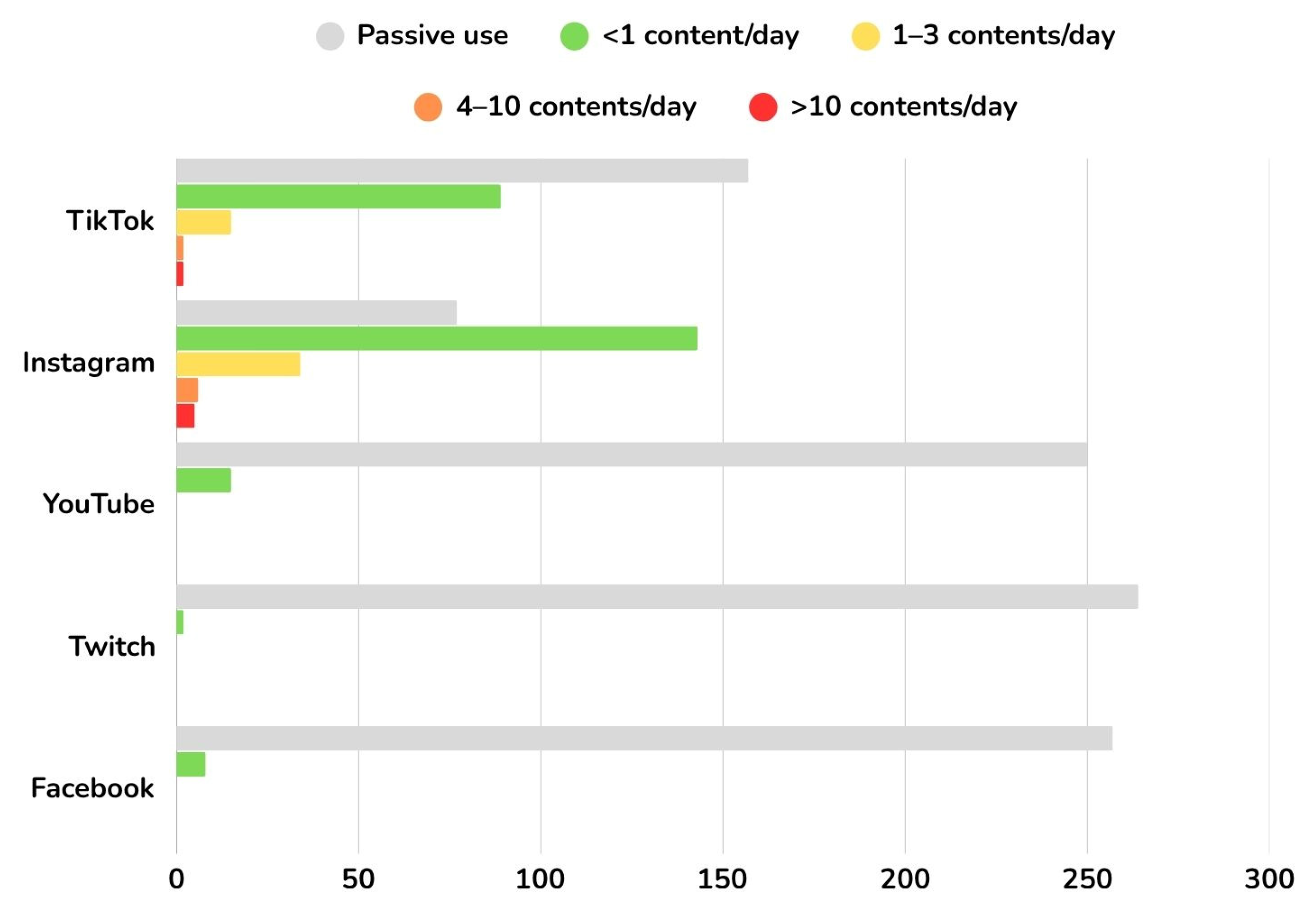
Regarding engagement, SM use was predominantly passive: 61% of TikTok users primarily scrolled content without posting, 29.8% of Instagram users reported exclusively consuming content, and all participants used YouTube and Twitch solely for viewing (Figure 1). However, female adolescents were significantly more likely than males to actively use TikTok (χ2 = 4.96, p = 0.026, OR = 7.30) and Instagram (χ2 = 5.61, p = 0.018, OR = 2.88).
Diagnostic categories were also associated with usage style. Depressive disorders were more common among passive TikTok users (χ2 = 7.02; p = 0.015), whereas neurodevelopmental disorders (NDs) were more frequent among active users (χ2 = 11.9; p = 0.006).
We did not observe any significant correlations between age and either the type or the amount of SM use.

3.4. Content Preferences

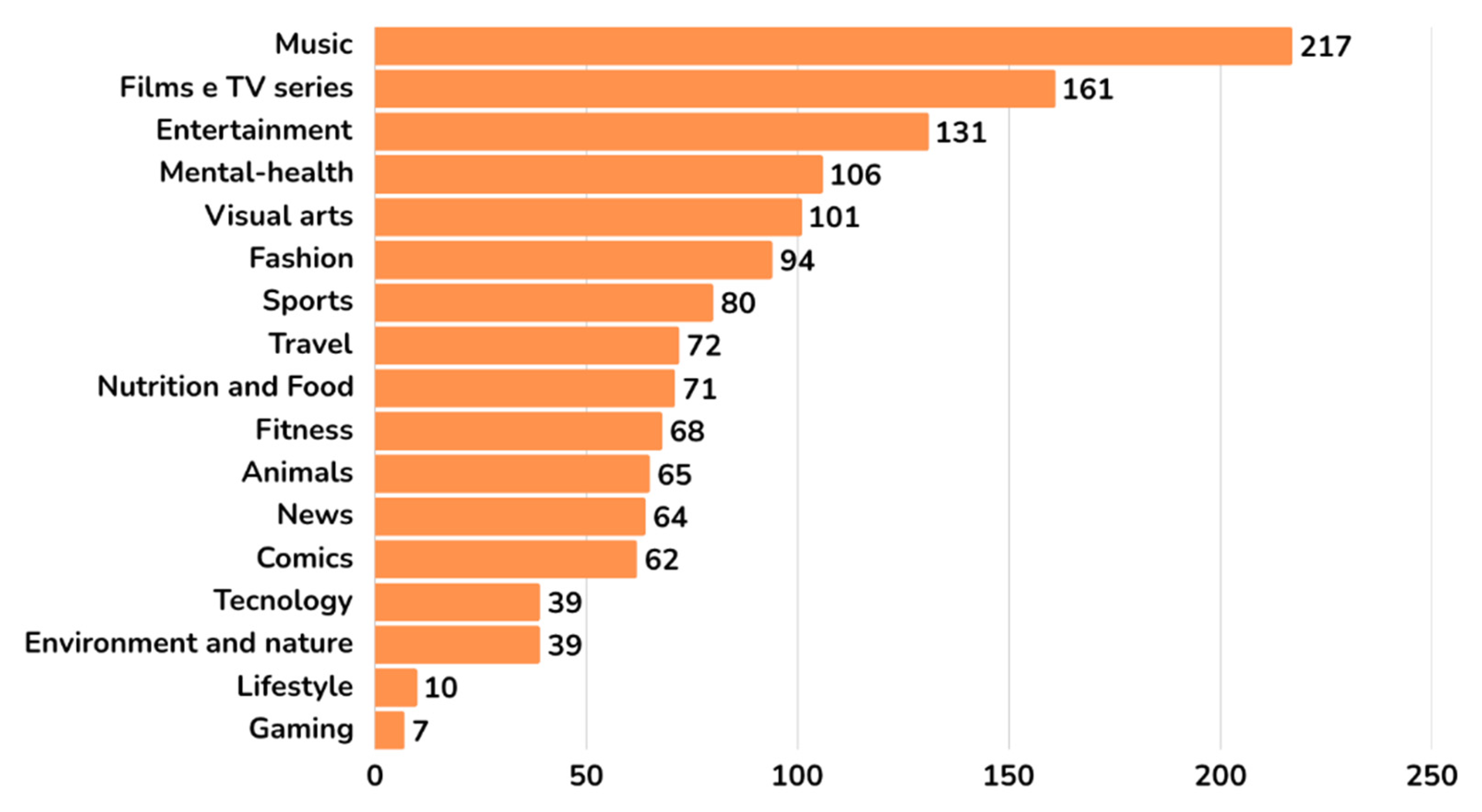
Adolescents reported a wide range of online interests. The most frequently accessed topics included music and entertainment. About 40% regularly viewed content related to psychology and mental health, and 53% engaged with material on fitness, diet, and nutrition. Less common categories included news, nature, and technology (Figure 2).
Gender differences emerged in content consumption and online activities. Female adolescents were significantly more likely to engage with psychology-related content (χ2 = 12.5, p < 0.001; OR = 3.00), whereas male adolescents showed a markedly higher likelihood of engaging in videogame-related activities (χ2 = 15.3, p < 0.001; OR = 0.34). Content preferences also varied by diagnosis: adolescents with anxiety disorders (AD) were significantly more likely to follow psychology-related content compared to others (χ2 = 7.26, p = 0.007, OR = 2.24), as were those with trauma- and stressor-related disorders (TSRDs χ2 = 5.68, p = 0.017, OR = 2.98). In contrast, adolescents with NDs were more likely to prefer entertainment- and comic-related content (χ2 = 4.77, p = 0.029, OR = 2.61; χ2 = 17.0, p < 0.001, OR = 5.42). No specific content preferences were observed among participants with externalizing disorders.

3.5. Perceived Stress Among SM Users

Perceived stress levels (PSS-10) were higher among females (Mdn = 27.00, IQR = 12.0) compared to males (Mdn = 19.00, IQR = 11.3). Higher PSS-10 scores were also observed in different diagnostic groups, with median PSS-10 scores of 28 in MDs and 29 in ADs. In contrast, lower PSS-10 scores were found among adolescents with neurodevelopmental disorders with medians of 21 (Table 2).
A significant positive correlation was observed between SMDS-9 total scores and PSS-10 (U = 3036, p = 0.003, r = 0.29). Moreover, help-seeking adolescents who spent more time on SM reported significantly higher perceived stress (t(263) = −4.93, p < 0.001, d = 0.64). Those spending more than 4 h per day had PSS-10 scores that were, on average, 5.51 points higher (SE = 1.12) than those with lower daily use.
Platform-specific analyses revealed comparable patterns: heavier users of TikTok and Instagram reported higher stress levels than lighter users (TikTok: t(261) = −2.09, p = 0.037, d = 0.68; Instagram: Mann–Whitney U = 6738, p = 0.019), while YouTube and Twitch use was unrelated to stress.
Content preferences also varied according to perceived stress levels. Adolescents with higher PSS-10 scores were significantly more likely to consume psychology- or mental health-related content (χ2 = 8.63; p = 0.004; OR = 2.11, post hoc power = 0.84) compared to those with lower stress.

4. Discussion

This study examined Problematic Social Media Use (PSMU) in a large clinical sample of 265 adolescents, addressing two major gaps consistently highlighted in recent literature: the underrepresentation of psychiatrically diagnosed youth in SM research [30], and the limited exploration of diagnosis-specific vulnerabilities. Only a few studies to date have reported prevalence estimates of PSMU specifically in clinical adolescent populations. Notably, the limited available research [31] has relied on non-validated measures of maladaptive use rather than on instruments specifically designed and validated for diagnosing PSMU.
Our sample was predominantly female (72.8%), in line with the well-documented overrepresentation of girls in psychiatric wards [32,33,34]. This gender distribution should therefore be interpreted as a characteristic of the clinical setting rather than a sampling bias.
In our sample, 14.4% of adolescents met criteria for PSMU, a rate slightly higher than the 13.5% reported in the general Italian adolescent population [11]. This comparison should, however, be interpreted with caution, as differences in sampling procedures, clinical characteristics, and assessment methods limit direct comparability. Nevertheless, the observed pattern aligns with international evidence indicating that youth with mental health conditions tend to show greater problematic SM engagement [35]. More importantly, the distribution of PSMU across diagnostic groups echoed trends repeatedly documented in the literature: prevalence was markedly higher among adolescents with anxiety (23.6%) and mood disorders (21.1%), and more generally within internalizing conditions (19.2%). Conversely, we found no associations with externalizing disorders. In this sense, although internalizing and externalizing symptoms share a common substrate of emotional dysregulation, they diverge in their coping strategies [36]. Youth experiencing negative affect may turn to SM as a coping strategy, seeking social reassurance and positive feedback [37]. However, this pattern may also increase exposure to idealized and socially salient content, potentially amplifying negative affect and social comparison processes [38]. In individuals with pre-existing vulnerabilities, these dynamics may exacerbate depressive, anxious, or eating-related symptoms, potentially through mechanisms such as rumination and reduced self-esteem [38]. Prior studies have shown that adolescents with mental health conditions spend more time online and also report less satisfying digital interactions, often reflecting a more conflicted or compensatory relationship with social platforms [30]. In line with this, participants using SM for more than four hours per day showed PSS-10 scores over five points higher than their peers. Importantly, multivariable analyses further clarified these associations: when considered simultaneously, greater screentime, depressive disorders, and higher perceived stress emerged as independent predictors of PSMU, whereas demographic factors and platform-specific use were not significant. This pattern supports the interpretation of PSMU as a transdiagnostic phenomenon more closely related to underlying psychological distress and intensity of engagement, rather than to the use of specific platforms.
A central observation from our data is the predominance of passive SM use, especially on TikTok and Instagram. While passive consumption is common in the general adolescent population [16], its clinical implications may differ in psychiatric samples. Passive behaviors such as scrolling, observing, and comparing are consistently associated with lower well-being, higher levels of anxiety and depression, and greater loneliness [39]. This aligns with our finding that depressive disorders were more frequent among passive TikTok users, suggesting that passive engagement may particularly reinforce negative affect and cognitive vulnerabilities. For emotionally fragile adolescents, scrolling may represent an avoidance-oriented coping behavior that could be associated with the persistence of internalizing symptoms, although causal direction cannot be established [35].
TikTok emerged as a particularly relevant platform: adolescents with PSMU showed nearly threefold higher odds of intensive use. The platform’s fast-paced, emotionally salient, and socially evaluative content may contribute to reinforcing cognitive-affective patterns associated with emotional vulnerability [16]. Higher perceived stress was also significantly associated with greater use of TikTok and Instagram, but not with YouTube or Twitch, platforms typically hosting longer contents and used for passive entertainment rather than reciprocal interaction, supporting the idea that social interactivity is a key driver of emotional strain [40,41]. These findings, although associative and not causal, suggest that social interactivity and emotional immediacy, rather than mere exposure, may play a key role in the psychological impact of SM use.
In contrast, participants with neurodevelopmental disorders (NDs) were more frequently active users, suggesting distinct digital habits. Active behaviors such as posting or interacting may reflect socio-cognitive characteristics typical of NDs, impulsivity, novelty seeking, reduced inhibition, or a preference for structured and predictable online interactions [42]. Their content preferences supported this interpretation: they showed strong interest in comic-themed content, consistent with evidence that neurodivergent youth gravitate toward fast-paced, visually stimulating, and reward-oriented materials [43,44].
Content preferences also diverged within internalizing conditions. Adolescents with anxiety disorders, trauma- and stressor-related disorders, and particularly depressive disorders were more likely to seek psychology- and mental health-related content. While such material may provide emotional validation or informal coping, it also exposes adolescents to unfiltered or misleading information that may reinforce maladaptive cognitions, especially among those with heightened emotional sensitivity [33,45]. This preference may reflect an attempt to acquire “technical” tools to better interpret one’s own mental and emotional states. This pattern may reflect an attempt to better interpret and make sense of internal emotional experiences, possibly attributing external frameworks to subjective states [34].

Limitations and Future Directions

Some limitations should be acknowledged. The cross-sectional design prevents causal conclusions, making it impossible to determine whether problematic SM use contributes to psychological distress or vice versa. Also, the overrepresentation of internalizing disorders in our clinical sample may in part account for the prominent patterns observed in this diagnostic group. All measures were self-reported, potentially introducing recall bias. Additionally, no objective data on actual screen time or platform-specific behavior were collected; the analyses focused primarily on broad usage patterns rather than fine-grained, real-time interactions; and engagement style and content preferences were assessed using non-validated items, which may limit the reliability and comparability of these measures.
Furthermore, data collection occurred at the initial stage of clinical evaluation, often at first contact or admission, when detailed information on broader psychosocial context, comorbidity burden, and ongoing or planned pharmacological treatments was not yet fully available. This may have limited the inclusion of potentially relevant contextual variables. Given the single-center nature of the study, the composition of the sample also does not allow for the results to be fully generalized. Future research should address these limitations by adopting longitudinal long-term designs capable of disentangling causal directions between emotional vulnerability and digital behavior. Also, further studies should incorporate a broader range of potentially relevant contextual and clinical variables, including socioeconomic status, family environment, social functioning, hospitalization, and pharmacological treatment, as well as psychosocial factors (i.e., emotion regulation, interpersonal functioning, and personality traits), to better characterize the factors associated with PSMU in help-seeking adolescents.

5. Conclusions

This study provides one of the first clinical examinations of PSMU in a sample of adolescents receiving psychiatric care, contributing to a still-limited body of evidence in clinically referred populations. While digital engagement was pervasive, with a large proportion of participants reporting more than four hours of daily use, our findings suggest that the psychological correlates of SM use may be more closely related to how adolescents engage with these platforms rather than to duration alone.
In our sample, 14.4% of adolescents met criteria for PSMU, with higher prevalence among those with internalizing disorders, particularly mood, anxiety, and eating disorders. These patterns are consistent with previous literature and support the notion that adolescents characterized by emotional dysregulation and heightened sensitivity to social evaluation may be particularly vulnerable to maladaptive SM use. Female and gender-diverse adolescents also showed higher levels of PSMU, further highlighting the relevance of individual vulnerability factors.
Importantly, multivariable analyses indicated that higher PSMU levels were independently associated with greater screen time, the presence of depressive symptoms, and higher perceived stress, whereas platform-specific use did not remain significantly associated. This suggests that general patterns of engagement and underlying psychological distress may play a more central role than specific platforms per se.
At a behavioral level, SM use was predominantly passive, and passive engagement patterns were associated with clinical features such as depressive symptomatology, although these findings remain correlational. Taken together, these results are consistent with an integrative perspective in which addiction-like features of PSMU may reflect underlying maladaptive coping processes rather than a distinct categorical disorder. In this framework, adolescents may turn to SM in an attempt to regulate emotional distress or seek reassurance, potentially reinforcing patterns of compulsive engagement over time [46,47].
These findings should be interpreted cautiously given the cross-sectional design, which precludes any inference on directionality or causality. The relationship between SM use and psychological distress is likely bidirectional and dynamic, warranting further investigation through longitudinal designs.
Future research should move beyond quantitative indicators such as screentime and focus on qualitative dimensions of SM engagement, including content preferences and patterns of interaction, which appear closely linked to adolescents’ emotional needs. A psychosocial perspective on digital behavior may help clinicians better identify at-risk profiles and support the development of targeted interventions aimed at promoting more adaptive and intentional use of digital environments.

Supplementary Materials

The following supporting information can be downloaded at: https://www.mdpi.com/article/10.3390/psychiatryint7030125/s1, Table S1: Items included in Section 1 (General Information) and Section 2 (Smartphone and Social Media Use) of the questionnaire administered to adolescents participating in the study. Table S2: Multivariable linear regression model examining factors associated with PSMU (SMDS-9 total score as dependent variable). Unstandardized regression coefficients (β), standard errors (SE), 95% confidence intervals (CI), and p-values are reported. Predictors were selected based on theoretical relevance and results from univariate analyses. Model fit indices indicated a good overall fit (R2 = 0.25; adjusted R2 = 0.18; F(df, df) = 3.99, p < 0.001). Assumptions of linear regression were assessed and met, including normality of residuals, homoscedasticity, and absence of multicollinearity (all variance inflation factors [VIF] < 2.00).

Author Contributions

Conceptualization, S.R., D.E. and G.D.I.; data curation, S.R., F.P., B.A., G.C. and M.P.C.; writing—original draft preparation, D.E., G.D.I., F.P. and B.A.; writing—review and editing, S.R. and A.T.; resources, D.C.; supervision, D.C., G.C., M.P.C. and A.T.; project administration, A.T. All authors have read and agreed to the published version of the manuscript.

Funding

This research received no external funding.

Institutional Review Board Statement

The study was conducted in accordance with the Declaration of Helsinki, and approved by the Territorial Ethics Committee of Latium Area 1 (protocol code 7875 and date of approval 3 May 2025).

Informed Consent Statement

Written informed consent for participation was obtained from the parents or legal guardians of all patients included in the study, and assent was obtained from all participating adolescents.

Data Availability Statement

The data presented in this study are available on request from the corresponding author. The data are not publicly available due to ethical/privacy issues.

Conflicts of Interest

The authors declare no conflicts of interest.

Abbreviations

The following abbreviations are used in this manuscript:
ADAnxiety Disorders
ADHDAttention-Deficit/Hyperactivity Disorder
ASDAutism Spectrum Disorder
EDEating Disorders
ExtDsExternalizing Disorders
IQRInterquartile Range
LDsLearning Disabilities
MDMood Disorders
NDsNeurodevelopmental Disorders
OCDObsessive-Compulsive Disorder
PSS-10Perceived Stress Scale—10 items
PSMUProblematic Social Media Use
SDSomatic Symptom Disorders
SMSocial Media
SMDSSocial Media Disorder Scale
SMDS-9Social Media Disorder Scale—9 item version
TSTourette Syndrome
TSRDsTrauma- and Stressor-Related Disorders

References

  1. Mental Health America. Social Belonging and Confidence. Available online: https://mhanational.org/resources/social-belonging-and-confidence/ (accessed on 26 October 2025).
  2. Smith, D.; Leonis, T.; Anandavalli, S. Belonging and loneliness in cyberspace: Impacts of social media on adolescents’ well-being. Aust. J. Psychol. 2021, 73, 12–23. [Google Scholar] [CrossRef]
  3. Tullett-Prado, D.; Stavropoulos, V.; Gomez, R.; Doley, J. Social media use and abuse: Different profiles of users and their associations with addictive behaviours. Addict. Behav. Rep. 2023, 17, 100479. [Google Scholar] [CrossRef]
  4. Peng, P.; Liao, Y. Six addiction components of problematic social media use in relation to depression, anxiety, and stress symptoms: A latent profile analysis and network analysis. BMC Psychiatry 2023, 23, 321. [Google Scholar] [CrossRef]
  5. Liese, B.S.; Kim, H.S.; Hodgins, D.C. Insecure attachment and addiction: Testing the mediating role of emotion dysregulation in four potentially addictive behaviors. Addict. Behav. 2020, 107, 106432. [Google Scholar] [CrossRef]
  6. Cheng, C.; Sun, P.; Mak, K.-K. Internet Addiction and Psychosocial Maladjustment: Avoidant Coping and Coping Inflexibility as Psychological Mechanisms. Cyberpsychol. Behav. Soc. Netw. 2015, 18, 539–546. [Google Scholar] [CrossRef] [PubMed]
  7. Marino, C.; Lenzi, M.; Canale, N.; Pierannunzio, D.; Dalmasso, P.; Borraccino, A.; Cappello, N.; Lemma, P.; Vieno, A.; 2018 HBSC-Italia Group; et al. Problematic social media use: Associations with health complaints among adolescents. Ann. Dell’istituto Super. Sanità 2020, 56, 514–521. [Google Scholar]
  8. Twenge, J.M.; Cooper, A.B.; Joiner, T.E.; Duffy, M.E.; Binau, S.G. Age, period, and cohort trends in mood disorder indicators and suicide-related outcomes in a nationally representative dataset, 2005–2017. J. Abnorm. Psychol. 2019, 128, 185–199. [Google Scholar] [CrossRef]
  9. Nesi, J.; Choukas-Bradley, S.; Prinstein, M.J. Transformation of Adolescent Peer Relations in the Social Media Context: Part 2—Application to Peer Group Processes and Future Directions for Research. Clin. Child Fam. Psychol. Rev. 2018, 21, 295–319. [Google Scholar] [CrossRef]
  10. Azagba, S.; Ebling, T.; Korkmaz, A. Social media use and mental health indicators among US adolescents: A population-based study. J. Psychiatr. Res. 2024, 176, 354–359. [Google Scholar] [CrossRef]
  11. Indagine, E. 2022—Hbsc—Uso dei Social Media. Available online: https://www.epicentro.iss.it/hbsc/indagine-2022-social-media?utm_source=chatgpt.com (accessed on 26 October 2025).
  12. Vogels, E.A.; Gelles-Watnick, R.; Massarat, N. Teens, Social Media and Technology 2022. Pew Research Center. Available online: https://www.pewresearch.org/internet/2022/08/10/teens-social-media-and-technology-2022/ (accessed on 26 October 2025).
  13. Nagata, J.M.; Memon, Z.; Talebloo, J.; Li, K.; Low, P.; Shao, I.Y.; Ganson, K.T.; Testa, A.; He, J.; Brindis, C.D.; et al. Prevalence and Patterns of Social Media Use in Early Adolescents. Acad. Pediatr. 2025, 25, 102784. [Google Scholar] [CrossRef] [PubMed]
  14. Lopes, L.S.; Valentini, J.P.; Monteiro, T.H.; Costacurta, M.C.F.; Soares, L.O.N.; Telfar-Barnard, L.; Nunes, P.V. Problematic Social Media Use and Its Relationship with Depression or Anxiety: A Systematic Review. Cyberpsychol. Behav. Soc. Netw. 2022, 25, 691–702. [Google Scholar] [CrossRef]
  15. Svensson, R.; Johnson, B.; Olsson, A. Does gender matter? The association between different digital media activities and adolescent well-being. BMC Public Health 2022, 22, 273. [Google Scholar] [CrossRef]
  16. Conte, G.; Iorio, G.D.; Esposito, D.; Romano, S.; Panvino, F.; Maggi, S.; Altomonte, B.; Casini, M.P.; Ferrara, M.; Terrinoni, A. Scrolling through adolescence: A systematic review of the impact of TikTok on adolescent mental health. Eur. Child. Adolesc. Psychiatry 2025, 34, 1511–1527. [Google Scholar] [CrossRef]
  17. Saleem, N.; Young, P.; Yousuf, S. Exploring the Relationship Between Social Media Use and Symptoms of Depression and Anxiety Among Children and Adolescents: A Systematic Narrative Review. Cyberpsychol. Behav. Soc. Netw. 2024, 27, 771–797. [Google Scholar] [CrossRef]
  18. Walker, D.M.; Bell, M.R.; Flores, C.; Gulley, J.M.; Willing, J.; Paul, M.J. Adolescence and Reward: Making Sense of Neural and Behavioral Changes Amid the Chaos. J. Neurosci. 2017, 37, 10855–10866. [Google Scholar] [CrossRef]
  19. Leo, K.; Kewitz, S.; Wartberg, L.; Lindenberg, K. Depression and Social Anxiety Predict Internet Use Disorder Symptoms in Children and Adolescents at 12-Month Follow-Up: Results from a Longitudinal Study. Front. Psychol. 2021, 12, 787162. [Google Scholar] [CrossRef]
  20. Verma, A.; Islam, S.; Moghaddam, V.; Anwar, A. Digital Emotion Regulation on Social Media. arXiv 2023, arXiv:2307.13187. [Google Scholar] [CrossRef]
  21. Orben, A.; Meier, A.; Dalgleish, T.; Blakemore, S.-J. Mechanisms linking social media use to adolescent mental health vulnerability. Nat. Rev. Psychol. 2024, 3, 407–423. [Google Scholar] [CrossRef]
  22. Barthorpe, A.; Winstone, L.; Mars, B.; Moran, P. Is social media screen time really associated with poor adolescent mental health? A time use diary study. J. Affect. Disord. 2020, 274, 864–870. [Google Scholar] [CrossRef]
  23. Agyapong-Opoku, N.; Agyapong-Opoku, F.; Greenshaw, A.J. Effects of Social Media Use on Youth and Adolescent Mental Health: A Scoping Review of Reviews. Behav. Sci. 2025, 15, 574. [Google Scholar] [CrossRef]
  24. WMA—The World Medical Association-WMA Declaration of Helsinki—Ethical Principles for Medical Research Involving Human Participants. Available online: https://www.wma.net/policies-post/wma-declaration-of-helsinki/ (accessed on 26 October 2025).
  25. Boer, M.; van den Eijnden, R.J.J.M.; Finkenauer, C.; Boniel-Nissim, M.; Marino, C.; Inchley, J.; Cosma, A.; Paakkari, L.; Stevens, G.W.J.M. Cross-national validation of the social media disorder scale: Findings from adolescents from 44 countries. Addiction 2022, 117, 784–795. [Google Scholar] [CrossRef]
  26. Bagot, K.S.; Tomko, R.L.; Marshall, A.T.; Hermann, J.; Cummins, K.; Ksinan, A.; Kakalis, M.; Breslin, F.; Lisdahl, K.M.; Mason, M.; et al. Youth screen use in the ABCD® study. Dev. Cogn. Neurosci. 2022, 57, 101150. [Google Scholar] [CrossRef]
  27. Riehm, K.E.; Feder, K.A.; Tormohlen, K.N.; Crum, R.M.; Young, A.S.; Green, K.M.; Pacek, L.R.; La Flair, L.N.; Mojtabai, R. Associations Between Time Spent Using Social Media and Internalizing and Externalizing Problems Among US Youth. JAMA Psychiatry 2019, 76, 1266–1273. [Google Scholar] [CrossRef]
  28. Mondo, M.; Sechi, C.; Cabras, C. Psychometric evaluation of three versions of the Italian Perceived Stress Scale. Curr. Psychol. 2021, 40, 1884–1892. [Google Scholar] [CrossRef]
  29. The Jamovi Project. Jamovi, Version 2.6. [Computer Software]. The Jamovi Project: Sydney, Australia, 2025. Available online: https://www.jamovi.org (accessed on 13 May 2026).
  30. Fassi, L.; Ferguson, A.M.; Przybylski, A.K.; Ford, T.J.; Orben, A. Social media use in adolescents with and without mental health conditions. Nat. Hum. Behav. 2025, 9, 1283–1299. [Google Scholar] [CrossRef]
  31. Kennard, B.D.; Hughes, J.L.; Minhajuddin, A.; Jones, S.M.; Jha, M.K.; Slater, H.; Mayes, T.L.; Storch, E.A.; LaGrone, J.M.; Martin, S.L.; et al. Problematic social media use and relationship to mental health characteristics in youth from the Texas Youth Depression and Suicide Research Network (TX-YDSRN). J. Affect. Disord. 2025, 374, 128–140. [Google Scholar] [CrossRef]
  32. Dil, L.; Mérelle, S.; Lommerse, N.; Peen, J.; So, P.; Van, R.; Zoeteman, J.; Dekker, J. Gender-specific pathways in mental health crisis in adolescents, from consultation to (in)voluntary admission: A retrospective study. BMC Psychiatry 2024, 24, 235. [Google Scholar] [CrossRef]
  33. Cavelti, M.; Ruppen, N.A.; Sele, S.; Moessner, M.; Bauer, S.; Becker, K.; Krämer, J.; Eschenbeck, H.; Rummel-Kluge, C.; Thomasius, R.; et al. An examination of sociodemographic and clinical factors influencing help-seeking attitudes and behaviors among adolescents with mental health problems. Eur. Child Adolesc. Psychiatry 2025, 34, 1391–1402. [Google Scholar] [CrossRef]
  34. Mohamad, I.N.F.; Mubin, N.N.A. Social Media Use for Youth Mental Health Awareness and Help-Seeking Attitudes: A Systematic Review. EDUC. J. Soc. Sci. 2023, 9, 1–12. [Google Scholar] [CrossRef]
  35. Fassi, L.; Thomas, K.; Parry, D.A.; Leyland-Craggs, A.; Ford, T.J.; Orben, A. Social Media Use and Internalizing Symptoms in Clinical and Community Adolescent Samples: A Systematic Review and Meta-Analysis. JAMA Pediatr. 2024, 178, 814. [Google Scholar] [CrossRef]
  36. Iannattone, S.; Mezzalira, S.; Bottesi, G.; Gatta, M.; Miscioscia, M. Emotion dysregulation and psychopathological symptoms in non-clinical adolescents: The mediating role of boredom and social media use. Child Adolesc. Psychiatry Ment. Health 2024, 18, 5. [Google Scholar] [CrossRef]
  37. Garrett, S.L.; Shipkova, M.; Prinstein, M.J.; Telzer, E.H.; Lindquist, K.A. Positive and Negative Sentiment in Social Media Direct Messages Predicts Negative Emotion Differentiation Among Adolescents. Affect. Sci. 2025, 6, 272–279. [Google Scholar] [CrossRef]
  38. Zubashvili, A. The mediating role of cognitive emotion regulation strategies in the link between psychological distress and problematic social media use among youth. Bus. Legis. 2023, 16, 38–48. [Google Scholar] [CrossRef]
  39. Thorisdottir, I.E.; Sigurvinsdottir, R.; Kristjansson, A.L.; Allegrante, J.P.; Lilly, C.L.; Sigfusdottir, I.D. Longitudinal association between social media use and psychological distress among adolescents. Prev. Med. 2020, 141, 106270. [Google Scholar] [CrossRef] [PubMed]
  40. Gentzler, A.L.; Hughes, J.L.; Johnston, M.; Alderson, J.E. Which social media platforms matter and for whom? Examining moderators of links between adolescents’ social media use and depressive symptoms. J. Adolesc. 2023, 95, 1725–1748. [Google Scholar] [CrossRef] [PubMed]
  41. De Wit, J.; Van Der Kraan, A.; Theeuwes, J. Live Streams on Twitch Help Viewers Cope with Difficult Periods in Life. Front. Psychol. 2020, 11, 586975. [Google Scholar] [CrossRef]
  42. Giardina, A.; Schimmenti, A.; Starcevic, V.; King, D.; Di Blasi, M.; Billieux, J. Problematic gaming, social withdrawal, and Escapism: The Compensatory-Dissociative Online Gaming (C-DOG) model. Comput. Hum. Behav. 2024, 155, 108187. [Google Scholar] [CrossRef]
  43. Thorell, L.B.; Burén, J.; Wiman, J.S.; Sandberg, D.; Nutley, S.B. Longitudinal associations between digital media use and ADHD symptoms in children and adolescents: A systematic literature review. Eur. Child Adolesc. Psychiatry 2024, 33, 2503–2526. [Google Scholar] [CrossRef]
  44. Alhujaili, N.; Platt, E.; Khalid-Khan, S.; Groll, D. Comparison of Social Media Use Among Adolescents with Autism Spectrum Disorder and Non-ASD Adolescents. Adolesc. Health Med. Ther. 2022, 13, 15–21. [Google Scholar] [CrossRef]
  45. Mackenzie, E.; McMaugh, A.; Van Bergen, P.; Parada, R.H. Online support seeking, co-rumination, and mental health in adolescent girls. Front. Psychiatry 2023, 14, 1040636. [Google Scholar] [CrossRef]
  46. Casale, S. Problematic social media use: Conceptualization, assessment and trends in scientific literature. Addict. Behav. Rep. 2020, 12, 100281. [Google Scholar] [CrossRef] [PubMed]
  47. Yildirim Demirdöğen, E.; Akinci, M.A.; Bozkurt, A.; Bayraktutan, B.; Turan, B.; Aydoğdu, S.; Ucuz, İ.; Abanoz, E.; Yitik Tonkaz, G.; Çakir, A.; et al. Social media addiction, escapism and coping strategies are associated with the problematic internet use of adolescents in Türkiye: A multi-center study. Front. Psychiatry 2024, 15, 1355759. [Google Scholar] [CrossRef] [PubMed]
Figure 1. The graph shows the distribution of content creation within our sample. By ‘content’, we refer to any photo (temporary or permanent), video (short or long, recorded or live, temporary or permanent), or text-based post (e.g., tweets, status updates—excluding private messages) that is created and publicly shared on the user’s profile.
Psychiatryint 07 00125 g001
Figure 2. The graph shows the different contents searched online in our sample. The sum may exceed 100%, as a single individual could choose more than one content.
Psychiatryint 07 00125 g002
Table 1. Frequency and percentage of the different diagnostic categories and the PSMU diagnosis in our sample (n = 265). The total number of cases may exceed the sample size, and the sum of percentages may exceed 100%, as a single individual can present with multiple diagnoses simultaneously. MDs: Mood disorders; ADs: Anxiety disorders; EDs: Eating disorders; ADHD: Attention Deficit Hyperactivity Disorder; ASD: Autism Spectrum Disorder; LDs: Learning Disabilities; TS: Tourette Syndrome; TSRD: Trauma- and stressor-related disorders; Externalizing disorders: Disruptive, Impulse-control, Conduct and Substances use disorders; SD: Somatization Disorders; OCD: Obsessive-Compulsive Disorder. * The chi-square test revealed a statistically significant difference in the percentage of PSMU between patients with some diagnoses (internalizing disorders, MD, AD or ED) and other diagnostic categories.
DiagnosisN (% of Whole Sample)N of PMSU (% of the Subgroup)
Internalizing disorders172 (65)33 (19.2) *
MDs123 (46.4)26 (21.1) *
ADs72 (27.2)17 (23.6) *
TSRDs21 (7.9)3 (14.3)
SDs15 (5.7)1 (6.7)
EDs38 (14.4)10 (26.3) *
Neurodevelopmental dis.26 (9.8)2 (7.7)
ADHD11 (4.2)2 (18.2)
ASD10 (3.7)none
LDs4 (1.5)none
TS3 (1.2)none
Externalizing disorders16 (6.1)none
OCD9 (3.4)none
Table 2. Reports SMDS-9 and PSS-10 scores by different social media platforms, gender and the principal diagnostic categories, expressed as median (IQR) or mean (SD), as appropriate. Gender NC: gender non-conforming, MDs: Mood disorders; ADs: Anxiety disorders; EDs: Eating disorders; NDs: Neurodevelopmental disorders; ExtDs: Externalizing disorders; SD: Somatic Symptom Disorders; OCD: Obsessive-Compulsive Disorder.
PSS-10 SMDS-9
VariableGroupNMean (SD)Median (IQR)Mean (SD) Median (IQR)
SM platformTikTok13127.6 (7.34)29 (10.00)3.30 (2.42)3 (4.00)
Instagram9726.64 (7.23)28 (11.00)3.13 (2.28)3 (4.00)
YouTube5525.65 (9.11)27 (15.00)2.95 (2.35)3 (4.00)
X3126.93 (6.91)29 (11.00)3.55 (2.65)3 (5.00)
Snapchat2625.04 (7.87)25 (9.75)2.92 (2.38)2 (4.00)
Tumblr1027.10 (5.99)28 (9.25)3.30 (2.06)3 (2.50)
Twitch1024.50 (16.50)23 (12.04)2.00 (2.49)1 (1.75)
GenderFemale19326.33 (8.49)27 (12.00)3.03 (2.29)3 (4.00)
Male7220.44 (8.70)19 (11.25)2.29 (2.25)2 (2.25)
Gender NC3525.97 (7.52)28 (11.50)3.63 (2.58)3 (3.50)
DiagnosisMDs 12326.94 (7.76)28 (12.00)3.41 (2.46)3 (4.00)
ADs7226.78 (8.60)29 (14.25)3.53 (2.53)3 (3.25)
EDs3825.55 (8.33)27 (12.00)3.21 (2.46)3 (4.75)
NDs2620.92 (8.95)21 (11.00)2.42 (2.12)2 (3.00)
ExtDs1622.65 (10.75)25 (17.00)1.50 (1.41)1 (1.25)
SD1525 (6.69)24 (9.50)2 (2.10)1 (3.50)
OCD921.1 (11.7)23 (9.00)1.56 (1.59)1 (1.00)
Table 3. The table shows the different activities performed online in our sample. The sum may exceed 100%, as a single individual could choose more than one activity. Other: Digital drawing/illustration/writing, Video calling, Video/photo editing apps.
ActivityFrequency n (%)Activity
Social media (e.g., WhatsApp, Instagram, TikTok)235 (88.3)Social media (e.g., WhatsApp, Instagram, TikTok)
Listening to music217 (81.6)Listening to music
Watching movies or TV shows126 (47.4)Watching movies or TV shows
Playing video games97 (36.5)Playing video games
Studying71 (26.7)Studying
Listening to podcasts19 (7.1)Listening to podcasts
Reading e-books16 (6)Reading e-books
Other3 (1.1)Other
Disclaimer/Publisher’s Note: The statements, opinions and data contained in all publications are solely those of the individual author(s) and contributor(s) and not of MDPI and/or the editor(s). MDPI and/or the editor(s) disclaim responsibility for any injury to people or property resulting from any ideas, methods, instructions or products referred to in the content.