Review

Educational Approaches to Violence Risk Assessment and Management in Psychiatry and Psychology: A Scoping Review


by
Désirée Muller-Mallet
1,
Béatrice Ouellon
1,
Lionel Cailhol
1,2,3,
Stéphanie Borduas Pagé
1,2 and
Alexandre Hudon
1,2,3,4,5,*
1
Department of Psychiatry and Addictology, Université de Montréal, Montreal, QC H3T 1J4, Canada
2
Department of Psychiatry, Institut Universitaire en Santé Mentale de Montréal, Montreal, QC H1N 3M5, Canada
3
Centre de Recherche de l’Institut Universitaire en Santé Mentale de Montréal, Montreal, QC H1N 3V2, Canada
4
Department of Psychiatry, Institut National de Psychiatrie Légale Philippe-Pinel, Montreal, QC H1C 1H1, Canada
5
Centre de Recherche en Pédagogie de la Santé, Université de Montréal, Montreal, QC H3T 1J4, Canada
*
Author to whom correspondence should be addressed.
Psychiatry Int. 2026, 7(3), 126; https://doi.org/10.3390/psychiatryint7030126

Submission received: 13 January 2026 / Revised: 24 April 2026 / Accepted: 29 May 2026 / Published: 5 June 2026

Abstract

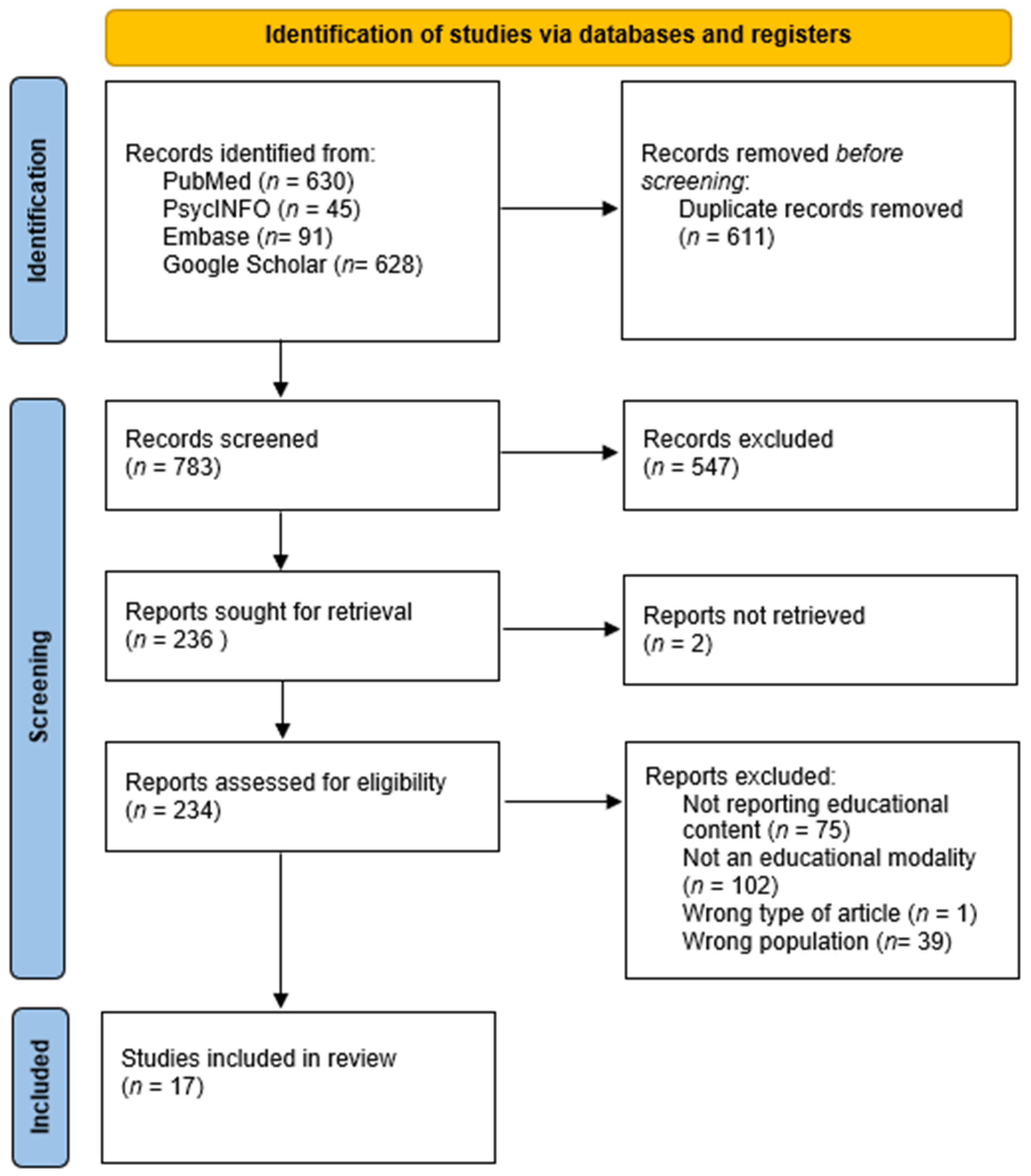
Workplace violence and hetero-aggressive behavior represent significant occupational hazards in mental health settings, particularly for psychiatry and psychology trainees who are frequently exposed yet often insufficiently prepared. This scoping review aimed to map and critically describe existing educational approaches to violence risk assessment, prevention, and management in mental health training programs, with a focus on psychiatry and psychology education. A scoping review identified 17 eligible studies examining curricular content, pedagogical modalities, and training outcomes related to violence education. Included studies encompassed surveys, curricular descriptions, and educational interventions employing didactic, simulation-based, and blended learning formats. Overall, the literature revealed variability and fragmentation in training, with most programs lacking structured or longitudinal curricula. Didactic approaches improved conceptual understanding but were consistently perceived as insufficient for skill acquisition and confidence. In contrast, blended and simulation-based modalities, particularly those using standardized patients and structured debriefing, were associated with greater gains in applied skills, confidence, and perceived clinical readiness. Core competencies emphasized across curricula included de-escalation strategies, violence risk assessment frameworks, communication skills, and, less consistently, legal and institutional considerations. These findings highlight persistent educational gaps and support the integration of experiential, longitudinal, and system-informed training models to better prepare mental health trainees for violence-related clinical challenges.
Keywords: workplace violence; hetero-aggressive behavior; violence risk assessment; de-escalation training; psychiatry education; psychology training; simulation-based education; forensic psychiatry; medical education; aggression management workplace violence; hetero-aggressive behavior; violence risk assessment; de-escalation training; psychiatry education; psychology training; simulation-based education; forensic psychiatry; medical education; aggression management