
A Delphi Study to Identify Effective Self-Help and Kindness Strategies for Subthreshold Depression


Abstract
1. Introduction
1.1. Subthreshold Depression
1.2. Overview and Role of Self-Help Strategies
1.3. Self-Help Strategies for Depression: The Delphi Approach
1.4. Closing the Gap Between Experts and Individuals with Lived Experience
1.5. Acts of Kindness as a Self-Help Modality
1.6. The Present Study
2. Materials and Methods
2.1. Study Design
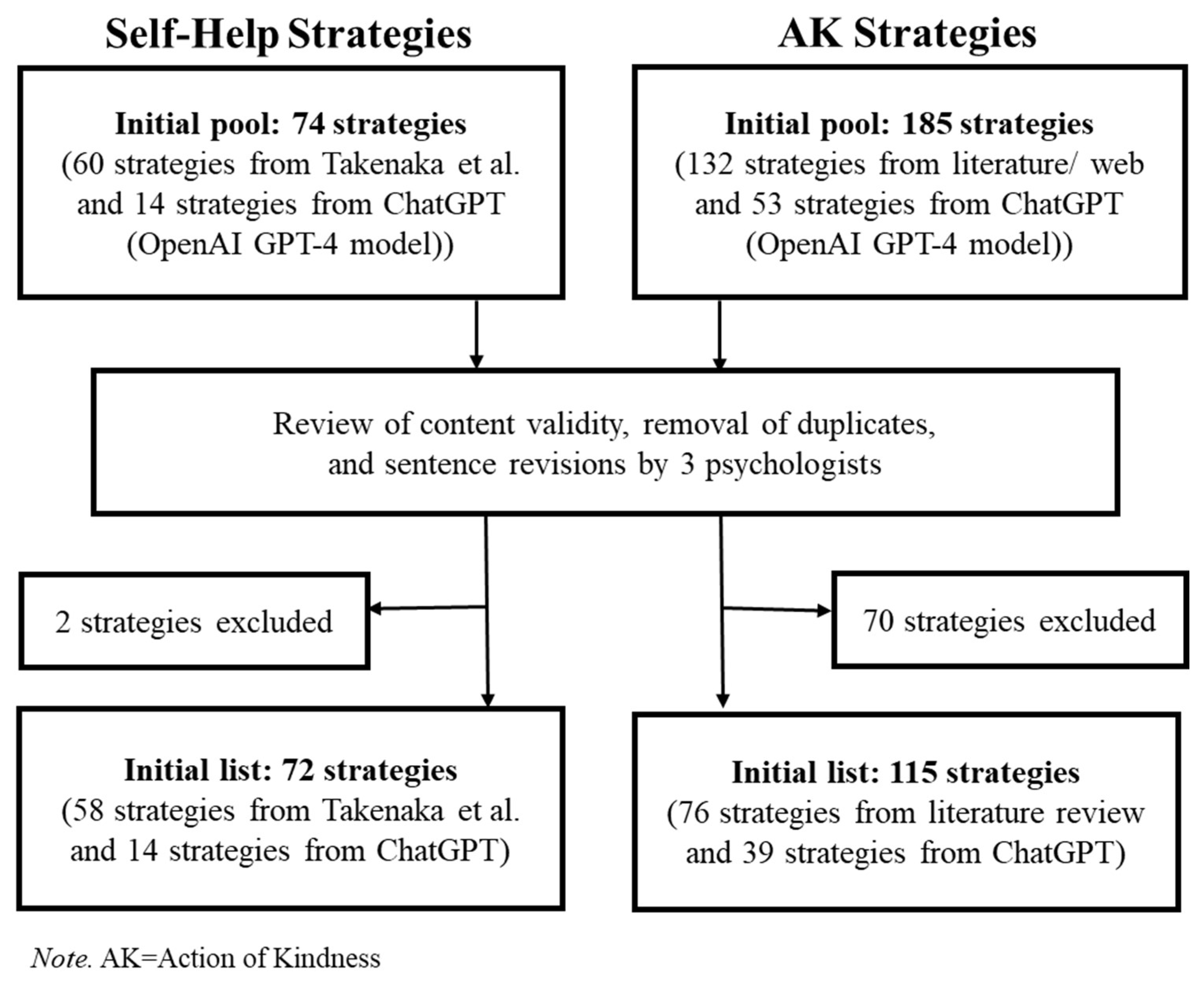
2.2. Development of the Initial Strategy List
2.2.1. Self-Help Strategies
2.2.2. Acts of Kindness Strategies
2.2.3. Refinement and Finalization
- Self-Help (72 items): 58 items from Takenaka et al. [24] and 14 AI-generated items.
- Acts of Kindness (115 items): 76 items from the literature and 39 AI-generated items.
2.3. Participants and Panel Selection
2.3.1. Selection of Clinical Psychology Expert Panel
2.3.2. Selection of Subthreshold Depression Panel
2.4. Procedure and Consensus Criteria
2.4.1. Evaluation Metrics and Instructions
2.4.2. Consensus Thresholds (Endorsement Criteria)
- Self-Help Strategies: A threshold of 70% agreement was set, following Takenaka et al. [24].
- Acts of Kindness Strategies: Considering that the clinical utility of AK is less widely recognized, a more inclusive threshold of 51% was adopted, which is the second most common criterion used in Delphi studies [25]. This lower threshold was necessitated by the specific clinical landscape in Japan, where empirical research and clinical recognition of AK interventions remain significantly limited compared to Western contexts. Since 2006, only a few Japanese studies have explored AK, and their findings regarding clinical efficacy have been inconsistent [45]. Given this lack of established evidence in the domestic literature, a 70% threshold risked prematurely excluding potentially effective strategies that are not yet widely known. Therefore, a 51% majority consensus was utilized to broaden the scope of this exploratory study and ensure that promising AK items were captured for future validation.
2.4.3. Iterative Feedback and Item Generation
2.5. Overview of Delphi Survey Rounds
2.5.1. Round 1: Baseline Evaluation and Item Generation
- Demographics: General participants reported their age, sex, occupation, and history of psychiatric treatment. Expert participants reported their age, sex, and years of clinical experience.
- Patient Health Questionnaire-9 (Japanese Version): To identify the SD panel, we utilized the Japanese version of the PHQ-9 [44]. This validated scale comprises nine items (e.g., “Little interest or pleasure in doing things”) rated on a 4-point scale (0: Not at all to 3: Nearly every day).
- Evaluation of Initial Strategies: All participants rated the helpfulness and feasibility of the initial 187-item pool.
- Expert Solicitation of Additional Strategies: Experts were asked open-ended questions to propose additional strategies that they perceived as helpful and feasible in clinical practice.
2.5.2. Round 2: Reevaluation and Integration
- Reevaluation: Strategies that reached the consensus threshold in only one of the two panels in Round 1 were presented again for assessment.
- New Item Assessment: Strategies proposed by the expert panel in Round 1 were evaluated by both panels for the first time.
2.5.3. Round 3: Final Consensus Building
2.6. Ethical Considerations
2.7. Statistical Analysis
3. Results
3.1. Participant Characteristics
3.1.1. Clinical Psychology Expert Panel
3.1.2. Subthreshold Depression Panel
3.2. Retention and Attrition Rates
- Expert Panel: Forty-five of the 51 experts participated in Round 2 (88.2%). In Round 3, 41 experts remained, representing 80.4% of the original pool.
- Subthreshold Depression Panel: Of the 191 individuals, 120 participated in Round 2 (62.8%), and 101 completed all three rounds (52.9%).
3.3. Evaluation and Selection of Self-Help Strategies
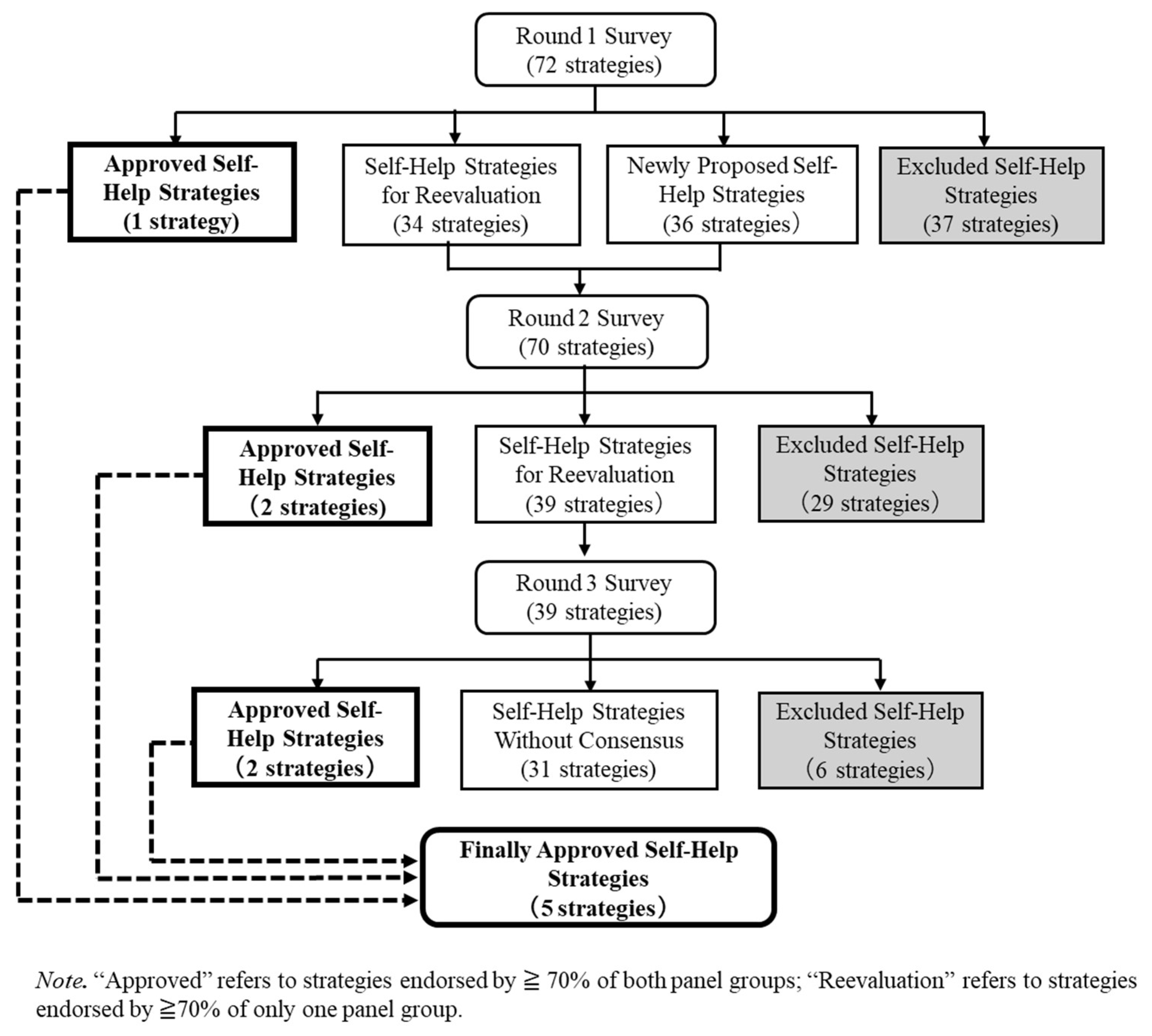
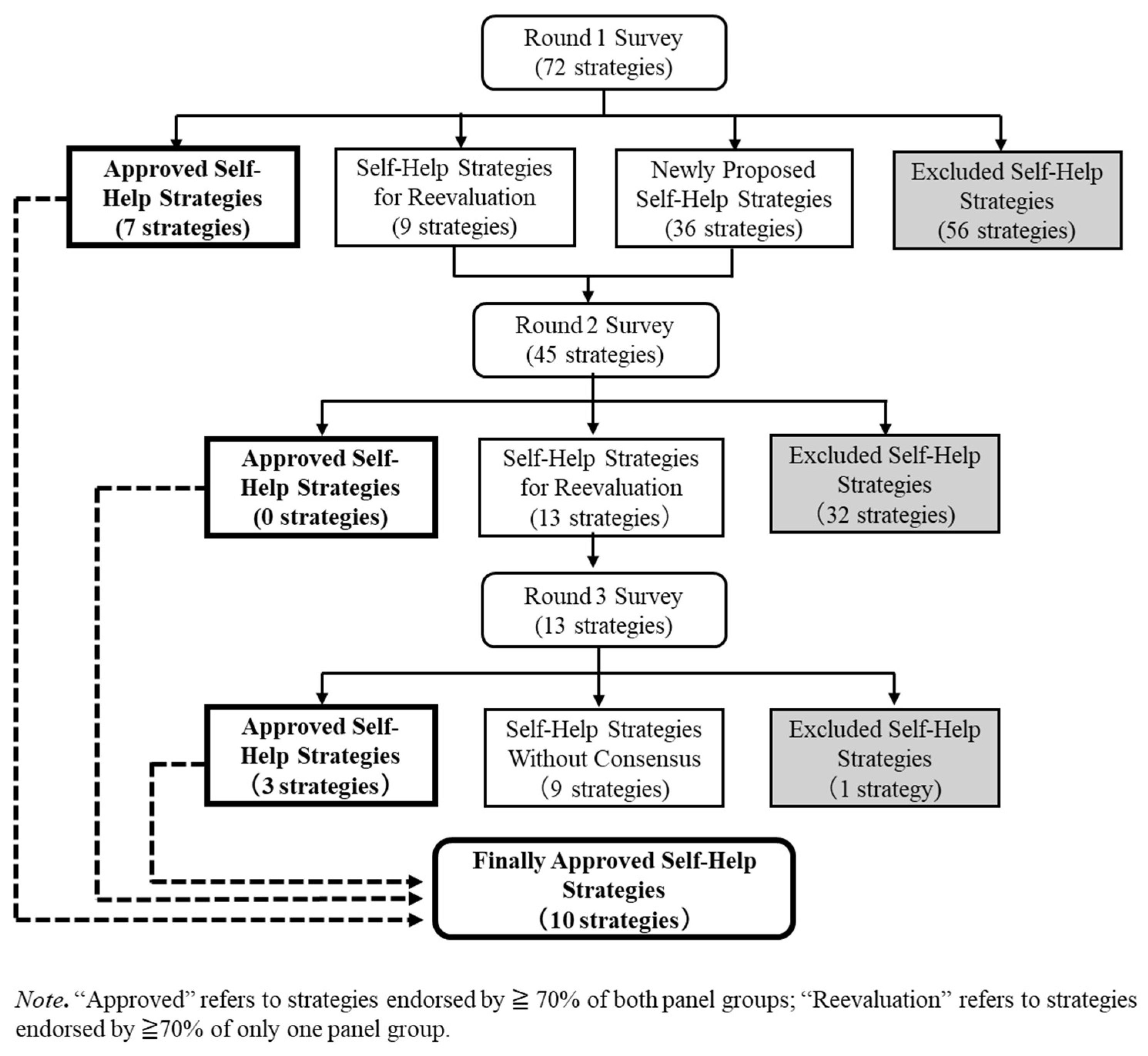
3.3.1. Progression of Rounds of Self-Help Strategies
3.3.2. Final Consensus List: Self-Help
- Helpfulness (5 items): The following strategies were endorsed: “Getting some fresh air,” “Eating delicious food,” “Resting without overexerting myself and giving myself a break when feeling tired,” “Thinking about plans I look forward to,” and “Looking at beautiful scenery.” Based on the categories of Takenaka et al. [24], “Getting some fresh air” was categorized as self-care, “Thinking about plans I look forward to” as cognitive strategies, and “Looking at beautiful scenery” as a pleasant activity. “Resting without overexerting myself” was an AI-generated item, and “Eating delicious food” was a novel strategy proposed by experts in Round 1.
- Feasibility (10 items): Strategies such as “Deep breathing (self-care),” “Stretching one’s back (self-care),” and “Listening to favorite music (pleasant activity)” were endorsed. Although no AI-generated items survived the final feasibility threshold, three expert-proposed items—“Eating delicious food,” “Watching videos or TV,” and “Making time to be alone”—were deemed highly feasible. Notably, the number of strategies endorsed for feasibility was twice that of those endorsed for helpfulness.
3.4. Evaluation and Selection of Acts of Kindness Strategies
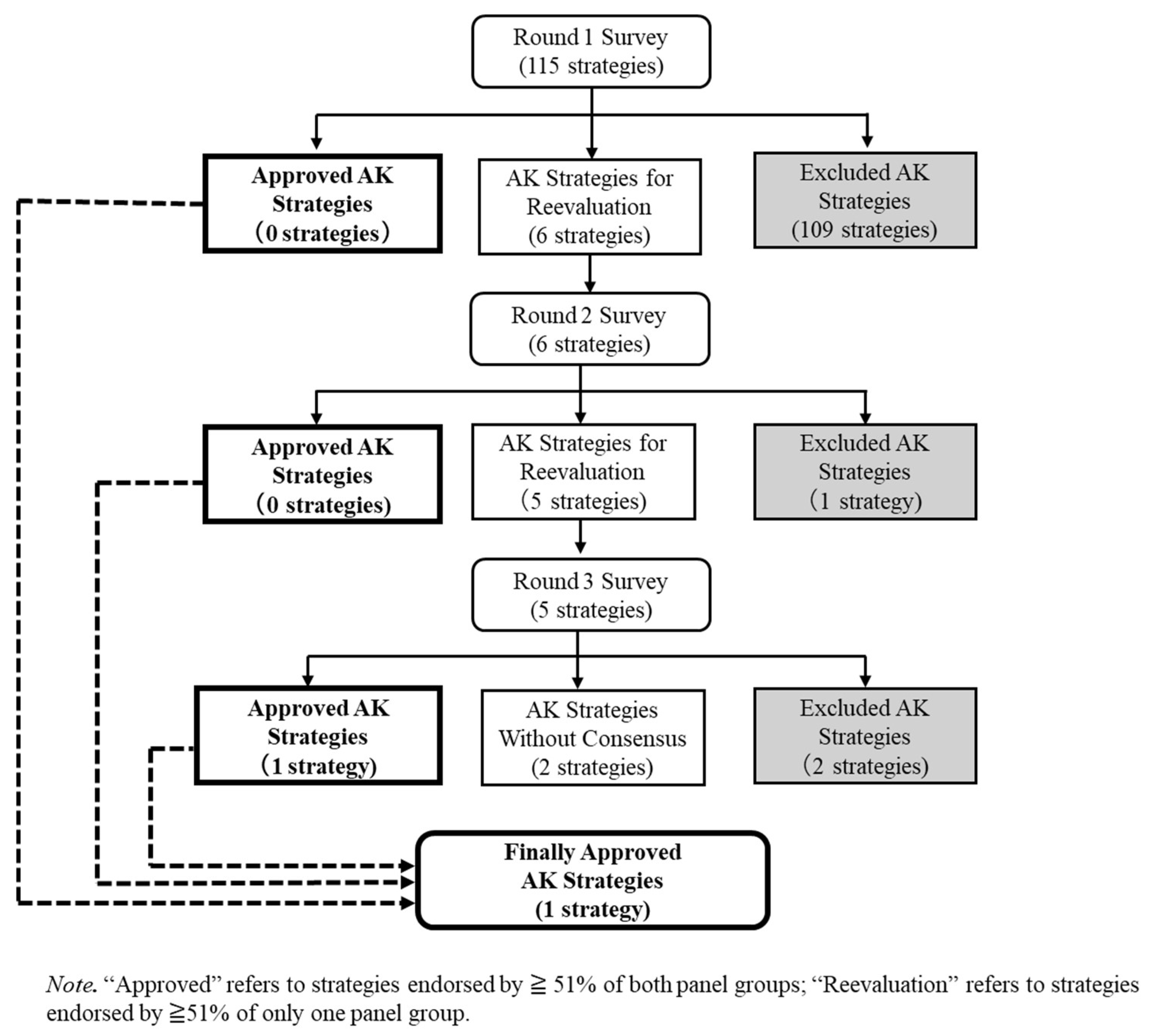
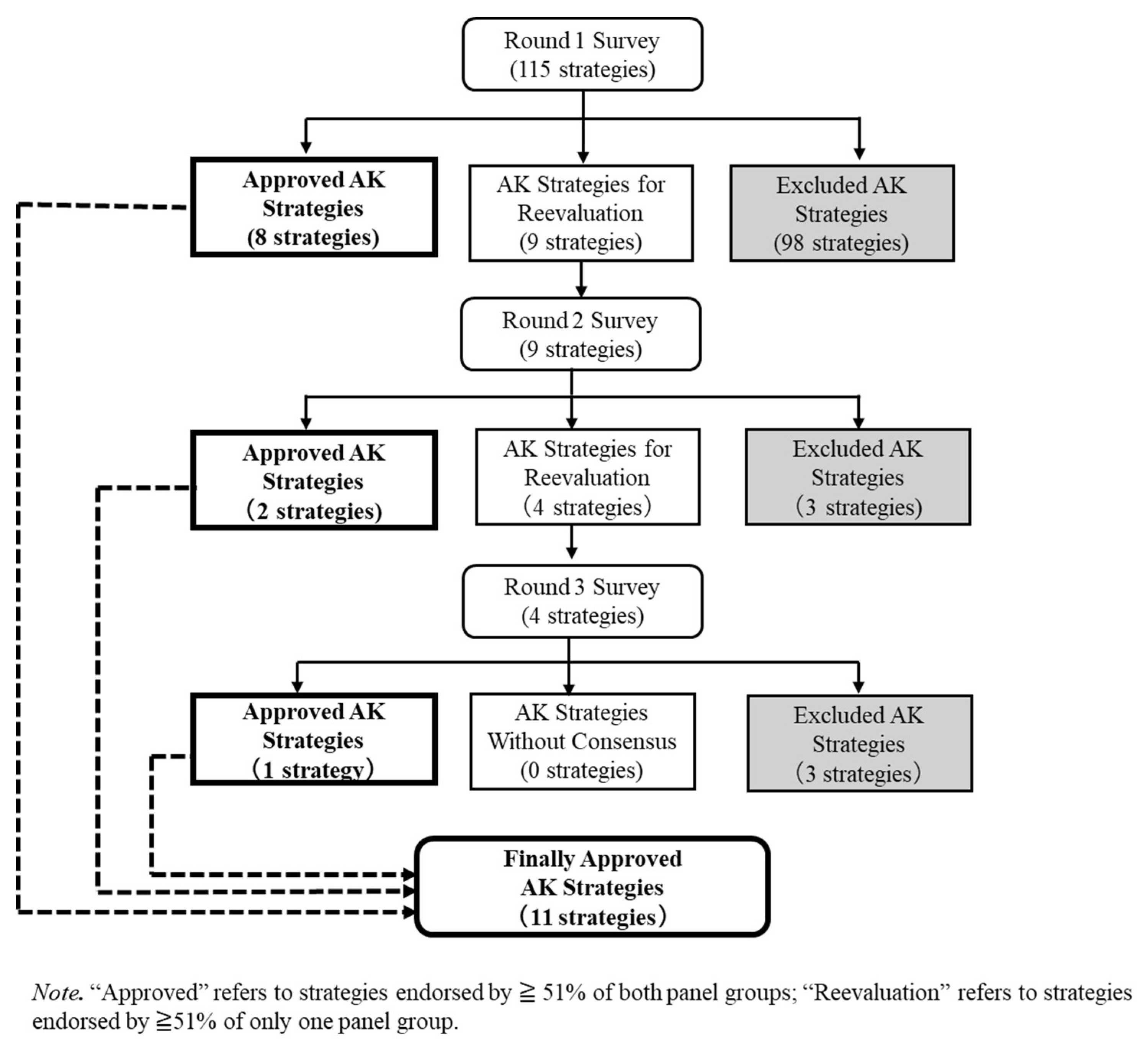
3.4.1. Progression of Rounds of AK Strategies
3.4.2. Final Consensus List: Acts of Kindness
- Helpfulness (1 item): Only one strategy reached a consensus: “Inviting an acquaintance for a walk or tea and spending time together.”
- Feasibility (11 items): Eleven strategies reached a consensus, characterized by low-effort prosocial acts such as “Saying ‘Thank you’ to store clerks,” “Holding the door open for others,” and “Letting someone pass on a narrow path.”
3.5. Discrepancies in Evaluations Between the Expert and Subthreshold Depression Panels
4. Discussion
4.1. Evaluation and Categorization of Self-Help Strategies
4.2. Self-Help Strategies: Comparison with Prior Research and Perception Gaps
4.3. Acts of Kindness: Cultural Context and Perception Gaps
4.4. Practical Applications and Social Dissemination
4.5. Limitations and Future Directions
5. Conclusions
Supplementary Materials
Author Contributions
Funding
Institutional Review Board Statement
Informed Consent Statement
Data Availability Statement
Acknowledgments
Conflicts of Interest
Abbreviations
| SD | Subthreshold Depression |
| AK | Acts of Kindness |
| MDD | Major Depressive Disorder |
| PHQ-9 | Patient Health Questionnaire-9 |
References
- Bromet, E.; Andrade, L.H.; Hwang, I.; Sampson, N.A.; Alonso, J.; de Girolamo, G.; de Graaf, R.; Demyttenaere, K.; Hu, C.; Iwata, N.; et al. Cross-national epidemiology of DSM-IV major depressive episode. BMC Med. 2011, 9, 90. [Google Scholar] [CrossRef]
- Nishi, D.; Ishikawa, H.; Kawakami, N. Prevalence of mental disorders and mental health service use in Japan. Psychiatry Clin. Neurosci. 2019, 73, 458–465. [Google Scholar] [CrossRef]
- American Psychiatric Association. Diagnostic and Statistical Manual of Mental Disorders, 5th ed.; Text Revision; Takahashi, S.; Ohno, Y., Translators; Igaku-Shoin: Tokyo, Japan, 2023. [Google Scholar]
- Berk, M.; Köhler-Forsberg, O.; Turner, M.; Penninx, B.W.J.H.; Wrobel, A.; Firth, J.; Loughman, A.; Reavley, N.J.; McGrath, J.J.; Momen, N.C.; et al. Comorbidity between major depressive disorder and physical diseases: A comprehensive review of epidemiology, mechanisms and management. World Psychiatry 2023, 22, 366–387. [Google Scholar] [CrossRef]
- Lamers, F.; van Oppen, P.; Comijs, H.C.; Smit, J.H.; Spinhoven, P.; van Balkom, A.J.L.M.; Nolen, W.A.; Zitman, F.G.; Beekman, A.T.F.; Penninx, B.W.J.H. Comorbidity patterns of anxiety and depressive disorders in a large cohort study: The Netherlands Study of Depression and Anxiety (NESDA). J. Clin. Psychiatry 2011, 72, 341–348. [Google Scholar] [CrossRef] [PubMed]
- Arnone, D.; Karmegam, S.R.; Östlundh, L.; Alkhyeli, F.; Alhammadi, L.; Alhammadi, S.; Alkhoori, A.; Selvaraj, S. Risk of suicidal behavior in patients with major depression and bipolar disorder—A systematic review and meta-analysis of registry-based studies. Neurosci. Biobehav. Rev. 2024, 159, 105594. [Google Scholar] [CrossRef] [PubMed]
- Solomon, D.A.; Keller, M.B.; Leon, A.C.; Mueller, T.I.; Lavori, P.W.; Shea, M.T.; Coryell, W.; Warshaw, M.; Turvey, C.; Maser, J.D.; et al. Multiple recurrences of major depressive disorder. Am. J. Psychiatry 2000, 157, 229–233. [Google Scholar] [CrossRef] [PubMed]
- Pincus, H.A.; Davis, W.W.; McQueen, L.E. Subthreshold mental disorders. Br. J. Psychiatry 1999, 174, 288–296. [Google Scholar] [CrossRef]
- Volz, H.P.; Stirnweiß, J.; Kasper, S.; Möller, H.J.; Seifritz, E. Subthreshold depression—Concept, operationalisation and epidemiological data. A scoping review. Int. J. Psychiatry Clin. Pract. 2023, 27, 92–106. [Google Scholar] [CrossRef]
- Jorm, A.F.; Christensen, H.; Griffiths, K.M.; Rodgers, B. Effectiveness of complementary and self-help treatments for depression. Med. J. Aust. 2002, 176, S84–S96. [Google Scholar] [CrossRef]
- Rohde, P.; Beevers, C.G.; Stice, E.; O’Neil, K. Major and minor depression in female adolescents: Onset, course, symptom presentation, and demographic associations. J. Clin. Psychol. 2009, 65, 1339–1349. [Google Scholar] [CrossRef]
- Spitzer, R.L.; Kroenke, K.; Williams, J.B. Validation and utility of a self-report version of PRIME-MD: The PHQ primary care study. JAMA 1999, 282, 1737–1744. [Google Scholar] [CrossRef]
- Beck, A.T.; Steer, R.A.; Ball, R.; Ranieri, W. Comparison of Beck Depression Inventories-IA and -II in psychiatric outpatients. J. Pers. Assess. 1996, 67, 588–597. [Google Scholar] [CrossRef] [PubMed]
- Radloff, L.S. The CES-D scale: A self-report depression scale for research in the general population. Appl. Psychol. Meas. 1977, 1, 385–401. [Google Scholar] [CrossRef]
- Hao, X.; Jia, Y.; Chen, J.; Zou, C.; Jiang, C. Subthreshold depression: A systematic review and network meta-analysis of non-pharmacological interventions. Neuropsychiatr. Dis. Treat. 2023, 19, 2149–2169. [Google Scholar] [CrossRef] [PubMed]
- Jorm, A.F.; Griffiths, K.M.; Christensen, H.; Parslow, R.A.; Rogers, B. Actions taken to cope with depression at different levels of severity: A community survey. Psychol. Med. 2004, 34, 293–299. [Google Scholar] [CrossRef]
- Ishikawa, H.; Tachimori, H.; Takeshima, T.; Umeda, M.; Miyamoto, K.; Shimoda, H.; Baba, T.; Kawakami, N. Prevalence, treatment, and the correlates of common mental disorders in the mid 2010′s in Japan: The results of the World Mental Health Japan 2nd Survey. J. Affect. Disord. 2018, 241, 554–562. [Google Scholar] [CrossRef]
- Jorm, A.F.; Griffiths, K.M. Population promotion of informal self-help strategies for early intervention against depression and anxiety. Psychol. Med. 2006, 36, 3–6. [Google Scholar] [CrossRef]
- Takenaka, K. The role of self-help strategies in the prevention of mental health problems. Ind. Health Res. 2019, 12, 135–144. (In Japanese) [Google Scholar] [CrossRef]
- Norcross, J.C. Integrating self-help into psychotherapy: 16 practical suggestions. Prof. Psychol. Res. Pract. 2006, 37, 683–693. [Google Scholar] [CrossRef]
- Martell, C.R.; Addis, M.E.; Jacobson, N.S. Depression in Context: Strategies for Guided Action; Kumano, H.; Suzuki, S., Translators; Nihon Hyoron Sha: Tokyo, Japan, 2011. [Google Scholar]
- Takenaka, K.; Shimazaki, T. Preventive Activities for Mental Health Problems: Mental Health ABC Activities; Waseda University Applied Health Science Laboratory, Sun Life Kikaku: Tokyo, Japan, 2016; (In Japanese). Available online: https://www.waseda.jp/inst/weekly/assets/uploads/2016/10/a104da31379e670cec9a9fa9d478f6dc.pdf (accessed on 24 December 2025).
- Morgan, A.J.; Jorm, A.F. Self-help strategies that are helpful for sub-threshold depression: A Delphi consensus study. J. Affect. Disord. 2009, 115, 196–200. [Google Scholar] [CrossRef]
- Takenaka, K.; Noda, T.; Yamatsuta, K.; Matsui, T. Examination of self-help strategies for improvement and recovery of mood symptoms: A survey using the Delphi method. Jpn. J. Health Psychol. 2021, 33, 125–136. (In Japanese) [Google Scholar] [CrossRef]
- Fujita, Y.; Ueki, S.; Kitao, M.; Maeda, Y.; Fujiwara, C. Delphi method study with nurse participants: Survey of the Japanese literature. Mukogawa Women’s Univ. J. Nurs. 2017, 3, 35–42. (In Japanese) [Google Scholar] [CrossRef]
- Lyubomirsky, S.; King, L.A.; Diener, E. The benefits of frequent positive affect: Does happiness lead to success? Psychol. Bull. 2005, 131, 803–855. [Google Scholar] [CrossRef]
- Cregg, D.R.; Cheavens, J.S. Healing through helping: An experimental investigation of kindness, social activities, and reappraisal as well-being interventions. J. Posit. Psychol. 2023, 18, 924–941. [Google Scholar] [CrossRef]
- Curry, O.S.; Rowland, L.A.; Van Lissa, C.J.; Zlotowitz, S.; McAlaney, J.; Whitehouse, H. Happy to help? A systematic review and meta-analysis of the effects of performing acts of kindness on the well-being of the actor. J. Exp. Soc. Psychol. 2018, 76, 320–329. [Google Scholar] [CrossRef]
- Zhuniq, M.; Winter, F.; Aguilar-Raab, C. Compassion for others and well-being: A meta-analysis. Sci. Rep. 2025, 15, 36478. [Google Scholar] [CrossRef]
- Naclerio, M.; Lazar, L.; Hornstein, E.A.; Eisenberger, N.I. Exploring the Effects of Prosocial and Self-Kindness Interventions on Mental Health Outcomes. Emotion 2026, 26, 14–24. [Google Scholar] [CrossRef]
- Kato, R. Examination of positive psychological effects of intentional acts of kindness. Anim. Stud. 2024, 6, 59–67. (In Japanese) [Google Scholar]
- Nolen-Hoeksema, S. Responses to depression and their effects on the duration of depressive episodes. J. Abnorm. Psychol. 1991, 1, 569–582. [Google Scholar] [CrossRef] [PubMed]
- Miles, A.; Andiappan, M.; Upenieks, L.; Orfanidis, C. Using prosocial behavior to safeguard mental health and foster emotional well-being during the COVID-19 pandemic: Aregistered report of a randomized trial. PLoS ONE 2022, 17, e0272152. [Google Scholar] [CrossRef] [PubMed]
- Kikuchi, A. Scientizing Kindness: Prosocial Behavior, Psychology, and Skills; Kawashima Shoten: Tokyo, Japan, 1988. (In Japanese) [Google Scholar]
- Matsui, Y. Structural analysis of helping behavior. Jpn. J. Psychol. 1981, 52, 226–232. (In Japanese) [Google Scholar] [CrossRef]
- Takagi, O. Taxonomy of prosocial behavior. Bull. Fac. Sociol. Kansai Univ. 1987, 28, 67–114. (In Japanese) [Google Scholar]
- Tanaka, K.; Ando, M. Act of “I’ll do for you” and measurement of its willingness. J. Hum. Interface Soc. 2014, 16, 249–259. (In Japanese) [Google Scholar] [CrossRef]
- Yokotsuka, R. An attempt to construct a scale of prosocial behavior for high school students. Jpn. J. Educ. Psychol. 1989, 37, 158–162. (In Japanese) [Google Scholar] [CrossRef][Green Version]
- Hamilton, D.R. The Five Side Effects of Kindness: This Book Will Make You Feel Better, Be Happier & Live Longer; Horiuchi, K., Translator; Sunmark Publishing: Tokyo, Japan, 2018. [Google Scholar]
- Gida. Why Small Acts of Kindness Change Your Life. Available online: https://yurukenja.com/small-kindness/ (accessed on 24 December 2015).
- Shimazu, A.; Horita, Y. Implementation Manual for the Program to Improve Kind Behavior. Available online: https://hp3.jp/wp-content/uploads/2019/06/05.pdf (accessed on 24 December 2025).
- PASONA. Mental Health in the Workplace: Let’s Increase Kind Behavior. Available online: https://www.safetynet.co.jp/column/20230123/ (accessed on 24 December 2015).
- Romero-Collado, A. Essential elements to elaborate a study with the (e)Delphi method. Enferm. Intensiv. 2021, 32, 100–104. [Google Scholar] [CrossRef]
- Muramatsu, K.; Miyaoka, H.; Kamijima, K.; Muramatsu, Y.; Tanaka, Y.; Hosaka, M.; Miwa, Y.; Fuse, K.; Yoshimine, F.; Mashima, I.; et al. Performance of the Japanese version of the Patient Health Questionnaire-9 (J-PHQ-9) for depression in primary care. Gen. Hosp. Psychiatry 2018, 52, 64–69. [Google Scholar] [CrossRef] [PubMed]
- Otake, K.; Shimai, S.; Tanaka-Matusumi, J.; Otsui, K.; Fredrickson, B.L. Happy people become happier thtough kindness: A counting kindnesses intervention. J. Happiness Stud. 2006, 7, 361–375. [Google Scholar] [CrossRef]
- Oikawa, M. Emotion regulation process of distraction: Toward effective use. Jpn. J. Educ. Psychol. 2003, 51, 443–456. (In Japanese) [Google Scholar] [CrossRef][Green Version]
- Lazarus, A.A. Multimodal behavioral treatment of depression. Behav. Ther. 1974, 5, 549–554. [Google Scholar] [CrossRef]
- Morgan, A.J.; Mackinnon, A.J.; Jorm, A.F. Behavior change through automated e-mails: Mediation analysis of self-help strategy use for depressive symptoms. Behav. Res. Ther. 2013, 51, 57–62. [Google Scholar] [CrossRef] [PubMed]
- Rehm, L.P. A self-control model of depression. Behav. Ther. 1977, 8, 787–804. [Google Scholar] [CrossRef]
- Rehm, L.P.; Plakosh, P. Preference for immediate reinforcement in depression. J. Behav. Ther. Exp. Psychiatry 1975, 6, 101–103. [Google Scholar] [CrossRef]
- Takata, T. Developmental process of independent and interdependent self-construal in Japanese culture: Cross-cultural and cross-sectional analyses. Jpn. J. Educ. Psychol. 1999, 47, 480–489. (In Japanese) [Google Scholar] [CrossRef] [PubMed]
- Suriano, R.; Valentino, T. From childhood adversity to resilience: A serial mediation model involving positive humor styles and tolerance of ambiguity. J. Affect. Disord. 2026, 403, 121453. [Google Scholar] [CrossRef] [PubMed]



| Score | n (%) |
|---|---|
| 0~4 points | 432 (58.8%) |
| 5~9 points | 191 (26.0%) |
| 10~14 points | 76 (10.3%) |
| 15~19 points | 23 (3.1%) |
| 20~27 points | 13 (1.8%) |
| Sex | Male | 104 |
| Female | 87 | |
| Occupation (%) | Office worker | 98 (51.3%) |
| Self-employed/freelance | 19 (9.9%) | |
| Full-time homemaker | 17 (8.9%) | |
| Part-time/temporary worker | 30 (15.7%) | |
| Student | 4 (2.1%) | |
| Unemployed | 17 (9.0%) | |
| Other | 4 (2.1%) | |
| No response | 2 (1.1%) | |
| History of treatment for mental disorders | Yes | 0 |
| No | 182 | |
| No response | 9 |
| Clinical Psychology Experts | Individuals with Subthreshold Depression | |
|---|---|---|
| First Survey | 51 (100.0%) | 191 (100.0%) |
| Second Survey | 45 (88.2%) | 120 (62.8%) |
| Third Survey | 41 (80.4%) | 101 (52.9%) |
| Category | Strategies | Helpfulness | Feasibility | ||||
|---|---|---|---|---|---|---|---|
| Experts | Individual with SD | Consensus Round | Experts | Individual with SD | Consensus Round | ||
| Self-care | Getting fresh air | 92.7% | 74.0% | 3 | 90.0% | 82.3% | 1 |
| Eating delicious food (additional item) | 86.7% | 72.1% | 2 | 75.6% | 72.0% | 3 | |
| Stretching one’s back | 66.7% | 45.8% | - | 90.2% | 83.3% | 1 | |
| Opening your hands and relaxing | 43.1% | 13.5% | - | 96.1% | 72.6% | 1 | |
| Deep breathing | 73.2% | 60.0% | - | 94.1% | 84.4% | 1 | |
| Drinking water before feeling thirsty | 35.3% | 40.6% | - | 84.3% | 78.9% | 1 | |
| Eating sweets | 66.7% | 65.6% | - | 90.2% | 81.3% | 1 | |
| Resting without overexerting myself (AI-generated item) | 98.0% | 76.0% | 1 | 66.7% | 64.6% | - | |
| Cognitive strategy | Thinking about plans I look forward to | 82.2% | 70.5% | 2 | 45.1% | 67.7% | - |
| Avoidance | Making time to be alone (additional item) | 73.2% | 50.0% | - | 70.7% | 73.5% | 3 |
| Pleasant activity | Listening to music you like | 87.8% | 64.0% | - | 94.1% | 79.2% | 1 |
| Watching videos or TV (additional item) | 62.2% | 52.5% | - | 82.9% | 70.0% | 3 | |
| Looking at beautiful scenery | 80.5% | 72.0% | 3 | 56.9% | 62.5% | - | |
| Category | Strategies | Helpfulness | Feasibility | ||||
|---|---|---|---|---|---|---|---|
| Experts | Individual with SD | Consensus Round | Experts | Individual with SD | Consensus Round | ||
| Kindness to close others | Inviting an acquaintance for a walk or tea and spending time together (AI-generated item) | 61.0% | 58.8% | 3 | 31.4% | 36.8% | - |
| Warming up the room for those living with you | 34.7% | 29.4% | - | 60.0% | 61.1% | 1 | |
| Preparing a bath for those living with you | 31.6% | 21.6% | - | 54.9% | 58.9% | 1 | |
| Nursing a family member when they are unwell | 45.3% | 22.0% | - | 62.7% | 62.7% | 3 | |
| Helping others in need | Taking a photo for someone who asks you to press the shutter | 40.0% | 23.5% | - | 64.7% | 62.1% | 1 |
| Helping a child who has fallen get back up | 38.9% | 23.5% | - | 60.8% | 53.7% | 1 | |
| Letting someone pass on a narrow path | 39.4% | 13.7% | - | 68.6% | 56.4% | 1 | |
| Informing or returning lost/forgotten items to the owner | 45.7% | 27.5% | - | 53.3% | 61.0% | 2 | |
| Delivering lost items found on the street to a police box or store service counter (AI-generated item) | 17.0% | 21.6% | - | 60.0% | 62.7% | 2 | |
| Pressing and holding the “Open” button in an elevator to wait for others | 34.0% | 17.6% | - | 76.5% | 66.3% | 1 | |
| Everyday etiquette | Holding the door open for others | 38.3% | 17.6% | - | 68.6% | 68.1% | 1 |
| Saying “Thank you” to store clerks | 45.7% | 39.2% | - | 76.6% | 70.6% | 1 | |
| Number of Strategies Rated Higher by One Panel | ||||
|---|---|---|---|---|
| Clinical Psychology Experts | Individuals with SD | Total | ||
| Self-Help Strategy | Helpfulness | 79 strategies | 0 strategies | 79 strategies |
| Feasibility | 17 strategies | 20 strategies | 37 strategies | |
| AK Strategy | Helpfulness | 4 strategies | 2 strategies | 6 strategies |
| Feasibility | 6 strategies | 16 strategies | 22 strategies | |
Disclaimer/Publisher’s Note: The statements, opinions and data contained in all publications are solely those of the individual author(s) and contributor(s) and not of MDPI and/or the editor(s). MDPI and/or the editor(s) disclaim responsibility for any injury to people or property resulting from any ideas, methods, instructions or products referred to in the content. |
© 2026 by the authors. Licensee MDPI, Basel, Switzerland. This article is an open access article distributed under the terms and conditions of the Creative Commons Attribution (CC BY) license.
Share and Cite
Hanai, N.; Fujieda, S.; Hongo, Y.; Asano, K. A Delphi Study to Identify Effective Self-Help and Kindness Strategies for Subthreshold Depression. Psychiatry Int. 2026, 7, 118. https://doi.org/10.3390/psychiatryint7030118
Hanai N, Fujieda S, Hongo Y, Asano K. A Delphi Study to Identify Effective Self-Help and Kindness Strategies for Subthreshold Depression. Psychiatry International. 2026; 7(3):118. https://doi.org/10.3390/psychiatryint7030118
Chicago/Turabian StyleHanai, Nanako, Satsuki Fujieda, Yuki Hongo, and Kenichi Asano. 2026. "A Delphi Study to Identify Effective Self-Help and Kindness Strategies for Subthreshold Depression" Psychiatry International 7, no. 3: 118. https://doi.org/10.3390/psychiatryint7030118
APA StyleHanai, N., Fujieda, S., Hongo, Y., & Asano, K. (2026). A Delphi Study to Identify Effective Self-Help and Kindness Strategies for Subthreshold Depression. Psychiatry International, 7(3), 118. https://doi.org/10.3390/psychiatryint7030118