
Review

An Assessment Aid Intended for Psychiatrists Regarding 2025 Peer-Reviewed Publications on Burnout and Associated Brain Changes Following PRISMA-ScR Guidelines


History of Medicine Program, Department of Psychiatry, Temerty Faculty of Medicine, University of Toronto, Toronto, ON M5S 1A1, Canada
Psychiatry Int. 2026, 7(3), 116; https://doi.org/10.3390/psychiatryint7030116
Submission received: 12 February 2026 / Revised: 27 March 2026 / Accepted: 7 May 2026 / Published: 1 June 2026

Abstract

Research on burnout has been a consistent and increasingly popular topic since the 1970s when it was first defined. The focus of publications regarding burnout spans studies of various occupations, countries, age groups, social groups, and effects. A recent development is the documenting of brain changes associated with burnout. This review aims to investigate the peer-reviewed publications on this topic published in 2025. Although not a scoping review because it is limited to one year and peer-reviewed reports, this study follows the standardized PRISMA-ScR guidelines for scoping reviews as the methodology. The search was of five relevant databases: Google Scholar, OVID, PubMed, Scopus, and Web of Science. Brain changes AND burnout AND 2025 are the keywords searched. The keywords were limited to these to identify those articles where researchers themselves connected a relationship between brain changes and burnout during 2025. The results were several perspectives that investigated burnout, and the brain changes were various. The findings differ depending on the measurement tools used for burnout assessment, as discussed. The purpose of conducting the review is to aid psychiatrists in identifying the most recent research to enhance patient treatment options by considering current information on this developing topic.

1. Introduction

Burnout, a term originating in 1974 [1], arises in individuals who are strongly dedicated or committed to their job [2] and are overwhelmed by confronting work-related issues [3]. Emotional, mental, and physical fatigue is the result [4], causing a reduction in work engagement [5]. Burnout then represents a response to chronic workplace stress [6] such that job stress, lack of perceived social support when experiencing it, and lowered job satisfaction are predictors of burnout [7].
Since it was first defined, burnout has been a consistent and increasingly studied topic [8], focusing on various occupations [9,10,11], countries [12,13,14], age groups [15,16,17], genders [18,19,20], social groups [21,22,23], and effects [24,25,26]. Documenting brain changes associated with burnout represents a recent development [6,27,28], with results refined yearly, as recognized in this 2025 review [29]. In fact, 2025 was particularly relevant because of recently published insight that overwork (of which burnout can be the result) leads to significant brain changes [30].
This review aims to investigate peer-reviewed publications on burnout and brain changes published in 2025, following the Preferred Reporting Items for Systematic Review and Meta-Analysis (PRISMA-ScR) process [31,32,33] to identify the range of literature related to burnout-associated brain changes in those publications that recognize this relationship. Two perspectives examine the results of the included studies: (1) the advancement of burnout research in articles that consider brain changes, and (2) the effect on burnout of specific brain changes. In association with brain changes, a discussion of the assessment tools for measuring burnout results follows. Regarding 2025, these findings demonstrate several unique developments in both burnout and brain changes. The intention of identifying these is to assist psychiatrists in assessing the most current research to enhance their patient treatment options for burnout regarding brain changes.

2. Materials and Methods

Although not a scoping review per se, as it is limited to the most recent year and only peer-reviewed publications [34], this study follows the broadly supported [35] and internationally standardized [36] 2020 Preferred Reporting Items for Systematic Review and Meta-Analysis (PRISMA) guidelines for scoping reviews (PRISMA-ScR) [37,38]. This process is (1) considered a rigorous method for conducting a literature review; and (2) provides clear guidance regarding (i) research questions, (ii) the recognition of the inclusion and exclusion criteria, and (iii) precise and time-effective database examination [39,40]. The basis of the database selection (Google Scholar, OVID, PubMed, Scopus, and Web of Science) was by topic and their high regard [41].
One researcher conducted all aspects of the review. Revealing the steps reduces the possibility of cognitive bias. (1) All searches were on 1 January 2026, with the returns of every search copied immediately to a Word file in the order returned as displayed by the database results; (2) the Word file, Supplementary S1—five database searches on 1 January 2026 for the keywords brain change AND burnout AND 2025, was created to conduct the exclusions; (3) a listing of the keywords and order of exclusion process is at the top of each search in Supplementary S1; (4) the registration of the protocol was at https://osf.io/6v59z/overview on 31 January 2026 (accessed on 6 May 2026); and (5) the Supplementary S2—Preferred Reporting Items for Systematic Review and Meta-Analysis extension for scoping reviews (PRISMA-ScR) checklist was completed, indicating the page number of each aspect of the review process. Supplementary S1 and Supplementary S2 are available for download at https://osf.io/6v59z/overview (accessed on 6 May 2026). Following these steps and documenting the results permits any researcher to scrutinize the process and results.

2.1. Database Searches

Table 1 presents the search order for the five database searches regarding the searched databases, search parameters, and the number of returns.

2.2. Selection of Sources of Evidence

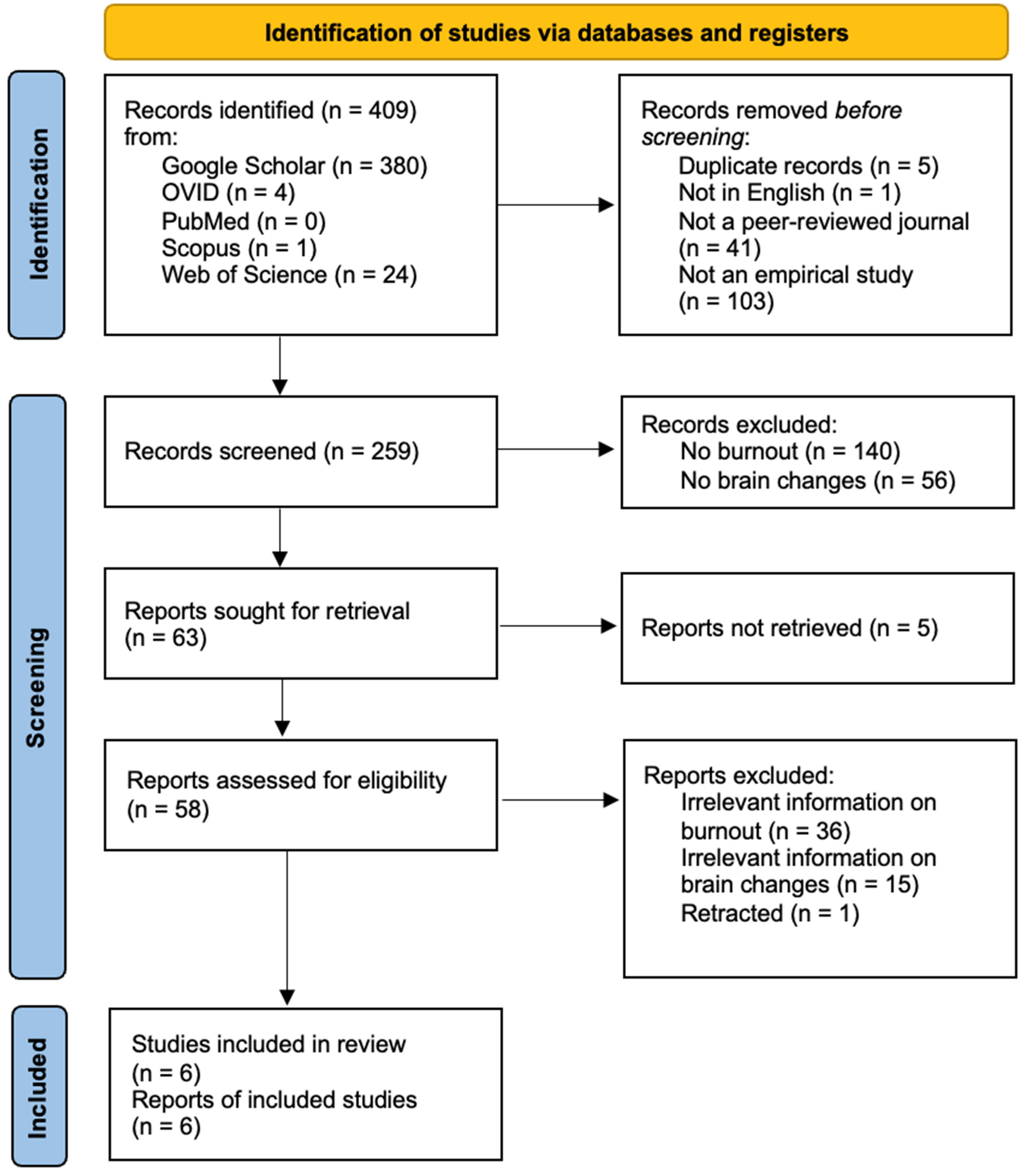
The search process of the five databases is in Supplementary S1. The results of that process are shown in the standardized PRISMA flow diagram in Figure 1.

2.3. Data Items and Summary

Table 2 summarizes the results of the exclusion process for the five database searches, providing additional details regarding the search process beyond those outlined in Figure 1. The details of these results are available in Supplementary S1.

3. Results

The PRISMA checklist (Supplementary S2) results section includes four required sections and one optional (not completed for this review). The results of the first of these four completed sections are presented in Figure 1. The other three sections are (1) the characteristics of the sources of evidence, (2) the results of individual sources of evidence, and (3) a synthesis of the results. The following subsections regard each of these three sections of the PRISMA-ScR checklist.

3.1. Characteristics of the Sources of Evidence

The bibliographic information of the included studies represents the characteristics of the evidence sources. This information is shown in Table 3.
Fewer than three authored the only Google Scholar report [42]. None of the articles were by the same research team. Those authored by teams suggested that they were more likely to lack interpretation bias, primarily because of diverse perspectives, critical dialog, and reductions in individual blind spots [48].
The first report was the only one from a general journal specific to psychiatrists (Australasian Psychiatry) [42], the second report was from a dedicated neuroscience journal (Frontiers in Human Neuroscience) [43], the third was from a public health journal (Frontiers in Public Health) [44], and the last three [45,46,47] were from journals focusing on aspects of psychiatric practice (Journal of Affective Disorders Reports, European Journal of Psychotraumatology, and Emotion). When the intent is to aid psychiatrists in locating research on brain changes and burnout, publications in high-impact general psychiatric journals are those most likely to be read by the greatest number of psychiatrists. Although Australasian Psychiatry is a general psychiatric journal, it was ranked 164th of all psychiatric journals, with an impact factor of 1.2. None of the other journals representing the studies included were on the list of 190 journals regarding their impact factor [49]. As such, high-impact journals do not currently examine the relationship between burnout and brain changes.

3.2. Individual Sources of Evidence

Regarding the study aims represented in Table 4, the first two reports focused on burnout and brain changes [42,43]. The next four were focused on brain changes regarding stress disorders more generally, where burnout is included among these [44,45,46,47]. As such, although all included studies identify brain changes and burnout, this relationship was the focus of the manuscript for only the first two reports. For psychiatrists, the lack of extensive research investigating the link between burnout and specific brain changes is significant because it hinders the official classification of burnout as a medical disorder, complicates diagnosis, and prevents the development of targeted, biological treatments, as noted in this 2025 review of the psychiatric consequences of burnout [50].
When considering the value of the results of each study, it is relevant to note that, except for the first return (with 720 total participants) [42], each of the other studies [43,44,45,46,47] had fewer than 100 participants. Yet, in accordance with the Central Limit Theory, (n = 30) is the lower limit for such quantitative research [51]. As such, all of the studies were within this limit, meaning that the results of these studies can be considered valid. Without valid, evidence-based research, there can be a misdirection of resources, and psychiatric care can fail to implement effective and quality interventions [52].
Since the focus of this review is research from 2025, the study date matters. Only one of the publications reports the date of the study [44]. Because it is possible that the study results are not from 2025, a missing study completion date is a limitation [53]. Up-to-date burnout research permits psychiatrists to address the high prevalence of burnout and implement effective, evidence-based organizational interventions [54].
Four studies were conducted in Western countries (Australia [42], Poland [43], Switzerland [45], and the Netherlands [47]), while two were conducted in Asian countries (China [44], Taiwan [46]). The location of the studies is relevant because all of these countries represent those where the type of stress resulting in workplace burnout is likely [55,56,57,58]. Although China remains a developing nation [59], ref. [44] is a study on a developed area of the country. Therefore, similar to other studies, economically developed areas are the focus. However, it matters to psychiatrists that burnout research heavily focuses on developed countries because the result is a significant knowledge gap regarding developing regions, one that hinders the development of applicable intervention strategies in developing nations and limits the understanding of burnout in low-resource settings. The risk is importing ineffective and culturally mismatched solutions for burnout resolution [60].

3.2.1. Outcomes Regarding the Aims

Table 5 presents the outcomes highlighted for the study aim from each investigation. They concern the aims relevant to burnout. The measured outcomes for the six reports focus on different aspects of brain changes regarding burnout, which may not be the primary aims of the studies.
The first article [42], on the differences between those who consider themselves “burning out” and others who self-identify as burned out, notes that a common precursor to burnout in those self-identifying as “burning out” is reported headaches. These headaches produce structural and functional brain changes and was reinforced recently in a review of magnetic resonance imaging (MRI) studies regarding burnout and the brain [29]. For those burned out, additional brain changes were regarding sustained hypothalamic–pituitary–adrenal (HPA) axis suppression of the immune system, leading to these individuals falling ill. A 2025 systematic review of burnout, when characterized by endocrine dysregulation and circadian disruption, noted its association primarily with altered HPA-axis activity [61]. These results suggest that complaints of persistent headaches in burned-out employees should be recognized as potentially altering their brain function, both functionally and structurally, leading to consistently high cortisol levels and causing a reduction in its production. The outcome is hypocortisolism, similar to the effects of severe stress and trauma, producing a higher probability of other health issues [62].
In those who were burned out in the second study [43], the EEG recordings coincided with high scores of exhaustion and cynicism and low scores for self-efficacy. A 2025 systematic review of EEG and burnout identified EEG markers as valuable in complementing symptom scales for earlier diagnosis, treatment monitoring, and public health surveillance [63]. By exhibiting coherent neurophysiological signatures comparable in magnitude to established psychiatric disorders, burnout invalidates its classification as a non-disease [63].
In comparing differences in statistically calculated degree centrality (DC) and subsequent functional connectivity (FC) in [44], the findings support recent similar research on DC and FC regarding burnout [29]. With these results, scientists can map the transition of the brain from a state of normal functioning to one of disrupted, inefficient communication without presupposing which regions are affected. This two-step approach is particularly powerful for identifying specific neural substrates of burnout, such as decreased connectivity between the precuneus and the medial orbitofrontal cortex (mOFC), which correlates directly with clinical symptoms like emotional exhaustion and reduced professional self-efficacy [43].
The idea that brain-derived neurotrophic factor (BDNF) levels are likely an indicator of an underlying pathophysiology present in burnout [45] is consistent with earlier research in this area from 2023 [27]. For psychiatrists, BDNF levels are a critical indicator in burnout because they bridge the gap between subjective experience (exhaustion, stress) and objective physiological damage, providing a potential biological marker for a condition often misunderstood or misdiagnosed. Reduced BDNF levels signify a disruption in neural plasticity and in the adaptability and repair of the brain, indicating that burnout is not merely “work stress” but an underlying pathophysiological process that is serious, supporting earlier research published in 2024 [64].
One report [46] recognized changes in gray matter volume and neurotransmitter levels as correlated with emotional states, specifically those leading to burnout. Support for this finding is part of a review of earlier research—a mechanistic review of magnetic resonance imaging (MRI) studies—also from 2025 [29]. This research transforms burnout from a vague, subjective complaint of “tiredness” into an objective and diagnosable neurobiological condition, allowing clinicians to tailor pharmacological or behavioral treatments, demonstrating that chronic stress causes reversible structural damage to the brain [29].
The role of the dorsolateral prefrontal cortex and precuneus in burnout, investigated in [47], is one that was first considered in combination in 2013 [65]. What is unexpected is that a search of “role of the dorsolateral prefrontal cortex and precuneus in burnout” in Google Scholar on 26 January 2026 produced a 2025 publication focused on this relationship and mentions both burnout and brain changes [66]. Yet, regarding the 1 January 2026 searches of brain changes AND burnout AND 2025, it was not a result of any of the searches performed. Because it provides a neurobiological basis for cognitive and emotional symptoms as a quantifiable neurocognitive syndrome, the role of the dorsolateral prefrontal cortex (DLPFC) and precuneus in burnout is critical to psychiatrists. Understanding that burnout involves structural and functional impairments in these specific brain regions—particularly residents and trainees—helps psychiatrists diagnose, manage, and prevent severe burnout-related medical errors and cognitive decline [29].

3.2.2. Study Type

Also presented in Table 5 is the type of study for each publication. All the results were quantitative studies involving the analysis of a questionnaire. The analysis from one was based entirely on questionnaire responses [42]. Another used the questionnaire in combination with EEG data [43]. Three studies relied on MRI scanning [44,46,47] in addition to the questionnaire. One used blood samples along with the questionnaire [45]. The use of questionnaires in testing for burnout by mental health professionals in all cases is valuable because burnout is a complex and often difficult-to-diagnose condition, with symptoms that can mimic or overlap with other mental health disorders like depression or anxiety. In their ability to identify symptoms, track severity, and distinguish between general stress and burnout, validated questionnaires offer standardized, objective, and efficient methods. The British Medical Association has published an online burnout assessment questionnaire that may be helpful in this regard for clinicians [67].
The one study that did not use a supporting objective measure was ref. [42]. The focus of this study was on the headaches experienced by individuals who were burning out. This investigation was not seeking to establish the structural and functional brain changes resulting from burnout headache. The goal was to understand the extent of the problem, which was identified as substantial. Without an objective measure, the value of this result is limited for psychiatrists, especially since it was published in a general psychiatry journal, reaching a wider audience than the other included studies. Lacking an objective measure compromises the reliability, diagnosis, and treatment of the condition. Without objective data, subjective reports of headaches can lead to the pathologization of normal stress, which makes it difficult to differentiate burnout from established medical disorders. This need for more objective data in this regard was the conclusion of a 2024 review of burnout [68].
The relevance of EEG data [43] regarding burnout is well-known and has been recently summarized in a 2025 mechanistic review of the topic [29]. MRI scanning [44,46,47] is also an accepted method of testing in burnout research, covered additionally in ref. [29]. These technologies help distinguish burnout from depression, quantify severity, track recovery, and validate burnout as a distinct, actionable medical disorder rather than simply a psychological feeling [29].
Regarding ref. [45], Google Scholar was searched for 2025 publications on the “value of “blood samples” in burnout research regarding “brain changes” on 26 January 2026. It was not anticipated that there would be a peer-reviewed result of this search indicating the relevance of blood samples in this regard [69]. Given that each of “brain changes” AND “burnout” AND “2025” was found in this article, it is unclear why it was not returned by any of the database searches on 1 January 2026. Unlike most of the results included from those searches, this study was dated. It took place from February to August 2021, as well as 3 to 6 months later, with the last date in March 2022. By using blood samples, psychiatrists can identify specific physiological markers that can differentiate burnout from other conditions, track its impact on physical health, and tailor treatments to address underlying hormonal or nutritional imbalances [70].

3.2.3. Significance

Significance relates to the statistical tests performed [71] (see Table 5). Only two studies directly stated that the tests yielded significant results [45,47]. Another referred to “a high prevalence rate” [42]. A fourth mentions “a potential neurological basis” [43], while a fifth reports a “definite causal relationship” [44]. The final report merely states that the changes were “evident” [46]. The value of statistical significance is for establishing results that were not due to chance [72,73]. However, it is not the only determinant of research quality. The design of the study can be rigorous, validly measured, and reliably executed, and still produce statistically non-significant results [72]. Each of the studies included meets these design criteria, although most do not report significant results. For psychiatrists, having burnout research results rated as statistically significant legitimizes burnout as a serious, actionable occupational hazard rather than merely a personal failure or transient stress, allowing for targeted organizational and clinical interventions. Significant findings justify the allocation of resources for interventions, aid in distinguishing burnout from depression, and relate directly to the quality of patient care [74].

3.3. Synthesis

The synthesis regards the specific findings of each study about either burnout or brain changes. Each of the included reports provides increased information regarding burnout that was unavailable before 2025. These results are found in Table 6.

3.3.1. Burnout

Although it was known as early as 2009 that burnout could lead to hospitalization for mental and cardiovascular disorders [75], what ref. [42] offered as new information was that up to 10% of individuals could experience hospitalization. Although this study did not specify the reason for the hospitalization, another 2023 publication found that hospitalization resulted from problems in work relationships [76]. For psychiatrists, the fact that up to 10% of individuals experiencing burnout may require hospitalization is significant, because it highlights that burnout is not merely occupational stress but a severe, often debilitating health crisis. However, the assessment of this result must consider the lack of quantifiable data in coming to this conclusion.
When providing a comprehensive examination of resting-state functional brain connectivity of burnout [43], the recommendation is for the “eyes-open condition” (EO) in contrast to the “eyes-closed condition” (EC). This finding reinforces the results of similar research begun in 2013 [77]. Research from 2019 found that the task condition significantly affects the results regarding these two conditions [78]. A 2023 paper concluded that EC tends to correlate with greater integration of brain connectivity, and EO with greater specialization [79]. For psychiatrists, the recommendation is for EO over EC in resting-state functional connectivity (rs-FC) examinations of burnout because EO reveals distinct neural signatures of burnout—specifically, decreased functional connectivity in the right frontal/midline areas that are not detectable in the eyes-closed state [63].
Ref. [44] found that a central factor regarding burnout is a positive relationship between precuneus–mOFC connectivity and personal accomplishment. It is the first study to find this connection. Although there are other publications on the connection between burnout and the precuneus [29], they do not regard mOFC connectivity. The identification of a positive relationship between precuneus–medial orbitofrontal cortex (mOFC) connectivity and personal accomplishment provides a neurobiological basis for the emotional symptoms of burnout, distinguishing it from depression and offering a potential biomarker for diagnosis and treatment [29].
The finding of ref. [42] was that hospitalization may be necessary for those experiencing burnout. Therefore, the result of ref. [45]—that various interventions have demonstrated success with burnout inpatients—is encouraging. This research is unique. Other recent studies on burnout and inpatients concern burnout arising from being an inpatient rather than burnout being the reason for the hospital admission [80,81]. This result means that burnout is recognizable as a critical, systemic public health crisis within healthcare rather than just a personal failing. For psychiatrists, these successful interventions provide concrete tools for treating high levels of emotional exhaustion, helping to prevent employee turnover [82].
In addition to the publications on burnout in specific types of employment [9,10,11], ref. [46] identified that frontline police officers report significantly higher levels of burnout and depressive symptoms than controls. A 2025 systematic review and meta-analysis of this topic connected burnout in police officers to several post-traumatic stress disorders rather than depression [83]. These results matter to psychiatrists because they regard public safety and the health of a high-risk group. Police officers with high burnout can overreact, increasing their use of force, and display reduced empathy in critical community interactions [84].
The focus of the comparison between ratings of well-being and a desire for change in ref. [47] is a new study focus for burnout research. Other recent publications have prioritized promoting well-being and resilience to overcome burnout rather than the desire to change [85,86,87]. The shift in burnout research to focus on the comparison between ratings of well-being and a desire for change moves beyond simply measuring burnout as a pathological state toward understanding the motivational and functional outcomes of burnout distress [88].

3.3.2. Brain Changes

The first article cautions that burnout has distinctive physical symptom risks, including structural and functional brain changes, and these risks deserve greater recognition [42]. Ref. [44]—another of the included studies—represents a study that agrees that burnout brain changes are both structural and functional. However, in other cases, structural changes alone are recognized concerning burnout [89,90]. Ref. [89] represents a review returned by (1) Google Scholar; (2) three databases associated with OVID (Embase, Healthstar, and Medline); and (3) Web of Science, and includes both burnout and brain changes. For brain changes in burnout to have both a structural and functional component demonstrates burnout as a legitimate neurobiological condition rather than a state of mind or a weakness. Recognizing physical risks—such as cortical thinning and neuroendocrine dysfunction—allows psychiatrists to treat burnout as a serious, long-term health risk [29].
Ref. [43] notes a potential neurobiological basis for burnout syndrome in the EO resting state, where the observed continuous dense-array EEG data patterns characterized by decreased functional connectivity in the alpha3 sub-band (11–13 Hz) in frontal and midline brain sections, particularly in the right frontal area, support this suggestion. This article represents the first to make this connection regarding brain changes. This information is highly significant to psychiatrists because it helps transform burnout from a nebulous, self-reported syndrome into a quantifiable neurophysiologically dependent disorder, providing evidence-based insight into the mechanics of burnout and aiding diagnosis and treatment [63].
In addition to identifying that burnout results in structural and functional brain changes, Ref. [44] also finds that the impact on brain function in the context of burnout can result in hormonal fluctuations. These differences result in rs-fMRI signal-identified changes to emotional regulation. This finding follows a 2024 publication on stress in general regarding subcortical networks. It concluded that the relationship between stress and connectivity changes was precise and functionally meaningful in balancing hormones [91]. This perspective allows for better diagnoses, differentiation from major depression, and the development of targeted, evidence-based treatments [29,63].
The finding that inpatient treatment was effective for burnout patients [45] is particularly encouraging, following a 2024 study published in 2025 that found that the BDNF gene rs6265 and the FKBP5 gene rs1360780 may jointly contribute to an increased risk of burnout resulting from exposure to high childhood abuse [92]. As there is no direct mention of brain changes, the study results for this review have not included this paper. Successful inpatient treatment for burnout is closely linked to reversing the structural and functional brain damage caused by chronic stress, specifically by reducing the size of an enlarged amygdala, repairing connectivity in the prefrontal cortex, and increasing key neurotrophic factors. Treatment includes Cognitive Behavioral Therapy (CBT) and mindfulness. The aim is to normalize brain activity and restore executive cognitive functions [93].
Regarding the reduced gray matter volume and lower levels of excitatory neurotransmitter for structural and neurochemical brain alterations in burned-out police officers [46], ref. [66] represents another publication on this topic returned in the 26 January 2026 Google Scholar search. This was the second search that returned ref. [66] as relevant. However, none of the 1 January 2026 searches regarding brain changes AND burnout AND 2025 included it. In contrast, another study from 2025—one that focused on perfectionism rather than burnout—recognized that, during situations of maladaptive perfectionism (that may result in burnout), glutamatergic activity tends to be excessive rather than reduced. This brain change leads to intensifying emotional responses and increasing self-criticism with a fear of failure, contributing to a cycle of anxiety and chronic stress in perfectionist individuals [94]. These structural and neurochemical changes, often found in regions responsible for emotional regulation and cognitive control (like the orbitofrontal cortex and dACC), help explain the cognitive impairments, emotional exhaustion, and increased risk-taking behavior often observed in this population [46].
Ref. [47] was the only included result that specified burnout as a whole-brain related problem. However, it was not the first to do so, as a 2023 study investigated a whole-brain assessment for burnout [95]. The 2025 study added that significant whole-brain effects were those demonstrated by contrasting themes. This perspective changes the approach to burnout from simple stress management to clinical, targeted interventions that aim to reverse structural and functional brain damage [29].

4. Discussion

A common element in all the included results is the use of a questionnaire to assess burnout, along with any additional empirical tests. The measurement tools employed varied. They included the Burnout Assessment Tool (BAT), the Sydney Burnout Measure (SBM) [42], the Maslach Burnout Inventory—General Survey [43], the Maslach Burnout Inventory—Human Services Survey (MBI-HSS) [44], the Maslach Burnout Inventory [45], the Copenhagen Burnout Inventory (CBI) for measuring workplace fatigue/burnout [46], and the Dutch version of the Maslach Burnout Inventory—Utrechtse Burnout Schaal Algemene versie (UBOS-A) [47]. None of the studies employed the same questionnaire to assess burnout.
The Burnout Assessment Tool (BAT) [96] and Sydney Burnout Measure (SBM) [97] are newer, comprehensive instruments with 4–7 dimensions. Both focus on broader cognitive and physical impairment. This focus is in comparison to the traditional Maslach Burnout Inventory (MBI) and Copenhagen Burnout Inventory (CBI), which test for exhaustion and cynicism [98,99]. BAT/SBM evaluate current severity and offer clinical depth, unlike MBI’s frequency-based approach [100,101].
Although several inventories employed in the included studies are part of the MBI, they are unique. The Maslach Burnout Inventory (MBI) is a comprehensive term. The Maslach Burnout Inventory—Human Services Survey (MBI-HSS) is a specific 22-item version. Its design is for the service professions, such as healthcare, social work, and law enforcement. The MBI-HSS is considered the original, standard version in this regard [102]. In contrast, the Maslach Burnout Inventory—General Survey (MBI-GS) (16 items) is adapted for general occupations, focusing on exhaustion, cynicism, and professional efficacy [103]. The Dutch Utrechtse Burnout Schaal (UBOS-A), a version of the Maslach Burnout Inventory—General Survey (MBI-GS), is a validated adaptation measuring the same three-factor structure (exhaustion, cynicism, and personal accomplishment) but consists of 20 items, compared to the standard 22-item MBI (nine items for exhaustion, five for depersonalization/cynicism, and eight for personal accomplishment) [104].
As such, when deciding on which questionnaire to employ as an inventory to assess burnout, it is necessary to determine the purpose of the assessment. For evaluating the current severity of burnout for clinical depth, BAT [96] and SBM [97] can be used individually or in combination. In contrast, if the goal is to match the measurement tool with the occupation, the choice should be to employ a more precise measurement than MBI—general occupations should use the MBI-GS and the service professions should employ the MBI-HSS. Although not employed by any of the included studies, the Educators Survey (MBI-ES) is an MBI designed for educators [105]. If there is a concern that understanding the country of origin would affect interpreting burnout, a tool such as the UBOS-A would be advised [104]. MBI has been validated in many languages [103].
Whatever the treatment selection for burnout regarding brain changes, the choice of an appropriate questionnaire to initially assess the aspects demonstrated of burnout using either CBI or MBI (using the relevant version for employment and nationality) will determine how the brain changes are measured [106]; for example, knowing the severity of the burnout with the BAT/SBM will contribute to understanding if treatment is best undertaken inpatient, outpatient in person, or via telehealth [107,108].
Differences in burnout assessment tools significantly impact research on brain changes by creating distinct symptom profiles (e.g., emotional vs. cognitive focus), connecting with dissimilar neural markers. CBI and MBI correlate with amygdala enlargement, dysfunction in the amygdala–anterior cingulate cortex, and prefrontal cortex thinning in their focus on exhaustion, depersonalization, and personal accomplishment [29]. In contrast, the type of cognitive impairment or psychophysiological fatigue that aligns with functional changes in the precuneus and cognitive processing centers tests with BAT and SBM [109].

4.1. Overarching Concepts

New findings that brain changes are both structural and functional [42,44,46], affect the entire brain [47], and may lead to hospitalization [42] have been identified by the included studies. These results represent an advancement for this topic in contrast to the 2025 review, which recognized previous research on this topic and determined that it is structural alone [89]. As such, brain changes associated with burnout are both structural and functional, and 2025 was the turning point year for this recognition [110,111]. This new understanding, that burnout affects both the structure and function of the entire brain, explains why multi-modal assessment tools which combine questionnaires are both relevant and advised. Additionally, EEG, MRI, and biomarker tests demonstrated their value in 2025 for further understanding of the functional changes associated with burnout. However, psychiatrists must remain cautious about the findings from 2025. There were few included studies assessed in this review, and they lacked (1) a large population, (2) various types of employment, (3) employees of different socioeconomic backgrounds, and (4) longitudinal considerations. Consequently, although 2025 was a watershed year for studies regarding functional changes associated with burnout in the whole brain, these results represent the beginning of this area of study, though not a complete, comprehensive understanding.

4.2. Limitations

As a review concerned with the currency of publications, the date of the study would be a significant factor. Only one of the included reports [44] states the study date. The primary reason why the study date is important, as noted in the previous subsection, is that it was not until the publication of research in 2025 that the extent to which burnout alters the brain was recognized. Lacking the date of study completion in the remaining reports is a limitation for this 2025 review [53].
Keyword bias [112] can be a reason for a lack of returns from database searches. In cases where there might be a gap in the keywords, the advice is to search Google Scholar as a supplementary database [113]. Although one of the databases searched was Google Scholar, the returns were still limited, with the included returns from Web of Science significantly greater than those from Google Scholar. In confining this review to only those publications regarding a keyword search of brain changes AND burnout AND 2025, additional comparisons were made, some of which were published in 2025 ([29,61,63,66,89,94,95,110,111]). These supplementary publications were relevant to the topics; however, they were reviews and were therefore excluded from the included studies.
On the other hand, one later-identified relevant study [66] was not among the search results. It contained “burnout” and “2025”, but it referred to “brain activity” rather than brain changes. To identify this study, the search was for “role of the dorsolateral prefrontal cortex and precuneus in burnout”. To this extent, several other keywords might have produced additional relevant studies—some are “neural correlates”, “neuroimaging”, “functional connectivity”, “brain structure”, or “neurobiological mechanisms”. A search on 22 March 2026 of the same five databases for these keywords produced results that represent the contents of Supplementary S3 (uploaded to OSF on 24 March 2026). The result of this search was that ref. [66] was then returned in Google Scholar, OVID (Medline), and Web of Science each. However, it was the only included study that was in addition to the original search of burnout AND brain changes AND 2025. Although not part of the included studies, ref. [66] was examined in relation to both ref. [46] and ref. [47]. This additional search demonstrated that, to return ref. [66], the original keywords were insufficient, representing a limitation.
More problematically was the identification of one article with a search of “value of “blood samples” for burnout research regarding “brain changes” [69] that included all the keywords brain changes AND burnout AND 2025 in the text, yet it was not among the included studies. There is no explanation for why there was no return of this article in any of the searches—the initial search or the additional one on 22 March 2026. Moreover, the 22 March 2026 search that included “brain structure” was unable to identify [114]—a 2025 paper that concerns both burnout and brain changes—that had been the result of the 26 March 2026 search of Google (not Google Scholar) regarding the question: “Why was 2025 particularly significant for research regarding brain changes and burnout?” Ref. [114] was not reviewed in the body of this paper as it did not return with the five selected databases; however, the title of the article summarizes its findings: “Whole-brain gray matter volume mediates the relationship between psychological distress and job satisfaction.” The results of this study further reinforce the findings of ref. [47], where the brain changes associated with burnout affect the whole brain. The lack of any of these searches to identify these relevant studies indicates a limitation associated with the search engines themselves.
Some pre-2025 publications assessed the included studies ([65,75,77,78,79,80,85,86,87,107]). The use of earlier studies appears to be contrary to the intention to review only those publications from 2025. Their citation was to demonstrate a continuing trend in the respective research areas, and there is an acknowledgement of their earlier publication dates in the text where they appear.
An additional limitation is that, in comparison to a systematic review and meta-analysis [115,116], this review does not evaluate sample sizes [117] or the validity of the measurement tools [118]. The advice was to avoid conducting a systematic review and meta-analysis for this type of analysis [34,119,120]. However, this choice then required following the PRISMA-ScR guidelines [36,119,121,122,123] for scoping reviews. The decision to follow the methodology of a scoping review was because the aim was to locate the extent of research on the topic published in 2025. Nevertheless, although this work follows the guidelines of PRSIMA-ScR, research older than 2025 and any reports that were not peer-reviewed were excluded, making it not a scoping review per se. If the aim had been to find the range of all research on burnout and brain changes, this would be a limitation. However, as the aim was to clarify the most recent studies on the topic from 2025, not conducting a full scoping review made the research from that year evident—previous studies were referenced when they were relevant to the 2025 research. There was an exclusion of non-peer-reviewed research because mitigating bias was not a requirement, as it is with peer-reviewed research [124]. The focus on studies from 2025 results from psychiatry witnessing a shift towards precision psychiatry and novel biological treatments during the past year [125,126], as captured in this review.
Nevertheless, the manuscript remains ambiguous in its methodology, as it is between a scoping review and a narrative review. Although there are references to PRISMA-ScR and a following of the PRISMA-ScR guidelines, the methodological choices (e.g., temporal restriction, keyword selection, and lack of dual screening) are those of a focused narrative synthesis. This result—being neither a scoping review nor a narrative review—is a limitation.
By examining only peer-reviewed studies from 2025, the result was a small number of included studies, equaling a sample size of n = 6. As such, with so few results, it is difficult to generalize the outcomes in broader terms, especially since the results were heterogeneous. Nevertheless, this identified problem of a small number of returns in recent research regarding burnout is not unique to this review. A 2026 systematic review of burnout and biological biomarkers in emergency and acute-care healthcare workers noted a similar problem [127].
One researcher conducted the data charting process—a method that may create cognitive bias [128]. A way to reduce such bias is to have at least two independent reviewers for screening and data extraction [129]. As this was not the method employed, one reason for following PRISMA-ScR procedures for scoping reviews [38] was that, in ensuring rigor, transparency, and reproducibility [130], this process mitigates possible cognitive bias. Supplementary S1 lists the returns from all five database searches, with the details of the reasons for those excluded and included. This file is available to any researcher for examination. As such, it acts as the full set of data necessary for multiple researchers to confirm screening and data extraction. Another means of controlling cognitive bias for transparency was the Preferred Reporting Items for Systematic Review and Meta-Analysis extension for scoping reviews (PRISMA-ScR) checklist [37] of Supplementary S2, which was completed.

4.3. Suggested Research Directions

The variety of topics investigating brain changes and burnout has progressed consistently. The 2025 publications make these results evident. Some results have strengthened a line of research that began more than a decade ago [65,75,77,107]. These include investigations of inpatient burnout [45], functional neuroimaging [47], and fMRI regarding eyes-open and eyes-closed conditions [43], in which the expectation is that continued research will be fruitful.
What is lacking is a comprehensive examination of brain changes in burnout available from a single study. Researchers in 2025 used either BAT/SBM or CBI/MBI. The recommendation is to use both types of questionnaire to assess burnout. Combining the use of more than one burnout assessment tool can merge the symptom profiles to include both emotional and cognitive focuses. As such, information on brain changes can potentially include amygdala enlargement, amygdala–anterior cingulate cortex dysfunction, and prefrontal cortex thinning [29] along with functional changes in the precuneus and cognitive processing hubs [91].
Additionally, considering differences in occupation and economic development would further enhance the research on this topic. The concentration on burnout research regarding brain changes in 2025 was on professionals in service industries [44,46] and in developed nations [42,43,45,46,47]. There was no focus in 2025 regarding brain changes and burnout, for example, in factory workers in developing nations. The role of burnout associated with factory work in developing countries was only beginning to be investigated in 2025 [131,132].
With more precise data from a broader and more appropriate range of questionnaires, tailoring brain changes studies can anticipate the measures that are most likely to provide relevant and insightful findings. This review of 2025 publications identified that EEG data [43], MRI scanning [44,46,47], and blood samples [45] each provide valuable information on the brain changes associated with burnout. In 2025, the assessment of burnout was with only one measurement type per study. The advice is for future research to test for burnout comprehensively when considering the brain changes that may be affected by it.
Learning that, as a result of burnout symptoms, 10% of participants in one study were hospitalized [42] may be a reason to reinterpret the seriousness of burnout symptoms. Inpatient treatment programs were successful in reducing burnout. In part, this interpretation was a result of brain changes in hospital-based tests, suggesting that continuing research on inpatient treatment programs for burnout is advisable.
None of the included studies were in a high-impact journal. To gain higher visibility and greater impact on the field, the advice for future research on burnout and brain changes is to publish in the highest-ranking psychiatry journals. As of 2024, the following journals had the highest impact factors: World Psychiatry—65.8, Psychotherapy and Psychosomatics—17.4, and JAMA Psychiatry—17.1 [49].
Overall, these recommendations for suggested research directions regarding the relationship between burnout and brain changes distinguish the need for researchers to anticipate that burnout produces brain changes in various ways. Research in 2025 revealed that burnout is associated with both structural and functional brain changes [42,44,46]. Further research on functional brain changes with burnout is warranted. Building on the findings from 2025, researchers can now begin their studies with the foundational assumption that burnout produces both structural and functional brain changes. In this way, studies can search for additional brain changes using a full range of assessment tools and tests, further expanding the range of these anticipated changes. Doing so will not only increase research in this area but also identify burnout-reduction interventions and their effects on the brain. As such, long-term negative outcomes from burnout will potentially be lessened.

5. Conclusions

In investigating peer-reviewed publications on burnout and brain changes published in 2025, this review followed the PRISMA-ScR guidelines when searching five databases. There were various recorded brain changes in the six peer-reviewed publications included regarding burnout. All studies employed questionnaires to assess the type or level of burnout in gauging the structural and functional brain changes. Additionally, five of the six reports employed another objective empirical method to determine the kind of brain change, such as EEG data, MRI scanning, or blood samples.
The research on this topic demonstrates that investigations on this new area of burnout research are ongoing and expanding in their reach and application. Regarding research on brain changes and burnout in 2025, various occupations and countries were investigated. A turning point in 2025 was reached in burnout research and brain changes. Research from 2025 (1) identified burnout with structural and functional changes in the whole brain, in addition (2) to being properly testable by more than one type of questionnaire and several quantitative methods, though the research is still in its infancy. Therefore, psychiatrists should be cautious in the conclusions they draw from the results and their selected methods of treatment in response to this research. In the future, expansions of this area of investigation to compare age groups, genders, social groups, and longitudinal effects of burnout on brain changes are necessary to supplement the current range of evolving research on the topic of brain changes and burnout.

Supplementary Materials

The following supporting information can be downloaded at: https://www.mdpi.com/article/10.3390/psychiatryint7030116/s1, Supplementary S1—five database searches on 1 January 2026 for the keywords brain change AND burnout AND 2025; Supplementary S2—Preferred Reporting Items for Systematic Review and Meta-Analysis Extension for Scoping Reviews (PRISMA-ScR) checklist; and Supplementary S3—five database searches on 22 March 2026 for the keywords burnout AND (neural correlates OR neuroimaging OR functional connectivity OR brain structure OR neurobiological mechanisms), with the limit of results from 2025.

Funding

This research received no external funding.

Institutional Review Board Statement

Not applicable.

Informed Consent Statement

Not applicable.

Data Availability Statement

No new data were created or analyzed in this study. Data sharing is not applicable to this article.

Acknowledgments

The author takes full responsibility for the contents of this review.

Conflicts of Interest

The author declares no conflicts of interest.

Abbreviations

The following abbreviations are used in this manuscript:
PRISMAPreferred Reporting Items for Systematic Review and Meta-Analysis
ScRScoping Review
EEGElectroencephalogram
fMRIFunctional Magnetic Resonance Imaging
BDNFBrain-Derived Neurotrophic Factor
DCDegree Centrality
FCFunctional Connectivity
HPAHypothalamic–Pituitary–Adrenal
mOFCMedial Orbitofrontal Cortex
SCSSelf-Compassion Scale
HAMD-17Hamilton Depression Rating Scale, 17-Item Version
dACCDorsal Anterior Cingulate Cortex
FDRFalse Discovery Rate
EOEyes-Open Condition
ECEyes-Closed Condition
BATBurnout Assessment Tool
SBMSydney Burnout Measure
MBI-HSSMaslach Burnout Inventory—Human Services Survey
CBICopenhagen Burnout Inventory
UBOS-AUtrechtse Burnout Schaal Algemene Versie/Dutch Utrechtse Burnout Schaal
MBI-GSMaslach Burnout Inventory—General Survey
MBI-ESMaslach Burnout Inventory—Educators Survey

References

  1. Freudenberger, H.J. Staff Burn-Out. J. Soc. Issues 1974, 30, 159–165. [Google Scholar] [CrossRef]
  2. Leiter, M.P.; Maslach, C. Job Burnout. In Handbook of Occupational Health Psychology, 3rd ed.; Tetrick, L.E., Fisher, G.G., Ford, M.T., Quick, J.C., Eds.; American Psychological Association: Washington, DC, USA, 2024; pp. 291–307. ISBN 978-1-4338-3777-7. [Google Scholar]
  3. Maslach, C.; Leiter, M.P. The Burnout Challenge: Managing People’s Relationships with Their Jobs; Harvard University Press: Cambridge, MA, USA; London, UK, 2022; ISBN 978-0-674-25101-4. [Google Scholar]
  4. Khammissa, R.A.G.; Nemutandani, S.; Feller, G.; Lemmer, J.; Feller, L. Burnout Phenomenon: Neurophysiological Factors, Clinical Features, and Aspects of Management. J. Int. Med. Res. 2022, 50, 03000605221106428. [Google Scholar] [CrossRef]
  5. Edú-Valsania, S.; Laguía, A.; Moriano, J.A. Burnout: A Review of Theory and Measurement. Int. J. Environ. Res. Public Health 2022, 19, 1780. [Google Scholar] [CrossRef]
  6. Bayes, A.; Tavella, G.; Parker, G. The Biology of Burnout: Causes and Consequences. World J. Biol. Psychiatry 2021, 22, 686–698. [Google Scholar] [CrossRef]
  7. Wu, F.; Ren, Z.; Wang, Q.; He, M.; Xiong, W.; Ma, G.; Fan, X.; Guo, X.; Liu, H.; Zhang, X. The Relationship between Job Stress and Job Burnout: The Mediating Effects of Perceived Social Support and Job Satisfaction. Psychol. Health Med. 2021, 26, 204–211. [Google Scholar] [CrossRef]
  8. Demerouti, E.; Bakker, A.B.; Peeters, M.C.W.; Breevaart, K. New Directions in Burnout Research. Eur. J. Work Organ. Psychol. 2021, 30, 686–691. [Google Scholar] [CrossRef]
  9. Amer, S.A.A.M.; Elotla, S.F.; Ameen, A.E.; Shah, J.; Fouad, A.M. Occupational Burnout and Productivity Loss: A Cross-Sectional Study Among Academic University Staff. Front. Public Health 2022, 10, 861674. [Google Scholar] [CrossRef] [PubMed]
  10. Lu, F.-I.; Ratnapalan, S. Burnout Interventions for Resident Physicians: A Scoping Review of Their Content, Format, and Effectiveness. Arch. Pathol. Lab. Med. 2023, 147, 227–235. [Google Scholar] [CrossRef] [PubMed]
  11. Govindaras, B.; Wern, T.S.; Kaur, S.; Haslin, I.A.; Ramasamy, R.K. Sustainable Environment to Prevent Burnout and Attrition in Project Management. Sustainability 2023, 15, 2364. [Google Scholar] [CrossRef]
  12. Ge, M.; Hu, F.; Jia, Y.; Tang, W.; Zhang, W.; Chen, H. Global Prevalence of Nursing Burnout Syndrome and Temporal Trends for the Last 10 Years: A Meta-analysis of 94 Studies Covering over 30 Countries. J. Clin. Nurs. 2023, 32, 5836–5854. [Google Scholar] [CrossRef]
  13. Pelly, D.; Daly, M.; Delaney, L.; Doyle, O. Worker Stress, Burnout, and Wellbeing Before and During the COVID-19 Restrictions in the United Kingdom. Front. Psychol. 2022, 13, 823080. [Google Scholar] [CrossRef]
  14. Wright, T.; Mughal, F.; Babatunde, O.; Dikomitis, L.; Mallen, C.; Helliwell, T. Burnout among Primary Health-Care Professionals in Low- and Middle-Income Countries: Systematic Review and Meta-Analysis. Bull. World Health Organ. 2022, 100, 385–401A. [Google Scholar] [CrossRef]
  15. Tsai, H.-J.; Tsou, M.-T. Age, Sex, and Profession Difference Among Health Care Workers with Burnout and Metabolic Syndrome in Taiwan Tertiary Hospital—A Cross-Section Study. Front. Med. 2022, 9, 854403. [Google Scholar] [CrossRef] [PubMed]
  16. Zhang, X.; Qu, G.; Chen, X.; Luo, Y. The Network Analysis of Anxiety, Depression and Academic Burnout Symptom Relationships throughout Early, Middle, and Late Adolescence. J. Adolesc. 2025, 97, 233–248. [Google Scholar] [CrossRef]
  17. Gajewski, P.D.; Rieker, J.A.; Athanassiou, G.; Bröde, P.; Claus, M.; Golka, K.; Hengstler, J.G.; Kleinsorge, T.; Nitsche, M.A.; Reinders, J.; et al. A Systematic Analysis of Biological, Sociodemographic, Psychosocial, and Lifestyle Factors Contributing to Work Ability Across the Working Life Span: Cross-Sectional Study. JMIR Form. Res. 2023, 7, e40818. [Google Scholar] [CrossRef]
  18. Xue, D.; Sun, B.; Li, W.; Li, X.; Xiao, W. The Relationship between Resiliency, Psychological Empowerment, and Teacher Burnout across Different Genders: A Psychological Network Analysis. Behav. Sci. 2024, 14, 878. [Google Scholar] [CrossRef]
  19. Singh, R.; Sharma, A.; Gupta, N.; Mishra, M.; Kushwaha, R. Anxiety, Mental Health, Job Insecurity and Workplace Challenges: Exploring the Well-Being of Women Gig Workers in the Gig Economy. Ment. Health Soc. Incl. 2024, 29, 362–381. [Google Scholar] [CrossRef]
  20. Artz, B.; Kaya, I.; Kaya, O. Gender Role Perspectives and Job Burnout. Rev. Econ. Househ. 2022, 20, 447–470. [Google Scholar] [CrossRef] [PubMed]
  21. Huang, Q.; Wang, Y.; Yuan, K.; Liu, H. How Role Overload Affects Physical and Psychological Health of Low-Ranking Government Employees at Different Ages: The Mediating Role of Burnout. Saf. Health Work 2022, 13, 207–212. [Google Scholar] [CrossRef] [PubMed]
  22. Mikkonen, K.; Veikkola, H.-R.; Sorkkila, M.; Aunola, K. Parenting Styles of Finnish Parents and Their Associations with Parental Burnout. Curr. Psychol. 2023, 42, 21412–21423. [Google Scholar] [CrossRef]
  23. Lam, L.T.; Lam, M.K.; Reddy, P.; Wong, P. Factors Associated with Work-Related Burnout among Corporate Employees Amidst COVID-19 Pandemic. Int. J. Environ. Res. Public Health 2022, 19, 1295. [Google Scholar] [CrossRef] [PubMed]
  24. Özkan, A.H. The Effect of Burnout and Its Dimensions on Turnover Intention among Nurses: A Meta-analytic Review. J. Nurs. Manag. 2022, 30, 660–669. [Google Scholar] [CrossRef] [PubMed]
  25. Bakker, A.B.; De Vries, J.D. Job Demands–Resources Theory and Self-Regulation: New Explanations and Remedies for Job Burnout. Anxiety Stress Coping 2021, 34, 1–21. [Google Scholar] [CrossRef] [PubMed]
  26. Kloutsiniotis, P.V.; Mihail, D.M.; Mylonas, N.; Pateli, A. Transformational Leadership, HRM Practices and Burnout during the COVID-19 Pandemic: The Role of Personal Stress, Anxiety, and Workplace Loneliness. Int. J. Hosp. Manag. 2022, 102, 103177. [Google Scholar] [CrossRef]
  27. Mikołajewski, D.; Masiak, J.; Mikołajewska, E. Neurophysiological Determinants of Occupational Stress and Burnout. J. Educ. Health Sport 2023, 21, 33–46. [Google Scholar] [CrossRef]
  28. Renaud, C.; Lacroix, A. Systematic Review of Occupational Burnout in Relation to Cognitive Functions: Current Issues and Treatments. Int. J. Stress Manag. 2023, 30, 109–127. [Google Scholar] [CrossRef]
  29. Chmiel, J.; Kurpas, D. Burnout and the Brain—A Mechanistic Review of Magnetic Resonance Imaging (MRI) Studies. Int. J. Mol. Sci. 2025, 26, 8379. [Google Scholar] [CrossRef]
  30. Jang, W.; Kim, S.; Kim, Y.; Lee, S.; Choi, J.Y.; Lee, W. Overwork and Changes in Brain Structure: A Pilot Study. Occup. Environ. Med. 2025, 82, 105–111. [Google Scholar] [CrossRef]
  31. Dickson, K.; Yeung, C.A. PRISMA 2020 Updated Guideline. Br. Dent. J. 2022, 232, 760–761. [Google Scholar] [CrossRef]
  32. Page, M.J.; McKenzie, J.E.; Bossuyt, P.M.; Boutron, I.; Hoffmann, T.C.; Mulrow, C.D.; Shamseer, L.; Tetzlaff, J.M.; Akl, E.A.; Brennan, S.E.; et al. The PRISMA 2020 Statement: An Updated Guideline for Reporting Systematic Reviews. BMJ 2021, 372, n71. [Google Scholar] [CrossRef]
  33. Page, M.J.; Moher, D.; Bossuyt, P.M.; Boutron, I.; Hoffmann, T.C.; Mulrow, C.D.; Shamseer, L.; Tetzlaff, J.M.; Akl, E.A.; Brennan, S.E.; et al. PRISMA 2020 Explanation and Elaboration: Updated Guidance and Exemplars for Reporting Systematic Reviews. BMJ 2021, 372, n160. [Google Scholar] [CrossRef]
  34. Pollock, D.; Evans, C.; Jia, R.M.; Alexander, L.; Pieper, D.; Brandão De Moraes, É.; Peters, M.D.J.; Tricco, A.C.; Khalil, H.; Godfrey, C.M.; et al. “How-to”: Scoping Review? J. Clin. Epidemiol. 2024, 176, 111572. [Google Scholar] [CrossRef] [PubMed]
  35. Peters, M.D.J.; Godfrey, C.; McInerney, P.; Khalil, H.; Larsen, P.; Marnie, C.; Pollock, D.; Tricco, A.C.; Munn, Z. Best Practice Guidance and Reporting Items for the Development of Scoping Review Protocols. JBI Evid. Synth. 2022, 20, 953–968. [Google Scholar] [CrossRef]
  36. Peters, M.D.J.; Marnie, C.; Tricco, A.C.; Pollock, D.; Munn, Z.; Alexander, L.; McInerney, P.; Godfrey, C.M.; Khalil, H. Updated Methodological Guidance for the Conduct of Scoping Reviews. JBI Evid. Synth. 2020, 18, 2119–2126. [Google Scholar] [CrossRef]
  37. PRISMA. PRISMA PRISMA for Scoping Reviews (PRISMA-ScR). PRISMA 2020. 2025. Available online: https://www.prisma-statement.org/scoping (accessed on 6 May 2026).
  38. Tricco, A.C.; Lillie, E.; Zarin, W.; O’Brien, K.K.; Colquhoun, H.; Levac, D.; Moher, D.; Peters, M.D.J.; Horsley, T.; Weeks, L.; et al. PRISMA Extension for Scoping Reviews (PRISMA-ScR): Checklist and Explanation. Ann. Intern. Med. 2018, 169, 467–473. [Google Scholar] [CrossRef]
  39. Nazri, M.; Rudi, M. Malaysia Military Leadership: A Systematic Literature Review of Current Research. IJBM 2019, 3, 1–15. Available online: https://www.ijbmjournal.com/uploads/2/6/8/1/26810285/40012019-ijbm-15-29.pdf (accessed on 6 May 2026).
  40. Chalmers, H.; Brown, J.; Koryakina, A. Topics, Publication Patterns, and Reporting Quality in Systematic Reviews in Language Education. Lessons from the International Database of Education Systematic Reviews (IDESR). Appl. Linguist. Rev. 2024, 15, 1645–1669. [Google Scholar] [CrossRef]
  41. Gusenbauer, M.; Haddaway, N.R. Which Academic Search Systems Are Suitable for Systematic Reviews or Meta-analyses? Evaluating Retrieval Qualities of Google Scholar, PubMed, and 26 Other Resources. Res. Synth. Methods 2020, 11, 181–217. [Google Scholar] [CrossRef]
  42. Parker, G.; Russo, N. Burnout: At Times a Physical State. Australas. Psychiatry 2025, 34, 10398562251395535. [Google Scholar] [CrossRef]
  43. Afek, N.; Harmatiuk, D.; Gawłowska, M.; Ferreira, J.M.A.; Golonka, K.; Tukaiev, S.; Popov, A.; Marek, T. Functional Connectivity in Burnout Syndrome: A Resting-State EEG Study. Front. Hum. Neurosci. 2025, 19, 1481760. [Google Scholar] [CrossRef] [PubMed]
  44. Liu, J.-P.; Gu, S.-Y.; Song, C.-M.; Yang, H.-C.; Shi, Y.; Gu, Y.-F.; Wang, S.-F.; Chen, Y.-Z. Abnormal Intrinsic Functional Hubs and Connectivity in Nurses with Occupational Burnout: A Resting-State fMRI Study. Front. Public Health 2025, 13, 1595550. [Google Scholar] [CrossRef]
  45. La Marca, R.; Scheiwiller, M.; Pfaff, M.; La Marca-Ghaemmaghami, P.; Böker, H. Plasma BDNF in Burnout-Related Depressive Disorders: The Mediating Role of Perceived Social Isolation and the Biopsychological Effect of a Multimodal Inpatient Treatment. J. Affect. Disord. Rep. 2025, 20, 100880. [Google Scholar] [CrossRef]
  46. Wang, W.-Y.; Lin, Y.-C.; Liu, Y.-H.; Lee, P.-L.; Lin, S.-H.N.; Chang, L.-H.; Lin, C.-P. Neurobiological and Emotional Impact of Occupational Stress in Frontline Police Officers: A Neuroimaging and Neurochemical Study. Eur. J. Psychotraumatol. 2025, 16, 2572187. [Google Scholar] [CrossRef]
  47. Green, K.H.; Van De Groep, S.; Van Der Cruijsen, R.; Warnert, E.A.H.; Crone, E.A. Neural Correlates of Well-Being in Young Adults. Emotion 2025, 25, 1677–1689. [Google Scholar] [CrossRef]
  48. Ren, Z.; Webster, A.C.; Hunter, K.E.; Zhang, J.; Yao, Y.; Tan-Koay, A.G.; Tan, A.C. Reducing Risk of Bias in Interventional Studies during Their Design and Conduct: A Scoping Review. BMC Med. Res. Methodol. 2025, 25, 85. [Google Scholar] [CrossRef] [PubMed]
  49. OOIR. The Observatory of International Research Journal Rankings: Psychiatry. 2026. Available online: https://ooir.org/journals.php?field=Clinical+Medicine&category=Psychiatry&metric=jif (accessed on 6 May 2026).
  50. Ungurianu, A.; Ciubară, A.; Ciobotaru, O.R. A Review of Burnout Psychiatric Consequences. BRAIN 2025, 16, 479–496. [Google Scholar] [CrossRef]
  51. Zhang, X.; Astivia, O.L.O.; Kroc, E.; Zumbo, B.D. How to Think Clearly about the Central Limit Theorem. Psychol. Methods 2023, 28, 1427–1445. [Google Scholar] [CrossRef] [PubMed]
  52. Demerouti, E.; Bakker, A.B. Revitalising Burnout Research. Work Stress 2025, 39, 153–161. [Google Scholar] [CrossRef]
  53. Willis, L.D. How to Write the Methods Section of a Research Manuscript. Respir. Care 2023, 68, 1763–1770. [Google Scholar] [CrossRef]
  54. Cao, B.; Hassan, N.C.; Omar, M.K. Interventions to Reduce Burnout Among University Lecturers: A Systematic Literature Review. Behav. Sci. 2025, 15, 649. [Google Scholar] [CrossRef]
  55. Ouyang, C.; Zhu, Y.; Ma, Z.; Qian, X. Why Employees Experience Burnout: An Explanation of Illegitimate Tasks. Int. J. Environ. Res. Public Health 2022, 19, 8923. [Google Scholar] [CrossRef]
  56. Lee, Y.-L.; Dai, J.-W.; Li, X.-W.; Chiang, M.-Y.; Chen, P.-T.; Lin, Y.-C.; Wang, C.-H. Prevalence and the Associated Factors of Burnout among the Critical Healthcare Professionals during the Post-Pandemic Era: A Multi-Institutional Survey in Taiwan with a Systematic Review of the Asian Literatures. BMC Public Health 2024, 24, 3480. [Google Scholar] [CrossRef]
  57. Győri, Á.; Perpék, É.; Ádám, S. Mental Health Risk in Human Services Work across Europe: The Predictive Role of Employment in Various Sectors. Front. Public Health 2025, 12, 1407998. [Google Scholar] [CrossRef]
  58. Hurria, C. Burnout—An Exponential Rise. J. Organ. Psychol. 2023, 23, 37–46. [Google Scholar] [CrossRef]
  59. Rodrik, D.; Stiglitz, J.E. A New Growth Strategy for Developing Nations. In The New Global Economic Order; Routledge: London, UK, 2025; pp. 89–107. ISBN 978-1-003-57138-4. [Google Scholar]
  60. Frey, E.; Chong, Y.-Y.; Chien, W.-T.; Gloster, A.T. Cross-Cultural Comparison of Burnout, Insomnia and Turnover Intention Among Nurses in Eastern and Western Cultures During the COVID-19 Pandemic: Protective and Risk Factors. Nurs. Rep. 2025, 15, 52. [Google Scholar] [CrossRef]
  61. Ungurianu, A.; Marina, V. The Biological Clock Influenced by Burnout, Hormonal Dysregulation and Circadian Misalignment: A Systematic Review. Clocks Sleep 2025, 7, 63. [Google Scholar] [CrossRef]
  62. Sic, A.; Bogicevic, M.; Brezic, N.; Nemr, C.; Knezevic, N.N. Chronic Stress and Headaches: The Role of the HPA Axis and Autonomic Nervous System. Biomedicines 2025, 13, 463. [Google Scholar] [CrossRef]
  63. Chmiel, J.; Malinowska, A. Neural Correlates of Burnout Syndrome Based on Electroencephalography (EEG)—A Mechanistic Review and Discussion of Burnout Syndrome Cognitive Bias Theory. JCM 2025, 14, 5357. [Google Scholar] [CrossRef]
  64. Cortés-Álvarez, N.Y.; Lara-Morales, A.; Bautista-Rodríguez, E.; Marmolejo-Murillo, L.G.; Díaz Jiménez, A.; Vergara Hernández, L.A.; Fernández Moya, M.; Vuelvas-Olmos, C.R. Job Burnout, Cognitive Functioning, and Brain-Derived Neurotrophic Factor Expression among Hospital Mexican Nurses. PLoS ONE 2024, 19, e0304092. [Google Scholar] [CrossRef]
  65. Durning, S.J.; Costanzo, M.; Artino, A.R.; Dyrbye, L.N.; Beckman, T.J.; Schuwirth, L.; Holmboe, E.; Roy, M.J.; Wittich, C.M.; Lipner, R.S.; et al. Functional Neuroimaging Correlates of Burnout among Internal Medicine Residents and Faculty Members. Front. Psychiatry 2013, 4, 131. [Google Scholar] [CrossRef]
  66. Song, C.-M.; Liu, J.-P.; Yang, H.-C.; Li, Q.-H.; Wang, S.; Chen, H.-J.; Wang, S.-F.; Chen, L.; Gu, S.-Y.; Zhang, F.; et al. Transcriptional and Neurotransmitter Signatures of Cerebral Spontaneous Neural Activity in Nurses with Burnout. Front. Public Health 2025, 13, 1630294. [Google Scholar] [CrossRef]
  67. British Medical Association. Risk of Burnout Questionnaire. Your Wellbeing. 2025. Available online: https://www.bma.org.uk/advice-and-support/your-wellbeing/risk-of-burnout-questionnaire/risk-of-burnout-questionnaire (accessed on 6 May 2026).
  68. Demerouti, E. Burnout: A Comprehensive Review. Z. Für Arbeitswissenschaft 2024, 78, 492–504. [Google Scholar] [CrossRef]
  69. Canivet, C.; Hébert, T.; Boilard, E.; Morin, C.M.; Deslauriers, J. Mental Health among Healthcare Workers during COVID-19: A Study to Oversee the Impact of the Risk Perception and Relationship with Inflammation from Blood-Based Extracellular Vesicles. Front. Public Health 2025, 13, 1560129. [Google Scholar] [CrossRef]
  70. Ungur, A.P.; Socaciu, A.-I.; Barsan, M.; Rajnoveanu, A.G.; Ionut, R.; Socaciu, C.; Procopciuc, L.M. Blood Metabolic Biomarkers of Occupational Stress in Healthcare Professionals: Discriminating Burnout Levels and the Impact of Night Shift Work. Clocks Sleep 2025, 7, 36. [Google Scholar] [CrossRef]
  71. Rahayu, N.I.; Muktiarni, M.; Hidayat, Y. An Application of Statistical Testing: A Guide to Basic Parametric Statistics in Educational Research Using SPSS. ASEAN J. Sci. Eng. 2024, 4, 569–582. [Google Scholar] [CrossRef]
  72. Wouk, K.; Kenny, K.; Chetwynd, E. About Research: Clinical Versus Statistical Significance. J. Hum. Lact. 2025, 41, 181–184. [Google Scholar] [CrossRef]
  73. Cote, M.P.; Lubowitz, J.H.; Brand, J.C.; Rossi, M.J. Misinterpretation of P Values and Statistical Power Creates a False Sense of Certainty: Statistical Significance, Lack of Significance, and the Uncertainty Challenge. Arthrosc. J. Arthrosc. Relat. Surg. 2021, 37, 1057–1063. [Google Scholar] [CrossRef]
  74. Sideri, A.D.; Kipoulas, E.; Leddy, A.; Hackmann, C. Prevalence and Risk Factors of Burnout Among Mental Health Professionals in the NHS: A Systematic Review. Couns. Psychother. Res. 2025, 25, e70055. [Google Scholar] [CrossRef]
  75. Toppinen-Tanner, S.; Ahola, K.; Koskinen, A.; Väänänen, A. Burnout Predicts Hospitalization for Mental and Cardiovascular Disorders: 10-year Prospective Results from Industrial Sector. Stress Health 2009, 25, 287–296. [Google Scholar] [CrossRef]
  76. Mazur, L.M.; Adapa, K.; Meltzer-Brody, S.; Karwowski, W. Towards Better Understanding of Workplace Factors Contributing to Hospitalist Burden and Burnout Prior to COVID-19 Pandemic. Appl. Ergon. 2023, 106, 103884. [Google Scholar] [CrossRef]
  77. Patriat, R.; Molloy, E.K.; Meier, T.B.; Kirk, G.R.; Nair, V.A.; Meyerand, M.E.; Prabhakaran, V.; Birn, R.M. The Effect of Resting Condition on Resting-State fMRI Reliability and Consistency: A Comparison between Resting with Eyes Open, Closed, and Fixated. NeuroImage 2013, 78, 463–473. [Google Scholar] [CrossRef] [PubMed]
  78. Agcaoglu, O.; Wilson, T.W.; Wang, Y.; Stephen, J.; Calhoun, V.D. Resting State Connectivity Differences in Eyes Open versus Eyes Closed Conditions. Hum. Brain Mapp. 2019, 40, 2488–2498. [Google Scholar] [CrossRef] [PubMed]
  79. Han, J.; Zhou, L.; Wu, H.; Huang, Y.; Qiu, M.; Huang, L.; Lee, C.; Lane, T.J.; Qin, P. Eyes-Open and Eyes-Closed Resting State Network Connectivity Differences. Brain Sci. 2023, 13, 122. [Google Scholar] [CrossRef]
  80. Jafari, A.; Moshki, M.; Naddafi, F.; Taghinezhad, F.; Charoghchian Khorasani, E.; Karimian, N.; Farhadian, Z.; Alizadeh, H. Application of the Path Analysis Model to Evaluate the Role of Distress, Mental Health Literacy and Burnout in Predicting Self-Care Behaviors among Patients with Type 2 Diabetes. Diabetol. Metab. Syndr. 2024, 16, 137. [Google Scholar] [CrossRef]
  81. Cyranka, K. Measures of Psychiatric Changes in Type 1 Diabetes: Depression, Bipolar, and Beyond. In Handbook of the Behavior and Psychology of Disease; Martin, C.R., Preedy, V.R., Patel, V.B., Rajendram, R., Eds.; Springer Nature: Cham, Switzerland, 2025; pp. 799–815. ISBN 978-3-031-73362-8. [Google Scholar]
  82. Tang, Y.; Raffone, A.; Wong, S.Y.S. Burnout and Stress: New Insights and Interventions. Sci. Rep. 2025, 15, 8335. [Google Scholar] [CrossRef]
  83. Ugwu, L.E.; Idemudia, E.S. Burnout and Post-Traumatic Stress Disorders in Police Officers: Systematic Review and Meta-Analysis. J. Police Crim. Psychol. 2025, 40, 645–658. [Google Scholar] [CrossRef]
  84. Santre, S. Mental Disorders and Mental Health Promotion in Police Officers. Health Psychol. Res. 2024, 12, 93904. [Google Scholar] [CrossRef]
  85. Cloninger, C.R.; Stoyanov, D.; Stoyanova, K.K.; Stutzman, K.K. Empowerment of Health Professionals: Promoting Well-Being and Overcoming Burn-Out. In Person Centered Medicine; Mezzich, J.E., Appleyard, W.J., Glare, P., Snaedal, J., Wilson, C.R., Eds.; Springer International Publishing: Cham, Switzerland, 2023; pp. 703–723. ISBN 978-3-031-17649-4. [Google Scholar]
  86. Heiden, M.; Hallman, D.M.; Svensson, M.; Mathiassen, S.E.; Svensson, S.; Bergström, G. Mismatch between Actual and Preferred Extent of Telework: Cross-Sectional and Prospective Associations with Well-Being and Burnout. BMC Public Health 2023, 23, 1736. [Google Scholar] [CrossRef]
  87. Meeusen, V.; Gatt, S.P.; Barach, P.; Van Zundert, A. Occupational Well-Being, Resilience, Burnout, and Job Satisfaction of Surgical Teams. In Handbook of Perioperative and Procedural Patient Safety; Elsevier: Amsterdam, The Netherlands, 2024; pp. 205–229. ISBN 978-0-323-66179-9. [Google Scholar]
  88. McCall, T.C.; Perkins, K.; Alford, A.A. Burnout, Belonging, and Mental Well-Being: Predictors of Turnover Intent Among Local Public Health Professionals. J. Public Health Manag. Pract. 2026, 32, S25–S32. [Google Scholar] [CrossRef]
  89. Oprinca-Muja, L.-A.; Mohor, C.-I.; Oprinca, G.-C.; Cardoș, R.; Domnariu, C.-D.; Cristian, A.-N.; Băcilă, C.; Fleacă, S.-R.; Cristian, A.; Morar, S. Burnout Syndrome in Forensic Medicine and Its Association with Vicarious Trauma, Posttraumatic Stress Syndrome and Occupational Stress. Int. J. Leg. Med. 2025, 139, 1223–1237. [Google Scholar] [CrossRef] [PubMed]
  90. Pihlaja, M.; Tuominen, P.P.A.; Peräkylä, J.; Hartikainen, K.M. Occupational Burnout Is Linked with Inefficient Executive Functioning, Elevated Average Heart Rate, and Decreased Physical Activity in Daily Life—Initial Evidence from Teaching Professionals. Brain Sci. 2022, 12, 1723. [Google Scholar] [CrossRef]
  91. Jensen, D.E.A.; Ebmeier, K.P.; Suri, S.; Rushworth, M.F.S.; Klein-Flügge, M.C. Nuclei-Specific Hypothalamus Networks Predict a Dimensional Marker of Stress in Humans. Nat. Commun. 2024, 15, 2426. [Google Scholar] [CrossRef] [PubMed]
  92. Li, Y.; Jia, H.; Wei, X.; Zhen, S.; He, S.-C.; Zhang, X.Y. Interaction of Childhood Trauma with BDNF and FKBP5 Gene Polymorphisms in Predicting Burnout in General Occupational Groups. Eur. Arch. Psychiatry Clin. Neurosci. 2025, 275, 1959–1968. [Google Scholar] [CrossRef]
  93. Bagasi, A.; Al Harbi, E.K.; Alabbasi, S.M.; Alqaedi, R.O.; Alharbi, B.A.; Alhomaid, T.A. Effectiveness of Workplace Mental Health Programs in Reducing Occupational Burnout: A Systematic Review. Cureus 2025, 17, e88715. [Google Scholar] [CrossRef]
  94. Rodrigues, F.D.A.A.; dos Santos Nascimento, F.H. Neurobiology of Perfectionism. Int. J. Sustain. Sci. Technol. 2025, 3, 63–68. [Google Scholar] [CrossRef]
  95. Nelson, A.; Malmberg Gavelin, H.; Andersson, M.; Josefsson, M.; Eskilsson, T.; Slunga Järvholm, L.; Stigsdotter Neely, A.; Boraxbekk, C.-J. Subjective Cognitive Complaints and Its Associations to Response Inhibition and Neural Activation in Patients with Stress-Related Exhaustion Disorder. Stress 2023, 26, 2188092. [Google Scholar] [CrossRef]
  96. Schaufeli, W.B.; Desart, S.; De Witte, H. Burnout Assessment Tool (BAT)—Development, Validity, and Reliability. Int. J. Environ. Res. Public Health 2020, 17, 9495. [Google Scholar] [CrossRef]
  97. Parker, G.; Tavella, G.; Hopcraft, M. Exploring the Validity of the Sydney Burnout Measure. Psychiatry Res. 2023, 326, 115271. [Google Scholar] [CrossRef] [PubMed]
  98. Alahmari, M.A.; Al Moaleem, M.M.; Hamdi, B.A.; Hamzi, M.A.; Aljadaani, A.T.; Khormi, F.A.; Darraj, M.A.; Shrwani, R.J.; AlOmar, A.A.; Tahhah, M.K.; et al. Prevalence of Burnout in Healthcare Specialties: A Systematic Review Using Copenhagen and Maslach Burnout Inventories. Med. Sci. Monit. 2022, 28, e938798-1. [Google Scholar] [CrossRef] [PubMed]
  99. Romo, L.; Zerhouni, O.; Nann, S.; Rebuffe, E.; Tessier, S.; Touzé, C.; Cruchet, L.; Duret, C. Assessment of Burnout in the General Population of France: Comparing the Maslach Burnout Inventory and the Copenhagen Burnout Inventory. Ment. Health Sci. 2025, 3, e97. [Google Scholar] [CrossRef]
  100. Tong, J.; Bickmeier, R.M.; Rogelberg, S.G. A Comparison of Frequency- and Agreement-Based Response Formats in the Measurement of Burnout and Engagement. Int. J. Environ. Res. Public Health 2020, 17, 543. [Google Scholar] [CrossRef] [PubMed]
  101. Yeskuatov, E.; Foo, L.K.; Chua, S.-L. Detecting Burnout Among Undergraduate Computing Students with Supervised Machine Learning. Healthcare 2025, 13, 3182. [Google Scholar] [CrossRef]
  102. Lin, C.-Y.; Alimoradi, Z.; Griffiths, M.D.; Pakpour, A.H. Psychometric Properties of the Maslach Burnout Inventory for Medical Personnel (MBI-HSS-MP). Heliyon 2022, 8, e08868. [Google Scholar] [CrossRef]
  103. Wang, A.; Duan, Y.; Norton, P.G.; Leiter, M.P.; Estabrooks, C.A. Validation of the Maslach Burnout Inventory-General Survey 9-Item Short Version: Psychometric Properties and Measurement Invariance across Age, Gender, and Continent. Front. Psychol. 2024, 15, 1439470. [Google Scholar] [CrossRef]
  104. Meynaar, I.A.; Ottens, T.; Zegers, M.; Van Mol, M.M.C.; Van Der Horst, I.C.C. Burnout, Resilience and Work Engagement among Dutch Intensivists in the Aftermath of the COVID-19 Crisis: A Nationwide Survey. J. Crit. Care 2021, 62, 1–5. [Google Scholar] [CrossRef]
  105. Lemos, A.; Piedade, F.; Ferreira, T.; Guedes, C.; Alves, D.; Grande, C.; Leal, T.; Cadima, J.; Vatou, A.; Evangelou, M.; et al. Psychometric Properties of Maslach Burnout Inventory—Educators Survey (MBI-ES): A Study with Early Childhood Education Professionals from Greece, Cyprus, Portugal, and Romania. Eur. J. Psychol. Assess. 2025. [Google Scholar] [CrossRef]
  106. Li, H.; Dance, E.; Poonja, Z.; Aguilar, L.S.; Colmers-Gray, I. Agreement between the Maslach Burnout Inventory and the Copenhagen Burnout Inventory among Emergency Physicians and Trainees. Acad. Emerg. Med. 2024, 31, 1243–1255. [Google Scholar] [CrossRef]
  107. Roberts, D.L.; Cannon, K.J.; Wellik, K.E.; Wu, Q.; Budavari, A.I. Burnout in Inpatient-based versus Outpatient-based Physicians: A Systematic Review and Meta-analysis. J. Hosp. Med. 2013, 8, 653–664. [Google Scholar] [CrossRef] [PubMed]
  108. Guseva Canu, I.; Getzmann, R.; Shoman, Y.; Rota, F.; Saillant, S.; Von Känel, R.; Cohidon, C.; Lazor-Blanchet, C.; Rochat, L.; Weissbrodt, R.; et al. Diagnosis and Treatment of Occupational Burnout in the Swiss Outpatient Sector: A National Survey of Healthcare Professionals’ Attributes and Attitudes. PLoS ONE 2024, 19, e0294834. [Google Scholar] [CrossRef]
  109. Schumann, A.; Di GiuliMano, M.; Schulz, S.; De La Cruz, F.; Kreuder, T.; Seifert, G.; Bär, K.-J. Mapping the Brain’s Fatigue Network: A Transdiagnostic Systematic Review and Meta-Analysis on Functional Correlates of Mental Fatigue. Brain Commun. 2025, 7, fcaf315. [Google Scholar] [CrossRef] [PubMed]
  110. Karakolias, S. Seeing Burnout Coming: Early Signs and Recognition Strategies in Health Professionals. Front. Public Health 2025, 13, 1721220. [Google Scholar] [CrossRef]
  111. Vandenabeele, R.; Joosen, M.C.W.; Van Dam, A. Chronic Stress in Relation to Clinical Burnout: An Integrative Scoping Review of Definitions and Measurement Approaches. Front. Psychol. 2025, 16, 1712340. [Google Scholar] [CrossRef]
  112. Waldeyer, J.; Roelle, J. The Keyword Effect: A Conceptual Replication, Effects on Bias, and an Optimization. Metacogn. Learn. 2021, 16, 37–56. [Google Scholar] [CrossRef]
  113. Ewald, H.; Klerings, I.; Wagner, G.; Heise, T.L.; Stratil, J.M.; Lhachimi, S.K.; Hemkens, L.G.; Gartlehner, G.; Armijo-Olivo, S.; Nussbaumer-Streit, B. Searching Two or More Databases Decreased the Risk of Missing Relevant Studies: A Metaresearch Study. J. Clin. Epidemiol. 2022, 149, 154–164. [Google Scholar] [CrossRef]
  114. Kokubun, K.; Nemoto, K.; Yamakawa, Y. Whole-Brain Gray Matter Volume Mediates the Relationship between Psychological Distress and Job Satisfaction. Acta Psychol. 2025, 256, 105059. [Google Scholar] [CrossRef]
  115. Smith, S.A.; Duncan, A.A. Systematic and Scoping Reviews: A Comparison and Overview. Semin. Vasc. Surg. 2022, 35, 464–469. [Google Scholar] [CrossRef]
  116. Mathew, J.L. Systematic Reviews and Meta-Analysis: A Guide for Beginners. Indian Pediatr. 2022, 59, 320–330. [Google Scholar] [CrossRef] [PubMed]
  117. Ahn, E.; Kang, H. Introduction to Systematic Review and Meta-Analysis. Korean J. Anesthesiol. 2018, 71, 103–112. [Google Scholar] [CrossRef]
  118. Bakker, E.A.; Hartman, Y.A.W.; Hopman, M.T.E.; Hopkins, N.D.; Graves, L.E.F.; Dunstan, D.W.; Healy, G.N.; Eijsvogels, T.M.H.; Thijssen, D.H.J. Validity and Reliability of Subjective Methods to Assess Sedentary Behaviour in Adults: A Systematic Review and Meta-Analysis. Int. J. Behav. Nutr. Phys. Act. 2020, 17, 75. [Google Scholar] [CrossRef] [PubMed]
  119. Mak, S.; Thomas, A. An Introduction to Scoping Reviews. J. Grad. Med. Educ. 2022, 14, 561–564. [Google Scholar] [CrossRef] [PubMed]
  120. Gupta, A.; Singh, A.; Aneja, K.; Aggarwal, V.; Wadhwa, J.; Abraham, D. How to Write a Scoping Review?—A Comprehensive Guide. Endodontology 2023, 35, 9–14. [Google Scholar] [CrossRef]
  121. Khalil, H.; Peters, M.D.J.; Tricco, A.C.; Pollock, D.; Alexander, L.; McInerney, P.; Godfrey, C.M.; Munn, Z. Conducting High Quality Scoping Reviews-Challenges and Solutions. J. Clin. Epidemiol. 2021, 130, 156–160. [Google Scholar] [CrossRef]
  122. McGowan, J.; Straus, S.; Moher, D.; Langlois, E.V.; O’Brien, K.K.; Horsley, T.; Aldcroft, A.; Zarin, W.; Garitty, C.M.; Hempel, S.; et al. Reporting Scoping Reviews—PRISMA ScR Extension. J. Clin. Epidemiol. 2020, 123, 177–179. [Google Scholar] [CrossRef]
  123. Munn, Z.; Pollock, D.; Khalil, H.; Alexander, L.; Mclnerney, P.; Godfrey, C.M.; Peters, M.; Tricco, A.C. What Are Scoping Reviews? Providing a Formal Definition of Scoping Reviews as a Type of Evidence Synthesis. JBI Evid. Synth. 2022, 20, 950–952. [Google Scholar] [CrossRef]
  124. Smith, J.; Noble, H. Understanding Sources of Bias in Research. Evid. Based Nurs. 2025, 28, 137–139. [Google Scholar] [CrossRef]
  125. Kas, M.J.H.; Penninx, B.W.J.H.; Knudsen, G.M.; Cuthbert, B.; Falkai, P.; Sachs, G.S.; Ressler, K.J.; Bałkowiec-Iskra, E.; Butlen-Ducuing, F.; Leboyer, M.; et al. Precision Psychiatry Roadmap: Towards a Biology-Informed Framework for Mental Disorders. Mol. Psychiatry 2025, 30, 3846–3855. [Google Scholar] [CrossRef]
  126. Cevoli, F.; Manji, H.K.; Miller, A.H.; Penninx, B.W.J.H.; Kas, M.; Pariante, C.; De Picker, L.; Swieboda, P.; Leboyer, M. Implementing Precision Medicine in Psychiatry. JAMA Psychiatry 2026, 83, 207. [Google Scholar] [CrossRef] [PubMed]
  127. Butoi, M.A.; Belghiru, V.I.; Puticiu, M.I.; Tat, R.; Golea, A.; Rotaru, L.T. Burnout and Biological Biomarkers in Emergency and Acute-Care Healthcare Workers: A Systematic Scoping Review with Evidence Mapping. Medicina 2026, 62, 526. [Google Scholar] [CrossRef]
  128. Neal, T.M.S.; Lienert, P.; Denne, E.; Singh, J.P. A General Model of Cognitive Bias in Human Judgment and Systematic Review Specific to Forensic Mental Health. Law Hum. Behav. 2022, 46, 99–120. [Google Scholar] [CrossRef]
  129. Nussbaumer-Streit, B.; Sommer, I.; Hamel, C.; Devane, D.; Noel-Storr, A.; Puljak, L.; Trivella, M.; Gartlehner, G. Rapid Reviews Methods Series: Guidance on Team Considerations, Study Selection, Data Extraction and Risk of Bias Assessment. BMJ Evid.-Based Med. 2023, 28, 418–423. [Google Scholar] [CrossRef] [PubMed]
  130. Shang, H.; Xiong, L.; Chen, K.; Tian, R.; Tu, J.; Shang, X. Ethical Dimensions of Healthcare Nudges: A PRISMA-ScR–Guided Scoping Review and Framework for Responsible Behavioral Governance. Front. Public Health 2025, 13, 1716466. [Google Scholar] [CrossRef]
  131. Obadaarachchi, L.; Isuru, A.; Hewage, S.; Vipuladasa, M.; Williams, S.S. Prevalence and Correlates of Depression and Psychological Distress among Garment Factory Employees in Hambantota District, Sri Lanka. BMC Psychol. 2025, 13, 798. [Google Scholar] [CrossRef]
  132. Trinh Thi, L.; Nguyen Huy, H.; Tran Thu, H.; Truong Thi Khanh, H. The Impact of Role and Work/Life Conflicts on Burnout: The Moderating Role of Social Support in Vietnam’s Manufacturing Sector. J. Workplace Behav. Health 2025, 40, 1228–1253. [Google Scholar] [CrossRef]
Figure 1. PRISMA 2020 flow diagram for new systematic review searches of databases. Source: Ref. [33]. The license of this work is under CC BY 4.0. To view a copy of this license, visit https://creativecommons.org/licenses/by/4.0/ (accessed on 6 May 2026).
Psychiatryint 07 00116 g001
Table 1. Databases, search parameters, and returns (#) of the searches of five databases on 1 January 2026 regarding burnout AND brain changes AND 2025 in their search order.
DatabaseSearch Parameters#
Google ScholarKeywords: “brain changes”, “burnout”, “2025”, “English”380
OVIDKeywords: brain changes AND burnout AND 2025
Limits: English, full text, human
4
PubMedKeywords: brain changes AND burnout AND 20250
ScopusKeywords: brain changes AND burnout AND 20251
Web of ScienceKeywords: brain changes AND burnout AND 202524
Table 2. Detailed results of the searches of five databases on 1 January 2026.
Google ScholarOVIDPubMedScopusWeb of
Science
Duplicate
Records
3 2
Not in English1
Not a Peer-
Reviewed
Journal
41
Not an
Empirical Study
931 18
No Burnout140
No Brain Changes50 6
Not Retrieved5
Irrelevant
Information on Burnout
35 1
Irrelevant
Information on Brain Changes
14 1
Retracted 1
Included10005
Total Results38040124
Table 3. Citation numbers (#), article titles, authors, and journals of the six included studies from the 1 January 2026 search of burnout AND brain changes AND 2025 in five databases in their order of return.
#Article TitleAuthorsJournal
[42]Burnout: At times a physical stateParker & RussoAustralasian Psychiatry
[43]Functional connectivity in burnout syndrome: A resting-state EEG studyAfek et al.Frontiers in Human Neuroscience
[44]Abnormal intrinsic functional hubs and connectivity in nurses with occupational burnout: A resting-state fMRI studyLiu et al.Frontiers in Public Health
[45]Plasma BDNF in burnout-related depressive disorders: The mediating role of perceived social isolation and the biopsychological effect of a multimodal inpatient treatmentLa Marca et al.Journal of Affective Disorders Reports
[46]Neurobiological and emotional impact of occupational stress in frontline police officers: a neuroimaging and neurochemical studyWang et al.European Journal of
Psychotraumatology
[47]Neural correlates of well-being in young adultsGreen et al.Emotion
Table 4. Citation numbers (#), exact quotations of study aims, types of participants and their numbers, study dates, and study locations of the six included studies from the 1 January 2026 search of burnout AND brain changes AND 2025 in five databases in their order of return.
#Study AimParticipantsStudy DateLocation
[42]To determine the prevalence of several physical symptoms
informally reported as occurring or as being over-
represented in those experiencing burnout.
317 burning out and 403 burned-out adults.Not reported.Black Dog Institute, Australia
[43]To extend the existing knowledge on brain mechanisms in burnout syndrome by developing an analysis of functional connectivity in eyes-closed and eyes-open resting-state conditions for each EEG frequency band separately.98 participants, aged 25–55 years, 1.5 years of work experience.Not reported.Jagiellonian University, Kraków, Poland
[44]To investigate brain functional alterations in nurses with burnout using rs-fMRI. 40 female nurses with burnout and 40 healthy controls.September 2024 to December 2024.Yancheng Clinical Medical College, China
[45]To examine the association of plasma BDNF with
burnout-related depressive disorders and the impact of a multimodal inpatient treatment on BDNF levels.
35 inpatients at a specialized burnout clinic and 21 healthy controls.Not reported for the three time periods, at least 6 months apart.University of
Zurich, Switzerland
[46]To investigate the neurobiological signatures of chronic stress in police officers, with particular focus on brain regions central to emotional and cognitive regulation.33 frontline police officers and 36 demographically matched controls.Not reported.Taipei, Taiwan
[47]To identify the behavioral and neural correlates of
subjective evaluation of well-being across multiple domains.
34 young adults.Not reported.Erasmus Medical Center, Rotterdam, The Netherlands
Table 5. Citation numbers (#), outcomes of the aims, study types, and statistical significance of the results of the six included studies from the 1 January 2026 search of burnout AND brain changes AND 2025 in five databases in their order of return.
#Outcomes Regarding AimStudy TypeSignificance
[42]Headaches were reported by 89% of the sample, representing the symptom most often reported by those in the burning out group. Its high prevalence in early phase expression may suggest it as a marker of stress onset. In conjunction with falling ill, such changes reflect sustained hypothalamic–pituitary–adrenal (HPA) axis suppression of the immune system.Quantitative questionnaire.‘Experiencing headaches’ had a higher prevalence among the ‘burning out’ group, while the remaining variables regarding illness were significantly more prevalent in the ‘burnt out’ group.
[43]For the EEG recordings, the burnout group had high scores on the exhaustion and cynicism subscales and low scores on the self-efficacy subscale. Depression symptoms were significantly higher but mild in the burnout group; in the control group, minimal depression symptoms were observed.Quantitative questionnaire and continuous dense-array EEG data from 256 channels.The significance of coherence value differences between the burnout group and control group was assessed separately for the eyes-open and eyes-closed conditions for each pair of channels within each frequency band.
[44]Impaired integration between self-referential processing and reward/emotion regulation systems reduced DC in the precuneus. Coinciding with decreasing FC with the medial orbitofrontal cortex (mOFC), these represent key neural substrates of occupational burnout. There is considerable potential in neuroimaging biomarkers for the objective assessment of burnout.Quantitative questionnaire and MRI scanning.Comparing the occupational burnout group to the healthy control group demonstrates there were significant reductions in DC within the bilateral precuneus, and decreased FC between the left precuneus and the right mOFC. As observed with the diagnostic accuracy of the integrated DC-FC mode, there were significant robust correlations with clinical burnout scales.
[45]Between plasma brain-derived neurotrophic factor (BDNF) levels and depression severity, there was an inverse association demonstrated, such that plasma BDNF is likely an indicator of an underlying pathophysiology present in various stress-related disorders, e.g., burnout, and not merely as a specific biomarker of depression.Quantitative questionnaire and blood samples.The effect of BDNF levels on the Self-Compassion Scale (SCS)–Isolation was significant. This adverse effect indicates lower social isolation in inpatients with higher BDNF levels. From the SCS–Isolation to the Hamilton Depression Rating Scale, 17-item version (HAMD-17), the path was also significantly positive, demonstrating a higher depression severity in inpatients experiencing higher social isolation. Although not for the direct path from BDNF levels on HAMD-17, as the result of BDNF levels on HAMD-17 was deemed significant.
[46]Regarding changes in gray matter volume, neurotransmitter levels, and their correlations with emotional states, the significance of neurobiological impacts in high-stress professions, especially under conditions of high burnout, was highlighted.Quantitative questionnaire and MRI scanning.Compared to controls, police participants exhibited significantly lower mean levels of excitatory neurotransmitters in the dorsal anterior cingulate cortex (dACC). These reductions were associated with medium effect sizes and remained statistically significant after correction for the False Discovery Rate (FDR).
[47]Increased activity was shown in neural results in the dorsolateral prefrontal cortex, for the domain of ‘dealing with stress’, and the precuneus, for the domain of ‘positive family relations’, compared to the other domains, which lacked specific neural patterns.Quantitative questionnaire and MRI scanning.A negative correlation existed between the mean score on well-being positivity ratings and the mean score on the desire for future changes in well-being, such that participants with lower well-being had a greater desire for future changes in their well-being across domains.
Table 6. Citation numbers (#), burnout, and brain changes in the six included studies from the 1 January 2026 search of burnout AND brain changes AND 2025 in five databases in their order of return.
#BurnoutBrain Changes
[42]In total, 10% of the sample requiring hospital admission demonstrates the severity of burnout states in some individuals; however, the study questionnaire did not seek specific details on the reason for hospitalization.Most of the symptoms evaluated had a high prevalence rate. As such, there should be greater recognition of burnout having distinctive physical symptom risks, including structural and functional brain changes.
[43]For individuals experiencing occupational burnout compared with controls, the provision was a comprehensive examination of resting-state functional brain connectivity. The recommendation for burnout syndrome is using the “eyes-open condition” (EO) in further resting-state protocols.In the EO resting state, the observed patterns suggest a potential neurobiological basis for burnout syndrome—one characterized by decreased functional connectivity in the alpha3 sub-band (11–13 Hz) in frontal and midline brain sections, particularly in the right frontal area.
[44]A key facet of burnout is a positive relationship between precuneus–mOFC connectivity and personal accomplishment.As a cross-sectional study, establishing a definitive causal relationship between the observed brain functional changes and the development of burnout was prevented. Hormonal fluctuations can impact emotional regulation and rs-fMRI signals, affecting brain function in the context of burnout.
[45]The findings indicate various intervention possibilities to improve biopsychological well-being in inpatients experiencing burnout-related depressive disorders.Inpatients with burnout-related depressive disorders exhibited lower BDNF levels than controls; however, inpatient treatment led to a significant increase in BDNF levels, with an inverse relationship between the change in BDNF levels and depression severity.
[46]Compared to control participants, frontline police officers reported significantly higher levels of burnout and depressive symptoms.Reduced gray matter volume and lower levels of the excitatory neurotransmitter glutamate were observed in police officers, indicating structural and neurochemical brain alterations.
[47]All well-being domains and burnout ratings demonstrated negative associations. The desire for change in the domains of confidence, impact, and whether loved had positive associations with burnout ratings.When contrasting each domain, there was whole-brain domain-specific activation. Contrasting “family” with “other” and “stress” with “other” resulted in significant effects.
Disclaimer/Publisher’s Note: The statements, opinions and data contained in all publications are solely those of the individual author(s) and contributor(s) and not of MDPI and/or the editor(s). MDPI and/or the editor(s) disclaim responsibility for any injury to people or property resulting from any ideas, methods, instructions or products referred to in the content.