


Abstract
Schizophrenia is a chronic, progressive, and multifactorial disorder that leads to significant disability and social maladaptation in patients. Although considerable progress has been made in research, the etiology and pathogenesis of schizophrenia remain incompletely understood. However, the involvement of genetic factors in the development of this disease has been established. Using the GWAS catalog, we identified variants within the TCF4 gene that showed a significant association with schizophrenia. The GWAS catalog lists 30 variants within the TCF4 gene associated with schizophrenia. Among these, 12 variants demonstrate a specific association with schizophrenia in the absence of reported comorbidities. The presence and allele frequencies of these variants were subsequently analyzed in two population databases: Database of Population Frequencies of Genetic Variants in the Russian Federation (DPF) and gnomAD. For the functional annotation of the genetic variants, we utilized specialized tracks within the UCSC Genome Browser. The CpG Islands track served to identify potential regulatory regions. The GeneHancer database was used to predict SNP localization within enhancer regions and their potential target genes. To characterize the epigenetic landscape and functional chromatin states, the ENCODE Regulation and ENCODE cCREs tracks were utilized. Comparative analysis revealed significant heterogeneity in the allele and genotype frequencies of TCF4 polymorphisms between the Russian population and other global cohorts. This observed inter-ethnic variability may partly explain the discrepant genetic association findings for schizophrenia reported across different ancestral groups. Therefore, further functional studies are essential to define the precise mechanisms by which TCF4 variants contribute to disease pathogenesis.
1. Introduction
Schizophrenia is a severe mental disorder with a complex pathogenesis arising from the interplay of genetic and environmental factors [1]. Typically manifesting in late adolescence, the disease is associated with reduced life expectancy, increased suicide risk, and substantial medical and social costs. Current pharmacological treatments for schizophrenia have limited efficacy [2]. Consequently, there is a critical need to identify novel therapeutic targets, a process hindered by the insufficient understanding of the disorder’s underlying mechanisms.
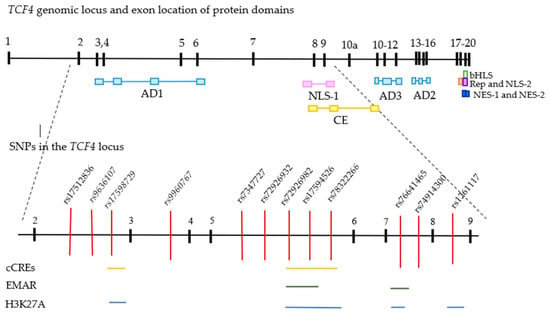
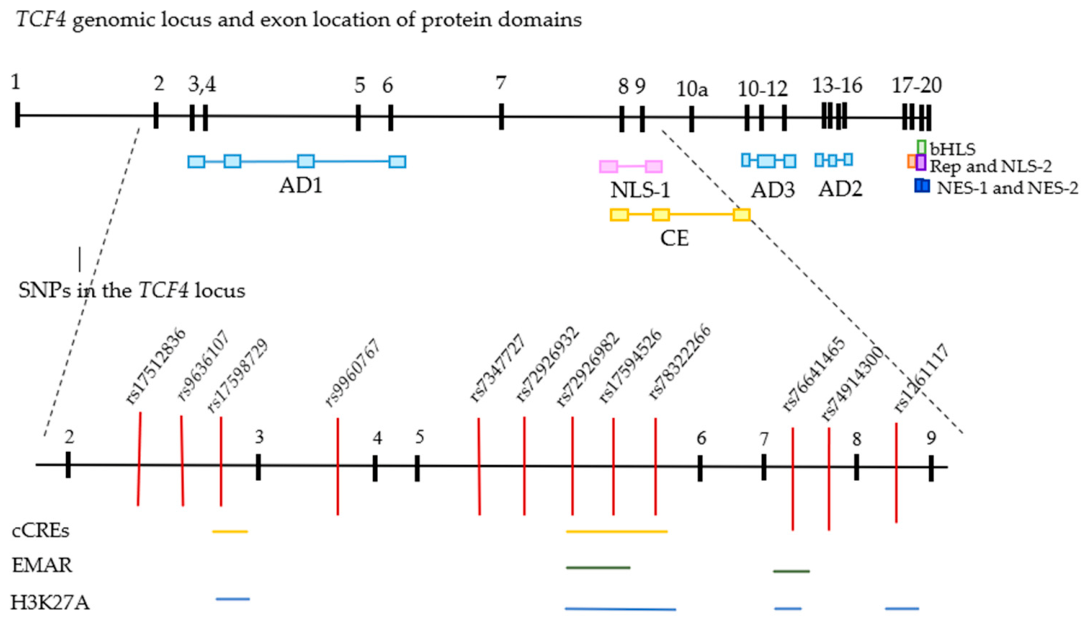
In 2009, a meta-analysis integrating data from several genome-wide association studies (GWAS) revealed a significant association between single-nucleotide polymorphism (SNP) variants in the TCF4 gene and an increased risk of schizophrenia [3]. The TCF4 gene encodes transcription factor 4, a member of the evolutionarily conserved class I basic helix-loop-helix (bHLH) family of transcription factors. This protein binds to canonical E-box sequences (CACCTG) in the promoter and enhancer regions of its target genes. The domain architecture of TCF4 mediates interactions with a diverse array of transcriptional co-regulators and facilitates direct DNA binding through its bHLH domain [4] (Figure 1). Polymorphic variants in TCF4 have been associated with a spectrum of psychiatric disorders, including schizophrenia.
Figure 1.
The genomic organisation of TCF4 is characterised by an exon-domain structure, and the presence of single-nucleotide polymorphisms (SNP) is identified through mapping.
This figure has been adapted from [5] and has been supplemented with the authors’ own data. The schematic representation of the TCF4 gene structure displays exons as vertical bars (not drawn to scale). The structure of the TCF4 protein is illustrated below, with functional domains indicated.
Note: AD1, AD2, and AD3–activation domains; CE–conserved domain; Rep–repression domain; NLS1 and NLS2–nuclear localization signals; NES-1 and NES-2–nuclear export signals; bHLH—basic DNA-binding domain.
TCF4 regulates epigenetic mechanisms, such as histone methylation and acetylation, and is involved in the development and function of the central nervous system. It is critical for cognitive plasticity, including memory formation and social behavior. Furthermore, TCF4 initiates neuronal differentiation and plays a critical role in nervous system development [6]. Although significant gaps remain in understanding its precise functions, current evidence indicates that this transcription factor is essential for normal brain physiology [7]. Therefore, further studies of TCF4 genetic variability are essential to clarify its pathogenic mechanisms in psychiatric disorders.
The objective of this study is to analyze the population-specific distribution of TCF4 gene polymorphisms associated with schizophrenia through a comparative analysis of allele frequencies in the Russian and global populations. This analysis is based on data from the DPF database and gnomAD.
2. Materials and Methods
TCF4 gene variants have been demonstrated to be associated with a number of neurological disorders, including schizophrenia [7], bipolar disorder [8], major depressive disorder [9], post-traumatic stress disorder [10], Angelman syndrome, and autism [11]. It is acknowledged that the pathogenesis of these conditions differs from that of schizophrenia. The present study therefore sought to focus on TCF4 variants associated exclusively with schizophrenia, excluding those that may also be associated with other disorders.
Using the GWAS catalog, we identified genetic variants within the TCF4 gene that showed a significant association with schizophrenia [12]. The selected variants were subsequently analyzed for their presence and allele frequency in two independent reference datasets. The first was the Database of Population Frequencies of Genetic Variants in the Russian Federation (v59.1) which contains depersonalized whole-genome sequencing data. It includes over 550 million germline genetic variants, derived from whole-genome sequencing data of more than 120,000 samples from residents of the Russian Federation. The sample set under consideration comprised individuals residing in the Russian Federation. The sequencing was performed on the NovaSeq 6000 platform (Illumina, Inc., San Diego, CA, USA) using the Nextera DNA Flex library preparation kit (Illumina, Inc., San Diego, CA, USA). All samples were subjected to rigorous quality control procedures in accordance with the following criteria: In order to be considered positive, a sample must display a Q30 greater than 75 or 85, and the proportion of heterozygous variants in the sample must deviate by more than 3 standard deviations from the mean for the entire sample. Furthermore, sex determination based on sequencing data (chromosomal sex determination) must match the metadata, and the average genome coverage must be greater than 30×.
Duplicate samples were also excluded from the sample, resulting in a list of 120,762 unique samples and unique variants found in this sample. The generated list of variants is filtered according to the following criteria: the coverage depth of the reference and alternative alleles (allele depth, AD) in total ranges from 20 to 200 and the accuracy of genotype determination (genome quality, GQ) is more than 30.
The DPF under scrutiny contains no information pertaining to the ethnicity of the surveyed persons. Consequently, the restoration of such data using the tools provided in the service is rendered impossible. Nevertheless, the sample that formed the basis of the developed database was collected in 85 regions of the Russian Federation, and the criteria for inclusion and exclusion of participants in the study did not include requirements for belonging to certain ethnic groups. Consequently, the collected sample can be regarded as being commensurate with the population distribution as of 2020–2024 [13].
The second was the population database gnomAD (v4.1.0), which aggregates exome and genome sequences from diverse global populations, including European, Finnish, Ashkenazi Jewish, Amish, African/African-American, Admixed American, Middle Eastern, South Asian, and East Asian populations [14]. A comparative analysis of allele frequencies was performed between the Russian cohort data and the aggregated global populations in gnomAD.
For the functional annotation of the genetic variants, we utilized specialized tracks within the UCSC Genome Browser [15]. Potential regulatory regions were identified using the CpG Islands track to detect CpG-rich areas, which are often associated with promoters and may be involved in epigenetic regulation. The localization of SNPs within enhancer regions and their potential target genes were determined using the GeneHancer database [16]. To characterize the epigenetic landscape and chromatin state at the loci of interest, we utilized the ENCODE Regulation and ENCODE cCREs (candidate Cis-Regulatory Elements) tracks. These provide data on key histone modifications (H3K4me3, H3K27ac) and chromatin accessibility from assays such as DNase-seq and ATAC-seq [17]. Basic gene structural annotation, including exon-intron boundaries, coding sequences, splice sites, and untranslated regions (UTRs), was performed using the GENCODE V48 track. This step was essential for predicting variant impact on mRNA processing and protein structure.
In order to evaluate the autonomy of the selected SNPs and ascertain the potential redundancy between them, a pair-wise linkage disequilibrium (LD) analysis was conducted utilizing the LDlink tool (https://ldlink.nih.gov/ (accessed on 25 September 2025)) based on data from the 1000 Genomes European project. Haplotypes are available for continental populations (e.g., European, African, and mixed American) and subpopulations (e.g., Finnish, Gambian, and Peruvian). The following indicators were calculated: D’ (a measure of historical recombination), r2 (a measure of allele correlation), and r2 values > 0.8 were considered to indicate strong LD (linkage disequilibrium), suggesting information redundancy. Conversely, r2 < 0.3 was considered an indicator of marker independence [18].
Statistical analysis was performed using Microsoft Excel (Microsoft Corporation, USA). The chi-square test (χ2) was used to compare the significance of differences between populations. To account for multiple comparisons (12 SNPs), the Bonferroni correction was applied. Differences were considered statistically significant at an adjusted threshold of p < 0.05/12 = 0.0042.
3. Results and Discussion
The GWAS catalog lists 30 TCF4 genetic variants associated with schizophrenia. Of these, 12 variants are specifically linked to schizophrenia without reported comorbidities, such as autism spectrum disorder or major depressive disorder (Table 1).
Table 1.
TCF4 genetic variants associated with schizophrenia identified in the GWAS catalog.
In 2009, large-scale genome-wide association studies identified polymorphic variants in the TCF4 gene as contributors to schizophrenia risk [3]. Subsequent research by Ripke S. et al. demonstrated that two SNPs, rs9960767 and rs17512836, showed the most significant association with the disease [19].
The overall global frequency of the risk allele (rs9960767-C, chr18:55487771-A > C) in is approximately 10%. However, significant inter-population variability has been identified, ranging from 23% in the Amish population to 0.3% in East Asian populations. In the Russian cohort, the allele frequency is 4%, which is below the global average. This intronic variant is located 23,634 base pairs from the nearest exon, and based on current annotation, does not reside within any known regulatory elements.
The rs9960767 variant of the TCF4 gene was identified as one of the most statistically significant markers of schizophrenia and was subsequently associated with impaired sensorimotor inhibition, a generally recognized endophenotypic marker of schizophrenia [3,20,21]. An association with sensory inhibition (P50) was demonstrated for rs17512836-C, thereby confirming the significance of this variant as a locus of predisposition to schizophrenia [22,23].
The rs17512836-C allele (chr18:55527730-T > C) is characterized by a low global frequency (2%) with considerable inter-population variability. Its frequency ranges from 20% in the Amish population to 0.01% in East Asian populations. In the Russian cohort, the allele frequency is 1.7%, which is comparable to the global average. This intronic variant is located 57,550 base pairs from the nearest exon and, according to the investigated databases, it is not located within any known regulatory elements.
Given that rs9960767-C and rs17512836-C appear to lack direct regulatory potential, the mechanisms behind their pathogenic influence require explanation. A plausible hypothesis involves other genetic variants in linkage disequilibrium with these SNPs, located within functional genomic regions. Specifically, our analysis identified six SNPs in the TCF4 locus that reside within established regulatory elements: rs1261117-T, rs17594526-T, rs17598729-C, rs78322266, rs76641465, and rs72926982-T (Figure 1). Specifically, the analysis identified six SNPs within the TCF4 locus located in established regulatory elements: rs1261117-T, rs17594526-T, rs17598729-C, rs78322266, rs76641465-T, and rs72926982-T. The SNPs under scrutiny are located at distances ranging from 949 to 30,429 base pairs from the nearest exons. The minor allele frequencies observed in global populations range from 2% to 13%, indicating a moderate prevalence of the condition.
As demonstrated in Table 1, four of the analyzed SNPs have been identified within the regulatory regions of the TCF4 gene. The variants rs17594526-T and rs72926982-T are annotated as cis-regulatory elements (cCREs) and epigenetically modified regions (EMARs). These are associated with the H3K27ac histone mark, which is characteristic of active enhancers and promoters. The variants rs17598729-C and rs78322266 are also located in cCREs and carry the H3K27ac mark, but lack the EMAR annotation. The localization of these four SNPs in regulatory regions suggests a potential role in the transcriptional control of TCF4.
In contrast to the variants located in cCREs or EMARs, rs1261117-T and rs76641465-T lack the corresponding annotations. However, the presence of the H3K27ac histone mark at these loci suggests a potential regulatory role. Notwithstanding the data presented, direct experimental evidence for functional significance is available only for rs17594526-T [24]. For the remaining variants analyzed, the functional role remains to be elucidated, emphasizing the necessity for further experimental studies.
Despite the lack of functional validation for most variants, their biological relevance is underscored by their attainment of GWAS significance. The meta-analysis confirmed that 8 of the 12 SNPs at the 18q21.1 locus reached the required significance threshold (p < 5.0 × 10⁻⁸) (highlighted in bold italics in Table 1). Notably, the SNP rs78322266 showed the most significant association with schizophrenia (p = 3.00 × 10⁻¹⁴).
The global frequency of the rs78322266 allele is approximately 2%, with significant inter-population variability ranging from 26% in the Amish population to 0.019% in East Asian populations. In the Russian cohort, its frequency is 1%. The variant is located 7009 base pairs from the nearest exon. According to the analyzed databases, the variant is localized within cis-regulatory elements and epigenetically modified regions, and is associated with the active enhancer histone mark H3K27ac, suggesting a potential role in transcriptional regulation. To date, no studies have specifically investigated the functional contribution of this allele to schizophrenia pathogenesis.
Further analysis of four variants (rs72926932-A, rs73477270, rs74914300-T, rs9636107-G) indicated they are not located within known regulatory elements, and no direct functional role in schizophrenia has been established for them. Notably, three of these SNPs (rs73477270, rs9636107-G, and rs74914300-T) reached GWAS significance (p < 5.0 × 10⁻⁸). Given their strong GWAS association, a potential contribution to disease pathogenesis remains plausible.
The linkage disequilibrium analysis revealed that the majority of the 12 analyzed SNPs were in linkage equilibrium or exhibited only negligible correlation (all values of r2 < 0.3). However, an exception was observed in the pair rs72926932 and rs72926982, for which a strong LD was detected. The data indicates a high degree of redundancy between the two variants, as evidenced by the close to perfect correlation (D’ = 0.9914, r2 = 0.9829, p < 0.0001). All other pairwise comparisons yielded r2 values below 0.3, thereby confirming the independence of the remaining SNPs (e.g., rs1261117 and rs76641465: D’ = 0.4648, r2 = 0.0661). The results obtained confirm that these SNPs can be considered as predominantly independent genetic markers, with the exception of the pair rs72926932 and rs72926982, which should be interpreted together due to their high LD.
The LD between rs72926932 and rs72926982 (r2 = 0.98) has been revealed, indicating that these two variants are not independent signals and are likely to be part of the same haploblock. This fact must be taken into account when interpreting their individual associations.
An analysis of the Genotype-Tissue Expression (GTEx) database (v10) revealed a significant association between rs72926982 and rs72926932 and TCF4 expression in testis tissue (p = 6.5 × 10⁻⁵, NES = 0.24) [25]. No eQTL effect was observed in brain tissues; nevertheless, the positive NES value indicates that the alternative allele increases TCF4 expression, suggesting a potential regulatory function that may be cell-type specific. For the remaining variants analyzed, no significant eQTL associations with TCF4 were identified in the GTEx database. Statistical analysis using the criterion χ2 demonstrated that the frequency of all analyzed variants in the Russian population, with the exception of rs9636107, significantly differs from global indicators (p < 0.01).
Schizophrenia exhibits substantial clinical and neuroanatomical heterogeneity, yet conventional cross-sectional studies and GWAS typically analyze patients at different disease stages as homogeneous groups, diluting pathological diversity. P. Falkai suggests considering not only the presence or absence of a diagnosis of schizophrenia o, but also the stage of disease development, its course (type of course), cases of prodromal stages, first or repeated episodes, duration of the disease, etc. [26].
In our previous association study, none of the investigated TCF4 polymorphic variants showed a significant association with the diagnosis of schizophrenia [27]. We proceeded from Crow’s dichotomous concept of schizophrenia (positive and negative) for psychopathological estimation [28]. This concept postulates two “pathological aspects” underlying schizophrenia: a positive component (potentially sensitive to antipsychotics) and a negative component (often progressive and associated with a deficit state and poor long-term outcome). Positive symptoms manifest themselves in the form of hallucinations and delusions; negative symptoms include flattening of emotions and avolition. The described symptoms are characterized by either a continuous or episodic course, which, in contrast to the former, is manifested by exacerbations of schizophrenia episodes and then remissions. As the disorder develops, negative symptoms come to the forefront of the clinical picture in a significant proportion of patients. To investigate the involvement of the studied genetic variants in the progression of predominant negative or positive symptoms according to the PANSS survey data, the initial sample of schizophrenia patients was split into two subgroups: a subgroup with predominant negative symptoms and a subgroup of patients with predominant positive symptoms. We identified significant associations with specific clinical phenotypes of schizophrenia. The AA genotype and A allele of the rs2958182, as well as the A allele of the rs9636107, were associated with a predominance of negative symptoms. Conversely, the TT genotype and T allele of rs2958182, along with the G allele of rs9636107, were significantly more frequent in patients with predominant positive symptoms [27].
In summary, comparative analysis revealed significant heterogeneity in the allele and genotype frequencies of TCF4 polymorphisms between the Russian population and other global cohorts, with the exception of rs9636107. It is imperative that the identified differences are given full consideration when conducting associative studies involving these genetic markers. The results of the LD analysis confirm that the selected SNPs can be considered independent markers, with the exception of the pair rs72926932 and rs72926982, which are in strong linkage disequilibrium. This allows the use of the obtained data for further investigation into the population-specific characteristics of TCF4 gene variants, taking into account the established correlations of SNPs. Therefore, further functional studies are required to elucidate the contribution of polymorphic variants of the TCF4 gene to the pathogenesis of schizophrenia, as well as to assess the influence of the population structure on the reproducibility of results.
Author Contributions
Conceptualization E.S.S. and N.A.S.; validation, S.A.I. data curation, E.S.S.; writing—original draft preparation, E.S.S.; writing—review and editing, N.A.S. and S.A.I.; project administration, S.A.I. All authors have read and agreed to the published version of the manuscript.
Funding
This research was funded by an interdisciplinary project of Tomsk National Research Medical Center, “The role of transcription factor TCF4 in the pathogenesis of schizophrenia and Pitt–Hopkins syndrome” (#24/2-grant-MNI).
Institutional Review Board Statement
Ethical review and approval were waived for this study due to the use of open databases and services for bioinformatics analysis.
Informed Consent Statement
Informed consent was waived due to the use of open databases. There is no identifying information in the study.
Data Availability Statement
The data presented in this study are available on request from the corresponding author upon reasonable request.
Conflicts of Interest
The authors declare no conflicts of interest.
Abbreviations
The following abbreviations are used in this manuscript:
| SNP | Single nucleotide polymorphisms |
| E-box | Ephrussi box |
| bHLH | conserved class I basic helix-loop-helix family of transcription factors |
| GWAS | Genome-wide association search |
| DPF | Database of Population Frequencies of Genetic Variants in the Russian Federation |
| cCREs | Cis-regulatory elements |
| UTR | Untranslated regions |
| LD | Linkage Disequilibrium |
| EMAR | Epigenetically modified regions |
References
- Owen, M.J.; Sawa, A.; Mortensen, P.B. Schizophrenia. Lancet 2016, 388, 86–97. [Google Scholar] [CrossRef] [Scilit] [PubMed]
- Trubetskoy, V.; Pardiñas, A.F.; Qi, T.; Panagiotaropoulou, G.; Awasthi, S.; Bigdeli, T.B.; Bryois, J.; Chen, C.Y.; Dennison, C.A.; Hall, L.S.; et al. Mapping Genomic Loci Implicates Genes and Synaptic Biology in Schizophrenia. Nature 2022, 604, 502–508. [Google Scholar] [CrossRef] [Scilit] [PubMed]
- Stefansson, H.; Ophoff, R.A.; Steinberg, S.; Andreassen, O.A.; Cichon, S.; Rujescu, D.; Werge, T.; Pietiläinen, O.P.H.; Mors, O.; Mortensen, P.B.; et al. Common Variants Conferring Risk of Schizophrenia. Nature 2009, 460, 744–747. [Google Scholar] [CrossRef] [Scilit] [PubMed]
- Forrest, M.P.; Hill, M.J.; Kavanagh, D.H.; Tansey, K.E.; Waite, A.J.; Blake, D.J. The Psychiatric Risk Gene Transcription Factor 4 (TCF4) Regulates Neurodevelopmental Pathways Associated with Schizophrenia, Autism, and Intellectual Disability. Schizophr. Bull. 2018, 44, 1100–1110. [Google Scholar] [CrossRef] [Scilit] [PubMed]
- Teixeira, J.R.; Szeto, R.A.; Carvalho, V.M.A.; Muotri, A.R.; Papes, F. Transcription factor 4 and its association with psychiatric disorders. Transl. Psychiatry 2021, 11, 19. [Google Scholar] [CrossRef] [Scilit] [PubMed]
- Blake, D.J.; Forrest, M.; Chapman, R.M.; Tinsley, C.L.; O’Donovan, M.C.; Owen, M.J. TCF4, Schizophrenia, and Pitt-Hopkins Syndrome. Schizophr. Bull. 2010, 36, 443–447. [Google Scholar] [CrossRef] [Scilit] [PubMed]
- Bocharova, A.V.; Stepanov, V.A.; Marusin, A.V.; Kharkov, V.N.; Vagaitseva, K.V.; Fedorenko, O.Y.; Bokhan, N.A.; Semke, A.V.; Ivanova, S.A. Association Study of Genetic Markers of Schizophrenia and Its Cognitive Endophenotypes. Russ. J. Genet. 2017, 53, 139–146. [Google Scholar] [CrossRef] [Scilit]
- Smoller, J.W.; Kendler, K.K.; Craddock, N.; Lee, P.H. Identification of risk loci with shared effects on five major psychiatric disorders: A genome-wide analysis. Lancet 2013, 381, 1371–1379. [Google Scholar] [CrossRef] [Scilit] [PubMed]
- Wray, N.R.; Ripke, S.; Mattheisen, M.; Trzaskowski, M.; Byrne, E.M.; Abdellaoui, A.; Adams, M.J.; Agerbo, E.; Air, T.M.; Andlauer, T.M.F.; et al. Genome-wide association analyses identify 44 risk variants and refine the genetic architecture of major depression. Nat. Genet. 2018, 50, 668–681. [Google Scholar] [CrossRef] [Scilit] [PubMed]
- Gelernter, J.; Sun, N.; Polimanti, R.; Pietrzak, R.; Levey, D.F.; Bryois, J.; Lu, Q.; Hu, Y.; Li, B.; Radhakrishnan, K.; et al. Genome-wide association study of post-traumatic stress disorder reexperiencing symptoms in >165,000 US veterans. Nat. Neurosci. 2019, 22, 1394–1401. [Google Scholar] [CrossRef] [Scilit] [PubMed]
- Mullegama, S.V.; Alaimo, J.T.; Chen, L.; Elsea, S.H. Phenotypic and molecular convergence of 2q23.1 deletion syndrome with other neurodevelopmental syndromes associated with autism spectrum disorder. Int. J. Mol. Sci. 2015, 16, 7627–7643. [Google Scholar] [CrossRef] [Scilit] [PubMed]
- GWAS. Available online: https://www.ebi.ac.uk/gwas/ (accessed on 10 June 2025).
- Database of Population Frequencies of Genetic Variants of the Population of the Russian Federation. FMBA of Russia. The Application Version is 1.3.4 from 11.12.2025. The Database Version is 59.1 from 03.10.2024. Available online: https://gdbpop.nir.cspfmba.ru/ (accessed on 25 September 2025).
- gnomAD v4.1. Available online: https://gnomad.broadinstitute.org/news/2024-04-gnomad-v4-1 (accessed on 11 June 2025).
- UCSC Genome Browser. Available online: https://genome.ucsc.edu/ (accessed on 11 June 2025).
- GeneHancer. Available online: https://www.genecards.org/Guide/GeneHancer (accessed on 11 June 2025).
- ENCODE. Available online: https://www.encodeproject.org/ (accessed on 11 June 2025).
- Machiela, M.J.; Chanock, S.J. LDlink: A web-based application for exploring population-specific haplotype structure and linking correlated alleles of possible functional variants. Bioinformatics 2015, 31, 3555–3557. [Google Scholar] [CrossRef] [Scilit] [PubMed]
- Ripke, S.; Neale, B.M.; Corvin, A.; Walters, J.T.R.; Farh, K.H.; Holmans, P.A.; Lee, P.; Bulik-Sullivan, B.; Collier, D.A.; Huang, H.; et al. Biological Insights from 108 Schizophrenia-Associated Genetic Loci. Nature 2014, 511, 421–427. [Google Scholar] [CrossRef] [Scilit] [PubMed]
- Quednow, B.B.; Ettinger, U.; Mössner, R.; Rujescu, D.; Giegling, I.; Collier, D.A.; Schmechtig, A.; Kühn, K.U.; Möller, H.J.; Maier, W.; et al. The Schizophrenia Risk Allele C of the TCF4 rs9960767 Polymorphism Disrupts Sensorimotor Gating in Schizophrenia Spectrum and Healthy Volunteers. J. Neurosci. 2011, 31, 6684–6691. [Google Scholar] [CrossRef] [Scilit] [PubMed]
- Lennertz, L.; Quednow, B.B.; Benninghoff, J.; Wagner, M.; Maier, W.; Mössner, R. Impact of TCF4 on the Genetics of Schizophrenia. Eur. Arch. Psychiatry Clin. Neurosci. 2011, 261, 161. [Google Scholar] [CrossRef] [Scilit] [PubMed]
- Quednow, B.B.; Brinkmeyer, J.; Mobascher, A.; Nothnagel, M.; Musso, F.; Gründer, G.; Savary, N.; Petrovsky, N.; Frommann, I.; Lennertz, L.; et al. Schizophrenia Risk Polymorphisms in the TCF4 Gene Interact with Smoking in the Modulation of Auditory Sensory Gating. Proc. Natl. Acad. Sci. USA 2012, 109, 6271–6276. [Google Scholar] [CrossRef] [Scilit] [PubMed]
- Hamshere, M.L.; Walters, J.T.R.; Smith, R.; Richards, A.L.; Green, E.; Grozeva, D.; Jones, I.; Forty, L.; Jones, L.; Gordon-Smith, K.; et al. Genome-Wide Significant Associations in Schizophrenia to ITIH3/4, CACNA1C and SDCCAG8, and Extensive Replication of Associations Reported by the Schizophrenia PGC. Mol. Psychiatry 2013, 18, 708–712. [Google Scholar] [CrossRef] [Scilit] [PubMed]
- Marusin, A.V.; Bocharova, A.V.; Vagaytseva, K.V.; Stepanov, V.A. A Multiplex Set of Markers as a Tool for Developing Genetic Testing for Susceptibility to Schizophrenia, Alcoholism and Related Personality Traits at a Young Age and Mental Abilities in Old Age. Patent No. 2819816, 24 May 2024. Available online: https://www.fips.ru/registers-doc-view/fips_servlet?DB=RUPAT&DocNumber=2819816&TypeFile=html (accessed on 11 June 2025). (In Russian)
- GTEx. Available online: https://www.gtexportal.org/home/ (accessed on 23 March 2026).
- Falkai, P. A desperate search for biomarkers in schizophrenia. What is going wrong? World Psychiatry 2011, 10, 38–39. [Google Scholar] [CrossRef] [Scilit] [PubMed]
- Ivanova, S.A.; Tiguntsev, V.V.; Boiko, A.S.; Mikhalitskaya, E.V.; Petkun, D.A.; Mednova, I.A.; Fedorenko, O.Y.; Skryabin, N.A.; Kornetova, E.G.; Kornetov, A.N.; et al. Positive and Negative Symptoms of Schizophrenia and Polymorphic Variants of the TCF4 Gene: Pilot Associative Study. Int. J. Mol. Sci. 2025, 26, 10507. [Google Scholar] [CrossRef] [Scilit] [PubMed]
- Crow, T.J. The Two-Syndrome Concept: Origins and Current Status. Schizophr. Bull. 1985, 11, 471–488. [Google Scholar] [CrossRef] [Scilit] [PubMed]

Disclaimer/Publisher’s Note: The statements, opinions and data contained in all publications are solely those of the individual author(s) and contributor(s) and not of MDPI and/or the editor(s). MDPI and/or the editor(s) disclaim responsibility for any injury to people or property resulting from any ideas, methods, instructions or products referred to in the content. |
© 2026 by the authors. Licensee MDPI, Basel, Switzerland. This article is an open access article distributed under the terms and conditions of the Creative Commons Attribution (CC BY) license.