1. Introduction
AN is a serious eating disorder that poses significant clinical and public health challenges, particularly for adolescent girls [
1]. Eating disorders are among the most lethal psychiatric illnesses, with mortality rates second only to opioid addiction [
2]. The peak age of onset for AN and related disorders has shifted into early adolescence (often around 12–13 years), and incidence has been rising in recent years [
3]. Globally, the prevalence of eating disorders roughly doubled from about 3.5% to 7.8% over the past decade [
4]. Epidemiological studies indicate that up to 14–22% of youth report disordered eating behaviors [
5]. Importantly, adolescent females are disproportionately affected: community surveys show that approximately 5.7% of adolescent girls exhibit an eating disorder, compared to 1.2% of boys [
6]. These figures underscore that AN and related conditions constitute a major health concern for young women, warranting investigation of contemporary risk factors and early interventions.
In today’s digital era, problematic social media use has emerged as a potential contributor to body image disturbance [
7] and eating pathology among adolescents [
8]. Over 90% of teenagers are active on social networking platforms, where they are inundated with images and messages about appearance [
9]. PSMU refers to dysregulated, excessive engagement with social networking sites, often with an addiction-like pattern of use [
10]. In addition to sociocultural influences, emerging research highlights the role of underlying psychological vulnerability factors in the development and maintenance of problematic Internet and social media use among adolescents. Subthreshold psychiatric symptoms, affective temperaments, and difficulties in emotion regulation have been increasingly associated with maladaptive patterns of online engagement, suggesting that problematic digital behaviors may reflect broader psychological vulnerabilities rather than isolated behavioral phenomena. For example, studies have demonstrated that subclinical levels of anxiety and depressive symptoms are significantly associated with increased risk of Internet addiction, even in non-clinical populations. Similarly, affective temperament profiles and deficits in emotion regulation have been shown to interact with Internet addiction severity, further exacerbating maladaptive coping strategies and emotional dysregulation. These findings suggest that problematic social media use may be embedded within a broader network of psychological risk factors, reinforcing the importance of integrative models that consider both individual vulnerabilities and environmental influences [
11,
12]. Research suggests that high levels of social media exposure—especially to appearance-focused content—can intensify internalization of thin ideals and drive social comparison [
13]. For example, greater use of visually oriented platforms (like Instagram or TikTok) and higher “social media addiction” scores have been associated with increased eating disorder risk in adolescents [
14]. The nature of content is also critical: unsupervised exposure to so-called “pro-ana” (pro-anorexia) or “thinspiration” communities can reinforce unhealthy body image ideals and weight-control behaviors [
15]. Such content often glamorizes extreme thinness or fitness, implicitly encouraging disordered eating habits. In vulnerable teens, engaging with these online groups may trigger or exacerbate AN symptoms [
16]. Thus, both the quantity (time and compulsivity of use) and quality (appearance-centric, potentially harmful content) of social media engagement likely impact adolescents’ eating attitudes. PSMU may not only directly foster body dissatisfaction and dietary restriction but also displace healthy coping strategies, creating a fertile ground for eating disorders to develop.
Beyond peer and media influences, family environment—particularly parenting style—plays a pivotal role in adolescents’ mental health and could modulate risk for anorexia [
17]. Parenting style is typically categorized into authoritative (high warmth, high control), authoritarian (low warmth, high control), permissive (high warmth, low control), and uninvolved/neglectful (low warmth, low control) patterns [
18]. An authoritative parenting style is widely regarded as the most protective, characterized by supportive involvement and consistent yet reasonable expectations [
19]. Authoritative parenting has been linked to positive outcomes such as higher adolescent self-esteem, better emotion regulation, and even healthier eating behaviors [
20]. In contrast, authoritarian parenting (overly strict, critical, and lacking warmth) and permissive parenting (overindulgent or lax in guidance) are often considered riskier family environments for adolescent well-being [
21,
22]. Studies have noted that adolescents—especially girls—who perceive their parents as very controlling or unsupportive tend to report more body image concerns and disordered eating [
23]. For instance, one study in adolescent females found a significant negative association between authoritative parenting and anorexia nervosa incidence, whereas authoritarian parenting was positively associated with AN symptoms [
24]. Similarly, permissive or inconsistent parenting has been linked to higher odds of unhealthy eating behaviors in youth [
25]. These findings align with the broader literature that anchors authoritative parenting as a protective factor and implicates the extremes of low warmth or low structure in elevating risk. In essence, a home environment with clear communication, emotional support, and appropriate monitoring may buffer adolescents against sociocultural pressures [
26], whereas a harsh or laissez-faire parenting approach might leave teens more vulnerable to influences like social media or peer ideals that encourage disordered eating.
In addition to contemporary pressures, childhood trauma and adverse experiences have long been recognized as important risk factors for eating disorders [
27]. A substantial body of evidence indicates that individuals with eating disorders report higher rates of early-life abuse, neglect, or household dysfunction relative to those without eating pathology [
28,
29]. Meta-analyses estimate that childhood maltreatment (particularly emotional abuse or neglect) is 2–4 times more common in patients with eating disorders, and such patients often have an earlier onset and more severe illness course [
30]. In the context of AN, trauma exposure can engender a cascade of psychological vulnerabilities—notably difficulties in emotion regulation, heightened anxiety, and pervasive feelings of shame or low self-worth [
31]. These trauma sequelae may predispose an adolescent to use disordered eating as a maladaptive coping strategy or a form of control. Supporting this, Racine and Wildes (2015) [
32] found that among individuals with AN, a history of childhood emotional abuse was strongly linked to greater AN symptom severity, and this relationship was significantly mediated by emotion dysregulation problems. In other words, early abuse seemed to precipitate poor emotional coping, which in turn fueled anorexic symptoms. Other research has highlighted the role of shame—a frequent aftermath of childhood abuse—in eating disorders [
33]. For example, studies in binge eating disorder have shown that internalized shame and distress, stemming from childhood maltreatment, can lead to binge eating as a dysfunctional emotion-regulation strategy [
34]. Although AN and binge eating differ in symptomatic expression [
35], both may serve to temporarily manage unbearable emotions arising from trauma (whether through rigid control of food intake or through episodic overeating). Thus, childhood trauma can be viewed as a distal risk factor that increases vulnerability to eating disorders via intermediate processes like chronic emotion dysregulation, hyperarousal, and self-critical cognitions [
36]. Given the high prevalence of trauma in eating-disorder populations, it is critical to consider trauma history when examining models of risk—even in non-clinical samples of adolescents, where subclinical symptoms might first appear.
Notably, most prior research tends to examine these risk domains—social media influences, parenting, and trauma—in isolation. Studies often focus on a single category of risk or a simple bivariate association (e.g., linking social media use to body image, or parenting style to adolescent dieting behaviors). However, real-world risk for anorexia nervosa is likely multifactorial, arising from a confluence of individual, familial, and sociocultural factors. There have been limited attempts to integrate multiple pathways into a unified explanatory model. Structural equation modeling (SEM) offers a powerful approach to test such complex models, including potential mediation effects, but to date relatively few SEM studies have simultaneously assessed social media behavior, family environment, and trauma in relation to eating disorder symptoms. Moreover, much of the existing literature has centered on clinical samples (adolescents already diagnosed with eating disorders), which may not fully capture how these risk factors operate before pathology is entrenched. There is a need for research in community (non-clinical) adolescent populations to identify early risk pathways for disordered eating. By studying subclinical symptoms in otherwise healthy teens, we can better understand which psychosocial factors might tip the balance toward developing an eating disorder. Recent reviews have emphasized the interplay between societal pressures (like the internalized thin ideal) and family context in eating disorder etiology, reinforcing that a more holistic, multivariate approach is warranted. Taken together, the field would benefit from integrative models that examine how problematic social media use, parenting style, and childhood trauma jointly influence anorexia-related outcomes, and whether certain factors mediate or explain the effects of others.
The current study addresses this gap by testing an integrative model of anorexia nervosa risk in a non-clinical sample of adolescent girls. We focused on PSMU as a contemporary risk factor and examined two psychosocial variables—perceived parenting style and childhood trauma experiences—as potential mediators of its relationship with anorexia symptoms. Using structural equation modeling, we evaluated both direct and indirect statistical pathways. Our central hypothesis was that higher levels of PSMU would be associated with greater AN symptomatology, and that this association would be partly mediated by (a) more negative or maladaptive parenting characteristics (specifically, high authoritarian/low authoritative parenting), and (b) higher exposure to childhood traumatic events. Stated differently, we expected that adolescent girls who engage in more compulsive or dysregulated social media use would also be more likely to report a history of childhood trauma and a less supportive parenting environment—and that these two factors would, in turn, contribute to increased anorexic symptoms. By elucidating these pathways in a community sample, the study aims to inform early identification of at-risk youth and highlight targets for preventive intervention (such as family-based approaches and digital literacy programs) before full-threshold AN emerges.
2. Materials and Methods
2.1. Study Design and Setting
This study employed a cross-sectional, school-based survey design to examine the association between social media use and AN symptoms among adolescent girls, and to test the mediating roles of perceived parenting style and childhood traumatic experiences within this relationship. The study was conceptualized within an epidemiological and prevention-oriented framework, aiming to identify psychosocial risk pathways relevant to the early detection of eating disorder symptomatology during adolescence. Data collection was conducted in İstanbul, Türkiye, a metropolitan city characterized by marked socioeconomic heterogeneity across districts. To ensure broad socioeconomic representation, participants were recruited from multiple districts representing diverse income and educational profiles, and data were collected from both governmental public schools and private colleges. This sampling strategy was deliberately adopted to balance potential socioeconomic influences on social media use, family environment, and eating-related psychopathology. A community-based, non-clinical sampling approach was used to capture subclinical and at-risk eating disorder symptoms prior to formal diagnosis, in line with contemporary public mental health and prevention models for eating disorders. All data were obtained using standardized self-report questionnaires, administered in classroom settings under researcher supervision. The cross-sectional design was deemed appropriate for examining complex associative and mediation models involving sociocultural, familial, and trauma-related variables in a large adolescent sample, particularly in contexts where longitudinal follow-up is not feasible at the initial stage of investigation.
2.2. Participants and Sampling Procedure
Participants were female adolescents aged 13–18 years enrolled in secondary or high schools in İstanbul, Türkiye. A stratified cluster sampling approach was used, with schools selected from multiple districts to reflect the city’s socioeconomic diversity and to reduce potential socioeconomic bias. Data were collected from both governmental public schools and private colleges to ensure balanced representation of educational and family contexts. Within participating schools, classrooms served as sampling clusters, and all students in selected classes were invited to participate. Written parental informed consent and adolescent assent were obtained prior to data collection. Adolescents with a self-reported prior psychiatric diagnosis requiring ongoing clinical treatment, severe medical conditions that could interfere with participation, or substantially incomplete questionnaires were excluded from the analyses. A total of n = 474 adolescents were initially recruited across participating schools. Of these, n = 11 cases were excluded due to substantial missingness (>20% across the survey battery) or failure to meet inclusion criteria. The final analytic sample therefore consisted of n = 463 participants included in the structural equation modeling analyses.
Participants were recruited from 5 schools and 13 classroom clusters (mean cluster size ≈ 35 students), with classrooms treated as the primary sampling units in the analyses.
2.3. Sample Size and Power Analysis
An a priori sample size estimation was conducted based on requirements for structural equation modeling, considering the complexity of the hypothesized mediation model and the number of latent constructs included. Assuming a medium effect size, a significance level of 0.05, and adequate statistical power (0.80), a minimum sample of approximately 300 participants was deemed sufficient to obtain stable parameter estimates. To account for potential exclusions, missing data, and to allow for robust estimation of indirect effects, the target sample size was increased to approximately 500 adolescent girls. This sample size was considered adequate for testing the proposed mediation model and for ensuring sufficient statistical precision in the estimation of direct and indirect effects.
2.4. Measures
2.4.1. Sociodemographic and Anthropometric Information
Sociodemographic data were collected using a self-report form designed for this study, including age, grade level, parental education, family income, family composition, and district of residence. Anthropometric information was obtained through self-reported height and weight, from which body mass index (BMI) was calculated. These variables were included to characterize the sample and to account for potential sociodemographic and physical correlates of eating disorder symptomatology in subsequent analyses.
2.4.2. Anorexia Nervosa Symptoms (Eating Attitudes Test–26)
Anorexia nervosa symptomatology was assessed using the Eating Attitudes Test–26 (EAT-26), originally developed by Garner et al. (1982) [
37] as a short form of the Eating Attitudes Test for screening disordered eating behaviors, particularly anorexia nervosa. The scale consists of 26 items assessing dieting behaviors, bulimia and food preoccupation, and oral control, with higher scores indicating greater eating-related psychopathology. The Turkish adaptation and psychometric evaluation of the EAT-26 was conducted by Ergüney-Okumuş and Sertel-Berk (2020) [
38] in a large non-clinical sample, demonstrating acceptable construct validity and reliability. In the Turkish validation study, the scale showed good internal consistency, with a Cronbach’s alpha coefficient of 0.84, and satisfactory test–retest reliability. A total score of 20 or higher is commonly used as a cutoff indicating clinically relevant risk for eating disorder symptomatology.
2.4.3. Social Media Use (Social Media Disorder Scale)
Problematic social media use was assessed using the Social Media Disorder Scale (SMDS), developed by Van Den Eijnden et al. (2016) [
39] based on DSM-5 Internet Gaming Disorder criteria to capture behavioral addiction–like features of social media use. The scale comprises 9 items assessing symptoms such as preoccupation, tolerance, withdrawal, persistence, conflict, and escape, rated on a Likert-type scale. The Turkish adaptation and validation of the SMDS for adolescents was conducted by Savci et al. (2018) [
40]. Psychometric analyses supported a single-factor structure with good model fit indices. In the Turkish adolescent sample, the scale demonstrated good internal consistency, with Cronbach’s alpha coefficients ranging between 0.83 and 0.86 across different samples, indicating satisfactory reliability for assessing problematic social media use in adolescents.
2.4.4. Parenting Style (Parenting Styles and Dimensions Questionnaire)
Perceived parenting style was measured using the Parenting Styles and Dimensions Questionnaire (PSDQ), originally developed by Robinson et al. (1995) [
41] to assess authoritative, authoritarian, and permissive parenting dimensions. The Turkish adaptation of the scale was conducted by Önder and Gülay (2009) [
42] in a sample of parents, with subsequent psychometric evaluation demonstrating acceptable validity and reliability. The Turkish version includes subscales corresponding to authoritative, authoritarian, and permissive parenting styles. Reported internal consistency coefficients for the Turkish form were α = 0.84 for authoritative, α = 0.71 for authoritarian, and α = 0.38 for permissive parenting, consistent with previous findings indicating lower reliability for the permissive subscale. The PSDQ has been widely used to capture adolescents’ perceptions of parental attitudes within family environments.
2.4.5. Childhood Traumatic Experiences (Childhood Trauma Questionnaire)
Childhood traumatic experiences were assessed using the Childhood Trauma Questionnaire (CTQ), originally developed by Bernstein et al. (1998) [
43] as a retrospective self-report measure of childhood abuse and neglect. The short form of the CTQ includes 25 items covering five domains: emotional abuse, physical abuse, sexual abuse, emotional neglect, and physical neglect. The Turkish adaptation and validation of the CTQ was conducted by Kırlıoğlu and Tekin (2020) [
44], with confirmatory factor analyses supporting the original five-factor structure. The Turkish version demonstrated excellent internal consistency, with a Cronbach’s alpha coefficient of 0.97 for the total scale and subscale alphas ranging from 0.93 to 0.96, indicating very high reliability. The CTQ is widely used in adolescent and adult samples to assess exposure to early adverse experiences.
2.5. Statistical Analysis
Primary analyses were conducted using R (version 4.3.2) with the lavaan package (version 0.6-21). Where applicable, confirmatory and supplementary analyses were conducted using IBM SPSS Statistics (V25) and AMOS (version 31). Socioeconomic status (SES) was operationalized using parental education level (categorized as high school or below vs. university or higher) and perceived family income (categorized as low–middle, middle, and high). These variables were included as covariates in all structural models. Prior to hypothesis testing, data were screened for completeness and plausibility. Participants with substantially incomplete questionnaires (e.g., >20% missing across the survey battery) were excluded, and remaining missing values were handled using appropriate missing-data methods within the SEM framework (e.g., full information maximum likelihood) when assumptions were met. Descriptive statistics (means, standard deviations, ranges, and frequencies) were calculated for all study variables. Scale reliability was evaluated using Cronbach’s alpha, and (where reported) McDonald’s omega, for each instrument and relevant subscales.
Bivariate associations among anorexia nervosa symptoms, problematic social media use, parenting dimensions, and childhood trauma were examined using correlation analyses to characterize the direction and magnitude of relationships prior to multivariable modeling. The primary hypotheses were tested using structural equation modeling (SEM) to estimate direct and indirect (mediated) pathways from problematic social media use to anorexia nervosa symptoms via parenting style and childhood traumatic experiences. Indirect effects were evaluated using bias-corrected bootstrapping with 5000 resamples, and mediation was considered supported when 95% confidence intervals for the indirect effect did not include zero. Parenting style was modeled as a latent construct primarily indicated by authoritative (negative loading) and authoritarian (positive loading) dimensions, reflecting an underlying continuum of adaptive versus maladaptive parenting. The permissive dimension was retained with caution due to lower reliability and weaker contribution to the latent construct. Competing mediation specifications (e.g., parallel mediation versus sequential mediation where theoretically justified) were compared using standard SEM fit criteria and parsimony considerations. For structural equation modeling, parenting style was modeled as a latent construct indicated primarily by authoritative (negative loading) and authoritarian (positive loading) parenting dimensions, while the permissive subscale was retained with caution due to lower reliability.
All models included prespecified covariates to reduce confounding, including age, body mass index (BMI), and key socioeconomic indicators (e.g., parental education and/or a composite socioeconomic index derived from the sociodemographic form). Model fit was evaluated using commonly recommended indices (e.g., χ2/df, CFI, TLI, RMSEA, SRMR), and parameter estimates were reported as standardized and unstandardized coefficients with corresponding standard errors and confidence intervals. Statistical significance was set at p < 0.05 (two-tailed).
Given the clustered sampling design (students nested within classrooms), potential non-independence of observations was addressed by estimating structural equation models using cluster-robust standard errors at the classroom level. This approach adjusts standard errors and confidence intervals to account for within-cluster dependence while retaining the specified model structure. The clustered sampling structure consisted of 13 classroom clusters nested within 5 schools, and all primary analyses were re-estimated using cluster-robust standard errors at the classroom level. The pattern, magnitude, and statistical significance of the results remained unchanged, indicating that clustering did not materially influence the findings.
Participant flow was examined prior to analysis. Cases with substantial missingness (>20% across the survey battery) were excluded from the dataset. For the remaining data, missing values were minimal and handled using full information maximum likelihood (FIML) within the structural equation modeling framework.
Descriptive inspection of missingness patterns indicated that missing data were low in magnitude and did not show systematic patterns across key study variables, supporting the assumption of data missing at random (MAR). Under this assumption, FIML provides unbiased parameter estimates and was therefore considered appropriate.
3. Results
3.1. Participant Characteristics
Of the n = 474 adolescents initially recruited, n = 11 were excluded due to substantial missingness or not meeting inclusion criteria. The final analytic sample consisted of 463 adolescent girls aged 13 to 18 years. Participants were recruited from secondary and high schools across multiple districts of İstanbul, representing a wide range of socioeconomic backgrounds. The sample included students attending both governmental public schools (n = 287, 62.0%) and private colleges (n = 176, 38.0%), ensuring balanced representation of differing educational and family contexts.
The mean age of the participants was 15.6 years (SD = 1.4). The mean body mass index was 21.3 kg/m
2 (SD = 3.6), which falls within the expected range for adolescent populations. With respect to socioeconomic indicators, 44.9% of participants reported parental education at the university level or higher, while 55.1% reported high school education or below. Family income distribution reflected the socioeconomic heterogeneity of the metropolitan setting, with 48.6% of participants reporting middle-income status, 29.4% low-to-middle income, and 22.0% high income. A small number of cases were excluded due to substantial missingness (>20%), and the remaining dataset showed low levels of missing data across all variables (generally <5%). No systematic patterns of missingness were observed. The exclusion rate was low (2.3%), and no systematic patterns of missingness were observed among excluded cases. Detailed sociodemographic and anthropometric characteristics of the sample are presented in
Table 1.
3.2. Descriptive Statistics and Scale Reliability
Descriptive statistics for the main study variables are presented in
Table 2. Overall, participants reported low-to-moderate levels of anorexia nervosa symptomatology as measured by the EAT-26, while scores on problematic social media use (SMDS) showed substantial between-participant variability, consistent with a school-based adolescent sample. Parenting dimensions assessed with the PSDQ indicated that perceived authoritative and authoritarian parenting were represented across a broad range of scores, whereas the permissive parenting dimension showed comparatively lower internal consistency, consistent with prior Turkish validation findings. Childhood trauma exposure (CTQ) scores also demonstrated adequate variability, enabling examination of trauma-related pathways in multivariable models.
Internal consistency estimates for the study measures were acceptable to excellent. The EAT-26 and SMDS demonstrated good reliability, and the CTQ showed excellent internal consistency in the present sample. Reliability coefficients for PSDQ subscales were acceptable for authoritative and authoritarian parenting, while the permissive subscale was interpreted cautiously due to lower reliability. Detailed descriptive statistics (means, standard deviations, and observed ranges) and Cronbach’s alpha coefficients for each scale and subscale are reported in
Table 2.
3.3. Bivariate Associations Among Study Variables
Bivariate correlations among the main study variables are presented in
Table 3. Anorexia nervosa symptom severity was positively associated with problematic social media use, indicating that higher levels of compulsive or dysregulated social media engagement were related to greater eating disorder–related symptomatology. AN symptoms were also positively correlated with childhood traumatic experiences, suggesting higher symptom levels among adolescents reporting greater exposure to early adverse experiences.
With respect to family-related factors, perceived authoritarian parenting showed a positive association with AN symptoms, whereas authoritative parenting was negatively associated with eating disorder symptom severity. The permissive parenting dimension showed weaker and less consistent associations with AN symptoms, consistent with its lower internal reliability in the current sample. Problematic social media use was positively correlated with childhood trauma exposure and authoritarian parenting, and negatively correlated with authoritative parenting.
Overall, the pattern of correlations was in the expected directions and supported the theoretical assumptions underlying the proposed mediation model. All correlation coefficients were of small to moderate magnitude, indicating related but non-redundant constructs suitable for subsequent structural equation modeling.
3.4. Structural Equation Modeling: Measurement Model
Prior to testing the hypothesized mediation pathways, the adequacy of the measurement model was evaluated within the structural equation modeling framework. Latent constructs were specified in accordance with the theoretical model, and all indicators loaded on their intended factors. The measurement model demonstrated acceptable fit (χ2/df = 2.41, CFI = 0.95, TLI = 0.94, RMSEA = 0.056, SRMR = 0.048), as reflected by standard fit indices (χ2/df, CFI, TLI, RMSEA, and SRMR), all of which were within commonly recommended thresholds for good-to-acceptable model fit.
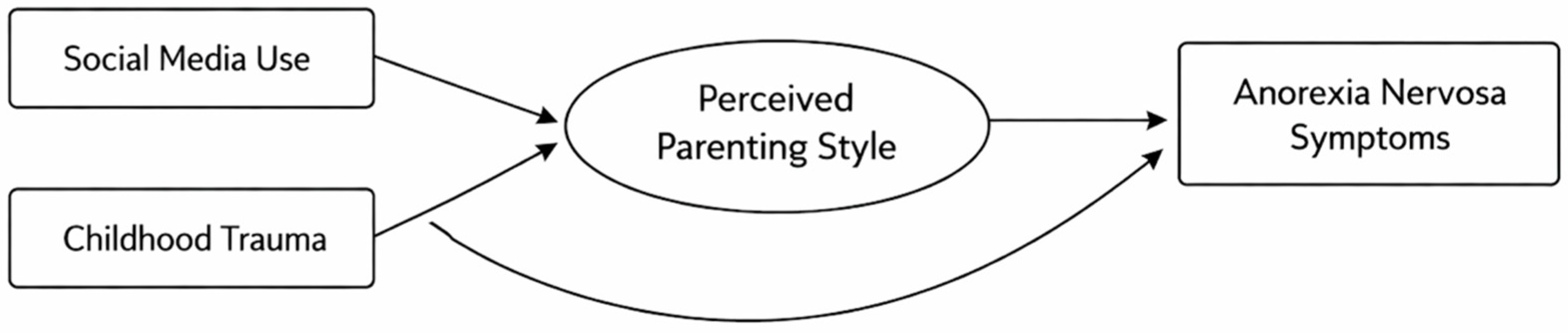
All standardized factor loadings were statistically significant and of meaningful magnitude, indicating that the observed indicators adequately represented the latent constructs. No improper solutions were detected (e.g., negative error variances or non-convergence), and the measurement model supported proceeding to the structural model to test direct and indirect effects. The hypothesized conceptual framework guiding these analyses is illustrated in
Figure 1.
In
Figure 1, the model illustrates the hypothesized associations between problematic social media use and anorexia nervosa symptom severity, with perceived parenting style and childhood traumatic experiences specified as parallel mediators. Direct and indirect correlational pathway were tested using structural equation modeling.
3.5. Structural Equation Modeling: Direct Effects
Following confirmation of an acceptable measurement model, the hypothesized structural model was tested to examine the direct associations among problematic social media use, parenting style, childhood traumatic experiences, and AN symptoms. The structural model demonstrated good overall fit to the data (χ2/df = 2.36, CFI = 0.96, TLI = 0.95, RMSEA = 0.054, SRMR = 0.046), meeting commonly recommended thresholds for acceptable model fit. The structural model demonstrated acceptable overall fit to the data, with all fit indices meeting commonly recommended criteria, supporting the adequacy of the specified pathways.
Problematic social media use showed a significant direct association with AN symptom severity, indicating that higher levels of dysregulated social media engagement were related to greater eating disorder–related symptomatology. In addition, problematic social media use was positively associated with childhood traumatic experiences and with less adaptive parenting characteristics, reflecting meaningful links between current digital behaviors and broader psychosocial risk contexts.
Childhood traumatic experiences exhibited a significant direct effect on AN symptoms, such that greater trauma exposure was associated with higher levels of eating disorder symptomatology. Parenting style also showed a direct association with AN symptoms, with more authoritarian parenting patterns linked to increased symptom severity, whereas more authoritative parenting was associated with lower symptom levels. Permissive parenting contributed minimally to the latent parenting construct and was therefore interpreted cautiously due to its lower internal consistency.
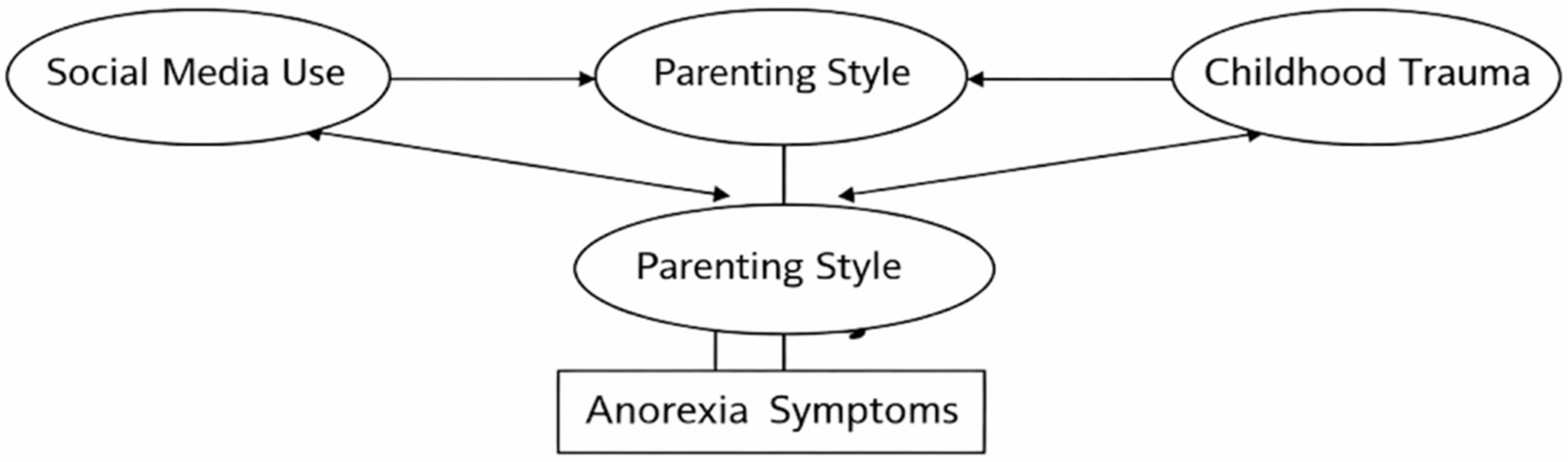
All reported direct effects are presented as standardized path coefficients with corresponding standard errors and significance levels in
Table 4, and the structural paths are illustrated in
Figure 2. These findings provided the basis for subsequent mediation analyses examining indirect correlational pathways linking problematic social media use to AN symptoms through parenting style and childhood trauma.
Standardized factor loadings indicated that authoritative and authoritarian parenting were the primary contributors to the latent parenting construct, whereas the permissive dimension showed substantially weaker loading, consistent with its lower internal consistency.
In
Figure 2, standardized path coefficients are shown for all statistically significant associations. Problematic social media use was directly associated with anorexia nervosa symptom severity and showed significant indirect associations via perceived parenting style and childhood traumatic experiences. Childhood trauma showed a significant indirect statistical association with anorexia nervosa symptoms, while parenting style contributed a smaller but significant indirect pathway. The total association between problematic social media use and anorexia nervosa symptoms reflects the combined direct and indirect statistical pathways. All displayed paths were statistically significant (
p < 0.05). Covariates (age, body mass index, parental education, and perceived family income) were included in the model but are not displayed in the figure for clarity.
To evaluate the potential impact of clustering, all primary models were re-estimated using cluster-robust standard errors at the classroom level. The pattern, magnitude, and statistical significance of all direct and indirect effects remained unchanged, indicating that the main findings were robust to clustering.
Standardized factor loadings for the parenting latent construct are presented in
Table 5. Authoritative and authoritarian parenting demonstrated strong and statistically significant loadings, whereas the permissive dimension showed a comparatively weaker loading, consistent with its lower internal consistency.
3.6. Mediation Analyses
Mediation analyses were conducted to examine whether perceived parenting style and childhood traumatic experiences accounted for the association between problematic social media use and AN symptom severity. Indirect effects were tested using bias-corrected bootstrapping with 5000 resamples, and mediation was considered statistically significant when the 95% confidence intervals did not include zero.
Results indicated a significant indirect effect of problematic social media use on AN symptoms through childhood traumatic experiences, such that higher levels of problematic social media use were associated with greater trauma exposure, which in turn was related to increased AN symptom severity. This indirect pathway remained significant after accounting for age, body mass index, and socioeconomic covariates.
A secondary indirect pathway through parenting style was also observed. Problematic social media use was associated with less adaptive parenting patterns, which were in turn linked to higher levels of AN symptomatology. Although the magnitude of this indirect effect was smaller than that observed for childhood trauma, it was statistically significant and consistent with the hypothesized model.
When both mediators were included simultaneously, the direct effect of problematic social media use on AN symptoms remained statistically significant, indicating partial mediation. The combined indirect effects accounted for a meaningful proportion of the total association between problematic social media use and AN symptoms. In addition to the primary parallel mediation model, alternative model specifications were explored, including sequential mediation pathways. However, these alternative models did not demonstrate improved fit or conceptual clarity compared to the pre-specified parallel mediation model. Therefore, the final model was retained based on both theoretical justification and model parsimony. Estimates of indirect effects and corresponding confidence intervals are reported in
Table 6.
A sensitivity analysis excluding the permissive parenting indicator yielded identical results to the primary model. The alternative model demonstrated the same fit indices (χ2/df = 2.36, CFI = 0.96, TLI = 0.95, RMSEA = 0.054, SRMR = 0.046). Key parameter estimates remained unchanged, including the direct effect of problematic social media use on anorexia nervosa symptoms (β = 0.18, p < 0.001), as well as the effects of parenting style (β = −0.17) and childhood trauma (β = 0.29). These findings indicate that the results are robust and not influenced by the inclusion of the permissive parenting indicator.
A sensitivity analysis excluding the permissive parenting indicator yielded comparable model fit and parameter estimates, indicating that the main findings were robust to the specification of the parenting construct. All models were adjusted for age, body mass index, parental education, and perceived family income.
4. Discussion
This study examined the interrelationships between social media habits, family dynamics, and trauma history in relation to anorexia nervosa symptoms among adolescent girls. Consistent with our hypotheses, we found that problematic social media use had a significant direct effect on AN symptom severity, even after accounting for parenting style and childhood trauma. In addition, both proposed mediators were significant: there were indirect effects such that PSMU was linked to AN symptoms through perceived parenting style and through childhood traumatic experiences. In our structural equation model, higher PSMU was associated with a more maladaptive parenting profile (characterized by higher authoritarian and lower authoritative qualities), as well as with greater childhood trauma exposure; each of these, in turn, predicted elevated anorexic symptoms. Notably, the mediation via childhood trauma was stronger than that via parenting style. While both indirect pathways were significant, the effect size for the trauma pathway was larger, suggesting that trauma played a more dominant role in linking social media use to eating pathology in this sample. Although childhood trauma was specified as a mediator in the statistical model, it should be interpreted as a distal vulnerability factor rather than a causal consequence of problematic social media use, given the cross-sectional design. Overall, the model supports a nuanced risk framework: adolescent girls who engage in dysregulated social media use are at risk for heightened anorexia-related symptoms, partly because this behavior is intertwined with deeper psychosocial vulnerabilities rooted in their upbringing and past experiences. Although childhood trauma was modeled as a mediator in the present analyses, this specification should be interpreted within a statistical framework rather than a temporal or causal one. From a developmental perspective, childhood trauma is more appropriately conceptualized as a distal vulnerability factor that precedes the emergence of problematic social media use and eating disorder symptoms. The current modeling approach reflects associations among variables within a cross-sectional design and does not imply that problematic social media use leads to trauma exposure.
An additional mechanism that may help explain the observed associations is emotion regulation. A growing body of research suggests that difficulties in emotion regulation represent a transdiagnostic vulnerability underlying a range of maladaptive behaviors in adolescence, including problematic social media use and eating-related psychopathology. Adolescents who struggle to regulate negative affect may be more likely to engage in excessive or compulsive social media use as a means of distraction or emotional escape, while also adopting maladaptive eating behaviors as a strategy to manage distress or regain a sense of control. From this perspective, problematic social media use and anorexia nervosa symptoms may be linked not only through environmental and developmental factors but also through shared underlying deficits in emotional processing and regulation. Future research should directly examine emotion regulation as a potential mediator or moderator within these pathways using longitudinal designs.
It is important to note that the present findings are based on cross-sectional data and therefore do not permit conclusions regarding temporal ordering or causality. The observed mediation pathways should be interpreted as statistical associations rather than evidence of causal mechanisms. These findings both confirm and extend prior research. Each individual link in our model aligns with known associations in the literature. First, the direct association between heavy social media use and anorexic symptoms [
45] resonates with a growing body of evidence that digital media can adversely affect adolescent mental health [
46]. Frequent social media use—especially when it becomes problematic or addictive—has been linked with body dissatisfaction, internalization of thin ideals [
47], and disordered eating behaviors [
48]. Our results bolster this evidence by showing that even in a non-clinical cohort, those who reported more compulsive social media engagement tended to have higher EAT-26 scores (a proxy for AN symptomatology). This suggests that the sheer extent of social media involvement may contribute to eating disorder risk, potentially by creating constant opportunities for appearance-based comparison and reinforcing a preoccupation with body image [
49]. It is worth noting that PSMU encompasses not just time spent online, but a dysfunctional
pattern of use (e.g., inability to cut back, using social media to cope with negative emotions, neglecting other activities). Such dysregulated use could amplify the impact of harmful content: for example, an adolescent who compulsively scrolls through appearance-focused feeds late into the night may be continuously exposing herself to “idealized” bodies and pro-dieting messages, thereby strengthening maladaptive beliefs about weight and shape [
50]. The combination of exposure and compulsion may be especially toxic, and our findings underscore that PSMU is a salient risk factor on its own.
Second, our study reinforces the link between childhood trauma and eating disorder symptoms, which has been well-documented in clinical samples [
51,
52,
53]. Even among these community participants, greater reported trauma (e.g., emotional abuse, physical neglect) was associated with higher anorexic symptom levels [
54]. This dovetails with the literature suggesting that early-life adversity can create lasting emotional and cognitive scars that predispose individuals to disorders like AN [
55]. For instance, trauma survivors often struggle with emotion regulation [
56] and may develop maladaptive coping strategies; restrictive eating [
57] or obsessive control [
58] of food intake can sometimes function as a way to regain a sense of control or to numb emotional pain. Our data add to this narrative by indicating that trauma not only has a direct effect on AN symptoms but also serves as a mediator in the context of social media influences [
59]. The mediation finding implies a scenario in which adolescents with trauma histories might be especially vulnerable to using social media in problematic ways (perhaps as an escape or in search of support), and this problematic use then contributes to eating pathology [
60]. While our cross-sectional design cannot establish causation, one interpretation is that underlying trauma-related vulnerabilities drive both an overreliance on social media and an increased risk of anorexic behaviors. This interpretation is consistent with theoretical models where trauma leads to negative self-schemas (feelings of shame, inadequacy) that make adolescents more susceptible to online influences and also to extreme weight-control as a form of self-punishment or control [
61]. The stronger role of trauma (relative to parenting) in our model suggests that addressing early traumatic stress could be critical in preventing downstream eating disorders.
Third, the findings highlight the influence of parenting style on adolescent eating pathology [
62], while also contextualizing its relative contribution. We observed that a less adaptive parenting style—specifically, one skewed toward authoritarianism and low in authoritative qualities—was associated with higher AN symptoms. This result is in line with previous studies indicating that harsh, critical, or overcontrolling parenting may contribute to the development of eating disorders [
63]. Authoritarian parents often impose rigid rules, emphasize obedience, and may be less attuned to a child’s emotional needs [
64]; such an environment could foster perfectionism [
65], low self-esteem [
66], or poor autonomy [
67] in the child, all of which are known risk factors for AN. Likewise, a home lacking warmth or open communication might leave adolescents ill-equipped to discuss body image concerns [
68] or to resist unhealthy societal pressures. Our findings also converge with literature on permissive parenting, which suggests that overly lenient or uninvolved parents (low monitoring and guidance) can inadvertently increase youths’ risk behaviors, including disordered eating [
69]. In the present study’s latent construct, the permissive dimension was less influential (due in part to measurement limitations), but the overall family context of low support/structure clearly correlated with worse eating attitudes.
It is noteworthy, however, that the mediating effect of parenting style was smaller than that of trauma. This does not negate the importance of parenting; rather, it may reflect that by adolescence, parental influence is just one of several forces shaping eating behavior. Peers, media, and individual temperament could be exerting equal or greater effects on girls’ attitudes toward eating and body image [
70]. Additionally, the impact of parenting might be more indirect—for example, a non-nurturing family climate could contribute to an adolescent’s vulnerability (such as lower self-worth or coping skills), which then makes her more likely to develop AN symptoms when exposed to triggers like social media. In our model, PSMU was associated with “less adaptive parenting characteristics” (i.e., higher authoritarian, lower authoritative), suggesting that girls in chaotic or high-conflict households may turn to social media in a dysregulated way (perhaps due to less parental supervision or in search of validation). That dynamic can set the stage for problematic content consumption and subsequent eating concerns. On the other hand, those reporting authoritative parenting (high warmth and reasonable control) had lower AN symptoms, reinforcing the idea that a supportive family may serve as a protective buffer even amid pervasive social media influences. An authoritative parent might actively discuss online content with their teen, promote body positivity, or recognize warning signs of disordered eating early on. Thus, our study’s integration of parenting into the model provides a more complete picture: while not as potent as trauma, parenting style does meaningfully intersect with digital behavior to influence eating outcomes. It also suggests a degree of modifiability—parenting practices can potentially be improved, offering a tangible leverage point for prevention. Future longitudinal research is needed to evaluate alternative model configurations in which childhood trauma functions as an antecedent factor contributing to both problematic social media use and anorexia nervosa symptoms.
4.1. Implications for Prevention and Early Intervention
The present findings carry several important clinical and public health implications. Foremost, the results underscore the need for a multifaceted prevention approach that addresses not only individual behaviors like social media use but also the underlying context of trauma and family environment. Given that childhood trauma emerged as a key mediator, one implication is that trauma-informed screening and care should be incorporated into adolescent health services, especially in populations at risk for eating disorders. Pediatricians, school counselors, and mental health professionals working with teens could routinely screen for adverse childhood experiences (ACEs) as part of early risk assessment for eating pathology. Those identified with significant trauma histories might benefit from targeted interventions—for example, cognitive-behavioral therapies or skills training focused on emotion regulation, coping with shame, and building a positive self-image. By addressing trauma-related distress early, we might reduce adolescents’ need to resort to maladaptive coping mechanisms like disordered eating. Moreover, trauma-informed approaches in schools (such as curricula that teach resilience and emotional awareness) could indirectly buffer students against the lure of dangerous online communities that often prey on vulnerable youth.
In parallel, strategies to promote healthy social media use and digital literacy are crucial. Our findings add to calls for educating young people about the curated and often unrealistic nature of social media content. Adolescents should be taught to critically evaluate appearance-focused posts and to recognize the potential harms of comparison-driven browsing. Programs in schools could incorporate modules on media literacy, helping students understand how algorithms might push extreme diet or “body perfect” content, and how to seek out positive online spaces instead. Additionally, encouraging a balanced use of technology—setting limits on screen time, unplugging during meals or before bed—may help prevent the kind of dysregulated use that correlates with higher AN symptoms. Parents and caregivers can also play a role here: family discussions about social media experiences or co-viewing content can open lines of communication. On a broader level, policy measures and platform-level interventions should be considered. Social media companies could implement stronger content moderation regarding pro-ED (pro-eating disorder) material, provide in-app warnings or resources when users search for terms like “#thinspo” (thin inspiration), or use algorithms to redirect users toward recovery and body-positive content. Recent recommendations have suggested that multi-stakeholder efforts—involving tech companies, healthcare providers, and educators—are needed to create a safer online environment for youth. Our study reinforces that this is not just an abstract concern: there are tangible mental health consequences (like AN symptoms) associated with problematic social media engagement, so prevention efforts in this domain are directly relevant to reducing eating disorder incidence.
The role of parenting highlighted in our study also points to family-oriented prevention opportunities. Interventions that support parents in adopting an authoritative style could have protective downstream effects. For instance, parenting workshops or family-based programs can emphasize the importance of warmth, open dialogue, and consistent limits. Parents can be coached on how to talk about body image and food in healthy ways (avoiding critical comments about weight, not modeling extreme dieting), how to supervise their child’s media use without overreaching, and how to provide a secure environment where the teen feels comfortable discussing struggles. Family meals, when possible, are a simple practice associated with lower rates of teen eating disorders—they provide structure and an opportunity for connection. Conversely, identifying families where parenting is either very harsh or very permissive might help target those adolescents for additional support. For example, a teen from a highly authoritarian home might benefit from a mentoring program or a support group to counterbalance the rigidity at home. Meanwhile, working with parents who are overly permissive—perhaps helping them set appropriate boundaries and show interest in the adolescent’s activities—could reduce the adolescent’s engagement in risky behaviors, including harmful online communities. The family unit remains a critical arena for early intervention: as our findings suggest, a positive family climate (characterized by understanding and guidance) can mitigate some risk pathways, whereas a dysfunctional one can amplify them. Strengthening family functioning and communication is therefore a key preventative strategy.
4.2. Limitations
Several limitations of this study should be acknowledged when interpreting the results and considering their application. First, the study design was cross-sectional, meaning that all variables were measured at a single time point. This limits our ability to draw conclusions about causality or temporal ordering. Importantly, the mediation findings should be interpreted as statistical rather than causal, as the cross-sectional design does not allow the temporal sequencing of variables to be established. We cannot be certain, for example, whether problematic social media use led to increased anorexia symptoms, or if girls with emerging eating disorder symptoms turned to social media as a result (or both in a reciprocal fashion). It is also conceivable that pre-existing characteristics (e.g., trait impulsivity or depression) drive both higher social media use and eating problems. The cross-sectional nature precludes definitive answers on directionality; longitudinal studies will be needed to untangle these pathways and confirm the mediation effects over time. Second, all data were obtained via adolescent self-report questionnaires. Self-report is susceptible to biases such as under-reporting or over-reporting, especially for sensitive topics like trauma history or disordered eating. Participants might have minimized certain experiences (due to shame or recall issues), or response styles could have influenced the pattern of associations. Additionally, using the same method (surveys) for all constructs raises the possibility of common method variance inflating some correlations. This shared method variance may lead to inflated associations among variables and should be considered when interpreting the magnitude of the observed relationships. Future research should consider multi-informant approaches—for instance, incorporating parent reports of parenting style, clinician interviews for eating symptoms, or official records for documented trauma—to provide a more robust assessment. Third, the generalizability of our findings is limited by the sample characteristics. Our sample consisted of adolescent girls in Türkiye, and while this focus addresses an understudied population, it means the results may not fully extrapolate to other cultural or demographic groups. Cultural norms can influence parenting practices, attitudes toward social media, and stigma around trauma or eating disorders. Similarly, we did not include male adolescents; risk factors for boys with eating disorders might differ in important ways. Caution is warranted in assuming the same mediation model would apply to males or to youth in other countries. Replication in diverse samples—including Western and non-Western contexts, and with inclusion of different genders—is an important next step to verify the universality of these pathways. Fourth, there were measurement limitations in our study, particularly regarding the assessment of parenting style. The permissive parenting subscale showed low internal consistency (poor reliability) in this sample, which complicates interpretation of that component. To further evaluate this issue, a sensitivity analysis excluding the permissive parenting indicator was conducted, and the results remained consistent, suggesting that the main findings were not driven by this low-reliability component. In our SEM, the latent “parenting” construct was driven mainly by the authoritative and authoritarian dimensions (which had acceptable reliability), whereas permissiveness contributed minimally. This means our measure may not have fully captured the influence of a truly permissive parenting style (characterized by high indulgence and low discipline). It is possible that if measured more reliably, permissiveness could have shown a stronger relationship with the outcomes (some literature suggests permissive parenting is associated with adolescent impulsivity and risk behaviors, which could include disordered eating). Therefore, conclusions about “parenting style” in this study primarily reflect the axis of authoritative vs. authoritarian parenting. The low reliability of the permissive subscale should be addressed in future research by using refined instruments or additional items to better gauge that construct. Despite these limitations, it is heartening that the structural model fit the data well and yielded theoretically coherent results, lending credence to the overall pattern observed. Body mass index (BMI) was derived from self-reported height and weight, which may be subject to reporting bias and measurement error. This limitation should be considered when interpreting associations involving BMI.
4.3. Future Directions
This study opens several avenues for further inquiry. A clear priority is to conduct longitudinal studies tracking adolescents over time to establish temporal sequences—for example, measuring trauma and parenting in childhood, social media use in early adolescence, and eating outcomes in later adolescence. Such designs could test whether PSMU prospectively predicts increases in eating disorder symptoms and whether the mediation by trauma/parenting holds when temporally separated. Experience sampling or ecological momentary assessment might also clarify the day-to-day dynamics between social media engagement and eating disorder behaviors (e.g., does spike in social media use or exposure to certain content precede restriction or body dissatisfaction episodes?). Additionally, future models could incorporate other relevant variables to expand our understanding. For instance, emotion dysregulation and internalizing symptoms (anxiety/depression) are potential mediators or moderators between trauma and eating disorders—including these could illuminate whether trauma’s effect is direct or funneled through general psychological distress. Similarly, factors like peer influence, school climate, or socio-economic status could be integrated to see how they interact with parenting and media factors. Another worthwhile direction is to test moderation effects: Do the paths in our model differ by any subgroup? One could examine if a supportive parenting style can buffer (moderate) the impact of social media exposure on eating outcomes, or if certain trauma types (e.g., emotional vs. physical abuse) are particularly pernicious in this context. It would also be valuable to explore protective factors—for example, high self-esteem or strong social support—that might interrupt the mediated pathway from PSMU to AN symptoms. By identifying such protective moderators, we can refine interventions to bolster those strengths in at-risk youth.
From a clinical standpoint, our findings underscore the importance of early detection and multi-pronged intervention. Healthcare providers working with adolescents should maintain a high index of suspicion for emerging disordered eating in those who present with a cluster of risk factors (e.g., a history of abuse, reports of high social media usage, and signs of family dysfunction). Screening tools or checklists could be developed for pediatric or school settings, combining questions on social media habits (such as the Social Media Disorder Scale items) with questions on parenting (e.g., perceived support or conflict at home) and trauma exposure. An adolescent who screens positive on multiple domains might be a candidate for preventive counseling or a referral to specialized services. Early intervention could take the form of psychoeducational workshops for at-risk teens, teaching them about the tricks of social media imagery, healthy eating and exercise norms, and ways to cope with stress or trauma that do not involve controlling food. Family-based preventive interventions could likewise be implemented—for example, short programs where parents and teens learn communication skills around body image and digital media, or where families develop “technology use agreements” that encourage moderation and joint activities outside of screen time. Given that family and trauma factors often lie outside the traditional scope of eating disorder prevention (which has historically focused mostly on media literacy or individual resilience), our study highlights the merit of a broader approach. Incorporating trauma-informed care and family dynamics into prevention efforts may substantially improve their efficacy.