2. Materials and Methods
2.1. Study Design and Setting
A retrospective cohort study was conducted on pediatric psychiatric emergency department visits at a tertiary care children’s hospital in South Korea. The study included 520 ED visits for psychiatric emergencies by patients under 18 years of age, spanning from 2016 to 2024. Data were extracted from electronic medical records, including patient demographics, clinical characteristics, insurance status, and follow-up outcomes. All patients in the study were covered under the NHI system, and each patient’s insurance was further categorized as either NHI alone or NHI with supplemental private insurance (if the family carried any private health insurance plan in addition to the public NHI). Given South Korea’s nearly universal insurance enrollment, none of the patients were uninsured. Race/ethnicity was not captured; the patient population was predominantly Korean in this single-center cohort. This ensured that the analysis focused on factors other than race, such as insurance type and clinical characteristics.
Inclusion criteria were ED encounters for psychiatric emergencies among patients aged <18 years during the study period. We excluded encounters resulting in direct psychiatric inpatient admission, transfers to outside hospitals, and records with insufficient information to ascertain insurance type or follow-up outcomes. Data were extracted from the hospital’s electronic medical record and administrative billing systems using a standardized query, with subsequent clinician review of presenting problems and discharge documentation to confirm eligibility and key covariates.
The study was approved by the Institutional Review Board of Seoul National University Bundang Hospital, which waived informed consent for this retrospective analysis on 18 April 2025 (B-2505-970-111).
2.2. Outcome Definition
The primary outcome was attendance at an outpatient mental health follow-up appointment after the ED visit. Follow-up was defined as at least one non-emergency outpatient visit with a psychiatrist or other mental health professional within 30 days of ED discharge. This could include visits to psychiatric clinics or hospital outpatient departments. Consistent with HEDIS quality metrics, this binary indicator captures initial care engagement rather than the quality, continuity, or adequacy of subsequent treatment. We selected 30-day follow-up as the primary outcome because it captures a clinically meaningful window for establishing continuity of care after a psychiatric emergency and is the most widely used benchmark for quality measurement found in the literature. The 7-day window was examined as a secondary outcome to assess rapid linkage to care, which is particularly relevant for high-acuity presentations. If a patient was admitted to an inpatient psychiatric unit from the ED, that case was excluded from the follow-up analysis (since our interest was in outpatient linkage after ED discharge). Recurrent ED visits and psychiatric readmissions within 6 months were recorded for descriptive purposes to contextualize the implications of follow-up (though not the primary outcome in this study). Follow-up was counted regardless of whether a pre-arranged appointment had been scheduled at ED discharge. When available, pre-scheduled appointment data were used in sensitivity analyses.
2.3. Independent Variables
Variable selection was guided by Andersen’s Behavioral Model of Health Services Use, which conceptualizes utilization as a function of predisposing factors (e.g., age, sex), enabling factors (e.g., insurance type, prior care engagement), and need factors (e.g., clinical acuity and diagnosis). The operational definitions and analytical roles of the study variables are summarized in
Table 1. The key independent variable of interest was insurance type, i.e., NHI only versus NHI plus private insurance. Because children are enrolled as dependents under a parent/guardian’s NHI coverage, and supplemental private insurance is typically purchased at the household level, insurance status was classified based on the family’s coverage recorded in the hospital administrative database at the time of the ED visit. We also examined other factors potentially associated with follow-up adherence, including patient age (in years), sex, clinical presentation (for example, suicidal ideation/attempt, aggression, psychotic symptoms, etc.), prior mental health care utilization (whether the patient had any outpatient psychiatric visits or hospitalizations in the year before the index ED visit), and discharge disposition from the ED (such as referred to outpatient care, given an appointment at time of discharge, etc.). Presenting problems and diagnoses were abstracted from clinician documentation and ICD-10-based discharge codes; psychiatric diagnoses were captured using F-codes, and service-encounter or counseling-related contacts were captured where applicable using Z-codes. Data on diagnoses made in the ED (categorized into groups such as depressive disorders, anxiety, behavioral disorders, etc.) and whether psychotropic medications were initiated or adjusted were collected. Socioeconomic status was not directly measured; however, insurance type was used as a proxy, since carrying private insurance often correlates with higher socioeconomic resources in Korea. Notably, because all patients had public insurance, the distinction is not one of having insurance versus not (as in some other countries), but rather the possible augmented coverage provided by private insurance.
2.4. Statistical Analysis
Descriptive analyses were conducted initially to compare the attributes of patients who attended a follow-up within 30 days versus those who did not. Chi-square tests and t-tests (or nonparametric equivalents) were used for univariate comparisons as appropriate. A multivariable logistic regression model was then constructed to identify independent predictors of outpatient follow-up (yes/no within 30 days). Insurance type (NHI alone vs. NHI plus private) was included as a primary covariate. Other covariates in the model were those judged a priori to potentially influence follow-up, such as age, sex, prior psychiatric care, and severity of presentation (e.g., whether the ED visit was precipitated by a suicide attempt). Given the homogeneity of this sample, race was not included in the model. The primary model was specified as: logit(P(follow-up within 30 days)) = β0 + β1(insurance type) + β2(age) + β3(sex) + β4(prior outpatient MH care) + β5(clinical presentation) + β6(diagnosis group) + ε. We checked for multicollinearity among covariates (variance inflation factors <2) and goodness-of-fit of the model.
To explore whether the association between insurance type and follow-up differed by prior treatment status, a pre-specified interaction term (insurance type × prior outpatient mental health care) was included in a secondary model. Because 520 visits arose from 480 unique patients, a sensitivity analysis using generalized estimating equations (GEEs) with an exchangeable working correlation structure was performed to account for within-patient clustering; results were substantively identical and are reported in the
Supplementary Materials. All analyses were conducted in R version 4.4.0 (R Foundation for Statistical Computing, Vienna, Austria) using the base glm function for logistic regression, geepack for GEE, and mice for multiple imputation.
Linearity of continuous covariates (e.g., age) was assessed using restricted cubic splines. Missing data were rare (5%); when present, multiple imputation with chained equations (m = 20) was used. In additional sensitivity analyses, we (1) re-fit models additionally adjusting for “pre-scheduled appointment at discharge” when available and (2) repeated analyses using robust standard errors and an alternative outcome window (14 days). Findings were unchanged in direction and magnitude. Results are reported as adjusted odds ratios (aORs) with 95% confidence intervals. A 2-tailed p value < 0.05 was considered statistically significant. Model calibration and goodness-of-fit were assessed using the Hosmer–Lemeshow test and visual inspection of observed versus predicted probabilities.
3. Results
3.1. Patient Characteristics
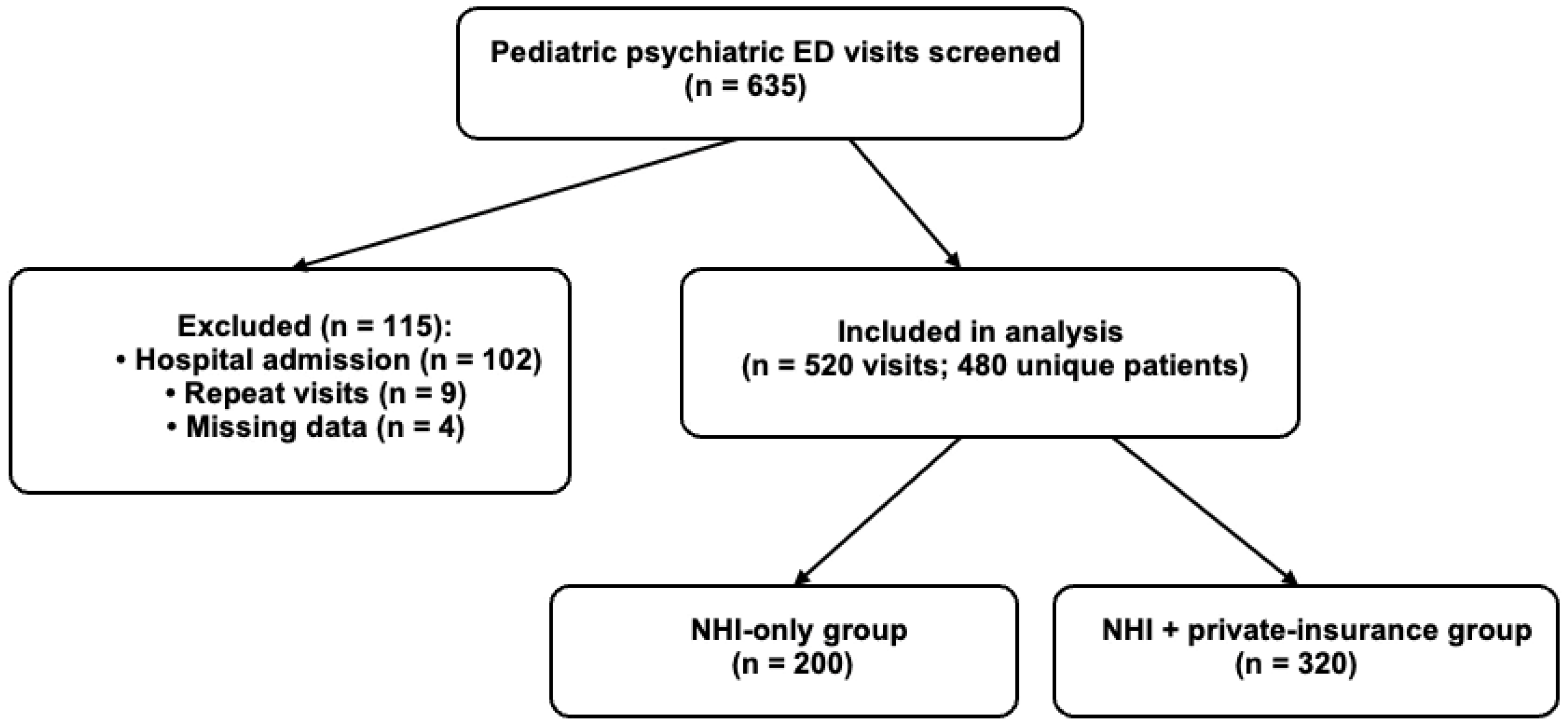
As shown in
Figure 1, 635 pediatric psychiatric emergency department (ED) visits were initially screened. After excluding 102 cases admitted to inpatient psychiatry, 9 repeat visits by the same patients (retaining the chronologically first visit for each patient), and 4 encounters with incomplete data, 520 visits (representing 480 unique patients) were included in the analysis.
The median age of patients was 15 years (interquartile range [IQR] 14–17), and 53.8% of visits involved female patients. Nearly all participants were Korean nationals covered by the NHI; among them, 320 (61.5%) carried supplemental private insurance and 200 (38.5%) relied solely on NHI. The most common presenting problems were suicidal ideation/behavior (180, 34.6%), disruptive behavior (100, 19.2%), depression (80, 15.4%), and anxiety (70, 13.5%). Overall, 200 (38.5%) had prior outpatient mental health care.
As summarized in
Table 2, baseline demographic and clinical variables were similar across insurance groups. Patients with supplemental private insurance were more likely to have prior outpatient psychiatric visits (50.0% vs. 20.0%,
p < 0.001).
3.2. Outpatient Follow-Up Rates
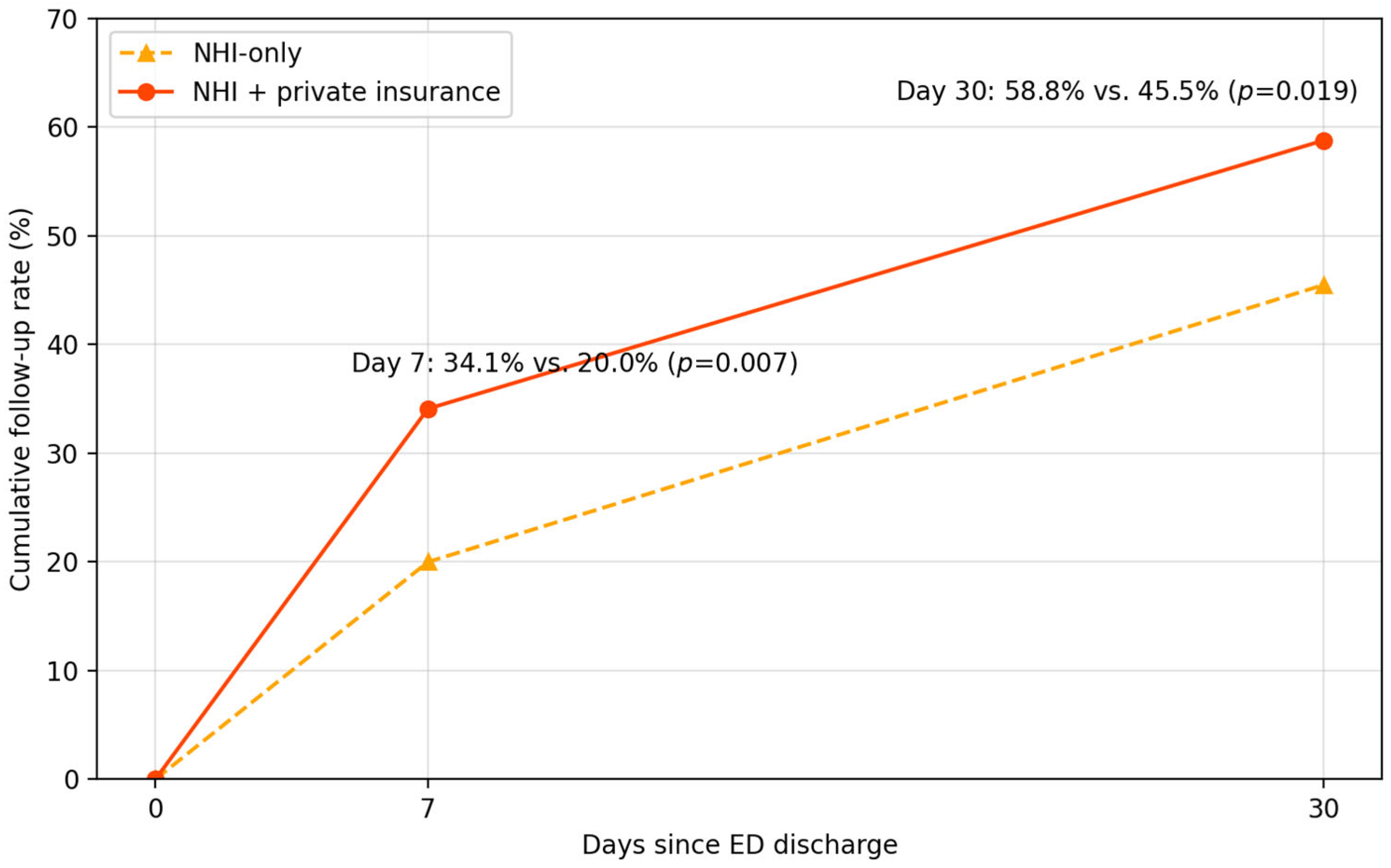
Overall, 28.7% of patients attended an outpatient mental health visit within 7 days and 53.7% within 30 days following discharge from the psychiatric ED. The absolute difference by insurance type was slightly larger at 7 days (34.1% vs. 20.0%; absolute difference 14.1 percentage points) than at 30 days (58.8% vs. 45.5%; absolute difference 13.3 percentage points), suggesting that supplemental insurance may particularly facilitate early engagement with outpatient services. Follow-up rates were significantly higher among those with supplemental private insurance compared with those covered by NHI alone—34.1% versus 20.0% at 7 days (
p = 0.007) and 58.8% versus 45.5% at 30 days (
p = 0.019) (
Table 3;
Figure 2).
3.3. Multivariable Regression Results
In the adjusted logistic regression analysis (
Table 4), having supplemental private insurance was independently associated with increased likelihood of attending a 30-day follow-up appointment. After controlling for age, sex, prior outpatient care, and clinical presentation, patients with NHI plus private insurance had 1.5-fold higher odds of follow-up compared with those with NHI only (aOR 1.50, 95% CI 1.10–2.05,
p = 0.02). In plain terms, children with supplemental private insurance were about 50% more likely to obtain a follow-up visit within 30 days than those with NHI alone, even after accounting for measured clinical factors. Other significant predictors of follow-up included prior outpatient mental health treatment (aOR 2.00, 95% CI 1.30–3.10) and suicidal ideation or attempt at presentation (aOR 1.40, 95% CI 1.10–1.80,
p = 0.01). Age showed a modest negative association with 30-day follow-up (aOR 0.94, 95% CI 0.90–0.99,
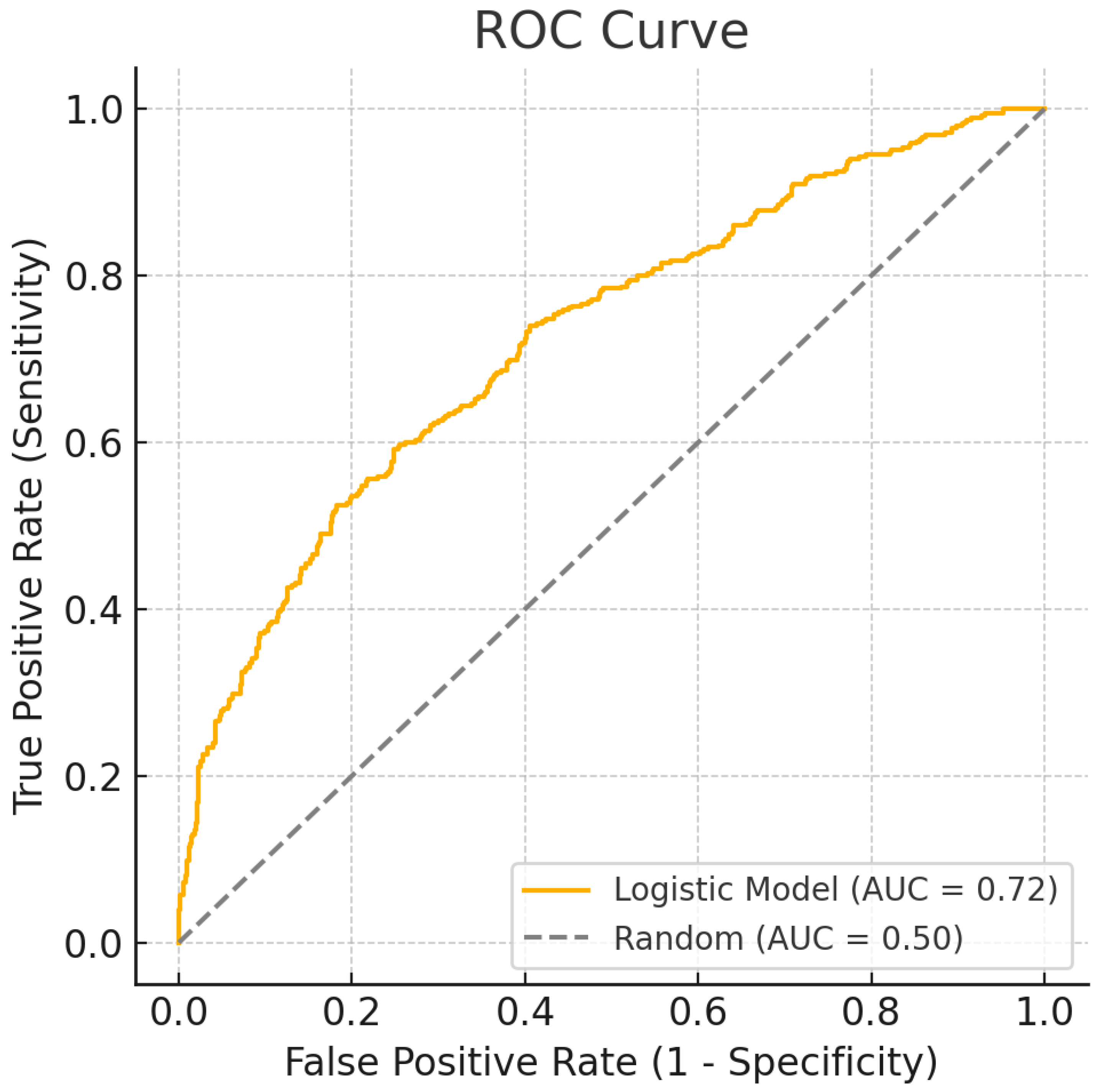
p = 0.03). Sex and diagnostic category were not significant in the adjusted model. The model demonstrated acceptable discrimination (c-statistic = 0.72) and satisfactory goodness-of-fit (Hosmer–Lemeshow
p = 0.38).
In unadjusted comparisons, follow-up did not differ by sex and was similar across age ranges; however, in multivariable analysis, age showed a modest negative association with 30-day follow-up (aOR 0.94, 95% CI 0.90–0.99; p = 0.03). Adolescents with a history of prior outpatient mental health care were substantially more likely to return for follow-up than those without previous treatment engagement (30-day follow-up 72.0% vs. 42.2%, p < 0.001).
Note: ED = emergency department; IQR = interquartile range; MH = mental health; NHI = National Health Insurance.
The model demonstrated acceptable discrimination (c-statistic = 0.72;
Figure 3) and satisfactory goodness-of-fit (Hosmer–Lemeshow
p = 0.38).
3.4. Interaction and Sensitivity Analyses
A pre-specified interaction between insurance type and prior outpatient mental health care was statistically significant (pinteraction = 0.03). Among patients without prior mental health treatment (n = 320), those with supplemental private insurance had a higher 30-day follow-up rate than NHI-only patients (45.6% vs. 38.8%, p = 0.022; aOR 1.72, 95% CI 1.12–2.64). In contrast, among patients with prior treatment (n = 200), follow-up rates were nearly identical between insurance groups (71.9% vs. 72.5%, p = 0.99; aOR 1.03, 95% CI 0.52–2.04). This indicates that the protective effect of supplemental insurance is concentrated among patients who are new to the mental health system.
In the sensitivity analysis accounting for within-patient clustering using GEE (n = 520 visits from 480 unique patients), the point estimate for supplemental private insurance was essentially unchanged (aOR 1.48, 95% CI 1.07–2.04, p = 0.02), confirming that the small degree of repeat visits did not bias results. Analyses using a 14-day outcome window and models additionally adjusting for pre-scheduled discharge appointments yielded consistent findings.
3.5. Outcomes of ED Visits
To contextualize the implications of follow-up care, outcomes following the index ED visit were examined. Within 6 months, 26% of patients experienced a repeat psychiatric ED visit or psychiatric hospitalization. Timely post-ED follow-up was associated with a lower short-term return rate: only 5% of patients who completed a 30-day outpatient visit returned to the ED within 1 month, compared with 12% among those without follow-up (p = 0.01). Over 6 months, the cumulative return rates narrowed (20% with follow-up vs. 30% without, p = 0.07). These findings suggest that early outpatient engagement after an emergency encounter may reduce short-term relapse or rehospitalization risk, although long-term differences attenuate over time.
4. Discussion
In this study of 520 pediatric psychiatric emergency department (ED) visits in South Korea, outpatient follow-up care was frequently not achieved despite universal health coverage. Approximately half of the youths did not receive any outpatient mental health visit within 1 month after their ED crisis, a finding that mirrors low follow-up rates reported internationally [
4]. These results indicate that insurance coverage alone is insufficient to guarantee timely access to continuing psychiatric care.
Children and adolescents with supplemental private insurance exhibited significantly higher follow-up rates than those relying solely on NHI. Importantly, the pre-specified interaction analysis revealed that this association was driven primarily by patients without prior mental health treatment. Among treatment-naïve patients, supplemental insurance conferred a 1.72-fold increase in follow-up odds, whereas among patients already engaged in care, insurance type had no measurable effect. This pattern suggests that supplemental insurance may lower the threshold for initiating new outpatient engagement—for example, by reducing co-payment anxiety or expanding perceived access—but adds little benefit once a patient has an established treatment relationship. This finding has direct policy implications: interventions to improve follow-up should particularly target families without prior mental health care exposure, who may face both financial and informational barriers.
These findings should be interpreted considering South Korea’s healthcare financing structure. Although NHI covers psychiatric consultations, patients typically pay approximately 30% of outpatient costs out-of-pocket [
6,
7]. Moreover, key components of evidence-based care, such as psychotherapy and counseling, are often excluded from reimbursement [
7]. Consequently, a child discharged from the ED who is advised to pursue therapy faces substantial private expenses. Families with supplemental private insurance may receive partial reimbursement or possess greater financial flexibility to pay for uncovered services, whereas those relying solely on NHI may defer treatment. Persistent financial barriers thus help explain the observed insurance-related differences in follow-up.
Our follow-up outcome should also be interpreted cautiously. A single outpatient visit within 30 days may represent an initial screening encounter rather than meaningful treatment initiation or sustained engagement, and our data do not capture visit frequency, therapeutic modality, medication adherence, or patient-reported improvement. Thus, the follow-up metrics used here reflect the first step in the continuum of post-emergency mental health care rather than the adequacy of ongoing care. Future studies should incorporate more granular outcomes such as time-to-first-visit, number of visits within 90 days, treatment retention at 6 months, and patient-reported outcome measures.
However, because insurance type also correlates with socioeconomic status, the observed association may partly reflect unmeasured confounding by income, parental education, or health literacy rather than insurance benefits per se. The markedly higher prevalence of prior outpatient mental health care among privately insured patients (50.0% vs. 20.0%) further underscores that these two groups differ in ways beyond financial coverage. Although the regression model adjusted for prior care, residual confounding cannot be excluded in this observational design.
More broadly, we interpret supplemental private insurance status as a composite marker of socioeconomic advantage rather than a purely financial exposure. In South Korea, holding supplemental coverage is shaped by household resources and is plausibly correlated with parental health literacy, health-seeking behavior, familiarity with referral pathways, and the capacity to absorb logistical costs (e.g., time off work, transportation, caregiving for siblings). Accordingly, the association observed in our adjusted models should not be interpreted as evidence of a direct causal effect of insurance coverage per se; rather, private insurance likely serves as a measurable proxy for a constellation of socioeconomic and behavioral determinants that facilitate successful linkage to outpatient care.
From a pediatric psychiatry perspective, the post-ED period is a high-risk transition point: symptoms that prompted an emergency visit (e.g., suicidal thoughts, self-harm, aggression, or acute psychosis) may recur if outpatient care is delayed, and families often leave the ED with uncertainty about diagnosis, treatment options, and how to navigate the outpatient system. For adolescents, ambivalence about treatment and concerns about confidentiality can reduce engagement, whereas for younger children, follow-up depends heavily on parental capacity, time, and perceived stigma. Therefore, even modest improvements in early linkage—particularly among treatment-naïve families—may translate into clinically meaningful reductions in crisis recurrence and disruptions to school and family functioning.
Beyond financial factors, several systemic and societal barriers also contribute to poor continuity of pediatric mental health care in South Korea. One challenge is the shortage and uneven distribution of qualified providers: the psychiatry workforce is concentrated in metropolitan regions, and specialized child–adolescent services remain limited outside major cities. Even among those who completed follow-up, the median waiting time for an outpatient appointment after ED discharge was about 2 weeks, which can feel prolonged for families in crisis. Workforce expansion and improved geographic distribution of mental health professionals are therefore essential to reduce delays and ensure equitable access.
Fragmentation across the health, mental health, and social-service sectors also undermines continuity. Korea lacks a unified system to coordinate transitions from emergency to community care; families often must arrange follow-up appointments independently. Any administrative or logistical obstacle—difficulty securing an appointment, uncertainty about where to seek care, or emotional fatigue—can result in loss to follow-up. In contrast, systems in other countries have implemented patient navigators and structured referral pathways that proactively link ED patients to outpatient providers [
8,
9].
Cultural stigma remains another key barrier. Despite public campaigns, mental illness continues to carry social prejudice in Korea [
10]. Families may avoid psychiatric care due to fear of labeling or social discrimination. Some parents may downplay the crisis as transient or wish to avoid a formal psychiatric record for their child. Stigma can thus deter adherence to follow-up recommendations, even when care is accessible. Addressing stigma and improving mental health literacy are critical steps toward enhancing adherence to recommended care.
Despite these challenges, Korea’s universal coverage offers a strong foundation. No patient in this study was denied care for financial ineligibility, and psychiatric medications and consultations were partially reimbursed. The government has recently expanded NHI coverage for mental health services and piloted collaborative care and counseling programs [
11,
12]. Nevertheless, many outpatient therapies remain non-reimbursable, and private insurance products covering mental health care are limited. Closing these insurance gaps could substantially improve continuity of care by lowering families’ financial burden.
4.1. Policy Implications
Recent policy discussions and budget lines have focused on expanding mental health benefits and workforce supply, but service-coverage gaps remain, particularly for psychotherapy in community settings. To address the inadequate follow-up identified in this study, a multi-pronged strategy is needed.
First, Korea should expand community-based mental health services for youth [
11]. Strengthening school-based programs (e.g., the Wee Center system) and community mental health welfare centers can provide easily accessible follow-up options, particularly for families unable to reach hospital clinics.
Second, the pediatric mental health workforce must grow through targeted training, loan-forgiveness incentives, and improved reimbursement for psychiatric consultations [
12]. A more even geographic distribution of providers would reduce regional disparities.
Third, care coordination systems should be enhanced. Hospitals could schedule follow-up appointments before ED discharge or use case managers to contact families post-visit, consistent with successful models elsewhere [
13]. Telepsychiatry and e-consultation could also reduce waiting times.
Finally, policymakers should enhance insurance coverage by lowering co-payments for psychiatric visits and including psychotherapy under NHI [
14]. Prioritizing outpatient mental health follow-up for youth as a high-coverage service—akin to cancer care—would reduce disparities. Encouraging private insurers to offer affordable riders for outpatient psychiatric treatment could further strengthen access.
4.2. Strengths and Limitations
This study is, to our knowledge, one of the first to examine pediatric psychiatric ED follow-up in South Korea’s universal coverage system. A key strength of this study is the focus on insurance heterogeneity within a single-payer model, which yields policy-relevant insights. The pre-specified interaction analysis adds mechanistic understanding of when insurance matters. Detailed clinical data allowed adjustment for confounders such as prior service use, enhancing validity.
However, several limitations warrant mention. First, the retrospective observational design precludes causal inference. Second, follow-up status derived from our hospital medical records may miss outpatient care completed outside the system. Third, insurance type was measured from administrative and billing records and could not distinguish policy generation, benefit scope, or actual reimbursement for psychiatric services. Finally, data on pre-scheduled appointments were not uniformly available and were therefore examined only in sensitivity analyses.
Residual confounding and selection bias are therefore plausible. Several household-level variables were unavailable in our clinical dataset, including parental education, household income, health literacy, family structure (e.g., single-parent households), and stigma-related attitudes toward psychiatric care. Each of these factors is likely associated with both supplemental insurance enrollment and the propensity to attend follow-up, and the expected direction of confounding would generally inflate the apparent “insurance effect” (bias away from the null). Although we adjusted for prior outpatient mental health care, that variable is itself influenced by socioeconomic determinants that also drive insurance uptake; thus, it likely captures only part of the underlying differences in health-seeking behavior between groups. Accordingly, the reported adjusted odds ratio should be interpreted as an association—and potentially an upper bound of the insurance-specific causal contribution—rather than a definitive estimate of a direct insurance benefit. Future work could use richer socioeconomic data (e.g., linked administrative or census variables) and causal methods such as propensity score approaches or instrumental variables to better disentangle these mechanisms.
External validity is also limited by the single-center design in a university-affiliated tertiary children’s hospital located in a metropolitan area. This setting may serve a referral population that is more clinically complex and may include families who have already navigated awareness and access barriers (e.g., distance, referral pathways), which could attenuate or otherwise alter observed disparities compared with community hospitals. Moreover, regional variation in outpatient psychiatric infrastructure may modify the insurance–follow-up association: in rural or underserved areas where provider scarcity is the dominant bottleneck, supplemental insurance may matter less than service availability, whereas in urban areas with multiple providers, affordability and cost-sharing may be more salient. Multi-center studies spanning tertiary and community settings, as well as urban and rural regions, are needed to evaluate the generalizability of these findings and how context shapes the magnitude and direction of associations.