Article

From Quest for Significance to Social Media Addiction: The Mediating Role of Boredom and the Moderating Role of Age in a Spanish Sample


by
Ginevra Tagliaferri
1,*,
Clarissa Cricenti
1,
Andrea Civera-Antony
2,
Carlos González-Manzanares
2 and
Manuel Martí-Vilar
2,*
1
Department of Psychology, Sapienza University of Rome, Via dei Marsi 78, 00185 Rome, Italy
2
Department de Psicologia Bàsica, Faculty of Psychology and Speech Therapy, Universitat de València, Av. Blasco Ibañez, 21, 46010 Valencia, Spain
*
Authors to whom correspondence should be addressed.
Psychiatry Int. 2026, 7(3), 107; https://doi.org/10.3390/psychiatryint7030107

Submission received: 15 March 2026 / Revised: 27 April 2026 / Accepted: 30 April 2026 / Published: 8 May 2026
(This article belongs to the Special Issue The Impact of Social Media on Mental Health)

Abstract

(1) Background: Social media addiction (SMA) is conceptualized as a behavioral addiction linked to emotional dysregulation. This study investigates whether multidimensional state boredom mediates the relationship between the quest for significance and SMA, exploring the moderating role of age cohorts. (2) Methods: A cross-sectional study was conducted with 316 Spanish participants (aged 18–68) divided into Generation Z, Millennials, and Generation X. Standardized measures (BSMAS, SQS, MSBS) were analyzed using a multiple moderated mediation model (PROCESS Model 14), controlling for gender. (3) Results: Boredom dimensions correlated positively with both quest for significance and SMA. The final model explained 53.5% of SMA variance. High-arousal boredom and inattention were positively associated with SMA, while low-arousal boredom showed a negative association. Notably, the quest for significance was indirectly associated with SMA through high-arousal boredom exclusively among Generation Z, with no significant indirect effects found in older cohorts. (4) Conclusions: The findings highlight high-arousal boredom as a key link between existential motives and SMA, particularly in younger individuals. These results underscore the importance of age-specific emotional and motivational processes in designing prevention and intervention strategies for problematic social media use.

1. Introduction

Over recent decades, technology has become deeply embedded in social life, transforming the ways in which people communicate, interact, and construct their identities [1]. A clear example is the use of social networks, which have evolved from simple entertainment spaces into platforms for communication, relationships, and personal expression. At the global level, statistics reported by WeAreSocial [2] and INE [3] estimate that there are approximately 5.24 billion social network users, corresponding to 81% of the population that uses the Internet. In Spain, recent data indicate that 84.2% of the population connects to the Internet more than once a day [3], highlighting the normalization of constant connectivity.
This hyperconnectivity is heavily facilitated by an almost universal mobile penetration; recent reports from the INE show that mobile phones are present in 99.5% of Spanish households [3]. Furthermore, the Digital 2025 report for Spain reveals that Spanish users spend an average of nearly two hours a day exclusively on social media platforms, deeply integrating these tools into their daily routines [2].
Beyond the mere time spent online, the specific usage habits of the Spanish population significantly influence the digital experience. According to the Estudio de Redes Sociales 2024 by IAB Spain, while WhatsApp and Instagram remain the dominant platforms for daily interactions and relational maintenance, TikTok has experienced explosive growth, particularly among younger demographics [4]. This shift marks a transition from traditional digital socialization to rapid, algorithm-driven entertainment. The dominance of short-form vertical videos drastically modifies engagement patterns, providing immediate, high-frequency dopamine rewards that can reduce sustained attention spans.
Additionally, the Spanish digital experience is characterized by a multifaceted use of social media—serving simultaneously as a primary source of news, a space for brand interaction, and an entertainment hub. This multi-purpose environment blurs the boundaries between leisure and digital saturation, making users more susceptible to phenomena such as FOMO (Fear Of Missing Out) [3].
In light of this evidence, it is crucial to examine not only the amount of time devoted to digital technologies, but also the possible physical, behavioral, and psychological implications associated with intensive use [5,6,7]. Both social network use and smartphone have received increasing scientific attention, especially when such practices become excessive or dysregulated [8]. The literature has shown that dysfunctional patterns of use may be associated with emotional distress and self-regulation difficulties and, in more severe cases, may take the form of genuine behavioral addictions, similar to substance addictions but without the involvement of chemical agents [9,10]. Such problematic use is characterized by typical addictive features, such as craving, salience, tolerance, conflict, and relapse [11].
The compulsive use of social networks has been described through conceptualizations such as Social Media Addiction (SMA) [12] and Problematic Social Media Use (PSMU), understood as a form of psychological dependence that produces addictive-like symptoms [13]. For the purposes of this research, “Social Media Addiction” and “Problematic Social Media Use” are treated as synonymous constructs, both referring to a pattern of pervasive and maladaptive social media consumption that interferes with daily functioning. Furthermore, it should be noted that, in this context, the term “addiction” is used exclusively in a research-related sense, without any clinical implications. Although SMA/PSMU is not included in the DSM-5, it has a substantial impact on psychological well-being [14,15] and shows high prevalence worldwide [16,17,18,19]. Within this framework, understanding the mechanisms underlying social network addiction represents a key research priority.
One of the main motivations that may sustain addiction to social networks is the need to regulate negative emotions such as stress, anxiety, loneliness, or depression [20,21,22]. The transition from non-problematic to addictive use may occur when individuals come to perceive social networks as the only effective strategy to alleviate such emotional states [8,23], thereby reinforcing the behavior through this compensatory mood-regulation mechanism [24]. Furthermore, SMA is associated with emotional difficulties, sensation seeking, social withdrawal, and reduced online socio-emotional competencies [25,26,27,28]. Despite the fact that the literature has extensively examined the cognitive and behavioral correlates of technological addictions, important gaps remain regarding the role of emotions—and boredom in particular—in problematic social media use [29,30]. Boredom, defined as “an aversive state of wanting, but being unable, to engage in satisfying activities” (p. 483) [31], is a complex experience that emerges when the environment fails to provide adequate stimulation. It can manifest as state boredom (SB), a situational and temporary response to insufficient stimulation, or as trait boredom (TB), a stable disposition to experience boredom across different contexts [31,32,33].
Recent research [34,35] has shown that boredom, both as state and trait, represents a cross-cutting factor associated with risk behaviors and several forms of addiction, including substance abuse, problematic Internet use, and dysfunctional social media use [29,36,37,38].
Its multidimensional nature—encompassing emotional, arousal-related, cognitive, and existential aspects—helps to explain this association and can be delineated through seven primary dimensions [39]:
  • Lack of engagement: The aversive experience arising from the desire, coupled with the inability, to participate in an activity perceived as stimulating and rewarding.
  • Low-arousal negative affect: The presence of feelings of lethargy, apathy, and psychophysical fatigue in response to a redundant or monotonous environment.
  • High-arousal negative affect: The emergence of feelings of restlessness, agitation, and frustration, often stemming from the constant, unsuccessful attempt to self-stimulate.
  • Slow passage of time: A cognitive distortion wherein the individual perceives an unnatural and unpleasant slowing of the temporal dimension.
  • Difficulty focusing attention: The inability to maintain concentration, coupled with the need to control one’s attentional processes with extreme effort.
  • Stimulation discrepancy: The gap, experienced with profound distress, between the internal need for arousal or novelty and the actual availability of external stimuli.
  • Existential void: The perception of pointlessness and the profound sense that one’s actions, or the immediate situation, are entirely devoid of purpose or meaning.
The complex interplay of these elements means that difficulties in emotion regulation [40,41], discrepancies between the need for stimuli and their availability [42,43], attentional deficits [44,45], and the perceived lack of meaning [46,47] all contribute to rendering individuals more vulnerable to the compulsive use of digital technologies.
Consistently, several studies [29,30,48] indicate that high levels of boredom predict a greater risk of problematic use of digital platforms, which are often sought out as sources of rapid gratification.
The evolution of the relationship between individuals and digital technologies has driven contemporary psychology to redefine boredom not merely as a passive state, but as a critical determinant of addictive behaviors. The foundations of this process find robust theoretical grounding in the Interaction of Person–Affect–Cognition–Execution (I-PACE) model [49] and the Compensatory Internet Use Theory (CIUT). Both theoretical frameworks postulate that the immediate efficacy of digital media in alleviating negative affective states reinforces smartphone use as a primary coping mechanism. As addiction progresses, a critical transition occurs: media use is no longer driven by the pursuit of gratification but rather becomes a purely compensatory act. This phenomenon is further exacerbated by a progressive decline in inhibitory control, trapping the user in a recursive cycle of boredom and hyperconnectivity [49].
Within these compensatory dynamics, the specific role of boredom is further elucidated by the Boredom Feedback Model (BFM) [50], which highlights how a systematic reliance on external digital stimuli to alleviate boredom can evolve into a dysfunctional anticipatory strategy. From this perspective, at the cognitive and attentional levels, the Meaning and Attentional Components (MAC) model [51] suggests that boredom emerges from a failure to integrate attentional resources with the perceived semantic value of a given activity. When this balance is disrupted, individuals tend to seek refuge in digital media to compensate for stimulation deficits or to evade tasks perceived as devoid of meaning [52]. Although an optimal balance between challenge and skill can theoretically lead to a state of “flow” [53], the ubiquity of modern devices provides an immediate escape route that circumvents natural self-regulatory mechanisms.
However, boredom does not only imply a need for stimulation: it may also reflect a deeper motivational or existential void that links it to the quest for significance [54]. The quest for significance represents one of the main motivational forces driving human behavior [55] and is defined as the desire to feel important, recognized, and socially valued [54,55]. According to Significance Quest Theory (SQT), this quest can be activated by three conditions: loss of significance, threat of significance loss, and opportunity for significance gain [55,56]. In the presence of these conditions, individuals may strongly pursue the restoration or enhancement of their personal significance, sometimes subordinating other concerns, such as empathy, affective bonds, or moral norms [57].
Only recently has it been hypothesized that these dynamics might also emerge in the use of digital technologies, particularly social media, which provide environments rich in opportunities for visibility, recognition, and social belonging [58]. From childhood onward, personal significance is constructed through interaction with the social environment, which is now extended to digital contexts where social networks become privileged spaces for validation, status, and identity construction [58].
In summary, both boredom and the quest for significance appear to be two crucial psychological processes that may motivate dysfunctional use of digital technologies, as these tools provide immediate gratifications, highly responsive social environments, and opportunities for identity construction. Nonetheless, only one study has directly examined the association between the quest for significance and social media use [58], and no research has yet investigated the joint role of boredom and the quest for significance in the contexts of social media.

1.1. Age Differences in Social Media Use

According to the Pew Research Center [59,60], Millennials are defined as individuals born between 1981 and 1996, Generation Z as those born from 1997 onward (often extended through 2012), and Generation X as those born between 1965 and 1980. These cohort-based distinctions are widely used to examine age-related differences in digital behaviors.
Social media use varies systematically across age groups, reflecting generational differences in adoption, platform preference, and usage motives. Younger cohorts show higher engagement levels and more dynamic interaction patterns compared to older generations [61,62], although scholars caution against conflating age and cohort effects [63].
Generation Z (approximately 18–26 years) demonstrates the highest intensity of use, with a strong preference for visually oriented and video-based platforms such as YouTube, Instagram, TikTok, and Snapchat. Their use is primarily oriented toward entertainment, self-expression, and active content creation [62]. Millennials (approximately 27–47 years) maintain high engagement across both established and emerging platforms, integrating social, professional, and entertainment functions [64]. In contrast, Generation X (approximately 48–61 years) shows more selective and stable usage patterns, favoring established platforms and primarily using them to maintain existing social ties and consume information [64].
Overall, generational differences in social media use concern not only adoption rates but also distinct patterns of engagement, with younger cohorts characterized by higher intensity and active participation, and older cohorts by more selective and relationship-oriented use [63].

1.2. Main Hypotheses

Based on prior literature linking boredom and meaning-related processes to maladaptive digital engagement, the present study examined whether multidimensional boredom mediates the association between search for meaning (SQS) and social media addiction (BSMAS), and whether these processes vary across age cohorts, while controlling for gender.
Accordingly, the following hypotheses were formulated:
H1. 
Boredom dimensions (MSBS: disengagement, high arousal, low arousal, inattention, and time perception) are positively associated with Search for meaning (SQS), controlling for age and gender.
H2. 
Boredom dimensions (MSBS: disengagement, high arousal, low arousal, inattention, and time perception) are positively associated with Social Media Addiction (BSMAS), controlling for age and gender.
H3. 
Boredom dimensions mediate the relationship between search for meaning (SQS) and BSMAS.
H4. 
Age moderates the associations between boredom’s dimensions and BSMAS, such that the effects of boredom on BSMAS differ across age cohorts.
H5. 
The indirect effect of SQS on BSMAS through boredom (moderated mediation) varies across age groups, with stronger indirect effects expected among younger individuals (Gen Z).

2. Materials and Methods

2.1. Participants

The study initially recruited 417 participants using a non-probabilistic convenience sampling approach. Eligibility criteria required participants to be 18 years of age or older and to be residents of Spain. Of the initial sample, eleven participants did not complete the entire questionnaire; therefore, only fully completed responses were retained in the final analyses to ensure data quality, integrity, and reliability. All participants gave informed consent to participate in the study. The final sample comprised 316 participants (110 males and 206 females), with ages ranging from 18 to 68 years (M = 37.24, SD = 15.6). Males represented 34.8% of the sample (M = 39.3, SD = 14.4), while females accounted for 65.2% (M = 34.9, SD = 15.3), a distribution that falls within the recommended 35–65% range to reduce potential gender bias.

Age Group Classification and Distribution

Participants were categorized into three age-based generational groups according to widely adopted demographic conventions [59,60]. Group 1 included individuals belonging to Generation Z (born 1997–2012; approximately 18–29 years old in 2025), Group 2 comprised Millennials (born 1981–1996; approximately 27–47 years old in 2025), and Group 3 consisted of Generation X participants (born 1965–1980; approximately 48–61 years old in 2025).
The final sample was relatively balanced across groups. Generation Z (Group 1) included 121 participants, representing 38.3% of the total sample. Millennials (Group 2) comprised 88 participants (27.8%), while Generation X (Group 3) included 107 participants (33.9%). Cumulatively, 66.1% of the sample was composed of Generation Z and Millennials, with Generation X accounting for the remaining 33.9%.

2.2. Procedure

Participants were recruited online and completed the survey voluntarily and anonymously using a non-probabilistic convenience sampling strategy. Access to the questionnaire was provided via a dedicated link hosted on the Qualtrics Online Platform. Participation was limited to individuals who encountered the survey link and chose to take part. No compensation or incentives were provided for participation. To reduce potential biases, informed consent was obtained prior to the start of the survey, with clear information that responses would remain anonymous and that participants were free to withdraw at any time without any consequences. This anonymity was intended to minimize socially desirable responding. Participants completed the survey in different settings (e.g., home, university, or workplace) and used devices of their preference, including personal computers, smartphones, or tablets. The average completion time for the questionnaire was approximately 20 min. Ethical approval was granted through an expedited review by the Institutional Board of the Comité de Ética of the University of Valencia (2025-PSILOG-4140282), in accordance with the ethical standards outlined in the Declaration of Helsinki.

2.3. Measures

The first section of the questionnaire included a series of questions concerning sociodemographic information (e.g., gender, sexual orientation, age, marital status, educational level, cohabitation, profession) and information about the use of social media (e.g., motivation for using the Internet, daily time spent on social networks).

2.3.1. Multidimensional State Boredom Scale (MSBS)

The version validated by Aìda et al. [65] was administered. This self-report scale consists of 29 items rated on a seven-point Likert scale from 1 (Strongly disagree) to 7 (Strongly agree), assessing state boredom. The MSBS contains five subscales: disengagement (e.g., “I am stuck in a situation that I feel is irrelevant”), high-arousal negative affect (e.g., “Everything seems to irritate me right now”), low-arousal negative affect (e.g., “I feel lonely”), inattention (e.g., “I am easily distracted”), and time perception (e.g., “Time is passing more slowly than usual”). This version demonstrated good internal consistency, with Cronbach’s alpha reported at 0.89.

2.3.2. Significance Quest Scale (SQS)

This self-report scale measures levels of the quest for significance developed by Şahin [58]. It consists of 26 items rated on a five-point Likert scale from 1 (does not describe me at all) to 5 (describes me). It includes four subscales: impressibility (e.g., “I like causing a stir”), respectability (e.g., “I wish everyone liked my ideas”), difference (e.g., “I strive to have an admirable personality”), and popularity (e.g., “I would like to be recognized by everyone”). This version demonstrated excellent internal consistency, with Cronbach’s alpha reported at 0.96.

2.3.3. Bergen Social Media Addiction Scale (BSMAS)

This self-report scale assesses social media-related experiences over the past year. The Spanish version adapted by Arrivillaga et al. [66] was used in the present study. The BSMAS contains six items reflecting core addiction elements (i.e., salience, mood modification, tolerance, withdrawal, conflict, relapse) [11]. Each item refers to experiences within the previous 12 months and is rated on a five-point Likert scale from 1 (very rarely) to 5 (very often). Example items include: “How often during the last year have you used social media so much that it had a negative impact on your work/studies?” and “How often during the last year have you felt the need to use social media more and more?”. This version showed good internal consistency, with Cronbach’s alpha reported at 0.87.

2.4. Data Analysis

Statistical analyses were conducted using IBM SPSS Statistics version 29 (IBM Corp., Armonk, NY, USA), with statistical significance set at p < 0.05.
Preliminary analyses were conducted to assess the assumptions underlying the statistical models. Examination of the normality of variables, multicollinearity among predictors, and the distribution of residuals indicated that the assumptions of normality, linearity, homoscedasticity, and independence were adequately met. No substantial violations were detected.
First, descriptive statistics were computed for all study variables and sociodemographic characteristics of the sample (Table 1 and Table 2). Specifically, age-related differences were first examined using a one-way analysis of variance (ANOVA) for social media addiction (BSMAS) and Search for meaning (SQS) scores, and a multivariate analysis of variance (MANOVA) for multidimensional boredom (MSBS dimensions), to account for its multiple subscales. Subsequently, gender differences were assessed using independent samples t-tests for BSMAS, SQS, and MSBS dimensions. Bonferroni correction was applied to control for multiple comparisons.
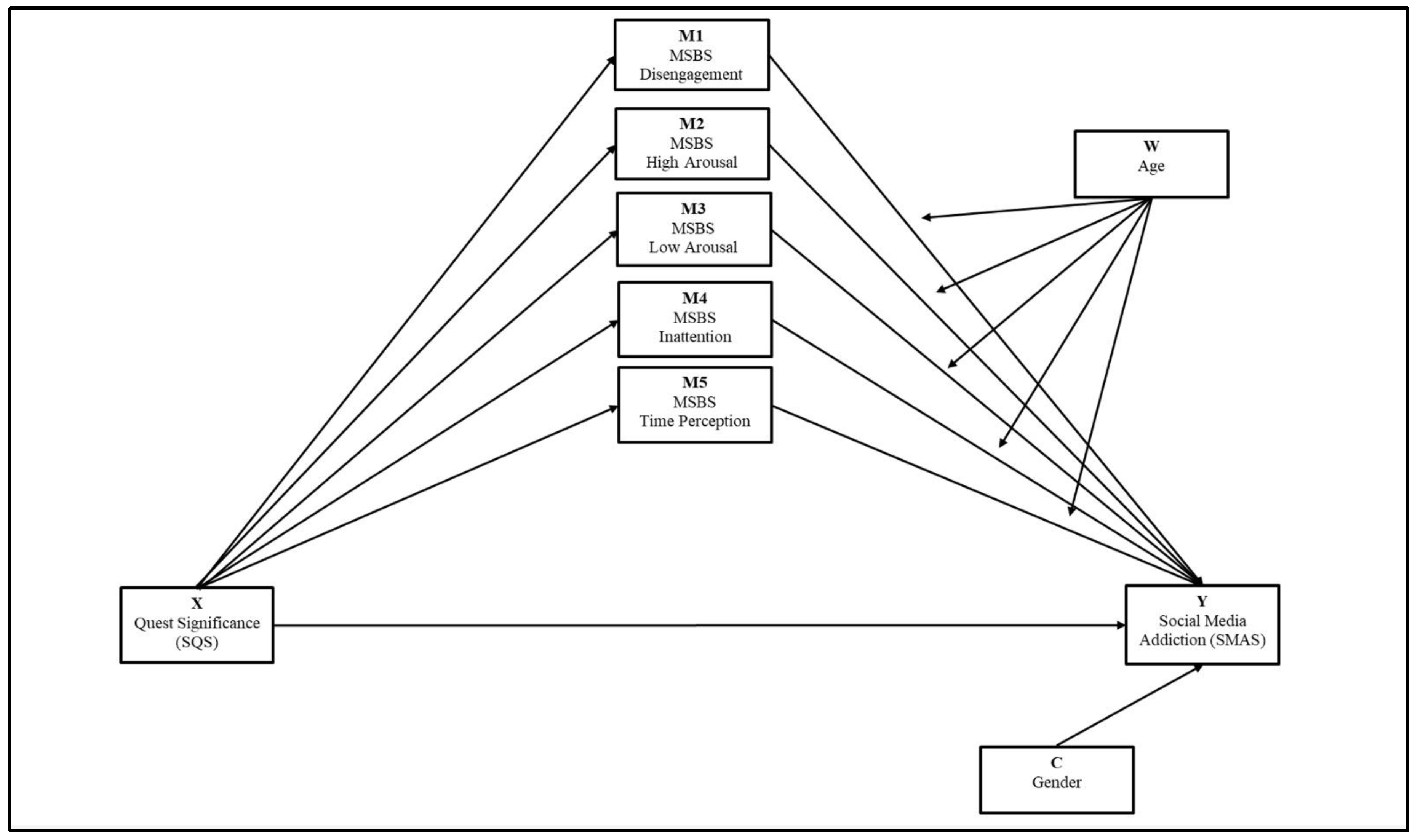
The internal consistency of all scales was assessed using Cronbach’s alpha coefficients. Partial Pearson correlation analyses (controlling for gender and age) were then performed to examine the associations among SQS, MSBS dimensions, and BSMAS. To test the hypothesized model, a multiple moderated mediation analysis (Model 14; Figure 1) was conducted using PROCESS macro version 4.0 [67]. In this model, search for meaning (SQS) was specified as the independent variable, social media addiction (BSMAS) as the dependent variable, and the five boredom dimensions (MSBS: disengagement, high arousal, low arousal, inattention, and time perception) as parallel mediators. Age cohort was entered as a moderator of the paths from each boredom dimension to BSMAS, while gender was included as a covariate. Age was included in the moderated mediation model as a categorical variable representing three generational cohorts (Generation Z, Millennials, and Generation X). Dummy coding was applied, with Generation Z serving as the reference group. Two dummy variables were created: one comparing Millennials to Generation Z and the other comparing Generation X to Generation Z. Indirect effects were estimated using 5000 bootstrap samples and 95% bias-corrected confidence intervals. Moderated mediation was evaluated through the indices of moderated mediation and conditional indirect effects across age groups.

3. Results

3.1. Descriptive Analysis

Differences across age groups in the study variables were examined. Means and standard deviations are reported in Table 1 (see Supplementary Materials—Table S1 for all post hoc results).
A multivariate analysis of variance (MANOVA) revealed a significant main effect of age on the MSBS dimensions [Wilks’ Λ = 0.923, F(10, 618) = 2.526, p < 0.01, η2p = 0.039]. Specifically, univariate ANOVAs indicated significant effects for Inattention [F(2, 313) = 6.366, p < 0.01, η2p = 0.039] and Time Perception [F(2, 313) = 5.989, p < 0.01, η2p = 0.037]. Bonferroni-adjusted post hoc pairwise comparisons showed that Generation Z reported significantly higher scores than Generation X on both dimensions (p < 0.01). No statistically significant effects of age were found for Disengagement [F(2, 313) = 2.186, p = 0.114, η2p = 0.014], High Arousal [F(2, 313) = 2.053, p = 0.130, η2p = 0.013], or Low Arousal [F(2, 313) = 1.899, p = 0.151, η2p = 0.012]. A one-way analysis of variance (ANOVA) revealed a significant main effect of age on social media addiction (BSMAS), [F(2, 313) = 44.035, p < 0.001, η2p = 0.220]. Bonferroni-adjusted post hoc pairwise comparisons indicated that Generation Z scored significantly higher than both Millennials and Generation X (p < 0.001), and Millennials scored significantly higher than Generation X (p < 0.001). Similarly, a significant main effect of age was observed for Search for Meaning (SQS), [F(2, 313) = 9.449, p < 0.001, η2p = 0.057]. Bonferroni-adjusted post hoc pairwise comparisons showed that Generation Z reported significantly higher scores than both Millennials (p < 0.05) and Generation X (p < 0.001).
In addition to age-related differences, gender differences in the study variables were also examined. Means and standard deviations are reported in Table 2. Independent samples t-tests indicated that no statistically significant gender differences emerged for any of the MSBS dimensions, including Disengagement [t(314) = −0.739, p = 0.461; d = 0.09], High Arousal [t(314) = −1.080, p = 0.281; d = 0.13], Low Arousal [t(314) = −0.636, p = 0.525; d = 0.08], Inattention [t(314) = −0.943, p = 0.347; d = 0.11], and Time Perception [t(314) = −0.389, p = 0.697; d = 0.05]. Similarly, no significant gender differences were found for Search for Meaning (SQS), [t(314) = −0.804, p = 0.422; d = 0.09]. In contrast, a statistically significant gender difference was observed for social media addiction (BSMAS), [t(314) = −2.723, p = 0.007; d = 0.33], with females reporting higher scores than males.

3.2. Correlation Analysis

Partial correlations controlling for gender and age (Table 3a) showed that all boredom dimensions were positively and significantly associated with both social media addiction (BSMAS) and search for meaning (SQS).
Specifically, BSMAS was positively correlated with Disengagement (r = 0.384, p < 0.001), High Arousal (r = 0.411, p < 0.001), Low Arousal (r = 0.322, p < 0.001), Inattention (r = 0.513, p < 0.001), and Time Perception (r = 0.350, p < 0.001). Similarly, SQS was positively correlated with Disengagement (r = 0.336, p < 0.001), High Arousal (r = 0.349, p < 0.001), Low Arousal (r = 0.329, p < 0.001), Inattention (r = 0.383, p < 0.001), and Time Perception (r = 0.270, p < 0.001).
Regarding covariates, gender was positively associated with BSMAS (r = 0.119, p < 0.05). Age showed significant negative correlations with Inattention (r = −0.202, p < 0.001), Time Perception (r = −0.191, p < 0.001), BSMAS (r = −0.472, p < 0.001), and SQS (r = −0.216, p < 0.001). Zero-order correlations showed the same pattern of associations (Table 3b).

3.3. Multiple Moderated Mediation Analysis

A moderated mediation model was tested in which SQS was indirectly associated with BSMAS through the five MSBS boredom dimensions, with age cohort moderating the paths from MSBS to BSMAS and gender included as a covariate.
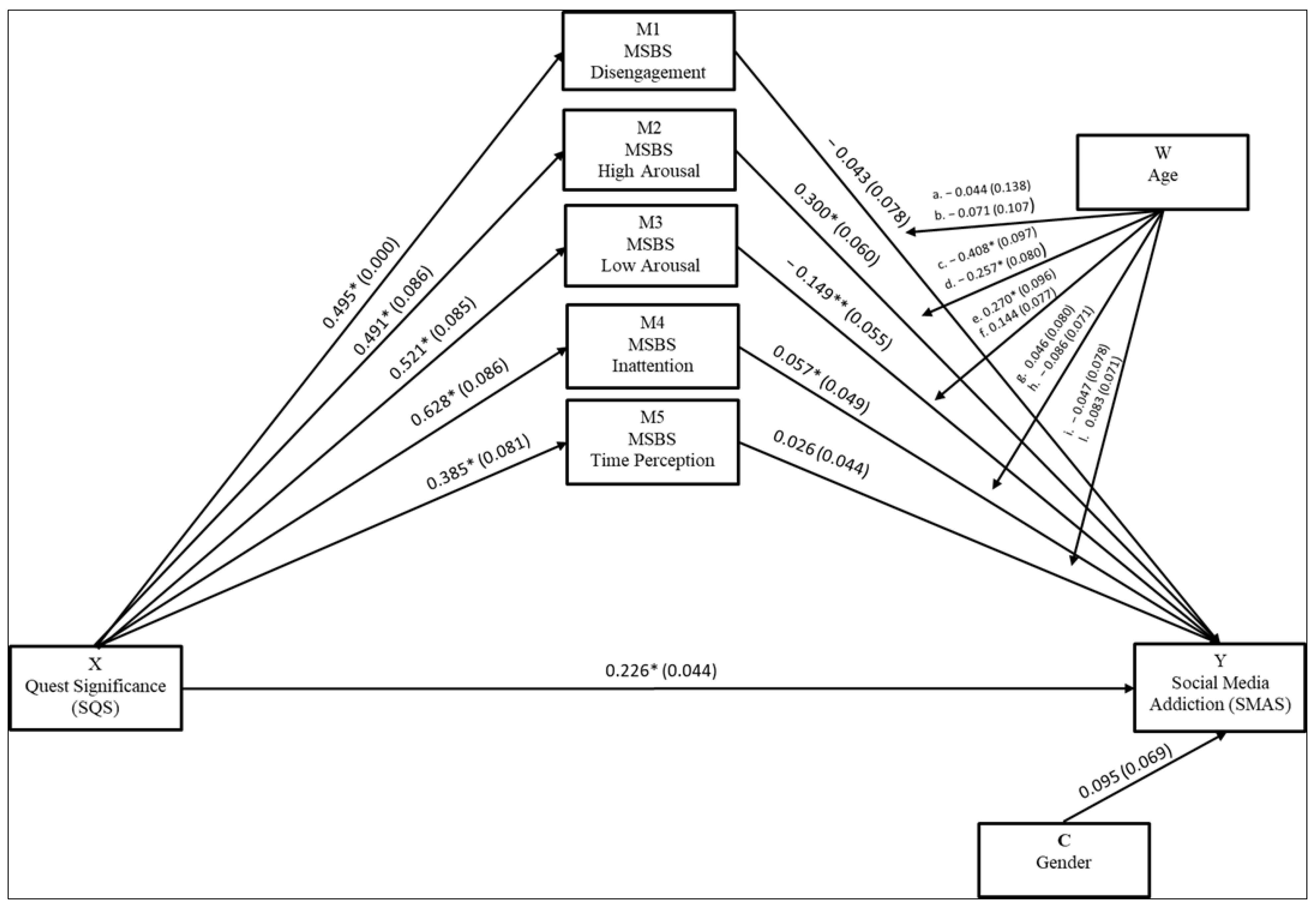
Results (Table 4) showed that SQS was positively associated with all boredom dimensions: Disengagement (B = 0.495, p < 0.001), High Arousal (B = 0.491, p < 0.001), Low Arousal (B = 0.521, p < 0.001), Inattention (B = 0.628, p < 0.001), and Time Perception (B = 0.385, p < 0.001). Regarding BSMAS, High Arousal boredom (B = 0.300, p < 0.001) and Inattention (B = 0.157, p < 0.001) showed positive associations, whereas Low Arousal boredom showed a negative association (B = −0.149, p < 0.01).
Disengagement and Time Perception were not significantly related to BSMAS. The interaction terms were significant for High Arousal × Age (B = −0.408, p < 0.001; B = −0.257, p < 0.001) and Low Arousal × Age (B = 0.270, p < 0.01), whereas no moderation emerged for Disengagement, Inattention, or Time Perception in the relationship between boredom and BSMAS.
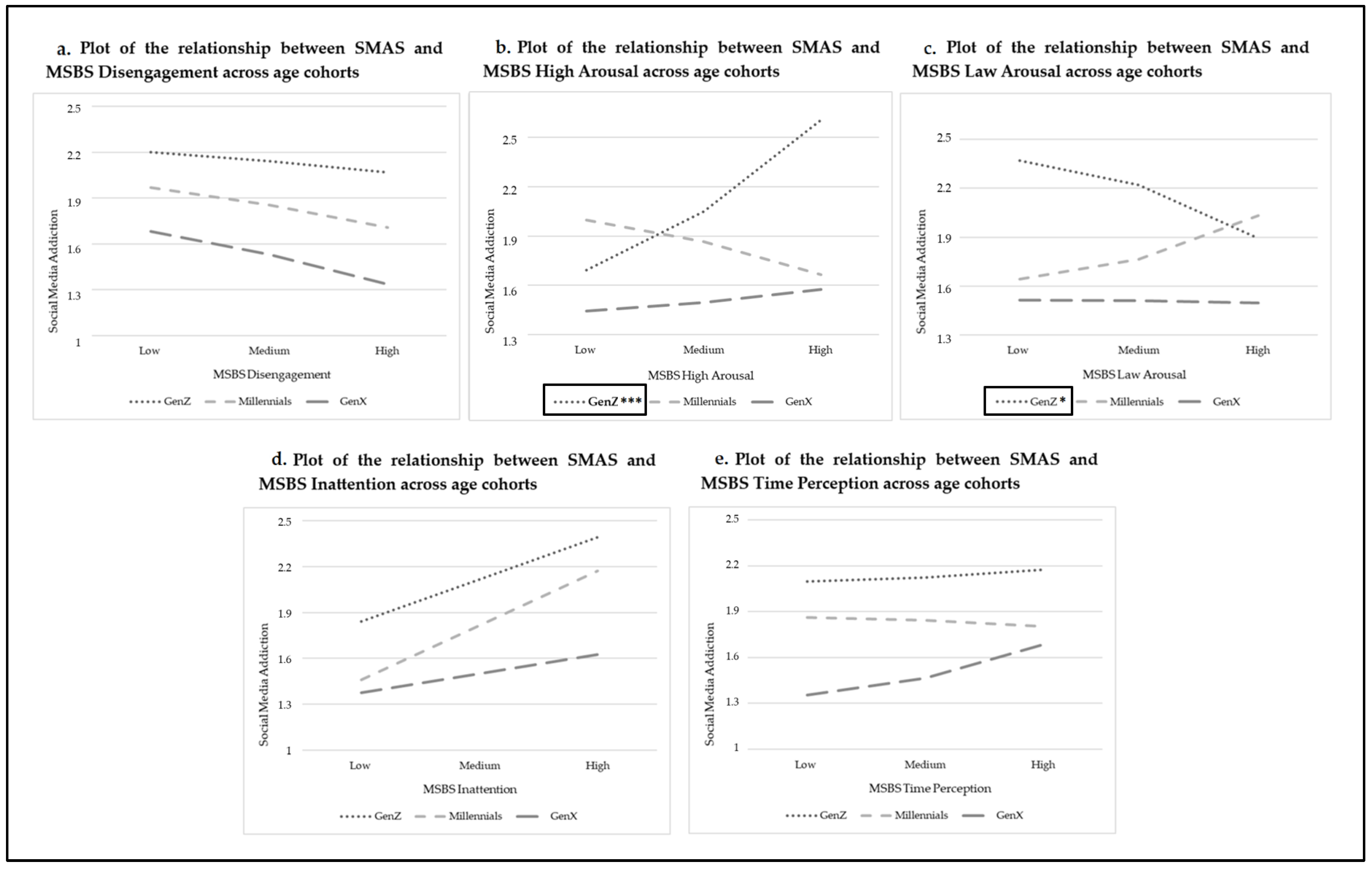
Simple slope analyses (Figure 2) indicated that high-arousal boredom (Figure 2b) was positively associated with BSMAS only in Generation Z (B = 0.300, SE = 0.060, p < 0.001, 95% CI [0.182, 0.417]), whereas no significant associations were observed in Millennials (B = −0.109, p = 0.160) or Generation X (B = 0.042, p = 0.421). Conversely, low-arousal boredom (Figure 2c) was negatively associated with BSMAS in Generation Z (B = −0.149, SE = 0.055, p < 0.01, 95% CI [−0.257, −0.041]), whereas this association was not statistically significant in Millennials (B = 0.121, p = 0.127) or Generation X (B = −0.006, p = 0.915).
Consistent with these interactions, the conditional indirect effects (Table 5) indicated that mediation occurred only among Gen Z. Specifically, SQS showed a positive indirect effect on BSMAS through High Arousal boredom in Gen Z (B = 0.147, BootSE = 0.041, 95% CI [0.075, 0.237]), but not among Millennials or Gen X (CIs included zero). Conversely, a negative indirect effect through Low Arousal boredom emerged in Gen Z (B = −0.078, BootSE = 0.032, 95% CI [−0.145, −0.018]), with no significant effects in older cohorts. The indices of moderated mediation confirmed that the indirect effects differed significantly across age groups for High Arousal and Low Arousal boredom.
For High Arousal, the index comparing Gen Z with Millennials was −0.200 (BootSE = 0.063, 95% CI [−0.337, −0.091]) and with Gen X was −0.126 (BootSE = 0.049, 95% CI [−0.230, −0.043]). For Low Arousal, the index comparing Gen Z with Millennials was 0.141 (BootSE = 0.059, 95% CI [0.036, 0.265]), whereas the comparison with Gen X was not significant. Indices for Disengagement, Inattention, and Time Perception were not significant, as all confidence intervals included zero.
The direct effect of SQS on BSMAS remained significant (B = 0.226, SE = 0.044, 95% CI [0.140, 0.313]), indicating partial mediation.
Overall, the final model (Figure 3) explained 53.5% of the variance in BSMAS (R2 = 0.535).

4. Discussion

This study is the first to investigate the mediating role of state boredom in the association between meaningfulness seeking (SQS) and social media addiction (SMA), and the moderating role of age cohort in these relationships within a Spanish sample. Overall, the results provide partial support for the hypothesized model and highlight the central relationship of high- and low-arousal boredom, particularly among young people (Gen Z), with problematic social media use.

4.1. Boredom, Quest for Significance, and Social Media Addiction

Consistent with H1 and H2, all dimensions of boredom were positively associated with both search for meaning (SQS) and social media addiction (SMA), even after controlling for gender and age. These findings align with previous research suggesting that boredom—both as a dispositional and situational state—represents a cross-cutting factor linked to maladaptive digital engagement and several forms of addiction [29,30,34,35,36,37,38].
From a theoretical standpoint, these links find support in the Meaning-and-Attentional Components (MAC) model [51], which conceptualizes boredom as an affective signal relating to an imbalance between attentional demands and the perceived semantic value of an activity. When this balance is disrupted, individuals tend to seek refuge in digital media, a behavior associated with compensating for stimulation deficits or evading tasks perceived as devoid of meaning [52]. In the specific Spanish context, where 84.2% of the population connects to the Internet multiple times a day and spends an average of nearly two hours exclusively on social media [3,4], these platforms represent readily accessible environments structurally primed to provide immediate stimulation, distraction, and social validation to mitigate such disengagement.
Importantly, the search for meaning (SQS) was positively associated with all boredom dimensions, supporting the idea that individuals who experience a stronger quest for personal significance may also be more sensitive to feelings of disengagement, arousal dysregulation, or the “existential void” described in Fahlman et al.’s dimensions of boredom [39]. According to Significance Quest Theory (SQT) [54,55,56], the need to feel important and recognized can represent a powerful motivational correlate, especially under conditions of loss or threat of significance. From childhood onward, personal significance is constructed through interaction with the social environment [58]. When traditional or offline sources of significance are perceived as insufficient, digital platforms may serve as alternative, highly responsive arenas for validation, visibility, and identity construction [58].

4.2. Differential Role of Boredom Dimensions

However, not all boredom dimensions were equally associated with social media addiction in the multivariate model (H3). High-arousal boredom and inattention showed positive associations with SMA, whereas low-arousal boredom was negatively associated with SMA. Disengagement and time perception were not significant correlates in the full model.
High-arousal boredom—characterized by irritability, agitation, and restlessness stemming from the constant, unsuccessful attempt to self-stimulate [31]—appears particularly relevant in its relationship to addictive-like social media behaviors. This relationship is highly consistent with the Interaction of Person–Affect–Cognition–Execution (I-PACE) model [49], the Compensatory Internet Use Theory (CIUT), and emotion-regulation models of behavioral addictions [20,21,22,23,24]. These frameworks suggest a link between compulsive online behaviors and the alleviation of aversive high-activation emotional states. Social media platforms—particularly with the explosive growth of short-form, vertical video applications like TikTok that deliver rapid, algorithm-driven entertainment [4]—offer immediate, high-frequency dopamine rewards. These rapid rewards are especially appealing when individuals experience agitation or a “stimulation discrepancy” [31,42,43]. As the addiction pattern progresses, the I-PACE model posits a critical transition: the immediate efficacy of digital media in mitigating negative affective states is linked to reinforced smartphone use as a primary coping mechanism, which correlates with progressively reduced inhibitory control, trapping the user in a recursive cycle of hyperconnectivity and compensatory behavior [49].
Conversely, the negative association between low-arousal boredom and SMA is noteworthy. Low-arousal boredom reflects feelings of lethargy, loneliness, and reduced psychophysical activation in response to a monotonous environment [31]. In younger individuals, this dimension was inversely related to problematic social media use. This mirrors the Boredom Feedback Model (BFM) [50], where different strategies to cope with boredom (such as withdrawal versus external stimulation-seeking) may be associated with distinct levels of physiological activation. One possible interpretation is that low-arousal states may not necessarily be linked to the active, high-frequency engagement required by modern algorithmic feeds, but rather to withdrawal or passivity.

4.3. Age as a Moderator: Generational Differences

One of the most relevant contributions of this study concerns the moderating role of age cohort (H4 and H5). The results of the simple slope analyses highlight a differential role of boredom dimensions in relation to social media addiction. While some dimensions, such as inattention, showed a general association with SMA across the entire sample, other dimensions displayed age-specific patterns. Only high-arousal boredom, characterized by agitation and restlessness, was positively associated with social media addiction in Generation Z, whereas low-arousal boredom, reflecting apathy and reduced activation, was negatively associated with SMA in this group.
Conditional indirect effects confirmed that the mediation occurred exclusively in Gen Z. Specifically, the quest for significance was indirectly associated with higher social media addiction through high-arousal boredom among Gen Z, whereas this pathway was non-significant in older cohorts.
The findings suggest that more activated forms of boredom may be especially likely to prompt engagement with social media, possibly as a means of regulating heightened internal states through stimulation, distraction, or reward-seeking. In contrast, low-arousal boredom may be associated with withdrawal or reduced behavioral activation, making social media engagement less likely. Importantly, these associations were not significant in Millennials or Generation X, indicating that social media may function as a more immediate and accessible strategy for managing affective states primarily among younger individuals, whereas in older cohorts such behaviors may be less directly driven by momentary emotional experiences.
These findings support H5 and suggest that younger individuals are particularly sensitive to the interplay between existential motives and boredom-related experiences in the context of problematic social media use. This generational effect may reflect developmental and contextual factors. Gen Z has grown up in a fully digitalized environment where online visibility, peer validation, and algorithm-driven feedback systems are deeply embedded in daily life [60]. For this cohort, social media may represent not only a communication tool but also a primary arena for identity formation and social recognition.
Consequently, the quest for significance may be more tightly intertwined with online engagement patterns. In contrast, older cohorts (Millennials and Gen X) may rely on a broader repertoire of offline sources of meaning and social validation, potentially buffering the link between boredom/significance motives and problematic use.

4.4. Partial Mediation and Direct Effects

The direct association between SQS and SMA remained significant, indicating partial mediation. This suggests that boredom accounts for only part of the relationship between the quest for significance and social media addiction. As Significance Quest Theory outlines, the fundamental human desire to feel socially valued is strongly associated with behavior independent of the affective distress of boredom [54,55].
Furthermore, the specific Spanish digital experience is characterized by a multifaceted use of social media—serving simultaneously as news, brand interaction, and entertainment [3]. This multi-purpose environment blurs the boundaries between leisure and digital saturation, making users structurally susceptible to phenomena such as FOMO (Fear Of Missing Out) and social comparison [5,22]. Therefore, other psychological mechanisms, such as emotion regulation difficulties or the anxiety of missing out on opportunities for significance gain, are likely linked alongside boredom to the transition from non-problematic use to genuine behavioral addiction [8,9,10].
Overall, the model explained 53.5% of the variance in social media addiction, highlighting the substantial explanatory power of integrating motivational (quest for significance), emotional (boredom dimensions), and developmental (age cohort) factors within a single framework.

5. Conclusions

Several limitations should be acknowledged when interpreting the findings of this study. First, the cross-sectional design precludes any causal or directional inferences. Although the moderated mediation model is theoretically grounded in frameworks such as the I-PACE model [49], longitudinal or experimental studies are necessary to establish temporal precedence and clarify the potential bidirectional relationship between boredom and problematic social media use. Indeed, while boredom is often conceptualized as a trigger for digital engagement, it is equally plausible that pervasive social media use may exacerbate boredom over time by reducing an individual’s capacity for sustained attention and endogenous stimulation seeking.
Second, the study relied exclusively on self-report measures, which may introduce response biases, including social desirability and common method variance—a particularly relevant concern in psychiatry when assessing addiction-like behaviors. Future research would benefit from multimethod approaches, incorporating objective digital biomarkers or behavioral tracking data to validate subjective perceptions of use.
Third, the non-probabilistic convenience sampling and the relatively high proportion of female participants limit the generalizability of the results. Replications in more diverse and representative clinical and community samples are warranted. Furthermore, while we assessed boredom as a state (MSBS), trait boredom is also strongly associated with problematic technology use [36]; future studies should examine both components simultaneously to disentangle their relative contributions.
Finally, the categorical operationalization of generational cohorts may conflate age, developmental stage, and sociocultural influences [63]. Longitudinal designs tracking individuals across the lifespan would provide a more precise understanding of how the association between significance seeking and digital addiction evolves developmentally.
Future research should also include comparative studies between control groups and clinical cohorts, i.e., individuals with a clinical diagnosis of social media addiction.
For clinical practice, these findings offer several relevant insights. From a diagnostic and early detection perspective, the strong association between high arousal boredom and SMA suggests that restlessness and agitation may serve as clinical warning signs for underlying problematic digital engagement. It would be advisable to consider screening for specific dimensions of boredom to better identify risk profiles, particularly among Generation Z, where the link between existential search and emotional dysregulation appears to be more pronounced [20,68]. In fact, identifying the specific “boredom phenotype” (agitated vs. lethargic) may provide useful information for more personalised diagnostic assessments [50,51].
Regarding intervention strategies, the present findings suggest that a “one-size-fits-all” approach may be insufficient to address the complexities of problematic social media use. For adolescents and young adults, clinical efforts should prioritize the development of emotion regulation skills—such as those derived from Dialectical Behavior Therapy (DBT)—to facilitate the management of high-arousal negative affect without recurring to digital stimuli as a primary compensatory mechanism [18,49]. In this demographic, these techniques may be integrated with family therapy [67] and, where psychiatric comorbidities such as ADHD or Major Depressive Disorder are present, targeted pharmacological treatments [69,70,71]. Conversely, for older adults, therapeutic emphasis might shift toward the diversification of offline sources of personal meaning. In these cases, Meaning-Centered Psychotherapy could represent a valuable tool to address existential voids that are often associated with maladaptive digital engagement [55,71].
More broadly, integrating Significance Quest Theory into existing therapeutic frameworks, such as Cognitive Behavioral Therapy (CBT) or Acceptance and Commitment Therapy (ACT), may enable patients to identify how their digital habits are intertwined with a frustrated search for meaning [72,73]. In this context, it is advisable to expand traditional protocols by incorporating interventions that strengthen adaptive coping strategies and promote mindfulness-based regulation. The recognition and management of specific affective states, such as boredom, appear to be a critical clinical lever. Rather than focusing solely on digital abstinence, fostering “meaningful engagement” is increasingly recognized as a superior strategy for promoting long-term behavioral change and psychological resilience in highly digitalized societies [34,74]. Such a multi-faceted approach, targeting the underlying emotional and motivational drivers of technology use, may significantly enhance the effectiveness and sustainability of clinical outcomes [75,76,77].
In conclusion, this study highlights that social media addiction is rooted not only in behavioral habits but also in complex motivational and affective dynamics. The results underscore the pivotal role of high-arousal boredom as a correlate of both the quest for significance and problematic social media use, especially in younger cohorts. Understanding how these factors interact across developmental stages offers a valuable framework for developing targeted preventive and spirit-of-meaning interventions in the field of digital mental health.

Supplementary Materials

The following supporting information can be downloaded at: https://www.mdpi.com/article/10.3390/psychiatryint7030107/s1, Table S1: Bonferroni-adjusted post hoc comparisons across age cohorts for MSBS dimensions, BSMAS, and SQS.

Author Contributions

Conceptualization, G.T., M.M.-V. and C.C.; methodology, G.T. and C.C.; validation, G.T., M.M.-V. and C.C.; software, C.C.; formal analysis, G.T., M.M.-V., C.C., A.C.-A. and C.G.-M.; investigation, G.T., M.M.-V., C.C., A.C.-A. and C.G.-M.; resources, A.C.-A. and C.G.-M.; data curation, A.C.-A. and C.G.-M.; writing—original draft preparation, A.C.-A. and C.G.-M.; writing—review and editing, G.T. and C.C.; visualization, G.T. and C.C.; supervision, G.T. and M.M.-V.; project administration, G.T. and M.M.-V. All authors have read and agreed to the published version of the manuscript.

Funding

This research received no external funding.

Institutional Review Board Statement

The study was conducted in accordance with the Declaration of Helsinki, and approved by the Commission for Ethics in Experimental Research at the University of Valencia (protocol code: 2025-PSILOG-4140282 and date of approval: 12 December 2025).

Informed Consent Statement

Informed consent was obtained from all subjects involved in the study.

Data Availability Statement

The data presented in this study are available on request from the corresponding author. The data are not publicly available due to ethical/privacy issues.

Conflicts of Interest

The authors declare no conflicts of interest.

Abbreviations

The following abbreviations are used in this manuscript:
SMASocial media addiction
BSMASBergen Social Media Addiction Scale
SQSSignificance Quest Scale
MSBSMultidimensional State Boredom Scale
PSMUProblematic Social Media Use
DSM-5Diagnostic and Statistical Manual of Mental Disorders, 5th Edition
SBState boredom
TBTrait boredom
MACMeaning-and-Attentional Components
BFMBoredom Feedback Model
I-PACEInteraction of Person–Affect–Cognition–Execution
CIUTCompensatory Internet Use Theory
SQTSignificance Quest Theory
INEInstituto Nacional de Estadística
GenZ Generation Z
GenX
FOMO
Generation X
Fear of Missing Out

References

  1. Huang, L.; Yang, F.; Wu, W. Adult attachment, social anxiety, and problematic social media use: A meta-analysis and meta-analytic structural equation model. Addict. Behav. 2025, 160, 108163. [Google Scholar] [CrossRef]
  2. We Are Social. Digital 2025: Global Overview Report. 2025. Available online: https://wearesocial.com/it/blog/2025/02/digital-2025/ (accessed on 21 October 2025).
  3. Instituto Nacional de Estadística (INE). Encuesta Sobre Equipamiento y uso de Tecnologías de Información y Comunicación en los Hogares. 2025. Available online: https://www.ine.es (accessed on 21 October 2025).
  4. IAB Spain. Estudio de Redes Sociales 2024. Available online: https://iabspain.es/estudio/estudio-de-redes-sociales-2024/ (accessed on 21 October 2025).
  5. Meynadier, J.; Malouff, J.M.; Schutte, N.S.; Loi, N.M.; Griffiths, M.D. Relationships Between Social Media Addiction, Social Media Use Metacognitions, Depression, Anxiety, Fear of Missing Out, Loneliness, and Mindfulness. Int. J. Ment. Health Addict. 2025. [Google Scholar] [CrossRef]
  6. Gan, W.Y.; Chin, W.-L.; Huang, S.-W.; Tung, S.E.H.; Lee, L.J.; Poon, W.C.; Siaw, Y.L.; O’bRien, K.S.; Pramukti, I.; Ruckwongpatr, K.; et al. Association between mental distress and weight-related self-stigma via problematic social media and smartphone use among Malaysian university students. Int. J. Ment. Health Promot. 2025, 27, 319–331. [Google Scholar] [CrossRef]
  7. Langlais, M.; Bigalke, J.; Bigalke, J. Relationship stress and sleep: Examining the mediation of social media use for objective and subjective sleep quality. J. Soc. Media Res. 2025, 2, 1–12. [Google Scholar] [CrossRef]
  8. Griffiths, M.D.; Kuss, D.J.; Demetrovics, Z. Social networking addiction: An overview of preliminary findings. In Behavioral addictions. Criteria, Evidence, and Treatment; Rosenberg, K.P., Curtiss Feder, L., Eds.; Elsevier: New York, NY, USA, 2014; pp. 119–141. [Google Scholar]
  9. Kuss, D.J.; Griffiths, M.D. Social networking sites and addiction: Ten lessons learned. Int. J. Environ. Res. Public Health 2017, 14, 311. [Google Scholar] [CrossRef]
  10. Andreassen, C.S. Online social network site addiction: A comprehensive review. Curr. Addict. Rep. 2015, 2, 175–184. [Google Scholar] [CrossRef]
  11. Griffiths, M.D. A ‘components’ model of addiction within a biopsychosocial framework. J. Subst. Use 2005, 10, 191–197. [Google Scholar] [CrossRef]
  12. Van den Eijnden, R.J.J.M.; Lemmens, J.S.; Valkenburg, P.M. The Social Media Disorder Scale. Comput. Hum. Behav. 2016, 61, 478–487. [Google Scholar] [CrossRef]
  13. Sun, Y.; Zhang, Y. A review of theories and models applied in studies of social media addiction and implications for future research. Addict. Behav. 2021, 114, 106699. [Google Scholar] [CrossRef]
  14. Griffiths, D.M. Social networking addiction: Emerging themes and issues. J. Addict. Res. Ther. 2013, 4. [Google Scholar] [CrossRef]
  15. Shimkhada, R.; Ponce, N.A. Social media use and serious psychological distress among adolescents. JMIR Pediatr. Parent. 2024, 7, e57041. [Google Scholar] [CrossRef]
  16. Beyens, I.; Pouwels, J.L.; Van Driel, I.I.; Keijsers, L.; Valkenburg, P.M. The effect of social media on well-being differs from adolescent to adolescent. Sci. Rep. 2020, 10, 10763. [Google Scholar] [CrossRef]
  17. Boer, M.; Stevens, G.W.J.M.; Finkenauer, C.; De Looze, M.E.; Van Den Eijnden, R.J.J.M. Social media use intensity, social media use problems, and mental health among adolescents: Investigating directionality and mediating processes. Comput. Hum. Behav. 2021, 116, 106645. [Google Scholar] [CrossRef]
  18. Shannon, H.; Bush, K.; Villeneuve, P.J.; Hellemans, K.G.; Guimond, S. Problematic Social Media Use in Adolescents and Young Adults: Systematic Review and Meta-analysis. JMIR Ment. Health 2022, 9, e33450. [Google Scholar] [CrossRef]
  19. Yildirim, U.; Campean, F.; Korsunovs, A.; Doikin, A. Flow heuristics for functional modelling in model-based systems engineering. Proc. Des. Soc. 2023, 3, 1895–1904. [Google Scholar] [CrossRef]
  20. Montag, C.; Demetrovics, Z.; Elhai, J.D.; Grant, D.; Koning, I.; Rumpf, H.J.; Spada, M.M.; Throuvala, M.; van den Eijnden, R. Problematic social media use in childhood and adolescence. Addict. Behav. 2024, 153, 107980. [Google Scholar] [CrossRef]
  21. Huang, C. A meta-analysis of the problematic social media use and mental health. Int. J. Soc. Psychiatry 2020, 68, 12–33. [Google Scholar] [CrossRef]
  22. Elhai, J.D.; Yang, H.; Fang, J.; Bai, X.; Hall, B.J. Depression and anxiety symptoms are related to problematic smartphone use severity in Chinese young adults: Fear of missing out as a mediator. Addict. Behav. 2021, 112, 106585. [Google Scholar] [CrossRef] [PubMed]
  23. Thomas, V.; Blazer-Carr, B.; Azmitia, M.; Whittaker, S. Alone and online: Understanding the relationships between social media, solitude, and psychological adjustment. Psychol. Pop. Media 2021, 10, 201–211. [Google Scholar] [CrossRef]
  24. Brand, M.; Young, K.S.; Laier, C.; Wölfling, K.; Potenza, M.N. Integrating psychological and neurobiological considerations regarding the development and maintenance of specific Internet-use disorders: An Interaction of Person-Affect-Cognition-Execution (I-PACE) model. Neurosci. Biobehav. Rev. 2016, 71, 252–266. [Google Scholar] [CrossRef]
  25. Gentile, D.A.; Choo, H.; Liau, A.; Sim, T.; Li, D.; Fung, D.; Khoo, A. Pathological video game use among youths: A two-year longitudinal study. Pediatrics 2011, 127, e319–e329. [Google Scholar] [CrossRef] [PubMed]
  26. Savci, M.; Aysan, F. Relationship between impulsivity, social media usage and loneliness. Educ. Process Int. J. 2016, 5, 106. [Google Scholar] [CrossRef]
  27. Kiss, H.; Fitzpatrick, K.M.; Piko, B.F. The digital divide: Risk and protective factors and the differences in problematic use of digital devices among Hungarian youth. Child. Youth Serv. Rev. 2020, 108, 104612. [Google Scholar] [CrossRef]
  28. Varchetta, M.; Tagliaferri, G.; Mari, E.; Quaglieri, A.; Cricenti, C.; Martí-Vilar, M. Cross-Cultural Examination of Problematic Internet Use and Associated Psychological Variables: A Comparative Study in Italy, Spain, Ecuador, and Peru. J. Clin. Med. 2024, 13, 3451. [Google Scholar] [CrossRef] [PubMed]
  29. Biolcati, R.; Mancini, G.; Trombini, E. Proneness to boredom and risk behaviors during adolescents’ free time. Psychol. Rep. 2018, 121, 303–323. [Google Scholar] [CrossRef]
  30. Donati, M.A.; Beccari, C.; Primi, C. Boredom and problematic Facebook use in adolescents: What is the relationship considering trait or state boredom? Addict. Behav. 2022, 125, 107132. [Google Scholar] [CrossRef]
  31. Eastwood, J.D.; Frischen, A.; Fenske, M.J.; Smilek, D. The unengaged mind: Defining boredom in terms of attention. Perspect. Psychol. Sci. 2012, 7, 482–495. [Google Scholar] [CrossRef]
  32. Neu, J. Boring from within. In Emotions in Psychopathology: Theory and Research; Flack, W.F., Laird, J.D., Eds.; Oxford University Press: Oxford, UK, 1998; pp. 158–170. [Google Scholar]
  33. Elpidorou, A. The good of boredom is in its function. Nat. Hum. Behav. 2018, 2, 103–104. [Google Scholar]
  34. Orsolini, L.; Volpe, U.; Pompili, M. Boredom, boredom proneness and addictions: A systematic review. Front. Psychiatry 2023, 14, 1065956. [Google Scholar]
  35. Zhang, J.; Wang, L.; Wu, Y. Trait boredom and problematic smartphone use: A meta-analysis. Addict. Behav. 2022, 129, 107270. [Google Scholar]
  36. Tagliaferri, G.; Martí-Vilar, M.; Frisari, F.V.; Quaglieri, A.; Mari, E.; Burrai, J.; Giannini, A.M.; Cricenti, C. Connected by Boredom: A Systematic Review of the Role of Trait Boredom in Problematic Technology Use. Brain Sci. 2025, 15, 794. [Google Scholar] [CrossRef]
  37. Freund, A.M.; Nikitin, J.; Ritter, J.O. Psychological correlates of boredom in everyday life. Motiv. Emot. 2021, 45, 259–273. [Google Scholar]
  38. Ryan, T.; Chester, A.; Reece, J.; Xenos, S. The uses and abuses of Facebook: A review of Facebook addiction. J. Behav. Addict. 2014, 3, 133–148. [Google Scholar] [CrossRef]
  39. Fahlman, S.A.; Mercer-Lynn, K.B.; Flora, D.B.; Eastwood, J.D. Development and validation of the multidimensional state boredom scale. Assessment 2013, 20, 68–85. [Google Scholar] [CrossRef] [PubMed]
  40. Fenichel, O. On the psychology of boredom. In The Collected Papers of Otto Fenichel; Norton: New York, NY, USA, 1953; pp. 292–302. [Google Scholar]
  41. Greenson, R.R. On boredom. J. Am. Psychoanal. Assoc. 1953, 1, 7–21. [Google Scholar] [CrossRef] [PubMed]
  42. Berlyne, D.E. Conflict, Arousal, and Curiosity; McGraw-Hill: New York, NY, USA, 1960. [Google Scholar]
  43. Csikszentmihalyi, M. Beyond Boredom and Anxiety; Jossey-Bass: San Francisco, CA, USA, 2000. [Google Scholar]
  44. Fisher, C.D. Effects of external and internal interruptions on boredom at work: Two studies. J. Organ. Behav. 1998, 19, 503–522. [Google Scholar] [CrossRef]
  45. Hamilton, J.A. Work and boredom. Free Assoc. 1983, 1, 295–320. [Google Scholar]
  46. Frankl, V.E. Man’s Search for Meaning: An Introduction to Logotherapy; Simon & Schuster: New York, NY, USA, 1984. [Google Scholar]
  47. Maddi, S.R. The search for meaning. In Nebraska Symposium on Motivation; Page, M., Ed.; University of Nebraska Press: Lincoln, NE, USA, 1970; Volume 18, pp. 137–186. [Google Scholar]
  48. Skues, J.; Williams, B.; Oldmeadow, J.; Wise, L. The effects of boredom, loneliness, and distress tolerance on problem internet use among university students. Int. J. Ment. Health Addict. 2016, 14, 167–180. [Google Scholar] [CrossRef]
  49. Brand, M.; Wegmann, E.; Stark, R.; Müller, A.; Wölfling, K.; Robbins, T.W.; Potenza, M.N. The Interaction of Person-Affect-Cognition-Execution (I-PACE) Model for Addictive Behaviors: Update, Generalization to Addictive Behaviors beyond Internet-Use Disorders, and Specification of the Process Character of Addictive Behaviors. Neurosci. Biobehav. Rev. 2019, 104, 1–10. [Google Scholar] [CrossRef]
  50. Tam, K.Y.Y.; van Tilburg, W.A.P.; Chan, C.S. What Is Boredom Proneness? A Comparison of Three Characterizations. J. Pers. 2021, 89, 831–846. [Google Scholar] [CrossRef]
  51. Westgate, E.C.; Wilson, T.D. Boring thoughts and bored minds: The MAC model of boredom and cognitive engagement. Psychol. Rev. 2018, 125, 689. [Google Scholar] [CrossRef]
  52. Poels, K.; Rudnicki, K.; Vandebosch, H. The Media Psychology of Boredom and Mobile Media Use. J. Media Psychol. 2022, 34, 113–125. [Google Scholar] [CrossRef]
  53. Marty-Dugas, J.; Smilek, D. Deep, effortless concentration: Re-examining the flow concept and exploring relations with inattention, absorption, and personality. Psychol. Res. 2019, 83, 1760–1777. [Google Scholar] [CrossRef]
  54. Kruglanski, A.W.; Chen, X.; Dechesne, M.; Fishman, S.; Orehek, E. Fully committed: Suicide bombers’ motivation and the quest for personal significance. Polit. Psychol. 2009, 30, 331–357. [Google Scholar] [CrossRef]
  55. Kruglanski, A.W.; Gelfand, M.J.; Bélanger, J.J.; Sheveland, A.; Hetiarachchi, M.; Gunaratna, R. The psychology of radicalization and deradicalization: How significance quest impacts violent extremism. Adv. Polit. Psychol. 2014, 35, 69–93. [Google Scholar] [CrossRef]
  56. Webber, D.; Babush, M.; Schori-Eyal, N.; Vazeou-Nieuwenhuis, A.; Hettiarachchi, M.; Bélanger, J.J.; Moyano, M.; Trujillo, H.M.; Gunaratna, R.; Kruglanski, A.W.; et al. The road to extremism: Field and experimental evidence that significance loss-induced need for closure fosters radicalization. J. Pers. Soc. Psychol. 2017, 114, 270–285. [Google Scholar] [CrossRef] [PubMed]
  57. Kruglanski, A.W.; Ellenberg, M. The quest for personal significance and ideological violence. AJOB Neurosci. 2020, 11, 285–287. [Google Scholar] [CrossRef] [PubMed]
  58. Şahin, E.S. Predictive relations between quest for significance and social media addiction of adults. Int. J. Mod. Educ. Stud. 2022, 6, 378–399. [Google Scholar] [CrossRef]
  59. Pew Research Center. Mobile fact sheet. Washington (DC): Pew Research Center. 2019. Available online: https://www.pewresearch.org/internet/fact-sheet/mobile/ (accessed on 13 November 2025).
  60. Pew Research Center. Social media fact sheet. Washington (DC): Pew Research Center. 2023. Available online: https://www.pewresearch.org/internet/fact-sheet/social-media/ (accessed on 5 December 2025).
  61. Chang, C.W.; Choi, J.; Bazarova, N.N.; Löckenhoff, C.E. Influences of digital media and social networks on generational online behavior. SAGE Open 2023, 13. [Google Scholar] [CrossRef]
  62. Mude, G. Social media usage: A comparison between Generation Y and Generation Z. J. Retail. Consum. Serv. 2023, 71, 103182. [Google Scholar] [CrossRef]
  63. Rudolph, C.W.; Allan, B.; Clark, M.A.; Hertel, G. Generations and generational differences: Debunking myths in organizational science and practice and paving new paths forward. PLoS ONE 2020, 15, e0224140. [Google Scholar] [CrossRef]
  64. Hysa, B.; Karasek, A.; Zdonek, I. Social media usage by different generations as a tool for sustainable tourism marketing in society 5.0. Sustainability 2021, 13, 1018. [Google Scholar] [CrossRef]
  65. Aìda, M.; Minguez, J.; Montero-Marin, J.; Gili, M.; Puebla-Guedea, M.; Herrera-Mercadal, P.; Navarro-Gil, M.; Garcia-Campayo, J. Validation of the Spanish version of the Multidimensional State Boredom Scale (MSBS). Health Qual. Life Outcomes 2015, 13, 59. [Google Scholar]
  66. Arrivillaga, C.; Griffiths, M.D.; Rey, L.; Extremera, N. Validation of the Spanish version of the Bergen Social Media Addiction Scale (BSMAS) among Spanish adolescents. Curr. Psychol. 2024, 43, 31582–31591. [Google Scholar] [CrossRef]
  67. Hayes, A.F. Introduction to Mediation, Moderation, and Conditional Process Analysis: A Regression-Based Approach, 3rd ed.; The Guilford Press: New York, NY, USA, 2022. [Google Scholar]
  68. Elpidorou, A. The bored mind is a guiding mind: Toward a regulatory theory of boredom. Phenomenol. Cogn. Sci. 2018, 17, 455–484. [Google Scholar] [CrossRef]
  69. Han, D.H.; Kim, S.M.; Lee, Y.S.; Renshaw, P.F. The effect of family therapy on the changes in the severity of on-line game play and brain activity in adolescents with on-line game addiction. Psychiatry Res. 2012, 202, 126–131. [Google Scholar] [CrossRef]
  70. Han, D.H.; Lee, Y.S.; Na, C.; Ahn, J.Y.; Chung, U.S.; Daniels, M.A.; Haws, C.A.; Renshaw, P.F. The effect of methylphenidate on Internet video game play in children with attention-deficit/hyperactivity disorder. Compr. Psychiatry 2009, 50, 251–256. [Google Scholar] [CrossRef]
  71. Zhang, J.T.; Yao, Y.W.; Potenza, M.N.; Xia, C.C.; Lan, J.; Liu, L.; Wang, L.J.; Liu, B.; Ma, S.S.; Fang, X.Y. Altered resting-state neural activity and changes following a craving behavioral intervention for Internet gaming disorder. Sci. Rep. 2016, 6, 28109. [Google Scholar] [CrossRef]
  72. Vos, J. Meaning in Life: An Evidence-Based Handbook for Practitioners; Bloomsbury Publishing: London, UK, 2018. [Google Scholar]
  73. Crosby, J.M.; Twohig, M.P. Acceptance and Commitment Therapy for Problematic Internet Pornography Use: A Randomized Trial. Behav. Ther. 2016, 47, 355–366. [Google Scholar] [CrossRef]
  74. Kardefelt-Winther, D. A conceptual and methodological critique of internet addiction research: Towards a model of compensatory internet use. Comput. Hum. Behav. 2014, 31, 351–354. [Google Scholar] [CrossRef]
  75. Demirtepe-Saygili, D. Stress, coping, and social media use. In The Psychology and Dynamics Behind Social Media Interactions; Desjarlais, M., Ed.; IGI Global: Hershey, PA, USA, 2020; pp. 241–267. [Google Scholar]
  76. Sriwilai, K.; Charoensukmongkol, P. Face it, don’t Facebook it: Impacts of Social Media Addiction on Mindfulness, Coping Strategies and the Consequence on Emotional Exhaustion. Stress Health 2016, 32, 427–434. [Google Scholar] [CrossRef]
  77. Sun, X.; Li, B.J.; Zhang, H.; Zhang, G. Social media use for coping with stress and psychological adjustment: A transactional model of stress and coping perspective. Front. Psychol. 2023, 14, 1140312. [Google Scholar] [CrossRef]
Figure 1. Proposed multiple moderated mediation model (Model 14). Note. X, independent variable; Y, dependent variable; M1, mediator 1; M2, mediator 2; M3, mediator 3; M4, mediator 4; M5, mediator 5; W, moderator; C = covariate.
Psychiatryint 07 00107 g001
Figure 2. Relationships between MSBS dimensions and social media addiction (BSMAS) across age cohorts (Gen Z, Millennials, Gen X). Note. * p < 0.01; *** p < 0.001.
Psychiatryint 07 00107 g002
Figure 3. Multiple moderated mediation model in which the mediators were considered in parallel. Numbers represent standardised coefficients. Numbers within parentheses represent standardised errors. Note: X, independent variable; Y, dependent variable; C, covariate; M1, mediator 1; M2, mediator 2; M3, Mediator 3; M4, Mediator 4; M5, Mediator 5; W, Moderator 1; a., M1 × W1; b., M1 × W2; c., M2 × W1; d., M2 × W2; e., M3 × W1; f., M3 × W2; g. M4 × W1; h., M4 × W2; i., M5 × W1; l., M6 × W2. * p < 0.05; ** p < 0.01;
Psychiatryint 07 00107 g003
Table 1. Descriptive statistics for the MSBS, BSMAS and SQS by age groups.
Age-Based
Generational Groups
MeanStd Error
MSBS DisengagementGen Z3.2020.130
Millennials3.0630.152
Gen X2.8080.138
MSBS HighArousalGen Z2.7870.124
Millennials2.7890.146
Gen X2.4580.132
MSBS LowArousalGen Z2.7140.140
Millennials2.6890.164
Gen X2.3480.149
MSBS InattentionGen Z3.7070.143
Millennials3.3150.168
Gen X2.9630.152
MSBS TimePerceptionGen Z2.6300.124
Millennials2.4450.146
Gen X2.0110.132
BSMASGen Z2.2750.065
Millennials1.8070.076
Gen X1.3910.069
SQSGen Z2.7740.086
Millennials2.4300.101
Gen X2.2370.091
Table 2. Descriptive statistics for the MSBS, BSMAS and SQS by gender.
GenderMeanStd Error
MSBS DisengagementMale2.9480.137
Female3.0730.100
MSBS HighArousalMale2.5620.131
Female2.7370.096
MSBS LowArousalMale2.5070.147
Female2.6230.108
MSBS InattentionMale3.2300.153
Female3.4080.112
MSBS TimePerceptionMale2.3270.133
Female2.3910.097
BSMASMale1.6790.075
Female1.9350.056
SQSMale2.4360.092
Female2.5280.068
Table 3. Partial correlation coefficients (Pearson’s r) between social media addiction (BSMAS), search for meaning (SQS) and boredom (MSBS) scores controlling for gender and age.
(a) Partial correlations
MSBS
Disengagement
MSBS
HighArousal
MSBS
LowArousal
MSBS
Inattention
MSBS
TimePerception
GenderAge
BSMAS0.384 ***0.411 ***0.322 ***0.513 ***0.350 ***0.119 *−0.472 ***
SQS0.336 ***0.349 ***0.329 ***0.383 ***0.270***0.045−0.216 ***
Gender0.0420.0610.0360.0530.022-
Age−0.090−0.078−0.079−0.202 ***−0.191 ***−0.140 *-
(b) Zeroorder correlations
MSBS
Disengagement
MSBS
HighArousal
MSBS
LowArousal
MSBS
Inattention
MSBS
TimePerception
BSMAS0.388 ***0.423 ***0.323 ***0.483 ***0.301 ***
SQS0.326 ***0.341 ***0.320 ***0.354 ***0.238 ***
Note. Partial correlations were computed controlling for age and gender. Gender was coded as 0 = male and 1 = female. * p < 0.05, *** p < 0.001.
Table 4. Model coefficients for the multiple moderated mediation analysis.
PredictorMSBS
Disengagement
MSBS
HighArousal
MSBS
LowArousal
MSBS
Inattention
MSBS
TimePerception
BSMAS
β
(SE HC0)
β
(SE HC0)
β
(SE HC0)
β
(SE HC0)
β
(SE HC0)
β
(SE HC0)
Constant1.663 (0.322) ***1.237 (0.299) ***1.171 (0.350) ***1.578 (0.345) ***1.360 (0.314) ***
SQS (X)0.495 (0.000) ***0.491 (0.086) ***0.521 (0.085) ***0.628 (0.086) ***0.385 (0.081) ***
Gender (cov)0.080 (0.156)0.130 (0.149)0.068 (0.171)0.120 (0.168)0.029 (0.155)0.095 (0.069)
MSBS Disengagement −0.043 (0.078)
MSBS HighArousal 0.300 (0.060) ***
MSBS LowArousal −0.149 (0.055) **
MSBS Inattention 0.157 (0.049) ***
MSBS TimePerception 0.026 (0.044)
Millennials (vs. Gen Z) 0.185 (0.238)
Gen X (vs. Gen Z) −0.003 (0.173)
Disengagement × Millennials −0.044 (0.138)
Disengagement × Gen X −0.071 (0.107)
High Arousal × Millennials −0.408 (0.097) ***
High Arousal × Gen X −0.257 (0.08) ***
Low Arousal × Millennials 0.270 (0.096) **
Low Arousal × Gen X 0.144 (0.077)
Inattention × Millennials 0.046 (0.080)
Inattention × Gen X −0.086 (0.071)
Time Perception × Millennials −0.047 (0.078)
Time Perception × Gen X 0.083 (0.071)
R2
F HC0 (df)
0.114 ***
18.3296 (2, 313)
0.124 ***
17.7528 (2, 313)
0.109 ***
18.8923 (2, 313)
0.148 ***
27.0719 (2, 313)
0.073 ***
11.4688 (2, 313)
0.535 ***
23.2938 (19, 296)
∆R20.001 (0.222)0.027 (9.939)0.013 (4.258)0.004 (1.458)0.003 (1.281)Diseng*Gen   0.801
HighAr*Gen   0.001
LowAr*Gen   0.015
Inatt*Gen     0.234
TimePerc*Gen 0.279
Note. SQS, Significance Quest Scale; MSBS, Multidimensional State Boredom Scale; BSMAS, Bergen Social Media Addiction Scale; W, age cohort; W1 and W2, dummy variables in two-way interaction. W1, comparing GenZ and Millennials on BSMAS; Z2, comparing GenZ and GenX on BSMAS. Bootstrap sample size = 5000 (two-tailed); ** p < 0.01; *** p < 0.001.
Table 5. Bootstrap direct and conditional indirect effects of SQS on BSMAS through boredom across age cohorts (Model 14).
Direct Effect β (SE HC0)
0.226 (0.044)
95% Boot CI (LL; UL)
(0.1397; 0.3129)
Indirect
Effect
MSBS
Disengagement
MSBS
HighArousal
MSBS
LowArousal
MSBS
Inattention
MSBS
TimePerception
β (SE HC0)95% Boot CI (LL; UL)β (SE HC0)95% Boot CI (LL; UL)β (SE HC0)95% Boot CI (LL; UL)β (SE HC0)95% Boot CI (LL; UL)β (SE HC0)95% Boot CI (LL; UL)
GenZ−0.022 (0.041)(−0.1009; 0.0623)0.147 (0.042)(0.0753; 0.2373)−0.078 (0.032)(−0.1447; −0.018)0.099 (0.037)(0.0348; 0.178)0.010 (0.019)(−0.0267; 0.0488)
Millennials−0.043 (0.063)(−0.1683; 0.0791)−0.053 (0.044)(−0.1426; 0.0319)0.063 (0.046)(−0.0192; 0.1642)0.128 (0.048)(0.0315; 0.2219)−0.008 (0.028)(−0.0575; 0.0587)
GenX−0.057 (0.041)(−0.1361; 0.0245)0.021 (0.029)(−0.0341; 0.082)−0.003 (0.031)(−0.0673; 0.0593)0.045 (0.036)(−0.0308; 0.1105)0.0421 (0.025)(−0.0005; 0.0994)
Disclaimer/Publisher’s Note: The statements, opinions and data contained in all publications are solely those of the individual author(s) and contributor(s) and not of MDPI and/or the editor(s). MDPI and/or the editor(s) disclaim responsibility for any injury to people or property resulting from any ideas, methods, instructions or products referred to in the content.