
From Quest for Significance to Social Media Addiction: The Mediating Role of Boredom and the Moderating Role of Age in a Spanish Sample

 , , and
Abstract
1. Introduction
- Lack of engagement: The aversive experience arising from the desire, coupled with the inability, to participate in an activity perceived as stimulating and rewarding.
- Low-arousal negative affect: The presence of feelings of lethargy, apathy, and psychophysical fatigue in response to a redundant or monotonous environment.
- High-arousal negative affect: The emergence of feelings of restlessness, agitation, and frustration, often stemming from the constant, unsuccessful attempt to self-stimulate.
- Slow passage of time: A cognitive distortion wherein the individual perceives an unnatural and unpleasant slowing of the temporal dimension.
- Difficulty focusing attention: The inability to maintain concentration, coupled with the need to control one’s attentional processes with extreme effort.
- Stimulation discrepancy: The gap, experienced with profound distress, between the internal need for arousal or novelty and the actual availability of external stimuli.
- Existential void: The perception of pointlessness and the profound sense that one’s actions, or the immediate situation, are entirely devoid of purpose or meaning.
1.1. Age Differences in Social Media Use
1.2. Main Hypotheses
2. Materials and Methods
2.1. Participants
Age Group Classification and Distribution
2.2. Procedure
2.3. Measures
2.3.1. Multidimensional State Boredom Scale (MSBS)
2.3.2. Significance Quest Scale (SQS)
2.3.3. Bergen Social Media Addiction Scale (BSMAS)
2.4. Data Analysis
3. Results
3.1. Descriptive Analysis
3.2. Correlation Analysis
3.3. Multiple Moderated Mediation Analysis
4. Discussion
4.1. Boredom, Quest for Significance, and Social Media Addiction
4.2. Differential Role of Boredom Dimensions
4.3. Age as a Moderator: Generational Differences
4.4. Partial Mediation and Direct Effects
5. Conclusions
Supplementary Materials
Author Contributions
Funding
Institutional Review Board Statement
Informed Consent Statement
Data Availability Statement
Conflicts of Interest
Abbreviations
| SMA | Social media addiction |
| BSMAS | Bergen Social Media Addiction Scale |
| SQS | Significance Quest Scale |
| MSBS | Multidimensional State Boredom Scale |
| PSMU | Problematic Social Media Use |
| DSM-5 | Diagnostic and Statistical Manual of Mental Disorders, 5th Edition |
| SB | State boredom |
| TB | Trait boredom |
| MAC | Meaning-and-Attentional Components |
| BFM | Boredom Feedback Model |
| I-PACE | Interaction of Person–Affect–Cognition–Execution |
| CIUT | Compensatory Internet Use Theory |
| SQT | Significance Quest Theory |
| INE | Instituto Nacional de Estadística |
| GenZ | Generation Z |
| GenX FOMO | Generation X Fear of Missing Out |
References
- Huang, L.; Yang, F.; Wu, W. Adult attachment, social anxiety, and problematic social media use: A meta-analysis and meta-analytic structural equation model. Addict. Behav. 2025, 160, 108163. [Google Scholar] [CrossRef] [Scilit]
- We Are Social. Digital 2025: Global Overview Report. 2025. Available online: https://wearesocial.com/it/blog/2025/02/digital-2025/ (accessed on 21 October 2025).
- Instituto Nacional de Estadística (INE). Encuesta Sobre Equipamiento y uso de Tecnologías de Información y Comunicación en los Hogares. 2025. Available online: https://www.ine.es (accessed on 21 October 2025).
- IAB Spain. Estudio de Redes Sociales 2024. Available online: https://iabspain.es/estudio/estudio-de-redes-sociales-2024/ (accessed on 21 October 2025).
- Meynadier, J.; Malouff, J.M.; Schutte, N.S.; Loi, N.M.; Griffiths, M.D. Relationships Between Social Media Addiction, Social Media Use Metacognitions, Depression, Anxiety, Fear of Missing Out, Loneliness, and Mindfulness. Int. J. Ment. Health Addict. 2025. [Google Scholar] [CrossRef] [Scilit]
- Gan, W.Y.; Chin, W.-L.; Huang, S.-W.; Tung, S.E.H.; Lee, L.J.; Poon, W.C.; Siaw, Y.L.; O’bRien, K.S.; Pramukti, I.; Ruckwongpatr, K.; et al. Association between mental distress and weight-related self-stigma via problematic social media and smartphone use among Malaysian university students. Int. J. Ment. Health Promot. 2025, 27, 319–331. [Google Scholar] [CrossRef] [Scilit]
- Langlais, M.; Bigalke, J.; Bigalke, J. Relationship stress and sleep: Examining the mediation of social media use for objective and subjective sleep quality. J. Soc. Media Res. 2025, 2, 1–12. [Google Scholar] [CrossRef] [Scilit]
- Griffiths, M.D.; Kuss, D.J.; Demetrovics, Z. Social networking addiction: An overview of preliminary findings. In Behavioral addictions. Criteria, Evidence, and Treatment; Rosenberg, K.P., Curtiss Feder, L., Eds.; Elsevier: New York, NY, USA, 2014; pp. 119–141. [Google Scholar]
- Kuss, D.J.; Griffiths, M.D. Social networking sites and addiction: Ten lessons learned. Int. J. Environ. Res. Public Health 2017, 14, 311. [Google Scholar] [CrossRef] [Scilit]
- Andreassen, C.S. Online social network site addiction: A comprehensive review. Curr. Addict. Rep. 2015, 2, 175–184. [Google Scholar] [CrossRef] [Scilit]
- Griffiths, M.D. A ‘components’ model of addiction within a biopsychosocial framework. J. Subst. Use 2005, 10, 191–197. [Google Scholar] [CrossRef] [Scilit]
- Van den Eijnden, R.J.J.M.; Lemmens, J.S.; Valkenburg, P.M. The Social Media Disorder Scale. Comput. Hum. Behav. 2016, 61, 478–487. [Google Scholar] [CrossRef] [Scilit]
- Sun, Y.; Zhang, Y. A review of theories and models applied in studies of social media addiction and implications for future research. Addict. Behav. 2021, 114, 106699. [Google Scholar] [CrossRef] [Scilit]
- Griffiths, D.M. Social networking addiction: Emerging themes and issues. J. Addict. Res. Ther. 2013, 4. [Google Scholar] [CrossRef]
- Shimkhada, R.; Ponce, N.A. Social media use and serious psychological distress among adolescents. JMIR Pediatr. Parent. 2024, 7, e57041. [Google Scholar] [CrossRef] [Scilit]
- Beyens, I.; Pouwels, J.L.; Van Driel, I.I.; Keijsers, L.; Valkenburg, P.M. The effect of social media on well-being differs from adolescent to adolescent. Sci. Rep. 2020, 10, 10763. [Google Scholar] [CrossRef] [Scilit]
- Boer, M.; Stevens, G.W.J.M.; Finkenauer, C.; De Looze, M.E.; Van Den Eijnden, R.J.J.M. Social media use intensity, social media use problems, and mental health among adolescents: Investigating directionality and mediating processes. Comput. Hum. Behav. 2021, 116, 106645. [Google Scholar] [CrossRef] [Scilit]
- Shannon, H.; Bush, K.; Villeneuve, P.J.; Hellemans, K.G.; Guimond, S. Problematic Social Media Use in Adolescents and Young Adults: Systematic Review and Meta-analysis. JMIR Ment. Health 2022, 9, e33450. [Google Scholar] [CrossRef] [Scilit]
- Yildirim, U.; Campean, F.; Korsunovs, A.; Doikin, A. Flow heuristics for functional modelling in model-based systems engineering. Proc. Des. Soc. 2023, 3, 1895–1904. [Google Scholar] [CrossRef] [Scilit]
- Montag, C.; Demetrovics, Z.; Elhai, J.D.; Grant, D.; Koning, I.; Rumpf, H.J.; Spada, M.M.; Throuvala, M.; van den Eijnden, R. Problematic social media use in childhood and adolescence. Addict. Behav. 2024, 153, 107980. [Google Scholar] [CrossRef] [Scilit]
- Huang, C. A meta-analysis of the problematic social media use and mental health. Int. J. Soc. Psychiatry 2020, 68, 12–33. [Google Scholar] [CrossRef] [Scilit]
- Elhai, J.D.; Yang, H.; Fang, J.; Bai, X.; Hall, B.J. Depression and anxiety symptoms are related to problematic smartphone use severity in Chinese young adults: Fear of missing out as a mediator. Addict. Behav. 2021, 112, 106585. [Google Scholar] [CrossRef] [Scilit] [PubMed]
- Thomas, V.; Blazer-Carr, B.; Azmitia, M.; Whittaker, S. Alone and online: Understanding the relationships between social media, solitude, and psychological adjustment. Psychol. Pop. Media 2021, 10, 201–211. [Google Scholar] [CrossRef] [Scilit]
- Brand, M.; Young, K.S.; Laier, C.; Wölfling, K.; Potenza, M.N. Integrating psychological and neurobiological considerations regarding the development and maintenance of specific Internet-use disorders: An Interaction of Person-Affect-Cognition-Execution (I-PACE) model. Neurosci. Biobehav. Rev. 2016, 71, 252–266. [Google Scholar] [CrossRef] [Scilit]
- Gentile, D.A.; Choo, H.; Liau, A.; Sim, T.; Li, D.; Fung, D.; Khoo, A. Pathological video game use among youths: A two-year longitudinal study. Pediatrics 2011, 127, e319–e329. [Google Scholar] [CrossRef] [Scilit] [PubMed]
- Savci, M.; Aysan, F. Relationship between impulsivity, social media usage and loneliness. Educ. Process Int. J. 2016, 5, 106. [Google Scholar] [CrossRef] [Scilit]
- Kiss, H.; Fitzpatrick, K.M.; Piko, B.F. The digital divide: Risk and protective factors and the differences in problematic use of digital devices among Hungarian youth. Child. Youth Serv. Rev. 2020, 108, 104612. [Google Scholar] [CrossRef] [Scilit]
- Varchetta, M.; Tagliaferri, G.; Mari, E.; Quaglieri, A.; Cricenti, C.; Martí-Vilar, M. Cross-Cultural Examination of Problematic Internet Use and Associated Psychological Variables: A Comparative Study in Italy, Spain, Ecuador, and Peru. J. Clin. Med. 2024, 13, 3451. [Google Scholar] [CrossRef] [Scilit] [PubMed]
- Biolcati, R.; Mancini, G.; Trombini, E. Proneness to boredom and risk behaviors during adolescents’ free time. Psychol. Rep. 2018, 121, 303–323. [Google Scholar] [CrossRef] [Scilit]
- Donati, M.A.; Beccari, C.; Primi, C. Boredom and problematic Facebook use in adolescents: What is the relationship considering trait or state boredom? Addict. Behav. 2022, 125, 107132. [Google Scholar] [CrossRef] [Scilit]
- Eastwood, J.D.; Frischen, A.; Fenske, M.J.; Smilek, D. The unengaged mind: Defining boredom in terms of attention. Perspect. Psychol. Sci. 2012, 7, 482–495. [Google Scholar] [CrossRef] [Scilit]
- Neu, J. Boring from within. In Emotions in Psychopathology: Theory and Research; Flack, W.F., Laird, J.D., Eds.; Oxford University Press: Oxford, UK, 1998; pp. 158–170. [Google Scholar]
- Elpidorou, A. The good of boredom is in its function. Nat. Hum. Behav. 2018, 2, 103–104. [Google Scholar]
- Orsolini, L.; Volpe, U.; Pompili, M. Boredom, boredom proneness and addictions: A systematic review. Front. Psychiatry 2023, 14, 1065956. [Google Scholar]
- Zhang, J.; Wang, L.; Wu, Y. Trait boredom and problematic smartphone use: A meta-analysis. Addict. Behav. 2022, 129, 107270. [Google Scholar]
- Tagliaferri, G.; Martí-Vilar, M.; Frisari, F.V.; Quaglieri, A.; Mari, E.; Burrai, J.; Giannini, A.M.; Cricenti, C. Connected by Boredom: A Systematic Review of the Role of Trait Boredom in Problematic Technology Use. Brain Sci. 2025, 15, 794. [Google Scholar] [CrossRef] [Scilit]
- Freund, A.M.; Nikitin, J.; Ritter, J.O. Psychological correlates of boredom in everyday life. Motiv. Emot. 2021, 45, 259–273. [Google Scholar]
- Ryan, T.; Chester, A.; Reece, J.; Xenos, S. The uses and abuses of Facebook: A review of Facebook addiction. J. Behav. Addict. 2014, 3, 133–148. [Google Scholar] [CrossRef] [Scilit]
- Fahlman, S.A.; Mercer-Lynn, K.B.; Flora, D.B.; Eastwood, J.D. Development and validation of the multidimensional state boredom scale. Assessment 2013, 20, 68–85. [Google Scholar] [CrossRef] [Scilit] [PubMed]
- Fenichel, O. On the psychology of boredom. In The Collected Papers of Otto Fenichel; Norton: New York, NY, USA, 1953; pp. 292–302. [Google Scholar]
- Greenson, R.R. On boredom. J. Am. Psychoanal. Assoc. 1953, 1, 7–21. [Google Scholar] [CrossRef] [Scilit] [PubMed]
- Berlyne, D.E. Conflict, Arousal, and Curiosity; McGraw-Hill: New York, NY, USA, 1960. [Google Scholar]
- Csikszentmihalyi, M. Beyond Boredom and Anxiety; Jossey-Bass: San Francisco, CA, USA, 2000. [Google Scholar]
- Fisher, C.D. Effects of external and internal interruptions on boredom at work: Two studies. J. Organ. Behav. 1998, 19, 503–522. [Google Scholar] [CrossRef]
- Hamilton, J.A. Work and boredom. Free Assoc. 1983, 1, 295–320. [Google Scholar]
- Frankl, V.E. Man’s Search for Meaning: An Introduction to Logotherapy; Simon & Schuster: New York, NY, USA, 1984. [Google Scholar]
- Maddi, S.R. The search for meaning. In Nebraska Symposium on Motivation; Page, M., Ed.; University of Nebraska Press: Lincoln, NE, USA, 1970; Volume 18, pp. 137–186. [Google Scholar]
- Skues, J.; Williams, B.; Oldmeadow, J.; Wise, L. The effects of boredom, loneliness, and distress tolerance on problem internet use among university students. Int. J. Ment. Health Addict. 2016, 14, 167–180. [Google Scholar] [CrossRef] [Scilit]
- Brand, M.; Wegmann, E.; Stark, R.; Müller, A.; Wölfling, K.; Robbins, T.W.; Potenza, M.N. The Interaction of Person-Affect-Cognition-Execution (I-PACE) Model for Addictive Behaviors: Update, Generalization to Addictive Behaviors beyond Internet-Use Disorders, and Specification of the Process Character of Addictive Behaviors. Neurosci. Biobehav. Rev. 2019, 104, 1–10. [Google Scholar] [CrossRef] [Scilit]
- Tam, K.Y.Y.; van Tilburg, W.A.P.; Chan, C.S. What Is Boredom Proneness? A Comparison of Three Characterizations. J. Pers. 2021, 89, 831–846. [Google Scholar] [CrossRef] [Scilit]
- Westgate, E.C.; Wilson, T.D. Boring thoughts and bored minds: The MAC model of boredom and cognitive engagement. Psychol. Rev. 2018, 125, 689. [Google Scholar] [CrossRef] [Scilit]
- Poels, K.; Rudnicki, K.; Vandebosch, H. The Media Psychology of Boredom and Mobile Media Use. J. Media Psychol. 2022, 34, 113–125. [Google Scholar] [CrossRef] [Scilit]
- Marty-Dugas, J.; Smilek, D. Deep, effortless concentration: Re-examining the flow concept and exploring relations with inattention, absorption, and personality. Psychol. Res. 2019, 83, 1760–1777. [Google Scholar] [CrossRef] [Scilit]
- Kruglanski, A.W.; Chen, X.; Dechesne, M.; Fishman, S.; Orehek, E. Fully committed: Suicide bombers’ motivation and the quest for personal significance. Polit. Psychol. 2009, 30, 331–357. [Google Scholar] [CrossRef] [Scilit]
- Kruglanski, A.W.; Gelfand, M.J.; Bélanger, J.J.; Sheveland, A.; Hetiarachchi, M.; Gunaratna, R. The psychology of radicalization and deradicalization: How significance quest impacts violent extremism. Adv. Polit. Psychol. 2014, 35, 69–93. [Google Scholar] [CrossRef] [Scilit]
- Webber, D.; Babush, M.; Schori-Eyal, N.; Vazeou-Nieuwenhuis, A.; Hettiarachchi, M.; Bélanger, J.J.; Moyano, M.; Trujillo, H.M.; Gunaratna, R.; Kruglanski, A.W.; et al. The road to extremism: Field and experimental evidence that significance loss-induced need for closure fosters radicalization. J. Pers. Soc. Psychol. 2017, 114, 270–285. [Google Scholar] [CrossRef] [Scilit] [PubMed]
- Kruglanski, A.W.; Ellenberg, M. The quest for personal significance and ideological violence. AJOB Neurosci. 2020, 11, 285–287. [Google Scholar] [CrossRef] [Scilit] [PubMed]
- Şahin, E.S. Predictive relations between quest for significance and social media addiction of adults. Int. J. Mod. Educ. Stud. 2022, 6, 378–399. [Google Scholar] [CrossRef] [Scilit]
- Pew Research Center. Mobile fact sheet. Washington (DC): Pew Research Center. 2019. Available online: https://www.pewresearch.org/internet/fact-sheet/mobile/ (accessed on 13 November 2025).
- Pew Research Center. Social media fact sheet. Washington (DC): Pew Research Center. 2023. Available online: https://www.pewresearch.org/internet/fact-sheet/social-media/ (accessed on 5 December 2025).
- Chang, C.W.; Choi, J.; Bazarova, N.N.; Löckenhoff, C.E. Influences of digital media and social networks on generational online behavior. SAGE Open 2023, 13. [Google Scholar] [CrossRef] [Scilit]
- Mude, G. Social media usage: A comparison between Generation Y and Generation Z. J. Retail. Consum. Serv. 2023, 71, 103182. [Google Scholar] [CrossRef] [Scilit]
- Rudolph, C.W.; Allan, B.; Clark, M.A.; Hertel, G. Generations and generational differences: Debunking myths in organizational science and practice and paving new paths forward. PLoS ONE 2020, 15, e0224140. [Google Scholar] [CrossRef] [Scilit]
- Hysa, B.; Karasek, A.; Zdonek, I. Social media usage by different generations as a tool for sustainable tourism marketing in society 5.0. Sustainability 2021, 13, 1018. [Google Scholar] [CrossRef] [Scilit]
- Aìda, M.; Minguez, J.; Montero-Marin, J.; Gili, M.; Puebla-Guedea, M.; Herrera-Mercadal, P.; Navarro-Gil, M.; Garcia-Campayo, J. Validation of the Spanish version of the Multidimensional State Boredom Scale (MSBS). Health Qual. Life Outcomes 2015, 13, 59. [Google Scholar]
- Arrivillaga, C.; Griffiths, M.D.; Rey, L.; Extremera, N. Validation of the Spanish version of the Bergen Social Media Addiction Scale (BSMAS) among Spanish adolescents. Curr. Psychol. 2024, 43, 31582–31591. [Google Scholar] [CrossRef] [Scilit]
- Hayes, A.F. Introduction to Mediation, Moderation, and Conditional Process Analysis: A Regression-Based Approach, 3rd ed.; The Guilford Press: New York, NY, USA, 2022. [Google Scholar]
- Elpidorou, A. The bored mind is a guiding mind: Toward a regulatory theory of boredom. Phenomenol. Cogn. Sci. 2018, 17, 455–484. [Google Scholar] [CrossRef] [Scilit]
- Han, D.H.; Kim, S.M.; Lee, Y.S.; Renshaw, P.F. The effect of family therapy on the changes in the severity of on-line game play and brain activity in adolescents with on-line game addiction. Psychiatry Res. 2012, 202, 126–131. [Google Scholar] [CrossRef] [Scilit]
- Han, D.H.; Lee, Y.S.; Na, C.; Ahn, J.Y.; Chung, U.S.; Daniels, M.A.; Haws, C.A.; Renshaw, P.F. The effect of methylphenidate on Internet video game play in children with attention-deficit/hyperactivity disorder. Compr. Psychiatry 2009, 50, 251–256. [Google Scholar] [CrossRef] [Scilit]
- Zhang, J.T.; Yao, Y.W.; Potenza, M.N.; Xia, C.C.; Lan, J.; Liu, L.; Wang, L.J.; Liu, B.; Ma, S.S.; Fang, X.Y. Altered resting-state neural activity and changes following a craving behavioral intervention for Internet gaming disorder. Sci. Rep. 2016, 6, 28109. [Google Scholar] [CrossRef] [Scilit]
- Vos, J. Meaning in Life: An Evidence-Based Handbook for Practitioners; Bloomsbury Publishing: London, UK, 2018. [Google Scholar]
- Crosby, J.M.; Twohig, M.P. Acceptance and Commitment Therapy for Problematic Internet Pornography Use: A Randomized Trial. Behav. Ther. 2016, 47, 355–366. [Google Scholar] [CrossRef] [Scilit]
- Kardefelt-Winther, D. A conceptual and methodological critique of internet addiction research: Towards a model of compensatory internet use. Comput. Hum. Behav. 2014, 31, 351–354. [Google Scholar] [CrossRef] [Scilit]
- Demirtepe-Saygili, D. Stress, coping, and social media use. In The Psychology and Dynamics Behind Social Media Interactions; Desjarlais, M., Ed.; IGI Global: Hershey, PA, USA, 2020; pp. 241–267. [Google Scholar]
- Sriwilai, K.; Charoensukmongkol, P. Face it, don’t Facebook it: Impacts of Social Media Addiction on Mindfulness, Coping Strategies and the Consequence on Emotional Exhaustion. Stress Health 2016, 32, 427–434. [Google Scholar] [CrossRef] [Scilit]
- Sun, X.; Li, B.J.; Zhang, H.; Zhang, G. Social media use for coping with stress and psychological adjustment: A transactional model of stress and coping perspective. Front. Psychol. 2023, 14, 1140312. [Google Scholar] [CrossRef] [Scilit]



| Age-Based Generational Groups | Mean | Std Error | |
|---|---|---|---|
| MSBS Disengagement | Gen Z | 3.202 | 0.130 |
| Millennials | 3.063 | 0.152 | |
| Gen X | 2.808 | 0.138 | |
| MSBS HighArousal | Gen Z | 2.787 | 0.124 |
| Millennials | 2.789 | 0.146 | |
| Gen X | 2.458 | 0.132 | |
| MSBS LowArousal | Gen Z | 2.714 | 0.140 |
| Millennials | 2.689 | 0.164 | |
| Gen X | 2.348 | 0.149 | |
| MSBS Inattention | Gen Z | 3.707 | 0.143 |
| Millennials | 3.315 | 0.168 | |
| Gen X | 2.963 | 0.152 | |
| MSBS TimePerception | Gen Z | 2.630 | 0.124 |
| Millennials | 2.445 | 0.146 | |
| Gen X | 2.011 | 0.132 | |
| BSMAS | Gen Z | 2.275 | 0.065 |
| Millennials | 1.807 | 0.076 | |
| Gen X | 1.391 | 0.069 | |
| SQS | Gen Z | 2.774 | 0.086 |
| Millennials | 2.430 | 0.101 | |
| Gen X | 2.237 | 0.091 |
| Gender | Mean | Std Error | |
|---|---|---|---|
| MSBS Disengagement | Male | 2.948 | 0.137 |
| Female | 3.073 | 0.100 | |
| MSBS HighArousal | Male | 2.562 | 0.131 |
| Female | 2.737 | 0.096 | |
| MSBS LowArousal | Male | 2.507 | 0.147 |
| Female | 2.623 | 0.108 | |
| MSBS Inattention | Male | 3.230 | 0.153 |
| Female | 3.408 | 0.112 | |
| MSBS TimePerception | Male | 2.327 | 0.133 |
| Female | 2.391 | 0.097 | |
| BSMAS | Male | 1.679 | 0.075 |
| Female | 1.935 | 0.056 | |
| SQS | Male | 2.436 | 0.092 |
| Female | 2.528 | 0.068 |
| (a) Partial correlations | |||||||
| MSBS Disengagement | MSBS HighArousal | MSBS LowArousal | MSBS Inattention | MSBS TimePerception | Gender | Age | |
| BSMAS | 0.384 *** | 0.411 *** | 0.322 *** | 0.513 *** | 0.350 *** | 0.119 * | −0.472 *** |
| SQS | 0.336 *** | 0.349 *** | 0.329 *** | 0.383 *** | 0.270*** | 0.045 | −0.216 *** |
| Gender | 0.042 | 0.061 | 0.036 | 0.053 | 0.022 | - | |
| Age | −0.090 | −0.078 | −0.079 | −0.202 *** | −0.191 *** | −0.140 * | - |
| (b) Zeroorder correlations | |||||||
| MSBS Disengagement | MSBS HighArousal | MSBS LowArousal | MSBS Inattention | MSBS TimePerception | |||
| BSMAS | 0.388 *** | 0.423 *** | 0.323 *** | 0.483 *** | 0.301 *** | ||
| SQS | 0.326 *** | 0.341 *** | 0.320 *** | 0.354 *** | 0.238 *** | ||
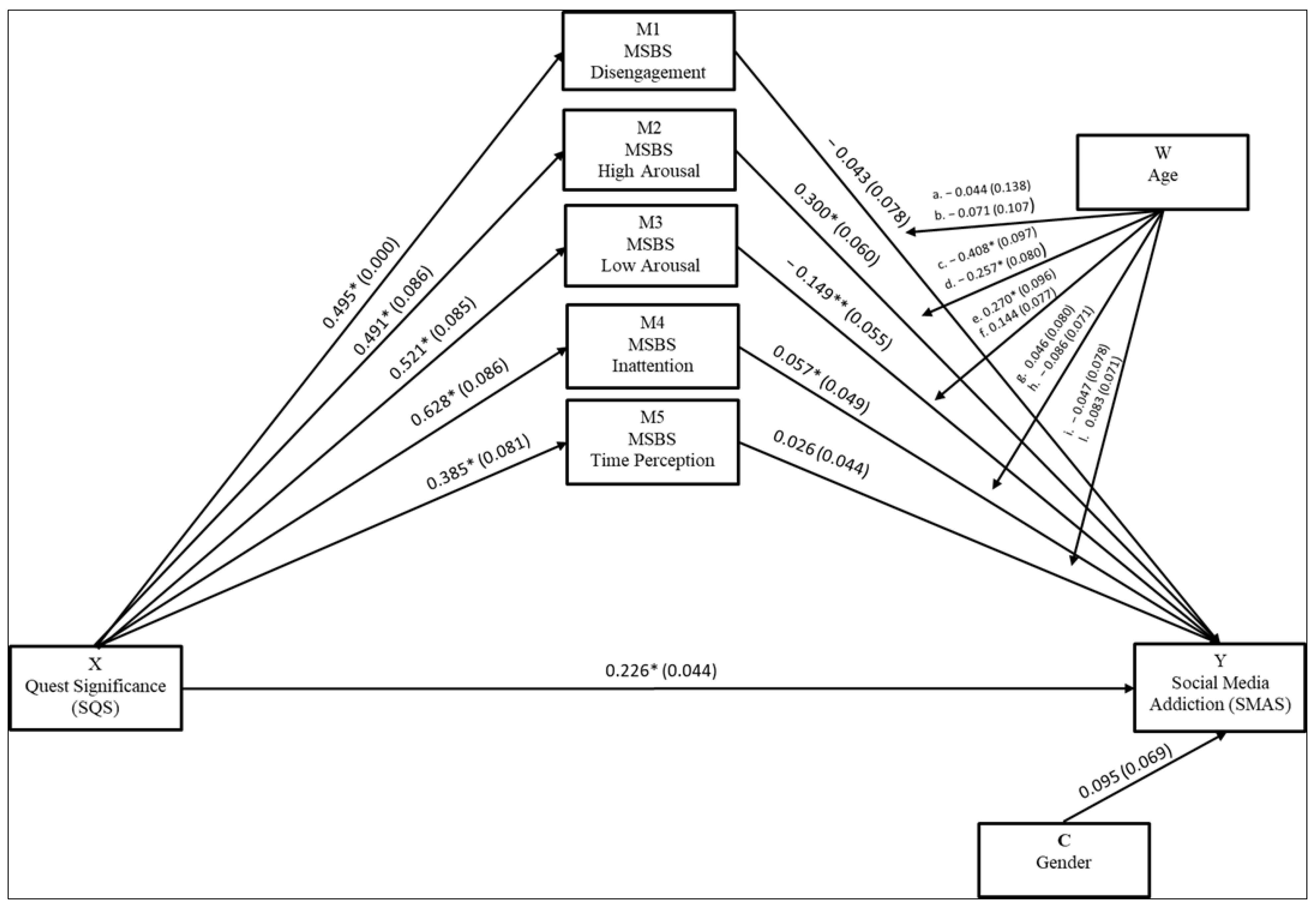
| Predictor | MSBS Disengagement | MSBS HighArousal | MSBS LowArousal | MSBS Inattention | MSBS TimePerception | BSMAS |
|---|---|---|---|---|---|---|
| β (SE HC0) | β (SE HC0) | β (SE HC0) | β (SE HC0) | β (SE HC0) | β (SE HC0) | |
| Constant | 1.663 (0.322) *** | 1.237 (0.299) *** | 1.171 (0.350) *** | 1.578 (0.345) *** | 1.360 (0.314) *** | |
| SQS (X) | 0.495 (0.000) *** | 0.491 (0.086) *** | 0.521 (0.085) *** | 0.628 (0.086) *** | 0.385 (0.081) *** | |
| Gender (cov) | 0.080 (0.156) | 0.130 (0.149) | 0.068 (0.171) | 0.120 (0.168) | 0.029 (0.155) | 0.095 (0.069) |
| MSBS Disengagement | −0.043 (0.078) | |||||
| MSBS HighArousal | 0.300 (0.060) *** | |||||
| MSBS LowArousal | −0.149 (0.055) ** | |||||
| MSBS Inattention | 0.157 (0.049) *** | |||||
| MSBS TimePerception | 0.026 (0.044) | |||||
| Millennials (vs. Gen Z) | 0.185 (0.238) | |||||
| Gen X (vs. Gen Z) | −0.003 (0.173) | |||||
| Disengagement × Millennials | −0.044 (0.138) | |||||
| Disengagement × Gen X | −0.071 (0.107) | |||||
| High Arousal × Millennials | −0.408 (0.097) *** | |||||
| High Arousal × Gen X | −0.257 (0.08) *** | |||||
| Low Arousal × Millennials | 0.270 (0.096) ** | |||||
| Low Arousal × Gen X | 0.144 (0.077) | |||||
| Inattention × Millennials | 0.046 (0.080) | |||||
| Inattention × Gen X | −0.086 (0.071) | |||||
| Time Perception × Millennials | −0.047 (0.078) | |||||
| Time Perception × Gen X | 0.083 (0.071) | |||||
| R2 F HC0 (df) | 0.114 *** 18.3296 (2, 313) | 0.124 *** 17.7528 (2, 313) | 0.109 *** 18.8923 (2, 313) | 0.148 *** 27.0719 (2, 313) | 0.073 *** 11.4688 (2, 313) | 0.535 *** 23.2938 (19, 296) |
| ∆R2 | 0.001 (0.222) | 0.027 (9.939) | 0.013 (4.258) | 0.004 (1.458) | 0.003 (1.281) | Diseng*Gen 0.801 HighAr*Gen 0.001 LowAr*Gen 0.015 Inatt*Gen 0.234 TimePerc*Gen 0.279 |
| Direct Effect | β (SE HC0) 0.226 (0.044) | 95% Boot CI (LL; UL) (0.1397; 0.3129) | |||||||||
|---|---|---|---|---|---|---|---|---|---|---|---|
| Indirect Effect | MSBS Disengagement | MSBS HighArousal | MSBS LowArousal | MSBS Inattention | MSBS TimePerception | ||||||
| β (SE HC0) | 95% Boot CI (LL; UL) | β (SE HC0) | 95% Boot CI (LL; UL) | β (SE HC0) | 95% Boot CI (LL; UL) | β (SE HC0) | 95% Boot CI (LL; UL) | β (SE HC0) | 95% Boot CI (LL; UL) | ||
| GenZ | −0.022 (0.041) | (−0.1009; 0.0623) | 0.147 (0.042) | (0.0753; 0.2373) | −0.078 (0.032) | (−0.1447; −0.018) | 0.099 (0.037) | (0.0348; 0.178) | 0.010 (0.019) | (−0.0267; 0.0488) | |
| Millennials | −0.043 (0.063) | (−0.1683; 0.0791) | −0.053 (0.044) | (−0.1426; 0.0319) | 0.063 (0.046) | (−0.0192; 0.1642) | 0.128 (0.048) | (0.0315; 0.2219) | −0.008 (0.028) | (−0.0575; 0.0587) | |
| GenX | −0.057 (0.041) | (−0.1361; 0.0245) | 0.021 (0.029) | (−0.0341; 0.082) | −0.003 (0.031) | (−0.0673; 0.0593) | 0.045 (0.036) | (−0.0308; 0.1105) | 0.0421 (0.025) | (−0.0005; 0.0994) | |
Disclaimer/Publisher’s Note: The statements, opinions and data contained in all publications are solely those of the individual author(s) and contributor(s) and not of MDPI and/or the editor(s). MDPI and/or the editor(s) disclaim responsibility for any injury to people or property resulting from any ideas, methods, instructions or products referred to in the content. |
© 2026 by the authors. Licensee MDPI, Basel, Switzerland. This article is an open access article distributed under the terms and conditions of the Creative Commons Attribution (CC BY) license.
Share and Cite
Tagliaferri, G.; Cricenti, C.; Civera-Antony, A.; González-Manzanares, C.; Martí-Vilar, M. From Quest for Significance to Social Media Addiction: The Mediating Role of Boredom and the Moderating Role of Age in a Spanish Sample. Psychiatry Int. 2026, 7, 107. https://doi.org/10.3390/psychiatryint7030107
Tagliaferri G, Cricenti C, Civera-Antony A, González-Manzanares C, Martí-Vilar M. From Quest for Significance to Social Media Addiction: The Mediating Role of Boredom and the Moderating Role of Age in a Spanish Sample. Psychiatry International. 2026; 7(3):107. https://doi.org/10.3390/psychiatryint7030107
Chicago/Turabian StyleTagliaferri, Ginevra, Clarissa Cricenti, Andrea Civera-Antony, Carlos González-Manzanares, and Manuel Martí-Vilar. 2026. "From Quest for Significance to Social Media Addiction: The Mediating Role of Boredom and the Moderating Role of Age in a Spanish Sample" Psychiatry International 7, no. 3: 107. https://doi.org/10.3390/psychiatryint7030107
APA StyleTagliaferri, G., Cricenti, C., Civera-Antony, A., González-Manzanares, C., & Martí-Vilar, M. (2026). From Quest for Significance to Social Media Addiction: The Mediating Role of Boredom and the Moderating Role of Age in a Spanish Sample. Psychiatry International, 7(3), 107. https://doi.org/10.3390/psychiatryint7030107