Article

Body Esteem in Women with Complex PTSD: A Comparative Study

by
Rodrigo Ramirez-Rodriguez
1,*,
Ángel Alberto Puig-Lagunes
2,
Rafael Fernández-Demeneghi
3,
Ana Karina Ceja-Venegas
4,
Yuliana Yessy Gomez-Rutti
5 and
Miriam Betzabe Tecamachaltzi-Silvarán
6
1
Campus Zacatenco, Instituto Politécnico Nacional, Ciudad de México 07738, Mexico
2
Facultad de Medicina, Campus Minatitlán, Universidad Veracruzana, Veracruz 96760, Mexico
3
Instituto de Investigaciones en Comportamiento Alimentario y Nutrición, Universidad de Guadalajara, Ciudad Guzmán 49010, Mexico
4
Campus Colima, Instituto Colimense de Ciencias Forenses, Colima 28030, Mexico
5
Facultad de Ciencias de la Salud, Universidad Privada del Norte, Lima 15083, Peru
6
Facultad de Ciencias para el Desarrollo Humano, Universidad Autónoma de Tlaxcala, Tlaxcala 90070, Mexico
*
Author to whom correspondence should be addressed.
Psychiatry Int. 2026, 7(2), 46; https://doi.org/10.3390/psychiatryint7020046
Submission received: 15 January 2026 / Revised: 16 February 2026 / Accepted: 24 February 2026 / Published: 2 March 2026

Abstract

Background: Although trauma can adversely affect body esteem, the specific impact of complex post-traumatic stress disorder (CPTSD) remains underexplored among Mexican women. Objective: This study examined body esteem among trauma-exposed controls and women with either PTSD or CPTSD in a sample of female Mexican university students. Method: Using a cross-sectional design, we recruited 657 cisgender Mexican women (aged 18–66) who completed the Body Esteem Scale (BES), International Trauma Questionnaire (ITQ), and Adverse Childhood Experiences-International Questionnaire (ACE-IQ). Participants were classified into three groups: trauma-exposed controls (n = 526), PTSD (n = 68), and CPTSD (n = 63). Results: Total BES scores differed significantly across groups. Participants with CPTSD reported lower overall body esteem (M = 99.48, SD = 21.32) compared to those with PTSD (M = 114.24, SD = 26.68) and controls (M = 119.38, SD = 24.93). Significant group differences also emerged in the Sexual & Physical Attractiveness and Physical Condition & Weight Concern subscales. Furthermore, the negative correlation between BES scores and trauma symptoms was more pronounced in the CPTSD group (rho = −0.40) than in the PTSD group (rho = −0.25). Conclusions: CPTSD is associated with significantly diminished body esteem in this population. These findings underscore the critical need for culturally sensitive, trauma-informed interventions that address both the psychological and somatic dimensions of body image.

1. Introduction

Across cultures, body dissatisfaction is increasingly recognized as a pervasive global mental health concern. Research examining how body perception influences psychological well-being relies on contemporary theoretical frameworks that conceptualize body image as a multidimensional construct rather than a simple visual judgment [1]. Within psychology, body image is broadly defined as the constellation of thoughts, feelings, and attitudes an individual holds about their physical form, encompassing both appearance and subjective evaluations of identity and self-worth [2]. Positive body image extends beyond the mere absence of dissatisfaction; it reflects acceptance, respect, and a favorable regard for one’s body, including comfort with how it looks and feels [2]. A central component of this construct is body appreciation, which involves actively valuing and respecting the body without adhering to narrow cultural standards of attractiveness. Empirical evidence links body appreciation to improved mental health outcomes, including lower depressive symptomatology and higher self-esteem [3]. Alongside appearance-focused positivity, research emphasizes functionality appreciation, highlighting the value of what the body can do—such as physiological processes, physical abilities, sensory experiences, and self-care routines—rather than its appearance alone [4]. Meta-analytic evidence indicates that functionality appreciation is associated with fewer body image disturbances, reduced eating disorder symptomatology, and enhanced overall well-being [4]. Integrating both body and functionality appreciation into theoretical models complements research on negative body image and elucidates the protective mechanisms that support psychological well-being within broader sociocultural contexts.
In Mexico, exposure to traumatic events is highly prevalent. Epidemiological data indicate that approximately 68% of the population has experienced at least one stressful life event, with 2.3% of women meeting the criteria for PTSD in structured assessments, underscoring significant sex differences in trauma-related burden. This indicates that trauma exposure and PTSD symptoms represent a substantial public health issue, particularly for young adult women (e.g., university students) who simultaneously navigate multiple sociocultural stressors [5]. Concurrently, studies among Mexican university students reveal that body-related concerns are widespread: nearly one in five students displays significant eating disorder symptomatology. Women exhibit a particularly elevated risk, with body dissatisfaction emerging as the strongest predictor of disordered eating behaviors [6]. These intersecting patterns demonstrate that both trauma-related psychopathology and body image disturbances are highly salient among young Mexican women, strongly supporting the rationale for focusing on this demographic.
Recent research further frames body image as a global mental health priority, revealing that appearance-related dissatisfaction and preoccupation with body weight and shape are pervasive across diverse cultures and socioeconomic contexts [7]. These concerns are consistently linked to adverse mental health outcomes—including depression, anxiety, and disordered eating—and are heavily influenced by sociocultural factors such as media exposure and social comparison. This global perspective reinforces the necessity for body image models that extend beyond mere appearance to incorporate protective, positive dimensions of embodiment. Beyond general well-being, post-traumatic stress disorder (PTSD) is consistently associated with severe body image disturbances, including reduced body satisfaction, negative body attitudes, and impaired body awareness. Studies across diverse populations document that individuals with PTSD frequently report dissatisfaction with their physical appearance alongside heightened somatic complaints, such as pain, muscular tension, and restricted movement [8,9]. Female patients appear particularly vulnerable to these negative bodily experiences, with PTSD and mood disorders predicting greater impairments in body satisfaction and attitude [10,11]. Early-life trauma further exacerbates these difficulties, resulting in substantial deficits in body attitude, satisfaction, and awareness, independent of co-occurring psychiatric conditions or dissociative symptoms [12]. The interplay between trauma, body image, and physical symptoms is equally evident in chronic pain populations, where trauma symptoms and body esteem influence pain intensity, revealing notable sex differences in these associations [13]. Collectively, these findings underscore the critical need for integrative, trauma-informed interventions addressing both the psychological and somatic dimensions of embodiment in individuals with PTSD.
The established evidence linking PTSD to body image disturbances suggests that complex post-traumatic stress disorder (CPTSD)—a more severe and pervasive trauma-related condition—may exert an even greater impact on body esteem. As defined in the ICD-11, CPTSD encompasses the core PTSD symptoms of re-experiencing, avoidance, and a persistent sense of threat, alongside additional symptom clusters including affect dysregulation, negative self-concept, and interpersonal disturbances [14]. Etiologically, cumulative adverse childhood experiences play a central role in the development of CPTSD, with early-life trauma shaping maladaptive cognitive–affective patterns and self-perceptions [15]. Biological variables, particularly sex, also influence vulnerability, as females consistently show higher prevalence rates for both PTSD and CPTSD [16]. Accordingly, recent findings indicate that young adults with CPTSD exhibit significantly lower self-esteem compared to those with PTSD, highlighting profound disruptions in core self-worth [17]. Given the established links between self-esteem and body image in trauma-exposed populations, it is reasonable to hypothesize that women with CPTSD experience pronounced impairments in body satisfaction and esteem, potentially exceeding those observed in PTSD alone [18]. These associations emphasize the importance of assessing body image domains within comprehensive interventions for CPTSD, particularly for female survivors of chronic childhood trauma.
Despite growing global interest in trauma-related disorders, research on CPTSD remains scarce in the Mexican context. This limits our understanding of how this severe form of trauma impacts self-perception and well-being in a population characterized by distinct cultural norms and specific traumatic exposures. This gap is particularly salient given the evidence that sociocultural factors heavily shape body image and associated self-esteem. For instance, Mexican individuals differ from other cultural groups in their perception of body size and attractiveness, with Mexican women valuing specific body features differently than their counterparts in other cultures [19]. Furthermore, cultural ideals and societal expectations exert a profound influence on body image across diverse populations, particularly among women navigating Western thin-ideal pressures [20]. Given these cultural nuances and the lack of empirical CPTSD studies in Mexico, investigating how CPTSD affects body-related self-esteem among Mexican women is imperative. Such research will elucidate the culturally specific pathways linking chronic trauma to negative self-concept and body dissatisfaction, ultimately informing culturally sensitive assessment tools and guiding interventions that address both trauma and embodiment in this understudied demographic.

2. Materials and Methods

2.1. Study Design

This study employed a cross-sectional, observational, and comparative design, with data collected between March and April 2025. Specifically, the research examined body esteem among female undergraduate and graduate students in Mexico reporting trauma-related symptoms consistent with either PTSD or CPTSD.

2.2. Sample

Participants were recruited using a non-probability convenience sampling strategy targeting university communities and research institutions across Mexico via institutional networks and social media platforms. Eligible participants were required to be cisgender Mexican women aged 18 years or older. Individuals with a diagnosed cognitive or severe mental disability were excluded from the study. Following the application of these criteria, the final sample comprised 657 women. Based on their responses to the International Trauma Questionnaire (ITQ), participants were stratified into three groups: trauma-exposed controls (n = 526, 80.0%), individuals with PTSD (n = 68, 10.4%), and individuals with CPTSD (n = 63, 9.6%).

2.3. Data Collection

This study received ethical approval from the Institutional Review Board (IRB) of the Faculty of Medicine, Minatitlán Campus, Universidad Veracruzana (Protocol: F-001-CI-2025) and was conducted in accordance with the Declaration of Helsinki. The research team circulated study invitations through social media platforms (WhatsApp, Facebook, and Instagram) and via institutional networks at various universities and research centers. Interested individuals accessed the survey through an online questionnaire hosted on Google Forms. Participation was entirely voluntary, and no financial or material compensation was provided. All participants were informed of the study’s objectives and provided electronic informed consent prior to enrollment. Data anonymity and confidentiality were strictly maintained throughout the research process.

2.4. Instruments

International Trauma Questionnaire (ITQ): The ITQ was administered to assess the presence of PTSD and CPTSD. The ITQ has demonstrated adequate psychometric properties for use with the Mexican population [21]. A PTSD diagnosis requires experiencing at least one symptom from two of the following three categories: (1) re-experiencing the trauma in the present moment, (2) avoidance behaviors, and (3) a heightened sense of current threat. Additionally, at least one associated functional impairment must be reported. A symptom or impairment is considered present if it receives a score greater than two. CPTSD includes all the criteria for PTSD, but also requires the presence of at least one symptom from each of the three PTSD symptom clusters mentioned above. Furthermore, a CPTSD diagnosis involves additional symptoms grouped under disturbances in self-organization (DSO), including: (1) emotional dysregulation, (2) a negative self-perception, and (3) disturbances in relationships. To meet the criteria for CPTSD, there must also be evidence of functional impairment related to both the PTSD and DSO symptoms. Each impairment must also score above two. Importantly, a person can be diagnosed with either PTSD or CPTSD, but not both. If the CPTSD criteria are met, only the CPTSD diagnosis is applied. It is important to note that ITQ-based groupings reflect probable ICD-11 PTSD and CPTSD classifications derived from self-report data, rather than clinician-confirmed diagnoses; however, the ITQ is widely validated and considered appropriate for research purposes. In this study, the internal consistency of the ITQ was good (α = 0.85).
Body Esteem Scale (BES): The BES was administered to assess participants’ self-perceptions regarding their body image. This instrument has demonstrated robust psychometric properties within Mexican populations [22]. The measure comprises 35 items distributed across two subscales: Physical & Sexual Attractiveness (19 items) and Physical Condition & Weight Concern (16 items). Responses are rated on a 5-point Likert scale ranging from 1 (strong negative feelings) to 5 (strong positive feelings), with higher cumulative scores reflecting greater body esteem. In the present sample, the BES demonstrated excellent internal consistency for both subscales: Physical & Sexual Attractiveness (α = 0.92) and Physical Condition & Weight Concern (α = 0.92).
Adverse Childhood Experiences-International Questionnaire (ACE-IQ): This self-administered questionnaire assesses exposure to adverse events occurring before the age of 18. The instrument has demonstrated adequate psychometric properties within Mexican adult populations [23]. In the present study, each ACE-IQ item was coded dichotomously, with “Yes” responses scored as 1 and “No” responses scored as 0. The cumulative ACE score for each participant was calculated by summing these binary responses across all items. Thus, the final score reflects the total number of distinct adversity categories experienced, with higher scores indicating greater exposure to childhood adversity. This approach aligns with the conventional scoring used in the original ACE research [24], where the focus is on the number of categories of adversity experienced rather than on severity or frequency. This cumulative count has been shown to correlate with risk gradients for mental and physical health outcomes in epidemiological research [25]. The questionnaire comprises 31 items distributed across five modules: family violence (6 items), sexual abuse (4 items), peer victimization (7 items), family dysfunction (7 items), and community violence (7 items). Higher cumulative scores indicate a greater breadth of exposure to diverse adverse childhood experiences. In the current sample, the ACE-IQ demonstrated acceptable internal consistency (α = 0.78).

2.5. Statistical Analysis

All statistical analyses and data visualizations were performed using RStudio (version 4.5.2) for macOS. Categorical variables were described using absolute and relative frequencies, whereas quantitative variables were summarized as means and standard deviations (SD). Differences in body esteem across diagnostic groups were assessed using a one-way analysis of variance (ANOVA). Normality and homogeneity of variances were assessed using the Shapiro–Wilk and Levene tests. Effect sizes for these group differences were estimated using omega squared (ω2). Post hoc pairwise comparisons were conducted using Tukey’s Honestly Significant Difference (HSD) test, which strictly controls for family-wise Type I error rates across multiple comparisons. To explore the associations between trauma symptoms and body esteem, Spearman’s rank-order correlations were calculated. Additionally, an exploratory stepwise linear regression was conducted—incorporating diagnostic group, the five trauma-type variables, and their interaction terms—to examine whether the relationship between diagnosis and body esteem varied according to trauma type. All statistical tests were two-tailed, with significance defined as p < 0.05.

3. Results

3.1. Sociodemographic Characteristics and Adverse Childhood Experiences

The sample consisted predominantly of young adults, with the majority aged between 18 and 25 years (65.7%), and most held a bachelor’s degree (85.2%). The majority of participants resided in urban areas (84.6%) and reported having no children (79.3%). Regarding adverse childhood experiences (ACEs), high prevalence rates were observed across several domains, most notably family dysfunction (90.7%), peer violence (79.8%), and family violence (74.4%). Additionally, community violence was reported by 59.4% of the participants, while sexual victimization affected 39.7%. An examination of cumulative ACE exposure indicated a high burden of poly-victimization: most participants had experienced multiple adversities, with 28.5% endorsing four ACE domains and 27.4% endorsing all five domains. A comprehensive overview of the sample’s sociodemographic and trauma-exposure characteristics is presented in Table 1.

3.2. Body Esteem Across Trauma-Exposed, PTSD, and CPTSD Groups

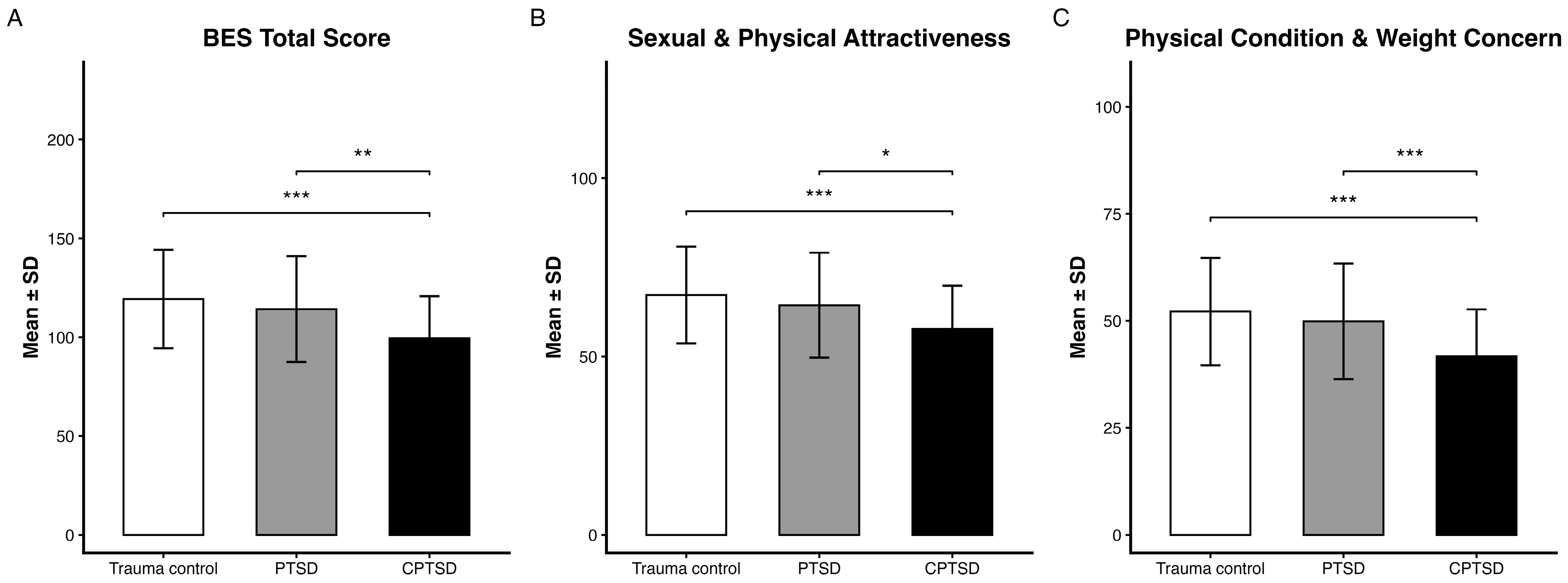
Mean scores for the body esteem domains were compared across the trauma-exposed control, PTSD, and CPTSD groups (see Table 2). A one-way analysis of variance revealed a significant main effect of diagnostic group on the BES Total Score, (F = 18.58, p < 0.001), yielding a small effect size (ω2 = 0.05). Post hoc pairwise comparisons utilizing Tukey’s HSD indicated that women in the CPTSD group reported significantly lower overall body esteem (M = 99.48, SD = 21.32) than both those in the PTSD (M = 114.24, SD = 26.68) and trauma-exposed control groups (M = 119.38, SD = 24.93). Notably, no significant difference emerged between the PTSD and control groups (Figure 1A). Similar patterns were observed across the BES subscales. Significant group differences emerged for Sexual & Physical Attractiveness (F= 14.42, p < 0.001), with a small effect size (ω2 = 0.05). Post hoc comparisons confirmed that participants with CPTSD scored significantly lower in this domain (M = 57.71, SD = 12.11) compared to the PTSD (M = 64.37, SD = 14.67) and control groups (M = 67.23, SD = 13.57), with no significant variance detected between the latter two groups (Figure 1B). Finally, analysis of the Physical Condition & Weight Concern subscale also yielded a significant group effect, (F = 19.79, p < 0.001), with a small effect size (ω2 = 0.05). Consistent with the other domains, post hoc testing revealed that the CPTSD group reported substantially lower scores (M = 41.76, SD = 10.92) than both the PTSD (M = 49.87, SD = 13.52) and control groups (M = 52.16, SD = 12.52), while differences between the PTSD and control groups remained non-significant (Figure 1C).

3.3. Association Between Body Esteem and Trauma Symptoms

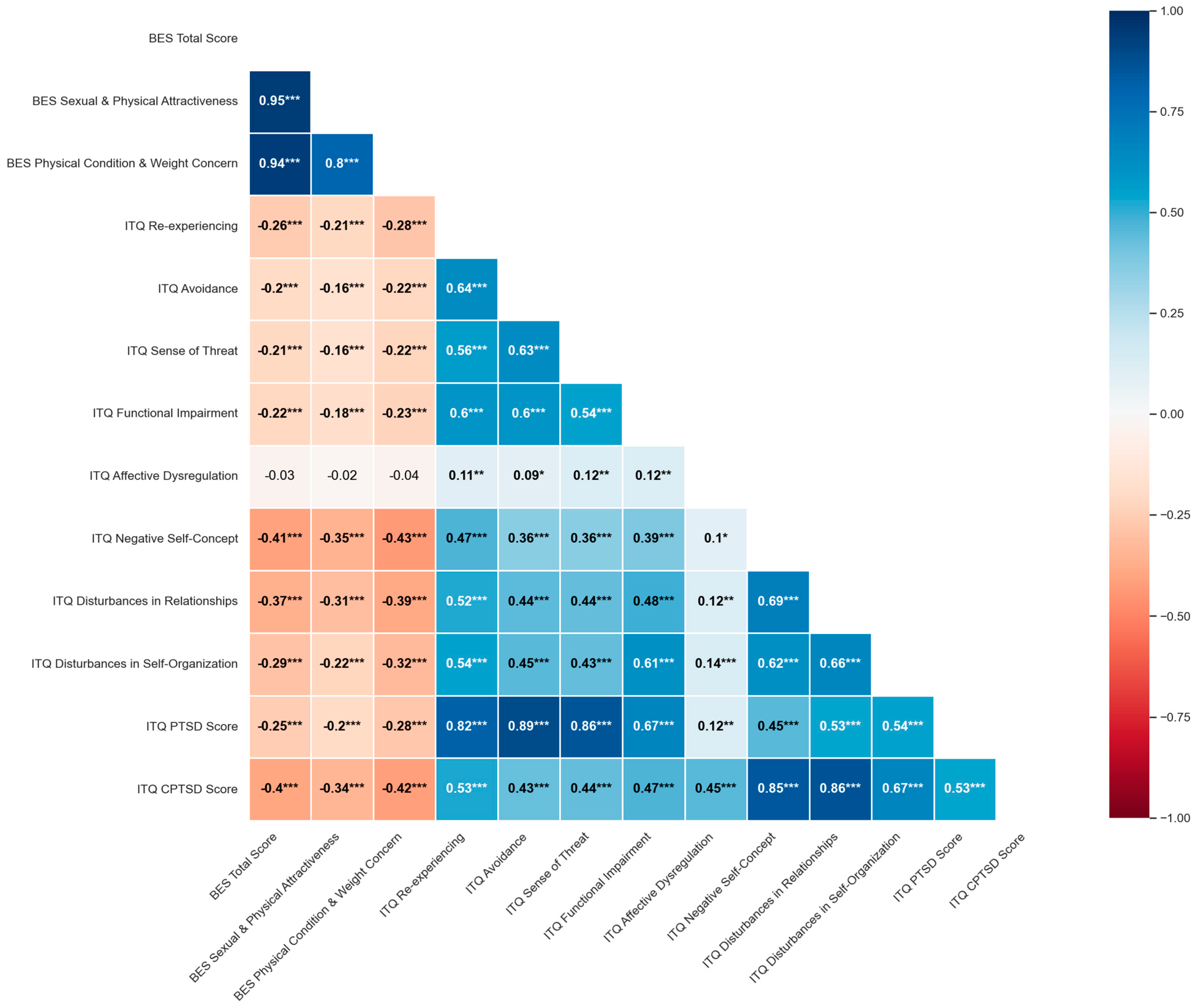
Figure 2 illustrates the bivariate associations between body esteem and trauma-related symptoms. A Spearman rank-order correlation matrix revealed that all core PTSD and CPTSD symptom domains were significantly and inversely associated with BES scores. Regarding the core PTSD clusters, Re-experiencing exhibited the strongest negative correlations with the BES Total Score (ρ = −0.26), as well as with the Sexual & Physical Attractiveness (ρ = −0.21) and Physical Condition & Weight Concern (ρ = −0.28) subscales. Similarly, both the Sense of Threat and Avoidance clusters were negatively correlated with overall body esteem (ρ = −0.21 and ρ = −0.20, respectively), alongside identical inverse associations with the Sexual & Physical Attractiveness (ρ = −0.16) and Physical Condition & Weight Concern (ρ = −0.22) subscales.
Regarding CPTSD symptoms, Negative Self-Concept was negatively correlated with the BES total score (ρ = −0.41), Sexual & Physical Attractiveness (ρ = −0.35), and Physical Condition & Weight Concern (ρ = −0.43). Disturbances in Relationships was negatively correlated with the BES total score (ρ = −0.37), Sexual & Physical Attractiveness (ρ = −0.31), and Physical Condition & Weight Concern (ρ = −0.39). Disturbances in Self-Organization showed negative correlations with the BES total score (ρ = −0.29), Sexual & Physical Attractiveness (ρ = −0.22), and Physical Condition & Weight Concern (ρ = −0.32).
Finally, the overall PTSD score was negatively correlated with the BES total score (ρ = −0.25), Sexual & Physical Attractiveness (ρ = −0.20), and Physical Condition & Weight Concern (ρ = −0.28), while the overall CPTSD score showed negative correlations with the BES total score (ρ = −0.40), Sexual & Physical Attractiveness (ρ = −0.34), and Physical Condition & Weight Concern (ρ = −0.42).

3.4. Adverse Childhood Experiences Across Trauma-Exposed, PTSD, and CPTSD Groups

Table 3 presents the proportion of participants endorsing various adverse childhood experiences across the trauma-exposed control, PTSD, and CPTSD groups. Compared to the control group, significantly higher proportions of participants with PTSD and CPTSD reported a history of family violence (85.3% and 84.1% vs. 71.9%), sexual victimization (52.9% and 66.7% vs. 34.8%), and peer violence (88.2% and 96.8% vs. 76.6%). Exposure to community violence also varied significantly, affecting 56.3% of the trauma-exposed controls, 70.6% of those with PTSD, and 73.0% of participants with CPTSD.
Overall, between-group differences in ACE exposure were statistically significant for family violence (Cramer’s V = 0.104, p < 0.05), sexual victimization (Cramer’s V = 0.204, p < 0.001), peer violence (Cramer’s V = 0.154, p < 0.001), and community violence (Cramer’s V = 0.114, p < 0.01). In contrast, family dysfunction was highly prevalent across all diagnostic categories (ranging from 89.9% to 98.4%), yielding no significant differences among the groups (Cramer’s V = 0.067, p > 0.05).

3.5. Moderation Regression Predicting BES Total Score and Subscale Domains from Adverse Childhood Experiences Across Diagnostic Groups

Table 4 details the results of the moderation regression models predicting body esteem domains from ACEs across diagnostic groups. In the model predicting the BES Total Score, peer violence emerged as a significant negative predictor (β = −8.84, SE = 2.57, 95% CI [−13.90, −3.79]), whereas family dysfunction was a significant positive predictor (β = 8.70, SE = 3.52, 95% CI [1.77, 15.63]). Similar predictive patterns were observed across the BES subscales.
For the Sexual & Physical Attractiveness dimension, both family dysfunction (β = 5.41, SE = 1.93, 95% CI [1.61, 9.20]) and peer violence (β = −3.45, SE = 1.41, 95% CI [−6.21, −0.67]) demonstrated significant main effects. Regarding Physical Condition & Weight Concern, peer violence negatively predicted the outcome (β = −8.15, SE = 2.02, 95% CI [−12.02, −4.81]), while family dysfunction emerged as a positive predictor (β = 5.95, SE = 2.25, 95% CI [1.53, 10.38]).
Furthermore, a significant interaction effect between peer violence and family dysfunction was observed (β = 6.53, SE = 2.73, 95% CI [1.15, 11.91]). Crucially, no significant interactions with the diagnostic group were found across any of the models.

4. Discussion

The present study aimed to evaluate body esteem among Mexican women with CPTSD. Our findings revealed a marked reduction in body esteem within this population, significantly affecting domains such as Sexual & Physical Attractiveness, as well as concerns regarding Physical Condition & Weight Concern. These results are consistent with prior research in individuals with PTSD, who also exhibit profound devaluations in body perception [8,9]. Notably, body esteem was significantly more impaired in women with CPTSD compared to those with PTSD [17], highlighting the devastating impact of complex trauma on the embodied self-concept.
Within the CPTSD symptom profile, negative self-concept emerges as a critical factor contributing to diminished body esteem. Negative self-concept is defined by pervasive beliefs about oneself as diminished, defeated, or worthless [26]. Self-rejection and self-criticism may exacerbate the deterioration of both global self-esteem and body valuation, indicating that negative self-concept plays a central role in shaping self-image. Meta-analytic evidence further indicates that childhood sexual abuse strongly drives the development of negative self-concept in children and adolescents [27], emphasizing the long-term sequelae of early adverse experiences on body esteem in women with CPTSD. Additionally, sexual attractiveness is negatively predicted by histories of adverse childhood experiences, particularly childhood sexual abuse [28]. Regarding Physical Condition & Weight Concern, PTSD has been established as a risk factor for overweight and obesity [29], suggesting that early trauma contributes to impairments across multiple dimensions of embodiment.
Sociocultural context also plays a pivotal role in shaping body esteem among women. Body esteem refers to individuals’ self-evaluations regarding their physical appearance [30] and holds particular psychological significance for women, as societal norms frequently conflate physical appearance with social value [31,32]. In societies that emphasize female bodily aesthetics as a primary benchmark of worth, body esteem can become central to identity formation [33]. Such cultural pressures may exacerbate the detrimental effects of trauma on women’s bodily evaluations.
Trauma-induced disruptions in body awareness provide further explanatory mechanisms for the observed reduction in body esteem. Research indicates that PTSD affects both the sense of body ownership (SBO)—the feeling that one’s body belongs to oneself—and the sense of agency (SoA)—the perception of being in control of one’s actions [34]. In non-dissociative PTSD, hyper-precise trauma-related priors combined with heightened interoceptive sensitivity create rigid self-representations and increased bodily self-criticism. Conversely, in dissociative PTSD, weakened priors and reduced interoception lead to bodily disconnection and a diminished sense of control. These profound alterations in ownership and agency offer a plausible mechanism for the body esteem disturbances observed among women with CPTSD.
Neurobiological evidence offers additional insight into the mechanisms underlying poor body esteem. Decreased thalamic activity has been observed during cognitive inhibition tasks in individuals with CPTSD [35]. Given the thalamus’ role as a central hub for sensory integration [36], disruptions in thalamic processing may impair the accurate perception of bodily and environmental cues, including sexual stimuli. These neurobiological alterations, functioning in tandem with negative self-concept and trauma history, provide an integrated explanation for the profound reduction in body esteem observed in our sample.
Among the core PTSD symptom clusters, re-experiencing, avoidance, and sense of threat demonstrated small-to-moderate inverse correlations with body esteem indices. Although modest, these associations are consistent with theoretical models positing that trauma exposure disrupts bodily self-perception while increasing hypervigilance and somatic distress, all of which negatively influence body-related evaluations [37]. Intrusive memories and heightened physiological arousal may reinforce negative appraisals of the body as unsafe, damaged, or out of control. Notably, CPTSD-specific disturbances—particularly Negative Self-Concept and Disturbances in Relationships—demonstrated stronger correlations with body esteem. These findings align with the conceptualization of CPTSD within the World Health Organization’s ICD-11 framework, which emphasizes persistent disturbances in self-organization (DSO), including pervasive shame, guilt, and feelings of worthlessness [38]. The robust associations between CPTSD symptoms and body esteem likely reflect the identity-altering impact of complex trauma. A negative self-concept, characterized by chronic self-criticism and feelings of defectiveness, may generalize to body-related domains, compelling individuals to evaluate their physical selves more harshly. Furthermore, the overall CPTSD severity score exhibited stronger negative correlations with the BES total and subscale scores than the overall PTSD score. This pattern supports emerging evidence that CPTSD is associated with broader, more debilitating impairments in self-perception and interpersonal functioning than PTSD alone [39]. These results underscore the critical importance of addressing body-related self-evaluations within trauma-informed interventions, particularly for patients presenting with CPTSD.
The disproportionate rates of sexual victimization and peer violence observed among CPTSD participants (66.7% and 96.8%, respectively) compared to trauma-exposed controls align with the contemporary literature emphasizing the cumulative, interpersonal nature of trauma in the etiology of complex PTSD [40,41]. Sexual abuse and chronic peer victimization constitute repeated interpersonal traumas, which are consistently linked to more severe symptomatology, emotion dysregulation, and the characteristic self-organization disturbances of CPTSD [42]. These patterns suggest that interpersonal ACEs—particularly those involving betrayal or threat within close relationships or social hierarchies—disproportionately drive the development of PTSD and CPTSD. Although family dysfunction was highly prevalent across all groups (89.9–98.4%), it did not significantly differentiate the trauma-exposed controls from the PTSD or CPTSD groups. This ceiling effect suggests that family dysfunction, while widespread in this demographic, may operate as a ubiquitous background vulnerability rather than a discriminating predictor of posttraumatic diagnostic status. This observation is consistent with research indicating that chronic family adversity contributes to a generalized vulnerability for psychopathology, whereas specific traumatic exposures, such as sexual abuse or peer violence, play a more proximal role in shaping distinct PTSD and CPTSD symptom clusters [43,44]. Additionally, community violence exposure was elevated in the clinical groups (70.6% and 73.0%), supporting findings that cumulative environmental adversity exacerbates the risk for posttraumatic psychopathology [45].
The differential prevalence of specific ACEs across diagnostic categories underscores the necessity of evaluating both the typology and severity of early trauma in clinical assessments. CPTSD appears inextricably linked to high rates of interpersonal trauma (sexual victimization and peer violence), aligning with ICD-11 conceptualizations that emphasize DSO symptoms resulting from chronic, repeated interpersonal victimization [40]. These findings reinforce the clinical utility of the ACE-IQ in identifying trauma profiles that signal a heightened risk for complex posttraumatic symptomatology. Moreover, the data support the growing emphasis on poly-victimization frameworks, wherein exposure to multiple forms of abuse across varying contexts (family, peers, and community) exponentially elevates the risk for PTSD and CPTSD [16]. The graded pattern of trauma exposure across the control, PTSD, and CPTSD groups highlights the compounding effects of interpersonal and community adversities in shaping posttraumatic outcomes.
Peer violence demonstrated a robust negative association with overall body esteem and both subdomains. These findings align with the literature linking peer victimization—particularly appearance-based bullying—to body dissatisfaction and increased eating disorder risk [46]. Peer contexts are developmentally central during adolescence, and social evaluations within these environments are frequently appearance-salient. Consequently, peer violence may directly target the bodily self, amplifying shame, self-surveillance, and weight-related preoccupation. Objectification theory [47] provides a relevant explanatory framework: repeated exposure to harsh external evaluation fosters internalized body monitoring and contingent self-worth. From a trauma-informed perspective, interpersonal humiliation may consolidate negative embodied self-schemas [39], explaining the particularly strong associations observed in the weight and physical elucidating the particularly strong associations observed in the Physical Condition & Weight Concern domain.
Unexpectedly, family dysfunction emerged as a positive predictor of body esteem across the regression models. A theoretically plausible explanation is that, for some individuals, severe family dysfunction may foster a compensatory investment in domains perceived as controllable or socially valued—such as physical appearance. Self-affirmation theory [48] and contingency models of self-worth [49] propose that when self-integrity is threatened in one domain (e.g., relational security within the family), individuals may bolster alternative domains to maintain coherence and worth. In contexts of family dysfunction—characterized by instability, emotional invalidation, or lack of attunement—appearance may become a domain where control, predictability, and external validation are achievable.
Developmental trauma research further suggests that childhood trauma can lead to different emotional adaptation patterns. Some individuals show emotional instability and intense fear of rejection, while others develop emotional numbing, guilt, and relational withdrawal [43]. Within this framework, elevated body esteem in the context of family dysfunction may not reflect a secure, adaptive embodiment, but rather a strategic self-investment in a socially reinforced domain. Thus, the observed positive association likely reflects a conditional or compensatory form of body esteem rather than globally adaptive self-regard. This interpretation is consistent with evidence indicating that self-esteem can become highly domain-specific and contingent under chronic stress [50]. Future research should investigate whether this association is mediated by perfectionism, appearance-contingent self-worth, or specific emotion regulation strategies.
The significant interaction observed in the Physical Condition & Weight Concern domain suggests that the relationship between peer violence and weight-related body esteem varies as a function of family dysfunction. One speculative interpretation is that individuals exposed to family dysfunction who develop compensatory appearance investments may exhibit a partial psychological buffering against peer-based appearance attacks—at least at the level of self-reported esteem. Alternatively, this interaction may reflect complex adaptive processes whereby exposure to multiple, compounding adversities fundamentally alters the salience of specific evaluative contexts. Resilience frameworks emphasize that adversities interact dynamically rather than purely additively [51]. Probing simple slopes in future longitudinal studies would clarify whether family dysfunction attenuates or amplifies the negative impact of peer violence on weight-related concerns.
Finally, the lack of significant moderation by diagnostic group suggests that adverse interpersonal experiences are more proximally linked to body esteem than the diagnostic categorization itself. Although CPTSD inherently includes a persistent negative self-concept [40], the current findings indicate that specific experiential variables—particularly peer violence—are stronger predictors of body-related self-evaluation than belonging to a specific clinical group. This strongly supports dimensional models of trauma-related self-disturbance, wherein specific developmental experiences shape domain-specific self-representations, including the bodily self [41].
In summary, our findings indicate that body esteem is severely compromised among Mexican women with CPTSD. This impairment is driven by negative self-concept, early interpersonal trauma exposure, and sociocultural pressures, alongside potential neurobiological vulnerabilities. These results robustly underscore the critical need for culturally sensitive, trauma-informed clinical interventions that comprehensively address both the psychological and somatic dimensions of the body experience in women with complex trauma histories.

5. Implications

Our findings highlight the clinical imperative for trauma-informed, body- and movement-oriented interventions (BMOIs) for women with CPTSD. Emerging evidence suggests that BMOIs—including dance/movement therapy, trauma-sensitive yoga, and somatic or sensorimotor approaches—can effectively reduce trauma symptoms, improve arousal regulation, and normalize trauma-disrupted psychophysiological patterns. These mechanisms, in turn, may indirectly foster healthier body esteem [52]. Systematic reviews and meta-analyses indicate that BMOIs yield moderate reductions in PTSD symptom severity, demonstrating their distinct relevance for addressing trauma-related embodied distress [11]. Clinically, a comprehensive treatment program might combine weekly sessions of an established trauma-focused psychotherapy (e.g., cognitive processing therapy) to address maladaptive beliefs, alongside twice-weekly trauma-sensitive yoga or somatic exercises to enhance interoceptive awareness and physiological regulation. Such an integrated approach empowers patients to process traumatic memories cognitively while simultaneously rehabilitating their embodied self-experience and body-related self-esteem, thoroughly addressing both the psychological and somatic dimensions of CPTSD.

6. Strengths, Limitations, and Future Research

This study presents several notable strengths. First, to our knowledge, it represents the first comparative analysis of body esteem across trauma-exposed controls, PTSD, and CPTSD groups in adult women, providing novel empirical evidence on how complex trauma differentially impacts embodied self-perception. By examining multiple subdomains of body esteem, this study extends the existing trauma literature beyond global self-worth, offering a more nuanced understanding of the physical and embodied facets of self-concept. Second, the research addresses a critical geographical and cultural gap, constituting the first investigation of body esteem among Mexican women with CPTSD using psychometrically validated and culturally adapted instruments. This contextual focus enhances the ecological validity of the findings and underscores the profound relevance of sociocultural norms—surrounding body image, femininity, and appearance—in shaping trauma-related outcomes.
Nevertheless, several methodological limitations must be acknowledged. First, the sample consisted predominantly of highly educated, young university students, recruited online, which may limit the generalizability of these findings to broader, more socioeconomically diverse female populations. Second, online recruitment also introduces potential self-selection effects, whereby individuals with particular symptom profiles or interest in mental health topics may be more likely to participate. These factors should be considered when generalizing results to clinical CPTSD populations. Third, body esteem and trauma exposure were assessed exclusively through self-report measures, introducing potential vulnerability to social desirability and shared method variance biases. Fourth, the cross-sectional design strictly precludes causal inferences regarding the directionality of the associations between trauma symptoms and body esteem. Fifth, psychiatric comorbidities commonly associated with CPTSD—such as depression, anxiety, eating disorders, and severe dissociative symptoms—as well as other robust predictors of body esteem (e.g., body mass index [BMI] and the internalization of sociocultural body ideals) were not assessed. Consequently, the observed group differences in body esteem may be partly mediated or confounded by these unmeasured variables rather than being uniquely attributable to CPTSD etiology. Finally, although the BES has demonstrated robust psychometric properties in Mexican populations, measurement invariance across trauma-related diagnostic subgroups was not formally tested. Therefore, observed group differences should be interpreted cautiously.
Future research should prospectively investigate how the specific type, developmental timing, and chronicity of trauma—particularly interpersonal and early-life adversities—shape body esteem across the lifespan. Longitudinal designs are urgently needed to clarify the temporal relationships between trauma exposure, CPTSD symptom trajectory, and corresponding shifts in body esteem. Additionally, examining potential mediators and moderators—such as shame, interoceptive awareness, emotion regulation strategies, social support, and culturally specific body ideals—will help elucidate the mechanisms driving individual variability in clinical outcomes. Finally, rigorous intervention studies, such as randomized controlled trials, should evaluate whether integrating BMOIs with standard trauma-focused therapies can effectively restore body esteem in women with CPTSD, particularly within culturally diverse and historically underrepresented populations.

7. Conclusions

Body esteem is significantly and disproportionately diminished in Mexican women with CPTSD compared to both those with PTSD and trauma-exposed controls. These findings robustly underscore the critical need to integrate body-related self-perceptions into trauma-informed assessment and intervention frameworks, particularly when working within culturally specific contexts where the somatic impact of complex trauma intersects with rigid societal appearance ideals.

Author Contributions

Conceptualization, R.R.-R.; methodology, R.R.-R., Á.A.P.-L. and R.F.-D.; validation, R.R.-R., Á.A.P.-L. and R.F.-D.; formal analysis, R.R.-R. and A.K.C.-V.; investigation, R.R.-R. and A.K.C.-V.; data curation, R.R.-R. and A.K.C.-V.; writing—original draft preparation, R.R.-R., Á.A.P.-L., R.F.-D., Y.Y.G.-R. and M.B.T.-S.; writing—review and editing, R.R.-R., Á.A.P.-L., R.F.-D., Y.Y.G.-R. and M.B.T.-S.; visualization, R.R.-R. and Á.A.P.-L.; supervision, R.R.-R.; project administration, R.R.-R. All authors have read and agreed to the published version of the manuscript.

Funding

This research received no external funding.

Institutional Review Board Statement

The study was conducted in accordance with the Declaration of Helsinki and approved by the Institutional Review Board Research Ethics Committee of Faculty of Medicine, Minatitlan Campus at Universidad Veracruzana (Approval code: F-001-CI-2025, Approved date: 25 February 2025) for studies involving humans.

Informed Consent Statement

Informed consent was obtained from all subjects involved in the study.

Data Availability Statement

The data that support the findings of this study are not openly available due to reasons of sensitivity and are available from the corresponding author upon reasonable request.

Acknowledgments

RR-R (CVU:785735), and RF-D (CVU:714861) thanks, the Secretaría de Ciencia, Humanidades, Tecnología e Innovación (SECIHTI) for the support through the scholarship of Postdoctoral Stays in Mexico.

Conflicts of Interest

The authors declare no conflicts of interest.

Abbreviations

The following abbreviations are used in this manuscript:
CPTSDComplex Posttraumatic Stress Disorder
PTSDPosttraumatic Stress Disorder
BESBody Esteem Scale
ITQInternational Trauma Questionnaire
ACE-IQAdverse Childhood Experiences-International Questionnaire

References

  1. Tylka, T.L.; Wood-Barcalow, N.L. What is and what is not positive body image? Conceptual foundations and construct definition. Body Image 2015, 14, 118–129. [Google Scholar] [CrossRef] [Scilit]
  2. Gillen, M.M.; Markey, C.H. Body image and mental health. In Encyclopedia of Mental Health, 3rd ed.; Elsevier: Amsterdam, The Netherlands, 2023; Volume 1, pp. V1-246–V1-256. [Google Scholar] [CrossRef] [Scilit]
  3. Linardon, J.; McClure, Z.; Tylka, T.L.; Fuller-Tyszkiewicz, M. Body appreciation and its psychological correlates: A systematic review and meta-analysis. Body Image 2022, 42, 287–296. [Google Scholar] [CrossRef] [Scilit]
  4. Linardon, J.; Messer, M.; Tylka, T.L. Functionality appreciation and its correlates: Systematic review and meta-analysis. Body Image 2023, 45, 65–72. [Google Scholar] [CrossRef] [Scilit] [PubMed]
  5. Medina-Mora, M.E.; Borges-Guimaraes, G.; Lara, C.; Ramos-Lira, L.; Zambrano, J.; Fleiz-Bautista, C. Prevalencia de sucesos violentos y de trastorno por estrés postraumático en la población mexicana. Salud Pública México 2005, 47, 8–21. [Google Scholar] [CrossRef] [Scilit] [PubMed]
  6. Alonso-Catalán, M.; Tafoya, S.A.; Vazquez-Arevalo, R.; Ávila-Escalante, M.L.; Tusié-Luna, M.T.; Moreno-Macías, L.; Moreno-Macías, H.; Corral-Aguilar, J.; Aburto-Arciniega, M.; Silva-Avalos, S.; et al. Frequency, Correlates, and Symptom Severity of Eating Disorders Among College Students in Mexico. Int. J. Environ. Res. Public Health 2025, 22, 1797. [Google Scholar] [CrossRef] [Scilit] [PubMed]
  7. Rodgers, R.F.; Laveway, K.; Campos, P.; de Carvalho, P.H.B. Body image as a global mental health concern. Camb. Prisms Glob. Ment. Health 2023, 10, e9. [Google Scholar] [CrossRef] [Scilit]
  8. Cikuru, J.; Kaganda, P.; Blavier, A.; Foucart, J. Post-traumatic stress disorder and body satisfaction among patients at Ruhigita clinic, Bukavu (DRC): An observational study. Front. Psychol. 2025, 16, 1704684. [Google Scholar] [CrossRef] [Scilit]
  9. Nyboe, L.; Bentholm, A.; Gyllensten, A.L. Bodily symptoms in patients with post traumatic stress disorder: A comparative study of traumatized refugees, Danish war veterans, and healthy controls. J. Bodyw. Mov. Ther. 2017, 21, 523–527. [Google Scholar] [CrossRef] [Scilit]
  10. Scheffers, M.; Hoek, M.; Bosscher, R.J.; van Duijn, M.A.J.; Schoevers, R.A.; van Busschbach, J.T. Negative body experience in women with early childhood trauma: Associations with trauma severity and dissociation. Eur. J. Psychotraumatol. 2017, 8, 1322892. [Google Scholar] [CrossRef] [Scilit]
  11. van de Kamp, M.M.; Scheffers, M.; Emck, C.; Cuijpers, P.; Beek, P.J. Negative Body Experience in a Clinical Sample of Mental Disorders: Associations with Posttraumatic Stress Disorder, Mood Disorders, and Personality Disorders. J. Clin. Psychol. 2025, 81, 334–344. [Google Scholar] [CrossRef] [Scilit]
  12. Dyer, A.; Borgmann, E.; Kleindienst, N.; Feldmann, R.E., Jr.; Vocks, S.; Bohus, M. Body image in patients with posttraumatic stress disorder after childhood sexual abuse and co-occurring eating disorder. Psychopathology 2013, 46, 186–191. [Google Scholar] [CrossRef] [Scilit]
  13. Rzeszutek, M.; Oniszczenko, W.; Schier, K.; Biernat-Kałuża, E.; Gasik, R. Sex differences in trauma symptoms, body image and intensity of pain in a Polish sample of patients suffering from chronic pain. Psychol. Health Med. 2016, 21, 827–835. [Google Scholar] [CrossRef] [Scilit] [PubMed]
  14. World Health Organization. ICD-11 for Mortality and Morbidity Statistics. 2018. Available online: https://icd.who.int/browse/2025-01/mms/en#585833559 (accessed on 8 January 2026).
  15. Cloitre, M. Complex PTSD: Assessment and treatment. Eur. J. Psychotraumatol. 2021, 12, 1866423. [Google Scholar] [CrossRef] [Scilit]
  16. Kairyte, A.; Kvedaraite, M.; Kazlauskas, E.; Gelezelyte, O. Exploring the links between various traumatic experiences and ICD-11 PTSD and Complex PTSD: A cross-sectional study. Front. Psychol. 2022, 13, 896981. [Google Scholar] [CrossRef] [Scilit] [PubMed]
  17. Li, Y.; Liang, Y. The effect of childhood trauma on complex posttraumatic stress disorder: The role of self-esteem. Eur. J. Psychotraumatol. 2023, 14, 2272478. [Google Scholar] [CrossRef] [Scilit] [PubMed]
  18. Bödicker, C.; Reinckens, J.; Höfler, M.; Hoyer, J. Is Childhood Maltreatment Associated with Body Image Disturbances in Adulthood? A Systematic Review and Meta-Analysis. J. Child Adolesc. Trauma 2021, 15, 523–538. [Google Scholar] [CrossRef] [Scilit]
  19. de Oca, Y.P.A.M.; Medina, J.L.V.; Blanquet, E.R.P.; Munoz, M.A.T.; Fuentes, N.I.G.A.L. Self perception of body attractiveness in two cultures: Mexican and Argentine. Rev. Mex. Trastor. Aliment. 2015, 6, 45–50. [Google Scholar] [CrossRef] [Scilit]
  20. Abdoli, M.; Scotto Rosato, M.; Desousa, A.; Cotrufo, P. Cultural Differences in Body Image: A Systematic Review. Soc. Sci. 2024, 13, 305. [Google Scholar] [CrossRef] [Scilit]
  21. Valdovinos, V.S.; Juárez-Loya, A.; Ramos-Lira, L.; González-Forteza, C.; Valdez-Santiago, R. International Trauma Questionnaire (ITQ): Psychometric properties of the Spanish-language Version in a Clinical Sample of Mexican Women. J. Aggress. Maltreat. Trauma 2023, 32, 935–949. [Google Scholar] [CrossRef] [Scilit]
  22. Escoto Ponce de León, M.D.C.; Bosques-Brugada, L.E.; Cervantes-Luna, B.S.; Camacho Ruiz, E.J.; Díaz Rangel, I.; Rodríguez Hernández, G. Adaptación y propiedades psicométricas de la Escala de Estima Corporal en mujeres y varones mexicanos. Rev. Mex. Trastor. Aliment. 2016, 7, 97–104. [Google Scholar] [CrossRef] [Scilit]
  23. Téllez, A.; Almaraz-Castruita, D.A.; Valdez, A.; Juárez-García, D.M.; de Jesús Sánchez-Jáuregui, T.; Hinojosa Fernández, R.; López Calderón, S.F.; García Balvaneda, H. Validating the Spanish Adverse Childhood Experiences International Questionnaire (ACE-IQ): A Mexican Analysis. J. Aggress. Maltreat. Trauma 2023, 32, 918–934. [Google Scholar] [CrossRef] [Scilit]
  24. World Health Organization. Adverse Childhood Experiences International Questionnaire (ACE-IQ): Guidance for Analysing ACE-IQ. 2020. Available online: https://cdn.who.int/media/docs/default-source/documents/child-maltreatment/ace-iq-guidance-for-analysing.pdf?sfvrsn=adfe12bb_2 (accessed on 10 February 2026).
  25. Ujhelyi Nagy, A.; Kuritár Szabó, I.; Hann, E.; Kósa, K. Measuring the Prevalence of Adverse Childhood Experiences by Survey Research Methods. Int. J. Environ. Res. Public Health 2019, 16, 1048. [Google Scholar] [CrossRef] [Scilit]
  26. Cloitre, M.; Garvert, D.W.; Brewin, C.R.; Bryant, R.A.; Maercker, A. Evidence for proposed ICD-11 PTSD and complex PTSD: A latent profile analysis. Eur. J. Psychotraumatol. 2013, 4, 20706. [Google Scholar] [CrossRef] [Scilit] [PubMed]
  27. Melamed, D.M.; Botting, J.; Lofthouse, K.; Pass, L.; Meiser-Stedman, R. The Relationship Between Negative Self-Concept, Trauma, and Maltreatment in Children and Adolescents: A Meta-Analysis. Clin. Child Fam. Psychol. Rev. 2024, 27, 220–234. [Google Scholar] [CrossRef] [Scilit] [PubMed]
  28. Kilimnik, C.D.; Meston, C.M. Role of body esteem in the sexual excitation and inhibition responses of women with and without a history of childhood sexual abuse. J. Sex. Med. 2016, 13, 1718–1728. [Google Scholar] [CrossRef] [Scilit]
  29. Takemoto, E.; Van Oss, K.R.; Chamany, S.; Brite, J.; Brackbill, R. Post-traumatic stress disorder and the association with overweight, obesity, and weight change among individuals exposed to the World Trade Center disaster, 2003–2016. Psychol. Med. 2021, 51, 2647–2656. [Google Scholar] [CrossRef] [Scilit]
  30. Cragun, D.; DeBate, R.D.; Ata, R.N.; Thompson, J.K. Psychometric properties of the Body Esteem Scale for Adolescents and Adults in an early adolescent sample. Eat. Weight. Disord.-Stud. Anorex. Bulim. Obes. 2013, 18, 275–282. [Google Scholar] [CrossRef] [Scilit]
  31. Merino, M.; Tornero-Aguilera, J.F.; Rubio-Zarapuz, A.; Villanueva-Tobaldo, C.V.; Martín-Rodríguez, A.; Clemente-Suárez, V.J. Body Perceptions and Psychological Well-Being: A Review of the Impact of Social Media and Physical Measurements on Self-Esteem and Mental Health with a Focus on Body Image Satisfaction and Its Relationship with Cultural and Gender Factors. Healthcare 2024, 12, 1396. [Google Scholar] [CrossRef] [Scilit]
  32. Santhira Shagar, P.; Donovan, C.L.; Boddy, J.; Tapp, C.; Harris, N. Does culture moderate the relationship between body dissatisfaction and quality of life? A comparative study of Australian and Malaysian emerging adults. Health Psychol. Open 2021, 8, 20551029211018378. [Google Scholar] [CrossRef] [Scilit]
  33. Frederick, D.A.; Crerand, C.E.; Brown, T.A.; Perez, M.; Best, C.R.; Cook-Cottone, C.P.; Compte, E.J.; Convertino, L.; Gordon, A.R.; Malcarne, V.L.; et al. Demographic predictors of body image satisfaction: The U.S. Body Project I. Body Image 2022, 41, 17–31. [Google Scholar] [CrossRef] [Scilit]
  34. Laurin, A.; Bottemanne, H.; Bulteau, S.; El Haj, M.; Sauvaget, A.; Deschamps, T. Toward dimensional body consciousness impairments in post-traumatic stress disorder and its dissociative subtype: A predictive processing approach. Neurosci. Biobehav. Rev. 2026, 182, 106546. [Google Scholar] [CrossRef] [Scilit]
  35. Bryant, R.A.; Tran, J.; Williamson, T.; Korgaonkar, M.S. Neural processes during response inhibition in complex posttraumatic stress disorder. Depress. Anxiety 2022, 39, 307–314. [Google Scholar] [CrossRef] [Scilit]
  36. Hwang, K.; Bertolero, M.A.; Liu, W.B.; D’Esposito, M. The Human Thalamus Is an Integrative Hub for Functional Brain Networks. J. Neurosci. Off. J. Soc. Neurosci. 2017, 37, 5594–5607. [Google Scholar] [CrossRef] [Scilit]
  37. Badour, C.L.; Feldner, M.T. Trauma-related reactivity and regulation of emotion: Associations with posttraumatic stress symptoms. J. Behav. Ther. Exp. Psychiatry 2013, 44, 69–76. [Google Scholar] [CrossRef] [Scilit]
  38. Cloitre, M.; Shevlin, M.; Brewin, C.R.; Bisson, J.I.; Roberts, N.P.; Maercker, A.; Karatzias, T.; Hyland, P. The International Trauma Questionnaire: Development of a self-report measure of ICD-11 PTSD and complex PTSD. Acta Psychiatr. Scand. 2018, 138, 536–546. [Google Scholar] [CrossRef] [Scilit]
  39. Brewin, C.R.; Cloitre, M.; Hyland, P.; Shevlin, M.; Maercker, A.; Bryant, R.A.; Humayun, A.; Jones, L.M.; Kagee, A.; Rousseau, C.; et al. A review of current evidence regarding the ICD-11 proposals for diagnosing PTSD and complex PTSD. Clin. Psychol. Rev. 2017, 58, 1–15. [Google Scholar] [CrossRef] [Scilit] [PubMed]
  40. Cloitre, M.; Hyland, P.; Bisson, J.I.; Brewin, C.R.; Roberts, N.P.; Karatzias, T.; Shevlin, M. ICD-11 Posttraumatic Stress Disorder and Complex Posttraumatic Stress Disorder in the United States: A Population-Based Study. J. Trauma. Stress 2019, 32, 833–842. [Google Scholar] [CrossRef] [Scilit] [PubMed]
  41. Hyland, P.; Shevlin, M.; Fyvie, C.; Cloitre, M.; Karatzias, T. The relationship between ICD-11 PTSD, complex PTSD and dissociative experiences. J. Trauma Dissociation 2020, 21, 62–72. [Google Scholar] [CrossRef] [Scilit] [PubMed]
  42. Karatzias, T.; Shevlin, M.; Fyvie, C.; Hyland, P.; Efthymiadou, E.; Wilson, D.; Roberts, N.; Bisson, J.I.; Brewin, C.R.; Cloitre, M. Evidence of distinct profiles of Posttraumatic Stress Disorder (PTSD) and Complex Posttraumatic Stress Disorder (CPTSD) based on the new ICD-11 Trauma Questionnaire (ICD-TQ). J. Affect. Disord. 2017, 207, 181–187. [Google Scholar] [CrossRef] [Scilit]
  43. Ford, J.D.; Courtois, C.A. Complex PTSD and borderline personality disorder. Borderline Personal. Disord. Emot. Dysregul. 2021, 8, 16. [Google Scholar] [CrossRef] [Scilit]
  44. Lacey, R.E.; Minnis, H. Practitioner Review: Twenty years of research with adverse childhood experience scores—Advantages, disadvantages and applications to practice. J. Child Psychol. Psychiatry 2020, 61, 116–130. [Google Scholar] [CrossRef] [Scilit]
  45. Isaksson, J.; Nyman, S.; Schwab-Stone, M.; Stickley, A.; Ruchkin, V. The severity of perceived stress associated with community violence exposure and its role in future posttraumatic stress: Findings from a longitudinal study of U.S. adolescents. Child Adolesc. Psychiatry Ment. Health 2024, 18, 121. [Google Scholar] [CrossRef] [Scilit]
  46. Puhl, R.M.; Lessard, L.M. Weight Stigma in Youth: Prevalence, Consequences, and Considerations for Clinical Practice. Curr. Obes. Rep. 2020, 9, 402–411. [Google Scholar] [CrossRef] [Scilit]
  47. Fredrickson, B.L.; Roberts, T.-A. Objectification theory: Toward understanding women’s lived experiences and mental health risks. Psychol. Women Q. 1997, 21, 173–206. [Google Scholar] [CrossRef] [Scilit]
  48. Steele, C.M. The psychology of self-affirmation: Sustaining the integrity of the self. In Advances in Experimental Social Psychology, Vol. 21: Social Psychological Studies of the Self: Perspectives and Programs; Academic Press: San Diego, CA, USA, 1988; pp. 261–302. [Google Scholar]
  49. Crocker, J.; Wolfe, C.T. Contingencies of self-worth. Psychol. Rev. 2001, 108, 593–623. [Google Scholar] [CrossRef]
  50. Crocker, J.; Luhtanen, R.K.; Cooper, M.L.; Bouvrette, A. Contingencies of Self-Worth in College Students: Theory and Measurement. J. Pers. Soc. Psychol. 2003, 85, 894–908. [Google Scholar] [CrossRef] [Scilit] [PubMed]
  51. Masten, A.S. Resilience of children in disasters: A multisystem perspective. Int. J. Psychol. 2021, 56, 1–11. [Google Scholar] [CrossRef] [Scilit] [PubMed]
  52. Pelixo, P.; Veiga, G.; Pereira, A.; Santos, G.D. Body and Movement-Oriented Interventions in adolescents’ trauma: A scoping review. Eur. J. Psychotraumatol. 2025, 16, 2524901. [Google Scholar] [CrossRef] [Scilit] [PubMed]
Figure 1. Mean scores (± SD) of (A) BES Total Score; (B) Sexual & Physical Attractiveness; (C) Physical Condition & Weight Concern across groups. * p < 0.05; ** p < 0.01; *** p <0.001.
Psychiatryint 07 00046 g001
Figure 2. Spearman correlation matrix between BES scores and PTSD/CPTSD symptom domains. * p < 0.05; ** p < 0.01; *** p <0.001.
Psychiatryint 07 00046 g002
Table 1. Sociodemographic characteristics and childhood adversity (n = 657).
VariableLeveln (%) or Mean (SD)
Age (years)25.96 (8.60)
18–25432 (65.71%)
26–35136 (20.70%)
36–4560 (9.13%)
46–5524 (3.65%)
56–665 (0.76%)
EducationPostgraduate97 (14.8%)
Bachelor560 (85.2%)
ResidenceRural101 (15.4%)
Urban556 (84.6%)
Income<MX $12,977221 (33.6%)
<MX $18,56946 (7.0%)
<MX $23,451188 (28.6%)
<MX $77,97589 (13.5%)
<MX $9313113 (17.2%)
JobNo343 (52.2%)
Yes314 (47.8%)
ChildrenNo521 (79.3%)
Yes136 (20.7%)
ACE-IQ
Family violenceYes489 (74.4%)
No168 (25.6%)
Sexual victimizationYes261 (39.7%)
No396 (60.3%)
Peer violenceYes524 (79.8%)
No133 (20.2%)
Family dysfunctionYes596 (90.7%)
No61 (9.3%)
Community violenceYes390 (59.4%)
No267 (40.6%)
Cumulative of ACE domains
024 (3.7%)
156 (8.5%)
274 (11.3%)
3136 (20.7%)
4187 (28.5%)
5180 (27.4%)
Table 2. Means and standard deviations of BES scores by diagnosis.
VariableTrauma Control
(n = 526)
PTSD
(n = 68)
CPTSD
(n = 63)
Fpω2
Sexual & physical attractiveness67.23 (13.57) b64.37 (14.67) b57.71 (12.11) a14.42<0.0010.05
Physical Condition & Weight Concern52.16 (12.52) b49.87 (13.52) b41.76 (10.92) a19.79<0.0010.05
Total score119.38 (24.93) b114.24 (26.68) b99.48 (21.32) a18.58<0.0010.05
Note: Different letters indicate statistically significant differences in multiple pairwise comparisons between groups.
Table 3. Relative and absolute frequencies of ACE-IQ domains by diagnosis.
ACE-IQ Trauma Control
(n = 526)
PTSD
(n = 68)
CPTSD
(n = 63)
Cramer’s V
Family violenceYes378 (71.9%)58 (85.3%)53 (84.1%)0.104 *
No148 (28.1%)10 (14.7%)10 (15.9%)
Sexual victimizationYes183 (34.8%)36 (52.9%)42 (66.7%)0.204 ***
No343 (65.2%)32 (47.1%)21 (33.3%)
Peer violenceYes403 (76.6%)60 (88.2%)61 (96.8%)0.154 ***
No123 (23.4%)8 (11.8%)2 (3.2%)
Family dysfunctionYes473 (89.9%)61 (89.7%)62 (98.4%)0.067
No53 (10.1%)7 (10.3%)1 (1.6%)
Community violenceYes296 (56.3%)48 (70.6%)46 (73.0%)0.114 **
No230 (43.7%)20 (29.4%)17 (27.0%)
Note. Values are n (%). Cramer’s V from chi-square tests. * p < 0.05, ** p < 0.01, *** p < 0.001.
Table 4. Stepwise Moderation Regression Predicting BES Total Score and Subscale Domains from Adverse Childhood Experiences Across Diagnostic Groups.
βSE95% CI
BES Total Score
Peer violence−8.842.57−13.90, −3.79
Family dysfunction8.73.521.77, 15.63
Sexual & Physical Attractiveness
Family dysfunction5.411.931.61, 9.2
Peer violence−3.451.41−6.21, −0.67
Physical Condition & Weight Concern
Peer violence−8.152.02−12.02, −4.81
Family dysfunction5.952.251.53, 10.38
Peer violence × Family violence6.532.731.15, 11.91
Note: Only significant predictors and interaction terms retained in the final stepwise moderation regression model are presented.
Disclaimer/Publisher’s Note: The statements, opinions and data contained in all publications are solely those of the individual author(s) and contributor(s) and not of MDPI and/or the editor(s). MDPI and/or the editor(s) disclaim responsibility for any injury to people or property resulting from any ideas, methods, instructions or products referred to in the content.