Article

Association Between Depressive Symptoms and Positive Screening for Possible Eating Disorders Among Italian Public Health Residents: Findings from the PHRASI Cross-Sectional Study


by
Giuseppa Minutolo
1,
Veronica Gallinoro
2,
Valentina De Nicolò
3,
Marta Caminiti
4,
Fabrizio Cedrone
5,
Nausicaa Berselli
6,*,
Alessandro Catalini
7 and
Vincenza Gianfredi
8 on behalf of the Working Group on ‘Public Mental Health’ 2021/2022 of the Medical Residents’ Assembly of the Italian Society of Hygiene and Preventive Medicine
1
Food Hygiene, Nutritional Surveillance and Prevention, Department of Prevention, Provincial Healthcare Authority of Palermo, 90129 Palermo, Italy
2
UOC Cure Primarie, Dipartimento Assistenza Territoriale, Asl Napoli 3 Sud, 80053 Castellammare di Stabia, Italy
3
Department of Public Health and Infectious Diseases, Sapienza University of Rome, 00161 Rome, Italy
4
School of Hygiene and Preventive Medicine, University of Perugia, 06100 Perugia, Italy
5
Hospital Management, Local Health Authority of Pescara, 65100 Pescara, Italy
6
Public Hygiene Service, Public Health Department, Local Health Authority of Modena, 41123 Modena, Italy
7
UOC Igiene Degli Alimenti e Nutrizione, Dipartimento di Prevenzione, AST Macerata, 62100 Macerata, Italy
8
Department of Cardiac Thoracic Vascular Sciences and Public Health, University of Padua, 35128 Padova, Italy
*
Author to whom correspondence should be addressed.
Psychiatry Int. 2026, 7(1), 19; https://doi.org/10.3390/psychiatryint7010019
Submission received: 28 July 2025 / Revised: 7 November 2025 / Accepted: 9 January 2026 / Published: 15 January 2026

Abstract

Background: Depression and eating disorders (EDs) represent significant and often multiple public health concerns. Healthcare workers, including medical residents, were affected by several stressors that the COVID-19 pandemic has engendered and amplified, potentially exacerbating mental health issues. Despite this, limited evidence is available regarding the association between depressive symptoms and possible EDs among Public Health Residents (PHRs). Methods: A nationwide cross-sectional study, the ‘Public Health Residents Anonymous Survey in Italy (PHRASI),’ was conducted between June and July 2022. A total of 379 PHRs participated in this study, filling in a self-administered questionnaire which included the PHQ-9 for assessing depressive symptoms and the SCOFF (Sick, Control, One, Fat, Food) test as a screening tool for possible EDs. Multivariable logistic regression evaluated associations between sociodemographic and training/work-related factors, depressive symptoms, and EDs. Results: Overall, 40.6% of respondents screened positive for possible EDs. Depressive symptoms had a positive association with possible EDs (aOR = 2.76; 95% CI = 1.55–4.93). Other factors associated with higher ED odds included region of residence (aOR = 1.92; 95% CI = 1.06–3.47), intention to repeat the test for another postgraduate course (aOR = 3.22; 95% CI = 1.25–8.3), and working more than 40 h per week (aOR = 1.91; 95% CI = 1.19–3.07). Conversely, having more than one child (aOR = 0.32; 95% CI = 0.13–0.78) was associated with lower odds. Conclusions: The findings highlight a significant association between depressive symptoms and positive screening for possible EDs, underscoring the need for integrated mental health support and preventive interventions within medical residency programmes, especially in the context of public health crises.

1. Introduction

Depression and eating disorders (EDs) represent significant public health challenges, being notably impactful on total well-being. According to the World Health Organization (WHO), depression is a major issue for healthcare systems and will become the leading cause of disease burden by 2030 [1].
Concurrently, EDs encompass several psychiatric diseases such as anorexia nervosa (AN), bulimia nervosa (BN), and binge eating disorder (BED). These determine severe psychological distress, impaired functioning, and increased morbidity and mortality. Major Depressive Disorder (MDD) is one of the most widespread psychiatric concomitant diagnoses with EDs. Specifically, 13% of women affected by MDD or anxiety disorders an had co-occurrent EDs in their lifetime, compared to 3% who had only EDs [2]. Moreover, among individuals diagnosed with EDs, between 50% and 75% also exhibit symptoms of depression and anxiety [3,4], affecting 46–74% of patients with AN and 30–60% of those with BN [5]. A systematic review and meta-analysis underscored that depression and EDs were bidirectionally associated, whereby EDs can increase the risk of developing depressive symptoms, and depression itself can exacerbate maladaptive eating patterns [6]. This interplay underscores the complexity of these conditions and highlights the need for further investigation into their interconnected mechanisms.
The emergence of the novel strain of Coronavirus (SARS-CoV-2) introduced unprecedented global stressors that have disproportionately affected vulnerable populations, including healthcare professionals and trainees worldwide. The comprehensive pandemic response involved various containment measures, such as the isolation of infected individuals to prevent the disease from spreading. While these measures have effectively reduced the transmission of infection, concerns have emerged regarding the potential psychological ramifications of social isolation and the restrictions on daily life that these measures entail. Evidence has reported an increase in adverse mental conditions, ranging from negative emotions such as anger and guilt to mental disorders, encompassing anxiety, depression, and post-traumatic stress symptoms [7,8].
Preliminary evidence has highlighted a concerning rise in both depressive symptoms and disordered eating behaviours during the pandemic, likely driven by heightened stress, disrupted routines, and reduced access to social support systems [9]. In Italy, although the most acute phases of the pandemic had passed by 2022, healthcare professionals—including medical residents—continued to face residual surge duties, such as managing long-term vaccination programmes, supporting delayed clinical services, and participating in ongoing COVID-19 surveillance and control measures [10,11]. By mid-2022, Italian healthcare workers—especially younger ones and those in training (residents, medical students, early career nurses)—were still experiencing substantial aftershocks from the pandemic: high demand for patient care (including COVID and post-COVID cases), backlog of delayed treatments, and periodic surge duties meant overtime and extended shifts had become more or less normalized in many settings [12]. These conditions generated an excessive workload for healthcare professionals, who were experiencing burnout and mental disorders. These symptoms particularly affected healthcare workers in Northern Italy, where the first wave of the COVID-19 pandemic occurred [10,11]. However, limited evidence has explored the association between depressive symptoms and EDs specifically among Public Health Residents (PHRs), a population uniquely positioned at the intersection of high professional responsibility and personal health vulnerability. Extended working hours, limited personal time, and frequent exposure to distressing situations have contributed to elevated levels of stress for a subset of health professionals. Many healthcare workers worked without adequate rest or nourishment, which could have led to physical and emotional fatigue and hunger [13]. This situation has heightened the risk of mental health challenges, including EDs, among health workers as they seek to manage the demands of their profession [14,15,16]. A recent study has shown that depression and EDs have increased among a sample of healthcare professionals, compared to pre-pandemic status [13].
Understanding the association between depressive symptoms and EDs is essential for implementing targeted interventions focused on the total well-being of healthcare trainees, particularly during ongoing public health threats. To address this gap, the current study conducted a nationwide cross-sectional analysis among Italian Public Health Medical Residents during the COVID-19 health emergency [17]. Specifically, the main objectives of this study are to (1) ascertain the prevalence of EDs among PHRs, and (2) evaluate the association between PHRs’ depressive symptoms and EDs, also assessing other associated socioeconomic and occupational factors.

2. Materials and Methods

A nationwide cross-sectional study, titled ‘Public Health Residents Anonymous Survey in Italy (PHRASI)’, involved around 1600 PHRs attending any of four years of the specialization course in Hygiene and Preventive Medicine at Italian universities, following the Strengthening the Reporting of Observational Studies in Epidemiology (STROBE) Statement [18]. The checklist was depicted in Supplementary Table S1. The study’s purpose was to assess PHRs’ mental health outcomes and their associated factors in the emergency context of the COVID-19 pandemic, a challenging period in which an increase in working requests to face the pandemic led to the enrolment of PHRs using different forms of Italian employment contract (for example, continuous and coordinated contractual relationships) due to a shortage of healthcare workers [19].
The study methodology was described previously [19]. In summary, the recruitment of PHRs was totally voluntary through a self-administered anonymous questionnaire created with Google Forms (©2022 Google, Mountain View, CA, USA), in which the missing data was avoided, making the answer to each of the main 88-items mandatory. Secondary elective items, such as working hours provided by the additional contract, were completed only if the respondent gave a positive response to the previous main item. Using a mailing list created by the medical residents’ Assembly of the Italian Society of Hygiene and Preventive Medicine and online chats, the questionnaire link was widespread to the potential respondent PHRs without any other incentives for the participation in this study. Any potential respondents gave their consent electronically to participate in this study and process their personal data, after declaring that they understand the methods and purpose of the study, as it was described in the study protocol [19]. Anonymous data was collected from 14 June to 26 July 2022 in an encrypted database, whose access was granted only to the researchers who had the password. Being anonymous data, the questionnaire was designed to avoid any respondents’ identification and, consequently, ensure their privacy. The approval of this study by a local ethics committee was not mandatory, since in Italy, for studies involving anonymous data collected through questionnaire completion, ethical approval is not required. The data collection was performed in accordance with the current laws on personal data management [20,21,22,23].

2.1. Socio-Demographic and Working Variables

The variables of interest regarding socio-demographic and working aspects were well-described in a previous PHRASI study [17]. Briefly, age was a continuous variable, expressed in years. It was also categorized into quartiles. As defined by the Italian National Institute of Statistics (ISTAT) and Cedrone et al. [17,24], region of residence/traineeship consisted of a categorical variable which reported three large Italian areas (the North, the Centre, and the South and islands of Italy). The number of children was categorized as a three-level variable: no child, only one, and more than one. Course year in the postgraduate course was a dichotomous variable which was derived from the four-level ordinal variable ‘course year’: 1st biennium (the first and the second year) and 2nd biennium (the third and the fourth). Intention to repeat the test for another postgraduate course (specialization school/general practitioner) derived from a three-level categorical variable (‘Yes’, ‘Maybe’, ‘No’), which was dichotomized, including the last two levels in the category ‘No’. The working/training hours per week were calculated as the sum of the training hours provided in the specialization course contract (38 h) and the working hours from the additional employment contract compatible with the specialization course, such as on-call medical duties and a coordinated and continuous collaboration contract. This variable was handled as a dichotomous variable setting at more than 40 h per week in accordance with the Italian Law no. 66/2003 (art. 3) [25].
The other dichotomous variables are sex, cohabitation, off-site, commuter, willingness to remain in the current workplace after the postgraduate course, simultaneous attendance of two traineeships, having an additional employment contract compatible with the medical resident status, and attainment of an independent income stream.

2.2. Depressive Symptoms

The Italian version of the Patient Health Questionnaire-9 (PHQ-9) evaluated the severity of depressive symptoms [26]. Scoring followed established guidelines [27], with the tool consisting of nine questions rated on a four-level scale from 0 (‘not at all’) to 3 (‘nearly every day’). The sum of nine item scores represented the total score, on a scale from 0 (no depressive symptoms) to 27 (severe depressive symptoms). Analyses were conducted twice using two different thresholds (≥10 and ≥5). For the main analysis, the threshold of 10 or higher typically reflects moderate to severe depressive symptoms, commonly seen in individuals with clinically significant depression. Scores below 10 generally suggest the absence of major depression or indicate only mild or minimal symptoms. Conversely, using a threshold of 5, scores equal to or above this value denote the presence of at least mild depressive symptoms, whereas scores below 5 reflect minimal or no symptoms [28]. For this study, the internal consistency, measured by Cronbach’s alpha, was fulfilling (α = 0.88) [29].

2.3. Eating Disorders

Possible EDs were evaluated using the Italian adaptation of the SCOFF questionnaire (Sick, Control, One, Fat, Food) [30], a validated screening instrument commonly used in primary care. The tool consists of five yes/no questions, with a threshold of two positive responses, suggesting the likelihood of disordered eating behaviour and the need for additional assessment. In its Italian validation study, the Cronbach’s alpha of SCOFF was acceptable (α = 0.64), indicating acceptable internal consistency. In this study, such a coefficient was slightly reduced (α = 0.59), while remaining at a satisfactory level of internal consistency [29]. The threshold to indicate a screening-positive result for possible EDs in this study was 2.

2.4. Sample Size

Nowadays, no epidemiological data are available for Italian medical residents affected by EDs. Therefore, for the purpose of having a representative interpretation of the results for the population with similar characteristics [31], as there are no further data in the literature which could be comparable to this study population, the single-proportion precision formula reported by Ahmed SK calculated the minimum sample size (n) [32]:
n   = Z 2 × p × ( 1 p ) E 2
considering Z = 1.96, p = 0.5 as the standard proportion when it was unknown in the population under study, and 0.05 as the level of precision (E). The result of the sample size calculation is 384. Posing a margin of error equal to ±5% [33], the acceptable limits of the sample size are 365–403.

2.5. Statistical Analysis

Categorical variables were summarized in absolute and relative frequencies, whereas continuous variables were checked with the Shapiro–Wilk test, reporting mean and standard deviation (SD) for normally distributed data and median and interquartile range (IQR) for non-normally distributed data. Missing values in such variables were imputed by choosing the mode for qualitative variables and the most appropriate measure of central tendency for quantitative variables. Prevalence in percentage of subjects screened positively for EDs, stratified by age quartiles and sex, was depicted graphically. An item-level endorsement frequency checked the robustness of the SCOFF results. Differences between subjects with and without EDs and continuous variables were detected using the Mann–Whitney U test, while those involving categorical variables were determined using Chi-squared or Fisher’s exact test. Variance inflation factor (VIF) checks multicollinearity between independent variables, excluding those with a value greater than 5 [34]. Univariate analysis was performed, including socioeconomic, occupational, and mental status variables. The multivariable logistic regression model was adjusted for sex and age. The final multivariable model, which was the main model used in this study, involved all independent variables, including the covariates sex and age, whose estimations were achieved through robust standard errors clustered by regions of traineeship. The multivariable mixed model was performed with a random intercept for the Italian regions of traineeship. Crude and adjusted odds ratios (cOR and aOR, respectively) were reported with related confidence intervals at 95% (95% CI). The main models included PHQ-9 ≥ 10. Sensitivity analysis was conducted for models with PHQ-9 ≥ 5 to check the consistency and robustness of the results.
Discrimination and calibration of logistic models were assessed using the C-statistic—the acceptable value of the area under the curve (AUC) was above 0.7—and the Hosmer–Lemeshow test, respectively [35,36]. Influential data points in the multivariable logistic final and mixed models were detected using the following measures [37,38,39], considering n = number of respondents and p = number of variables (including the intercept):
  • Cook’s distance, having the threshold > 4/n;
  • Leverage, evaluating high hat values if >2p/n;
  • Difference in betas (DFBETAS), having the threshold > 2/ n
To assess direction and statistical significance of the association measures, univariate and multivariable Poisson regression models were performed with robust standard errors clustered for regions of traineeship, encompassing the two thresholds of depressive symptoms (PHQ-9 ≥ 10 and PHQ-9 ≥ 5) separately. As the logistic regression models, three different Poisson regression models were built (adjusted for sex and age, final, and mixed model with random intercept), indicating crude and adjusted prevalence ratios (cPR and aPR, respectively). The ratio between deviance and residuals was checked to see the goodness of fit [40]. All results were statistically significant if the p-value was below 0.05.

3. Results

A total of 379 PHRs participated in this study, whose characteristics are depicted in Table 1 and Supplementary Table S2. The response rate was 23.7%. Fourteen records reported missing values for the variable regarding working hours provided by the additional working contract. Such a variable, being non-normally distributed, was imputed using the median value of 24. Then, it was added to the training hours provided by the specialization course to obtain the total weekly working/training hours. General descriptions of the respondents’ characteristics were already published in a previous article [17]. Briefly, most of the respondents were female (n = 219, 57.8%), with a median age of 30 (IQR = 29–34). Northern Italy was the region of residence and the region of traineeship for 41.4% (n = 157) and 47.0% (n = 178) of PHRs, respectively. Cohabitants were 74.1% (n = 281), and subjects without offspring were 86.3% (n = 327). Regarding economic conditions, 57.3% were economically independent. Offsite and commuter were 44.3% (n = 168) and 31.9% (n = 121), respectively. Most of the respondents attended the first biennium (n = 292, 77.0%). The respondents with a willingness to remain in their current workplace were 67.0% (n = 254), and those who had a simultaneous traineeship were 15.3% (n = 58). Only 4.1% (n = 18) of respondents admitted their intention to repeat the test for another specialization course. Subjects with an additional employment contract were 36.1% (n = 137), while those who worked/trained above 40 h per week were 35.9% (n = 136). Regarding depressive symptoms, 25.6% (n = 97) reported clinically relevant symptoms, whereas 60.9% (n = 231) reported mild to severe symptoms.
Possible EDs were revealed by 40.6% (n = 154) of the respondents. Among them, 47.3% of the subjects aged 30–34 years old were females (Supplementary Figure S1). The item-level endorsement frequencies indicated that only a third of the items in the SCOFF questionnaire received 91.0% positive answers. The willingness to remain in the current workplace after the postgraduate course was lower among respondents with EDs (61.0% vs. 71.1%, p = 0.041). On the other hand, possible EDs are significantly more frequent among respondents with a working contract compatible with the attendance at the postgraduate school (42.9% vs. 31.6%, p = 0.024) and a workload over 40 h per week (42.2% vs. 31.6%, p = 0.034). Moreover, respondents with clinically relevant depressive symptoms had a higher prevalence of possible EDs (37.7% vs. 17.3% p < 0.001). As presented in Table 1, such prevalence increased dramatically among respondents with mild to severe depressive symptoms (80.5% vs. 47.6%, p < 0.001).
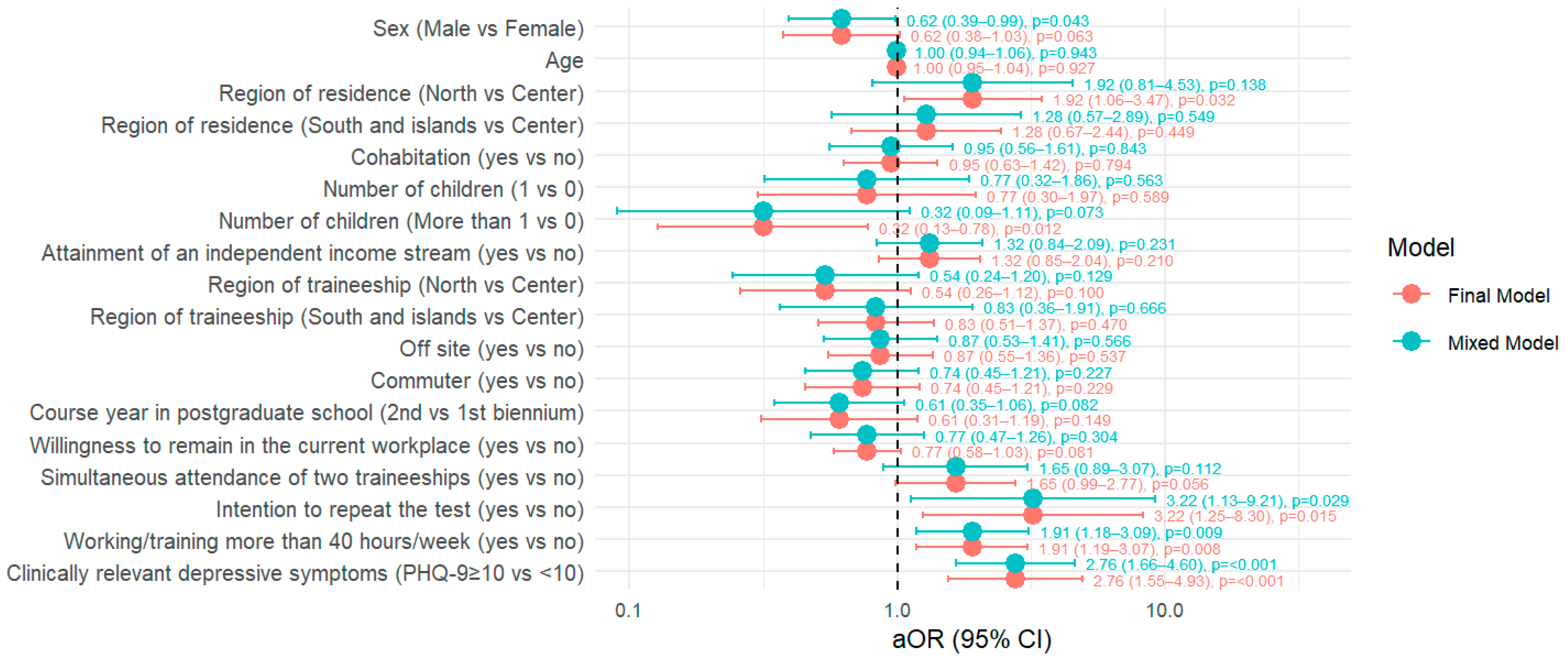
After checking multicollinearity (Supplementary Table S3), the variable ‘having additional employment’ was excluded from the multivariable analysis due to having the highest VIF (91.3 for the model with PHQ-9 ≥ 10 and 90.5 for the model with PHQ-9 ≥ 5) of the independent variables. Multivariable logistic regression final and mixed models with PHQ-9 ≥ 10 are depicted in Figure 1 and Supplementary Table S4. The final model, which is the main focus of this study, shows that subjects with more than one child had lower odds of having possible EDs by nearly 68.0% (aOR = 0.32; 95% IC = 0.13–0.78). On the contrary, being a resident of Northern Italy compared with the Centre (aOR = 1.92; 95% CI = 1.06–3.47), having the intention to repeat the test for another postgraduate course (aOR = 3.22; 95% IC = 1.25–8.3), and working/training more than 40 h per week (aOR = 1.91; 95% IC = 1.19–3.07) was associated with higher odds of possible EDs. Also, clinically relevant depressive symptoms were associated with nearly a three-fold increase in the odds of possible EDs (aOR = 2.76; 95% IC = 1.55–4.93). The mixed model with random intercept confirmed the direction and statistical significance of the previous variables, except for residence in Northern Italy and having more than one child. Moreover, even if sex was a covariate, male subjects had lower odds of having possible EDs by nearly 38.0% (aOR = 0.62; 95% CI = 0.39–0.99). Sensitivity analysis with mild to severe depressive symptoms (Supplementary Table S5) shows that having more than one child was associated with lower odds of possible EDs by nearly 77.0% in both models (aOR = 0.23; 95% CI = 0.1–0.54 for the final model, 95% CI = 0.06–0.83 for the mixed model). On the contrary, working/training more than 40 h per week (aOR = 1.88; 95% CI = 1.17–3.02 for the final, 95% CI = 1.14–3.08 for the mixed), and mild to severe depressive symptoms (aOR = 4.7; 95% CI = 2.75–8.03 for the final, 95% CI = 2.8–7.87 for the mixed) were positively associated with possible EDs. Only the mixed model showed that attending the 2nd biennium of the specialization course was associated with lower odds of EDs by nearly 47.0% (aOR = 0.53; 95% CI = 0.3–0.94).
The final and mixed multivariable logistic regression models with clinically relevant depressive symptoms (PHQ-9 ≥ 10) had an acceptable discriminant ability (AUC = 0.71; 95% CI = 0.65–0.76) and good calibration (χ2 = 8.3; p = 0.40), checked by the Hosmer–Lemeshow test. Considering that with the PHQ-9 ≥ 5, discrimination was fulfilling (AUC = 0.75; 95% CI = 0.70–0.79), whereas calibration was good (χ2 = 13.5; p = 0.095). Although a few data points were found influential, the models did not have extreme outliers.
Modified Poisson regression models, encompassing the two different cut-offs of the PHQ-9 score, were depicted in Supplementary Table S6 (PHQ-9 ≥ 10) and S7 (PHQ-9 ≥ 5). Considering the final model with PHQ-9 ≥ 10, subjects resident in Northern Italy compared to the Centre (aPR = 1.42; 95% CI = 1.02–1.99), simultaneous attendance of two traineeships (aPR = 1.3; 95% = 1–1.67), intention to repeat the test (aPR = 1.8; 95% CI = 1.27–2.55), working/training more than 40 h per week (aPR = 1.41; 95% CI = 1.12–1.79), and clinically relevant depressive symptoms (aPR = 1.68; 95% CI = 1.28–2.22) had a higher PR of positive screening for possible EDs. On the contrary, having more than one child reduced it (aPR = 0.47; 95% CI = 0.24–0.91). The mixed model confirmed the statistical significance of working/training more than 40 h per week and clinically relevant depressive symptoms. The final model with PHQ-9 ≥ 5 shows that simultaneous attendance of two traineeships (aPR = 1.24; 95% = 1–1.52), intention to repeat the test (aPR = 1.53; 95% CI = 1.06–2.21), working/training more than 40 h per week (aPR = 1.37; 95% CI = 1.12–1.66), and mild to severe depressive symptoms (aPR = 2.53; 95% CI = 1.79–3.59) were associated with a higher PR of positive screening for possible EDs. On the contrary, subjects with more than one child had a lower PR (aPR = 0.43; 95% CI = 0.24–0.79). Mild to severe depressive symptoms were the only statistically significant variable in the mixed model. The ratio between deviance and residuals was 0.69 for the final model with PHQ-9 ≥ 10 and 0.65 for the PHQ-9 ≥ 5 one, denoting mild under dispersion.

4. Discussion

4.1. Interpretation of the Main Results

The findings of this study reveal that 40.6% of the PHRs screened positive for possible EDs, of which 47.3% were represented by female subjects aged 30–34 years old, highlighting a substantial prevalence of disordered eating behaviours within this population. Additionally, there was a significant association between depressive symptoms and positive screening for EDs among Italian PHRs during the COVID-19 pandemic (p < 0.001). These results underscore the heightened vulnerability of healthcare professionals in training, who faced exceptional psychological stress during and beyond the acute emergency phases of the COVID-19 pandemic due to increased workloads, role ambiguity, and limited supervision, often performing tasks outside their core competencies. Training pathways were frequently disrupted, with reduced access to mentorship and uncertainty about career progression, contributing to professional dissatisfaction and emotional exhaustion. Additionally, persistent social restrictions and isolation from peer networks further eroded personal coping resources. Although the findings align with previous research suggesting a relationship between depression and EDs, any directionality could not be assessed due to the nature of this study.
Other factors associated with a positive screening included the intention to repeat the test for another postgraduate course and working/training more than 40 h per week. Conversely, having more than one child was associated with lower odds for possible EDs. The final model of multivariable logistic regression showed a significant positive association between residence in Northern Italy compared to the Centre and possible EDs (aOR = 1.92; 95% CI = 1.06–3.47), which was not confirmed by the mixed model (aOR = 1.92; 95% CI = 0.81–4.53). These results may reflect the fact that the COVID-19 pandemic changed the ongoing training programmes of PHRs dramatically, making their attendance more challenging and stressful [41,42]. Furthermore, occupational factors such as working more than 40 h per week were also associated with a higher risk of EDs. Considering the results of the final model, PHRs residing in Northern Italy seemed to have suffered the effects of the COVID-19 pandemic more than others [10,11], showing a higher odds of possible EDs. These findings suggest that work-related stress and the demands of postgraduate training may contribute to maladaptive coping mechanisms, including disordered eating patterns.
The fear of infection (for self, colleagues, family), the pressure of working on “frontline” wards, often under conditions of reduced staffing, together with frequent reassignments or task reallocations, amplified professional uncertainty. The paucity of non-clinical support, the unpredictability of schedules, the curtailment of rest periods, and the compounding of stress for healthcare workers in training due to disruptions to learning and mentoring have all been demonstrated through empirical studies from Italy. Alfonsi et al. surveyed 287 healthcare workers (nurses and physicians) between February and June 2022 [43]. The study found that nurses exhibited a greater deterioration over time in psychological symptoms (anxiety, depression, stress) and sleep quality compared to physicians. Furthermore, the presence of frontline work was identified as an additional risk factor [43]. A multicentre prospective study conducted in Italy revealed that medical residents experienced heightened rates of post-traumatic stress disorder, depression, anxiety, and poor sleep in 2021. The investigation established a strong correlation between these outcomes and work-related changes, including increased working hours, negative alterations in training, and reassignment [44]. Collectively, these findings indicate that, by mid-2022, work stress among healthcare workers in training would be particularly susceptible to overload, uncertainty, isolation, and disrupted training pathways. The long-term pressures during the COVID-19 pandemic, generated by overwhelming workload, led to an exacerbation of mental health disorders among healthcare workers. As a matter of fact, a longitudinal study by Maunder et al. (2024) revealed that burnout during the pandemic had chronic effects on healthcare workers’ mental health [45], leading to the onset of several mental health disorders [46].
Interestingly, certain factors associated with lower odds emerged from the analysis. Respondents with more than one child exhibited a significantly lower likelihood of developing EDs. This result may reflect the stabilizing influence of family responsibilities or stronger social support networks [47]. However, further studies should investigate the role of offspring in preventing EDs among adults, especially healthcare workers.

4.2. Potential Biological Mechanisms

The connection between depression and eating disorders may be explained by several biological pathways. For instance, it is possible that chronic stress and depression may lead to elevated cortisol levels, which could contribute to appetite dysregulation, emotional eating, and changes in body weight [48,49]—key features in various EDs. Additionally, alterations in neurotransmitter systems, particularly serotonin (5-HT), dopamine, and norepinephrine, have been implicated in both depression and EDs [50,51,52,53]. Moreover, recent evidence suggests that inflammatory processes may play a role in the association between mood disorders and eating disorders. In detail, several studies showed high levels of pro-inflammatory markers (e.g., IL-6, TNF-α) in patients affected by both mental disorders. This suggests that an underlying pro-inflammatory profile makes some subjects more vulnerable to the development of depressive symptoms and eating disorders [54,55]. Another notable aspect is hormonal imbalances, particularly involving leptin and ghrelin, which also contribute by disrupting hunger and satiety signals, fostering unhealthy eating behaviours [56]. These interconnected biological pathways, whose mechanisms are only hypothesized in light of the results of this study, highlight the complex relationship between depressive symptoms and EDs. This emphasizes the need for further investigations exploring the bidirectionality of such mental disorders in medical residents and integrating healthcare services and therapeutic approaches.

4.3. Implications for Public Health and Future Directions

The findings of this study have significant implications for public health, particularly concerning the mental well-being of healthcare trainees during times of crisis. The strong association identified between depressive symptoms and EDs among Italian PHRs highlights the urgent need for targeted mental health interventions within healthcare training programmes [17,57,58,59]. Given the heightened vulnerability of healthcare professionals during the COVID-19 pandemic—marked by increased workloads, occupational stress, and social isolation [47,60]—it is critical to implement preventive strategies that address both depressive symptoms and disordered eating behaviours. Occupational medicine should enhance health surveillance on healthcare workers through mental health screenings both at onboarding and annually, using validated tools for depressive symptoms (PHQ-9) and EDs (SCOFF). Early screening for mental health conditions, along with the integration of psychological support services within public health residency programmes, could mitigate the onset of these comorbid conditions and promote overall well-being [61], as well as improve working/training performance [62]. Pathways for subjects with depressive symptoms and EDs should be tailored and reserved through dedicated and more accessible healthcare services, involving a multidisciplinary team of healthcare professionals (for example, psychiatrists, psychologists, occupational doctors, dieticians, and hygienists with expertise in food security). Further investigations into the working hours completed by PHRs and adherence to meal breaks could assess actual compliance with the current regulatory limits, providing sanctions and other restrictive measures for non-compliant employers or university tutors. Furthermore, training programmes should incorporate mental health education and coping strategies as part of their curricula, empowering future public health professionals to manage stress effectively and recognize early signs of psychological distress [63]. Also, professors, tutors, and employers should be included in educational programmes to promote good working practices among PHRs, such as peer-to-peer and supervisor support [47], compliance with legal working hours, and adherence to meal breaks. Respecting the legal working hours means having enough time to prepare meals and ensure conviviality, which represents one of the pillars of the Mediterranean diet [64]. Future research should aim to explore the long-term consequences of depressive symptoms and EDs in healthcare professionals, particularly in the post-pandemic context. Longitudinal studies could provide valuable insights into the persistence of these conditions over time and the effectiveness of various interventions. Additionally, qualitative research may offer a deeper understanding of the personal experiences and coping mechanisms of PHRs facing these challenges.

4.4. Limitations and Strengths

This study presents several limitations that should be considered when interpreting the findings. First, its cross-sectional design precludes any determination of causality and directionality between depressive symptoms and EDs; while a significant association was observed, the temporal relationship between these conditions cannot be established. The convenience sampling due to recruitment using a mailing list, the voluntary nature of participation, and the unknown overall response rate may have resulted in selection and non-responder bias, making the sample not fully representative. It is conceivable that individuals experiencing higher levels of psychological distress may have been more motivated to respond, or, on the contrary, subjects having a higher workload may not have had much available time to complete the survey, or those who had trouble filling out the questionnaire may not have had the possibility to participate in this study. These features may influence the results, leading to either an overestimation of distressed subjects or an underestimation of individuals with excessive workload. Another relevant limiting factor was recruitment using a mailing list. Some PHRs could not participate in this study for several reasons, such as the absence of the PHR’s personal contact in the list, a non-working link, an unstable internet connection, or a diversion of the message to the spam folder. Since participation in this study was totally voluntary, some PHRs might not have had the willingness to complete the questionnaire, likely due to the unrecognized importance of a study like this. Hence, these aspects limit the generalizability of the results to the population of PHRs. Additionally, the convenience sampling from the study population, including Italian PHRs, may restrict the generalizability of the findings to the study population itself, other healthcare professionals, or populations in different cultural or healthcare contexts. As no national database collecting sociodemographic characteristics of PHRs exists, the representativeness of our convenience sample could not be assessed. Given the higher proportion of female subjects screened positively for EDs, an overestimation cannot be excluded. Therefore, the results should be interpreted with caution. As the response rate was modest (23.7%), the achieved convenience sample (n = 379) was slightly lower than the target sample size (n = 384). However, considering a margin of error equal to ±5 [33], the minimal shortfall from the target (n = 5) was unlikely to have significantly influenced the precision of estimates. A post hoc precision showed that the achieved convenience sample had a margin of error equal to ±5.03%, which differed by 0.03% from the target sample size (±5%). Therefore, the impact on the precision of the estimate was negligible, and the achieved convenience sample was acceptable. Given the convenience sampling, the margin of error was calculated as an indicator of internal precision, excluding the population’s representativeness.
Second, the SCOFF questionnaire is a screening tool for possible EDs with a modest internal consistency obtained in this study (α = 0.59). Although this value was lower than the one reported by Pannocchia et al. [30], Cronbach’s α calculated in this convenience sample was higher than the values in other population subgroups, which were below 0.57 [65,66]. It follows that Cronbach’s α depends closely on the number of questions, which reduces as the number of questions decreases [30,67]. Hence, the internal consistency of the SCOFF questionnaire in this study can be considered substantially acceptable, as Leung also underscored [66]. Likely, the third item of the SCOFF questionnaire, having extreme frequencies, might worsen the internal consistency of the screening tool, reducing Cronbach’s α accordingly. It could be hypothesized that the respondents either struggled to manage their body weight or, conversely, successfully maintained it. However, this aspect remained unexplored due to the absence of questions regarding body weight at different timepoints (the current body weight and the previous three months). Using a threshold of ≥2, false positives may not be excluded, potentially inflating prevalence estimates and influencing associations. Furthermore, the reliance on self-reported measures, including the PHQ-9 and SCOFF questionnaires, may introduce reporting bias or social desirability bias, potentially resulting in underreporting or overreporting of symptoms. Moreover, when lowering the PHQ-9 cut-off from 10 (moderate to severe depressive symptoms) to 5 (mild to severe depressive symptoms), the calibration of the logistic regression model was reduced slightly. However, the Hosmer–Lemeshow test did not give evidence of poor fit, with the p-value of both models being above 0.05 (p = 0.40 vs. p = 0.095).
Third, residual confounding cannot be ruled out in this study due to unmeasured variables such as prior ED diagnosis, body mass index, use of psychotropic medication, and intensity of pandemic-related assignments. These unmeasured factors may have influenced the results, limiting the interpretation of the findings. Moreover, 14 out of 379 records with missing data in the variable ‘additional employment contract’ were imputed using the median value. Representing them a proportion of 3.7%, its impact on the binary variable ‘working/training more than 40 h per week’, which was the sum of 38 weekly hours provided by the specialization course and the hours of additional contract, in terms of potential misclassification near the threshold, was minimal.
Despite these limitations, the study has notable strengths. It represents one of the few investigations to examine the association between depressive symptoms and EDs specifically within a population of healthcare professionals in training, offering valuable insights into a group that has been underexplored in the literature. The nationwide scope of the survey and the inclusion of PHRs from various regions of Italy enhance the attempt to obtain a representative interpretation of the sample. Furthermore, the use of validated screening tools (PHQ-9 and SCOFF) strengthens the reliability of the findings. Finally, the study’s focus on the unique context of the COVID-19 pandemic provides timely and relevant data on the mental health challenges faced by healthcare trainees during a global public health crisis, offering critical evidence to inform future interventions and policy measures.

5. Conclusions

This study provides important insights into mental health issues, exploring the association between depressive symptoms and EDs among Italian PHRs during the COVID-19 pandemic. The findings reveal a concerning prevalence of possible EDs with depressive symptoms within this population, with a significant association indicating that residents experiencing clinically relevant depressive symptoms were at higher odds of developing EDs. In addition, residing in Northern Italy compared to Central Italy, the intention to repeat the test for another postgraduate course, and long working hours (≥40 h per week) represented factors with higher odds for EDs, while having more than one child was associated with lower odds. These results underscore the vulnerability of healthcare professionals in training, who face heightened psychological pressures due to demanding workloads, extended working hours, and the emotional toll of frontline public health responsibilities during a global health crisis.

Supplementary Materials

The following supporting information can be downloaded at: https://www.mdpi.com/article/10.3390/psychiatryint7010019/s1. Supplementary Table S1: STROBE Statement—Checklist of items included in this cross-sectional study; Supplementary Table S2: Item-level endorsement frequencies according to the SCOFF (Sick, Control, One, Fat, Food) test. The first uppercase letter of the acronym in each question is bold. Supplementary Figure S1: Prevalence in percentage of screening positivity for eating disorders stratified by sex and age quartiles. SCOFF: Sick, Control, One, Fat, Food; Supplementary Table S3: Variance inflation factor (VIF) to check multicollinearity between independent variables. A VIF value higher than 5 (in bold) indicates the presence of collinearity. The highest value was bold and underlined. VIF was calculated twice (with and without collinear independent variables) for the two models (with the cut-off PHQ-9 of 10 or 5). The presence of a dash in the cell indicates that the variable was excluded from the model; Supplementary Table S4: Univariate analysis and multivariable logistic regression models with robust standard errors and random intercept (mixed model), including mild to severe depressive symptoms (PHQ-9 ≥ 10). Both models (final and mixed) exclude the variable ‘Having an additional employment contract compatible with the medical resident status’ for its highest VIF value. The significant p-value was bold; Supplementary Table S5: Univariate analysis and multivariable logistic regression models with robust standard errors and random intercept (mixed model), including mild to severe depressive symptoms (PHQ-9 ≥ 5). Both models (final and mixed) exclude the variable ‘Having an additional employment contract compatible with the medical resident status’ for its highest VIF value. The significant p-value was bold; Supplementary Table S6: Modified Poisson regression model with robust standard errors and random intercept (mixed model), including clinically relevant depressive symptoms (PHQ-9 ≥ 10). Both models (final and mixed) exclude the variable ‘Having an additional employment contract compatible with the medical resident status’ for its highest VIF value. The significant p-value was bold; Supplementary Table S7: Modified Poisson regression model with robust standard errors and random intercept (mixed model), including mild to severe depressive symptoms (PHQ-9 ≥ 5). Both models (final and mixed) exclude the variable ‘Having an additional employment contract compatible with the medical resident status’ for its highest VIF value. The significant p-value was bold.

Author Contributions

Conceptualization, G.M. and V.G. (Vincenza Gianfredi); methodology, G.M., A.C. and V.G. (Vincenza Gianfredi); software, G.M.; validation, A.C., M.C. and F.C.; formal analysis, G.M. and V.G. (Vincenza Gianfredi); investigation, G.M., A.C., F.C. and V.G. (Vincenza Gianfredi); resources, G.M.; data curation, V.G. (Veronica Gallinoro), V.D.N., F.C. and N.B.; writing—original draft preparation, G.M., V.G. (Veronica Gallinoro), M.C. and V.D.N.; writing—review and editing, G.M., V.G. (Veronica Gallinoro), V.D.N., N.B. and V.G. (Vincenza Gianfredi); visualization, A.C. and F.C.; supervision, V.G. (Vincenza Gianfredi). All authors have read and agreed to the published version of the manuscript.

Funding

This research received no external funding.

Institutional Review Board Statement

Ethical review and approval were waived due to perfectly anonymized and voluntary questionnaires. The survey in this paper was non-interventional, anonymous. The procedure complies with the General Data Protection Regulation (GDPR).

Informed Consent Statement

Although the questionnaire is perfectly anonymous, the protocol states that it will be possible to be completed only after the respondents declare that they understand the methods and purpose of the study and give their consent to the processing of personal data electronically before completing the survey.

Data Availability Statement

Data are available upon reasonable request.

Acknowledgments

This study arises from a scientific collaboration within the 2021/2022 Working Group on Public Mental Health of the Medical Residents’ Assembly of the Italian Society of Hygiene and Preventive Medicine. The authors of this article are all part of this group. We thank the other members of the group who have actively taken part in this project. We thank the Board of the medical residents’ Assembly of the Italian Society of Hygiene and Preventive Medicine for the years 2021/2022, for supporting the design of this survey.

Conflicts of Interest

The authors declare no conflicts of interest.

References

  1. GBD 2019 Mental Disorders Collaborators. Global, Regional, and National Burden of 12 Mental Disorders in 204 Countries and Territories, 1990–2019: A Systematic Analysis for the Global Burden of Disease Study 2019. Lancet Psychiatry 2022, 9, 137–150. [Google Scholar] [CrossRef]
  2. Garcia, S.C.; Mikhail, M.E.; Keel, P.K.; Burt, S.A.; Neale, M.C.; Boker, S.; Klump, K.L. Increased Rates of Eating Disorders and Their Symptoms in Women with Major Depressive Disorder and Anxiety Disorders. Int. J. Eat. Disord. 2020, 53, 1844–1854. [Google Scholar] [CrossRef] [PubMed]
  3. Hudson, J.I.; Hiripi, E.; Pope, H.G., Jr.; Kessler, R.C. The Prevalence and Correlates of Eating Disorders in the National Comorbidity Survey Replication. Biol. Psychiatry 2007, 61, 348–358, Erratum in Biol. Psychiatry 2012, 72, 164. [Google Scholar] [CrossRef] [PubMed]
  4. Swinbourne, J.; Hunt, C.; Abbott, M.; Russell, J.; St Clare, T.; Touyz, S. The Comorbidity between Eating Disorders and Anxiety Disorders: Prevalence in an Eating Disorder Sample and Anxiety Disorder Sample. Aust. N. Z. J. Psychiatry 2012, 46, 118–131. [Google Scholar] [CrossRef] [PubMed]
  5. Casper, R.C. Depression and Eating Disorders. Depress. Anxiety 1998, 8, 96–104. [Google Scholar] [CrossRef]
  6. Puccio, F.; Fuller-Tyszkiewicz, M.; Ong, D.; Krug, I. A Systematic Review and Meta-Analysis on the Longitudinal Relationship between Eating Pathology and Depression. Int. J. Eat. Disord. 2016, 49, 439–454. [Google Scholar] [CrossRef]
  7. Chew, Q.H.; Wei, K.C.; Vasoo, S.; Chua, H.C.; Sim, K. Narrative Synthesis of Psychological and Coping Responses towards Emerging Infectious Disease Outbreaks in the General Population: Practical Considerations for the COVID-19 Pandemic. Singap. Med. J. 2020, 61, 350–356. [Google Scholar] [CrossRef]
  8. Cao, W.; Fang, Z.; Hou, G.; Han, M.; Xu, X.; Dong, J.; Zheng, J. The Psychological Impact of the COVID-19 Epidemic on College Students in China. Psychiatry Res. 2020, 287, 112934. [Google Scholar] [CrossRef]
  9. OECD; European Union. Health at a Glance: Europe 2022: State of Health in the EU Cycle; OECD Publishing: Paris, France, 2022. [Google Scholar]
  10. Parotto, E.; Lamberti-Castronuovo, A.; Censi, V.; Valente, M.; Atzori, A.; Ragazzoni, L. Exploring Italian Healthcare Facilities Response to COVID-19 Pandemic: Lessons Learned from the Italian Response to COVID-19 Initiative. Front. Public Health 2023, 10, 1016649. [Google Scholar] [CrossRef]
  11. Epifanio, M.S.; La Grutta, S.; Piombo, M.A.; Riolo, M.; Spicuzza, V.; Franco, M.; Mancini, G.; De Pascalis, L.; Trombini, E.; Andrei, F. Hopelessness and Burnout in Italian Healthcare Workers during COVID-19 Pandemic: The Mediating Role of Trait Emotional Intelligence. Front. Psychol. 2023, 14, 1146408. [Google Scholar] [CrossRef]
  12. Abati, E.; Nelva Stellio, L.; Manini, A.; Moroni, F.; Azzalini, L.; Vilca, L.M. A Cross-Sectional Survey Study of the Impact of COVID-19 Pandemic on the Training and Quality of Life of Italian Medical Residents in the Lombardy Region. Ann. Med. 2022, 54, 2325–2338. [Google Scholar] [CrossRef]
  13. Lahlou, L.; Ziouziou, I.; Abdelnaby, A.; Kharroubi, A.; Wakrim, S.; Mouhadi, K.; Ajdi, F. Depression and Eating Disorders among Health Care Professionals in Morocco during the COVID-19 Pandemic. Electron. J. Gen. Med. 2022, 19, em387. [Google Scholar] [CrossRef]
  14. Rana, W.; Mukhtar, S.; Mukhtar, S. Mental Health of Medical Workers in Pakistan during the Pandemic COVID-19 Outbreak. Asian J. Psychiatry 2020, 51, 102080. [Google Scholar] [CrossRef] [PubMed]
  15. Schafer, K.M.; Lieberman, A.; Sever, A.C.; Joiner, T. Prevalence Rates of Anxiety, Depressive, and Eating Pathology Symptoms between the Pre- and Peri-COVID-19 Eras: A Meta-Analysis. J. Affect. Disord. 2022, 298, 364–372. [Google Scholar] [CrossRef] [PubMed]
  16. Tanhan, A.; Yavuz, K.F.; Young, J.S.; Nalbant, A.; Arslan, G.; Yıldırım, M.; Ulusoy, S.; Genç, E.; Uğur, E.; Çiçek, İ. A Proposed Framework Based on Literature Review of Online Contextual Mental Health Services to Enhance Wellbeing and Address Psychopathology During COVID-19. Electron. J. Gen. Med. 2020, 17, em254. [Google Scholar] [CrossRef]
  17. Cedrone, F.; Berselli, N.; Stacchini, L.; De Nicolò, V.; Caminiti, M.; Ancona, A.; Minutolo, G.; Mazza, C.; Cosma, C.; Gallinoro, V.; et al. Depressive Symptoms of Public Health Medical Residents during the COVID-19 Pandemic, a Nation-Wide Survey: The PHRASI Study. Int. J. Environ. Res. Public Health 2023, 20, 5620. [Google Scholar] [CrossRef]
  18. von Elm, E.; Altman, D.G.; Egger, M.; Pocock, S.J.; Gøtzsche, P.C.; Vandenbroucke, J.P. The Strengthening the Reporting of Observational Studies in Epidemiology (STROBE) Statement: Guidelines for Reporting Observational Studies. Lancet 2007, 370, 1453–1457. [Google Scholar] [CrossRef]
  19. Catalini, A.; Mazza, C.; Cosma, C.; Minutolo, G.; De Nicolò, V.; Gallinoro, V.; Caminiti, M.; Ancona, A.; Stacchini, L.; Berselli, N.; et al. Public Health Residents’ Anonymous Survey in Italy (PHRASI): Study Protocol for a Cross-Sectional Study for a Multidimensional Assessment of Mental Health and Its Determinants. Int. J. Environ. Res. Public Health 2023, 20, 2003. [Google Scholar] [CrossRef]
  20. Repubblica Italiana. Decreto Legislativo 30 giugno 2003, n. 196. Codice in materia di protezione dei dati personali. In Supplemento Ordinario alla “Gazzetta Ufficiale Della Repubblica Italiana”; Ministero della Giustizia—Ufficio Pubblicazioni leggi e Decreti, Ed.; Serie Generale: Paris, France; Istituto Poligrafico e Zecca dello Stato: Rome, Italy, 2003; Volume 123/L, pp. 11–207. [Google Scholar]
  21. Agenzia Italiana del Farmaco. Determinazione 20 marzo 2008. Linee guida per la classificazione e conduzione degli studi osservazionali sui farmaci. In Gazzetta Ufficiale Della Repubblica Italiana; Ministero della Giustizia—Ufficio Pubblicazioni leggi e Decreti, Ed.; Serie Generale—Parte Prima: Paris, France; Istituto Poligrafico e Zecca dello Stato: Rome, Italy, 2008; Volume 149, pp. 68–74. [Google Scholar]
  22. European Union. Regulation (EU) 2016/679 of the European Parliament and of the Council of 27 April 2016 on the Protection of Natural Persons with Regard to the Processing of Personal Data and on the Free Movement of Such Data, and Repealing Directive 95/46/EC (General Data Protection Regulation) (Text with EEA Relevance). Off. J. Eur. Union 2016, 59, L119/1–L119/88. Available online: https://eur-lex.europa.eu/legal-content/EN/TXT/?uri=OJ:L:2016:119:TOC (accessed on 8 January 2026).
  23. Repubblica Italiana. Decreto Legislativo 10 agosto 2018, n. 101. Disposizioni per l’adeguamento della normativa nazionale alle disposizioni del regolamento (UE) 2016/679 del Parlamento europeo e del Consiglio, del 27 aprile 2016, relativo alla protezione delle persone fisiche con riguardo al trattamento dei dati personali, nonché alla libera circolazione di tali dati e che abroga la direttiva 95/46/CE (regolamento generale sulla protezione dei dati). In Gazzetta Ufficiale Della Repubblica Italiana; Serie Generale: Paris, France; Istituto Poligrafico e Zecca dello Stato: Rome, Italy, 2018; Volume 159, pp. 1–43. [Google Scholar]
  24. Istituto Nazionale di Statistica (ISTAT). Popolazione Residente per Sesso, Età e Stato Civile al 1° Gennaio 2022. Available online: https://demo.istat.it/app/?l=it&a=2022&i=POS (accessed on 14 January 2023).
  25. Repubblica Italiana. Decreto Legislativo 8 aprile 2003, n. 66. Attuazione delle direttive 93/104/CE e 2000/34/CE concernenti taluni aspetti dell’organizzazione dell’orario di lavoro. In Supplemento Ordinario Alla “Gazzetta Ufficiale Della Repubblica Italiana”; Ministero della Giustizia—Ufficio Pubblicazioni leggi e Decreti, Ed.; Serie Generale: Paris, France; Istituto Poligrafico e Zecca dello Stato: Rome, Italy, 2003; Volume 61/L, pp. 68–84. [Google Scholar]
  26. Mazzotti, E.; Fassone, G.; Picardi, A.; Sagoni, E.; Ramieri, L.; Lega, I.; Camaioni, D.; Abeni, D.; Pasquini, P. II Patient Health Questionnaire (PHQ) per Lo Screening Dei Disturbi Psichiatrici. G. Ital. Psicopatol. 2003, 9, 235–242. [Google Scholar]
  27. Kroenke, K.; Spitzer, R.L.; Williams, J.B.W. The PHQ-9: Validity of a Brief Depression Severity Measure. J. Gen. Int. Med. 2001, 16, 606–613. [Google Scholar] [CrossRef]
  28. Manea, L.; Gilbody, S.; McMillan, D. Optimal Cut-off Score for Diagnosing Depression with the Patient Health Questionnaire (PHQ-9): A Meta-Analysis. CMAJ 2012, 184, E191. [Google Scholar] [CrossRef]
  29. Taber, K.S. The Use of Cronbach’s Alpha When Developing and Reporting Research Instruments in Science Education. Res. Sci. Educ. 2018, 48, 1273–1296. [Google Scholar] [CrossRef]
  30. Pannocchia, L.; Di Fiorino, M.; Giannini, M.; Vanderlinden, J. A Psychometric Exploration of an Italian Translation of the SCOFF Questionnaire. Eur. Eat. Disord. Rev. 2011, 19, 371–373. [Google Scholar] [CrossRef]
  31. Rudolph, J.E.; Zhong, Y.; Duggal, P.; Mehta, S.H.; Lau, B. Defining Representativeness of Study Samples in Medical and Population Health Research. BMJ Med. 2023, 2, e000399. [Google Scholar] [CrossRef]
  32. Ahmed, S.K. How to Choose a Sampling Technique and Determine Sample Size for Research: A Simplified Guide for Researchers. Oral Oncol. Rep. 2024, 12, 100662. [Google Scholar] [CrossRef]
  33. Puisa, R.; Montewka, J.; Krata, P. A Framework Estimating the Minimum Sample Size and Margin of Error for Maritime Quantitative Risk Analysis. Reliab. Eng. Syst. Saf. 2023, 235, 109221. [Google Scholar] [CrossRef]
  34. Kim, J.H. Multicollinearity and Misleading Statistical Results. Korean J. Anesth. 2019, 72, 558–569. [Google Scholar] [CrossRef]
  35. Ying, G.-S.; Maguire, M.G.; Glynn, R.J.; Rosner, B. Tutorial on Biostatistics: Receiver-Operating Characteristic (ROC) Analysis for Correlated Eye Data. Ophthalmic Epidemiol. 2022, 29, 117–127. [Google Scholar] [CrossRef]
  36. Hosmer, D.W.; Lemesbow, S. Goodness of Fit Tests for the Multiple Logistic Regression Model. Commun. Stat. Theory Methods 1980, 9, 1043–1069. [Google Scholar] [CrossRef]
  37. Altman, N.; Krzywinski, M. Analyzing Outliers: Influential or Nuisance? Nat. Methods 2016, 13, 281–282. [Google Scholar] [CrossRef] [PubMed]
  38. Costa e Silva, E.; Lopes, I.C.; Correia, A.; Faria, S. A Logistic Regression Model for Consumer Default Risk. J. Appl. Stat. 2020, 47, 2879–2894. [Google Scholar] [CrossRef]
  39. Weichle, T.; Hynes, D.M.; Durazo-Arvizu, R.; Tarlov, E.; Zhang, Q. Impact of Alternative Approaches to Assess Outlying and Influential Observations on Health Care Costs. SpringerPlus 2013, 2, 614. [Google Scholar] [CrossRef] [PubMed]
  40. Feng, C.; Li, L.; Sadeghpour, A. A Comparison of Residual Diagnosis Tools for Diagnosing Regression Models for Count Data. BMC Med. Res. Methodol. 2020, 20, 175. [Google Scholar] [CrossRef]
  41. Chen, S.-Y.; Lo, H.-Y.; Hung, S.-K. What Is the Impact of the COVID-19 Pandemic on Residency Training: A Systematic Review and Analysis. BMC Med. Educ. 2021, 21, 618. [Google Scholar] [CrossRef]
  42. Alam, L.; Alam, M.; Kazmi, S.K.H.; Kazmi, S.A.H. Impact of COVID-19 Pandemic on the Residency Programs of the Country: A Multicentre Study. Pak. J. Med. Sci. 2021, 37, 367–372. [Google Scholar] [CrossRef]
  43. Alfonsi, V.; Scarpelli, S.; Gorgoni, M.; Couyoumdjian, A.; Rosiello, F.; Sandroni, C.; Corsi, R.; Pietrantonio, F.; De Gennaro, L. Healthcare Workers after Two Years of COVID-19: The Consequences of the Pandemic on Psychological Health and Sleep among Nurses and Physicians. Int. J. Environ. Res. Public Health 2023, 20, 1410. [Google Scholar] [CrossRef]
  44. Lo Moro, G.; Giacomini, G.; Scaioli, G.; Acuti Martellucci, C.; Alba, D.; Brunelli, L.; Brusaferro, S.; Flacco, M.E.; Mazzucco, W.; Fronticelli Baldelli, L.; et al. Pandemic Impact on Training and Mental Health of Medical Residents: An Italian Multicentre Prospective Study. Ann. Ist. Super. Sanita 2024, 60, 283–293. [Google Scholar] [CrossRef]
  45. Maunder, R.G.; Heeney, N.D.; Jeffs, L.P.; Wiesenfeld, L.A.; Hunter, J.J. A Longitudinal Study of Hospital Workers’ Mental Health from Fall 2020 to the End of the COVID-19 Pandemic in 2023. Sci. Rep. 2024, 14, 26137. [Google Scholar] [CrossRef]
  46. Gu, M.; Wang, S.; Zhang, S.; Song, S.; Gu, J.; Shi, Y.; Li, W.; Chen, L.; Liang, Y.; Yang, Y.; et al. The Interplay among Burnout, and Symptoms of Depression, Anxiety, and Stress in Chinese Clinical Therapists. Sci. Rep. 2024, 14, 25461. [Google Scholar] [CrossRef]
  47. Stacchini, L.; Catalini, A.; De Nicolò, V.; Cosma, C.; Gallinoro, V.; Ancona, A.; Berselli, N.; Caminiti, M.; Mazza, C.; Minutolo, G.; et al. Social Network Characteristics and Depressive Symptoms of Italian Public Health Medical Residents: The Public Health Residents’ Anonymous Survey in Italy (PHRASI). Behav. Sci. 2023, 13, 881. [Google Scholar] [CrossRef]
  48. Nucci, D.; Santangelo, O.E.; Provenzano, S.; Nardi, M.; Firenze, A.; Gianfredi, V. Altered Food Behavior and Cancer: A Systematic Review of the Literature. Int. J. Environ. Res. Public Health 2022, 19, 10299. [Google Scholar] [CrossRef] [PubMed]
  49. Rutters, F.; La Fleur, S.; Lemmens, S.; Born, J.; Martens, M.; Adam, T. The Hypothalamic-Pituitary-Adrenal Axis, Obesity, and Chronic Stress Exposure: Foods and HPA Axis. Curr. Obes. Rep. 2012, 1, 199–207. [Google Scholar] [CrossRef]
  50. Bao, A.-M.; Swaab, D.F. The Human Hypothalamus in Mood Disorders: The HPA Axis in the Center. IBRO Rep. 2019, 6, 45–53. [Google Scholar] [CrossRef] [PubMed]
  51. Steiger, H. Eating Disorders and the Serotonin Connection: State, Trait and Developmental Effects. J. Psychiatry Neurosci. 2004, 29, 20–29. [Google Scholar]
  52. Pitchumoni, C.S.; Chaudhari, R. Anorexia, Appetite, Hunger, and Satiety in Older Adults. In Geriatric Gastroenterology; Pitchumoni, C.S., Dharmarajan, T.S., Eds.; Springer International Publishing: Cham, Switzerland, 2021; pp. 411–438. ISBN 978-3-030-30192-7. [Google Scholar]
  53. Telzer, E.H. Dopaminergic Reward Sensitivity Can Promote Adolescent Health: A New Perspective on the Mechanism of Ventral Striatum Activation. Dev. Cogn. Neurosci. 2016, 17, 57–67. [Google Scholar] [CrossRef]
  54. Elgellaie, A.; Thomas, S.J.; Kaelle, J.; Bartschi, J.; Larkin, T. Pro-Inflammatory Cytokines IL-1α, IL-6 and TNF-α in Major Depressive Disorder: Sex-Specific Associations with Psychological Symptoms. Eur. J. Neurosci. 2023, 57, 1913–1928. [Google Scholar] [CrossRef]
  55. Maunder, R.G.; Heeney, N.D.; Hunter, J.J.; Strudwick, G.; Jeffs, L.P.; Ginty, L.; Johnstone, J.; Kiss, A.; Loftus, C.A.; Wiesenfeld, L.A. Trends in Burnout and Psychological Distress in Hospital Staff over 12 Months of the COVID-19 Pandemic: A Prospective Longitudinal Survey. J. Occup. Med. Toxicol. 2022, 17, 11. [Google Scholar] [CrossRef]
  56. Yeung, A.Y.; Tadi, P. Physiology, Obesity Neurohormonal Appetite and Satiety Control. In StatPearls; StatPearls Publishing: Treasure Island, FL, USA, 2025. [Google Scholar]
  57. Caminiti, M.; Cedrone, F.; Stacchini, L.; Gianfredi, V.; Minutolo, G.; Berselli, N.; Sabato, M.; De Nicolò, V.; Ancona, A.; Catalini, A. Focus on Residents’ Mental Health: The Public Health Residents’ Anonymous Survey in Italy (PHRASI). Eur. J. Public Health 2024, 34, ckae144.2261. [Google Scholar] [CrossRef]
  58. Catalini, A.; Stacchini, L.; Minutolo, G.; Ancona, A.; Caminiti, M.; Cosma, C.; Gallinoro, V.; De Nicolò, V.; Cedrone, F.; Barbadoro, P.; et al. Workload Is Associated with Anxiety and Insomnia Symptoms in an Italian Nationally Representative Sample of Public Health Medical Residents: The PHRASI Cross-Sectional Study. Healthcare 2024, 12, 2299. [Google Scholar] [CrossRef]
  59. Gianfredi, V.; Stacchini, L.; Minutolo, G.; De Nicolò, V.; Berselli, N.; Ancona, A.; Catalini, A.; Cedrone, F. Impacts of Unhealthy Behaviors on Mental Health among Public Health Residents: The PHRASI Study. Diseases 2024, 12, 134. [Google Scholar] [CrossRef]
  60. Catalini, A.; Minutolo, G.; Caminiti, M.; Ancona, A.; Cosma, C.; Gallinoro, V.; Gianfredi, V. Physical Activity and Sedentary Behavior on Well-Being and Self-Rated Health of Italian Public Health Medical Residents During the COVID-19 Pandemic: The PHRASI Study. Sports 2024, 12, 332. [Google Scholar] [CrossRef]
  61. Castillo, E.G.; Ijadi-Maghsoodi, R.; Shadravan, S.; Moore, E.; Mensah, M.O.; Docherty, M.; Aguilera Nunez, M.G.; Barcelo, N.; Goodsmith, N.; Halpin, L.E.; et al. Community Interventions to Promote Mental Health and Social Equity. Curr. Psychiatry Rep. 2019, 21, 35. [Google Scholar] [CrossRef] [PubMed]
  62. Waddell, A.; Kunstler, B.; Lennox, A.; Pattuwage, L.; Grundy, E.A.; Tsering, D.; Olivier, P.; Bragge, P. How Effective Are Interventions in Optimizing Workplace Mental Health and Well-Being? A Scoping Review of Reviews and Evidence Map. Scand. J. Work Environ. Health 2023, 49, 235–248. [Google Scholar] [CrossRef]
  63. Wiedermann, C.J.; Barbieri, V.; Plagg, B.; Marino, P.; Piccoliori, G.; Engl, A. Fortifying the Foundations: A Comprehensive Approach to Enhancing Mental Health Support in Educational Policies Amidst Crises. Healthcare 2023, 11, 1423. [Google Scholar] [CrossRef]
  64. Sofi, F.; Martini, D.; Angelino, D.; Cairella, G.; Campanozzi, A.; Danesi, F.; Dinu, M.; Erba, D.; Iacoviello, L.; Pellegrini, N.; et al. Mediterranean Diet: Why a New Pyramid? An Updated Representation of the Traditional Mediterranean Diet by the Italian Society of Human Nutrition (SINU). Nutr. Metab. Cardiovasc. Dis. 2025, 35, 103919. [Google Scholar] [CrossRef]
  65. Wan Wahida, W.M.Z.; Lai, P.S.M.; Abdul Hadi, H. Validity and Reliability of the English Version of the Sick, Control, One Stone, Fat, Food (SCOFF) in Malaysia. Clin. Nutr. ESPEN 2017, 18, 55–58. [Google Scholar] [CrossRef] [PubMed]
  66. Leung, S.F.; Lee, K.L.; Lee, S.M.; Leung, S.C.; Hung, W.S.; Lee, W.L.; Leung, Y.Y.; Li, M.W.; Tse, T.K.; Wong, H.K.; et al. Psychometric Properties of the SCOFF Questionnaire (Chinese Version) for Screening Eating Disorders in Hong Kong Secondary School Students: A Cross-Sectional Study. Int. J. Nurs. Stud. 2009, 46, 239–247. [Google Scholar] [CrossRef]
  67. Tavakol, M.; Dennick, R. Making Sense of Cronbach’s Alpha. Int. J. Med. Educ. 2011, 2, 53–55. [Google Scholar] [CrossRef] [PubMed]
Figure 1. Multivariable logistic regression final (dot and line in red) and mixed (dot and line in green) models (SCOFF ≥ 2). The final model is the main model of this study. Both models (final and mixed) exclude the variable ‘Having an additional employment contract compatible with the medical resident status’ for its highest VIF value.
Psychiatryint 07 00019 g001
Table 1. The PHRs’ characteristics (socioeconomic, occupational, and mental) related to eating disorders. Statistically significant results have p-values in bold.
Independent Variables Dependent Variablep-Value 2
Total [17]No Positive Screening for Possible Eating Disorders
(SCOFF < 2)
N = 225
(59.4%) 1
Positive Screening for Possible Eating Disorders
(SCOFF ≥ 2)
N = 154
(40.6%) 1
Socioeconomic characteristics
Age30 (29–34)30 (29–34)30 (29–33)0.700
Sex 0.090
Female219 (57.8%)122 (54.2%)97 (63.0%)
Male160 (42.2%)103 (45.8%)57 (37.0%)
Region of residence 0.800
  North157 (41.4%)90 (40.0%)67 (43.5%)
  Centre96 (25.3%)59 (26.2%)37 (24.0%)
  South and islands126 (33.2%)76 (33.8%)50 (32.5%)
Cohabitation >0.900
  No281 (74.1%)167 (74.2%)114 (74.0%)
  Yes98 (25.9%)58 (25.8%)40 (26.0%)
Number of children 0.140
  0327 (86.3%)189 (84.0%)138 (89.6%)
  132 (8.4%)20 (8.9%)12 (7.8%)
  More than 120 (5.3%)16 (7.1%)4 (2.6%)
Attainment of an independent income stream 0.100
No162 (42.7%)104 (46.2%)58 (37.7%)
Yes217 (57.3%)121 (53.8%)96 (62.3%)
Working/traineeship characteristics
Region of traineeship 0.900
  North178 (47.0%)107 (47.5%)71 (46.1%)
  Centre113 (29.8%)65 (28.9%)48 (31.2%)
  South and islands88 (23.2%)53 (23.6%)35 (22.7%)
Off-site 0.900
  No211 (55.7%)126 (56.0%)85 (55.2%)
  Yes168 (44.3%)99 (44.0%)69 (44.8%)
Commuter 0.600
  No258 (68.1%)151 (67.1%)107 (69.5%)
  Yes121 (31.9%)74 (32.9%)47 (30.5%)
Course year in the postgraduate school 0.300
  1st biennium292 (77.0%)169 (75.1%)123 (79.9%)
  2nd biennium87 (23.0%)56 (24.9%)31 (20.1%)
Willingness to remain in the current workplace place after the postgraduate course 0.041
  No125 (33.0%)65 (28.9%)60 (39.0%)
  Yes254 (67.0%)160 (71.1%)94 (61.0%)
Simultaneous attendance of two traineeships 0.062
  No321 (84.7%)197 (87.6%)124 (80.5%)
  Yes58 (15.3%)28 (12.4%)30 (19.5%)
Intention to repeat the test for another postgraduate course 0.200
  No361 (95.3%)218 (96.9%)143 (92.9%)
  Yes18 (4.7%)7 (3.1%)11 (7.1%)
Having an additional employment contract compatible with the medical resident status 0.024
  No242 (63.9%)154 (68.4%)88 (57.1%)
  Yes137 (36.1%)71 (31.6%)66 (42.9%)
Working/training more than 40 h per week § 0.034
  No243 (64.1%)154 (68.4%)89 (57.8%)
  Yes136 (35.9%)71 (31.6%)65 (42.2%)
Depressive symptoms
Clinically relevant depressive symptoms <0.001
  PHQ-9 < 10282 (74.4%)186 (82.7%)96 (62.3%)
  PHQ-9 ≥ 1097 (25.6%)39 (17.3%)58 (37.7%)
Mild to severe depressive symptoms <0.001
PHQ-9 < 5148 (39.1%)118 (52.4%)30 (19.5%)
PHQ-9 ≥ 5231 (60.9%)107 (47.6%)124 (80.5%)
1 n (%) for qualitative variable or median (IQR) for the quantitative. 2 U Mann–Whitney test; Pearson’s Chi-squared or Fisher’s exact test. IQR = Interquartile range; SCOFF = Sick, Control, One, Fat, Food; PHQ-9 = Patient Health Questionnaire 9. § Missing values in the continuous variable working/training hours (derived from the sum of 38 h-training programme and the number of hours provided by the additional working contract), being non-normal distributed, were imputed choosing the median.
Disclaimer/Publisher’s Note: The statements, opinions and data contained in all publications are solely those of the individual author(s) and contributor(s) and not of MDPI and/or the editor(s). MDPI and/or the editor(s) disclaim responsibility for any injury to people or property resulting from any ideas, methods, instructions or products referred to in the content.