Article

Immersive Journalism and the Shift to the Metaverse: A Bibliometric and NLP Analysis with Projections to 2030


by
Hüseyin Köse
1 and
Bahar Balcı Aydoğan
2,*
1
Department of Journalism, Faculty of Communication, Atatürk University, Erzurum 25000, Turkey
2
Ula Ali Koçman Vocational School, Muğla Sıtkı Koçman University, Muğla 48000, Turkey
*
Author to whom correspondence should be addressed.
Journal. Media 2026, 7(3), 193; https://doi.org/10.3390/journalmedia7030193 (registering DOI)

Submission received: 13 August 2026 / Revised: 14 September 2026 / Accepted: 15 September 2026 / Published: 19 September 2026

Abstract

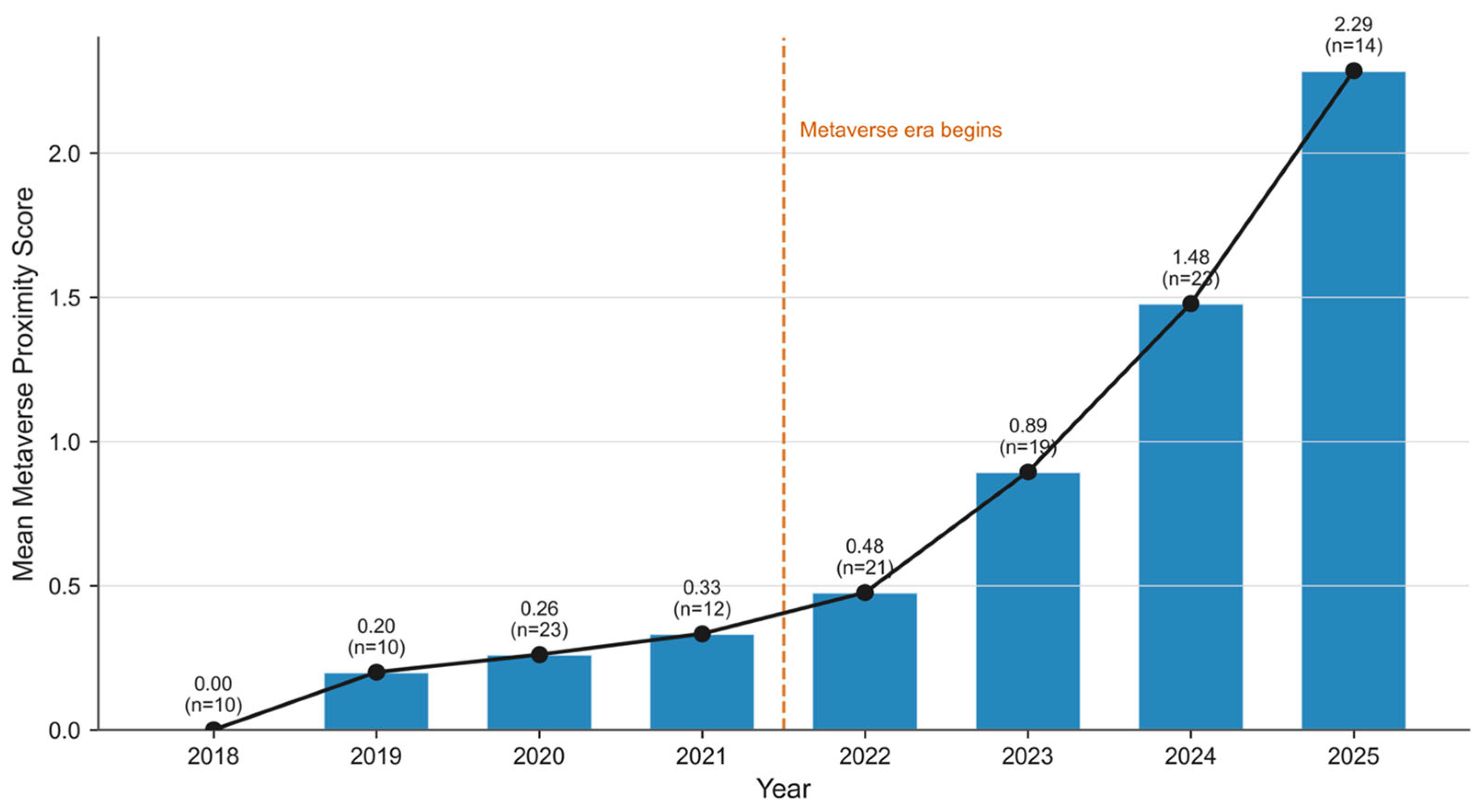
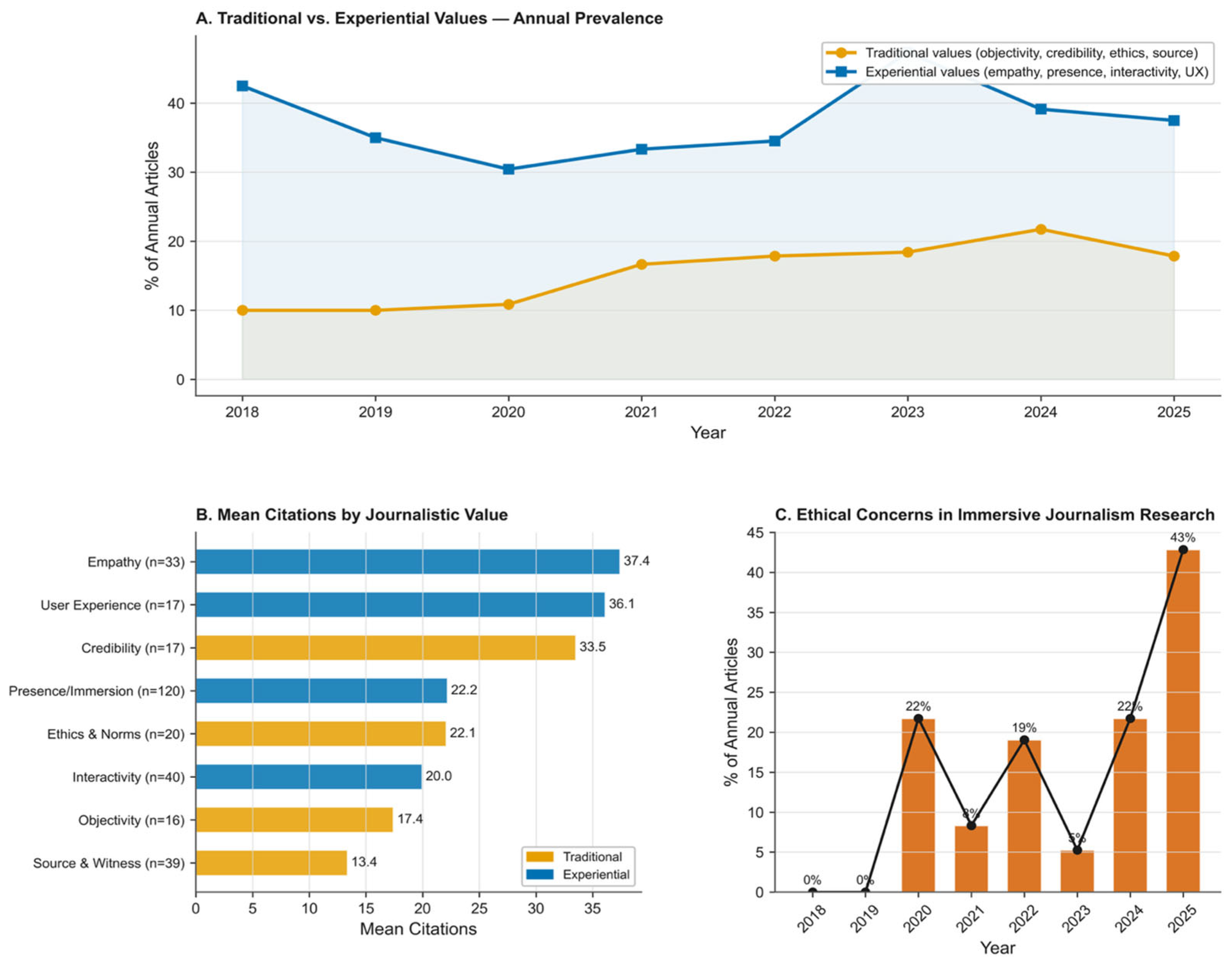
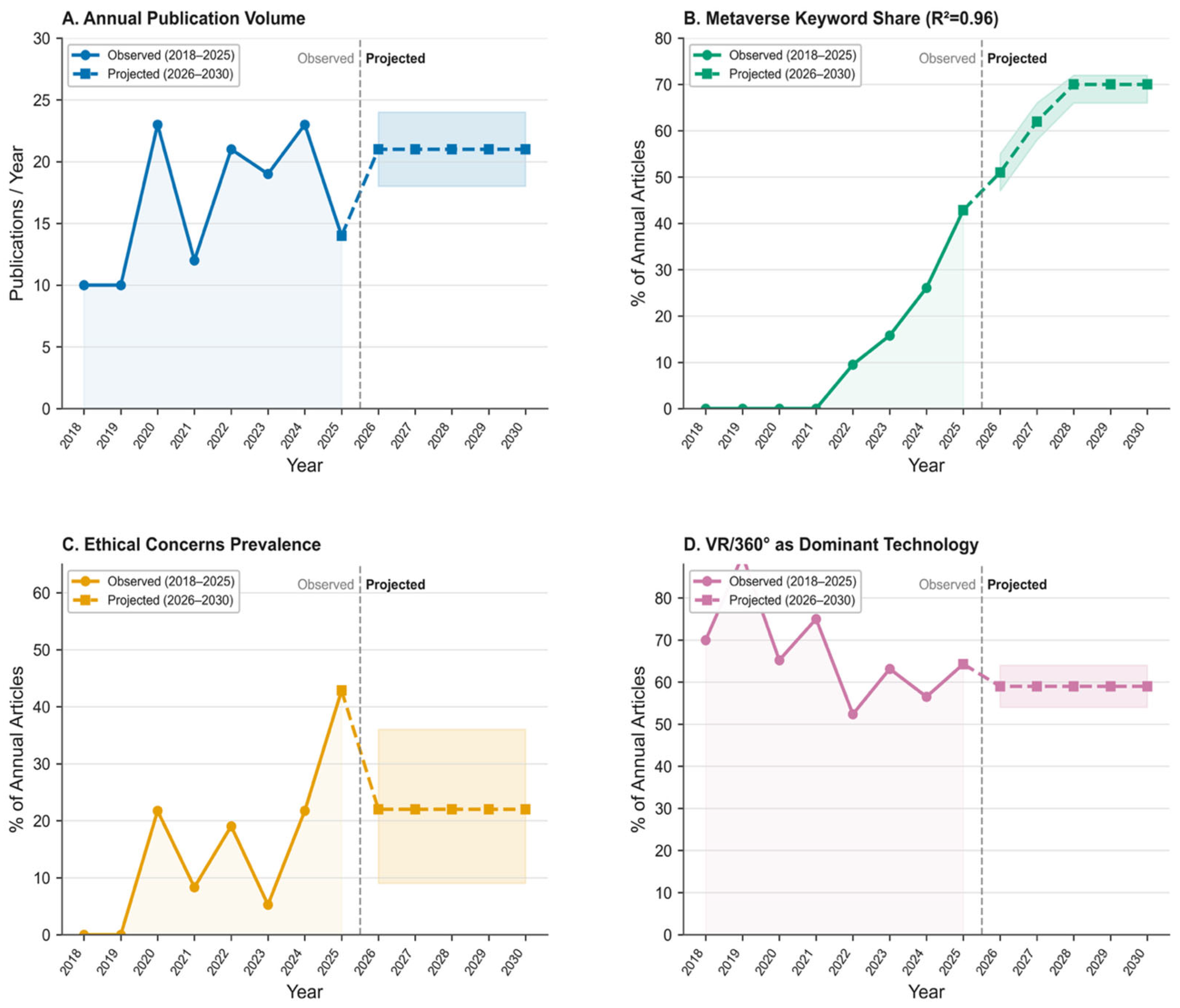
Immersive journalism—a practice that situates audiences within news events through VR, AR, and 360-degree video—has developed steadily since the mid-2000s. Yet how metaverse discourse has reshaped the field’s research agenda remains unclear, as existing bibliometric studies remain descriptive, tracking publication counts without examining whether the metaverse label reflects a conceptual shift or merely a trend. This study addresses that gap using bibliometric and NLP analysis of 143 Scopus-indexed publications (2005–2026). First, the Metaverse Proximity Score, introduced here, shows metaverse-proximate terminology increased nearly fivefold in mean score between 2022 and 2025 (0.48 to 2.29). Second, although empathy-focused studies attract the highest mean citation count (37.4), their share peaked in 2023 (42.1%) before falling sharply to 21.4% by 2025; this “empathy paradox” shows that citation impact and thematic visibility diverge. Third, discussions of trust and disinformation rose markedly over the sample period, reaching their highest share by 2025, though this estimate rests on a small subsample (n = 14) and should be read as directional rather than precise. Projections to 2030 suggest a plausible scenario in which publication volume stabilizes while metaverse-related themes continue to gain influence, suggesting the field may be moving beyond its technology-driven origins toward an agenda shaped by ethical and normative concerns.
Keywords: virtual reality; augmented reality; 360-degree video; empathy paradox; Metaverse Proximity Score; journalistic values; science mapping; natural language processing virtual reality; augmented reality; 360-degree video; empathy paradox; Metaverse Proximity Score; journalistic values; science mapping; natural language processing